Idea Statica
  • Steel
  • Concrete
  • BIM & Workflows
  • Support & Learning
  • Pricing
  • Company
  • Steel overview
  • Connection design
  • Member design
  • Parametric design
  • Steel case studies
  • Concrete overview
  • Walls and D-regions
  • Anchoring design
  • Concrete case studies
  • BIM Overview
  • Supported integrations
  • Checkbot
  • Viewer
  • APIs
  • Support Center
  • E-learning & certification
  • Blog
  • Downloads & Licensing
  • Plans
  • Free community tool
  • Enterprise customers
  • Students & educators
  • How much will you save?
  • About us
  • Contact
  • Research & development
  • Authorized resellers
  • Meet our customers
  • Career
  • Steel
    Steel overviewConnection designMember designParametric designSteel case studies
  • Concrete
    Concrete overviewWalls and D-regionsAnchoring designConcrete case studies
  • BIM & Workflows
    BIM OverviewSupported integrationsCheckbotViewerAPIs
  • Support & Learning
    Support CenterE-learning & certificationBlogDownloads & Licensing
  • Pricing
    PlansFree community toolEnterprise customersStudents & educatorsHow much will you save?
  • Company
    About usContactResearch & developmentAuthorized resellersMeet our customersCareer
14-Day Trial
14-Day Trial

Subscribe to our newsletter

Company

  • About us
  • Partners
  • Careers
  • Patent

Resources

  • Customer projects
  • Case studies
  • Connection Library
  • Verification books

Legal

  • EULA
  • Global privacy policy
  • California Privacy
  • TOS Viewer
  • Licensing

Help

  • Contact
  • Quote request
  • Resellers
  • Downloads
FacebookInstagramLinkedInYouTube

Ā© IDEA StatiCa 2009-2026

Trusted and used worldwide by engineers, fabricators & consultants.

Support CenterKnowledge Base ArticlesShear in RCS - circular cross-sections
ULS results in RCS - Capacity N-M-M, Shear, Torsion, Interaction, Response N-M-M
SLS results in RCS - Stress Limitation, Crack Width, Detailing
Limited interaction check in Beam and RCS
Improvement of interaction check
Crack width check of cross-sections with a large concrete cover
Fatigue check
Shear in RCS - circular cross-sections
How to set the lever arm properly
Accurate calculation of the shear resistance of slabs
Shear in RCS - circular section
ConcreteReinforced concreteKnowledge baseRCSEN (Eurocode)

Shear in RCS - circular cross-sections

This article is also available in
ENCZDEESFRITPTNLHUROKRPLTHTRVIZH

In this article, we will introduce the reduction factor χ which is meant to account for the reduced effectiveness of shear reinforcement in circular cross-sections.

To begin with, let us recall the directions of shear stress in a circular cross-section.Ā 

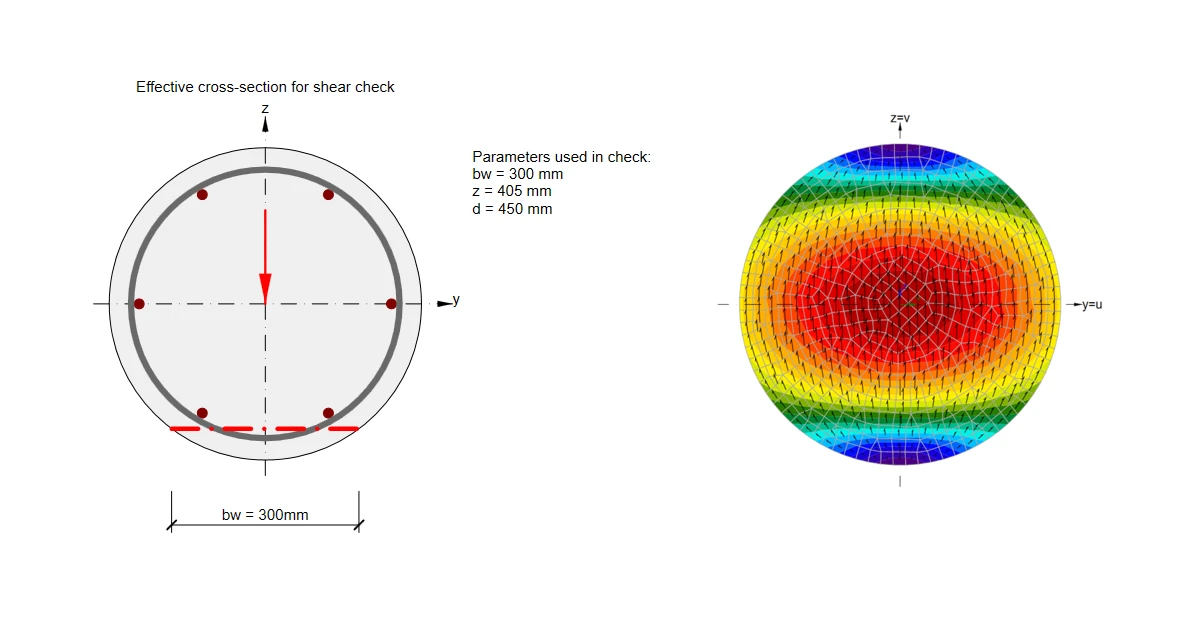
Shear stresses for an uncracked solid circular cross-section have a vertical direction and are assumed to be constant through the width b. If flexural cracking occurs in the section the vertical shear stress distribution will be modified. A sketch of such shear stress distributions can be found in the following figure.
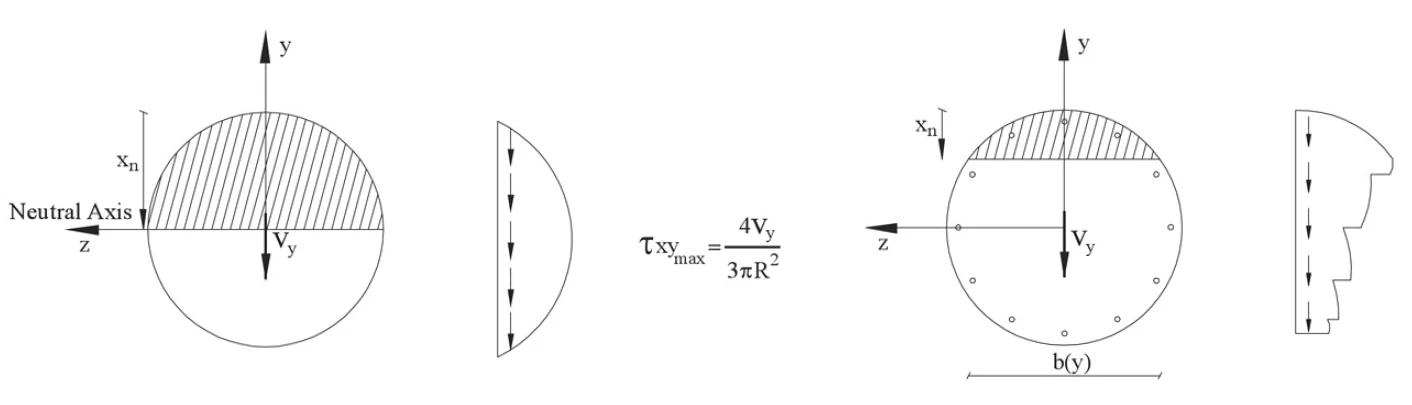
For determining shear stresses on closed thin-walled members, it is assumed that the shear stresses are uniformly distributed over the entire thickness t of the wall and act parallel to the section boundaries.

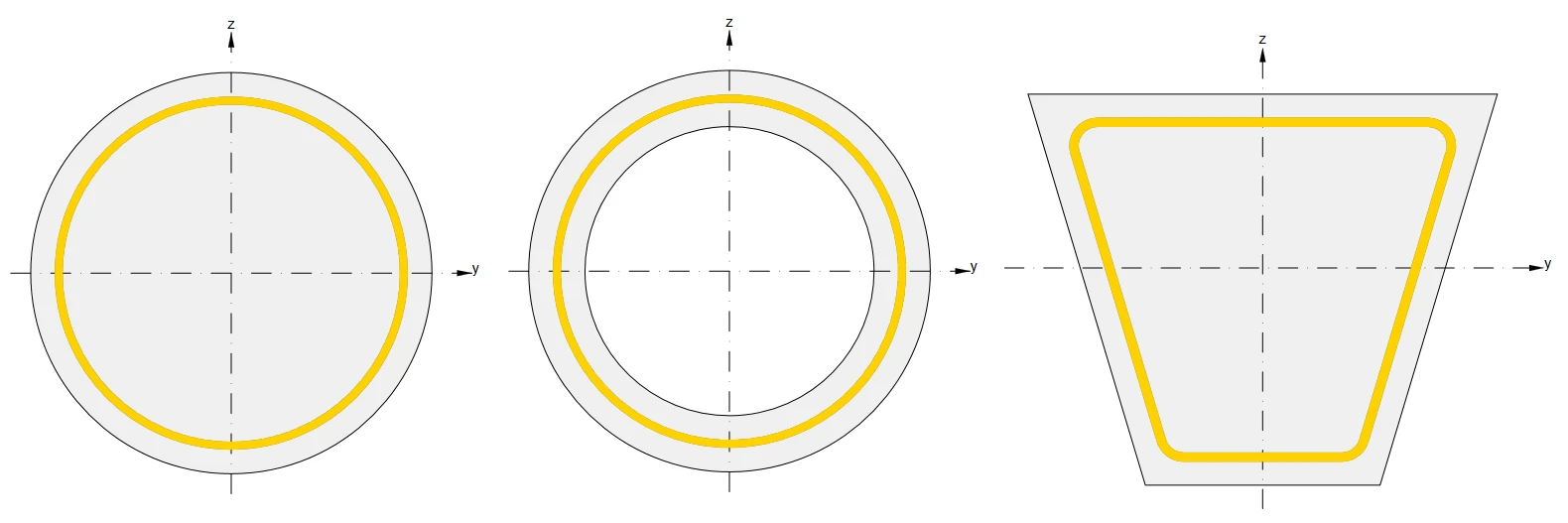
These assumptions can be verified by FEA analysis of the cross-sections. In the following figure, we can see the results of the FEA analysis for three types of cross-section - solid circular section, hollowed circular section, and trapezoidal section. The calculations were done in the General cross-section editor tool. Shear stresses caused by unit shear force Vv are displayed including arrows of the flow of stress.
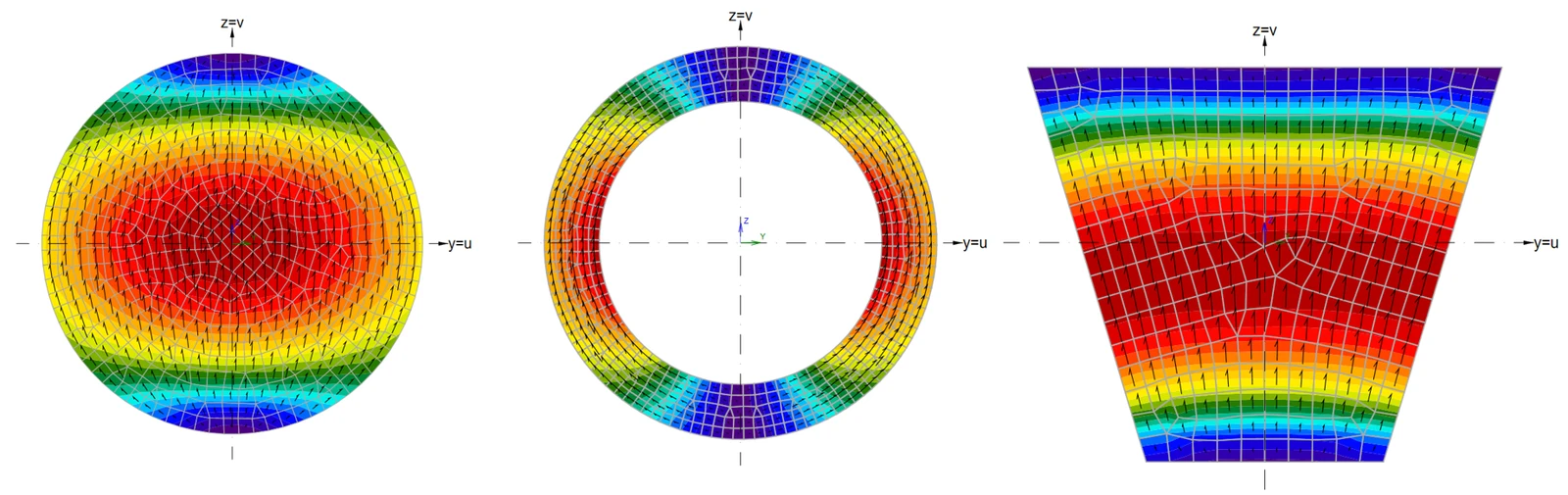
Let's consider stirrups equidistant to the cross-sectional edges, as shown in the figure below.Ā 

We can notice that the shear stress flow in the solid circular section does not follow the stirrup geometry causing reduced effectivity of shear reinforcement. This effect is taken into account by the reduction factor χ, which influences the shear resistance VRd,s.
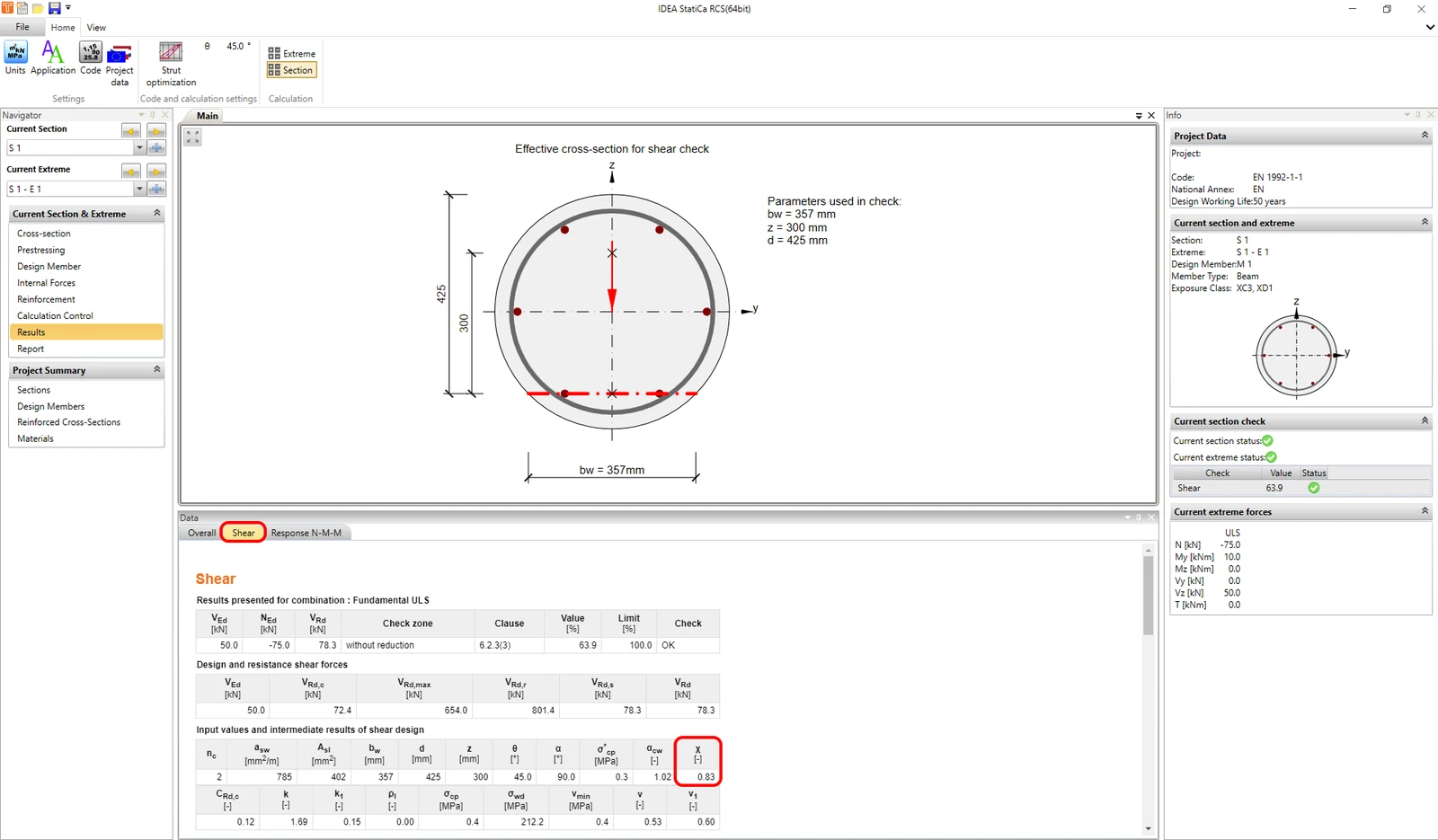
In IDEA StatiCa RCS, the reduction factor is calculated according to the following formula.

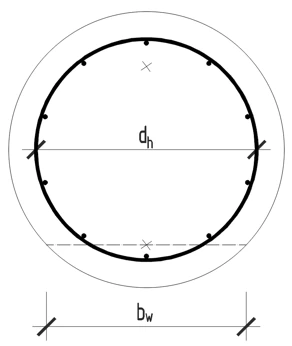
χ=bw/dh≤0.85{χ}={{b}_{w}} / {{d}_{h}}\le 0.85χ=bw​/dh​≤0.85

Where the bw is the shear width and dh is the diameter of the circular stirrup.Ā 

The shear width bw is calculated in several ways.

1. Method

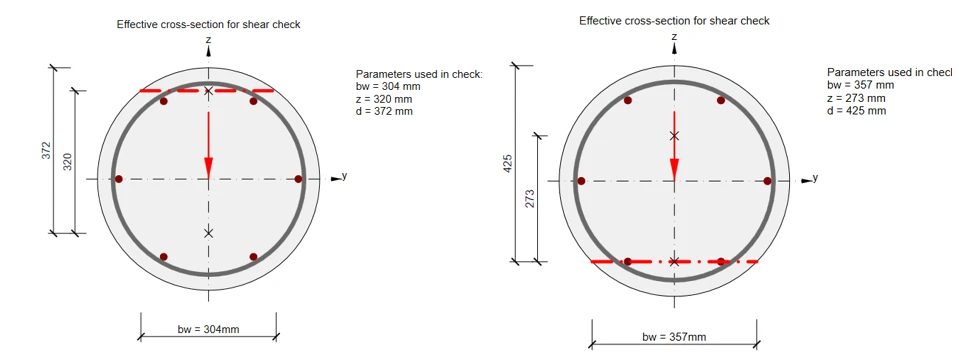
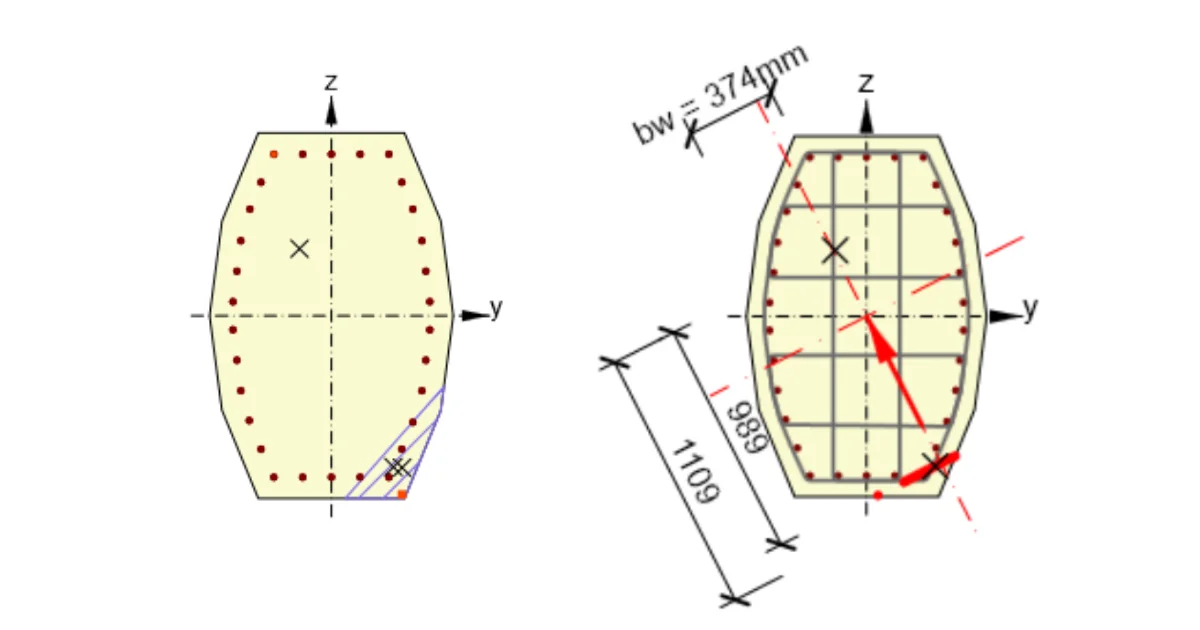
The shear width bw is calculated as the minimum width between tension and compression chords in case of the occurrence of flexural cracks in ULS. It can be seen in two examples of a circular section in the following figure.
2. Method

If the status without flexural cracks is neglected - see the figure:
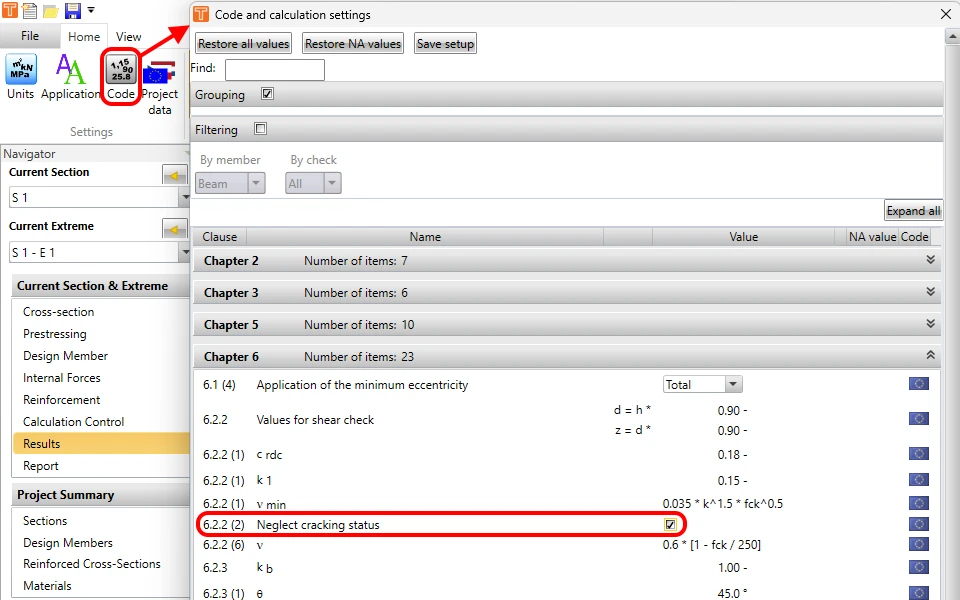
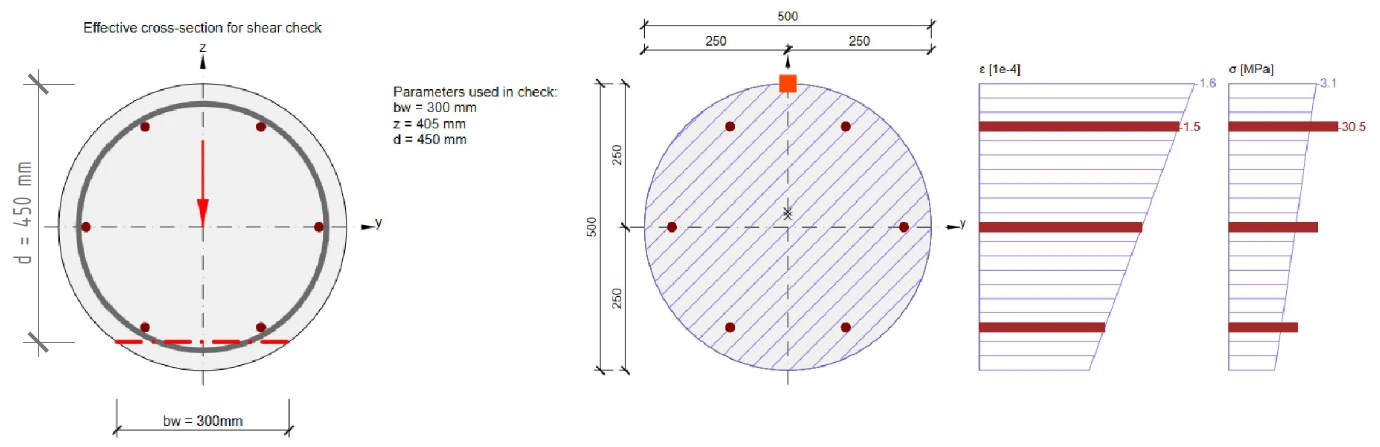
And if there is no tension or compression chord in the cross-section (the whole section is under the compression or tension), Ā bw is the width of the cross-section at distance d from the edge of the cross-section. Where d is the effective depth and is calculated as d=0.9*h for sections without tension or compression chord (fully compressed or fully tensioned).
3. Method

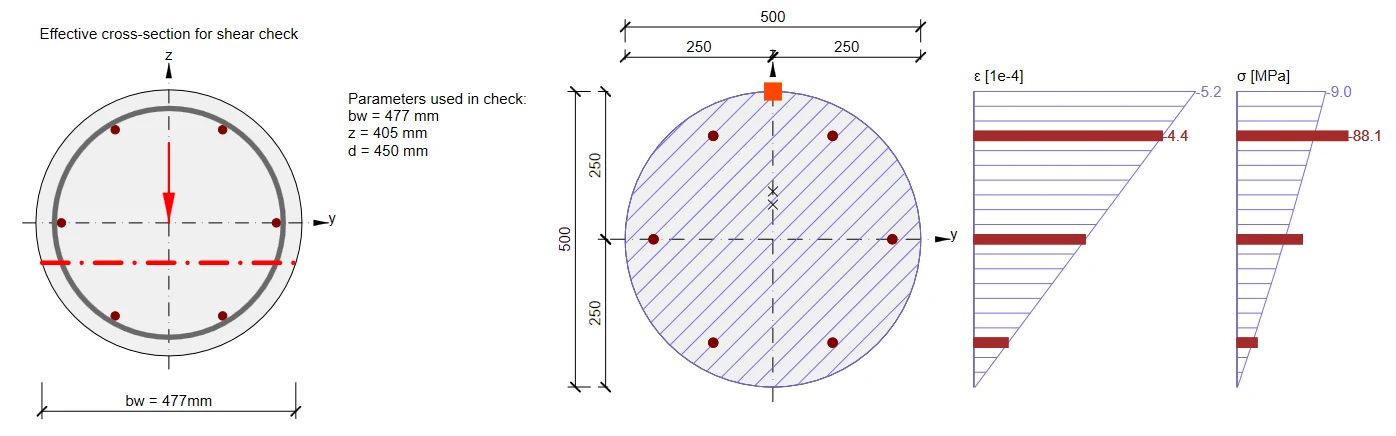
If the status without flexural cracks is considered (according to EN 1992-1-1 6.2.2(2)) and the cross-section is not affected by flexural cracks in ULS. The value of bw is calculated at the level of the maximal principal tension stress.
4. Method

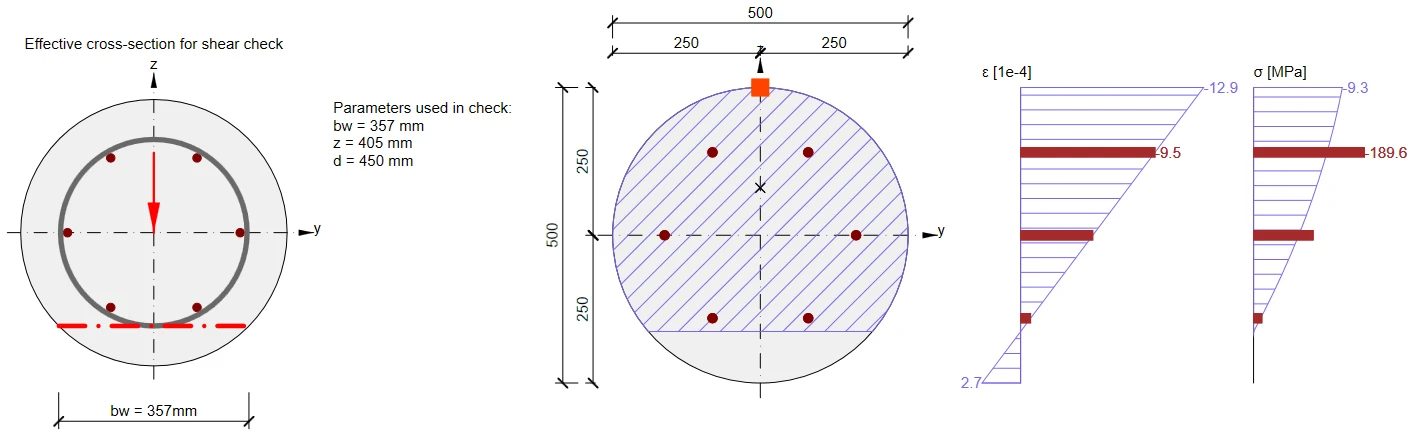
A cross-section that is affected by flexural cracks but only the compression chord or only the tension chord exists - the area for which the program looking for the smallest value of bw is bounded on one side by the existing centre of gravity of the concrete in compression (or the centre of gravity of the reinforcement in tension), the other side of the area is defined by the shear reinforcement.
5. Method

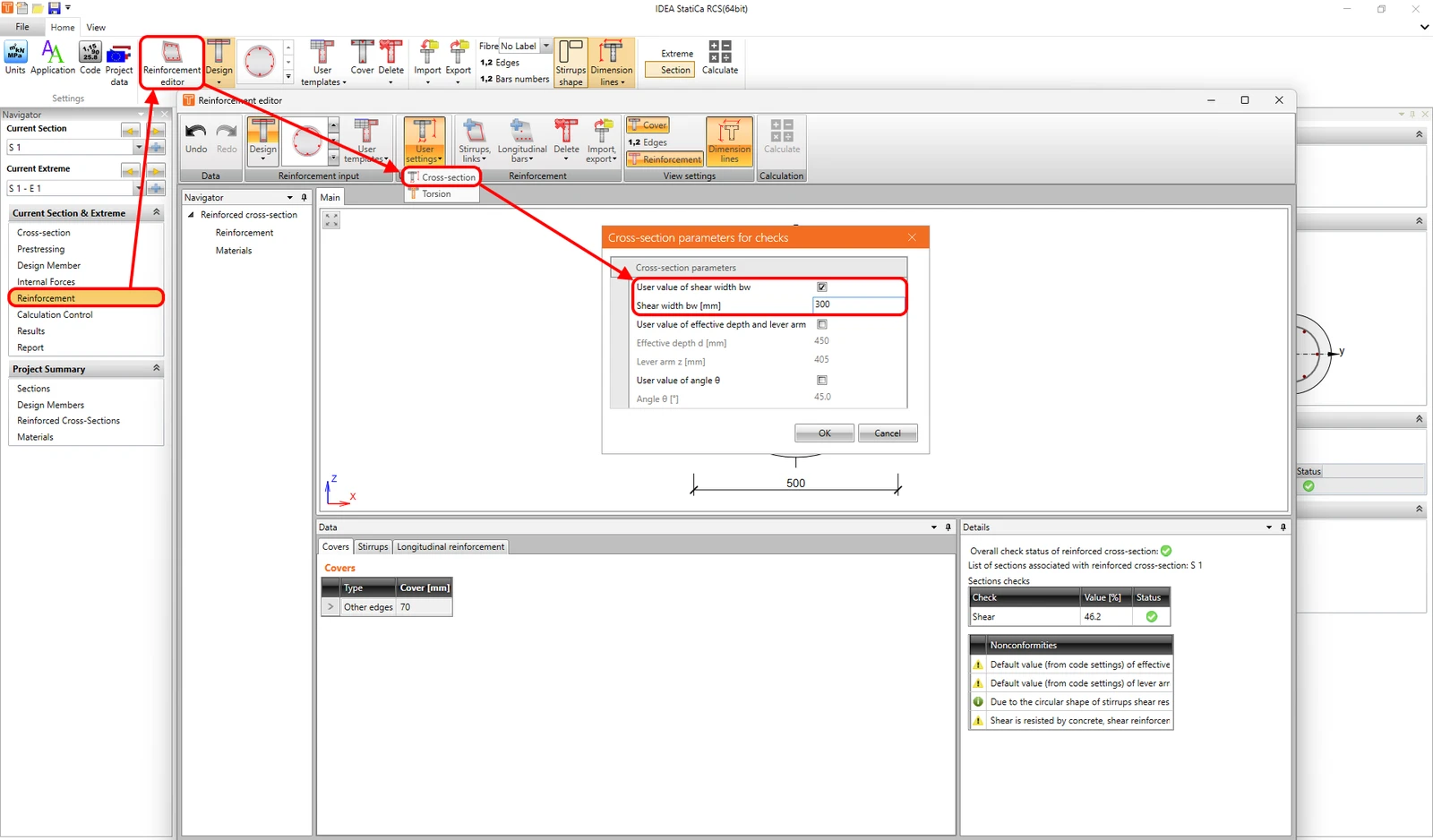
In some cases, it is worth considering setting the value of bw manually. It can be done in the Reinforcement editor.
Take the latest version of IDEA StatiCa for a test drive today

Get 14 days of full access, completely free.

Check out IDEA StatiCa for free
Related articles

How to set the lever arm properly
  • Concrete
  • RCS
  • Beam
  • EN (Eurocode)
  • Reinforcement
  • ULS
  • SIA (Switzerland)
  • +7
  • Concrete
  • RCS
  • Beam
  • EN (Eurocode)
  • Reinforcement
  • ULS
  • SIA (Switzerland)

Knowledge base

How to set the lever arm properly

Read more
ULS results in RCS - Capacity N-M-M, Shear, Torsion, Interaction, Response N-M-M
  • Concrete
  • RCS
  • EN (Eurocode)
  • ULS
  • +4
  • Concrete
  • RCS
  • EN (Eurocode)
  • ULS

Knowledge base

ULS results in RCS - Capacity N-M-M, Shear, Torsion, Interaction, Response N-M-M

Read more
Reinforcement in RCS application
  • Concrete
  • RCS
  • EN (Eurocode)
  • Reinforcement
  • +4
  • Concrete
  • RCS
  • EN (Eurocode)
  • Reinforcement

Knowledge base

Reinforcement in RCS application

Read more
Code and calculation settings in RCS
  • Concrete
  • RCS
  • EN (Eurocode)
  • +3
  • Concrete
  • RCS
  • EN (Eurocode)

Knowledge base

Code and calculation settings in RCS

Read more