Idea Statica
  • Steel
  • Concrete
  • BIM & workflows
  • Support & Learning
  • Pricing
  • Company
  • Steel overview
  • Connection design
  • Member design
  • Parametric design
  • Steel case studies
  • Concrete overview
  • Walls and D-regions
  • Anchoring design
  • Members & cross-sections
  • Concrete case studies
  • BIM overview
  • Supported integrations
  • Checkbot
  • Viewer
  • APIs
  • Support Center
  • E-learning & certification
  • Blog
  • Downloads & Licensing
  • Plans
  • Free community tool
  • Enterprise customers
  • Students & educators
  • How much will you save?
  • About us
  • Contact
  • Research & development
  • Authorized resellers
  • Meet our customers
  • Career
  • Steel
    Steel overviewConnection designMember designParametric designSteel case studies
  • Concrete
    Concrete overviewWalls and D-regionsAnchoring designMembers & cross-sectionsConcrete case studies
  • BIM & workflows
    BIM overviewSupported integrationsCheckbotViewerAPIs
  • Support & Learning
    Support CenterE-learning & certificationBlogDownloads & Licensing
  • Pricing
    PlansFree community toolEnterprise customersStudents & educatorsHow much will you save?
  • Company
    About usContactResearch & developmentAuthorized resellersMeet our customersCareer
14-Day Trial
14-Day Trial
  • Steel
  • Concrete
  • BIM & workflows
  • Support & Learning
  • Pricing
  • Company

Subscribe to our newsletter

Company

  • About us
  • Partners
  • Careers
  • Patent

Resources

  • Customer projects
  • Case studies
  • Connection Library
  • Verification books

Legal

  • EULA
  • Privacy policy
  • California Privacy
  • TOS Viewer
  • Licensing

Help

  • Contact
  • Quote request
  • Resellers
  • Downloads
FacebookInstagramLinkedInYouTube

© IDEA StatiCa 2009-2026

Trusted and used worldwide by engineers, fabricators & consultants.

Support CenterKnowledge Base ArticlesFire design
Advanced analysis types for your steel structures
Fire design
Fire design of steel connections (22.1)
Fire design – automatic temperature calculation (23.1)
Fire temperature verification of a stiffening plate
Fire resistance – automatic temperature calculation
SteelConnection designMember designKnowledge baseConnection

Fire design

This article is also available in
ENCZDEESFRITPTNLHUROKRPLTHTRVIZH

Fire design is available for user-set temperatures. Reduced material characteristics are used based on preset temperature and material degradation curve. Fire design is available in Connection and Member applications.

Temperature

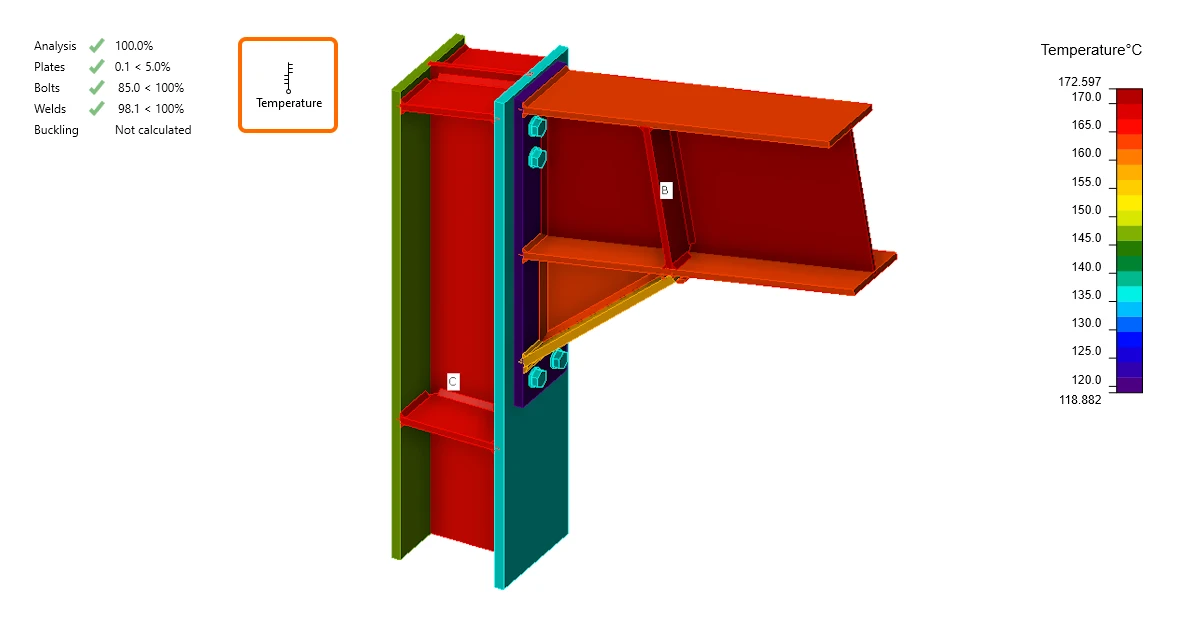
In IDEA StatiCa Member, the user sets a temperature for the whole model. All entities in the model have a set temperature.

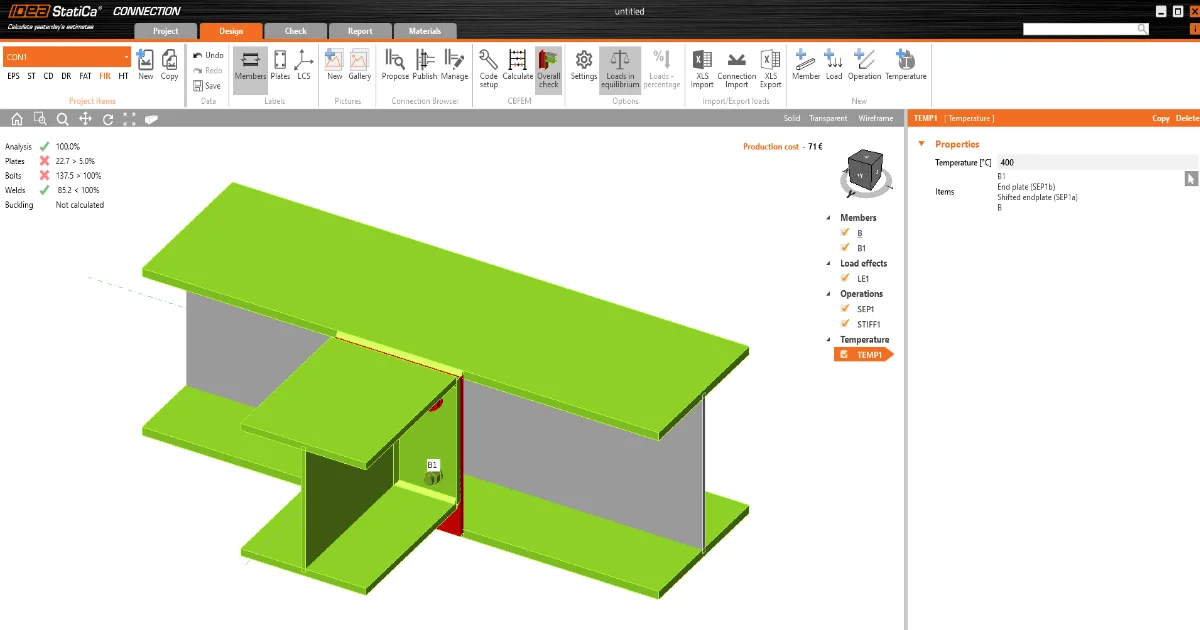
In IDEA StatiCa Connection, the user may set the temperature for each member or plate separately. The temperature of connecting elements - bolts and welds - is assumed to be according to the hottest connecting plate.

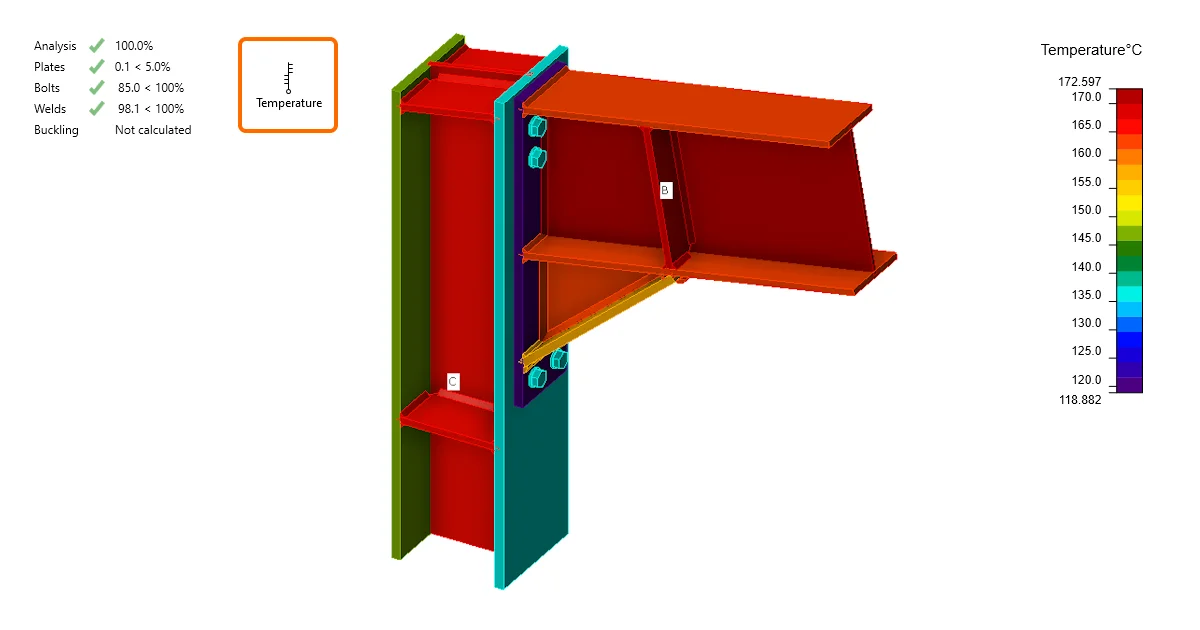
The temperature of members and plates in connections may be determined according to EN 1993-1-2 – Cl. 4.2.5 Steel temperature development and D.3 Temperature of joints in fire. The thermal properties of steel components are taken from EN 1993-1-2:

  • Specific heat – Cl. 3.4.1.2
  • Thermal conductivity – Cl. 3.4.1.3

Note that thermal elongation is not used in IDEA StatiCa Steel, because it would add forces that are greatly dependent on boundary conditions. Users are encouraged to add forces from the thermal expansion into the load effects themselves.

Material degradation

Material degradation of steel plates is available according to three codes:

  • EN 1993-1-2 – Table 3.1
  • AISC 360-16 – Table A-4.2.1
  • CSA S16-14 – Table K.1

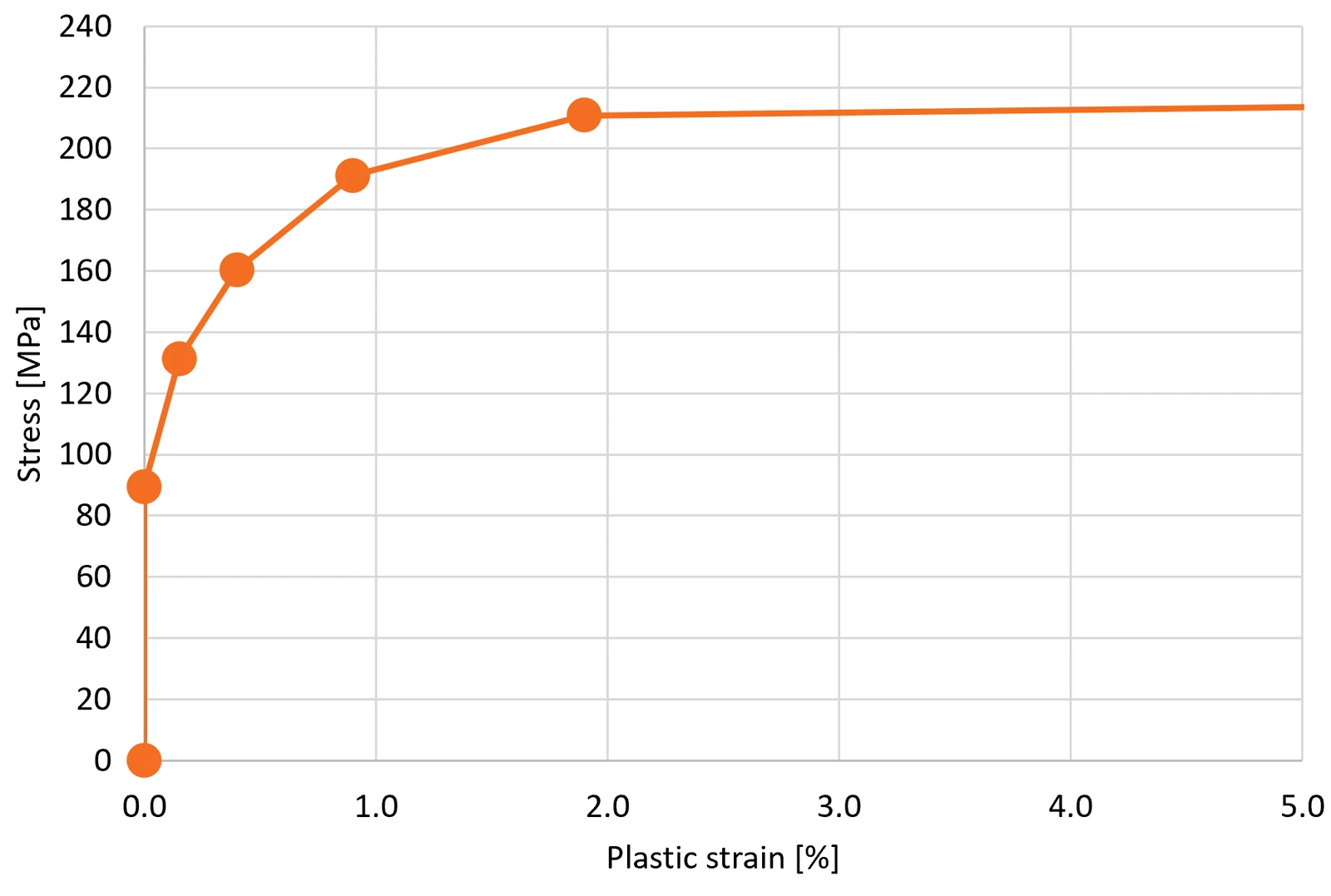
The multilinear material diagram is used for steel plates with six points according to EN 1993-1-2 – Figure 3.1. An example is shown for steel grade S355, material degradation according to EN 1993-1-2 – Table 3.1, and temperature θ=560∘C\theta = 560^{\circ}\textrm{C}θ=560∘C. The slope of plastic branch past the yield strength fyf_yfy​ is Ea,θ/1000E_{a,\theta}/1000Ea,θ​/1000. The reduction factors for modulus of elasticity kE,θk_{E,\theta}kE,θ​, for proportionality limit kp,θk_{p,\theta}kp,θ​, and yield strength ky,θk_{y,\theta}ky,θ​ are 0.426, 0.252, and 0.594, respectively. The plastic strain is assumed to build up since the proportionality limit.


StrainPlastic strainStress

ε\varepsilonε [%]εpl\varepsilon_{pl}εpl​ [%]σ\sigmaσ [MPa]
00.000.000.0
10.100.0089.5
20.250.15131.4
30.500.40160.5
41.000.90191.3
52.001.90210.9
615.0014.90222.5

Material degradation of bolts is available according to three codes:

  • EN 1993-1-2 – Table D.1
  • AISC 360-16 – Table A-4.2.3
  • CSA S16-14 – Table K.3

Material degradation of welds is available according to one code:

  • EN 1993-1-2 – Table D.1

Only the resistance of bolts and welds is reduced. Their stiffness remains the same as at ambient temperature.

Thermal expansion is neglected and not assumed in any models. If necessary, the effects of thermal expansion should be simulated by added loads.

Checks

Steel plates are checked for plastic strain 5% by default. 

In Eurocode, a dedicated partial safety factor for Fire design, γM,fi\gamma_{M,fi}γM,fi​ is used for checks of bolts and welds. In all other codes, the standard resistance or safety factors are used. The load-deformation curves and checks of bolts and welds are reduced by factors kbk_bkb​ and kfk_fkf​ based on set temperature.

Preloaded bolts are assumed to slip and are checked as regular snug-tight bolts.

Anchors and concrete blocks are not checked in Fire design, since the temperature of the corresponding concrete structure is unknown.

Stiffness

Stiffness analysis is not available for Fire design at the moment. It is recommended to use stiffness analysis for ambient temperature and multiply the stiffness by reduction factor for modulus of elasticity kE,θk_{E,\theta}kE,θ​.

Related articles

IDEA StatiCa Connection – Structural design of steel connections
  • Steel
  • Connection
  • EN (Eurocode)
  • AISC (USA)
  • AS (Australia)
  • CSA (Canada)
  • IS (India)
  • GB (China)
  • HKG (Hong Kong)
  • SP 16 (Russia)
  • CBFEM
  • +11
  • Steel
  • Connection
  • EN (Eurocode)
  • AISC (USA)
  • AS (Australia)
  • CSA (Canada)
  • IS (India)
  • GB (China)
  • HKG (Hong Kong)
  • SP 16 (Russia)
  • CBFEM

Theoretical background

IDEA StatiCa Connection – Structural design of steel connections

Read more
The Fire resistance code-check helps to analyze the fire resistance of steel connections and beams exposed to the thermal effects of fire. Reduce the costs by optimizing the structure's design while keeping its safety in a few clicks!
  • Steel
  • Connection
  • Member
  • EN (Eurocode)
  • Fire resistance
  • AISC (USA)
  • +6
  • Steel
  • Connection
  • Member
  • EN (Eurocode)
  • Fire resistance
  • AISC (USA)

Knowledge base

Fire design of steel connections (22.1)

Read more
Fire resistance – automatic temperature calculation
  • Steel
  • Connection
  • EN (Eurocode)
  • Fire resistance
  • v23.1
  • +5
  • Steel
  • Connection
  • EN (Eurocode)
  • Fire resistance
  • v23.1

Knowledge base

Fire design – automatic temperature calculation (23.1)

Read more