Idea Statica
  • Steel
  • Concrete
  • BIM & workflows
  • Support & Learning
  • Pricing
  • Company
  • Steel overview
  • Connection design
  • Member design
  • Parametric design
  • Steel case studies
  • Concrete overview
  • Walls and D-regions
  • Anchoring design
  • Members & cross-sections
  • Concrete case studies
  • BIM overview
  • Supported integrations
  • Checkbot
  • Viewer
  • APIs
  • Support Center
  • E-learning & certification
  • Blog
  • Downloads & Licensing
  • Plans
  • Free community tool
  • Enterprise customers
  • Students & educators
  • How much will you save?
  • About us
  • Contact
  • Research & development
  • Authorized resellers
  • Meet our customers
  • Career
  • Steel
    Steel overviewConnection designMember designParametric designSteel case studies
  • Concrete
    Concrete overviewWalls and D-regionsAnchoring designMembers & cross-sectionsConcrete case studies
  • BIM & workflows
    BIM overviewSupported integrationsCheckbotViewerAPIs
  • Support & Learning
    Support CenterE-learning & certificationBlogDownloads & Licensing
  • Pricing
    PlansFree community toolEnterprise customersStudents & educatorsHow much will you save?
  • Company
    About usContactResearch & developmentAuthorized resellersMeet our customersCareer
14-Day Trial
14-Day Trial
  • Steel
  • Concrete
  • BIM & workflows
  • Support & Learning
  • Pricing
  • Company

Subscribe to our newsletter

Company

  • About us
  • Partners
  • Careers
  • Patent

Resources

  • Customer projects
  • Case studies
  • Connection Library
  • Verification books

Legal

  • EULA
  • Privacy policy
  • California Privacy
  • TOS Viewer
  • Licensing

Help

  • Contact
  • Quote request
  • Resellers
  • Downloads
FacebookInstagramLinkedInYouTube

© IDEA StatiCa 2009-2026

Trusted and used worldwide by engineers, fabricators & consultants.

Support CenterBlogGeometrically and materially nonlinear analysis (GMNA)
Geometrically and materially nonlinear analysis (GMNA)
SteelConnection designFeaturesCBFEMGMNA

Geometrically and materially nonlinear analysis (GMNA)

December 9, 2019
This article is also available in
ENCZDEESFRITPTNLHUROKRPLTHTRVIZH

For an engineer, it is always important to be able to model a structure behaving as close to reality as possible. That is why we introduced the new geometrically nonlinear analysis (GMNA) for steel hollow section members to the latest IDEA StatiCa version 10.1.

This brand new type of analysis is an important part of the code-check for the hollow section members with a significant influence on the calculated resistance of the whole connection. GMNA calculation brings results of the analysis closer to the real behavior of the construction (but not necessarily to the code requirements).

Until version 10.0, our CBFEM method has used the materially nonlinear analysis (MNA method, elastoplastic working diagram). This solution is still sufficient for the vast majority of connection cases.

But for specific hollow section members and/or members with extremely slender walls, point loading can cause high local deformations (especially of cross-sections) which influence the overall stability of the member. In these cases, the geometrically linear analysis may not capture the behavior of the joint with sufficient precision and its load resistance may be underestimated or overestimated.
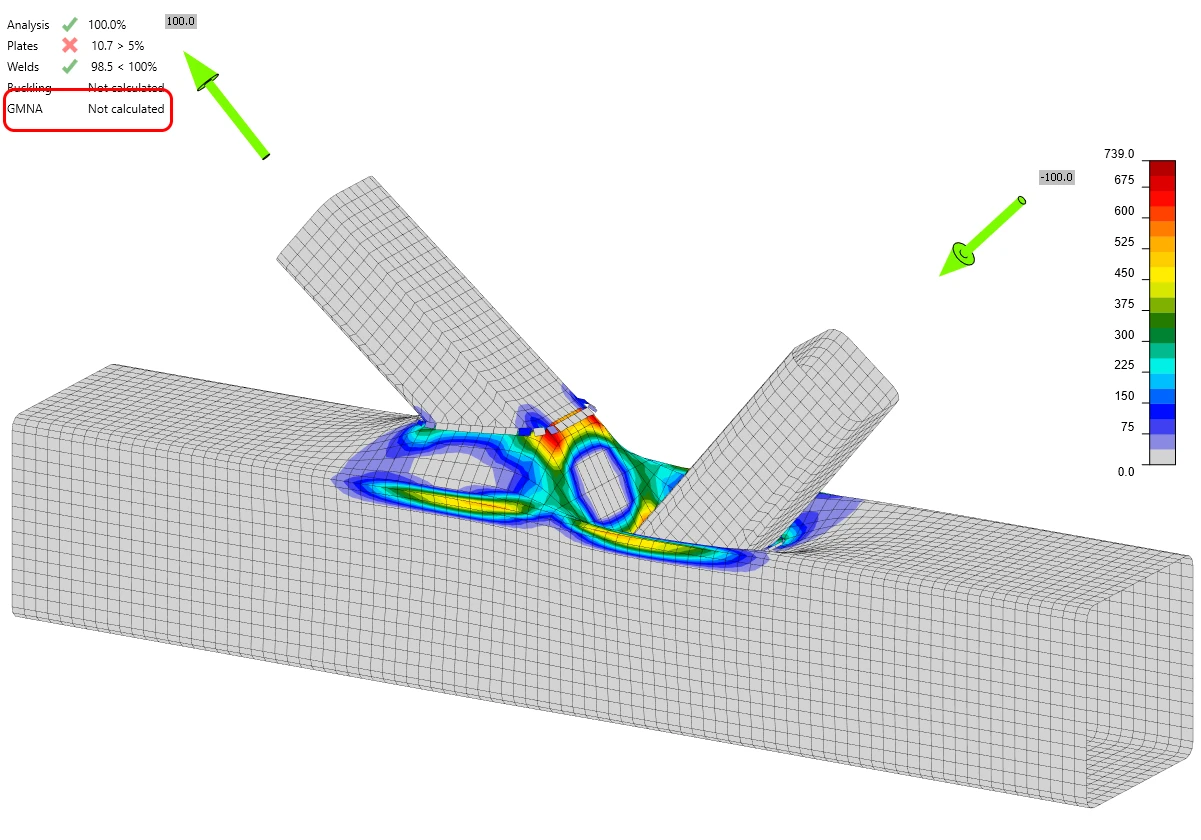
materially nonlinear analysis

That is why we have developed a new and more advanced analysis based on the geometrically nonlinear solution which takes these effects into account. The new analysis is called GMNA – geometrically and materially nonlinear analysis. We have verified this approach using models from ANSYS and ABAQUS.
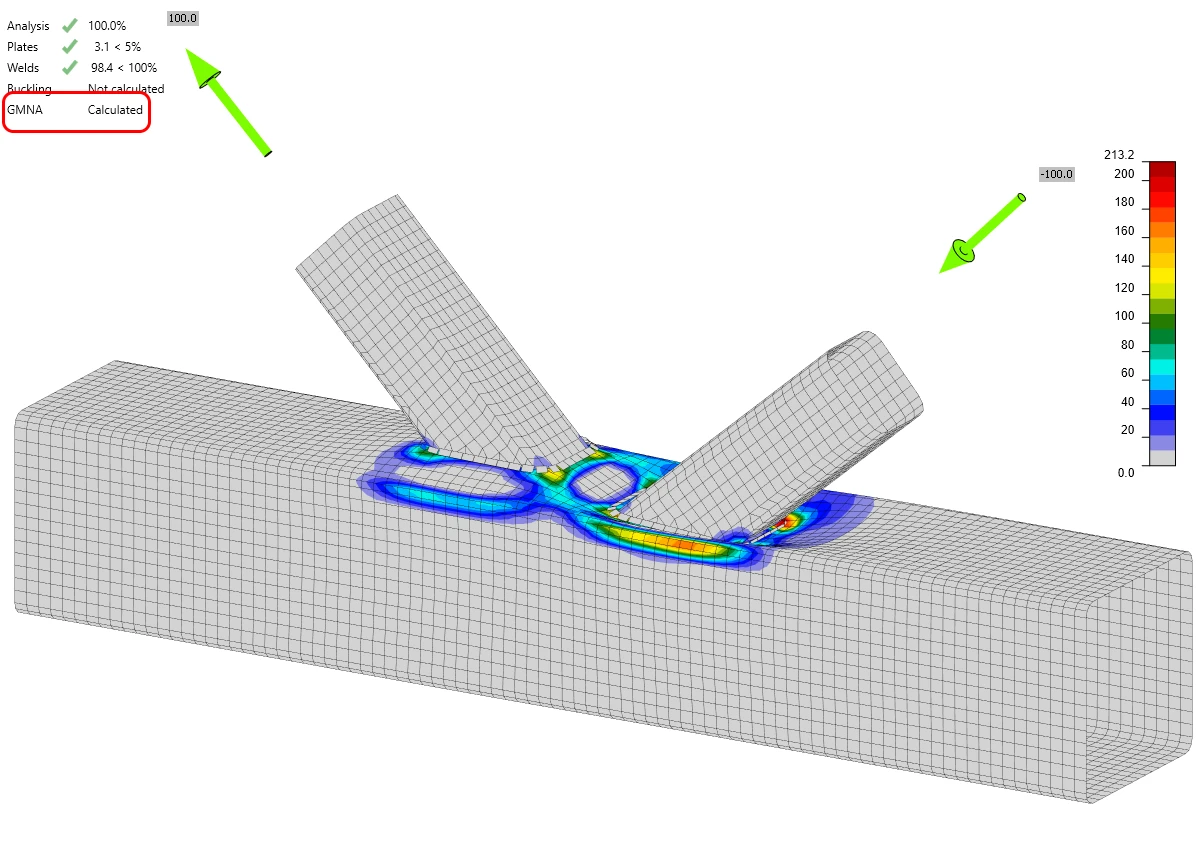
Geometrically and materially nonlinear analysis (GMNA)

Important note

GMNA feature is turned on by default in all new projects where a bearing member has a hollow cross-section assigned to it. Projects from previous versions keep their original settings. Users can switch into GMNA in the code setup dialog.

Note: If the bearing member is not a hollow section, the GMNA solver is disabled for the analysis of the whole connection model regardless of the settings in the code setup (GMNA on or off).

This might result in a scenario when a connection created in 10.0 and recalculated in 10.1 using GMNA gives different results. In general, results are less conservative for members in tension and more conservative for members in pressure.

It is possible that some connections designed in the previous version, especially those designed very aggressively and/or with border-line code-check values, will no longer pass the code-check in version 10.1. We recommend to recalculate them in version 10.1 and investigate the differences with the previous version together with your local support partner (reseller) or directly with IDEA StatiCa.

Try IDEA StatiCa for free

Start your trial today and enjoy 14-days of full access and services free of charge.

START FREE TRIAL

Ondrej Fridrich

Ondrej Fridrich

Marketing Engineer IDEA StatiCa US

Experienced marketing leader with 15+ years in software & construction; expert in digital campaigns and web management.

More articles by this authorLinkedIn