


New steel roof over a heritage hall in Zagreb
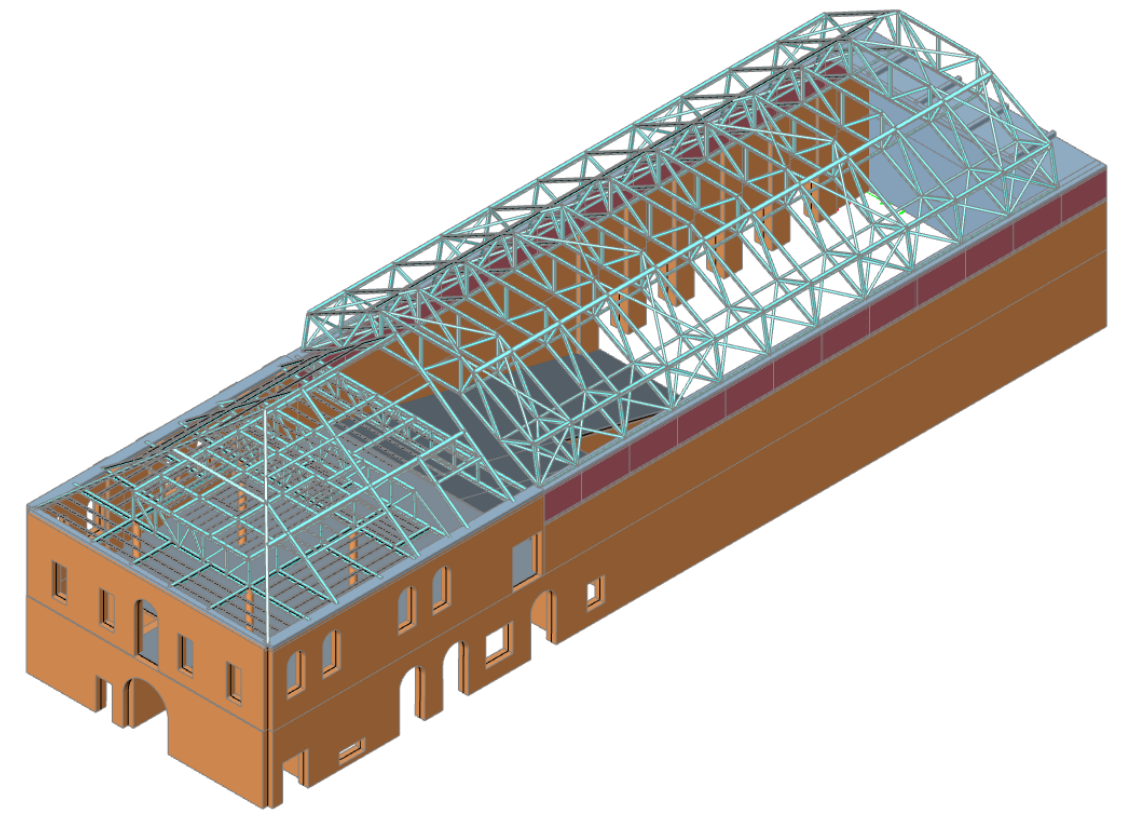
\[ \textsf{\textit{\footnotesize{Global 3D model of the structure}}}\]
About the Project
Europa Cinema, built in 1924–1925 and renowned for its ornate interior, is undergoing restoration and modernization following an expanded project scope triggered by the recent earthquake effects in Zagreb. The building is listed as a protected cultural property, which significantly shaped the engineering strategy. As part of emergency maintenance, the entire roof and ceiling over the main hall will be replaced, ensuring safety while preserving the architectural character. The attic, previously a lightweight void above the hall, will be adapted to host upgraded HVAC equipment and new technical systems. This change increased permanent loads compared to the original structure, making a full reconsideration of the roof structure unavoidable.
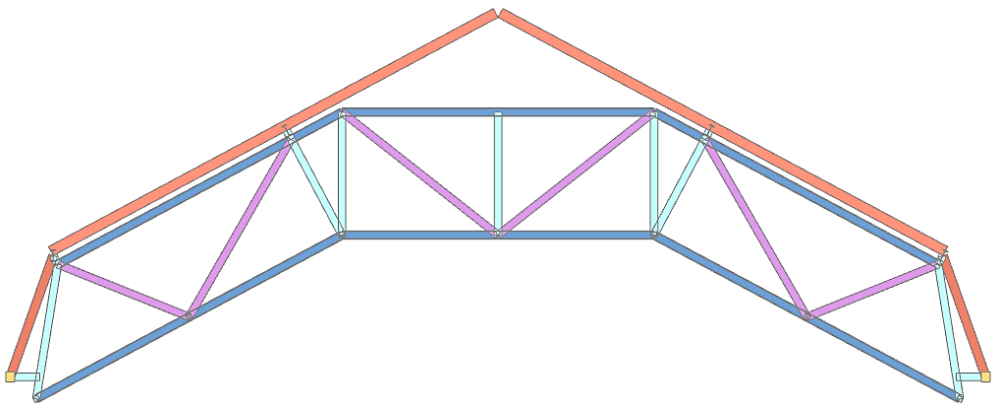
\[ \textsf{\textit{\footnotesize{Main structural truss system}}}\]
The new system is based on primary steel elements combined with secondary timber rafters. This hybrid approach preserves the aesthetic continuity of the interior while providing the necessary stiffness and load-bearing capacity. The original trough‑shaped soffit geometry is respected, maintaining the visual impression from within the hall. The main girders, complex steel trusses at approximately 3.0 m spacing, use HEB sections for chords, SHS posts and diagonals, CHS bracing in both directions, and are tied longitudinally with steel purlins supporting timber rafters. The entire erection process had to be conceived for a dense city‑center location with limited crane access, which drove the decision to employ bolted connections assembled on site.
Engineering Challenges
Working inside a protected cultural monument demanded minimal intervention into existing masonry while coordinating many stakeholders and modern building services. Frequent late‑stage layout adjustments, driven by multidisciplinary needs and conservation requirements, meant the sizing of truss members and numerous bespoke connections became a moving target. The geometry had to accommodate the preservation of the trough‑shaped ceiling while still housing sizable HVAC units, which significantly altered the loading regime compared to the original roof.
Heritage authorities required non‑intrusive solutions that minimized anchoring into historic walls, further complicating stability checks. The trusses had to span over the main hall without introducing heavy thrusts into the masonry. The detailing of supports and bearings therefore needed careful balancing between restraint and allowance for tolerances. Fire safety standards added another dimension, since the concealed attic space must safely house steel elements in a compartmentalized environment.
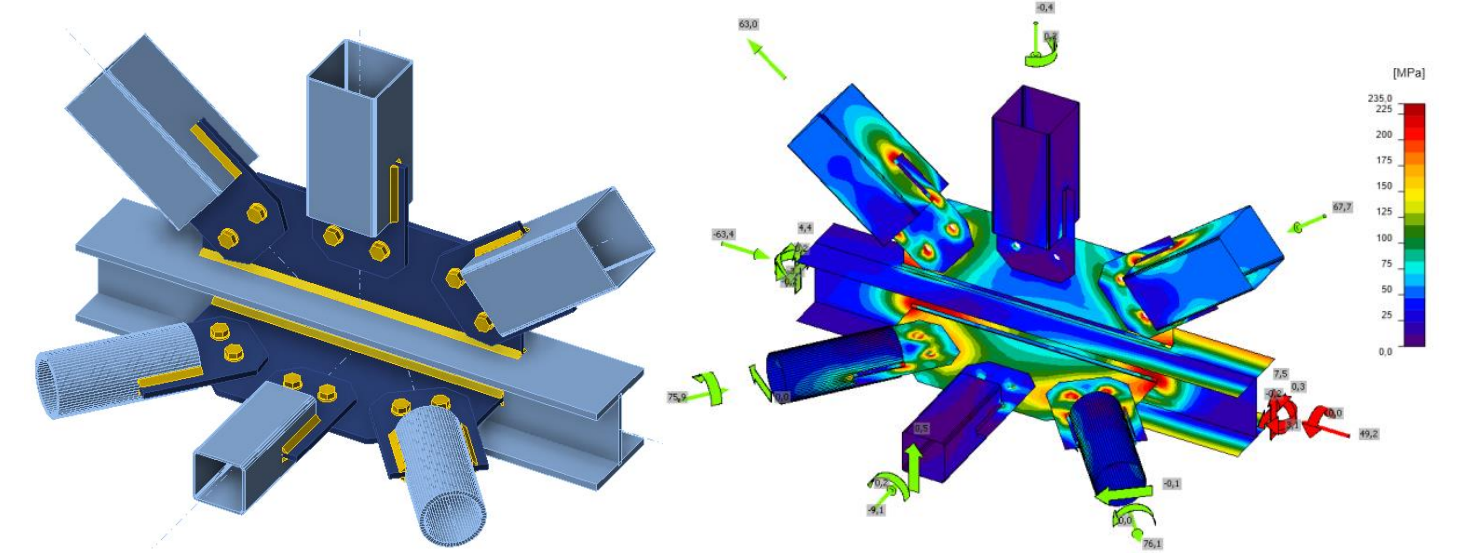
\[ \textsf{\textit{\footnotesize{Example of steel connections}}}\]
In parallel, the confined site logistics and earthquake‑induced urgency placed pressure on design speed and constructability. Transporting large components through narrow city streets, coordinating temporary works for erection, and ensuring resilience against aftershocks were all central to the engineering challenge. These constraints amplified the importance of efficient digital workflows and reliable software tools.

Croatia
Solutions and Results
Global analysis and member design were completed in SCIA Engineer, with detailed connection checks performed in IDEA StatiCa Connection. The SCIA to IDEA StatiCa BIM link allowed the transfer of elements and governing internal forces for each joint, drastically reducing manual re‑entry and the risk of transcription errors. The ability to synchronize design changes between the global analysis and local connection verification meant that every late adjustment in geometry or load distribution could be re‑checked without starting from scratch.

\[ \textsf{\textit{\footnotesize{Example of steel connections}}}\]
Croatia
Because site lifting and access constraints favored smaller assemblies, all connections were engineered as bolted, enabling a kit‑of‑parts erection strategy. This approach reduced the risk associated with welding in restricted spaces and allowed the contractor to plan a clear installation sequence. IDEA StatiCa’s ability to evaluate many load combinations in one go sped optimization, while the intuitive interface shortened the learning curve for the team and supported rapid re‑checks whenever the truss layout or MEP coordination shifted.
The project was executed in a Eurocode‑based workflow for steel members and connections, with IDEA StatiCa providing code‑based verification of joints and SCIA Engineer maintaining the global structural model. This integrated process yielded a robust, installation‑friendly roof system that respects the hall’s heritage profile and accommodates modern services without intrusive strengthening of the historic envelope. In doing so, the design not only secures the safety of the building but also enables the long‑term cultural use of one of Zagreb’s most cherished landmarks.
Conclusion
Europa Cinema is one of the cultural symbols of the city of Zagreb, and it is worth preserving
for future generations. The emergency maintenance project will modernize the entire building
and significantly improve safety and extend its service life.
IDEA StatiCa has made a significant contribution to the calculation of the steel structures. This program is an ideal tool for calculating complex connections, greatly simplifying the design and optimization of the structure, while saving time. This is one of the first projects where the company used IDEA StatiCa, and it will certainly continue to use it in the future.
About Intrados Projekt d.o.o.
Intrados Projekt d.o.o. is a company that specializes in designing and supervising, primarily in the field of renovation and reconstruction of existing structures. It is particularly specialized in work on buildings of protected cultural heritage. The company was founded in 2016 by Martina Vujasinović and Hrvoje Podnar, designers with years of experience and a permit from the Ministry of Culture for carrying out tasks related to the protection and preservation of cultural heritage.