
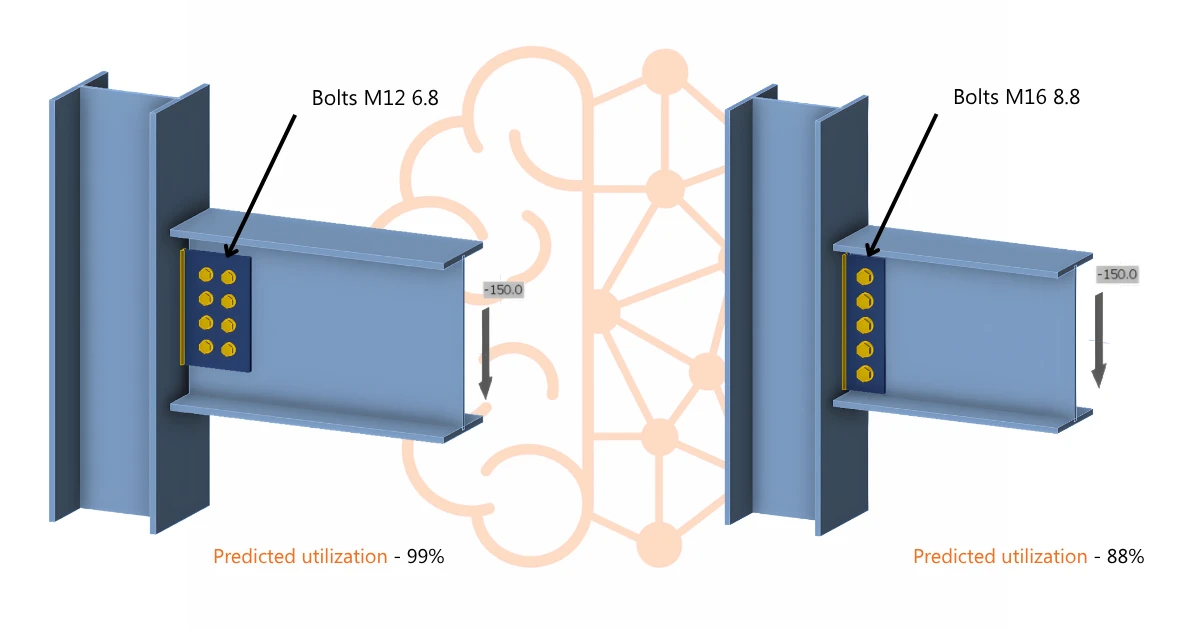


What is the more utilized solution?
Is it more efficient to use two rows of bolts M12 or a single row of bolts M16?
To answer this question in a typical workflow, we would model one option, run the analysis, then modify the design and run another calculation. Each modification means another iteration, but the truth is that almost no engineer has time to spend hours iterating on what is best.
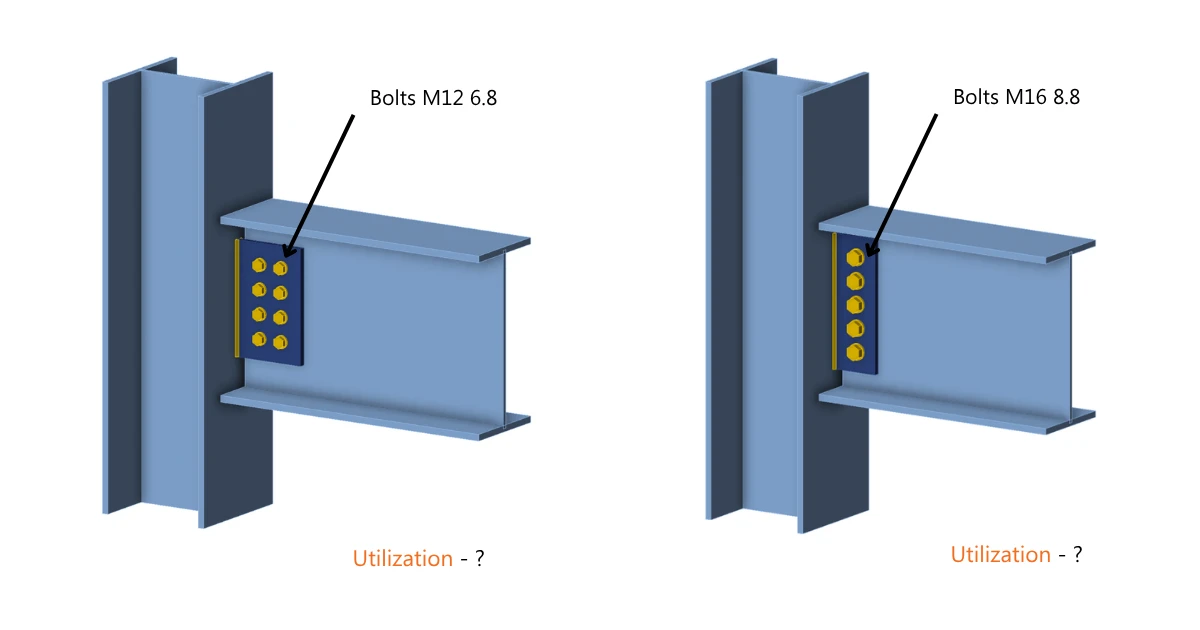
But what if there was a different way?
You could use IDEA StatiCa machine-learned templates and see immediately predicted utilization of the design and run the analysis only when you find the best fit.
What does it look like in practice?
In practice, this approach is not entirely new. It is closer to how experienced engineers already think.
An experienced structural engineer can look at a steel connection and immediately sense whether it is reasonable or potentially problematic. Not because he runs through all checks of components in his head within seconds, but because he has seen hundreds or thousands of similar details before.
Machine learning works in a similar way.
It compares the current configuration to a large dataset of previously analyzed designs and estimates its utilization based on what it has learned from similar situations.
This allows engineers to quickly answer the question raised above. With just a few clicks, I can see that, if the goal is maximum utilization, two rows of M12 bolts are more efficient than a single row of M16 bolts before I even run the analysis.
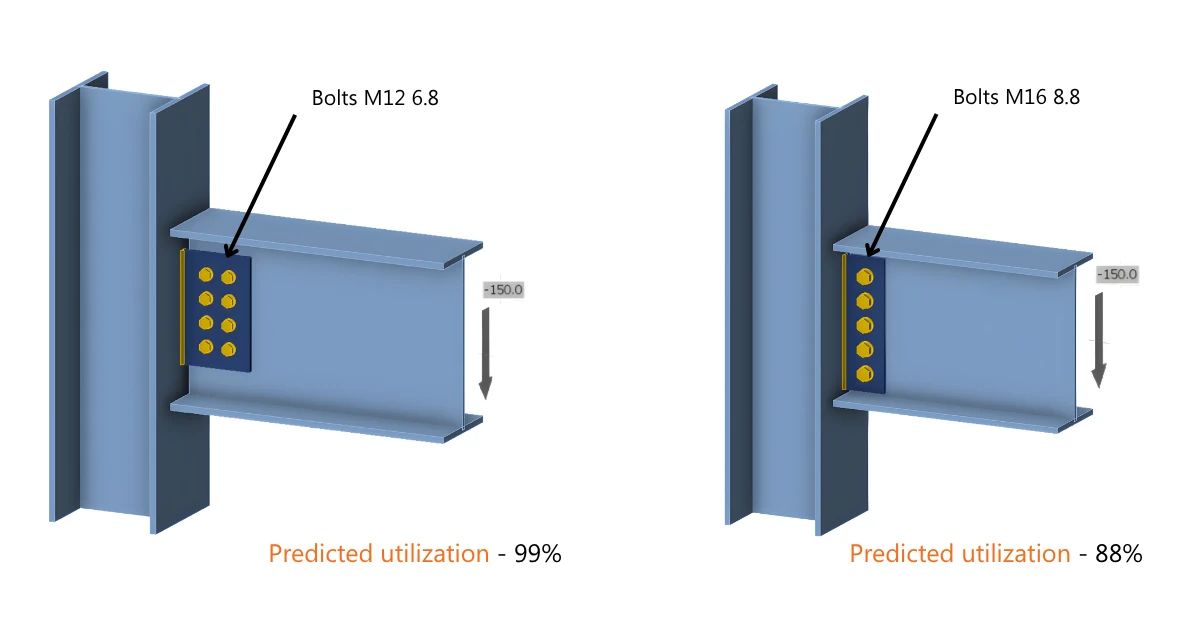
With combination of parametric design, it makes the design process as easy as it is in Excel.
How machine learning is used in IDEA StatiCa
Machine learning is not used to replace structural analysis, but it is about building on top of it.
The introduction of the CBFEM method was a major step forward. It allowed engineers to analyze any steel connection regardless of its complexity. Instead of relying on simplified assumptions, engineers can now work with a generally consistent approach.
However, this generality comes at a cost. Compared to analytical methods, FEM-based analysis is computationally demanding. As a result, exploring design variants becomes more time-consuming. This is where the machine-learned templates step comes in. Machine-learning templates are built directly on top of CBFEM. Instead of simplifying the physics, they learn from it.
A large number of connection configurations are generated and evaluated using CBFEM. Each of these cases, defined by its geometry, loading, plates, welds and bolts, produces accurate results in terms of utilization. This dataset is then used to train a machine learning model that captures the relationship between input parameters and structural response. The result is a predictive model that can estimate the utilization of a connection, similar to a well-prepared Excel.
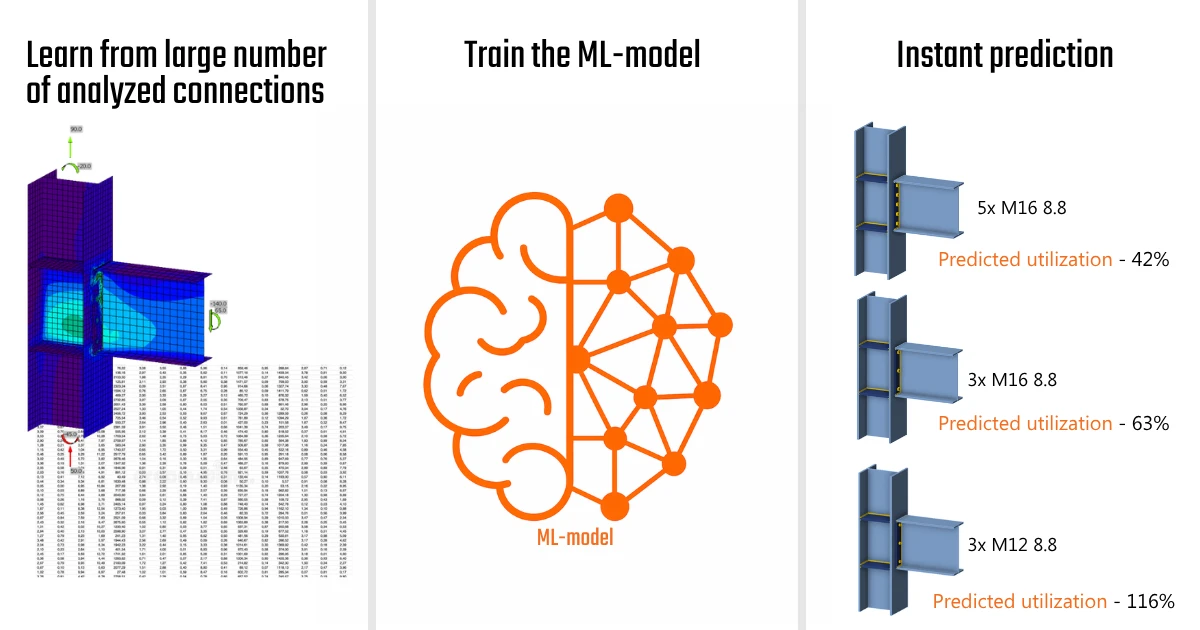
Once the user is satisfied with the predicted utilization, the final verification must be performed by running the standard stress/strain calculation. Only the calculated result represents the actual design check according to the selected code.
Try it yourself and see how quickly you can evaluate multiple design options and compare them before running a single calculation.