


Introduction
Eccentrically Braced Frames (EBFs) represent one of the most advanced and reliable lateral force resisting system (LFRS) in modern steel construction, especially in west coast of United States. They are widely used in critical and essential structures - such as airport control towers, hospitals, emergency facilities, and high-importance civic buildings - where uninterrupted post-earthquake functionality is crucial.
Unlike Concentrically Braced Frames (CBFs) - which include Ordinary Concentrically Braced Frames (OCBFs), Special Concentrically Braced Frames (SCBFs), and Buckling Restrained Braced Frames (BRBFs) - the defining feature of an EBF is the presence of a link element.
This link is a short beam segment located between the ends of two braces, or between a brace and a column, deliberately designed as a structural fuse to undergo inelastic deformation and dissipate seismic energy.
This verification example was prepared in a joint project between the University of Illinois at Chicago and IDEA StatiCa. This work was conducted by:

Goal of the Project
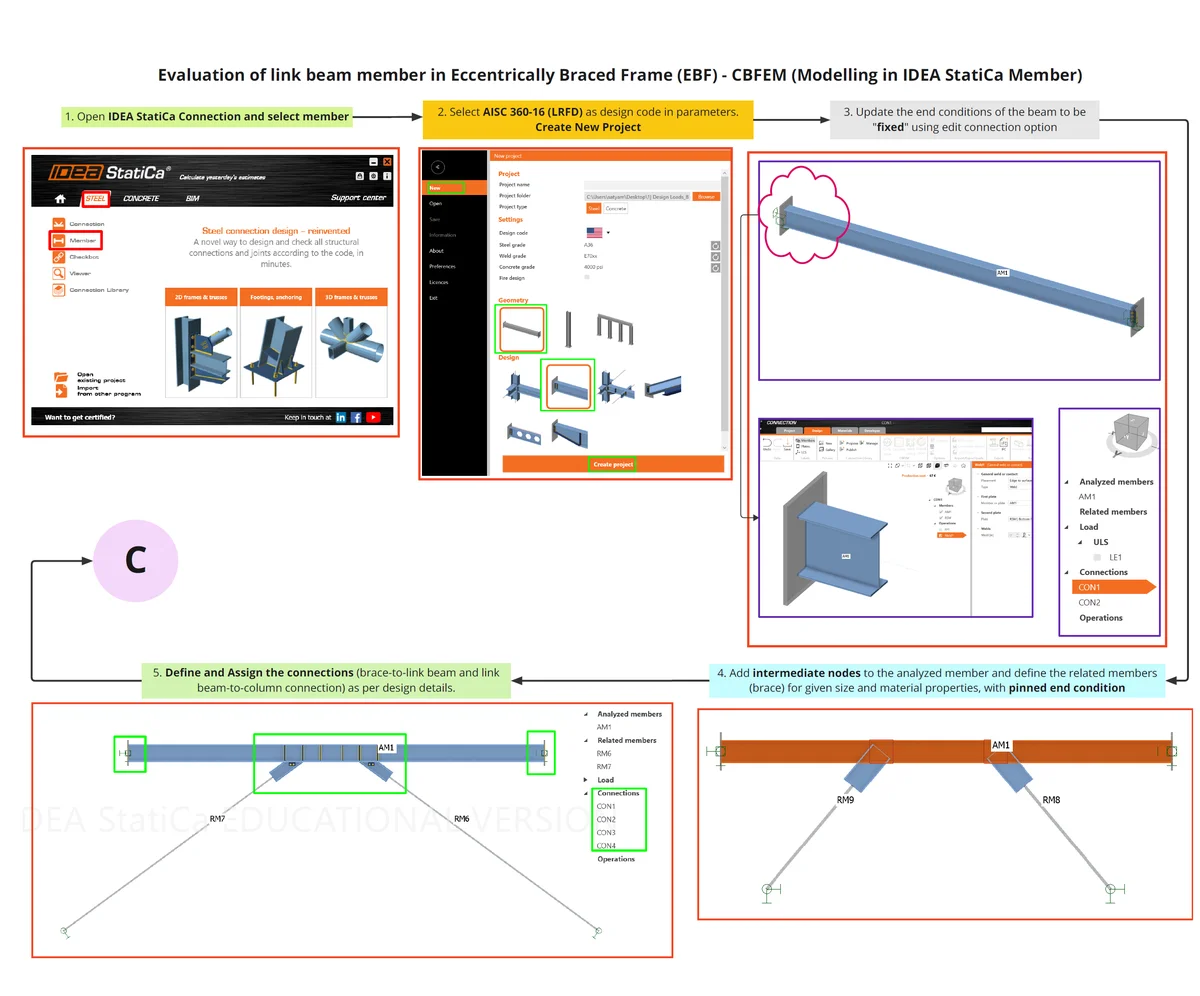
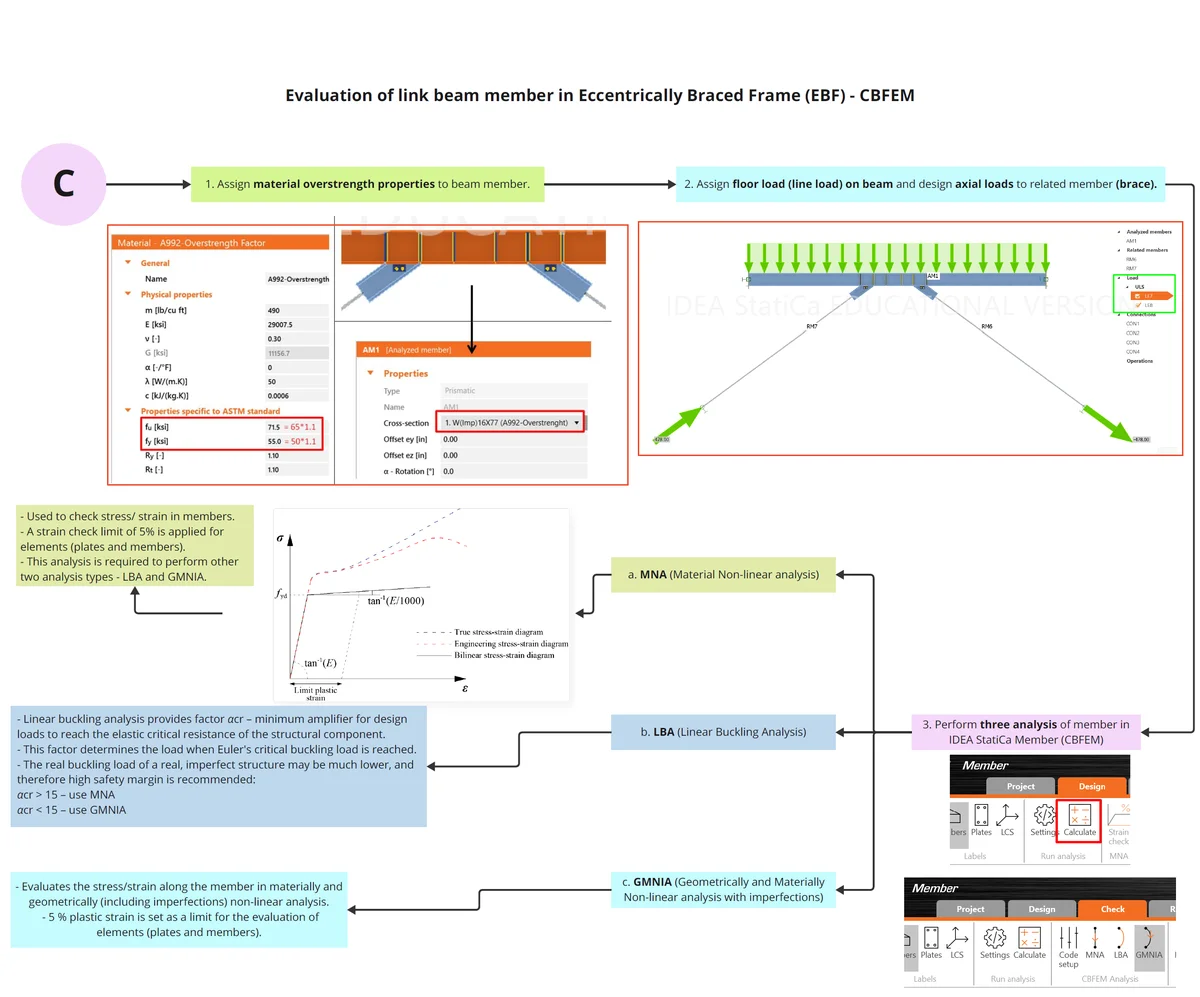
The objective of this project was to evaluate the behavior of seismic bracing connections for an EBF obtained from the IDEA StatiCa software package considering capacity design, wherein the brace members that are considered as the “fuse” for Eccentrically Braced Frames (EBFs) are expected to undergo significant inelastic plastic deformation for the action of the governing seismic load case. The link member is evaluated using IDEA StatiCa Member by performing three analysis - Material non-linear analysis (MNA), linear buckling analysis (LBA) and geometrically and materially non-linear analysis with imperfections (GMNIA).
For the presented study, the brace-to-beam/column bracing connection and the link member, which are common in an Eccentrically Braced Frame (EBF) system, are analyzed using CBFEM and verification with AISC is performed.
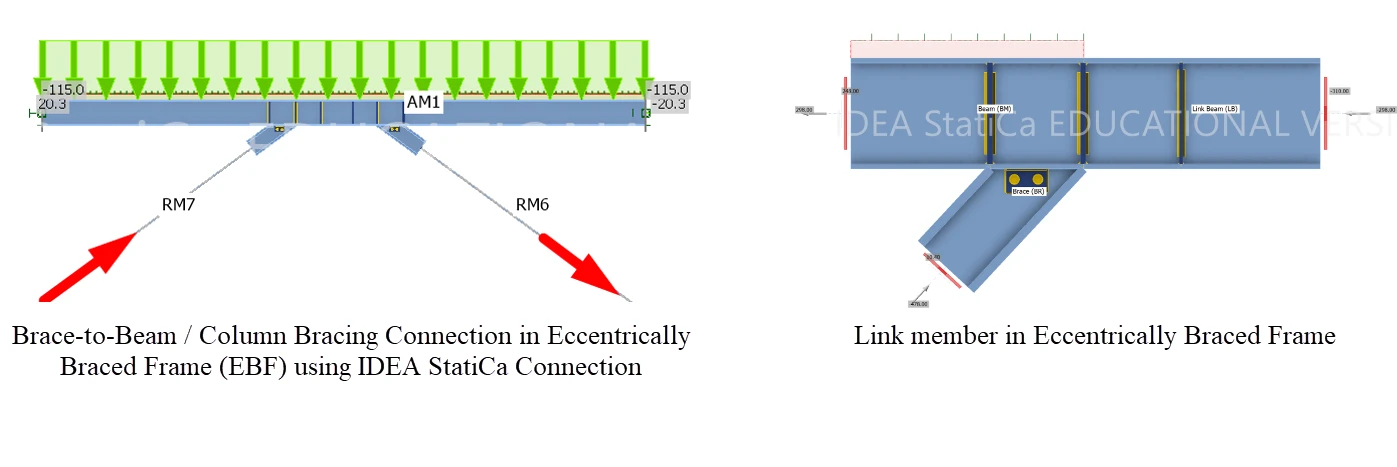
Verification Project Structure
- For each connection type, a baseline model was created, matching the design details specified in AISC 341-16.
- Following the requirements given in AISC 341-16 and AISC 360-16, the design checks were performed for each connection type for the considered limit states in the connection. In addition, the link member was separately analyzed in IDEA StatiCa Member using MNA, LBA, and GMNIA for stability and rotation capacity verification
- The same specimens were modeled and analyzed in IDEA StatiCa, and their design resistance and failure modes were evaluated.
- The capacity design analysis was performed using IDEA StatiCa, such that the link member is the dissipative item in the EBF.
- Several parametric studies were conducted for the presented connection to understand its behavior for link rotation and deformation of the link member, which are essential requirements for analysis and design of bracing connections and members.
- The results obtained from IDEA StatiCa and the AISC design calculations were evaluated, and recommendations were provided.
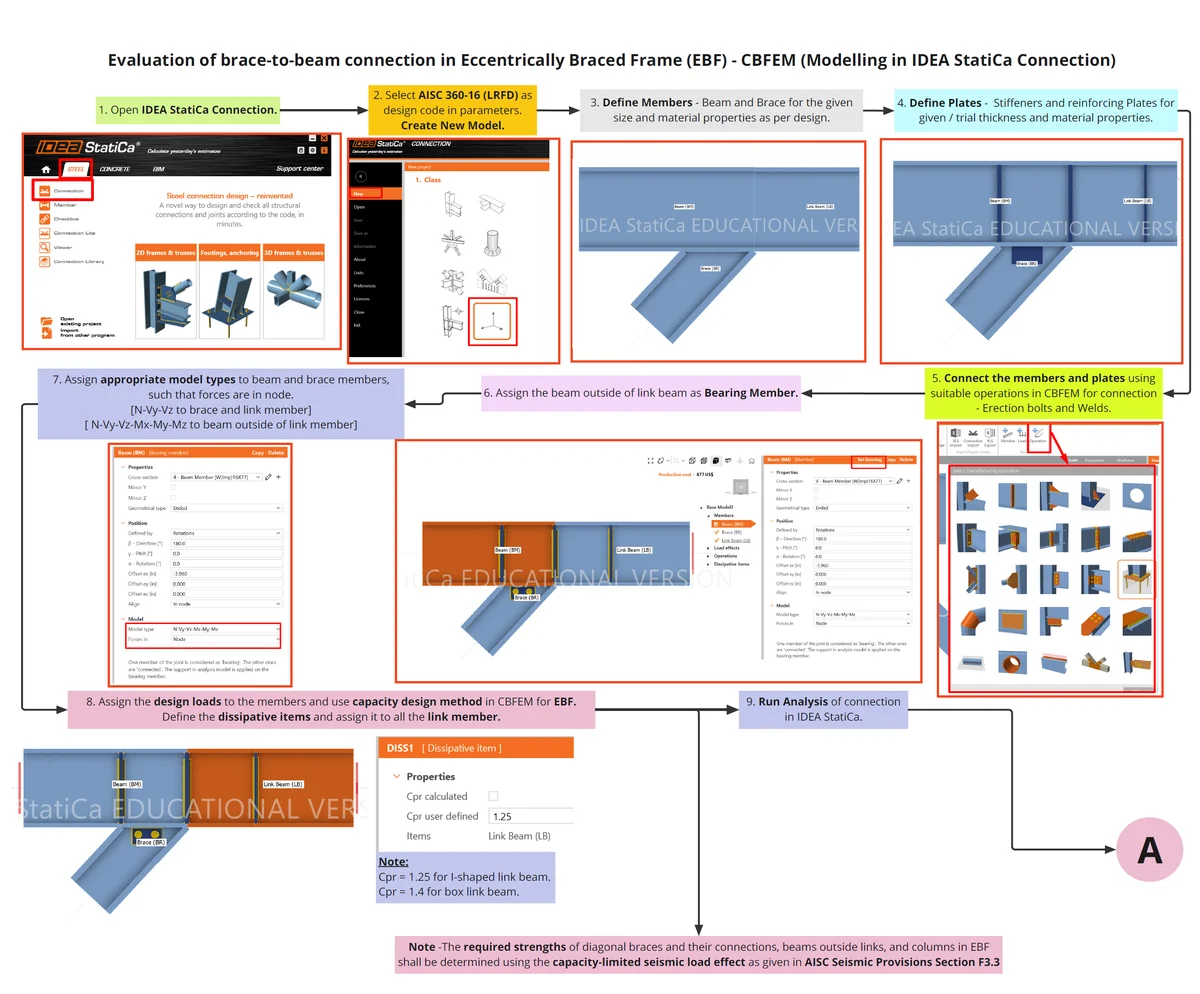
EBF - Part 1
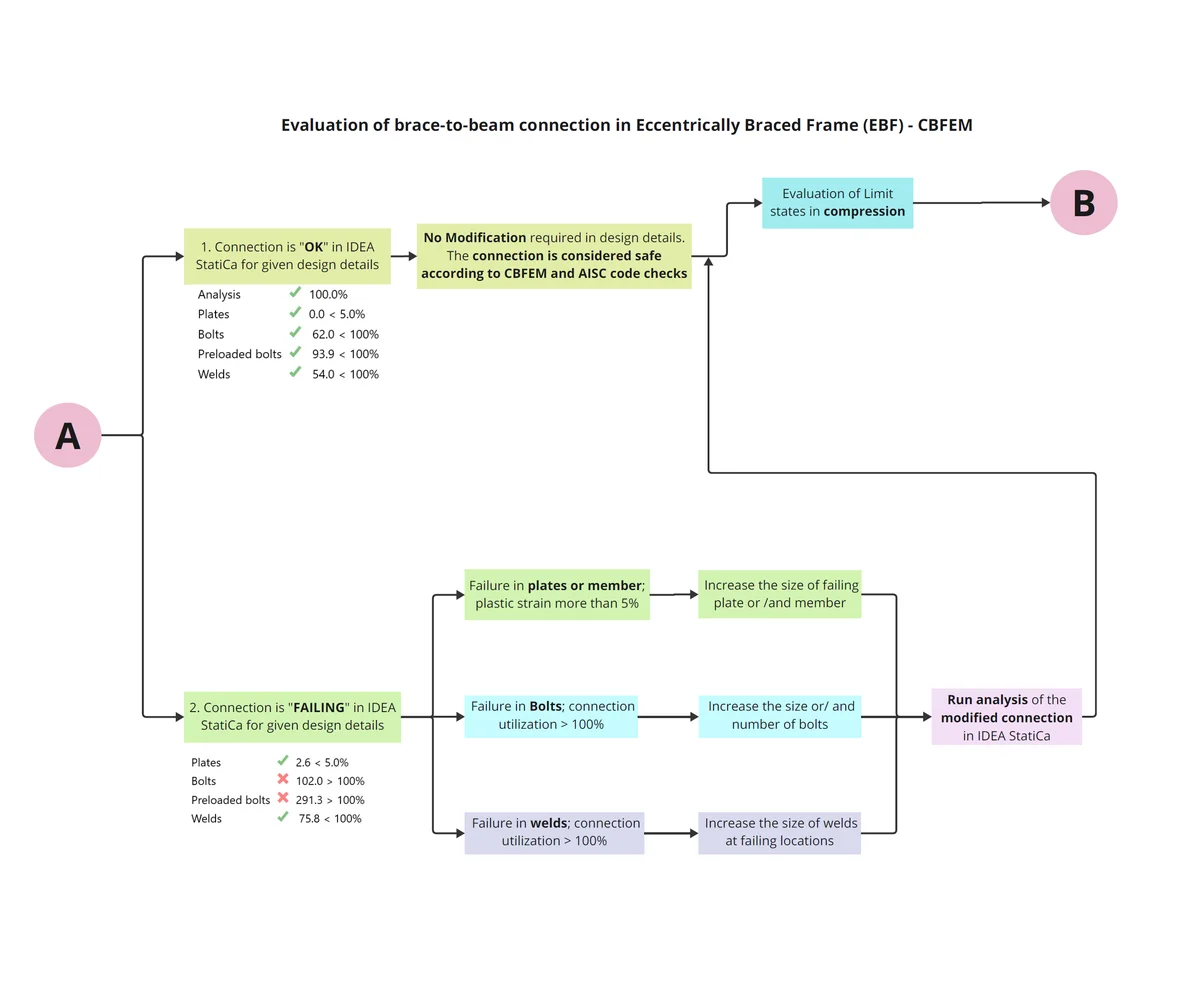
EBF - Part 2
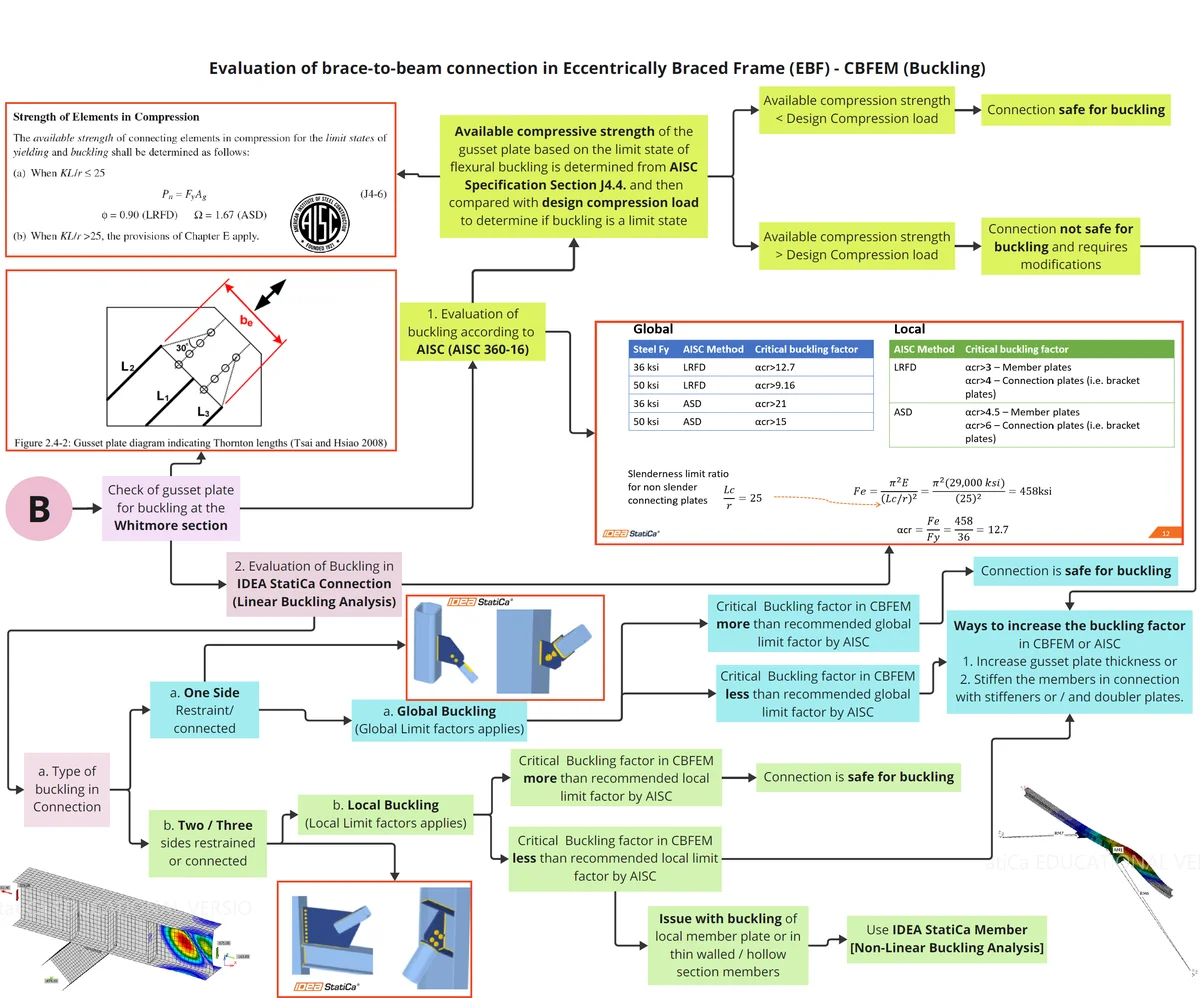
EBF - Part 3
EBF - Part 4
EBF - Part 5
Summary
Eccentrically Braced Frames (EBFs) remain among the most efficient seismic lateral force resisting systems, offering high stiffness coupled with significant ductility. The inelastic demand is intentionally concentrated within the link, allowing braces, beams, and columns outside the link to remain essentially elastic. This study conducted by UIC evaluated both the brace-to-link connection and the link member using IDEA StatiCa’s Component-Based Finite Element Method (CBFEM), with verification against AISC 360-16 and AISC 341-16 provisions.
The brace-to-link connection demonstrated satisfactory performance under seismic design actions. Capacity design checks, with the link designated as the dissipative element, confirmed that the connection and its welds, plates, and stiffeners provided the required safety margin. Even under increased loading, while certain components approached higher utilization, the inelastic response was effectively confined to the link, validating the intended design mechanism.
The link member was further analyzed using material non-linear analysis (MNA), linear buckling analysis (LBA), and geometrically and materially non-linear analysis with imperfections (GMNIA). The MNA confirmed plastic strains localized in the link at 1.7%, well below the 5% ductility threshold. Because the LBA produced a critical buckling factor below the recommended value of 15, GMNIA was conducted, confirming overall stability with plasticity concentrated in the web and demonstrating excellent energy dissipation.
Parametric studies of short, intermediate, and long links reinforced the alignment with AISC expectations: shear yielding for short links, combined shear and flexural yielding for intermediate links, and flexural yielding for long links. The link rotation angles obtained from CBFEM closely matched the AISC 341 provisions, further validating the approach.
In summary, IDEA StatiCa’s CBFEM framework reliably captures the strength, stability, and deformation capacities of EBF connections and members, with outcomes consistent with AISC provisions. This establishes CBFEM as a robust and reliable tool for seismic design and verification of EBF systems, for advanced research and practical engineering applications.
Summary of Results
| Sr No. | Link Details | Link Rotation Angle (γp) | ||||
| Type | Behavior governed by | Length (e) | Shall not exceed | γp_AISC | γp_CBFEM | |
| 1 | Short | Shear yielding | 48in | 0.08 radians | 0.03 radians | 0.04 radians |
| 2 | Intermediate | Combined shear and flexural yielding | 80in | 0.04 radians(from linear interpolation) | 0.02 radians | 0.02 radians |
| 3 | Long | Flexural yielding | 98in | 0.02 radians | 0.01 radians | 0.01 radians |
Read the full study examples:
References
2021 IBC SEAOC Structural/Seismic Design Manual, Volume 4: Examples for Steel-Framed. (n.d.). Retrieved January 5, 2025, from https://codes.iccsafe.org/content/SEAOCVOL42021P1
AISC 341. (2016). Seismic Design Manual. American Institute of Steel Construction, Chicago, Illinois.
Bruneau, M., Uang, C.-M., & Sabelli, R. (2011). Ductile Design of Steel Structures (2nd Edition). McGraw-Hill Education. https://www.accessengineeringlibrary.com/content/book/9780071623957
IDEA StatiCa UK. (2022, June 30). https://ideastatica.uk/design-of-eccentrically-connected-bracing-members/
Koboevic, S., & David, S. O. (2010). Design and seismic behaviour of taller eccentrically braced frames. Canadian Journal of Civil Engineering, 37(2), 195–208. https://doi.org/10.1139/L09-131