
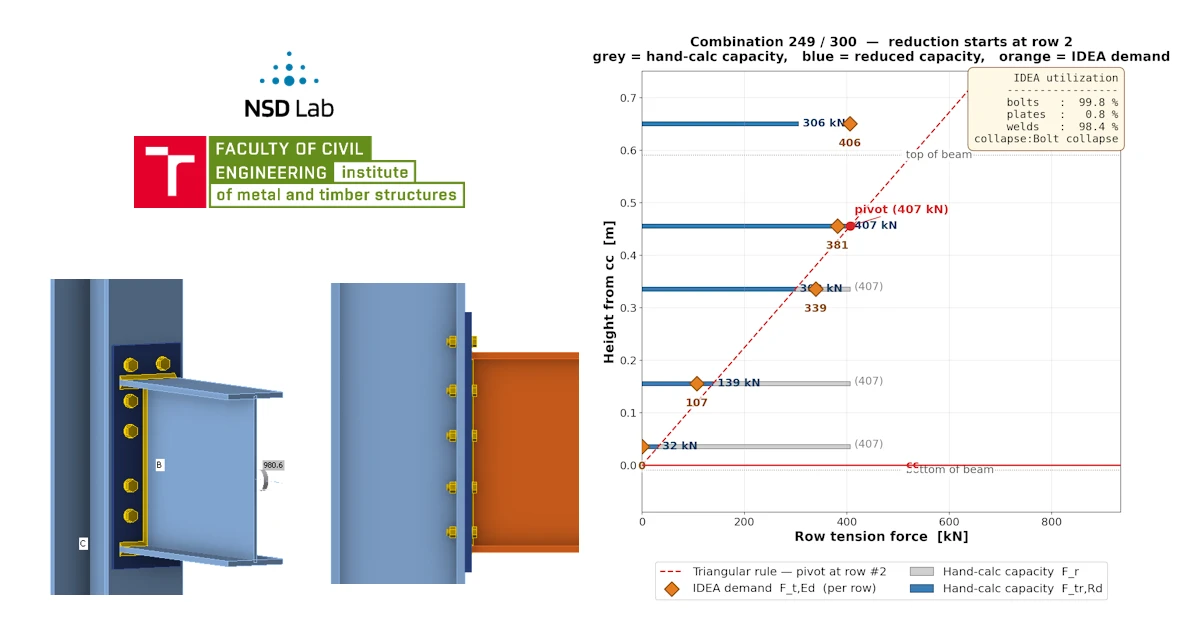
This study investigates the assumptions of distribution of forces in bolt rows at an end-plate connection.
EN 1993-1-8:2005, Clause 6.2.7.2(9) states:
Where the effective design tension resistance Ftx,Rd of one of the previous bolt rows x is greater than 1.9 Ft,Rd, the effective design tension resistance Ftr,Rd for bolt row r should be reduced, if necessary, in order to ensure that:
where:
- hx is the distance from bolt row x to the center of compression;
- x is the bolt row farthest from the center of compression that has a design tension resistance greater than 1.9 Ft,Rd.
Three cases are investigated:
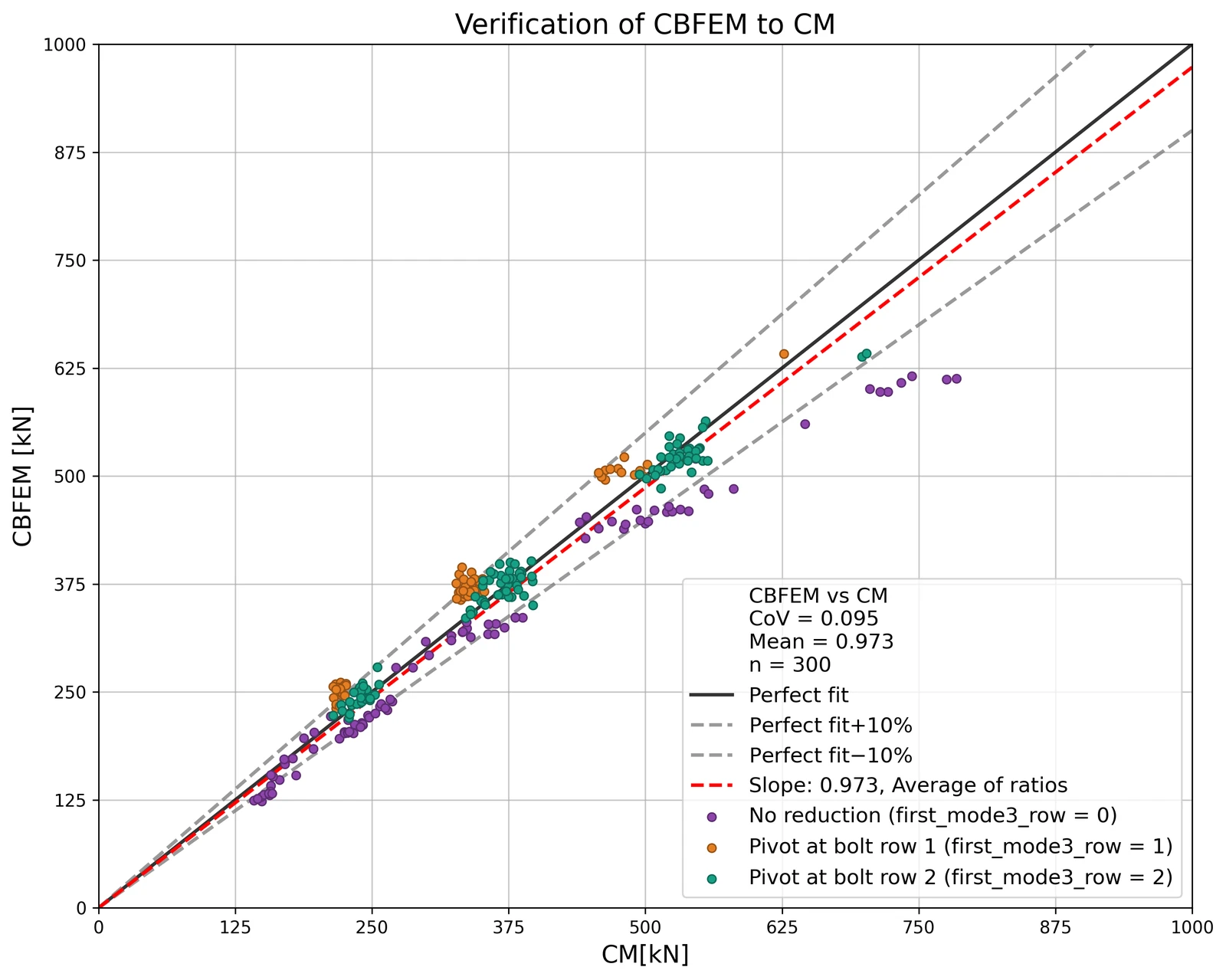
- Resistance of each bolt row was always below the limit of 1.9⋅Ft,Rd. Plastic force distribution is assumed in the component method.
- The limit of 1.9⋅Ft,Rd was reached already in the first bolt row. Elastic force distribution is assumed in the component method.
- The limit of 1.9⋅Ft,Rd was reached in the second bolt row below the beam flange. Elastic force distribution is assumed in the rows below in the component method.
The results include a comparison of bolt forces (CBFEM) or T-stub resistances (CM) in each bolt row:
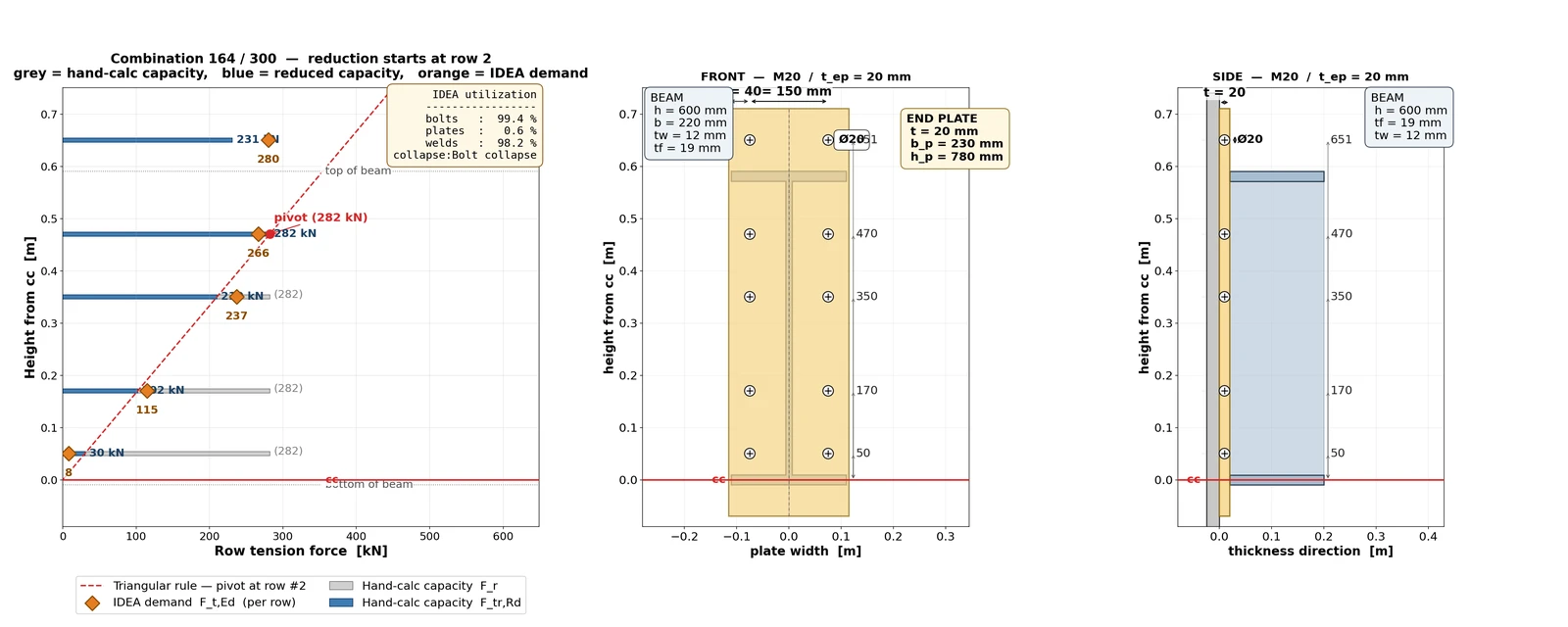
The resistances determined using the two methods, CM and CBFEM, are in close agreement:
Read the full report in the attached pdf.
The results of each case, along with the validation calculation example, are available in this zip folder: