
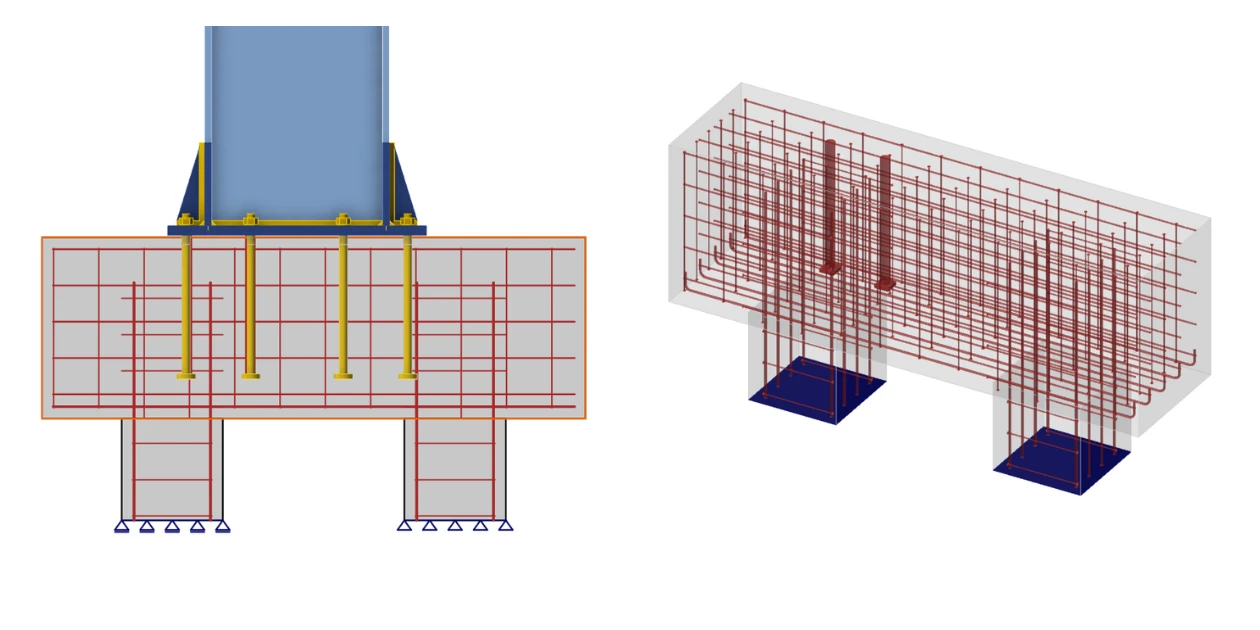


เมื่อทำการยึดเหล็กกับคอนกรีต โดยทั่วไปจะใช้สลักยึดหรือพุกเคมีเพื่อให้มั่นใจในความมั่นคงของโครงสร้างและความสามารถในการรับน้ำหนักในโครงการก่อสร้าง โดยแบบจำลองจะถูกวิเคราะห์ใน IDEA StatiCa Detail app
Widget #NaN: widget_content_image_collapse_item
Name: IDEA StatiCa Detail
ID: b3110a59-a173-4dde-81ac-e4d2ed554ff5
Show Raw Data
{
"title": {
"name": "Title",
"type": "text",
"value": "IDEA StatiCa Detail"
},
"description": {
"images": [],
"linkedItemCodenames": [],
"linkedItems": [],
"links": [],
"name": "Description",
"type": "rich_text",
"value": "<p>เหมาะสำหรับชิ้นส่วนที่มีบริเวณ D (บริเวณไม่ต่อเนื่อง) ช่องเปิด และส่วนเสริมคาน รวมถึงชิ้นส่วน 2D ที่มีรูปทรงทั่วไป </p>\n<ul>\n <li>วิธี CSFM แบบไม่เชิงเส้น </li>\n <li>ความเค้นและความเครียดของ Concrete และเหล็กเสริมทั้งหมด</li>\n <li>การตรวจสอบความกว้างรอยแตก</li>\n <li>การตรวจสอบขีดจำกัดความเค้น</li>\n <li>การโก่งตัวแบบไม่เชิงเส้น</li>\n <li>นำเข้าข้อมูลจาก Beam application</li>\n</ul>"
},
"link_text": {
"name": "Link text",
"type": "text",
"value": "อ่านเพิ่มเติมเกี่ยวกับการคำนวณ"
},
"link_url": {
"name": "Link URL",
"type": "text",
"value": ""
},
"content_item_link": {
"name": "Content item link",
"type": "modular_content",
"value": [
"detail_theoretical_background"
],
"linkedItems": [
{
"elements": {
"title": {
"name": "Main headline (H1)",
"type": "text",
"value": "IDEA StatiCa Module รายละเอียด – การออกแบบโครงสร้างสำหรับบริเวณไม่ต่อเนื่องของ Concrete"
},
"preview_image": {
"name": "Preview image",
"type": "asset",
"value": [
{
"name": "Structural design of concrete members in IDEA StatiCa Detail.png",
"description": null,
"type": "image/png",
"size": 163091,
"url": "https://assets-us-01.kc-usercontent.com:443/66e7a155-be94-0096-73e6-c55dfc7e5788/7885cdc1-8e4a-4744-834e-72ea84ebbaf4/Structural%20design%20of%20concrete%20members%20in%20IDEA%20StatiCa%20Detail.png",
"width": 1200,
"height": 630,
"renditions": {}
}
]
},
"post_date": {
"name": "Post date",
"type": "date_time",
"value": null,
"displayTimeZone": null
},
"perex_content": {
"name": "Lead paragraph",
"type": "text",
"value": ""
},
"content": {
"images": [],
"linkedItemCodenames": [
"n040e96bb_486f_01f3_c432_7a23524f9331",
"theoretical_background_detail___general",
"a4bf16aa_6c2f_013e_1829_b9e25da3520e",
"theoretical_background_detail___main_assumptions_a",
"n67efa21f_23bd_0100_0148_693d9e355fd4",
"theoretical_background_detail___general___reinforc",
"n3387f1b0_a148_01f2_c521_8982bf821616",
"theoretical_background_detail___general___finite_e",
"n5a454114_cda7_01ac_2a78_a6de5ef06909",
"theoretical_background_detail___supports_and_load_",
"n779c20eb_117a_01d7_d627_9519532f7ade",
"theoretical_background_detail___load_transfer_at_t",
"n139133fb_8c26_0102_6b4f_3513e30e50ac",
"theoretical_background_detail___geometric_modifica",
"n400db889_291a_01ec_2b5c_4ef44ac08366",
"theoretical_background_detail___finite_element_typ",
"e7f79b22_bbb4_0191_dabc_999404b56d71",
"theoretical_background_detail___meshing",
"b3722d5c_2c12_01f8_8c9e_833582888727",
"theoretical_background_detail___solution_method_an",
"n5edb1005_76bb_0151_eae3_db8b3683baef",
"theoretical_background_detail___presentation_of_re",
"n978b3c2e_46e3_01f2_76ef_33d1116b0278",
"theoretical_background_detail___general___verifica",
"n87e806c7_4545_0146_3777_8d6eb4869c34",
"theoretical_background_detail___material_models__e",
"n1534a30e_6761_0171_a4f9_75aeb26cc31a",
"theoretical_background_detail___safety_factors",
"n9434c7ec_7980_0136_b33e_8a308d27d134",
"theoretical_background_detail___ultimate_limit_sta",
"n50ff4744_78f7_01f7_3551_097b5b78c4bc",
"theoretical_background_detail___partially_loaded_a",
"n03c0807f_9a1c_0133_bf9c_7962d39bb052",
"theoretical_background_detail___serviceability_lim",
"n8087c563_aff6_01b7_4912_b90597183afc",
"theoretical_background_detail___material_models__a",
"n36199632_b4e1_0174_2159_f7af58609c6d",
"theoretical_background_detail___factors___aci",
"b99a3f3f_74b2_01f2_79e2_3e6b5ea4fa73",
"theoretical_background_detail___strength_analysis_",
"bc0dab28_71ea_0113_c3a4_30b3a0d47c41",
"theoretical_background_detail___bearing_and_anchor",
"n720952b5_b0d2_0172_3e6f_8b8fd8d8c7ad",
"theoretical_background_detail___serviceability_ver",
"n46537cd0_9cdd_01c3_88fe_d53de6bb2dad",
"theoretical_background_detail___material_models__a_0b99d24",
"f8a30564_36a1_018a_3097_17b99f01f95d",
"theoretical_background_detail___resistance_and_loa",
"n24be91a3_fe1f_013b_a03d_cd9d045de7e4",
"theoretical_background_detail___strength_limit_sta",
"n6c2be4b0_9ee9_015d_b7f5_db4962d18b03",
"theoretical_background_detail___bearing_and_anchor_69cbe39",
"fd3ad7ab_3d32_018b_2b8f_715c0dad8963",
"theoretical_background_detail___service_limit_stat",
"n8f5d5ee6_6dbb_01bf_5218_02292159a74c",
"theoretical_background_detail___material_models__a_b7035a6",
"n094cf23e_ff81_018b_04fa_acd11fe30998",
"theoretical_background_detail___stress_reduction_a",
"e64dfcde_fc39_0132_0732_bc2e27f5fdce",
"theoretical_background_detail___strength_analysis__8bc3bfe",
"fb4f1e92_d8b4_0188_90bb_683d2482dc27",
"theoretical_background_detail___serviceability_ver_77b5f2c",
"n642589a6_4da6_01a2_de20_89abe76387f1",
"prestressing_in_detail___model_description__body_",
"a88f8b07_3321_01fa_6be7_5de76b226c27"
],
"linkedItems": [
{
"elements": {
"title": {
"name": "Title",
"type": "text",
"value": "1.1 General introduction"
},
"id": {
"name": "ID",
"type": "text",
"value": "general-introduction"
},
"printable_anchor": {
"name": "Printable anchor used in PDF content table",
"type": "multiple_choice",
"value": []
},
"translation__translation_connector": {
"name": "Translation Connector",
"type": "taxonomy",
"value": [],
"taxonomyGroup": "languages"
},
"translation__force_translation": {
"name": "Force translation",
"type": "multiple_choice",
"value": []
},
"translation__translate_standalone_nested_content_items": {
"name": "Translate standalone nested content items",
"type": "multiple_choice",
"value": []
},
"translation__last_translation": {
"images": [],
"linkedItemCodenames": [],
"linkedItems": [],
"links": [],
"name": "Last translation",
"type": "rich_text",
"value": "<p><br></p>"
},
"translation__ai_translated": {
"name": "AI translated",
"type": "multiple_choice",
"value": []
},
"translation___experimental__synchronize_content_references": {
"name": "[Experimental] Synchronize content references",
"type": "multiple_choice",
"value": []
},
"translation___experimental__selective_element_translation": {
"name": "[Experimental] Selective translation",
"type": "multiple_choice",
"value": []
},
"translation__selectivetranslationelementid": {
"name": "selectiveTranslationElementId",
"type": "custom",
"value": null
}
},
"system": {
"codename": "n040e96bb_486f_01f3_c432_7a23524f9331",
"collection": "default",
"id": "040e96bb-486f-01f3-c432-7a23524f9331",
"language": "th-TH",
"lastModified": "2026-08-14T22:45:59.9271002Z",
"name": "040e96bb-486f-01f3-c432-7a23524f9331",
"sitemapLocations": [],
"type": "widget_anchor_target",
"workflowStep": null,
"workflow": null
}
},
{
"elements": {
"title": {
"name": "Main headline (H1)",
"type": "text",
"value": "1.1 บทนำทั่วไปสำหรับการออกแบบโครงสร้าง Concrete detail"
},
"preview_image": {
"name": "Preview image",
"type": "asset",
"value": [
{
"name": "General introduction for the structural design of concrete details.png",
"description": null,
"type": "image/png",
"size": 151821,
"url": "https://assets-us-01.kc-usercontent.com:443/66e7a155-be94-0096-73e6-c55dfc7e5788/918cd80e-191a-437a-8d6a-d2f8c7f688c2/General%20introduction%20for%20the%20structural%20design%20of%20concrete%20details.png",
"width": 1200,
"height": 630,
"renditions": {}
}
]
},
"post_date": {
"name": "Post date",
"type": "date_time",
"value": null,
"displayTimeZone": null
},
"perex_content": {
"name": "Lead paragraph",
"type": "text",
"value": ""
},
"content": {
"images": [
{
"description": null,
"imageId": "874c8092-fb41-44c6-804d-52727044d470",
"url": "https://assets-us-01.kc-usercontent.com:443/66e7a155-be94-0096-73e6-c55dfc7e5788/dc96c2fd-25aa-43fd-b6d5-556b5242b9cf/Discontinuity%20regions.png",
"height": 939,
"width": 1394
}
],
"linkedItemCodenames": [],
"linkedItems": [],
"links": [],
"name": "Content",
"type": "rich_text",
"value": "<p>การออกแบบและการประเมินชิ้นส่วน Concrete โดยปกติจะดำเนินการที่ระดับหน้าตัด (1D-element) หรือระดับจุด (2D-element) ขั้นตอนนี้ได้รับการอธิบายไว้ในมาตรฐานการออกแบบโครงสร้างทั้งหมด เช่น ใน (EN 1992-1-1 หรือ ACI 318-19) และถูกใช้ในงานปฏิบัติวิศวกรรมโครงสร้างในชีวิตประจำวัน อย่างไรก็ตาม สิ่งที่ไม่ค่อยเป็นที่รู้หรือถูกให้ความสำคัญคือ ขั้นตอนนี้สามารถใช้ได้เฉพาะในบริเวณที่สมมติฐาน Bernoulli-Navier เกี่ยวกับการกระจายความเครียดแบบระนาบใช้ได้เท่านั้น (เรียกว่าบริเวณ B) ส่วนบริเวณที่สมมติฐานนี้ไม่สามารถใช้ได้เรียกว่าบริเวณไม่ต่อเนื่องหรือบริเวณถูกรบกวน (บริเวณ D) ตัวอย่างของบริเวณ B และ D ของชิ้นส่วน 1D แสดงไว้ใน (Fig. 1) ตัวอย่างเหล่านี้ได้แก่ บริเวณรองรับแรง ส่วนที่มีการใช้แรงกระทำแบบจุด ตำแหน่งที่มีการเปลี่ยนแปลงหน้าตัดอย่างฉับพลัน ช่องเปิด เป็นต้น เมื่อออกแบบโครงสร้าง Concrete เราจะพบบริเวณ D อื่นๆ อีกมากมาย เช่น ผนัง ไดอะแฟรมสะพาน Console เป็นต้น </p>\n<figure data-asset-id=\"874c8092-fb41-44c6-804d-52727044d470\" data-image-id=\"874c8092-fb41-44c6-804d-52727044d470\"><img src=\"https://assets-us-01.kc-usercontent.com:443/66e7a155-be94-0096-73e6-c55dfc7e5788/dc96c2fd-25aa-43fd-b6d5-556b5242b9cf/Discontinuity%20regions.png\" data-asset-id=\"874c8092-fb41-44c6-804d-52727044d470\" data-image-id=\"874c8092-fb41-44c6-804d-52727044d470\" alt=\"\"></figure>\n<p><em>\\[ \\textsf{\\textit{\\footnotesize{Fig. 1\\qquad Discontinuity regions (Navrátil et al. 2017)}}}\\]</em></p>\n<p>ในอดีต กฎการออกแบบแบบกึ่งประสบการณ์ (semi-empirical) ถูกนำมาใช้ในการกำหนดขนาดบริเวณไม่ต่อเนื่อง โชคดีที่กฎเหล่านี้ได้ถูกแทนที่เป็นส่วนใหญ่ในช่วงหลายทศวรรษที่ผ่านมาด้วยแบบจำลองค้ำยันและตัวดึง (Schlaich et al., 1987) และสนามความเค้น (stress fields) (Marti 1985) ซึ่งปรากฏอยู่ในมาตรฐานการออกแบบปัจจุบันและถูกใช้บ่อยครั้งโดยผู้ออกแบบในปัจจุบัน แบบจำลองเหล่านี้มีความสอดคล้องทางกลศาสตร์และเป็นเครื่องมือที่ทรงพลัง โปรดทราบว่าสนามความเค้นโดยทั่วไปสามารถเป็นแบบต่อเนื่องหรือไม่ต่อเนื่องก็ได้ และแบบจำลองค้ำยันและตัวดึงเป็นกรณีพิเศษของสนามความเค้นแบบไม่ต่อเนื่อง</p>\n<p>แม้จะมีการพัฒนาเครื่องมือคำนวณในช่วงหลายทศวรรษที่ผ่านมา แบบจำลองค้ำยันและตัวดึงยังคงถูกใช้เป็นหลักในลักษณะการคำนวณด้วยมือ การนำไปใช้กับโครงสร้างจริงเป็นเรื่องยุ่งยากและใช้เวลานาน เนื่องจากต้องมีการทำซ้ำ (iteration) และต้องพิจารณาหลายกรณีแรง นอกจากนี้ วิธีนี้ยังไม่เหมาะสมสำหรับการตรวจสอบเกณฑ์ความสามารถในการใช้งาน (การเสียรูป ความกว้างรอยแตก ฯลฯ)</p>\n<p>ความสนใจของวิศวกรโครงสร้างในเครื่องมือที่เชื่อถือได้และรวดเร็วสำหรับการออกแบบบริเวณ D นำไปสู่การตัดสินใจพัฒนาวิธีสนามความเค้นที่สอดคล้อง (Compatible Stress Field Method) แบบใหม่ ซึ่งเป็นวิธีการออกแบบสนามความเค้นด้วยความช่วยเหลือของคอมพิวเตอร์ที่ช่วยให้สามารถออกแบบและประเมินชิ้นส่วน Concrete โครงสร้างที่รับแรงกระทำในระนาบได้โดยอัตโนมัติ</p>\n<p>วิธีสนามความเค้นที่สอดคล้อง (Compatible Stress Field Method หรือ CSFM) เป็นวิธีการวิเคราะห์สนามความเค้นแบบต่อเนื่องบนพื้นฐาน FE ซึ่งคำตอบของสนามความเค้นแบบคลาสสิกได้รับการเสริมด้วยการพิจารณาทางจลนศาสตร์ (kinematic) กล่าวคือ สถานะของความเครียดจะถูกประเมินตลอดทั้งโครงสร้าง ดังนั้น กำลังรับแรงอัดประสิทธิผลของ Concrete จึงสามารถคำนวณได้โดยอัตโนมัติจากสถานะของความเครียดตามขวาง ในลักษณะเดียวกันกับการวิเคราะห์สนามแรงอัด (compression field analyses) ที่คำนึงถึงการอ่อนตัวจากแรงอัด (Vecchio and Collins 1986; Kaufmann and Marti 1998) และวิธี EPSF (Fernández Ruiz and Muttoni 2007) ยิ่งไปกว่านั้น CSFM ยังคำนึงถึงการเสริมความแข็งจากแรงดึง ซึ่งให้ค่าความแข็งที่สมจริงแก่ชิ้นส่วนต่างๆ และครอบคลุมข้อกำหนดของมาตรฐานการออกแบบทั้งหมด (รวมถึงแง่มุมด้านความสามารถในการใช้งานและความสามารถในการเสียรูป) ซึ่งวิธีการก่อนหน้านี้ไม่สามารถจัดการได้อย่างสอดคล้องกัน CSFM ใช้กฎความสัมพันธ์เชิงองค์ประกอบแบบแกนเดียว (uniaxial constitutive laws) ทั่วไปที่กำหนดโดยมาตรฐานการออกแบบสำหรับ Concrete และเหล็กเสริม ซึ่งเป็นที่ทราบตั้งแต่ขั้นตอนการออกแบบ ทำให้สามารถใช้วิธีตัวประกอบความปลอดภัยบางส่วน (partial safety factor method) ได้ ดังนั้น ผู้ออกแบบจึงไม่จำเป็นต้องกำหนดคุณสมบัติวัสดุเพิ่มเติมที่มักจะเป็นไปตามอำเภอใจ ซึ่งโดยทั่วไปจำเป็นสำหรับการวิเคราะห์ FE แบบไม่เชิงเส้น ทำให้วิธีนี้เหมาะสมอย่างยิ่งสำหรับงานปฏิบัติทางวิศวกรรม</p>\n<p>เพื่อส่งเสริมการใช้สนามความเค้นด้วยความช่วยเหลือของคอมพิวเตอร์โดยวิศวกรโครงสร้าง วิธีการเหล่านี้ควรถูกนำไปใช้งานในสภาพแวดล้อมซอฟต์แวร์ที่ใช้งานง่าย ด้วยเหตุนี้ CSFM จึงได้ถูกนำไปใช้งานใน <em>IDEA StatiCa Detail</em> ซึ่งเป็นซอฟต์แวร์เชิงพาณิชย์ใหม่ที่ใช้งานง่าย พัฒนาร่วมกันโดย ETH Zurich และบริษัทซอฟต์แวร์ IDEA StatiCa ภายใต้กรอบโครงการ DR-Design Eurostars-10571</p>"
},
"linked_items": {
"name": "Linked items",
"type": "modular_content",
"value": [
"detail_theoretical_background",
"theoretical_background_detail___general___reinforc",
"dimenzovani_zb_konstrukci_podle_csfm",
"prestressed_i_section"
],
"linkedItems": [
"[Circular Reference]",
{
"elements": {
"title": {
"name": "Main headline (H1)",
"type": "text",
"value": "1.3 เครื่องมือออกแบบสำหรับเหล็กเสริม"
},
"preview_image": {
"name": "Preview image",
"type": "asset",
"value": [
{
"name": "Reinforcement structural design.png",
"description": null,
"type": "image/png",
"size": 61765,
"url": "https://assets-us-01.kc-usercontent.com:443/66e7a155-be94-0096-73e6-c55dfc7e5788/8d4e1ab7-8d44-491e-873f-8ea42d620992/Reinforcement%20structural%20design.png",
"width": 1200,
"height": 630,
"renditions": {}
}
]
},
"post_date": {
"name": "Post date",
"type": "date_time",
"value": null,
"displayTimeZone": null
},
"perex_content": {
"name": "Lead paragraph",
"type": "text",
"value": ""
},
"content": {
"images": [
{
"description": null,
"imageId": "eee2b9e4-83cd-4b9c-98e7-f575b2ff9cff",
"url": "https://assets-us-01.kc-usercontent.com:443/66e7a155-be94-0096-73e6-c55dfc7e5788/9b0c4840-5a55-46f3-95ba-86a9baabbf0c/Model%20used%20to%20illustrate%20the%20use%20of%20the%20reinforcement%20design%20tools.png",
"height": 603,
"width": 864
},
{
"description": null,
"imageId": "f6c14a09-4d2b-40e6-ac82-5ff08c10439a",
"url": "https://assets-us-01.kc-usercontent.com:443/66e7a155-be94-0096-73e6-c55dfc7e5788/ea7896d1-8276-4d08-b811-066cca73b455/Results%20from%20the%20linear%20analysis%20tool.jpg",
"height": 315,
"width": 1177
},
{
"description": null,
"imageId": "f4f47d5e-3196-4a88-96ca-7162b0c8c271",
"url": "https://assets-us-01.kc-usercontent.com:443/66e7a155-be94-0096-73e6-c55dfc7e5788/f4d37064-76c7-4413-b1aa-87455a32852c/Results%20from%20the%20topology%20optimization%201.jpg",
"height": 320,
"width": 1179
},
{
"description": null,
"imageId": "7ddd1329-64ea-4a47-be5d-64994439e729",
"url": "https://assets-us-01.kc-usercontent.com:443/66e7a155-be94-0096-73e6-c55dfc7e5788/d81f2841-8274-414a-8f30-b55427216169/Results%20from%20the%20topology%20optimization%202.png",
"height": 315,
"width": 1179
}
],
"linkedItemCodenames": [],
"linkedItems": [],
"links": [
{
"codename": "csfm_concrete_verification",
"linkId": "42ce7f6b-6491-4224-a01e-c4c0072ed1cd",
"urlSlug": "design-your-structural-concrete-details-with-confidence",
"type": "blog_post"
},
{
"codename": "topology_optimization_for_reinforced_concrete",
"linkId": "decdf07d-a46b-5894-9a22-793436e318c7",
"urlSlug": "topology-optimization-for-reinforced-concrete",
"type": "blog_post"
}
],
"name": "Content",
"type": "rich_text",
"value": "<h3>ขั้นตอนการทำงานและเป้าหมาย</h3>\n<p>เป้าหมายของเครื่องมือออกแบบเหล็กเสริมใน <a data-item-id=\"42ce7f6b-6491-4224-a01e-c4c0072ed1cd\" href=\"\">CSFM</a> คือการช่วยให้ผู้ออกแบบสามารถกำหนดตำแหน่งและปริมาณของเหล็กเสริมที่ต้องการได้อย่างมีประสิทธิภาพ เครื่องมือต่อไปนี้มีไว้เพื่อช่วย / แนะนำผู้ใช้ในกระบวนการนี้: การคำนวณเชิงเส้น และ <a data-item-id=\"decdf07d-a46b-5894-9a22-793436e318c7\" href=\"\">การหาค่าเหมาะสมทางทอพอโลยี</a></p>\n<p>เครื่องมือออกแบบเหล็กเสริมพิจารณาแบบจำลองความสัมพันธ์เชิงองค์ประกอบ (constitutive model) ที่ง่ายกว่าแบบจำลองที่ใช้ในการตรวจสอบขั้นสุดท้ายของโครงสร้าง ดังนั้น การกำหนดเหล็กเสริมในขั้นตอนนี้ควรถือเป็นการออกแบบเบื้องต้นที่จะต้องได้รับการยืนยัน/ปรับปรุงในขั้นตอนการตรวจสอบขั้นสุดท้าย การใช้เครื่องมือออกแบบเหล็กเสริมแบบต่าง ๆ จะแสดงในแบบจำลองที่แสดงในรูปที่ 3 ซึ่งประกอบด้วยปลายด้านหนึ่งของคานช่วงเดียวที่รองรับแบบธรรมดา (simply supported beam) ที่มีความลึกแปรผัน ภายใต้แรงกระทำแบบกระจายสม่ำเสมอ</p>\n<figure data-asset-id=\"eee2b9e4-83cd-4b9c-98e7-f575b2ff9cff\" data-image-id=\"eee2b9e4-83cd-4b9c-98e7-f575b2ff9cff\"><img src=\"https://assets-us-01.kc-usercontent.com:443/66e7a155-be94-0096-73e6-c55dfc7e5788/9b0c4840-5a55-46f3-95ba-86a9baabbf0c/Model%20used%20to%20illustrate%20the%20use%20of%20the%20reinforcement%20design%20tools.png\" data-asset-id=\"eee2b9e4-83cd-4b9c-98e7-f575b2ff9cff\" data-image-id=\"eee2b9e4-83cd-4b9c-98e7-f575b2ff9cff\" alt=\"\"></figure>\n<p><em>\\[ \\textsf{\\textit{\\footnotesize{Fig. 3\\qquad Model used to illustrate the use of the reinforcement design tools.}}}\\]</em></p>\n<h3>การวิเคราะห์เชิงเส้น</h3>\n<p>การวิเคราะห์เชิงเส้นพิจารณาคุณสมบัติวัสดุแบบยืดหยุ่นเชิงเส้น (linear elastic) และไม่คำนึงถึงเหล็กเสริมในบริเวณคอนกรีต ดังนั้นจึงเป็นการคำนวณที่รวดเร็วมาก ซึ่งให้ข้อมูลเชิงลึกเบื้องต้นเกี่ยวกับตำแหน่งของบริเวณแรงดึงและแรงอัด ตัวอย่างของการคำนวณดังกล่าวแสดงในรูปที่ 4</p>\n<figure data-asset-id=\"f6c14a09-4d2b-40e6-ac82-5ff08c10439a\" data-image-id=\"f6c14a09-4d2b-40e6-ac82-5ff08c10439a\"><img src=\"https://assets-us-01.kc-usercontent.com:443/66e7a155-be94-0096-73e6-c55dfc7e5788/ea7896d1-8276-4d08-b811-066cca73b455/Results%20from%20the%20linear%20analysis%20tool.jpg\" data-asset-id=\"f6c14a09-4d2b-40e6-ac82-5ff08c10439a\" data-image-id=\"f6c14a09-4d2b-40e6-ac82-5ff08c10439a\" alt=\"\"></figure>\n<p><em>\\[ \\textsf{\\textit{\\footnotesize{Fig. 4\\qquad Results from the linear analysis tool for defining reinforcement layout}}}\\]</em></p>\n<p><em>\\[ \\textsf{\\textit{\\footnotesize{(red: areas in compression, blue: areas in tension).}}}\\]</em></p>\n<h3>การหาค่าเหมาะสมทางทอพอโลยี</h3>\n<p>การหาค่าเหมาะสมทางทอพอโลยีเป็นวิธีการที่มุ่งค้นหาการกระจายตัวของวัสดุที่เหมาะสมที่สุดในปริมาตรที่กำหนด สำหรับรูปแบบแรงกระทำหนึ่ง ๆ การหาค่าเหมาะสมทางทอพอโลยีที่นำมาใช้ใน <em>Idea StatiCa Detail</em> ใช้แบบจำลอง Finite Element เชิงเส้น แต่ละ Finite Element อาจมีความหนาแน่นสัมพัทธ์ตั้งแต่ 0 ถึง 100% ซึ่งแสดงถึงปริมาณสัมพัทธ์ของวัสดุที่ใช้ ความหนาแน่นขององค์ประกอบเหล่านี้เป็นพารามิเตอร์ในการหาค่าเหมาะสม การกระจายตัวของวัสดุที่ได้จะถือว่าเหมาะสมที่สุดสำหรับชุดของแรงกระทำที่กำหนด หากทำให้พลังงานความเครียดรวมของระบบมีค่าน้อยที่สุด ตามคำนิยาม การกระจายตัวที่เหมาะสมที่สุดยังเป็นรูปทรงที่มีความแข็ง (stiffness) มากที่สุดเท่าที่จะเป็นไปได้สำหรับแรงกระทำที่กำหนด</p>\n<p>กระบวนการหาค่าเหมาะสมแบบวนซ้ำเริ่มต้นด้วยการกระจายความหนาแน่นที่สม่ำเสมอ<em> </em>การคำนวณจะดำเนินการสำหรับสัดส่วนปริมาตรรวมหลายค่า (20%, 40%, 60% และ 80%) ซึ่งช่วยให้ผู้ใช้สามารถเลือกผลลัพธ์ที่เหมาะสมกับการใช้งานจริงมากที่สุด รูปทรงที่ได้ประกอบด้วยโครงถักที่มีค้ำยันรับแรงอัดและตัวดึง และแสดงถึงรูปทรงที่เหมาะสมที่สุดสำหรับกรณีแรงกระทำที่กำหนด (รูปที่ 5)</p>\n<figure data-asset-id=\"f4f47d5e-3196-4a88-96ca-7162b0c8c271\" data-image-id=\"f4f47d5e-3196-4a88-96ca-7162b0c8c271\"><img src=\"https://assets-us-01.kc-usercontent.com:443/66e7a155-be94-0096-73e6-c55dfc7e5788/f4d37064-76c7-4413-b1aa-87455a32852c/Results%20from%20the%20topology%20optimization%201.jpg\" data-asset-id=\"f4f47d5e-3196-4a88-96ca-7162b0c8c271\" data-image-id=\"f4f47d5e-3196-4a88-96ca-7162b0c8c271\" alt=\"\"></figure>\n<figure data-asset-id=\"7ddd1329-64ea-4a47-be5d-64994439e729\" data-image-id=\"7ddd1329-64ea-4a47-be5d-64994439e729\"><img src=\"https://assets-us-01.kc-usercontent.com:443/66e7a155-be94-0096-73e6-c55dfc7e5788/d81f2841-8274-414a-8f30-b55427216169/Results%20from%20the%20topology%20optimization%202.png\" data-asset-id=\"7ddd1329-64ea-4a47-be5d-64994439e729\" data-image-id=\"7ddd1329-64ea-4a47-be5d-64994439e729\" alt=\"\"></figure>\n<p><em>\\[ \\textsf{\\textit{\\footnotesize{Fig. 5\\qquad Results from the topology optimization design tool with 20\\% and 40\\% effective volume}}}\\]</em></p>\n<p><em>\\[ \\textsf{\\textit{\\footnotesize{(red: areas in compression, blue: areas in tension).}}}\\]</em></p>\n<p><br></p>"
},
"linked_items": {
"name": "Linked items",
"type": "modular_content",
"value": [
"theoretical_background_detail___general",
"theoretical_background_detail___general___finite_e",
"dimenzovani_zb_konstrukci_podle_csfm"
],
"linkedItems": [
"[Circular Reference]",
{
"elements": {
"title": {
"name": "Main headline (H1)",
"type": "text",
"value": "2.1 บทนำเกี่ยวกับการนำวิธี Finite Element ไปใช้งาน"
},
"preview_image": {
"name": "Preview image",
"type": "asset",
"value": [
{
"name": "Finite element implementation in IDEA StatiCa Detail.png",
"description": null,
"type": "image/png",
"size": 481046,
"url": "https://assets-us-01.kc-usercontent.com:443/66e7a155-be94-0096-73e6-c55dfc7e5788/0388381a-906d-48f1-a5b2-ce00188fded9/Finite%20element%20implementation%20in%20IDEA%20StatiCa%20Detail.png",
"width": 1200,
"height": 630,
"renditions": {}
}
]
},
"post_date": {
"name": "Post date",
"type": "date_time",
"value": null,
"displayTimeZone": null
},
"perex_content": {
"name": "Lead paragraph",
"type": "text",
"value": ""
},
"content": {
"images": [
{
"description": null,
"imageId": "9e86fe68-36a5-433d-9451-40d2b5078b86",
"url": "https://assets-us-01.kc-usercontent.com:443/66e7a155-be94-0096-73e6-c55dfc7e5788/3f70008c-0c34-4dbe-8219-4d8aa7079bb5/Visualization%20of%20the%20calculation%20model.png",
"height": 562,
"width": 847
}
],
"linkedItemCodenames": [],
"linkedItems": [],
"links": [
{
"codename": "untitled_content_item_a11adc2",
"linkId": "a11adc2d-9c84-4667-8061-600660e1ad87",
"urlSlug": "concrete-walls-challenge-or-routine",
"type": "blog_post"
}
],
"name": "Content",
"type": "rich_text",
"value": "<p>วิธี CSFM พิจารณาสนามความเค้นต่อเนื่องในคอนกรีต (Finite Elements แบบ 2 มิติ) ร่วมกับชิ้นส่วน \"แท่ง\" แบบไม่ต่อเนื่อง (Finite Elements แบบ 1 มิติ) ที่แทนเหล็กเสริม ดังนั้น เหล็กเสริมจึงไม่ได้ถูกฝังแบบกระจายเข้าไปใน Finite Elements แบบ 2 มิติของคอนกรีต แต่ถูกจำลองอย่างชัดเจนและเชื่อมต่อเข้ากับคอนกรีตโดยตรง แบบจำลองการคำนวณพิจารณาสภาวะความเค้นแบบระนาบ (plane stress)</p>\n<figure data-asset-id=\"9e86fe68-36a5-433d-9451-40d2b5078b86\" data-image-id=\"9e86fe68-36a5-433d-9451-40d2b5078b86\"><img src=\"https://assets-us-01.kc-usercontent.com:443/66e7a155-be94-0096-73e6-c55dfc7e5788/3f70008c-0c34-4dbe-8219-4d8aa7079bb5/Visualization%20of%20the%20calculation%20model.png\" data-asset-id=\"9e86fe68-36a5-433d-9451-40d2b5078b86\" data-image-id=\"9e86fe68-36a5-433d-9451-40d2b5078b86\" alt=\"\"></figure>\n<p><em>\\[ \\textsf{\\textit{\\footnotesize{Fig. 6\\qquad Visualization of the calculation model of a structural element (trimmed beam) in Idea StatiCa Detail.}}}\\]</em></p>\n<p>สามารถจำลองได้ทั้ง<a data-item-id=\"a11adc2d-9c84-4667-8061-600660e1ad87\" href=\"\">ผนัง</a>และคานทั้งชิ้น รวมถึงรายละเอียด (บางส่วน) ของคาน (บริเวณความไม่ต่อเนื่องแบบแยกเดี่ยว หรือที่เรียกว่าปลายตัด) ในกรณีของผนังและคานทั้งชิ้น จะต้องกำหนดจุดรองรับในลักษณะที่ทำให้ได้โครงสร้างที่เป็นแบบสถิตยสมดุลพอดี (statically determinate) หรือแบบสถิตยไม่กำหนด (statically indeterminate) จากภายนอก การถ่ายแรงที่ปลายตัดของคานจะถูกนำเข้าผ่านโซนถ่ายแรงแบบ Saint-Venant พิเศษ ซึ่งช่วยให้เกิดการกระจายความเค้นที่สมจริงในบริเวณรายละเอียดที่วิเคราะห์</p>"
},
"linked_items": {
"name": "Linked items",
"type": "modular_content",
"value": [
"theoretical_background_detail___general___reinforc",
"theoretical_background_detail___general___verifica",
"n2017_solution_for_walls_and_details_of_concrete_st",
"fire_resistance_check_of_concrete_structures"
],
"linkedItems": [
"[Circular Reference]",
{
"elements": {
"title": {
"name": "Main headline (H1)",
"type": "text",
"value": "3.1 สภาวะขีดจำกัดและการคำนวณความกว้างของรอยแตกร้าว"
},
"preview_image": {
"name": "Preview image",
"type": "asset",
"value": [
{
"name": "Structural element verification in IDEA StatiCa Detail.png",
"description": null,
"type": "image/png",
"size": 174643,
"url": "https://assets-us-01.kc-usercontent.com:443/66e7a155-be94-0096-73e6-c55dfc7e5788/3ab2c71e-930c-4975-88fe-72502fad03d5/Structural%20element%20verification%20in%20IDEA%20StatiCa%20Detail.png",
"width": 1200,
"height": 630,
"renditions": {}
}
]
},
"post_date": {
"name": "Post date",
"type": "date_time",
"value": null,
"displayTimeZone": null
},
"perex_content": {
"name": "Lead paragraph",
"type": "text",
"value": ""
},
"content": {
"images": [
{
"description": null,
"imageId": "8c27dc0f-1cfe-4026-bbf5-4b51604c3558",
"url": "https://assets-us-01.kc-usercontent.com:443/66e7a155-be94-0096-73e6-c55dfc7e5788/aabe4d74-d599-4c9d-a62d-8e448a66360a/Mesh%20multiplier.PNG",
"height": 55,
"width": 421
}
],
"linkedItemCodenames": [
"theoretical_background_detail___crack_width_calcul"
],
"linkedItems": [],
"links": [],
"name": "Content",
"type": "rich_text",
"value": "<p>การประเมินโครงสร้างโดยใช้ CSFM ดำเนินการโดยการวิเคราะห์สองแบบที่แตกต่างกัน คือ การวิเคราะห์สำหรับสภาวะใช้งาน (SLS) และการวิเคราะห์สำหรับชุดแรงกระทำที่สภาวะขีดจำกัดสูงสุด (ULS) การวิเคราะห์สภาวะใช้งานตั้งสมมติฐานว่าพฤติกรรมสภาวะขีดจำกัดสูงสุดของ Element เป็นที่น่าพอใจ และเงื่อนไขการครากของวัสดุจะไม่ถึงที่ระดับแรงในสภาวะใช้งาน แนวทางนี้ทำให้สามารถใช้แบบจำลองการก่อตัวที่ง่ายขึ้น (โดยมีช่วงเชิงเส้นของไดอะแกรมความเค้น-ความเครียดของคอนกรีต) สำหรับการวิเคราะห์สภาวะใช้งาน เพื่อเพิ่มความเสถียรเชิงตัวเลขและความเร็วในการคำนวณ ดังนั้น จึงแนะนำให้ใช้ขั้นตอนการทำงานที่นำเสนอด้านล่างนี้ ซึ่งการวิเคราะห์สภาวะขีดจำกัดสูงสุดจะถูกดำเนินการเป็นขั้นตอนแรก</p>\n<h3>การวิเคราะห์สภาวะขีดจำกัดสูงสุด</h3>\n<p>การตรวจสอบต่างๆ ที่กำหนดโดยมาตรฐานการออกแบบเฉพาะจะถูกประเมินโดยอาศัยผลลัพธ์โดยตรงที่ได้จากแบบจำลอง การตรวจสอบ ULS ดำเนินการสำหรับกำลังของคอนกรีต กำลังของเหล็กเสริม และความยาวยึดเหนี่ยว (ความเค้นเฉือนแรงยึดเหนี่ยว)</p>\n<p>เพื่อให้มั่นใจว่าชิ้นส่วนโครงสร้างมีการออกแบบที่มีประสิทธิภาพ ขอแนะนำอย่างยิ่งให้ดำเนินการวิเคราะห์เบื้องต้นซึ่งพิจารณาขั้นตอนต่อไปนี้:</p>\n<ul>\n <li>เลือกชุดแรงกระทำที่วิกฤตที่สุดบางส่วน</li>\n <li>คำนวณเฉพาะชุดแรงกระทำที่สภาวะขีดจำกัดสูงสุด (ULS)</li>\n <li>ใช้ตาข่ายที่หยาบ (โดยการเพิ่มตัวคูณของขนาดตาข่ายเริ่มต้นใน Setup (Fig. 19))</li>\n</ul>\n<figure data-asset-id=\"8c27dc0f-1cfe-4026-bbf5-4b51604c3558\" data-image-id=\"8c27dc0f-1cfe-4026-bbf5-4b51604c3558\"><img src=\"https://assets-us-01.kc-usercontent.com:443/66e7a155-be94-0096-73e6-c55dfc7e5788/aabe4d74-d599-4c9d-a62d-8e448a66360a/Mesh%20multiplier.PNG\" data-asset-id=\"8c27dc0f-1cfe-4026-bbf5-4b51604c3558\" data-image-id=\"8c27dc0f-1cfe-4026-bbf5-4b51604c3558\" alt=\"\"></figure>\n<p><em>\\[ \\textsf{\\textit{\\footnotesize{Fig. 19\\qquad Mesh multiplier.}}}\\]</em></p>\n<p>แบบจำลองดังกล่าวจะคำนวณได้อย่างรวดเร็วมาก ทำให้ผู้ออกแบบสามารถทบทวนรายละเอียดของชิ้นส่วนโครงสร้างได้อย่างมีประสิทธิภาพ และดำเนินการวิเคราะห์ซ้ำจนกว่าข้อกำหนดการตรวจสอบทั้งหมดจะเป็นไปตามเกณฑ์สำหรับชุดแรงกระทำที่วิกฤตที่สุด เมื่อข้อกำหนดการตรวจสอบทั้งหมดของการวิเคราะห์เบื้องต้นนี้เป็นไปตามเกณฑ์แล้ว ขอแนะนำให้รวมชุดแรงกระทำที่สภาวะขีดจำกัดสูงสุดทั้งหมด และใช้ขนาดตาข่ายที่ละเอียด (ขนาดตาข่ายที่โปรแกรมแนะนำ) ผู้ใช้สามารถเปลี่ยนขนาดตาข่ายได้โดยใช้ตัวคูณ ซึ่งมีค่าตั้งแต่ 0.5 ถึง 5 (Fig. 19)</p>\n<p>ผลลัพธ์และการตรวจสอบพื้นฐาน (ความเค้น ความเครียด และอัตราการใช้งาน (กล่าวคือ ค่าที่คำนวณได้/ค่าจำกัดตามมาตรฐาน) รวมถึงทิศทางของความเค้นหลักในกรณีของ Element คอนกรีต) จะแสดงผ่านกราฟต่างๆ ซึ่งโดยทั่วไปแรงอัดจะแสดงเป็นสีแดงและแรงดึงเป็นสีน้ำเงิน ค่าต่ำสุดและสูงสุดโดยรวมสำหรับโครงสร้างทั้งหมดสามารถถูกเน้นได้ เช่นเดียวกับค่าต่ำสุดและสูงสุดสำหรับทุกส่วนที่ผู้ใช้กำหนดเอง ในแท็บแยกต่างหากของโปรแกรม ผลลัพธ์ขั้นสูง เช่น ค่าเทนเซอร์ การเปลี่ยนรูปของโครงสร้าง และอัตราส่วนเหล็กเสริม (ประสิทธิผลและทางเรขาคณิต) ที่ใช้สำหรับคำนวณการเสริมความแข็งจากแรงดึงของเหล็กเสริม สามารถแสดงได้ นอกจากนี้ แรงกระทำและปฏิกิริยาสำหรับชุดแรงกระทำหรือกรณีแรงกระทำที่เลือกไว้ก็สามารถนำเสนอได้เช่นกัน</p>\n<h3>การวิเคราะห์สภาวะขีดจำกัดการใช้งาน</h3>\n<p>การประเมิน SLS ดำเนินการสำหรับการจำกัดความเค้น ความกว้างรอยแตกร้าว และขีดจำกัดการโก่งตัว ความเค้นจะถูกตรวจสอบใน Element คอนกรีตและเหล็กเสริมตามมาตรฐานที่บังคับใช้ในลักษณะเดียวกันกับที่กำหนดไว้สำหรับ ULS</p>\n<p>การวิเคราะห์สภาวะใช้งานมีการทำให้ง่ายขึ้นบางประการของแบบจำลองการก่อตัวซึ่งใช้สำหรับการวิเคราะห์สภาวะขีดจำกัดสูงสุด โดยสมมติว่ามีการยึดเหนี่ยวที่สมบูรณ์แบบ กล่าวคือ ความยาวยึดเหนี่ยวจะไม่ถูกตรวจสอบที่สภาวะใช้งาน นอกจากนี้ ช่วงพลาสติกของเส้นโค้งความเค้น-ความเครียดของคอนกรีตภายใต้แรงอัดจะถูกละเลย ในขณะที่ช่วงยืดหยุ่นเป็นเชิงเส้นและไม่มีขอบเขต การทำให้ง่ายขึ้นเหล่านี้ช่วยเพิ่มความเสถียรเชิงตัวเลขและความเร็วในการคำนวณ และไม่ได้ลดความเป็นทั่วไปของผลเฉลย ตราบใดที่ขีดจำกัดความเค้นของวัสดุที่ได้ที่สภาวะใช้งานต่ำกว่าจุดครากอย่างชัดเจน (ตามที่มาตรฐานกำหนด) ดังนั้น แบบจำลองที่ทำให้ง่ายขึ้นที่ใช้สำหรับสภาวะใช้งานจะใช้ได้ก็ต่อเมื่อข้อกำหนดการตรวจสอบทั้งหมดเป็นไปตามเกณฑ์เท่านั้น</p>\n<object type=\"application/kenticocloud\" data-type=\"item\" data-rel=\"link\" data-codename=\"theoretical_background_detail___crack_width_calcul\"></object>"
},
"linked_items": {
"name": "Linked items",
"type": "modular_content",
"value": [
"theoretical_background_detail___general___finite_e",
"theoretical_background_detail___finite_element_typ",
"general_description_of_sls_results_in_detail_appli"
],
"linkedItems": [
"[Circular Reference]",
{
"elements": {
"title": {
"name": "Main headline (H1)",
"type": "text",
"value": "2.5 ประเภทของ Finite Element"
},
"preview_image": {
"name": "Preview image",
"type": "asset",
"value": [
{
"name": "finite elements.png",
"description": null,
"type": "image/png",
"size": 219517,
"url": "https://assets-us-01.kc-usercontent.com:443/66e7a155-be94-0096-73e6-c55dfc7e5788/48fa7d1e-4cae-4946-924d-ec19029fa362/finite%20elements.png",
"width": 1230,
"height": 630,
"renditions": {}
}
]
},
"post_date": {
"name": "Post date",
"type": "date_time",
"value": null,
"displayTimeZone": null
},
"perex_content": {
"name": "Lead paragraph",
"type": "text",
"value": ""
},
"content": {
"images": [
{
"description": null,
"imageId": "03fd72f4-b362-492a-8885-349785eaa70a",
"url": "https://assets-us-01.kc-usercontent.com:443/66e7a155-be94-0096-73e6-c55dfc7e5788/511cc4d5-618a-4542-ac53-52a29549070f/Finite%20element%20model.png",
"height": 449,
"width": 1177
},
{
"description": null,
"imageId": "a031a0ff-a5a7-4a37-b59f-cb1c408f080b",
"url": "https://assets-us-01.kc-usercontent.com:443/66e7a155-be94-0096-73e6-c55dfc7e5788/1cc20fd2-92d7-42dc-ac17-24f318cbd45c/Bond.PNG",
"height": 707,
"width": 1773
},
{
"description": null,
"imageId": "6e05f6d3-2d4c-4c6c-90f0-89e34117415c",
"url": "https://assets-us-01.kc-usercontent.com:443/66e7a155-be94-0096-73e6-c55dfc7e5788/748b5346-4251-4154-b923-919c94d0c6d0/Model%20for%20the%20reduction%20of%20the%20anchorage%20length.PNG",
"height": 702,
"width": 1792
}
],
"linkedItemCodenames": [],
"linkedItems": [],
"links": [],
"name": "Content",
"type": "rich_text",
"value": "<p>โมเดลการวิเคราะห์ Finite Element แบบไม่เชิงเส้น (inelastic) ถูกสร้างขึ้นโดยใช้ Finite Element หลายประเภทเพื่อจำลอง Concrete เหล็กเสริม และแรงยึดเหนี่ยวระหว่างกัน อิลิเมนต์ Concrete และเหล็กเสริมจะถูกสร้างตาข่าย (mesh) แยกจากกันก่อน แล้วจึงเชื่อมต่อเข้าด้วยกันโดยใช้อิลิเมนต์ multi-point constraint (MPC) วิธีนี้ทำให้เหล็กเสริมสามารถอยู่ในตำแหน่งสัมพัทธ์ใดๆ ก็ได้เมื่อเทียบกับ Concrete หากต้องคำนวณตรวจสอบความยาวยึดเหนี่ยว จะมีการแทรกอิลิเมนต์ Spring สำหรับแรงยึดเหนี่ยวและปลายยึดเหนี่ยว (bond and anchorage end spring elements) ระหว่างเหล็กเสริมและอิลิเมนต์ MPC</p>\n<figure data-asset-id=\"03fd72f4-b362-492a-8885-349785eaa70a\" data-image-id=\"03fd72f4-b362-492a-8885-349785eaa70a\"><img src=\"https://assets-us-01.kc-usercontent.com:443/66e7a155-be94-0096-73e6-c55dfc7e5788/511cc4d5-618a-4542-ac53-52a29549070f/Finite%20element%20model.png\" data-asset-id=\"03fd72f4-b362-492a-8885-349785eaa70a\" data-image-id=\"03fd72f4-b362-492a-8885-349785eaa70a\" alt=\"\"></figure>\n<p><em>\\[ \\textsf{\\textit{\\footnotesize{Fig. 13\\qquad Finite element model: reinforcement elements mapped to concrete mesh using MPC elements and bond elements.}}}\\]</em></p>\n<h3>Concrete</h3>\n<p>Concrete ถูกจำลองโดยใช้อิลิเมนต์เปลือกบาง (shell elements) รูปสี่เหลี่ยมและสามเหลี่ยม คือ CQUAD4 และ CTRIA3 ซึ่งกำหนดโดยจุดต่อ (node) สี่จุดหรือสามจุดตามลำดับ อิลิเมนต์เหล่านี้สมมติให้มีเฉพาะสภาวะความเค้นระนาบ (plane stress) เท่านั้น กล่าวคือไม่พิจารณาความเค้นหรือความเครียดในทิศทาง z</p>\n<p>แต่ละอิลิเมนต์มีจุดหาค่าปริพันธ์ (integration point) สี่หรือสามจุด ซึ่งวางอยู่ที่ประมาณ 1/4 ของขนาดอิลิเมนต์ ที่แต่ละจุดหาค่าปริพันธ์ในทุกอิลิเมนต์ จะคำนวณทิศทางของความเครียดหลัก α<sub>1</sub>, α<sub>2</sub> ในทั้งสองทิศทางนี้ จะประเมินความเค้นหลัก σ<em><sub>c</sub></em><sub>1</sub>, σ<em><sub>c</sub></em><sub>2</sub> และค่าความแข็ง <em>E</em><sub>1</sub>, <em>E</em><sub>2</sub> ตามไดอะแกรมความเค้น-ความเครียดของ Concrete ที่กำหนดไว้ ดังแสดงใน Fig. 2 ควรสังเกตว่าผลของการอ่อนตัวจากแรงอัด (compression softening) จะเชื่อมโยงพฤติกรรมของทิศทางแรงอัดหลักเข้ากับสภาวะจริงของทิศทางหลักอีกทิศทางหนึ่ง</p>\n<h3>เหล็กเสริม</h3>\n<p>เหล็กเสริมถูกจำลองโดยอิลิเมนต์ \"แท่ง\" แบบ 1 มิติที่มีสองจุดต่อ (CROD) ซึ่งมีเฉพาะความแข็งตามแนวแกน (axial stiffness) เท่านั้น อิลิเมนต์เหล่านี้เชื่อมต่อกับอิลิเมนต์ \"bond\" พิเศษซึ่งพัฒนาขึ้นเพื่อจำลองพฤติกรรมการเลื่อน (slip) ระหว่างเหล็กเสริมและ Concrete โดยรอบ อิลิเมนต์ bond เหล่านี้จะเชื่อมต่อกับตาข่าย (mesh) ที่แทน Concrete ผ่านอิลิเมนต์ MPC (multi-point constraint) วิธีนี้ทำให้สามารถสร้างตาข่าย (mesh) ของเหล็กเสริมและ Concrete แยกจากกันได้อย่างอิสระ ในขณะที่การเชื่อมต่อระหว่างกันจะเกิดขึ้นในภายหลัง</p>\n<h3>อิลิเมนต์ Bond</h3>\n<p>ความยาวยึดเหนี่ยวจะถูกตรวจสอบโดยการนำความเค้นเฉือนจากแรงยึดเหนี่ยว (bond shear stress) ระหว่างอิลิเมนต์ Concrete (2 มิติ) และอิลิเมนต์เหล็กเสริม (1 มิติ) มาใช้ในโมเดล Finite Element เพื่อการนี้ จึงได้พัฒนาอิลิเมนต์ Finite Element ประเภท \"bond\" ขึ้น</p>\n<p>คำนิยามของอิลิเมนต์ bond มีลักษณะคล้ายกับอิลิเมนต์เปลือกบาง (CQUAD4) โดยกำหนดด้วย 4 จุดต่อเช่นกัน แต่ต่างจากอิลิเมนต์เปลือกบางตรงที่มีเฉพาะความแข็งเฉือนที่ไม่เป็นศูนย์ระหว่างจุดต่อบนสองจุดและจุดต่อล่างสองจุดเท่านั้น ในโมเดล จุดต่อบนจะเชื่อมกับอิลิเมนต์ที่แทนเหล็กเสริม และจุดต่อล่างจะเชื่อมกับอิลิเมนต์ที่แทน Concrete พฤติกรรมของอิลิเมนต์นี้อธิบายด้วยความเค้นยึดเหนี่ยว τ<em><sub>b</sub></em> ในรูปฟังก์ชันสองเชิงเส้น (bilinear) ของการเลื่อนระหว่างจุดต่อบนและล่าง δ<em><sub>u</sub></em> ดูรูปที่ 14</p>\n<figure data-asset-id=\"a031a0ff-a5a7-4a37-b59f-cb1c408f080b\" data-image-id=\"a031a0ff-a5a7-4a37-b59f-cb1c408f080b\"><img src=\"https://assets-us-01.kc-usercontent.com:443/66e7a155-be94-0096-73e6-c55dfc7e5788/1cc20fd2-92d7-42dc-ac17-24f318cbd45c/Bond.PNG\" data-asset-id=\"a031a0ff-a5a7-4a37-b59f-cb1c408f080b\" data-image-id=\"a031a0ff-a5a7-4a37-b59f-cb1c408f080b\" alt=\"\"></figure>\n<p><em>\\[ \\textsf{\\textit{\\footnotesize{Fig. 14\\qquad (a) conceptual illustration of the deformation of a bond element; (b) a stress-deformation function.}}}\\]</em></p>\n<p><br></p>\n<p>ค่ามอดูลัสความแข็งแบบยืดหยุ่น (elastic stiffness modulus) ของความสัมพันธ์ bond-slip คือ <em>G</em><em><sub>b</sub></em> ถูกกำหนดดังนี้:</p>\n<p>\\[G_b = k_g \\cdot \\frac{E_c}{Ø}\\]</p>\n<p>โดยที่:</p>\n<p><em>k</em><em><sub>g</sub></em> สัมประสิทธิ์ขึ้นอยู่กับผิวของเหล็กเสริม (ค่าเริ่มต้น <em>k</em><em><sub>g</sub></em><sub> </sub>= 0.2)</p>\n<p><em>E</em><em><sub>c</sub></em> มอดูลัสยืดหยุ่นของ Concrete (ใช้ค่า <em>E</em><em><sub>cm</sub></em> ในกรณีของ EN)</p>\n<p>Ø เส้นผ่านศูนย์กลางของเหล็กเสริม</p>\n<p>ค่าการออกแบบ (ค่าที่คูณตัวประกอบแล้ว) ของความเค้นเฉือนยึดเหนี่ยวประลัย (ultimate bond shear stress) <em>f</em><em><sub>bd</sub></em> ที่กำหนดไว้ในมาตรฐานการออกแบบที่เลือก EN 1992-1-1 หรือ ACI 318-19 จะถูกใช้เพื่อตรวจสอบความยาวยึดเหนี่ยว ค่าการเสริมความแข็ง (hardening) ของช่วงพลาสติกคำนวณตามค่าเริ่มต้นเป็น <em>G</em><em><sub>b</sub></em>/10<sup>5</sup></p>\n<h3>Spring สำหรับการยึดเหนี่ยว</h3>\n<p>การจัดให้มีปลายยึดเหนี่ยวที่เหล็กเสริม (เช่น การงอ ขอเกี่ยว ห่วง...) ซึ่งเป็นไปตามข้อกำหนดของมาตรฐานการออกแบบ ช่วยให้สามารถลดความยาวยึดเหนี่ยวพื้นฐาน (basic anchorage length) ของเหล็กเสริม (<em>l</em><em><sub>b,net</sub></em>) ได้ด้วยตัวประกอบ β หนึ่งค่า (เรียกว่า 'สัมประสิทธิ์การยึดเหนี่ยว' ในที่นี้) ค่าการออกแบบของความยาวยึดเหนี่ยว (<em>l</em><em><sub>b</sub></em>) จะคำนวณได้ดังนี้:</p>\n<p>\\[l_b = \\left(1 - \\beta\\right)l_{b,net}\\]</p>\n<p>การลดค่า <em>l</em><em><sub>b,net</sub></em> ที่ต้องการนั้นเทียบเท่ากับการกระตุ้น (activation) เหล็กเสริมที่ปลายด้วยเปอร์เซ็นต์ของความสามารถรับแรงสูงสุด ตามที่กำหนดโดยสัมประสิทธิ์การลดการยึดเหนี่ยว ดังแสดงในรูปที่ 15a</p>\n<figure data-asset-id=\"6e05f6d3-2d4c-4c6c-90f0-89e34117415c\" data-image-id=\"6e05f6d3-2d4c-4c6c-90f0-89e34117415c\"><img src=\"https://assets-us-01.kc-usercontent.com:443/66e7a155-be94-0096-73e6-c55dfc7e5788/748b5346-4251-4154-b923-919c94d0c6d0/Model%20for%20the%20reduction%20of%20the%20anchorage%20length.PNG\" data-asset-id=\"6e05f6d3-2d4c-4c6c-90f0-89e34117415c\" data-image-id=\"6e05f6d3-2d4c-4c6c-90f0-89e34117415c\" alt=\"\"></figure>\n<p><em>\\[ \\textsf{\\textit{\\footnotesize{Fig. 15\\qquad Model for the reduction of the anchorage length:}}}\\]</em></p>\n<p><em>\\[ \\textsf{\\textit{\\footnotesize{(a) anchorage force along the anchorage length of the reinforcing bar; (b) slip-anchorage force constitutive relationship.}}}\\]</em></p>\n<p>การลดความยาวยึดเหนี่ยวถูกรวมไว้ในโมเดล Finite Element โดยใช้อิลิเมนต์ Spring ที่ปลายของเหล็กเสริม (รูปที่ 15) ซึ่งกำหนดโดยแบบจำลองความสัมพันธ์เชิงองค์ประกอบ (constitutive model) ที่แสดงในรูปที่ 15b แรงสูงสุดที่ส่งผ่านโดย Spring นี้ (<em>F</em><em><sub>au</sub></em>) คือ:</p>\n<p>\\[F_{au} = \\beta \\cdot A_s \\cdot f_{yd}\\]</p>\n<p>โดยที่ :</p>\n<p><em>β</em> สัมประสิทธิ์การยึดเหนี่ยวตามประเภทของการยึดเหนี่ยว</p>\n<p><em>A</em><em><sub>s</sub></em> พื้นที่หน้าตัดของเหล็กเสริม</p>\n<p><em>f</em><em><sub>yd</sub></em><em> </em> ค่าการออกแบบ (ค่าที่คูณตัวประกอบแล้ว) ของกำลังครากของเหล็กเสริม</p>"
},
"linked_items": {
"name": "Linked items",
"type": "modular_content",
"value": [
"theoretical_background_detail___general___reinforc",
"theoretical_background_detail___general___verifica",
"n2017_solution_for_walls_and_details_of_concrete_st",
"fire_resistance_check_of_concrete_structures"
],
"linkedItems": [
"[Circular Reference]",
"[Circular Reference]"
]
},
"regions": {
"name": "Region",
"type": "taxonomy",
"value": [
{
"name": "AMER",
"codename": "amer"
},
{
"name": "EMEA",
"codename": "emea"
},
{
"name": "APAC",
"codename": "apac"
}
],
"taxonomyGroup": "region"
},
"product_groups": {
"name": "Product group",
"type": "taxonomy",
"value": [
{
"name": "Concrete",
"codename": "concrete"
}
],
"taxonomyGroup": "product_group"
},
"support_center_article_types": {
"name": "Support center article",
"type": "taxonomy",
"value": [
{
"name": "Knowledge base",
"codename": "knowledgebase_article"
}
],
"taxonomyGroup": "support_center_article"
},
"expertise_levels": {
"name": "Expertise level",
"type": "taxonomy",
"value": [],
"taxonomyGroup": "expertise_level"
},
"labels": {
"name": "Labels",
"type": "taxonomy",
"value": [
{
"name": "Detail 2D",
"codename": "detail"
},
{
"name": "ACI (USA)",
"codename": "aci__usa_"
},
{
"name": "EN (Eurocode)",
"codename": "eurocode"
}
],
"taxonomyGroup": "labels"
},
"attachments__files": {
"name": "Attachments",
"type": "asset",
"value": []
},
"content_priority__value": {
"name": "Content priority value",
"type": "number",
"value": 7100
},
"options": {
"name": "Options",
"type": "multiple_choice",
"value": []
},
"url_slug": {
"name": "Url slug",
"type": "url_slug",
"value": "2-5-finite-element-types"
},
"unique_url_slug": {
"name": "Unique URL slug",
"type": "custom",
"value": "[\"finite-element-types\",\"[autogenerated]\"]"
},
"content_settings__sitemap": {
"name": "Show in sitemap",
"type": "multiple_choice",
"value": []
},
"content_settings__robots": {
"name": "Search engine indexing",
"type": "multiple_choice",
"value": []
},
"content_settings__is_hidden": {
"name": "Hidden nested content",
"type": "multiple_choice",
"value": [
{
"name": "yes",
"codename": "yes"
}
]
},
"content_settings__is_topped": {
"name": "Topped",
"type": "multiple_choice",
"value": []
},
"metadata__page_title": {
"name": "Page title",
"type": "text",
"value": ""
},
"metadata__page_description": {
"name": "Page description",
"type": "text",
"value": ""
},
"metadata__page_keywords": {
"name": "Page keywords",
"type": "text",
"value": ""
},
"metadata__canonical_url": {
"name": "Canonical URL",
"type": "text",
"value": ""
},
"metadata__og_title": {
"name": "OG:title",
"type": "text",
"value": ""
},
"metadata__og_description": {
"name": "OG:description",
"type": "text",
"value": ""
},
"metadata__og_image": {
"name": "OG:image",
"type": "asset",
"value": []
},
"translation__translation_connector": {
"name": "Translation Connector",
"type": "taxonomy",
"value": [],
"taxonomyGroup": "languages"
},
"translation__force_translation": {
"name": "Force translation",
"type": "multiple_choice",
"value": []
},
"translation__translate_standalone_nested_content_items": {
"name": "Translate standalone nested content items",
"type": "multiple_choice",
"value": []
},
"translation__last_translation": {
"images": [],
"linkedItemCodenames": [],
"linkedItems": [],
"links": [],
"name": "Last translation",
"type": "rich_text",
"value": "<p>Translation info:</p>\n<ul>\n <li>cs-CZ: Translated on 14.8.2026 10:51</li>\n <li>de-DE: Translated on 14.8.2026 12:19</li>\n <li>en-US: Never translated</li>\n <li>es-ES: Translated on 14.8.2026 08:47</li>\n <li>fr-FR: Translated on 14.8.2026 13:34</li>\n <li>hu-HU: Translated on 14.8.2026 18:24</li>\n <li>it-IT: Translated on 14.8.2026 14:44</li>\n <li>ja-JP: Never translated</li>\n <li>ko-KR: Translated on 12.5.2026 19:58</li>\n <li>nl-NL: Translated on 14.8.2026 15:57</li>\n <li>pl-PL: Translated on 14.8.2026 21:33</li>\n <li>pt-PT: Translated on 14.8.2026 17:13</li>\n <li>ro-RO: Translated on 14.8.2026 20:06</li>\n <li>ru-RU: Never translated</li>\n <li>th-TH: Translated on 15.8.2026 00:08</li>\n <li>tr-TR: Never translated</li>\n <li>vi-VN: Never translated</li>\n <li>zh-CN: Translated on 14.8.2026 22:55</li>\n</ul>\n<p>Publish info:</p>\n<ul>\n <li>Publish info is available only in the main language</li>\n</ul>"
},
"translation__ai_translated": {
"name": "AI translated",
"type": "multiple_choice",
"value": [
{
"name": "Translated",
"codename": "translated"
}
]
},
"translation___experimental__synchronize_content_references": {
"name": "[Experimental] Synchronize content references",
"type": "multiple_choice",
"value": []
},
"translation___experimental__selective_element_translation": {
"name": "[Experimental] Selective translation",
"type": "multiple_choice",
"value": []
},
"translation__selectivetranslationelementid": {
"name": "selectiveTranslationElementId",
"type": "custom",
"value": null
},
"page_tree_settings__page_label": {
"name": "Page label",
"type": "text",
"value": ""
},
"page_tree_settings__path_segment": {
"name": "Path segment",
"type": "text",
"value": ""
},
"page_tree_settings__breadcrumb_style": {
"name": "Breadcrumb style",
"type": "multiple_choice",
"value": []
},
"page_tree_settings__hide_in_breadcrumbs": {
"name": "Hide in breadcrumbs",
"type": "multiple_choice",
"value": []
}
},
"system": {
"codename": "theoretical_background_detail___finite_element_typ",
"collection": "default",
"id": "85424e98-41cd-4bdd-a978-e4b540a10be5",
"language": "th-TH",
"lastModified": "2026-08-14T22:08:27.2452971Z",
"name": "Theoretical background Detail - Finite element types",
"sitemapLocations": [],
"type": "support_center_article",
"workflowStep": "published",
"workflow": "default"
}
}
]
},
"regions": {
"name": "Region",
"type": "taxonomy",
"value": [
{
"name": "AMER",
"codename": "amer"
},
{
"name": "EMEA",
"codename": "emea"
},
{
"name": "APAC",
"codename": "apac"
}
],
"taxonomyGroup": "region"
},
"product_groups": {
"name": "Product group",
"type": "taxonomy",
"value": [
{
"name": "Concrete",
"codename": "concrete"
}
],
"taxonomyGroup": "product_group"
},
"support_center_article_types": {
"name": "Support center article",
"type": "taxonomy",
"value": [
{
"name": "Knowledge base",
"codename": "knowledgebase_article"
}
],
"taxonomyGroup": "support_center_article"
},
"expertise_levels": {
"name": "Expertise level",
"type": "taxonomy",
"value": [],
"taxonomyGroup": "expertise_level"
},
"labels": {
"name": "Labels",
"type": "taxonomy",
"value": [
{
"name": "Detail 2D",
"codename": "detail"
},
{
"name": "ACI (USA)",
"codename": "aci__usa_"
},
{
"name": "EN (Eurocode)",
"codename": "eurocode"
}
],
"taxonomyGroup": "labels"
},
"attachments__files": {
"name": "Attachments",
"type": "asset",
"value": []
},
"content_priority__value": {
"name": "Content priority value",
"type": "number",
"value": 7000
},
"options": {
"name": "Options",
"type": "multiple_choice",
"value": []
},
"url_slug": {
"name": "Url slug",
"type": "url_slug",
"value": "3-1-limit-states-and-crack-width-calculation"
},
"unique_url_slug": {
"name": "Unique URL slug",
"type": "custom",
"value": "[\"3-1-limit-states-and-crack-width-calculation\",\"[autogenerated]\"]"
},
"content_settings__sitemap": {
"name": "Show in sitemap",
"type": "multiple_choice",
"value": []
},
"content_settings__robots": {
"name": "Search engine indexing",
"type": "multiple_choice",
"value": []
},
"content_settings__is_hidden": {
"name": "Hidden nested content",
"type": "multiple_choice",
"value": [
{
"name": "yes",
"codename": "yes"
}
]
},
"content_settings__is_topped": {
"name": "Topped",
"type": "multiple_choice",
"value": []
},
"metadata__page_title": {
"name": "Page title",
"type": "text",
"value": "การตรวจสอบชิ้นส่วนโครงสร้างใน IDEA StatiCa Module รายละเอียด"
},
"metadata__page_description": {
"name": "Page description",
"type": "text",
"value": "การประเมินโครงสร้างโดยใช้ CSFM ดำเนินการผ่านการวิเคราะห์สองแบบที่แตกต่างกัน คือ การวิเคราะห์สำหรับชุดแรงผสมของสภาวะขีดจำกัดด้านการใช้งาน (SLS) และการวิเคราะห์สำหรับชุดแรงผสมของสภาวะขีดจำกัดด้านกำลัง (ULS) IDEA StatiCa Detail - ซอฟต์แวร์ออกแบบทางวิศวกรรมโครงสร้าง"
},
"metadata__page_keywords": {
"name": "Page keywords",
"type": "text",
"value": ""
},
"metadata__canonical_url": {
"name": "Canonical URL",
"type": "text",
"value": ""
},
"metadata__og_title": {
"name": "OG:title",
"type": "text",
"value": ""
},
"metadata__og_description": {
"name": "OG:description",
"type": "text",
"value": ""
},
"metadata__og_image": {
"name": "OG:image",
"type": "asset",
"value": []
},
"translation__translation_connector": {
"name": "Translation Connector",
"type": "taxonomy",
"value": [],
"taxonomyGroup": "languages"
},
"translation__force_translation": {
"name": "Force translation",
"type": "multiple_choice",
"value": []
},
"translation__translate_standalone_nested_content_items": {
"name": "Translate standalone nested content items",
"type": "multiple_choice",
"value": []
},
"translation__last_translation": {
"images": [],
"linkedItemCodenames": [],
"linkedItems": [],
"links": [],
"name": "Last translation",
"type": "rich_text",
"value": "<p>Translation info:</p>\n<ul>\n <li>cs-CZ: Translated on 14.8.2026 10:52</li>\n <li>de-DE: Translated on 14.8.2026 12:20</li>\n <li>en-US: Never translated</li>\n <li>es-ES: Translated on 14.8.2026 08:48</li>\n <li>fr-FR: Translated on 14.8.2026 13:35</li>\n <li>hu-HU: Translated on 14.8.2026 18:25</li>\n <li>it-IT: Translated on 14.8.2026 14:45</li>\n <li>ja-JP: Never translated</li>\n <li>ko-KR: Translated on 12.5.2026 20:00</li>\n <li>nl-NL: Translated on 14.8.2026 15:59</li>\n <li>pl-PL: Translated on 14.8.2026 21:34</li>\n <li>pt-PT: Translated on 14.8.2026 17:14</li>\n <li>ro-RO: Translated on 14.8.2026 20:07</li>\n <li>ru-RU: Never translated</li>\n <li>th-TH: Translated on 15.8.2026 00:10</li>\n <li>tr-TR: Never translated</li>\n <li>vi-VN: Never translated</li>\n <li>zh-CN: Translated on 14.8.2026 22:56</li>\n</ul>\n<p>Publish info:</p>\n<ul>\n <li>Publish info is available only in the main language</li>\n</ul>"
},
"translation__ai_translated": {
"name": "AI translated",
"type": "multiple_choice",
"value": [
{
"name": "Translated",
"codename": "translated"
}
]
},
"translation___experimental__synchronize_content_references": {
"name": "[Experimental] Synchronize content references",
"type": "multiple_choice",
"value": []
},
"translation___experimental__selective_element_translation": {
"name": "[Experimental] Selective translation",
"type": "multiple_choice",
"value": []
},
"translation__selectivetranslationelementid": {
"name": "selectiveTranslationElementId",
"type": "custom",
"value": null
},
"page_tree_settings__page_label": {
"name": "Page label",
"type": "text",
"value": ""
},
"page_tree_settings__path_segment": {
"name": "Path segment",
"type": "text",
"value": ""
},
"page_tree_settings__breadcrumb_style": {
"name": "Breadcrumb style",
"type": "multiple_choice",
"value": []
},
"page_tree_settings__hide_in_breadcrumbs": {
"name": "Hide in breadcrumbs",
"type": "multiple_choice",
"value": []
}
},
"system": {
"codename": "theoretical_background_detail___general___verifica",
"collection": "default",
"id": "b42f7f51-b2ee-464e-bfeb-5170776cbd10",
"language": "th-TH",
"lastModified": "2026-08-14T22:10:04.650491Z",
"name": "Theoretical background Detail - General - Verification of the structural element",
"sitemapLocations": [],
"type": "support_center_article",
"workflowStep": "published",
"workflow": "default"
}
}
]
},
"regions": {
"name": "Region",
"type": "taxonomy",
"value": [
{
"name": "AMER",
"codename": "amer"
},
{
"name": "EMEA",
"codename": "emea"
},
{
"name": "APAC",
"codename": "apac"
}
],
"taxonomyGroup": "region"
},
"product_groups": {
"name": "Product group",
"type": "taxonomy",
"value": [
{
"name": "Concrete",
"codename": "concrete"
}
],
"taxonomyGroup": "product_group"
},
"support_center_article_types": {
"name": "Support center article",
"type": "taxonomy",
"value": [
{
"name": "Knowledge base",
"codename": "knowledgebase_article"
}
],
"taxonomyGroup": "support_center_article"
},
"expertise_levels": {
"name": "Expertise level",
"type": "taxonomy",
"value": [],
"taxonomyGroup": "expertise_level"
},
"labels": {
"name": "Labels",
"type": "taxonomy",
"value": [
{
"name": "Detail 2D",
"codename": "detail"
},
{
"name": "ACI (USA)",
"codename": "aci__usa_"
},
{
"name": "EN (Eurocode)",
"codename": "eurocode"
}
],
"taxonomyGroup": "labels"
},
"attachments__files": {
"name": "Attachments",
"type": "asset",
"value": []
},
"content_priority__value": {
"name": "Content priority value",
"type": "number",
"value": 7100
},
"options": {
"name": "Options",
"type": "multiple_choice",
"value": []
},
"url_slug": {
"name": "Url slug",
"type": "url_slug",
"value": "finite-element-implementation"
},
"unique_url_slug": {
"name": "Unique URL slug",
"type": "custom",
"value": "[\"finite-element-implementation\",\"[autogenerated]\"]"
},
"content_settings__sitemap": {
"name": "Show in sitemap",
"type": "multiple_choice",
"value": []
},
"content_settings__robots": {
"name": "Search engine indexing",
"type": "multiple_choice",
"value": []
},
"content_settings__is_hidden": {
"name": "Hidden nested content",
"type": "multiple_choice",
"value": [
{
"name": "yes",
"codename": "yes"
}
]
},
"content_settings__is_topped": {
"name": "Topped",
"type": "multiple_choice",
"value": []
},
"metadata__page_title": {
"name": "Page title",
"type": "text",
"value": "การนำวิธี Finite Element ไปใช้งานใน IDEA StatiCa Module รายละเอียด"
},
"metadata__page_description": {
"name": "Page description",
"type": "text",
"value": "คำอธิบายโดยละเอียดเกี่ยวกับการนำวิธี Finite Element ไปใช้งานใน IDEA StatiCa Module รายละเอียด IDEA StatiCa Module รายละเอียด - ซอฟต์แวร์สำหรับออกแบบ Concrete"
},
"metadata__page_keywords": {
"name": "Page keywords",
"type": "text",
"value": ""
},
"metadata__canonical_url": {
"name": "Canonical URL",
"type": "text",
"value": ""
},
"metadata__og_title": {
"name": "OG:title",
"type": "text",
"value": ""
},
"metadata__og_description": {
"name": "OG:description",
"type": "text",
"value": ""
},
"metadata__og_image": {
"name": "OG:image",
"type": "asset",
"value": []
},
"translation__translation_connector": {
"name": "Translation Connector",
"type": "taxonomy",
"value": [],
"taxonomyGroup": "languages"
},
"translation__force_translation": {
"name": "Force translation",
"type": "multiple_choice",
"value": []
},
"translation__translate_standalone_nested_content_items": {
"name": "Translate standalone nested content items",
"type": "multiple_choice",
"value": []
},
"translation__last_translation": {
"images": [],
"linkedItemCodenames": [],
"linkedItems": [],
"links": [],
"name": "Last translation",
"type": "rich_text",
"value": "<p>Translation info:</p>\n<ul>\n <li>cs-CZ: Translated on 14.8.2026 10:50</li>\n <li>de-DE: Translated on 14.8.2026 12:19</li>\n <li>en-US: Never translated</li>\n <li>es-ES: Translated on 14.8.2026 08:47</li>\n <li>fr-FR: Translated on 14.8.2026 13:33</li>\n <li>hu-HU: Translated on 14.8.2026 18:23</li>\n <li>it-IT: Translated on 14.8.2026 14:44</li>\n <li>ja-JP: Never translated</li>\n <li>ko-KR: Translated on 12.5.2026 19:55</li>\n <li>nl-NL: Translated on 14.8.2026 15:57</li>\n <li>pl-PL: Translated on 14.8.2026 21:32</li>\n <li>pt-PT: Translated on 14.8.2026 17:12</li>\n <li>ro-RO: Translated on 14.8.2026 20:05</li>\n <li>ru-RU: Never translated</li>\n <li>th-TH: Translated on 15.8.2026 00:07</li>\n <li>tr-TR: Never translated</li>\n <li>vi-VN: Never translated</li>\n <li>zh-CN: Translated on 14.8.2026 22:54</li>\n</ul>\n<p>Publish info:</p>\n<ul>\n <li>Publish info is available only in the main language</li>\n</ul>"
},
"translation__ai_translated": {
"name": "AI translated",
"type": "multiple_choice",
"value": [
{
"name": "Translated",
"codename": "translated"
}
]
},
"translation___experimental__synchronize_content_references": {
"name": "[Experimental] Synchronize content references",
"type": "multiple_choice",
"value": []
},
"translation___experimental__selective_element_translation": {
"name": "[Experimental] Selective translation",
"type": "multiple_choice",
"value": []
},
"translation__selectivetranslationelementid": {
"name": "selectiveTranslationElementId",
"type": "custom",
"value": null
},
"page_tree_settings__page_label": {
"name": "Page label",
"type": "text",
"value": ""
},
"page_tree_settings__path_segment": {
"name": "Path segment",
"type": "text",
"value": ""
},
"page_tree_settings__breadcrumb_style": {
"name": "Breadcrumb style",
"type": "multiple_choice",
"value": []
},
"page_tree_settings__hide_in_breadcrumbs": {
"name": "Hide in breadcrumbs",
"type": "multiple_choice",
"value": []
}
},
"system": {
"codename": "theoretical_background_detail___general___finite_e",
"collection": "default",
"id": "1638f9e0-9e47-421b-9191-15d040e77c8a",
"language": "th-TH",
"lastModified": "2026-08-14T22:07:16.0894391Z",
"name": "Theoretical background Detail - General - Finite element implementation",
"sitemapLocations": [],
"type": "support_center_article",
"workflowStep": "published",
"workflow": "default"
}
}
]
},
"regions": {
"name": "Region",
"type": "taxonomy",
"value": [
{
"name": "AMER",
"codename": "amer"
},
{
"name": "EMEA",
"codename": "emea"
},
{
"name": "APAC",
"codename": "apac"
}
],
"taxonomyGroup": "region"
},
"product_groups": {
"name": "Product group",
"type": "taxonomy",
"value": [
{
"name": "Concrete",
"codename": "concrete"
}
],
"taxonomyGroup": "product_group"
},
"support_center_article_types": {
"name": "Support center article",
"type": "taxonomy",
"value": [
{
"name": "Knowledge base",
"codename": "knowledgebase_article"
}
],
"taxonomyGroup": "support_center_article"
},
"expertise_levels": {
"name": "Expertise level",
"type": "taxonomy",
"value": [],
"taxonomyGroup": "expertise_level"
},
"labels": {
"name": "Labels",
"type": "taxonomy",
"value": [
{
"name": "Detail 2D",
"codename": "detail"
},
{
"name": "EN (Eurocode)",
"codename": "eurocode"
},
{
"name": "Reinforcement",
"codename": "reinforcement"
},
{
"name": "ACI (USA)",
"codename": "aci__usa_"
}
],
"taxonomyGroup": "labels"
},
"attachments__files": {
"name": "Attachments",
"type": "asset",
"value": []
},
"content_priority__value": {
"name": "Content priority value",
"type": "number",
"value": 7200
},
"options": {
"name": "Options",
"type": "multiple_choice",
"value": []
},
"url_slug": {
"name": "Url slug",
"type": "url_slug",
"value": "2-reinforcement-design"
},
"unique_url_slug": {
"name": "Unique URL slug",
"type": "custom",
"value": "[\"2-reinforcement-design\",\"[autogenerated]\"]"
},
"content_settings__sitemap": {
"name": "Show in sitemap",
"type": "multiple_choice",
"value": []
},
"content_settings__robots": {
"name": "Search engine indexing",
"type": "multiple_choice",
"value": []
},
"content_settings__is_hidden": {
"name": "Hidden nested content",
"type": "multiple_choice",
"value": [
{
"name": "yes",
"codename": "yes"
}
]
},
"content_settings__is_topped": {
"name": "Topped",
"type": "multiple_choice",
"value": []
},
"metadata__page_title": {
"name": "Page title",
"type": "text",
"value": "เหล็กเสริมสำหรับการออกแบบโครงสร้าง"
},
"metadata__page_description": {
"name": "Page description",
"type": "text",
"value": "IDEA StatiCa Module รายละเอียด พื้นฐานทางทฤษฎีสำหรับการออกแบบโครงสร้างเหล็กเสริมคอนกรีต IDEA StatiCa Module รายละเอียด - ซอฟต์แวร์ออกแบบ Concrete"
},
"metadata__page_keywords": {
"name": "Page keywords",
"type": "text",
"value": ""
},
"metadata__canonical_url": {
"name": "Canonical URL",
"type": "text",
"value": ""
},
"metadata__og_title": {
"name": "OG:title",
"type": "text",
"value": ""
},
"metadata__og_description": {
"name": "OG:description",
"type": "text",
"value": ""
},
"metadata__og_image": {
"name": "OG:image",
"type": "asset",
"value": []
},
"translation__translation_connector": {
"name": "Translation Connector",
"type": "taxonomy",
"value": [],
"taxonomyGroup": "languages"
},
"translation__force_translation": {
"name": "Force translation",
"type": "multiple_choice",
"value": []
},
"translation__translate_standalone_nested_content_items": {
"name": "Translate standalone nested content items",
"type": "multiple_choice",
"value": []
},
"translation__last_translation": {
"images": [],
"linkedItemCodenames": [],
"linkedItems": [],
"links": [],
"name": "Last translation",
"type": "rich_text",
"value": "<p>Translation info:</p>\n<ul>\n <li>cs-CZ: Translated on 14.8.2026 10:56</li>\n <li>de-DE: Translated on 14.8.2026 12:23</li>\n <li>en-US: Never translated</li>\n <li>es-ES: Translated on 14.8.2026 08:51</li>\n <li>fr-FR: Translated on 14.8.2026 13:38</li>\n <li>hu-HU: Translated on 14.8.2026 18:29</li>\n <li>it-IT: Translated on 14.8.2026 14:48</li>\n <li>ja-JP: Never translated</li>\n <li>ko-KR: Translated on 12.5.2026 19:55</li>\n <li>nl-NL: Translated on 14.8.2026 16:01</li>\n <li>pl-PL: Translated on 14.8.2026 21:37</li>\n <li>pt-PT: Translated on 14.8.2026 17:16</li>\n <li>ro-RO: Translated on 14.8.2026 20:10</li>\n <li>ru-RU: Never translated</li>\n <li>th-TH: Translated on 15.8.2026 00:14</li>\n <li>tr-TR: Never translated</li>\n <li>vi-VN: Never translated</li>\n <li>zh-CN: Translated on 14.8.2026 22:59</li>\n</ul>\n<p>Publish info:</p>\n<ul>\n <li>Publish info is available only in the main language</li>\n</ul>"
},
"translation__ai_translated": {
"name": "AI translated",
"type": "multiple_choice",
"value": [
{
"name": "Translated",
"codename": "translated"
}
]
},
"translation___experimental__synchronize_content_references": {
"name": "[Experimental] Synchronize content references",
"type": "multiple_choice",
"value": []
},
"translation___experimental__selective_element_translation": {
"name": "[Experimental] Selective translation",
"type": "multiple_choice",
"value": []
},
"translation__selectivetranslationelementid": {
"name": "selectiveTranslationElementId",
"type": "custom",
"value": null
},
"page_tree_settings__page_label": {
"name": "Page label",
"type": "text",
"value": ""
},
"page_tree_settings__path_segment": {
"name": "Path segment",
"type": "text",
"value": ""
},
"page_tree_settings__breadcrumb_style": {
"name": "Breadcrumb style",
"type": "multiple_choice",
"value": []
},
"page_tree_settings__hide_in_breadcrumbs": {
"name": "Hide in breadcrumbs",
"type": "multiple_choice",
"value": []
}
},
"system": {
"codename": "theoretical_background_detail___general___reinforc",
"collection": "default",
"id": "0e906322-2262-4075-a13c-2f864a41b7ee",
"language": "th-TH",
"lastModified": "2026-08-14T22:14:02.7652756Z",
"name": "Theoretical background Detail - General - Reinforcement design",
"sitemapLocations": [],
"type": "support_center_article",
"workflowStep": "published",
"workflow": "default"
}
}
]
},
"regions": {
"name": "Region",
"type": "taxonomy",
"value": [
{
"name": "EMEA",
"codename": "emea"
},
{
"name": "APAC",
"codename": "apac"
}
],
"taxonomyGroup": "region"
},
"product_groups": {
"name": "Product group",
"type": "taxonomy",
"value": [
{
"name": "Concrete",
"codename": "concrete"
}
],
"taxonomyGroup": "product_group"
},
"support_center_article_types": {
"name": "Support center article",
"type": "taxonomy",
"value": [
{
"name": "Knowledge base",
"codename": "knowledgebase_article"
}
],
"taxonomyGroup": "support_center_article"
},
"expertise_levels": {
"name": "Expertise level",
"type": "taxonomy",
"value": [],
"taxonomyGroup": "expertise_level"
},
"labels": {
"name": "Labels",
"type": "taxonomy",
"value": [
{
"name": "Detail 2D",
"codename": "detail"
},
{
"name": "EN (Eurocode)",
"codename": "eurocode"
},
{
"name": "CSFM",
"codename": "csfm"
},
{
"name": "ACI (USA)",
"codename": "aci__usa_"
}
],
"taxonomyGroup": "labels"
},
"attachments__files": {
"name": "Attachments",
"type": "asset",
"value": []
},
"content_priority__value": {
"name": "Content priority value",
"type": "number",
"value": 7300
},
"options": {
"name": "Options",
"type": "multiple_choice",
"value": []
},
"url_slug": {
"name": "Url slug",
"type": "url_slug",
"value": "1-1-general-introduction-for-the-structural-design-of-concrete-details"
},
"unique_url_slug": {
"name": "Unique URL slug",
"type": "custom",
"value": "[\"general-introduction-for-the-structural-design-of-concrete-details\",\"[autogenerated]\"]"
},
"content_settings__sitemap": {
"name": "Show in sitemap",
"type": "multiple_choice",
"value": []
},
"content_settings__robots": {
"name": "Search engine indexing",
"type": "multiple_choice",
"value": []
},
"content_settings__is_hidden": {
"name": "Hidden nested content",
"type": "multiple_choice",
"value": [
{
"name": "yes",
"codename": "yes"
}
]
},
"content_settings__is_topped": {
"name": "Topped",
"type": "multiple_choice",
"value": []
},
"metadata__page_title": {
"name": "Page title",
"type": "text",
"value": "บทนำทั่วไปสำหรับการออกแบบโครงสร้าง Concrete detail"
},
"metadata__page_description": {
"name": "Page description",
"type": "text",
"value": "IDEA StatiCa Detail พื้นฐานทางทฤษฎีสำหรับการออกแบบโครงสร้าง Concrete detail ขั้นสูง การออกแบบโครงสร้างชิ้นส่วน Concrete โดยใช้วิธี CSFM IDEA StatiCa Detail - ซอฟต์แวร์ออกแบบ Concrete"
},
"metadata__page_keywords": {
"name": "Page keywords",
"type": "text",
"value": ""
},
"metadata__canonical_url": {
"name": "Canonical URL",
"type": "text",
"value": ""
},
"metadata__og_title": {
"name": "OG:title",
"type": "text",
"value": ""
},
"metadata__og_description": {
"name": "OG:description",
"type": "text",
"value": ""
},
"metadata__og_image": {
"name": "OG:image",
"type": "asset",
"value": []
},
"translation__translation_connector": {
"name": "Translation Connector",
"type": "taxonomy",
"value": [],
"taxonomyGroup": "languages"
},
"translation__force_translation": {
"name": "Force translation",
"type": "multiple_choice",
"value": []
},
"translation__translate_standalone_nested_content_items": {
"name": "Translate standalone nested content items",
"type": "multiple_choice",
"value": []
},
"translation__last_translation": {
"images": [],
"linkedItemCodenames": [],
"linkedItems": [],
"links": [],
"name": "Last translation",
"type": "rich_text",
"value": "<p>Translation info:</p>\n<ul>\n <li>cs-CZ: Translated on 14.8.2026 10:54</li>\n <li>de-DE: Translated on 14.8.2026 12:22</li>\n <li>en-US: Never translated</li>\n <li>es-ES: Translated on 14.8.2026 08:49</li>\n <li>fr-FR: Translated on 14.8.2026 13:36</li>\n <li>hu-HU: Translated on 14.8.2026 18:27</li>\n <li>it-IT: Translated on 14.8.2026 14:47</li>\n <li>ja-JP: Never translated</li>\n <li>ko-KR: Translated on 12.5.2026 19:53</li>\n <li>nl-NL: Translated on 14.8.2026 16:00</li>\n <li>pl-PL: Translated on 14.8.2026 21:36</li>\n <li>pt-PT: Translated on 14.8.2026 17:15</li>\n <li>ro-RO: Translated on 14.8.2026 20:09</li>\n <li>ru-RU: Never translated</li>\n <li>th-TH: Translated on 15.8.2026 00:11</li>\n <li>tr-TR: Never translated</li>\n <li>vi-VN: Never translated</li>\n <li>zh-CN: Translated on 14.8.2026 22:57</li>\n</ul>\n<p>Publish info:</p>\n<ul>\n <li>Publish info is available only in the main language</li>\n</ul>"
},
"translation__ai_translated": {
"name": "AI translated",
"type": "multiple_choice",
"value": [
{
"name": "Translated",
"codename": "translated"
}
]
},
"translation___experimental__synchronize_content_references": {
"name": "[Experimental] Synchronize content references",
"type": "multiple_choice",
"value": []
},
"translation___experimental__selective_element_translation": {
"name": "[Experimental] Selective translation",
"type": "multiple_choice",
"value": []
},
"translation__selectivetranslationelementid": {
"name": "selectiveTranslationElementId",
"type": "custom",
"value": null
},
"page_tree_settings__page_label": {
"name": "Page label",
"type": "text",
"value": ""
},
"page_tree_settings__path_segment": {
"name": "Path segment",
"type": "text",
"value": ""
},
"page_tree_settings__breadcrumb_style": {
"name": "Breadcrumb style",
"type": "multiple_choice",
"value": []
},
"page_tree_settings__hide_in_breadcrumbs": {
"name": "Hide in breadcrumbs",
"type": "multiple_choice",
"value": []
}
},
"system": {
"codename": "theoretical_background_detail___general",
"collection": "default",
"id": "2b523983-1e01-41c9-bad0-5807b5485059",
"language": "th-TH",
"lastModified": "2026-08-14T22:11:46.6962884Z",
"name": "Theoretical background Detail - General - Introduction",
"sitemapLocations": [],
"type": "support_center_article",
"workflowStep": "published",
"workflow": "default"
}
},
{
"elements": {
"title": {
"name": "Title",
"type": "text",
"value": "1.2 Main assumptions and limitations"
},
"id": {
"name": "ID",
"type": "text",
"value": "main-assumptions-and-limitations"
},
"printable_anchor": {
"name": "Printable anchor used in PDF content table",
"type": "multiple_choice",
"value": []
},
"translation__translation_connector": {
"name": "Translation Connector",
"type": "taxonomy",
"value": [],
"taxonomyGroup": "languages"
},
"translation__force_translation": {
"name": "Force translation",
"type": "multiple_choice",
"value": []
},
"translation__translate_standalone_nested_content_items": {
"name": "Translate standalone nested content items",
"type": "multiple_choice",
"value": []
},
"translation__last_translation": {
"images": [],
"linkedItemCodenames": [],
"linkedItems": [],
"links": [],
"name": "Last translation",
"type": "rich_text",
"value": "<p><br></p>"
},
"translation__ai_translated": {
"name": "AI translated",
"type": "multiple_choice",
"value": []
},
"translation___experimental__synchronize_content_references": {
"name": "[Experimental] Synchronize content references",
"type": "multiple_choice",
"value": []
},
"translation___experimental__selective_element_translation": {
"name": "[Experimental] Selective translation",
"type": "multiple_choice",
"value": []
},
"translation__selectivetranslationelementid": {
"name": "selectiveTranslationElementId",
"type": "custom",
"value": null
}
},
"system": {
"codename": "a4bf16aa_6c2f_013e_1829_b9e25da3520e",
"collection": "default",
"id": "a4bf16aa-6c2f-013e-1829-b9e25da3520e",
"language": "th-TH",
"lastModified": "2026-08-14T22:45:59.9271002Z",
"name": "a4bf16aa-6c2f-013e-1829-b9e25da3520e",
"sitemapLocations": [],
"type": "widget_anchor_target",
"workflowStep": null,
"workflow": null
}
},
{
"elements": {
"title": {
"name": "Main headline (H1)",
"type": "text",
"value": "1.2 สมมติฐานหลักและข้อจำกัดสำหรับวิธี Compatible Stress Field Method ในรูปแบบ 2D"
},
"preview_image": {
"name": "Preview image",
"type": "asset",
"value": [
{
"name": "Fig. 2 - Basic assumptions of CSFM.png",
"description": null,
"type": "image/png",
"size": 187222,
"url": "https://assets-us-01.kc-usercontent.com:443/66e7a155-be94-0096-73e6-c55dfc7e5788/70d687dc-a209-4d67-aeb9-c0bdabacd5c1/Fig.%202%20-%20Basic%20assumptions%20of%20CSFM.png",
"width": 1343,
"height": 824,
"renditions": {}
}
]
},
"post_date": {
"name": "Post date",
"type": "date_time",
"value": null,
"displayTimeZone": null
},
"perex_content": {
"name": "Lead paragraph",
"type": "text",
"value": ""
},
"content": {
"images": [
{
"description": null,
"imageId": "a5b4f7ac-3fc1-4050-9269-afdb9901a92e",
"url": "https://assets-us-01.kc-usercontent.com:443/66e7a155-be94-0096-73e6-c55dfc7e5788/70d687dc-a209-4d67-aeb9-c0bdabacd5c1/Fig.%202%20-%20Basic%20assumptions%20of%20CSFM.png",
"height": 824,
"width": 1343
}
],
"linkedItemCodenames": [],
"linkedItems": [],
"links": [
{
"codename": "concrete",
"linkId": "b4790cf9-a605-45b3-b41b-e36909ad4291",
"urlSlug": "concrete",
"type": "landing_page"
}
],
"name": "Content",
"type": "rich_text",
"value": "<p><strong>CSFM considers maximum principal concrete stress in compression (σ</strong><em><strong><sub>c</sub></strong></em><strong><sub>2</sub></strong><em><strong><sub>r</sub></strong></em><strong>) and reinforcement stresses (σ</strong><em><strong><sub>sr</sub></strong></em><strong>) at the cracks while neglecting the concrete tensile strength (σ</strong><em><strong><sub>c</sub></strong></em><strong><sub>1</sub></strong><em><strong><sub>r</sub></strong></em><strong> = 0), except for its stiffening effect on the reinforcement.</strong> การพิจารณาผลของการเสริมความแข็งจากแรงดึงทำให้สามารถจำลองความเครียดเฉลี่ยของเหล็กเสริม (ε<em><sub>m</sub></em>) ได้ รอยแตกร้าวสมมติที่หมุนได้และไม่มีความเค้น ซึ่งเปิดออกโดยไม่มีการลื่นไถล (รูปที่ 2a) ถูกนำมาพิจารณา และสภาวะสมดุลที่รอยแตกร้าวร่วมกับความเครียดเฉลี่ยของเหล็กเสริมก็ถูกนำมาพิจารณาด้วยเช่นกัน </p>\n<figure data-asset-id=\"a5b4f7ac-3fc1-4050-9269-afdb9901a92e\" data-image-id=\"a5b4f7ac-3fc1-4050-9269-afdb9901a92e\"><img src=\"https://assets-us-01.kc-usercontent.com:443/66e7a155-be94-0096-73e6-c55dfc7e5788/70d687dc-a209-4d67-aeb9-c0bdabacd5c1/Fig.%202%20-%20Basic%20assumptions%20of%20CSFM.png\" data-asset-id=\"a5b4f7ac-3fc1-4050-9269-afdb9901a92e\" data-image-id=\"a5b4f7ac-3fc1-4050-9269-afdb9901a92e\" alt=\"\"></figure>\n<p><em>\\( \\textsf{\\textit{\\footnotesize{Fig. 2\\qquad Basic assumptions of the CSFM: (a) principal stresses in concrete; (b) stresses in the reinforcement direction;}}}\\) \\( \\textsf{\\textit{\\footnotesize{(c) stress-strain diagram of concrete in terms of maximum stresses with consideration of compression softening;}}}\\) \\( \\textsf{\\textit{\\footnotesize{(d) stress-strain diagram of reinforcement in terms of stresses at cracks and average strains; (e) compression softening}}}\\) \\( \\textsf{\\textit{\\footnotesize{law; (f) bond shear stress-slip relationship for anchorage length verifications.}}}\\)</em></p>\n<p><br></p>\n<p>แม้จะมีความเรียบง่าย แต่สมมติฐานลักษณะเดียวกันนี้ได้รับการพิสูจน์แล้วว่าให้ผลการทำนายที่แม่นยำสำหรับชิ้นส่วนเสริมเหล็กที่รับแรงกระทำในระนาบ (Kaufmann 1998; Kaufmann and Marti 1998) หากเหล็กเสริมที่มีอยู่สามารถป้องกันการวิบัติแบบเปราะที่รอยแตกร้าวได้ นอกจากนี้ การไม่พิจารณาส่วนช่วยใด ๆ ของกำลังรับแรงดึงของคอนกรีตต่อภาระบรรทุกสูงสุดยังสอดคล้องกับหลักการของมาตรฐานการออกแบบสมัยใหม่ ซึ่งส่วนใหญ่อ้างอิงจากทฤษฎีพลาสติก</p>\n<p>อย่างไรก็ตาม <strong>วิธี CSFM ไม่เหมาะสำหรับชิ้นส่วนเพรียวบาง</strong> ที่ไม่มีเหล็กเสริมตามขวาง เนื่องจากกลไกที่เกี่ยวข้องกับชิ้นส่วนดังกล่าว เช่น การประสานกันของมวลรวม (aggregate interlock) ความเค้นดึงคงเหลือที่ปลายรอยแตกร้าว และผลของแรงเฉือนที่เหล็กเสริมรับ (dowel action) ซึ่งทั้งหมดนี้อาศัยกำลังรับแรงดึงของคอนกรีตไม่ทางตรงก็ทางอ้อม จะไม่ถูกนำมาพิจารณา แม้ว่ามาตรฐานการออกแบบบางฉบับจะอนุญาตให้ออกแบบชิ้นส่วนดังกล่าวโดยอาศัยข้อกำหนดกึ่งประสบการณ์ (semi-empirical) แต่วิธี CSFM ไม่ได้มีวัตถุประสงค์สำหรับโครงสร้างประเภทนี้ที่อาจเกิดการวิบัติแบบเปราะได้</p>\n<h4>Concrete</h4>\n<p>แบบจำลองคอนกรีตที่ใช้ในวิธี CSFM อ้างอิงจากกฎเชิงองค์ประกอบ (constitutive laws) สำหรับแรงอัดแกนเดียวที่กำหนดโดยมาตรฐานการออกแบบสำหรับการออกแบบหน้าตัด ซึ่งขึ้นอยู่กับกำลังรับแรงอัดเท่านั้น แผนภาพพาราโบลา-สี่เหลี่ยมผืนผ้า (รูปที่ 2c) ถูกใช้เป็นค่าเริ่มต้นในวิธี CSFM แต่ผู้ออกแบบสามารถเลือกใช้ความสัมพันธ์แบบยืดหยุ่น-พลาสติกอุดมคติที่เรียบง่ายกว่าได้เช่นกัน เมื่อประเมินตามมาตรฐาน ACI สามารถใช้เฉพาะแผนภาพความเค้น-ความเครียดแบบพาราโบลา-สี่เหลี่ยมผืนผ้าเท่านั้น ดังที่ได้กล่าวไว้ก่อนหน้านี้ กำลังรับแรงดึงจะถูกละเว้น เช่นเดียวกับในการออกแบบคอนกรีตเสริมเหล็กแบบดั้งเดิม</p>\n<p>กำลังรับแรงอัดประสิทธิผลจะถูกประเมินโดยอัตโนมัติสำหรับคอนกรีตที่แตกร้าวแล้ว โดยอาศัยความเครียดดึงหลัก (ε<sub>1</sub>) ผ่านทางตัวประกอบลดค่า <em>k</em><em><sub>c</sub></em><sub>2</sub> ดังแสดงในรูปที่ 2c และ 2e ความสัมพันธ์การลดค่าที่ใช้งาน (รูปที่ 2e) เป็นการขยายผลทั่วไปของข้อเสนอ <em>fib</em> Model Code 2010 สำหรับการตรวจสอบแรงเฉือน ซึ่งมีค่าจำกัด 0.65 สำหรับอัตราส่วนสูงสุดของกำลังรับแรงอัดประสิทธิผลของคอนกรีตต่อกำลังรับแรงอัดของคอนกรีต ซึ่งไม่สามารถนำไปใช้กับกรณีการรับแรงกระทำอื่น ๆ ได้</p>\n<p>วิธี CSFM ใน<a data-item-id=\"b4790cf9-a605-45b3-b41b-e36909ad4291\" href=\"\"><em>IDEA StatiCa Module รายละเอียด</em></a>ไม่ได้พิจารณาเกณฑ์การวิบัติที่ชัดเจนในเชิงความเครียดสำหรับคอนกรีตรับแรงอัด (กล่าวคือ พิจารณาช่วงพลาสติกแบบไม่จำกัดหลังจากถึงความเค้นสูงสุด) การลดรูปนี้ไม่อนุญาตให้ตรวจสอบความสามารถในการเปลี่ยนรูปของโครงสร้างที่วิบัติจากแรงอัดได้ อย่างไรก็ตาม กำลังรับแรงสูงสุดของโครงสร้างจะถูกทำนายอย่างถูกต้อง เมื่อนอกเหนือจากตัวประกอบของคอนกรีตที่แตกร้าว (<em>k</em><em><sub>c</sub></em><sub>2</sub>) ที่กำหนดไว้ใน (รูปที่ 2e) แล้ว การเพิ่มขึ้นของความเปราะของคอนกรีตเมื่อกำลังของคอนกรีตเพิ่มขึ้นจะถูกพิจารณาผ่านทางตัวประกอบลดค่า <em>\\( \\eta_{fc} \\)</em> ที่กำหนดไว้ใน <em>fib</em> Model Code 2010 ดังนี้:</p>\n<p>\\[f_{c,red} = k_c \\cdot f_{c} = \\eta _{fc} \\cdot k_{c2} \\cdot f_{c}\\]</p>\n<p>\\[{\\eta _{fc}} = {\\left( {\\frac{{30}}{{{f_{c}}}}} \\right)^{\\frac{1}{3}}} \\le 1\\]</p>\n<p>โดยที่:</p>\n<p><em>k</em><em><sub>c </sub></em>คือตัวประกอบลดค่าโดยรวมของกำลังรับแรงอัด</p>\n<p><em>k</em><em><sub>c</sub></em><sub>2</sub> คือตัวประกอบลดค่าเนื่องจากการเกิดรอยแตกร้าวตามขวาง</p>\n<p><em>f</em><em><sub>c</sub></em> คือกำลังลักษณะเฉพาะของแท่งคอนกรีตทรงกระบอก (หน่วย MPa สำหรับการนิยาม <em>\\( \\eta_{fc} \\)</em>)</p>\n<p>นอกจากนี้ยังมีการลดค่าตัวประกอบ<em> k</em><em><sub>c</sub></em><sub>2</sub> เนื่องจากความเสถียรของการคำนวณ การลดค่านี้ไม่มีผลต่อกำลังรับแรงรวมของชิ้นส่วน โดยสมมติให้ค่า <em>f</em><em><sub>cd</sub></em> เป็นกำลังของคอนกรีตที่ปรับด้วยตัวประกอบ (ค่าการออกแบบ) ค่า <em>k</em><em><sub>c</sub></em><sub>2</sub> จะถูกลดลงตามกฎต่อไปนี้</p>\n<p>σ<em><sub>c</sub></em><sub>2</sub><em><sub>r</sub></em><em> < 0.11f</em><em><sub>cd</sub></em><em> k</em><em><sub>c</sub></em><sub>2</sub><em>=1.0<br>0.11f</em><em><sub>cd</sub></em><em> < </em>σ<em><sub>c</sub></em><sub>2</sub><em><sub>r</sub></em><em> < 0.37f</em><em><sub>cd</sub></em><em> k</em><em><sub>c</sub></em><sub>2</sub><em> </em>เป็นการประมาณค่าเชิงเส้นระหว่าง 1.0 และค่าที่นำมาจาก<br> กราฟที่แสดงในรูปที่ 2f<em><br></em>σ<em><sub>c</sub></em><sub>2</sub><em><sub>r</sub></em><em> > 0.37f</em><em><sub>cd</sub></em><em> k</em><em><sub>c</sub></em><sub>2</sub><em> </em>นำมาจากกราฟในรูปที่ 2f โดยตรง</p>\n<h4>Reinforcement</h4>\n<p>แผนภาพความเค้น-ความเครียดแบบสองเส้นตรง (bilinear) ในอุดมคติสำหรับเหล็กเสริมเปล่าที่มาตรฐานการออกแบบมักกำหนดไว้ (รูปที่ 2d) ถูกนำมาพิจารณา การกำหนดแผนภาพนี้จำเป็นต้องทราบเพียงคุณสมบัติพื้นฐานของเหล็กเสริมในระหว่างขั้นตอนการออกแบบเท่านั้น (ชั้นกำลังและชั้นความเหนียว) ผู้ใช้ยังสามารถกำหนดความสัมพันธ์ความเค้น-ความเครียดที่กำหนดเองได้เช่นกัน</p>\n<p>การเสริมความแข็งจากแรงดึง (tension stiffening) ถูกนำมาพิจารณาโดยการปรับเปลี่ยนความสัมพันธ์ความเค้น-ความเครียดของเหล็กเสริมเปล่าที่ป้อนเข้า เพื่อจับความแข็งเฉลี่ยของเหล็กเสริมที่ฝังอยู่ในคอนกรีต (ε<em><sub>m</sub></em>)</p>\n<h4>Bond model</h4>\n<p>แรงยึดเหนี่ยว-การลื่นไถล (bond-slip) ระหว่างเหล็กเสริมและคอนกรีตถูกนำเข้าสู่แบบจำลอง finite element โดยพิจารณาความสัมพันธ์เชิงองค์ประกอบแบบแข็ง-พลาสติกสมบูรณ์แบบง่าย (rigid-perfectly plastic) ที่แสดงในรูปที่ 2f โดย <em>f</em><em><sub>bd</sub></em> คือค่าการออกแบบ (ค่าที่ปรับด้วยตัวประกอบ) ของความเค้นยึดเหนี่ยวสูงสุด (ultimate bond stress) ที่กำหนดโดยมาตรฐานการออกแบบสำหรับสภาวะการยึดเหนี่ยวเฉพาะนั้น ๆ</p>\n<p>นี่เป็นแบบจำลองอย่างง่ายที่มีวัตถุประสงค์เพียงอย่างเดียวคือการตรวจสอบข้อกำหนดด้านแรงยึดเหนี่ยวตามมาตรฐานการออกแบบ (กล่าวคือ ความยาวยึดเหนี่ยวของเหล็กเสริม) การลดความยาวยึดเหนี่ยวเมื่อใช้ตะขอ ห่วง และรูปทรงของเหล็กเสริมลักษณะคล้ายกัน สามารถนำมาพิจารณาได้โดยการกำหนดความสามารถในการรับแรงค่าหนึ่งที่ปลายของเหล็กเสริม ดังจะได้อธิบายเพิ่มเติมต่อไป </p>"
},
"linked_items": {
"name": "Linked items",
"type": "modular_content",
"value": [
"detail_theoretical_background",
"theoretical_background_detail___general___reinforc",
"dimenzovani_zb_konstrukci_podle_csfm",
"prestressed_i_section"
],
"linkedItems": [
"[Circular Reference]",
"[Circular Reference]"
]
},
"regions": {
"name": "Region",
"type": "taxonomy",
"value": [
{
"name": "AMER",
"codename": "amer"
},
{
"name": "EMEA",
"codename": "emea"
},
{
"name": "APAC",
"codename": "apac"
}
],
"taxonomyGroup": "region"
},
"product_groups": {
"name": "Product group",
"type": "taxonomy",
"value": [
{
"name": "Concrete",
"codename": "concrete"
}
],
"taxonomyGroup": "product_group"
},
"support_center_article_types": {
"name": "Support center article",
"type": "taxonomy",
"value": [
{
"name": "Knowledge base",
"codename": "knowledgebase_article"
}
],
"taxonomyGroup": "support_center_article"
},
"expertise_levels": {
"name": "Expertise level",
"type": "taxonomy",
"value": [],
"taxonomyGroup": "expertise_level"
},
"labels": {
"name": "Labels",
"type": "taxonomy",
"value": [
{
"name": "Detail 2D",
"codename": "detail"
},
{
"name": "EN (Eurocode)",
"codename": "eurocode"
},
{
"name": "CSFM",
"codename": "csfm"
},
{
"name": "ACI (USA)",
"codename": "aci__usa_"
}
],
"taxonomyGroup": "labels"
},
"attachments__files": {
"name": "Attachments",
"type": "asset",
"value": []
},
"content_priority__value": {
"name": "Content priority value",
"type": "number",
"value": 7300
},
"options": {
"name": "Options",
"type": "multiple_choice",
"value": []
},
"url_slug": {
"name": "Url slug",
"type": "url_slug",
"value": "main-assumptions-and-limitations-for-csfm"
},
"unique_url_slug": {
"name": "Unique URL slug",
"type": "custom",
"value": "[\"main-assumptions-and-limitations-for-csfm\",\"[autogenerated]\"]"
},
"content_settings__sitemap": {
"name": "Show in sitemap",
"type": "multiple_choice",
"value": []
},
"content_settings__robots": {
"name": "Search engine indexing",
"type": "multiple_choice",
"value": []
},
"content_settings__is_hidden": {
"name": "Hidden nested content",
"type": "multiple_choice",
"value": [
{
"name": "yes",
"codename": "yes"
}
]
},
"content_settings__is_topped": {
"name": "Topped",
"type": "multiple_choice",
"value": []
},
"metadata__page_title": {
"name": "Page title",
"type": "text",
"value": ""
},
"metadata__page_description": {
"name": "Page description",
"type": "text",
"value": ""
},
"metadata__page_keywords": {
"name": "Page keywords",
"type": "text",
"value": ""
},
"metadata__canonical_url": {
"name": "Canonical URL",
"type": "text",
"value": ""
},
"metadata__og_title": {
"name": "OG:title",
"type": "text",
"value": ""
},
"metadata__og_description": {
"name": "OG:description",
"type": "text",
"value": ""
},
"metadata__og_image": {
"name": "OG:image",
"type": "asset",
"value": []
},
"translation__translation_connector": {
"name": "Translation Connector",
"type": "taxonomy",
"value": [],
"taxonomyGroup": "languages"
},
"translation__force_translation": {
"name": "Force translation",
"type": "multiple_choice",
"value": []
},
"translation__translate_standalone_nested_content_items": {
"name": "Translate standalone nested content items",
"type": "multiple_choice",
"value": []
},
"translation__last_translation": {
"images": [],
"linkedItemCodenames": [],
"linkedItems": [],
"links": [],
"name": "Last translation",
"type": "rich_text",
"value": "<p>Translation info:</p>\n<ul>\n <li>cs-CZ: Translated on 14.8.2026 10:55</li>\n <li>de-DE: Translated on 14.8.2026 12:23</li>\n <li>en-US: Never translated</li>\n <li>es-ES: Translated on 14.8.2026 08:50</li>\n <li>fr-FR: Translated on 14.8.2026 13:37</li>\n <li>hu-HU: Translated on 14.8.2026 18:28</li>\n <li>it-IT: Translated on 14.8.2026 14:47</li>\n <li>ja-JP: Never translated</li>\n <li>ko-KR: Translated on 12.5.2026 19:54</li>\n <li>nl-NL: Translated on 14.8.2026 16:01</li>\n <li>pl-PL: Translated on 14.8.2026 21:37</li>\n <li>pt-PT: Translated on 14.8.2026 17:16</li>\n <li>ro-RO: Translated on 14.8.2026 20:10</li>\n <li>ru-RU: Never translated</li>\n <li>th-TH: Translated on 15.8.2026 00:13</li>\n <li>tr-TR: Never translated</li>\n <li>vi-VN: Never translated</li>\n <li>zh-CN: Translated on 14.8.2026 22:58</li>\n</ul>\n<p>Publish info:</p>\n<ul>\n <li>Publish info is available only in the main language</li>\n</ul>"
},
"translation__ai_translated": {
"name": "AI translated",
"type": "multiple_choice",
"value": [
{
"name": "Translated",
"codename": "translated"
}
]
},
"translation___experimental__synchronize_content_references": {
"name": "[Experimental] Synchronize content references",
"type": "multiple_choice",
"value": []
},
"translation___experimental__selective_element_translation": {
"name": "[Experimental] Selective translation",
"type": "multiple_choice",
"value": []
},
"translation__selectivetranslationelementid": {
"name": "selectiveTranslationElementId",
"type": "custom",
"value": null
},
"page_tree_settings__page_label": {
"name": "Page label",
"type": "text",
"value": ""
},
"page_tree_settings__path_segment": {
"name": "Path segment",
"type": "text",
"value": ""
},
"page_tree_settings__breadcrumb_style": {
"name": "Breadcrumb style",
"type": "multiple_choice",
"value": []
},
"page_tree_settings__hide_in_breadcrumbs": {
"name": "Hide in breadcrumbs",
"type": "multiple_choice",
"value": []
}
},
"system": {
"codename": "theoretical_background_detail___main_assumptions_a",
"collection": "default",
"id": "2ebdaf9c-827f-4fd6-9f82-28bc96970a64",
"language": "th-TH",
"lastModified": "2026-08-14T22:13:12.9282423Z",
"name": "Theoretical background Detail - Main assumptions and limitations",
"sitemapLocations": [],
"type": "support_center_article",
"workflowStep": "published",
"workflow": "default"
}
},
{
"elements": {
"title": {
"name": "Title",
"type": "text",
"value": "1.3 Design tools for reinforcement"
},
"id": {
"name": "ID",
"type": "text",
"value": "design-tools-for-reinforcement"
},
"printable_anchor": {
"name": "Printable anchor used in PDF content table",
"type": "multiple_choice",
"value": []
},
"translation__translation_connector": {
"name": "Translation Connector",
"type": "taxonomy",
"value": [],
"taxonomyGroup": "languages"
},
"translation__force_translation": {
"name": "Force translation",
"type": "multiple_choice",
"value": []
},
"translation__translate_standalone_nested_content_items": {
"name": "Translate standalone nested content items",
"type": "multiple_choice",
"value": []
},
"translation__last_translation": {
"images": [],
"linkedItemCodenames": [],
"linkedItems": [],
"links": [],
"name": "Last translation",
"type": "rich_text",
"value": "<p><br></p>"
},
"translation__ai_translated": {
"name": "AI translated",
"type": "multiple_choice",
"value": []
},
"translation___experimental__synchronize_content_references": {
"name": "[Experimental] Synchronize content references",
"type": "multiple_choice",
"value": []
},
"translation___experimental__selective_element_translation": {
"name": "[Experimental] Selective translation",
"type": "multiple_choice",
"value": []
},
"translation__selectivetranslationelementid": {
"name": "selectiveTranslationElementId",
"type": "custom",
"value": null
}
},
"system": {
"codename": "n67efa21f_23bd_0100_0148_693d9e355fd4",
"collection": "default",
"id": "67efa21f-23bd-0100-0148-693d9e355fd4",
"language": "th-TH",
"lastModified": "2026-08-14T22:45:59.9271002Z",
"name": "67efa21f-23bd-0100-0148-693d9e355fd4",
"sitemapLocations": [],
"type": "widget_anchor_target",
"workflowStep": null,
"workflow": null
}
},
"[Circular Reference]",
{
"elements": {
"title": {
"name": "Title",
"type": "text",
"value": "2.1 Introduction to finite element implementation"
},
"id": {
"name": "ID",
"type": "text",
"value": "introduction-to-finite-element-implementation"
},
"printable_anchor": {
"name": "Printable anchor used in PDF content table",
"type": "multiple_choice",
"value": []
},
"translation__translation_connector": {
"name": "Translation Connector",
"type": "taxonomy",
"value": [],
"taxonomyGroup": "languages"
},
"translation__force_translation": {
"name": "Force translation",
"type": "multiple_choice",
"value": []
},
"translation__translate_standalone_nested_content_items": {
"name": "Translate standalone nested content items",
"type": "multiple_choice",
"value": []
},
"translation__last_translation": {
"images": [],
"linkedItemCodenames": [],
"linkedItems": [],
"links": [],
"name": "Last translation",
"type": "rich_text",
"value": "<p><br></p>"
},
"translation__ai_translated": {
"name": "AI translated",
"type": "multiple_choice",
"value": []
},
"translation___experimental__synchronize_content_references": {
"name": "[Experimental] Synchronize content references",
"type": "multiple_choice",
"value": []
},
"translation___experimental__selective_element_translation": {
"name": "[Experimental] Selective translation",
"type": "multiple_choice",
"value": []
},
"translation__selectivetranslationelementid": {
"name": "selectiveTranslationElementId",
"type": "custom",
"value": null
}
},
"system": {
"codename": "n3387f1b0_a148_01f2_c521_8982bf821616",
"collection": "default",
"id": "3387f1b0-a148-01f2-c521-8982bf821616",
"language": "th-TH",
"lastModified": "2026-08-14T22:45:59.9271002Z",
"name": "3387f1b0-a148-01f2-c521-8982bf821616",
"sitemapLocations": [],
"type": "widget_anchor_target",
"workflowStep": null,
"workflow": null
}
},
"[Circular Reference]",
{
"elements": {
"title": {
"name": "Title",
"type": "text",
"value": "2.2 Supports and load transmitting components"
},
"id": {
"name": "ID",
"type": "text",
"value": "supports-and-load-transmitting-components"
},
"printable_anchor": {
"name": "Printable anchor used in PDF content table",
"type": "multiple_choice",
"value": []
},
"translation__translation_connector": {
"name": "Translation Connector",
"type": "taxonomy",
"value": [],
"taxonomyGroup": "languages"
},
"translation__force_translation": {
"name": "Force translation",
"type": "multiple_choice",
"value": []
},
"translation__translate_standalone_nested_content_items": {
"name": "Translate standalone nested content items",
"type": "multiple_choice",
"value": []
},
"translation__last_translation": {
"images": [],
"linkedItemCodenames": [],
"linkedItems": [],
"links": [],
"name": "Last translation",
"type": "rich_text",
"value": "<p><br></p>"
},
"translation__ai_translated": {
"name": "AI translated",
"type": "multiple_choice",
"value": []
},
"translation___experimental__synchronize_content_references": {
"name": "[Experimental] Synchronize content references",
"type": "multiple_choice",
"value": []
},
"translation___experimental__selective_element_translation": {
"name": "[Experimental] Selective translation",
"type": "multiple_choice",
"value": []
},
"translation__selectivetranslationelementid": {
"name": "selectiveTranslationElementId",
"type": "custom",
"value": null
}
},
"system": {
"codename": "n5a454114_cda7_01ac_2a78_a6de5ef06909",
"collection": "default",
"id": "5a454114-cda7-01ac-2a78-a6de5ef06909",
"language": "th-TH",
"lastModified": "2026-08-14T22:45:59.9271002Z",
"name": "5a454114-cda7-01ac-2a78-a6de5ef06909",
"sitemapLocations": [],
"type": "widget_anchor_target",
"workflowStep": null,
"workflow": null
}
},
{
"elements": {
"title": {
"name": "Main headline (H1)",
"type": "text",
"value": "2.2 ฐานรองรับและองค์ประกอบถ่ายแรง"
},
"preview_image": {
"name": "Preview image",
"type": "asset",
"value": [
{
"name": "supports and load transmitting components.png",
"description": null,
"type": "image/png",
"size": 61630,
"url": "https://assets-us-01.kc-usercontent.com:443/66e7a155-be94-0096-73e6-c55dfc7e5788/5a3640a9-3cfd-49bc-a306-ef899e97e9a7/supports%20and%20load%20transmitting%20components.png",
"width": 1230,
"height": 630,
"renditions": {}
}
]
},
"post_date": {
"name": "Post date",
"type": "date_time",
"value": null,
"displayTimeZone": null
},
"perex_content": {
"name": "Lead paragraph",
"type": "text",
"value": ""
},
"content": {
"images": [
{
"description": null,
"imageId": "168a03f0-9bf7-4893-87d9-9744163d0453",
"url": "https://assets-us-01.kc-usercontent.com:443/66e7a155-be94-0096-73e6-c55dfc7e5788/e51c52f3-be54-4b55-bb4d-c4089b8239a5/Supports.png",
"height": 119,
"width": 606
},
{
"description": null,
"imageId": "d0cdeffe-373f-419a-8e49-d714b8494a68",
"url": "https://assets-us-01.kc-usercontent.com:443/66e7a155-be94-0096-73e6-c55dfc7e5788/069fe6fe-74e0-41a9-90ba-1aeeede8a0fb/Load%20transmitting%20devices.png",
"height": 129,
"width": 557
},
{
"description": null,
"imageId": "04324fc6-7d2d-43a7-9248-3056e9bcc513",
"url": "https://assets-us-01.kc-usercontent.com:443/66e7a155-be94-0096-73e6-c55dfc7e5788/38d4656d-6c90-445a-858b-cd97d4b29730/Patch%20support.png",
"height": 434,
"width": 1311
}
],
"linkedItemCodenames": [],
"linkedItems": [],
"links": [
{
"codename": "types_of_supports_in_idea_statica_detail__csfm_",
"linkId": "5a121972-f384-4f14-8788-9da298e1aae1",
"urlSlug": "types-of-supports-in-idea-statica-detail",
"type": "support_center_article"
}
],
"name": "Content",
"type": "rich_text",
"value": "<p>เพื่อจำลองสถานการณ์ส่วนใหญ่ที่เกิดขึ้นระหว่างกระบวนการก่อสร้าง มีฐานรองรับหลายประเภท (รูปที่ 7) และองค์ประกอบที่ใช้สำหรับถ่ายแรง (รูปที่ 8) ให้เลือกใช้ใน CSFM</p>\n<h3>ฐานรองรับ</h3>\n<p>ฐานรองรับแบบจุดสามารถจำลองได้หลายวิธีเพื่อให้แน่ใจว่าความเค้นไม่รวมตัวอยู่ที่จุดเดียว แต่กระจายไปทั่วพื้นที่ที่กว้างขึ้น ตัวเลือกแรกคือฐานรองรับแบบจุดกระจาย (รูปที่ 7a) ซึ่งกระจายแรงบนขอบของชิ้นส่วนอย่างสม่ำเสมอตามความกว้างที่กำหนด</p>\n<figure data-asset-id=\"168a03f0-9bf7-4893-87d9-9744163d0453\" data-image-id=\"168a03f0-9bf7-4893-87d9-9744163d0453\"><img src=\"https://assets-us-01.kc-usercontent.com:443/66e7a155-be94-0096-73e6-c55dfc7e5788/e51c52f3-be54-4b55-bb4d-c4089b8239a5/Supports.png\" data-asset-id=\"168a03f0-9bf7-4893-87d9-9744163d0453\" data-image-id=\"168a03f0-9bf7-4893-87d9-9744163d0453\" alt=\"\"></figure>\n<p><em>\\[ \\textsf{\\textit{\\footnotesize{Fig. 7\\qquad Various types of supports:}}}\\]</em></p>\n<p><em>\\[ \\textsf{\\textit{\\footnotesize{(a) point distributed; (b) bearing plate; (c) line support; (d) patch support; (e) hanging.}}}\\]</em></p>\n<p>ในทางกลับกัน ฐานรองรับแบบ patch (รูปที่ 7d) สามารถวางได้เฉพาะภายในปริมาตรของคอนกรีตที่มีรัศมีประสิทธิผลที่กำหนดไว้เท่านั้น จากนั้นจะเชื่อมต่อด้วยชิ้นส่วนแข็งเกร็งไปยัง node ของตาข่ายเหล็กเสริมภายในรัศมีนี้ ดังนั้น จึงจำเป็นต้องกำหนดกรงเหล็กเสริมรอบฐานรองรับแบบ patch</p>\n<p>เพื่อการจำลองสถานการณ์จริงบางกรณีได้อย่างแม่นยำยิ่งขึ้น ยังมีตัวเลือกอื่นอีกสองแบบสำหรับฐานรองรับแบบจุด ประการแรกคือฐานรองรับแบบจุดที่มีแผ่นรองรับแรงซึ่งกำหนดความกว้างและความหนา (รูปที่ 7b) วัสดุของแผ่นรองรับแรงสามารถระบุได้ และแผ่นรองรับแรงทั้งแผ่นจะถูกสร้างตาข่ายแยกต่างหาก ประการที่สองคือฐานรองรับแบบแขวน (รูปที่ 7e) ซึ่งสามารถใช้สำหรับจำลองห่วงยก (lifting anchors) หรือ stud ยก (lifting studs)</p>\n<p>ฐานรองรับแบบเส้น (รูปที่ 7c) สามารถกำหนดบนขอบ (โดยระบุความยาว) หรือภายในชิ้นส่วน (โดย polyline) นอกจากนี้ยังสามารถระบุความแข็งเกร็งและ/หรือพฤติกรรมไม่เชิงเส้น (ฐานรองรับในแรงอัด/แรงดึง หรือเฉพาะแรงอัด) ได้อีกด้วย</p>\n<ul>\n <li>อ่านคำอธิบายโดยละเอียดใน<strong> </strong><a data-item-id=\"5a121972-f384-4f14-8788-9da298e1aae1\" href=\"\"><strong>ประเภทของฐานรองรับใน IDEA StatiCa Module รายละเอียด</strong></a></li>\n</ul>\n<h3>องค์ประกอบถ่ายแรง</h3>\n<p>การนำแรงเข้าสู่โครงสร้างก็สามารถจำลองได้หลายวิธีเช่นกัน สำหรับแรงแบบจุด สามารถใช้แผ่นรองรับแรง (รูปที่ 8a) ได้เช่นเดียวกับฐานรองรับแบบจุด โดยกระจายแรงกระจุกตัวไปยังพื้นที่ที่กว้างขึ้นด้วยแผ่นเหล็กที่กำหนดความกว้างและความหนา </p>\n<figure data-asset-id=\"d0cdeffe-373f-419a-8e49-d714b8494a68\" data-image-id=\"d0cdeffe-373f-419a-8e49-d714b8494a68\"><img src=\"https://assets-us-01.kc-usercontent.com:443/66e7a155-be94-0096-73e6-c55dfc7e5788/069fe6fe-74e0-41a9-90ba-1aeeede8a0fb/Load%20transmitting%20devices.png\" data-asset-id=\"d0cdeffe-373f-419a-8e49-d714b8494a68\" data-image-id=\"d0cdeffe-373f-419a-8e49-d714b8494a68\" alt=\"\"></figure>\n<p><em>\\[ \\textsf{\\textit{\\footnotesize{Fig. 8\\qquad Various types of load transfer components:}}}\\]</em></p>\n<p><em>\\[ \\textsf{\\textit{\\footnotesize{(a) bearing plate; (b) patch load; (c) hanging; (d) partially loaded area.}}}\\]</em></p>\n<p>แรงแบบจุดสามารถกระทำได้โดยตรงบนพื้นผิวของโครงสร้างด้วยรัศมีการกระทำที่กำหนด (แรงกระทำต่อชิ้นส่วนคอนกรีต) หรือผ่านอุปกรณ์ถ่ายแรงพิเศษที่เรียกว่า patch load (รูปที่ 8b และรูปที่ 9) patch load ช่วยให้สามารถถ่ายแรงโดยตรงไปยังเหล็กเสริมที่กำหนดไว้ซึ่งอยู่ภายในพื้นที่ของรัศมีประสิทธิผล เพื่อให้แน่ใจว่า patch load ทำงานได้อย่างถูกต้อง จำเป็นต้องกำหนดกลุ่มเหล็กเสริมที่จะเชื่อมต่อกับแรงนั้น (ในคุณสมบัติของเหล็กเสริม) เมื่อไม่ได้กำหนดเหล็กเสริมที่เชื่อมต่อกัน กลไกการถ่ายแรงจะเหมือนกับแรงแบบจุดที่วางบนพื้นผิวของชิ้นส่วน และแรงจะถูกถ่ายผ่านข้อจำกัด (constraints) ไปยังชิ้นส่วนคอนกรีต ไม่ใช่ถ่ายไปยังเหล็กเสริมโดยตรง </p>\n<figure data-asset-id=\"04324fc6-7d2d-43a7-9248-3056e9bcc513\" data-image-id=\"04324fc6-7d2d-43a7-9248-3056e9bcc513\"><img src=\"https://assets-us-01.kc-usercontent.com:443/66e7a155-be94-0096-73e6-c55dfc7e5788/38d4656d-6c90-445a-858b-cd97d4b29730/Patch%20support.png\" data-asset-id=\"04324fc6-7d2d-43a7-9248-3056e9bcc513\" data-image-id=\"04324fc6-7d2d-43a7-9248-3056e9bcc513\" alt=\"\"></figure>\n<p><em>\\[ \\textsf{\\textit{\\footnotesize{Fig. 9\\qquad Patch load: (a) load application; (b) load transferred through rebars (a group of bars for the load transfer is defined);}}}\\]</em></p>\n<p><em>\\[ \\textsf{\\textit{\\footnotesize{(c) load transferred through concrete (a group of bars for the load transfer is not defined).}}}\\]</em></p>\n<p>ห่วงยก (lifting anchors) หรือ stud ยก (lifting studs) สามารถจำลองได้ด้วยแรงแบบแขวน (รูปที่ 8c) ผู้ใช้สามารถใช้พื้นที่รับแรงบางส่วน (partially loaded area) (รูปที่ 8d) ซึ่งช่วยเพิ่มกำลังรับแรงอัดของคอนกรีตตามมาตรฐาน Eurocode (ไม่สามารถใช้องค์ประกอบถ่ายแรงประเภทนี้ได้เมื่อตั้งค่าเป็น ACI) โครงสร้างยังสามารถรับแรงแบบเส้นบนขอบ โดย polyline ทั่วไป หรือโดยแรงพื้นผิวได้อีกด้วย Detail application สามารถพิจารณาน้ำหนักตัวเอง (self-weight) โดยอัตโนมัติในการวิเคราะห์</p>\n<p><br></p>"
},
"linked_items": {
"name": "Linked items",
"type": "modular_content",
"value": [
"theoretical_background_detail___general___reinforc",
"theoretical_background_detail___general___verifica",
"n2017_solution_for_walls_and_details_of_concrete_st",
"fire_resistance_check_of_concrete_structures"
],
"linkedItems": [
"[Circular Reference]",
"[Circular Reference]"
]
},
"regions": {
"name": "Region",
"type": "taxonomy",
"value": [
{
"name": "AMER",
"codename": "amer"
},
{
"name": "EMEA",
"codename": "emea"
},
{
"name": "APAC",
"codename": "apac"
}
],
"taxonomyGroup": "region"
},
"product_groups": {
"name": "Product group",
"type": "taxonomy",
"value": [
{
"name": "Concrete",
"codename": "concrete"
}
],
"taxonomyGroup": "product_group"
},
"support_center_article_types": {
"name": "Support center article",
"type": "taxonomy",
"value": [
{
"name": "Knowledge base",
"codename": "knowledgebase_article"
}
],
"taxonomyGroup": "support_center_article"
},
"expertise_levels": {
"name": "Expertise level",
"type": "taxonomy",
"value": [],
"taxonomyGroup": "expertise_level"
},
"labels": {
"name": "Labels",
"type": "taxonomy",
"value": [
{
"name": "Detail 2D",
"codename": "detail"
},
{
"name": "EN (Eurocode)",
"codename": "eurocode"
}
],
"taxonomyGroup": "labels"
},
"attachments__files": {
"name": "Attachments",
"type": "asset",
"value": []
},
"content_priority__value": {
"name": "Content priority value",
"type": "number",
"value": 7100
},
"options": {
"name": "Options",
"type": "multiple_choice",
"value": []
},
"url_slug": {
"name": "Url slug",
"type": "url_slug",
"value": "2-2-supports-and-load-transmitting-components"
},
"unique_url_slug": {
"name": "Unique URL slug",
"type": "custom",
"value": "[\"supports-and-load-transmitting-components\",\"[autogenerated]\"]"
},
"content_settings__sitemap": {
"name": "Show in sitemap",
"type": "multiple_choice",
"value": []
},
"content_settings__robots": {
"name": "Search engine indexing",
"type": "multiple_choice",
"value": []
},
"content_settings__is_hidden": {
"name": "Hidden nested content",
"type": "multiple_choice",
"value": [
{
"name": "yes",
"codename": "yes"
}
]
},
"content_settings__is_topped": {
"name": "Topped",
"type": "multiple_choice",
"value": []
},
"metadata__page_title": {
"name": "Page title",
"type": "text",
"value": ""
},
"metadata__page_description": {
"name": "Page description",
"type": "text",
"value": ""
},
"metadata__page_keywords": {
"name": "Page keywords",
"type": "text",
"value": ""
},
"metadata__canonical_url": {
"name": "Canonical URL",
"type": "text",
"value": ""
},
"metadata__og_title": {
"name": "OG:title",
"type": "text",
"value": ""
},
"metadata__og_description": {
"name": "OG:description",
"type": "text",
"value": ""
},
"metadata__og_image": {
"name": "OG:image",
"type": "asset",
"value": []
},
"translation__translation_connector": {
"name": "Translation Connector",
"type": "taxonomy",
"value": [],
"taxonomyGroup": "languages"
},
"translation__force_translation": {
"name": "Force translation",
"type": "multiple_choice",
"value": []
},
"translation__translate_standalone_nested_content_items": {
"name": "Translate standalone nested content items",
"type": "multiple_choice",
"value": []
},
"translation__last_translation": {
"images": [],
"linkedItemCodenames": [],
"linkedItems": [],
"links": [],
"name": "Last translation",
"type": "rich_text",
"value": "<p>Translation info:</p>\n<ul>\n <li>cs-CZ: Translated on 14.8.2026 10:56</li>\n <li>de-DE: Translated on 14.8.2026 12:24</li>\n <li>en-US: Never translated</li>\n <li>es-ES: Translated on 14.8.2026 08:51</li>\n <li>fr-FR: Translated on 14.8.2026 13:38</li>\n <li>hu-HU: Translated on 14.8.2026 18:29</li>\n <li>it-IT: Translated on 14.8.2026 14:48</li>\n <li>ja-JP: Never translated</li>\n <li>ko-KR: Translated on 12.5.2026 19:56</li>\n <li>nl-NL: Translated on 14.8.2026 16:02</li>\n <li>pl-PL: Translated on 14.8.2026 21:38</li>\n <li>pt-PT: Translated on 14.8.2026 17:17</li>\n <li>ro-RO: Translated on 14.8.2026 20:11</li>\n <li>ru-RU: Never translated</li>\n <li>th-TH: Translated on 15.8.2026 00:14</li>\n <li>tr-TR: Never translated</li>\n <li>vi-VN: Never translated</li>\n <li>zh-CN: Translated on 14.8.2026 22:59</li>\n</ul>\n<p>Publish info:</p>\n<ul>\n <li>Publish info is available only in the main language</li>\n</ul>"
},
"translation__ai_translated": {
"name": "AI translated",
"type": "multiple_choice",
"value": [
{
"name": "Translated",
"codename": "translated"
}
]
},
"translation___experimental__synchronize_content_references": {
"name": "[Experimental] Synchronize content references",
"type": "multiple_choice",
"value": []
},
"translation___experimental__selective_element_translation": {
"name": "[Experimental] Selective translation",
"type": "multiple_choice",
"value": []
},
"translation__selectivetranslationelementid": {
"name": "selectiveTranslationElementId",
"type": "custom",
"value": null
},
"page_tree_settings__page_label": {
"name": "Page label",
"type": "text",
"value": ""
},
"page_tree_settings__path_segment": {
"name": "Path segment",
"type": "text",
"value": ""
},
"page_tree_settings__breadcrumb_style": {
"name": "Breadcrumb style",
"type": "multiple_choice",
"value": []
},
"page_tree_settings__hide_in_breadcrumbs": {
"name": "Hide in breadcrumbs",
"type": "multiple_choice",
"value": []
}
},
"system": {
"codename": "theoretical_background_detail___supports_and_load_",
"collection": "default",
"id": "50ed723b-9b87-4870-a69f-e05b5a8a8150",
"language": "th-TH",
"lastModified": "2026-08-14T22:14:47.789903Z",
"name": "Theoretical background Detail - Supports and load transmitting components",
"sitemapLocations": [],
"type": "support_center_article",
"workflowStep": "published",
"workflow": "default"
}
},
{
"elements": {
"title": {
"name": "Title",
"type": "text",
"value": "2.3 Load transfer at trimmed ends of beams"
},
"id": {
"name": "ID",
"type": "text",
"value": "load-transfer-at-trimmed-ends-of-beams"
},
"printable_anchor": {
"name": "Printable anchor used in PDF content table",
"type": "multiple_choice",
"value": []
},
"translation__translation_connector": {
"name": "Translation Connector",
"type": "taxonomy",
"value": [],
"taxonomyGroup": "languages"
},
"translation__force_translation": {
"name": "Force translation",
"type": "multiple_choice",
"value": []
},
"translation__translate_standalone_nested_content_items": {
"name": "Translate standalone nested content items",
"type": "multiple_choice",
"value": []
},
"translation__last_translation": {
"images": [],
"linkedItemCodenames": [],
"linkedItems": [],
"links": [],
"name": "Last translation",
"type": "rich_text",
"value": "<p><br></p>"
},
"translation__ai_translated": {
"name": "AI translated",
"type": "multiple_choice",
"value": []
},
"translation___experimental__synchronize_content_references": {
"name": "[Experimental] Synchronize content references",
"type": "multiple_choice",
"value": []
},
"translation___experimental__selective_element_translation": {
"name": "[Experimental] Selective translation",
"type": "multiple_choice",
"value": []
},
"translation__selectivetranslationelementid": {
"name": "selectiveTranslationElementId",
"type": "custom",
"value": null
}
},
"system": {
"codename": "n779c20eb_117a_01d7_d627_9519532f7ade",
"collection": "default",
"id": "779c20eb-117a-01d7-d627-9519532f7ade",
"language": "th-TH",
"lastModified": "2026-08-14T22:45:59.9271002Z",
"name": "779c20eb-117a-01d7-d627-9519532f7ade",
"sitemapLocations": [],
"type": "widget_anchor_target",
"workflowStep": null,
"workflow": null
}
},
{
"elements": {
"title": {
"name": "Main headline (H1)",
"type": "text",
"value": "2.3 การถ่ายแรงที่ปลายคานที่ถูกตัดปาด"
},
"preview_image": {
"name": "Preview image",
"type": "asset",
"value": [
{
"name": "trimmed end.png",
"description": null,
"type": "image/png",
"size": 103606,
"url": "https://assets-us-01.kc-usercontent.com:443/66e7a155-be94-0096-73e6-c55dfc7e5788/4af393d0-87fd-40a9-b70f-c259c02b14aa/trimmed%20end.png",
"width": 1230,
"height": 630,
"renditions": {}
}
]
},
"post_date": {
"name": "Post date",
"type": "date_time",
"value": null,
"displayTimeZone": null
},
"perex_content": {
"name": "Lead paragraph",
"type": "text",
"value": ""
},
"content": {
"images": [
{
"description": null,
"imageId": "aa4c7293-3a3e-4c89-b88b-f6a84b0c457f",
"url": "https://assets-us-01.kc-usercontent.com:443/66e7a155-be94-0096-73e6-c55dfc7e5788/a2eb228a-7276-410a-a213-edf91bcfb6e9/Saint-Venant%20zone.PNG",
"height": 640,
"width": 1778
}
],
"linkedItemCodenames": [],
"linkedItems": [],
"links": [],
"name": "Content",
"type": "rich_text",
"value": "<p>ในหลายกรณี เราจำเป็นต้องสร้างแบบจำลองเฉพาะรายละเอียด (บางส่วน) ของชิ้นส่วนโครงสร้างเท่านั้น เช่น จุดรองรับคาน ช่องเปิดกลางคาน เป็นต้น แนวทางนี้อาจนำไปสู่รูปแบบจุดรองรับที่ไม่เสถียรแต่สามารถยอมรับได้ใน <em>IDEA StatiCa Detail</em> (รวมถึงกรณีที่ไม่มีจุดรองรับเลย) อย่างไรก็ตาม ในกรณีเช่นนี้ จำเป็นต้องสร้างแบบจำลองหน้าตัดที่แสดงถึงการเชื่อมต่อกับบริเวณ B ที่อยู่ติดกันด้วย รวมถึงแรงภายในที่หน้าตัดนี้ที่สอดคล้องกับสมดุล ในบางกรณี (เช่น เมื่อสร้างแบบจำลองจุดรองรับคาน) แรงภายในเหล่านี้สามารถกำหนดได้โดยอัตโนมัติจากโปรแกรม</p>\n<p>ระหว่างบริเวณ B และบริเวณไม่ต่อเนื่องที่กำลังวิเคราะห์ โปรแกรมจะสร้างโซนถ่ายแรงแบบ Saint-Venant ขึ้นโดยอัตโนมัติ เพื่อให้มั่นใจได้ถึงการกระจายความเค้นที่สมจริงในบริเวณที่วิเคราะห์ ความกว้างของโซนถ่ายแรงนี้กำหนดเป็นครึ่งหนึ่งของความลึกของหน้าตัด เนื่องจากจุดประสงค์เดียวของโซน Saint-Venant คือเพื่อให้ได้การกระจายความเค้นที่เหมาะสมในส่วนที่เหลือของแบบจำลอง จึงไม่มีการแสดงผลลัพธ์จากบริเวณนี้ในการตรวจสอบ และไม่มีการพิจารณาเกณฑ์หยุดใด ๆ ในบริเวณนี้</p>\n<p>ขอบของโซน Saint-Venant ที่แสดงถึงปลายคานที่ถูกตัดปาดจะถูกสร้างแบบจำลองให้เป็นแบบแข็ง กล่าวคือ สามารถหมุนได้แต่ต้องคงความเรียบเป็นระนาบ โดยทำได้ด้วยการเชื่อมต่อ Node ทั้งหมดของขอบนี้ในแบบจำลอง FEM เข้ากับ Node แยกต่างหากที่ตำแหน่งจุดศูนย์ถ่วงความเฉื่อยของหน้าตัด โดยใช้ Element ตัวเชื่อมแบบแข็ง<em> </em>(RBE2) จากนั้นแรงภายในของ Element จะสามารถนำไปใช้ที่ Node นี้ได้ ดังแสดงในรูปที่ 10</p>\n<figure data-asset-id=\"aa4c7293-3a3e-4c89-b88b-f6a84b0c457f\" data-image-id=\"aa4c7293-3a3e-4c89-b88b-f6a84b0c457f\"><img src=\"https://assets-us-01.kc-usercontent.com:443/66e7a155-be94-0096-73e6-c55dfc7e5788/a2eb228a-7276-410a-a213-edf91bcfb6e9/Saint-Venant%20zone.PNG\" data-asset-id=\"aa4c7293-3a3e-4c89-b88b-f6a84b0c457f\" data-image-id=\"aa4c7293-3a3e-4c89-b88b-f6a84b0c457f\" alt=\"\"></figure>\n<p><em>\\[ \\textsf{\\textit{\\footnotesize{Fig. 10\\qquad Transfer of internal forces at a trimmed end.}}}\\]</em></p>"
},
"linked_items": {
"name": "Linked items",
"type": "modular_content",
"value": [
"theoretical_background_detail___general___reinforc",
"theoretical_background_detail___general___verifica",
"n2017_solution_for_walls_and_details_of_concrete_st",
"fire_resistance_check_of_concrete_structures"
],
"linkedItems": [
"[Circular Reference]",
"[Circular Reference]"
]
},
"regions": {
"name": "Region",
"type": "taxonomy",
"value": [
{
"name": "AMER",
"codename": "amer"
},
{
"name": "EMEA",
"codename": "emea"
},
{
"name": "APAC",
"codename": "apac"
}
],
"taxonomyGroup": "region"
},
"product_groups": {
"name": "Product group",
"type": "taxonomy",
"value": [
{
"name": "Concrete",
"codename": "concrete"
}
],
"taxonomyGroup": "product_group"
},
"support_center_article_types": {
"name": "Support center article",
"type": "taxonomy",
"value": [
{
"name": "Knowledge base",
"codename": "knowledgebase_article"
}
],
"taxonomyGroup": "support_center_article"
},
"expertise_levels": {
"name": "Expertise level",
"type": "taxonomy",
"value": [],
"taxonomyGroup": "expertise_level"
},
"labels": {
"name": "Labels",
"type": "taxonomy",
"value": [
{
"name": "Detail 2D",
"codename": "detail"
},
{
"name": "ACI (USA)",
"codename": "aci__usa_"
},
{
"name": "EN (Eurocode)",
"codename": "eurocode"
}
],
"taxonomyGroup": "labels"
},
"attachments__files": {
"name": "Attachments",
"type": "asset",
"value": []
},
"content_priority__value": {
"name": "Content priority value",
"type": "number",
"value": 7100
},
"options": {
"name": "Options",
"type": "multiple_choice",
"value": []
},
"url_slug": {
"name": "Url slug",
"type": "url_slug",
"value": "2-3-load-transfer-at-trimmed-ends-of-beams"
},
"unique_url_slug": {
"name": "Unique URL slug",
"type": "custom",
"value": "[\"2-3-load-transfer-at-trimmed-ends-of-beams\",\"[autogenerated]\"]"
},
"content_settings__sitemap": {
"name": "Show in sitemap",
"type": "multiple_choice",
"value": []
},
"content_settings__robots": {
"name": "Search engine indexing",
"type": "multiple_choice",
"value": []
},
"content_settings__is_hidden": {
"name": "Hidden nested content",
"type": "multiple_choice",
"value": [
{
"name": "yes",
"codename": "yes"
}
]
},
"content_settings__is_topped": {
"name": "Topped",
"type": "multiple_choice",
"value": []
},
"metadata__page_title": {
"name": "Page title",
"type": "text",
"value": ""
},
"metadata__page_description": {
"name": "Page description",
"type": "text",
"value": ""
},
"metadata__page_keywords": {
"name": "Page keywords",
"type": "text",
"value": ""
},
"metadata__canonical_url": {
"name": "Canonical URL",
"type": "text",
"value": ""
},
"metadata__og_title": {
"name": "OG:title",
"type": "text",
"value": ""
},
"metadata__og_description": {
"name": "OG:description",
"type": "text",
"value": ""
},
"metadata__og_image": {
"name": "OG:image",
"type": "asset",
"value": []
},
"translation__translation_connector": {
"name": "Translation Connector",
"type": "taxonomy",
"value": [],
"taxonomyGroup": "languages"
},
"translation__force_translation": {
"name": "Force translation",
"type": "multiple_choice",
"value": []
},
"translation__translate_standalone_nested_content_items": {
"name": "Translate standalone nested content items",
"type": "multiple_choice",
"value": []
},
"translation__last_translation": {
"images": [],
"linkedItemCodenames": [],
"linkedItems": [],
"links": [],
"name": "Last translation",
"type": "rich_text",
"value": "<p>Translation info:</p>\n<ul>\n <li>cs-CZ: Translated on 14.8.2026 10:57</li>\n <li>de-DE: Translated on 14.8.2026 12:24</li>\n <li>en-US: Never translated</li>\n <li>es-ES: Translated on 14.8.2026 08:51</li>\n <li>fr-FR: Translated on 14.8.2026 13:38</li>\n <li>hu-HU: Translated on 14.8.2026 18:30</li>\n <li>it-IT: Translated on 14.8.2026 14:49</li>\n <li>ja-JP: Never translated</li>\n <li>ko-KR: Translated on 12.5.2026 19:56</li>\n <li>nl-NL: Translated on 14.8.2026 16:02</li>\n <li>pl-PL: Translated on 14.8.2026 21:38</li>\n <li>pt-PT: Translated on 14.8.2026 17:17</li>\n <li>ro-RO: Translated on 14.8.2026 20:11</li>\n <li>ru-RU: Never translated</li>\n <li>th-TH: Translated on 15.8.2026 00:15</li>\n <li>tr-TR: Never translated</li>\n <li>vi-VN: Never translated</li>\n <li>zh-CN: Translated on 14.8.2026 22:59</li>\n</ul>\n<p>Publish info:</p>\n<ul>\n <li>Publish info is available only in the main language</li>\n</ul>"
},
"translation__ai_translated": {
"name": "AI translated",
"type": "multiple_choice",
"value": [
{
"name": "Translated",
"codename": "translated"
}
]
},
"translation___experimental__synchronize_content_references": {
"name": "[Experimental] Synchronize content references",
"type": "multiple_choice",
"value": []
},
"translation___experimental__selective_element_translation": {
"name": "[Experimental] Selective translation",
"type": "multiple_choice",
"value": []
},
"translation__selectivetranslationelementid": {
"name": "selectiveTranslationElementId",
"type": "custom",
"value": null
},
"page_tree_settings__page_label": {
"name": "Page label",
"type": "text",
"value": ""
},
"page_tree_settings__path_segment": {
"name": "Path segment",
"type": "text",
"value": ""
},
"page_tree_settings__breadcrumb_style": {
"name": "Breadcrumb style",
"type": "multiple_choice",
"value": []
},
"page_tree_settings__hide_in_breadcrumbs": {
"name": "Hide in breadcrumbs",
"type": "multiple_choice",
"value": []
}
},
"system": {
"codename": "theoretical_background_detail___load_transfer_at_t",
"collection": "default",
"id": "aa1a5fc8-a069-4196-9c2e-cde472068193",
"language": "th-TH",
"lastModified": "2026-08-14T22:15:21.9185323Z",
"name": "Theoretical background Detail - Load transfer at trimmed ends of beams",
"sitemapLocations": [],
"type": "support_center_article",
"workflowStep": "published",
"workflow": "default"
}
},
{
"elements": {
"title": {
"name": "Title",
"type": "text",
"value": "2.4 Geometric modification of cross-sections"
},
"id": {
"name": "ID",
"type": "text",
"value": "geometric-modification-of-cross-sections"
},
"printable_anchor": {
"name": "Printable anchor used in PDF content table",
"type": "multiple_choice",
"value": []
},
"translation__translation_connector": {
"name": "Translation Connector",
"type": "taxonomy",
"value": [],
"taxonomyGroup": "languages"
},
"translation__force_translation": {
"name": "Force translation",
"type": "multiple_choice",
"value": []
},
"translation__translate_standalone_nested_content_items": {
"name": "Translate standalone nested content items",
"type": "multiple_choice",
"value": []
},
"translation__last_translation": {
"images": [],
"linkedItemCodenames": [],
"linkedItems": [],
"links": [],
"name": "Last translation",
"type": "rich_text",
"value": "<p><br></p>"
},
"translation__ai_translated": {
"name": "AI translated",
"type": "multiple_choice",
"value": []
},
"translation___experimental__synchronize_content_references": {
"name": "[Experimental] Synchronize content references",
"type": "multiple_choice",
"value": []
},
"translation___experimental__selective_element_translation": {
"name": "[Experimental] Selective translation",
"type": "multiple_choice",
"value": []
},
"translation__selectivetranslationelementid": {
"name": "selectiveTranslationElementId",
"type": "custom",
"value": null
}
},
"system": {
"codename": "n139133fb_8c26_0102_6b4f_3513e30e50ac",
"collection": "default",
"id": "139133fb-8c26-0102-6b4f-3513e30e50ac",
"language": "th-TH",
"lastModified": "2026-08-14T22:45:59.9271002Z",
"name": "139133fb-8c26-0102-6b4f-3513e30e50ac",
"sitemapLocations": [],
"type": "widget_anchor_target",
"workflowStep": null,
"workflow": null
}
},
{
"elements": {
"title": {
"name": "Main headline (H1)",
"type": "text",
"value": "2.4 การปรับเปลี่ยนทางเรขาคณิตของหน้าตัด"
},
"preview_image": {
"name": "Preview image",
"type": "asset",
"value": [
{
"name": "cross section.png",
"description": null,
"type": "image/png",
"size": 4944,
"url": "https://assets-us-01.kc-usercontent.com:443/66e7a155-be94-0096-73e6-c55dfc7e5788/f7db528e-c5cc-4a96-b054-b9db8dc23939/cross%20section.png",
"width": 1230,
"height": 630,
"renditions": {}
}
]
},
"post_date": {
"name": "Post date",
"type": "date_time",
"value": null,
"displayTimeZone": null
},
"perex_content": {
"name": "Lead paragraph",
"type": "text",
"value": ""
},
"content": {
"images": [
{
"description": null,
"imageId": "ce95f78c-b3c0-4954-9fb1-7a5435c91008",
"url": "https://assets-us-01.kc-usercontent.com:443/66e7a155-be94-0096-73e6-c55dfc7e5788/4e366c46-e62a-448b-8a80-26ed25dda17d/Cross-section%20reduction.png",
"height": 441,
"width": 1200
},
{
"description": null,
"imageId": "1068a23c-e975-4022-afc5-3143ddacfdd2",
"url": "https://assets-us-01.kc-usercontent.com:443/66e7a155-be94-0096-73e6-c55dfc7e5788/0baf2a09-9999-4a25-b83b-8433d9fae04d/Horizontal%20haunch.png",
"height": 605,
"width": 1384
}
],
"linkedItemCodenames": [],
"linkedItems": [],
"links": [],
"name": "Content",
"type": "rich_text",
"value": "<p>การลดขนาดหน้าตัดจะดำเนินการโดยอัตโนมัติสำหรับโครงสร้างที่กำหนดเป็นคานหรือจุดต่อเฟรม (กำหนดโดยแกน x และหน้าตัด) การปรับเปลี่ยนนี้จะถูกนำไปใช้โดยอัตโนมัติกับหน้าตัดที่มีปีกกว้างมาก (รูปที่ 11) และอยู่บนพื้นฐานของสมมติฐานที่ว่าสนามความเค้นอัด (compression stress field) จะขยายตัวจากผนังในมุม 45° ดังนั้นความกว้างที่ลดลงดังกล่าวจึงเป็นความกว้างสูงสุดที่สามารถถ่ายแรงได้</p>\n<p>โปรดทราบว่าวิธีการกำหนดความกว้างประสิทธิผลของปีก (effective width flange) ที่นำมาใช้ใน CSFM นั้นแตกต่างจากวิธีที่ระบุไว้ใน 5.3.2.1 EN 1992-1-1 (2015) หรือใน 9.2.4.4 ACI 318-19 นอกเหนือจากรูปทรงเรขาคณิตแล้ว ความกว้างประสิทธิผลของปีกตามหลัก Eurocode ยังได้รับผลกระทบอย่างชัดเจนจากความยาวช่วงและเงื่อนไขขอบเขตของโครงสร้างอีกด้วย</p>\n<figure data-asset-id=\"ce95f78c-b3c0-4954-9fb1-7a5435c91008\" data-image-id=\"ce95f78c-b3c0-4954-9fb1-7a5435c91008\"><img src=\"https://assets-us-01.kc-usercontent.com:443/66e7a155-be94-0096-73e6-c55dfc7e5788/4e366c46-e62a-448b-8a80-26ed25dda17d/Cross-section%20reduction.png\" data-asset-id=\"ce95f78c-b3c0-4954-9fb1-7a5435c91008\" data-image-id=\"ce95f78c-b3c0-4954-9fb1-7a5435c91008\" alt=\"\"></figure>\n<p><em>\\[ \\textsf{\\textit{\\footnotesize{Fig. 11\\qquad Width reduction of a cross-section: (a) user input; (b) FE model – automatically determined reduced flange width.}}}\\]</em></p>\n<p>ในกรณีของส่วนเสริมคาน (haunch) ที่วางอยู่ในระนาบแนวนอน (รูปที่ 12) ส่วนเสริมคานแต่ละส่วนจะถูกแบ่งออกเป็นห้าช่วงตลอดความยาวของมัน แต่ละช่วงเหล่านี้จะถูกจำลองเป็นผนังที่มีความหนาคงที่ ซึ่งเท่ากับความหนาจริงที่จุดกึ่งกลางของช่วงนั้นๆ</p>\n<figure data-asset-id=\"1068a23c-e975-4022-afc5-3143ddacfdd2\" data-image-id=\"1068a23c-e975-4022-afc5-3143ddacfdd2\"><img src=\"https://assets-us-01.kc-usercontent.com:443/66e7a155-be94-0096-73e6-c55dfc7e5788/0baf2a09-9999-4a25-b83b-8433d9fae04d/Horizontal%20haunch.png\" data-asset-id=\"1068a23c-e975-4022-afc5-3143ddacfdd2\" data-image-id=\"1068a23c-e975-4022-afc5-3143ddacfdd2\" alt=\"\"></figure>\n<p><em>\\[ \\textsf{\\textit{\\footnotesize{Fig. 12\\qquad Horizontal haunch: (a) user input; (b) FE model – a haunch automatically divided into five sections.}}}\\]</em></p>"
},
"linked_items": {
"name": "Linked items",
"type": "modular_content",
"value": [
"theoretical_background_detail___general___reinforc",
"theoretical_background_detail___general___verifica",
"n2017_solution_for_walls_and_details_of_concrete_st",
"fire_resistance_check_of_concrete_structures"
],
"linkedItems": [
"[Circular Reference]",
"[Circular Reference]"
]
},
"regions": {
"name": "Region",
"type": "taxonomy",
"value": [
{
"name": "AMER",
"codename": "amer"
},
{
"name": "EMEA",
"codename": "emea"
},
{
"name": "APAC",
"codename": "apac"
}
],
"taxonomyGroup": "region"
},
"product_groups": {
"name": "Product group",
"type": "taxonomy",
"value": [
{
"name": "Concrete",
"codename": "concrete"
}
],
"taxonomyGroup": "product_group"
},
"support_center_article_types": {
"name": "Support center article",
"type": "taxonomy",
"value": [
{
"name": "Knowledge base",
"codename": "knowledgebase_article"
}
],
"taxonomyGroup": "support_center_article"
},
"expertise_levels": {
"name": "Expertise level",
"type": "taxonomy",
"value": [],
"taxonomyGroup": "expertise_level"
},
"labels": {
"name": "Labels",
"type": "taxonomy",
"value": [
{
"name": "Detail 2D",
"codename": "detail"
},
{
"name": "ACI (USA)",
"codename": "aci__usa_"
},
{
"name": "EN (Eurocode)",
"codename": "eurocode"
}
],
"taxonomyGroup": "labels"
},
"attachments__files": {
"name": "Attachments",
"type": "asset",
"value": []
},
"content_priority__value": {
"name": "Content priority value",
"type": "number",
"value": 7100
},
"options": {
"name": "Options",
"type": "multiple_choice",
"value": []
},
"url_slug": {
"name": "Url slug",
"type": "url_slug",
"value": "2-4-geometric-modification-of-cross-sections"
},
"unique_url_slug": {
"name": "Unique URL slug",
"type": "custom",
"value": "[\"2-4-geometric-modification-of-cross-sections\",\"[autogenerated]\"]"
},
"content_settings__sitemap": {
"name": "Show in sitemap",
"type": "multiple_choice",
"value": []
},
"content_settings__robots": {
"name": "Search engine indexing",
"type": "multiple_choice",
"value": []
},
"content_settings__is_hidden": {
"name": "Hidden nested content",
"type": "multiple_choice",
"value": [
{
"name": "yes",
"codename": "yes"
}
]
},
"content_settings__is_topped": {
"name": "Topped",
"type": "multiple_choice",
"value": []
},
"metadata__page_title": {
"name": "Page title",
"type": "text",
"value": ""
},
"metadata__page_description": {
"name": "Page description",
"type": "text",
"value": ""
},
"metadata__page_keywords": {
"name": "Page keywords",
"type": "text",
"value": ""
},
"metadata__canonical_url": {
"name": "Canonical URL",
"type": "text",
"value": ""
},
"metadata__og_title": {
"name": "OG:title",
"type": "text",
"value": ""
},
"metadata__og_description": {
"name": "OG:description",
"type": "text",
"value": ""
},
"metadata__og_image": {
"name": "OG:image",
"type": "asset",
"value": []
},
"translation__translation_connector": {
"name": "Translation Connector",
"type": "taxonomy",
"value": [],
"taxonomyGroup": "languages"
},
"translation__force_translation": {
"name": "Force translation",
"type": "multiple_choice",
"value": []
},
"translation__translate_standalone_nested_content_items": {
"name": "Translate standalone nested content items",
"type": "multiple_choice",
"value": []
},
"translation__last_translation": {
"images": [],
"linkedItemCodenames": [],
"linkedItems": [],
"links": [],
"name": "Last translation",
"type": "rich_text",
"value": "<p>Translation info:</p>\n<ul>\n <li>cs-CZ: Translated on 14.8.2026 10:57</li>\n <li>de-DE: Translated on 14.8.2026 12:24</li>\n <li>en-US: Never translated</li>\n <li>es-ES: Translated on 14.8.2026 08:52</li>\n <li>fr-FR: Translated on 14.8.2026 13:39</li>\n <li>hu-HU: Translated on 14.8.2026 18:30</li>\n <li>it-IT: Translated on 14.8.2026 14:49</li>\n <li>ja-JP: Never translated</li>\n <li>ko-KR: Translated on 12.5.2026 19:57</li>\n <li>nl-NL: Translated on 14.8.2026 16:03</li>\n <li>pl-PL: Translated on 14.8.2026 21:39</li>\n <li>pt-PT: Translated on 14.8.2026 17:17</li>\n <li>ro-RO: Translated on 14.8.2026 20:12</li>\n <li>ru-RU: Never translated</li>\n <li>th-TH: Translated on 15.8.2026 00:15</li>\n <li>tr-TR: Never translated</li>\n <li>vi-VN: Never translated</li>\n <li>zh-CN: Translated on 14.8.2026 23:00</li>\n</ul>\n<p>Publish info:</p>\n<ul>\n <li>Publish info is available only in the main language</li>\n</ul>"
},
"translation__ai_translated": {
"name": "AI translated",
"type": "multiple_choice",
"value": [
{
"name": "Translated",
"codename": "translated"
}
]
},
"translation___experimental__synchronize_content_references": {
"name": "[Experimental] Synchronize content references",
"type": "multiple_choice",
"value": []
},
"translation___experimental__selective_element_translation": {
"name": "[Experimental] Selective translation",
"type": "multiple_choice",
"value": []
},
"translation__selectivetranslationelementid": {
"name": "selectiveTranslationElementId",
"type": "custom",
"value": null
},
"page_tree_settings__page_label": {
"name": "Page label",
"type": "text",
"value": ""
},
"page_tree_settings__path_segment": {
"name": "Path segment",
"type": "text",
"value": ""
},
"page_tree_settings__breadcrumb_style": {
"name": "Breadcrumb style",
"type": "multiple_choice",
"value": []
},
"page_tree_settings__hide_in_breadcrumbs": {
"name": "Hide in breadcrumbs",
"type": "multiple_choice",
"value": []
}
},
"system": {
"codename": "theoretical_background_detail___geometric_modifica",
"collection": "default",
"id": "5cff133b-460c-4bf2-94c2-3957a7b88e47",
"language": "th-TH",
"lastModified": "2026-08-14T22:15:50.0284167Z",
"name": "Theoretical background Detail - Geometric modification of cross-sections",
"sitemapLocations": [],
"type": "support_center_article",
"workflowStep": "published",
"workflow": "default"
}
},
{
"elements": {
"title": {
"name": "Title",
"type": "text",
"value": "2.5 Finite element types"
},
"id": {
"name": "ID",
"type": "text",
"value": "finite-element-types"
},
"printable_anchor": {
"name": "Printable anchor used in PDF content table",
"type": "multiple_choice",
"value": []
},
"translation__translation_connector": {
"name": "Translation Connector",
"type": "taxonomy",
"value": [],
"taxonomyGroup": "languages"
},
"translation__force_translation": {
"name": "Force translation",
"type": "multiple_choice",
"value": []
},
"translation__translate_standalone_nested_content_items": {
"name": "Translate standalone nested content items",
"type": "multiple_choice",
"value": []
},
"translation__last_translation": {
"images": [],
"linkedItemCodenames": [],
"linkedItems": [],
"links": [],
"name": "Last translation",
"type": "rich_text",
"value": "<p><br></p>"
},
"translation__ai_translated": {
"name": "AI translated",
"type": "multiple_choice",
"value": []
},
"translation___experimental__synchronize_content_references": {
"name": "[Experimental] Synchronize content references",
"type": "multiple_choice",
"value": []
},
"translation___experimental__selective_element_translation": {
"name": "[Experimental] Selective translation",
"type": "multiple_choice",
"value": []
},
"translation__selectivetranslationelementid": {
"name": "selectiveTranslationElementId",
"type": "custom",
"value": null
}
},
"system": {
"codename": "n400db889_291a_01ec_2b5c_4ef44ac08366",
"collection": "default",
"id": "400db889-291a-01ec-2b5c-4ef44ac08366",
"language": "th-TH",
"lastModified": "2026-08-14T22:45:59.9271002Z",
"name": "400db889-291a-01ec-2b5c-4ef44ac08366",
"sitemapLocations": [],
"type": "widget_anchor_target",
"workflowStep": null,
"workflow": null
}
},
"[Circular Reference]",
{
"elements": {
"title": {
"name": "Title",
"type": "text",
"value": "2.6 Meshing"
},
"id": {
"name": "ID",
"type": "text",
"value": "meshing"
},
"printable_anchor": {
"name": "Printable anchor used in PDF content table",
"type": "multiple_choice",
"value": []
},
"translation__translation_connector": {
"name": "Translation Connector",
"type": "taxonomy",
"value": [],
"taxonomyGroup": "languages"
},
"translation__force_translation": {
"name": "Force translation",
"type": "multiple_choice",
"value": []
},
"translation__translate_standalone_nested_content_items": {
"name": "Translate standalone nested content items",
"type": "multiple_choice",
"value": []
},
"translation__last_translation": {
"images": [],
"linkedItemCodenames": [],
"linkedItems": [],
"links": [],
"name": "Last translation",
"type": "rich_text",
"value": "<p><br></p>"
},
"translation__ai_translated": {
"name": "AI translated",
"type": "multiple_choice",
"value": []
},
"translation___experimental__synchronize_content_references": {
"name": "[Experimental] Synchronize content references",
"type": "multiple_choice",
"value": []
},
"translation___experimental__selective_element_translation": {
"name": "[Experimental] Selective translation",
"type": "multiple_choice",
"value": []
},
"translation__selectivetranslationelementid": {
"name": "selectiveTranslationElementId",
"type": "custom",
"value": null
}
},
"system": {
"codename": "e7f79b22_bbb4_0191_dabc_999404b56d71",
"collection": "default",
"id": "e7f79b22-bbb4-0191-dabc-999404b56d71",
"language": "th-TH",
"lastModified": "2026-08-14T22:45:59.9271002Z",
"name": "e7f79b22-bbb4-0191-dabc-999404b56d71",
"sitemapLocations": [],
"type": "widget_anchor_target",
"workflowStep": null,
"workflow": null
}
},
{
"elements": {
"title": {
"name": "Main headline (H1)",
"type": "text",
"value": "2.6 การสร้างตาข่าย (Meshing)"
},
"preview_image": {
"name": "Preview image",
"type": "asset",
"value": [
{
"name": "meshing.png",
"description": null,
"type": "image/png",
"size": 97183,
"url": "https://assets-us-01.kc-usercontent.com:443/66e7a155-be94-0096-73e6-c55dfc7e5788/5d7b4b67-07f2-43de-aeb0-425cd2860402/meshing.png",
"width": 1230,
"height": 630,
"renditions": {}
}
]
},
"post_date": {
"name": "Post date",
"type": "date_time",
"value": null,
"displayTimeZone": null
},
"perex_content": {
"name": "Lead paragraph",
"type": "text",
"value": ""
},
"content": {
"images": [
{
"description": null,
"imageId": "fdb308bd-ea8c-424d-84fd-7203d42e3a8d",
"url": "https://assets-us-01.kc-usercontent.com:443/66e7a155-be94-0096-73e6-c55dfc7e5788/addaaf72-0c44-4147-8ec2-03986c3fa271/Patch%20load%20mapping.png",
"height": 435,
"width": 1400
}
],
"linkedItemCodenames": [],
"linkedItems": [],
"links": [
{
"codename": "general_description_of_load_impulses_in_detail_app",
"linkId": "38cbe005-0e1e-4d75-ae8a-2ef9dcee4c2b",
"urlSlug": "general-description-of-load-impulses-in-detail-application",
"type": "support_center_article"
}
],
"name": "Content",
"type": "rich_text",
"value": "<p>Finite element ถูกนำมาใช้ภายในโปรแกรม และแบบจำลองการวิเคราะห์จะถูกสร้างขึ้นโดยอัตโนมัติโดยไม่จำเป็นต้องอาศัยความเชี่ยวชาญของผู้ใช้งาน ส่วนสำคัญของกระบวนการนี้คือการสร้างตาข่าย (meshing)</p>\n<h3>Concrete</h3>\n<p>ชิ้นส่วน Concrete ทั้งหมดจะถูกสร้างตาข่ายรวมกัน ขนาดของ element ที่แนะนำจะถูกคำนวณโดยอัตโนมัติโดยแอปพลิเคชันตามขนาดและรูปร่างของโครงสร้าง และคำนึงถึงเส้นผ่านศูนย์กลางของเหล็กเสริมที่มีขนาดใหญ่ที่สุด นอกจากนี้ ขนาด element ที่แนะนำยังรับประกันว่าจะมีการสร้าง element อย่างน้อย 4 element ในส่วนที่บางของโครงสร้าง เช่น เสาเรียวหรือแผ่นพื้นบาง เพื่อให้มั่นใจได้ถึงผลลัพธ์ที่น่าเชื่อถือในบริเวณเหล่านี้ จำนวน element ของ Concrete สูงสุดถูกจำกัดไว้ที่ 5000 element แต่ค่านี้เพียงพอที่จะให้ขนาด element ตามที่แนะนำสำหรับโครงสร้างส่วนใหญ่ ผู้ออกแบบสามารถเลือกกำหนดขนาด element ของ Concrete เองได้เสมอ โดยการปรับตัวคูณของขนาดตาข่ายเริ่มต้น</p>\n<h3>เหล็กเสริม</h3>\n<p>เหล็กเสริมจะถูกแบ่งออกเป็น element ที่มีความยาวใกล้เคียงกับขนาด element ของ Concrete เมื่อสร้างตาข่ายของเหล็กเสริมและ Concrete แล้ว ทั้งสองจะถูกเชื่อมต่อกันด้วย bond element ดังแสดงในรูปที่ 13</p>\n<h3>แผ่นรองรับแรง</h3>\n<p>ชิ้นส่วนโครงสร้างเสริม เช่น แผ่นรองรับแรง จะถูกสร้างตาข่ายแยกต่างหาก ขนาดของ element เหล่านี้คำนวณเป็น 2/3 ของขนาด element ของ Concrete ในบริเวณการเชื่อมต่อ จากนั้น node ของตาข่ายแผ่นรองรับแรงจะถูกเชื่อมต่อกับ node ที่ขอบของตาข่าย Concrete โดยใช้ interpolation constraint element (RBE3)</p>\n<h3>แรงกระทำและจุดรองรับ</h3>\n<p>แรงกระทำแบบ patch และจุดรองรับแบบ patch จะเชื่อมต่อกับเหล็กเสริมเท่านั้น ดังแสดงในรูปที่ 16 ดังนั้น จึงจำเป็นต้องกำหนดเหล็กเสริมโดยรอบบริเวณดังกล่าว การเชื่อมต่อกับ node ทั้งหมดของเหล็กเสริมภายในรัศมีที่มีผลจะถูกรับประกันด้วย RBE3 element ที่มีน้ำหนักเท่ากัน</p>\n<figure data-asset-id=\"fdb308bd-ea8c-424d-84fd-7203d42e3a8d\" data-image-id=\"fdb308bd-ea8c-424d-84fd-7203d42e3a8d\"><img src=\"https://assets-us-01.kc-usercontent.com:443/66e7a155-be94-0096-73e6-c55dfc7e5788/addaaf72-0c44-4147-8ec2-03986c3fa271/Patch%20load%20mapping.png\" data-asset-id=\"fdb308bd-ea8c-424d-84fd-7203d42e3a8d\" data-image-id=\"fdb308bd-ea8c-424d-84fd-7203d42e3a8d\" alt=\"\"></figure>\n<p><em>\\[ \\textsf{\\textit{\\footnotesize{Fig. 16\\qquad Patch load mapping to reinforcement mesh.}}}\\]</em></p>\n<p>จุดรองรับแบบเส้นและแรงกระทำแบบเส้นจะเชื่อมต่อกับ node ของตาข่าย Concrete โดยใช้ RBE3 element ตามความกว้างหรือรัศมีที่มีผลที่กำหนดไว้ น้ำหนักของการเชื่อมต่อจะแปรผกผันกับระยะห่างจากจุดรองรับหรือแรงกระทำ</p>\n<ul>\n <li>อ่านเพิ่มเติมเกี่ยวกับการเชื่อมต่อระหว่างแรงกระทำแต่ละประเภทกับตาข่ายได้ใน <a data-item-id=\"38cbe005-0e1e-4d75-ae8a-2ef9dcee4c2b\" href=\"\"><strong>General description of Load impulses in Detail application</strong></a></li>\n</ul>"
},
"linked_items": {
"name": "Linked items",
"type": "modular_content",
"value": [
"theoretical_background_detail___general___reinforc",
"theoretical_background_detail___general___verifica",
"n2017_solution_for_walls_and_details_of_concrete_st",
"fire_resistance_check_of_concrete_structures"
],
"linkedItems": [
"[Circular Reference]",
"[Circular Reference]"
]
},
"regions": {
"name": "Region",
"type": "taxonomy",
"value": [
{
"name": "AMER",
"codename": "amer"
},
{
"name": "EMEA",
"codename": "emea"
},
{
"name": "APAC",
"codename": "apac"
}
],
"taxonomyGroup": "region"
},
"product_groups": {
"name": "Product group",
"type": "taxonomy",
"value": [
{
"name": "Concrete",
"codename": "concrete"
}
],
"taxonomyGroup": "product_group"
},
"support_center_article_types": {
"name": "Support center article",
"type": "taxonomy",
"value": [
{
"name": "Knowledge base",
"codename": "knowledgebase_article"
}
],
"taxonomyGroup": "support_center_article"
},
"expertise_levels": {
"name": "Expertise level",
"type": "taxonomy",
"value": [],
"taxonomyGroup": "expertise_level"
},
"labels": {
"name": "Labels",
"type": "taxonomy",
"value": [
{
"name": "Detail 2D",
"codename": "detail"
},
{
"name": "ACI (USA)",
"codename": "aci__usa_"
},
{
"name": "EN (Eurocode)",
"codename": "eurocode"
}
],
"taxonomyGroup": "labels"
},
"attachments__files": {
"name": "Attachments",
"type": "asset",
"value": []
},
"content_priority__value": {
"name": "Content priority value",
"type": "number",
"value": 7100
},
"options": {
"name": "Options",
"type": "multiple_choice",
"value": []
},
"url_slug": {
"name": "Url slug",
"type": "url_slug",
"value": "2-6-meshing"
},
"unique_url_slug": {
"name": "Unique URL slug",
"type": "custom",
"value": "[\"2-6-meshing\",\"[autogenerated]\"]"
},
"content_settings__sitemap": {
"name": "Show in sitemap",
"type": "multiple_choice",
"value": []
},
"content_settings__robots": {
"name": "Search engine indexing",
"type": "multiple_choice",
"value": []
},
"content_settings__is_hidden": {
"name": "Hidden nested content",
"type": "multiple_choice",
"value": [
{
"name": "yes",
"codename": "yes"
}
]
},
"content_settings__is_topped": {
"name": "Topped",
"type": "multiple_choice",
"value": []
},
"metadata__page_title": {
"name": "Page title",
"type": "text",
"value": ""
},
"metadata__page_description": {
"name": "Page description",
"type": "text",
"value": ""
},
"metadata__page_keywords": {
"name": "Page keywords",
"type": "text",
"value": ""
},
"metadata__canonical_url": {
"name": "Canonical URL",
"type": "text",
"value": ""
},
"metadata__og_title": {
"name": "OG:title",
"type": "text",
"value": ""
},
"metadata__og_description": {
"name": "OG:description",
"type": "text",
"value": ""
},
"metadata__og_image": {
"name": "OG:image",
"type": "asset",
"value": []
},
"translation__translation_connector": {
"name": "Translation Connector",
"type": "taxonomy",
"value": [],
"taxonomyGroup": "languages"
},
"translation__force_translation": {
"name": "Force translation",
"type": "multiple_choice",
"value": []
},
"translation__translate_standalone_nested_content_items": {
"name": "Translate standalone nested content items",
"type": "multiple_choice",
"value": []
},
"translation__last_translation": {
"images": [],
"linkedItemCodenames": [],
"linkedItems": [],
"links": [],
"name": "Last translation",
"type": "rich_text",
"value": "<p>Translation info:</p>\n<ul>\n <li>cs-CZ: Translated on 14.8.2026 10:58</li>\n <li>de-DE: Translated on 14.8.2026 12:25</li>\n <li>en-US: Never translated</li>\n <li>es-ES: Translated on 14.8.2026 08:52</li>\n <li>fr-FR: Translated on 14.8.2026 13:39</li>\n <li>hu-HU: Translated on 14.8.2026 18:31</li>\n <li>it-IT: Translated on 14.8.2026 14:49</li>\n <li>ja-JP: Never translated</li>\n <li>ko-KR: Translated on 12.5.2026 19:58</li>\n <li>nl-NL: Translated on 14.8.2026 16:03</li>\n <li>pl-PL: Translated on 14.8.2026 21:39</li>\n <li>pt-PT: Translated on 14.8.2026 17:17</li>\n <li>ro-RO: Translated on 14.8.2026 20:12</li>\n <li>ru-RU: Never translated</li>\n <li>th-TH: Translated on 15.8.2026 00:16</li>\n <li>tr-TR: Never translated</li>\n <li>vi-VN: Never translated</li>\n <li>zh-CN: Translated on 14.8.2026 23:00</li>\n</ul>\n<p>Publish info:</p>\n<ul>\n <li>Publish info is available only in the main language</li>\n</ul>"
},
"translation__ai_translated": {
"name": "AI translated",
"type": "multiple_choice",
"value": [
{
"name": "Translated",
"codename": "translated"
}
]
},
"translation___experimental__synchronize_content_references": {
"name": "[Experimental] Synchronize content references",
"type": "multiple_choice",
"value": []
},
"translation___experimental__selective_element_translation": {
"name": "[Experimental] Selective translation",
"type": "multiple_choice",
"value": []
},
"translation__selectivetranslationelementid": {
"name": "selectiveTranslationElementId",
"type": "custom",
"value": null
},
"page_tree_settings__page_label": {
"name": "Page label",
"type": "text",
"value": ""
},
"page_tree_settings__path_segment": {
"name": "Path segment",
"type": "text",
"value": ""
},
"page_tree_settings__breadcrumb_style": {
"name": "Breadcrumb style",
"type": "multiple_choice",
"value": []
},
"page_tree_settings__hide_in_breadcrumbs": {
"name": "Hide in breadcrumbs",
"type": "multiple_choice",
"value": []
}
},
"system": {
"codename": "theoretical_background_detail___meshing",
"collection": "default",
"id": "5ac4303b-fbe3-4ca1-b1a4-850fd7a9657f",
"language": "th-TH",
"lastModified": "2026-08-14T22:16:22.6286258Z",
"name": "Theoretical background Detail - Meshing",
"sitemapLocations": [],
"type": "support_center_article",
"workflowStep": "published",
"workflow": "default"
}
},
{
"elements": {
"title": {
"name": "Title",
"type": "text",
"value": "2.7 Solution method and load control algorithm"
},
"id": {
"name": "ID",
"type": "text",
"value": "solution-method-and-load-control-algorithm"
},
"printable_anchor": {
"name": "Printable anchor used in PDF content table",
"type": "multiple_choice",
"value": []
},
"translation__translation_connector": {
"name": "Translation Connector",
"type": "taxonomy",
"value": [],
"taxonomyGroup": "languages"
},
"translation__force_translation": {
"name": "Force translation",
"type": "multiple_choice",
"value": []
},
"translation__translate_standalone_nested_content_items": {
"name": "Translate standalone nested content items",
"type": "multiple_choice",
"value": []
},
"translation__last_translation": {
"images": [],
"linkedItemCodenames": [],
"linkedItems": [],
"links": [],
"name": "Last translation",
"type": "rich_text",
"value": "<p><br></p>"
},
"translation__ai_translated": {
"name": "AI translated",
"type": "multiple_choice",
"value": []
},
"translation___experimental__synchronize_content_references": {
"name": "[Experimental] Synchronize content references",
"type": "multiple_choice",
"value": []
},
"translation___experimental__selective_element_translation": {
"name": "[Experimental] Selective translation",
"type": "multiple_choice",
"value": []
},
"translation__selectivetranslationelementid": {
"name": "selectiveTranslationElementId",
"type": "custom",
"value": null
}
},
"system": {
"codename": "b3722d5c_2c12_01f8_8c9e_833582888727",
"collection": "default",
"id": "b3722d5c-2c12-01f8-8c9e-833582888727",
"language": "th-TH",
"lastModified": "2026-08-14T22:45:59.9271002Z",
"name": "b3722d5c-2c12-01f8-8c9e-833582888727",
"sitemapLocations": [],
"type": "widget_anchor_target",
"workflowStep": null,
"workflow": null
}
},
{
"elements": {
"title": {
"name": "Main headline (H1)",
"type": "text",
"value": "2.7 วิธีการแก้ปัญหาและอัลกอริทึมการควบคุมแรง"
},
"preview_image": {
"name": "Preview image",
"type": "asset",
"value": [
{
"name": "solution method.png",
"description": null,
"type": "image/png",
"size": 17501,
"url": "https://assets-us-01.kc-usercontent.com:443/66e7a155-be94-0096-73e6-c55dfc7e5788/30d885ad-5360-4a31-bafe-34519ace3c53/solution%20method.png",
"width": 1200,
"height": 630,
"renditions": {}
}
]
},
"post_date": {
"name": "Post date",
"type": "date_time",
"value": null,
"displayTimeZone": null
},
"perex_content": {
"name": "Lead paragraph",
"type": "text",
"value": ""
},
"content": {
"images": [
{
"description": null,
"imageId": "883637b4-6077-43ff-b6e8-ac1e86785345",
"url": "https://assets-us-01.kc-usercontent.com:443/66e7a155-be94-0096-73e6-c55dfc7e5788/c1026dcf-91ed-47ab-af2e-705ca886a9ed/Constitutive%20relationship%20of%20bond%20and%20anchorage.PNG",
"height": 603,
"width": 1788
}
],
"linkedItemCodenames": [],
"linkedItems": [],
"links": [],
"name": "Content",
"type": "rich_text",
"value": "<p>อัลกอริทึม Newton-Raphson (NR) แบบเต็มรูปแบบมาตรฐานถูกใช้เพื่อหาคำตอบของปัญหา FEM แบบไม่เชิงเส้น </p>\n<p>โดยทั่วไป อัลกอริทึม NR มักไม่ลู่เข้าเมื่อมีการใส่แรงเต็มค่าในขั้นตอนเดียว วิธีปกติซึ่งใช้ในที่นี้เช่นกัน คือการใส่แรงตามลำดับในหลายขั้นที่เพิ่มขึ้น (increments) และใช้ผลลัพธ์จากขั้นก่อนหน้าเพื่อเริ่มต้นการแก้ปัญหาแบบ Newton ของขั้นถัดไป เพื่อจุดประสงค์นี้ อัลกอริทึมควบคุมแรงถูกนำมาใช้งานบน Newton-Raphson ในกรณีที่การทำซ้ำ (iteration) ของ NR ไม่ลู่เข้า ขั้นการเพิ่มแรงปัจจุบันจะถูกลดลงครึ่งหนึ่งของค่าเดิม และทำการทำซ้ำ NR ใหม่อีกครั้ง</p>\n<p>วัตถุประสงค์ที่สองของอัลกอริทึมควบคุมแรงคือการหาแรงวิกฤต ซึ่งสอดคล้องกับ \"เกณฑ์หยุด\" บางประการ ได้แก่ ความเครียดสูงสุดใน Concrete ระยะเลื่อน (slip) สูงสุดในชิ้นส่วนแรงยึดเหนี่ยว (bond elements) ระยะการเคลื่อนตัวสูงสุดในชิ้นส่วนความยาวยึดเหนี่ยว (anchorage elements) และความเครียดสูงสุดในเหล็กเสริม แรงวิกฤตหาได้โดยใช้วิธีการแบ่งครึ่ง (bisection method) ในกรณีที่เกณฑ์หยุดถูกเกินที่จุดใดก็ตามในแบบจำลอง ผลลัพธ์ของขั้นการเพิ่มแรงล่าสุดจะถูกทิ้งไป และคำนวณขั้นการเพิ่มแรงใหม่ที่มีขนาดครึ่งหนึ่งของขั้นก่อนหน้า กระบวนการนี้จะทำซ้ำจนกว่าจะพบแรงวิกฤตด้วยค่าความคลาดเคลื่อนที่ยอมรับได้ที่กำหนด</p>\n<p>สำหรับ Concrete เกณฑ์หยุดถูกกำหนดไว้ที่ความเครียด 5% ในแรงอัด (กล่าวคือ มีขนาดใหญ่กว่าความเครียดวิบัติจริงของ Concrete ประมาณหนึ่งอันดับ) และ 7% ในแรงดึงที่จุดอินทิเกรตของชิ้นส่วนเปลือกบาง (shell elements) ในแรงดึง ค่าดังกล่าวถูกกำหนดขึ้นเพื่อให้ความเครียดขีดจำกัดในเหล็กเสริม ซึ่งโดยทั่วไปอยู่ที่ประมาณ 5% โดยไม่คำนึงถึงการเสริมความแข็งจากแรงดึง ถูกพบก่อน ในแรงอัด ค่าดังกล่าวถูกเลือกจากทางเลือกหลายทางในฐานะค่าที่มากพอที่จะทำให้ผลของการบดอัดเสียหายปรากฏชัดในผลลัพธ์ แต่มีขนาดเล็กพอที่จะไม่ก่อให้เกิดปัญหามากเกินไปกับเสถียรภาพเชิงตัวเลข</p>\n<figure data-asset-id=\"883637b4-6077-43ff-b6e8-ac1e86785345\" data-image-id=\"883637b4-6077-43ff-b6e8-ac1e86785345\"><img src=\"https://assets-us-01.kc-usercontent.com:443/66e7a155-be94-0096-73e6-c55dfc7e5788/c1026dcf-91ed-47ab-af2e-705ca886a9ed/Constitutive%20relationship%20of%20bond%20and%20anchorage.PNG\" data-asset-id=\"883637b4-6077-43ff-b6e8-ac1e86785345\" data-image-id=\"883637b4-6077-43ff-b6e8-ac1e86785345\" alt=\"\"></figure>\n<p><em>\\[ \\textsf{\\textit{\\footnotesize{Fig. 17\\qquad Constitutive relationship of bond and anchorage elements used for anchorage length verification:}}}\\]</em></p>\n<p><em>\\[ \\textsf{\\textit{\\footnotesize{(a) bond shear stress slip response of a bond element; (b) force-displacement response of an anchorage element.}}}\\]</em></p>\n<p>สำหรับเหล็กเสริม เกณฑ์หยุดถูกกำหนดในรูปของความเค้น เนื่องจากมีการจำลองความเค้นที่รอยแตกร้าว เกณฑ์ในแรงดึงจึงสอดคล้องกับกำลังรับแรงดึงของเหล็กเสริมโดยคำนึงถึงค่าสัมประสิทธิ์ความปลอดภัย ค่าเดียวกันนี้ใช้สำหรับเกณฑ์ในแรงอัด</p>\n<p>เกณฑ์หยุดในชิ้นส่วนแรงยึดเหนี่ยวและ Spring ความยาวยึดเหนี่ยวคือ α·δ<em>u</em><em><sub>max</sub></em> โดยที่ δ<em>u</em><em><sub>max</sub></em> คือระยะเลื่อนสูงสุดที่ใช้ในการตรวจสอบตามมาตรฐาน และ α = 10</p>"
},
"linked_items": {
"name": "Linked items",
"type": "modular_content",
"value": [
"theoretical_background_detail___general___reinforc",
"theoretical_background_detail___general___verifica",
"n2017_solution_for_walls_and_details_of_concrete_st",
"fire_resistance_check_of_concrete_structures"
],
"linkedItems": [
"[Circular Reference]",
"[Circular Reference]"
]
},
"regions": {
"name": "Region",
"type": "taxonomy",
"value": [
{
"name": "AMER",
"codename": "amer"
},
{
"name": "EMEA",
"codename": "emea"
},
{
"name": "APAC",
"codename": "apac"
}
],
"taxonomyGroup": "region"
},
"product_groups": {
"name": "Product group",
"type": "taxonomy",
"value": [
{
"name": "Concrete",
"codename": "concrete"
}
],
"taxonomyGroup": "product_group"
},
"support_center_article_types": {
"name": "Support center article",
"type": "taxonomy",
"value": [
{
"name": "Knowledge base",
"codename": "knowledgebase_article"
}
],
"taxonomyGroup": "support_center_article"
},
"expertise_levels": {
"name": "Expertise level",
"type": "taxonomy",
"value": [],
"taxonomyGroup": "expertise_level"
},
"labels": {
"name": "Labels",
"type": "taxonomy",
"value": [
{
"name": "Detail 2D",
"codename": "detail"
},
{
"name": "ACI (USA)",
"codename": "aci__usa_"
},
{
"name": "EN (Eurocode)",
"codename": "eurocode"
}
],
"taxonomyGroup": "labels"
},
"attachments__files": {
"name": "Attachments",
"type": "asset",
"value": []
},
"content_priority__value": {
"name": "Content priority value",
"type": "number",
"value": 7100
},
"options": {
"name": "Options",
"type": "multiple_choice",
"value": []
},
"url_slug": {
"name": "Url slug",
"type": "url_slug",
"value": "2-7-solution-method-and-load-control-algorithm"
},
"unique_url_slug": {
"name": "Unique URL slug",
"type": "custom",
"value": "[\"2-7-solution-method-and-load-control-algorithm\",\"[autogenerated]\"]"
},
"content_settings__sitemap": {
"name": "Show in sitemap",
"type": "multiple_choice",
"value": []
},
"content_settings__robots": {
"name": "Search engine indexing",
"type": "multiple_choice",
"value": []
},
"content_settings__is_hidden": {
"name": "Hidden nested content",
"type": "multiple_choice",
"value": [
{
"name": "yes",
"codename": "yes"
}
]
},
"content_settings__is_topped": {
"name": "Topped",
"type": "multiple_choice",
"value": []
},
"metadata__page_title": {
"name": "Page title",
"type": "text",
"value": ""
},
"metadata__page_description": {
"name": "Page description",
"type": "text",
"value": ""
},
"metadata__page_keywords": {
"name": "Page keywords",
"type": "text",
"value": ""
},
"metadata__canonical_url": {
"name": "Canonical URL",
"type": "text",
"value": ""
},
"metadata__og_title": {
"name": "OG:title",
"type": "text",
"value": ""
},
"metadata__og_description": {
"name": "OG:description",
"type": "text",
"value": ""
},
"metadata__og_image": {
"name": "OG:image",
"type": "asset",
"value": []
},
"translation__translation_connector": {
"name": "Translation Connector",
"type": "taxonomy",
"value": [],
"taxonomyGroup": "languages"
},
"translation__force_translation": {
"name": "Force translation",
"type": "multiple_choice",
"value": []
},
"translation__translate_standalone_nested_content_items": {
"name": "Translate standalone nested content items",
"type": "multiple_choice",
"value": []
},
"translation__last_translation": {
"images": [],
"linkedItemCodenames": [],
"linkedItems": [],
"links": [],
"name": "Last translation",
"type": "rich_text",
"value": "<p>Translation info:</p>\n<ul>\n <li>cs-CZ: Translated on 14.8.2026 10:58</li>\n <li>de-DE: Translated on 14.8.2026 12:25</li>\n <li>en-US: Never translated</li>\n <li>es-ES: Translated on 14.8.2026 08:52</li>\n <li>fr-FR: Translated on 14.8.2026 13:39</li>\n <li>hu-HU: Translated on 14.8.2026 18:31</li>\n <li>it-IT: Translated on 14.8.2026 14:50</li>\n <li>ja-JP: Never translated</li>\n <li>ko-KR: Translated on 12.5.2026 19:59</li>\n <li>nl-NL: Translated on 14.8.2026 16:03</li>\n <li>pl-PL: Translated on 14.8.2026 21:39</li>\n <li>pt-PT: Translated on 14.8.2026 17:18</li>\n <li>ro-RO: Translated on 14.8.2026 20:13</li>\n <li>ru-RU: Never translated</li>\n <li>th-TH: Translated on 15.8.2026 00:17</li>\n <li>tr-TR: Never translated</li>\n <li>vi-VN: Never translated</li>\n <li>zh-CN: Translated on 14.8.2026 23:00</li>\n</ul>\n<p>Publish info:</p>\n<ul>\n <li>Publish info is available only in the main language</li>\n</ul>"
},
"translation__ai_translated": {
"name": "AI translated",
"type": "multiple_choice",
"value": [
{
"name": "Translated",
"codename": "translated"
}
]
},
"translation___experimental__synchronize_content_references": {
"name": "[Experimental] Synchronize content references",
"type": "multiple_choice",
"value": []
},
"translation___experimental__selective_element_translation": {
"name": "[Experimental] Selective translation",
"type": "multiple_choice",
"value": []
},
"translation__selectivetranslationelementid": {
"name": "selectiveTranslationElementId",
"type": "custom",
"value": null
},
"page_tree_settings__page_label": {
"name": "Page label",
"type": "text",
"value": ""
},
"page_tree_settings__path_segment": {
"name": "Path segment",
"type": "text",
"value": ""
},
"page_tree_settings__breadcrumb_style": {
"name": "Breadcrumb style",
"type": "multiple_choice",
"value": []
},
"page_tree_settings__hide_in_breadcrumbs": {
"name": "Hide in breadcrumbs",
"type": "multiple_choice",
"value": []
}
},
"system": {
"codename": "theoretical_background_detail___solution_method_an",
"collection": "default",
"id": "b1a7fc51-513b-4798-bbdb-4f9488d24004",
"language": "th-TH",
"lastModified": "2026-08-14T22:17:01.159331Z",
"name": "Theoretical background Detail - Solution method and load-control algorithm",
"sitemapLocations": [],
"type": "support_center_article",
"workflowStep": "published",
"workflow": "default"
}
},
{
"elements": {
"title": {
"name": "Title",
"type": "text",
"value": "2.8 Presentation of results"
},
"id": {
"name": "ID",
"type": "text",
"value": "presentation-of-results"
},
"printable_anchor": {
"name": "Printable anchor used in PDF content table",
"type": "multiple_choice",
"value": []
},
"translation__translation_connector": {
"name": "Translation Connector",
"type": "taxonomy",
"value": [],
"taxonomyGroup": "languages"
},
"translation__force_translation": {
"name": "Force translation",
"type": "multiple_choice",
"value": []
},
"translation__translate_standalone_nested_content_items": {
"name": "Translate standalone nested content items",
"type": "multiple_choice",
"value": []
},
"translation__last_translation": {
"images": [],
"linkedItemCodenames": [],
"linkedItems": [],
"links": [],
"name": "Last translation",
"type": "rich_text",
"value": "<p><br></p>"
},
"translation__ai_translated": {
"name": "AI translated",
"type": "multiple_choice",
"value": []
},
"translation___experimental__synchronize_content_references": {
"name": "[Experimental] Synchronize content references",
"type": "multiple_choice",
"value": []
},
"translation___experimental__selective_element_translation": {
"name": "[Experimental] Selective translation",
"type": "multiple_choice",
"value": []
},
"translation__selectivetranslationelementid": {
"name": "selectiveTranslationElementId",
"type": "custom",
"value": null
}
},
"system": {
"codename": "n5edb1005_76bb_0151_eae3_db8b3683baef",
"collection": "default",
"id": "5edb1005-76bb-0151-eae3-db8b3683baef",
"language": "th-TH",
"lastModified": "2026-08-14T22:45:59.9271002Z",
"name": "5edb1005-76bb-0151-eae3-db8b3683baef",
"sitemapLocations": [],
"type": "widget_anchor_target",
"workflowStep": null,
"workflow": null
}
},
{
"elements": {
"title": {
"name": "Main headline (H1)",
"type": "text",
"value": "2.8 การนำเสนอผลลัพธ์"
},
"preview_image": {
"name": "Preview image",
"type": "asset",
"value": [
{
"name": "presentation_results_preview2.png",
"description": null,
"type": "image/png",
"size": 258008,
"url": "https://assets-us-01.kc-usercontent.com:443/66e7a155-be94-0096-73e6-c55dfc7e5788/b8b2eaf9-d685-410f-bf37-89ac34e16a40/presentation_results_preview2.png",
"width": 1200,
"height": 630,
"renditions": {}
}
]
},
"post_date": {
"name": "Post date",
"type": "date_time",
"value": null,
"displayTimeZone": null
},
"perex_content": {
"name": "Lead paragraph",
"type": "text",
"value": ""
},
"content": {
"images": [
{
"description": null,
"imageId": "5633d094-25c8-46e3-a481-843b6082214b",
"url": "https://assets-us-01.kc-usercontent.com:443/66e7a155-be94-0096-73e6-c55dfc7e5788/9dac87f5-fd94-41db-bcb2-c56897b22a45/Result%20presentation.PNG",
"height": 801,
"width": 2000
}
],
"linkedItemCodenames": [],
"linkedItems": [],
"links": [],
"name": "Content",
"type": "rich_text",
"value": "<p>ผลลัพธ์จะถูกนำเสนอแยกกันสำหรับ Concrete และสำหรับชิ้นส่วนเหล็กเสริม ค่าความเค้นและความเครียดใน Concrete จะถูกคำนวณที่จุดอินทิเกรชัน (integration points) ของ shell elements อย่างไรก็ตาม เนื่องจากการนำเสนอข้อมูลในลักษณะนี้ไม่สะดวกในทางปฏิบัติ ผลลัพธ์จึงถูกนำเสนอโดยค่าเริ่มต้นที่ node ต่างๆ เช่น ค่าสูงสุดของความเค้นอัดจากจุดอินทิเกรชันแบบเกาส์ (gauss integration points) ที่อยู่ติดกันในชิ้นส่วนที่เชื่อมต่อกัน (รูปที่ 18) ควรสังเกตว่าการนำเสนอลักษณะนี้อาจประเมินผลลัพธ์ที่ขอบรับแรงอัดของชิ้นส่วนต่ำกว่าความเป็นจริงในกรณีที่ขนาดของ finite-element ใกล้เคียงกับความลึกของบริเวณรับแรงอัด</p>\n<figure data-asset-id=\"5633d094-25c8-46e3-a481-843b6082214b\" data-image-id=\"5633d094-25c8-46e3-a481-843b6082214b\"><img src=\"https://assets-us-01.kc-usercontent.com:443/66e7a155-be94-0096-73e6-c55dfc7e5788/9dac87f5-fd94-41db-bcb2-c56897b22a45/Result%20presentation.PNG\" data-asset-id=\"5633d094-25c8-46e3-a481-843b6082214b\" data-image-id=\"5633d094-25c8-46e3-a481-843b6082214b\" alt=\"\"></figure>\n<p><em>รูปที่ 18 - Finite element ของ Concrete พร้อมจุดอินทิเกรชันและ node: การนำเสนอผลลัพธ์สำหรับ Concrete ที่ node และที่ finite elements</em></p>\n<p>ผลลัพธ์สำหรับ finite elements ของเหล็กเสริมจะเป็นค่าคงที่สำหรับแต่ละชิ้นส่วน (หนึ่งค่า เช่น สำหรับความเค้นในเหล็ก) หรือเป็นเชิงเส้น (สองค่า สำหรับผลลัพธ์ของแรงยึดเหนี่ยว) สำหรับชิ้นส่วนเสริม เช่น ชิ้นส่วนของแผ่นรองรับแรง จะแสดงเฉพาะค่าการเสียรูปเท่านั้น</p>"
},
"linked_items": {
"name": "Linked items",
"type": "modular_content",
"value": [
"theoretical_background_detail___general___reinforc",
"theoretical_background_detail___general___verifica",
"n2017_solution_for_walls_and_details_of_concrete_st",
"fire_resistance_check_of_concrete_structures"
],
"linkedItems": [
"[Circular Reference]",
"[Circular Reference]"
]
},
"regions": {
"name": "Region",
"type": "taxonomy",
"value": [
{
"name": "AMER",
"codename": "amer"
},
{
"name": "EMEA",
"codename": "emea"
},
{
"name": "APAC",
"codename": "apac"
}
],
"taxonomyGroup": "region"
},
"product_groups": {
"name": "Product group",
"type": "taxonomy",
"value": [
{
"name": "Concrete",
"codename": "concrete"
}
],
"taxonomyGroup": "product_group"
},
"support_center_article_types": {
"name": "Support center article",
"type": "taxonomy",
"value": [
{
"name": "Knowledge base",
"codename": "knowledgebase_article"
}
],
"taxonomyGroup": "support_center_article"
},
"expertise_levels": {
"name": "Expertise level",
"type": "taxonomy",
"value": [],
"taxonomyGroup": "expertise_level"
},
"labels": {
"name": "Labels",
"type": "taxonomy",
"value": [
{
"name": "Detail 2D",
"codename": "detail"
},
{
"name": "ACI (USA)",
"codename": "aci__usa_"
},
{
"name": "EN (Eurocode)",
"codename": "eurocode"
}
],
"taxonomyGroup": "labels"
},
"attachments__files": {
"name": "Attachments",
"type": "asset",
"value": []
},
"content_priority__value": {
"name": "Content priority value",
"type": "number",
"value": 7100
},
"options": {
"name": "Options",
"type": "multiple_choice",
"value": []
},
"url_slug": {
"name": "Url slug",
"type": "url_slug",
"value": "2-8-presentation-of-results"
},
"unique_url_slug": {
"name": "Unique URL slug",
"type": "custom",
"value": "[\"2-8-presentation-of-results\",\"[autogenerated]\"]"
},
"content_settings__sitemap": {
"name": "Show in sitemap",
"type": "multiple_choice",
"value": []
},
"content_settings__robots": {
"name": "Search engine indexing",
"type": "multiple_choice",
"value": []
},
"content_settings__is_hidden": {
"name": "Hidden nested content",
"type": "multiple_choice",
"value": [
{
"name": "yes",
"codename": "yes"
}
]
},
"content_settings__is_topped": {
"name": "Topped",
"type": "multiple_choice",
"value": []
},
"metadata__page_title": {
"name": "Page title",
"type": "text",
"value": ""
},
"metadata__page_description": {
"name": "Page description",
"type": "text",
"value": ""
},
"metadata__page_keywords": {
"name": "Page keywords",
"type": "text",
"value": ""
},
"metadata__canonical_url": {
"name": "Canonical URL",
"type": "text",
"value": ""
},
"metadata__og_title": {
"name": "OG:title",
"type": "text",
"value": ""
},
"metadata__og_description": {
"name": "OG:description",
"type": "text",
"value": ""
},
"metadata__og_image": {
"name": "OG:image",
"type": "asset",
"value": []
},
"translation__translation_connector": {
"name": "Translation Connector",
"type": "taxonomy",
"value": [],
"taxonomyGroup": "languages"
},
"translation__force_translation": {
"name": "Force translation",
"type": "multiple_choice",
"value": []
},
"translation__translate_standalone_nested_content_items": {
"name": "Translate standalone nested content items",
"type": "multiple_choice",
"value": []
},
"translation__last_translation": {
"images": [],
"linkedItemCodenames": [],
"linkedItems": [],
"links": [],
"name": "Last translation",
"type": "rich_text",
"value": "<p>Translation info:</p>\n<ul>\n <li>cs-CZ: Translated on 14.8.2026 10:58</li>\n <li>de-DE: Translated on 14.8.2026 12:25</li>\n <li>en-US: Never translated</li>\n <li>es-ES: Translated on 14.8.2026 08:53</li>\n <li>fr-FR: Translated on 14.8.2026 13:40</li>\n <li>hu-HU: Translated on 14.8.2026 18:32</li>\n <li>it-IT: Translated on 14.8.2026 14:50</li>\n <li>ja-JP: Never translated</li>\n <li>ko-KR: Translated on 12.5.2026 19:59</li>\n <li>nl-NL: Translated on 14.8.2026 16:04</li>\n <li>pl-PL: Translated on 14.8.2026 21:40</li>\n <li>pt-PT: Translated on 14.8.2026 17:18</li>\n <li>ro-RO: Translated on 14.8.2026 20:13</li>\n <li>ru-RU: Never translated</li>\n <li>th-TH: Translated on 15.8.2026 00:17</li>\n <li>tr-TR: Never translated</li>\n <li>vi-VN: Never translated</li>\n <li>zh-CN: Translated on 14.8.2026 23:01</li>\n</ul>\n<p>Publish info:</p>\n<ul>\n <li>Publish info is available only in the main language</li>\n</ul>"
},
"translation__ai_translated": {
"name": "AI translated",
"type": "multiple_choice",
"value": [
{
"name": "Translated",
"codename": "translated"
}
]
},
"translation___experimental__synchronize_content_references": {
"name": "[Experimental] Synchronize content references",
"type": "multiple_choice",
"value": []
},
"translation___experimental__selective_element_translation": {
"name": "[Experimental] Selective translation",
"type": "multiple_choice",
"value": []
},
"translation__selectivetranslationelementid": {
"name": "selectiveTranslationElementId",
"type": "custom",
"value": null
},
"page_tree_settings__page_label": {
"name": "Page label",
"type": "text",
"value": ""
},
"page_tree_settings__path_segment": {
"name": "Path segment",
"type": "text",
"value": ""
},
"page_tree_settings__breadcrumb_style": {
"name": "Breadcrumb style",
"type": "multiple_choice",
"value": []
},
"page_tree_settings__hide_in_breadcrumbs": {
"name": "Hide in breadcrumbs",
"type": "multiple_choice",
"value": []
}
},
"system": {
"codename": "theoretical_background_detail___presentation_of_re",
"collection": "default",
"id": "8b9399db-b927-491a-a50f-c66ad97560af",
"language": "th-TH",
"lastModified": "2026-08-14T22:17:28.0147069Z",
"name": "Theoretical background Detail - Presentation of results",
"sitemapLocations": [],
"type": "support_center_article",
"workflowStep": "published",
"workflow": "default"
}
},
{
"elements": {
"title": {
"name": "Title",
"type": "text",
"value": "3.1 Limit states and crack width calculation"
},
"id": {
"name": "ID",
"type": "text",
"value": "limit-states-and-crack-width-calculation"
},
"printable_anchor": {
"name": "Printable anchor used in PDF content table",
"type": "multiple_choice",
"value": []
},
"translation__translation_connector": {
"name": "Translation Connector",
"type": "taxonomy",
"value": [],
"taxonomyGroup": "languages"
},
"translation__force_translation": {
"name": "Force translation",
"type": "multiple_choice",
"value": []
},
"translation__translate_standalone_nested_content_items": {
"name": "Translate standalone nested content items",
"type": "multiple_choice",
"value": []
},
"translation__last_translation": {
"images": [],
"linkedItemCodenames": [],
"linkedItems": [],
"links": [],
"name": "Last translation",
"type": "rich_text",
"value": "<p><br></p>"
},
"translation__ai_translated": {
"name": "AI translated",
"type": "multiple_choice",
"value": []
},
"translation___experimental__synchronize_content_references": {
"name": "[Experimental] Synchronize content references",
"type": "multiple_choice",
"value": []
},
"translation___experimental__selective_element_translation": {
"name": "[Experimental] Selective translation",
"type": "multiple_choice",
"value": []
},
"translation__selectivetranslationelementid": {
"name": "selectiveTranslationElementId",
"type": "custom",
"value": null
}
},
"system": {
"codename": "n978b3c2e_46e3_01f2_76ef_33d1116b0278",
"collection": "default",
"id": "978b3c2e-46e3-01f2-76ef-33d1116b0278",
"language": "th-TH",
"lastModified": "2026-08-14T22:45:59.9271002Z",
"name": "978b3c2e-46e3-01f2-76ef-33d1116b0278",
"sitemapLocations": [],
"type": "widget_anchor_target",
"workflowStep": null,
"workflow": null
}
},
"[Circular Reference]",
{
"elements": {
"title": {
"name": "Title",
"type": "text",
"value": "4.1 Material models EN"
},
"id": {
"name": "ID",
"type": "text",
"value": "material-models-en"
},
"printable_anchor": {
"name": "Printable anchor used in PDF content table",
"type": "multiple_choice",
"value": []
},
"translation__translation_connector": {
"name": "Translation Connector",
"type": "taxonomy",
"value": [],
"taxonomyGroup": "languages"
},
"translation__force_translation": {
"name": "Force translation",
"type": "multiple_choice",
"value": []
},
"translation__translate_standalone_nested_content_items": {
"name": "Translate standalone nested content items",
"type": "multiple_choice",
"value": []
},
"translation__last_translation": {
"images": [],
"linkedItemCodenames": [],
"linkedItems": [],
"links": [],
"name": "Last translation",
"type": "rich_text",
"value": "<p><br></p>"
},
"translation__ai_translated": {
"name": "AI translated",
"type": "multiple_choice",
"value": []
},
"translation___experimental__synchronize_content_references": {
"name": "[Experimental] Synchronize content references",
"type": "multiple_choice",
"value": []
},
"translation___experimental__selective_element_translation": {
"name": "[Experimental] Selective translation",
"type": "multiple_choice",
"value": []
},
"translation__selectivetranslationelementid": {
"name": "selectiveTranslationElementId",
"type": "custom",
"value": null
}
},
"system": {
"codename": "n87e806c7_4545_0146_3777_8d6eb4869c34",
"collection": "default",
"id": "87e806c7-4545-0146-3777-8d6eb4869c34",
"language": "th-TH",
"lastModified": "2026-08-14T22:45:59.9271002Z",
"name": "87e806c7-4545-0146-3777-8d6eb4869c34",
"sitemapLocations": [],
"type": "widget_anchor_target",
"workflowStep": null,
"workflow": null
}
},
{
"elements": {
"title": {
"name": "Main headline (H1)",
"type": "text",
"value": "4.1 แบบจำลองวัสดุ (EN)"
},
"preview_image": {
"name": "Preview image",
"type": "asset",
"value": [
{
"name": "Verification of the structural concrete elements (EN).png",
"description": null,
"type": "image/png",
"size": 69784,
"url": "https://assets-us-01.kc-usercontent.com:443/66e7a155-be94-0096-73e6-c55dfc7e5788/5787011f-bbfb-47f8-8496-0401101a4bd0/Verification%20of%20the%20structural%20concrete%20elements%20%28EN%29.png",
"width": 1200,
"height": 630,
"renditions": {}
}
]
},
"post_date": {
"name": "Post date",
"type": "date_time",
"value": null,
"displayTimeZone": null
},
"perex_content": {
"name": "Lead paragraph",
"type": "text",
"value": ""
},
"content": {
"images": [
{
"description": null,
"imageId": "d99ce820-6afd-4050-a438-c0bd6d3e5e29",
"url": "https://assets-us-01.kc-usercontent.com:443/66e7a155-be94-0096-73e6-c55dfc7e5788/e72b03ac-c1db-4c39-bbc2-f4d87b7522f2/Concrete%20stress-strain%20diagram%20CSFM.PNG",
"height": 571,
"width": 1739
},
{
"description": null,
"imageId": "b9d5ff6a-d0b5-43f3-a686-dddbe6675ac1",
"url": "https://assets-us-01.kc-usercontent.com:443/66e7a155-be94-0096-73e6-c55dfc7e5788/085222c7-055a-4870-9bcb-8f18bd65620f/Compression%20softening%20CSFM.PNG",
"height": 574,
"width": 1500
},
{
"description": null,
"imageId": "78f0e024-ae44-4ec0-b939-6ac74688ae23",
"url": "https://assets-us-01.kc-usercontent.com:443/66e7a155-be94-0096-73e6-c55dfc7e5788/bca48b51-2839-4b96-8dac-078574e47c12/Fig.%2011%20-%20Concrete%20stress-strain%20for%20serviceability%20.png",
"height": 908,
"width": 1750
},
{
"description": null,
"imageId": "ba3b27c3-ad63-46d8-b734-279c1a98639f",
"url": "https://assets-us-01.kc-usercontent.com:443/66e7a155-be94-0096-73e6-c55dfc7e5788/47fb26f0-9509-403c-ac42-7d68821d59d1/Steel%20stress-strain%20diagram%20CSFM.PNG",
"height": 719,
"width": 1822
},
{
"description": null,
"imageId": "4a23c310-98c5-488d-a3a0-2ec9064a2f61",
"url": "https://assets-us-01.kc-usercontent.com:443/66e7a155-be94-0096-73e6-c55dfc7e5788/111ff130-8480-486a-adca-4c0068bcf66e/Tension%20stiffening%20CSFM.PNG",
"height": 569,
"width": 1761
}
],
"linkedItemCodenames": [],
"linkedItems": [],
"links": [],
"name": "Content",
"type": "rich_text",
"value": "<h3>Concrete - ULS</h3>\n<p>แบบจำลองคอนกรีตที่นำมาใช้ใน CSFM อ้างอิงจากกฎความสัมพันธ์เชิงองค์ประกอบแบบแรงอัดทางเดียว (uniaxial compression) ที่กำหนดโดย EN 1992-1-1 สำหรับการออกแบบหน้าตัด ซึ่งขึ้นอยู่กับกำลังรับแรงอัดเท่านั้น แผนภาพพาราโบลา-สี่เหลี่ยมผืนผ้าที่ระบุใน EN 1992-1-1 ข้อ 3.1.7 (1) (รูปที่ 24a) ถูกใช้เป็นค่าเริ่มต้นใน CSFM แต่ผู้ออกแบบสามารถเลือกความสัมพันธ์แบบยืดหยุ่น-พลาสติกอุดมคติที่ง่ายกว่าตาม EN 1992-1-1 ข้อ 3.1.7 (2) (รูปที่ 24b) กำลังรับแรงดึงถูกละเลย เช่นเดียวกับการออกแบบคอนกรีตเสริมเหล็กแบบดั้งเดิม</p>\n<figure data-asset-id=\"d99ce820-6afd-4050-a438-c0bd6d3e5e29\" data-image-id=\"d99ce820-6afd-4050-a438-c0bd6d3e5e29\"><img src=\"https://assets-us-01.kc-usercontent.com:443/66e7a155-be94-0096-73e6-c55dfc7e5788/e72b03ac-c1db-4c39-bbc2-f4d87b7522f2/Concrete%20stress-strain%20diagram%20CSFM.PNG\" data-asset-id=\"d99ce820-6afd-4050-a438-c0bd6d3e5e29\" data-image-id=\"d99ce820-6afd-4050-a438-c0bd6d3e5e29\" alt=\"\"></figure>\n<p><em>\\[ \\textsf{\\textit{\\footnotesize{Fig. 24\\qquad The stress-strain diagrams of concrete for ULS: a) parabola-rectangle diagram; b) bilinear diagram.}}}\\]</em></p>\n<p>การนำ CSFM ไปใช้ใน <em>IDEA StatiCa Detail</em> ไม่ได้พิจารณาเกณฑ์การวิบัติที่ชัดเจนในแง่ของความเครียดสำหรับคอนกรีตในแรงอัด (กล่าวคือ หลังจากถึงความเค้นสูงสุดแล้ว จะพิจารณาช่วงพลาสติกที่มีค่า ε<em><sub>cu</sub></em><sub>2</sub> (ε<em><sub>cu</sub></em><sub>3</sub>) เท่ากับ 5% ในขณะที่ EN 1992-1-1 สมมติความเครียดสูงสุดน้อยกว่า 0.35%) การทำให้ง่ายขึ้นนี้ทำให้ไม่สามารถตรวจสอบความสามารถในการเปลี่ยนรูปของโครงสร้างที่วิบัติจากแรงอัดได้ อย่างไรก็ตาม ความสามารถในการรับแรงสูงสุด <em>f</em><em><sub>cd</sub></em> ตาม EN 1992-1-1 3.1.3 ยังคงคาดการณ์ได้อย่างถูกต้อง เมื่อนอกจากปัจจัยของคอนกรีตที่แตกร้าว (<em>k</em><em><sub>c</sub></em><sub>2</sub> ที่นิยามใน (รูปที่ 25)) แล้ว ยังพิจารณาการเพิ่มขึ้นของความเปราะของคอนกรีตเมื่อกำลังของคอนกรีตเพิ่มขึ้น โดยใช้ตัวประกอบลดค่า <em>\\(\\eta_{fc}\\)</em> ที่นิยามใน <em>fib</em> Model Code 2010 ดังนี้:</p>\n<p>\\[f_{cd}={\\alpha_{cc}} \\cdot \\frac{f_{ck,red}}{γ_c} = {\\alpha_{cc}} \\cdot \\frac{k_c \\cdot f_{ck}}{γ_c} = {\\alpha_{cc}} \\cdot \\frac{\\eta _{fc} \\cdot k_{c2} \\cdot f_{ck}}{γ_c}\\]</p>\n<p>\\[{\\eta _{fc}} = {\\left( {\\frac{{30}}{{{f_{ck}}}}} \\right)^{\\frac{1}{3}}} \\le 1\\]</p>\n<p>โดยที่:</p>\n<p>α<em><sub>cc</sub></em> คือสัมประสิทธิ์ที่คำนึงถึงผลกระทบระยะยาวต่อกำลังรับแรงอัดและผลกระทบที่ไม่พึงประสงค์อันเนื่องมาจากลักษณะการรับแรง ตาม EN 1992-1-1 ข้อ 3.1.6 (1) ค่าเริ่มต้นคือ 1.0</p>\n<p><em>k</em><em><sub>c </sub></em>คือตัวประกอบลดค่ากำลังรับแรงอัดโดยรวม</p>\n<p><em>k</em><em><sub>c</sub></em><sub>2</sub> คือตัวประกอบลดค่าเนื่องจากการเกิดรอยแตกร้าวตามขวาง</p>\n<p><em>f</em><em><sub>ck</sub></em> คือกำลังรับแรงอัดคุณลักษณะของคอนกรีตทรงกระบอก (หน่วยเป็น MPa สำหรับนิยามของ <em>\\( \\eta_{fc} \\)</em>)</p>\n<figure data-asset-id=\"b9d5ff6a-d0b5-43f3-a686-dddbe6675ac1\" data-image-id=\"b9d5ff6a-d0b5-43f3-a686-dddbe6675ac1\"><img src=\"https://assets-us-01.kc-usercontent.com:443/66e7a155-be94-0096-73e6-c55dfc7e5788/085222c7-055a-4870-9bcb-8f18bd65620f/Compression%20softening%20CSFM.PNG\" data-asset-id=\"b9d5ff6a-d0b5-43f3-a686-dddbe6675ac1\" data-image-id=\"b9d5ff6a-d0b5-43f3-a686-dddbe6675ac1\" alt=\"\"></figure>\n<p><em>\\[ \\textsf{\\textit{\\footnotesize{Fig. 25\\qquad The compression softening law.}}}\\]</em></p>\n<h3>Concrete - SLS</h3>\n<p>การวิเคราะห์สภาวะใช้งานประกอบด้วยการทำให้ง่ายขึ้นบางประการของแบบจำลองความสัมพันธ์เชิงองค์ประกอบที่ใช้สำหรับการวิเคราะห์สภาวะขีดจำกัดขั้นสุดท้าย ช่วงพลาสติกของกราฟความเค้น-ความเครียดของคอนกรีตในแรงอัดถูกละเลย ในขณะที่ช่วงยืดหยุ่นเป็นแบบเชิงเส้นและไม่มีขีดจำกัด ไม่พิจารณากฎการอ่อนตัวจากแรงอัด การทำให้ง่ายขึ้นเหล่านี้ช่วยเพิ่มเสถียรภาพเชิงตัวเลขและความเร็วในการคำนวณ และไม่ลดความเป็นทั่วไปของผลลัพธ์ ตราบใดที่ขีดจำกัดความเค้นวัสดุที่ได้ในสภาวะใช้งานต่ำกว่าจุดครากอย่างชัดเจน (ตามที่ Eurocode กำหนด) ดังนั้น แบบจำลองแบบง่ายที่ใช้สำหรับสภาวะใช้งานจะใช้ได้ก็ต่อเมื่อข้อกำหนดการตรวจสอบทั้งหมดเป็นไปตามเงื่อนไข</p>\n<figure data-asset-id=\"78f0e024-ae44-4ec0-b939-6ac74688ae23\" data-image-id=\"78f0e024-ae44-4ec0-b939-6ac74688ae23\"><img src=\"https://assets-us-01.kc-usercontent.com:443/66e7a155-be94-0096-73e6-c55dfc7e5788/bca48b51-2839-4b96-8dac-078574e47c12/Fig.%2011%20-%20Concrete%20stress-strain%20for%20serviceability%20.png\" data-asset-id=\"78f0e024-ae44-4ec0-b939-6ac74688ae23\" data-image-id=\"78f0e024-ae44-4ec0-b939-6ac74688ae23\" alt=\"\"></figure>\n<p><em>\\[ \\textsf{\\textit{\\footnotesize{Fig. 26\\qquad Concrete stress-strain diagrams implemented for serviceability analysis: short- and long-term verifications.}}}\\]</em></p>\n<p><br></p>\n<p><strong>ผลกระทบระยะยาว</strong></p>\n<p>ในการวิเคราะห์สภาวะใช้งาน ผลกระทบระยะยาวของคอนกรีตจะถูกพิจารณาโดยใช้ค่าสัมประสิทธิ์การคืบแบบไม่มีที่สิ้นสุดที่มีผล (\\(\\varphi\\), ค่าเริ่มต้นคือ 2.5) ซึ่งปรับเปลี่ยนโมดูลัสยืดหยุ่นซีแคนต์ของคอนกรีต (<em>E</em><em><sub>cm</sub></em>) ตาม EN 1992-1-1 หัวข้อ 3.1.4 (3) และ 7.4.3 (5) ดังนี้:</p>\n<p>\\[E_{c,eff} = \\frac{E_{cm}}{1+\\varphi}\\]</p>\n<p>เมื่อพิจารณาผลกระทบระยะยาว ขั้นตอนการรับแรงที่มีน้ำหนักบรรทุกถาวรทั้งหมดจะถูกคำนวณก่อนโดยพิจารณาสัมประสิทธิ์การคืบ (กล่าวคือ ใช้โมดูลัสยืดหยุ่นที่มีผลของคอนกรีต <em>E</em><em><sub>c,eff</sub></em>) จากนั้นน้ำหนักบรรทุกเพิ่มเติมจะถูกคำนวณโดยไม่มีสัมประสิทธิ์การคืบ (กล่าวคือ ใช้ <em>E</em><em><sub>cm</sub></em>) นอกจากนี้ เพื่อดำเนินการตรวจสอบระยะสั้น จะมีการคำนวณอีกครั้งหนึ่งซึ่งน้ำหนักบรรทุกทั้งหมดถูกคำนวณโดยไม่มีสัมประสิทธิ์การคืบ การคำนวณทั้งสองแบบสำหรับการตรวจสอบระยะยาวและระยะสั้นแสดงไว้ในรูปที่ 26</p>\n<p>ค่าสัมประสิทธิ์การคืบถูกกำหนดโดยผู้ใช้ในคุณสมบัติวัสดุ และควรคำนวณตาม EN 1992-1-1 รูปที่ 3.1</p>\n<h3>เหล็กเสริม</h3>\n<p>โดยค่าเริ่มต้น จะพิจารณาแผนภาพความเค้น-ความเครียดแบบสองเส้นตรงในอุดมคติสำหรับเหล็กเสริมเปล่าที่นิยามใน EN 1992-1-1 หัวข้อ 3.2.7 (รูปที่ 27) การนิยามแผนภาพนี้ต้องการเพียงคุณสมบัติพื้นฐานของเหล็กเสริมที่ทราบในขั้นตอนการออกแบบ (ระดับกำลังและความเหนียว) เมื่อใดก็ตามที่ทราบ ความสัมพันธ์ความเค้น-ความเครียดที่แท้จริงของเหล็กเสริม (รีดร้อน, ขึ้นรูปเย็น, ชุบแข็งและอบกลับด้วยตนเอง, ...) สามารถนำมาพิจารณาได้ แผนภาพความเค้น-ความเครียดของเหล็กเสริมสามารถกำหนดโดยผู้ใช้ได้ แต่ในกรณีนี้ จะไม่สามารถสมมติผลของการเสริมความแข็งจากแรงดึงได้ (ไม่สามารถคำนวณความกว้างของรอยแตกร้าวได้) การใช้แผนภาพความเค้น-ความเครียดที่มีช่วงบนแนวนอนไม่อนุญาตให้มีการตรวจสอบความคงทนของโครงสร้าง ดังนั้น จำเป็นต้องมีการตรวจสอบข้อกำหนดความเหนียวมาตรฐานด้วยตนเอง</p>\n<figure data-asset-id=\"ba3b27c3-ad63-46d8-b734-279c1a98639f\" data-image-id=\"ba3b27c3-ad63-46d8-b734-279c1a98639f\"><img src=\"https://assets-us-01.kc-usercontent.com:443/66e7a155-be94-0096-73e6-c55dfc7e5788/47fb26f0-9509-403c-ac42-7d68821d59d1/Steel%20stress-strain%20diagram%20CSFM.PNG\" data-asset-id=\"ba3b27c3-ad63-46d8-b734-279c1a98639f\" data-image-id=\"ba3b27c3-ad63-46d8-b734-279c1a98639f\" alt=\"\"></figure>\n<p><em>\\( \\textsf{\\textit{\\footnotesize{Fig. 27 \\qquad Stress-strain diagram of reinforcement: a) bilinear diagram with an inclined top branch; b) bilinear diagram}}}\\) \\( \\textsf{\\textit{\\footnotesize{with a horizontal top branch.}}}\\)</em></p>\n<p><br></p>\n<p>การเสริมความแข็งจากแรงดึง (รูปที่ 28) ถูกนำมาพิจารณาโดยอัตโนมัติ โดยการปรับเปลี่ยนความสัมพันธ์ความเค้น-ความเครียดที่ป้อนเข้าของเหล็กเสริมเปล่า เพื่อจับความแข็งเฉลี่ยของเหล็กที่ฝังอยู่ในคอนกรีต (ε<em><sub>m</sub></em>)</p>\n<figure data-asset-id=\"4a23c310-98c5-488d-a3a0-2ec9064a2f61\" data-image-id=\"4a23c310-98c5-488d-a3a0-2ec9064a2f61\"><img src=\"https://assets-us-01.kc-usercontent.com:443/66e7a155-be94-0096-73e6-c55dfc7e5788/111ff130-8480-486a-adca-4c0068bcf66e/Tension%20stiffening%20CSFM.PNG\" data-asset-id=\"4a23c310-98c5-488d-a3a0-2ec9064a2f61\" data-image-id=\"4a23c310-98c5-488d-a3a0-2ec9064a2f61\" alt=\"\"></figure>\n<p><em>\\[ \\textsf{\\textit{\\footnotesize{Fig. 28\\qquad Scheme of tension stiffening.}}}\\]</em></p>"
},
"linked_items": {
"name": "Linked items",
"type": "modular_content",
"value": [
"theoretical_background_detail___general___verifica",
"detail_theoretical_background",
"reinforcement_template_in_idea_statica_detail",
"n2022_03_16_code_check_of_walls_and_deep_beams"
],
"linkedItems": [
"[Circular Reference]",
"[Circular Reference]"
]
},
"regions": {
"name": "Region",
"type": "taxonomy",
"value": [
{
"name": "AMER",
"codename": "amer"
},
{
"name": "EMEA",
"codename": "emea"
},
{
"name": "APAC",
"codename": "apac"
}
],
"taxonomyGroup": "region"
},
"product_groups": {
"name": "Product group",
"type": "taxonomy",
"value": [
{
"name": "Concrete",
"codename": "concrete"
}
],
"taxonomyGroup": "product_group"
},
"support_center_article_types": {
"name": "Support center article",
"type": "taxonomy",
"value": [
{
"name": "Knowledge base",
"codename": "knowledgebase_article"
}
],
"taxonomyGroup": "support_center_article"
},
"expertise_levels": {
"name": "Expertise level",
"type": "taxonomy",
"value": [],
"taxonomyGroup": "expertise_level"
},
"labels": {
"name": "Labels",
"type": "taxonomy",
"value": [
{
"name": "Detail 2D",
"codename": "detail"
},
{
"name": "EN (Eurocode)",
"codename": "eurocode"
},
{
"name": "Cracks",
"codename": "cracks"
},
{
"name": "Reinforcement",
"codename": "reinforcement"
}
],
"taxonomyGroup": "labels"
},
"attachments__files": {
"name": "Attachments",
"type": "asset",
"value": []
},
"content_priority__value": {
"name": "Content priority value",
"type": "number",
"value": 6900
},
"options": {
"name": "Options",
"type": "multiple_choice",
"value": []
},
"url_slug": {
"name": "Url slug",
"type": "url_slug",
"value": "4-1-material-models-en"
},
"unique_url_slug": {
"name": "Unique URL slug",
"type": "custom",
"value": "[\"4-1-material-models-en\",\"[autogenerated]\"]"
},
"content_settings__sitemap": {
"name": "Show in sitemap",
"type": "multiple_choice",
"value": []
},
"content_settings__robots": {
"name": "Search engine indexing",
"type": "multiple_choice",
"value": []
},
"content_settings__is_hidden": {
"name": "Hidden nested content",
"type": "multiple_choice",
"value": [
{
"name": "yes",
"codename": "yes"
}
]
},
"content_settings__is_topped": {
"name": "Topped",
"type": "multiple_choice",
"value": []
},
"metadata__page_title": {
"name": "Page title",
"type": "text",
"value": ""
},
"metadata__page_description": {
"name": "Page description",
"type": "text",
"value": ""
},
"metadata__page_keywords": {
"name": "Page keywords",
"type": "text",
"value": ""
},
"metadata__canonical_url": {
"name": "Canonical URL",
"type": "text",
"value": ""
},
"metadata__og_title": {
"name": "OG:title",
"type": "text",
"value": ""
},
"metadata__og_description": {
"name": "OG:description",
"type": "text",
"value": ""
},
"metadata__og_image": {
"name": "OG:image",
"type": "asset",
"value": []
},
"translation__translation_connector": {
"name": "Translation Connector",
"type": "taxonomy",
"value": [],
"taxonomyGroup": "languages"
},
"translation__force_translation": {
"name": "Force translation",
"type": "multiple_choice",
"value": []
},
"translation__translate_standalone_nested_content_items": {
"name": "Translate standalone nested content items",
"type": "multiple_choice",
"value": []
},
"translation__last_translation": {
"images": [],
"linkedItemCodenames": [],
"linkedItems": [],
"links": [],
"name": "Last translation",
"type": "rich_text",
"value": "<p>Translation info:</p>\n<ul>\n <li>cs-CZ: Translated on 14.8.2026 10:59</li>\n <li>de-DE: Translated on 14.8.2026 12:26</li>\n <li>en-US: Never translated</li>\n <li>es-ES: Translated on 14.8.2026 08:53</li>\n <li>fr-FR: Translated on 14.8.2026 13:40</li>\n <li>hu-HU: Translated on 14.8.2026 18:33</li>\n <li>it-IT: Translated on 14.8.2026 14:51</li>\n <li>ja-JP: Never translated</li>\n <li>ko-KR: Translated on 12.5.2026 20:01</li>\n <li>nl-NL: Translated on 14.8.2026 16:04</li>\n <li>pl-PL: Translated on 14.8.2026 21:40</li>\n <li>pt-PT: Translated on 14.8.2026 17:19</li>\n <li>ro-RO: Translated on 14.8.2026 20:14</li>\n <li>ru-RU: Never translated</li>\n <li>th-TH: Translated on 15.8.2026 00:18</li>\n <li>tr-TR: Never translated</li>\n <li>vi-VN: Never translated</li>\n <li>zh-CN: Translated on 14.8.2026 23:01</li>\n</ul>\n<p>Publish info:</p>\n<ul>\n <li>Publish info is available only in the main language</li>\n</ul>"
},
"translation__ai_translated": {
"name": "AI translated",
"type": "multiple_choice",
"value": [
{
"name": "Translated",
"codename": "translated"
}
]
},
"translation___experimental__synchronize_content_references": {
"name": "[Experimental] Synchronize content references",
"type": "multiple_choice",
"value": []
},
"translation___experimental__selective_element_translation": {
"name": "[Experimental] Selective translation",
"type": "multiple_choice",
"value": []
},
"translation__selectivetranslationelementid": {
"name": "selectiveTranslationElementId",
"type": "custom",
"value": null
},
"page_tree_settings__page_label": {
"name": "Page label",
"type": "text",
"value": ""
},
"page_tree_settings__path_segment": {
"name": "Path segment",
"type": "text",
"value": ""
},
"page_tree_settings__breadcrumb_style": {
"name": "Breadcrumb style",
"type": "multiple_choice",
"value": []
},
"page_tree_settings__hide_in_breadcrumbs": {
"name": "Hide in breadcrumbs",
"type": "multiple_choice",
"value": []
}
},
"system": {
"codename": "theoretical_background_detail___material_models__e",
"collection": "default",
"id": "1838439f-0398-4754-b0c9-6f627127a407",
"language": "th-TH",
"lastModified": "2026-08-14T22:18:35.467573Z",
"name": "Theoretical background Detail - Material models (EN)",
"sitemapLocations": [],
"type": "support_center_article",
"workflowStep": "published",
"workflow": "default"
}
},
{
"elements": {
"title": {
"name": "Title",
"type": "text",
"value": "4.2 Safety factors"
},
"id": {
"name": "ID",
"type": "text",
"value": "safety-factors"
},
"printable_anchor": {
"name": "Printable anchor used in PDF content table",
"type": "multiple_choice",
"value": []
},
"translation__translation_connector": {
"name": "Translation Connector",
"type": "taxonomy",
"value": [],
"taxonomyGroup": "languages"
},
"translation__force_translation": {
"name": "Force translation",
"type": "multiple_choice",
"value": []
},
"translation__translate_standalone_nested_content_items": {
"name": "Translate standalone nested content items",
"type": "multiple_choice",
"value": []
},
"translation__last_translation": {
"images": [],
"linkedItemCodenames": [],
"linkedItems": [],
"links": [],
"name": "Last translation",
"type": "rich_text",
"value": "<p><br></p>"
},
"translation__ai_translated": {
"name": "AI translated",
"type": "multiple_choice",
"value": []
},
"translation___experimental__synchronize_content_references": {
"name": "[Experimental] Synchronize content references",
"type": "multiple_choice",
"value": []
},
"translation___experimental__selective_element_translation": {
"name": "[Experimental] Selective translation",
"type": "multiple_choice",
"value": []
},
"translation__selectivetranslationelementid": {
"name": "selectiveTranslationElementId",
"type": "custom",
"value": null
}
},
"system": {
"codename": "n1534a30e_6761_0171_a4f9_75aeb26cc31a",
"collection": "default",
"id": "1534a30e-6761-0171-a4f9-75aeb26cc31a",
"language": "th-TH",
"lastModified": "2026-08-14T22:45:59.9271002Z",
"name": "1534a30e-6761-0171-a4f9-75aeb26cc31a",
"sitemapLocations": [],
"type": "widget_anchor_target",
"workflowStep": null,
"workflow": null
}
},
{
"elements": {
"title": {
"name": "Main headline (H1)",
"type": "text",
"value": "4.2 ค่าความปลอดภัย (Safety factors)"
},
"preview_image": {
"name": "Preview image",
"type": "asset",
"value": [
{
"name": "safety factors.png",
"description": null,
"type": "image/png",
"size": 163446,
"url": "https://assets-us-01.kc-usercontent.com:443/66e7a155-be94-0096-73e6-c55dfc7e5788/776e0780-6d49-4fbc-9056-8923de185410/safety%20factors.png",
"width": 1200,
"height": 630,
"renditions": {}
}
]
},
"post_date": {
"name": "Post date",
"type": "date_time",
"value": null,
"displayTimeZone": null
},
"perex_content": {
"name": "Lead paragraph",
"type": "text",
"value": ""
},
"content": {
"images": [
{
"description": null,
"imageId": "7b26aa26-7ec4-4296-9296-645d3d6041b5",
"url": "https://assets-us-01.kc-usercontent.com:443/66e7a155-be94-0096-73e6-c55dfc7e5788/4cadae4a-9a8a-4f9b-935c-51395116ed4e/Material%20factors.png",
"height": 124,
"width": 417
},
{
"description": null,
"imageId": "99632028-f378-4338-b74b-bef12aec3f6a",
"url": "https://assets-us-01.kc-usercontent.com:443/66e7a155-be94-0096-73e6-c55dfc7e5788/2d2607d1-29e9-4dfd-80ef-db2ba7d172bf/Combination%20factors.png",
"height": 164,
"width": 522
}
],
"linkedItemCodenames": [],
"linkedItems": [],
"links": [
{
"codename": "concrete",
"linkId": "b4790cf9-a605-45b3-b41b-e36909ad4291",
"urlSlug": "concrete",
"type": "landing_page"
}
],
"name": "Content",
"type": "rich_text",
"value": "<p>วิธี Compatible Stress Field Method สอดคล้องกับมาตรฐานการออกแบบสมัยใหม่ เนื่องจากแบบจำลองการคำนวณใช้เฉพาะคุณสมบัติวัสดุมาตรฐาน รูปแบบค่าความปลอดภัยบางส่วน (partial safety factor) ที่กำหนดไว้ในมาตรฐานการออกแบบจึงสามารถนำมาใช้ได้โดยไม่ต้องปรับเปลี่ยนใดๆ ด้วยวิธีนี้ แรงกระทำที่ป้อนเข้าจะถูกคูณด้วยตัวประกอบ และคุณสมบัติวัสดุลักษณะเฉพาะจะถูกลดค่าลงโดยใช้สัมประสิทธิ์ความปลอดภัยที่กำหนดไว้ในมาตรฐานการออกแบบ เช่นเดียวกับการวิเคราะห์ Concrete แบบดั้งเดิม ค่าตัวประกอบความปลอดภัยของวัสดุที่กำหนดไว้ใน EN 1992-1-1 บทที่ 2.4.2.4 ถูกตั้งเป็นค่าเริ่มต้น แต่ผู้ใช้สามารถเปลี่ยนตัวประกอบความปลอดภัยได้ในการตั้งค่ามาตรฐานและการคำนวณ (Code and calculation settings) (รูปที่ 29)</p>\n<figure data-asset-id=\"7b26aa26-7ec4-4296-9296-645d3d6041b5\" data-image-id=\"7b26aa26-7ec4-4296-9296-645d3d6041b5\"><img src=\"https://assets-us-01.kc-usercontent.com:443/66e7a155-be94-0096-73e6-c55dfc7e5788/4cadae4a-9a8a-4f9b-935c-51395116ed4e/Material%20factors.png\" data-asset-id=\"7b26aa26-7ec4-4296-9296-645d3d6041b5\" data-image-id=\"7b26aa26-7ec4-4296-9296-645d3d6041b5\" alt=\"\"></figure>\n<p><em>\\[ \\textsf{\\textit{\\footnotesize{Fig. 29\\qquad The setting of material safety factors in Idea StatiCa Detail.}}}\\]</em></p>\n<p><br></p>\n<p>ตัวประกอบความปลอดภัยของแรงกระทำต้องถูกกำหนดโดยผู้ใช้ในกฎการรวมแรง (Combination rules) สำหรับการรวมแรงแบบไม่เชิงเส้นของแต่ละกรณีแรงกระทำ (รูปที่ 30) สำหรับแม่แบบทั้งหมดที่ติดตั้งไว้ใน <a data-item-id=\"b4790cf9-a605-45b3-b41b-e36909ad4291\" href=\"\">Idea StatiCa Detail</a> ตัวประกอบความปลอดภัยบางส่วนได้ถูกกำหนดไว้ล่วงหน้าแล้ว</p>\n<figure data-asset-id=\"99632028-f378-4338-b74b-bef12aec3f6a\" data-image-id=\"99632028-f378-4338-b74b-bef12aec3f6a\"><img src=\"https://assets-us-01.kc-usercontent.com:443/66e7a155-be94-0096-73e6-c55dfc7e5788/2d2607d1-29e9-4dfd-80ef-db2ba7d172bf/Combination%20factors.png\" data-asset-id=\"99632028-f378-4338-b74b-bef12aec3f6a\" data-image-id=\"99632028-f378-4338-b74b-bef12aec3f6a\" alt=\"\"></figure>\n<p><em>\\[ \\textsf{\\textit{\\footnotesize{Fig. 30\\qquad The setting of load partial factors in Idea StatiCa Detail.}}}\\]</em></p>\n<p><br></p>\n<p>ด้วยการใช้ชุดค่าผสมของตัวประกอบความปลอดภัยบางส่วนที่กำหนดโดยผู้ใช้อย่างเหมาะสม ผู้ใช้ยังสามารถคำนวณด้วย CSFM โดยใช้วิธีตัวประกอบกำลังต้านทานรวม (global resistance factor method) ได้ (Navrátil, et al. 2017) แต่แนวทางนี้แทบไม่ได้ถูกนำมาใช้ในทางปฏิบัติการออกแบบจริง แนวทางปฏิบัติบางฉบับแนะนำให้ใช้วิธีตัวประกอบกำลังต้านทานรวมสำหรับการวิเคราะห์แบบไม่เชิงเส้น อย่างไรก็ตาม ในการวิเคราะห์แบบไม่เชิงเส้นแบบง่าย (เช่น CSFM) ซึ่งต้องการเพียงคุณสมบัติวัสดุที่ใช้ในการคำนวณด้วยมือแบบดั้งเดิม การใช้รูปแบบค่าความปลอดภัยบางส่วนยังคงเป็นที่ต้องการมากกว่า</p>"
},
"linked_items": {
"name": "Linked items",
"type": "modular_content",
"value": [
"theoretical_background_detail___general___verifica",
"detail_theoretical_background",
"reinforcement_template_in_idea_statica_detail",
"n2022_03_16_code_check_of_walls_and_deep_beams"
],
"linkedItems": [
"[Circular Reference]",
"[Circular Reference]"
]
},
"regions": {
"name": "Region",
"type": "taxonomy",
"value": [
{
"name": "AMER",
"codename": "amer"
},
{
"name": "EMEA",
"codename": "emea"
},
{
"name": "APAC",
"codename": "apac"
}
],
"taxonomyGroup": "region"
},
"product_groups": {
"name": "Product group",
"type": "taxonomy",
"value": [
{
"name": "Concrete",
"codename": "concrete"
}
],
"taxonomyGroup": "product_group"
},
"support_center_article_types": {
"name": "Support center article",
"type": "taxonomy",
"value": [
{
"name": "Knowledge base",
"codename": "knowledgebase_article"
}
],
"taxonomyGroup": "support_center_article"
},
"expertise_levels": {
"name": "Expertise level",
"type": "taxonomy",
"value": [],
"taxonomyGroup": "expertise_level"
},
"labels": {
"name": "Labels",
"type": "taxonomy",
"value": [
{
"name": "Detail 2D",
"codename": "detail"
},
{
"name": "EN (Eurocode)",
"codename": "eurocode"
},
{
"name": "Cracks",
"codename": "cracks"
},
{
"name": "Reinforcement",
"codename": "reinforcement"
}
],
"taxonomyGroup": "labels"
},
"attachments__files": {
"name": "Attachments",
"type": "asset",
"value": []
},
"content_priority__value": {
"name": "Content priority value",
"type": "number",
"value": 6900
},
"options": {
"name": "Options",
"type": "multiple_choice",
"value": []
},
"url_slug": {
"name": "Url slug",
"type": "url_slug",
"value": "4-2-safety-factors"
},
"unique_url_slug": {
"name": "Unique URL slug",
"type": "custom",
"value": "[\"4-2-safety-factors\",\"[autogenerated]\"]"
},
"content_settings__sitemap": {
"name": "Show in sitemap",
"type": "multiple_choice",
"value": []
},
"content_settings__robots": {
"name": "Search engine indexing",
"type": "multiple_choice",
"value": []
},
"content_settings__is_hidden": {
"name": "Hidden nested content",
"type": "multiple_choice",
"value": [
{
"name": "yes",
"codename": "yes"
}
]
},
"content_settings__is_topped": {
"name": "Topped",
"type": "multiple_choice",
"value": []
},
"metadata__page_title": {
"name": "Page title",
"type": "text",
"value": ""
},
"metadata__page_description": {
"name": "Page description",
"type": "text",
"value": ""
},
"metadata__page_keywords": {
"name": "Page keywords",
"type": "text",
"value": ""
},
"metadata__canonical_url": {
"name": "Canonical URL",
"type": "text",
"value": ""
},
"metadata__og_title": {
"name": "OG:title",
"type": "text",
"value": ""
},
"metadata__og_description": {
"name": "OG:description",
"type": "text",
"value": ""
},
"metadata__og_image": {
"name": "OG:image",
"type": "asset",
"value": []
},
"translation__translation_connector": {
"name": "Translation Connector",
"type": "taxonomy",
"value": [],
"taxonomyGroup": "languages"
},
"translation__force_translation": {
"name": "Force translation",
"type": "multiple_choice",
"value": []
},
"translation__translate_standalone_nested_content_items": {
"name": "Translate standalone nested content items",
"type": "multiple_choice",
"value": []
},
"translation__last_translation": {
"images": [],
"linkedItemCodenames": [],
"linkedItems": [],
"links": [],
"name": "Last translation",
"type": "rich_text",
"value": "<p>Translation info:</p>\n<ul>\n <li>cs-CZ: Translated on 14.8.2026 11:00</li>\n <li>de-DE: Translated on 14.8.2026 12:27</li>\n <li>en-US: Never translated</li>\n <li>es-ES: Translated on 14.8.2026 08:54</li>\n <li>fr-FR: Translated on 14.8.2026 13:41</li>\n <li>hu-HU: Translated on 14.8.2026 18:33</li>\n <li>it-IT: Translated on 14.8.2026 14:51</li>\n <li>ja-JP: Never translated</li>\n <li>ko-KR: Translated on 12.5.2026 20:01</li>\n <li>nl-NL: Translated on 14.8.2026 16:05</li>\n <li>pl-PL: Translated on 14.8.2026 21:41</li>\n <li>pt-PT: Translated on 14.8.2026 17:19</li>\n <li>ro-RO: Translated on 14.8.2026 20:14</li>\n <li>ru-RU: Never translated</li>\n <li>th-TH: Translated on 15.8.2026 00:19</li>\n <li>tr-TR: Never translated</li>\n <li>vi-VN: Never translated</li>\n <li>zh-CN: Translated on 14.8.2026 23:02</li>\n</ul>\n<p>Publish info:</p>\n<ul>\n <li>Publish info is available only in the main language</li>\n</ul>"
},
"translation__ai_translated": {
"name": "AI translated",
"type": "multiple_choice",
"value": [
{
"name": "Translated",
"codename": "translated"
}
]
},
"translation___experimental__synchronize_content_references": {
"name": "[Experimental] Synchronize content references",
"type": "multiple_choice",
"value": []
},
"translation___experimental__selective_element_translation": {
"name": "[Experimental] Selective translation",
"type": "multiple_choice",
"value": []
},
"translation__selectivetranslationelementid": {
"name": "selectiveTranslationElementId",
"type": "custom",
"value": null
},
"page_tree_settings__page_label": {
"name": "Page label",
"type": "text",
"value": ""
},
"page_tree_settings__path_segment": {
"name": "Path segment",
"type": "text",
"value": ""
},
"page_tree_settings__breadcrumb_style": {
"name": "Breadcrumb style",
"type": "multiple_choice",
"value": []
},
"page_tree_settings__hide_in_breadcrumbs": {
"name": "Hide in breadcrumbs",
"type": "multiple_choice",
"value": []
}
},
"system": {
"codename": "theoretical_background_detail___safety_factors",
"collection": "default",
"id": "3cbd210f-4490-4b0e-9de8-c84044452bc1",
"language": "th-TH",
"lastModified": "2026-08-14T22:19:04.580626Z",
"name": "Theoretical background Detail - Safety factors",
"sitemapLocations": [],
"type": "support_center_article",
"workflowStep": "published",
"workflow": "default"
}
},
{
"elements": {
"title": {
"name": "Title",
"type": "text",
"value": "4.3 Ultimate limit state analysis"
},
"id": {
"name": "ID",
"type": "text",
"value": "ultimate-limit-state-analysis"
},
"printable_anchor": {
"name": "Printable anchor used in PDF content table",
"type": "multiple_choice",
"value": []
},
"translation__translation_connector": {
"name": "Translation Connector",
"type": "taxonomy",
"value": [],
"taxonomyGroup": "languages"
},
"translation__force_translation": {
"name": "Force translation",
"type": "multiple_choice",
"value": []
},
"translation__translate_standalone_nested_content_items": {
"name": "Translate standalone nested content items",
"type": "multiple_choice",
"value": []
},
"translation__last_translation": {
"images": [],
"linkedItemCodenames": [],
"linkedItems": [],
"links": [],
"name": "Last translation",
"type": "rich_text",
"value": "<p><br></p>"
},
"translation__ai_translated": {
"name": "AI translated",
"type": "multiple_choice",
"value": []
},
"translation___experimental__synchronize_content_references": {
"name": "[Experimental] Synchronize content references",
"type": "multiple_choice",
"value": []
},
"translation___experimental__selective_element_translation": {
"name": "[Experimental] Selective translation",
"type": "multiple_choice",
"value": []
},
"translation__selectivetranslationelementid": {
"name": "selectiveTranslationElementId",
"type": "custom",
"value": null
}
},
"system": {
"codename": "n9434c7ec_7980_0136_b33e_8a308d27d134",
"collection": "default",
"id": "9434c7ec-7980-0136-b33e-8a308d27d134",
"language": "th-TH",
"lastModified": "2026-08-14T22:45:59.9271002Z",
"name": "9434c7ec-7980-0136-b33e-8a308d27d134",
"sitemapLocations": [],
"type": "widget_anchor_target",
"workflowStep": null,
"workflow": null
}
},
{
"elements": {
"title": {
"name": "Main headline (H1)",
"type": "text",
"value": "4.3 การวิเคราะห์สภาวะขีดจำกัดสูงสุด"
},
"preview_image": {
"name": "Preview image",
"type": "asset",
"value": [
{
"name": "eurocodes.png",
"description": null,
"type": "image/png",
"size": 295317,
"url": "https://assets-us-01.kc-usercontent.com:443/66e7a155-be94-0096-73e6-c55dfc7e5788/44f1ebbb-483c-4c24-bf68-64ec39607c70/eurocodes.png",
"width": 1200,
"height": 630,
"renditions": {}
}
]
},
"post_date": {
"name": "Post date",
"type": "date_time",
"value": null,
"displayTimeZone": null
},
"perex_content": {
"name": "Lead paragraph",
"type": "text",
"value": ""
},
"content": {
"images": [
{
"description": null,
"imageId": "c6ca9e31-4172-4034-a8b0-cdb2ad98d82a",
"url": "https://assets-us-01.kc-usercontent.com:443/66e7a155-be94-0096-73e6-c55dfc7e5788/7aa307dc-3cd6-4d42-8dd8-d0ff97994677/Bond%20conditions.PNG",
"height": 701,
"width": 1116
},
{
"description": null,
"imageId": "8a2ed21c-590e-4061-8c46-c5cc4c60ade1",
"url": "https://assets-us-01.kc-usercontent.com:443/66e7a155-be94-0096-73e6-c55dfc7e5788/e00845bc-3d60-4315-a8b3-67d4a52666a4/Direction%20of%20concreting.png",
"height": 442,
"width": 1011
},
{
"description": null,
"imageId": "d3675eaf-0adb-4512-9366-58e4bdf171b1",
"url": "https://assets-us-01.kc-usercontent.com:443/66e7a155-be94-0096-73e6-c55dfc7e5788/1a6bbdca-e56b-47e1-a85f-00d4317689a8/Flim.png",
"height": 520,
"width": 1463
},
{
"description": null,
"imageId": "a4b32213-4a43-4c1d-a3c3-21d42d5dfbad",
"url": "https://assets-us-01.kc-usercontent.com:443/66e7a155-be94-0096-73e6-c55dfc7e5788/b16975dc-aeea-4e7e-bfc7-23a8f8b28c7e/Available%20anchorage%20types%20for%20longitudinal%20rebars.png",
"height": 141,
"width": 1200
},
{
"description": null,
"imageId": "ec5159ea-3a7f-43fa-a807-a217b79d6cc9",
"url": "https://assets-us-01.kc-usercontent.com:443/66e7a155-be94-0096-73e6-c55dfc7e5788/86ffb525-5912-4a7f-9576-fff17481b7a1/Available%20anchorage%20types%20for%20stirrups.png",
"height": 230,
"width": 1200
}
],
"linkedItemCodenames": [],
"linkedItems": [],
"links": [
{
"codename": "rn_25_1__smooth_rebars_in_detail",
"linkId": "182f8ba8-899b-44fc-a1c7-59d562ef8c6c",
"urlSlug": "smooth-rebars-in-detail",
"type": "support_center_article"
}
],
"name": "Content",
"type": "rich_text",
"value": "<p>การตรวจสอบต่างๆ ที่กำหนดโดย EN 1992-1-1 จะได้รับการประเมินโดยอาศัยผลลัพธ์โดยตรงที่ได้จากแบบจำลอง การตรวจสอบ ULS จะดำเนินการสำหรับกำลังของคอนกรีต กำลังของเหล็กเสริม และการยึดเหนี่ยว (ความเค้นเฉือนจากแรงยึดเหนี่ยว)</p>\n<p><strong>กำลังของคอนกรีต</strong>ในการรับแรงอัดจะประเมินจากอัตราส่วนระหว่างความเค้นอัดหลักสูงสุด σ<em><sub>c </sub></em>= σ<em><sub>c</sub></em><sub>2</sub> ที่ได้จากการวิเคราะห์ FE และค่าจำกัด σ<em><sub>c,lim</sub></em> = <em>f</em><em><sub>cd</sub></em> </p>\n<p><strong>กำลังของเหล็กเสริม</strong>จะประเมินทั้งในแรงดึงและแรงอัดโดยเป็นอัตราส่วนระหว่างความเค้นในเหล็กเสริมที่รอยแตกร้าว σ<em><sub>sr</sub></em> และค่าจำกัดที่กำหนด σ<em><sub>s,lim</sub></em>:</p>\n<p>\\(σ_{s,lim} = \\frac{k \\cdot f_{yk}}{γ_s}\\qquad\\qquad\\textsf{\\small{for bilinear diagram with inclined top branch}}\\)</p>\n<p>\\(σ_{s,lim} = \\frac{f_{yk}}{γ_s}\\qquad\\qquad\\,\\,\\,\\,\\textsf{\\small{for bilinear diagram with horizontal top branch}}\\)</p>\n<p>โดยที่:</p>\n<p><em>f</em><em><sub>yk</sub></em> กำลังจุดครากของเหล็กเสริมตาม EN 1992-1-1 ข้อ 3.2.3</p>\n<p><em>k</em> อัตราส่วนของกำลังรับแรงดึง <em>f</em><em><sub>tk</sub></em> ต่อความเค้นที่จุดคราก<br> \\(k = \\frac{f_{tk}}{f_{yk}}\\)</p>\n<p><em>γ</em><em><sub>s </sub></em><sub> </sub>คือค่าตัวประกอบความปลอดภัยบางส่วนสำหรับเหล็กเสริม</p>\n<p><strong>ความเค้นเฉือนจากแรงยึดเหนี่ยว</strong>จะประเมินแยกต่างหากโดยเป็นอัตราส่วนระหว่างความเค้นยึดเหนี่ยว τ<em><sub>b</sub></em> ที่คำนวณโดยการวิเคราะห์ FE และกำลังยึดเหนี่ยวขั้นสุดท้าย <em>f</em><em><sub>bd</sub></em><sub>,</sub> ตาม EN 1992-1-1 บทที่ 8.4.2:</p>\n<p>\\[\\frac{τ_{b}}{f_{bd}}\\]</p>\n<p>\\[f_{bd} = 2.25 \\cdot η_1\\cdot η_2\\cdot f_{ctd}\\]</p>\n<p>โดยที่:</p>\n<p><em>f</em><em><sub>ctd</sub></em><sub> </sub> คือค่าการออกแบบของกำลังรับแรงดึงของคอนกรีตตาม EN 1992-1-1 ข้อ 3.1.6 (2) เนื่องจากความเปราะที่เพิ่มขึ้นของคอนกรีตกำลังสูง <em>f</em><em><sub>ctk,0.05</sub></em><sub> </sub>จึงถูกจำกัดไว้ที่ค่าสำหรับ C60/75 ตาม EN 1992-1-1 ข้อ 8.4.2 (2)</p>\n<p>η<sub>1</sub> คือสัมประสิทธิ์ที่เกี่ยวข้องกับคุณภาพของสภาพการยึดเหนี่ยวและตำแหน่งของเหล็กเส้นระหว่างการเทคอนกรีต (รูปที่ 31)</p>\n<p>η<sub>1</sub> = 1.0 เมื่อได้สภาพ 'ดี' และ</p>\n<p>η<sub>1</sub> = 0.7 สำหรับกรณีอื่นๆ ทั้งหมด และสำหรับเหล็กเสริมในชิ้นส่วนโครงสร้างที่ก่อสร้างด้วยแบบหล่อเลื่อน (slip-forms) เว้นแต่จะสามารถแสดงได้ว่ามีสภาพการยึดเหนี่ยวที่ 'ดี'</p>\n<p>η<sub>2</sub> เกี่ยวข้องกับขนาดเส้นผ่านศูนย์กลางของเหล็กเสริม:</p>\n<p> η<sub>2</sub> = 1.0 สำหรับ Ø ≤ 32 mm</p>\n<p> η<sub>2</sub> = (132 - Ø)/100 สำหรับ Ø > 32 mm</p>\n<figure data-asset-id=\"c6ca9e31-4172-4034-a8b0-cdb2ad98d82a\" data-image-id=\"c6ca9e31-4172-4034-a8b0-cdb2ad98d82a\"><img src=\"https://assets-us-01.kc-usercontent.com:443/66e7a155-be94-0096-73e6-c55dfc7e5788/7aa307dc-3cd6-4d42-8dd8-d0ff97994677/Bond%20conditions.PNG\" data-asset-id=\"c6ca9e31-4172-4034-a8b0-cdb2ad98d82a\" data-image-id=\"c6ca9e31-4172-4034-a8b0-cdb2ad98d82a\" alt=\"\"></figure>\n<p><em>\\[ \\textsf{\\textit{\\footnotesize{Fig. 31\\qquad EN 1992-1-1 Figure 8.2 - Description of bond conditions.}}}\\]</em></p>\n<p>ใน IDEA StatiCa Detail สภาพการยึดเหนี่ยวจะถูกนำมาพิจารณาตามรูปที่ 31 c) และ d) สามารถกำหนดทิศทางการเทคอนกรีตได้ในแอปพลิเคชันสำหรับแต่ละรายการโครงการ ดังนี้</p>\n<figure data-asset-id=\"8a2ed21c-590e-4061-8c46-c5cc4c60ade1\" data-image-id=\"8a2ed21c-590e-4061-8c46-c5cc4c60ade1\"><img src=\"https://assets-us-01.kc-usercontent.com:443/66e7a155-be94-0096-73e6-c55dfc7e5788/e00845bc-3d60-4315-a8b3-67d4a52666a4/Direction%20of%20concreting.png\" data-asset-id=\"8a2ed21c-590e-4061-8c46-c5cc4c60ade1\" data-image-id=\"8a2ed21c-590e-4061-8c46-c5cc4c60ade1\" alt=\"\"></figure>\n<p>การตรวจสอบเหล่านี้ดำเนินการโดยอ้างอิงกับค่าจำกัดที่เหมาะสมสำหรับส่วนต่างๆ ของโครงสร้าง (กล่าวคือ แม้จะมีเกรดเดียวทั้งสำหรับคอนกรีตและวัสดุเหล็กเสริม แผนภาพความเค้น-ความเครียดสุดท้ายจะแตกต่างกันในแต่ละส่วนของโครงสร้าง เนื่องจากผลของการเสริมความแข็งจากแรงดึงและการอ่อนตัวจากแรงอัด)</p>\n<p>นอกจากนี้ยังมีตัวเลือกในการจำลอง<strong>เหล็กเสริมผิวเรียบ</strong> สามารถดูข้อมูลเพิ่มเติมได้ที่นี่: <a data-item-id=\"182f8ba8-899b-44fc-a1c7-59d562ef8c6c\" href=\"\">Smooth rebars in Detail</a></p>\n<p><strong>แรงรวม </strong><em><strong>F</strong></em><em><strong><sub>tot</sub></strong></em><strong> และแรงจำกัด </strong><em><strong>F</strong></em><em><strong><sub>lim</sub></strong></em></p>\n<p>แรงรวม <em><strong>F</strong></em><em><strong><sub>tot</sub></strong></em> เป็นผลลัพธ์จากการวิเคราะห์ไฟไนต์เอลิเมนต์ และสามารถกำหนดได้สองวิธี</p>\n<p>\\[F_{tot}=A_{s}\\cdot \\sigma_{s}\\]</p>\n<p>โดยที่ <em>A</em><em><sub>s</sub></em> คือพื้นที่หน้าตัดของเหล็กเสริม และ <em>σ</em><em><sub>s</sub></em> คือความเค้นในเหล็กเสริม</p>\n<p>หรือเป็นผลรวมของแรงยึดเหนี่ยว <em>F</em><em><sub>a </sub></em>และแรงยึดเหนี่ยวจากพันธะ <em>F</em><em><sub>bond</sub></em><em>.</em></p>\n<p>\\[F_{tot}=F_{a}+F_{bond}\\]</p>\n<p>โดยที่ <em>F</em><em><sub>a</sub></em> คือแรงที่เกิดขึ้นจริงใน Spring การยึดเหนี่ยว และ <em>F</em><em><sub>bond</sub></em> คือแรงยึดเหนี่ยวจากพันธะที่ได้จากการอินทิเกรตความเค้นยึดเหนี่ยว <em>τ</em><em><sub>b</sub></em> ตลอดความยาวของเหล็กเสริม <em>l.</em></p>\n<p>\\[F_{bond}=C_{s} \\cdot \\int_{0}^{l}\\tau_{b}\\left( x \\right)dx\\]</p>\n<p>C<sub>s</sub> คือเส้นรอบวงของเหล็กเสริม</p>\n<p>แรงจำกัด <em><strong>F</strong></em><em><strong><sub>lim</sub></strong></em> คือแรงสูงสุดในชิ้นส่วนของเหล็กเสริมโดยพิจารณา<strong>กำลังประลัย</strong>ของเหล็กเสริมและ<strong>สภาพการยึดเหนี่ยว</strong> (แรงยึดเหนี่ยวระหว่างคอนกรีตและเหล็กเสริม รวมถึงขอเกี่ยว ห่วง ฯลฯ สำหรับการยึด)</p>\n<p>\\[F_{lim}=min\\left( F_{lim,bond}+F_{au},F_{u} \\right)\\]</p>\n<p>\\[F_{u}=k\\cdot f_{yd}\\cdot A_{s}\\]</p>\n<p>\\[F_{au}=\\beta\\cdot k\\cdot f_{yd}\\cdot A_{s}\\]</p>\n<p>\\[F_{lim,bond}=C_{s}\\cdot l \\cdot f_{bd}\\]</p>\n<p>โดยที่ C<sub>s</sub> คือเส้นรอบวงของเหล็กเสริม และ <em>l</em> คือความยาวจากจุดเริ่มต้นของเหล็กเสริมถึงจุดที่พิจารณา</p>\n<figure data-asset-id=\"d3675eaf-0adb-4512-9366-58e4bdf171b1\" data-image-id=\"d3675eaf-0adb-4512-9366-58e4bdf171b1\"><img src=\"https://assets-us-01.kc-usercontent.com:443/66e7a155-be94-0096-73e6-c55dfc7e5788/1a6bbdca-e56b-47e1-a85f-00d4317689a8/Flim.png\" data-asset-id=\"d3675eaf-0adb-4512-9366-58e4bdf171b1\" data-image-id=\"d3675eaf-0adb-4512-9366-58e4bdf171b1\" alt=\"\"></figure>\n<p><em>\\[ \\textsf{\\textit{\\footnotesize{Fig. 32\\qquad Definition of the limit force Flim}}}\\]</em></p>\n<p><br></p>\n<p>\\[F_{lim,2}=F_{lim,1}+F_{lim,add}\\]</p>\n<p>โดยที่ <em>F</em><em><sub>lim,add</sub></em> คือแรงเพิ่มเติมที่คำนวณจากขนาดของมุมระหว่างชิ้นส่วนที่อยู่ติดกัน <em>F</em><em><sub>lim,2</sub></em> ต้องมีค่าน้อยกว่า <em>F</em><em><sub>u</sub></em> เสมอ</p>\n<p><br></p>\n<p><strong>ประเภทของการยึดเหนี่ยว</strong>ที่มีอยู่ใน CSFM ได้แก่ เหล็กเส้นตรง (กล่าวคือ ไม่มีการลดปลายยึด) การงอ ขอเกี่ยว ห่วง เหล็กขวางเชื่อมติด พันธะสมบูรณ์ และเหล็กเส้นต่อเนื่อง ประเภททั้งหมดนี้ พร้อมด้วยสัมประสิทธิ์การยึดเหนี่ยว β ที่เกี่ยวข้อง แสดงไว้ในรูปที่ 32 สำหรับเหล็กเสริมตามยาว และในรูปที่ 33 สำหรับเหล็กปลอก ค่าของสัมประสิทธิ์การยึดเหนี่ยวที่นำมาใช้เป็นไปตาม EN 1992-1-1 ข้อ 8.4.4 ตารางที่ 8.2 ควรสังเกตว่าแม้จะมีตัวเลือกที่แตกต่างกัน แต่ CSFM แบ่งประเภทปลายยึดเหนี่ยวออกเป็นสามแบบ ได้แก่ (i) ไม่มีการลดความยาวยึดเหนี่ยว (ii) การลดความยาวยึดเหนี่ยว 30% ในกรณีของการยึดเหนี่ยวแบบปรับมาตรฐาน และ (iii) พันธะสมบูรณ์</p>\n<figure data-asset-id=\"a4b32213-4a43-4c1d-a3c3-21d42d5dfbad\" data-image-id=\"a4b32213-4a43-4c1d-a3c3-21d42d5dfbad\"><img src=\"https://assets-us-01.kc-usercontent.com:443/66e7a155-be94-0096-73e6-c55dfc7e5788/b16975dc-aeea-4e7e-bfc7-23a8f8b28c7e/Available%20anchorage%20types%20for%20longitudinal%20rebars.png\" data-asset-id=\"a4b32213-4a43-4c1d-a3c3-21d42d5dfbad\" data-image-id=\"a4b32213-4a43-4c1d-a3c3-21d42d5dfbad\" alt=\"\"></figure>\n<p><em>\\[ \\textsf{\\textit{\\footnotesize{Fig. 33\\qquad Available anchorage types and respective anchorage coefficients for longitudinal reinforcing bars in the CSFM:}}}\\]</em></p>\n<p><em>\\[ \\textsf{\\textit{\\footnotesize{(a) straight bar; (b) bend; (c) hook; (d) loop; (e) welded transverse bar; (f) perfect bond; (g) continuous bar.}}}\\]</em></p>\n<p><br></p>\n<figure data-asset-id=\"ec5159ea-3a7f-43fa-a807-a217b79d6cc9\" data-image-id=\"ec5159ea-3a7f-43fa-a807-a217b79d6cc9\"><img src=\"https://assets-us-01.kc-usercontent.com:443/66e7a155-be94-0096-73e6-c55dfc7e5788/86ffb525-5912-4a7f-9576-fff17481b7a1/Available%20anchorage%20types%20for%20stirrups.png\" data-asset-id=\"ec5159ea-3a7f-43fa-a807-a217b79d6cc9\" data-image-id=\"ec5159ea-3a7f-43fa-a807-a217b79d6cc9\" alt=\"\"></figure>\n<p><em>\\[ \\textsf{\\textit{\\footnotesize{Fig. 33\\qquad Available anchorage types and respective anchorage coefficients for stirrups.}}}\\]</em></p>\n<p><em>\\[ \\textsf{\\textit{\\footnotesize{Closed stirrups: (a) hook; (b) bend; (c) overlap. Open stirrups: (d) hook; (e) continuous bar.}}}\\]</em></p>\n<p>เพื่อให้เป็นไปตาม EN 1992-1-1 ควรใช้ Spring การยึดเหนี่ยวในการคำนวณ โดย Spring การยึดเหนี่ยวจะถูกปรับด้วยสัมประสิทธิ์ β ดังนั้นผู้ใช้ต้องเลือกใช้ประเภทการยึดเหนี่ยวแบบใดแบบหนึ่งที่มีอยู่เมื่อกำหนดเงื่อนไขจุดเริ่มต้นและจุดสิ้นสุดของเหล็กเสริม </p>"
},
"linked_items": {
"name": "Linked items",
"type": "modular_content",
"value": [
"theoretical_background_detail___general___verifica",
"detail_theoretical_background",
"reinforcement_template_in_idea_statica_detail",
"n2022_03_16_code_check_of_walls_and_deep_beams"
],
"linkedItems": [
"[Circular Reference]",
"[Circular Reference]"
]
},
"regions": {
"name": "Region",
"type": "taxonomy",
"value": [
{
"name": "AMER",
"codename": "amer"
},
{
"name": "EMEA",
"codename": "emea"
},
{
"name": "APAC",
"codename": "apac"
}
],
"taxonomyGroup": "region"
},
"product_groups": {
"name": "Product group",
"type": "taxonomy",
"value": [
{
"name": "Concrete",
"codename": "concrete"
}
],
"taxonomyGroup": "product_group"
},
"support_center_article_types": {
"name": "Support center article",
"type": "taxonomy",
"value": [
{
"name": "Knowledge base",
"codename": "knowledgebase_article"
}
],
"taxonomyGroup": "support_center_article"
},
"expertise_levels": {
"name": "Expertise level",
"type": "taxonomy",
"value": [],
"taxonomyGroup": "expertise_level"
},
"labels": {
"name": "Labels",
"type": "taxonomy",
"value": [
{
"name": "Detail 2D",
"codename": "detail"
},
{
"name": "EN (Eurocode)",
"codename": "eurocode"
},
{
"name": "Cracks",
"codename": "cracks"
},
{
"name": "Reinforcement",
"codename": "reinforcement"
}
],
"taxonomyGroup": "labels"
},
"attachments__files": {
"name": "Attachments",
"type": "asset",
"value": []
},
"content_priority__value": {
"name": "Content priority value",
"type": "number",
"value": 6900
},
"options": {
"name": "Options",
"type": "multiple_choice",
"value": []
},
"url_slug": {
"name": "Url slug",
"type": "url_slug",
"value": "4-3-ultimate-limit-state-analysis"
},
"unique_url_slug": {
"name": "Unique URL slug",
"type": "custom",
"value": "[\"ultimate-limit-state-analysis\",\"[autogenerated]\"]"
},
"content_settings__sitemap": {
"name": "Show in sitemap",
"type": "multiple_choice",
"value": []
},
"content_settings__robots": {
"name": "Search engine indexing",
"type": "multiple_choice",
"value": []
},
"content_settings__is_hidden": {
"name": "Hidden nested content",
"type": "multiple_choice",
"value": [
{
"name": "yes",
"codename": "yes"
}
]
},
"content_settings__is_topped": {
"name": "Topped",
"type": "multiple_choice",
"value": []
},
"metadata__page_title": {
"name": "Page title",
"type": "text",
"value": ""
},
"metadata__page_description": {
"name": "Page description",
"type": "text",
"value": ""
},
"metadata__page_keywords": {
"name": "Page keywords",
"type": "text",
"value": ""
},
"metadata__canonical_url": {
"name": "Canonical URL",
"type": "text",
"value": ""
},
"metadata__og_title": {
"name": "OG:title",
"type": "text",
"value": ""
},
"metadata__og_description": {
"name": "OG:description",
"type": "text",
"value": ""
},
"metadata__og_image": {
"name": "OG:image",
"type": "asset",
"value": []
},
"translation__translation_connector": {
"name": "Translation Connector",
"type": "taxonomy",
"value": [],
"taxonomyGroup": "languages"
},
"translation__force_translation": {
"name": "Force translation",
"type": "multiple_choice",
"value": []
},
"translation__translate_standalone_nested_content_items": {
"name": "Translate standalone nested content items",
"type": "multiple_choice",
"value": []
},
"translation__last_translation": {
"images": [],
"linkedItemCodenames": [],
"linkedItems": [],
"links": [],
"name": "Last translation",
"type": "rich_text",
"value": "<p>Translation info:</p>\n<ul>\n <li>cs-CZ: Translated on 14.8.2026 11:01</li>\n <li>de-DE: Translated on 14.8.2026 12:27</li>\n <li>en-US: Never translated</li>\n <li>es-ES: Translated on 14.8.2026 08:54</li>\n <li>fr-FR: Translated on 14.8.2026 13:41</li>\n <li>hu-HU: Translated on 14.8.2026 18:34</li>\n <li>it-IT: Translated on 14.8.2026 14:52</li>\n <li>ja-JP: Never translated</li>\n <li>ko-KR: Translated on 12.5.2026 20:02</li>\n <li>nl-NL: Translated on 14.8.2026 16:06</li>\n <li>pl-PL: Translated on 14.8.2026 21:42</li>\n <li>pt-PT: Translated on 14.8.2026 17:20</li>\n <li>ro-RO: Translated on 14.8.2026 20:15</li>\n <li>ru-RU: Never translated</li>\n <li>th-TH: Translated on 15.8.2026 00:20</li>\n <li>tr-TR: Never translated</li>\n <li>vi-VN: Never translated</li>\n <li>zh-CN: Translated on 14.8.2026 23:02</li>\n</ul>\n<p>Publish info:</p>\n<ul>\n <li>Publish info is available only in the main language</li>\n</ul>"
},
"translation__ai_translated": {
"name": "AI translated",
"type": "multiple_choice",
"value": [
{
"name": "Translated",
"codename": "translated"
}
]
},
"translation___experimental__synchronize_content_references": {
"name": "[Experimental] Synchronize content references",
"type": "multiple_choice",
"value": []
},
"translation___experimental__selective_element_translation": {
"name": "[Experimental] Selective translation",
"type": "multiple_choice",
"value": []
},
"translation__selectivetranslationelementid": {
"name": "selectiveTranslationElementId",
"type": "custom",
"value": null
},
"page_tree_settings__page_label": {
"name": "Page label",
"type": "text",
"value": ""
},
"page_tree_settings__path_segment": {
"name": "Path segment",
"type": "text",
"value": ""
},
"page_tree_settings__breadcrumb_style": {
"name": "Breadcrumb style",
"type": "multiple_choice",
"value": []
},
"page_tree_settings__hide_in_breadcrumbs": {
"name": "Hide in breadcrumbs",
"type": "multiple_choice",
"value": []
}
},
"system": {
"codename": "theoretical_background_detail___ultimate_limit_sta",
"collection": "default",
"id": "49596809-9b1e-4b70-8cf6-27aa7f840b83",
"language": "th-TH",
"lastModified": "2026-08-14T22:20:24.4054009Z",
"name": "Theoretical background Detail - Ultimate limit state analysis",
"sitemapLocations": [],
"type": "support_center_article",
"workflowStep": "published",
"workflow": "default"
}
},
{
"elements": {
"title": {
"name": "Title",
"type": "text",
"value": "4.4 Partially loaded areas (PLA)"
},
"id": {
"name": "ID",
"type": "text",
"value": "partially-loaded-areas"
},
"printable_anchor": {
"name": "Printable anchor used in PDF content table",
"type": "multiple_choice",
"value": []
},
"translation__translation_connector": {
"name": "Translation Connector",
"type": "taxonomy",
"value": [],
"taxonomyGroup": "languages"
},
"translation__force_translation": {
"name": "Force translation",
"type": "multiple_choice",
"value": []
},
"translation__translate_standalone_nested_content_items": {
"name": "Translate standalone nested content items",
"type": "multiple_choice",
"value": []
},
"translation__last_translation": {
"images": [],
"linkedItemCodenames": [],
"linkedItems": [],
"links": [],
"name": "Last translation",
"type": "rich_text",
"value": "<p><br></p>"
},
"translation__ai_translated": {
"name": "AI translated",
"type": "multiple_choice",
"value": []
},
"translation___experimental__synchronize_content_references": {
"name": "[Experimental] Synchronize content references",
"type": "multiple_choice",
"value": []
},
"translation___experimental__selective_element_translation": {
"name": "[Experimental] Selective translation",
"type": "multiple_choice",
"value": []
},
"translation__selectivetranslationelementid": {
"name": "selectiveTranslationElementId",
"type": "custom",
"value": null
}
},
"system": {
"codename": "n50ff4744_78f7_01f7_3551_097b5b78c4bc",
"collection": "default",
"id": "50ff4744-78f7-01f7-3551-097b5b78c4bc",
"language": "th-TH",
"lastModified": "2026-08-14T22:45:59.9271002Z",
"name": "50ff4744-78f7-01f7-3551-097b5b78c4bc",
"sitemapLocations": [],
"type": "widget_anchor_target",
"workflowStep": null,
"workflow": null
}
},
{
"elements": {
"title": {
"name": "Main headline (H1)",
"type": "text",
"value": "4.4 บริเวณที่รับแรงบางส่วน (Partially loaded areas, PLA)"
},
"preview_image": {
"name": "Preview image",
"type": "asset",
"value": [
{
"name": "Partially loaded areas.png",
"description": null,
"type": "image/png",
"size": 105195,
"url": "https://assets-us-01.kc-usercontent.com:443/66e7a155-be94-0096-73e6-c55dfc7e5788/3a60077b-3642-4e6c-b93e-e264a9f4609e/Partially%20loaded%20areas.png",
"width": 1200,
"height": 630,
"renditions": {}
}
]
},
"post_date": {
"name": "Post date",
"type": "date_time",
"value": null,
"displayTimeZone": null
},
"perex_content": {
"name": "Lead paragraph",
"type": "text",
"value": ""
},
"content": {
"images": [
{
"description": null,
"imageId": "d2ebd9b3-ebcd-4cb6-a090-4b0a9a1d2566",
"url": "https://assets-us-01.kc-usercontent.com:443/66e7a155-be94-0096-73e6-c55dfc7e5788/94ecb791-703a-44b7-8665-2f1526a20c1e/Partially%20loaded%20areas%20EC.PNG",
"height": 480,
"width": 1191
},
{
"description": null,
"imageId": "77fdebe4-afac-4ee7-aee5-716984d4e6d3",
"url": "https://assets-us-01.kc-usercontent.com:443/66e7a155-be94-0096-73e6-c55dfc7e5788/3dcea2b1-7700-46f3-a938-4c08204d52e8/Fictitious%20struts.PNG",
"height": 420,
"width": 1633
},
{
"description": null,
"imageId": "05c2e193-bc14-42b5-bc07-da8610febda8",
"url": "https://assets-us-01.kc-usercontent.com:443/66e7a155-be94-0096-73e6-c55dfc7e5788/6ae87bd2-682b-4b92-ab1f-4b12e9d3a0df/Cone%20geometry.png",
"height": 406,
"width": 1857
},
{
"description": null,
"imageId": "47a5fe4b-0b51-4d87-a9cd-8e59e61835e4",
"url": "https://assets-us-01.kc-usercontent.com:443/66e7a155-be94-0096-73e6-c55dfc7e5788/c4ff37a9-9d49-493b-946e-f048713b05cf/Partially%20loaded%20areas.PNG",
"height": 474,
"width": 1791
}
],
"linkedItemCodenames": [],
"linkedItems": [],
"links": [],
"name": "Content",
"type": "rich_text",
"value": "<p>เมื่อออกแบบโครงสร้างคอนกรีต เราจะพบกับบริเวณที่รับแรงบางส่วน (Partially loaded areas, PLA) สองกลุ่มใหญ่ - กลุ่มแรกประกอบด้วยฐานรองรับ (bearings) ในขณะที่อีกกลุ่มประกอบด้วยบริเวณยึดเหนี่ยว (anchoring areas) ตามมาตรฐานที่ใช้ในปัจจุบันสำหรับการออกแบบโครงสร้างคอนกรีตเสริมเหล็ก EN 1992-1-1 บทที่ 6.7 (<em>รูปที่ 34</em>) ควรพิจารณาการบดอัดเสียหายเฉพาะที่ของคอนกรีตและแรงดึงตามขวางสำหรับบริเวณที่รับแรงบางส่วน สำหรับแรงกระจายสม่ำเสมอบนพื้นที่ <em>A</em><em><sub>c0</sub></em> ความสามารถในการรับแรงอัดของคอนกรีตอาจเพิ่มขึ้นได้สูงสุดถึงสามเท่า ขึ้นอยู่กับพื้นที่กระจายในการออกแบบ <em>A</em><em><sub>c1.</sub></em></p>\n<figure data-asset-id=\"d2ebd9b3-ebcd-4cb6-a090-4b0a9a1d2566\" data-image-id=\"d2ebd9b3-ebcd-4cb6-a090-4b0a9a1d2566\"><img src=\"https://assets-us-01.kc-usercontent.com:443/66e7a155-be94-0096-73e6-c55dfc7e5788/94ecb791-703a-44b7-8665-2f1526a20c1e/Partially%20loaded%20areas%20EC.PNG\" data-asset-id=\"d2ebd9b3-ebcd-4cb6-a090-4b0a9a1d2566\" data-image-id=\"d2ebd9b3-ebcd-4cb6-a090-4b0a9a1d2566\" alt=\"\"></figure>\n<p><em>\\[ \\textsf{\\textit{\\footnotesize{Fig. 34\\qquad Partially loaded areas according to EN 1992-1-1.}}}\\]</em></p>\n<p>บริเวณที่รับแรงบางส่วนต้องมีเหล็กเสริมตามขวางที่เพียงพอ ซึ่งออกแบบมาเพื่อรับแรงระเบิด (bursting forces) ที่เกิดขึ้นในบริเวณนั้น สำหรับการออกแบบเหล็กเสริมตามขวางในบริเวณที่รับแรงบางส่วน จะใช้วิธีแบบจำลองค้ำยันและตัวดึงตาม Eurocode หากไม่มีเหล็กเสริมตามขวางที่จำเป็น จะไม่สามารถพิจารณาเพิ่มความสามารถในการรับแรงอัดของคอนกรีตได้</p>\n<p><br></p>\n<p><strong>บริเวณที่รับแรงบางส่วนใน CSFM</strong></p>\n<figure data-asset-id=\"77fdebe4-afac-4ee7-aee5-716984d4e6d3\" data-image-id=\"77fdebe4-afac-4ee7-aee5-716984d4e6d3\"><img src=\"https://assets-us-01.kc-usercontent.com:443/66e7a155-be94-0096-73e6-c55dfc7e5788/3dcea2b1-7700-46f3-a938-4c08204d52e8/Fictitious%20struts.PNG\" data-asset-id=\"77fdebe4-afac-4ee7-aee5-716984d4e6d3\" data-image-id=\"77fdebe4-afac-4ee7-aee5-716984d4e6d3\" alt=\"\"></figure>\n<p><em>\\[ \\textsf{\\textit{\\footnotesize{Fig. 35\\qquad Fictitious struts with concrete finite element mesh.}}}\\]</em></p>\n<p>เมื่อใช้ CSFM สามารถออกแบบและตรวจสอบโครงสร้างคอนกรีตเสริมเหล็กโดยรวมผลของการเพิ่มความต้านทานแรงอัดของคอนกรีตในบริเวณที่รับแรงบางส่วนได้ เนื่องจาก CSFM เป็นแบบจำลองผนัง (2D) และบริเวณที่รับแรงบางส่วนเป็นงานเชิงพื้นที่ (3D) จึงจำเป็นต้องหาวิธีแก้ปัญหาที่รวมงานสองประเภทที่แตกต่างกันนี้เข้าด้วยกัน (<em>รูปที่ 35</em>) หากเปิดใช้งานฟังก์ชัน \"บริเวณที่รับแรงบางส่วน\" รูปทรงกรวยที่อนุญาตจะถูกสร้างขึ้นตาม Eurocode (<em>รูปที่ 34</em>) การชนกันทางเรขาคณิตทั้งหมดจะถูกแก้ไขอย่างสมบูรณ์ในแบบ 3D สำหรับรูปทรงของชิ้นส่วนคอนกรีตที่กำหนดและขนาดของแต่ละ PLA จากนั้น แบบจำลองการคำนวณของบริเวณที่รับแรงบางส่วนจะถูกสร้างขึ้น</p>\n<figure data-asset-id=\"05c2e193-bc14-42b5-bc07-da8610febda8\" data-image-id=\"05c2e193-bc14-42b5-bc07-da8610febda8\"><img src=\"https://assets-us-01.kc-usercontent.com:443/66e7a155-be94-0096-73e6-c55dfc7e5788/6ae87bd2-682b-4b92-ab1f-4b12e9d3a0df/Cone%20geometry.png\" data-asset-id=\"05c2e193-bc14-42b5-bc07-da8610febda8\" data-image-id=\"05c2e193-bc14-42b5-bc07-da8610febda8\" alt=\"\"></figure>\n<p><em>\\[ \\textsf{\\textit{\\footnotesize{Fig. 36\\qquad Allowable cone geometries.}}}\\]</em></p>\n<p>การปรับเปลี่ยนแบบจำลองวัสดุพิสูจน์แล้วว่าเป็นวิธีการที่ไม่เหมาะสม ซึ่งส่วนใหญ่เป็นเพราะการแมปคุณสมบัติไปยังตาข่ายไฟไนต์เอลิเมนต์นั้นมีปัญหา จึงพบว่าวิธีการที่ไม่ขึ้นอยู่กับตาข่ายไฟไนต์เอลิเมนต์เป็นวิธีแก้ปัญหาที่เหมาะสมกว่า ค้ำยันสมมติ (fictitious struts) ที่มีความสอดคล้องกันอย่างสมบูรณ์จะถูกสร้างขึ้นสำหรับรูปทรงกรวยรับแรงอัดที่ทราบ (<em>รูปที่ 35</em> <em>และรูปที่ 37</em>) ค้ำยันเหล่านี้มีคุณสมบัติวัสดุเหมือนกันกับคอนกรีตที่ใช้ในแบบจำลอง รวมถึงกราฟความเค้น-ความเครียด รูปทรงของกรวยเป็นตัวกำหนดทิศทางของค้ำยัน ซึ่งจะกระจายแรงทีละน้อยจาก PLA ไปยังพื้นที่กระจายในการออกแบบ ความหนาแน่นของพื้นที่ของค้ำยันสมมติจะเปลี่ยนแปลงในแต่ละส่วนของกรวย และจะเพิ่มพื้นที่คอนกรีตสมมติในทิศทางของแรง ที่ระดับของพื้นที่รับแรง (<em>A</em><em><sub>c0</sub></em>) จะมีการเพิ่มพื้นที่คอนกรีตสมมติตามอัตราส่วน \\(\\sqrt{A_{c0} \\cdot A_{c1}} - A_{real}\\) (โดยที่ <em>A</em><em><sub>real</sub></em> คือพื้นที่ของฐานรองรับที่สมมติขึ้นในแบบจำลองการคำนวณ 2D) และพื้นที่นี้จะลดลงเป็นเส้นตรงจนเหลือศูนย์เมื่อเข้าใกล้พื้นที่กระจายในการออกแบบ (<em>A</em><em><sub>c1</sub></em>) วิธีแก้ปัญหานี้ทำให้มั่นใจได้ว่าความเค้นอัดในคอนกรีตมีค่าคงที่ตลอดปริมาตรของกรวยทั้งหมด</p>\n<figure data-asset-id=\"47a5fe4b-0b51-4d87-a9cd-8e59e61835e4\" data-image-id=\"47a5fe4b-0b51-4d87-a9cd-8e59e61835e4\"><img src=\"https://assets-us-01.kc-usercontent.com:443/66e7a155-be94-0096-73e6-c55dfc7e5788/c4ff37a9-9d49-493b-946e-f048713b05cf/Partially%20loaded%20areas.PNG\" data-asset-id=\"47a5fe4b-0b51-4d87-a9cd-8e59e61835e4\" data-image-id=\"47a5fe4b-0b51-4d87-a9cd-8e59e61835e4\" alt=\"\"></figure>\n<p>\\[\\rho \\left( {\\beta ,z} \\right) = \\left( {\\sqrt {\\frac{A_{c1}}{A_{c0}}} - \\frac{A_{real}}{A_{c0}}} \\right)\\,\\cdot\\,\\left( {1 - \\frac{z}{h}} \\right)\\,\\cdot\\,\\frac{1}{{\\cos \\beta }}\\]</p>\n<p><em>\\[ \\textsf{\\textit{\\footnotesize{Fig. 37\\qquad Fictitious struts in the computational model}}}\\]</em></p>\n<p>ความต้านทานของบริเวณที่รับแรงบางส่วนจะเพิ่มขึ้นตามอัตราส่วนของพื้นที่กระจายในการออกแบบและพื้นที่รับแรงที่กำหนดไว้ใน EN 1992-1-1 (6.7) ควรระลึกไว้ว่านี่คือแบบจำลองในการออกแบบที่ไม่สามารถอธิบายสถานะความเค้นได้อย่างแม่นยำเหนือบริเวณที่รับแรงบางส่วน ซึ่งการไหลของแรงจริงนั้นซับซ้อนกว่ามาก อย่างไรก็ตาม วิธีแก้ปัญหานี้ช่วยให้สามารถกระจายแรงได้อย่างถูกต้องไปยังแบบจำลองทั้งหมด ในขณะที่ยังคงคำนึงถึงความสามารถในการรับแรงที่เพิ่มขึ้นของบริเวณที่รับแรงบางส่วน นอกจากนี้ยังนำแรงตามขวางเข้ามาในบริเวณนี้อย่างถูกต้องอีกด้วย</p>\n<p>เมื่อใช้ฟังก์ชันบริเวณที่รับแรงบางส่วนเพื่อจำลองการเพิ่มความสามารถในการรับแรงอัดของคอนกรีต จำเป็นต้องทำการตรวจสอบตามมาตรฐานแยกต่างหากตาม EN 1992-1-1 หัวข้อ 6.7 (2) แรงดึงตามขวาง (splitting forces) ที่ถ่ายโดยเหล็กเสริมจะถูกตรวจสอบโดยอัตโนมัติ</p>"
},
"linked_items": {
"name": "Linked items",
"type": "modular_content",
"value": [
"theoretical_background_detail___general___verifica",
"detail_theoretical_background",
"reinforcement_template_in_idea_statica_detail",
"n2022_03_16_code_check_of_walls_and_deep_beams"
],
"linkedItems": [
"[Circular Reference]",
"[Circular Reference]"
]
},
"regions": {
"name": "Region",
"type": "taxonomy",
"value": [
{
"name": "EMEA",
"codename": "emea"
},
{
"name": "APAC",
"codename": "apac"
}
],
"taxonomyGroup": "region"
},
"product_groups": {
"name": "Product group",
"type": "taxonomy",
"value": [
{
"name": "Concrete",
"codename": "concrete"
}
],
"taxonomyGroup": "product_group"
},
"support_center_article_types": {
"name": "Support center article",
"type": "taxonomy",
"value": [
{
"name": "Knowledge base",
"codename": "knowledgebase_article"
}
],
"taxonomyGroup": "support_center_article"
},
"expertise_levels": {
"name": "Expertise level",
"type": "taxonomy",
"value": [],
"taxonomyGroup": "expertise_level"
},
"labels": {
"name": "Labels",
"type": "taxonomy",
"value": [
{
"name": "Detail 2D",
"codename": "detail"
},
{
"name": "EN (Eurocode)",
"codename": "eurocode"
},
{
"name": "ACI (USA)",
"codename": "aci__usa_"
},
{
"name": "Cracks",
"codename": "cracks"
},
{
"name": "Reinforcement",
"codename": "reinforcement"
}
],
"taxonomyGroup": "labels"
},
"attachments__files": {
"name": "Attachments",
"type": "asset",
"value": []
},
"content_priority__value": {
"name": "Content priority value",
"type": "number",
"value": 6900
},
"options": {
"name": "Options",
"type": "multiple_choice",
"value": []
},
"url_slug": {
"name": "Url slug",
"type": "url_slug",
"value": "4-4-partially-loaded-areas-pla"
},
"unique_url_slug": {
"name": "Unique URL slug",
"type": "custom",
"value": "[\"partially-loaded-areas-pla\",\"[autogenerated]\"]"
},
"content_settings__sitemap": {
"name": "Show in sitemap",
"type": "multiple_choice",
"value": []
},
"content_settings__robots": {
"name": "Search engine indexing",
"type": "multiple_choice",
"value": []
},
"content_settings__is_hidden": {
"name": "Hidden nested content",
"type": "multiple_choice",
"value": [
{
"name": "yes",
"codename": "yes"
}
]
},
"content_settings__is_topped": {
"name": "Topped",
"type": "multiple_choice",
"value": []
},
"metadata__page_title": {
"name": "Page title",
"type": "text",
"value": ""
},
"metadata__page_description": {
"name": "Page description",
"type": "text",
"value": ""
},
"metadata__page_keywords": {
"name": "Page keywords",
"type": "text",
"value": ""
},
"metadata__canonical_url": {
"name": "Canonical URL",
"type": "text",
"value": ""
},
"metadata__og_title": {
"name": "OG:title",
"type": "text",
"value": ""
},
"metadata__og_description": {
"name": "OG:description",
"type": "text",
"value": ""
},
"metadata__og_image": {
"name": "OG:image",
"type": "asset",
"value": []
},
"translation__translation_connector": {
"name": "Translation Connector",
"type": "taxonomy",
"value": [],
"taxonomyGroup": "languages"
},
"translation__force_translation": {
"name": "Force translation",
"type": "multiple_choice",
"value": []
},
"translation__translate_standalone_nested_content_items": {
"name": "Translate standalone nested content items",
"type": "multiple_choice",
"value": []
},
"translation__last_translation": {
"images": [],
"linkedItemCodenames": [],
"linkedItems": [],
"links": [],
"name": "Last translation",
"type": "rich_text",
"value": "<p>Translation info:</p>\n<ul>\n <li>cs-CZ: Translated on 14.8.2026 11:01</li>\n <li>de-DE: Translated on 14.8.2026 12:28</li>\n <li>en-US: Never translated</li>\n <li>es-ES: Translated on 14.8.2026 08:55</li>\n <li>fr-FR: Translated on 14.8.2026 13:42</li>\n <li>hu-HU: Translated on 14.8.2026 18:35</li>\n <li>it-IT: Translated on 14.8.2026 14:52</li>\n <li>ja-JP: Never translated</li>\n <li>ko-KR: Translated on 12.5.2026 20:03</li>\n <li>nl-NL: Translated on 14.8.2026 16:06</li>\n <li>pl-PL: Translated on 14.8.2026 21:42</li>\n <li>pt-PT: Translated on 14.8.2026 17:20</li>\n <li>ro-RO: Translated on 14.8.2026 20:16</li>\n <li>ru-RU: Never translated</li>\n <li>th-TH: Translated on 15.8.2026 00:21</li>\n <li>tr-TR: Never translated</li>\n <li>vi-VN: Never translated</li>\n <li>zh-CN: Translated on 14.8.2026 23:03</li>\n</ul>\n<p>Publish info:</p>\n<ul>\n <li>Publish info is available only in the main language</li>\n</ul>"
},
"translation__ai_translated": {
"name": "AI translated",
"type": "multiple_choice",
"value": [
{
"name": "Translated",
"codename": "translated"
}
]
},
"translation___experimental__synchronize_content_references": {
"name": "[Experimental] Synchronize content references",
"type": "multiple_choice",
"value": []
},
"translation___experimental__selective_element_translation": {
"name": "[Experimental] Selective translation",
"type": "multiple_choice",
"value": []
},
"translation__selectivetranslationelementid": {
"name": "selectiveTranslationElementId",
"type": "custom",
"value": null
},
"page_tree_settings__page_label": {
"name": "Page label",
"type": "text",
"value": ""
},
"page_tree_settings__path_segment": {
"name": "Path segment",
"type": "text",
"value": ""
},
"page_tree_settings__breadcrumb_style": {
"name": "Breadcrumb style",
"type": "multiple_choice",
"value": []
},
"page_tree_settings__hide_in_breadcrumbs": {
"name": "Hide in breadcrumbs",
"type": "multiple_choice",
"value": []
}
},
"system": {
"codename": "theoretical_background_detail___partially_loaded_a",
"collection": "default",
"id": "9fd288fa-b420-4063-981c-e44e8a4daf55",
"language": "th-TH",
"lastModified": "2026-08-14T22:21:19.4496852Z",
"name": "Theoretical background Detail - Partially loaded areas",
"sitemapLocations": [],
"type": "support_center_article",
"workflowStep": "published",
"workflow": "default"
}
},
{
"elements": {
"title": {
"name": "Title",
"type": "text",
"value": "4.5 Serviceability limit state analysis"
},
"id": {
"name": "ID",
"type": "text",
"value": "serviceability-limit-state-analysis"
},
"printable_anchor": {
"name": "Printable anchor used in PDF content table",
"type": "multiple_choice",
"value": []
},
"translation__translation_connector": {
"name": "Translation Connector",
"type": "taxonomy",
"value": [],
"taxonomyGroup": "languages"
},
"translation__force_translation": {
"name": "Force translation",
"type": "multiple_choice",
"value": []
},
"translation__translate_standalone_nested_content_items": {
"name": "Translate standalone nested content items",
"type": "multiple_choice",
"value": []
},
"translation__last_translation": {
"images": [],
"linkedItemCodenames": [],
"linkedItems": [],
"links": [],
"name": "Last translation",
"type": "rich_text",
"value": "<p><br></p>"
},
"translation__ai_translated": {
"name": "AI translated",
"type": "multiple_choice",
"value": []
},
"translation___experimental__synchronize_content_references": {
"name": "[Experimental] Synchronize content references",
"type": "multiple_choice",
"value": []
},
"translation___experimental__selective_element_translation": {
"name": "[Experimental] Selective translation",
"type": "multiple_choice",
"value": []
},
"translation__selectivetranslationelementid": {
"name": "selectiveTranslationElementId",
"type": "custom",
"value": null
}
},
"system": {
"codename": "n03c0807f_9a1c_0133_bf9c_7962d39bb052",
"collection": "default",
"id": "03c0807f-9a1c-0133-bf9c-7962d39bb052",
"language": "th-TH",
"lastModified": "2026-08-14T22:45:59.9271002Z",
"name": "03c0807f-9a1c-0133-bf9c-7962d39bb052",
"sitemapLocations": [],
"type": "widget_anchor_target",
"workflowStep": null,
"workflow": null
}
},
{
"elements": {
"title": {
"name": "Main headline (H1)",
"type": "text",
"value": "4.5 การวิเคราะห์สภาวะขีดจำกัดด้านการใช้งาน (Serviceability Limit State)"
},
"preview_image": {
"name": "Preview image",
"type": "asset",
"value": [
{
"name": "eurocodes.png",
"description": null,
"type": "image/png",
"size": 295317,
"url": "https://assets-us-01.kc-usercontent.com:443/66e7a155-be94-0096-73e6-c55dfc7e5788/44f1ebbb-483c-4c24-bf68-64ec39607c70/eurocodes.png",
"width": 1200,
"height": 630,
"renditions": {}
}
]
},
"post_date": {
"name": "Post date",
"type": "date_time",
"value": null,
"displayTimeZone": null
},
"perex_content": {
"name": "Lead paragraph",
"type": "text",
"value": ""
},
"content": {
"images": [],
"linkedItemCodenames": [],
"linkedItems": [],
"links": [],
"name": "Content",
"type": "rich_text",
"value": "<p>การประเมิน SLS ดำเนินการเพื่อจำกัดความเค้น ความกว้างของรอยแตกร้าว และขีดจำกัดการโก่งตัว ความเค้นจะถูกตรวจสอบใน Concrete และเหล็กเสริมตาม EN 1992-1-1 ในลักษณะเดียวกับที่กำหนดไว้สำหรับ ULS</p>\n<h3>การจำกัดความเค้น</h3>\n<p>ความเค้นอัดใน Concrete ต้องถูกจำกัดเพื่อหลีกเลี่ยงรอยแตกร้าวตามยาว ตาม EN 1992-1-1 บทที่ 7.2 (2) รอยแตกร้าวตามยาวอาจเกิดขึ้นได้หากระดับความเค้นภายใต้การรวมแรงกระทำแบบ characteristic เกินค่า <em>k</em><sub>1</sub><em>f</em><em><sub>ck</sub></em> ความเค้นอัดใน Concrete ประเมินจากอัตราส่วนระหว่างความเค้นอัดหลักสูงสุด σ<em><sub>c</sub></em> <em>= σ</em><em><sub>c</sub></em><sub>2</sub><em><sub> </sub></em>ที่ได้จากการวิเคราะห์ FE สำหรับสภาวะขีดจำกัดด้านการใช้งาน และค่าขีดจำกัด σ<em><sub>c,lim</sub></em> ดังนี้:</p>\n<p>\\[\\frac{σ_{c}}{σ_{c,lim}}\\]</p>\n<p>\\[σ_{c,lim} = k_1\\cdot f_{ck}\\]</p>\n<p>โดยที่:</p>\n<p><em>f</em><em><sub>ck</sub></em> กำลังอัดทรงกระบอกลักษณะเฉพาะของ Concrete,</p>\n<p><em>k</em><sub>1</sub> =0.6</p>\n<p>หากความเค้นใน Concrete ภายใต้แรงกระทำแบบกึ่งถาวร (quasi-permanent) น้อยกว่า <em>k</em><sub>2</sub><em>f</em><em><sub>ck</sub></em> ตาม EN 1992-1-1 ข้อ 7.2(3) อาจสมมติให้เป็น creep แบบเชิงเส้นได้ หากความเค้นใน Concrete เกิน <em>k</em><sub>2</sub><em>f</em><em><sub>ck</sub></em> ควรพิจารณา creep แบบไม่เชิงเส้น (ดู EN 1992-1-1 ข้อ 3.1.4) ใน IDEA StatiCa Module รายละเอียด สามารถสมมติได้เฉพาะ creep แบบเชิงเส้นตาม EN 1992-1-1 ข้อ 3.1.4 (3) เท่านั้น (ดู Material models (EN))</p>\n<p>อาจสมมติได้ว่าสามารถหลีกเลี่ยงการแตกร้าวหรือการเสียรูปที่ไม่ยอมรับได้ หากภายใต้การรวมแรงกระทำแบบ characteristic ความเค้นดึงในเหล็กเสริมไม่เกิน <em>k</em><sub>3</sub><em>f</em><em><sub>yk</sub></em> (EN 1992-1-1 บทที่ 7.2 (5)) กำลังของเหล็กเสริมประเมินจากอัตราส่วนระหว่างความเค้นในเหล็กเสริมที่ตำแหน่งรอยแตกร้าว σ<em><sub>s</sub></em> <em>= </em>σ<em><sub>sr</sub></em> และค่าขีดจำกัดที่กำหนด σ<em><sub>s,lim</sub></em>:</p>\n<p>\\[\\frac{σ_{s}}{σ_{s,lim}}\\]</p>\n<p>\\[σ_{s,lim} = k_3\\cdot f_{yk}\\]</p>\n<p>โดยที่:</p>\n<p><em>f</em><em><sub>yk</sub></em> กำลังจุดครากของเหล็กเสริม,</p>\n<p><em>k</em><sub>3</sub> =0.8</p>\n<h3>การโก่งตัว</h3>\n<p>การโก่งตัวสามารถประเมินได้เฉพาะสำหรับผนังหรือคานแบบ isostatic (สถิตยศาสตร์กำหนดได้) หรือ hyperstatic (สถิตยศาสตร์กำหนดไม่ได้) เท่านั้น ในกรณีเหล่านี้ จะพิจารณาค่าสัมบูรณ์ของการโก่งตัว (เทียบกับสถานะเริ่มต้นก่อนรับแรงกระทำ) และผู้ใช้ต้องกำหนดค่าสูงสุดที่ยอมรับได้ของการโก่งตัว การโก่งตัวที่ปลายตัดไม่สามารถตรวจสอบได้ เนื่องจากเป็นโครงสร้างที่ไม่เสถียรโดยพื้นฐาน ซึ่งสมดุลถูกทำให้เกิดขึ้นโดยการเพิ่มแรงที่ปลาย ดังนั้นค่าการโก่งตัวจึงไม่สมจริง สามารถคำนวณและตรวจสอบการโก่งตัวระยะสั้น <em>u</em><em><sub>z,st</sub></em> หรือระยะยาว <em>u</em><em><sub>z,lt</sub></em> เทียบกับค่าขีดจำกัดที่ผู้ใช้กำหนดได้:</p>\n<p>\\[\\frac{u_ z}{u_{z,lim}}\\]</p>\n<p>โดยที่:</p>\n<p><em>u</em><em><sub>z</sub></em> การโก่งตัวระยะสั้นหรือระยะยาวที่คำนวณโดยการวิเคราะห์ FE,</p>\n<p><em>u</em><em><sub>z,lim</sub></em> ค่าขีดจำกัดของการโก่งตัวที่กำหนดโดยผู้ใช้</p>\n<h3>ความกว้างของรอยแตกร้าว</h3>\n<p>ความกว้างและทิศทางของรอยแตกร้าวจะคำนวณเฉพาะสำหรับผลกระทบระยะยาว (โดยใช้ <em>E</em><em><sub>c,eff</sub></em>) สำหรับการรวมแรงกระทำที่เปิดใช้งานการประเมินความกว้างของรอยแตกร้าว การตรวจสอบตามค่าขีดจำกัดที่ผู้ใช้กำหนดตาม Eurocode แสดงได้ดังนี้:</p>\n<p>\\[\\frac{w}{w_{lim}}\\]</p>\n<p>โดยที่:</p>\n<p><em>w</em> ความกว้างของรอยแตกร้าวที่คำนวณโดยการวิเคราะห์ FE,</p>\n<p><em>w</em><em><sub>lim</sub></em> ค่าขีดจำกัดของความกว้างรอยแตกร้าวที่กำหนดโดยผู้ใช้</p>\n<p><br></p>\n<p>มีวิธีคำนวณความกว้างของรอยแตกร้าวสองแบบ (การแตกร้าวแบบ stabilized และ non-stabilized) ในกรณีทั่วไป (การแตกร้าวแบบ stabilized) ความกว้างของรอยแตกร้าวคำนวณโดยการอินทิเกรตความเครียดบนชิ้นส่วน 1D ของเหล็กเสริม จากนั้นทิศทางของรอยแตกร้าวจะคำนวณจากจุดอินทิเกรตของชิ้นส่วน Concrete แบบ 2D ที่ใกล้ที่สุดสามจุด (จากจุดศูนย์กลางของชิ้นส่วนไฟไนต์ 1D ของเหล็กเสริมที่กำหนด) แม้ว่าวิธีการคำนวณทิศทางของรอยแตกร้าวนี้จะไม่สอดคล้องกับตำแหน่งจริงของรอยแตกร้าว แต่ก็ยังให้ค่าที่เป็นตัวแทนซึ่งนำไปสู่ผลลัพธ์ความกว้างของรอยแตกร้าวที่สามารถเปรียบเทียบได้กับค่าความกว้างของรอยแตกร้าวที่มาตรฐานกำหนด ณ ตำแหน่งของเหล็กเสริม</p>"
},
"linked_items": {
"name": "Linked items",
"type": "modular_content",
"value": [
"theoretical_background_detail___general___verifica",
"detail_theoretical_background",
"reinforcement_template_in_idea_statica_detail",
"n2022_03_16_code_check_of_walls_and_deep_beams"
],
"linkedItems": [
"[Circular Reference]",
"[Circular Reference]"
]
},
"regions": {
"name": "Region",
"type": "taxonomy",
"value": [
{
"name": "EMEA",
"codename": "emea"
},
{
"name": "APAC",
"codename": "apac"
}
],
"taxonomyGroup": "region"
},
"product_groups": {
"name": "Product group",
"type": "taxonomy",
"value": [
{
"name": "Concrete",
"codename": "concrete"
}
],
"taxonomyGroup": "product_group"
},
"support_center_article_types": {
"name": "Support center article",
"type": "taxonomy",
"value": [
{
"name": "Knowledge base",
"codename": "knowledgebase_article"
}
],
"taxonomyGroup": "support_center_article"
},
"expertise_levels": {
"name": "Expertise level",
"type": "taxonomy",
"value": [],
"taxonomyGroup": "expertise_level"
},
"labels": {
"name": "Labels",
"type": "taxonomy",
"value": [
{
"name": "Detail 2D",
"codename": "detail"
},
{
"name": "EN (Eurocode)",
"codename": "eurocode"
},
{
"name": "Cracks",
"codename": "cracks"
},
{
"name": "Reinforcement",
"codename": "reinforcement"
}
],
"taxonomyGroup": "labels"
},
"attachments__files": {
"name": "Attachments",
"type": "asset",
"value": []
},
"content_priority__value": {
"name": "Content priority value",
"type": "number",
"value": 6900
},
"options": {
"name": "Options",
"type": "multiple_choice",
"value": []
},
"url_slug": {
"name": "Url slug",
"type": "url_slug",
"value": "4-5-serviceability-limit-state-analysis"
},
"unique_url_slug": {
"name": "Unique URL slug",
"type": "custom",
"value": "[\"serviceability-limit-state-analysis\",\"[autogenerated]\"]"
},
"content_settings__sitemap": {
"name": "Show in sitemap",
"type": "multiple_choice",
"value": []
},
"content_settings__robots": {
"name": "Search engine indexing",
"type": "multiple_choice",
"value": []
},
"content_settings__is_hidden": {
"name": "Hidden nested content",
"type": "multiple_choice",
"value": [
{
"name": "yes",
"codename": "yes"
}
]
},
"content_settings__is_topped": {
"name": "Topped",
"type": "multiple_choice",
"value": []
},
"metadata__page_title": {
"name": "Page title",
"type": "text",
"value": ""
},
"metadata__page_description": {
"name": "Page description",
"type": "text",
"value": ""
},
"metadata__page_keywords": {
"name": "Page keywords",
"type": "text",
"value": ""
},
"metadata__canonical_url": {
"name": "Canonical URL",
"type": "text",
"value": ""
},
"metadata__og_title": {
"name": "OG:title",
"type": "text",
"value": ""
},
"metadata__og_description": {
"name": "OG:description",
"type": "text",
"value": ""
},
"metadata__og_image": {
"name": "OG:image",
"type": "asset",
"value": []
},
"translation__translation_connector": {
"name": "Translation Connector",
"type": "taxonomy",
"value": [],
"taxonomyGroup": "languages"
},
"translation__force_translation": {
"name": "Force translation",
"type": "multiple_choice",
"value": []
},
"translation__translate_standalone_nested_content_items": {
"name": "Translate standalone nested content items",
"type": "multiple_choice",
"value": []
},
"translation__last_translation": {
"images": [],
"linkedItemCodenames": [],
"linkedItems": [],
"links": [],
"name": "Last translation",
"type": "rich_text",
"value": "<p>Translation info:</p>\n<ul>\n <li>cs-CZ: Translated on 14.8.2026 11:02</li>\n <li>de-DE: Translated on 14.8.2026 12:29</li>\n <li>en-US: Never translated</li>\n <li>es-ES: Translated on 14.8.2026 08:55</li>\n <li>fr-FR: Translated on 14.8.2026 13:42</li>\n <li>hu-HU: Translated on 14.8.2026 18:36</li>\n <li>it-IT: Translated on 14.8.2026 14:53</li>\n <li>ja-JP: Never translated</li>\n <li>ko-KR: Translated on 12.5.2026 20:03</li>\n <li>nl-NL: Translated on 14.8.2026 16:07</li>\n <li>pl-PL: Translated on 14.8.2026 21:43</li>\n <li>pt-PT: Translated on 14.8.2026 17:21</li>\n <li>ro-RO: Translated on 14.8.2026 20:16</li>\n <li>ru-RU: Never translated</li>\n <li>th-TH: Translated on 15.8.2026 00:22</li>\n <li>tr-TR: Never translated</li>\n <li>vi-VN: Never translated</li>\n <li>zh-CN: Translated on 14.8.2026 23:03</li>\n</ul>\n<p>Publish info:</p>\n<ul>\n <li>Publish info is available only in the main language</li>\n</ul>"
},
"translation__ai_translated": {
"name": "AI translated",
"type": "multiple_choice",
"value": [
{
"name": "Translated",
"codename": "translated"
}
]
},
"translation___experimental__synchronize_content_references": {
"name": "[Experimental] Synchronize content references",
"type": "multiple_choice",
"value": []
},
"translation___experimental__selective_element_translation": {
"name": "[Experimental] Selective translation",
"type": "multiple_choice",
"value": []
},
"translation__selectivetranslationelementid": {
"name": "selectiveTranslationElementId",
"type": "custom",
"value": null
},
"page_tree_settings__page_label": {
"name": "Page label",
"type": "text",
"value": ""
},
"page_tree_settings__path_segment": {
"name": "Path segment",
"type": "text",
"value": ""
},
"page_tree_settings__breadcrumb_style": {
"name": "Breadcrumb style",
"type": "multiple_choice",
"value": []
},
"page_tree_settings__hide_in_breadcrumbs": {
"name": "Hide in breadcrumbs",
"type": "multiple_choice",
"value": []
}
},
"system": {
"codename": "theoretical_background_detail___serviceability_lim",
"collection": "default",
"id": "70b033ed-8364-4692-a84d-8eda80f00dce",
"language": "th-TH",
"lastModified": "2026-08-14T22:22:05.5850118Z",
"name": "Theoretical background Detail - Serviceability limit state analysis",
"sitemapLocations": [],
"type": "support_center_article",
"workflowStep": "published",
"workflow": "default"
}
},
{
"elements": {
"title": {
"name": "Title",
"type": "text",
"value": "5.1 Material models (ACI)"
},
"id": {
"name": "ID",
"type": "text",
"value": "material-models-aci"
},
"printable_anchor": {
"name": "Printable anchor used in PDF content table",
"type": "multiple_choice",
"value": []
},
"translation__translation_connector": {
"name": "Translation Connector",
"type": "taxonomy",
"value": [],
"taxonomyGroup": "languages"
},
"translation__force_translation": {
"name": "Force translation",
"type": "multiple_choice",
"value": []
},
"translation__translate_standalone_nested_content_items": {
"name": "Translate standalone nested content items",
"type": "multiple_choice",
"value": []
},
"translation__last_translation": {
"images": [],
"linkedItemCodenames": [],
"linkedItems": [],
"links": [],
"name": "Last translation",
"type": "rich_text",
"value": "<p><br></p>"
},
"translation__ai_translated": {
"name": "AI translated",
"type": "multiple_choice",
"value": []
},
"translation___experimental__synchronize_content_references": {
"name": "[Experimental] Synchronize content references",
"type": "multiple_choice",
"value": []
},
"translation___experimental__selective_element_translation": {
"name": "[Experimental] Selective translation",
"type": "multiple_choice",
"value": []
},
"translation__selectivetranslationelementid": {
"name": "selectiveTranslationElementId",
"type": "custom",
"value": null
}
},
"system": {
"codename": "n8087c563_aff6_01b7_4912_b90597183afc",
"collection": "default",
"id": "8087c563-aff6-01b7-4912-b90597183afc",
"language": "th-TH",
"lastModified": "2026-08-14T22:45:59.9271002Z",
"name": "8087c563-aff6-01b7-4912-b90597183afc",
"sitemapLocations": [],
"type": "widget_anchor_target",
"workflowStep": null,
"workflow": null
}
},
{
"elements": {
"title": {
"name": "Main headline (H1)",
"type": "text",
"value": "5.1 แบบจำลองวัสดุ (ACI)"
},
"preview_image": {
"name": "Preview image",
"type": "asset",
"value": [
{
"name": "Material models (ACI)_00.png",
"description": null,
"type": "image/png",
"size": 62814,
"url": "https://assets-us-01.kc-usercontent.com:443/66e7a155-be94-0096-73e6-c55dfc7e5788/d34cdf5e-0275-4137-8744-a69bc4303153/Material%20models%20%28ACI%29_00.png",
"width": 1200,
"height": 630,
"renditions": {}
}
]
},
"post_date": {
"name": "Post date",
"type": "date_time",
"value": null,
"displayTimeZone": null
},
"perex_content": {
"name": "Lead paragraph",
"type": "text",
"value": ""
},
"content": {
"images": [
{
"description": null,
"imageId": "a84d11ec-b1f2-431e-afad-b6e1b7e8a83c",
"url": "https://assets-us-01.kc-usercontent.com:443/66e7a155-be94-0096-73e6-c55dfc7e5788/f578dd02-9167-45e0-b80f-4a1331dfe20a/Concrete%20stress-strain%20diagram%20CSFM%20-%20ACI.png",
"height": 571,
"width": 859
},
{
"description": null,
"imageId": "b9d5ff6a-d0b5-43f3-a686-dddbe6675ac1",
"url": "https://assets-us-01.kc-usercontent.com:443/66e7a155-be94-0096-73e6-c55dfc7e5788/085222c7-055a-4870-9bcb-8f18bd65620f/Compression%20softening%20CSFM.PNG",
"height": 574,
"width": 1500
},
{
"description": null,
"imageId": "0d015331-6ce6-4a70-b087-58766f33e248",
"url": "https://assets-us-01.kc-usercontent.com:443/66e7a155-be94-0096-73e6-c55dfc7e5788/07b977ad-1511-48d6-b96e-12b3c67bb3b9/Concrete%20stress-strain%20for%20serviceability%20-%20ACI.png",
"height": 858,
"width": 1235
},
{
"description": null,
"imageId": "f5a1e9f7-76c9-4bdf-9d6b-a28ade763397",
"url": "https://assets-us-01.kc-usercontent.com:443/66e7a155-be94-0096-73e6-c55dfc7e5788/1bb4b6d8-065d-4c52-a7e0-66ed3c01281f/Sustained%20load%20duration%20-%20ACI.png",
"height": 220,
"width": 690
},
{
"description": null,
"imageId": "2d9c6401-28af-4bfe-bc92-1d6f830f7c93",
"url": "https://assets-us-01.kc-usercontent.com:443/66e7a155-be94-0096-73e6-c55dfc7e5788/77dadff9-85d4-402e-94e5-a3725f908933/Steel%20stress-strain%20diagram%20CSFM%20-%20ACI.png",
"height": 719,
"width": 938
},
{
"description": null,
"imageId": "c9add949-2ad5-4922-8e6c-0d75fb47cb70",
"url": "https://assets-us-01.kc-usercontent.com:443/66e7a155-be94-0096-73e6-c55dfc7e5788/c045fcb6-32c6-4a92-aa15-24530fb11484/Tension%20stiffening%20CSFM%20-%20ACI.png",
"height": 569,
"width": 883
}
],
"linkedItemCodenames": [],
"linkedItems": [],
"links": [],
"name": "Content",
"type": "rich_text",
"value": "<h3>Concrete - กำลังวัสดุ</h3>\n<p>แบบจำลอง Concrete ที่นำมาใช้ในการคำนวณกำลังในวิธี CSFM มีพื้นฐานมาจากเส้นโค้งความเค้น-ความเครียดแบบพาราโบลา-พลาสติกสำหรับ Concrete ซึ่งอ้างอิงจากเส้นโค้งความเค้น-ความเครียดแบบพาราโบลาของ Portland Cement Association ที่อธิบายไว้ใน PCA's Notes on ACI 318-99 Building Code Requirements for Structural Concrete, Figure 6-8 โดยไม่คำนึงถึงกำลังรับแรงดึง เช่นเดียวกับการออกแบบคอนกรีตเสริมเหล็กแบบดั้งเดิม</p>\n<figure data-asset-id=\"a84d11ec-b1f2-431e-afad-b6e1b7e8a83c\" data-image-id=\"a84d11ec-b1f2-431e-afad-b6e1b7e8a83c\"><img src=\"https://assets-us-01.kc-usercontent.com:443/66e7a155-be94-0096-73e6-c55dfc7e5788/f578dd02-9167-45e0-b80f-4a1331dfe20a/Concrete%20stress-strain%20diagram%20CSFM%20-%20ACI.png\" data-asset-id=\"a84d11ec-b1f2-431e-afad-b6e1b7e8a83c\" data-image-id=\"a84d11ec-b1f2-431e-afad-b6e1b7e8a83c\" alt=\"\"></figure>\n<p><em>\\[ \\textsf{\\textit{\\footnotesize{Fig. 38\\qquad The stress-strain diagram of concrete for Strength analysis}}}\\]</em></p>\n<p>การนำวิธี CSFM ไปใช้ใน <em>IDEA StatiCa Module รายละเอียด</em> ไม่ได้พิจารณาเกณฑ์การวิบัติที่ชัดเจนในแง่ของความเครียดสำหรับ Concrete ในสภาวะแรงอัด (กล่าวคือ หลังจากถึงค่าความเค้นสูงสุดแล้ว จะพิจารณาช่วงพลาสติกที่มีค่า ε<em><sub>c</sub></em><sub>0</sub> สูงสุด 5% ในขณะที่ ACI 318-19 Cl. 22.2.2.1 กำหนดความเครียดประลัยไว้น้อยกว่า 0.3%) การลดรูปนี้ทำให้ไม่สามารถตรวจสอบความสามารถในการเสียรูปของโครงสร้างที่วิบัติจากแรงอัดได้ อย่างไรก็ตาม กำลังยังคงถูกทำนายได้อย่างถูกต้อง เนื่องจากนอกจากปัจจัยของ Concrete ที่แตกร้าว (<em>k</em><em><sub>c</sub></em><sub>2</sub> ที่กำหนดไว้ใน (Fig. 39)) แล้ว ยังพิจารณาถึงความเปราะที่เพิ่มขึ้นของ Concrete เมื่อกำลังของมันเพิ่มขึ้น โดยใช้ตัวประกอบลดค่า <em>\\(\\eta_{fc}\\)</em> ที่กำหนดไว้ใน <em>fib</em> Model Code 2010 ดังนี้:</p>\n<p>\\[f'_{c,lim}=\\alpha_{1}\\cdot\\phi_{c}\\cdot k_{c}\\cdot f'_{c}\\]</p>\n<p>\\[k_{c}=\\eta_{fc}\\cdot k_{c2}\\]</p>\n<p>\\[{\\eta _{fc}} = {\\left( {\\frac{{30}}{{{f'_{c}}}}} \\right)^{\\frac{1}{3}}} \\le 1\\]</p>\n<p>โดยที่:</p>\n<p><em>α</em><sub>1</sub> คือตัวประกอบลดกำลังรับแรงอัดของ Concrete ที่กำหนดไว้ใน ACI 318-19 Cl. 22.2.2.4.1 เมื่อใช้แผนภาพความเค้น-ความเครียดแบบพาราโบลา-สี่เหลี่ยม จำเป็นต้องลดค่าความเค้นอัดสูงสุดด้วยตัวประกอบนี้ ซึ่งจะปรับค่าเฉลี่ยการกระจายความเค้นในบริเวณรับแรงอัด เพื่อให้กำลังรับแรงอัดที่ได้มีค่าน้อยกว่าหรือเท่ากับกำลังรับแรงอัดที่คำนวณโดยใช้แผนภาพความเค้น-ความเครียดที่มีช่วงพลาสติกแบบลดลง<em>.</em></p>\n<p><em>Φ</em><em><sub>c </sub></em>คือตัวประกอบลดกำลังสำหรับ Concrete ค่าเริ่มต้นถูกกำหนดตาม ACI 318-19 Table 24.2.1 (b)(f)</p>\n<p><em>k</em><em><sub>c</sub></em><sub>2</sub> คือตัวประกอบลดค่าเนื่องจากการมีอยู่ของรอยแตกร้าวตามขวาง</p>\n<p><em>f'</em><em><sub>c</sub></em> คือกำลังอัดทรงกระบอกของ Concrete (หน่วยเป็น MPa สำหรับการนิยาม <em>\\( \\eta_{fc} \\)</em>)</p>\n<figure data-asset-id=\"b9d5ff6a-d0b5-43f3-a686-dddbe6675ac1\" data-image-id=\"b9d5ff6a-d0b5-43f3-a686-dddbe6675ac1\"><img src=\"https://assets-us-01.kc-usercontent.com:443/66e7a155-be94-0096-73e6-c55dfc7e5788/085222c7-055a-4870-9bcb-8f18bd65620f/Compression%20softening%20CSFM.PNG\" data-asset-id=\"b9d5ff6a-d0b5-43f3-a686-dddbe6675ac1\" data-image-id=\"b9d5ff6a-d0b5-43f3-a686-dddbe6675ac1\" alt=\"\"></figure>\n<p><em>\\[ \\textsf{\\textit{\\footnotesize{Fig. 39\\qquad The compression softening law.}}}\\]</em></p>\n<p><em>k</em><em><sub>c</sub></em><sub>2</sub> คือตัวประกอบลดค่าที่มีพื้นฐานสมมติฐานเดียวกันกับสัมประสิทธิ์บริเวณ Node <em>β</em><em><sub>n</sub></em> ที่กำหนดไว้ใน ACI 318-19 Table 23.9.2 ยกเว้นในกรณีของวิธี CSFM ที่จะตรวจสอบการมีอยู่ของความเค้นดึงหลักที่ตั้งฉากกับความเค้นอัดหลักสำหรับแต่ละ Finite Element (ไม่ใช่เฉพาะที่ Node ของแบบจำลองค้ำยันและตัวดึงเท่านั้น)</p>\n<h3>Concrete – สภาวะการใช้งาน</h3>\n<p>การวิเคราะห์สภาวะการใช้งานมีการลดรูปบางประการของแบบจำลองคุณสมบัติวัสดุที่ใช้ในการวิเคราะห์กำลัง โดยไม่พิจารณาช่วงพลาสติกของเส้นโค้งความเค้น-ความเครียดของ Concrete ในสภาวะแรงอัด ในขณะที่ช่วงยืดหยุ่นเป็นแบบเชิงเส้นและไม่มีที่สิ้นสุด ไม่พิจารณาการอ่อนตัวจากแรงอัด การลดรูปเหล่านี้ช่วยเพิ่มเสถียรภาพเชิงตัวเลขและความเร็วในการคำนวณ และไม่ลดความเป็นทั่วไปของผลลัพธ์ตราบเท่าที่ขีดจำกัดความเค้นวัสดุที่เป็นผลลัพธ์ในสภาวะการใช้งานยังต่ำกว่าจุดครากอย่างชัดเจน (ตามที่ ACI กำหนด) ดังนั้น แบบจำลองแบบลดรูปที่ใช้สำหรับสภาวะการใช้งานจะใช้ได้ก็ต่อเมื่อข้อกำหนดการตรวจสอบทั้งหมดเป็นไปตามเงื่อนไข</p>\n<figure data-asset-id=\"0d015331-6ce6-4a70-b087-58766f33e248\" data-image-id=\"0d015331-6ce6-4a70-b087-58766f33e248\"><img src=\"https://assets-us-01.kc-usercontent.com:443/66e7a155-be94-0096-73e6-c55dfc7e5788/07b977ad-1511-48d6-b96e-12b3c67bb3b9/Concrete%20stress-strain%20for%20serviceability%20-%20ACI.png\" data-asset-id=\"0d015331-6ce6-4a70-b087-58766f33e248\" data-image-id=\"0d015331-6ce6-4a70-b087-58766f33e248\" alt=\"\"></figure>\n<p><em>\\[ \\textsf{\\textit{\\footnotesize{Fig. 40\\qquad Concrete stress-strain diagrams implemented for serviceability analysis: short- and long-term verifications.}}}\\]</em></p>\n<p><br></p>\n<p><strong>ผลกระทบระยะยาว</strong></p>\n<p>พฤติกรรมระยะยาวของโครงสร้าง เช่น การโก่งตัวระยะยาวหรือการคำนวณความกว้างของรอยแตกร้าวที่เกิดจากน้ำหนักบรรทุกค้างนาน ได้รับอิทธิพลจากการคืบของ Concrete มาตรฐาน ACI 318-19 ในย่อหน้า 24.2.4.1.3 กำหนดตัวประกอบขึ้นกับเวลาสำหรับน้ำหนักบรรทุกค้างนาน – ξ ซึ่งแสดงถึงผลของการคืบสำหรับระยะเวลาน้ำหนักบรรทุกค้างนานที่กำหนด</p>\n<p>ใน Detail application โมดูลัสยืดหยุ่น <em>E</em><em><sub>c</sub></em> จะถูกปรับเพื่อกำหนดพฤติกรรมระยะยาวของโครงสร้างผ่านตัวประกอบ ξ โมดูลัสยืดหยุ่นที่ปรับแล้วเรียกว่า <em>E</em><em><sub>c,eff</sub></em> – ดู Figure 40</p>\n<p>โดยสมมติว่าการเสียรูปขององค์ประกอบแสดงในรูปของความเครียด สามารถเขียนได้ว่า:</p>\n<p>\\[\\epsilon_{tot} = \\epsilon_{0} + \\epsilon_{creep} = \\epsilon_{0} \\cdot (1+\\xi)\\]</p>\n<p>โดยที่:</p>\n<p><em>ε</em><em><sub>0</sub></em> คือความเครียดระยะสั้น (ไม่มีผลของการคืบ) และ <em>ε</em><em><sub>creep</sub></em> คือความเครียดที่เกิดจากการคืบ</p>\n<p>โดยใช้กฎของ Hooke เราสามารถเขียนได้ว่า:</p>\n<p>\\[E_{c,eff} = \\frac{f_{c}}{\\epsilon_{tot}}\\]</p>\n<p>แทนค่า \\(\\epsilon_{tot} = \\epsilon_{0} \\cdot (1+\\xi)\\) และ \\(\\epsilon_{0} = f_{c} / E_{c}\\) เราจะได้:</p>\n<p>\\[E_{c,eff} = \\frac{E_{c}}{1+\\xi}\\]</p>\n<p>ระยะเวลาน้ำหนักบรรทุกค้างนานสำหรับการกำหนดตัวประกอบ ξ สามารถตั้งค่าแยกกันได้สำหรับแต่ละชุดผลรวมน้ำหนักบรรทุกระยะยาวในสภาวะการใช้งาน</p>\n<figure data-asset-id=\"f5a1e9f7-76c9-4bdf-9d6b-a28ade763397\" data-image-id=\"f5a1e9f7-76c9-4bdf-9d6b-a28ade763397\"><img src=\"https://assets-us-01.kc-usercontent.com:443/66e7a155-be94-0096-73e6-c55dfc7e5788/1bb4b6d8-065d-4c52-a7e0-66ed3c01281f/Sustained%20load%20duration%20-%20ACI.png\" data-asset-id=\"f5a1e9f7-76c9-4bdf-9d6b-a28ade763397\" data-image-id=\"f5a1e9f7-76c9-4bdf-9d6b-a28ade763397\" alt=\"\"></figure>\n<p><em>\\[ \\textsf{\\textit{\\footnotesize{Fig. 41\\qquad Sustained load duration}}}\\]</em></p>\n<p>การโก่งตัว ความเค้น และความกว้างของรอยแตกร้าวที่ขึ้นกับเวลา จากนั้นจะถูกคำนวณด้วยแบบจำลองวัสดุที่ปรับปรุงแล้ว โดยที่ผลของการปรับปรุงแรงอัดจะถูกนำมาพิจารณาโดยอัตโนมัติตามธรรมชาติของการวิเคราะห์ FE ดังนั้นจึงไม่จำเป็นต้องคูณด้วยตัวประกอบที่กำหนดไว้ใน 24.2.4.1.1 เพิ่มเติมอีก</p>\n<p><strong>ผลกระทบระยะสั้น</strong></p>\n<p>ในการตรวจสอบระยะสั้น จะมีการคำนวณอีกครั้งหนึ่งซึ่งน้ำหนักบรรทุกทั้งหมดจะถูกคำนวณโดยไม่มีตัวประกอบขึ้นกับเวลาสำหรับน้ำหนักบรรทุกค้างนาน การคำนวณทั้งสองแบบสำหรับการตรวจสอบระยะยาวและระยะสั้นแสดงไว้ใน Fig. 40</p>\n<h3>เหล็กเสริม</h3>\n<p>พิจารณาแผนภาพความเค้น-ความเครียดแบบยืดหยุ่น-พลาสติกอย่างสมบูรณ์ ที่มีจุดครากที่กำหนดไว้สำหรับเหล็กเสริมที่ไม่ได้อัดแรงล่วงหน้า ดู ACI 319-19 CL. 20.2.1 การนิยามแผนภาพนี้ต้องการเพียงคุณสมบัติพื้นฐานของเหล็กเสริมเท่านั้น คือ กำลังและโมดูลัสยืดหยุ่น</p>\n<p>แผนภาพความเค้น-ความเครียดของเหล็กเสริมสามารถกำหนดโดยผู้ใช้ได้เช่นกัน แต่ในกรณีนี้ จะไม่สามารถสมมติผลของการเสริมความแข็งจากแรงดึงได้ (ไม่สามารถคำนวณความกว้างของรอยแตกร้าวได้) </p>\n<figure data-asset-id=\"2d9c6401-28af-4bfe-bc92-1d6f830f7c93\" data-image-id=\"2d9c6401-28af-4bfe-bc92-1d6f830f7c93\"><img src=\"https://assets-us-01.kc-usercontent.com:443/66e7a155-be94-0096-73e6-c55dfc7e5788/77dadff9-85d4-402e-94e5-a3725f908933/Steel%20stress-strain%20diagram%20CSFM%20-%20ACI.png\" data-asset-id=\"2d9c6401-28af-4bfe-bc92-1d6f830f7c93\" data-image-id=\"2d9c6401-28af-4bfe-bc92-1d6f830f7c93\" alt=\"\"></figure>\n<p><em>\\[ \\textsf{\\textit{\\footnotesize{Fig. 42 \\qquad Stress-strain diagram of reinforcement}}}\\]</em></p>\n<p>โดยที่:</p>\n<p><em>Φ</em><em><sub>s </sub></em>คือตัวประกอบลดกำลังสำหรับเหล็กเสริม โดยค่าเริ่มต้นถูกกำหนดตาม ACI 318-19 Table 24.2.1</p>\n<p><em>f</em><em><sub>y</sub></em> คือกำลังจุดครากของเหล็กเสริม</p>\n<p><em>E</em><em><sub>s</sub></em> โมดูลัสยืดหยุ่นของเหล็กเสริม</p>\n<p>เลือกใช้ค่า 10% เป็นความเครียดขีดจำกัดที่การคำนวณจะหยุดลง ซึ่งถือว่าปลอดภัยตามมาตรฐาน ASTM A955/A955M-20c Article 7</p>\n<p>การเสริมความแข็งจากแรงดึง (Fig. 43) ถูกนำมาพิจารณาโดยอัตโนมัติโดยการปรับความสัมพันธ์ความเค้น-ความเครียดของเหล็กเส้นเปลือยที่ป้อนเข้า เพื่อให้สะท้อนถึงความแข็งเฉลี่ยของเหล็กเส้นที่ฝังอยู่ใน Concrete (ε<em><sub>m</sub></em>)</p>\n<figure data-asset-id=\"c9add949-2ad5-4922-8e6c-0d75fb47cb70\" data-image-id=\"c9add949-2ad5-4922-8e6c-0d75fb47cb70\"><img src=\"https://assets-us-01.kc-usercontent.com:443/66e7a155-be94-0096-73e6-c55dfc7e5788/c045fcb6-32c6-4a92-aa15-24530fb11484/Tension%20stiffening%20CSFM%20-%20ACI.png\" data-asset-id=\"c9add949-2ad5-4922-8e6c-0d75fb47cb70\" data-image-id=\"c9add949-2ad5-4922-8e6c-0d75fb47cb70\" alt=\"\"></figure>\n<p><em>\\[ \\textsf{\\textit{\\footnotesize{Fig. 43\\qquad Scheme of tension stiffening.}}}\\]</em></p>"
},
"linked_items": {
"name": "Linked items",
"type": "modular_content",
"value": [
"theoretical_background_detail___general___verifica",
"detail_theoretical_background",
"reinforcement_template_in_idea_statica_detail",
"n2022_03_16_code_check_of_walls_and_deep_beams"
],
"linkedItems": [
"[Circular Reference]",
"[Circular Reference]"
]
},
"regions": {
"name": "Region",
"type": "taxonomy",
"value": [
{
"name": "AMER",
"codename": "amer"
},
{
"name": "EMEA",
"codename": "emea"
},
{
"name": "APAC",
"codename": "apac"
}
],
"taxonomyGroup": "region"
},
"product_groups": {
"name": "Product group",
"type": "taxonomy",
"value": [
{
"name": "Concrete",
"codename": "concrete"
},
{
"name": "Reinforced concrete",
"codename": "reinforced_concrete"
},
{
"name": "Prestressed concrete",
"codename": "prestressed_concrete"
}
],
"taxonomyGroup": "product_group"
},
"support_center_article_types": {
"name": "Support center article",
"type": "taxonomy",
"value": [
{
"name": "Knowledge base",
"codename": "knowledgebase_article"
}
],
"taxonomyGroup": "support_center_article"
},
"expertise_levels": {
"name": "Expertise level",
"type": "taxonomy",
"value": [],
"taxonomyGroup": "expertise_level"
},
"labels": {
"name": "Labels",
"type": "taxonomy",
"value": [
{
"name": "Detail 2D",
"codename": "detail"
},
{
"name": "Cracks",
"codename": "cracks"
},
{
"name": "Reinforcement",
"codename": "reinforcement"
},
{
"name": "ACI (USA)",
"codename": "aci__usa_"
}
],
"taxonomyGroup": "labels"
},
"attachments__files": {
"name": "Attachments",
"type": "asset",
"value": []
},
"content_priority__value": {
"name": "Content priority value",
"type": "number",
"value": 6900
},
"options": {
"name": "Options",
"type": "multiple_choice",
"value": []
},
"url_slug": {
"name": "Url slug",
"type": "url_slug",
"value": "5-1-material-models-aci"
},
"unique_url_slug": {
"name": "Unique URL slug",
"type": "custom",
"value": "[\"5-1-material-models-aci\",\"[autogenerated]\"]"
},
"content_settings__sitemap": {
"name": "Show in sitemap",
"type": "multiple_choice",
"value": []
},
"content_settings__robots": {
"name": "Search engine indexing",
"type": "multiple_choice",
"value": []
},
"content_settings__is_hidden": {
"name": "Hidden nested content",
"type": "multiple_choice",
"value": [
{
"name": "yes",
"codename": "yes"
}
]
},
"content_settings__is_topped": {
"name": "Topped",
"type": "multiple_choice",
"value": []
},
"metadata__page_title": {
"name": "Page title",
"type": "text",
"value": ""
},
"metadata__page_description": {
"name": "Page description",
"type": "text",
"value": ""
},
"metadata__page_keywords": {
"name": "Page keywords",
"type": "text",
"value": ""
},
"metadata__canonical_url": {
"name": "Canonical URL",
"type": "text",
"value": ""
},
"metadata__og_title": {
"name": "OG:title",
"type": "text",
"value": ""
},
"metadata__og_description": {
"name": "OG:description",
"type": "text",
"value": ""
},
"metadata__og_image": {
"name": "OG:image",
"type": "asset",
"value": []
},
"translation__translation_connector": {
"name": "Translation Connector",
"type": "taxonomy",
"value": [],
"taxonomyGroup": "languages"
},
"translation__force_translation": {
"name": "Force translation",
"type": "multiple_choice",
"value": []
},
"translation__translate_standalone_nested_content_items": {
"name": "Translate standalone nested content items",
"type": "multiple_choice",
"value": []
},
"translation__last_translation": {
"images": [],
"linkedItemCodenames": [],
"linkedItems": [],
"links": [],
"name": "Last translation",
"type": "rich_text",
"value": "<p>Translation info:</p>\n<ul>\n <li>cs-CZ: Translated on 14.8.2026 11:03</li>\n <li>de-DE: Translated on 14.8.2026 12:29</li>\n <li>en-US: Never translated</li>\n <li>es-ES: Translated on 14.8.2026 08:56</li>\n <li>fr-FR: Translated on 14.8.2026 13:43</li>\n <li>hu-HU: Translated on 14.8.2026 18:37</li>\n <li>it-IT: Translated on 14.8.2026 14:54</li>\n <li>ja-JP: Never translated</li>\n <li>ko-KR: Translated on 12.5.2026 20:05</li>\n <li>nl-NL: Translated on 14.8.2026 16:08</li>\n <li>pl-PL: Translated on 14.8.2026 21:44</li>\n <li>pt-PT: Translated on 14.8.2026 17:21</li>\n <li>ro-RO: Translated on 14.8.2026 20:17</li>\n <li>ru-RU: Never translated</li>\n <li>th-TH: Translated on 15.8.2026 00:23</li>\n <li>tr-TR: Never translated</li>\n <li>vi-VN: Never translated</li>\n <li>zh-CN: Translated on 14.8.2026 23:04</li>\n</ul>\n<p>Publish info:</p>\n<ul>\n <li>Publish info is available only in the main language</li>\n</ul>"
},
"translation__ai_translated": {
"name": "AI translated",
"type": "multiple_choice",
"value": [
{
"name": "Translated",
"codename": "translated"
}
]
},
"translation___experimental__synchronize_content_references": {
"name": "[Experimental] Synchronize content references",
"type": "multiple_choice",
"value": []
},
"translation___experimental__selective_element_translation": {
"name": "[Experimental] Selective translation",
"type": "multiple_choice",
"value": []
},
"translation__selectivetranslationelementid": {
"name": "selectiveTranslationElementId",
"type": "custom",
"value": null
},
"page_tree_settings__page_label": {
"name": "Page label",
"type": "text",
"value": ""
},
"page_tree_settings__path_segment": {
"name": "Path segment",
"type": "text",
"value": ""
},
"page_tree_settings__breadcrumb_style": {
"name": "Breadcrumb style",
"type": "multiple_choice",
"value": []
},
"page_tree_settings__hide_in_breadcrumbs": {
"name": "Hide in breadcrumbs",
"type": "multiple_choice",
"value": []
}
},
"system": {
"codename": "theoretical_background_detail___material_models__a",
"collection": "default",
"id": "068aeaae-4e4d-4b95-904a-fe6148f87287",
"language": "th-TH",
"lastModified": "2026-08-14T22:23:23.1926475Z",
"name": "Theoretical background Detail - Material models (ACI)",
"sitemapLocations": [],
"type": "support_center_article",
"workflowStep": "published",
"workflow": "default"
}
},
{
"elements": {
"title": {
"name": "Title",
"type": "text",
"value": "5.2 Strength reduction and load factors"
},
"id": {
"name": "ID",
"type": "text",
"value": "strength-reduction-and-load-factors"
},
"printable_anchor": {
"name": "Printable anchor used in PDF content table",
"type": "multiple_choice",
"value": []
},
"translation__translation_connector": {
"name": "Translation Connector",
"type": "taxonomy",
"value": [],
"taxonomyGroup": "languages"
},
"translation__force_translation": {
"name": "Force translation",
"type": "multiple_choice",
"value": []
},
"translation__translate_standalone_nested_content_items": {
"name": "Translate standalone nested content items",
"type": "multiple_choice",
"value": []
},
"translation__last_translation": {
"images": [],
"linkedItemCodenames": [],
"linkedItems": [],
"links": [],
"name": "Last translation",
"type": "rich_text",
"value": "<p><br></p>"
},
"translation__ai_translated": {
"name": "AI translated",
"type": "multiple_choice",
"value": []
},
"translation___experimental__synchronize_content_references": {
"name": "[Experimental] Synchronize content references",
"type": "multiple_choice",
"value": []
},
"translation___experimental__selective_element_translation": {
"name": "[Experimental] Selective translation",
"type": "multiple_choice",
"value": []
},
"translation__selectivetranslationelementid": {
"name": "selectiveTranslationElementId",
"type": "custom",
"value": null
}
},
"system": {
"codename": "n36199632_b4e1_0174_2159_f7af58609c6d",
"collection": "default",
"id": "36199632-b4e1-0174-2159-f7af58609c6d",
"language": "th-TH",
"lastModified": "2026-08-14T22:45:59.9271002Z",
"name": "36199632-b4e1-0174-2159-f7af58609c6d",
"sitemapLocations": [],
"type": "widget_anchor_target",
"workflowStep": null,
"workflow": null
}
},
{
"elements": {
"title": {
"name": "Main headline (H1)",
"type": "text",
"value": "5.2 การลดกำลังและตัวคูณแรงกระทำ"
},
"preview_image": {
"name": "Preview image",
"type": "asset",
"value": []
},
"post_date": {
"name": "Post date",
"type": "date_time",
"value": null,
"displayTimeZone": null
},
"perex_content": {
"name": "Lead paragraph",
"type": "text",
"value": ""
},
"content": {
"images": [
{
"description": null,
"imageId": "1fa1394b-aa7d-4e35-ba1b-74d51ffa7f89",
"url": "https://assets-us-01.kc-usercontent.com:443/66e7a155-be94-0096-73e6-c55dfc7e5788/7f5c8c73-4050-4623-9f74-04bee16498f2/Strength%20reduction%20factors%20-%20ACI.png",
"height": 496,
"width": 879
},
{
"description": null,
"imageId": "fe8369c9-e929-4d00-b389-fa2c8d9c0cca",
"url": "https://assets-us-01.kc-usercontent.com:443/66e7a155-be94-0096-73e6-c55dfc7e5788/db9f1517-72eb-45bd-9f0c-6c748d7c9146/Load%20factors%20-%20ACI.png",
"height": 339,
"width": 678
}
],
"linkedItemCodenames": [],
"linkedItems": [],
"links": [],
"name": "Content",
"type": "rich_text",
"value": "<p>วิธี Compatible Stress Field Method สอดคล้องกับมาตรฐานการออกแบบสมัยใหม่ เนื่องจากแบบจำลองการคำนวณใช้เพียงคุณสมบัติวัสดุมาตรฐาน รูปแบบตัวคูณความปลอดภัยบางส่วน (partial safety factor) ที่กำหนดไว้ในมาตรฐานการออกแบบจึงสามารถนำมาใช้ได้โดยไม่ต้องปรับเปลี่ยนใดๆ ด้วยวิธีนี้ แรงกระทำที่ป้อนเข้าจะถูกคูณด้วยตัวคูณแรงกระทำ และคุณสมบัติวัสดุลักษณะเฉพาะจะถูกลดค่าโดยใช้ตัวคูณลดกำลังที่เกี่ยวข้อง เช่นเดียวกับการวิเคราะห์คอนกรีตแบบทั่วไป</p>\n<p>ค่าของ<strong>ตัวคูณลดกำลัง</strong>ถูกกำหนดไว้ใน ACI 318-19 ข้อ 21.2 ค่าเริ่มต้นสำหรับคอนกรีตและเหล็กเสริมถูกเลือกโดยอิงจากสมมติฐานว่าตัวอย่างทั่วไปที่คำนวณในแอปพลิเคชันนี้ถูกควบคุมด้วยแรงเฉือน (อิงจากตาราง 21.2.1 (b), (f), (g)) อย่างไรก็ตาม สามารถสร้างแบบจำลองชิ้นส่วนได้ทุกประเภท ดังนั้น หากมีการประเมินชิ้นส่วนที่ถูกควบคุมด้วยแรงอัดหรือแรงดึง ผู้ใช้สามารถเปลี่ยนค่าตัวคูณลดกำลังได้ในหน้า Preferences</p>\n<figure data-asset-id=\"1fa1394b-aa7d-4e35-ba1b-74d51ffa7f89\" data-image-id=\"1fa1394b-aa7d-4e35-ba1b-74d51ffa7f89\"><img src=\"https://assets-us-01.kc-usercontent.com:443/66e7a155-be94-0096-73e6-c55dfc7e5788/7f5c8c73-4050-4623-9f74-04bee16498f2/Strength%20reduction%20factors%20-%20ACI.png\" data-asset-id=\"1fa1394b-aa7d-4e35-ba1b-74d51ffa7f89\" data-image-id=\"1fa1394b-aa7d-4e35-ba1b-74d51ffa7f89\" alt=\"\"></figure>\n<p><em>\\[ \\textsf{\\textit{\\footnotesize{Fig. 44\\qquad The setting of strength reduction factors in IDEA StatiCa Detail.}}}\\]</em></p>\n<p><br></p>\n<p><strong>ตัวคูณแรงกระทำ</strong>สำหรับชุดผสมแรงด้านกำลัง (Strength combinations) ต้องกำหนดตาม ACI 318-19 ตาราง 5.3.1</p>\n<p>ยกเว้นที่ระบุไว้ในบทที่ 34 ชุดผสมแรงระดับใช้งาน (service-level load combinations) ไม่ได้ถูกกำหนดไว้ใน ACI 318-19 ขอแนะนำให้ใช้กฎการรวมแรงตามภาคผนวก C ของ ASCE/SEI 7-16 สำหรับแม่แบบทั้งหมด ตัวคูณแรงกระทำได้ถูกกำหนดไว้ล่วงหน้าแล้ว</p>\n<figure data-asset-id=\"fe8369c9-e929-4d00-b389-fa2c8d9c0cca\" data-image-id=\"fe8369c9-e929-4d00-b389-fa2c8d9c0cca\"><img src=\"https://assets-us-01.kc-usercontent.com:443/66e7a155-be94-0096-73e6-c55dfc7e5788/db9f1517-72eb-45bd-9f0c-6c748d7c9146/Load%20factors%20-%20ACI.png\" data-asset-id=\"fe8369c9-e929-4d00-b389-fa2c8d9c0cca\" data-image-id=\"fe8369c9-e929-4d00-b389-fa2c8d9c0cca\" alt=\"\"></figure>\n<p><em>\\[ \\textsf{\\textit{\\footnotesize{Fig. 45\\qquad The setting of load factors in Idea StatiCa Detail.}}}\\]</em></p>"
},
"linked_items": {
"name": "Linked items",
"type": "modular_content",
"value": [
"theoretical_background_detail___general___verifica",
"detail_theoretical_background",
"reinforcement_template_in_idea_statica_detail",
"n2022_03_16_code_check_of_walls_and_deep_beams"
],
"linkedItems": [
"[Circular Reference]",
"[Circular Reference]"
]
},
"regions": {
"name": "Region",
"type": "taxonomy",
"value": [
{
"name": "AMER",
"codename": "amer"
},
{
"name": "EMEA",
"codename": "emea"
},
{
"name": "APAC",
"codename": "apac"
}
],
"taxonomyGroup": "region"
},
"product_groups": {
"name": "Product group",
"type": "taxonomy",
"value": [
{
"name": "Concrete",
"codename": "concrete"
}
],
"taxonomyGroup": "product_group"
},
"support_center_article_types": {
"name": "Support center article",
"type": "taxonomy",
"value": [
{
"name": "Knowledge base",
"codename": "knowledgebase_article"
}
],
"taxonomyGroup": "support_center_article"
},
"expertise_levels": {
"name": "Expertise level",
"type": "taxonomy",
"value": [],
"taxonomyGroup": "expertise_level"
},
"labels": {
"name": "Labels",
"type": "taxonomy",
"value": [
{
"name": "Detail 2D",
"codename": "detail"
},
{
"name": "EN (Eurocode)",
"codename": "eurocode"
},
{
"name": "Cracks",
"codename": "cracks"
},
{
"name": "Reinforcement",
"codename": "reinforcement"
}
],
"taxonomyGroup": "labels"
},
"attachments__files": {
"name": "Attachments",
"type": "asset",
"value": []
},
"content_priority__value": {
"name": "Content priority value",
"type": "number",
"value": 6900
},
"options": {
"name": "Options",
"type": "multiple_choice",
"value": []
},
"url_slug": {
"name": "Url slug",
"type": "url_slug",
"value": "5-2-strength-reduction-and-load-factors"
},
"unique_url_slug": {
"name": "Unique URL slug",
"type": "custom",
"value": "[\"5-2-strength-reduction-and-load-factors\",\"[autogenerated]\"]"
},
"content_settings__sitemap": {
"name": "Show in sitemap",
"type": "multiple_choice",
"value": []
},
"content_settings__robots": {
"name": "Search engine indexing",
"type": "multiple_choice",
"value": []
},
"content_settings__is_hidden": {
"name": "Hidden nested content",
"type": "multiple_choice",
"value": [
{
"name": "yes",
"codename": "yes"
}
]
},
"content_settings__is_topped": {
"name": "Topped",
"type": "multiple_choice",
"value": []
},
"metadata__page_title": {
"name": "Page title",
"type": "text",
"value": ""
},
"metadata__page_description": {
"name": "Page description",
"type": "text",
"value": ""
},
"metadata__page_keywords": {
"name": "Page keywords",
"type": "text",
"value": ""
},
"metadata__canonical_url": {
"name": "Canonical URL",
"type": "text",
"value": ""
},
"metadata__og_title": {
"name": "OG:title",
"type": "text",
"value": ""
},
"metadata__og_description": {
"name": "OG:description",
"type": "text",
"value": ""
},
"metadata__og_image": {
"name": "OG:image",
"type": "asset",
"value": []
},
"translation__translation_connector": {
"name": "Translation Connector",
"type": "taxonomy",
"value": [],
"taxonomyGroup": "languages"
},
"translation__force_translation": {
"name": "Force translation",
"type": "multiple_choice",
"value": []
},
"translation__translate_standalone_nested_content_items": {
"name": "Translate standalone nested content items",
"type": "multiple_choice",
"value": []
},
"translation__last_translation": {
"images": [],
"linkedItemCodenames": [],
"linkedItems": [],
"links": [],
"name": "Last translation",
"type": "rich_text",
"value": "<p>Translation info:</p>\n<ul>\n <li>cs-CZ: Translated on 14.8.2026 11:03</li>\n <li>de-DE: Translated on 14.8.2026 12:30</li>\n <li>en-US: Never translated</li>\n <li>es-ES: Translated on 14.8.2026 08:56</li>\n <li>fr-FR: Translated on 14.8.2026 13:43</li>\n <li>hu-HU: Translated on 14.8.2026 18:37</li>\n <li>it-IT: Translated on 14.8.2026 14:54</li>\n <li>ja-JP: Never translated</li>\n <li>ko-KR: Translated on 12.5.2026 20:05</li>\n <li>nl-NL: Translated on 14.8.2026 16:08</li>\n <li>pl-PL: Translated on 14.8.2026 21:44</li>\n <li>pt-PT: Translated on 14.8.2026 17:22</li>\n <li>ro-RO: Translated on 14.8.2026 20:18</li>\n <li>ru-RU: Never translated</li>\n <li>th-TH: Translated on 15.8.2026 00:23</li>\n <li>tr-TR: Never translated</li>\n <li>vi-VN: Never translated</li>\n <li>zh-CN: Translated on 14.8.2026 23:04</li>\n</ul>\n<p>Publish info:</p>\n<ul>\n <li>Publish info is available only in the main language</li>\n</ul>"
},
"translation__ai_translated": {
"name": "AI translated",
"type": "multiple_choice",
"value": [
{
"name": "Translated",
"codename": "translated"
}
]
},
"translation___experimental__synchronize_content_references": {
"name": "[Experimental] Synchronize content references",
"type": "multiple_choice",
"value": []
},
"translation___experimental__selective_element_translation": {
"name": "[Experimental] Selective translation",
"type": "multiple_choice",
"value": []
},
"translation__selectivetranslationelementid": {
"name": "selectiveTranslationElementId",
"type": "custom",
"value": null
},
"page_tree_settings__page_label": {
"name": "Page label",
"type": "text",
"value": ""
},
"page_tree_settings__path_segment": {
"name": "Path segment",
"type": "text",
"value": ""
},
"page_tree_settings__breadcrumb_style": {
"name": "Breadcrumb style",
"type": "multiple_choice",
"value": []
},
"page_tree_settings__hide_in_breadcrumbs": {
"name": "Hide in breadcrumbs",
"type": "multiple_choice",
"value": []
}
},
"system": {
"codename": "theoretical_background_detail___factors___aci",
"collection": "default",
"id": "bc990646-f698-490d-851e-4ab70850a3bc",
"language": "th-TH",
"lastModified": "2026-08-14T22:23:52.5712308Z",
"name": "Theoretical background Detail - Strength reduction and load factors - ACI",
"sitemapLocations": [],
"type": "support_center_article",
"workflowStep": "published",
"workflow": "default"
}
},
{
"elements": {
"title": {
"name": "Title",
"type": "text",
"value": "5.3 Strength verifications"
},
"id": {
"name": "ID",
"type": "text",
"value": "strength-verifications"
},
"printable_anchor": {
"name": "Printable anchor used in PDF content table",
"type": "multiple_choice",
"value": []
},
"translation__translation_connector": {
"name": "Translation Connector",
"type": "taxonomy",
"value": [],
"taxonomyGroup": "languages"
},
"translation__force_translation": {
"name": "Force translation",
"type": "multiple_choice",
"value": []
},
"translation__translate_standalone_nested_content_items": {
"name": "Translate standalone nested content items",
"type": "multiple_choice",
"value": []
},
"translation__last_translation": {
"images": [],
"linkedItemCodenames": [],
"linkedItems": [],
"links": [],
"name": "Last translation",
"type": "rich_text",
"value": "<p><br></p>"
},
"translation__ai_translated": {
"name": "AI translated",
"type": "multiple_choice",
"value": []
},
"translation___experimental__synchronize_content_references": {
"name": "[Experimental] Synchronize content references",
"type": "multiple_choice",
"value": []
},
"translation___experimental__selective_element_translation": {
"name": "[Experimental] Selective translation",
"type": "multiple_choice",
"value": []
},
"translation__selectivetranslationelementid": {
"name": "selectiveTranslationElementId",
"type": "custom",
"value": null
}
},
"system": {
"codename": "b99a3f3f_74b2_01f2_79e2_3e6b5ea4fa73",
"collection": "default",
"id": "b99a3f3f-74b2-01f2-79e2-3e6b5ea4fa73",
"language": "th-TH",
"lastModified": "2026-08-14T22:45:59.9271002Z",
"name": "b99a3f3f-74b2-01f2-79e2-3e6b5ea4fa73",
"sitemapLocations": [],
"type": "widget_anchor_target",
"workflowStep": null,
"workflow": null
}
},
{
"elements": {
"title": {
"name": "Main headline (H1)",
"type": "text",
"value": "5.3 การตรวจสอบกำลัง"
},
"preview_image": {
"name": "Preview image",
"type": "asset",
"value": []
},
"post_date": {
"name": "Post date",
"type": "date_time",
"value": null,
"displayTimeZone": null
},
"perex_content": {
"name": "Lead paragraph",
"type": "text",
"value": ""
},
"content": {
"images": [
{
"description": null,
"imageId": "8a2ed21c-590e-4061-8c46-c5cc4c60ade1",
"url": "https://assets-us-01.kc-usercontent.com:443/66e7a155-be94-0096-73e6-c55dfc7e5788/e00845bc-3d60-4315-a8b3-67d4a52666a4/Direction%20of%20concreting.png",
"height": 442,
"width": 1011
},
{
"description": null,
"imageId": "d3675eaf-0adb-4512-9366-58e4bdf171b1",
"url": "https://assets-us-01.kc-usercontent.com:443/66e7a155-be94-0096-73e6-c55dfc7e5788/1a6bbdca-e56b-47e1-a85f-00d4317689a8/Flim.png",
"height": 520,
"width": 1463
},
{
"description": null,
"imageId": "85c164c0-d864-4723-8c34-a84a426100b2",
"url": "https://assets-us-01.kc-usercontent.com:443/66e7a155-be94-0096-73e6-c55dfc7e5788/b76bc446-995d-4d16-8ef9-4aa26671edda/Available%20anchorage%20types%20for%20longitudinal%20rebars.png",
"height": 140,
"width": 951
}
],
"linkedItemCodenames": [],
"linkedItems": [],
"links": [
{
"codename": "rn_25_1__smooth_rebars_in_detail",
"linkId": "182f8ba8-899b-44fc-a1c7-59d562ef8c6c",
"urlSlug": "smooth-rebars-in-detail",
"type": "support_center_article"
}
],
"name": "Content",
"type": "rich_text",
"value": "<p>การตรวจสอบต่างๆ ที่กำหนดโดย ACI 318-19 จะได้รับการประเมินโดยอาศัยผลลัพธ์โดยตรงที่ได้จากแบบจำลอง การตรวจสอบจะดำเนินการสำหรับกำลังของ Concrete, กำลังของเหล็กเสริม, และการยึดเหนี่ยว (ความเค้นเฉือนจากแรงยึดเหนี่ยว)</p>\n<p><strong>กำลังของ Concrete</strong> ในการรับแรงอัดจะได้รับการประเมินโดยเป็นอัตราส่วนระหว่างความเค้นอัดหลักสูงสุด <em>f</em><em><sub>c</sub></em> (หรือ σ<sub>2</sub> ในผลลัพธ์เสริม) ที่ได้จากการวิเคราะห์ FE และค่าจำกัด <em>f'</em><em><sub>c,lim</sub></em></p>\n<p><strong>กำลังของเหล็กเสริม</strong> จะได้รับการประเมินทั้งในสภาวะแรงดึงและแรงอัด โดยเป็นอัตราส่วนระหว่างความเค้นในเหล็กเสริมที่ตำแหน่งรอยแตกร้าว <em>f</em><em><sub>s</sub></em> และค่าจำกัดที่กำหนด <em>f</em><em><sub>y,lim</sub></em></p>\n<p><strong>ความเค้นเฉือนจากแรงยึดเหนี่ยว</strong> จะได้รับการประเมินแยกต่างหาก โดยเป็นอัตราส่วนระหว่างความเค้นยึดเหนี่ยว τ<em><sub>b</sub></em> ที่คำนวณได้จากการวิเคราะห์ FE และกำลังยึดเหนี่ยว <em>f</em><em><sub>bu</sub></em></p>\n<p>อย่างไรก็ตาม มาตรฐาน ACI ไม่ได้กล่าวถึงกำลังยึดเหนี่ยวโดยตรง แต่ใช้การคำนวณสิ่งที่เรียกว่าความยาวพัฒนา (development length) ซึ่งอธิบายไว้ใน Section 25.4.2 เนื่องจากกำลังยึดเหนี่ยวเป็นพารามิเตอร์นำเข้าพื้นฐานสำหรับการคำนวณความยาวพัฒนา ดู R25.4.1.1 และ ACI Committee 408 1966 กำลังยึดเหนี่ยวสามารถคำนวณได้ดังนี้</p>\n<p>สมมติว่าหากเรายึดเหล็กเสริมเข้าไปในบล็อกคอนกรีตด้วยความยาวพัฒนา <em>l</em><em><sub>d</sub></em> หรือมากกว่านั้น การดึงเหล็กเสริมออกจะทำให้เกิดการขาดของเหล็กเสริมแทนที่จะเป็นการหลุดออกของคอนกรีต สามารถเขียนเป็นสูตรได้ดังนี้</p>\n<p>\\[\\pi\\cdot d_{b} \\cdot l_{d} \\cdot f_{bu}=f_{y}\\cdot A_{s}\\]</p>\n<p>โดยที่:</p>\n<p><em>d</em><em><sub>b</sub></em> คือเส้นผ่านศูนย์กลางของเหล็กเสริม, <em>l</em><em><sub>d</sub></em> คือความยาวพัฒนา, <em>f</em><em><sub>bu</sub></em> คือกำลังยึดเหนี่ยว, <em>f</em><em><sub>y</sub></em> คือกำลังจุดครากของเหล็กเสริม, และ <em>A</em><em><sub>s</sub></em> คือพื้นที่หน้าตัดของเหล็กเสริม</p>\n<p>จากที่กล่าวมาข้างต้น สูตรสำหรับคำนวณกำลังยึดเหนี่ยวสามารถหาได้ง่ายดังนี้:</p>\n<p>\\[f_{bu}=\\frac{f_{y}\\cdot A_{s}}{\\pi\\cdot d_{b} \\cdot l_{d} }\\]</p>\n<p>ความยาวพัฒนา <em>l</em><em><sub>d</sub></em> จึงถูกกำหนดตาม ACI 318-19 Table 25.4.2.3 ดังนี้:</p>\n<p>\\[l_{d}=\\left( \\frac{f_{y}\\cdot\\psi_{t}\\cdot\\psi_{e}\\cdot\\psi_{g}}{C\\cdot\\lambda\\sqrt{f'_{c}}} \\right)\\cdot d_{b}\\]</p>\n<p>โดยที่:</p>\n<p><em>C = 25</em> (2.1 สำหรับหน่วยเมตริก) สำหรับเหล็กเส้นเบอร์ 6 หรือเล็กกว่าและลวดข้ออ้อย, <em>C = 20</em> (1.7 สำหรับหน่วยเมตริก) สำหรับเหล็กเส้นเบอร์ 7 หรือใหญ่กว่า, λ = 1.0 สำหรับ Concrete น้ำหนักปกติ, <em>ψ</em><em><sub>t</sub></em>, <em>ψ</em><em><sub>e</sub></em><sub>,</sub> <em>ψ</em><em><sub>g</sub></em> ถูกกำหนดตาม ACI 318-19 Table 25.4.2.3 </p>\n<p>รองรับเฉพาะเหล็กเสริมแบบไม่เคลือบผิวหรือเคลือบสังกะสี (galvanized) เท่านั้น ดังนั้น <em>ψ</em><em><sub>e</sub></em><em> = 1.0</em> ค่า <em>ψ</em><em><sub>g</sub></em> จะถูกกำหนดโดยอัตโนมัติจากเกรดของเหล็กเสริม และ <em>ψ</em><em><sub>t</sub></em> จะถูกกำหนดโดยอัตโนมัติจากตำแหน่งของเหล็กเสริมในแบบจำลองและจากทิศทางของการเทคอนกรีตซึ่งสามารถตั้งค่าได้ใน application สำหรับแต่ละรายการโครงการดังนี้</p>\n<figure data-asset-id=\"8a2ed21c-590e-4061-8c46-c5cc4c60ade1\" data-image-id=\"8a2ed21c-590e-4061-8c46-c5cc4c60ade1\"><img src=\"https://assets-us-01.kc-usercontent.com:443/66e7a155-be94-0096-73e6-c55dfc7e5788/e00845bc-3d60-4315-a8b3-67d4a52666a4/Direction%20of%20concreting.png\" data-asset-id=\"8a2ed21c-590e-4061-8c46-c5cc4c60ade1\" data-image-id=\"8a2ed21c-590e-4061-8c46-c5cc4c60ade1\" alt=\"\"></figure>\n<p><em>\\[ \\textsf{\\textit{\\footnotesize{Fig. 46\\qquad Direction of concreting}}}\\]</em></p>\n<p>การตรวจสอบเหล่านี้ดำเนินการโดยพิจารณาจากค่าจำกัดที่เหมาะสมสำหรับแต่ละส่วนของโครงสร้าง (กล่าวคือ แม้จะมีเกรดเดียวกันทั้งสำหรับวัสดุ Concrete และเหล็กเสริม แต่แผนภาพความเค้น-ความเครียดสุดท้ายจะแตกต่างกันในแต่ละส่วนของโครงสร้าง เนื่องจากผลของการเสริมความแข็งจากแรงดึงและการอ่อนตัวจากแรงอัด)</p>\n<p>นอกจากนี้ยังมีตัวเลือกในการสร้างแบบจำลอง <strong>เหล็กเสริมผิวเรียบ (smooth rebars)</strong> สามารถดูข้อมูลเพิ่มเติมได้ที่นี่: <a data-item-id=\"182f8ba8-899b-44fc-a1c7-59d562ef8c6c\" href=\"\">Smooth rebars in Detail</a></p>\n<p><strong>แรงรวม </strong><em><strong>F</strong></em><em><strong><sub>tot</sub></strong></em><strong> และแรงจำกัด </strong><em><strong>F</strong></em><em><strong><sub>lim</sub></strong></em></p>\n<p>แรงรวม <em><strong>F</strong></em><em><strong><sub>tot</sub></strong></em> เป็นผลลัพธ์จากการวิเคราะห์ finite element และสามารถนิยามได้ 2 วิธี</p>\n<p>\\[F_{tot}=A_{s} \\cdot f_{s}\\]</p>\n<p>โดยที่ <em>A</em><em><sub>s</sub></em> คือพื้นที่หน้าตัดของเหล็กเสริม และ <em>f</em><em><sub>s</sub></em> คือความเค้นในเหล็กเสริม</p>\n<p>หรือเป็นผลรวมของ แรงยึดเหนี่ยว <em>F</em><em><sub>a </sub></em>และ แรงยึดเหนี่ยวตามความยาว <em>F</em><em><sub>bond</sub></em><em>.</em></p>\n<p>\\[F_{tot}=F_{a}+F_{bond}\\]</p>\n<p>โดยที่ <em>F</em><em><sub>a</sub></em> คือแรงที่เกิดขึ้นจริงใน spring ยึดเหนี่ยว และ <em>F</em><em><sub>bond</sub></em> คือแรงยึดเหนี่ยวตามความยาวที่สามารถหาได้จากการอินทิเกรตความเค้นยึดเหนี่ยว <em>τ</em><em><sub>b</sub></em> ตลอดความยาวของเหล็กเสริม <em>l.</em></p>\n<p>\\[F_{bond}=C_{s} \\cdot \\int_{0}^{l}\\tau_{b}\\left( x \\right)dx\\]</p>\n<p>C<sub>s</sub> คือเส้นรอบวงของเหล็กเสริม</p>\n<p>แรงจำกัด <em><strong>F</strong></em><em><strong><sub>lim</sub></strong></em> คือแรงสูงสุดในชิ้นส่วนของเหล็กเสริมโดยพิจารณา <strong>กำลัง</strong> ของเหล็กเสริมและ <strong>เงื่อนไขการยึดเหนี่ยว </strong>(แรงยึดเหนี่ยวระหว่าง Concrete และเหล็กเสริม และตะขอยึด, ห่วง ฯลฯ)</p>\n<p>\\[F_{lim}=min\\left( F_{lim,bond}+F_{au},F_{u} \\right)\\]</p>\n<p>\\[F_{u}=f_{y,lim}\\cdot A_{s}\\]</p>\n<p>\\[F_{au}=\\beta\\cdot f_{y,lim}\\cdot A_{s}\\]</p>\n<p>\\[F_{lim,bond}=C_{s}\\cdot l \\cdot f_{bu}\\]</p>\n<p>โดยที่ C<sub>s</sub> คือเส้นรอบวงของเหล็กเสริม และ <em>l</em> คือความยาวจากจุดเริ่มต้นของเหล็กเสริมถึงจุดที่พิจารณา</p>\n<figure data-asset-id=\"d3675eaf-0adb-4512-9366-58e4bdf171b1\" data-image-id=\"d3675eaf-0adb-4512-9366-58e4bdf171b1\"><img src=\"https://assets-us-01.kc-usercontent.com:443/66e7a155-be94-0096-73e6-c55dfc7e5788/1a6bbdca-e56b-47e1-a85f-00d4317689a8/Flim.png\" data-asset-id=\"d3675eaf-0adb-4512-9366-58e4bdf171b1\" data-image-id=\"d3675eaf-0adb-4512-9366-58e4bdf171b1\" alt=\"\"></figure>\n<p><em>\\[ \\textsf{\\textit{\\footnotesize{Fig. 47\\qquad Definition of the limit force Flim}}}\\]</em></p>\n<p><br></p>\n<p>\\[F_{lim,2}=F_{lim,1}+F_{lim,add}\\]</p>\n<p>โดยที่ <em>F</em><em><sub>lim,add</sub></em> คือแรงเพิ่มเติมที่คำนวณจากขนาดของมุมระหว่างชิ้นส่วนที่อยู่ติดกัน <em>F</em><em><sub>lim,2</sub></em> ต้องมีค่าน้อยกว่า <em>F</em><em><sub>u</sub></em> เสมอ</p>\n<p><br></p>\n<p><strong>ประเภทของการยึดเหนี่ยว</strong> ที่มีให้ใช้งานใน CSFM ได้แก่ เหล็กเส้นตรง (กล่าวคือ ไม่มีการลดปลายยึด), ตะของอ 90 องศา, ตะของอ 180 องศา, การยึดเหนี่ยวสมบูรณ์ (perfect bond), และเหล็กเส้นต่อเนื่อง ประเภททั้งหมดนี้พร้อมด้วยค่าสัมประสิทธิ์การยึดเหนี่ยว β ที่เกี่ยวข้อง แสดงไว้ใน Fig. 48 สำหรับเหล็กเสริมตามแนวยาว ค่าสัมประสิทธิ์การยึดเหนี่ยวที่นำมาใช้ได้มาจากการเปรียบเทียบสมการจาก section ACI 318-19 25.4.3.1 และสมการที่นำมาจาก section ACI 318-19 25.4.2.3 ควรสังเกตว่า แม้จะมีตัวเลือกที่หลากหลาย แต่ CSFM แบ่งประเภทของปลายยึดเหนี่ยวออกเป็น 3 ประเภท คือ (i) ไม่มีการลดความยาวยึดเหนี่ยว (ii) การลดความยาวยึดเหนี่ยว 30% ในกรณีของการยึดเหนี่ยวแบบมาตรฐาน และ (iii) การยึดเหนี่ยวสมบูรณ์</p>\n<figure data-asset-id=\"85c164c0-d864-4723-8c34-a84a426100b2\" data-image-id=\"85c164c0-d864-4723-8c34-a84a426100b2\"><img src=\"https://assets-us-01.kc-usercontent.com:443/66e7a155-be94-0096-73e6-c55dfc7e5788/b76bc446-995d-4d16-8ef9-4aa26671edda/Available%20anchorage%20types%20for%20longitudinal%20rebars.png\" data-asset-id=\"85c164c0-d864-4723-8c34-a84a426100b2\" data-image-id=\"85c164c0-d864-4723-8c34-a84a426100b2\" alt=\"\"></figure>\n<p><em>\\[ \\textsf{\\textit{\\footnotesize{Fig. 48\\qquad Available anchorage types and respective anchorage coefficients for longitudinal reinforcing bars in CSFM:}}}\\]</em></p>\n<p><em>\\[ \\textsf{\\textit{\\footnotesize{(a) straight bar; (b) 90-degree hook; (c) 180-degree hook; (d) perfect bond; (e) continuous bar}}}\\]</em></p>\n<p>ค่าสัมประสิทธิ์การยึดเหนี่ยวสำหรับเหล็กปลอกจะเท่ากับ β = 1.0 เสมอ</p>\n<p>เพื่อให้สอดคล้องกับ ACI ควรใช้ spring ยึดเหนี่ยวในการคำนวณ โดย spring ยึดเหนี่ยวจะถูกปรับด้วยค่าสัมประสิทธิ์ β ดังนั้นผู้ใช้ต้องเลือกใช้หนึ่งในประเภทการยึดเหนี่ยวที่มีให้เมื่อกำหนดเงื่อนไขจุดเริ่มต้นและจุดสิ้นสุดของเหล็กเสริม </p>"
},
"linked_items": {
"name": "Linked items",
"type": "modular_content",
"value": [
"theoretical_background_detail___general___verifica",
"detail_theoretical_background",
"reinforcement_template_in_idea_statica_detail",
"n2022_03_16_code_check_of_walls_and_deep_beams"
],
"linkedItems": [
"[Circular Reference]",
"[Circular Reference]"
]
},
"regions": {
"name": "Region",
"type": "taxonomy",
"value": [
{
"name": "AMER",
"codename": "amer"
},
{
"name": "EMEA",
"codename": "emea"
},
{
"name": "APAC",
"codename": "apac"
}
],
"taxonomyGroup": "region"
},
"product_groups": {
"name": "Product group",
"type": "taxonomy",
"value": [
{
"name": "Concrete",
"codename": "concrete"
}
],
"taxonomyGroup": "product_group"
},
"support_center_article_types": {
"name": "Support center article",
"type": "taxonomy",
"value": [
{
"name": "Knowledge base",
"codename": "knowledgebase_article"
}
],
"taxonomyGroup": "support_center_article"
},
"expertise_levels": {
"name": "Expertise level",
"type": "taxonomy",
"value": [],
"taxonomyGroup": "expertise_level"
},
"labels": {
"name": "Labels",
"type": "taxonomy",
"value": [
{
"name": "Detail 2D",
"codename": "detail"
},
{
"name": "EN (Eurocode)",
"codename": "eurocode"
},
{
"name": "Cracks",
"codename": "cracks"
},
{
"name": "Reinforcement",
"codename": "reinforcement"
}
],
"taxonomyGroup": "labels"
},
"attachments__files": {
"name": "Attachments",
"type": "asset",
"value": []
},
"content_priority__value": {
"name": "Content priority value",
"type": "number",
"value": 6900
},
"options": {
"name": "Options",
"type": "multiple_choice",
"value": []
},
"url_slug": {
"name": "Url slug",
"type": "url_slug",
"value": "5-3-strength-verifications"
},
"unique_url_slug": {
"name": "Unique URL slug",
"type": "custom",
"value": "[\"5-3-strength-verifications\",\"[autogenerated]\"]"
},
"content_settings__sitemap": {
"name": "Show in sitemap",
"type": "multiple_choice",
"value": []
},
"content_settings__robots": {
"name": "Search engine indexing",
"type": "multiple_choice",
"value": []
},
"content_settings__is_hidden": {
"name": "Hidden nested content",
"type": "multiple_choice",
"value": [
{
"name": "yes",
"codename": "yes"
}
]
},
"content_settings__is_topped": {
"name": "Topped",
"type": "multiple_choice",
"value": []
},
"metadata__page_title": {
"name": "Page title",
"type": "text",
"value": ""
},
"metadata__page_description": {
"name": "Page description",
"type": "text",
"value": ""
},
"metadata__page_keywords": {
"name": "Page keywords",
"type": "text",
"value": ""
},
"metadata__canonical_url": {
"name": "Canonical URL",
"type": "text",
"value": ""
},
"metadata__og_title": {
"name": "OG:title",
"type": "text",
"value": ""
},
"metadata__og_description": {
"name": "OG:description",
"type": "text",
"value": ""
},
"metadata__og_image": {
"name": "OG:image",
"type": "asset",
"value": []
},
"translation__translation_connector": {
"name": "Translation Connector",
"type": "taxonomy",
"value": [],
"taxonomyGroup": "languages"
},
"translation__force_translation": {
"name": "Force translation",
"type": "multiple_choice",
"value": []
},
"translation__translate_standalone_nested_content_items": {
"name": "Translate standalone nested content items",
"type": "multiple_choice",
"value": []
},
"translation__last_translation": {
"images": [],
"linkedItemCodenames": [],
"linkedItems": [],
"links": [],
"name": "Last translation",
"type": "rich_text",
"value": "<p>Translation info:</p>\n<ul>\n <li>cs-CZ: Translated on 14.8.2026 11:04</li>\n <li>de-DE: Translated on 14.8.2026 12:30</li>\n <li>en-US: Never translated</li>\n <li>es-ES: Translated on 14.8.2026 08:57</li>\n <li>fr-FR: Translated on 14.8.2026 13:44</li>\n <li>hu-HU: Translated on 14.8.2026 18:38</li>\n <li>it-IT: Translated on 14.8.2026 14:55</li>\n <li>ja-JP: Never translated</li>\n <li>ko-KR: Translated on 12.5.2026 20:06</li>\n <li>nl-NL: Translated on 14.8.2026 16:09</li>\n <li>pl-PL: Translated on 14.8.2026 21:45</li>\n <li>pt-PT: Translated on 14.8.2026 17:22</li>\n <li>ro-RO: Translated on 14.8.2026 20:18</li>\n <li>ru-RU: Never translated</li>\n <li>th-TH: Translated on 15.8.2026 00:25</li>\n <li>tr-TR: Never translated</li>\n <li>vi-VN: Never translated</li>\n <li>zh-CN: Translated on 14.8.2026 23:05</li>\n</ul>\n<p>Publish info:</p>\n<ul>\n <li>Publish info is available only in the main language</li>\n</ul>"
},
"translation__ai_translated": {
"name": "AI translated",
"type": "multiple_choice",
"value": [
{
"name": "Translated",
"codename": "translated"
}
]
},
"translation___experimental__synchronize_content_references": {
"name": "[Experimental] Synchronize content references",
"type": "multiple_choice",
"value": []
},
"translation___experimental__selective_element_translation": {
"name": "[Experimental] Selective translation",
"type": "multiple_choice",
"value": []
},
"translation__selectivetranslationelementid": {
"name": "selectiveTranslationElementId",
"type": "custom",
"value": null
},
"page_tree_settings__page_label": {
"name": "Page label",
"type": "text",
"value": ""
},
"page_tree_settings__path_segment": {
"name": "Path segment",
"type": "text",
"value": ""
},
"page_tree_settings__breadcrumb_style": {
"name": "Breadcrumb style",
"type": "multiple_choice",
"value": []
},
"page_tree_settings__hide_in_breadcrumbs": {
"name": "Hide in breadcrumbs",
"type": "multiple_choice",
"value": []
}
},
"system": {
"codename": "theoretical_background_detail___strength_analysis_",
"collection": "default",
"id": "6364de3b-5531-4046-a57b-f8150ac0e9f6",
"language": "th-TH",
"lastModified": "2026-08-14T22:25:02.0594683Z",
"name": "Theoretical background Detail - Strength analysis - ACI",
"sitemapLocations": [],
"type": "support_center_article",
"workflowStep": "published",
"workflow": "default"
}
},
{
"elements": {
"title": {
"name": "Title",
"type": "text",
"value": "5.4 Bearing and anchorage zones - Partially loaded areas"
},
"id": {
"name": "ID",
"type": "text",
"value": "bearing-and-anchorage-zones-partially-loaded-areas"
},
"printable_anchor": {
"name": "Printable anchor used in PDF content table",
"type": "multiple_choice",
"value": []
},
"translation__translation_connector": {
"name": "Translation Connector",
"type": "taxonomy",
"value": [],
"taxonomyGroup": "languages"
},
"translation__force_translation": {
"name": "Force translation",
"type": "multiple_choice",
"value": []
},
"translation__translate_standalone_nested_content_items": {
"name": "Translate standalone nested content items",
"type": "multiple_choice",
"value": []
},
"translation__last_translation": {
"images": [],
"linkedItemCodenames": [],
"linkedItems": [],
"links": [],
"name": "Last translation",
"type": "rich_text",
"value": "<p><br></p>"
},
"translation__ai_translated": {
"name": "AI translated",
"type": "multiple_choice",
"value": []
},
"translation___experimental__synchronize_content_references": {
"name": "[Experimental] Synchronize content references",
"type": "multiple_choice",
"value": []
},
"translation___experimental__selective_element_translation": {
"name": "[Experimental] Selective translation",
"type": "multiple_choice",
"value": []
},
"translation__selectivetranslationelementid": {
"name": "selectiveTranslationElementId",
"type": "custom",
"value": null
}
},
"system": {
"codename": "bc0dab28_71ea_0113_c3a4_30b3a0d47c41",
"collection": "default",
"id": "bc0dab28-71ea-0113-c3a4-30b3a0d47c41",
"language": "th-TH",
"lastModified": "2026-08-14T22:45:59.9271002Z",
"name": "bc0dab28-71ea-0113-c3a4-30b3a0d47c41",
"sitemapLocations": [],
"type": "widget_anchor_target",
"workflowStep": null,
"workflow": null
}
},
{
"elements": {
"title": {
"name": "Main headline (H1)",
"type": "text",
"value": "5.4 พื้นที่รองรับแรงและโซนยึดเหนี่ยว – พื้นที่รับแรงบางส่วน"
},
"preview_image": {
"name": "Preview image",
"type": "asset",
"value": []
},
"post_date": {
"name": "Post date",
"type": "date_time",
"value": null,
"displayTimeZone": null
},
"perex_content": {
"name": "Lead paragraph",
"type": "text",
"value": ""
},
"content": {
"images": [
{
"description": null,
"imageId": "0d1d9eab-8cca-488d-a1fc-a0e55a22ba6e",
"url": "https://assets-us-01.kc-usercontent.com:443/66e7a155-be94-0096-73e6-c55dfc7e5788/2d1db553-b91c-4327-8c20-396cc2144140/Partially%20loaded%20areas%20Bearings.png",
"height": 659,
"width": 1059
},
{
"description": null,
"imageId": "77fdebe4-afac-4ee7-aee5-716984d4e6d3",
"url": "https://assets-us-01.kc-usercontent.com:443/66e7a155-be94-0096-73e6-c55dfc7e5788/3dcea2b1-7700-46f3-a938-4c08204d52e8/Fictitious%20struts.PNG",
"height": 420,
"width": 1633
},
{
"description": null,
"imageId": "05c2e193-bc14-42b5-bc07-da8610febda8",
"url": "https://assets-us-01.kc-usercontent.com:443/66e7a155-be94-0096-73e6-c55dfc7e5788/6ae87bd2-682b-4b92-ab1f-4b12e9d3a0df/Cone%20geometry.png",
"height": 406,
"width": 1857
},
{
"description": null,
"imageId": "aff079fa-74f7-4575-a46b-8e589950238a",
"url": "https://assets-us-01.kc-usercontent.com:443/66e7a155-be94-0096-73e6-c55dfc7e5788/1dae350c-2f3a-445d-930f-f383e991dcca/Partially%20loaded%20areas%20-%20ACI.png",
"height": 474,
"width": 1791
}
],
"linkedItemCodenames": [],
"linkedItems": [],
"links": [],
"name": "Content",
"type": "rich_text",
"value": "<p>เมื่อออกแบบโครงสร้าง Concrete เราจะพบกับพื้นที่รับแรงบางส่วน (PLA) สองกลุ่มใหญ่ – กลุ่มแรกคือ<strong>พื้นที่รองรับแรง</strong> ในขณะที่อีกกลุ่มคือ<strong>บริเวณยึดเหนี่ยว</strong> </p>\n<p>ตามมาตรฐานที่ใช้ในปัจจุบันสำหรับการออกแบบโครงสร้าง Concrete เสริมเหล็ก ACI 318-19 บทที่ 22.8 ควรพิจารณาการบดอัดเสียหายเฉพาะที่ของ Concrete และแรงดึงตามขวางสำหรับ<strong>พื้นที่รองรับแรง</strong> สำหรับแรงกระทำแบบกระจายสม่ำเสมอบนพื้นที่ <em>A</em><em><sub>c1</sub></em> ความสามารถในการรับแรงอัดของ Concrete อาจเพิ่มขึ้นได้สูงสุดถึงสองเท่า ขึ้นอยู่กับพื้นที่กระจายแรงตามการออกแบบ <em>A</em><em><sub>c2</sub></em> ดูตาราง ACI 318-19 22.8.3.2</p>\n<figure data-asset-id=\"0d1d9eab-8cca-488d-a1fc-a0e55a22ba6e\" data-image-id=\"0d1d9eab-8cca-488d-a1fc-a0e55a22ba6e\"><img src=\"https://assets-us-01.kc-usercontent.com:443/66e7a155-be94-0096-73e6-c55dfc7e5788/2d1db553-b91c-4327-8c20-396cc2144140/Partially%20loaded%20areas%20Bearings.png\" data-asset-id=\"0d1d9eab-8cca-488d-a1fc-a0e55a22ba6e\" data-image-id=\"0d1d9eab-8cca-488d-a1fc-a0e55a22ba6e\" alt=\"\"></figure>\n<p><em>\\[ \\textsf{\\textit{\\footnotesize{Fig. 49\\qquad Partially loaded areas for bearings according to ACI 318-19}}}\\]</em></p>\n<p>สำหรับ<strong>บริเวณยึดเหนี่ยว</strong>ของการอัดแรงภายหลัง ให้ปฏิบัติตาม ACI 318-19 บทที่ 25.9</p>\n<p>พื้นที่รับแรงบางส่วนต้องเสริมเหล็กตามขวางอย่างเพียงพอ ซึ่งออกแบบมาเพื่อรับแรงแตกร้าว (splitting forces) ที่เกิดขึ้นในบริเวณนั้น หากไม่มีเหล็กเสริมตามขวางที่จำเป็น จะไม่สามารถพิจารณาเพิ่มความสามารถในการรับแรงอัดของ Concrete ได้</p>\n<p><br></p>\n<p><strong>พื้นที่รับแรงบางส่วนใน CSFM</strong></p>\n<figure data-asset-id=\"77fdebe4-afac-4ee7-aee5-716984d4e6d3\" data-image-id=\"77fdebe4-afac-4ee7-aee5-716984d4e6d3\"><img src=\"https://assets-us-01.kc-usercontent.com:443/66e7a155-be94-0096-73e6-c55dfc7e5788/3dcea2b1-7700-46f3-a938-4c08204d52e8/Fictitious%20struts.PNG\" data-asset-id=\"77fdebe4-afac-4ee7-aee5-716984d4e6d3\" data-image-id=\"77fdebe4-afac-4ee7-aee5-716984d4e6d3\" alt=\"\"></figure>\n<p><em>\\[ \\textsf{\\textit{\\footnotesize{Fig. 50\\qquad Fictitious struts with concrete finite element mesh.}}}\\]</em></p>\n<p>ด้วยการใช้ CSFM สามารถออกแบบและประเมินโครงสร้าง Concrete เสริมเหล็ก โดยรวมผลของความสามารถในการรับแรงอัดของ Concrete ที่เพิ่มขึ้นในพื้นที่รับแรงบางส่วนได้ เนื่องจาก CSFM เป็นแบบจำลองผนัง (2D) ในขณะที่พื้นที่รับแรงบางส่วนเป็นปัญหาเชิงพื้นที่ (3D) จึงจำเป็นต้องหาวิธีแก้ปัญหาที่รวมงานทั้งสองประเภทที่แตกต่างกันนี้เข้าด้วยกัน (<em>Fig. 50</em>) หากเปิดใช้งานฟังก์ชัน \"พื้นที่รับแรงบางส่วน\" รูปทรงกรวยที่อนุญาตจะถูกสร้างขึ้นตาม ACI (<em>Fig. 49</em>) การชนกันทางเรขาคณิตทั้งหมดจะถูกแก้ไขอย่างสมบูรณ์ในรูปแบบ 3D สำหรับรูปทรงเรขาคณิตของชิ้นส่วน Concrete ที่กำหนด และขนาดของแต่ละ PLA จากนั้นจะสร้างแบบจำลองการคำนวณของพื้นที่รับแรงบางส่วน</p>\n<figure data-asset-id=\"05c2e193-bc14-42b5-bc07-da8610febda8\" data-image-id=\"05c2e193-bc14-42b5-bc07-da8610febda8\"><img src=\"https://assets-us-01.kc-usercontent.com:443/66e7a155-be94-0096-73e6-c55dfc7e5788/6ae87bd2-682b-4b92-ab1f-4b12e9d3a0df/Cone%20geometry.png\" data-asset-id=\"05c2e193-bc14-42b5-bc07-da8610febda8\" data-image-id=\"05c2e193-bc14-42b5-bc07-da8610febda8\" alt=\"\"></figure>\n<p><em>\\[ \\textsf{\\textit{\\footnotesize{Fig. 51\\qquad Allowable cone geometries.}}}\\]</em></p>\n<p>การปรับเปลี่ยนแบบจำลองวัสดุพิสูจน์แล้วว่าเป็นวิธีที่ไม่เหมาะสม ซึ่งส่วนใหญ่เป็นเพราะการแมปคุณสมบัติไปยังตาข่ายไฟไนต์เอลิเมนต์นั้นมีปัญหา จึงพบว่าวิธีการที่ไม่ขึ้นกับตาข่ายไฟไนต์เอลิเมนต์เป็นวิธีแก้ปัญหาที่เหมาะสมกว่า ค้ำยันสมมติที่สอดคล้องกันอย่างสมบูรณ์จะถูกสร้างขึ้นสำหรับรูปทรงกรวยรับแรงอัดที่ทราบ (<em>Fig. 51</em> <em>and Fig. 52</em>) ค้ำยันเหล่านี้มีคุณสมบัติวัสดุเหมือนกันกับ Concrete ที่ใช้ในแบบจำลอง รวมถึงกราฟความเค้น-ความเครียด รูปทรงของกรวยจะกำหนดทิศทางของค้ำยัน ซึ่งจะกระจายแรงกระทำอย่างค่อยเป็นค่อยไปจาก PLA ไปยังพื้นที่กระจายแรงตามการออกแบบ ความหนาแน่นของพื้นที่ของค้ำยันสมมติจะแปรผันในแต่ละส่วนของกรวย และจะเพิ่มพื้นที่ Concrete สมมติในทิศทางของแรงกระทำ ที่ระดับของพื้นที่รับแรง (<em>A</em><em><sub>c1</sub></em>) จะมีการเพิ่มพื้นที่ Concrete สมมติตามอัตราส่วน \\(\\sqrt{A_{c1} \\cdot A_{c2}} - A_{real}\\) (โดยที่ <em>A</em><em><sub>real</sub></em> คือพื้นที่ของตัวรองรับที่สมมติขึ้นในแบบจำลองการคำนวณ 2D) และพื้นที่นี้จะลดลงเป็นเส้นตรงจนเป็นศูนย์ไปยังพื้นที่กระจายแรงตามการออกแบบ (<em>A</em><em><sub>c2</sub></em>) วิธีแก้ปัญหานี้ทำให้มั่นใจได้ว่าความเค้นอัดใน Concrete มีค่าคงที่ตลอดปริมาตรกรวยทั้งหมด</p>\n<figure data-asset-id=\"aff079fa-74f7-4575-a46b-8e589950238a\" data-image-id=\"aff079fa-74f7-4575-a46b-8e589950238a\"><img src=\"https://assets-us-01.kc-usercontent.com:443/66e7a155-be94-0096-73e6-c55dfc7e5788/1dae350c-2f3a-445d-930f-f383e991dcca/Partially%20loaded%20areas%20-%20ACI.png\" data-asset-id=\"aff079fa-74f7-4575-a46b-8e589950238a\" data-image-id=\"aff079fa-74f7-4575-a46b-8e589950238a\" alt=\"\"></figure>\n<p>\\[\\rho \\left( {\\beta ,z} \\right) = \\left( {\\sqrt {\\frac{A_{c2}}{A_{c1}}} - \\frac{A_{real}}{A_{c1}}} \\right)\\,\\cdot\\,\\left( {1 - \\frac{z}{h}} \\right)\\,\\cdot\\,\\frac{1}{{\\cos \\beta }}\\]</p>\n<p><em>\\[ \\textsf{\\textit{\\footnotesize{Fig. 52\\qquad Fictitious struts in the computational model}}}\\]</em></p>\n<p>ความสามารถในการรับแรงของพื้นที่รับแรงบางส่วนจะเพิ่มขึ้นตามอัตราส่วนของพื้นที่กระจายแรงตามการออกแบบต่อพื้นที่รับแรง ซึ่งกำหนดไว้ใน ACI 318-19 บทที่ 22.8 ควรระลึกไว้ว่านี่เป็นแบบจำลองการออกแบบที่ไม่สามารถอธิบายสถานะความเค้นเหนือพื้นที่รับแรงบางส่วนได้อย่างแม่นยำ ซึ่งการไหลของแรงจริงมีความซับซ้อนกว่ามาก อย่างไรก็ตาม วิธีแก้ปัญหานี้ทำให้สามารถกระจายแรงกระทำไปยังแบบจำลองทั้งหมดได้อย่างถูกต้อง ในขณะที่ยังคงคำนึงถึงความสามารถในการรับแรงที่เพิ่มขึ้นของพื้นที่รับแรงบางส่วน นอกจากนี้ยังนำความเค้นตามขวางในบริเวณนี้มาใช้ได้อย่างถูกต้องเพื่อออกแบบเหล็กเสริมสำหรับแรงแตกร้าวได้อย่างเหมาะสม</p>\n<p>ความเค้น<strong>รองรับแรง</strong>ที่ยอมให้ <em>0.85f</em><em><sub>c</sub></em><em>'</em> ระบุไว้ในตาราง 22.8.3.2 ความหนาแน่นถูกจำกัดไว้เพื่อไม่ให้เกินความสามารถสูงสุดสองเท่าตามที่กำหนดในสูตรในตาราง 22.8.3.2(b) </p>\n<p>สำหรับ<strong>บริเวณยึดเหนี่ยว</strong> PLA ถูกใช้ในลักษณะเดียวกันกับพื้นที่รองรับแรงในโปรแกรม ด้วยเหตุนี้ โซนท้องถิ่น (local zones) ที่กำหนดไว้ใน ACI 318-19 บทที่ 25.9 จะต้องได้รับการตรวจสอบตาม ACI 318-19 25.9.3 ด้วยตนเอง ดังนั้น PLA จึงถูกใช้เพียงเพื่อหลีกเลี่ยงการเกินเกณฑ์ความเครียดในโซนท้องถิ่น และป้องกันไม่ให้การคำนวณหยุดก่อนกำหนด ในทางกลับกัน ตาม ACI 318-19 ข้อ 25.9.4.3.1 (b) เหล็กเสริมที่ต้านทานความเค้นในระนาบจากการแตกและกะเทาะ (bursting and spalling) สามารถตรวจสอบได้โดยตรงและมีประโยชน์ในโปรแกรม</p>"
},
"linked_items": {
"name": "Linked items",
"type": "modular_content",
"value": [
"theoretical_background_detail___general___verifica",
"detail_theoretical_background",
"reinforcement_template_in_idea_statica_detail",
"n2022_03_16_code_check_of_walls_and_deep_beams"
],
"linkedItems": [
"[Circular Reference]",
"[Circular Reference]"
]
},
"regions": {
"name": "Region",
"type": "taxonomy",
"value": [
{
"name": "EMEA",
"codename": "emea"
},
{
"name": "APAC",
"codename": "apac"
},
{
"name": "AMER",
"codename": "amer"
}
],
"taxonomyGroup": "region"
},
"product_groups": {
"name": "Product group",
"type": "taxonomy",
"value": [
{
"name": "Concrete",
"codename": "concrete"
},
{
"name": "Reinforced concrete",
"codename": "reinforced_concrete"
},
{
"name": "Prestressed concrete",
"codename": "prestressed_concrete"
}
],
"taxonomyGroup": "product_group"
},
"support_center_article_types": {
"name": "Support center article",
"type": "taxonomy",
"value": [
{
"name": "Knowledge base",
"codename": "knowledgebase_article"
}
],
"taxonomyGroup": "support_center_article"
},
"expertise_levels": {
"name": "Expertise level",
"type": "taxonomy",
"value": [],
"taxonomyGroup": "expertise_level"
},
"labels": {
"name": "Labels",
"type": "taxonomy",
"value": [
{
"name": "Detail 2D",
"codename": "detail"
},
{
"name": "EN (Eurocode)",
"codename": "eurocode"
},
{
"name": "ACI (USA)",
"codename": "aci__usa_"
},
{
"name": "Cracks",
"codename": "cracks"
},
{
"name": "Reinforcement",
"codename": "reinforcement"
}
],
"taxonomyGroup": "labels"
},
"attachments__files": {
"name": "Attachments",
"type": "asset",
"value": []
},
"content_priority__value": {
"name": "Content priority value",
"type": "number",
"value": 6900
},
"options": {
"name": "Options",
"type": "multiple_choice",
"value": []
},
"url_slug": {
"name": "Url slug",
"type": "url_slug",
"value": "5-4-bearing-and-anchorage-zones-partially-loaded-areas"
},
"unique_url_slug": {
"name": "Unique URL slug",
"type": "custom",
"value": "[\"bearing-and-anchorage-zones-partially-loaded-areas\",\"[autogenerated]\"]"
},
"content_settings__sitemap": {
"name": "Show in sitemap",
"type": "multiple_choice",
"value": []
},
"content_settings__robots": {
"name": "Search engine indexing",
"type": "multiple_choice",
"value": []
},
"content_settings__is_hidden": {
"name": "Hidden nested content",
"type": "multiple_choice",
"value": [
{
"name": "yes",
"codename": "yes"
}
]
},
"content_settings__is_topped": {
"name": "Topped",
"type": "multiple_choice",
"value": []
},
"metadata__page_title": {
"name": "Page title",
"type": "text",
"value": ""
},
"metadata__page_description": {
"name": "Page description",
"type": "text",
"value": ""
},
"metadata__page_keywords": {
"name": "Page keywords",
"type": "text",
"value": ""
},
"metadata__canonical_url": {
"name": "Canonical URL",
"type": "text",
"value": ""
},
"metadata__og_title": {
"name": "OG:title",
"type": "text",
"value": ""
},
"metadata__og_description": {
"name": "OG:description",
"type": "text",
"value": ""
},
"metadata__og_image": {
"name": "OG:image",
"type": "asset",
"value": []
},
"translation__translation_connector": {
"name": "Translation Connector",
"type": "taxonomy",
"value": [],
"taxonomyGroup": "languages"
},
"translation__force_translation": {
"name": "Force translation",
"type": "multiple_choice",
"value": []
},
"translation__translate_standalone_nested_content_items": {
"name": "Translate standalone nested content items",
"type": "multiple_choice",
"value": []
},
"translation__last_translation": {
"images": [],
"linkedItemCodenames": [],
"linkedItems": [],
"links": [],
"name": "Last translation",
"type": "rich_text",
"value": "<p>Translation info:</p>\n<ul>\n <li>cs-CZ: Translated on 14.8.2026 11:05</li>\n <li>de-DE: Translated on 14.8.2026 12:31</li>\n <li>en-US: Never translated</li>\n <li>es-ES: Translated on 14.8.2026 08:58</li>\n <li>fr-FR: Translated on 14.8.2026 13:45</li>\n <li>hu-HU: Translated on 14.8.2026 18:39</li>\n <li>it-IT: Translated on 14.8.2026 14:55</li>\n <li>ja-JP: Never translated</li>\n <li>ko-KR: Translated on 12.5.2026 20:07</li>\n <li>nl-NL: Translated on 14.8.2026 16:09</li>\n <li>pl-PL: Translated on 14.8.2026 21:46</li>\n <li>pt-PT: Translated on 14.8.2026 17:23</li>\n <li>ro-RO: Translated on 14.8.2026 20:19</li>\n <li>ru-RU: Never translated</li>\n <li>th-TH: Translated on 15.8.2026 00:26</li>\n <li>tr-TR: Never translated</li>\n <li>vi-VN: Never translated</li>\n <li>zh-CN: Translated on 14.8.2026 23:06</li>\n</ul>\n<p>Publish info:</p>\n<ul>\n <li>Publish info is available only in the main language</li>\n</ul>"
},
"translation__ai_translated": {
"name": "AI translated",
"type": "multiple_choice",
"value": [
{
"name": "Translated",
"codename": "translated"
}
]
},
"translation___experimental__synchronize_content_references": {
"name": "[Experimental] Synchronize content references",
"type": "multiple_choice",
"value": []
},
"translation___experimental__selective_element_translation": {
"name": "[Experimental] Selective translation",
"type": "multiple_choice",
"value": []
},
"translation__selectivetranslationelementid": {
"name": "selectiveTranslationElementId",
"type": "custom",
"value": null
},
"page_tree_settings__page_label": {
"name": "Page label",
"type": "text",
"value": ""
},
"page_tree_settings__path_segment": {
"name": "Path segment",
"type": "text",
"value": ""
},
"page_tree_settings__breadcrumb_style": {
"name": "Breadcrumb style",
"type": "multiple_choice",
"value": []
},
"page_tree_settings__hide_in_breadcrumbs": {
"name": "Hide in breadcrumbs",
"type": "multiple_choice",
"value": []
}
},
"system": {
"codename": "theoretical_background_detail___bearing_and_anchor",
"collection": "default",
"id": "e1ddec17-9dd8-4216-bef1-8157fd1a576d",
"language": "th-TH",
"lastModified": "2026-08-14T22:26:05.1235296Z",
"name": "Theoretical background Detail – Bearing and anchorage zones – Partially loaded areas - ACI",
"sitemapLocations": [],
"type": "support_center_article",
"workflowStep": "published",
"workflow": "default"
}
},
{
"elements": {
"title": {
"name": "Title",
"type": "text",
"value": "5.5 Serviceability verifications"
},
"id": {
"name": "ID",
"type": "text",
"value": "serviceability-verifications"
},
"printable_anchor": {
"name": "Printable anchor used in PDF content table",
"type": "multiple_choice",
"value": []
},
"translation__translation_connector": {
"name": "Translation Connector",
"type": "taxonomy",
"value": [],
"taxonomyGroup": "languages"
},
"translation__force_translation": {
"name": "Force translation",
"type": "multiple_choice",
"value": []
},
"translation__translate_standalone_nested_content_items": {
"name": "Translate standalone nested content items",
"type": "multiple_choice",
"value": []
},
"translation__last_translation": {
"images": [],
"linkedItemCodenames": [],
"linkedItems": [],
"links": [],
"name": "Last translation",
"type": "rich_text",
"value": "<p><br></p>"
},
"translation__ai_translated": {
"name": "AI translated",
"type": "multiple_choice",
"value": []
},
"translation___experimental__synchronize_content_references": {
"name": "[Experimental] Synchronize content references",
"type": "multiple_choice",
"value": []
},
"translation___experimental__selective_element_translation": {
"name": "[Experimental] Selective translation",
"type": "multiple_choice",
"value": []
},
"translation__selectivetranslationelementid": {
"name": "selectiveTranslationElementId",
"type": "custom",
"value": null
}
},
"system": {
"codename": "n720952b5_b0d2_0172_3e6f_8b8fd8d8c7ad",
"collection": "default",
"id": "720952b5-b0d2-0172-3e6f-8b8fd8d8c7ad",
"language": "th-TH",
"lastModified": "2026-08-14T22:45:59.9271002Z",
"name": "720952b5-b0d2-0172-3e6f-8b8fd8d8c7ad",
"sitemapLocations": [],
"type": "widget_anchor_target",
"workflowStep": null,
"workflow": null
}
},
{
"elements": {
"title": {
"name": "Main headline (H1)",
"type": "text",
"value": "5.5 การตรวจสอบสภาวะขีดจำกัดด้านการใช้งาน (Serviceability verifications)"
},
"preview_image": {
"name": "Preview image",
"type": "asset",
"value": []
},
"post_date": {
"name": "Post date",
"type": "date_time",
"value": null,
"displayTimeZone": null
},
"perex_content": {
"name": "Lead paragraph",
"type": "text",
"value": ""
},
"content": {
"images": [
{
"description": null,
"imageId": "aebd4701-afaa-4f1f-b7f6-e531c65ed403",
"url": "https://assets-us-01.kc-usercontent.com:443/66e7a155-be94-0096-73e6-c55dfc7e5788/5dff4f86-fd02-432a-812c-cf520aabe92b/Prestressed%20member%20class.png",
"height": 445,
"width": 856
},
{
"description": null,
"imageId": "5f5abc59-7c83-43de-9aa6-045ba160e215",
"url": "https://assets-us-01.kc-usercontent.com:443/66e7a155-be94-0096-73e6-c55dfc7e5788/26aa9ff8-a409-41a2-b69b-b28fc2841ec0/Concrete%20compressive%20stress%20limits%20at%20service%20loads%20-%20ACI.png",
"height": 156,
"width": 455
},
{
"description": null,
"imageId": "977137a7-f1f0-4e67-8f44-06634328b1a4",
"url": "https://assets-us-01.kc-usercontent.com:443/66e7a155-be94-0096-73e6-c55dfc7e5788/35ae9de1-6a34-4952-a6e7-ffc528e1e5aa/Deflection%20limit%20value%20selection.png",
"height": 94,
"width": 588
},
{
"description": null,
"imageId": "00675749-f338-4b86-80b7-14648ef6e0b5",
"url": "https://assets-us-01.kc-usercontent.com:443/66e7a155-be94-0096-73e6-c55dfc7e5788/4af498a4-6b3b-4043-be8f-f10522f5b188/Reasonable%20crack%20widths%20-%20ACI.png",
"height": 414,
"width": 1150
}
],
"linkedItemCodenames": [],
"linkedItems": [],
"links": [],
"name": "Content",
"type": "rich_text",
"value": "<p>การประเมินสภาวะขีดจำกัดด้านการใช้งานจะดำเนินการสำหรับการจำกัดความเค้น ความกว้างของรอยร้าว และขีดจำกัดการโก่งตัว ความเค้นจะถูกตรวจสอบในคอนกรีตและเหล็กเสริมตามมาตรฐาน ACI 318-19 ในลักษณะเดียวกันกับที่ระบุไว้สำหรับกำลังรับแรง</p>\n<h3>การจำกัดความเค้น</h3>\n<p>ความเค้นอัดที่ยอมให้ในคอนกรีตภายใต้น้ำหนักบรรทุกใช้งานจะต้องได้รับการตรวจสอบสำหรับชิ้นส่วนอัดแรงประเภท U และ T ตามตาราง R24.5.2.1 ไม่จำเป็นต้องตรวจสอบขีดจำกัดความเค้นสำหรับคอนกรีตที่สมมติว่าเกิดการแตกร้าวแล้ว ผู้ใช้จำเป็นต้องกำหนดประเภทของชิ้นส่วนอัดแรงในการตั้งค่าชิ้นส่วนออกแบบ</p>\n<figure data-asset-id=\"aebd4701-afaa-4f1f-b7f6-e531c65ed403\" data-image-id=\"aebd4701-afaa-4f1f-b7f6-e531c65ed403\"><img src=\"https://assets-us-01.kc-usercontent.com:443/66e7a155-be94-0096-73e6-c55dfc7e5788/5dff4f86-fd02-432a-812c-cf520aabe92b/Prestressed%20member%20class.png\" data-asset-id=\"aebd4701-afaa-4f1f-b7f6-e531c65ed403\" data-image-id=\"aebd4701-afaa-4f1f-b7f6-e531c65ed403\" alt=\"\"></figure>\n<p><em>\\[ \\textsf{\\textit{\\footnotesize{Fig. 53\\qquad Prestressed flexural member class selection}}}\\]</em></p>\n<p>ความเค้นอัดที่ยอมให้สำหรับชิ้นส่วนที่รับน้ำหนักบรรทุกชั่วคราวถูกกำหนดไว้ตาม ACI 318-19 24.5.4.1 เท่ากับ <em>0.6f</em><em><sub>c</sub></em><em>' </em>ขีดจำกัดความเค้นอัดที่ <em>0.45f</em><em><sub>c</sub></em><em>'</em> ถูกกำหนดขึ้นเพื่อลดโอกาสการวิบัติของชิ้นส่วนคอนกรีตอัดแรงจากแรงกระทำซ้ำ ขีดจำกัดนี้ยังดูเหมาะสมในการป้องกันการคืบตัวที่มากเกินไปด้วย ที่ค่าความเค้นสูงขึ้น ความเครียดจากการคืบมักจะเพิ่มขึ้นอย่างรวดเร็วมากขึ้นเมื่อความเค้นที่กระทำเพิ่มขึ้น</p>\n<p>ความเค้นอัดในคอนกรีตถูกประเมินเป็นอัตราส่วนระหว่างความเค้นอัดหลักสูงสุด <em>f</em><em><sub>c</sub></em> <em>= σ</em><em><sub>c</sub></em><sub>2</sub><em><sub> </sub></em>ที่ได้จากการวิเคราะห์ FE สำหรับสภาวะการใช้งาน กับค่าขีดจำกัด ซึ่งกำหนดตามตาราง 24.5.4.1</p>\n<figure data-asset-id=\"5f5abc59-7c83-43de-9aa6-045ba160e215\" data-image-id=\"5f5abc59-7c83-43de-9aa6-045ba160e215\"><img src=\"https://assets-us-01.kc-usercontent.com:443/66e7a155-be94-0096-73e6-c55dfc7e5788/26aa9ff8-a409-41a2-b69b-b28fc2841ec0/Concrete%20compressive%20stress%20limits%20at%20service%20loads%20-%20ACI.png\" data-asset-id=\"5f5abc59-7c83-43de-9aa6-045ba160e215\" data-image-id=\"5f5abc59-7c83-43de-9aa6-045ba160e215\" alt=\"\"></figure>\n<p><em>\\[ \\textsf{\\textit{\\footnotesize{Fig. 54\\qquad Concrete compressive stress limits at service loads}}}\\]</em></p>\n<p>ในแอปพลิเคชัน <em>Prestress plus sustained load</em> ถือเป็นการรวมแรงระยะยาว (Long-term combination) และ <em>Prestress plus total load</em> ถือเป็นการรวมแรงระยะสั้น (Short-term combination)</p>\n<h3>การโก่งตัว</h3>\n<p>ขึ้นอยู่กับประเภทของการรวมแรงที่เลือก (ระยะยาวหรือระยะสั้น) การโก่งตัวระยะยาวหรือระยะสั้นจะถูกประเมิน ค่าการโก่งตัวสูงสุดที่ยอมให้จะต้องถูกกำหนดโดยผู้ใช้และต้องพิจารณาให้สอดคล้องกับ ACI 138-19 24.2 </p>\n<figure data-asset-id=\"977137a7-f1f0-4e67-8f44-06634328b1a4\" data-image-id=\"977137a7-f1f0-4e67-8f44-06634328b1a4\"><img src=\"https://assets-us-01.kc-usercontent.com:443/66e7a155-be94-0096-73e6-c55dfc7e5788/35ae9de1-6a34-4952-a6e7-ffc528e1e5aa/Deflection%20limit%20value%20selection.png\" data-asset-id=\"977137a7-f1f0-4e67-8f44-06634328b1a4\" data-image-id=\"977137a7-f1f0-4e67-8f44-06634328b1a4\" alt=\"\"></figure>\n<p><em>\\[ \\textsf{\\textit{\\footnotesize{Fig. 55\\qquad Maximum allowable deflection value}}}\\]</em></p>\n<p>ในแอปพลิเคชัน สามารถแสดงการโก่งตัวจากน้ำหนักบรรทุกคงที่ <em>Δ</em><em><sub>DL</sub></em> และน้ำหนักบรรทุกจร <em>Δ</em><em><sub>LL</sub></em> แยกกันได้ รวมถึงการโก่งตัวรวม <em>Δ</em><em><sub>Tot</sub></em><sub> </sub>(คงที่+จร) ในขณะที่แสดงรูปทรงที่เสียรูปด้วย</p>\n<p>ไม่สามารถตรวจสอบการโก่งตัวที่ปลายตัดได้</p>\n<h3>ความกว้างของรอยร้าว</h3>\n<p><br></p>\n<p>ความกว้างของรอยร้าวและทิศทางของรอยร้าวถูกคำนวณสำหรับการรวมแรงสภาวะการใช้งานระยะสั้นหรือระยะยาว เนื่องจาก ACI ไม่ได้กำหนดขีดจำกัดความกว้างของรอยร้าวไว้โดยตรง ผู้ใช้จึงต้องระบุค่าขีดจำกัดความกว้างของรอยร้าว <em>w</em><em><sub>lim</sub></em></p>\n<p>การตรวจสอบจะแสดงดังนี้:</p>\n<p>\\[\\frac{w}{w_{lim}}\\]</p>\n<p>โดยที่:</p>\n<p><em>w</em> ความกว้างของรอยร้าวระยะสั้นหรือระยะยาวที่คำนวณโดยการวิเคราะห์ FE</p>\n<p><em>w</em><em><sub>lim</sub></em> ค่าขีดจำกัดของความกว้างรอยร้าวที่กำหนดโดยผู้ใช้</p>\n<p>วิธีการคำนวณความกว้างของรอยร้าวที่ใช้ในแอปพลิเคชัน ซึ่งอธิบายไว้อย่างละเอียดในเอกสารนี้ด้วย เป็นไปตาม ACI 224R-01 ดังนั้นจึงสามารถใช้ตาราง 4.1 ของ ACI 224R-01 เพื่อกำหนดค่าขีดจำกัดของความกว้างรอยร้าวได้</p>\n<figure data-asset-id=\"00675749-f338-4b86-80b7-14648ef6e0b5\" data-image-id=\"00675749-f338-4b86-80b7-14648ef6e0b5\"><img src=\"https://assets-us-01.kc-usercontent.com:443/66e7a155-be94-0096-73e6-c55dfc7e5788/4af498a4-6b3b-4043-be8f-f10522f5b188/Reasonable%20crack%20widths%20-%20ACI.png\" data-asset-id=\"00675749-f338-4b86-80b7-14648ef6e0b5\" data-image-id=\"00675749-f338-4b86-80b7-14648ef6e0b5\" alt=\"\"></figure>\n<p><em>\\[ \\textsf{\\textit{\\footnotesize{Fig. 56\\qquad Reasonable crack widths for reinforced concrete under service load}}}\\]</em></p>\n<p>มีวิธีการคำนวณความกว้างของรอยร้าวสองแบบ (การแตกร้าวแบบคงตัวและแบบไม่คงตัว) ในกรณีทั่วไป (การแตกร้าวแบบคงตัว) ความกว้างของรอยร้าวจะคำนวณโดยการอินทิเกรตความเครียดบนชิ้นส่วน 1D ของเหล็กเสริม ทิศทางของรอยร้าวจะถูกคำนวณจากจุดอินทิเกรตสามจุดที่ใกล้ที่สุด (จากจุดศูนย์กลางของชิ้นส่วนไฟไนต์ 1D ของเหล็กเสริมที่กำหนด) ของชิ้นส่วนคอนกรีต 2D แม้ว่าวิธีการคำนวณทิศทางของรอยร้าวนี้จะไม่สอดคล้องกับตำแหน่งจริงของรอยร้าว แต่ก็ยังให้ค่าที่เป็นตัวแทนซึ่งนำไปสู่ผลลัพธ์ความกว้างของรอยร้าวที่สามารถเปรียบเทียบได้กับค่าความกว้างของรอยร้าวที่มาตรฐานกำหนดไว้ ณ ตำแหน่งของเหล็กเสริม</p>"
},
"linked_items": {
"name": "Linked items",
"type": "modular_content",
"value": [
"theoretical_background_detail___general___verifica",
"detail_theoretical_background",
"reinforcement_template_in_idea_statica_detail",
"n2022_03_16_code_check_of_walls_and_deep_beams"
],
"linkedItems": [
"[Circular Reference]",
"[Circular Reference]"
]
},
"regions": {
"name": "Region",
"type": "taxonomy",
"value": [
{
"name": "EMEA",
"codename": "emea"
},
{
"name": "APAC",
"codename": "apac"
},
{
"name": "AMER",
"codename": "amer"
}
],
"taxonomyGroup": "region"
},
"product_groups": {
"name": "Product group",
"type": "taxonomy",
"value": [
{
"name": "Concrete",
"codename": "concrete"
},
{
"name": "Reinforced concrete",
"codename": "reinforced_concrete"
},
{
"name": "Prestressed concrete",
"codename": "prestressed_concrete"
}
],
"taxonomyGroup": "product_group"
},
"support_center_article_types": {
"name": "Support center article",
"type": "taxonomy",
"value": [
{
"name": "Knowledge base",
"codename": "knowledgebase_article"
}
],
"taxonomyGroup": "support_center_article"
},
"expertise_levels": {
"name": "Expertise level",
"type": "taxonomy",
"value": [],
"taxonomyGroup": "expertise_level"
},
"labels": {
"name": "Labels",
"type": "taxonomy",
"value": [
{
"name": "Detail 2D",
"codename": "detail"
},
{
"name": "Cracks",
"codename": "cracks"
},
{
"name": "Reinforcement",
"codename": "reinforcement"
},
{
"name": "ACI (USA)",
"codename": "aci__usa_"
}
],
"taxonomyGroup": "labels"
},
"attachments__files": {
"name": "Attachments",
"type": "asset",
"value": []
},
"content_priority__value": {
"name": "Content priority value",
"type": "number",
"value": 6900
},
"options": {
"name": "Options",
"type": "multiple_choice",
"value": []
},
"url_slug": {
"name": "Url slug",
"type": "url_slug",
"value": "5-5-serviceability-verifications"
},
"unique_url_slug": {
"name": "Unique URL slug",
"type": "custom",
"value": "[\"serviceability-verifications\",\"[autogenerated]\"]"
},
"content_settings__sitemap": {
"name": "Show in sitemap",
"type": "multiple_choice",
"value": []
},
"content_settings__robots": {
"name": "Search engine indexing",
"type": "multiple_choice",
"value": []
},
"content_settings__is_hidden": {
"name": "Hidden nested content",
"type": "multiple_choice",
"value": [
{
"name": "yes",
"codename": "yes"
}
]
},
"content_settings__is_topped": {
"name": "Topped",
"type": "multiple_choice",
"value": []
},
"metadata__page_title": {
"name": "Page title",
"type": "text",
"value": ""
},
"metadata__page_description": {
"name": "Page description",
"type": "text",
"value": ""
},
"metadata__page_keywords": {
"name": "Page keywords",
"type": "text",
"value": ""
},
"metadata__canonical_url": {
"name": "Canonical URL",
"type": "text",
"value": ""
},
"metadata__og_title": {
"name": "OG:title",
"type": "text",
"value": ""
},
"metadata__og_description": {
"name": "OG:description",
"type": "text",
"value": ""
},
"metadata__og_image": {
"name": "OG:image",
"type": "asset",
"value": []
},
"translation__translation_connector": {
"name": "Translation Connector",
"type": "taxonomy",
"value": [],
"taxonomyGroup": "languages"
},
"translation__force_translation": {
"name": "Force translation",
"type": "multiple_choice",
"value": []
},
"translation__translate_standalone_nested_content_items": {
"name": "Translate standalone nested content items",
"type": "multiple_choice",
"value": []
},
"translation__last_translation": {
"images": [],
"linkedItemCodenames": [],
"linkedItems": [],
"links": [],
"name": "Last translation",
"type": "rich_text",
"value": "<p>Translation info:</p>\n<ul>\n <li>cs-CZ: Translated on 14.8.2026 11:06</li>\n <li>de-DE: Translated on 14.8.2026 12:32</li>\n <li>en-US: Never translated</li>\n <li>es-ES: Translated on 14.8.2026 08:58</li>\n <li>fr-FR: Translated on 14.8.2026 13:45</li>\n <li>hu-HU: Translated on 14.8.2026 18:40</li>\n <li>it-IT: Translated on 14.8.2026 14:56</li>\n <li>ja-JP: Never translated</li>\n <li>ko-KR: Translated on 12.5.2026 20:07</li>\n <li>nl-NL: Translated on 14.8.2026 16:10</li>\n <li>pl-PL: Translated on 14.8.2026 21:46</li>\n <li>pt-PT: Translated on 14.8.2026 17:23</li>\n <li>ro-RO: Translated on 14.8.2026 20:20</li>\n <li>ru-RU: Never translated</li>\n <li>th-TH: Translated on 15.8.2026 00:26</li>\n <li>tr-TR: Never translated</li>\n <li>vi-VN: Never translated</li>\n <li>zh-CN: Translated on 14.8.2026 23:06</li>\n</ul>\n<p>Publish info:</p>\n<ul>\n <li>Publish info is available only in the main language</li>\n</ul>"
},
"translation__ai_translated": {
"name": "AI translated",
"type": "multiple_choice",
"value": [
{
"name": "Translated",
"codename": "translated"
}
]
},
"translation___experimental__synchronize_content_references": {
"name": "[Experimental] Synchronize content references",
"type": "multiple_choice",
"value": []
},
"translation___experimental__selective_element_translation": {
"name": "[Experimental] Selective translation",
"type": "multiple_choice",
"value": []
},
"translation__selectivetranslationelementid": {
"name": "selectiveTranslationElementId",
"type": "custom",
"value": null
},
"page_tree_settings__page_label": {
"name": "Page label",
"type": "text",
"value": ""
},
"page_tree_settings__path_segment": {
"name": "Path segment",
"type": "text",
"value": ""
},
"page_tree_settings__breadcrumb_style": {
"name": "Breadcrumb style",
"type": "multiple_choice",
"value": []
},
"page_tree_settings__hide_in_breadcrumbs": {
"name": "Hide in breadcrumbs",
"type": "multiple_choice",
"value": []
}
},
"system": {
"codename": "theoretical_background_detail___serviceability_ver",
"collection": "default",
"id": "6a23f6dd-ff47-4acc-8fab-37165f10b585",
"language": "th-TH",
"lastModified": "2026-08-14T22:26:53.1036446Z",
"name": "Theoretical background Detail – Serviceability verifications – ACI",
"sitemapLocations": [],
"type": "support_center_article",
"workflowStep": "published",
"workflow": "default"
}
},
{
"elements": {
"title": {
"name": "Title",
"type": "text",
"value": "6.1 Material models (AASHTO)"
},
"id": {
"name": "ID",
"type": "text",
"value": "material-models-aahsto"
},
"printable_anchor": {
"name": "Printable anchor used in PDF content table",
"type": "multiple_choice",
"value": []
},
"translation__translation_connector": {
"name": "Translation Connector",
"type": "taxonomy",
"value": [],
"taxonomyGroup": "languages"
},
"translation__force_translation": {
"name": "Force translation",
"type": "multiple_choice",
"value": []
},
"translation__translate_standalone_nested_content_items": {
"name": "Translate standalone nested content items",
"type": "multiple_choice",
"value": []
},
"translation__last_translation": {
"images": [],
"linkedItemCodenames": [],
"linkedItems": [],
"links": [],
"name": "Last translation",
"type": "rich_text",
"value": "<p><br></p>"
},
"translation__ai_translated": {
"name": "AI translated",
"type": "multiple_choice",
"value": []
},
"translation___experimental__synchronize_content_references": {
"name": "[Experimental] Synchronize content references",
"type": "multiple_choice",
"value": []
},
"translation___experimental__selective_element_translation": {
"name": "[Experimental] Selective translation",
"type": "multiple_choice",
"value": []
},
"translation__selectivetranslationelementid": {
"name": "selectiveTranslationElementId",
"type": "custom",
"value": null
}
},
"system": {
"codename": "n46537cd0_9cdd_01c3_88fe_d53de6bb2dad",
"collection": "default",
"id": "46537cd0-9cdd-01c3-88fe-d53de6bb2dad",
"language": "th-TH",
"lastModified": "2026-08-14T22:45:59.9271002Z",
"name": "46537cd0-9cdd-01c3-88fe-d53de6bb2dad",
"sitemapLocations": [],
"type": "widget_anchor_target",
"workflowStep": null,
"workflow": null
}
},
{
"elements": {
"title": {
"name": "Main headline (H1)",
"type": "text",
"value": "6.1 แบบจำลองวัสดุ (AASHTO)"
},
"preview_image": {
"name": "Preview image",
"type": "asset",
"value": [
{
"name": "Material models (ACI)_00.png",
"description": null,
"type": "image/png",
"size": 62814,
"url": "https://assets-us-01.kc-usercontent.com:443/66e7a155-be94-0096-73e6-c55dfc7e5788/d34cdf5e-0275-4137-8744-a69bc4303153/Material%20models%20%28ACI%29_00.png",
"width": 1200,
"height": 630,
"renditions": {}
}
]
},
"post_date": {
"name": "Post date",
"type": "date_time",
"value": null,
"displayTimeZone": null
},
"perex_content": {
"name": "Lead paragraph",
"type": "text",
"value": ""
},
"content": {
"images": [
{
"description": null,
"imageId": "a84d11ec-b1f2-431e-afad-b6e1b7e8a83c",
"url": "https://assets-us-01.kc-usercontent.com:443/66e7a155-be94-0096-73e6-c55dfc7e5788/f578dd02-9167-45e0-b80f-4a1331dfe20a/Concrete%20stress-strain%20diagram%20CSFM%20-%20ACI.png",
"height": 571,
"width": 859
},
{
"description": null,
"imageId": "b9d5ff6a-d0b5-43f3-a686-dddbe6675ac1",
"url": "https://assets-us-01.kc-usercontent.com:443/66e7a155-be94-0096-73e6-c55dfc7e5788/085222c7-055a-4870-9bcb-8f18bd65620f/Compression%20softening%20CSFM.PNG",
"height": 574,
"width": 1500
},
{
"description": null,
"imageId": "fdcc5f99-090b-4af6-af2f-efa12840c367",
"url": "https://assets-us-01.kc-usercontent.com:443/66e7a155-be94-0096-73e6-c55dfc7e5788/be2c4149-9e8e-4595-b5a5-7e9fa87c20f3/Concrete%20stress-strain%20for%20serviceability%20-%20AASHTO.png",
"height": 1241,
"width": 2349
},
{
"description": null,
"imageId": "2d9c6401-28af-4bfe-bc92-1d6f830f7c93",
"url": "https://assets-us-01.kc-usercontent.com:443/66e7a155-be94-0096-73e6-c55dfc7e5788/77dadff9-85d4-402e-94e5-a3725f908933/Steel%20stress-strain%20diagram%20CSFM%20-%20ACI.png",
"height": 719,
"width": 938
},
{
"description": null,
"imageId": "c9add949-2ad5-4922-8e6c-0d75fb47cb70",
"url": "https://assets-us-01.kc-usercontent.com:443/66e7a155-be94-0096-73e6-c55dfc7e5788/c045fcb6-32c6-4a92-aa15-24530fb11484/Tension%20stiffening%20CSFM%20-%20ACI.png",
"height": 569,
"width": 883
}
],
"linkedItemCodenames": [],
"linkedItems": [],
"links": [],
"name": "Content",
"type": "rich_text",
"value": "<h3>Concrete - กำลัง</h3>\n<p>แบบจำลองคอนกรีตที่ใช้สำหรับการคำนวณกำลังใน CSFM มีพื้นฐานมาจากสมมติฐานการออกแบบกำลังของ AASHTO LRFD เรื่องสมดุลและความเข้ากันได้ของความเครียด ตามมาตรา 5.6.2.1 ของ AASHTO LRFD (2024) กำลังรับแรงดึงของคอนกรีตถูกละเลย</p>\n<figure data-asset-id=\"a84d11ec-b1f2-431e-afad-b6e1b7e8a83c\" data-image-id=\"a84d11ec-b1f2-431e-afad-b6e1b7e8a83c\"><img src=\"https://assets-us-01.kc-usercontent.com:443/66e7a155-be94-0096-73e6-c55dfc7e5788/f578dd02-9167-45e0-b80f-4a1331dfe20a/Concrete%20stress-strain%20diagram%20CSFM%20-%20ACI.png\" data-asset-id=\"a84d11ec-b1f2-431e-afad-b6e1b7e8a83c\" data-image-id=\"a84d11ec-b1f2-431e-afad-b6e1b7e8a83c\" alt=\"\"></figure>\n<p><em>\\[ \\textsf{\\textit{\\footnotesize{Fig. 57\\qquad The stress-strain diagram of concrete for Strength analysis}}}\\]</em></p>\n<p>การใช้งาน CSFM ใน <em>IDEA StatiCa Detail</em> ไม่พิจารณาเกณฑ์การวิบัติที่ชัดเจนในรูปของความเครียดสำหรับคอนกรีตภายใต้แรงอัด (กล่าวคือ หลังจากถึงความเค้นสูงสุดแล้ว จะพิจารณาช่วงพลาสติกโดยมี ε<em><sub>c</sub></em><sub>0</sub> ที่ค่าสูงสุด 5% ในขณะที่มาตรา 5.6.2.1 ของ AASHTO LRFD (2024) สมมติความเครียดสูงสุดน้อยกว่า 0.3%) การทำให้เข้าใจง่ายนี้ไม่อนุญาตให้ตรวจสอบความสามารถในการเปลี่ยนรูปของโครงสร้างที่วิบัติจากแรงอัดได้ อย่างไรก็ตาม กำลังจะถูกทำนายได้อย่างเหมาะสมเมื่อ นอกเหนือจากตัวประกอบของคอนกรีตที่แตกร้าว (<em>k</em><em><sub>c</sub></em><sub>2</sub> ที่นิยามใน (Fig. 57)) การเพิ่มขึ้นของความเปราะของคอนกรีตเมื่อกำลังเพิ่มขึ้นถูกพิจารณาโดยใช้ตัวประกอบลดค่า <em>\\(\\eta_{fc}\\)</em> ที่นิยามใน <em>fib</em> Model Code 2010 ดังนี้:</p>\n<p>\\[f'_{c,lim}=\\alpha_{1}\\cdot\\phi_{c}\\cdot k_{c}\\cdot f'_{c}\\]</p>\n<p>\\[k_{c}=\\eta_{fc}\\cdot k_{c2}\\]</p>\n<p>\\[{\\eta _{fc}} = {\\left( {\\frac{{30}}{{{f'_{c}}}}} \\right)^{\\frac{1}{3}}} \\le 1\\]</p>\n<p>โดยที่:</p>\n<p><em>α</em><sub>1</sub> คือตัวประกอบลดค่ากำลังรับแรงอัดของคอนกรีตที่นิยามในมาตรา 5.6.2.2 ของ AASHTO LRFD (2024) เมื่อใช้แผนภาพความเค้น-ความเครียดแบบพาราโบลา-สี่เหลี่ยมผืนผ้า จำเป็นต้องลดความเค้นอัดสูงสุดด้วยตัวประกอบนี้ ซึ่งเป็นการหาค่าเฉลี่ยของการกระจายความเค้นในโซนรับแรงอัดในลักษณะที่ทำให้กำลังรับแรงอัดที่ได้มีค่าน้อยกว่าหรือเท่ากับกำลังรับแรงอัดที่คำนวณโดยใช้แผนภาพความเค้น-ความเครียดที่มีช่วงพลาสติกแบบลดลง<em>.</em></p>\n<p><em>Φ</em><em><sub>c </sub></em>คือตัวประกอบความต้านทานสำหรับคอนกรีต ค่าเริ่มต้นถูกกำหนดตามมาตรา 5.5.4.2 ของ AASHTO LRFD (2024)</p>\n<p><em>k</em><em><sub>c</sub></em><sub>2</sub> คือตัวประกอบลดค่าเนื่องจากการมีรอยแตกร้าวตามขวาง</p>\n<p><em>f'</em><em><sub>c</sub></em> คือกำลังของคอนกรีตทรงกระบอก (มีหน่วยเป็น MPa สำหรับการนิยาม <em>\\( \\eta_{fc} \\)</em>)</p>\n<figure data-asset-id=\"b9d5ff6a-d0b5-43f3-a686-dddbe6675ac1\" data-image-id=\"b9d5ff6a-d0b5-43f3-a686-dddbe6675ac1\"><img src=\"https://assets-us-01.kc-usercontent.com:443/66e7a155-be94-0096-73e6-c55dfc7e5788/085222c7-055a-4870-9bcb-8f18bd65620f/Compression%20softening%20CSFM.PNG\" data-asset-id=\"b9d5ff6a-d0b5-43f3-a686-dddbe6675ac1\" data-image-id=\"b9d5ff6a-d0b5-43f3-a686-dddbe6675ac1\" alt=\"\"></figure>\n<p><em>\\[ \\textsf{\\textit{\\footnotesize{Fig. 58\\qquad The compression softening law.}}}\\]</em></p>\n<p><em>k</em><em><sub>c</sub></em><sub>2</sub> เป็นตัวประกอบลดค่าที่มีพื้นฐานจากสมมติฐานเดียวกันกับตัวประกอบประสิทธิภาพของคอนกรีต <em>ν</em> ที่ระบุใน AASHTO LRFD (2024) 5.8.2.5.3a และตาราง 5.8.2.5.3a-1 ยกเว้นว่าใน CSFM การมีอยู่ของความเค้นดึงหลักที่ตั้งฉากกับความเค้นอัดหลักจะถูกตรวจสอบสำหรับแต่ละ finite element (ไม่ใช่เฉพาะสำหรับ node ของแบบจำลอง Strut and Tie เท่านั้น)</p>\n<h3>Concrete – สภาวะใช้งาน</h3>\n<p>การวิเคราะห์สภาวะใช้งานมีการทำให้เข้าใจง่ายบางส่วนของแบบจำลองความสัมพันธ์ที่ใช้สำหรับการวิเคราะห์กำลัง ช่วงพลาสติกของเส้นโค้งความเค้น-ความเครียดของคอนกรีตภายใต้แรงอัดถูกละเลย ในขณะที่ช่วงยืดหยุ่นเป็นเชิงเส้นและไม่มีขีดจำกัด กฎการอ่อนตัวจากแรงอัดไม่ถูกพิจารณา การทำให้เข้าใจง่ายเหล่านี้ช่วยเพิ่มความเสถียรเชิงตัวเลขและความเร็วในการคำนวณ และไม่ลดความเป็นทั่วไปของผลลัพธ์ตราบเท่าที่ขีดจำกัดความเค้นวัสดุที่เกิดขึ้นจริงในสภาวะใช้งานอยู่ต่ำกว่าจุดครากอย่างชัดเจน (สอดคล้องกับแนวทางสภาวะขีดจำกัดการใช้งานของ AASHTO LRFD) ดังนั้น แบบจำลองที่ทำให้เข้าใจง่ายซึ่งใช้สำหรับสภาวะใช้งานจะมีผลใช้ได้ก็ต่อเมื่อข้อกำหนดการตรวจสอบทั้งหมดได้รับการปฏิบัติตาม</p>\n<figure data-asset-id=\"fdcc5f99-090b-4af6-af2f-efa12840c367\" data-image-id=\"fdcc5f99-090b-4af6-af2f-efa12840c367\"><img src=\"https://assets-us-01.kc-usercontent.com:443/66e7a155-be94-0096-73e6-c55dfc7e5788/be2c4149-9e8e-4595-b5a5-7e9fa87c20f3/Concrete%20stress-strain%20for%20serviceability%20-%20AASHTO.png\" data-asset-id=\"fdcc5f99-090b-4af6-af2f-efa12840c367\" data-image-id=\"fdcc5f99-090b-4af6-af2f-efa12840c367\" alt=\"\"></figure>\n<p><em>\\[ \\textsf{\\textit{\\footnotesize{Fig. 59\\qquad Concrete stress-strain diagrams implemented for serviceability analysis: short- and long-term verifications.}}}\\]</em></p>\n<p><br></p>\n<p><strong>ผลกระทบระยะยาว</strong></p>\n<p>ความสัมพันธ์เชิงสร้างระยะยาว (เส้นโค้งสีแดงใน Fig. 59) ถูกใช้สำหรับการคำนวณความกว้างรอยแตกร้าว การโก่งตัวรวม และการจำกัดความเค้นของชิ้นส่วนอัดแรงเมื่อเลือกผลกระทบระยะยาวในแถบเมนูด้านบน ในแอปพลิเคชัน IDEA StatiCa Detail โมดูลัสยืดหยุ่นประสิทธิผลถูกใช้สำหรับการตรวจสอบผลกระทบระยะยาว ดังที่กล่าวถึงใน AASHTO LRFD (2024) C5.12.5.3.6-1</p>\n<p>\\[E_{eff} = \\frac{E_{c}}{1+\\psi}\\]</p>\n<p>โดยที่:<br><em>E</em><em><sub>c</sub></em> คือโมดูลัสยืดหยุ่นที่นิยามในมาตรา 5.4.2.4 ของ AASHTO LRFD (2024)<br><em>ψ</em> คือสัมประสิทธิ์การคืบที่นิยามในมาตรา 5.4.2.3.2 ของ AASHTO LRFD (2024)</p>\n<p>ตัวประกอบการคืบถูกกำหนดโดยผู้ใช้ในคุณสมบัติของวัสดุ</p>\n<p><strong>ผลกระทบระยะสั้น</strong></p>\n<p>เพื่อดำเนินการตรวจสอบระยะสั้น จะมีการคำนวณอีกครั้งหนึ่งซึ่งแรงกระทำทั้งหมดถูกคำนวณโดยไม่มีตัวประกอบการคืบ การคำนวณทั้งสองแบบสำหรับการตรวจสอบระยะยาวและระยะสั้นแสดงไว้ใน Fig. 59</p>\n<h3>เหล็กเสริม</h3>\n<p>พิจารณาแผนภาพความเค้น-ความเครียดแบบยืดหยุ่น-พลาสติกสมบูรณ์ที่มีจุดครากที่ชัดเจนสำหรับเหล็กเสริมที่ไม่ได้อัดแรง ดู AASHTO LRFD (2024) มาตรา 5.4.3 การนิยามแผนภาพนี้ต้องการเพียงคุณสมบัติพื้นฐานของเหล็กเสริมที่ทราบเท่านั้น – กำลังและโมดูลัสยืดหยุ่น</p>\n<p>แผนภาพความเค้น-ความเครียดของเหล็กเสริมสามารถกำหนดโดยผู้ใช้ได้เช่นกัน แต่ในกรณีนี้ ไม่สามารถสมมติผลของการเสริมความแข็งจากแรงดึงได้ (ไม่สามารถคำนวณความกว้างรอยแตกร้าวได้) </p>\n<figure data-asset-id=\"2d9c6401-28af-4bfe-bc92-1d6f830f7c93\" data-image-id=\"2d9c6401-28af-4bfe-bc92-1d6f830f7c93\"><img src=\"https://assets-us-01.kc-usercontent.com:443/66e7a155-be94-0096-73e6-c55dfc7e5788/77dadff9-85d4-402e-94e5-a3725f908933/Steel%20stress-strain%20diagram%20CSFM%20-%20ACI.png\" data-asset-id=\"2d9c6401-28af-4bfe-bc92-1d6f830f7c93\" data-image-id=\"2d9c6401-28af-4bfe-bc92-1d6f830f7c93\" alt=\"\"></figure>\n<p><em>\\[ \\textsf{\\textit{\\footnotesize{Fig. 60 \\qquad Stress-strain diagram of reinforcement}}}\\]</em></p>\n<p>โดยที่:</p>\n<p><em>Φ</em><em><sub>s </sub></em>คือตัวประกอบความต้านทานสำหรับเหล็กเสริม โดยค่าเริ่มต้นถูกกำหนดตามมาตรา 5.5.4.2 ของ AASHTO LRFD (2024)</p>\n<p><em>f</em><em><sub>y</sub></em> คือกำลังครากของเหล็กเสริม</p>\n<p><em>E</em><em><sub>s</sub></em> โมดูลัสยืดหยุ่นของเหล็กเสริม</p>\n<p>10% ถูกเลือกเป็นความเครียดขีดจำกัดที่การคำนวณจะหยุดลง ซึ่งถือว่าปลอดภัยตามมาตรา 7 ของ ASTM A955/A955M-20c</p>\n<p>การเสริมความแข็งจากแรงดึง (Fig. 61) ถูกนำมาพิจารณาโดยอัตโนมัติด้วยการปรับเปลี่ยนความสัมพันธ์ความเค้น-ความเครียดของเหล็กเสริมเปลือยที่ป้อนเข้า เพื่อให้สะท้อนถึงความแข็งเฉลี่ยของเหล็กเสริมที่ฝังอยู่ในคอนกรีต (ε<em><sub>m</sub></em>)</p>\n<figure data-asset-id=\"c9add949-2ad5-4922-8e6c-0d75fb47cb70\" data-image-id=\"c9add949-2ad5-4922-8e6c-0d75fb47cb70\"><img src=\"https://assets-us-01.kc-usercontent.com:443/66e7a155-be94-0096-73e6-c55dfc7e5788/c045fcb6-32c6-4a92-aa15-24530fb11484/Tension%20stiffening%20CSFM%20-%20ACI.png\" data-asset-id=\"c9add949-2ad5-4922-8e6c-0d75fb47cb70\" data-image-id=\"c9add949-2ad5-4922-8e6c-0d75fb47cb70\" alt=\"\"></figure>\n<p><em>\\[ \\textsf{\\textit{\\footnotesize{Fig. 61\\qquad Scheme of tension stiffening.}}}\\]</em></p>"
},
"linked_items": {
"name": "Linked items",
"type": "modular_content",
"value": [
"theoretical_background_detail___general___verifica",
"detail_theoretical_background",
"reinforcement_template_in_idea_statica_detail",
"n2022_03_16_code_check_of_walls_and_deep_beams"
],
"linkedItems": [
"[Circular Reference]",
"[Circular Reference]"
]
},
"regions": {
"name": "Region",
"type": "taxonomy",
"value": [
{
"name": "AMER",
"codename": "amer"
},
{
"name": "EMEA",
"codename": "emea"
},
{
"name": "APAC",
"codename": "apac"
}
],
"taxonomyGroup": "region"
},
"product_groups": {
"name": "Product group",
"type": "taxonomy",
"value": [
{
"name": "Concrete",
"codename": "concrete"
},
{
"name": "Reinforced concrete",
"codename": "reinforced_concrete"
},
{
"name": "Prestressed concrete",
"codename": "prestressed_concrete"
}
],
"taxonomyGroup": "product_group"
},
"support_center_article_types": {
"name": "Support center article",
"type": "taxonomy",
"value": [
{
"name": "Knowledge base",
"codename": "knowledgebase_article"
}
],
"taxonomyGroup": "support_center_article"
},
"expertise_levels": {
"name": "Expertise level",
"type": "taxonomy",
"value": [],
"taxonomyGroup": "expertise_level"
},
"labels": {
"name": "Labels",
"type": "taxonomy",
"value": [
{
"name": "Detail 2D",
"codename": "detail"
},
{
"name": "Cracks",
"codename": "cracks"
},
{
"name": "Reinforcement",
"codename": "reinforcement"
},
{
"name": "ACI (USA)",
"codename": "aci__usa_"
}
],
"taxonomyGroup": "labels"
},
"attachments__files": {
"name": "Attachments",
"type": "asset",
"value": []
},
"content_priority__value": {
"name": "Content priority value",
"type": "number",
"value": 6900
},
"options": {
"name": "Options",
"type": "multiple_choice",
"value": []
},
"url_slug": {
"name": "Url slug",
"type": "url_slug",
"value": "6-1-material-models-aashto"
},
"unique_url_slug": {
"name": "Unique URL slug",
"type": "custom",
"value": "[\"6-1-material-models-aashto\",\"[autogenerated]\"]"
},
"content_settings__sitemap": {
"name": "Show in sitemap",
"type": "multiple_choice",
"value": []
},
"content_settings__robots": {
"name": "Search engine indexing",
"type": "multiple_choice",
"value": []
},
"content_settings__is_hidden": {
"name": "Hidden nested content",
"type": "multiple_choice",
"value": [
{
"name": "yes",
"codename": "yes"
}
]
},
"content_settings__is_topped": {
"name": "Topped",
"type": "multiple_choice",
"value": []
},
"metadata__page_title": {
"name": "Page title",
"type": "text",
"value": ""
},
"metadata__page_description": {
"name": "Page description",
"type": "text",
"value": ""
},
"metadata__page_keywords": {
"name": "Page keywords",
"type": "text",
"value": ""
},
"metadata__canonical_url": {
"name": "Canonical URL",
"type": "text",
"value": ""
},
"metadata__og_title": {
"name": "OG:title",
"type": "text",
"value": ""
},
"metadata__og_description": {
"name": "OG:description",
"type": "text",
"value": ""
},
"metadata__og_image": {
"name": "OG:image",
"type": "asset",
"value": []
},
"translation__translation_connector": {
"name": "Translation Connector",
"type": "taxonomy",
"value": [],
"taxonomyGroup": "languages"
},
"translation__force_translation": {
"name": "Force translation",
"type": "multiple_choice",
"value": []
},
"translation__translate_standalone_nested_content_items": {
"name": "Translate standalone nested content items",
"type": "multiple_choice",
"value": []
},
"translation__last_translation": {
"images": [],
"linkedItemCodenames": [],
"linkedItems": [],
"links": [],
"name": "Last translation",
"type": "rich_text",
"value": "<p>Translation info:</p>\n<ul>\n <li>cs-CZ: Translated on 14.8.2026 11:07</li>\n <li>de-DE: Translated on 14.8.2026 12:32</li>\n <li>en-US: Never translated</li>\n <li>es-ES: Translated on 14.8.2026 08:59</li>\n <li>fr-FR: Translated on 14.8.2026 13:46</li>\n <li>hu-HU: Translated on 14.8.2026 18:41</li>\n <li>it-IT: Translated on 14.8.2026 14:57</li>\n <li>ja-JP: Never translated</li>\n <li>ko-KR: Translated on 12.5.2026 20:08</li>\n <li>nl-NL: Translated on 14.8.2026 16:11</li>\n <li>pl-PL: Translated on 14.8.2026 21:47</li>\n <li>pt-PT: Translated on 14.8.2026 17:24</li>\n <li>ro-RO: Translated on 14.8.2026 20:21</li>\n <li>ru-RU: Never translated</li>\n <li>th-TH: Translated on 15.8.2026 00:28</li>\n <li>tr-TR: Never translated</li>\n <li>vi-VN: Never translated</li>\n <li>zh-CN: Translated on 14.8.2026 23:07</li>\n</ul>\n<p>Publish info:</p>\n<ul>\n <li>Publish info is available only in the main language</li>\n</ul>"
},
"translation__ai_translated": {
"name": "AI translated",
"type": "multiple_choice",
"value": [
{
"name": "Translated",
"codename": "translated"
}
]
},
"translation___experimental__synchronize_content_references": {
"name": "[Experimental] Synchronize content references",
"type": "multiple_choice",
"value": []
},
"translation___experimental__selective_element_translation": {
"name": "[Experimental] Selective translation",
"type": "multiple_choice",
"value": []
},
"translation__selectivetranslationelementid": {
"name": "selectiveTranslationElementId",
"type": "custom",
"value": null
},
"page_tree_settings__page_label": {
"name": "Page label",
"type": "text",
"value": ""
},
"page_tree_settings__path_segment": {
"name": "Path segment",
"type": "text",
"value": ""
},
"page_tree_settings__breadcrumb_style": {
"name": "Breadcrumb style",
"type": "multiple_choice",
"value": []
},
"page_tree_settings__hide_in_breadcrumbs": {
"name": "Hide in breadcrumbs",
"type": "multiple_choice",
"value": []
}
},
"system": {
"codename": "theoretical_background_detail___material_models__a_0b99d24",
"collection": "default",
"id": "0b99d249-5c32-434f-8f94-5df6cabb8f16",
"language": "th-TH",
"lastModified": "2026-08-14T22:28:00.4867478Z",
"name": "Theoretical background Detail - Material models (AASHTO)",
"sitemapLocations": [],
"type": "support_center_article",
"workflowStep": "published",
"workflow": "default"
}
},
{
"elements": {
"title": {
"name": "Title",
"type": "text",
"value": "6.2 Resistance and load factors"
},
"id": {
"name": "ID",
"type": "text",
"value": "resistance-and-load-factors"
},
"printable_anchor": {
"name": "Printable anchor used in PDF content table",
"type": "multiple_choice",
"value": []
},
"translation__translation_connector": {
"name": "Translation Connector",
"type": "taxonomy",
"value": [],
"taxonomyGroup": "languages"
},
"translation__force_translation": {
"name": "Force translation",
"type": "multiple_choice",
"value": []
},
"translation__translate_standalone_nested_content_items": {
"name": "Translate standalone nested content items",
"type": "multiple_choice",
"value": []
},
"translation__last_translation": {
"images": [],
"linkedItemCodenames": [],
"linkedItems": [],
"links": [],
"name": "Last translation",
"type": "rich_text",
"value": "<p><br></p>"
},
"translation__ai_translated": {
"name": "AI translated",
"type": "multiple_choice",
"value": []
},
"translation___experimental__synchronize_content_references": {
"name": "[Experimental] Synchronize content references",
"type": "multiple_choice",
"value": []
},
"translation___experimental__selective_element_translation": {
"name": "[Experimental] Selective translation",
"type": "multiple_choice",
"value": []
},
"translation__selectivetranslationelementid": {
"name": "selectiveTranslationElementId",
"type": "custom",
"value": null
}
},
"system": {
"codename": "f8a30564_36a1_018a_3097_17b99f01f95d",
"collection": "default",
"id": "f8a30564-36a1-018a-3097-17b99f01f95d",
"language": "th-TH",
"lastModified": "2026-08-14T22:45:59.9271002Z",
"name": "f8a30564-36a1-018a-3097-17b99f01f95d",
"sitemapLocations": [],
"type": "widget_anchor_target",
"workflowStep": null,
"workflow": null
}
},
{
"elements": {
"title": {
"name": "Main headline (H1)",
"type": "text",
"value": "6.2 กำลังต้านทานและตัวคูณแรงกระทำ"
},
"preview_image": {
"name": "Preview image",
"type": "asset",
"value": []
},
"post_date": {
"name": "Post date",
"type": "date_time",
"value": null,
"displayTimeZone": null
},
"perex_content": {
"name": "Lead paragraph",
"type": "text",
"value": ""
},
"content": {
"images": [
{
"description": null,
"imageId": "4d2e1aae-3ec0-4e09-9461-ce5d5cb329b4",
"url": "https://assets-us-01.kc-usercontent.com:443/66e7a155-be94-0096-73e6-c55dfc7e5788/22c831e5-30cb-49da-9661-edf4748ca6aa/Resistance%20factors%20-%20AASHTO.png",
"height": 494,
"width": 796
},
{
"description": null,
"imageId": "d3234a33-200e-46f1-99bd-ef3eb153e6ee",
"url": "https://assets-us-01.kc-usercontent.com:443/66e7a155-be94-0096-73e6-c55dfc7e5788/b3a557f2-2e6a-4b2c-8ba8-bfd210e04c3f/Load%20factors%20AASHTO.png",
"height": 291,
"width": 717
}
],
"linkedItemCodenames": [],
"linkedItems": [],
"links": [],
"name": "Content",
"type": "rich_text",
"value": "<p>วิธี Compatible Stress Field Method สอดคล้องกับมาตรฐานการออกแบบสมัยใหม่ เนื่องจากแบบจำลองการคำนวณใช้เพียงคุณสมบัติวัสดุมาตรฐาน รูปแบบตัวคูณความปลอดภัยบางส่วนที่กำหนดไว้ในมาตรฐานการออกแบบจึงสามารถนำไปใช้ได้โดยไม่ต้องปรับเปลี่ยนใดๆ ด้วยวิธีนี้ แรงกระทำที่ป้อนเข้าจะถูกคูณด้วยตัวคูณแรง และคุณสมบัติวัสดุมาตรฐาน (characteristic) จะถูกลดค่าโดยใช้ตัวคูณกำลังต้านทานที่เกี่ยวข้อง เช่นเดียวกับการวิเคราะห์คอนกรีตแบบดั้งเดิม</p>\n<p>ค่าของ<strong>ตัวคูณกำลังต้านทาน</strong>ถูกกำหนดไว้ใน AASHTO LRFD (2024) มาตรา 5.5.4 ค่าเริ่มต้นสำหรับ Concrete และเหล็กเสริมถูกเลือกอย่างระมัดระวัง (conservative) โดยอิงจากสมมติฐานว่าตัวอย่างการแก้ปัญหาโดยทั่วไปคือบริเวณ D (บริเวณไม่ต่อเนื่อง) ซึ่งเป็นกรณีทั่วไปสำหรับวิธี SaT อย่างไรก็ตาม สามารถสร้างแบบจำลองชิ้นส่วนได้ทุกประเภท ดังนั้น หากมีการประเมินชิ้นส่วนที่ควบคุมด้วยแรงอัดหรือแรงดึง ผู้ใช้สามารถเปลี่ยนค่าตัวคูณลดกำลัง (strength reduction factor) ได้ในหน้า Preferences</p>\n<figure data-asset-id=\"4d2e1aae-3ec0-4e09-9461-ce5d5cb329b4\" data-image-id=\"4d2e1aae-3ec0-4e09-9461-ce5d5cb329b4\"><img src=\"https://assets-us-01.kc-usercontent.com:443/66e7a155-be94-0096-73e6-c55dfc7e5788/22c831e5-30cb-49da-9661-edf4748ca6aa/Resistance%20factors%20-%20AASHTO.png\" data-asset-id=\"4d2e1aae-3ec0-4e09-9461-ce5d5cb329b4\" data-image-id=\"4d2e1aae-3ec0-4e09-9461-ce5d5cb329b4\" alt=\"\"></figure>\n<p><em>\\[ \\textsf{\\textit{\\footnotesize{Fig. 62\\qquad การตั้งค่าตัวคูณกำลังต้านทานใน IDEA StatiCa Module รายละเอียด}}}\\]</em></p>\n<p><br></p>\n<p>ตัวคูณแรงกระทำและการรวมแรงต้องกำหนดตาม AASHTO LRFD Bridge Design Specifications (2024) มาตรา 3.4.1 และตาราง 3.4.1-1 ถึง 3.4.1-6 AASHTO LRFD ระบุการรวมแรงในสภาวะขีดจำกัดด้านกำลัง (Strength I ถึง Strength V) อย่างชัดเจน รวมถึงการรวมแรงในระดับการใช้งาน (Service I ถึง Service IV) พร้อมทั้งตัวคูณแรงที่สอดคล้องกันในแต่ละกรณี</p>\n<p>สำหรับแต่ละแม่แบบ โปรแกรมมีการรวมแรงพื้นฐานที่กำหนดไว้ล่วงหน้า ซึ่งต้องกรอกข้อมูลเพิ่มเติมขึ้นอยู่กับชิ้นส่วนที่กำลังประมวลผล</p>\n<figure data-asset-id=\"d3234a33-200e-46f1-99bd-ef3eb153e6ee\" data-image-id=\"d3234a33-200e-46f1-99bd-ef3eb153e6ee\"><img src=\"https://assets-us-01.kc-usercontent.com:443/66e7a155-be94-0096-73e6-c55dfc7e5788/b3a557f2-2e6a-4b2c-8ba8-bfd210e04c3f/Load%20factors%20AASHTO.png\" data-asset-id=\"d3234a33-200e-46f1-99bd-ef3eb153e6ee\" data-image-id=\"d3234a33-200e-46f1-99bd-ef3eb153e6ee\" alt=\"\"></figure>\n<p><em>\\[ \\textsf{\\textit{\\footnotesize{Fig. 63\\qquad การตั้งค่าตัวคูณแรงกระทำใน Idea StatiCa Module รายละเอียด}}}\\]</em></p>"
},
"linked_items": {
"name": "Linked items",
"type": "modular_content",
"value": [
"theoretical_background_detail___general___verifica",
"detail_theoretical_background",
"reinforcement_template_in_idea_statica_detail",
"n2022_03_16_code_check_of_walls_and_deep_beams"
],
"linkedItems": [
"[Circular Reference]",
"[Circular Reference]"
]
},
"regions": {
"name": "Region",
"type": "taxonomy",
"value": [
{
"name": "AMER",
"codename": "amer"
},
{
"name": "EMEA",
"codename": "emea"
},
{
"name": "APAC",
"codename": "apac"
}
],
"taxonomyGroup": "region"
},
"product_groups": {
"name": "Product group",
"type": "taxonomy",
"value": [
{
"name": "Concrete",
"codename": "concrete"
}
],
"taxonomyGroup": "product_group"
},
"support_center_article_types": {
"name": "Support center article",
"type": "taxonomy",
"value": [
{
"name": "Knowledge base",
"codename": "knowledgebase_article"
}
],
"taxonomyGroup": "support_center_article"
},
"expertise_levels": {
"name": "Expertise level",
"type": "taxonomy",
"value": [],
"taxonomyGroup": "expertise_level"
},
"labels": {
"name": "Labels",
"type": "taxonomy",
"value": [
{
"name": "Detail 2D",
"codename": "detail"
},
{
"name": "EN (Eurocode)",
"codename": "eurocode"
},
{
"name": "Cracks",
"codename": "cracks"
},
{
"name": "Reinforcement",
"codename": "reinforcement"
}
],
"taxonomyGroup": "labels"
},
"attachments__files": {
"name": "Attachments",
"type": "asset",
"value": []
},
"content_priority__value": {
"name": "Content priority value",
"type": "number",
"value": 6900
},
"options": {
"name": "Options",
"type": "multiple_choice",
"value": []
},
"url_slug": {
"name": "Url slug",
"type": "url_slug",
"value": "6-2-resistance-and-load-factors"
},
"unique_url_slug": {
"name": "Unique URL slug",
"type": "custom",
"value": "[\"6-2-resistance-and-load-factors\",\"[autogenerated]\"]"
},
"content_settings__sitemap": {
"name": "Show in sitemap",
"type": "multiple_choice",
"value": []
},
"content_settings__robots": {
"name": "Search engine indexing",
"type": "multiple_choice",
"value": []
},
"content_settings__is_hidden": {
"name": "Hidden nested content",
"type": "multiple_choice",
"value": [
{
"name": "yes",
"codename": "yes"
}
]
},
"content_settings__is_topped": {
"name": "Topped",
"type": "multiple_choice",
"value": []
},
"metadata__page_title": {
"name": "Page title",
"type": "text",
"value": ""
},
"metadata__page_description": {
"name": "Page description",
"type": "text",
"value": ""
},
"metadata__page_keywords": {
"name": "Page keywords",
"type": "text",
"value": ""
},
"metadata__canonical_url": {
"name": "Canonical URL",
"type": "text",
"value": ""
},
"metadata__og_title": {
"name": "OG:title",
"type": "text",
"value": ""
},
"metadata__og_description": {
"name": "OG:description",
"type": "text",
"value": ""
},
"metadata__og_image": {
"name": "OG:image",
"type": "asset",
"value": []
},
"translation__translation_connector": {
"name": "Translation Connector",
"type": "taxonomy",
"value": [],
"taxonomyGroup": "languages"
},
"translation__force_translation": {
"name": "Force translation",
"type": "multiple_choice",
"value": []
},
"translation__translate_standalone_nested_content_items": {
"name": "Translate standalone nested content items",
"type": "multiple_choice",
"value": []
},
"translation__last_translation": {
"images": [],
"linkedItemCodenames": [],
"linkedItems": [],
"links": [],
"name": "Last translation",
"type": "rich_text",
"value": "<p>Translation info:</p>\n<ul>\n <li>cs-CZ: Translated on 14.8.2026 11:07</li>\n <li>de-DE: Translated on 14.8.2026 12:33</li>\n <li>en-US: Never translated</li>\n <li>es-ES: Translated on 14.8.2026 08:59</li>\n <li>fr-FR: Translated on 14.8.2026 13:46</li>\n <li>hu-HU: Translated on 14.8.2026 18:41</li>\n <li>it-IT: Translated on 14.8.2026 14:57</li>\n <li>ja-JP: Never translated</li>\n <li>ko-KR: Translated on 12.5.2026 20:09</li>\n <li>nl-NL: Translated on 14.8.2026 16:11</li>\n <li>pl-PL: Translated on 14.8.2026 21:48</li>\n <li>pt-PT: Translated on 14.8.2026 17:24</li>\n <li>ro-RO: Translated on 14.8.2026 20:21</li>\n <li>ru-RU: Never translated</li>\n <li>th-TH: Translated on 15.8.2026 00:28</li>\n <li>tr-TR: Never translated</li>\n <li>vi-VN: Never translated</li>\n <li>zh-CN: Translated on 14.8.2026 23:07</li>\n</ul>\n<p>Publish info:</p>\n<ul>\n <li>Publish info is available only in the main language</li>\n</ul>"
},
"translation__ai_translated": {
"name": "AI translated",
"type": "multiple_choice",
"value": [
{
"name": "Translated",
"codename": "translated"
}
]
},
"translation___experimental__synchronize_content_references": {
"name": "[Experimental] Synchronize content references",
"type": "multiple_choice",
"value": []
},
"translation___experimental__selective_element_translation": {
"name": "[Experimental] Selective translation",
"type": "multiple_choice",
"value": []
},
"translation__selectivetranslationelementid": {
"name": "selectiveTranslationElementId",
"type": "custom",
"value": null
},
"page_tree_settings__page_label": {
"name": "Page label",
"type": "text",
"value": ""
},
"page_tree_settings__path_segment": {
"name": "Path segment",
"type": "text",
"value": ""
},
"page_tree_settings__breadcrumb_style": {
"name": "Breadcrumb style",
"type": "multiple_choice",
"value": []
},
"page_tree_settings__hide_in_breadcrumbs": {
"name": "Hide in breadcrumbs",
"type": "multiple_choice",
"value": []
}
},
"system": {
"codename": "theoretical_background_detail___resistance_and_loa",
"collection": "default",
"id": "1d3ee7ff-bce3-4aa5-b98c-7b3461b77650",
"language": "th-TH",
"lastModified": "2026-08-14T22:28:29.9011817Z",
"name": "Theoretical background Detail - Resistance and load factors - AASHTO",
"sitemapLocations": [],
"type": "support_center_article",
"workflowStep": "published",
"workflow": "default"
}
},
{
"elements": {
"title": {
"name": "Title",
"type": "text",
"value": "6.3 Strength limit state"
},
"id": {
"name": "ID",
"type": "text",
"value": "strength-limit-state"
},
"printable_anchor": {
"name": "Printable anchor used in PDF content table",
"type": "multiple_choice",
"value": []
},
"translation__translation_connector": {
"name": "Translation Connector",
"type": "taxonomy",
"value": [],
"taxonomyGroup": "languages"
},
"translation__force_translation": {
"name": "Force translation",
"type": "multiple_choice",
"value": []
},
"translation__translate_standalone_nested_content_items": {
"name": "Translate standalone nested content items",
"type": "multiple_choice",
"value": []
},
"translation__last_translation": {
"images": [],
"linkedItemCodenames": [],
"linkedItems": [],
"links": [],
"name": "Last translation",
"type": "rich_text",
"value": "<p><br></p>"
},
"translation__ai_translated": {
"name": "AI translated",
"type": "multiple_choice",
"value": []
},
"translation___experimental__synchronize_content_references": {
"name": "[Experimental] Synchronize content references",
"type": "multiple_choice",
"value": []
},
"translation___experimental__selective_element_translation": {
"name": "[Experimental] Selective translation",
"type": "multiple_choice",
"value": []
},
"translation__selectivetranslationelementid": {
"name": "selectiveTranslationElementId",
"type": "custom",
"value": null
}
},
"system": {
"codename": "n24be91a3_fe1f_013b_a03d_cd9d045de7e4",
"collection": "default",
"id": "24be91a3-fe1f-013b-a03d-cd9d045de7e4",
"language": "th-TH",
"lastModified": "2026-08-14T22:45:59.9271002Z",
"name": "24be91a3-fe1f-013b-a03d-cd9d045de7e4",
"sitemapLocations": [],
"type": "widget_anchor_target",
"workflowStep": null,
"workflow": null
}
},
{
"elements": {
"title": {
"name": "Main headline (H1)",
"type": "text",
"value": "6.3 สภาวะขีดจำกัดด้านความแข็งแรง"
},
"preview_image": {
"name": "Preview image",
"type": "asset",
"value": []
},
"post_date": {
"name": "Post date",
"type": "date_time",
"value": null,
"displayTimeZone": null
},
"perex_content": {
"name": "Lead paragraph",
"type": "text",
"value": ""
},
"content": {
"images": [
{
"description": null,
"imageId": "bdffaabf-ad2b-43bf-b943-deeafb3d57b3",
"url": "https://assets-us-01.kc-usercontent.com:443/66e7a155-be94-0096-73e6-c55dfc7e5788/9daaedd3-8368-4677-b72f-1dbc0933690e/Bond%20conditions%20-%20AASHTO.png",
"height": 286,
"width": 587
},
{
"description": null,
"imageId": "8a2ed21c-590e-4061-8c46-c5cc4c60ade1",
"url": "https://assets-us-01.kc-usercontent.com:443/66e7a155-be94-0096-73e6-c55dfc7e5788/e00845bc-3d60-4315-a8b3-67d4a52666a4/Direction%20of%20concreting.png",
"height": 442,
"width": 1011
},
{
"description": null,
"imageId": "d3675eaf-0adb-4512-9366-58e4bdf171b1",
"url": "https://assets-us-01.kc-usercontent.com:443/66e7a155-be94-0096-73e6-c55dfc7e5788/1a6bbdca-e56b-47e1-a85f-00d4317689a8/Flim.png",
"height": 520,
"width": 1463
},
{
"description": null,
"imageId": "85c164c0-d864-4723-8c34-a84a426100b2",
"url": "https://assets-us-01.kc-usercontent.com:443/66e7a155-be94-0096-73e6-c55dfc7e5788/b76bc446-995d-4d16-8ef9-4aa26671edda/Available%20anchorage%20types%20for%20longitudinal%20rebars.png",
"height": 140,
"width": 951
}
],
"linkedItemCodenames": [],
"linkedItems": [],
"links": [
{
"codename": "rn_25_1__smooth_rebars_in_detail",
"linkId": "182f8ba8-899b-44fc-a1c7-59d562ef8c6c",
"urlSlug": "smooth-rebars-in-detail",
"type": "support_center_article"
}
],
"name": "Content",
"type": "rich_text",
"value": "<p>การตรวจสอบต่างๆ ที่กำหนดโดย AASHTO จะได้รับการประเมินโดยอิงจากผลลัพธ์โดยตรงที่ได้จากแบบจำลอง การตรวจสอบดำเนินการสำหรับความแข็งแรงของ Concrete ความแข็งแรงของเหล็กเสริม และความยึดเหนี่ยว (ความเค้นเฉือนจากแรงยึดเหนี่ยว)</p>\n<p><strong>ความแข็งแรงของ Concrete</strong>ในการรับแรงอัดจะได้รับการประเมินเป็นอัตราส่วนระหว่างความเค้นอัดหลักสูงสุด <em>f</em><em><sub>c</sub></em> (หรือ σ<sub>2</sub> ในผลลัพธ์เสริม) ที่ได้จากการวิเคราะห์ FE และค่าจำกัด <em>f'</em><em><sub>c,lim</sub></em></p>\n<p><strong>ความแข็งแรงของเหล็กเสริม</strong>จะได้รับการประเมินทั้งในสภาวะแรงดึงและแรงอัดเป็นอัตราส่วนระหว่างความเค้นในเหล็กเสริมที่รอยแตกร้าว <em>f</em><em><sub>s</sub></em> และค่าจำกัดที่กำหนด <em>f</em><em><sub>y,lim</sub></em></p>\n<p><strong>ความเค้นเฉือนจากแรงยึดเหนี่ยว</strong>จะได้รับการประเมินแยกต่างหากเป็นอัตราส่วนระหว่างความเค้นยึดเหนี่ยว τ<em><sub>b</sub></em> ที่คำนวณได้จากการวิเคราะห์ FE และกำลังยึดเหนี่ยว <em>f</em><em><sub>bu</sub></em></p>\n<p>อย่างไรก็ตาม เนื่องจากกำลังยึดเหนี่ยวไม่ได้ถูกกำหนดไว้อย่างชัดเจนใน AASHTO ค่าของกำลังยึดเหนี่ยวจึงต้องคำนวณโดยใช้สมการที่กำหนดความยาวการพัฒนา (development length) แท้จริงแล้วกำลังยึดเหนี่ยวเป็นข้อมูลนำเข้าหลักสำหรับการกำหนดความยาวการพัฒนา ดูตัวอย่างเช่นบทความนี้ AASHTO LRFD (2024) Article C5.10.8.2 หรือ NCHRP Report 733, Attachment E หน้า E-9</p>\n<p>การคำนวณที่อธิบายไว้ใน AASHTO LRFD (2024) Article 5.10.8.2.1 และ 5.10.8.2.2 ซึ่งต้องอาศัยข้อมูลระยะห่างศูนย์กลางถึงศูนย์กลางสูงสุดของเหล็กเสริมตามขวางภายใน <em>l</em><em><sub>d</sub></em> จำนวนเหล็กเส้นหรือเส้นลวดที่พัฒนาแนวตามระนาบการแตกแยก พื้นที่หน้าตัดรวมของเหล็กเสริมตามขวางทั้งหมด และปริมาณทางเรขาคณิตอื่นๆ ที่ไม่สามารถกำหนดได้อย่างน่าเชื่อถือในแบบจำลอง Detail application สำหรับข้อมูลนำเข้าทั่วไป จึงได้นำแนวทางจาก AASHTO LRFD (2014) Article 5.11.2.1.1 มาใช้ในลักษณะต่อไปนี้:</p>\n<p>สมมติว่าหากเรายึดเหล็กเสริมเข้าไปในบล็อก Concrete ด้วยความยาวยึดเหนี่ยวเท่ากับความยาวการพัฒนา <em>l</em><em><sub>d</sub></em> หรือมากกว่า การดึงเหล็กเสริมออกจะทำให้เกิดการวิบัติของเหล็กเสริมเอง ไม่ใช่การหลุดออกจาก Concrete ซึ่งสามารถเขียนได้ด้วยสูตรต่อไปนี้</p>\n<p>\\[\\pi\\cdot d_{b} \\cdot l_{d} \\cdot f_{bu}=f_{y}\\cdot A_{b}\\]</p>\n<p>โดยที่:</p>\n<ul>\n <li><em>d</em><em><sub>b</sub></em> คือเส้นผ่านศูนย์กลางของเหล็กเสริม</li>\n <li><em>l</em><em><sub>d</sub></em> คือความยาวการพัฒนา</li>\n <li><em>f</em><em><sub>bu</sub></em> คือกำลังยึดเหนี่ยว</li>\n <li><em>f</em><em><sub>y</sub></em> คือกำลังครากของเหล็กเสริม</li>\n <li><em>A</em><em><sub>b</sub></em> คือพื้นที่หน้าตัดของเหล็กเสริม</li>\n</ul>\n<p>จากสูตรข้างต้น สามารถหาสูตรสำหรับคำนวณกำลังยึดเหนี่ยวได้อย่างง่ายดาย</p>\n<p> \\[f_{bu}=\\frac{f_{y}\\cdot A_{b}}{\\pi\\cdot d_{b} \\cdot l_{d} }\\]</p>\n<p><br></p>\n<p>ความยาวการพัฒนาแรงดึงพื้นฐาน <em>l</em><em><sub>db</sub></em> ถูกกำหนดไว้ใน AASHTO LRFD (2014) Article 5.11.2.1.1 ดังนี้:</p>\n<p>สำหรับเหล็กเส้นเบอร์ 11 และเล็กกว่า: \\(l_{bd}=\\max\\left(1.25\\cdot\\dfrac{A_{b}\\cdot f_{y}}{\\sqrt{f'_{c}}},\\ 0.4\\cdot d_{b}\\cdot f_{y}\\right)\\)</p>\n<p>สำหรับเหล็กเส้นเบอร์ 14: \\(l_{bd}=\\dfrac{2.70\\cdot f_{y}}{\\sqrt{f'_{c}}}\\)</p>\n<p>สำหรับเหล็กเส้นเบอร์ 18: \\(l_{bd}=\\dfrac{3.5\\cdot f_{y}}{\\sqrt{f'_{c}}}\\)</p>\n<p>โดยที่:</p>\n<ul>\n <li><em>A</em><em><sub>b</sub></em> คือพื้นที่หน้าตัดของเหล็กเสริม (in<sup>2</sup>)</li>\n <li><em>f</em><em><sub>y</sub></em> คือกำลังครากที่กำหนดของเหล็กเสริม (ksi)</li>\n <li><em>f'</em><em><sub>c</sub></em> คือกำลังอัดที่กำหนดของ Concrete ที่อายุ 28 วัน เว้นแต่จะระบุอายุอื่น (ksi)</li>\n <li><em>d</em><em><sub>b</sub></em> คือเส้นผ่านศูนย์กลางของเหล็กเสริม (in)</li>\n</ul>\n<p>จากนั้น โดยการคูณความยาวการพัฒนาพื้นฐาน <em>l</em><em><sub>db</sub></em> ด้วยตัวคูณปรับแก้ที่อธิบายไว้ใน AASHTO LRFD (2014) Article 5.11.2.1.2 และ 5.11.2.1.3 จะได้ความยาวการพัฒนา <em>l</em><em><sub>d</sub></em> เป็นข้อมูลนำเข้า</p>\n<p>ตัวคูณปรับแก้ที่ลดความยาวการพัฒนาตาม 5.11.2.1.3 จะมีค่าเท่ากับ 1.0 เสมอในโปรแกรม ตัวคูณปรับแก้สำหรับเหล็กเสริมแนวนอนด้านบนหรือใกล้แนวนอนจะมีค่าเท่ากับ 1.4 สำหรับสภาวะการยึดเหนี่ยวแบบ 'poor' ตามรูปต่อไปนี้:</p>\n<figure data-asset-id=\"bdffaabf-ad2b-43bf-b943-deeafb3d57b3\" data-image-id=\"bdffaabf-ad2b-43bf-b943-deeafb3d57b3\"><img src=\"https://assets-us-01.kc-usercontent.com:443/66e7a155-be94-0096-73e6-c55dfc7e5788/9daaedd3-8368-4677-b72f-1dbc0933690e/Bond%20conditions%20-%20AASHTO.png\" data-asset-id=\"bdffaabf-ad2b-43bf-b943-deeafb3d57b3\" data-image-id=\"bdffaabf-ad2b-43bf-b943-deeafb3d57b3\" alt=\"\"></figure>\n<p><em>\\[ \\textsf{\\textit{\\footnotesize{Fig. 64\\qquad Description of bond conditions; a) b) ‘good’ bond conditions for all bars; c) d) unhatched zone – ‘good’ bond conditions, hatched zone – ‘poor’ bond conditions}}}\\]</em></p>\n<p>สามารถกำหนดทิศทางของการเทConcreteได้ในโปรแกรม</p>\n<figure data-asset-id=\"8a2ed21c-590e-4061-8c46-c5cc4c60ade1\" data-image-id=\"8a2ed21c-590e-4061-8c46-c5cc4c60ade1\"><img src=\"https://assets-us-01.kc-usercontent.com:443/66e7a155-be94-0096-73e6-c55dfc7e5788/e00845bc-3d60-4315-a8b3-67d4a52666a4/Direction%20of%20concreting.png\" data-asset-id=\"8a2ed21c-590e-4061-8c46-c5cc4c60ade1\" data-image-id=\"8a2ed21c-590e-4061-8c46-c5cc4c60ade1\" alt=\"\"></figure>\n<p><em>\\[ \\textsf{\\textit{\\footnotesize{Fig. 65\\qquad Direction of concreting}}}\\]</em></p>\n<p>ตัวคูณปรับแก้อื่นๆ ที่กำหนดไว้ใน 5.11.2.1.2 มีค่าเท่ากับ 1.0 ทั้งหมด เนื่องจากรองรับเฉพาะ Concrete น้ำหนักปกติ และรองรับเฉพาะเหล็กเสริมที่ไม่มีการเคลือบผิว</p>\n<p>ความเค้นเฉือนจากแรงยึดเหนี่ยวและกำลังยึดเหนี่ยวของเหล็กเส้นในสภาวะแรงอัดคำนวณในลักษณะเดียวกันกับเหล็กเส้นในสภาวะแรงดึง แต่ใช้สมการจาก AASHTO LRFD (2014) Article 5.11.2.2</p>\n<p>นอกจากนี้ยังมีตัวเลือกในการจำลอง<strong>เหล็กเสริมผิวเรียบ</strong> สามารถดูข้อมูลเพิ่มเติมได้ที่นี่: <a data-item-id=\"182f8ba8-899b-44fc-a1c7-59d562ef8c6c\" href=\"\">Smooth rebars in Detail</a></p>\n<p><br></p>\n<p><strong>แรงรวม </strong><em><strong>F</strong></em><em><strong><sub>tot</sub></strong></em><strong> และแรงจำกัด </strong><em><strong>F</strong></em><em><strong><sub>lim</sub></strong></em></p>\n<p>แรงรวม <em><strong>F</strong></em><em><strong><sub>tot</sub></strong></em> เป็นผลลัพธ์จากการวิเคราะห์ Finite Element และสามารถกำหนดได้สองวิธี</p>\n<p>\\[F_{tot}=A_{b} \\cdot f_{s}\\]</p>\n<p>โดยที่ <em>A</em><em><sub>b</sub></em> คือพื้นที่หน้าตัดของเหล็กเสริม และ <em>f</em><em><sub>s</sub></em> คือความเค้นในเหล็กเสริม</p>\n<p>หรือเป็นผลรวมของแรงยึดเหนี่ยว (anchorage force) <em>F</em><em><sub>a </sub></em>และแรงยึดเหนี่ยวจากแรงยึดเหนี่ยว (bond force) <em>F</em><em><sub>bond</sub></em><em>.</em></p>\n<p>\\[F_{tot}=F_{a}+F_{bond}\\]</p>\n<p>โดยที่ <em>F</em><em><sub>a</sub></em> คือแรงจริงใน spring ยึดเหนี่ยว และ <em>F</em><em><sub>bond</sub></em> คือแรงยึดเหนี่ยวที่ได้จากการอินทิเกรตความเค้นยึดเหนี่ยว <em>τ</em><em><sub>b</sub></em> ตลอดความยาวของเหล็กเสริม <em>l.</em></p>\n<p>\\[F_{bond}=C_{s} \\cdot \\int_{0}^{l}\\tau_{b}\\left( x \\right)dx\\]</p>\n<p>C<sub>s</sub> คือเส้นรอบวงของเหล็กเสริม</p>\n<p>แรงจำกัด <em><strong>F</strong></em><em><strong><sub>lim</sub></strong></em> คือแรงสูงสุดในชิ้นส่วนของเหล็กเสริมโดยพิจารณาจาก<strong>ความแข็งแรง</strong>ของเหล็กเสริมและ<strong>สภาวะการยึดเหนี่ยว</strong>ด้วย (แรงยึดเหนี่ยวระหว่าง Concrete และเหล็กเสริม และตะขอยึด ห่วง ฯลฯ)</p>\n<p>\\[F_{lim}=min\\left( F_{lim,bond}+F_{au},F_{u} \\right)\\]</p>\n<p>\\[F_{u}=f_{y,lim}\\cdot A_{b}\\]</p>\n<p>\\[F_{au}=\\beta\\cdot f_{y,lim}\\cdot A_{b}\\]</p>\n<p>\\[F_{lim,bond}=C_{s}\\cdot l \\cdot f_{bu}\\]</p>\n<p>โดยที่ C<sub>s</sub> คือเส้นรอบวงของเหล็กเสริม และ <em>l</em> คือความยาวจากจุดเริ่มต้นของเหล็กเสริมถึงจุดที่พิจารณา</p>\n<figure data-asset-id=\"d3675eaf-0adb-4512-9366-58e4bdf171b1\" data-image-id=\"d3675eaf-0adb-4512-9366-58e4bdf171b1\"><img src=\"https://assets-us-01.kc-usercontent.com:443/66e7a155-be94-0096-73e6-c55dfc7e5788/1a6bbdca-e56b-47e1-a85f-00d4317689a8/Flim.png\" data-asset-id=\"d3675eaf-0adb-4512-9366-58e4bdf171b1\" data-image-id=\"d3675eaf-0adb-4512-9366-58e4bdf171b1\" alt=\"\"></figure>\n<p><em>\\[ \\textsf{\\textit{\\footnotesize{Fig. 66\\qquad Definition of the limit force Flim}}}\\]</em></p>\n<p><br></p>\n<p>\\[F_{lim,2}=F_{lim,1}+F_{lim,add}\\]</p>\n<p>โดยที่ <em>F</em><em><sub>lim,add</sub></em> คือแรงเพิ่มเติมที่คำนวณจากขนาดของมุมระหว่างชิ้นส่วนที่อยู่ติดกัน <em>F</em><em><sub>lim,2</sub></em> ต้องมีค่าน้อยกว่า <em>F</em><em><sub>u</sub></em> เสมอ</p>\n<p><br></p>\n<p><strong>ประเภทการยึดเหนี่ยว</strong>ที่มีอยู่ใน CSFM ได้แก่ เหล็กเส้นตรง (คือไม่มีการลดที่ปลายยึด) ตะของอ 90 องศา ตะของอ 180 องศา การยึดเหนี่ยวสมบูรณ์ (perfect bond) และเหล็กเส้นต่อเนื่อง ประเภททั้งหมดนี้ พร้อมกับค่าสัมประสิทธิ์การยึดเหนี่ยว β ที่เกี่ยวข้อง แสดงไว้ในรูปที่ 67 สำหรับเหล็กเสริมตามยาว ค่าสัมประสิทธิ์การยึดเหนี่ยวที่นำมาใช้ได้มาจากการเปรียบเทียบสมการจากหัวข้อ AASHTO LRFD (2014) 5.11.2.1 และสมการที่นำมาจากหัวข้อ AASHTO LRFD (2014) 5.11.2.4.1 ควรสังเกตว่า แม้จะมีตัวเลือกที่แตกต่างกันหลายแบบ CSFM แยกความแตกต่างของปลายยึดเหนี่ยวออกเป็นสามประเภท: (i) ไม่มีการลดความยาวการยึดเหนี่ยว (ii) การลดความยาวการยึดเหนี่ยวลง 30% ในกรณีของการยึดเหนี่ยวแบบปกติมาตรฐาน และ (iii) การยึดเหนี่ยวสมบูรณ์ (perfect bond)</p>\n<figure data-asset-id=\"85c164c0-d864-4723-8c34-a84a426100b2\" data-image-id=\"85c164c0-d864-4723-8c34-a84a426100b2\"><img src=\"https://assets-us-01.kc-usercontent.com:443/66e7a155-be94-0096-73e6-c55dfc7e5788/b76bc446-995d-4d16-8ef9-4aa26671edda/Available%20anchorage%20types%20for%20longitudinal%20rebars.png\" data-asset-id=\"85c164c0-d864-4723-8c34-a84a426100b2\" data-image-id=\"85c164c0-d864-4723-8c34-a84a426100b2\" alt=\"\"></figure>\n<p><em>\\[ \\textsf{\\textit{\\footnotesize{Fig. 67\\qquad Available anchorage types and respective anchorage coefficients for longitudinal reinforcing bars in CSFM:}}}\\]</em></p>\n<p><em>\\[ \\textsf{\\textit{\\footnotesize{(a) straight bar; (b) 90-degree hook; (c) 180-degree hook; (d) perfect bond; (e) continuous bar}}}\\]</em></p>\n<p>ค่าสัมประสิทธิ์การยึดเหนี่ยวสำหรับเหล็กปลอก (ใช้ได้กับชิ้นส่วนคาน) จะเท่ากับ β = 1.0 เสมอ</p>\n<p>เพื่อให้เป็นไปตามข้อกำหนดของ AASHTO ควรใช้ spring ยึดเหนี่ยวในการคำนวณ spring ยึดเหนี่ยวจะถูกปรับแก้ด้วยค่าสัมประสิทธิ์ β ดังนั้นผู้ใช้จะต้องเลือกใช้หนึ่งในประเภทการยึดเหนี่ยวที่มีอยู่เมื่อกำหนดเงื่อนไขจุดเริ่มต้นและจุดสิ้นสุดของเหล็กเสริม </p>"
},
"linked_items": {
"name": "Linked items",
"type": "modular_content",
"value": [
"theoretical_background_detail___general___verifica",
"detail_theoretical_background",
"reinforcement_template_in_idea_statica_detail",
"n2022_03_16_code_check_of_walls_and_deep_beams"
],
"linkedItems": [
"[Circular Reference]",
"[Circular Reference]"
]
},
"regions": {
"name": "Region",
"type": "taxonomy",
"value": [
{
"name": "AMER",
"codename": "amer"
},
{
"name": "EMEA",
"codename": "emea"
},
{
"name": "APAC",
"codename": "apac"
}
],
"taxonomyGroup": "region"
},
"product_groups": {
"name": "Product group",
"type": "taxonomy",
"value": [
{
"name": "Concrete",
"codename": "concrete"
}
],
"taxonomyGroup": "product_group"
},
"support_center_article_types": {
"name": "Support center article",
"type": "taxonomy",
"value": [
{
"name": "Knowledge base",
"codename": "knowledgebase_article"
}
],
"taxonomyGroup": "support_center_article"
},
"expertise_levels": {
"name": "Expertise level",
"type": "taxonomy",
"value": [],
"taxonomyGroup": "expertise_level"
},
"labels": {
"name": "Labels",
"type": "taxonomy",
"value": [
{
"name": "Detail 2D",
"codename": "detail"
},
{
"name": "EN (Eurocode)",
"codename": "eurocode"
},
{
"name": "Cracks",
"codename": "cracks"
},
{
"name": "Reinforcement",
"codename": "reinforcement"
}
],
"taxonomyGroup": "labels"
},
"attachments__files": {
"name": "Attachments",
"type": "asset",
"value": []
},
"content_priority__value": {
"name": "Content priority value",
"type": "number",
"value": 6900
},
"options": {
"name": "Options",
"type": "multiple_choice",
"value": []
},
"url_slug": {
"name": "Url slug",
"type": "url_slug",
"value": "6-3-strength-limit-state"
},
"unique_url_slug": {
"name": "Unique URL slug",
"type": "custom",
"value": "[\"6-3-strength-limit-state\",\"[autogenerated]\"]"
},
"content_settings__sitemap": {
"name": "Show in sitemap",
"type": "multiple_choice",
"value": []
},
"content_settings__robots": {
"name": "Search engine indexing",
"type": "multiple_choice",
"value": []
},
"content_settings__is_hidden": {
"name": "Hidden nested content",
"type": "multiple_choice",
"value": [
{
"name": "yes",
"codename": "yes"
}
]
},
"content_settings__is_topped": {
"name": "Topped",
"type": "multiple_choice",
"value": []
},
"metadata__page_title": {
"name": "Page title",
"type": "text",
"value": ""
},
"metadata__page_description": {
"name": "Page description",
"type": "text",
"value": ""
},
"metadata__page_keywords": {
"name": "Page keywords",
"type": "text",
"value": ""
},
"metadata__canonical_url": {
"name": "Canonical URL",
"type": "text",
"value": ""
},
"metadata__og_title": {
"name": "OG:title",
"type": "text",
"value": ""
},
"metadata__og_description": {
"name": "OG:description",
"type": "text",
"value": ""
},
"metadata__og_image": {
"name": "OG:image",
"type": "asset",
"value": []
},
"translation__translation_connector": {
"name": "Translation Connector",
"type": "taxonomy",
"value": [],
"taxonomyGroup": "languages"
},
"translation__force_translation": {
"name": "Force translation",
"type": "multiple_choice",
"value": []
},
"translation__translate_standalone_nested_content_items": {
"name": "Translate standalone nested content items",
"type": "multiple_choice",
"value": []
},
"translation__last_translation": {
"images": [],
"linkedItemCodenames": [],
"linkedItems": [],
"links": [],
"name": "Last translation",
"type": "rich_text",
"value": "<p>Translation info:</p>\n<ul>\n <li>cs-CZ: Translated on 14.8.2026 11:08</li>\n <li>de-DE: Translated on 14.8.2026 12:34</li>\n <li>en-US: Never translated</li>\n <li>es-ES: Translated on 14.8.2026 09:00</li>\n <li>fr-FR: Translated on 14.8.2026 13:47</li>\n <li>hu-HU: Translated on 14.8.2026 18:42</li>\n <li>it-IT: Language translation error (when inserting into Kontent.ai)</li>\n <li>ja-JP: Never translated</li>\n <li>ko-KR: Translated on 12.5.2026 20:10</li>\n <li>nl-NL: Translated on 14.8.2026 16:12</li>\n <li>pl-PL: Translated on 14.8.2026 21:49</li>\n <li>pt-PT: Translated on 14.8.2026 17:25</li>\n <li>ro-RO: Translated on 14.8.2026 20:22</li>\n <li>ru-RU: Never translated</li>\n <li>th-TH: Translated on 15.8.2026 00:29</li>\n <li>tr-TR: Never translated</li>\n <li>vi-VN: Never translated</li>\n <li>zh-CN: Translated on 14.8.2026 23:08</li>\n</ul>\n<p>Publish info:</p>\n<ul>\n <li>Publish info is available only in the main language</li>\n</ul>"
},
"translation__ai_translated": {
"name": "AI translated",
"type": "multiple_choice",
"value": [
{
"name": "Translated",
"codename": "translated"
}
]
},
"translation___experimental__synchronize_content_references": {
"name": "[Experimental] Synchronize content references",
"type": "multiple_choice",
"value": []
},
"translation___experimental__selective_element_translation": {
"name": "[Experimental] Selective translation",
"type": "multiple_choice",
"value": []
},
"translation__selectivetranslationelementid": {
"name": "selectiveTranslationElementId",
"type": "custom",
"value": null
},
"page_tree_settings__page_label": {
"name": "Page label",
"type": "text",
"value": ""
},
"page_tree_settings__path_segment": {
"name": "Path segment",
"type": "text",
"value": ""
},
"page_tree_settings__breadcrumb_style": {
"name": "Breadcrumb style",
"type": "multiple_choice",
"value": []
},
"page_tree_settings__hide_in_breadcrumbs": {
"name": "Hide in breadcrumbs",
"type": "multiple_choice",
"value": []
}
},
"system": {
"codename": "theoretical_background_detail___strength_limit_sta",
"collection": "default",
"id": "a3ff905f-f430-4f50-9411-e44b10d46e90",
"language": "th-TH",
"lastModified": "2026-08-14T22:29:52.08677Z",
"name": "Theoretical background Detail - Strength limit state - AASHTO",
"sitemapLocations": [],
"type": "support_center_article",
"workflowStep": "published",
"workflow": "default"
}
},
{
"elements": {
"title": {
"name": "Title",
"type": "text",
"value": "6.4 Bearing and anchorage zones resistance partially loaded areas"
},
"id": {
"name": "ID",
"type": "text",
"value": "bearing-and-anchorage-zones-resistance-partially-loaded-areas"
},
"printable_anchor": {
"name": "Printable anchor used in PDF content table",
"type": "multiple_choice",
"value": []
},
"translation__translation_connector": {
"name": "Translation Connector",
"type": "taxonomy",
"value": [],
"taxonomyGroup": "languages"
},
"translation__force_translation": {
"name": "Force translation",
"type": "multiple_choice",
"value": []
},
"translation__translate_standalone_nested_content_items": {
"name": "Translate standalone nested content items",
"type": "multiple_choice",
"value": []
},
"translation__last_translation": {
"images": [],
"linkedItemCodenames": [],
"linkedItems": [],
"links": [],
"name": "Last translation",
"type": "rich_text",
"value": "<p><br></p>"
},
"translation__ai_translated": {
"name": "AI translated",
"type": "multiple_choice",
"value": []
},
"translation___experimental__synchronize_content_references": {
"name": "[Experimental] Synchronize content references",
"type": "multiple_choice",
"value": []
},
"translation___experimental__selective_element_translation": {
"name": "[Experimental] Selective translation",
"type": "multiple_choice",
"value": []
},
"translation__selectivetranslationelementid": {
"name": "selectiveTranslationElementId",
"type": "custom",
"value": null
}
},
"system": {
"codename": "n6c2be4b0_9ee9_015d_b7f5_db4962d18b03",
"collection": "default",
"id": "6c2be4b0-9ee9-015d-b7f5-db4962d18b03",
"language": "th-TH",
"lastModified": "2026-08-14T22:45:59.9271002Z",
"name": "6c2be4b0-9ee9-015d-b7f5-db4962d18b03",
"sitemapLocations": [],
"type": "widget_anchor_target",
"workflowStep": null,
"workflow": null
}
},
{
"elements": {
"title": {
"name": "Main headline (H1)",
"type": "text",
"value": "6.4 ความต้านทานของบริเวณรับแรงกดและบริเวณยึดเหนี่ยว – พื้นที่รับแรงบางส่วน"
},
"preview_image": {
"name": "Preview image",
"type": "asset",
"value": []
},
"post_date": {
"name": "Post date",
"type": "date_time",
"value": null,
"displayTimeZone": null
},
"perex_content": {
"name": "Lead paragraph",
"type": "text",
"value": ""
},
"content": {
"images": [
{
"description": null,
"imageId": "635e6258-ee56-41b1-8137-b791039b6b3b",
"url": "https://assets-us-01.kc-usercontent.com:443/66e7a155-be94-0096-73e6-c55dfc7e5788/e777285d-ac56-4c61-801e-d2edd9ae0318/PLA%20AASHTO.png",
"height": 725,
"width": 1006
},
{
"description": null,
"imageId": "77fdebe4-afac-4ee7-aee5-716984d4e6d3",
"url": "https://assets-us-01.kc-usercontent.com:443/66e7a155-be94-0096-73e6-c55dfc7e5788/3dcea2b1-7700-46f3-a938-4c08204d52e8/Fictitious%20struts.PNG",
"height": 420,
"width": 1633
},
{
"description": null,
"imageId": "05c2e193-bc14-42b5-bc07-da8610febda8",
"url": "https://assets-us-01.kc-usercontent.com:443/66e7a155-be94-0096-73e6-c55dfc7e5788/6ae87bd2-682b-4b92-ab1f-4b12e9d3a0df/Cone%20geometry.png",
"height": 406,
"width": 1857
},
{
"description": null,
"imageId": "aff079fa-74f7-4575-a46b-8e589950238a",
"url": "https://assets-us-01.kc-usercontent.com:443/66e7a155-be94-0096-73e6-c55dfc7e5788/1dae350c-2f3a-445d-930f-f383e991dcca/Partially%20loaded%20areas%20-%20ACI.png",
"height": 474,
"width": 1791
}
],
"linkedItemCodenames": [],
"linkedItems": [],
"links": [],
"name": "Content",
"type": "rich_text",
"value": "<p>เมื่อออกแบบโครงสร้างคอนกรีต เราจะพบกับพื้นที่รับแรงบางส่วน (partially loaded areas - PLA) สองกลุ่มใหญ่ – กลุ่มแรกประกอบด้วย<strong>ที่รองรับแรง (bearings)</strong> ส่วนอีกกลุ่มประกอบด้วย<strong>บริเวณยึดเหนี่ยว (anchoring areas)</strong> </p>\n<p>ตามมาตรฐานที่ใช้ในปัจจุบันสำหรับการออกแบบโครงสร้างคอนกรีตเสริมเหล็ก ควรพิจารณาการบดอัดเสียหายเฉพาะที่ของคอนกรีตและแรงดึงตามขวางสำหรับ<strong>ที่รองรับแรง</strong> สำหรับแรงกระทำแบบกระจายสม่ำเสมอบนพื้นที่ <em>A</em><em><sub>1</sub></em> ความสามารถในการรับแรงอัดของคอนกรีตอาจเพิ่มขึ้นได้สูงสุดถึงสองเท่า ขึ้นอยู่กับพื้นที่กระจายแรงในการออกแบบ <em>A</em><em><sub>2</sub></em> ดูข้อมูลเพิ่มเติมได้ที่ AASHTO LRFD (2024) Article 5.6.5<br></p>\n<figure data-asset-id=\"635e6258-ee56-41b1-8137-b791039b6b3b\" data-image-id=\"635e6258-ee56-41b1-8137-b791039b6b3b\"><img src=\"https://assets-us-01.kc-usercontent.com:443/66e7a155-be94-0096-73e6-c55dfc7e5788/e777285d-ac56-4c61-801e-d2edd9ae0318/PLA%20AASHTO.png\" data-asset-id=\"635e6258-ee56-41b1-8137-b791039b6b3b\" data-image-id=\"635e6258-ee56-41b1-8137-b791039b6b3b\" alt=\"\"></figure>\n<p><em>\\[ \\textsf{\\textit{\\footnotesize{Fig. 68\\qquad Partially loaded areas for bearings according to AASHTO LRFD (2024) Article 5.6.5}}}\\]</em></p>\n<p>สำหรับ<strong>บริเวณยึดเหนี่ยว</strong>แบบอัดแรงภายหลัง ให้ปฏิบัติตาม AASHTO LRFD (2024) Article 5.8.4.4</p>\n<p>พื้นที่รับแรงบางส่วนจะต้องมีเหล็กเสริมตามขวางที่เพียงพอ ซึ่งออกแบบมาเพื่อรับแรงแตกร้าว (splitting forces) ที่เกิดขึ้นในบริเวณนั้น หากไม่มีเหล็กเสริมตามขวางตามที่กำหนด จะไม่สามารถพิจารณาเพิ่มความสามารถในการรับแรงอัดของคอนกรีตได้</p>\n<p><br></p>\n<p><strong>พื้นที่รับแรงบางส่วนใน CSFM</strong></p>\n<figure data-asset-id=\"77fdebe4-afac-4ee7-aee5-716984d4e6d3\" data-image-id=\"77fdebe4-afac-4ee7-aee5-716984d4e6d3\"><img src=\"https://assets-us-01.kc-usercontent.com:443/66e7a155-be94-0096-73e6-c55dfc7e5788/3dcea2b1-7700-46f3-a938-4c08204d52e8/Fictitious%20struts.PNG\" data-asset-id=\"77fdebe4-afac-4ee7-aee5-716984d4e6d3\" data-image-id=\"77fdebe4-afac-4ee7-aee5-716984d4e6d3\" alt=\"\"></figure>\n<p><em>\\[ \\textsf{\\textit{\\footnotesize{Fig. 69\\qquad Fictitious struts with concrete finite element mesh.}}}\\]</em></p>\n<p>การใช้ CSFM ทำให้สามารถออกแบบและประเมินโครงสร้างคอนกรีตเสริมเหล็กโดยรวมผลของการเพิ่มความต้านทานแรงอัดของคอนกรีตในพื้นที่รับแรงบางส่วนได้ เนื่องจาก CSFM เป็นแบบจำลองผนัง (2D) ในขณะที่พื้นที่รับแรงบางส่วนเป็นงานเชิงพื้นที่ (3D) จึงจำเป็นต้องหาวิธีแก้ปัญหาที่รวมงานทั้งสองประเภทที่แตกต่างกันนี้เข้าด้วยกัน (<em>Fig. 69</em>) หากเปิดใช้งานฟังก์ชัน \"พื้นที่รับแรงบางส่วน\" รูปทรงกรวยที่อนุญาตจะถูกสร้างขึ้นตามมาตรฐาน ACI (<em>Fig. 68</em>) การชนกันทางเรขาคณิตทั้งหมดจะถูกแก้ไขอย่างสมบูรณ์ในรูปแบบ 3 มิติ สำหรับรูปทรงเรขาคณิตของชิ้นส่วนคอนกรีตที่กำหนดและขนาดของแต่ละ PLA จากนั้นแบบจำลองการคำนวณของพื้นที่รับแรงบางส่วนจะถูกสร้างขึ้น</p>\n<figure data-asset-id=\"05c2e193-bc14-42b5-bc07-da8610febda8\" data-image-id=\"05c2e193-bc14-42b5-bc07-da8610febda8\"><img src=\"https://assets-us-01.kc-usercontent.com:443/66e7a155-be94-0096-73e6-c55dfc7e5788/6ae87bd2-682b-4b92-ab1f-4b12e9d3a0df/Cone%20geometry.png\" data-asset-id=\"05c2e193-bc14-42b5-bc07-da8610febda8\" data-image-id=\"05c2e193-bc14-42b5-bc07-da8610febda8\" alt=\"\"></figure>\n<p><em>\\[ \\textsf{\\textit{\\footnotesize{Fig. 70\\qquad Allowable cone geometries.}}}\\]</em></p>\n<p>การปรับเปลี่ยนแบบจำลองวัสดุพิสูจน์แล้วว่าเป็นวิธีที่ไม่เหมาะสม ซึ่งส่วนใหญ่เป็นเพราะการแมปคุณสมบัติไปยังตาข่ายไฟไนต์เอลิเมนต์เป็นปัญหา จึงพบว่าวิธีการที่ไม่ขึ้นกับตาข่ายไฟไนต์เอลิเมนต์เป็นวิธีแก้ปัญหาที่เหมาะสมกว่า ค้ำยันสมมติ (fictitious struts) ที่สอดคล้องกันอย่างสมบูรณ์จะถูกสร้างขึ้นสำหรับรูปทรงกรวยแรงอัดที่ทราบ (<em>Fig. 70</em> <em>and Fig. 71</em>) ค้ำยันเหล่านี้มีคุณสมบัติของวัสดุเหมือนกับคอนกรีตที่ใช้ในแบบจำลอง รวมถึงแผนภาพความเค้น-ความเครียด รูปทรงของกรวยเป็นตัวกำหนดทิศทางของค้ำยัน ซึ่งจะกระจายแรงกระทำไปทั่ว PLA ไปยังพื้นที่กระจายแรงในการออกแบบทีละน้อย ความหนาแน่นของพื้นที่ของค้ำยันสมมติจะแปรผันในแต่ละส่วนของกรวย และจะเพิ่มพื้นที่คอนกรีตสมมติในทิศทางของแรงกระทำ ที่ระดับของพื้นที่รับแรง (<em>A</em><em><sub>1</sub></em>) พื้นที่คอนกรีตสมมติจะถูกเพิ่มตามอัตราส่วน \\(\\sqrt{A_{1} \\cdot A_{2}} - A_{real}\\) (โดยที่ <em>A</em><em><sub>real</sub></em> คือพื้นที่ของที่รองรับที่สมมติขึ้นในแบบจำลองการคำนวณแบบ 2D) และพื้นที่นี้จะลดลงเป็นเส้นตรงจนเป็นศูนย์เมื่อเข้าใกล้พื้นที่กระจายแรงในการออกแบบ (<em>A</em><em><sub>2</sub></em>) วิธีแก้ปัญหานี้ทำให้มั่นใจได้ว่าความเค้นอัดในคอนกรีตคงที่ตลอดปริมาตรของกรวยทั้งหมด</p>\n<figure data-asset-id=\"aff079fa-74f7-4575-a46b-8e589950238a\" data-image-id=\"aff079fa-74f7-4575-a46b-8e589950238a\"><img src=\"https://assets-us-01.kc-usercontent.com:443/66e7a155-be94-0096-73e6-c55dfc7e5788/1dae350c-2f3a-445d-930f-f383e991dcca/Partially%20loaded%20areas%20-%20ACI.png\" data-asset-id=\"aff079fa-74f7-4575-a46b-8e589950238a\" data-image-id=\"aff079fa-74f7-4575-a46b-8e589950238a\" alt=\"\"></figure>\n<p>\\[\\rho \\left( {\\beta ,z} \\right) = \\left( {\\sqrt {\\frac{A_{2}}{A_{1}}} - \\frac{A_{real}}{A_{1}}} \\right)\\,\\cdot\\,\\left( {1 - \\frac{z}{h}} \\right)\\,\\cdot\\,\\frac{1}{{\\cos \\beta }}\\]</p>\n<p><em>\\[ \\textsf{\\textit{\\footnotesize{Fig. 71\\qquad Fictitious struts in the computational model}}}\\]</em></p>\n<p>ความต้านทานของพื้นที่รับแรงบางส่วนเพิ่มขึ้นตามอัตราส่วนของพื้นที่กระจายแรงในการออกแบบและพื้นที่รับแรงที่กำหนดไว้ใน AASHTO LRFD (2024) Article 5.6.5 ควรระลึกไว้ว่านี่เป็นแบบจำลองการออกแบบที่ไม่สามารถอธิบายสถานะความเค้นเหนือพื้นที่รับแรงบางส่วนได้อย่างแม่นยำ ซึ่งการไหลของแรงที่แท้จริงมีความซับซ้อนมากกว่านี้มาก อย่างไรก็ตาม วิธีแก้ปัญหานี้ช่วยให้สามารถกระจายแรงกระทำไปยังแบบจำลองทั้งหมดได้อย่างถูกต้อง ในขณะที่คำนึงถึงความสามารถในการรับแรงที่เพิ่มขึ้นของพื้นที่รับแรงบางส่วน นอกจากนี้ยังนำเสนอความเค้นตามขวางในบริเวณนี้อย่างถูกต้องเพื่อออกแบบเหล็กเสริมสำหรับแรงแตกร้าวได้อย่างเหมาะสม</p>\n<p>ความเค้น<strong>รับแรงกด</strong>ที่ยอมให้ <em>0.85f</em><em><sub>c</sub></em><em>'</em> ระบุไว้ใน AASHTO LRFD (2024) Article 5.8.4.4 ความหนาแน่นถูกจำกัดไว้เพื่อไม่ให้เกินความสามารถในการรับแรงสูงสุดสองเท่าตามที่กำหนดในสูตร formula 5.6.5-3 </p>\n<p>สำหรับ<strong>บริเวณยึดเหนี่ยว</strong> PLA ถูกใช้ในลักษณะเดียวกันกับที่รองรับแรงในแอปพลิเคชัน ด้วยเหตุนี้ ความเค้นอัดที่โซนเฉพาะที่ (local zone) และโซนรวม (global zone) ซึ่งกำหนดไว้ใน Article 5.8.4.4 และ 5.8.4.5 จะต้องตรวจสอบด้วยตนเอง ดังนั้น PLA จึงถูกใช้เพียงเพื่อหลีกเลี่ยงการเกินเกณฑ์ความเครียดในโซนเฉพาะที่ และเพื่อป้องกันการหยุดการคำนวณก่อนกำหนด ในทางกลับกัน เหล็กเสริมที่ต้านทานแรงระเบิด (bursting) การกะเทาะในระนาบ (spalling in-plane) และความเค้นดึงที่ขอบในโซนทั่วไป (ตามที่กำหนดใน Article 5.8.4.5) สามารถตรวจสอบได้โดยตรงและมีประสิทธิภาพในแอปพลิเคชัน</p>"
},
"linked_items": {
"name": "Linked items",
"type": "modular_content",
"value": [
"theoretical_background_detail___general___verifica",
"detail_theoretical_background",
"reinforcement_template_in_idea_statica_detail",
"n2022_03_16_code_check_of_walls_and_deep_beams"
],
"linkedItems": [
"[Circular Reference]",
"[Circular Reference]"
]
},
"regions": {
"name": "Region",
"type": "taxonomy",
"value": [
{
"name": "EMEA",
"codename": "emea"
},
{
"name": "APAC",
"codename": "apac"
},
{
"name": "AMER",
"codename": "amer"
}
],
"taxonomyGroup": "region"
},
"product_groups": {
"name": "Product group",
"type": "taxonomy",
"value": [
{
"name": "Concrete",
"codename": "concrete"
},
{
"name": "Reinforced concrete",
"codename": "reinforced_concrete"
},
{
"name": "Prestressed concrete",
"codename": "prestressed_concrete"
}
],
"taxonomyGroup": "product_group"
},
"support_center_article_types": {
"name": "Support center article",
"type": "taxonomy",
"value": [
{
"name": "Knowledge base",
"codename": "knowledgebase_article"
}
],
"taxonomyGroup": "support_center_article"
},
"expertise_levels": {
"name": "Expertise level",
"type": "taxonomy",
"value": [],
"taxonomyGroup": "expertise_level"
},
"labels": {
"name": "Labels",
"type": "taxonomy",
"value": [
{
"name": "Detail 2D",
"codename": "detail"
},
{
"name": "EN (Eurocode)",
"codename": "eurocode"
},
{
"name": "ACI (USA)",
"codename": "aci__usa_"
},
{
"name": "Cracks",
"codename": "cracks"
},
{
"name": "Reinforcement",
"codename": "reinforcement"
}
],
"taxonomyGroup": "labels"
},
"attachments__files": {
"name": "Attachments",
"type": "asset",
"value": []
},
"content_priority__value": {
"name": "Content priority value",
"type": "number",
"value": 6900
},
"options": {
"name": "Options",
"type": "multiple_choice",
"value": []
},
"url_slug": {
"name": "Url slug",
"type": "url_slug",
"value": "6-4-bearing-and-anchorage-zones-resistance-partially-loaded-areas"
},
"unique_url_slug": {
"name": "Unique URL slug",
"type": "custom",
"value": "[\"6-4-bearing-and-anchorage-zones-resistance-partially-loaded-areas\",\"[autogenerated]\"]"
},
"content_settings__sitemap": {
"name": "Show in sitemap",
"type": "multiple_choice",
"value": []
},
"content_settings__robots": {
"name": "Search engine indexing",
"type": "multiple_choice",
"value": []
},
"content_settings__is_hidden": {
"name": "Hidden nested content",
"type": "multiple_choice",
"value": [
{
"name": "yes",
"codename": "yes"
}
]
},
"content_settings__is_topped": {
"name": "Topped",
"type": "multiple_choice",
"value": []
},
"metadata__page_title": {
"name": "Page title",
"type": "text",
"value": ""
},
"metadata__page_description": {
"name": "Page description",
"type": "text",
"value": ""
},
"metadata__page_keywords": {
"name": "Page keywords",
"type": "text",
"value": ""
},
"metadata__canonical_url": {
"name": "Canonical URL",
"type": "text",
"value": ""
},
"metadata__og_title": {
"name": "OG:title",
"type": "text",
"value": ""
},
"metadata__og_description": {
"name": "OG:description",
"type": "text",
"value": ""
},
"metadata__og_image": {
"name": "OG:image",
"type": "asset",
"value": []
},
"translation__translation_connector": {
"name": "Translation Connector",
"type": "taxonomy",
"value": [],
"taxonomyGroup": "languages"
},
"translation__force_translation": {
"name": "Force translation",
"type": "multiple_choice",
"value": []
},
"translation__translate_standalone_nested_content_items": {
"name": "Translate standalone nested content items",
"type": "multiple_choice",
"value": []
},
"translation__last_translation": {
"images": [],
"linkedItemCodenames": [],
"linkedItems": [],
"links": [],
"name": "Last translation",
"type": "rich_text",
"value": "<p>Translation info:</p>\n<ul>\n <li>cs-CZ: Translated on 14.8.2026 11:09</li>\n <li>de-DE: Translated on 14.8.2026 12:34</li>\n <li>en-US: Never translated</li>\n <li>es-ES: Translated on 14.8.2026 09:01</li>\n <li>fr-FR: Translated on 14.8.2026 13:48</li>\n <li>hu-HU: Translated on 14.8.2026 18:43</li>\n <li>it-IT: Translated on 14.8.2026 14:58</li>\n <li>ja-JP: Never translated</li>\n <li>ko-KR: Translated on 12.5.2026 20:11</li>\n <li>nl-NL: Translated on 14.8.2026 16:13</li>\n <li>pl-PL: Translated on 14.8.2026 21:49</li>\n <li>pt-PT: Translated on 14.8.2026 17:25</li>\n <li>ro-RO: Translated on 14.8.2026 20:23</li>\n <li>ru-RU: Never translated</li>\n <li>th-TH: Translated on 15.8.2026 00:30</li>\n <li>tr-TR: Never translated</li>\n <li>vi-VN: Never translated</li>\n <li>zh-CN: Translated on 14.8.2026 23:08</li>\n</ul>\n<p>Publish info:</p>\n<ul>\n <li>Publish info is available only in the main language</li>\n</ul>"
},
"translation__ai_translated": {
"name": "AI translated",
"type": "multiple_choice",
"value": [
{
"name": "Translated",
"codename": "translated"
}
]
},
"translation___experimental__synchronize_content_references": {
"name": "[Experimental] Synchronize content references",
"type": "multiple_choice",
"value": []
},
"translation___experimental__selective_element_translation": {
"name": "[Experimental] Selective translation",
"type": "multiple_choice",
"value": []
},
"translation__selectivetranslationelementid": {
"name": "selectiveTranslationElementId",
"type": "custom",
"value": null
},
"page_tree_settings__page_label": {
"name": "Page label",
"type": "text",
"value": ""
},
"page_tree_settings__path_segment": {
"name": "Path segment",
"type": "text",
"value": ""
},
"page_tree_settings__breadcrumb_style": {
"name": "Breadcrumb style",
"type": "multiple_choice",
"value": []
},
"page_tree_settings__hide_in_breadcrumbs": {
"name": "Hide in breadcrumbs",
"type": "multiple_choice",
"value": []
}
},
"system": {
"codename": "theoretical_background_detail___bearing_and_anchor_69cbe39",
"collection": "default",
"id": "69cbe393-59e2-4587-a72e-45cf2c2b0e45",
"language": "th-TH",
"lastModified": "2026-08-14T22:30:58.5140263Z",
"name": "Theoretical background Detail – Bearing and anchorage zones – Partially loaded areas - AASHTO",
"sitemapLocations": [],
"type": "support_center_article",
"workflowStep": "published",
"workflow": "default"
}
},
{
"elements": {
"title": {
"name": "Title",
"type": "text",
"value": "6.5 Service limit state"
},
"id": {
"name": "ID",
"type": "text",
"value": "service-limit-state"
},
"printable_anchor": {
"name": "Printable anchor used in PDF content table",
"type": "multiple_choice",
"value": []
},
"translation__translation_connector": {
"name": "Translation Connector",
"type": "taxonomy",
"value": [],
"taxonomyGroup": "languages"
},
"translation__force_translation": {
"name": "Force translation",
"type": "multiple_choice",
"value": []
},
"translation__translate_standalone_nested_content_items": {
"name": "Translate standalone nested content items",
"type": "multiple_choice",
"value": []
},
"translation__last_translation": {
"images": [],
"linkedItemCodenames": [],
"linkedItems": [],
"links": [],
"name": "Last translation",
"type": "rich_text",
"value": "<p><br></p>"
},
"translation__ai_translated": {
"name": "AI translated",
"type": "multiple_choice",
"value": []
},
"translation___experimental__synchronize_content_references": {
"name": "[Experimental] Synchronize content references",
"type": "multiple_choice",
"value": []
},
"translation___experimental__selective_element_translation": {
"name": "[Experimental] Selective translation",
"type": "multiple_choice",
"value": []
},
"translation__selectivetranslationelementid": {
"name": "selectiveTranslationElementId",
"type": "custom",
"value": null
}
},
"system": {
"codename": "fd3ad7ab_3d32_018b_2b8f_715c0dad8963",
"collection": "default",
"id": "fd3ad7ab-3d32-018b-2b8f-715c0dad8963",
"language": "th-TH",
"lastModified": "2026-08-14T22:45:59.9271002Z",
"name": "fd3ad7ab-3d32-018b-2b8f-715c0dad8963",
"sitemapLocations": [],
"type": "widget_anchor_target",
"workflowStep": null,
"workflow": null
}
},
{
"elements": {
"title": {
"name": "Main headline (H1)",
"type": "text",
"value": "6.5 สภาวะขีดจำกัดการใช้งาน (Service Limit State)"
},
"preview_image": {
"name": "Preview image",
"type": "asset",
"value": []
},
"post_date": {
"name": "Post date",
"type": "date_time",
"value": null,
"displayTimeZone": null
},
"perex_content": {
"name": "Lead paragraph",
"type": "text",
"value": ""
},
"content": {
"images": [
{
"description": null,
"imageId": "0946a8a5-4fdf-4626-ad28-c49499d4d6eb",
"url": "https://assets-us-01.kc-usercontent.com:443/66e7a155-be94-0096-73e6-c55dfc7e5788/aacf656a-eb2c-4aae-a8b2-6b1c16cdc864/Compressive%20Stress%20Limits%20in%20Prestressed%20Concrete%20at%20Service%20Limit%20State%20-%20AASHTO.png",
"height": 141,
"width": 1110
},
{
"description": null,
"imageId": "ac528856-0620-4e95-9877-ea4415ba38b5",
"url": "https://assets-us-01.kc-usercontent.com:443/66e7a155-be94-0096-73e6-c55dfc7e5788/bf637c0b-a972-4836-a119-45f59df9ed58/Combination%20types%20-%20AASHTO.png",
"height": 208,
"width": 972
},
{
"description": null,
"imageId": "ceefbba0-847a-4d2d-8c6c-5430e5e9c43d",
"url": "https://assets-us-01.kc-usercontent.com:443/66e7a155-be94-0096-73e6-c55dfc7e5788/74bf96e4-46c2-4bb5-9b9f-2ab9ebf8f58b/Stress%20limitation%20model%20type%20-%20AASHTO.png",
"height": 415,
"width": 2559
},
{
"description": null,
"imageId": "ddf1f284-82ac-44ca-a815-6e64b4471afe",
"url": "https://assets-us-01.kc-usercontent.com:443/66e7a155-be94-0096-73e6-c55dfc7e5788/b95113f5-c76d-4a13-8962-99fd504ce2f2/Deflection%20check%20AASHTO.png",
"height": 97,
"width": 674
}
],
"linkedItemCodenames": [],
"linkedItems": [],
"links": [],
"name": "Content",
"type": "rich_text",
"value": "<p>การประเมินสภาวะใช้งานจะดำเนินการสำหรับการจำกัดความเค้น ความกว้างของรอยแตกร้าว และขีดจำกัดการโก่งตัว ความเค้นจะถูกตรวจสอบในคอนกรีตและเหล็กเสริมตามมาตรฐาน AASHTO LRFD ในลักษณะที่คล้ายคลึงกับที่ระบุไว้สำหรับกำลังรับแรง (Strength)</p>\n<h3>การจำกัดความเค้น</h3>\n<p>ความเค้นอัดในคอนกรีตจะถูกประเมินเฉพาะสำหรับชิ้นส่วนที่มีการอัดแรงล่วงหน้า (เมื่อมีกรณีน้ำหนักบรรทุก Prestressing อยู่ในแบบจำลอง) โดยเป็นอัตราส่วนระหว่างความเค้นอัดหลักสูงสุด <em>f</em><em><sub>c</sub></em> <em>= σ</em><em><sub>c</sub></em><sub>2</sub><em><sub> </sub></em>ที่ได้จากการวิเคราะห์ FE สำหรับสภาวะใช้งาน และค่าขีดจำกัด ซึ่งกำหนดขึ้นตาม AASHTO LRFD Table 5.9.2.3.2a-1</p>\n<figure data-asset-id=\"0946a8a5-4fdf-4626-ad28-c49499d4d6eb\" data-image-id=\"0946a8a5-4fdf-4626-ad28-c49499d4d6eb\"><img src=\"https://assets-us-01.kc-usercontent.com:443/66e7a155-be94-0096-73e6-c55dfc7e5788/aacf656a-eb2c-4aae-a8b2-6b1c16cdc864/Compressive%20Stress%20Limits%20in%20Prestressed%20Concrete%20at%20Service%20Limit%20State%20-%20AASHTO.png\" data-asset-id=\"0946a8a5-4fdf-4626-ad28-c49499d4d6eb\" data-image-id=\"0946a8a5-4fdf-4626-ad28-c49499d4d6eb\" alt=\"\"></figure>\n<p><em>\\[ \\textsf{\\textit{\\footnotesize{Fig. 72\\qquad Concrete compressive stress limits at service loads}}}\\]</em></p>\n<p>ในโปรแกรม <em>Prestress plus permanent load</em> จะถูกพิจารณาเป็นน้ำหนักบรรทุกแบบ Sustain และ <em>Prestress, permanent, and transient load</em> จะถูกพิจารณาเป็นน้ำหนักบรรทุกแบบ Total</p>\n<figure data-asset-id=\"ac528856-0620-4e95-9877-ea4415ba38b5\" data-image-id=\"ac528856-0620-4e95-9877-ea4415ba38b5\"><img src=\"https://assets-us-01.kc-usercontent.com:443/66e7a155-be94-0096-73e6-c55dfc7e5788/bf637c0b-a972-4836-a119-45f59df9ed58/Combination%20types%20-%20AASHTO.png\" data-asset-id=\"ac528856-0620-4e95-9877-ea4415ba38b5\" data-image-id=\"ac528856-0620-4e95-9877-ea4415ba38b5\" alt=\"\"></figure>\n<p><em>\\[ \\textsf{\\textit{\\footnotesize{Fig. 73\\qquad Serviceability combination types}}}\\]</em></p>\n<p>นอกจากนี้ ยังสามารถทำการวิเคราะห์ทั้งผลกระทบระยะสั้นและระยะยาวได้เสมอ โดยใช้แบบจำลองวัสดุที่คำนึงถึงหรือไม่คำนึงถึงค่าสัมประสิทธิ์การคืบ (creep factor) — ดูหัวข้อ \"Material models (AASHTO)\"</p>\n<figure data-asset-id=\"ceefbba0-847a-4d2d-8c6c-5430e5e9c43d\" data-image-id=\"ceefbba0-847a-4d2d-8c6c-5430e5e9c43d\"><img src=\"https://assets-us-01.kc-usercontent.com:443/66e7a155-be94-0096-73e6-c55dfc7e5788/74bf96e4-46c2-4bb5-9b9f-2ab9ebf8f58b/Stress%20limitation%20model%20type%20-%20AASHTO.png\" data-asset-id=\"ceefbba0-847a-4d2d-8c6c-5430e5e9c43d\" data-image-id=\"ceefbba0-847a-4d2d-8c6c-5430e5e9c43d\" alt=\"\"></figure>\n<p><em>\\[ \\textsf{\\textit{\\footnotesize{Fig. 74\\qquad Serviceability material models}}}\\]</em></p>\n<h3>การโก่งตัว</h3>\n<p>ค่าการโก่งตัวทันทีทันใด (Instantaneous deflections) และค่าการโก่งตัวรวม (Total deflections) จะถูกประเมินสำหรับแต่ละชุดผสมแรงที่เปิดใช้งานการประเมินการโก่งตัวไว้ </p>\n<ul>\n <li>สำหรับค่าการโก่งตัวทันทีทันใด จะใช้ค่ามอดุลัสยืดหยุ่น <em>E</em><em><sub>c</sub></em> ตามมาตรา 5.4.2.4 ของ AASHTO LRFD (2024) </li>\n <li>สำหรับค่าการโก่งตัวรวม จะใช้ค่ามอดุลัสยืดหยุ่นประสิทธิผล <em>E</em><em><sub>c,eff</sub></em> ตามมาตรา C5.12.5.3.6 ของ AASHTO LRFD (2024) </li>\n</ul>\n<p>ดูบทที่ '<em>Material models (AASHTO) - Concrete – Serviceability</em>' ในเอกสารนี้</p>\n<p>การตรวจสอบการโก่งตัวสามารถเปิดใช้งานได้ในแถบเมนูด้านบน ผู้ใช้สามารถตั้งค่าขีดจำกัดการโก่งตัวตามมาตรา 2.5.2.6.2 ของ AASHTO LRFD (2024) ขึ้นอยู่กับประเภทขององค์ประกอบที่กำลังวิเคราะห์</p>\n<figure data-asset-id=\"ddf1f284-82ac-44ca-a815-6e64b4471afe\" data-image-id=\"ddf1f284-82ac-44ca-a815-6e64b4471afe\"><img src=\"https://assets-us-01.kc-usercontent.com:443/66e7a155-be94-0096-73e6-c55dfc7e5788/b95113f5-c76d-4a13-8962-99fd504ce2f2/Deflection%20check%20AASHTO.png\" data-asset-id=\"ddf1f284-82ac-44ca-a815-6e64b4471afe\" data-image-id=\"ddf1f284-82ac-44ca-a815-6e64b4471afe\" alt=\"\"></figure>\n<p><em>\\[ \\textsf{\\textit{\\footnotesize{Fig. 75\\qquad Maximum allowable deflection value}}}\\]</em></p>\n<p>ไม่สามารถตรวจสอบการโก่งตัวที่ปลายที่ถูกตัดออกได้</p>\n<h3>ความกว้างของรอยแตกร้าว</h3>\n<p>ความกว้างและทิศทางของรอยแตกร้าวจะถูกคำนวณเฉพาะสำหรับผลกระทบระยะยาว (โดยใช้ <em>E</em><em><sub>c,eff</sub></em> ตามมาตรา C5.12.5.3.6 ของ AASHTO LRFD (2024)) สำหรับชุดผสมแรงที่เปิดใช้งานการประเมินความกว้างของรอยแตกร้าวไว้ การตรวจสอบตามค่าขีดจำกัดที่ผู้ใช้กำหนดมีดังนี้:</p>\n<p>\\[\\frac{w}{w_{lim}}\\]</p>\n<p>โดยที่:</p>\n<p><em>w</em> ความกว้างของรอยแตกร้าวที่คำนวณโดยการวิเคราะห์ FE</p>\n<p><em>w</em><em><sub>lim</sub></em> ค่าขีดจำกัดของความกว้างรอยแตกร้าวที่ผู้ใช้กำหนด</p>\n<p>ค่าขีดจำกัด <em>w</em><em><sub>lim</sub></em> ต้องถูกกำหนดตามประเภทขององค์ประกอบและระดับความเสี่ยงต่อการสัมผัสสิ่งแวดล้อม (exposure class) ตามมาตรา 5.6.7 ของ AASHTO LRFD (2024) และคำอธิบายประกอบ </p>\n<p>มีวิธีการคำนวณความกว้างของรอยแตกร้าวสองแบบ (การแตกร้าวแบบคงตัวและแบบไม่คงตัว) ในกรณีทั่วไป (การแตกร้าวแบบคงตัว) ความกว้างของรอยแตกร้าวจะถูกคำนวณโดยการอินทิเกรตค่าความเครียดบนชิ้นส่วน 1D ของเหล็กเสริม ทิศทางของรอยแตกร้าวจะถูกคำนวณจากจุดอินทิเกรตสามจุดที่ใกล้ที่สุด (จากจุดศูนย์กลางของชิ้นส่วนจำกัด 1D ของเหล็กเสริมที่กำหนด) ของชิ้นส่วนคอนกรีต 2D แม้ว่าวิธีการคำนวณทิศทางของรอยแตกร้าวนี้จะไม่สอดคล้องกับตำแหน่งจริงของรอยแตกร้าว แต่ก็ยังให้ค่าที่เป็นตัวแทนซึ่งนำไปสู่ผลลัพธ์ความกว้างของรอยแตกร้าวที่สามารถเปรียบเทียบกับค่าความกว้างรอยแตกร้าวที่กำหนดโดยมาตรฐานที่ตำแหน่งของเหล็กเสริมได้</p>"
},
"linked_items": {
"name": "Linked items",
"type": "modular_content",
"value": [
"theoretical_background_detail___general___verifica",
"detail_theoretical_background",
"reinforcement_template_in_idea_statica_detail",
"n2022_03_16_code_check_of_walls_and_deep_beams"
],
"linkedItems": [
"[Circular Reference]",
"[Circular Reference]"
]
},
"regions": {
"name": "Region",
"type": "taxonomy",
"value": [
{
"name": "EMEA",
"codename": "emea"
},
{
"name": "APAC",
"codename": "apac"
},
{
"name": "AMER",
"codename": "amer"
}
],
"taxonomyGroup": "region"
},
"product_groups": {
"name": "Product group",
"type": "taxonomy",
"value": [
{
"name": "Concrete",
"codename": "concrete"
},
{
"name": "Reinforced concrete",
"codename": "reinforced_concrete"
},
{
"name": "Prestressed concrete",
"codename": "prestressed_concrete"
}
],
"taxonomyGroup": "product_group"
},
"support_center_article_types": {
"name": "Support center article",
"type": "taxonomy",
"value": [
{
"name": "Knowledge base",
"codename": "knowledgebase_article"
}
],
"taxonomyGroup": "support_center_article"
},
"expertise_levels": {
"name": "Expertise level",
"type": "taxonomy",
"value": [],
"taxonomyGroup": "expertise_level"
},
"labels": {
"name": "Labels",
"type": "taxonomy",
"value": [
{
"name": "Detail 2D",
"codename": "detail"
},
{
"name": "Cracks",
"codename": "cracks"
},
{
"name": "Reinforcement",
"codename": "reinforcement"
},
{
"name": "ACI (USA)",
"codename": "aci__usa_"
}
],
"taxonomyGroup": "labels"
},
"attachments__files": {
"name": "Attachments",
"type": "asset",
"value": []
},
"content_priority__value": {
"name": "Content priority value",
"type": "number",
"value": 6900
},
"options": {
"name": "Options",
"type": "multiple_choice",
"value": []
},
"url_slug": {
"name": "Url slug",
"type": "url_slug",
"value": "6-5-service-limit-state"
},
"unique_url_slug": {
"name": "Unique URL slug",
"type": "custom",
"value": "[\"6-5-service-limit-state\",\"[autogenerated]\"]"
},
"content_settings__sitemap": {
"name": "Show in sitemap",
"type": "multiple_choice",
"value": []
},
"content_settings__robots": {
"name": "Search engine indexing",
"type": "multiple_choice",
"value": []
},
"content_settings__is_hidden": {
"name": "Hidden nested content",
"type": "multiple_choice",
"value": [
{
"name": "yes",
"codename": "yes"
}
]
},
"content_settings__is_topped": {
"name": "Topped",
"type": "multiple_choice",
"value": []
},
"metadata__page_title": {
"name": "Page title",
"type": "text",
"value": ""
},
"metadata__page_description": {
"name": "Page description",
"type": "text",
"value": ""
},
"metadata__page_keywords": {
"name": "Page keywords",
"type": "text",
"value": ""
},
"metadata__canonical_url": {
"name": "Canonical URL",
"type": "text",
"value": ""
},
"metadata__og_title": {
"name": "OG:title",
"type": "text",
"value": ""
},
"metadata__og_description": {
"name": "OG:description",
"type": "text",
"value": ""
},
"metadata__og_image": {
"name": "OG:image",
"type": "asset",
"value": []
},
"translation__translation_connector": {
"name": "Translation Connector",
"type": "taxonomy",
"value": [],
"taxonomyGroup": "languages"
},
"translation__force_translation": {
"name": "Force translation",
"type": "multiple_choice",
"value": []
},
"translation__translate_standalone_nested_content_items": {
"name": "Translate standalone nested content items",
"type": "multiple_choice",
"value": []
},
"translation__last_translation": {
"images": [],
"linkedItemCodenames": [],
"linkedItems": [],
"links": [],
"name": "Last translation",
"type": "rich_text",
"value": "<p>Translation info:</p>\n<ul>\n <li>cs-CZ: Translated on 14.8.2026 11:10</li>\n <li>de-DE: Translated on 14.8.2026 12:35</li>\n <li>en-US: Never translated</li>\n <li>es-ES: Translated on 14.8.2026 09:01</li>\n <li>fr-FR: Translated on 14.8.2026 13:48</li>\n <li>hu-HU: Translated on 14.8.2026 18:44</li>\n <li>it-IT: Translated on 14.8.2026 14:59</li>\n <li>ja-JP: Never translated</li>\n <li>ko-KR: Translated on 12.5.2026 20:11</li>\n <li>nl-NL: Translated on 14.8.2026 16:13</li>\n <li>pl-PL: Translated on 14.8.2026 21:50</li>\n <li>pt-PT: Translated on 14.8.2026 17:26</li>\n <li>ro-RO: Translated on 14.8.2026 20:23</li>\n <li>ru-RU: Never translated</li>\n <li>th-TH: Translated on 15.8.2026 00:31</li>\n <li>tr-TR: Never translated</li>\n <li>vi-VN: Never translated</li>\n <li>zh-CN: Translated on 14.8.2026 23:09</li>\n</ul>\n<p>Publish info:</p>\n<ul>\n <li>Publish info is available only in the main language</li>\n</ul>"
},
"translation__ai_translated": {
"name": "AI translated",
"type": "multiple_choice",
"value": [
{
"name": "Translated",
"codename": "translated"
}
]
},
"translation___experimental__synchronize_content_references": {
"name": "[Experimental] Synchronize content references",
"type": "multiple_choice",
"value": []
},
"translation___experimental__selective_element_translation": {
"name": "[Experimental] Selective translation",
"type": "multiple_choice",
"value": []
},
"translation__selectivetranslationelementid": {
"name": "selectiveTranslationElementId",
"type": "custom",
"value": null
},
"page_tree_settings__page_label": {
"name": "Page label",
"type": "text",
"value": ""
},
"page_tree_settings__path_segment": {
"name": "Path segment",
"type": "text",
"value": ""
},
"page_tree_settings__breadcrumb_style": {
"name": "Breadcrumb style",
"type": "multiple_choice",
"value": []
},
"page_tree_settings__hide_in_breadcrumbs": {
"name": "Hide in breadcrumbs",
"type": "multiple_choice",
"value": []
}
},
"system": {
"codename": "theoretical_background_detail___service_limit_stat",
"collection": "default",
"id": "740b1c37-551b-4c6b-9841-f493f718cd47",
"language": "th-TH",
"lastModified": "2026-08-14T22:31:45.8368165Z",
"name": "Theoretical background Detail – Service limit state – AASHTO",
"sitemapLocations": [],
"type": "support_center_article",
"workflowStep": "published",
"workflow": "default"
}
},
{
"elements": {
"title": {
"name": "Title",
"type": "text",
"value": "7.1 Material models (AUS)"
},
"id": {
"name": "ID",
"type": "text",
"value": "material-models-aus"
},
"printable_anchor": {
"name": "Printable anchor used in PDF content table",
"type": "multiple_choice",
"value": []
},
"translation__translation_connector": {
"name": "Translation Connector",
"type": "taxonomy",
"value": [],
"taxonomyGroup": "languages"
},
"translation__force_translation": {
"name": "Force translation",
"type": "multiple_choice",
"value": []
},
"translation__translate_standalone_nested_content_items": {
"name": "Translate standalone nested content items",
"type": "multiple_choice",
"value": []
},
"translation__last_translation": {
"images": [],
"linkedItemCodenames": [],
"linkedItems": [],
"links": [],
"name": "Last translation",
"type": "rich_text",
"value": "<p><br></p>"
},
"translation__ai_translated": {
"name": "AI translated",
"type": "multiple_choice",
"value": []
},
"translation___experimental__synchronize_content_references": {
"name": "[Experimental] Synchronize content references",
"type": "multiple_choice",
"value": []
},
"translation___experimental__selective_element_translation": {
"name": "[Experimental] Selective translation",
"type": "multiple_choice",
"value": []
},
"translation__selectivetranslationelementid": {
"name": "selectiveTranslationElementId",
"type": "custom",
"value": null
}
},
"system": {
"codename": "n8f5d5ee6_6dbb_01bf_5218_02292159a74c",
"collection": "default",
"id": "8f5d5ee6-6dbb-01bf-5218-02292159a74c",
"language": "th-TH",
"lastModified": "2026-08-14T22:45:59.9271002Z",
"name": "8f5d5ee6-6dbb-01bf-5218-02292159a74c",
"sitemapLocations": [],
"type": "widget_anchor_target",
"workflowStep": null,
"workflow": null
}
},
{
"elements": {
"title": {
"name": "Main headline (H1)",
"type": "text",
"value": "7.1 แบบจำลองวัสดุ (AS 3600)"
},
"preview_image": {
"name": "Preview image",
"type": "asset",
"value": []
},
"post_date": {
"name": "Post date",
"type": "date_time",
"value": null,
"displayTimeZone": null
},
"perex_content": {
"name": "Lead paragraph",
"type": "text",
"value": ""
},
"content": {
"images": [
{
"description": null,
"imageId": "1ce5c049-0015-4d84-8bd2-9bacc8e4b5b4",
"url": "https://assets-us-01.kc-usercontent.com:443/66e7a155-be94-0096-73e6-c55dfc7e5788/dc47139c-3c53-4397-bfa6-71fe09d5c24b/Concrete%20stress-strain%20diagram%20CSFM%20-%20AUS.png",
"height": 571,
"width": 859
},
{
"description": null,
"imageId": "b9d5ff6a-d0b5-43f3-a686-dddbe6675ac1",
"url": "https://assets-us-01.kc-usercontent.com:443/66e7a155-be94-0096-73e6-c55dfc7e5788/085222c7-055a-4870-9bcb-8f18bd65620f/Compression%20softening%20CSFM.PNG",
"height": 574,
"width": 1500
},
{
"description": null,
"imageId": "1a187098-8984-42f2-b203-d261cab0f727",
"url": "https://assets-us-01.kc-usercontent.com:443/66e7a155-be94-0096-73e6-c55dfc7e5788/5b3dc17b-2a5b-4258-8495-b5d436e4885b/Concrete%20stress-strain%20for%20serviceability%20-%20AUS.png",
"height": 628,
"width": 1181
},
{
"description": null,
"imageId": "7c1e2af1-4d0f-46da-8cf0-d5bee4931cf3",
"url": "https://assets-us-01.kc-usercontent.com:443/66e7a155-be94-0096-73e6-c55dfc7e5788/f9c75c70-4a16-4077-963e-7ccbed22202a/Desgn%20creep%20factor%20-%20AUS.png",
"height": 649,
"width": 1916
},
{
"description": null,
"imageId": "b5b99d46-a4ed-4625-853e-cdc4c4ede122",
"url": "https://assets-us-01.kc-usercontent.com:443/66e7a155-be94-0096-73e6-c55dfc7e5788/4e33b934-9d0f-4ba7-9764-4f31801c752b/Steel%20stress-strain%20diagram%20CSFM%20-%20AUS.png",
"height": 719,
"width": 938
},
{
"description": null,
"imageId": "c9465d3e-05e3-4514-a218-3a96876ed503",
"url": "https://assets-us-01.kc-usercontent.com:443/66e7a155-be94-0096-73e6-c55dfc7e5788/b27b5ab6-24ea-410b-901a-fccbd7e4005f/Tension%20stiffening%20CSFM%20-%20AUS.png",
"height": 569,
"width": 883
}
],
"linkedItemCodenames": [],
"linkedItems": [],
"links": [],
"name": "Content",
"type": "rich_text",
"value": "<h3>Concrete - กำลัง</h3>\n<p>แบบจำลอง Concrete ที่นำมาใช้สำหรับการคำนวณกำลังใน CSFM อ้างอิงจากเส้นโค้งความเค้น-ความเครียดแบบ parabolic-plastic กำลังรับแรงดึงถูกละเลย เช่นเดียวกับในการออกแบบคอนกรีตเสริมเหล็กแบบดั้งเดิม</p>\n<figure data-asset-id=\"1ce5c049-0015-4d84-8bd2-9bacc8e4b5b4\" data-image-id=\"1ce5c049-0015-4d84-8bd2-9bacc8e4b5b4\"><img src=\"https://assets-us-01.kc-usercontent.com:443/66e7a155-be94-0096-73e6-c55dfc7e5788/dc47139c-3c53-4397-bfa6-71fe09d5c24b/Concrete%20stress-strain%20diagram%20CSFM%20-%20AUS.png\" data-asset-id=\"1ce5c049-0015-4d84-8bd2-9bacc8e4b5b4\" data-image-id=\"1ce5c049-0015-4d84-8bd2-9bacc8e4b5b4\" alt=\"\"></figure>\n<p><em>\\[ \\textsf{\\textit{\\footnotesize{Fig. 76\\qquad The stress-strain diagram of concrete for Strength analysis}}}\\]</em></p>\n<p>การนำ CSFM มาใช้ใน <em>IDEA StatiCa Detail</em> ไม่ได้พิจารณาเกณฑ์การวิบัติที่ชัดเจนในแง่ของความเครียดสำหรับ Concrete ภายใต้แรงอัด (กล่าวคือ หลังจากถึงความเค้นสูงสุดแล้ว จะพิจารณาช่วงพลาสติกที่มีค่า ε<em><sub>c</sub></em><sub>0</sub> สูงสุดที่ 5% ในขณะที่ AS 3600 Cl. 8.3.1 กำหนดความเครียดประลัยไว้น้อยกว่า 0.3%) การลดรูปนี้ไม่อนุญาตให้ตรวจสอบความสามารถในการเปลี่ยนรูปของโครงสร้างที่วิบัติภายใต้แรงอัด อย่างไรก็ตาม กำลังจะถูกทำนายได้อย่างถูกต้องเมื่อ นอกจากตัวประกอบของ Concrete ที่แตกร้าว (<em>k</em><em><sub>c</sub></em><sub>2</sub> ที่กำหนดไว้ใน (Fig. 77)) แล้ว ยังพิจารณาการเพิ่มขึ้นของความเปราะของ Concrete เมื่อกำลังของมันเพิ่มขึ้น โดยใช้ตัวประกอบลดค่า <em>\\(\\eta_{fc}\\)</em> ที่กำหนดไว้ใน <em>fib</em> Model Code 2010 ดังนี้:</p>\n<p>\\[f'_{c,lim}=\\alpha_{2}\\cdot\\phi_{s}\\cdot \\beta \\cdot \\eta_{fc}\\cdot f'_{c}\\]</p>\n<p>\\[{\\eta _{fc}} = {\\left( {\\frac{{30}}{{{f'_{c}}}}} \\right)^{\\frac{1}{3}}} \\le 1\\]</p>\n<p>โดยที่:</p>\n<p><em>α</em><sub>2</sub> คือตัวประกอบลดค่ากำลังรับแรงอัดของ Concrete ที่กำหนดไว้ใน AS 3600 Cl. 8.3.1<br>เมื่อใช้ไดอะแกรมความเค้น-ความเครียดแบบ parabola-rectangle จำเป็นต้องลดความเค้นอัดสูงสุดด้วยตัวประกอบนี้ ซึ่งเป็นการหาค่าเฉลี่ยของการกระจายความเค้นในบริเวณรับแรงอัด ในลักษณะที่กำลังรับแรงอัดที่ได้มีค่าน้อยกว่าหรือเท่ากับกำลังรับแรงอัดที่คำนวณโดยใช้ไดอะแกรมความเค้น-ความเครียดที่มีช่วงพลาสติกแบบลดลง<em> </em>มีแนวทางที่คล้ายคลึงกันซึ่งกำหนดไว้สำหรับ Rectangular stress block ในบทที่ 8.1.3</p>\n<p><em>Φ</em><em><sub>s </sub></em>คือตัวประกอบลดค่าความเค้นสำหรับ Concrete ค่าเริ่มต้นถูกกำหนดตาม AS 3600 Table 2.2.3</p>\n<p><em>β</em> คือตัวประกอบลดค่าเนื่องจากการมีรอยแตกร้าวตามขวาง (เรียกอีกอย่างว่า <em>k</em><em><sub>c</sub></em><sub>2</sub> ในเนื้อหานี้)</p>\n<p><em>f'</em><em><sub>c</sub></em> คือกำลังของ Concrete รูปทรงกระบอก (มีหน่วยเป็น MPa สำหรับการนิยาม <em>\\( \\eta_{fc} \\)</em>)</p>\n<figure data-asset-id=\"b9d5ff6a-d0b5-43f3-a686-dddbe6675ac1\" data-image-id=\"b9d5ff6a-d0b5-43f3-a686-dddbe6675ac1\"><img src=\"https://assets-us-01.kc-usercontent.com:443/66e7a155-be94-0096-73e6-c55dfc7e5788/085222c7-055a-4870-9bcb-8f18bd65620f/Compression%20softening%20CSFM.PNG\" data-asset-id=\"b9d5ff6a-d0b5-43f3-a686-dddbe6675ac1\" data-image-id=\"b9d5ff6a-d0b5-43f3-a686-dddbe6675ac1\" alt=\"\"></figure>\n<p><em>\\[ \\textsf{\\textit{\\footnotesize{Fig. 77\\qquad The compression softening law.}}}\\]</em></p>\n<p><em>β</em> คือตัวประกอบลดค่าที่อ้างอิงจากหลักการเดียวกับตัวประกอบกำลังรับแรงอัดประสิทธิผลที่กำหนดไว้ในบทที่ 2.2.3 วรรณกรรมที่ใช้อ้างอิงในการกำหนดตัวประกอบนี้ (รวมถึงบริบทของมาตรฐาน AS3600) สามารถพบได้ใน AS3600:2018 Sup 1:2022 CL. C2.2.3</p>\n<h3>Concrete – สภาวะใช้งาน</h3>\n<p>การวิเคราะห์สภาวะใช้งานประกอบด้วยการลดรูปบางประการของแบบจำลองความสัมพันธ์เชิงองค์ประกอบซึ่งใช้สำหรับการวิเคราะห์กำลัง ช่วงพลาสติกของเส้นโค้งความเค้น-ความเครียดของ Concrete ภายใต้แรงอัดถูกละเลย ในขณะที่ช่วงยืดหยุ่นเป็นเส้นตรงและไม่มีที่สิ้นสุด ไม่พิจารณาการอ่อนตัวจากแรงอัด (Compression softening law) การลดรูปเหล่านี้ช่วยเพิ่มความเสถียรเชิงตัวเลขและความเร็วในการคำนวณ และไม่ลดความเป็นทั่วไปของผลลัพธ์ ตราบใดที่ขีดจำกัดความเค้นวัสดุที่เกิดขึ้นในสภาวะใช้งานอยู่ต่ำกว่าจุดครากอย่างชัดเจน (ตามที่ AS3600 กำหนด) ดังนั้น แบบจำลองแบบลดรูปที่ใช้สำหรับสภาวะใช้งานจะใช้ได้ก็ต่อเมื่อเป็นไปตามข้อกำหนดการตรวจสอบทั้งหมด</p>\n<figure data-asset-id=\"1a187098-8984-42f2-b203-d261cab0f727\" data-image-id=\"1a187098-8984-42f2-b203-d261cab0f727\"><img src=\"https://assets-us-01.kc-usercontent.com:443/66e7a155-be94-0096-73e6-c55dfc7e5788/5b3dc17b-2a5b-4258-8495-b5d436e4885b/Concrete%20stress-strain%20for%20serviceability%20-%20AUS.png\" data-asset-id=\"1a187098-8984-42f2-b203-d261cab0f727\" data-image-id=\"1a187098-8984-42f2-b203-d261cab0f727\" alt=\"\"></figure>\n<p><em>\\[ \\textsf{\\textit{\\footnotesize{Fig. 78\\qquad Concrete stress-strain diagrams implemented for serviceability analysis: short- and long-term verifications.}}}\\]</em></p>\n<p><br></p>\n<p><strong>ผลกระทบระยะยาว</strong></p>\n<p>ในการวิเคราะห์สภาวะใช้งาน ผลกระทบระยะยาวของ Concrete ถูกพิจารณาโดยใช้ค่าสัมประสิทธิ์การคืบสำหรับการออกแบบตาม AS 3600 CL 3.1.8 (<em>φ</em><em><sub>cc</sub></em> ซึ่งมีค่าเริ่มต้นเท่ากับ 2.5) ซึ่งจะปรับเปลี่ยนโมดูลัสยืดหยุ่นแบบซีแคนต์ของ Concrete (<em>E</em><em><sub>c</sub></em>) ดังนี้:</p>\n<p>\\[E_{c,eff} = \\frac{E_{c}}{1+\\varphi_{cc}}\\]</p>\n<p>การเพิ่มขึ้นของแรงกระทำจะถูกคำนวณตามลำดับดังนี้: การอัดแรง (Prestressing) - แรงถาวร (Permanent) - แรงจร (Imposed) โดยใช้โมดูลัสยืดหยุ่นประสิทธิผลที่เหมาะสมสำหรับแต่ละขั้นตอนดังแสดงใน Fig. 78 ค่าสัมประสิทธิ์การคืบถูกกำหนดโดยผู้ใช้งานในคุณสมบัติของวัสดุ และควรคำนวณตาม AS 3600 CL 3.1.8.3</p>\n<figure data-asset-id=\"7c1e2af1-4d0f-46da-8cf0-d5bee4931cf3\" data-image-id=\"7c1e2af1-4d0f-46da-8cf0-d5bee4931cf3\"><img src=\"https://assets-us-01.kc-usercontent.com:443/66e7a155-be94-0096-73e6-c55dfc7e5788/f9c75c70-4a16-4077-963e-7ccbed22202a/Desgn%20creep%20factor%20-%20AUS.png\" data-asset-id=\"7c1e2af1-4d0f-46da-8cf0-d5bee4931cf3\" data-image-id=\"7c1e2af1-4d0f-46da-8cf0-d5bee4931cf3\" alt=\"\"></figure>\n<p><em>\\[ \\textsf{\\textit{\\footnotesize{Fig. 79\\qquad Definition of the design creep factor}}}\\]</em></p>\n<p><strong>ผลกระทบระยะสั้น</strong></p>\n<p>ในการตรวจสอบระยะสั้น จะดำเนินการคำนวณอีกครั้งหนึ่ง โดยแรงกระทำทั้งหมดจะถูกคำนวณโดยไม่มีตัวประกอบที่ขึ้นกับเวลาสำหรับแรงกระทำต่อเนื่อง การคำนวณทั้งสองแบบสำหรับการตรวจสอบระยะยาวและระยะสั้นแสดงไว้ใน Fig. 78</p>\n<h3>เหล็กเสริม</h3>\n<p>พิจารณาไดอะแกรมความเค้น-ความเครียดแบบ elasto-plastic สมบูรณ์ที่มีจุดครากที่ชัดเจนสำหรับเหล็กเสริมที่ไม่ได้อัดแรงล่วงหน้า ดูที่ AS 3600 Section 3.2 การนิยามไดอะแกรมนี้ต้องการเพียงคุณสมบัติพื้นฐานของเหล็กเสริมเท่านั้น – กำลังและโมดูลัสยืดหยุ่น</p>\n<p>ไดอะแกรมความเค้น-ความเครียดของเหล็กเสริมสามารถกำหนดโดยผู้ใช้งานได้เช่นกัน แต่ในกรณีนี้ จะไม่สามารถสมมติผลของการเสริมความแข็งจากแรงดึงได้ (ไม่สามารถคำนวณความกว้างของรอยแตกร้าวได้) </p>\n<figure data-asset-id=\"b5b99d46-a4ed-4625-853e-cdc4c4ede122\" data-image-id=\"b5b99d46-a4ed-4625-853e-cdc4c4ede122\"><img src=\"https://assets-us-01.kc-usercontent.com:443/66e7a155-be94-0096-73e6-c55dfc7e5788/4e33b934-9d0f-4ba7-9764-4f31801c752b/Steel%20stress-strain%20diagram%20CSFM%20-%20AUS.png\" data-asset-id=\"b5b99d46-a4ed-4625-853e-cdc4c4ede122\" data-image-id=\"b5b99d46-a4ed-4625-853e-cdc4c4ede122\" alt=\"\"></figure>\n<p><em>\\[ \\textsf{\\textit{\\footnotesize{Fig. 80 \\qquad Stress-strain diagram of reinforcement}}}\\]</em></p>\n<p>โดยที่:</p>\n<p><em>Φ</em><em><sub>s </sub></em>คือตัวประกอบลดค่ากำลังสำหรับเหล็กเสริม โดยค่าเริ่มต้นถูกกำหนดตาม AS 3600 Table 2.2.3</p>\n<p><em>f</em><em><sub>y</sub></em> คือกำลังครากของเหล็กเสริม</p>\n<p><em>E</em><em><sub>s</sub></em> โมดูลัสยืดหยุ่นของเหล็กเสริม</p>\n<p>การเสริมความแข็งจากแรงดึง (Fig. 81) ถูกนำมาพิจารณาโดยอัตโนมัติ โดยการปรับเปลี่ยนความสัมพันธ์ความเค้น-ความเครียดของเหล็กเส้นเปล่าที่ป้อนเข้า เพื่อให้สามารถจับพฤติกรรมความแข็งเฉลี่ยของเหล็กเส้นที่ฝังอยู่ใน Concrete ได้ (ε<em><sub>m</sub></em>)</p>\n<figure data-asset-id=\"c9465d3e-05e3-4514-a218-3a96876ed503\" data-image-id=\"c9465d3e-05e3-4514-a218-3a96876ed503\"><img src=\"https://assets-us-01.kc-usercontent.com:443/66e7a155-be94-0096-73e6-c55dfc7e5788/b27b5ab6-24ea-410b-901a-fccbd7e4005f/Tension%20stiffening%20CSFM%20-%20AUS.png\" data-asset-id=\"c9465d3e-05e3-4514-a218-3a96876ed503\" data-image-id=\"c9465d3e-05e3-4514-a218-3a96876ed503\" alt=\"\"></figure>\n<p><em>\\[ \\textsf{\\textit{\\footnotesize{Fig. 81\\qquad Scheme of tension stiffening.}}}\\]</em></p>"
},
"linked_items": {
"name": "Linked items",
"type": "modular_content",
"value": [
"theoretical_background_detail___general___verifica",
"detail_theoretical_background",
"reinforcement_template_in_idea_statica_detail",
"n2022_03_16_code_check_of_walls_and_deep_beams"
],
"linkedItems": [
"[Circular Reference]",
"[Circular Reference]"
]
},
"regions": {
"name": "Region",
"type": "taxonomy",
"value": [
{
"name": "AMER",
"codename": "amer"
},
{
"name": "EMEA",
"codename": "emea"
},
{
"name": "APAC",
"codename": "apac"
}
],
"taxonomyGroup": "region"
},
"product_groups": {
"name": "Product group",
"type": "taxonomy",
"value": [
{
"name": "Concrete",
"codename": "concrete"
},
{
"name": "Reinforced concrete",
"codename": "reinforced_concrete"
},
{
"name": "Prestressed concrete",
"codename": "prestressed_concrete"
}
],
"taxonomyGroup": "product_group"
},
"support_center_article_types": {
"name": "Support center article",
"type": "taxonomy",
"value": [
{
"name": "Knowledge base",
"codename": "knowledgebase_article"
}
],
"taxonomyGroup": "support_center_article"
},
"expertise_levels": {
"name": "Expertise level",
"type": "taxonomy",
"value": [],
"taxonomyGroup": "expertise_level"
},
"labels": {
"name": "Labels",
"type": "taxonomy",
"value": [
{
"name": "Detail 2D",
"codename": "detail"
},
{
"name": "Cracks",
"codename": "cracks"
},
{
"name": "Reinforcement",
"codename": "reinforcement"
},
{
"name": "ACI (USA)",
"codename": "aci__usa_"
}
],
"taxonomyGroup": "labels"
},
"attachments__files": {
"name": "Attachments",
"type": "asset",
"value": []
},
"content_priority__value": {
"name": "Content priority value",
"type": "number",
"value": 6900
},
"options": {
"name": "Options",
"type": "multiple_choice",
"value": []
},
"url_slug": {
"name": "Url slug",
"type": "url_slug",
"value": "7-1-material-models-as-3600"
},
"unique_url_slug": {
"name": "Unique URL slug",
"type": "custom",
"value": "[\"material-models-aci\",\"[autogenerated]\"]"
},
"content_settings__sitemap": {
"name": "Show in sitemap",
"type": "multiple_choice",
"value": []
},
"content_settings__robots": {
"name": "Search engine indexing",
"type": "multiple_choice",
"value": []
},
"content_settings__is_hidden": {
"name": "Hidden nested content",
"type": "multiple_choice",
"value": []
},
"content_settings__is_topped": {
"name": "Topped",
"type": "multiple_choice",
"value": []
},
"metadata__page_title": {
"name": "Page title",
"type": "text",
"value": ""
},
"metadata__page_description": {
"name": "Page description",
"type": "text",
"value": ""
},
"metadata__page_keywords": {
"name": "Page keywords",
"type": "text",
"value": ""
},
"metadata__canonical_url": {
"name": "Canonical URL",
"type": "text",
"value": ""
},
"metadata__og_title": {
"name": "OG:title",
"type": "text",
"value": ""
},
"metadata__og_description": {
"name": "OG:description",
"type": "text",
"value": ""
},
"metadata__og_image": {
"name": "OG:image",
"type": "asset",
"value": []
},
"translation__translation_connector": {
"name": "Translation Connector",
"type": "taxonomy",
"value": [],
"taxonomyGroup": "languages"
},
"translation__force_translation": {
"name": "Force translation",
"type": "multiple_choice",
"value": []
},
"translation__translate_standalone_nested_content_items": {
"name": "Translate standalone nested content items",
"type": "multiple_choice",
"value": []
},
"translation__last_translation": {
"images": [],
"linkedItemCodenames": [],
"linkedItems": [],
"links": [],
"name": "Last translation",
"type": "rich_text",
"value": "<p>Translation info:</p>\n<ul>\n <li>cs-CZ: Translated on 14.8.2026 11:10</li>\n <li>de-DE: Translated on 14.8.2026 12:36</li>\n <li>en-US: Never translated</li>\n <li>es-ES: Translated on 14.8.2026 09:02</li>\n <li>fr-FR: Translated on 14.8.2026 13:49</li>\n <li>hu-HU: Translated on 14.8.2026 18:45</li>\n <li>it-IT: Translated on 14.8.2026 14:59</li>\n <li>ja-JP: Never translated</li>\n <li>ko-KR: Translated on 12.5.2026 20:12</li>\n <li>nl-NL: Translated on 14.8.2026 16:14</li>\n <li>pl-PL: Translated on 14.8.2026 21:51</li>\n <li>pt-PT: Translated on 14.8.2026 17:27</li>\n <li>ro-RO: Translated on 14.8.2026 20:24</li>\n <li>ru-RU: Never translated</li>\n <li>th-TH: Translated on 15.8.2026 00:32</li>\n <li>tr-TR: Never translated</li>\n <li>vi-VN: Never translated</li>\n <li>zh-CN: Translated on 14.8.2026 23:10</li>\n</ul>\n<p>Publish info:</p>\n<ul>\n <li>Publish info is available only in the main language</li>\n</ul>"
},
"translation__ai_translated": {
"name": "AI translated",
"type": "multiple_choice",
"value": [
{
"name": "Translated",
"codename": "translated"
}
]
},
"translation___experimental__synchronize_content_references": {
"name": "[Experimental] Synchronize content references",
"type": "multiple_choice",
"value": []
},
"translation___experimental__selective_element_translation": {
"name": "[Experimental] Selective translation",
"type": "multiple_choice",
"value": []
},
"translation__selectivetranslationelementid": {
"name": "selectiveTranslationElementId",
"type": "custom",
"value": null
},
"page_tree_settings__page_label": {
"name": "Page label",
"type": "text",
"value": ""
},
"page_tree_settings__path_segment": {
"name": "Path segment",
"type": "text",
"value": ""
},
"page_tree_settings__breadcrumb_style": {
"name": "Breadcrumb style",
"type": "multiple_choice",
"value": []
},
"page_tree_settings__hide_in_breadcrumbs": {
"name": "Hide in breadcrumbs",
"type": "multiple_choice",
"value": []
}
},
"system": {
"codename": "theoretical_background_detail___material_models__a_b7035a6",
"collection": "default",
"id": "b7035a6c-2e63-49b0-9f5a-4924322cc969",
"language": "th-TH",
"lastModified": "2026-08-14T22:32:55.8607652Z",
"name": "Theoretical background Detail - Material models (AS 3600)",
"sitemapLocations": [],
"type": "support_center_article",
"workflowStep": "published",
"workflow": "default"
}
},
{
"elements": {
"title": {
"name": "Title",
"type": "text",
"value": "7.2 Stress reduction and load factors"
},
"id": {
"name": "ID",
"type": "text",
"value": "stress-reduction-and-load-factors"
},
"printable_anchor": {
"name": "Printable anchor used in PDF content table",
"type": "multiple_choice",
"value": []
},
"translation__translation_connector": {
"name": "Translation Connector",
"type": "taxonomy",
"value": [],
"taxonomyGroup": "languages"
},
"translation__force_translation": {
"name": "Force translation",
"type": "multiple_choice",
"value": []
},
"translation__translate_standalone_nested_content_items": {
"name": "Translate standalone nested content items",
"type": "multiple_choice",
"value": []
},
"translation__last_translation": {
"images": [],
"linkedItemCodenames": [],
"linkedItems": [],
"links": [],
"name": "Last translation",
"type": "rich_text",
"value": "<p><br></p>"
},
"translation__ai_translated": {
"name": "AI translated",
"type": "multiple_choice",
"value": []
},
"translation___experimental__synchronize_content_references": {
"name": "[Experimental] Synchronize content references",
"type": "multiple_choice",
"value": []
},
"translation___experimental__selective_element_translation": {
"name": "[Experimental] Selective translation",
"type": "multiple_choice",
"value": []
},
"translation__selectivetranslationelementid": {
"name": "selectiveTranslationElementId",
"type": "custom",
"value": null
}
},
"system": {
"codename": "n094cf23e_ff81_018b_04fa_acd11fe30998",
"collection": "default",
"id": "094cf23e-ff81-018b-04fa-acd11fe30998",
"language": "th-TH",
"lastModified": "2026-08-14T22:45:59.9271002Z",
"name": "094cf23e-ff81-018b-04fa-acd11fe30998",
"sitemapLocations": [],
"type": "widget_anchor_target",
"workflowStep": null,
"workflow": null
}
},
{
"elements": {
"title": {
"name": "Main headline (H1)",
"type": "text",
"value": "7.2 การลดค่าความเค้นและตัวคูณแรง"
},
"preview_image": {
"name": "Preview image",
"type": "asset",
"value": []
},
"post_date": {
"name": "Post date",
"type": "date_time",
"value": null,
"displayTimeZone": null
},
"perex_content": {
"name": "Lead paragraph",
"type": "text",
"value": ""
},
"content": {
"images": [
{
"description": null,
"imageId": "61735d28-361b-4275-b2d7-9ca00e01ebcf",
"url": "https://assets-us-01.kc-usercontent.com:443/66e7a155-be94-0096-73e6-c55dfc7e5788/1d32796c-ae70-42fb-a3d3-4542e785f5b1/Stress%20reduction%20factors_AUS.png",
"height": 496,
"width": 876
},
{
"description": null,
"imageId": "c986c0fc-2e9a-42e1-95b4-1055d3ae76e2",
"url": "https://assets-us-01.kc-usercontent.com:443/66e7a155-be94-0096-73e6-c55dfc7e5788/887ee546-c598-41fd-b494-c43ccbc55194/Load%20factors%20AUS.png",
"height": 217,
"width": 609
}
],
"linkedItemCodenames": [],
"linkedItems": [],
"links": [],
"name": "Content",
"type": "rich_text",
"value": "<p>วิธีสนามความเค้นที่สอดคล้องเป็นไปตามข้อกำหนดของมาตรฐานการออกแบบสมัยใหม่ เนื่องจากแบบจำลองการคำนวณใช้เฉพาะคุณสมบัติวัสดุมาตรฐาน รูปแบบตัวคูณความปลอดภัยบางส่วนที่กำหนดไว้ในมาตรฐานการออกแบบจึงสามารถนำมาใช้ได้โดยไม่ต้องปรับเปลี่ยนใดๆ ด้วยวิธีนี้ แรงกระทำที่ป้อนเข้าจะถูกคูณด้วยตัวคูณแรง และคุณสมบัติวัสดุลักษณะเฉพาะจะถูกลดค่าโดยใช้ตัวคูณลดค่าความเค้นที่เกี่ยวข้อง เช่นเดียวกับการวิเคราะห์คอนกรีตแบบดั้งเดิม</p>\n<p>ค่าของ<strong>ตัวคูณลดค่าความเค้น</strong>ถูกกำหนดไว้ใน AUS 3600 Cl. 2.2.3 ค่าเริ่มต้นสำหรับคอนกรีตและเหล็กเสริมถูกตั้งค่าตามตาราง 2.2.3</p>\n<figure data-asset-id=\"61735d28-361b-4275-b2d7-9ca00e01ebcf\" data-image-id=\"61735d28-361b-4275-b2d7-9ca00e01ebcf\"><img src=\"https://assets-us-01.kc-usercontent.com:443/66e7a155-be94-0096-73e6-c55dfc7e5788/1d32796c-ae70-42fb-a3d3-4542e785f5b1/Stress%20reduction%20factors_AUS.png\" data-asset-id=\"61735d28-361b-4275-b2d7-9ca00e01ebcf\" data-image-id=\"61735d28-361b-4275-b2d7-9ca00e01ebcf\" alt=\"\"></figure>\n<p><em>\\[ \\textsf{\\textit{\\footnotesize{Fig. 82\\qquad The setting of stress reduction factors in IDEA StatiCa Detail.}}}\\]</em></p>\n<p><br></p>\n<p><strong>ตัวคูณแรง</strong>สำหรับชุดผสมแรงด้านกำลัง (Strength combinations) ต้องกำหนดตาม AS 3600 Cl. 4.2.2 ตัวคูณแรงสำหรับชุดผสมแรงด้านการใช้งาน (Serviceability combinations) ต้องกำหนดตามตาราง 4.1 สำหรับทุกแม่แบบ ตัวคูณแรงถูกกำหนดไว้ล่วงหน้าแล้ว</p>\n<figure data-asset-id=\"c986c0fc-2e9a-42e1-95b4-1055d3ae76e2\" data-image-id=\"c986c0fc-2e9a-42e1-95b4-1055d3ae76e2\"><img src=\"https://assets-us-01.kc-usercontent.com:443/66e7a155-be94-0096-73e6-c55dfc7e5788/887ee546-c598-41fd-b494-c43ccbc55194/Load%20factors%20AUS.png\" data-asset-id=\"c986c0fc-2e9a-42e1-95b4-1055d3ae76e2\" data-image-id=\"c986c0fc-2e9a-42e1-95b4-1055d3ae76e2\" alt=\"\"></figure>\n<p><em>\\[ \\textsf{\\textit{\\footnotesize{Fig. 83\\qquad The setting of load factors in Idea StatiCa Detail.}}}\\]</em></p>"
},
"linked_items": {
"name": "Linked items",
"type": "modular_content",
"value": [
"theoretical_background_detail___general___verifica",
"detail_theoretical_background",
"reinforcement_template_in_idea_statica_detail",
"n2022_03_16_code_check_of_walls_and_deep_beams"
],
"linkedItems": [
"[Circular Reference]",
"[Circular Reference]"
]
},
"regions": {
"name": "Region",
"type": "taxonomy",
"value": [
{
"name": "AMER",
"codename": "amer"
},
{
"name": "EMEA",
"codename": "emea"
},
{
"name": "APAC",
"codename": "apac"
}
],
"taxonomyGroup": "region"
},
"product_groups": {
"name": "Product group",
"type": "taxonomy",
"value": [
{
"name": "Concrete",
"codename": "concrete"
}
],
"taxonomyGroup": "product_group"
},
"support_center_article_types": {
"name": "Support center article",
"type": "taxonomy",
"value": [
{
"name": "Knowledge base",
"codename": "knowledgebase_article"
}
],
"taxonomyGroup": "support_center_article"
},
"expertise_levels": {
"name": "Expertise level",
"type": "taxonomy",
"value": [],
"taxonomyGroup": "expertise_level"
},
"labels": {
"name": "Labels",
"type": "taxonomy",
"value": [
{
"name": "Detail 2D",
"codename": "detail"
},
{
"name": "EN (Eurocode)",
"codename": "eurocode"
},
{
"name": "Cracks",
"codename": "cracks"
},
{
"name": "Reinforcement",
"codename": "reinforcement"
}
],
"taxonomyGroup": "labels"
},
"attachments__files": {
"name": "Attachments",
"type": "asset",
"value": []
},
"content_priority__value": {
"name": "Content priority value",
"type": "number",
"value": 6900
},
"options": {
"name": "Options",
"type": "multiple_choice",
"value": []
},
"url_slug": {
"name": "Url slug",
"type": "url_slug",
"value": "7-2-stress-reduction-and-load-factors"
},
"unique_url_slug": {
"name": "Unique URL slug",
"type": "custom",
"value": "[\"stress-reduction-and-load-factors\",\"[autogenerated]\"]"
},
"content_settings__sitemap": {
"name": "Show in sitemap",
"type": "multiple_choice",
"value": []
},
"content_settings__robots": {
"name": "Search engine indexing",
"type": "multiple_choice",
"value": []
},
"content_settings__is_hidden": {
"name": "Hidden nested content",
"type": "multiple_choice",
"value": [
{
"name": "yes",
"codename": "yes"
}
]
},
"content_settings__is_topped": {
"name": "Topped",
"type": "multiple_choice",
"value": []
},
"metadata__page_title": {
"name": "Page title",
"type": "text",
"value": ""
},
"metadata__page_description": {
"name": "Page description",
"type": "text",
"value": ""
},
"metadata__page_keywords": {
"name": "Page keywords",
"type": "text",
"value": ""
},
"metadata__canonical_url": {
"name": "Canonical URL",
"type": "text",
"value": ""
},
"metadata__og_title": {
"name": "OG:title",
"type": "text",
"value": ""
},
"metadata__og_description": {
"name": "OG:description",
"type": "text",
"value": ""
},
"metadata__og_image": {
"name": "OG:image",
"type": "asset",
"value": []
},
"translation__translation_connector": {
"name": "Translation Connector",
"type": "taxonomy",
"value": [],
"taxonomyGroup": "languages"
},
"translation__force_translation": {
"name": "Force translation",
"type": "multiple_choice",
"value": []
},
"translation__translate_standalone_nested_content_items": {
"name": "Translate standalone nested content items",
"type": "multiple_choice",
"value": []
},
"translation__last_translation": {
"images": [],
"linkedItemCodenames": [],
"linkedItems": [],
"links": [],
"name": "Last translation",
"type": "rich_text",
"value": "<p>Translation info:</p>\n<ul>\n <li>cs-CZ: Translated on 14.8.2026 11:11</li>\n <li>de-DE: Translated on 14.8.2026 12:36</li>\n <li>en-US: Never translated</li>\n <li>es-ES: Translated on 14.8.2026 09:02</li>\n <li>fr-FR: Translated on 14.8.2026 13:49</li>\n <li>hu-HU: Translated on 14.8.2026 18:45</li>\n <li>it-IT: Translated on 14.8.2026 15:00</li>\n <li>ja-JP: Never translated</li>\n <li>ko-KR: Translated on 12.5.2026 20:12</li>\n <li>nl-NL: Translated on 14.8.2026 16:14</li>\n <li>pl-PL: Translated on 14.8.2026 21:51</li>\n <li>pt-PT: Translated on 14.8.2026 17:27</li>\n <li>ro-RO: Translated on 14.8.2026 20:24</li>\n <li>ru-RU: Never translated</li>\n <li>th-TH: Translated on 15.8.2026 00:33</li>\n <li>tr-TR: Never translated</li>\n <li>vi-VN: Never translated</li>\n <li>zh-CN: Translated on 14.8.2026 23:10</li>\n</ul>\n<p>Publish info:</p>\n<ul>\n <li>Publish info is available only in the main language</li>\n</ul>"
},
"translation__ai_translated": {
"name": "AI translated",
"type": "multiple_choice",
"value": [
{
"name": "Translated",
"codename": "translated"
}
]
},
"translation___experimental__synchronize_content_references": {
"name": "[Experimental] Synchronize content references",
"type": "multiple_choice",
"value": []
},
"translation___experimental__selective_element_translation": {
"name": "[Experimental] Selective translation",
"type": "multiple_choice",
"value": []
},
"translation__selectivetranslationelementid": {
"name": "selectiveTranslationElementId",
"type": "custom",
"value": null
},
"page_tree_settings__page_label": {
"name": "Page label",
"type": "text",
"value": ""
},
"page_tree_settings__path_segment": {
"name": "Path segment",
"type": "text",
"value": ""
},
"page_tree_settings__breadcrumb_style": {
"name": "Breadcrumb style",
"type": "multiple_choice",
"value": []
},
"page_tree_settings__hide_in_breadcrumbs": {
"name": "Hide in breadcrumbs",
"type": "multiple_choice",
"value": []
}
},
"system": {
"codename": "theoretical_background_detail___stress_reduction_a",
"collection": "default",
"id": "86837551-3791-4e0a-bdac-5523ce25f882",
"language": "th-TH",
"lastModified": "2026-08-14T22:33:20.565425Z",
"name": "Theoretical background Detail - Stress reduction and load factors - AUS",
"sitemapLocations": [],
"type": "support_center_article",
"workflowStep": "published",
"workflow": "default"
}
},
{
"elements": {
"title": {
"name": "Title",
"type": "text",
"value": "7.3 Strength and anchorage verifications"
},
"id": {
"name": "ID",
"type": "text",
"value": "strength-and-anchorage-verifications"
},
"printable_anchor": {
"name": "Printable anchor used in PDF content table",
"type": "multiple_choice",
"value": []
},
"translation__translation_connector": {
"name": "Translation Connector",
"type": "taxonomy",
"value": [],
"taxonomyGroup": "languages"
},
"translation__force_translation": {
"name": "Force translation",
"type": "multiple_choice",
"value": []
},
"translation__translate_standalone_nested_content_items": {
"name": "Translate standalone nested content items",
"type": "multiple_choice",
"value": []
},
"translation__last_translation": {
"images": [],
"linkedItemCodenames": [],
"linkedItems": [],
"links": [],
"name": "Last translation",
"type": "rich_text",
"value": "<p><br></p>"
},
"translation__ai_translated": {
"name": "AI translated",
"type": "multiple_choice",
"value": []
},
"translation___experimental__synchronize_content_references": {
"name": "[Experimental] Synchronize content references",
"type": "multiple_choice",
"value": []
},
"translation___experimental__selective_element_translation": {
"name": "[Experimental] Selective translation",
"type": "multiple_choice",
"value": []
},
"translation__selectivetranslationelementid": {
"name": "selectiveTranslationElementId",
"type": "custom",
"value": null
}
},
"system": {
"codename": "e64dfcde_fc39_0132_0732_bc2e27f5fdce",
"collection": "default",
"id": "e64dfcde-fc39-0132-0732-bc2e27f5fdce",
"language": "th-TH",
"lastModified": "2026-08-14T22:45:59.9271002Z",
"name": "e64dfcde-fc39-0132-0732-bc2e27f5fdce",
"sitemapLocations": [],
"type": "widget_anchor_target",
"workflowStep": null,
"workflow": null
}
},
{
"elements": {
"title": {
"name": "Main headline (H1)",
"type": "text",
"value": "7.3 การตรวจสอบความแข็งแรงและการยึดเหนี่ยว"
},
"preview_image": {
"name": "Preview image",
"type": "asset",
"value": []
},
"post_date": {
"name": "Post date",
"type": "date_time",
"value": null,
"displayTimeZone": null
},
"perex_content": {
"name": "Lead paragraph",
"type": "text",
"value": ""
},
"content": {
"images": [
{
"description": null,
"imageId": "8a2ed21c-590e-4061-8c46-c5cc4c60ade1",
"url": "https://assets-us-01.kc-usercontent.com:443/66e7a155-be94-0096-73e6-c55dfc7e5788/e00845bc-3d60-4315-a8b3-67d4a52666a4/Direction%20of%20concreting.png",
"height": 442,
"width": 1011
},
{
"description": null,
"imageId": "d3675eaf-0adb-4512-9366-58e4bdf171b1",
"url": "https://assets-us-01.kc-usercontent.com:443/66e7a155-be94-0096-73e6-c55dfc7e5788/1a6bbdca-e56b-47e1-a85f-00d4317689a8/Flim.png",
"height": 520,
"width": 1463
},
{
"description": null,
"imageId": "ea687a47-41cc-487f-b7b9-2ed97bfb2932",
"url": "https://assets-us-01.kc-usercontent.com:443/66e7a155-be94-0096-73e6-c55dfc7e5788/021688e6-24c8-441b-8210-9f0bb4377e75/Available%20anchorage%20types%20for%20longitudinal%20rebars_AUS.png",
"height": 140,
"width": 951
}
],
"linkedItemCodenames": [],
"linkedItems": [],
"links": [
{
"codename": "rn_25_1__smooth_rebars_in_detail",
"linkId": "182f8ba8-899b-44fc-a1c7-59d562ef8c6c",
"urlSlug": "smooth-rebars-in-detail",
"type": "support_center_article"
}
],
"name": "Content",
"type": "rich_text",
"value": "<p>การตรวจสอบต่างๆ ที่กำหนดโดย AS 3600 จะได้รับการประเมินโดยพิจารณาจากผลลัพธ์โดยตรงที่ได้จากแบบจำลอง การตรวจสอบจะดำเนินการสำหรับความแข็งแรงของ Concrete ความแข็งแรงของเหล็กเสริม และการยึดเหนี่ยว (ความเค้นเฉือนจากแรงยึดเหนี่ยว)</p>\n<p><strong>ความแข็งแรงของ Concrete</strong>ในการรับแรงอัดจะได้รับการประเมินเป็นอัตราส่วนระหว่างความเค้นอัดหลักสูงสุด <em>f</em><em><sub>c</sub></em> (หรือ σ<sub>2</sub> ในผลลัพธ์เสริม) ที่ได้จากการวิเคราะห์ FE และค่าจำกัด <em>f'</em><em><sub>c,lim</sub></em></p>\n<p><strong>ความแข็งแรงของเหล็กเสริม</strong>จะได้รับการประเมินทั้งในการรับแรงดึงและแรงอัด โดยเป็นอัตราส่วนระหว่างความเค้นในเหล็กเสริมที่ตำแหน่งรอยแตก <em>f</em><em><sub>s</sub></em> และค่าจำกัดที่กำหนด <em>f</em><em><sub>sy,lim</sub></em></p>\n<p><strong>ความเค้นเฉือนจากแรงยึดเหนี่ยว</strong>จะได้รับการประเมินแยกต่างหากเป็นอัตราส่วนระหว่างความเค้นยึดเหนี่ยว τ<em><sub>b</sub></em> ที่คำนวณได้จากการวิเคราะห์ FE และความเค้นยึดเหนี่ยวประลัยเชิงออกแบบ <em>f</em><em><sub>bu</sub></em></p>\n<p>สำหรับการกำหนดค่าความเค้นยึดเหนี่ยวประลัยเชิงออกแบบ <em>f</em><em><sub>bu</sub></em> จะใช้สูตร C13.1.2.2 ที่กำหนดไว้ใน AS3600:2018 Sup 1:2022 ในแอปพลิเคชัน</p>\n<p>\\[f_{bu}=\\frac{k_{2}}{k_{1} \\cdot k_{3}} \\cdot (0.5 \\cdot \\sqrt{f'_{c}})\\]</p>\n<p>โดยที่ <em>f'</em><em><sub>c</sub></em><em> ≤ 65 MPa</em> (ในสูตรมีหน่วยเป็น MPa) และค่าตัวประกอบ <em>k</em> กำหนดได้จาก AS 3600 Cl. 13.1.2.2 ดังนี้:</p>\n<p><em>k</em><em><sub>3</sub></em><em> = 0.7</em> (ค่าที่ระมัดระวังสำหรับเหล็กเสริมทุกประเภท)<br><em>k</em><em><sub>2</sub></em><em> = (132 - d</em><em><sub>b</sub></em><em>) / 100</em> (<em>d</em><em><sub>b</sub></em> คือขนาดเส้นผ่านศูนย์กลางของเหล็กเสริมในหน่วยมิลลิเมตร)<br>= 1.3 สำหรับเหล็กเสริมแนวนอนที่มีระยะเทคอนกรีตด้านล่างมากกว่า 300 มม. หรือ 1.0 ในกรณีอื่น</p>\n<p><em>k</em><em><sub>1</sub></em> จะถูกกำหนดโดยอัตโนมัติจากตำแหน่งของเหล็กเสริมในแบบจำลองและจากทิศทางการเทคอนกรีตที่สามารถกำหนดได้ในแอปพลิเคชันสำหรับแต่ละองค์ประกอบของโครงการ ดังนี้</p>\n<figure data-asset-id=\"8a2ed21c-590e-4061-8c46-c5cc4c60ade1\" data-image-id=\"8a2ed21c-590e-4061-8c46-c5cc4c60ade1\"><img src=\"https://assets-us-01.kc-usercontent.com:443/66e7a155-be94-0096-73e6-c55dfc7e5788/e00845bc-3d60-4315-a8b3-67d4a52666a4/Direction%20of%20concreting.png\" data-asset-id=\"8a2ed21c-590e-4061-8c46-c5cc4c60ade1\" data-image-id=\"8a2ed21c-590e-4061-8c46-c5cc4c60ade1\" alt=\"\"></figure>\n<p><em>\\[ \\textsf{\\textit{\\footnotesize{Fig. 84\\qquad Direction of concreting}}}\\]</em></p>\n<p>ความยาวยึดเหนี่ยวพื้นฐาน <em>L</em><em><sub>sy,tb</sub></em> คำนวณตามสูตร 13.1.2.2 ใน AS 3600 ดังนี้:</p>\n<p>\\[L_{sy,tb}=\\frac{0.5\\cdot k_{1}\\cdot k_{3}\\cdot f_{sy}\\cdot d_{b}}{k_{2}\\cdot \\sqrt{f'_{c}}}\\ge 29 \\cdot k_{1}\\cdot d_{b}\\]</p>\n<p>จากสูตรจะเห็นได้ว่าความยาวยึดเหนี่ยวพื้นฐาน <em>L</em><em><sub>sy,tb</sub></em> มีขอบเขตจำกัดจากด้านล่าง ดังนั้นความเค้นยึดเหนี่ยวประลัยเชิงออกแบบ <em>f</em><em><sub>bu</sub></em> จะต้องถูกจำกัดในลักษณะเดียวกันในแอปพลิเคชัน ดังนี้:</p>\n<p>\\[f_{bu}\\le \\frac{f_{sy}}{116 \\cdot k_{1}} \\]</p>\n<p>โดยที่ <em>f</em><em><sub>sy</sub></em> มีหน่วยเป็น MPa</p>\n<p>การอนุพันธ์ของข้อจำกัด <em>f</em><em><sub>bu</sub></em> มีดังนี้:</p>\n<p>\\[f_{bu}= \\frac{f_{sy}\\cdot A_{s}}{ \\pi \\cdot d_{b} \\cdot L_{sy,tb}}=\\frac{f_{sy}\\cdot \\pi \\cdot d_{b}^{2}}{4 \\cdot \\pi \\cdot d_{b} \\cdot 29 \\cdot k{1} \\cdot d_{b}} =\\frac{f_{sy}}{116 \\cdot k_{1}} \\]</p>\n<p>ยังมีตัวเลือกในการสร้างแบบจำลอง<strong>เหล็กเสริมผิวเรียบ</strong>ด้วย ข้อมูลเพิ่มเติมสามารถดูได้ที่นี่: <a data-item-id=\"182f8ba8-899b-44fc-a1c7-59d562ef8c6c\" href=\"\">Smooth rebars in Detail</a></p>\n<p><br></p>\n<p><strong>แรงรวม </strong><em><strong>F</strong></em><em><strong><sub>tot</sub></strong></em><strong> และแรงจำกัด </strong><em><strong>F</strong></em><em><strong><sub>lim</sub></strong></em></p>\n<p>แรงรวม <em><strong>F</strong></em><em><strong><sub>tot</sub></strong></em> เป็นผลลัพธ์จากการวิเคราะห์ finite element และสามารถกำหนดได้สองวิธี</p>\n<p>\\[F_{tot}=A_{s} \\cdot f_{s}\\]</p>\n<p>โดยที่ <em>A</em><em><sub>s</sub></em> คือพื้นที่หน้าตัดของเหล็กเสริม และ <em>f</em><em><sub>s</sub></em> คือความเค้นในเหล็กเสริม</p>\n<p>หรือเป็นผลรวมของแรงยึดเหนี่ยว <em>F</em><em><sub>a </sub></em>และแรงจากพันธะยึดเหนี่ยว <em>F</em><em><sub>bond</sub></em><em></em></p>\n<p>\\[F_{tot}=F_{a}+F_{bond}\\]</p>\n<p>โดยที่ <em>F</em><em><sub>a</sub></em> คือแรงจริงใน spring ยึดเหนี่ยว และ <em>F</em><em><sub>bond</sub></em> คือแรงจากพันธะยึดเหนี่ยวที่ได้จากการอินทิเกรตความเค้นยึดเหนี่ยว <em>τ</em><em><sub>b</sub></em> ตามแนวความยาวของเหล็กเสริม <em>l</em></p>\n<p>\\[F_{bond}=C_{s} \\cdot \\int_{0}^{l}\\tau_{b}\\left( x \\right)dx\\]</p>\n<p>C<sub>s</sub> คือความยาวเส้นรอบวงของเหล็กเสริม</p>\n<p>แรงจำกัด <em><strong>F</strong></em><em><strong><sub>lim</sub></strong></em> คือแรงสูงสุดในชิ้นส่วนของเหล็กเสริมโดยพิจารณาทั้ง<strong>ความแข็งแรง</strong>ของเหล็กเสริมและ<strong>สภาวะการยึดเหนี่ยว</strong>(แรงยึดเหนี่ยวระหว่าง Concrete และเหล็กเสริม และตะขอยึด ห่วง ฯลฯ)</p>\n<p>\\[F_{lim}=min\\left( F_{lim,bond}+F_{au},F_{u} \\right)\\]</p>\n<p>\\[F_{u}=f_{y,lim}\\cdot A_{s}\\]</p>\n<p>\\[F_{au}=\\beta\\cdot f_{y,lim}\\cdot A_{s}\\]</p>\n<p>\\[F_{lim,bond}=C_{s}\\cdot l \\cdot f_{bu}\\]</p>\n<p>โดยที่ C<sub>s</sub> คือความยาวเส้นรอบวงของเหล็กเสริม และ <em>l</em> คือความยาวจากจุดเริ่มต้นของเหล็กเสริมถึงตำแหน่งที่สนใจ</p>\n<figure data-asset-id=\"d3675eaf-0adb-4512-9366-58e4bdf171b1\" data-image-id=\"d3675eaf-0adb-4512-9366-58e4bdf171b1\"><img src=\"https://assets-us-01.kc-usercontent.com:443/66e7a155-be94-0096-73e6-c55dfc7e5788/1a6bbdca-e56b-47e1-a85f-00d4317689a8/Flim.png\" data-asset-id=\"d3675eaf-0adb-4512-9366-58e4bdf171b1\" data-image-id=\"d3675eaf-0adb-4512-9366-58e4bdf171b1\" alt=\"\"></figure>\n<p><em>\\[ \\textsf{\\textit{\\footnotesize{Fig. 85\\qquad Definition of the limit force Flim}}}\\]</em></p>\n<p><br></p>\n<p>\\[F_{lim,2}=F_{lim,1}+F_{lim,add}\\]</p>\n<p>โดยที่ <em>F</em><em><sub>lim,add</sub></em> คือแรงเพิ่มเติมที่คำนวณจากขนาดของมุมระหว่างชิ้นส่วนที่อยู่ติดกัน <em>F</em><em><sub>lim,2</sub></em> ต้องมีค่าน้อยกว่า <em>F</em><em><sub>u</sub></em> เสมอ</p>\n<p><br></p>\n<p><strong>ประเภทของการยึดเหนี่ยว</strong>ที่มีให้ใช้งานใน CSFM ได้แก่ เหล็กเสริมตรง (คือไม่มีการลดที่ปลายพุก), Standard cog, Standard hook, พันธะยึดเหนี่ยวสมบูรณ์ (perfect bond) และเหล็กเสริมต่อเนื่อง ประเภททั้งหมดนี้ พร้อมด้วยค่าตัวประกอบการยึดเหนี่ยว β ที่สัมพันธ์กัน แสดงไว้ใน Fig. 86 สำหรับเหล็กเสริมตามยาว ค่าตัวประกอบการยึดเหนี่ยวที่นำมาใช้ได้มาจาก AS 3600 Cl. 13.1.2 ควรสังเกตว่า CSFM แยกความแตกต่างของปลายยึดเหนี่ยวออกเป็นสามประเภท ได้แก่ (i) ไม่มีการลดความยาวยึดเหนี่ยว (ii) การลดความยาวยึดเหนี่ยวลง 50% ในกรณีของการยึดเหนี่ยวแบบมาตรฐาน และ (iii) พันธะยึดเหนี่ยวสมบูรณ์</p>\n<figure data-asset-id=\"ea687a47-41cc-487f-b7b9-2ed97bfb2932\" data-image-id=\"ea687a47-41cc-487f-b7b9-2ed97bfb2932\"><img src=\"https://assets-us-01.kc-usercontent.com:443/66e7a155-be94-0096-73e6-c55dfc7e5788/021688e6-24c8-441b-8210-9f0bb4377e75/Available%20anchorage%20types%20for%20longitudinal%20rebars_AUS.png\" data-asset-id=\"ea687a47-41cc-487f-b7b9-2ed97bfb2932\" data-image-id=\"ea687a47-41cc-487f-b7b9-2ed97bfb2932\" alt=\"\"></figure>\n<p><em>\\[ \\textsf{\\textit{\\footnotesize{Fig. 86\\qquad Available anchorage types and respective anchorage coefficients for longitudinal reinforcing bars in CSFM:}}}\\]</em></p>\n<p><em>\\[ \\textsf{\\textit{\\footnotesize{(a) straight bar; (b) Standard cog; (c) Standard hook; (d) perfect bond; (e) continuous bar}}}\\]</em></p>\n<p>ค่าตัวประกอบการยึดเหนี่ยวสำหรับเหล็กปลอกจะมีค่าเท่ากับ β = 1.0 เสมอ</p>\n<p>เพื่อให้เป็นไปตาม AS 3600 ควรใช้ spring ยึดเหนี่ยวในการคำนวณ โดย spring ยึดเหนี่ยวจะถูกปรับด้วยตัวประกอบ β ดังนั้นผู้ใช้จะต้องเลือกใช้ประเภทการยึดเหนี่ยวที่มีให้ใช้งานเมื่อกำหนดเงื่อนไขจุดเริ่มต้นและจุดสิ้นสุดของเหล็กเสริม </p>"
},
"linked_items": {
"name": "Linked items",
"type": "modular_content",
"value": [
"theoretical_background_detail___general___verifica",
"detail_theoretical_background",
"reinforcement_template_in_idea_statica_detail",
"n2022_03_16_code_check_of_walls_and_deep_beams"
],
"linkedItems": [
"[Circular Reference]",
"[Circular Reference]"
]
},
"regions": {
"name": "Region",
"type": "taxonomy",
"value": [
{
"name": "AMER",
"codename": "amer"
},
{
"name": "EMEA",
"codename": "emea"
},
{
"name": "APAC",
"codename": "apac"
}
],
"taxonomyGroup": "region"
},
"product_groups": {
"name": "Product group",
"type": "taxonomy",
"value": [
{
"name": "Concrete",
"codename": "concrete"
}
],
"taxonomyGroup": "product_group"
},
"support_center_article_types": {
"name": "Support center article",
"type": "taxonomy",
"value": [
{
"name": "Knowledge base",
"codename": "knowledgebase_article"
}
],
"taxonomyGroup": "support_center_article"
},
"expertise_levels": {
"name": "Expertise level",
"type": "taxonomy",
"value": [],
"taxonomyGroup": "expertise_level"
},
"labels": {
"name": "Labels",
"type": "taxonomy",
"value": [
{
"name": "Detail 2D",
"codename": "detail"
},
{
"name": "EN (Eurocode)",
"codename": "eurocode"
},
{
"name": "Cracks",
"codename": "cracks"
},
{
"name": "Reinforcement",
"codename": "reinforcement"
}
],
"taxonomyGroup": "labels"
},
"attachments__files": {
"name": "Attachments",
"type": "asset",
"value": []
},
"content_priority__value": {
"name": "Content priority value",
"type": "number",
"value": 6900
},
"options": {
"name": "Options",
"type": "multiple_choice",
"value": []
},
"url_slug": {
"name": "Url slug",
"type": "url_slug",
"value": "7-3-strength-and-anchorage-verifications"
},
"unique_url_slug": {
"name": "Unique URL slug",
"type": "custom",
"value": "[\"7-3-strength-and-anchorage-verifications\",\"[autogenerated]\"]"
},
"content_settings__sitemap": {
"name": "Show in sitemap",
"type": "multiple_choice",
"value": []
},
"content_settings__robots": {
"name": "Search engine indexing",
"type": "multiple_choice",
"value": []
},
"content_settings__is_hidden": {
"name": "Hidden nested content",
"type": "multiple_choice",
"value": [
{
"name": "yes",
"codename": "yes"
}
]
},
"content_settings__is_topped": {
"name": "Topped",
"type": "multiple_choice",
"value": []
},
"metadata__page_title": {
"name": "Page title",
"type": "text",
"value": ""
},
"metadata__page_description": {
"name": "Page description",
"type": "text",
"value": ""
},
"metadata__page_keywords": {
"name": "Page keywords",
"type": "text",
"value": ""
},
"metadata__canonical_url": {
"name": "Canonical URL",
"type": "text",
"value": ""
},
"metadata__og_title": {
"name": "OG:title",
"type": "text",
"value": ""
},
"metadata__og_description": {
"name": "OG:description",
"type": "text",
"value": ""
},
"metadata__og_image": {
"name": "OG:image",
"type": "asset",
"value": []
},
"translation__translation_connector": {
"name": "Translation Connector",
"type": "taxonomy",
"value": [],
"taxonomyGroup": "languages"
},
"translation__force_translation": {
"name": "Force translation",
"type": "multiple_choice",
"value": [
{
"name": "Re-translate and overwrite already translated content",
"codename": "forced"
}
]
},
"translation__translate_standalone_nested_content_items": {
"name": "Translate standalone nested content items",
"type": "multiple_choice",
"value": []
},
"translation__last_translation": {
"images": [],
"linkedItemCodenames": [],
"linkedItems": [],
"links": [],
"name": "Last translation",
"type": "rich_text",
"value": "<p>Translation info:</p>\n<ul>\n <li>cs-CZ: Translated on 31.8.2026 12:42</li>\n <li>de-DE: Translated on 31.8.2026 12:43</li>\n <li>en-US: Never translated</li>\n <li>es-ES: Translated on 31.8.2026 12:45</li>\n <li>fr-FR: Translated on 31.8.2026 12:44</li>\n <li>hu-HU: Translated on 31.8.2026 12:47</li>\n <li>it-IT: Translated on 31.8.2026 12:44</li>\n <li>ja-JP: Translated on 31.8.2026 12:52</li>\n <li>ko-KR: Translated on 31.8.2026 12:50</li>\n <li>nl-NL: Translated on 31.8.2026 12:46</li>\n <li>pl-PL: Translated on 31.8.2026 12:48</li>\n <li>pt-PT: Translated on 31.8.2026 12:46</li>\n <li>ro-RO: Translated on 31.8.2026 12:48</li>\n <li>ru-RU: Never translated</li>\n <li>th-TH: Translated on 31.8.2026 12:50</li>\n <li>tr-TR: Translated on 31.8.2026 12:52</li>\n <li>vi-VN: Translated on 31.8.2026 12:51</li>\n <li>zh-CN: Translated on 31.8.2026 12:49</li>\n</ul>\n<p>Publish info:</p>\n<ul>\n <li>Publish info is available only in the main language</li>\n</ul>"
},
"translation__ai_translated": {
"name": "AI translated",
"type": "multiple_choice",
"value": [
{
"name": "Translated",
"codename": "translated"
}
]
},
"translation___experimental__synchronize_content_references": {
"name": "[Experimental] Synchronize content references",
"type": "multiple_choice",
"value": []
},
"translation___experimental__selective_element_translation": {
"name": "[Experimental] Selective translation",
"type": "multiple_choice",
"value": []
},
"translation__selectivetranslationelementid": {
"name": "selectiveTranslationElementId",
"type": "custom",
"value": "{\"version\":1,\"requestId\":\"9aaf5d4e-e299-45be-b8ee-1e69bcaf2f23\",\"selections\":[{\"kind\":\"element\",\"path\":{\"rootElementId\":\"8c772882-d641-44d1-8dd1-be528f66940b\",\"componentIds\":[],\"elementId\":\"8c772882-d641-44d1-8dd1-be528f66940b\"}},{\"kind\":\"element\",\"path\":{\"rootElementId\":\"1dc89cef-ec7f-4a81-81ac-25c92f5d92e1\",\"componentIds\":[],\"elementId\":\"1dc89cef-ec7f-4a81-81ac-25c92f5d92e1\"}},{\"kind\":\"element\",\"path\":{\"rootElementId\":\"7da4e48e-b90c-4710-a37c-0a14a5a3a5eb\",\"componentIds\":[],\"elementId\":\"7da4e48e-b90c-4710-a37c-0a14a5a3a5eb\"}}]}"
},
"page_tree_settings__page_label": {
"name": "Page label",
"type": "text",
"value": ""
},
"page_tree_settings__path_segment": {
"name": "Path segment",
"type": "text",
"value": ""
},
"page_tree_settings__breadcrumb_style": {
"name": "Breadcrumb style",
"type": "multiple_choice",
"value": []
},
"page_tree_settings__hide_in_breadcrumbs": {
"name": "Hide in breadcrumbs",
"type": "multiple_choice",
"value": []
}
},
"system": {
"codename": "theoretical_background_detail___strength_analysis__8bc3bfe",
"collection": "default",
"id": "8bc3bfea-3de7-4f48-bc7e-4b5c199c56ba",
"language": "th-TH",
"lastModified": "2026-08-31T10:53:00.6677691Z",
"name": "Theoretical background Detail - Strength analysis - AUS",
"sitemapLocations": [],
"type": "support_center_article",
"workflowStep": "published",
"workflow": "default"
}
},
{
"elements": {
"title": {
"name": "Title",
"type": "text",
"value": "7.4 Serviceability checks"
},
"id": {
"name": "ID",
"type": "text",
"value": "serviceability-checks"
},
"printable_anchor": {
"name": "Printable anchor used in PDF content table",
"type": "multiple_choice",
"value": []
},
"translation__translation_connector": {
"name": "Translation Connector",
"type": "taxonomy",
"value": [],
"taxonomyGroup": "languages"
},
"translation__force_translation": {
"name": "Force translation",
"type": "multiple_choice",
"value": []
},
"translation__translate_standalone_nested_content_items": {
"name": "Translate standalone nested content items",
"type": "multiple_choice",
"value": []
},
"translation__last_translation": {
"images": [],
"linkedItemCodenames": [],
"linkedItems": [],
"links": [],
"name": "Last translation",
"type": "rich_text",
"value": "<p><br></p>"
},
"translation__ai_translated": {
"name": "AI translated",
"type": "multiple_choice",
"value": []
},
"translation___experimental__synchronize_content_references": {
"name": "[Experimental] Synchronize content references",
"type": "multiple_choice",
"value": []
},
"translation___experimental__selective_element_translation": {
"name": "[Experimental] Selective translation",
"type": "multiple_choice",
"value": []
},
"translation__selectivetranslationelementid": {
"name": "selectiveTranslationElementId",
"type": "custom",
"value": null
}
},
"system": {
"codename": "fb4f1e92_d8b4_0188_90bb_683d2482dc27",
"collection": "default",
"id": "fb4f1e92-d8b4-0188-90bb-683d2482dc27",
"language": "th-TH",
"lastModified": "2026-08-14T22:45:59.9271002Z",
"name": "fb4f1e92-d8b4-0188-90bb-683d2482dc27",
"sitemapLocations": [],
"type": "widget_anchor_target",
"workflowStep": null,
"workflow": null
}
},
{
"elements": {
"title": {
"name": "Main headline (H1)",
"type": "text",
"value": "7.4 การตรวจสอบสภาวะการใช้งาน (Serviceability)"
},
"preview_image": {
"name": "Preview image",
"type": "asset",
"value": []
},
"post_date": {
"name": "Post date",
"type": "date_time",
"value": null,
"displayTimeZone": null
},
"perex_content": {
"name": "Lead paragraph",
"type": "text",
"value": ""
},
"content": {
"images": [
{
"description": null,
"imageId": "c0d94b19-9672-487a-ac1b-41ee34a7f969",
"url": "https://assets-us-01.kc-usercontent.com:443/66e7a155-be94-0096-73e6-c55dfc7e5788/b1e12226-ebe6-4ecf-be42-0f9857c02cf9/Maximum%20allowable%20deflections.png",
"height": 96,
"width": 587
},
{
"description": null,
"imageId": "58beec32-b322-44cc-8a6f-af552cb75f67",
"url": "https://assets-us-01.kc-usercontent.com:443/66e7a155-be94-0096-73e6-c55dfc7e5788/34472a7f-e0a5-4d30-b990-361d7cd59f2b/REcommended%20final%20design%20crack%20widths%20-%20AUS.png",
"height": 619,
"width": 1035
},
{
"description": null,
"imageId": "709c3d3e-e2bf-4160-9dc7-8edfba902ee0",
"url": "https://assets-us-01.kc-usercontent.com:443/66e7a155-be94-0096-73e6-c55dfc7e5788/e16caacd-4f7b-4ba4-a7d1-48dd71a47890/Reccomended%20max%20cracks%20widths%20values%20for%20long-term%20loads.png",
"height": 310,
"width": 1130
}
],
"linkedItemCodenames": [],
"linkedItems": [],
"links": [],
"name": "Content",
"type": "rich_text",
"value": "<p>การประเมินสภาวะการใช้งานจะดำเนินการสำหรับขีดจำกัดความกว้างของรอยแตกร้าวและการโก่งตัว </p>\n<h3>การโก่งตัว</h3>\n<p>ตามประเภทของชุดค่าผสมที่เลือก (ระยะยาวหรือระยะสั้น) จะมีการประเมินการโก่งตัวระยะยาวหรือระยะสั้น ค่าการโก่งตัวสูงสุดที่ยอมให้ต้องกำหนดโดยผู้ใช้งาน และต้องพิจารณาตาม AS 3600 ข้อ 2.3.2 </p>\n<figure data-asset-id=\"c0d94b19-9672-487a-ac1b-41ee34a7f969\" data-image-id=\"c0d94b19-9672-487a-ac1b-41ee34a7f969\"><img src=\"https://assets-us-01.kc-usercontent.com:443/66e7a155-be94-0096-73e6-c55dfc7e5788/b1e12226-ebe6-4ecf-be42-0f9857c02cf9/Maximum%20allowable%20deflections.png\" data-asset-id=\"c0d94b19-9672-487a-ac1b-41ee34a7f969\" data-image-id=\"c0d94b19-9672-487a-ac1b-41ee34a7f969\" alt=\"\"></figure>\n<p><em>\\[ \\textsf{\\textit{\\footnotesize{Fig. 87\\qquad Maximum allowable deflection values}}}\\]</em></p>\n<p>ในโปรแกรม สามารถแสดงการโก่งตัวจากน้ำหนักบรรทักถาวร <em>Δ</em><em><sub>PL</sub></em> และน้ำหนักบรรทุกจร <em>Δ</em><em><sub>IL</sub></em> แยกกัน รวมถึงการโก่งตัวรวม <em>Δ</em><em><sub>Tot</sub></em><sub> </sub>(ถาวร + จร) โดยแสดงรูปทรงที่เสียรูปไปพร้อมกัน</p>\n<p>ไม่สามารถตรวจสอบการโก่งตัวที่ปลายที่ถูกตัดได้</p>\n<h3>ความกว้างของรอยแตกร้าว</h3>\n<p>ความกว้างและทิศทางของรอยแตกร้าวจะถูกคำนวณสำหรับชุดค่าผสมสภาวะการใช้งานระยะสั้นหรือระยะยาว วิธีการคำนวณความกว้างของรอยแตกร้าวโดยตรงในโปรแกรมเป็นไปตาม (อ้างอิงจาก) วิธีการที่ระบุใน AS 3600 8.6.2.3 </p>\n<p>การตรวจสอบจะแสดงผลดังนี้:</p>\n<p>\\[\\frac{w}{w_{lim}}\\]</p>\n<p>โดยที่:</p>\n<p><em>w</em> ความกว้างของรอยแตกร้าวระยะสั้นหรือระยะยาวที่คำนวณโดยการวิเคราะห์ FE</p>\n<p><em>w</em><em><sub>lim</sub></em> ค่าจำกัดของความกว้างรอยแตกร้าวที่กำหนดโดยผู้ใช้งาน</p>\n<p>ค่าความกว้างของรอยแตกร้าวสูงสุดที่แนะนำสามารถดูได้จาก AS3600:2018 Sup 1:2022 ตาราง C2.3.3.1</p>\n<figure data-asset-id=\"58beec32-b322-44cc-8a6f-af552cb75f67\" data-image-id=\"58beec32-b322-44cc-8a6f-af552cb75f67\"><img src=\"https://assets-us-01.kc-usercontent.com:443/66e7a155-be94-0096-73e6-c55dfc7e5788/34472a7f-e0a5-4d30-b990-361d7cd59f2b/REcommended%20final%20design%20crack%20widths%20-%20AUS.png\" data-asset-id=\"58beec32-b322-44cc-8a6f-af552cb75f67\" data-image-id=\"58beec32-b322-44cc-8a6f-af552cb75f67\" alt=\"\"></figure>\n<p><em>\\[ \\textsf{\\textit{\\footnotesize{Fig. 88\\qquad Recommended final design crack widths}}}\\]</em></p>\n<p>อีกวิธีหนึ่ง ตาม AS3600:2018 Sup 1:2022 ข้อ C8.6.1 - สำหรับโครงสร้างที่รับน้ำหนักบรรทุกใช้งานระยะยาว ค่าที่แนะนำสำหรับ <em>w</em><em><sub>lim</sub></em> มีดังนี้:</p>\n<figure data-asset-id=\"709c3d3e-e2bf-4160-9dc7-8edfba902ee0\" data-image-id=\"709c3d3e-e2bf-4160-9dc7-8edfba902ee0\"><img src=\"https://assets-us-01.kc-usercontent.com:443/66e7a155-be94-0096-73e6-c55dfc7e5788/e16caacd-4f7b-4ba4-a7d1-48dd71a47890/Reccomended%20max%20cracks%20widths%20values%20for%20long-term%20loads.png\" data-asset-id=\"709c3d3e-e2bf-4160-9dc7-8edfba902ee0\" data-image-id=\"709c3d3e-e2bf-4160-9dc7-8edfba902ee0\" alt=\"\"></figure>\n<p><em>\\[ \\textsf{\\textit{\\footnotesize{Fig. 89\\qquad Recommended values for the limit value of the crack width for beams based on exposure classes}}}\\]</em></p>\n<p>มีวิธีการคำนวณความกว้างของรอยแตกร้าวสองแบบ (การแตกร้าวแบบคงตัวและแบบไม่คงตัว) ในกรณีทั่วไป (การแตกร้าวแบบคงตัว) ความกว้างของรอยแตกร้าวจะคำนวณโดยการอินทิเกรตความเครียดบนชิ้นส่วน 1D ของเหล็กเสริม จากนั้นทิศทางของรอยแตกร้าวจะคำนวณจากจุดอินทิเกรตที่ใกล้ที่สุดสามจุด (จากจุดศูนย์กลางของชิ้นส่วน finite element 1D ของเหล็กเสริมที่กำหนด) ของชิ้นส่วนคอนกรีต 2D แม้ว่าวิธีการคำนวณทิศทางของรอยแตกร้าวนี้จะไม่ตรงกับตำแหน่งจริงของรอยแตกร้าว แต่ก็ยังให้ค่าที่เป็นตัวแทนซึ่งนำไปสู่ผลลัพธ์ความกว้างของรอยแตกร้าวที่สามารถเปรียบเทียบได้กับค่าความกว้างของรอยแตกร้าวที่มาตรฐานกำหนดไว้ที่ตำแหน่งของเหล็กเสริม</p>"
},
"linked_items": {
"name": "Linked items",
"type": "modular_content",
"value": [
"theoretical_background_detail___general___verifica",
"detail_theoretical_background",
"reinforcement_template_in_idea_statica_detail",
"n2022_03_16_code_check_of_walls_and_deep_beams"
],
"linkedItems": [
"[Circular Reference]",
"[Circular Reference]"
]
},
"regions": {
"name": "Region",
"type": "taxonomy",
"value": [
{
"name": "EMEA",
"codename": "emea"
},
{
"name": "APAC",
"codename": "apac"
},
{
"name": "AMER",
"codename": "amer"
}
],
"taxonomyGroup": "region"
},
"product_groups": {
"name": "Product group",
"type": "taxonomy",
"value": [
{
"name": "Concrete",
"codename": "concrete"
},
{
"name": "Reinforced concrete",
"codename": "reinforced_concrete"
},
{
"name": "Prestressed concrete",
"codename": "prestressed_concrete"
}
],
"taxonomyGroup": "product_group"
},
"support_center_article_types": {
"name": "Support center article",
"type": "taxonomy",
"value": [
{
"name": "Knowledge base",
"codename": "knowledgebase_article"
}
],
"taxonomyGroup": "support_center_article"
},
"expertise_levels": {
"name": "Expertise level",
"type": "taxonomy",
"value": [],
"taxonomyGroup": "expertise_level"
},
"labels": {
"name": "Labels",
"type": "taxonomy",
"value": [
{
"name": "Detail 2D",
"codename": "detail"
},
{
"name": "EN (Eurocode)",
"codename": "eurocode"
},
{
"name": "Cracks",
"codename": "cracks"
},
{
"name": "Reinforcement",
"codename": "reinforcement"
}
],
"taxonomyGroup": "labels"
},
"attachments__files": {
"name": "Attachments",
"type": "asset",
"value": []
},
"content_priority__value": {
"name": "Content priority value",
"type": "number",
"value": 6900
},
"options": {
"name": "Options",
"type": "multiple_choice",
"value": []
},
"url_slug": {
"name": "Url slug",
"type": "url_slug",
"value": "7-4-serviceability-checks"
},
"unique_url_slug": {
"name": "Unique URL slug",
"type": "custom",
"value": "[\"7-4-serviceability-checks\",\"[autogenerated]\"]"
},
"content_settings__sitemap": {
"name": "Show in sitemap",
"type": "multiple_choice",
"value": []
},
"content_settings__robots": {
"name": "Search engine indexing",
"type": "multiple_choice",
"value": []
},
"content_settings__is_hidden": {
"name": "Hidden nested content",
"type": "multiple_choice",
"value": [
{
"name": "yes",
"codename": "yes"
}
]
},
"content_settings__is_topped": {
"name": "Topped",
"type": "multiple_choice",
"value": []
},
"metadata__page_title": {
"name": "Page title",
"type": "text",
"value": ""
},
"metadata__page_description": {
"name": "Page description",
"type": "text",
"value": ""
},
"metadata__page_keywords": {
"name": "Page keywords",
"type": "text",
"value": ""
},
"metadata__canonical_url": {
"name": "Canonical URL",
"type": "text",
"value": ""
},
"metadata__og_title": {
"name": "OG:title",
"type": "text",
"value": ""
},
"metadata__og_description": {
"name": "OG:description",
"type": "text",
"value": ""
},
"metadata__og_image": {
"name": "OG:image",
"type": "asset",
"value": []
},
"translation__translation_connector": {
"name": "Translation Connector",
"type": "taxonomy",
"value": [],
"taxonomyGroup": "languages"
},
"translation__force_translation": {
"name": "Force translation",
"type": "multiple_choice",
"value": []
},
"translation__translate_standalone_nested_content_items": {
"name": "Translate standalone nested content items",
"type": "multiple_choice",
"value": []
},
"translation__last_translation": {
"images": [],
"linkedItemCodenames": [],
"linkedItems": [],
"links": [],
"name": "Last translation",
"type": "rich_text",
"value": "<p>Translation info:</p>\n<ul>\n <li>cs-CZ: Translated on 14.8.2026 11:12</li>\n <li>de-DE: Translated on 14.8.2026 12:37</li>\n <li>en-US: Never translated</li>\n <li>es-ES: Translated on 14.8.2026 09:03</li>\n <li>fr-FR: Translated on 14.8.2026 13:50</li>\n <li>hu-HU: Translated on 14.8.2026 18:47</li>\n <li>it-IT: Translated on 14.8.2026 15:01</li>\n <li>ja-JP: Never translated</li>\n <li>ko-KR: Translated on 12.5.2026 20:14</li>\n <li>nl-NL: Language translation error (when inserting into Kontent.ai)</li>\n <li>pl-PL: Translated on 14.8.2026 21:52</li>\n <li>pt-PT: Translated on 14.8.2026 17:28</li>\n <li>ro-RO: Translated on 14.8.2026 20:26</li>\n <li>ru-RU: Never translated</li>\n <li>th-TH: Translated on 15.8.2026 00:35</li>\n <li>tr-TR: Never translated</li>\n <li>vi-VN: Never translated</li>\n <li>zh-CN: Translated on 14.8.2026 23:11</li>\n</ul>\n<p>Publish info:</p>\n<ul>\n <li>Publish info is available only in the main language</li>\n</ul>"
},
"translation__ai_translated": {
"name": "AI translated",
"type": "multiple_choice",
"value": [
{
"name": "Translated",
"codename": "translated"
}
]
},
"translation___experimental__synchronize_content_references": {
"name": "[Experimental] Synchronize content references",
"type": "multiple_choice",
"value": []
},
"translation___experimental__selective_element_translation": {
"name": "[Experimental] Selective translation",
"type": "multiple_choice",
"value": []
},
"translation__selectivetranslationelementid": {
"name": "selectiveTranslationElementId",
"type": "custom",
"value": null
},
"page_tree_settings__page_label": {
"name": "Page label",
"type": "text",
"value": ""
},
"page_tree_settings__path_segment": {
"name": "Path segment",
"type": "text",
"value": ""
},
"page_tree_settings__breadcrumb_style": {
"name": "Breadcrumb style",
"type": "multiple_choice",
"value": []
},
"page_tree_settings__hide_in_breadcrumbs": {
"name": "Hide in breadcrumbs",
"type": "multiple_choice",
"value": []
}
},
"system": {
"codename": "theoretical_background_detail___serviceability_ver_77b5f2c",
"collection": "default",
"id": "77b5f2cf-4383-4009-baad-662643d8f2ad",
"language": "th-TH",
"lastModified": "2026-08-14T22:35:01.2893502Z",
"name": "Theoretical background Detail – Serviceability verifications – AUS",
"sitemapLocations": [],
"type": "support_center_article",
"workflowStep": "published",
"workflow": "default"
}
},
{
"elements": {
"title": {
"name": "Title",
"type": "text",
"value": "8 Prestressing in Detail - Model description"
},
"id": {
"name": "ID",
"type": "text",
"value": "prestressing-in-detail-model-description"
},
"printable_anchor": {
"name": "Printable anchor used in PDF content table",
"type": "multiple_choice",
"value": []
},
"translation__translation_connector": {
"name": "Translation Connector",
"type": "taxonomy",
"value": [],
"taxonomyGroup": "languages"
},
"translation__force_translation": {
"name": "Force translation",
"type": "multiple_choice",
"value": []
},
"translation__translate_standalone_nested_content_items": {
"name": "Translate standalone nested content items",
"type": "multiple_choice",
"value": []
},
"translation__last_translation": {
"images": [],
"linkedItemCodenames": [],
"linkedItems": [],
"links": [],
"name": "Last translation",
"type": "rich_text",
"value": "<p><br></p>"
},
"translation__ai_translated": {
"name": "AI translated",
"type": "multiple_choice",
"value": []
},
"translation___experimental__synchronize_content_references": {
"name": "[Experimental] Synchronize content references",
"type": "multiple_choice",
"value": []
},
"translation___experimental__selective_element_translation": {
"name": "[Experimental] Selective translation",
"type": "multiple_choice",
"value": []
},
"translation__selectivetranslationelementid": {
"name": "selectiveTranslationElementId",
"type": "custom",
"value": null
}
},
"system": {
"codename": "n642589a6_4da6_01a2_de20_89abe76387f1",
"collection": "default",
"id": "642589a6-4da6-01a2-de20-89abe76387f1",
"language": "th-TH",
"lastModified": "2026-08-14T22:45:59.9271002Z",
"name": "642589a6-4da6-01a2-de20-89abe76387f1",
"sitemapLocations": [],
"type": "widget_anchor_target",
"workflowStep": null,
"workflow": null
}
},
{
"elements": {
"title": {
"name": "Main headline (H1)",
"type": "text",
"value": "8 บทนำและแบบจำลองวัสดุ"
},
"preview_image": {
"name": "Preview image",
"type": "asset",
"value": []
},
"post_date": {
"name": "Post date",
"type": "date_time",
"value": null,
"displayTimeZone": "Europe/Prague"
},
"perex_content": {
"name": "Lead paragraph",
"type": "text",
"value": ""
},
"content": {
"images": [
{
"description": null,
"imageId": "7d9fac4b-fa97-49d3-a624-ddfab1bf7dee",
"url": "https://assets-us-01.kc-usercontent.com:443/66e7a155-be94-0096-73e6-c55dfc7e5788/aa25e678-c691-4887-9f8f-b5ae0c4a4fb2/prestressing%20model_Detail_01.png",
"height": 605,
"width": 2141
},
{
"description": null,
"imageId": "7b26f280-9951-4255-98c4-90f558de030f",
"url": "https://assets-us-01.kc-usercontent.com:443/66e7a155-be94-0096-73e6-c55dfc7e5788/1c112ef0-c06a-4141-9d09-1e3cfa42d079/prestressing%20model_Detail__ACI.png",
"height": 605,
"width": 2141
},
{
"description": null,
"imageId": "cd6cee68-68e6-44b3-921a-4ccf8cd4df35",
"url": "https://assets-us-01.kc-usercontent.com:443/66e7a155-be94-0096-73e6-c55dfc7e5788/035bbeed-4b37-4477-b848-8ee98b174f72/prestressing%20model_Detail_02.png",
"height": 361,
"width": 1387
},
{
"description": null,
"imageId": "3b267c80-ee0e-457f-af00-f74c91a48d7d",
"url": "https://assets-us-01.kc-usercontent.com:443/66e7a155-be94-0096-73e6-c55dfc7e5788/a028db63-b458-44e7-945b-bedabb1a6785/prestressing%20model_Detail_03.png",
"height": 309,
"width": 1011
}
],
"linkedItemCodenames": [],
"linkedItems": [],
"links": [
{
"codename": "theoretical_background_detail___finite_element_typ",
"linkId": "85424e98-41cd-4bdd-a978-e4b540a10be5",
"urlSlug": "2-5-finite-element-types",
"type": "support_center_article"
}
],
"name": "Content",
"type": "rich_text",
"value": "<p>วิธี Compatible Stress Field Method (CSFM) เป็นวิธีการคำนวณที่ใช้พื้นฐานความเค้นระนาบ 2 มิติ (2D plane stresses) โดยที่คอนกรีตถูกจำลองด้วยไฟไนต์เอลิเมนต์ 2 มิติ ซึ่งเชื่อมต่อกับเหล็กเสริมแบบ 1 มิติผ่านข้อจำกัด (constraints) นอกจากนี้ยังสามารถเพิ่มเอลิเมนต์แบบ 1 มิติชนิดพิเศษที่ใช้แทนเหล็กเสริมอัดแรงแบบยึดเกาะ (bonded prestressing reinforcement) เข้าไปในแบบจำลองได้ ซึ่งสามารถจำลองได้ทั้งแบบดึงลวดก่อน (pre-tensioned) และดึงลวดภายหลัง (post-tensioned)</p>\n<p>เหล็กเสริมอัดแรงถูกจำลองในลักษณะเดียวกับเหล็กเสริมทั่วไป โดยใช้เอลิเมนต์เชิงเส้นที่ถ่ายแรงตามแนวแกน เอลิเมนต์เหล็กเสริมอัดแรงแต่ละตัวมีคุณสมบัติเฉพาะตัวตามพื้นที่หน้าตัดและคุณสมบัติวัสดุของตนเอง คุณสมบัติเหล่านี้กำหนดโดยเส้นโค้งคุณสมบัติวัสดุ (characteristic material curve) ตามมาตรฐานที่ใช้ (EN 1992-1-1, ACI 318-19 เป็นต้น)</p>\n<p><strong>EUROCODE</strong></p>\n<p>แผนภาพความเค้น-ความเครียดของเหล็กเสริมอัดแรง: a) แผนภาพความเค้น-ความเครียดตามที่กำหนดใน EN 1992-1-1; b) ความเครียดเริ่มต้นสำหรับเหล็กเสริมแบบดึงลวดก่อน</p>\n<figure data-asset-id=\"7d9fac4b-fa97-49d3-a624-ddfab1bf7dee\" data-image-id=\"7d9fac4b-fa97-49d3-a624-ddfab1bf7dee\"><img src=\"https://assets-us-01.kc-usercontent.com:443/66e7a155-be94-0096-73e6-c55dfc7e5788/aa25e678-c691-4887-9f8f-b5ae0c4a4fb2/prestressing%20model_Detail_01.png\" data-asset-id=\"7d9fac4b-fa97-49d3-a624-ddfab1bf7dee\" data-image-id=\"7d9fac4b-fa97-49d3-a624-ddfab1bf7dee\" alt=\"\"></figure>\n<p><strong>ACI</strong></p>\n<p>แผนภาพความเค้น-ความเครียดของเหล็กเสริมอัดแรง: a) แผนภาพความเค้น-ความเครียด; b) ความเครียดเริ่มต้นสำหรับเหล็กเสริมแบบดึงลวดก่อน</p>\n<figure data-asset-id=\"7b26f280-9951-4255-98c4-90f558de030f\" data-image-id=\"7b26f280-9951-4255-98c4-90f558de030f\"><img src=\"https://assets-us-01.kc-usercontent.com:443/66e7a155-be94-0096-73e6-c55dfc7e5788/1c112ef0-c06a-4141-9d09-1e3cfa42d079/prestressing%20model_Detail__ACI.png\" data-asset-id=\"7b26f280-9951-4255-98c4-90f558de030f\" data-image-id=\"7b26f280-9951-4255-98c4-90f558de030f\" alt=\"\"></figure>\n<p><br></p>\n<p>เอลิเมนต์เหล็กเสริมเชื่อมต่อกับเอลิเมนต์ 2 มิติของแบบจำลองคอนกรีตด้วยแบบจำลองแรงยึดเหนี่ยว (bond model) ในลักษณะเดียวกับเหล็กเสริมคอนกรีตแบบดั้งเดิม </p>\n<ul>\n <li>อ่าน <a data-item-id=\"85424e98-41cd-4bdd-a978-e4b540a10be5\" href=\"\">ชนิดของไฟไนต์เอลิเมนต์</a></li>\n</ul>\n<p>เอลิเมนต์แบบจำลองแรงยึดเหนี่ยวช่วยให้เกิดการเปลี่ยนรูปสัมพัทธ์ระหว่างเหล็กเสริมอัดแรงกับคอนกรีตด้วยคุณลักษณะแบบไม่เชิงเส้นที่เหมาะสม สิ่งนี้จำลองการยึดเกาะของเหล็กเสริมกับคอนกรีตได้อย่างถูกต้อง รวมถึงแบบจำลองการยึดเหนี่ยว (anchorage model) ของเหล็กเสริมแบบดึงลวดก่อนด้วย การปรับแต่งปลายของเหล็กเสริมแบบดึงลวดภายหลัง เช่น แผ่นยึด (anchor plate) จะถูกจำลองด้วยเอลิเมนต์ที่มีความแข็งเกร็งสอดคล้องกับตัวยึดที่ปลายของเหล็กเสริมอัดแรง และแรงอัดแรงที่ปลายจะถูกใส่เป็นแรงกระทำแบบพื้นที่ (area load) เข้าสู่แบบจำลองคอนกรีตบนพื้นที่ขนาดเท่ากับแผ่นยึด แบบจำลองนี้ไม่สามารถอธิบายความเค้นสามแกน (triaxial stress) เฉพาะที่ในบริเวณใต้ตัวยึดได้อย่างถูกต้อง จึงต้องพิจารณาบริเวณนี้แยกต่างหาก </p>\n<p>ผลของการเสริมความแข็งจากแรงดึง (tension stiffening) ของเหล็กเสริมอันเนื่องมาจากปฏิสัมพันธ์กับคอนกรีตไม่ได้ถูกพิจารณาในเหล็กเสริมอัดแรง เนื่องจากคอนกรีตบริเวณใกล้เคียงกับเหล็กเสริมอัดแรงถูกสมมติว่าอยู่ในสภาวะรับแรงอัด</p>\n<h2>เหล็กเสริมแบบดึงลวดก่อน</h2>\n<p>เหล็กเสริมแบบดึงลวดก่อนจะถูกอัดแรงก่อนการเทคอนกรีตของชิ้นส่วน โดยเหล็กเสริมอัดแรงมักถูกวางเป็นเส้นตรงเสมอ จึงไม่เกิดการสูญเสียแรงอัดแรงจากแรงเสียดทาน เมื่อคอนกรีตมีกำลังตามที่ต้องการแล้ว เหล็กเสริมจะถูกปล่อยออกจากบล็อกยึด (anchor blocks) ทำให้เหล็กเสริมอัดแรงเริ่มทำงานและถ่ายแรงจากเหล็กเสริมไปยังคอนกรีต ผลกระทบนี้เทียบเท่าทางกายภาพกับการทำให้เหล็กเสริมเย็นตัวลง (subcooling) และถูกจำลองด้วยความเครียดเริ่มต้นในลักษณะเดียวกับแรงกระทำจากความร้อน ซึ่งจะได้แผนภาพความเค้น-ความเครียดของเหล็กเสริมอัดแรงดังแสดงในรูปด้านบนที่ b) แบบจำลองการคำนวณจะคำนวณการตอบสนองการเปลี่ยนรูปของโครงสร้างต่อแรงอัดแรงที่ใส่เข้าไปโดยอัตโนมัติ และดังนั้นจึงกำหนดค่าการสูญเสียแรงอัดแรงจากความเครียดยืดหยุ่นของเอลิเมนต์ได้โดยตรง</p>\n<p>เนื่องจากทราบแรงอัดแรง และดังนั้นจึงทราบความเค้นอัดแรง <em>σ</em><em><sub>pmo</sub></em> ด้วย แผนภาพวัสดุของเหล็กเสริมจึงถูกใช้สำหรับความสัมพันธ์ของความเค้นกับการเปลี่ยนรูป และสามารถเขียนได้ดังนี้:</p>\n<p><em>\\[{{σ}_{p}}=~{{f}}({{ε}}-{{ε}_{0}})\\]</em></p>\n<p>โดยสมมติว่าค่าอัดแรงในเหล็กเสริมต่ำกว่ากำลังจุดคราก (กล่าวคือ เป็นไปตามเงื่อนไขที่กำหนดใน EN 1992-1-1 บทที่ 5.10.3) การเปลี่ยนรูปเริ่มต้นสามารถคำนวณได้ดังนี้:</p>\n<p><em>\\[{{ε}_{0}}=\\frac{{{σ}_{pm0}}}{{{E}_{p}}}\\]</em></p>\n<p><em>ε</em><em><sub>0</sub></em> - ความเครียดเริ่มต้นจากการอัดแรง<br><em>σ</em><em><sub>pm0</sub></em> - ความเค้นก่อนการปล่อยแรง<br><em>E</em><em><sub>p</sub></em> - โมดูลัสยืดหยุ่นของเหล็กเสริมอัดแรง</p>\n<p>เหล็กเสริมแบบดึงลวดก่อนมีลักษณะเฉพาะตรงที่การยึดเหนี่ยวที่ปลายของเหล็กเสริมเกิดจากกลไกหลายอย่างร่วมกัน ได้แก่ การยึดเกาะระหว่างเหล็กเสริมกับคอนกรีตในระดับโมเลกุล แรงเสียดทานที่เกิดขึ้นที่ผิวสัมผัสระหว่างผิวเหล็กเสริมกับคอนกรีต การอัดเชิงกลของเหล็กเสริมแบบเกลียวเข้าไปในคอนกรีต และการขยายตัวของเส้นผ่านศูนย์กลางของเหล็กเสริมอัดแรงที่เรียกว่ากลไกลิ่ม (wedge mechanism) หรือ Hoyer effect ผลกระทบดังกล่าวข้างต้นถูกรวมไว้ในแบบจำลองการคำนวณ CSFM โดยการปรับคุณสมบัติของแบบจำลองการยึดเหนี่ยวในบริเวณปลายของเหล็กเสริมแบบดึงลวดก่อน</p>\n<p>ปฏิสัมพันธ์ของเหล็กเสริมแบบดึงลวดก่อนกับคอนกรีต: a) เหล็กเสริมแบบเกลียวอัดเข้าไปในคอนกรีต; b) Hoyer effect</p>\n<figure data-asset-id=\"cd6cee68-68e6-44b3-921a-4ccf8cd4df35\" data-image-id=\"cd6cee68-68e6-44b3-921a-4ccf8cd4df35\"><img src=\"https://assets-us-01.kc-usercontent.com:443/66e7a155-be94-0096-73e6-c55dfc7e5788/035bbeed-4b37-4477-b848-8ee98b174f72/prestressing%20model_Detail_02.png\" data-asset-id=\"cd6cee68-68e6-44b3-921a-4ccf8cd4df35\" data-image-id=\"cd6cee68-68e6-44b3-921a-4ccf8cd4df35\" alt=\"\"></figure>\n<h2>เหล็กเสริมแบบดึงลวดภายหลัง</h2>\n<p>เหล็กเสริมแบบดึงลวดภายหลังจะถูกอัดแรงหลังจากที่โครงสร้างถูกเทคอนกรีตแล้ว อุปกรณ์อัดแรงจะถูกรองรับโดยตรงในโครงสร้าง จึงช่วยขจัดการสูญเสียแรงอันเนื่องมาจากความเครียดยืดหยุ่นของโครงสร้างจากการอัดแรง เมื่อได้แรงอัดแรงตามที่ต้องการแล้ว เหล็กเสริมจะถูกยึดไว้ จากนั้นท่อร้อยสายเคเบิล (cable ducts) จะถูกฉีดปูนยาแนว (grouted) เพื่อให้เกิดการยึดเกาะระหว่างเหล็กเสริมกับโครงสร้าง ดังนั้นเมื่อจำลองเหล็กเสริมแบบดึงลวดภายหลัง การคำนวณจะถูกแบ่งออกเป็นหลายขั้นตอนของการรับแรง ได้แก่ การอัดแรง การใส่แรงกระทำถาวรอื่น ๆ และการใส่แรงกระทำแปรผัน</p>\n<p>ตาข่ายไฟไนต์เอลิเมนต์คอนกรีตพร้อมเอลิเมนต์เหล็กเสริมอัดแรงแบบ 1 มิติที่เชื่อมต่ออยู่:</p>\n<figure data-asset-id=\"3b267c80-ee0e-457f-af00-f74c91a48d7d\" data-image-id=\"3b267c80-ee0e-457f-af00-f74c91a48d7d\"><img src=\"https://assets-us-01.kc-usercontent.com:443/66e7a155-be94-0096-73e6-c55dfc7e5788/a028db63-b458-44e7-945b-bedabb1a6785/prestressing%20model_Detail_03.png\" data-asset-id=\"3b267c80-ee0e-457f-af00-f74c91a48d7d\" data-image-id=\"3b267c80-ee0e-457f-af00-f74c91a48d7d\" alt=\"\"></figure>\n<h4>ขั้นตอนการรับแรง \"การอัดแรง\"</h4>\n<p>เมื่ออัดแรงเหล็กเสริม ความแข็งเกร็งของเหล็กเสริมจะไม่ถูกรวมเข้ากับความแข็งเกร็งของโครงสร้าง ในขั้นตอนการรับแรงนี้ ความแข็งเกร็งของเอลิเมนต์เชิงเส้นจะไม่ถูกพิจารณาในแบบจำลอง โดยเอลิเมนต์เหล็กเสริมจะถูกแทนที่ด้วยแรงกระทำทดแทนที่สอดคล้องกับความเค้นอัดแรงและพื้นที่หน้าตัดเหล็กเสริม ดังแสดงในรูปด้านบน หลังจากได้รับแรงเต็มจากการอัดแรงและขั้นตอนการรับแรงนี้ลู่เข้า (convergence) แล้ว การเปลี่ยนรูปของเอลิเมนต์เชิงเส้นเฉพาะตัวจะถูกอ่านค่า โดยอาศัยการเปลี่ยนรูปนี้ ความเครียดเริ่มต้น <em>ε</em><em><sub>0</sub></em> ของแต่ละเอลิเมนต์เชิงเส้นของเหล็กเสริมอัดแรงจะถูกกำหนด</p>\n<p>ความเค้นอัดแรงสามารถกำหนดด้วยตนเองตลอดความยาวของเหล็กเสริม หรือคำนวณโดยอัตโนมัติตามรูปทรงของเหล็กเสริม หากเลือกการคำนวณค่าการสูญเสียแบบอัตโนมัติ จะพิจารณาการสูญเสียจากแรงเสียดทาน (ตาม EN 1992-1-1, 5.10.5.2 หรือ ACI 318-19, 20.3.2) และการเลื่อนไถลของเหล็กเสริม (การกดลิ่มยึด) ระหว่างการยึดเหนี่ยว เนื่องจากเหล็กเสริมอัดแรงทั้งหมดถูกใส่เข้าไปในขั้นตอนเดียว จึงไม่พิจารณาการสูญเสียจากการอัดแรงแบบต่อเนื่อง</p>\n<h4>ขั้นตอนการรับแรงถัดไปเมื่อเหล็กเสริมอัดแรงทำงานแล้ว</h4>\n<p>ในขั้นตอนการรับแรงถัดไป (การใส่แรงกระทำถาวรและแปรผันอื่น ๆ) จะใช้ขั้นตอนเดียวกันกับเหล็กเสริมแบบดึงลวดก่อน โดยพิจารณาความแข็งเกร็งเต็มที่ของเหล็กเสริมอัดแรง พิจารณาแรงยึดเหนี่ยวระหว่างเหล็กเสริมกับคอนกรีตโดยรอบ และแผนภาพความเค้น-ความเครียดของเหล็กเสริมอัดแรงถูกปรับด้วยความเครียดเริ่มต้น <em>ε</em><em><sub>0</sub></em> ความเครียดนี้แตกต่างกันไปสำหรับแต่ละเอลิเมนต์ และได้มาจากขั้นตอนการรับแรง \"การอัดแรง\" ก่อนหน้า เนื่องจากมีแรงยึดเหนี่ยวระหว่างเหล็กเสริมกับคอนกรีต การเปลี่ยนแปลงของแรงอัดแรงอันเนื่องมาจากการเปลี่ยนรูปยืดหยุ่นของโครงสร้างจากแรงกระทำภายนอกจึงถูกพิจารณาอย่างถูกต้องในแบบจำลอง</p>"
},
"linked_items": {
"name": "Linked items",
"type": "modular_content",
"value": [],
"linkedItems": []
},
"regions": {
"name": "Region",
"type": "taxonomy",
"value": [
{
"name": "AMER",
"codename": "amer"
},
{
"name": "EMEA",
"codename": "emea"
},
{
"name": "APAC",
"codename": "apac"
}
],
"taxonomyGroup": "region"
},
"product_groups": {
"name": "Product group",
"type": "taxonomy",
"value": [
{
"name": "Concrete",
"codename": "concrete"
},
{
"name": "Reinforced concrete",
"codename": "reinforced_concrete"
},
{
"name": "Prestressed concrete",
"codename": "prestressed_concrete"
}
],
"taxonomyGroup": "product_group"
},
"support_center_article_types": {
"name": "Support center article",
"type": "taxonomy",
"value": [
{
"name": "Knowledge base",
"codename": "knowledgebase_article"
}
],
"taxonomyGroup": "support_center_article"
},
"expertise_levels": {
"name": "Expertise level",
"type": "taxonomy",
"value": [
{
"name": "Beginner",
"codename": "beginner"
},
{
"name": "Intermediate",
"codename": "intermediate"
},
{
"name": "Expert",
"codename": "expert"
}
],
"taxonomyGroup": "expertise_level"
},
"labels": {
"name": "Labels",
"type": "taxonomy",
"value": [
{
"name": "Detail 2D",
"codename": "detail"
},
{
"name": "CSFM",
"codename": "csfm"
},
{
"name": "Prestressed members",
"codename": "prestressed_members"
},
{
"name": "Prestressing losses",
"codename": "prestressing_losses"
},
{
"name": "Reinforcement",
"codename": "reinforcement"
},
{
"name": "EN (Eurocode)",
"codename": "eurocode"
},
{
"name": "AISC (USA)",
"codename": "aisc"
}
],
"taxonomyGroup": "labels"
},
"attachments__files": {
"name": "Attachments",
"type": "asset",
"value": []
},
"content_priority__value": {
"name": "Content priority value",
"type": "number",
"value": null
},
"options": {
"name": "Options",
"type": "multiple_choice",
"value": []
},
"url_slug": {
"name": "Url slug",
"type": "url_slug",
"value": "8-introduction-and-material-models"
},
"unique_url_slug": {
"name": "Unique URL slug",
"type": "custom",
"value": "[\"introduction-and-material-models\",\"[autogenerated]\"]"
},
"content_settings__sitemap": {
"name": "Show in sitemap",
"type": "multiple_choice",
"value": []
},
"content_settings__robots": {
"name": "Search engine indexing",
"type": "multiple_choice",
"value": []
},
"content_settings__is_hidden": {
"name": "Hidden nested content",
"type": "multiple_choice",
"value": [
{
"name": "yes",
"codename": "yes"
}
]
},
"content_settings__is_topped": {
"name": "Topped",
"type": "multiple_choice",
"value": []
},
"metadata__page_title": {
"name": "Page title",
"type": "text",
"value": ""
},
"metadata__page_description": {
"name": "Page description",
"type": "text",
"value": ""
},
"metadata__page_keywords": {
"name": "Page keywords",
"type": "text",
"value": ""
},
"metadata__canonical_url": {
"name": "Canonical URL",
"type": "text",
"value": ""
},
"metadata__og_title": {
"name": "OG:title",
"type": "text",
"value": ""
},
"metadata__og_description": {
"name": "OG:description",
"type": "text",
"value": ""
},
"metadata__og_image": {
"name": "OG:image",
"type": "asset",
"value": []
},
"translation__translation_connector": {
"name": "Translation Connector",
"type": "taxonomy",
"value": [],
"taxonomyGroup": "languages"
},
"translation__force_translation": {
"name": "Force translation",
"type": "multiple_choice",
"value": []
},
"translation__translate_standalone_nested_content_items": {
"name": "Translate standalone nested content items",
"type": "multiple_choice",
"value": []
},
"translation__last_translation": {
"images": [],
"linkedItemCodenames": [],
"linkedItems": [],
"links": [],
"name": "Last translation",
"type": "rich_text",
"value": "<p>Translation info:</p>\n<ul>\n <li>cs-CZ: Translated on 14.8.2026 11:13</li>\n <li>de-DE: Translated on 14.8.2026 12:38</li>\n <li>en-US: Never translated</li>\n <li>es-ES: Translated on 14.8.2026 09:04</li>\n <li>fr-FR: Translated on 14.8.2026 13:51</li>\n <li>hu-HU: Translated on 14.8.2026 18:48</li>\n <li>it-IT: Translated on 14.8.2026 15:02</li>\n <li>ja-JP: Never translated</li>\n <li>ko-KR: Translated on 12.5.2026 20:15</li>\n <li>nl-NL: Translated on 14.8.2026 16:16</li>\n <li>pl-PL: Translated on 14.8.2026 21:53</li>\n <li>pt-PT: Translated on 14.8.2026 17:29</li>\n <li>ro-RO: Translated on 14.8.2026 20:26</li>\n <li>ru-RU: Never translated</li>\n <li>th-TH: Translated on 15.8.2026 00:36</li>\n <li>tr-TR: Never translated</li>\n <li>vi-VN: Never translated</li>\n <li>zh-CN: Translated on 14.8.2026 23:12</li>\n</ul>\n<p>Publish info:</p>\n<ul>\n <li>Publish info is available only in the main language</li>\n</ul>"
},
"translation__ai_translated": {
"name": "AI translated",
"type": "multiple_choice",
"value": [
{
"name": "Translated",
"codename": "translated"
}
]
},
"translation___experimental__synchronize_content_references": {
"name": "[Experimental] Synchronize content references",
"type": "multiple_choice",
"value": []
},
"translation___experimental__selective_element_translation": {
"name": "[Experimental] Selective translation",
"type": "multiple_choice",
"value": []
},
"translation__selectivetranslationelementid": {
"name": "selectiveTranslationElementId",
"type": "custom",
"value": null
},
"page_tree_settings__page_label": {
"name": "Page label",
"type": "text",
"value": ""
},
"page_tree_settings__path_segment": {
"name": "Path segment",
"type": "text",
"value": ""
},
"page_tree_settings__breadcrumb_style": {
"name": "Breadcrumb style",
"type": "multiple_choice",
"value": []
},
"page_tree_settings__hide_in_breadcrumbs": {
"name": "Hide in breadcrumbs",
"type": "multiple_choice",
"value": []
}
},
"system": {
"codename": "prestressing_in_detail___model_description__body_",
"collection": "default",
"id": "9e466f52-e5a6-4543-9d32-164897c5165e",
"language": "th-TH",
"lastModified": "2026-08-14T22:36:25.2490067Z",
"name": "Prestressing in Detail - Model description (body)",
"sitemapLocations": [],
"type": "support_center_article",
"workflowStep": "published",
"workflow": "default"
}
},
{
"elements": {
"title": {
"name": "Title",
"type": "text",
"value": ""
},
"event_id": {
"name": "Event ID",
"type": "text",
"value": ""
},
"description_top": {
"name": "Description before",
"type": "text",
"value": ""
},
"link_text": {
"name": "Link text",
"type": "text",
"value": "Start FREE trial"
},
"link_url": {
"name": "Link URL",
"type": "text",
"value": ""
},
"content_item_link": {
"name": "Content Item Link",
"type": "modular_content",
"value": [
"landing_page_role_navigation"
],
"linkedItems": [
{
"elements": {
"title": {
"name": "Main headline (H1)",
"type": "text",
"value": "เริ่มต้นใช้งานฟรี"
},
"subtitle": {
"name": "Subtitle",
"type": "text",
"value": ""
},
"breadcrumbs_page_title": {
"name": "Breadcrumbs page title",
"type": "text",
"value": ""
},
"breadcrumbs_parent": {
"name": "Breadcrumbs parent",
"type": "modular_content",
"value": [],
"linkedItems": []
},
"content": {
"images": [],
"linkedItemCodenames": [],
"linkedItems": [],
"links": [],
"name": "Content",
"type": "rich_text",
"value": "<p>เลือกบทบาทของคุณด้านล่าง แล้วเราจะส่งไลเซนส์ IDEA StatiCa แบบฟรีที่เหมาะสมกับความต้องการของคุณให้</p>"
},
"shared_content": {
"images": [],
"linkedItemCodenames": [],
"linkedItems": [],
"links": [
{
"codename": "portal_dashboard_landing_page",
"linkId": "2f0412c5-5b52-423c-a352-8af4da02be92",
"urlSlug": "dashboard",
"type": "portal_landing_page"
}
],
"name": "Shared content",
"type": "rich_text",
"value": "<h3>มีบัญชีอยู่แล้วใช่หรือไม่ <a data-item-id=\"2f0412c5-5b52-423c-a352-8af4da02be92\" href=\"\">เข้าสู่ระบบ</a></h3>"
},
"design": {
"name": "Design",
"type": "multiple_choice",
"value": []
},
"asset": {
"name": "Asset",
"type": "asset",
"value": []
},
"header_link": {
"name": "Header link",
"type": "text",
"value": ""
},
"header_content_item_link": {
"name": "Header Content Item Link",
"type": "modular_content",
"value": [],
"linkedItems": []
},
"header_cross_links": {
"name": "Header cross links",
"type": "modular_content",
"value": [],
"linkedItems": []
},
"header_content": {
"images": [],
"linkedItemCodenames": [],
"linkedItems": [],
"links": [],
"name": "Header content",
"type": "rich_text",
"value": "<p><br></p>"
},
"header_title": {
"name": "Header title",
"type": "text",
"value": ""
},
"header_alignment": {
"name": "Header alignment",
"type": "multiple_choice",
"value": []
},
"header_button_text": {
"name": "Header button text",
"type": "text",
"value": ""
},
"is_breadcrumbs_hidden": {
"name": "Hide breadcrumbs",
"type": "multiple_choice",
"value": []
},
"header_background_image": {
"name": "Background image",
"type": "asset",
"value": []
},
"header_background_image_effects": {
"name": "Background image effect",
"type": "multiple_choice",
"value": []
},
"is_header_full_height": {
"name": "Small height header",
"type": "multiple_choice",
"value": []
},
"header_background_video": {
"name": "Background video",
"type": "asset",
"value": []
},
"url_slug": {
"name": "URL slug",
"type": "url_slug",
"value": "role-navigation"
},
"unique_url_slug": {
"name": "Unique URL slug",
"type": "custom",
"value": "[\"role-navigation\",\"[autogenerated]\"]"
},
"content_settings__sitemap": {
"name": "Show in sitemap",
"type": "multiple_choice",
"value": []
},
"content_settings__robots": {
"name": "Search engine indexing",
"type": "multiple_choice",
"value": []
},
"content_settings__is_hidden": {
"name": "Hidden nested content",
"type": "multiple_choice",
"value": []
},
"content_settings__is_topped": {
"name": "Topped",
"type": "multiple_choice",
"value": []
},
"metadata__page_title": {
"name": "Page title",
"type": "text",
"value": "ทดลองใช้ฟรี 14 วัน"
},
"metadata__page_description": {
"name": "Page description",
"type": "text",
"value": "เลือกไลเซนส์ฟรีที่เหมาะกับคุณที่สุด สำหรับผู้ใช้งานเชิงธุรกิจ เรามีไลเซนส์ทดลองใช้ฟรี 14 วัน ส่วนนักศึกษาสามารถใช้ไลเซนส์เพื่อการศึกษาได้ 1 ปี"
},
"metadata__page_keywords": {
"name": "Page keywords",
"type": "text",
"value": ""
},
"metadata__canonical_url": {
"name": "Canonical URL",
"type": "text",
"value": ""
},
"metadata__og_title": {
"name": "OG:title",
"type": "text",
"value": ""
},
"metadata__og_description": {
"name": "OG:description",
"type": "text",
"value": ""
},
"metadata__og_image": {
"name": "OG:image",
"type": "asset",
"value": []
},
"translation__translation_connector": {
"name": "Translation Connector",
"type": "taxonomy",
"value": [],
"taxonomyGroup": "languages"
},
"translation__force_translation": {
"name": "Force translation",
"type": "multiple_choice",
"value": []
},
"translation__translate_standalone_nested_content_items": {
"name": "Translate standalone nested content items",
"type": "multiple_choice",
"value": []
},
"translation__last_translation": {
"images": [],
"linkedItemCodenames": [],
"linkedItems": [],
"links": [],
"name": "Last translation",
"type": "rich_text",
"value": "<p>Translation info:</p>\n<ul>\n <li>cs-CZ: Translated on 30.9.2026 16:56</li>\n <li>de-DE: Translated on 30.9.2026 16:58</li>\n <li>en-US: Never translated</li>\n <li>es-ES: Translated on 30.9.2026 17:03</li>\n <li>fr-FR: Translated on 30.9.2026 17:00</li>\n <li>hu-HU: Translated on 30.9.2026 17:07</li>\n <li>it-IT: Translated on 30.9.2026 17:01</li>\n <li>ja-JP: Translated on 11.8.2026 04:10</li>\n <li>ko-KR: Translated on 15.8.2026 01:59</li>\n <li>nl-NL: Translated on 30.9.2026 17:04</li>\n <li>pl-PL: Translated on 30.9.2026 17:11</li>\n <li>pt-PT: Translated on 30.9.2026 17:06</li>\n <li>ro-RO: Translated on 30.9.2026 17:09</li>\n <li>ru-RU: Translated on 12.6.2026 11:20</li>\n <li>th-TH: Translated on 30.9.2026 17:14</li>\n <li>tr-TR: Translated on 15.8.2026 04:36</li>\n <li>vi-VN: Translated on 15.8.2026 03:11</li>\n <li>zh-CN: Translated on 30.9.2026 17:12</li>\n</ul>\n<p>Publish info:</p>\n<ul>\n <li>Publish info is available only in the main language</li>\n</ul>"
},
"translation__ai_translated": {
"name": "AI translated",
"type": "multiple_choice",
"value": [
{
"name": "Translated",
"codename": "translated"
}
]
},
"translation___experimental__synchronize_content_references": {
"name": "[Experimental] Synchronize content references",
"type": "multiple_choice",
"value": []
},
"translation___experimental__selective_element_translation": {
"name": "[Experimental] Selective translation",
"type": "multiple_choice",
"value": []
},
"translation__selectivetranslationelementid": {
"name": "selectiveTranslationElementId",
"type": "custom",
"value": null
},
"page_tree_settings__page_label": {
"name": "Page label",
"type": "text",
"value": ""
},
"page_tree_settings__path_segment": {
"name": "Path segment",
"type": "text",
"value": ""
},
"page_tree_settings__breadcrumb_style": {
"name": "Breadcrumb style",
"type": "multiple_choice",
"value": []
},
"page_tree_settings__hide_in_breadcrumbs": {
"name": "Hide in breadcrumbs",
"type": "multiple_choice",
"value": []
}
},
"system": {
"codename": "landing_page_role_navigation",
"collection": "default",
"id": "0c872071-6a3f-4b99-8cd4-66440db9cc0d",
"language": "th-TH",
"lastModified": "2026-09-30T15:14:30.3486725Z",
"name": "Free trial / EDU license request – Role-navigation",
"sitemapLocations": [],
"type": "landing_page",
"workflowStep": "published",
"workflow": "default"
}
}
]
},
"description_bottom": {
"name": "Description after",
"type": "text",
"value": ""
},
"button_styles": {
"name": "Button style",
"type": "multiple_choice",
"value": [
{
"name": "filled button",
"codename": "filled_button"
}
]
},
"button_position": {
"name": "Button position",
"type": "multiple_choice",
"value": [
{
"name": "center",
"codename": "center"
}
]
},
"visibleinregion": {
"name": "VisibleInRegion",
"type": "multiple_choice",
"value": []
},
"regions": {
"name": "Region",
"type": "taxonomy",
"value": [],
"taxonomyGroup": "region"
},
"translation__translation_connector": {
"name": "Translation Connector",
"type": "taxonomy",
"value": [],
"taxonomyGroup": "languages"
},
"translation__force_translation": {
"name": "Force translation",
"type": "multiple_choice",
"value": []
},
"translation__translate_standalone_nested_content_items": {
"name": "Translate standalone nested content items",
"type": "multiple_choice",
"value": []
},
"translation__last_translation": {
"images": [],
"linkedItemCodenames": [],
"linkedItems": [],
"links": [],
"name": "Last translation",
"type": "rich_text",
"value": "<p><br></p>"
},
"translation__ai_translated": {
"name": "AI translated",
"type": "multiple_choice",
"value": []
},
"translation___experimental__synchronize_content_references": {
"name": "[Experimental] Synchronize content references",
"type": "multiple_choice",
"value": []
},
"translation___experimental__selective_element_translation": {
"name": "[Experimental] Selective translation",
"type": "multiple_choice",
"value": []
},
"translation__selectivetranslationelementid": {
"name": "selectiveTranslationElementId",
"type": "custom",
"value": null
}
},
"system": {
"codename": "a88f8b07_3321_01fa_6be7_5de76b226c27",
"collection": "default",
"id": "a88f8b07-3321-01fa-6be7-5de76b226c27",
"language": "th-TH",
"lastModified": "2026-08-14T22:45:59.9271002Z",
"name": "a88f8b07-3321-01fa-6be7-5de76b226c27",
"sitemapLocations": [],
"type": "widget_cta_button",
"workflowStep": null,
"workflow": null
}
}
],
"links": [],
"name": "Content",
"type": "rich_text",
"value": "<p><br></p>\n<p>พื้นฐานทางทฤษฎีอ้างอิงจาก COMPATIBLE STRESS FIELD DESIGN OF STRUCTURAL CONCRETE<br>(Kaufmann et al., 2020)</p>\n<h2>การออกแบบโครงสร้างของบริเวณไม่ต่อเนื่องของคอนกรีตใน IDEA StatiCa Module รายละเอียด</h2>\n<h3>1 บทนำเกี่ยวกับวิธี CSFM</h3>\n<p><a href=\"#general-introduction\">1.1 บทนำทั่วไปสำหรับการออกแบบโครงสร้างของรายละเอียดคอนกรีต</a><br><a href=\"#main-assumptions-and-limitations\">1.2 ข้อสมมติหลักและข้อจำกัด</a><br><a href=\"#design-tools-for-reinforcement\">1.3 เครื่องมือออกแบบสำหรับเหล็กเสริม</a></p>\n<h3>2 แบบจำลองการวิเคราะห์ของ IDEA StatiCa Module รายละเอียด</h3>\n<p><a href=\"#introduction-to-finite-element-implementation\">2.1 บทนำสู่การใช้งานไฟไนต์เอลิเมนต์</a><br><a href=\"#supports-and-load-transmitting-components\">2.2 จุดรองรับและองค์ประกอบถ่ายแรง</a><br><a href=\"#load-transfer-at-trimmed-ends-of-beams\">2.3 การถ่ายแรงที่ปลายคานที่ถูกตัด</a><br><a href=\"#geometric-modification-of-cross-sections\">2.4 การปรับเปลี่ยนรูปทรงเรขาคณิตของหน้าตัด</a><br><a href=\"#finite-element-types\">2.5 ชนิดของไฟไนต์เอลิเมนต์</a><br><a href=\"#meshing\">2.6 การสร้างตาข่าย</a><br><a href=\"#solution-method-and-load-control-algorithm\">2.7 วิธีการแก้ปัญหาและอัลกอริทึมควบคุมแรงกระทำ</a><br><a href=\"#presentation-of-results\">2.8 การนำเสนอผลลัพธ์</a></p>\n<h3>3 การตรวจสอบความถูกต้องของแบบจำลอง</h3>\n<p><a href=\"#limit-states-and-crack-width-calculation\">3.1 สภาวะขีดจำกัด การคำนวณความกว้างรอยแตกร้าว และการเสริมความแข็งจากแรงดึง</a></p>\n<h3>4 การตรวจสอบโครงสร้างตาม EUROCODE</h3>\n<p><a href=\"#material-models-en\">4.1 แบบจำลองวัสดุ (EN)</a><br><a href=\"#safety-factors\">4.2 ค่าตัวประกอบความปลอดภัย</a><br><a href=\"#ultimate-limit-state-analysis\">4.3 การวิเคราะห์สภาวะขีดจำกัดสูงสุด</a><br><a href=\"#partially-loaded-areas\">4.4 บริเวณรับแรงบางส่วน (PLA)<br></a><a href=\"#serviceability-limit-state-analysis\">4.5 การวิเคราะห์สภาวะขีดจำกัดการใช้งาน</a></p>\n<h3>5 การตรวจสอบโครงสร้างตาม ACI 318-19</h3>\n<p><a href=\"#material-models-aci\">5.1 แบบจำลองวัสดุ (ACI)</a><br><a href=\"#strength-reduction-and-load-factors\">5.2 ตัวประกอบลดกำลังและตัวประกอบแรงกระทำ</a><br><a href=\"#strength-verifications\">5.3 การตรวจสอบกำลัง</a><br><a href=\"#bearing-and-anchorage-zones-partially-loaded-areas\">5.4 บริเวณรองรับแรงและยึดเหนี่ยว - บริเวณรับแรงบางส่วน<br></a><a href=\"#serviceability-verifications\">5.5 การตรวจสอบสภาวะการใช้งาน</a></p>\n<h3>6 การตรวจสอบโครงสร้างตาม AASHTO</h3>\n<p><a href=\"#material-models-aahsto\">6.1 แบบจำลองวัสดุ (AASHTO)</a><br><a href=\"#resistance-and-load-factors\">6.2 ตัวประกอบความต้านทานและแรงกระทำ</a><br><a href=\"#strength-limit-state\">6.3 สภาวะขีดจำกัดด้านกำลัง</a><br><a href=\"#bearing-and-anchorage-zones-resistance-partially-loaded-areas\">6.4 ความต้านทานของบริเวณรองรับแรงและยึดเหนี่ยว – บริเวณรับแรงบางส่วน</a><br><a href=\"#service-limit-state\">6.5 สภาวะขีดจำกัดการใช้งาน</a></p>\n<h3>7 การตรวจสอบโครงสร้างตาม AS 3600</h3>\n<p><a href=\"#material-models-aus\">7.1 แบบจำลองวัสดุ (AUS)</a><br><a href=\"#stress-reduction-and-load-factors\">7.2 ตัวประกอบลดความเค้นและแรงกระทำ</a><br><a href=\"#strength-and-anchorage-verifications\">7.3 การตรวจสอบกำลังและการยึดเหนี่ยว</a><a href=\"#bearing-and-anchorage-zones-partially-loaded-areas\"><br></a><a href=\"#serviceability-checks\">7.4 การตรวจสอบสภาวะการใช้งาน</a></p>\n<h3><a href=\"#prestressing-in-detail-model-description\">8 การอัดแรงใน Detail - คำอธิบายแบบจำลอง</a></h3>\n<p><br></p>\n<p><br></p>\n<h2>1 บทนำเกี่ยวกับวิธี CSFM</h2>\n<object type=\"application/kenticocloud\" data-type=\"item\" data-rel=\"component\" data-codename=\"n040e96bb_486f_01f3_c432_7a23524f9331\"></object>\n<object type=\"application/kenticocloud\" data-type=\"item\" data-rel=\"link\" data-codename=\"theoretical_background_detail___general\"></object>\n<object type=\"application/kenticocloud\" data-type=\"item\" data-rel=\"component\" data-codename=\"a4bf16aa_6c2f_013e_1829_b9e25da3520e\"></object>\n<object type=\"application/kenticocloud\" data-type=\"item\" data-rel=\"link\" data-codename=\"theoretical_background_detail___main_assumptions_a\"></object>\n<object type=\"application/kenticocloud\" data-type=\"item\" data-rel=\"component\" data-codename=\"n67efa21f_23bd_0100_0148_693d9e355fd4\"></object>\n<object type=\"application/kenticocloud\" data-type=\"item\" data-rel=\"link\" data-codename=\"theoretical_background_detail___general___reinforc\"></object>\n<h1><br></h1>\n<h2>2 แบบจำลองการวิเคราะห์ของ IDEA StatiCa Module รายละเอียด</h2>\n<object type=\"application/kenticocloud\" data-type=\"item\" data-rel=\"component\" data-codename=\"n3387f1b0_a148_01f2_c521_8982bf821616\"></object>\n<object type=\"application/kenticocloud\" data-type=\"item\" data-rel=\"link\" data-codename=\"theoretical_background_detail___general___finite_e\"></object>\n<object type=\"application/kenticocloud\" data-type=\"item\" data-rel=\"component\" data-codename=\"n5a454114_cda7_01ac_2a78_a6de5ef06909\"></object>\n<object type=\"application/kenticocloud\" data-type=\"item\" data-rel=\"link\" data-codename=\"theoretical_background_detail___supports_and_load_\"></object>\n<object type=\"application/kenticocloud\" data-type=\"item\" data-rel=\"component\" data-codename=\"n779c20eb_117a_01d7_d627_9519532f7ade\"></object>\n<object type=\"application/kenticocloud\" data-type=\"item\" data-rel=\"link\" data-codename=\"theoretical_background_detail___load_transfer_at_t\"></object>\n<object type=\"application/kenticocloud\" data-type=\"item\" data-rel=\"component\" data-codename=\"n139133fb_8c26_0102_6b4f_3513e30e50ac\"></object>\n<object type=\"application/kenticocloud\" data-type=\"item\" data-rel=\"link\" data-codename=\"theoretical_background_detail___geometric_modifica\"></object>\n<object type=\"application/kenticocloud\" data-type=\"item\" data-rel=\"component\" data-codename=\"n400db889_291a_01ec_2b5c_4ef44ac08366\"></object>\n<object type=\"application/kenticocloud\" data-type=\"item\" data-rel=\"link\" data-codename=\"theoretical_background_detail___finite_element_typ\"></object>\n<object type=\"application/kenticocloud\" data-type=\"item\" data-rel=\"component\" data-codename=\"e7f79b22_bbb4_0191_dabc_999404b56d71\"></object>\n<object type=\"application/kenticocloud\" data-type=\"item\" data-rel=\"link\" data-codename=\"theoretical_background_detail___meshing\"></object>\n<object type=\"application/kenticocloud\" data-type=\"item\" data-rel=\"component\" data-codename=\"b3722d5c_2c12_01f8_8c9e_833582888727\"></object>\n<object type=\"application/kenticocloud\" data-type=\"item\" data-rel=\"link\" data-codename=\"theoretical_background_detail___solution_method_an\"></object>\n<object type=\"application/kenticocloud\" data-type=\"item\" data-rel=\"component\" data-codename=\"n5edb1005_76bb_0151_eae3_db8b3683baef\"></object>\n<object type=\"application/kenticocloud\" data-type=\"item\" data-rel=\"link\" data-codename=\"theoretical_background_detail___presentation_of_re\"></object>\n<h1><br></h1>\n<h2>3 การตรวจสอบความถูกต้องของแบบจำลอง</h2>\n<object type=\"application/kenticocloud\" data-type=\"item\" data-rel=\"component\" data-codename=\"n978b3c2e_46e3_01f2_76ef_33d1116b0278\"></object>\n<object type=\"application/kenticocloud\" data-type=\"item\" data-rel=\"link\" data-codename=\"theoretical_background_detail___general___verifica\"></object>\n<h1><br></h1>\n<h2>4 การตรวจสอบโครงสร้างตาม Eurocode</h2>\n<p>การประเมินโครงสร้างโดยใช้ CSFM ดำเนินการด้วยการวิเคราะห์สองแบบที่แตกต่างกัน คือ การวิเคราะห์สำหรับสภาวะการใช้งาน และการวิเคราะห์สำหรับการรวมแรงกระทำที่สภาวะขีดจำกัดสูงสุด การวิเคราะห์สภาวะการใช้งานสมมติว่าพฤติกรรมขั้นสุดท้ายขององค์ประกอบเป็นที่น่าพอใจ และเงื่อนไขการครากของวัสดุจะไม่เกิดขึ้นที่ระดับแรงกระทำในสภาวะการใช้งาน แนวทางนี้ช่วยให้สามารถใช้แบบจำลองความสัมพันธ์ (constitutive models) แบบง่าย (ที่มีช่วงเชิงเส้นของแผนภาพความเค้น-ความเครียดของคอนกรีต) สำหรับการวิเคราะห์สภาวะการใช้งาน เพื่อเพิ่มความเสถียรเชิงตัวเลขและความเร็วในการคำนวณ</p>\n<p><br></p>\n<object type=\"application/kenticocloud\" data-type=\"item\" data-rel=\"component\" data-codename=\"n87e806c7_4545_0146_3777_8d6eb4869c34\"></object>\n<object type=\"application/kenticocloud\" data-type=\"item\" data-rel=\"link\" data-codename=\"theoretical_background_detail___material_models__e\"></object>\n<object type=\"application/kenticocloud\" data-type=\"item\" data-rel=\"component\" data-codename=\"n1534a30e_6761_0171_a4f9_75aeb26cc31a\"></object>\n<object type=\"application/kenticocloud\" data-type=\"item\" data-rel=\"link\" data-codename=\"theoretical_background_detail___safety_factors\"></object>\n<object type=\"application/kenticocloud\" data-type=\"item\" data-rel=\"component\" data-codename=\"n9434c7ec_7980_0136_b33e_8a308d27d134\"></object>\n<object type=\"application/kenticocloud\" data-type=\"item\" data-rel=\"link\" data-codename=\"theoretical_background_detail___ultimate_limit_sta\"></object>\n<object type=\"application/kenticocloud\" data-type=\"item\" data-rel=\"component\" data-codename=\"n50ff4744_78f7_01f7_3551_097b5b78c4bc\"></object>\n<object type=\"application/kenticocloud\" data-type=\"item\" data-rel=\"link\" data-codename=\"theoretical_background_detail___partially_loaded_a\"></object>\n<object type=\"application/kenticocloud\" data-type=\"item\" data-rel=\"component\" data-codename=\"n03c0807f_9a1c_0133_bf9c_7962d39bb052\"></object>\n<object type=\"application/kenticocloud\" data-type=\"item\" data-rel=\"link\" data-codename=\"theoretical_background_detail___serviceability_lim\"></object>\n<h1><br></h1>\n<h2>5 การตรวจสอบโครงสร้างตาม ACI 318-19</h2>\n<p>การประเมินโครงสร้างโดยใช้ CSFM ดำเนินการด้วยการวิเคราะห์สองแบบที่แตกต่างกัน คือ การวิเคราะห์สำหรับสภาวะการใช้งาน และการวิเคราะห์สำหรับการรวมแรงกระทำด้านกำลัง การวิเคราะห์สภาวะการใช้งานสมมติว่าพฤติกรรมภายใต้แรงกระทำที่คูณตัวประกอบแล้วเป็นที่น่าพอใจ และเงื่อนไขการครากของวัสดุจะไม่เกิดขึ้นที่ระดับแรงกระทำในสภาวะการใช้งาน แนวทางนี้ช่วยให้สามารถใช้แบบจำลองความสัมพันธ์แบบง่าย (ที่มีช่วงเชิงเส้นของแผนภาพความเค้น-ความเครียดของคอนกรีต) สำหรับการวิเคราะห์สภาวะการใช้งาน เพื่อเพิ่มความเสถียรเชิงตัวเลขและความเร็วในการคำนวณ</p>\n<p>CSFM สอดคล้องกับ ACI 318-19 บทที่ 6.8.1.1 เพื่อให้ CSFM เป็นไปตามข้อกำหนดจาก ACI 318-19 มาตรา 6.8.1.2 ได้มีการทดสอบตรวจสอบความถูกต้องเป็นจำนวนมากที่มหาวิทยาลัยต่าง ๆ บทความแต่ละฉบับที่สรุปผลการตรวจสอบและการรับรองความถูกต้องสามารถดูได้ที่ลิงก์ต่อไปนี้</p>\n<ul>\n <li><a href=\"https://www.ideastatica.com/support-center-verifications?label=detail\">การตรวจสอบความถูกต้อง: Detail 2D</a></li>\n</ul>\n<object type=\"application/kenticocloud\" data-type=\"item\" data-rel=\"component\" data-codename=\"n8087c563_aff6_01b7_4912_b90597183afc\"></object>\n<object type=\"application/kenticocloud\" data-type=\"item\" data-rel=\"link\" data-codename=\"theoretical_background_detail___material_models__a\"></object>\n<object type=\"application/kenticocloud\" data-type=\"item\" data-rel=\"component\" data-codename=\"n36199632_b4e1_0174_2159_f7af58609c6d\"></object>\n<object type=\"application/kenticocloud\" data-type=\"item\" data-rel=\"link\" data-codename=\"theoretical_background_detail___factors___aci\"></object>\n<object type=\"application/kenticocloud\" data-type=\"item\" data-rel=\"component\" data-codename=\"b99a3f3f_74b2_01f2_79e2_3e6b5ea4fa73\"></object>\n<object type=\"application/kenticocloud\" data-type=\"item\" data-rel=\"link\" data-codename=\"theoretical_background_detail___strength_analysis_\"></object>\n<object type=\"application/kenticocloud\" data-type=\"item\" data-rel=\"component\" data-codename=\"bc0dab28_71ea_0113_c3a4_30b3a0d47c41\"></object>\n<object type=\"application/kenticocloud\" data-type=\"item\" data-rel=\"link\" data-codename=\"theoretical_background_detail___bearing_and_anchor\"></object>\n<object type=\"application/kenticocloud\" data-type=\"item\" data-rel=\"component\" data-codename=\"n720952b5_b0d2_0172_3e6f_8b8fd8d8c7ad\"></object>\n<object type=\"application/kenticocloud\" data-type=\"item\" data-rel=\"link\" data-codename=\"theoretical_background_detail___serviceability_ver\"></object>\n<h1><br></h1>\n<h2>6 การตรวจสอบโครงสร้างตาม AASHTO</h2>\n<object type=\"application/kenticocloud\" data-type=\"item\" data-rel=\"component\" data-codename=\"n46537cd0_9cdd_01c3_88fe_d53de6bb2dad\"></object>\n<object type=\"application/kenticocloud\" data-type=\"item\" data-rel=\"link\" data-codename=\"theoretical_background_detail___material_models__a_0b99d24\"></object>\n<object type=\"application/kenticocloud\" data-type=\"item\" data-rel=\"component\" data-codename=\"f8a30564_36a1_018a_3097_17b99f01f95d\"></object>\n<object type=\"application/kenticocloud\" data-type=\"item\" data-rel=\"link\" data-codename=\"theoretical_background_detail___resistance_and_loa\"></object>\n<object type=\"application/kenticocloud\" data-type=\"item\" data-rel=\"component\" data-codename=\"n24be91a3_fe1f_013b_a03d_cd9d045de7e4\"></object>\n<object type=\"application/kenticocloud\" data-type=\"item\" data-rel=\"link\" data-codename=\"theoretical_background_detail___strength_limit_sta\"></object>\n<object type=\"application/kenticocloud\" data-type=\"item\" data-rel=\"component\" data-codename=\"n6c2be4b0_9ee9_015d_b7f5_db4962d18b03\"></object>\n<object type=\"application/kenticocloud\" data-type=\"item\" data-rel=\"link\" data-codename=\"theoretical_background_detail___bearing_and_anchor_69cbe39\"></object>\n<object type=\"application/kenticocloud\" data-type=\"item\" data-rel=\"component\" data-codename=\"fd3ad7ab_3d32_018b_2b8f_715c0dad8963\"></object>\n<object type=\"application/kenticocloud\" data-type=\"item\" data-rel=\"link\" data-codename=\"theoretical_background_detail___service_limit_stat\"></object>\n<h1><br></h1>\n<h2>7 การตรวจสอบโครงสร้างตามมาตรฐานออสเตรเลีย AS 3600 (2018)</h2>\n<p>การประเมินโครงสร้างโดยใช้ CSFM ดำเนินการด้วยการวิเคราะห์สองแบบที่แตกต่างกัน คือ การวิเคราะห์สำหรับสภาวะการใช้งาน และการวิเคราะห์สำหรับการรวมแรงกระทำด้านกำลัง การวิเคราะห์สภาวะการใช้งานสมมติว่าพฤติกรรมภายใต้แรงกระทำที่คูณตัวประกอบแล้วเป็นที่น่าพอใจ และเงื่อนไขการครากของวัสดุจะไม่เกิดขึ้นที่ระดับแรงกระทำในสภาวะการใช้งาน แนวทางนี้ช่วยให้สามารถใช้แบบจำลองความสัมพันธ์แบบง่าย (ที่มีช่วงเชิงเส้นของแผนภาพความเค้น-ความเครียดของคอนกรีต) สำหรับการวิเคราะห์สภาวะการใช้งาน เพื่อเพิ่มความเสถียรเชิงตัวเลขและความเร็วในการคำนวณ</p>\n<p>CSFM เป็นวิธีการวิเคราะห์โครงสร้างที่เป็นไปตามกฎทั่วไปในบทที่ 6.1.1 และ 6.1.2 และถูกกำหนดเป็น (f) การวิเคราะห์ความเค้นแบบไม่เชิงเส้น (non-linear stress analysis) ในบทที่ 6.1.3 - รายละเอียดเพิ่มเติมในบทที่ 6.6 </p>\n<p>การวิเคราะห์โดย CSFM พิจารณาผลกระทบแบบไม่เชิงเส้นและไม่ยืดหยุ่นที่เกี่ยวข้องทั้งหมด (ยกเว้นการหดตัว) ตามที่กำหนดใน 6.6.3 </p>\n<p>เพื่อให้เป็นไปตามข้อกำหนดในมาตรา 6.6.4 และ 6.6.5 - สามารถดูรายละเอียดเพิ่มเติมได้ใน AS3600:2018 Sup 1:2022 มาตรา C6.6 - การตรวจสอบและรับรองความถูกต้องของวิธีการนี้ได้ดำเนินการที่มหาวิทยาลัยต่าง ๆ บทความแต่ละฉบับที่สรุปผลการตรวจสอบและการรับรองความถูกต้องสามารถดูได้ที่ลิงก์ต่อไปนี้</p>\n<ul>\n <li><a href=\"https://www.ideastatica.com/support-center-verifications?label=detail\">การตรวจสอบความถูกต้อง: Detail 2D</a></li>\n</ul>\n<p>เนื่องจาก IDEA StatiCa Module รายละเอียด เป็นโปรแกรมออกแบบเชิงปฏิบัติ กำลังอัดของทรงกระบอกตัวอย่างที่อายุ 28 วัน (factored characteristic compressive cylinder strength) <em>f'</em><em><sub>c</sub></em> ที่คูณตัวประกอบแล้วจึงถูกใช้ในการคำนวณ ดังที่อธิบายไว้ในบทถัดไป</p>\n<object type=\"application/kenticocloud\" data-type=\"item\" data-rel=\"component\" data-codename=\"n8f5d5ee6_6dbb_01bf_5218_02292159a74c\"></object>\n<object type=\"application/kenticocloud\" data-type=\"item\" data-rel=\"link\" data-codename=\"theoretical_background_detail___material_models__a_b7035a6\"></object>\n<object type=\"application/kenticocloud\" data-type=\"item\" data-rel=\"component\" data-codename=\"n094cf23e_ff81_018b_04fa_acd11fe30998\"></object>\n<object type=\"application/kenticocloud\" data-type=\"item\" data-rel=\"link\" data-codename=\"theoretical_background_detail___stress_reduction_a\"></object>\n<object type=\"application/kenticocloud\" data-type=\"item\" data-rel=\"component\" data-codename=\"e64dfcde_fc39_0132_0732_bc2e27f5fdce\"></object>\n<object type=\"application/kenticocloud\" data-type=\"item\" data-rel=\"link\" data-codename=\"theoretical_background_detail___strength_analysis__8bc3bfe\"></object>\n<object type=\"application/kenticocloud\" data-type=\"item\" data-rel=\"component\" data-codename=\"fb4f1e92_d8b4_0188_90bb_683d2482dc27\"></object>\n<object type=\"application/kenticocloud\" data-type=\"item\" data-rel=\"link\" data-codename=\"theoretical_background_detail___serviceability_ver_77b5f2c\"></object>\n<h1><br></h1>\n<h2>8 การอัดแรง - คำอธิบายแบบจำลอง</h2>\n<object type=\"application/kenticocloud\" data-type=\"item\" data-rel=\"component\" data-codename=\"n642589a6_4da6_01a2_de20_89abe76387f1\"></object>\n<object type=\"application/kenticocloud\" data-type=\"item\" data-rel=\"link\" data-codename=\"prestressing_in_detail___model_description__body_\"></object>\n<object type=\"application/kenticocloud\" data-type=\"item\" data-rel=\"component\" data-codename=\"a88f8b07_3321_01fa_6be7_5de76b226c27\"></object>\n<h1><br></h1>\n<h2>เอกสารอ้างอิง</h2>\n<p>ACI Committee 318. 2019. <em>Building Code Requirements for Structural Concrete (ACI 318-19) and Commentary</em>. Farmington Hills, MI: American Concrete Institute.</p>\n<p><br></p>\n<p>Alvarez, Manuel. 1998. <em>Einfluss des Verbundverhaltens auf das Verformungsvermögen von Stahlbeton</em>. IBK Bericht 236. Basel: Institut für Baustatik und Konstruktion, ETH Zurich, Birkhäuser Verlag.</p>\n<p><br></p>\n<p>Beeby, A. W. 1979. “The Prediction of Crack Widths in Hardened Concrete.” <em>The Structural Engineer</em> 57A (1): 9–17.</p>\n<p><br></p>\n<p>Broms, Bengt B. 1965. “Crack Width and Crack Spacing In Reinforced Concrete Members.” <em>ACI Journal Proceedings</em> 62 (10): 1237–56. https://doi.org/10.14359/7742.</p>\n<p><br></p>\n<p>Burns, C.. 2012. “Serviceability Analysis of Reinforced Concrete Members Based on the Tension Chord Model.” IBK Report Nr. 342, Zurich, Switzerland: ETH Zurich.</p>\n<p><br></p>\n<p>Crisfield, M. A. 1997. <em>Non-Linear Finite Element Analysis of Solids and Structures</em>. Wiley.</p>\n<p><br></p>\n<p>European Committee for Standardization (CEN). 2015. <em>1 Eurocode 2: Design of concrete structures - Part 1-1: General rules and rules for buildings</em>. Brussels: CEN, 2005.</p>\n<p><br></p>\n<p>Fernández Ruiz, M., and A. Muttoni. 2007. “On Development of Suitable Stress Fields for Structural Concrete.” <em>ACI Structural Journal</em> 104 (4): 495–502.</p>\n<p><br></p>\n<p>Kaufmann, W., J. Mata-Falcón, M. Weber, T. Galkovski, D. Thong Tran, J. Kabelac, M. Konecny, J. Navratil, M. Cihal, and P. Komarkova. 2020. “<em>Compatible Stress Field Design Of Structural Concrete</em>. Berlin, Germany.”AZ Druck und Datentechnik GmbH, ISBN 978-3-906916-95-8.</p>\n<p><br></p>\n<p>Kaufmann, W., and P. Marti. 1998. “Structural Concrete: Cracked Membrane Model.” <em>Journal of Structural Engineering</em> 124 (12): 1467–75. https://doi.org/10.1061/(ASCE)0733-9445(1998)124:12(1467).</p>\n<p><br></p>\n<p>Kaufmann, W.. 1998. “Strength and Deformations of Structural Concrete Subjected to In-Plane Shear and Normal Forces.” Doctoral dissertation, Basel: Institut für Baustatik und Konstruktion, ETH Zürich. https://doi.org/10.1007/978-3-0348-7612-4.</p>\n<p><br></p>\n<p>Konečný, M., J. Kabeláč, and J. Navrátil. 2017. <em>Use of Topology Optimization in Concrete Reinforcement Design</em>. 24. Czech Concrete Days (2017). ČBS ČSSI. https://resources.ideastatica.com/Content/06_Detail/Verification/Articles/Topology_optimization_US.pdf.</p>\n<p><br></p>\n<p>Marti, P. 1985. “Truss Models in Detailing.” <em>Concrete International</em> 7 (12): 66–73.</p>\n<p><br></p>\n<p>Marti, P. 2013. <em>Theory of Structures: Fundamentals, Framed Structures, Plates and Shells</em>. First edition. Berlin, Germany: Wiley Ernst & Sohn.</p>\n<p>http://sfx.ethz.ch/sfx_locater?sid=ALEPH:EBI01&genre=book&isbn=9783433029916.</p>\n<p><br></p>\n<p>Marti, P., M.Alvarez, W. Kaufmann, and V. Sigrist. 1998. “Tension Chord Model for Structural Concrete.” <em>Structural Engineering International</em> 8 (4): 287–298.</p>\n<p>https://doi.org/10.2749/101686698780488875.</p>\n<p><br></p>\n<p>Mata-Falcón, J. 2015. “Serviceability and Ultimate Behaviour of Dapped-End Beams (In Spanish: Estudio Del Comportamiento En Servicio y Rotura de Los Apoyos a Media Madera).” PhD thesis, Valencia: Universitat Politècnica de València.</p>\n<p><br></p>\n<p>Meier, H. 1983. “Berücksichtigung Des Wirklichkeitsnahen Werkstoffverhaltens Beim Standsicherheitsnachweis Turmartiger Stahlbetonbauwerke.” Institut für Massivbau, Universität Stuttgart.</p>\n<p><br></p>\n<p>Navrátil, J., P. Ševčík, L. Michalčík, P. Foltyn, and J. Kabeláč. 2017. <em>A Solution for Walls and Details of Concrete Structures</em>. 24. Czech Concrete Days.</p>\n<p><br></p>\n<p>Schlaich, J., K. Schäfer, and M. Jennewein. 1987a. “Toward a Consistent Design of Structural Concrete.” <em>PCI Journal</em> 32 (3): 74–150.</p>\n<p><br></p>\n<p>Standards Australia. 2018. <em>Concrete Structures (AS 3600:2018)</em>. Sydney, NSW: Standards Australia.</p>\n<p><br></p>\n<p>Standards Australia. 2022. <em>Concrete Structures – Commentary (Supplement 1 to AS 3600:2018)</em>. Sydney, NSW: Standards Australia.</p>\n<p><br></p>\n<p>Vecchio, F.J., and M.P. Collins. 1986. “The Modified Compression Field Theory for Reinforced Concrete Elements Subjected to Shear.” <em>ACI Journal</em> 83 (2): 219–31. </p>"
},
"linked_items": {
"name": "Linked items",
"type": "modular_content",
"value": [
"csfm___how_it_works__code_compliance__validation_a",
"n2026_02_25_webinar_concrete___bridge_detail",
"donaucitytower_2__vienna__austria",
"detail_verification__shear_tests_in_beams_with_low"
],
"linkedItems": [
{
"elements": {
"title": {
"name": "Main headline (H1)",
"type": "text",
"value": "CSFM อธิบาย"
},
"preview_image": {
"name": "Preview image",
"type": "asset",
"value": [
{
"name": "Plain strain (4).png",
"description": null,
"type": "image/png",
"size": 373017,
"url": "https://assets-us-01.kc-usercontent.com:443/66e7a155-be94-0096-73e6-c55dfc7e5788/3b429490-28c0-4b4d-9dc3-9b36a136fbec/Plain%20strain%20%284%29.png",
"width": 1200,
"height": 630,
"renditions": {}
}
]
},
"post_date": {
"name": "Post date",
"type": "date_time",
"value": null,
"displayTimeZone": "Asia/Singapore"
},
"perex_content": {
"name": "Lead paragraph",
"type": "text",
"value": "CSFM (Compatible Stress Fields Method) เป็นวิธีที่พัฒนาต่อยอดจากวิธีที่ใช้กันอย่างแพร่หลายในการแก้ปัญหาบริเวณไม่ต่อเนื่อง (D-region) ความแตกต่างระหว่างวิธีสนามความเค้นที่สอดคล้อง (CSFM) กับแบบจำลองค้ำยันและตัวดึง (Strut and Tie Method) คืออะไร? และผลลัพธ์ที่ได้จะเป็นอย่างไร? และผลลัพธ์นั้นสอดคล้องกับมาตรฐานหรือไม่? อ่านบทความต่อไปนี้เพื่อหาคำตอบ!"
},
"content": {
"images": [
{
"description": null,
"imageId": "a7b3dcf1-10ed-4b44-99e3-f59b4bd2a7fe",
"url": "https://assets-us-01.kc-usercontent.com:443/66e7a155-be94-0096-73e6-c55dfc7e5788/7fd8d041-20d1-40a8-9a71-eb9cdce27155/7.png",
"height": 1200,
"width": 1862
},
{
"description": null,
"imageId": "59f28d4a-b793-4501-a11a-6ae6245cab70",
"url": "https://assets-us-01.kc-usercontent.com:443/66e7a155-be94-0096-73e6-c55dfc7e5788/7aecb55f-dac0-47db-a25c-48082e5e70c4/Untitled%20design.png",
"height": 2000,
"width": 1414
},
{
"description": null,
"imageId": "6552ad81-c0fa-4071-9b95-00d09eb9fea4",
"url": "https://assets-us-01.kc-usercontent.com:443/66e7a155-be94-0096-73e6-c55dfc7e5788/9e760312-8401-44c8-aae1-020b514876fb/2.png",
"height": 747,
"width": 1900
},
{
"description": null,
"imageId": "9739b6d6-2cbc-4745-a590-4a85f7e1862f",
"url": "https://assets-us-01.kc-usercontent.com:443/66e7a155-be94-0096-73e6-c55dfc7e5788/dc56c80f-67f3-481d-a2c8-26dacc258bb2/csfm%20explained%20%281%29.png",
"height": 789,
"width": 1476
},
{
"description": null,
"imageId": "c5bf3113-2223-4ddc-bbab-2131db37ac0c",
"url": "https://assets-us-01.kc-usercontent.com:443/66e7a155-be94-0096-73e6-c55dfc7e5788/40e41bf7-4a81-4245-bd1b-843963c104e8/3.png",
"height": 883,
"width": 1900
},
{
"description": null,
"imageId": "6c73faf0-64d4-41ce-b816-520ccadff05a",
"url": "https://assets-us-01.kc-usercontent.com:443/66e7a155-be94-0096-73e6-c55dfc7e5788/51628156-5014-4501-8f28-9f3b93783840/1.png",
"height": 918,
"width": 1900
},
{
"description": null,
"imageId": "6c090b06-f906-4e6e-9016-d73de172f321",
"url": "https://assets-us-01.kc-usercontent.com:443/66e7a155-be94-0096-73e6-c55dfc7e5788/8fd3f66a-63b9-4aba-bb10-9e12889ed7d4/Finite%20element%20model.png",
"height": 449,
"width": 1177
},
{
"description": null,
"imageId": "9d541a10-b879-4d35-a6f8-4e85fa9843a6",
"url": "https://assets-us-01.kc-usercontent.com:443/66e7a155-be94-0096-73e6-c55dfc7e5788/7bd9ebbf-5d30-448a-93e2-c89641d05677/4.png",
"height": 1900,
"width": 1232
}
],
"linkedItemCodenames": [],
"linkedItems": [],
"links": [
{
"codename": "concrete",
"linkId": "b4790cf9-a605-45b3-b41b-e36909ad4291",
"urlSlug": "concrete",
"type": "landing_page"
},
{
"codename": "landing_page___verifications",
"linkId": "1e879886-9e36-49e1-acb1-e6001361531f",
"urlSlug": "support-center-verifications",
"type": "landing_page_support_center"
},
{
"codename": "detail_theoretical_background",
"linkId": "0000c94c-b603-48c4-8d31-bc56d7c95886",
"urlSlug": "theoretical-background-for-idea-statica-detail",
"type": "support_center_article"
},
{
"codename": "csfm_book___compatible_stress_field_design_of_stru",
"linkId": "0dd36e25-63b2-4d63-a33e-6043644fda4f",
"urlSlug": "csfm-book-compatible-stress-field-design-of-structural-concrete",
"type": "support_center_article"
}
],
"name": "Content",
"type": "rich_text",
"value": "<p>ในทางปฏิบัติ <strong>วิธีค้ำยันและตัวดึง (Strut-and-Tie, S&T)</strong> และ<strong>วิธีสนามความเค้น (Stress Fields Methods)</strong> เป็นวิธีมาตรฐานที่ใช้ในการออกแบบบริเวณไม่ต่อเนื่องในโครงสร้างคอนกรีตเสริมเหล็กและคอนกรีตอัดแรง <strong>วิธีสนามความเค้นที่สอดคล้อง (Compatible Stress Field Method, CSFM)</strong> ได้รับการพัฒนาโดยต่อยอดจากทฤษฎีคลาสสิกเหล่านี้ ทำให้สามารถทำงานอัตโนมัติได้ในระดับสูงและสอดคล้องกับมาตรฐานการออกแบบ แม้จะมีความเรียบง่าย แต่วิธีนี้ให้คำอธิบายที่สมจริงมากเกี่ยวกับพฤติกรรมของโครงสร้างคอนกรีต ทั้งในสภาวะขีดจำกัดด้านกำลัง (ULS) และสภาวะขีดจำกัดด้านการใช้งาน (SLS) วิธี CSFM ถูกนำไปใช้ใน<a data-item-id=\"b4790cf9-a605-45b3-b41b-e36909ad4291\" href=\"\">IDEA StatiCa Module รายละเอียด</a> </p>\n<figure data-asset-id=\"a7b3dcf1-10ed-4b44-99e3-f59b4bd2a7fe\" data-image-id=\"a7b3dcf1-10ed-4b44-99e3-f59b4bd2a7fe\"><img src=\"https://assets-us-01.kc-usercontent.com:443/66e7a155-be94-0096-73e6-c55dfc7e5788/7fd8d041-20d1-40a8-9a71-eb9cdce27155/7.png\" data-asset-id=\"a7b3dcf1-10ed-4b44-99e3-f59b4bd2a7fe\" data-image-id=\"a7b3dcf1-10ed-4b44-99e3-f59b4bd2a7fe\" alt=\"\"></figure>\n<p><em>รูปที่ 1 a) ผนังที่มีช่องเปิด b) ผนังรับแรงเฉือน c) คานที่มีปลายเว้าและช่องเปิด d) เสาสะพาน e) ไดอะแฟรมสะพาน </em></p>\n<p>ขั้นตอนมาตรฐานสำหรับการออกแบบหน้าตัดของโครงสร้างคอนกรีตสามารถใช้ได้ในส่วนที่สมมติฐานเบอร์นูลลี-นาเวียร์เรื่องการกระจายความเครียดแบบระนาบใช้ได้ (บริเวณ B) ส่วนที่สมมติฐานนี้ใช้ไม่ได้เรียกว่า<strong>บริเวณไม่ต่อเนื่อง (D-region)</strong> ซึ่งรวมถึงส่วนของโครงสร้างที่มีแรงกระทำแบบจุดรวมหรือมีการเปลี่ยนแปลงหน้าตัดอย่างฉับพลัน เช่น ปลายเว้า (รูปที่ 1c) คานลึก ผนังที่มีช่องเปิด (รูปที่ 1a, 1b) หรือ Console และแท่นหัวเสาเข็ม ในงานวิศวกรรมสะพาน ตัวอย่างเช่น หัวเสาสะพาน (รูปที่ 1d) ไดอะแฟรม (รูปที่ 1e) ตัวเบี่ยงแรง เป็นต้น</p>\n<h2>1. วิธีแบบจำลองค้ำยันและตัวดึง (Strut and Tie Method)</h2>\n<p>สมมติฐานพื้นฐานในการกำหนดแบบจำลอง S&T คือการไม่นำกำลังรับแรงดึงของคอนกรีตมาพิจารณา แบบจำลองโครงถักอย่างง่ายประกอบด้วยชิ้นส่วนที่รับแรงอัดและแรงดึง ซึ่งแสดงพฤติกรรมที่สภาวะ ULS โดยทั่วไปแล้วนี่ไม่ใช่ปัญหาที่ซับซ้อน และการกำหนดแบบจำลอง S&T พื้นฐาน (รูปที่ 2a) ไม่ควรเป็นปัญหาสำหรับวิศวกรที่มีประสบการณ์ อย่างไรก็ตาม แม้แต่สำหรับงานพื้นฐานนี้ การประเมินแบบจำลองอย่างถูกต้องตามมาตรฐานการออกแบบก็อาจเป็นกระบวนการที่น่าเบื่อ ต้องทำด้วยมือ และเป็นกระบวนการทำซ้ำ</p>\n<figure data-asset-id=\"59f28d4a-b793-4501-a11a-6ae6245cab70\" data-image-id=\"59f28d4a-b793-4501-a11a-6ae6245cab70\"><img src=\"https://assets-us-01.kc-usercontent.com:443/66e7a155-be94-0096-73e6-c55dfc7e5788/7aecb55f-dac0-47db-a25c-48082e5e70c4/Untitled%20design.png\" data-asset-id=\"59f28d4a-b793-4501-a11a-6ae6245cab70\" data-image-id=\"59f28d4a-b793-4501-a11a-6ae6245cab70\" alt=\"\"></figure>\n<p><em>รูปที่ 2 a) แบบจำลอง S&T ตัวเลือกที่ 1 b) แบบจำลอง S&T ตัวเลือกที่ 2 c) แบบจำลอง S&T ตัวเลือกที่ </em></p>\n<p>ต้องประเมินตัวดึง บริเวณ Node และความเครียดดึงตามขวางในค้ำยัน หากแบบจำลองไม่ผ่านการตรวจสอบ ต้องปรับเรขาคณิตของ S&T หรือต้องเลือกแบบจำลอง S&T แบบอื่น (รูปที่ 2b, 2c) สิ่งนี้มักนำไปสู่การที่วิศวกรโครงสร้างเลือกเรขาคณิตของแบบจำลอง S&T เพียงครั้งเดียวและประเมินเฉพาะเหล็กเสริมเท่านั้น ซึ่งอาจนำไปสู่ข้อผิดพลาดที่สำคัญ การเลือกแบบจำลองเป็นเรื่องของประสบการณ์เสมอ สำหรับรายละเอียดโครงสร้างที่ซับซ้อนมากขึ้น การเลือก S&T ที่จะสอดคล้องกับพฤติกรรมจริงของโครงสร้างอย่างเพียงพออาจไม่ง่ายเหมือนกรณีข้างต้น นอกจากนี้ S&T ยังเป็นวิธีสำหรับการออกแบบสภาวะขีดจำกัดด้านกำลังเท่านั้น ไม่สามารถใช้ออกแบบ<strong>สภาวะขีดจำกัดด้านการใช้งาน (การเสียรูป การแตกร้าว)</strong> ซึ่งเป็นเกณฑ์ที่สำคัญ โดยเฉพาะในโครงสร้างที่มีความสำคัญสูง เนื่องจากส่งผลโดยตรงต่ออายุการใช้งานของโครงสร้าง</p>\n<h2>2. วิธีสนามความเค้นที่สอดคล้อง - CSFM</h2>\n<p>CSFM เป็น<strong>วิธีไม่เชิงเส้น</strong>สมัยใหม่สำหรับการวิเคราะห์บริเวณ D และชิ้นส่วนที่สามารถลดรูปพฤติกรรมให้เป็นความเค้นระนาบ กล่าวคือแบบจำลอง 2 มิติ อย่างไรก็ตาม วิธีนี้ยังคงอยู่บนพื้นฐานของสมมติฐานพื้นฐานและปลอดภัยของมาตรฐาน กล่าวคือ <strong>คอนกรีตไม่รับแรงดึง</strong> และแรงดึงทั้งหมดต้องถูกถ่ายโอนโดยเหล็กเสริม วิธีสนามความเค้นที่สอดคล้อง (CSFM) เป็นวิวัฒนาการของวิธี S&T และวิธีสนามความเค้น ซึ่งขจัดข้อเสียหลักที่กล่าวมาข้างต้น ได้แก่ ความไม่แน่นอนในการเลือกแบบจำลอง ความยากในการทำงานอัตโนมัติ และความไม่สามารถประเมินสภาวะขีดจำกัดด้านการใช้งานได้</p>\n<figure data-asset-id=\"6552ad81-c0fa-4071-9b95-00d09eb9fea4\" data-image-id=\"6552ad81-c0fa-4071-9b95-00d09eb9fea4\"><img src=\"https://assets-us-01.kc-usercontent.com:443/66e7a155-be94-0096-73e6-c55dfc7e5788/9e760312-8401-44c8-aae1-020b514876fb/2.png\" data-asset-id=\"6552ad81-c0fa-4071-9b95-00d09eb9fea4\" data-image-id=\"6552ad81-c0fa-4071-9b95-00d09eb9fea4\" alt=\"\"></figure>\n<p><em>รูปที่ 3 a) ความเครียดระนาบ b) ความเค้นหลัก c) CSFM</em></p>\n<p>หลักการของ CSFM สามารถอธิบายได้บน<strong>ความเค้นระนาบ</strong>ของชิ้นส่วนระนาบพื้นฐานของโครงสร้างคอนกรีตเสริมเหล็ก รูปที่ 3a แสดงชิ้นส่วน 2 มิติพื้นฐานในสภาวะความเค้นระนาบตามที่เรารู้จักกันในตำราเรียนทุกเล่มเกี่ยวกับความยืดหยุ่นและกำลังวัสดุ นี่คือความเค้น ณ จุดหนึ่งในโครงสร้าง ซึ่งได้มา ตัวอย่างเช่น จากการวิเคราะห์แบบยืดหยุ่นเชิงเส้นโดยใช้วิธี Finite Element (FEM) ชิ้นส่วนนี้รับความเค้นปกติแนวนอน σ<sub>x</sub> ความเค้นปกติแนวตั้ง σ<sub>z</sub> และความเค้นเฉือน τ<sub>xz</sub> จากความเค้นเหล่านี้ สามารถหา<strong>ความเค้นหลัก</strong> และทิศทางของความเค้นหลักซึ่งกำหนดโดยมุม θ ได้ (รูปที่ 3b) จากนั้นชิ้นส่วนจะรับความเค้นดึงหลัก σ<sub>1</sub> และความเค้นอัดหลัก σ<sub>2</sub></p>\n<p>ความเครียดของชิ้นส่วนเดียวกันที่วิเคราะห์ด้วย CSFM จะมีลักษณะอย่างไร? ความเครียดแสดงในรูปที่ 3c คอนกรีตที่ถูกอัดจะปรากฏในทิศทางของความเค้นอัดหลัก σ<sub>2</sub> และเกิดสนามความเค้นที่มีความเค้น σ<sub>c2</sub> ขึ้น ดังที่กล่าวไว้ข้างต้น สมมติฐานพื้นฐานคือคอนกรีตไม่รับแรงดึง ดังนั้น ความเค้นดึงหลักตามขวาง σ<sub>1</sub> จะไม่ถูกถ่ายโอนโดยคอนกรีต และรอยแตกร้าวจะเกิดขึ้นในแนวตั้งฉากกับทิศทางนั้น ดังนั้นความเค้น σ<sub>c1r</sub> จึงต้องเป็นศูนย์ เพื่อหลีกเลี่ยงการวิบัติของชิ้นส่วน 2 มิติของเรา แรงดึงทั้งหมดต้องถูกถ่ายโอนโดยเหล็กเสริม (แสดงเป็นสีน้ำเงินในรูปที่ 3c) ซึ่งต้องเป็นส่วนหนึ่งของแบบจำลองการคำนวณ </p>\n<p>หากทำการวิเคราะห์ความเค้นนี้โดยใช้ CSFM<strong>อย่างต่อเนื่องตลอดทั้งบริเวณ 2 มิติ</strong>ที่ต้องการแก้ปัญหา ผลลัพธ์ที่ได้คือสนามการอัดต่อเนื่องในคอนกรีตบวกกับความเค้นดึงและอัดในเหล็กเสริม การแสดงกราฟิกอย่างง่ายของสนามความเค้น CSFM แสดงในรูปที่ 4 นอกเหนือจากอัตราการใช้งานของคอนกรีตและเหล็กเสริมแล้ว รูปยังแสดงทิศทางที่แตกต่างกันของความเค้นที่คำนวณได้ σ<sub>c2</sub> ตลอดบริเวณต่าง ๆ</p>\n<figure data-asset-id=\"9739b6d6-2cbc-4745-a590-4a85f7e1862f\" data-image-id=\"9739b6d6-2cbc-4745-a590-4a85f7e1862f\"><img src=\"https://assets-us-01.kc-usercontent.com:443/66e7a155-be94-0096-73e6-c55dfc7e5788/dc56c80f-67f3-481d-a2c8-26dacc258bb2/csfm%20explained%20%281%29.png\" data-asset-id=\"9739b6d6-2cbc-4745-a590-4a85f7e1862f\" data-image-id=\"9739b6d6-2cbc-4745-a590-4a85f7e1862f\" alt=\"\"></figure>\n<p><em>รูปที่ 4 ผลลัพธ์โดยรวมจาก IDEA StatiCa Module รายละเอียด </em></p>\n<p>การวิเคราะห์รายละเอียดหรือโครงสร้างโดยใช้<strong>CSFM อยู่บนพื้นฐานของวิธี Finite Element</strong> คอนกรีตถูกจำลองโดยใช้ชิ้นส่วนผนัง 2 มิติ และเหล็กเสริมโดยใช้ชิ้นส่วนสมาชิก 1 มิติ (รูปที่ 7) การวิเคราะห์ไม่ได้ทำในขั้นตอนเดียวเนื่องจากเป็นปัญหาไม่เชิงเส้น แรงกระทำถูกใส่เข้าไปแบบเพิ่มทีละขั้นระหว่างการคำนวณ และการแก้ระบบสมการไม่เชิงเส้นทำได้โดยใช้<strong>วิธีนิวตัน-ราฟสัน (Newton-Raphson method)</strong> </p>\n<p>รอยแตกร้าวสมมติแบบกระจาย (smeared crack) (ε<sub>1</sub> เป็นค่าเฉลี่ย) จะ \"เกิดขึ้น\" ในแนวตั้งฉากกับทิศทางของความเค้นหลัก ซึ่งอาจเปลี่ยนแปลงระหว่างการคำนวณไม่เชิงเส้นเมื่อชิ้นส่วน \"แตกร้าวไปทีละขั้น\" จากแต่ละขั้นของแรงกระทำที่เพิ่มเข้ามา โดยสรุปแล้ว มีการพิจารณารอยแตกร้าวหมุนสมมติที่ปราศจากความเค้น </p>\n<p>ผลลัพธ์ของการแก้ปัญหาด้วย FEM โดยใช้ CSFM คือสนามความเค้นที่สอดคล้องกัน (กล่าวคือ คอนกรีตไม่แตกออกเป็นค้ำยันแยกอิสระแต่ละตัวในแบบจำลอง) และสถานะความเครียดที่ต่อเนื่องตลอดทั้งบริเวณ 2 มิติที่กำลังแก้ปัญหา นี่คือข้อได้เปรียบสำคัญเหนือแนวทาง S&T แบบคลาสสิก และช่วยให้แบบจำลองการคำนวณสามารถทำงานอัตโนมัติและปรับปรุงได้ ดังที่อธิบายในย่อหน้าต่อไปนี้</p>\n<figure data-asset-id=\"c5bf3113-2223-4ddc-bbab-2131db37ac0c\" data-image-id=\"c5bf3113-2223-4ddc-bbab-2131db37ac0c\"><img src=\"https://assets-us-01.kc-usercontent.com:443/66e7a155-be94-0096-73e6-c55dfc7e5788/40e41bf7-4a81-4245-bd1b-843963c104e8/3.png\" data-asset-id=\"c5bf3113-2223-4ddc-bbab-2131db37ac0c\" data-image-id=\"c5bf3113-2223-4ddc-bbab-2131db37ac0c\" alt=\"\"></figure>\n<p><em>รูปที่ 5 หลักการของการอ่อนตัวของคอนกรีต</em></p>\n<p>สูตรอย่างง่ายของ CSFM ช่วยให้สามารถใช้แผนภาพความเค้น-ความเครียดแบบพาราโบลา-สี่เหลี่ยมมาตรฐานแกนเดียวสำหรับคอนกรีตในการรับแรงอัดตามมาตรฐานการออกแบบได้ เป็นที่ทราบกันดีว่ากำลังรับแรงอัดของคอนกรีตจะลดลงเมื่อคอนกรีตได้รับความเสียหายจากรอยแตกร้าวตามขวาง (รูปที่ 5) ผลของการอ่อนตัวจากแรงอัดนี้ถูกรวมเข้าในวิธีการโดยการนำกำลังรับแรงอัดประสิทธิผลของคอนกรีตมาพิจารณาโดยอัตโนมัติ </p>\n<p>โดยอาศัยระดับความเครียดดึงตามขวาง ε<sub>1</sub> ตัวประกอบลดค่า k<sub>c</sub> จะถูกกำหนด และแผนภาพความเค้น-ความเครียดของคอนกรีตจะถูกปรับ (รูปที่ 5) เนื่องจากทราบสนามความเครียดตลอดทั้งโครงสร้าง กำลังรับแรงอัดประสิทธิผลของคอนกรีตจึงสามารถคำนวณได้โดยอัตโนมัติในแต่ละหน้าตัด ขึ้นอยู่กับระดับความเครียดดึงตามขวาง ε<sub>1</sub> ในบริเวณนั้น ๆ</p>\n<figure data-asset-id=\"6c73faf0-64d4-41ce-b816-520ccadff05a\" data-image-id=\"6c73faf0-64d4-41ce-b816-520ccadff05a\"><img src=\"https://assets-us-01.kc-usercontent.com:443/66e7a155-be94-0096-73e6-c55dfc7e5788/51628156-5014-4501-8f28-9f3b93783840/1.png\" data-asset-id=\"6c73faf0-64d4-41ce-b816-520ccadff05a\" data-image-id=\"6c73faf0-64d4-41ce-b816-520ccadff05a\" alt=\"\"></figure>\n<p><em>รูปที่ 6 หลักการของการเสริมความแข็งจากแรงดึง</em></p>\n<p>นอกจากนี้ CSFM ยังพิจารณา<strong>ผลของการเสริมความแข็ง</strong>จากคอนกรีตรับแรงดึงระหว่างรอยแตกร้าวที่มีต่อเหล็กเสริม ซึ่งเรียกว่าการเสริมความแข็งจากแรงดึง (tension stiffening) ในแบบจำลองการคำนวณ จะใช้อัตราส่วนเหล็กเสริมเฉลี่ย ε<sub>m</sub> จากนั้นแผนภาพความเค้น-ความเครียดของเหล็กเสริมจะถูกปรับ (รูปที่ 6) สิ่งนี้ช่วยให้สามารถแสดงความแข็งของโครงสร้างคอนกรีตเสริมเหล็กที่เสียหายจากรอยแตกร้าวได้อย่างสมจริง อย่างไรก็ตาม กำลังรับแรงดึงของคอนกรีตยังคงไม่มีส่วนช่วยต่อกำลังรับสูงสุด ความเค้นสูงสุดในเหล็กเสริม σ<sub>sr</sub> ที่รอยแตกร้าวเป็นค่าที่สำคัญต่อการออกแบบ (รูปที่ 6)</p>\n<p>CSFM ใช้แบบจำลองวัสดุแกนเดียวทั่วไป (แผนภาพความเค้น-ความเครียด) ที่กำหนดไว้ใน<strong>มาตรฐานการออกแบบ</strong> จากนั้นจึงใช้วิธีมาตรฐาน คือวิธีตัวประกอบความปลอดภัยบางส่วน ในการประเมินสภาวะ ULS ความเรียบง่ายของวิธีนี้ทำให้เหมาะสมกับการปฏิบัติงานทางวิศวกรรมและสอดคล้องกับมาตรฐานการออกแบบ </p>\n<p>แม้ว่าจะเป็นการวิเคราะห์ FEA แบบไม่เชิงเส้น แต่วิศวกรโครงสร้างไม่จำเป็นต้องป้อนคุณสมบัติวัสดุเพิ่มเติมและคุณลักษณะของคอนกรีตเข้าไปในการคำนวณ ซึ่งอาจไม่มีให้ในขั้นตอนการออกแบบด้วยซ้ำ และซึ่งจำเป็นสำหรับ เช่น การวิเคราะห์ไม่เชิงเส้นด้วย FEA ที่อ้างอิงกลศาสตร์การแตกหัก ดังที่ได้กล่าวไว้แล้ว ข้อได้เปรียบสำคัญของการวิเคราะห์ CSFM นอกเหนือจากสภาวะขีดจำกัดด้านกำลังแล้ว คือความสามารถในการประเมิน<strong>สภาวะขีดจำกัดด้านการใช้งาน ได้แก่ การโก่งตัว ข้อจำกัดด้านความเค้น และโดยเฉพาะอย่างยิ่ง ความกว้างของรอยแตกร้าว</strong></p>\n<figure data-asset-id=\"6c090b06-f906-4e6e-9016-d73de172f321\" data-image-id=\"6c090b06-f906-4e6e-9016-d73de172f321\"><img src=\"https://assets-us-01.kc-usercontent.com:443/66e7a155-be94-0096-73e6-c55dfc7e5788/8fd3f66a-63b9-4aba-bb10-9e12889ed7d4/Finite%20element%20model.png\" data-asset-id=\"6c090b06-f906-4e6e-9016-d73de172f321\" data-image-id=\"6c090b06-f906-4e6e-9016-d73de172f321\" alt=\"\"></figure>\n<p><em>รูปที่ 7 ตัวอย่างการแสดงแบบจำลอง Finite Element ใน IDEA StatiCa Module รายละเอียด</em></p>\n<p>(รูปที่ 7) แบบจำลอง FEM ใน CSFM ประกอบด้วยชิ้นส่วนไฟไนต์เอลิเมนต์หลายประเภท:</p>\n<ul>\n <li>ชิ้นส่วน 1 มิติที่มีความแข็งตามแนวแกนสำหรับเหล็กเสริม</li>\n <li>ชิ้นส่วนไอโซพาราเมตริก 2 มิติสำหรับคอนกรีต</li>\n <li>Spring ปลายสำหรับแบบจำลองความยึดเหนี่ยวของเหล็กเสริมพร้อมการจัดการปลาย</li>\n <li>ชิ้นส่วน 2 มิติพิเศษเพื่อจำลองแรงยึดเหนี่ยวระหว่างเหล็กเสริมและคอนกรีต</li>\n <li>ข้อจำกัดแบบแข็งและแบบแทรกค่า (Multi-Point Constraints, MPC) ระหว่างชิ้นส่วนแรงยึดเหนี่ยวและคอนกรีต</li>\n</ul>\n<p>หากเหล็กเสริมที่ออกแบบไว้ป้องกันการวิบัติแบบเปราะของชิ้นส่วน CSFM ได้แสดงให้เห็นว่าให้การคาดการณ์ที่ดีมากเกี่ยวกับพฤติกรรมและกำลังรับสูงสุดของโครงสร้าง แม้จะมีความเรียบง่ายของสูตร กล่าวอีกนัยหนึ่งคือ วิธีนี้ไม่เหมาะสม เช่น สำหรับการออกแบบคานที่ไม่มีเหล็กเสริมรับแรงเฉือนตามขวางซึ่งแสดงพฤติกรรมที่อาจเปราะได้ <a data-item-id=\"1e879886-9e36-49e1-acb1-e6001361531f\" href=\"\">การตรวจสอบยืนยัน</a>ของวิธีนี้ รวมถึงการทดลอง มีอยู่ใน [1] คำอธิบายรายละเอียดเพิ่มเติมของวิธีนี้อยู่นอกเหนือขอบเขตของบทความนี้ และสามารถดูได้ใน<a data-item-id=\"0000c94c-b603-48c4-8d31-bc56d7c95886\" href=\"\">พื้นฐานทางทฤษฎี</a></p>\n<p>เห็นได้ชัดว่าหลักการของ CSFM เป็นหลักการทั่วไป ดังนั้นการนำไปใช้จึงไม่ได้จำกัดอยู่เพียงบริเวณ D เท่านั้น แต่สามารถใช้จำลองชิ้นส่วนทั้งชิ้นได้ เช่น คานสำเร็จรูป และในกรณีที่ชิ้นส่วนสามารถลดรูปให้เป็นแบบจำลอง 2 มิติแบบระนาบได้ วิธีนี้และการนำไปใช้ในซอฟต์แวร์ (IDEA StatiCa Module รายละเอียด) ยังได้รับการขยายเพิ่มเติม โดยสามารถกำหนด<strong>เหล็กเสริมอัดแรงก่อนและการอัดแรงภายหลัง</strong>ได้</p>\n<h2>3. ตัวอย่างการออกแบบหัวเสาสะพาน</h2>\n<p>การประยุกต์ใช้ CSFM ในทางปฏิบัติแสดงในตัวอย่างการออกแบบหัวเสาสะพานในรูปที่ 8 นี่คือเสาต้นที่สองของสะพานต่อเนื่องที่มีสามช่วง 30.0 ม. 42.0 ม. และ 30.0 ม. หัวเสาคอนกรีตเสริมเหล็กออกแบบด้วยคอนกรีตเกรด C40/50 และมีความหนา (ในทิศทางตามยาวของสะพาน) 2.0 ม.</p>\n<figure data-asset-id=\"9d541a10-b879-4d35-a6f8-4e85fa9843a6\" data-image-id=\"9d541a10-b879-4d35-a6f8-4e85fa9843a6\"><img src=\"https://assets-us-01.kc-usercontent.com:443/66e7a155-be94-0096-73e6-c55dfc7e5788/7bd9ebbf-5d30-448a-93e2-c89641d05677/4.png\" data-asset-id=\"9d541a10-b879-4d35-a6f8-4e85fa9843a6\" data-image-id=\"9d541a10-b879-4d35-a6f8-4e85fa9843a6\" alt=\"\"></figure>\n<p><em>รูปที่ 8 หัวเสาสะพาน: a) สรุปการออกแบบ; b) ความเค้นอัดในคอนกรีตที่ ULS; c) ความเค้นดึงในเหล็กเสริมที่ ULS; d) ความกว้างรอยแตกร้าวที่ SLS</em></p>\n<p>ที่ด้านบนของหัวเสา คานขวางเหล็กเสริม B500 ขนาด 20xϕ28+20xϕ25 - ชั้นบนสุดสี่ชั้น - ได้รับการออกแบบเป็นอันดับแรก รูปที่ 8a แสดงสรุปการออกแบบที่สภาวะขีดจำกัดด้านกำลัง แสดงความเค้นอัดในคอนกรีต ทิศทางของความเค้นอัด และความเค้นในเหล็กเสริม การกระจายความเค้นที่ละเอียดมากขึ้นในคอนกรีตและเหล็กเสริมแสดงไว้ในรูปที่ 8b และ 8c เหล็กเสริมตามขวางอยู่ต่ำกว่ากำลังจุดคราก ความเค้นในคอนกรีต (และความเครียดสัมพัทธ์) ก็เป็นที่น่าพอใจที่ ULS เช่นกัน อย่างไรก็ตาม ผลการคำนวณความกว้างรอยแตกร้าว (รูปที่ 8d) แสดงว่าการออกแบบไม่ผ่านที่ <strong>SLS</strong>: w<sub>max</sub> = 0.36 มม. > w<sub>lim</sub> = 0.3 มม. <strong>เพื่อให้เป็นไปตามความกว้างรอยแตกร้าวที่จำกัด จำเป็นต้องเพิ่มเหล็กเสริม</strong>ของคานขวางเป็น 20xϕ32+20xϕ28 ในกรณีที่ w<sub>lim</sub> = 0.2 มม. (เช่น เสาที่อยู่ใกล้ถนนที่มีละอองเกลือ ระดับผลกระทบสิ่งแวดล้อม XF2) เหล็กเสริมของคานขวางจะต้องเพิ่มขึ้นเป็น 24xϕ32+24xϕ28</p>\n<h2>บทสรุป</h2>\n<p>CSFM เหมาะกับการปฏิบัติงานทางวิศวกรรมเนื่องจากใช้<strong>แบบจำลองวัสดุอย่างง่ายที่กำหนดไว้ในมาตรฐานการออกแบบ</strong> นอกเหนือจากสภาวะขีดจำกัดด้านกำลังแล้ว ยังช่วยให้สามารถออกแบบสภาวะขีดจำกัดด้านการใช้งานได้ ซึ่งก่อนหน้านี้ยากที่จะจินตนาการถึงการประเมินเมื่อใช้แบบจำลอง S&T โดยการนำวิธีนี้ไปใช้ใน<strong>IDEA StatiCa Module รายละเอียด</strong> จึงเป็นไปได้ที่จะจับพฤติกรรมการตอบสนองของโครงสร้างได้อย่างสมจริง และออกแบบและประเมินบริเวณไม่ต่อเนื่องและชุดประกอบขนาดใหญ่ได้อย่างมีประสิทธิภาพและปลอดภัย</p>\n<p>CSFM ได้รับการพัฒนาขึ้นเป็นหลักผ่านผลงานของศาสตราจารย์ Walter Kaufmann หัวหน้าภาควิชาวิศวกรรมโครงสร้าง สถาบันเทคโนโลยีแห่งสหพันธ์สวิส (ETH) เมืองซูริค เขาและทีมงานยัง<a data-item-id=\"0dd36e25-63b2-4d63-a33e-6043644fda4f\" href=\"\">ตรวจสอบยืนยันวิธีการนี้และการนำไปใช้ในซอฟต์แวร์</a>ด้วย</p>\n<h2>เอกสารอ้างอิง</h2>\n<p>[1] KAUFMANN, Walter, et al.: Compatible stress field design of structural concrete, ETH Zurich, 2020, ISBN 978-3-906916-95-8,</p>\n<p>[2] KAUFMANN, W., MARTI, P.: Structural Concrete: Cracked Membrane Model. Journal of Structural Engineering 124 (12): 1467-75, 1998 https://doi.org/10.1061/(ASCE)0733-9445(1998)124:12(1467)</p>\n<p>[3] KRAUS, M., M. WEBER, W. KAUFMANN, W, BOBEK, L.: Numerical analysis of experimentally tested frame corners with opening moments using the Compatible Stress Field Method (CSFM). In: Computational Modelling of Concrete and Concrete Structures, pp. 694-03. CRC Press, 2022 <a href=\"https://doi.org/10.1201/9781003316404\">https://doi.org/10.1201/9781003316404</a></p>\n<h2>ผู้เขียน</h2>\n<p>Ing. Pavel Kaláb, Ph.D.</p>\n<p>IDEA StatiCa s.r.o.</p>\n<p><br></p>"
},
"linked_items": {
"name": "Linked items",
"type": "modular_content",
"value": [
"csfm_book___compatible_stress_field_design_of_stru",
"design_of_reinforced_concrete_walls",
"detail_tutorial___prestressed_beam_with_openings_0a8c1ef",
"detail_theoretical_background"
],
"linkedItems": [
"[Circular Reference]"
]
},
"regions": {
"name": "Region",
"type": "taxonomy",
"value": [
{
"name": "EMEA",
"codename": "emea"
},
{
"name": "APAC",
"codename": "apac"
}
],
"taxonomyGroup": "region"
},
"product_groups": {
"name": "Product group",
"type": "taxonomy",
"value": [
{
"name": "Concrete",
"codename": "concrete"
},
{
"name": "Reinforced concrete",
"codename": "reinforced_concrete"
}
],
"taxonomyGroup": "product_group"
},
"support_center_article_types": {
"name": "Support center article",
"type": "taxonomy",
"value": [
{
"name": "Knowledge base",
"codename": "knowledgebase_article"
}
],
"taxonomyGroup": "support_center_article"
},
"expertise_levels": {
"name": "Expertise level",
"type": "taxonomy",
"value": [],
"taxonomyGroup": "expertise_level"
},
"labels": {
"name": "Labels",
"type": "taxonomy",
"value": [
{
"name": "Detail 2D",
"codename": "detail"
},
{
"name": "EN (Eurocode)",
"codename": "eurocode"
},
{
"name": "ACI (USA)",
"codename": "aci__usa_"
},
{
"name": "Corbels/Brackets",
"codename": "corbels_brackets"
},
{
"name": "CSFM",
"codename": "csfm"
},
{
"name": "Coupling beams",
"codename": "coupling_beams"
},
{
"name": "Cracks",
"codename": "cracks"
},
{
"name": "Deflections",
"codename": "deflections"
},
{
"name": "Diaphragms",
"codename": "diaphragms"
},
{
"name": "Pier caps",
"codename": "pier_caps"
},
{
"name": "Openings",
"codename": "openings"
},
{
"name": "Reinforcement",
"codename": "reinforcement"
},
{
"name": "SLS",
"codename": "sls"
},
{
"name": "Stress in reinforcement",
"codename": "stress_in_reinforcement"
},
{
"name": "ULS",
"codename": "uls"
},
{
"name": "Wall",
"codename": "wall"
},
{
"name": "Bridges",
"codename": "bridges"
}
],
"taxonomyGroup": "labels"
},
"attachments__files": {
"name": "Attachments",
"type": "asset",
"value": []
},
"content_priority__value": {
"name": "Content priority value",
"type": "number",
"value": 10000
},
"options": {
"name": "Options",
"type": "multiple_choice",
"value": []
},
"url_slug": {
"name": "Url slug",
"type": "url_slug",
"value": "csfm-explained"
},
"unique_url_slug": {
"name": "Unique URL slug",
"type": "custom",
"value": "[\"csfm-explained\",\"[autogenerated]\"]"
},
"content_settings__sitemap": {
"name": "Show in sitemap",
"type": "multiple_choice",
"value": []
},
"content_settings__robots": {
"name": "Search engine indexing",
"type": "multiple_choice",
"value": []
},
"content_settings__is_hidden": {
"name": "Hidden nested content",
"type": "multiple_choice",
"value": []
},
"content_settings__is_topped": {
"name": "Topped",
"type": "multiple_choice",
"value": []
},
"metadata__page_title": {
"name": "Page title",
"type": "text",
"value": "CSFM (Compatible Stress Fields Method) หรือวิธีสนามความเค้นที่สอดคล้อง"
},
"metadata__page_description": {
"name": "Page description",
"type": "text",
"value": "CSFM (Compatible Stress Fields Method) เป็นวิธีที่พัฒนาต่อยอดจากวิธีที่ใช้กันอย่างแพร่หลายในการแก้ปัญหาบริเวณไม่ต่อเนื่อง (D-region) ความแตกต่างระหว่างวิธีสนามความเค้นที่สอดคล้อง (CSFM) กับแบบจำลองค้ำยันและตัวดึง (Strut and Tie Method) คืออะไร? ค้นหาข้อมูลเพิ่มเติมได้ในบทความแนะนำเกี่ยวกับ CSFM ของเรา"
},
"metadata__page_keywords": {
"name": "Page keywords",
"type": "text",
"value": ""
},
"metadata__canonical_url": {
"name": "Canonical URL",
"type": "text",
"value": ""
},
"metadata__og_title": {
"name": "OG:title",
"type": "text",
"value": ""
},
"metadata__og_description": {
"name": "OG:description",
"type": "text",
"value": ""
},
"metadata__og_image": {
"name": "OG:image",
"type": "asset",
"value": []
},
"translation__translation_connector": {
"name": "Translation Connector",
"type": "taxonomy",
"value": [],
"taxonomyGroup": "languages"
},
"translation__force_translation": {
"name": "Force translation",
"type": "multiple_choice",
"value": []
},
"translation__translate_standalone_nested_content_items": {
"name": "Translate standalone nested content items",
"type": "multiple_choice",
"value": []
},
"translation__last_translation": {
"images": [],
"linkedItemCodenames": [],
"linkedItems": [],
"links": [],
"name": "Last translation",
"type": "rich_text",
"value": "<p>Translation info:</p>\n<ul>\n <li>cs-CZ: Translated on 14.8.2026 11:17</li>\n <li>de-DE: Translated on 14.8.2026 12:41</li>\n <li>en-US: Never translated</li>\n <li>es-ES: Translated on 14.8.2026 09:06</li>\n <li>fr-FR: Translated on 14.8.2026 13:54</li>\n <li>hu-HU: Translated on 14.8.2026 18:52</li>\n <li>it-IT: Translated on 14.8.2026 15:04</li>\n <li>ja-JP: Never translated</li>\n <li>ko-KR: Translated on 12.5.2026 20:19</li>\n <li>nl-NL: Translated on 14.8.2026 16:19</li>\n <li>pl-PL: Translated on 14.8.2026 21:56</li>\n <li>pt-PT: Translated on 14.8.2026 17:31</li>\n <li>ro-RO: Translated on 14.8.2026 20:30</li>\n <li>ru-RU: Never translated</li>\n <li>th-TH: Translated on 15.8.2026 00:41</li>\n <li>tr-TR: Never translated</li>\n <li>vi-VN: Never translated</li>\n <li>zh-CN: Translated on 14.8.2026 23:14</li>\n</ul>\n<p>Publish info:</p>\n<ul>\n <li>Publish info is available only in the main language</li>\n</ul>"
},
"translation__ai_translated": {
"name": "AI translated",
"type": "multiple_choice",
"value": [
{
"name": "Translated",
"codename": "translated"
}
]
},
"translation___experimental__synchronize_content_references": {
"name": "[Experimental] Synchronize content references",
"type": "multiple_choice",
"value": []
},
"translation___experimental__selective_element_translation": {
"name": "[Experimental] Selective translation",
"type": "multiple_choice",
"value": []
},
"translation__selectivetranslationelementid": {
"name": "selectiveTranslationElementId",
"type": "custom",
"value": null
},
"page_tree_settings__page_label": {
"name": "Page label",
"type": "text",
"value": ""
},
"page_tree_settings__path_segment": {
"name": "Path segment",
"type": "text",
"value": ""
},
"page_tree_settings__breadcrumb_style": {
"name": "Breadcrumb style",
"type": "multiple_choice",
"value": []
},
"page_tree_settings__hide_in_breadcrumbs": {
"name": "Hide in breadcrumbs",
"type": "multiple_choice",
"value": []
}
},
"system": {
"codename": "csfm___how_it_works__code_compliance__validation_a",
"collection": "default",
"id": "eaab962d-ba44-4ee0-8fa7-45193c9f52b5",
"language": "th-TH",
"lastModified": "2026-08-14T22:41:17.3519088Z",
"name": "CSFM explained",
"sitemapLocations": [],
"type": "support_center_article",
"workflowStep": "published",
"workflow": "default"
}
},
{
"elements": {
"title": {
"name": "Main headline (H1)",
"type": "text",
"value": "Donau City Tower 2"
},
"location": {
"name": "Location",
"type": "text",
"value": "เวียนนา"
},
"country_74e5565__countries": {
"name": "Country",
"type": "custom",
"value": "[\"AT\"]"
},
"preview_image": {
"name": "Preview image",
"type": "asset",
"value": [
{
"name": "Donau City Tower 2.png",
"description": null,
"type": "image/png",
"size": 1057868,
"url": "https://assets-us-01.kc-usercontent.com:443/66e7a155-be94-0096-73e6-c55dfc7e5788/2b173586-d786-4ebd-b1a0-759f6c38a9a2/Donau%20City%20Tower%202.png",
"width": 1200,
"height": 630,
"renditions": {}
}
]
},
"header_image": {
"name": "Header image",
"type": "asset",
"value": []
},
"perex_content": {
"name": "Lead paragraph",
"type": "text",
"value": "Donau City Tower 2 เป็นอาคารสูงแห่งสุดท้ายในพื้นที่พัฒนา Donau City ในเขตที่ 22 ของกรุงเวียนนา อาคารนี้ร่วมกับ Donau City Tower 1 ก่อตัวเป็นคู่อาคารทางสถาปัตยกรรมที่เกิดขึ้นจากการแข่งขันซึ่งชนะเลิศโดยสตูดิโอ Dominique Perrault Architektur บริษัท ghp gmeiner haferl & partner zt GmbH ได้รับมอบหมายให้คำนวณโครงการ DC2 นี้ ลูกค้าของโครงการที่น่าประทับใจนี้คือ S+B Group ในนามของ Commerzreal"
},
"content": {
"images": [
{
"description": null,
"imageId": "2621fdfd-e4ce-40e8-9e9b-1f8c18a1a2de",
"url": "https://assets-us-01.kc-usercontent.com:443/66e7a155-be94-0096-73e6-c55dfc7e5788/5e0bd81a-222c-4f60-9467-6055c255e066/DC1.png",
"height": 500,
"width": 640
},
{
"description": null,
"imageId": "04b8b13b-dc14-4f46-adce-ea93ba9b6fcc",
"url": "https://assets-us-01.kc-usercontent.com:443/66e7a155-be94-0096-73e6-c55dfc7e5788/44c5b18a-04c8-4973-a6be-afe42482a139/DC2.png",
"height": 500,
"width": 640
}
],
"linkedItemCodenames": [
"n0864ef7f_7652_0162_3896_cd4d83de08b8",
"n56fc7693_3981_0158_5dbd_f2df1fd8615e",
"e4c3a972_15d2_0166_5a5b_4e1ba1b30ec4",
"untitled_content_item_1e33271"
],
"linkedItems": [
{
"elements": {
"url": {
"name": "Video URL",
"type": "text",
"value": "https://youtu.be/v9plCHSYS3U"
}
},
"system": {
"codename": "n0864ef7f_7652_0162_3896_cd4d83de08b8",
"collection": "default",
"id": "0864ef7f-7652-0162-3896-cd4d83de08b8",
"language": "th-TH",
"lastModified": "2026-08-14T22:43:22.6771753Z",
"name": "0864ef7f-7652-0162-3896-cd4d83de08b8",
"sitemapLocations": [],
"type": "video",
"workflowStep": null,
"workflow": null
}
},
{
"elements": {
"title": {
"name": "Title",
"type": "text",
"value": ""
},
"description": {
"name": "Description",
"type": "text",
"value": ""
},
"images": {
"name": "Images",
"type": "modular_content",
"value": [
"dc_2_2",
"dc_2_3",
"dc_2",
"dc_2_afe52ba"
],
"linkedItems": []
},
"cta_text": {
"name": "CTA text",
"type": "text",
"value": ""
},
"cta_link_url": {
"name": "CTA link URL",
"type": "text",
"value": ""
},
"cta_content_item_link": {
"name": "CTA content item link",
"type": "modular_content",
"value": [],
"linkedItems": []
},
"visibleinregion": {
"name": "VisibleInRegion",
"type": "multiple_choice",
"value": []
},
"regions": {
"name": "Region",
"type": "taxonomy",
"value": [],
"taxonomyGroup": "region"
},
"translation__translation_connector": {
"name": "Translation Connector",
"type": "taxonomy",
"value": [],
"taxonomyGroup": "languages"
},
"translation__force_translation": {
"name": "Force translation",
"type": "multiple_choice",
"value": []
},
"translation__translate_standalone_nested_content_items": {
"name": "Translate standalone nested content items",
"type": "multiple_choice",
"value": []
},
"translation__last_translation": {
"images": [],
"linkedItemCodenames": [],
"linkedItems": [],
"links": [],
"name": "Last translation",
"type": "rich_text",
"value": "<p><br></p>"
},
"translation__ai_translated": {
"name": "AI translated",
"type": "multiple_choice",
"value": []
},
"translation___experimental__synchronize_content_references": {
"name": "[Experimental] Synchronize content references",
"type": "multiple_choice",
"value": []
},
"translation___experimental__selective_element_translation": {
"name": "[Experimental] Selective translation",
"type": "multiple_choice",
"value": []
},
"translation__selectivetranslationelementid": {
"name": "selectiveTranslationElementId",
"type": "custom",
"value": null
}
},
"system": {
"codename": "n56fc7693_3981_0158_5dbd_f2df1fd8615e",
"collection": "default",
"id": "56fc7693-3981-0158-5dbd-f2df1fd8615e",
"language": "th-TH",
"lastModified": "2026-08-14T22:43:22.6771753Z",
"name": "56fc7693-3981-0158-5dbd-f2df1fd8615e",
"sitemapLocations": [],
"type": "widget_grid_gallery",
"workflowStep": null,
"workflow": null
}
},
{
"elements": {
"testimonial": {
"name": "Testimonial",
"type": "modular_content",
"value": [
"untitled_content_item_8d5c39c"
],
"linkedItems": []
}
},
"system": {
"codename": "e4c3a972_15d2_0166_5a5b_4e1ba1b30ec4",
"collection": "default",
"id": "e4c3a972-15d2-0166-5a5b-4e1ba1b30ec4",
"language": "th-TH",
"lastModified": "2026-08-14T22:43:22.6771753Z",
"name": "e4c3a972-15d2-0166-5a5b-4e1ba1b30ec4",
"sitemapLocations": [],
"type": "widget_single_testimonial",
"workflowStep": null,
"workflow": null
}
}
],
"links": [],
"name": "Content",
"type": "rich_text",
"value": "<object type=\"application/kenticocloud\" data-type=\"item\" data-rel=\"component\" data-codename=\"n0864ef7f_7652_0162_3896_cd4d83de08b8\"></object>\n<h1><br></h1>\n<h1>เกี่ยวกับโครงการ</h1>\n<p>ด้วยชั้นบน 52 ชั้น ชั้นใต้ดิน 6 ชั้น และความสูง 175 เมตรเหนือพื้นดิน อาคาร Donau City Tower 2 มีพื้นที่ใช้สอยรวมที่น่าประทับใจถึง 148,000 ตารางเมตร โครงการนี้เป็นตัวอย่างที่ชัดเจนของการผสมผสานระหว่างสถาปัตยกรรมสมัยใหม่กับความเป็นเลิศทางเทคนิค โดยจะเป็นอาคารที่สูงเป็นอันดับสามของประเทศ รองจาก Millennium Tower</p>\n<object type=\"application/kenticocloud\" data-type=\"item\" data-rel=\"component\" data-codename=\"n56fc7693_3981_0158_5dbd_f2df1fd8615e\"></object>\n<h1>ความท้าทายทางวิศวกรรม</h1>\n<p>โครงการนี้มีความท้าทายหลายประการ:</p>\n<ul>\n <li><strong>อัตราส่วนพื้นที่ใช้สอยที่เหมาะสม:</strong> การเพิ่มสัดส่วนพื้นที่ใช้สอยให้สูงสุดภายในพื้นที่รวม</li>\n <li><strong>การลดสิ่งกีดขวางให้น้อยที่สุด </strong>สำหรับงานระบบอาคารและการใช้งาน</li>\n <li><strong>ความแข็งแกร่งของโครงสร้างสูงสุด: </strong> เสถียรภาพที่เหมาะสมที่สุดโดยใช้ทรัพยากรน้อยที่สุด</li>\n <li><strong>ความยั่งยืน:</strong> โครงสร้างรับน้ำหนักต้องสามารถใช้งานได้อย่างน้อย 500 ปี ดังนั้นจึงเป็นการก่อสร้างที่ปราศจากการปล่อยมลพิษสำหรับการใช้งานในอนาคตทั้งหมด</li>\n</ul>\n<p>การผสมผสานของแง่มุมเหล่านี้ต้องอาศัยแนวทางที่สร้างสรรค์และการวางแผนทางเทคนิคที่แม่นยำ</p>\n<figure data-asset-id=\"2621fdfd-e4ce-40e8-9e9b-1f8c18a1a2de\" data-image-id=\"2621fdfd-e4ce-40e8-9e9b-1f8c18a1a2de\"><img src=\"https://assets-us-01.kc-usercontent.com:443/66e7a155-be94-0096-73e6-c55dfc7e5788/5e0bd81a-222c-4f60-9467-6055c255e066/DC1.png\" data-asset-id=\"2621fdfd-e4ce-40e8-9e9b-1f8c18a1a2de\" data-image-id=\"2621fdfd-e4ce-40e8-9e9b-1f8c18a1a2de\" alt=\"\"></figure>\n<p><br></p>\n<h1>บทบาทของ IDEA StatiCa</h1>\n<p>IDEA StatiCa เป็นเครื่องมือที่ขาดไม่ได้ในโครงการนี้ ซึ่งช่วยให้บริษัทประมวลผลรายละเอียดที่ซับซ้อนได้ง่ายขึ้นมาก โดยเฉพาะอย่างยิ่งใน<a href=\"https://www.ideastatica.com/walls-and-details\" data-new-window=\"true\" target=\"_blank\" rel=\"noopener noreferrer\">Module Concrete สำหรับรายละเอียด</a>ที่มีแรงกระทำเฉพาะจุดสูงสุด:</p>\n<ul>\n <li><strong>คานเชื่อมต่อ (Coupling beams): </strong>คานเหล่านี้เชื่อมต่อส่วนแกนทั้งสี่เข้าด้วยกันเพื่อสร้างแกนโดยรวม ต้องออกแบบสำหรับแรงกระทำสูงสุด และตรวจสอบพร้อมปรับให้เข้ากับข้อกำหนดของการวางแผนงานระบบอาคารที่มีการเปลี่ยนแปลงเกือบทุกวัน<br>หากไม่มี IDEA StatiCa การตรวจสอบเหล่านี้คงไม่สามารถทำได้ในระยะเวลาอันสั้น</li>\n <li><strong>ชิ้นส่วนรับน้ำหนัก:</strong> คานลักษณะคล้ายผนังตัวหนึ่งถ่ายเทแรงจากเสาของอาคารสูงข้ามทางเข้าโรงจอดรถ ในขณะที่อีกจุดหนึ่ง แผ่นผนังถ่ายเทแรงยึดโยงแบบรวมศูนย์ขนาด 190,000 kN ไปยังเสาเหล็ก</li>\n</ul>\n<figure data-asset-id=\"04b8b13b-dc14-4f46-adce-ea93ba9b6fcc\" data-image-id=\"04b8b13b-dc14-4f46-adce-ea93ba9b6fcc\"><img src=\"https://assets-us-01.kc-usercontent.com:443/66e7a155-be94-0096-73e6-c55dfc7e5788/44c5b18a-04c8-4973-a6be-afe42482a139/DC2.png\" data-asset-id=\"04b8b13b-dc14-4f46-adce-ea93ba9b6fcc\" data-image-id=\"04b8b13b-dc14-4f46-adce-ea93ba9b6fcc\" alt=\"\"></figure>\n<object type=\"application/kenticocloud\" data-type=\"item\" data-rel=\"component\" data-codename=\"e4c3a972_15d2_0166_5a5b_4e1ba1b30ec4\"></object>\n<h1>บทสรุป</h1>\n<p>Donau City Tower 2 เป็นสัญลักษณ์ของการผสมผสานระหว่างวิสัยทัศน์ทางสถาปัตยกรรมและความเชี่ยวชาญทางเทคนิค IDEA StatiCa มีส่วนสำคัญอย่างมากในการทำให้โครงการนี้ตอบสนองมาตรฐานสูงสุดด้านความยั่งยืน เสถียรภาพ และประสิทธิภาพ</p>\n<p>บริษัทได้ใช้ Module สำหรับโครงสร้าง Concrete มาเป็นเวลาสองปี และ Module งานก่อสร้างเหล็กมานานกว่านั้นมาก IDEA StatiCa ได้พิสูจน์แล้วว่าเป็นสิ่งที่ขาดไม่ได้ และเป็นเครื่องมือที่พวกเขาสามารถแนะนำให้กับวิศวกรทุกคน มันช่วยลดความซับซ้อนในการวางแผน ประหยัดเวลา และเป็นปัจจัยชี้ขาดสำหรับความสำเร็จในการดำเนินโครงการที่ท้าทายเช่น Donau City Tower 2</p>\n<object type=\"application/kenticocloud\" data-type=\"item\" data-rel=\"link\" data-codename=\"untitled_content_item_1e33271\"></object>"
},
"associated_companies": {
"name": "Associated customer",
"type": "modular_content",
"value": [
"ghp_gmeiner_haferl___partner_zt_gmbh__austria_"
],
"linkedItems": []
},
"regions": {
"name": "Region",
"type": "taxonomy",
"value": [
{
"name": "AMER",
"codename": "amer"
},
{
"name": "EMEA",
"codename": "emea"
},
{
"name": "APAC",
"codename": "apac"
}
],
"taxonomyGroup": "region"
},
"product_groups": {
"name": "Product group",
"type": "taxonomy",
"value": [
{
"name": "Concrete",
"codename": "concrete"
}
],
"taxonomyGroup": "product_group"
},
"labels": {
"name": "Labels",
"type": "taxonomy",
"value": [
{
"name": "Detail 2D",
"codename": "detail"
},
{
"name": "EN (Eurocode)",
"codename": "eurocode"
},
{
"name": "CSFM",
"codename": "csfm"
},
{
"name": "Coupling beams",
"codename": "coupling_beams"
}
],
"taxonomyGroup": "labels"
},
"image_gallery__files": {
"name": "Image gallery",
"type": "asset",
"value": []
},
"options": {
"name": "Options",
"type": "multiple_choice",
"value": []
},
"url_slug": {
"name": "Url slug",
"type": "url_slug",
"value": "donau-city-tower-2"
},
"unique_url_slug": {
"name": "Unique URL slug",
"type": "custom",
"value": "[\"donaucitytower-2\",\"[autogenerated]\"]"
},
"content_settings__sitemap": {
"name": "Show in sitemap",
"type": "multiple_choice",
"value": []
},
"content_settings__robots": {
"name": "Search engine indexing",
"type": "multiple_choice",
"value": []
},
"content_settings__is_hidden": {
"name": "Hidden nested content",
"type": "multiple_choice",
"value": []
},
"content_settings__is_topped": {
"name": "Topped",
"type": "multiple_choice",
"value": []
},
"metadata__page_title": {
"name": "Page title",
"type": "text",
"value": "Case study: Donau City Tower 2 เป็นอาคารสูงหลังสุดท้ายใน Donau City"
},
"metadata__page_description": {
"name": "Page description",
"type": "text",
"value": "ด้วยชั้นบน 52 ชั้น ชั้นใต้ดิน 6 ชั้น และความสูง 175 เมตรเหนือพื้นดิน อาคาร Donau City Tower 2 มีพื้นที่ใช้สอยรวมที่น่าประทับใจถึง 148,000 ตารางเมตร"
},
"metadata__page_keywords": {
"name": "Page keywords",
"type": "text",
"value": ""
},
"metadata__canonical_url": {
"name": "Canonical URL",
"type": "text",
"value": ""
},
"metadata__og_title": {
"name": "OG:title",
"type": "text",
"value": ""
},
"metadata__og_description": {
"name": "OG:description",
"type": "text",
"value": ""
},
"metadata__og_image": {
"name": "OG:image",
"type": "asset",
"value": []
},
"translation__translation_connector": {
"name": "Translation Connector",
"type": "taxonomy",
"value": [],
"taxonomyGroup": "languages"
},
"translation__force_translation": {
"name": "Force translation",
"type": "multiple_choice",
"value": []
},
"translation__translate_standalone_nested_content_items": {
"name": "Translate standalone nested content items",
"type": "multiple_choice",
"value": []
},
"translation__last_translation": {
"images": [],
"linkedItemCodenames": [],
"linkedItems": [],
"links": [],
"name": "Last translation",
"type": "rich_text",
"value": "<p>Translation info:</p>\n<ul>\n <li>cs-CZ: Translated on 14.8.2026 11:18</li>\n <li>de-DE: Translated on 14.8.2026 12:42</li>\n <li>en-US: Never translated</li>\n <li>es-ES: Translated on 14.8.2026 09:08</li>\n <li>fr-FR: Translated on 14.8.2026 13:55</li>\n <li>hu-HU: Translated on 14.8.2026 18:54</li>\n <li>it-IT: Translated on 14.8.2026 15:06</li>\n <li>ja-JP: Never translated</li>\n <li>ko-KR: Translated on 12.5.2026 20:20</li>\n <li>nl-NL: Translated on 14.8.2026 16:21</li>\n <li>pl-PL: Translated on 14.8.2026 21:58</li>\n <li>pt-PT: Translated on 14.8.2026 17:32</li>\n <li>ro-RO: Translated on 14.8.2026 20:31</li>\n <li>ru-RU: Never translated</li>\n <li>th-TH: Translated on 15.8.2026 00:43</li>\n <li>tr-TR: Never translated</li>\n <li>vi-VN: Never translated</li>\n <li>zh-CN: Translated on 14.8.2026 23:16</li>\n</ul>\n<p>Publish info:</p>\n<ul>\n <li>Publish info is available only in the main language</li>\n</ul>"
},
"translation__ai_translated": {
"name": "AI translated",
"type": "multiple_choice",
"value": [
{
"name": "Translated",
"codename": "translated"
}
]
},
"translation___experimental__synchronize_content_references": {
"name": "[Experimental] Synchronize content references",
"type": "multiple_choice",
"value": []
},
"translation___experimental__selective_element_translation": {
"name": "[Experimental] Selective translation",
"type": "multiple_choice",
"value": []
},
"translation__selectivetranslationelementid": {
"name": "selectiveTranslationElementId",
"type": "custom",
"value": null
},
"page_tree_settings__page_label": {
"name": "Page label",
"type": "text",
"value": ""
},
"page_tree_settings__path_segment": {
"name": "Path segment",
"type": "text",
"value": ""
},
"page_tree_settings__breadcrumb_style": {
"name": "Breadcrumb style",
"type": "multiple_choice",
"value": []
},
"page_tree_settings__hide_in_breadcrumbs": {
"name": "Hide in breadcrumbs",
"type": "multiple_choice",
"value": []
}
},
"system": {
"codename": "donaucitytower_2__vienna__austria",
"collection": "default",
"id": "329b1417-6be5-46ca-ba21-6e9394565ad2",
"language": "th-TH",
"lastModified": "2026-08-14T22:43:22.6771753Z",
"name": "Donau City Tower 2",
"sitemapLocations": [],
"type": "case_study",
"workflowStep": "published",
"workflow": "default"
}
},
{
"elements": {
"title": {
"name": "Main headline (H1)",
"type": "text",
"value": "<p>การทดสอบแรงเฉือนในคานที่มีปริมาณเหล็กปลอกน้อย</p>\n\nWait, I should not add tags that weren't there."
},
"preview_image": {
"name": "Preview image",
"type": "asset",
"value": [
{
"name": "Shear tests in beams with low amounts of stirrups preview.png",
"description": null,
"type": "image/png",
"size": 451885,
"url": "https://assets-us-01.kc-usercontent.com:443/66e7a155-be94-0096-73e6-c55dfc7e5788/33f4ed1e-7615-4b08-9378-34fc5d51a75d/Shear%20tests%20in%20beams%20with%20low%20amounts%20of%20stirrups%20preview.png",
"width": 1200,
"height": 630,
"renditions": {}
}
]
},
"post_date": {
"name": "Post date",
"type": "date_time",
"value": null,
"displayTimeZone": "Europe/Prague"
},
"perex_content": {
"name": "Lead paragraph",
"type": "text",
"value": ""
},
"content": {
"images": [
{
"description": null,
"imageId": "7a127e09-323a-47c2-bb68-f6d7305df916",
"url": "https://assets-us-01.kc-usercontent.com:443/66e7a155-be94-0096-73e6-c55dfc7e5788/b04ab1b6-8164-42a4-8153-b0bca529109d/Shear%20tests%20in%20beams%20with%20low%20amounts%20of%20stirrups%20fig%206.17.png",
"height": 766,
"width": 1331
},
{
"description": null,
"imageId": "ae1b1eb6-ac3f-45d5-908f-58e08887a726",
"url": "https://assets-us-01.kc-usercontent.com:443/66e7a155-be94-0096-73e6-c55dfc7e5788/f016576c-b58f-4934-8a91-92a8f02ada8b/Shear%20tests%20in%20beams%20with%20low%20amounts%20of%20stirrups%20table%2010.png",
"height": 600,
"width": 1328
},
{
"description": null,
"imageId": "460dd1dc-d307-4f49-b7d8-f46b081238f6",
"url": "https://assets-us-01.kc-usercontent.com:443/66e7a155-be94-0096-73e6-c55dfc7e5788/1c39493d-2611-4b20-8595-b15bd109181c/Shear%20tests%20in%20beams%20with%20low%20amounts%20of%20stirrups%20table%2010-2.png",
"height": 581,
"width": 1320
},
{
"description": null,
"imageId": "8493aef1-7d61-4eca-8e25-aeda94512c10",
"url": "https://assets-us-01.kc-usercontent.com:443/66e7a155-be94-0096-73e6-c55dfc7e5788/d40a91ae-9e7a-4cbe-9980-8bc295693359/Shear%20tests%20in%20beams%20with%20low%20amounts%20of%20stirrups%20table%206.11.png",
"height": 539,
"width": 1328
},
{
"description": null,
"imageId": "b38d80f8-07f0-4992-b707-36da923011d3",
"url": "https://assets-us-01.kc-usercontent.com:443/66e7a155-be94-0096-73e6-c55dfc7e5788/037428f1-0d3f-4404-9321-db2a2a0f0c8c/Shear%20tests%20in%20beams%20with%20low%20amounts%20of%20stirrups%20table%206.11-2.png",
"height": 308,
"width": 1323
},
{
"description": null,
"imageId": "78bf381f-664d-41ad-a30e-cb1dc0204a8e",
"url": "https://assets-us-01.kc-usercontent.com:443/66e7a155-be94-0096-73e6-c55dfc7e5788/6388402c-7243-4c35-9936-241e9bbc86e5/Shear%20tests%20in%20beams%20with%20low%20amounts%20of%20stirrups%20table%206.11-3.png",
"height": 652,
"width": 1329
},
{
"description": null,
"imageId": "be95afab-6efa-4ca2-af2d-187495214492",
"url": "https://assets-us-01.kc-usercontent.com:443/66e7a155-be94-0096-73e6-c55dfc7e5788/ee8f6a35-2573-4491-a59a-c75249bae2ec/Shear%20tests%20in%20beams%20with%20low%20amounts%20of%20stirrups%20fig%206.18.png",
"height": 326,
"width": 1324
},
{
"description": null,
"imageId": "f066bc6c-98fe-48c4-b90d-1eb356184726",
"url": "https://assets-us-01.kc-usercontent.com:443/66e7a155-be94-0096-73e6-c55dfc7e5788/654a5eaa-78a1-4ba4-aa24-c24a2bb360bd/Shear%20tests%20in%20beams%20with%20low%20amounts%20of%20stirrups%20table%206.12.png",
"height": 408,
"width": 1329
},
{
"description": null,
"imageId": "31352232-bbe5-4fb4-b54e-b0809010c318",
"url": "https://assets-us-01.kc-usercontent.com:443/66e7a155-be94-0096-73e6-c55dfc7e5788/4c6d49ee-719b-4472-9a67-06b062b2df81/Shear%20tests%20in%20beams%20with%20low%20amounts%20of%20stirrups%20table%206.13.png",
"height": 345,
"width": 1325
},
{
"description": null,
"imageId": "2fcb4c3b-de08-410f-93c2-989b65091df0",
"url": "https://assets-us-01.kc-usercontent.com:443/66e7a155-be94-0096-73e6-c55dfc7e5788/f3c49504-d203-4f82-a25e-0ab44da27aaa/Shear%20tests%20in%20beams%20with%20low%20amounts%20of%20stirrups%20table%206.13-2.png",
"height": 242,
"width": 1328
},
{
"description": null,
"imageId": "48a1d13e-083a-4eb5-927c-4812e5f4e37d",
"url": "https://assets-us-01.kc-usercontent.com:443/66e7a155-be94-0096-73e6-c55dfc7e5788/6fcfdbf1-9666-447a-988f-40df2e112587/Shear%20tests%20in%20beams%20with%20low%20amounts%20of%20stirrups%20table%206.13-3.png",
"height": 699,
"width": 1325
},
{
"description": null,
"imageId": "82f061b1-5fb4-4ea7-8342-375c6db59907",
"url": "https://assets-us-01.kc-usercontent.com:443/66e7a155-be94-0096-73e6-c55dfc7e5788/23242854-167d-40ac-8182-edd05e68f870/Shear%20tests%20in%20beams%20with%20low%20amounts%20of%20stirrups%20fig%206.19.png",
"height": 425,
"width": 1322
},
{
"description": null,
"imageId": "3ccbbd8a-d639-4133-be1c-6e4e9c0abade",
"url": "https://assets-us-01.kc-usercontent.com:443/66e7a155-be94-0096-73e6-c55dfc7e5788/a1037f6e-2499-4ade-bb10-681d8ea41e54/Shear%20tests%20in%20beams%20with%20low%20amounts%20of%20stirrups%20fig%206.19-2.png",
"height": 411,
"width": 1324
},
{
"description": null,
"imageId": "52e40f52-8d8f-4d36-a4c6-7885d25979c3",
"url": "https://assets-us-01.kc-usercontent.com:443/66e7a155-be94-0096-73e6-c55dfc7e5788/2391dda1-eba7-4458-8142-a7ff352da592/Shear%20tests%20in%20beams%20with%20low%20amounts%20of%20stirrups%20fig%206.19-3.png",
"height": 600,
"width": 1318
},
{
"description": null,
"imageId": "72d9b512-35a8-4c59-bf70-2fa1c8913dba",
"url": "https://assets-us-01.kc-usercontent.com:443/66e7a155-be94-0096-73e6-c55dfc7e5788/86e2648e-f52e-4162-8ad8-a9615fc572c6/Shear%20tests%20in%20beams%20with%20low%20amounts%20of%20stirrups%20fig%206.20.png",
"height": 376,
"width": 1291
},
{
"description": null,
"imageId": "5faec16e-18c3-4336-aaaf-92b23a315aed",
"url": "https://assets-us-01.kc-usercontent.com:443/66e7a155-be94-0096-73e6-c55dfc7e5788/65718f07-1206-42f2-990a-97e7e18d0547/Shear%20tests%20in%20beams%20with%20low%20amounts%20of%20stirrups%20fig%206.20-2.png",
"height": 533,
"width": 1291
},
{
"description": null,
"imageId": "4f5fd5df-0fbe-493e-aab6-f3613ea8a079",
"url": "https://assets-us-01.kc-usercontent.com:443/66e7a155-be94-0096-73e6-c55dfc7e5788/b2a3cfdf-9892-4c29-b6b0-a26d1f47bb22/Shear%20tests%20in%20beams%20with%20low%20amounts%20of%20stirrups%20fig%206.21.png",
"height": 701,
"width": 1327
},
{
"description": null,
"imageId": "43e6f9e6-0867-450f-86f0-447652d4cba9",
"url": "https://assets-us-01.kc-usercontent.com:443/66e7a155-be94-0096-73e6-c55dfc7e5788/e90b12fb-ba6f-4ce8-97c3-ebca7c6212f6/Shear%20tests%20in%20beams%20with%20low%20amounts%20of%20stirrups%20fig%206.21-2.png",
"height": 696,
"width": 1322
},
{
"description": null,
"imageId": "005c3655-78cd-4a12-b72d-adb1628d298d",
"url": "https://assets-us-01.kc-usercontent.com:443/66e7a155-be94-0096-73e6-c55dfc7e5788/ba5f9efa-97c3-461f-b6fc-5e3fdd4f0ff9/Shear%20tests%20in%20beams%20with%20low%20amounts%20of%20stirrups%20fig%206.21-3.png",
"height": 128,
"width": 1319
}
],
"linkedItemCodenames": [
"four_point_bending_tests_on_t_beams__definition_of",
"take_idea_statica_24_0_for_a_test_drive_today"
],
"linkedItems": [],
"links": [
{
"codename": "csfm___how_it_works__code_compliance__validation_a",
"linkId": "eaab962d-ba44-4ee0-8fa7-45193c9f52b5",
"urlSlug": "csfm-explained",
"type": "support_center_article"
},
{
"codename": "theoretical_background_detail___main_assumptions_a",
"linkId": "2ebdaf9c-827f-4fd6-9f82-28bc96970a64",
"urlSlug": "main-assumptions-and-limitations-for-csfm",
"type": "support_center_article"
},
{
"codename": "theoretical_background_detail___supports_and_load_",
"linkId": "50ed723b-9b87-4870-a69f-e05b5a8a8150",
"urlSlug": "2-2-supports-and-load-transmitting-components",
"type": "support_center_article"
},
{
"codename": "theoretical_background_detail___presentation_of_re",
"linkId": "8b9399db-b927-491a-a50f-c66ad97560af",
"urlSlug": "2-8-presentation-of-results",
"type": "support_center_article"
}
],
"name": "Content",
"type": "rich_text",
"value": "<h2>บทนำ </h2>\n<p>บทความนี้กล่าวถึงการใช้ <a data-item-id=\"eaab962d-ba44-4ee0-8fa7-45193c9f52b5\" href=\"\">CSFM</a> เพื่อวิเคราะห์การวิบัติจากแรงเฉือนในคานที่มีปริมาณเหล็กปลอกน้อย เพื่อจุดประสงค์นี้ ได้มีการวิเคราะห์ชุดการทดสอบที่ดำเนินการกับคานคอนกรีตเสริมเหล็กแบบรองรับอย่างง่ายโดย Huber (2016), Piyamahant (2002) และ Vecchio and Shim (2004) การทดสอบเหล่านี้ครอบคลุมพารามิเตอร์จำนวนมาก รวมถึงขนาดที่แตกต่างกัน ความชะลูดต่อแรงเฉือน และปริมาณเหล็กเสริมรับแรงเฉือนและเหล็กเสริมตามยาวที่แตกต่างกัน หัวข้อนี้อธิบายการวิเคราะห์การทดลอง 17 รายการจากชุดการทดสอบเหล่านี้โดยใช้ CSFM โดยสำรวจความสามารถของ CSFM ในการจำลองรูปแบบการวิบัติที่แตกต่างกันอย่างมาก ตั้งแต่การวิบัติจากแรงเฉือนที่มีและไม่มีการขาดของเหล็กปลอก ไปจนถึงการวิบัติจากการดัด และการวิบัติแบบผสมระหว่างแรงเฉือนกับการดัด </p>\n<p>การตั้งค่าการทดลอง รูปที่ 6.17 แสดงเรขาคณิต การตั้งค่าการทดสอบ และรูปแบบการจัดวางเหล็กเสริมของการทดลองที่วิเคราะห์ ข้อมูลเกี่ยวกับเหล็กเสริมรับแรงเฉือน (เส้นผ่านศูนย์กลาง (<em>Ø</em><em><sub>t</sub></em>) ระยะห่าง (<em>s</em><em><sub>t</sub></em>) และอัตราส่วนเหล็กเสริมเชิงเรขาคณิต (<em>ρ</em><em><sub>t,geo</sub></em>)) เหล็กเสริมรับแรงดัด (จำนวน (<em>n</em><em><sub>l</sub></em>) และเส้นผ่านศูนย์กลาง (<em>Ø</em><em><sub>l</sub></em>)) และ เรขาคณิต (ความลึกประสิทธิผล (<em>d</em>) ความชะลูดต่อแรงเฉือน (<em>a/d</em>) และความกว้างของคาน (<em>b</em>)) แสดงไว้ในตารางที่ 6.10 การทดสอบ R1000m60 และ R500m351 ที่ดำเนินการโดย Huber (2016) มีตะขอแบบขาเดียว ในขณะที่การทดสอบอื่นทั้งหมดใช้เหล็กปลอกปิดแบบสองขา ในการทดสอบที่วิเคราะห์จาก Piyamahant (2002) เรขาคณิตและเหล็กเสริมรับแรงดัดถูกกำหนดให้คงที่ ในขณะที่การศึกษาอีกสองรายการมีการเปลี่ยนแปลงค่าเหล่านี้ </p>\n<figure data-asset-id=\"7a127e09-323a-47c2-bb68-f6d7305df916\" data-image-id=\"7a127e09-323a-47c2-bb68-f6d7305df916\"><img src=\"https://assets-us-01.kc-usercontent.com:443/66e7a155-be94-0096-73e6-c55dfc7e5788/b04ab1b6-8164-42a4-8153-b0bca529109d/Shear%20tests%20in%20beams%20with%20low%20amounts%20of%20stirrups%20fig%206.17.png\" data-asset-id=\"7a127e09-323a-47c2-bb68-f6d7305df916\" data-image-id=\"7a127e09-323a-47c2-bb68-f6d7305df916\" alt=\"\"></figure>\n<figure data-asset-id=\"ae1b1eb6-ac3f-45d5-908f-58e08887a726\" data-image-id=\"ae1b1eb6-ac3f-45d5-908f-58e08887a726\"><img src=\"https://assets-us-01.kc-usercontent.com:443/66e7a155-be94-0096-73e6-c55dfc7e5788/f016576c-b58f-4934-8a91-92a8f02ada8b/Shear%20tests%20in%20beams%20with%20low%20amounts%20of%20stirrups%20table%2010.png\" data-asset-id=\"ae1b1eb6-ac3f-45d5-908f-58e08887a726\" data-image-id=\"ae1b1eb6-ac3f-45d5-908f-58e08887a726\" alt=\"\"></figure>\n<figure data-asset-id=\"460dd1dc-d307-4f49-b7d8-f46b081238f6\" data-image-id=\"460dd1dc-d307-4f49-b7d8-f46b081238f6\"><img src=\"https://assets-us-01.kc-usercontent.com:443/66e7a155-be94-0096-73e6-c55dfc7e5788/1c39493d-2611-4b20-8595-b15bd109181c/Shear%20tests%20in%20beams%20with%20low%20amounts%20of%20stirrups%20table%2010-2.png\" data-asset-id=\"460dd1dc-d307-4f49-b7d8-f46b081238f6\" data-image-id=\"460dd1dc-d307-4f49-b7d8-f46b081238f6\" alt=\"\"></figure>\n<object type=\"application/kenticocloud\" data-type=\"item\" data-rel=\"link\" data-codename=\"four_point_bending_tests_on_t_beams__definition_of\"></object>\n<h2>คุณสมบัติของวัสดุ</h2>\n<p>คุณสมบัติของวัสดุของเหล็กเสริมรับแรงเฉือน เหล็กเสริมรับแรงดัด และคอนกรีตที่ใช้ในการวิเคราะห์ CSFM สรุปไว้ในตารางที่ 6.11 คุณสมบัติของวัสดุส่วนใหญ่ที่จำเป็นสำหรับการวิเคราะห์ <a data-item-id=\"2ebdaf9c-827f-4fd6-9f82-28bc96970a64\" href=\"\">CSFM</a> มีอยู่ในรายงานการทดสอบที่เกี่ยวข้อง ค่าที่ต้องสมมติขึ้นระบุไว้ในตารางที่ 6.11 </p>\n<figure data-asset-id=\"8493aef1-7d61-4eca-8e25-aeda94512c10\" data-image-id=\"8493aef1-7d61-4eca-8e25-aeda94512c10\"><img src=\"https://assets-us-01.kc-usercontent.com:443/66e7a155-be94-0096-73e6-c55dfc7e5788/d40a91ae-9e7a-4cbe-9980-8bc295693359/Shear%20tests%20in%20beams%20with%20low%20amounts%20of%20stirrups%20table%206.11.png\" data-asset-id=\"8493aef1-7d61-4eca-8e25-aeda94512c10\" data-image-id=\"8493aef1-7d61-4eca-8e25-aeda94512c10\" alt=\"\"></figure>\n<figure data-asset-id=\"b38d80f8-07f0-4992-b707-36da923011d3\" data-image-id=\"b38d80f8-07f0-4992-b707-36da923011d3\"><img src=\"https://assets-us-01.kc-usercontent.com:443/66e7a155-be94-0096-73e6-c55dfc7e5788/037428f1-0d3f-4404-9321-db2a2a0f0c8c/Shear%20tests%20in%20beams%20with%20low%20amounts%20of%20stirrups%20table%206.11-2.png\" data-asset-id=\"b38d80f8-07f0-4992-b707-36da923011d3\" data-image-id=\"b38d80f8-07f0-4992-b707-36da923011d3\" alt=\"\"></figure>\n<figure data-asset-id=\"78bf381f-664d-41ad-a30e-cb1dc0204a8e\" data-image-id=\"78bf381f-664d-41ad-a30e-cb1dc0204a8e\"><img src=\"https://assets-us-01.kc-usercontent.com:443/66e7a155-be94-0096-73e6-c55dfc7e5788/6388402c-7243-4c35-9936-241e9bbc86e5/Shear%20tests%20in%20beams%20with%20low%20amounts%20of%20stirrups%20table%206.11-3.png\" data-asset-id=\"78bf381f-664d-41ad-a30e-cb1dc0204a8e\" data-image-id=\"78bf381f-664d-41ad-a30e-cb1dc0204a8e\" alt=\"\"></figure>\n<h2>การจำลองด้วย CSFM</h2>\n<p>เรขาคณิต เหล็กเสริม <a data-item-id=\"50ed723b-9b87-4870-a69f-e05b5a8a8150\" href=\"\">เงื่อนไขการรองรับและการรับแรง </a>ถูกจำลองใน CSFM ตามการตั้งค่าการทดลอง รูปที่ 6.18 แสดงการจำลองการทดสอบ A3 จาก Vecchio and Shim (2004) เป็นตัวอย่าง</p>\n<figure data-asset-id=\"be95afab-6efa-4ca2-af2d-187495214492\" data-image-id=\"be95afab-6efa-4ca2-af2d-187495214492\"><img src=\"https://assets-us-01.kc-usercontent.com:443/66e7a155-be94-0096-73e6-c55dfc7e5788/ee8f6a35-2573-4491-a59a-c75249bae2ec/Shear%20tests%20in%20beams%20with%20low%20amounts%20of%20stirrups%20fig%206.18.png\" data-asset-id=\"be95afab-6efa-4ca2-af2d-187495214492\" data-image-id=\"be95afab-6efa-4ca2-af2d-187495214492\" alt=\"\"></figure>\n<p>สำหรับการทดสอบแต่ละครั้ง มีการคำนวณเชิงตัวเลขสี่รูปแบบโดยใช้พารามิเตอร์ต่อไปนี้:</p>\n<ul>\n <li>ขนาดตาข่าย ซึ่งแปรผันตั้งแต่ 5 (ค่าเริ่มต้นสำหรับตัวอย่างเฉพาะเหล่านี้) ผ่าน 10 ไปจนถึง 20 ชิ้นส่วนจำกัดตลอดความลึกของคาน เนื่องจากตาข่ายเริ่มต้นมีความหยาบมากอยู่แล้ว การศึกษานี้จึงวิเคราะห์เฉพาะตาข่ายที่ละเอียดกว่า และใช้ตาข่ายที่มี 10 ชิ้นส่วน ยกเว้นใน M0 </li>\n <li> การพิจารณาหรือไม่พิจารณาผลของการเสริมความแข็งจากแรงดึง โดยค่าเริ่มต้น การเสริมความแข็งจากแรงดึงจะถูกพิจารณาใน CSFM </li>\n <li>การพิจารณาหรือไม่พิจารณาการแตกร้าวที่อาจไม่คงตัวในเหล็กปลอก เมื่อพิจารณา (ตามค่าเริ่มต้น) แบบจำลอง Pull-Out (POM) จะกำหนดการเสริมความแข็งจากแรงดึงในเหล็กปลอก (อัตราส่วนเหล็กเสริมเชิงเรขาคณิตของคานทั้งหมดต่ำกว่า (<em>ρ</em><em><sub>cr</sub></em>) ดังนั้นแบบจำลอง Tension Chord จึงไม่เคยถูกใช้) เมื่อปิดใช้งาน แบบจำลองจะพิจารณาการเสริมความแข็งจากแรงดึงโดยใช้ TCM</li>\n</ul>\n<p><em>\\[ρ_{\\text{cr}} = \\frac{f_{\\text{ct}}}{f_{\\text{y}} - (n-1)f_{\\text{ct}}}\\]</em></p>\n<p>โดยที่<em>:</em></p>\n<ul>\n <li>\\(f_y\\)<em> - </em>กำลังครากของเหล็กเสริม</li>\n <li>\\(f_{ct}\\) - กำลังรับแรงดึงของคอนกรีต</li>\n <li>\\(n = \\frac{E_s}{E_c}\\) - อัตราส่วนโมดูลัส</li>\n</ul>\n<p>ตารางที่ 6.12 แสดงพารามิเตอร์ที่ใช้ในการคำนวณเชิงตัวเลขแต่ละรูปแบบ M0 สอดคล้องกับแบบจำลองที่มีการตั้งค่าเริ่มต้นใน CSFM</p>\n<figure data-asset-id=\"f066bc6c-98fe-48c4-b90d-1eb356184726\" data-image-id=\"f066bc6c-98fe-48c4-b90d-1eb356184726\"><img src=\"https://assets-us-01.kc-usercontent.com:443/66e7a155-be94-0096-73e6-c55dfc7e5788/654a5eaa-78a1-4ba4-aa24-c24a2bb360bd/Shear%20tests%20in%20beams%20with%20low%20amounts%20of%20stirrups%20table%206.12.png\" data-asset-id=\"f066bc6c-98fe-48c4-b90d-1eb356184726\" data-image-id=\"f066bc6c-98fe-48c4-b90d-1eb356184726\" alt=\"\"></figure>\n<h2>การเปรียบเทียบกับผลการทดลอง</h2>\n<p>หัวข้อนี้ประกอบด้วยการเปรียบเทียบระหว่างแรงสูงสุดและรูปแบบการวิบัติที่ได้จาก <a data-item-id=\"8b9399db-b927-491a-a50f-c66ad97560af\" href=\"\">CSFM</a> และผลการทดลอง เพื่อยืนยัน CSFM สำหรับพฤติกรรมด้านการใช้งานและความสามารถในการเสียรูปด้วย ผลตอบสนองแรง-การเสียรูปที่ได้จากแบบจำลองจึงถูกเปรียบเทียบกับผลจากการทดสอบสำหรับคานที่เลือก</p>\n<h4>รูปแบบการวิบัติและแรงสูงสุด</h4>\n<p>ตารางที่ 6.13 สรุปแรงเฉือนสูงสุดที่วัดได้จากการทดสอบ (<em>V</em><em><sub>u,exp</sub></em>) แรงเฉือนสูงสุดที่ทำนายโดย CSFM (<em>V</em><em><sub>u,calc</sub></em>) และรูปแบบการวิบัติที่เกี่ยวข้อง ตารางนี้ยังให้ค่าเฉลี่ยและสัมประสิทธิ์การแปรผัน (CoV) ของอัตราส่วนระหว่างแรงสูงสุดที่วัดได้และที่คำนวณได้สำหรับแบบจำลองเชิงตัวเลขแต่ละรูปแบบ ในการวิเคราะห์ทั้งหมด (ยกเว้น M3 ซึ่งไม่พิจารณาการเสริมความแข็งจากแรงดึง) CSFM ทำนายการวิบัติจากแรงเฉือนในเหล็กปลอก ซึ่งสอดคล้องกับกลไกการวิบัติที่สังเกตได้ในการทดสอบจาก Huber (2016) และ Piyamahant (2002) เป็นอย่างดี แต่ไม่ตรงกับที่สังเกตได้ใน Vecchio and Shim (2004) การที่ไม่สามารถจับรูปแบบการวิบัติได้ดีในกรณีนี้ทำให้ได้ค่าประมาณแรงสูงสุดที่ค่อนข้างระมัดระวัง โดยรวมแล้ว พารามิเตอร์เริ่มต้นให้ค่าประมาณกำลังที่ดี แต่ค่อนข้างไปทางฝั่งไม่ปลอดภัยเล็กน้อย (โดยเฉลี่ย 6%)</p>\n<p>ความไวของการทำนายกำลังของ CSFM ต่อพารามิเตอร์เชิงตัวเลขต่างๆ ที่วิเคราะห์แสดงไว้ในรูปที่ 6.19 โดยใช้อัตราส่วนของแรงเฉือนสูงสุดจากการทดลองต่อที่คำนวณได้ (<em>V</em><em><sub>u,exp</sub></em><em>/V</em><em><sub>u,calc</sub></em>) แรงสูงสุดมีความไวอย่างชัดเจนต่อขนาดของชิ้นส่วนจำกัดที่เลือก (ดูรูปที่ 6.19 ก) ความแตกต่างสูงสุดระหว่างตาข่ายที่หยาบที่สุดและละเอียดที่สุด (M0 และ M2) อยู่ที่ 36% (การทดสอบที่ 4 จาก Piyamahant (2002)) โดยมีความแตกต่างเฉลี่ยประมาณ 15% การทำนายโดยใช้พารามิเตอร์เริ่มต้น (5 ชิ้นส่วนจำกัดตลอดความสูงของคานในแบบจำลอง M0) ประเมินกำลังจากการทดลองสูงเกินไปเล็กน้อย (ประมาณ 5%) เมื่อทำให้ตาข่ายละเอียดขึ้นเป็น 10 หรือ 20 ชิ้นส่วนจำกัดตลอดความสูงของคาน (แบบจำลอง M1 และ M2 ตามลำดับ) จะได้การทำนายกำลังที่ยอดเยี่ยมซึ่งค่อนข้างไปทางฝั่งปลอดภัยของแรงสูงสุด ไม่พบการเปลี่ยนแปลงของรูปแบบการวิบัติเมื่อเปลี่ยนขนาดตาข่ายชิ้นส่วนจำกัด แม้แต่ผลลัพธ์ด้วยขนาดตาข่ายเริ่มต้นก็ยังน่าพอใจมาก เมื่อพิจารณาว่าการทดลองหลายรายการแสดงการวิบัติจากแรงเฉือนแบบเปราะ ซึ่งเป็นสิ่งที่ยากต่อการทำนายโดยใช้วิธีการออกแบบทั่วไป</p>\n<p>วิธีการพิจารณาการเสริมความแข็งจากแรงดึงมีผลกระทบที่สำคัญอย่างมากต่อการทำนายกำลัง ดังที่เห็นได้ในรูปที่ 6.19 ข-ค การพิจารณาการเสริมความแข็งจากแรงดึงในเหล็กปลอกโดยใช้ POM (การตั้งค่าเริ่มต้นใน CSFM) ให้ผลสอดคล้องกับผลการทดลองเป็นอย่างดีโดยเฉลี่ย (ดูรูปที่ 6.19 ข) อย่างไรก็ตาม การไม่พิจารณาการเสริมความแข็งจากแรงดึงนำไปสู่การประเมินแรงสูงสุดสูงเกินไปโดยเฉลี่ยประมาณ 22% (ดูตารางที่ 6.12) เมื่อไม่พิจารณาการเสริมความแข็งจากแรงดึง รูปแบบการวิบัติจะเปลี่ยนเป็นการวิบัติจากการดัด (ดูตารางที่ 6.12) และรูปแบบการวิบัติจากแรงเฉือนที่สังเกตได้ไม่ตรงกัน ผลลัพธ์ยังมีความไวสูงมากต่อความสัมพันธ์การอ่อนตัวจากแรงอัดที่พิจารณา ดังที่เห็นได้ในรูปที่ 6.19 ค การใช้แบบจำลอง Tension Chord ในเหล็กปลอก (แบบจำลอง M4) แทนแบบจำลอง Pull-out (แบบจำลอง M1) ให้ผลลัพธ์ที่ดีกว่าเล็กน้อยเมื่อเทียบกับการไม่พิจารณาการเสริมความแข็งจากแรงดึง (แบบจำลอง M3) แต่ก็ยังคงประเมินแรงสูงสุดสูงเกินไปอย่างมากประมาณ 15% (ดูตารางที่ 6.12) ดังนั้น จึงสรุปได้ว่าการใช้แบบจำลอง Pull-Out-Model มีความสำคัญอย่างยิ่งในตัวอย่างเหล่านี้สำหรับการจำลองพฤติกรรมการรับน้ำหนักอย่างเหมาะสม </p>\n<figure data-asset-id=\"31352232-bbe5-4fb4-b54e-b0809010c318\" data-image-id=\"31352232-bbe5-4fb4-b54e-b0809010c318\"><img src=\"https://assets-us-01.kc-usercontent.com:443/66e7a155-be94-0096-73e6-c55dfc7e5788/4c6d49ee-719b-4472-9a67-06b062b2df81/Shear%20tests%20in%20beams%20with%20low%20amounts%20of%20stirrups%20table%206.13.png\" data-asset-id=\"31352232-bbe5-4fb4-b54e-b0809010c318\" data-image-id=\"31352232-bbe5-4fb4-b54e-b0809010c318\" alt=\"\"></figure>\n<figure data-asset-id=\"2fcb4c3b-de08-410f-93c2-989b65091df0\" data-image-id=\"2fcb4c3b-de08-410f-93c2-989b65091df0\"><img src=\"https://assets-us-01.kc-usercontent.com:443/66e7a155-be94-0096-73e6-c55dfc7e5788/f3c49504-d203-4f82-a25e-0ab44da27aaa/Shear%20tests%20in%20beams%20with%20low%20amounts%20of%20stirrups%20table%206.13-2.png\" data-asset-id=\"2fcb4c3b-de08-410f-93c2-989b65091df0\" data-image-id=\"2fcb4c3b-de08-410f-93c2-989b65091df0\" alt=\"\"></figure>\n<figure data-asset-id=\"48a1d13e-083a-4eb5-927c-4812e5f4e37d\" data-image-id=\"48a1d13e-083a-4eb5-927c-4812e5f4e37d\"><img src=\"https://assets-us-01.kc-usercontent.com:443/66e7a155-be94-0096-73e6-c55dfc7e5788/6fcfdbf1-9666-447a-988f-40df2e112587/Shear%20tests%20in%20beams%20with%20low%20amounts%20of%20stirrups%20table%206.13-3.png\" data-asset-id=\"48a1d13e-083a-4eb5-927c-4812e5f4e37d\" data-image-id=\"48a1d13e-083a-4eb5-927c-4812e5f4e37d\" alt=\"\"></figure>\n<figure data-asset-id=\"82f061b1-5fb4-4ea7-8342-375c6db59907\" data-image-id=\"82f061b1-5fb4-4ea7-8342-375c6db59907\"><img src=\"https://assets-us-01.kc-usercontent.com:443/66e7a155-be94-0096-73e6-c55dfc7e5788/23242854-167d-40ac-8182-edd05e68f870/Shear%20tests%20in%20beams%20with%20low%20amounts%20of%20stirrups%20fig%206.19.png\" data-asset-id=\"82f061b1-5fb4-4ea7-8342-375c6db59907\" data-image-id=\"82f061b1-5fb4-4ea7-8342-375c6db59907\" alt=\"\"></figure>\n<figure data-asset-id=\"3ccbbd8a-d639-4133-be1c-6e4e9c0abade\" data-image-id=\"3ccbbd8a-d639-4133-be1c-6e4e9c0abade\"><img src=\"https://assets-us-01.kc-usercontent.com:443/66e7a155-be94-0096-73e6-c55dfc7e5788/a1037f6e-2499-4ade-bb10-681d8ea41e54/Shear%20tests%20in%20beams%20with%20low%20amounts%20of%20stirrups%20fig%206.19-2.png\" data-asset-id=\"3ccbbd8a-d639-4133-be1c-6e4e9c0abade\" data-image-id=\"3ccbbd8a-d639-4133-be1c-6e4e9c0abade\" alt=\"\"></figure>\n<figure data-asset-id=\"52e40f52-8d8f-4d36-a4c6-7885d25979c3\" data-image-id=\"52e40f52-8d8f-4d36-a4c6-7885d25979c3\"><img src=\"https://assets-us-01.kc-usercontent.com:443/66e7a155-be94-0096-73e6-c55dfc7e5788/2391dda1-eba7-4458-8142-a7ff352da592/Shear%20tests%20in%20beams%20with%20low%20amounts%20of%20stirrups%20fig%206.19-3.png\" data-asset-id=\"52e40f52-8d8f-4d36-a4c6-7885d25979c3\" data-image-id=\"52e40f52-8d8f-4d36-a4c6-7885d25979c3\" alt=\"\"></figure>\n<p>รูปที่ 6.20 แสดงผลลัพธ์สนามความเค้นที่สอดคล้อง (ความเค้นอัดหลัก (<em>σ</em><em><sub>c</sub></em>) และความเค้นในเหล็กเสริม (<em>σ</em><em><sub>sr</sub></em>) ที่รอยแตกร้าว) สำหรับชิ้นทดสอบ A1 และ A3 จาก Vecchio and Shim (2004) ซึ่งเน้นแสดงการวิบัติจากแรงเฉือนที่ทำนายไว้ ผลลัพธ์เหล่านี้คำนวณโดยใช้พารามิเตอร์เชิงตัวเลข M1 (พารามิเตอร์เริ่มต้น ยกเว้นขนาดตาข่ายซึ่งเป็นครึ่งหนึ่งของค่าเริ่มต้น) จากสนามความเค้นจะเห็นได้ว่าความเค้นอัดในบริเวณรับแรงอัดเนื่องจากการดัดอยู่ในช่วงพลาสติก (99.5%) อย่างไรก็ตาม เนื่องจากเกณฑ์ที่พิจารณาสำหรับการบดอัดเสียหายของคอนกรีต การขาดของเหล็กปลอกจึงเกิดขึ้นก่อนที่คอนกรีตจะเกิดการบดอัดเสียหาย </p>\n<figure data-asset-id=\"72d9b512-35a8-4c59-bf70-2fa1c8913dba\" data-image-id=\"72d9b512-35a8-4c59-bf70-2fa1c8913dba\"><img src=\"https://assets-us-01.kc-usercontent.com:443/66e7a155-be94-0096-73e6-c55dfc7e5788/86e2648e-f52e-4162-8ad8-a9615fc572c6/Shear%20tests%20in%20beams%20with%20low%20amounts%20of%20stirrups%20fig%206.20.png\" data-asset-id=\"72d9b512-35a8-4c59-bf70-2fa1c8913dba\" data-image-id=\"72d9b512-35a8-4c59-bf70-2fa1c8913dba\" alt=\"\"></figure>\n<figure data-asset-id=\"5faec16e-18c3-4336-aaaf-92b23a315aed\" data-image-id=\"5faec16e-18c3-4336-aaaf-92b23a315aed\"><img src=\"https://assets-us-01.kc-usercontent.com:443/66e7a155-be94-0096-73e6-c55dfc7e5788/65718f07-1206-42f2-990a-97e7e18d0547/Shear%20tests%20in%20beams%20with%20low%20amounts%20of%20stirrups%20fig%206.20-2.png\" data-asset-id=\"5faec16e-18c3-4336-aaaf-92b23a315aed\" data-image-id=\"5faec16e-18c3-4336-aaaf-92b23a315aed\" alt=\"\"></figure>\n<h2>ผลตอบสนองแรง-การเสียรูป</h2>\n<p>ผลตอบสนองแรง-การเสียรูปที่คำนวณได้โดยใช้พารามิเตอร์เชิงตัวเลขจาก M1 (พิจารณา TCM สำหรับเหล็กเสริมรับแรงดัดและ POM สำหรับเหล็กปลอก) และ M3 (ไม่พิจารณาผลของการเสริมความแข็งจากแรงดึงใดๆ) ถูกเปรียบเทียบกับผลตอบสนองแรง-การเสียรูปที่วัดได้ในรูปที่ 6.21 สำหรับการทดสอบ R500m352, T1, A1 และ A3 แรง <em>V</em> สอดคล้องกับแรงเฉือนที่กระทำ และ <em>u</em> สอดคล้องกับการโก่งตัวที่กึ่งกลางช่วง (ดูรูปที่ 6.20a)</p>\n<figure data-asset-id=\"4f5fd5df-0fbe-493e-aab6-f3613ea8a079\" data-image-id=\"4f5fd5df-0fbe-493e-aab6-f3613ea8a079\"><img src=\"https://assets-us-01.kc-usercontent.com:443/66e7a155-be94-0096-73e6-c55dfc7e5788/b2a3cfdf-9892-4c29-b6b0-a26d1f47bb22/Shear%20tests%20in%20beams%20with%20low%20amounts%20of%20stirrups%20fig%206.21.png\" data-asset-id=\"4f5fd5df-0fbe-493e-aab6-f3613ea8a079\" data-image-id=\"4f5fd5df-0fbe-493e-aab6-f3613ea8a079\" alt=\"\"></figure>\n<figure data-asset-id=\"43e6f9e6-0867-450f-86f0-447652d4cba9\" data-image-id=\"43e6f9e6-0867-450f-86f0-447652d4cba9\"><img src=\"https://assets-us-01.kc-usercontent.com:443/66e7a155-be94-0096-73e6-c55dfc7e5788/e90b12fb-ba6f-4ce8-97c3-ebca7c6212f6/Shear%20tests%20in%20beams%20with%20low%20amounts%20of%20stirrups%20fig%206.21-2.png\" data-asset-id=\"43e6f9e6-0867-450f-86f0-447652d4cba9\" data-image-id=\"43e6f9e6-0867-450f-86f0-447652d4cba9\" alt=\"\"></figure>\n<figure data-asset-id=\"005c3655-78cd-4a12-b72d-adb1628d298d\" data-image-id=\"005c3655-78cd-4a12-b72d-adb1628d298d\"><img src=\"https://assets-us-01.kc-usercontent.com:443/66e7a155-be94-0096-73e6-c55dfc7e5788/ba5f9efa-97c3-461f-b6fc-5e3fdd4f0ff9/Shear%20tests%20in%20beams%20with%20low%20amounts%20of%20stirrups%20fig%206.21-3.png\" data-asset-id=\"005c3655-78cd-4a12-b72d-adb1628d298d\" data-image-id=\"005c3655-78cd-4a12-b72d-adb1628d298d\" alt=\"\"></figure>\n<p>เมื่อพิจารณาผลของการเสริมความแข็งจากแรงดึง ค่าการโก่งตัวจากการทดลองสามารถทำนายได้ค่อนข้างดีตลอดประวัติการรับแรงทั้งหมด แม้ว่าค่าการโก่งตัวที่แรงสูงสุดจะถูกประเมินต่ำเกินไปเล็กน้อย โดยเฉพาะอย่างยิ่งในการทดสอบ A3 จาก Vecchio and Shim (2004) ช่วงคงที่ที่สังเกตได้ในการทดลองอันเนื่องมาจากการครากของเหล็กเสริมรับแรงดัดไม่สามารถจับได้อย่างเหมาะสมในการวิเคราะห์เชิงตัวเลข เนื่องจากมีการทำนายการขาดของเหล็กปลอกเกิดขึ้นก่อน การไม่พิจารณาผลของการเสริมความแข็งจากแรงดึงนำไปสู่การประเมินแรงสูงสุดและการเสียรูปสูงเกินไป ข้อความเหล่านี้สำหรับการวิเคราะห์ที่ไม่พิจารณาการเสริมความแข็งจากแรงดึงก็ใช้ได้เช่นกันเมื่อใช้พารามิเตอร์ M4 (ใช้ TCM ทั้งในเหล็กปลอกและเหล็กเสริมรับแรงดัด)</p>\n<h2>บทสรุป</h2>\n<p>สามารถสรุปได้ดังต่อไปนี้เกี่ยวกับการเปรียบเทียบผลลัพธ์ของ CSFM และพฤติกรรมที่สังเกตได้ในการทดสอบที่วิเคราะห์ซึ่งดำเนินการกับคานแบบรองรับอย่างง่ายที่มีปริมาณเหล็กปลอกน้อย: </p>\n<ul>\n <li>CSFM ให้ค่าประมาณแรงสูงสุดที่ดี ซึ่งถูกประเมินสูงเกินไปเล็กน้อย (โดยเฉลี่ย 5%) เมื่อใช้พารามิเตอร์เชิงตัวเลขเริ่มต้น เป็นการยากที่จะจับรูปแบบการวิบัติแบบผสมอันเนื่องมาจากแรงเฉือนและการบดอัดเสียหายของคอนกรีตในการดัด CSFM ทำนายการวิบัติอันเนื่องมาจากการขาดของเหล็กปลอก ซึ่งนำไปสู่การทำนายกำลังที่มีความคลาดเคลื่อนไปทางฝั่งระมัดระวัง </li>\n <li>การทำนายแรงสูงสุดมีความไวในระดับหนึ่งต่อการเปลี่ยนแปลงขนาดตาข่ายชิ้นส่วนจำกัด การทำนายที่ดีที่สุดจะได้เมื่อทำให้ตาข่ายชิ้นส่วนจำกัดเริ่มต้นมีความละเอียดขึ้น ดังนั้น จึงแนะนำเสมอให้ตรวจสอบอิทธิพลของขนาดชิ้นส่วนจำกัดต่อผลลัพธ์เมื่อทำการตรวจสอบขั้นสุดท้าย </li>\n <li>การไม่พิจารณาการเสริมความแข็งจากแรงดึงนำไปสู่การประเมินแรงสูงสุดและความสามารถในการเสียรูปสูงเกินไปอย่างชัดเจนมาก แม้ในกรณีที่จำลองการเสริมความแข็งจากแรงดึงในเหล็กปลอกโดยใช้แบบจำลอง Tension Chord ค่าแรงสูงสุดที่ทำนายไว้ก็ยังอยู่ในฝั่งไม่ปลอดภัยอย่างชัดเจน ผลลัพธ์ที่ดีที่สุดจะได้เมื่อพิจารณาผลของการแตกร้าวที่ไม่คงตัวในเหล็กปลอกสำหรับปริมาณเหล็กเสริมน้อยโดยใช้แบบจำลอง Pull Out นี่คือแบบจำลองการเสริมความแข็งจากแรงดึงที่ถูกกำหนดเป็นค่าเริ่มต้นใน CSFM </li>\n</ul>\n<object type=\"application/kenticocloud\" data-type=\"item\" data-rel=\"link\" data-codename=\"take_idea_statica_24_0_for_a_test_drive_today\"></object>"
},
"linked_items": {
"name": "Linked items",
"type": "modular_content",
"value": [
"csfm___how_it_works__code_compliance__validation_a",
"linear_vs_csfm",
"basic_assumptions_of_csfm",
"can_you_trust_the_csfm_"
],
"linkedItems": [
"[Circular Reference]"
]
},
"regions": {
"name": "Region",
"type": "taxonomy",
"value": [
{
"name": "EMEA",
"codename": "emea"
},
{
"name": "APAC",
"codename": "apac"
},
{
"name": "CZ/SK",
"codename": "cz_sk"
}
],
"taxonomyGroup": "region"
},
"product_groups": {
"name": "Product group",
"type": "taxonomy",
"value": [
{
"name": "Concrete",
"codename": "concrete"
},
{
"name": "Reinforced concrete",
"codename": "reinforced_concrete"
}
],
"taxonomyGroup": "product_group"
},
"support_center_article_types": {
"name": "Support center article",
"type": "taxonomy",
"value": [
{
"name": "Verifications",
"codename": "verification_example"
}
],
"taxonomyGroup": "support_center_article"
},
"expertise_levels": {
"name": "Expertise level",
"type": "taxonomy",
"value": [],
"taxonomyGroup": "expertise_level"
},
"labels": {
"name": "Labels",
"type": "taxonomy",
"value": [
{
"name": "Detail 2D",
"codename": "detail"
},
{
"name": "Reinforcement",
"codename": "reinforcement"
}
],
"taxonomyGroup": "labels"
},
"attachments__files": {
"name": "Attachments",
"type": "asset",
"value": []
},
"content_priority__value": {
"name": "Content priority value",
"type": "number",
"value": 9900
},
"options": {
"name": "Options",
"type": "multiple_choice",
"value": []
},
"url_slug": {
"name": "Url slug",
"type": "url_slug",
"value": "shear-tests-in-beams-with-low-amounts-of-stirrups"
},
"unique_url_slug": {
"name": "Unique URL slug",
"type": "custom",
"value": "[\"shear-tests-in-beams-with-low-amounts-of-stirrups\",\"[autogenerated]\"]"
},
"content_settings__sitemap": {
"name": "Show in sitemap",
"type": "multiple_choice",
"value": []
},
"content_settings__robots": {
"name": "Search engine indexing",
"type": "multiple_choice",
"value": []
},
"content_settings__is_hidden": {
"name": "Hidden nested content",
"type": "multiple_choice",
"value": []
},
"content_settings__is_topped": {
"name": "Topped",
"type": "multiple_choice",
"value": []
},
"metadata__page_title": {
"name": "Page title",
"type": "text",
"value": "Shear tests in beams with low amounts of stirrups → การทดสอบแรงเฉือนในคานที่มีปริมาณเหล็กปลอกน้อย"
},
"metadata__page_description": {
"name": "Page description",
"type": "text",
"value": "บทความนี้กล่าวถึงการใช้ CSFM เพื่อวิเคราะห์การวิบัติจากแรงเฉือนในคานที่มีปริมาณเหล็กปลอกน้อย"
},
"metadata__page_keywords": {
"name": "Page keywords",
"type": "text",
"value": ""
},
"metadata__canonical_url": {
"name": "Canonical URL",
"type": "text",
"value": ""
},
"metadata__og_title": {
"name": "OG:title",
"type": "text",
"value": ""
},
"metadata__og_description": {
"name": "OG:description",
"type": "text",
"value": ""
},
"metadata__og_image": {
"name": "OG:image",
"type": "asset",
"value": []
},
"translation__translation_connector": {
"name": "Translation Connector",
"type": "taxonomy",
"value": [],
"taxonomyGroup": "languages"
},
"translation__force_translation": {
"name": "Force translation",
"type": "multiple_choice",
"value": []
},
"translation__translate_standalone_nested_content_items": {
"name": "Translate standalone nested content items",
"type": "multiple_choice",
"value": []
},
"translation__last_translation": {
"images": [],
"linkedItemCodenames": [],
"linkedItems": [],
"links": [],
"name": "Last translation",
"type": "rich_text",
"value": "<p>Translation info:</p>\n<ul>\n <li>cs-CZ: Translated on 14.8.2026 11:20</li>\n <li>de-DE: Translated on 14.8.2026 12:43</li>\n <li>en-US: Never translated</li>\n <li>es-ES: Translated on 14.8.2026 09:09</li>\n <li>fr-FR: Translated on 14.8.2026 13:56</li>\n <li>hu-HU: Translated on 14.8.2026 18:56</li>\n <li>it-IT: Translated on 14.8.2026 15:07</li>\n <li>ja-JP: Never translated</li>\n <li>ko-KR: Translated on 12.5.2026 20:22</li>\n <li>nl-NL: Translated on 14.8.2026 16:22</li>\n <li>pl-PL: Translated on 14.8.2026 21:59</li>\n <li>pt-PT: Translated on 14.8.2026 17:33</li>\n <li>ro-RO: Translated on 14.8.2026 20:33</li>\n <li>ru-RU: Never translated</li>\n <li>th-TH: Translated on 15.8.2026 00:45</li>\n <li>tr-TR: Never translated</li>\n <li>vi-VN: Never translated</li>\n <li>zh-CN: Translated on 14.8.2026 23:17</li>\n</ul>\n<p>Publish info:</p>\n<ul>\n <li>Publish info is available only in the main language</li>\n</ul>"
},
"translation__ai_translated": {
"name": "AI translated",
"type": "multiple_choice",
"value": [
{
"name": "Translated",
"codename": "translated"
}
]
},
"translation___experimental__synchronize_content_references": {
"name": "[Experimental] Synchronize content references",
"type": "multiple_choice",
"value": []
},
"translation___experimental__selective_element_translation": {
"name": "[Experimental] Selective translation",
"type": "multiple_choice",
"value": []
},
"translation__selectivetranslationelementid": {
"name": "selectiveTranslationElementId",
"type": "custom",
"value": null
},
"page_tree_settings__page_label": {
"name": "Page label",
"type": "text",
"value": ""
},
"page_tree_settings__path_segment": {
"name": "Path segment",
"type": "text",
"value": ""
},
"page_tree_settings__breadcrumb_style": {
"name": "Breadcrumb style",
"type": "multiple_choice",
"value": []
},
"page_tree_settings__hide_in_breadcrumbs": {
"name": "Hide in breadcrumbs",
"type": "multiple_choice",
"value": []
}
},
"system": {
"codename": "detail_verification__shear_tests_in_beams_with_low",
"collection": "default",
"id": "d92595fa-1566-4b74-91b5-7388988287a7",
"language": "th-TH",
"lastModified": "2026-08-14T22:45:46.8215923Z",
"name": "Detail Verification: Shear tests in beams with low amounts of stirrups",
"sitemapLocations": [],
"type": "support_center_article",
"workflowStep": "published",
"workflow": "default"
}
}
]
},
"regions": {
"name": "Region",
"type": "taxonomy",
"value": [
{
"name": "AMER",
"codename": "amer"
},
{
"name": "EMEA",
"codename": "emea"
},
{
"name": "APAC",
"codename": "apac"
},
{
"name": "CZ/SK",
"codename": "cz_sk"
}
],
"taxonomyGroup": "region"
},
"product_groups": {
"name": "Product group",
"type": "taxonomy",
"value": [
{
"name": "Reinforced concrete",
"codename": "reinforced_concrete"
},
{
"name": "Concrete",
"codename": "concrete"
},
{
"name": "Prestressed concrete",
"codename": "prestressed_concrete"
}
],
"taxonomyGroup": "product_group"
},
"support_center_article_types": {
"name": "Support center article",
"type": "taxonomy",
"value": [
{
"name": "Theoretical background",
"codename": "theoretical_background"
}
],
"taxonomyGroup": "support_center_article"
},
"expertise_levels": {
"name": "Expertise level",
"type": "taxonomy",
"value": [],
"taxonomyGroup": "expertise_level"
},
"labels": {
"name": "Labels",
"type": "taxonomy",
"value": [
{
"name": "ACI (USA)",
"codename": "aci__usa_"
},
{
"name": "EN (Eurocode)",
"codename": "eurocode"
},
{
"name": "Geometry",
"codename": "geometry"
},
{
"name": "Load effects",
"codename": "load_effects"
},
{
"name": "Overall check",
"codename": "check"
},
{
"name": "Material settings",
"codename": "material_settings"
},
{
"name": "Corbels/Brackets",
"codename": "corbels_brackets"
},
{
"name": "CSFM",
"codename": "csfm"
},
{
"name": "Cracks",
"codename": "cracks"
},
{
"name": "Deflections",
"codename": "deflections"
},
{
"name": "Diaphragms",
"codename": "diaphragms"
},
{
"name": "Openings",
"codename": "openings"
},
{
"name": "SLS",
"codename": "sls"
},
{
"name": "Stress in reinforcement",
"codename": "stress_in_reinforcement"
},
{
"name": "TDA",
"codename": "tda"
},
{
"name": "Topology optimization",
"codename": "topology_optimization"
},
{
"name": "ULS",
"codename": "uls"
},
{
"name": "Detail 2D",
"codename": "detail"
}
],
"taxonomyGroup": "labels"
},
"attachments__files": {
"name": "Attachments",
"type": "asset",
"value": []
},
"content_priority__value": {
"name": "Content priority value",
"type": "number",
"value": 15000
},
"options": {
"name": "Options",
"type": "multiple_choice",
"value": [
{
"name": "Show Print Button",
"codename": "show_print_button"
},
{
"name": "Show Navigation",
"codename": "show_navigation"
}
]
},
"url_slug": {
"name": "Url slug",
"type": "url_slug",
"value": "theoretical-background-for-idea-statica-detail"
},
"unique_url_slug": {
"name": "Unique URL slug",
"type": "custom",
"value": "[\"theoretical-background-for-idea-statica-detail\",\"[autogenerated]\"]"
},
"content_settings__sitemap": {
"name": "Show in sitemap",
"type": "multiple_choice",
"value": [
{
"name": "default",
"codename": "default"
}
]
},
"content_settings__robots": {
"name": "Search engine indexing",
"type": "multiple_choice",
"value": [
{
"name": "default",
"codename": "default"
}
]
},
"content_settings__is_hidden": {
"name": "Hidden nested content",
"type": "multiple_choice",
"value": []
},
"content_settings__is_topped": {
"name": "Topped",
"type": "multiple_choice",
"value": []
},
"metadata__page_title": {
"name": "Page title",
"type": "text",
"value": "IDEA StatiCa Module รายละเอียด – การออกแบบโครงสร้างของบริเวณไม่ต่อเนื่องในคอนกรีต"
},
"metadata__page_description": {
"name": "Page description",
"type": "text",
"value": "IDEA StatiCa Module รายละเอียด เป็นซอฟต์แวร์ออกแบบ Concrete สำหรับการออกแบบโครงสร้างและการตรวจสอบตามมาตรฐานของบริเวณไม่ต่อเนื่อง (D-region) ในคอนกรีต การวิเคราะห์ความเค้นของชิ้นส่วนคอนกรีตและการออกแบบผนังคอนกรีต"
},
"metadata__page_keywords": {
"name": "Page keywords",
"type": "text",
"value": ""
},
"metadata__canonical_url": {
"name": "Canonical URL",
"type": "text",
"value": ""
},
"metadata__og_title": {
"name": "OG:title",
"type": "text",
"value": ""
},
"metadata__og_description": {
"name": "OG:description",
"type": "text",
"value": ""
},
"metadata__og_image": {
"name": "OG:image",
"type": "asset",
"value": []
},
"translation__translation_connector": {
"name": "Translation Connector",
"type": "taxonomy",
"value": [],
"taxonomyGroup": "languages"
},
"translation__force_translation": {
"name": "Force translation",
"type": "multiple_choice",
"value": []
},
"translation__translate_standalone_nested_content_items": {
"name": "Translate standalone nested content items",
"type": "multiple_choice",
"value": []
},
"translation__last_translation": {
"images": [],
"linkedItemCodenames": [],
"linkedItems": [],
"links": [],
"name": "Last translation",
"type": "rich_text",
"value": "<p>Translation info:</p>\n<ul>\n <li>cs-CZ: Language translation error (when inserting into Kontent.ai)</li>\n <li>de-DE: Translated on 14.8.2026 12:44</li>\n <li>en-US: Never translated</li>\n <li>es-ES: Translated on 14.8.2026 09:09</li>\n <li>fr-FR: Translated on 14.8.2026 13:57</li>\n <li>hu-HU: Translated on 14.8.2026 18:56</li>\n <li>it-IT: Translated on 14.8.2026 15:07</li>\n <li>ja-JP: Never translated</li>\n <li>ko-KR: Translated on 12.5.2026 20:22</li>\n <li>nl-NL: Translated on 14.8.2026 16:22</li>\n <li>pl-PL: Translated on 14.8.2026 22:00</li>\n <li>pt-PT: Translated on 14.8.2026 17:34</li>\n <li>ro-RO: Translated on 14.8.2026 20:33</li>\n <li>ru-RU: Never translated</li>\n <li>th-TH: Translated on 15.8.2026 00:45</li>\n <li>tr-TR: Never translated</li>\n <li>vi-VN: Never translated</li>\n <li>zh-CN: Translated on 14.8.2026 23:17</li>\n</ul>\n<p>Publish info:</p>\n<ul>\n <li>Publish info is available only in the main language</li>\n</ul>"
},
"translation__ai_translated": {
"name": "AI translated",
"type": "multiple_choice",
"value": [
{
"name": "Translated",
"codename": "translated"
}
]
},
"translation___experimental__synchronize_content_references": {
"name": "[Experimental] Synchronize content references",
"type": "multiple_choice",
"value": []
},
"translation___experimental__selective_element_translation": {
"name": "[Experimental] Selective translation",
"type": "multiple_choice",
"value": []
},
"translation__selectivetranslationelementid": {
"name": "selectiveTranslationElementId",
"type": "custom",
"value": null
},
"page_tree_settings__page_label": {
"name": "Page label",
"type": "text",
"value": ""
},
"page_tree_settings__path_segment": {
"name": "Path segment",
"type": "text",
"value": ""
},
"page_tree_settings__breadcrumb_style": {
"name": "Breadcrumb style",
"type": "multiple_choice",
"value": []
},
"page_tree_settings__hide_in_breadcrumbs": {
"name": "Hide in breadcrumbs",
"type": "multiple_choice",
"value": []
}
},
"system": {
"codename": "detail_theoretical_background",
"collection": "default",
"id": "0000c94c-b603-48c4-8d31-bc56d7c95886",
"language": "th-TH",
"lastModified": "2026-08-14T22:45:59.9271002Z",
"name": "Theoretical background Detail",
"sitemapLocations": [],
"type": "support_center_article",
"workflowStep": "published",
"workflow": "default"
}
}
]
},
"kontent_video": {
"name": "Kontent video",
"type": "asset",
"value": [
{
"name": "Beam_video_new_ui.mp4",
"description": null,
"type": "video/mp4",
"size": 27595967,
"url": "https://assets-us-01.kc-usercontent.com:443/66e7a155-be94-0096-73e6-c55dfc7e5788/0de1c262-50b9-48e0-9b7e-6de5844494d8/Beam_video_new_ui.mp4",
"renditions": null
}
]
},
"youtube_video_url": {
"name": "YouTube video URL",
"type": "text",
"value": ""
},
"image": {
"name": "Image",
"type": "asset",
"value": []
},
"translation__translation_connector": {
"name": "Translation Connector",
"type": "taxonomy",
"value": [],
"taxonomyGroup": "languages"
},
"translation__force_translation": {
"name": "Force translation",
"type": "multiple_choice",
"value": []
},
"translation__translate_standalone_nested_content_items": {
"name": "Translate standalone nested content items",
"type": "multiple_choice",
"value": []
},
"translation__last_translation": {
"images": [],
"linkedItemCodenames": [],
"linkedItems": [],
"links": [],
"name": "Last translation",
"type": "rich_text",
"value": "<p>Translation info:</p>\n<ul>\n <li>cs-CZ: Never translated</li>\n <li>de-DE: Never translated</li>\n <li>en-US: Never translated</li>\n <li>es-ES: Never translated</li>\n <li>fr-FR: Never translated</li>\n <li>hu-HU: Never translated</li>\n <li>it-IT: Never translated</li>\n <li>ko-KR: Never translated</li>\n <li>nl-NL: Never translated</li>\n <li>pl-PL: Never translated</li>\n <li>pt-PT: Never translated</li>\n <li>ro-RO: Never translated</li>\n <li>ru-RU: Never translated</li>\n <li>th-TH: Translated on 28.6.2026 03:25</li>\n <li>tr-TR: Never translated</li>\n <li>vi-VN: Never translated</li>\n <li>zh-CN: Never translated</li>\n</ul>\n<p>Publish info:</p>\n<ul>\n <li>Publish info is available only in the main language</li>\n</ul>"
},
"translation__ai_translated": {
"name": "AI translated",
"type": "multiple_choice",
"value": [
{
"name": "Translated",
"codename": "translated"
}
]
},
"translation___experimental__synchronize_content_references": {
"name": "[Experimental] Synchronize content references",
"type": "multiple_choice",
"value": []
},
"translation___experimental__selective_element_translation": {
"name": "[Experimental] Selective translation",
"type": "multiple_choice",
"value": []
},
"translation__selectivetranslationelementid": {
"name": "selectiveTranslationElementId",
"type": "custom",
"value": null
}
}