
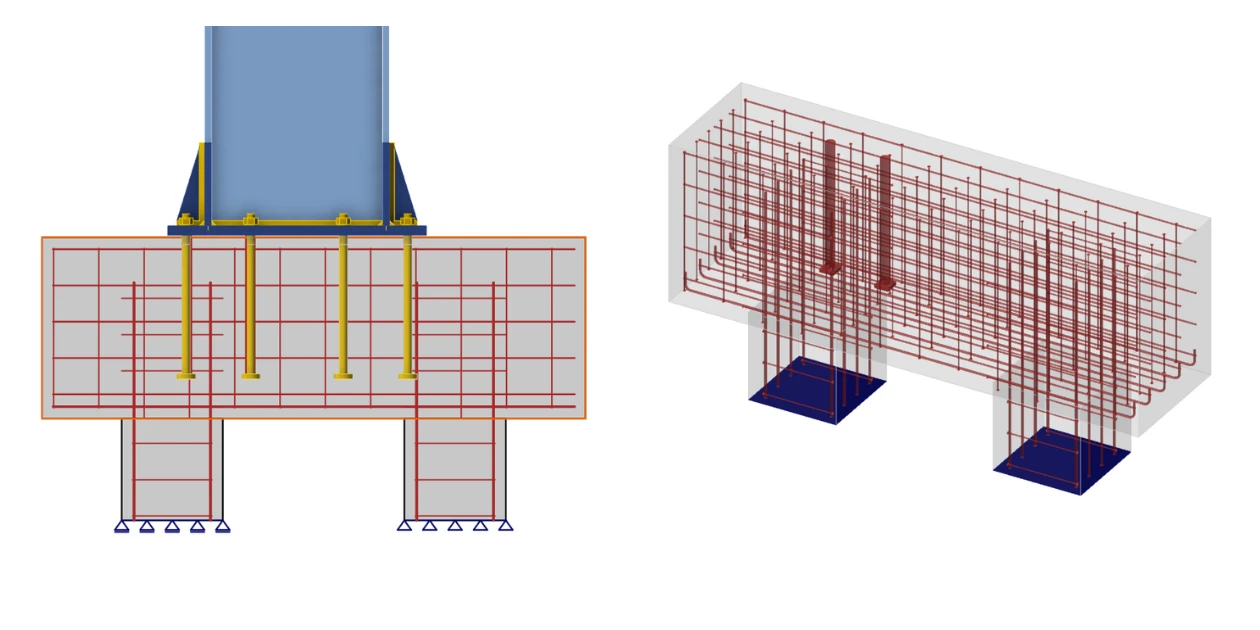


Khi neo thép vào bê tông, bu lông neo hoặc neo hóa chất thường được sử dụng để đảm bảo ổn định kết cấu và khả năng chịu tải trong các dự án thi công. Mô hình được phân tích trong ứng dụng IDEA StatiCa Detail.
Widget #NaN: widget_content_image_collapse_item
Name: IDEA StatiCa Detail
ID: b3110a59-a173-4dde-81ac-e4d2ed554ff5
Show Raw Data
{
"title": {
"name": "Title",
"type": "text",
"value": "IDEA StatiCa Detail"
},
"description": {
"images": [],
"linkedItemCodenames": [],
"linkedItems": [],
"links": [],
"name": "Description",
"type": "rich_text",
"value": "<p>Phù hợp nhất cho các cấu kiện có Vùng D (vùng gián đoạn), lỗ mở và gia cường, và các cấu kiện 2D có hình dạng tổng quát </p>\n<ul>\n <li>Phương pháp phi tuyến CSFM (phương pháp trường ứng suất tương thích) </li>\n <li>Ứng suất và biến dạng của bê tông và tất cả cốt thép</li>\n <li>Kiểm tra bề rộng vết nứt</li>\n <li>Kiểm tra giới hạn ứng suất</li>\n <li>Độ võng phi tuyến</li>\n <li>Nhập dữ liệu từ Beam application</li>\n</ul>"
},
"link_text": {
"name": "Link text",
"type": "text",
"value": "Đọc thêm về các tính toán"
},
"link_url": {
"name": "Link URL",
"type": "text",
"value": ""
},
"content_item_link": {
"name": "Content item link",
"type": "modular_content",
"value": [
"detail_theoretical_background"
],
"linkedItems": [
{
"elements": {
"title": {
"name": "Main headline (H1)",
"type": "text",
"value": "IDEA StatiCa Detail – Thiết kế kết cấu cho các vùng gián đoạn (D-region) trong bê tông"
},
"preview_image": {
"name": "Preview image",
"type": "asset",
"value": [
{
"name": "Structural design of concrete members in IDEA StatiCa Detail.png",
"description": null,
"type": "image/png",
"size": 163091,
"url": "https://assets-us-01.kc-usercontent.com:443/66e7a155-be94-0096-73e6-c55dfc7e5788/7885cdc1-8e4a-4744-834e-72ea84ebbaf4/Structural%20design%20of%20concrete%20members%20in%20IDEA%20StatiCa%20Detail.png",
"width": 1200,
"height": 630,
"renditions": {}
}
]
},
"post_date": {
"name": "Post date",
"type": "date_time",
"value": null,
"displayTimeZone": null
},
"perex_content": {
"name": "Lead paragraph",
"type": "text",
"value": ""
},
"content": {
"images": [],
"linkedItemCodenames": [
"n34ccb268_e46d_0186_818b_112849834cac",
"theoretical_background_detail___general",
"c1cc85f0_cbf3_0163_d3e7_b3c854fb70e3",
"theoretical_background_detail___main_assumptions_a",
"n497f1584_0757_0150_8e05_0e3d08d9c34b",
"theoretical_background_detail___general___reinforc",
"a682aa96_4546_01a1_9c3b_a341db5b581d",
"theoretical_background_detail___general___finite_e",
"n7f7c137a_5459_013f_2a92_d2aaa6bd5934",
"theoretical_background_detail___supports_and_load_",
"n288807ce_8abb_01c7_5861_6b23a90069e3",
"theoretical_background_detail___load_transfer_at_t",
"a3443841_4d94_01fb_5cf5_163a4db969e8",
"theoretical_background_detail___geometric_modifica",
"n62bb5d51_1dd3_01fb_b6d3_52eb49f1efdf",
"theoretical_background_detail___finite_element_typ",
"n535af688_ae13_01b5_f2b5_accf82c7e7e6",
"theoretical_background_detail___meshing",
"f835ada4_2d42_019d_400e_8c641ea5d830",
"theoretical_background_detail___solution_method_an",
"a66e88d2_2de6_0137_d586_728f72352ec8",
"theoretical_background_detail___presentation_of_re",
"n0fc72067_272b_01ed_9b4f_5b6561a3f36b",
"theoretical_background_detail___general___verifica",
"a27390a8_d98b_01b4_feae_b0373ecb226a",
"theoretical_background_detail___material_models__e",
"n791e6dc3_b621_0162_7088_67a18809eef4",
"theoretical_background_detail___safety_factors",
"n7fc52413_0d1f_01b3_34fd_3db395851640",
"theoretical_background_detail___ultimate_limit_sta",
"ae15cb8c_3cc5_01c4_3842_6f4619fe35da",
"theoretical_background_detail___partially_loaded_a",
"bde38d45_f670_01d7_6bfe_edbb525ae385",
"theoretical_background_detail___serviceability_lim",
"n2c963218_825c_0181_84bf_9eebd195cfd4",
"theoretical_background_detail___material_models__a",
"n12dcb4ff_0126_019b_d03d_6938d6341f7d",
"theoretical_background_detail___factors___aci",
"c0e9b11a_b85a_0118_3bf7_4067852655bc",
"theoretical_background_detail___strength_analysis_",
"n4925b7a9_2d66_01b5_92c0_3905f3f9c73c",
"theoretical_background_detail___bearing_and_anchor",
"n75188912_aa93_01fe_7ca1_4a8c01712128",
"theoretical_background_detail___serviceability_ver",
"f3d15547_6103_01cd_e520_52a515661e9d",
"theoretical_background_detail___material_models__a_0b99d24",
"n4389a93f_944a_016d_7b39_09fe5e3da0a2",
"theoretical_background_detail___resistance_and_loa",
"n2f2a2977_59e9_0196_8059_081df401f30c",
"theoretical_background_detail___strength_limit_sta",
"n6ec20032_147b_01aa_8e8d_d8154242350e",
"theoretical_background_detail___bearing_and_anchor_69cbe39",
"n0682da11_5a13_010f_18f8_856817bb273c",
"theoretical_background_detail___service_limit_stat",
"ec8298f7_4c71_019e_3f7a_960306e98fef",
"theoretical_background_detail___material_models__a_b7035a6",
"ded4ebec_d7c7_0160_68e5_d6fbfb469ae3",
"theoretical_background_detail___stress_reduction_a",
"n4b8d094a_fcb4_019d_ef07_13cfa7af7960",
"theoretical_background_detail___strength_analysis__8bc3bfe",
"n30a7c39c_70ff_01c9_73ab_fc2adabbde0a",
"theoretical_background_detail___serviceability_ver_77b5f2c",
"n7599736e_3243_01fb_cfaa_73b98f767edb",
"prestressing_in_detail___model_description__body_",
"n4d41f30f_c481_0169_df46_3807c9b00fc0"
],
"linkedItems": [
{
"elements": {
"title": {
"name": "Title",
"type": "text",
"value": "1.1 General introduction"
},
"id": {
"name": "ID",
"type": "text",
"value": "general-introduction"
},
"printable_anchor": {
"name": "Printable anchor used in PDF content table",
"type": "multiple_choice",
"value": []
},
"translation__translation_connector": {
"name": "Translation Connector",
"type": "taxonomy",
"value": [],
"taxonomyGroup": "languages"
},
"translation__force_translation": {
"name": "Force translation",
"type": "multiple_choice",
"value": []
},
"translation__translate_standalone_nested_content_items": {
"name": "Translate standalone nested content items",
"type": "multiple_choice",
"value": []
},
"translation__last_translation": {
"images": [],
"linkedItemCodenames": [],
"linkedItems": [],
"links": [],
"name": "Last translation",
"type": "rich_text",
"value": "<p><br></p>"
},
"translation__ai_translated": {
"name": "AI translated",
"type": "multiple_choice",
"value": []
},
"translation___experimental__synchronize_content_references": {
"name": "[Experimental] Synchronize content references",
"type": "multiple_choice",
"value": []
},
"translation___experimental__selective_element_translation": {
"name": "[Experimental] Selective translation",
"type": "multiple_choice",
"value": []
},
"translation__selectivetranslationelementid": {
"name": "selectiveTranslationElementId",
"type": "custom",
"value": null
}
},
"system": {
"codename": "n34ccb268_e46d_0186_818b_112849834cac",
"collection": "default",
"id": "34ccb268-e46d-0186-818b-112849834cac",
"language": "vi-VN",
"lastModified": "2026-08-15T01:36:49.5027809Z",
"name": "34ccb268-e46d-0186-818b-112849834cac",
"sitemapLocations": [],
"type": "widget_anchor_target",
"workflowStep": null,
"workflow": null
}
},
{
"elements": {
"title": {
"name": "Main headline (H1)",
"type": "text",
"value": "1.1 Giới thiệu chung về thiết kế kết cấu chi tiết bê tông"
},
"preview_image": {
"name": "Preview image",
"type": "asset",
"value": [
{
"name": "General introduction for the structural design of concrete details.png",
"description": null,
"type": "image/png",
"size": 151821,
"url": "https://assets-us-01.kc-usercontent.com:443/66e7a155-be94-0096-73e6-c55dfc7e5788/918cd80e-191a-437a-8d6a-d2f8c7f688c2/General%20introduction%20for%20the%20structural%20design%20of%20concrete%20details.png",
"width": 1200,
"height": 630,
"renditions": {}
}
]
},
"post_date": {
"name": "Post date",
"type": "date_time",
"value": null,
"displayTimeZone": null
},
"perex_content": {
"name": "Lead paragraph",
"type": "text",
"value": ""
},
"content": {
"images": [
{
"description": null,
"imageId": "874c8092-fb41-44c6-804d-52727044d470",
"url": "https://assets-us-01.kc-usercontent.com:443/66e7a155-be94-0096-73e6-c55dfc7e5788/dc96c2fd-25aa-43fd-b6d5-556b5242b9cf/Discontinuity%20regions.png",
"height": 939,
"width": 1394
}
],
"linkedItemCodenames": [],
"linkedItems": [],
"links": [],
"name": "Content",
"type": "rich_text",
"value": "<p>Việc thiết kế và đánh giá các cấu kiện bê tông thường được thực hiện ở cấp độ mặt cắt (cấu kiện 1D) hoặc điểm (cấu kiện 2D). Quy trình này được mô tả trong tất cả các tiêu chuẩn thiết kế kết cấu, ví dụ trong (EN 1992-1-1 hoặc ACI 318-19), và được sử dụng trong thực tiễn kỹ thuật kết cấu hàng ngày. Tuy nhiên, không phải lúc nào cũng được biết đến hoặc tuân thủ rằng quy trình này chỉ chấp nhận được ở những vùng mà giả thuyết Bernoulli-Navier về phân bố biến dạng phẳng áp dụng được (gọi là vùng B). Những nơi mà giả thuyết này không áp dụng được gọi là vùng gián đoạn hay vùng nhiễu loạn (vùng D). Ví dụ về vùng B và vùng D của các cấu kiện 1D được thể hiện trong (Hình 1). Đó là, ví dụ, các vùng gối tựa, các phần nơi tải trọng tập trung được đặt vào, các vị trí có sự thay đổi đột ngột về tiết diện, các lỗ mở, v.v. Khi thiết kế kết cấu bê tông, chúng ta còn gặp nhiều vùng D khác như tường, vách ngăn cầu, con sơn, v.v. </p>\n<figure data-asset-id=\"874c8092-fb41-44c6-804d-52727044d470\" data-image-id=\"874c8092-fb41-44c6-804d-52727044d470\"><img src=\"https://assets-us-01.kc-usercontent.com:443/66e7a155-be94-0096-73e6-c55dfc7e5788/dc96c2fd-25aa-43fd-b6d5-556b5242b9cf/Discontinuity%20regions.png\" data-asset-id=\"874c8092-fb41-44c6-804d-52727044d470\" data-image-id=\"874c8092-fb41-44c6-804d-52727044d470\" alt=\"\"></figure>\n<p><em>\\[ \\textsf{\\textit{\\footnotesize{Fig. 1\\qquad Discontinuity regions (Navrátil et al. 2017)}}}\\]</em></p>\n<p>Trong quá khứ, các quy tắc thiết kế bán thực nghiệm đã được sử dụng để định kích thước cho các vùng gián đoạn. May mắn thay, các quy tắc này phần lớn đã được thay thế trong những thập kỷ qua bằng các mô hình thanh chống - giằng (Schlaich et al., 1987) và trường ứng suất (Marti 1985), vốn được đưa vào các tiêu chuẩn thiết kế hiện hành và được các kỹ sư thiết kế sử dụng thường xuyên ngày nay. Các mô hình này là những công cụ mạnh mẽ và nhất quán về mặt cơ học. Lưu ý rằng trường ứng suất nói chung có thể liên tục hoặc gián đoạn, và mô hình thanh chống - giằng là một trường hợp đặc biệt của trường ứng suất gián đoạn.</p>\n<p>Mặc dù các công cụ tính toán đã phát triển trong những thập kỷ qua, mô hình thanh chống - giằng về cơ bản vẫn được sử dụng như tính toán bằng tay. Việc áp dụng mô hình này cho các công trình thực tế rất tốn công và mất thời gian vì cần phải lặp lại tính toán và cần xem xét nhiều trường hợp tải trọng khác nhau. Hơn nữa, phương pháp này không phù hợp để kiểm tra các tiêu chí về khả năng sử dụng (biến dạng, bề rộng vết nứt, v.v.).</p>\n<p>Nhu cầu của các kỹ sư kết cấu về một công cụ đáng tin cậy và nhanh chóng để thiết kế các vùng D đã dẫn đến quyết định phát triển Phương pháp trường ứng suất tương thích mới, một phương pháp thiết kế trường ứng suất có sự hỗ trợ của máy tính, cho phép tự động thiết kế và đánh giá các cấu kiện bê tông kết cấu chịu tải trọng trong mặt phẳng.</p>\n<p>Phương pháp trường ứng suất tương thích (CSFM) là một phương pháp phân tích trường ứng suất liên tục dựa trên phần tử hữu hạn, trong đó các giải pháp trường ứng suất cổ điển được bổ sung bằng các xem xét động học, nghĩa là trạng thái biến dạng được đánh giá trên toàn bộ kết cấu. Do đó, cường độ chịu nén hiệu quả của bê tông có thể được tự động tính toán dựa trên trạng thái biến dạng ngang theo cách tương tự như trong các phân tích trường nén có xét đến hiện tượng mềm hóa do nén (Vecchio và Collins 1986; Kaufmann và Marti 1998) và phương pháp EPSF (Fernández Ruiz và Muttoni 2007). Hơn nữa, CSFM xét đến hiệu ứng tăng cứng do kéo, cung cấp độ cứng thực tế cho các phần tử, và bao quát tất cả các quy định của tiêu chuẩn thiết kế (bao gồm các khía cạnh về khả năng sử dụng và khả năng biến dạng) mà các phương pháp trước đây chưa giải quyết một cách nhất quán. CSFM sử dụng các quan hệ bản chất đơn trục thông thường được quy định bởi các tiêu chuẩn thiết kế cho bê tông và cốt thép. Đây là những thông số đã biết ở giai đoạn thiết kế, cho phép sử dụng phương pháp hệ số an toàn riêng phần. Do đó, người thiết kế không cần phải cung cấp thêm các đặc tính vật liệu bổ sung, thường mang tính tùy ý, như thường được yêu cầu đối với các phân tích phần tử hữu hạn phi tuyến, khiến phương pháp này hoàn toàn phù hợp với thực tiễn kỹ thuật.</p>\n<p>Để thúc đẩy việc sử dụng trường ứng suất có sự hỗ trợ của máy tính bởi các kỹ sư kết cấu, các phương pháp này cần được triển khai trong các môi trường phần mềm thân thiện với người dùng. Với mục tiêu này, CSFM đã được triển khai trong <em>IDEA StatiCa Detail</em>; một phần mềm thương mại thân thiện với người dùng mới, được phát triển chung bởi ETH Zurich và công ty phần mềm IDEA StatiCa trong khuôn khổ dự án DR-Design Eurostars-10571.</p>"
},
"linked_items": {
"name": "Linked items",
"type": "modular_content",
"value": [
"detail_theoretical_background",
"theoretical_background_detail___general___reinforc",
"dimenzovani_zb_konstrukci_podle_csfm",
"prestressed_i_section"
],
"linkedItems": [
"[Circular Reference]",
{
"elements": {
"title": {
"name": "Main headline (H1)",
"type": "text",
"value": "1.3 Công cụ thiết kế cốt thép"
},
"preview_image": {
"name": "Preview image",
"type": "asset",
"value": [
{
"name": "Reinforcement structural design.png",
"description": null,
"type": "image/png",
"size": 61765,
"url": "https://assets-us-01.kc-usercontent.com:443/66e7a155-be94-0096-73e6-c55dfc7e5788/8d4e1ab7-8d44-491e-873f-8ea42d620992/Reinforcement%20structural%20design.png",
"width": 1200,
"height": 630,
"renditions": {}
}
]
},
"post_date": {
"name": "Post date",
"type": "date_time",
"value": null,
"displayTimeZone": null
},
"perex_content": {
"name": "Lead paragraph",
"type": "text",
"value": ""
},
"content": {
"images": [
{
"description": null,
"imageId": "eee2b9e4-83cd-4b9c-98e7-f575b2ff9cff",
"url": "https://assets-us-01.kc-usercontent.com:443/66e7a155-be94-0096-73e6-c55dfc7e5788/9b0c4840-5a55-46f3-95ba-86a9baabbf0c/Model%20used%20to%20illustrate%20the%20use%20of%20the%20reinforcement%20design%20tools.png",
"height": 603,
"width": 864
},
{
"description": null,
"imageId": "f6c14a09-4d2b-40e6-ac82-5ff08c10439a",
"url": "https://assets-us-01.kc-usercontent.com:443/66e7a155-be94-0096-73e6-c55dfc7e5788/ea7896d1-8276-4d08-b811-066cca73b455/Results%20from%20the%20linear%20analysis%20tool.jpg",
"height": 315,
"width": 1177
},
{
"description": null,
"imageId": "f4f47d5e-3196-4a88-96ca-7162b0c8c271",
"url": "https://assets-us-01.kc-usercontent.com:443/66e7a155-be94-0096-73e6-c55dfc7e5788/f4d37064-76c7-4413-b1aa-87455a32852c/Results%20from%20the%20topology%20optimization%201.jpg",
"height": 320,
"width": 1179
},
{
"description": null,
"imageId": "7ddd1329-64ea-4a47-be5d-64994439e729",
"url": "https://assets-us-01.kc-usercontent.com:443/66e7a155-be94-0096-73e6-c55dfc7e5788/d81f2841-8274-414a-8f30-b55427216169/Results%20from%20the%20topology%20optimization%202.png",
"height": 315,
"width": 1179
}
],
"linkedItemCodenames": [],
"linkedItems": [],
"links": [
{
"codename": "csfm_concrete_verification",
"linkId": "42ce7f6b-6491-4224-a01e-c4c0072ed1cd",
"urlSlug": "design-your-structural-concrete-details-with-confidence",
"type": "blog_post"
},
{
"codename": "topology_optimization_for_reinforced_concrete",
"linkId": "decdf07d-a46b-5894-9a22-793436e318c7",
"urlSlug": "topology-optimization-for-reinforced-concrete",
"type": "blog_post"
}
],
"name": "Content",
"type": "rich_text",
"value": "<h3>Quy trình làm việc và mục tiêu</h3>\n<p>Mục tiêu của các công cụ thiết kế cốt thép trong <a data-item-id=\"42ce7f6b-6491-4224-a01e-c4c0072ed1cd\" href=\"\">CSFM</a> là giúp người thiết kế xác định vị trí và lượng cốt thép cần thiết một cách hiệu quả. Các công cụ sau đây có sẵn để hỗ trợ / hướng dẫn người dùng trong quá trình này: tính toán tuyến tính và <a data-item-id=\"decdf07d-a46b-5894-9a22-793436e318c7\" href=\"\">tối ưu hóa cấu trúc hình học (topology optimization)</a>.</p>\n<p>Các công cụ thiết kế cốt thép sử dụng các mô hình cấu thành đơn giản hóa hơn so với các mô hình dùng để kiểm tra cuối cùng của kết cấu. Do đó, việc định nghĩa cốt thép ở bước này nên được xem là bước thiết kế sơ bộ, cần được xác nhận/tinh chỉnh trong bước kiểm tra cuối cùng. Việc sử dụng các công cụ thiết kế cốt thép khác nhau sẽ được minh họa trong mô hình thể hiện ở Hình 3, bao gồm một đầu của dầm đơn giản có chiều cao thay đổi, chịu tải trọng phân bố đều.</p>\n<figure data-asset-id=\"eee2b9e4-83cd-4b9c-98e7-f575b2ff9cff\" data-image-id=\"eee2b9e4-83cd-4b9c-98e7-f575b2ff9cff\"><img src=\"https://assets-us-01.kc-usercontent.com:443/66e7a155-be94-0096-73e6-c55dfc7e5788/9b0c4840-5a55-46f3-95ba-86a9baabbf0c/Model%20used%20to%20illustrate%20the%20use%20of%20the%20reinforcement%20design%20tools.png\" data-asset-id=\"eee2b9e4-83cd-4b9c-98e7-f575b2ff9cff\" data-image-id=\"eee2b9e4-83cd-4b9c-98e7-f575b2ff9cff\" alt=\"\"></figure>\n<p><em>\\[ \\textsf{\\textit{\\footnotesize{Fig. 3\\qquad Model used to illustrate the use of the reinforcement design tools.}}}\\]</em></p>\n<h3>Phân tích tuyến tính</h3>\n<p>Phân tích tuyến tính xem xét các đặc tính vật liệu đàn hồi tuyến tính và bỏ qua cốt thép trong vùng bê tông. Do đó, đây là phép tính rất nhanh, cung cấp cái nhìn ban đầu về vị trí các vùng chịu kéo và chịu nén. Một ví dụ về phép tính này được thể hiện ở Hình 4.</p>\n<figure data-asset-id=\"f6c14a09-4d2b-40e6-ac82-5ff08c10439a\" data-image-id=\"f6c14a09-4d2b-40e6-ac82-5ff08c10439a\"><img src=\"https://assets-us-01.kc-usercontent.com:443/66e7a155-be94-0096-73e6-c55dfc7e5788/ea7896d1-8276-4d08-b811-066cca73b455/Results%20from%20the%20linear%20analysis%20tool.jpg\" data-asset-id=\"f6c14a09-4d2b-40e6-ac82-5ff08c10439a\" data-image-id=\"f6c14a09-4d2b-40e6-ac82-5ff08c10439a\" alt=\"\"></figure>\n<p><em>\\[ \\textsf{\\textit{\\footnotesize{Fig. 4\\qquad Results from the linear analysis tool for defining reinforcement layout}}}\\]</em></p>\n<p><em>\\[ \\textsf{\\textit{\\footnotesize{(red: areas in compression, blue: areas in tension).}}}\\]</em></p>\n<h3>Tối ưu hóa cấu trúc hình học</h3>\n<p>Tối ưu hóa cấu trúc hình học là phương pháp nhằm tìm ra sự phân bố vật liệu tối ưu trong một thể tích cho trước, ứng với một cấu hình tải trọng nhất định. Tối ưu hóa cấu trúc hình học được triển khai trong <em>Idea StatiCa Detail</em> sử dụng mô hình phần tử hữu hạn tuyến tính. Mỗi phần tử hữu hạn có thể có mật độ tương đối từ 0 đến 100%, thể hiện lượng vật liệu tương đối được sử dụng. Các mật độ phần tử này là các tham số tối ưu hóa trong bài toán tối ưu. Sự phân bố vật liệu thu được được xem là tối ưu đối với tập hợp tải trọng đã cho nếu nó làm tối thiểu hóa tổng năng lượng biến dạng của hệ. Theo định nghĩa, sự phân bố tối ưu cũng chính là hình học có độ cứng lớn nhất có thể đối với các tải trọng đã cho.</p>\n<p>Quá trình tối ưu hóa lặp bắt đầu với sự phân bố mật độ đồng nhất.<em> </em>Phép tính được thực hiện cho nhiều tỷ lệ thể tích tổng (20%, 40%, 60% và 80%), cho phép người dùng lựa chọn kết quả thực tế nhất. Hình dạng thu được bao gồm các dàn với thanh chống và thanh giằng, thể hiện hình dạng tối ưu cho các trường hợp tải trọng đã cho (Hình 5).</p>\n<figure data-asset-id=\"f4f47d5e-3196-4a88-96ca-7162b0c8c271\" data-image-id=\"f4f47d5e-3196-4a88-96ca-7162b0c8c271\"><img src=\"https://assets-us-01.kc-usercontent.com:443/66e7a155-be94-0096-73e6-c55dfc7e5788/f4d37064-76c7-4413-b1aa-87455a32852c/Results%20from%20the%20topology%20optimization%201.jpg\" data-asset-id=\"f4f47d5e-3196-4a88-96ca-7162b0c8c271\" data-image-id=\"f4f47d5e-3196-4a88-96ca-7162b0c8c271\" alt=\"\"></figure>\n<figure data-asset-id=\"7ddd1329-64ea-4a47-be5d-64994439e729\" data-image-id=\"7ddd1329-64ea-4a47-be5d-64994439e729\"><img src=\"https://assets-us-01.kc-usercontent.com:443/66e7a155-be94-0096-73e6-c55dfc7e5788/d81f2841-8274-414a-8f30-b55427216169/Results%20from%20the%20topology%20optimization%202.png\" data-asset-id=\"7ddd1329-64ea-4a47-be5d-64994439e729\" data-image-id=\"7ddd1329-64ea-4a47-be5d-64994439e729\" alt=\"\"></figure>\n<p><em>\\[ \\textsf{\\textit{\\footnotesize{Fig. 5\\qquad Results from the topology optimization design tool with 20\\% and 40\\% effective volume}}}\\]</em></p>\n<p><em>\\[ \\textsf{\\textit{\\footnotesize{(red: areas in compression, blue: areas in tension).}}}\\]</em></p>\n<p><br></p>"
},
"linked_items": {
"name": "Linked items",
"type": "modular_content",
"value": [
"theoretical_background_detail___general",
"theoretical_background_detail___general___finite_e",
"dimenzovani_zb_konstrukci_podle_csfm"
],
"linkedItems": [
"[Circular Reference]",
{
"elements": {
"title": {
"name": "Main headline (H1)",
"type": "text",
"value": "2.1 Giới thiệu về triển khai phương pháp phần tử hữu hạn"
},
"preview_image": {
"name": "Preview image",
"type": "asset",
"value": [
{
"name": "Finite element implementation in IDEA StatiCa Detail.png",
"description": null,
"type": "image/png",
"size": 481046,
"url": "https://assets-us-01.kc-usercontent.com:443/66e7a155-be94-0096-73e6-c55dfc7e5788/0388381a-906d-48f1-a5b2-ce00188fded9/Finite%20element%20implementation%20in%20IDEA%20StatiCa%20Detail.png",
"width": 1200,
"height": 630,
"renditions": {}
}
]
},
"post_date": {
"name": "Post date",
"type": "date_time",
"value": null,
"displayTimeZone": null
},
"perex_content": {
"name": "Lead paragraph",
"type": "text",
"value": ""
},
"content": {
"images": [
{
"description": null,
"imageId": "9e86fe68-36a5-433d-9451-40d2b5078b86",
"url": "https://assets-us-01.kc-usercontent.com:443/66e7a155-be94-0096-73e6-c55dfc7e5788/3f70008c-0c34-4dbe-8219-4d8aa7079bb5/Visualization%20of%20the%20calculation%20model.png",
"height": 562,
"width": 847
}
],
"linkedItemCodenames": [],
"linkedItems": [],
"links": [
{
"codename": "untitled_content_item_a11adc2",
"linkId": "a11adc2d-9c84-4667-8061-600660e1ad87",
"urlSlug": "concrete-walls-challenge-or-routine",
"type": "blog_post"
}
],
"name": "Content",
"type": "rich_text",
"value": "<p>CSFM xem xét các trường ứng suất liên tục trong bê tông (phần tử hữu hạn 2D), kết hợp với các phần tử \"thanh\" rời rạc đại diện cho cốt thép (phần tử hữu hạn 1D). Do đó, cốt thép không được nhúng khuếch tán vào các phần tử hữu hạn 2D của bê tông mà được mô hình hóa tường minh và liên kết với chúng. Trạng thái ứng suất phẳng được xem xét trong mô hình tính toán.</p>\n<figure data-asset-id=\"9e86fe68-36a5-433d-9451-40d2b5078b86\" data-image-id=\"9e86fe68-36a5-433d-9451-40d2b5078b86\"><img src=\"https://assets-us-01.kc-usercontent.com:443/66e7a155-be94-0096-73e6-c55dfc7e5788/3f70008c-0c34-4dbe-8219-4d8aa7079bb5/Visualization%20of%20the%20calculation%20model.png\" data-asset-id=\"9e86fe68-36a5-433d-9451-40d2b5078b86\" data-image-id=\"9e86fe68-36a5-433d-9451-40d2b5078b86\" alt=\"\"></figure>\n<p><em>\\[ \\textsf{\\textit{\\footnotesize{Fig. 6\\qquad Visualization of the calculation model of a structural element (trimmed beam) in Idea StatiCa Detail.}}}\\]</em></p>\n<p>Cả toàn bộ <a data-item-id=\"a11adc2d-9c84-4667-8061-600660e1ad87\" href=\"\">tường</a> và dầm, cũng như các chi tiết (bộ phận) của dầm (vùng gián đoạn cô lập, còn gọi là đầu cắt), đều có thể được mô hình hóa. Trong trường hợp tường và dầm toàn bộ, các gối tựa phải được định nghĩa sao cho tạo ra một kết cấu tĩnh định hoặc siêu tĩnh (xét về mặt bên ngoài). Việc truyền tải trọng tại các đầu cắt của dầm được thực hiện thông qua một vùng truyền Saint-Venant đặc biệt, đảm bảo sự phân bố ứng suất thực tế trong vùng chi tiết được phân tích.</p>"
},
"linked_items": {
"name": "Linked items",
"type": "modular_content",
"value": [
"theoretical_background_detail___general___reinforc",
"theoretical_background_detail___general___verifica",
"n2017_solution_for_walls_and_details_of_concrete_st",
"fire_resistance_check_of_concrete_structures"
],
"linkedItems": [
"[Circular Reference]",
{
"elements": {
"title": {
"name": "Main headline (H1)",
"type": "text",
"value": "3.1 Trạng thái giới hạn và tính toán bề rộng vết nứt"
},
"preview_image": {
"name": "Preview image",
"type": "asset",
"value": [
{
"name": "Structural element verification in IDEA StatiCa Detail.png",
"description": null,
"type": "image/png",
"size": 174643,
"url": "https://assets-us-01.kc-usercontent.com:443/66e7a155-be94-0096-73e6-c55dfc7e5788/3ab2c71e-930c-4975-88fe-72502fad03d5/Structural%20element%20verification%20in%20IDEA%20StatiCa%20Detail.png",
"width": 1200,
"height": 630,
"renditions": {}
}
]
},
"post_date": {
"name": "Post date",
"type": "date_time",
"value": null,
"displayTimeZone": null
},
"perex_content": {
"name": "Lead paragraph",
"type": "text",
"value": ""
},
"content": {
"images": [
{
"description": null,
"imageId": "8c27dc0f-1cfe-4026-bbf5-4b51604c3558",
"url": "https://assets-us-01.kc-usercontent.com:443/66e7a155-be94-0096-73e6-c55dfc7e5788/aabe4d74-d599-4c9d-a62d-8e448a66360a/Mesh%20multiplier.PNG",
"height": 55,
"width": 421
}
],
"linkedItemCodenames": [
"theoretical_background_detail___crack_width_calcul"
],
"linkedItems": [],
"links": [],
"name": "Content",
"type": "rich_text",
"value": "<p>Việc đánh giá kết cấu bằng CSFM được thực hiện thông qua hai phân tích khác nhau: một phân tích cho tổ hợp tải trọng ở trạng thái giới hạn sử dụng và một phân tích cho tổ hợp tải trọng ở trạng thái giới hạn cực hạn. Phân tích trạng thái giới hạn sử dụng giả định rằng ứng xử cực hạn của cấu kiện là thỏa mãn, và các điều kiện chảy dẻo của vật liệu sẽ không đạt tới ở mức tải trọng sử dụng. Cách tiếp cận này cho phép sử dụng các mô hình vật liệu đơn giản hóa (với nhánh tuyến tính của biểu đồ ứng suất-biến dạng bê tông) cho phân tích trạng thái giới hạn sử dụng nhằm tăng cường độ ổn định số học và tốc độ tính toán. Do đó, khuyến nghị sử dụng quy trình được trình bày dưới đây, trong đó phân tích trạng thái giới hạn cực hạn được thực hiện như bước đầu tiên.</p>\n<h3>Phân tích trạng thái giới hạn cực hạn</h3>\n<p>Các kiểm tra khác nhau theo yêu cầu của các tiêu chuẩn thiết kế cụ thể được đánh giá dựa trên kết quả trực tiếp do mô hình cung cấp. Các kiểm tra ULS được thực hiện cho cường độ bê tông, cường độ cốt thép, và neo (ứng suất cắt liên kết dính).</p>\n<p>Để đảm bảo cấu kiện kết cấu có thiết kế hiệu quả, rất khuyến nghị chạy một phân tích sơ bộ có xét đến các bước sau:</p>\n<ul>\n <li>Chọn lựa các tổ hợp tải trọng nguy hiểm nhất.</li>\n <li>Chỉ tính toán các tổ hợp tải trọng ở trạng thái giới hạn cực hạn (ULS).</li>\n <li>Sử dụng lưới thô (bằng cách tăng hệ số nhân của kích thước lưới mặc định trong Setup (Hình 19)).</li>\n</ul>\n<figure data-asset-id=\"8c27dc0f-1cfe-4026-bbf5-4b51604c3558\" data-image-id=\"8c27dc0f-1cfe-4026-bbf5-4b51604c3558\"><img src=\"https://assets-us-01.kc-usercontent.com:443/66e7a155-be94-0096-73e6-c55dfc7e5788/aabe4d74-d599-4c9d-a62d-8e448a66360a/Mesh%20multiplier.PNG\" data-asset-id=\"8c27dc0f-1cfe-4026-bbf5-4b51604c3558\" data-image-id=\"8c27dc0f-1cfe-4026-bbf5-4b51604c3558\" alt=\"\"></figure>\n<p><em>\\[ \\textsf{\\textit{\\footnotesize{Fig. 19\\qquad Hệ số nhân lưới.}}}\\]</em></p>\n<p>Mô hình như vậy sẽ tính toán rất nhanh, cho phép kỹ sư thiết kế xem xét chi tiết cấu tạo của cấu kiện kết cấu một cách hiệu quả và chạy lại phân tích cho đến khi tất cả các yêu cầu kiểm tra được thỏa mãn đối với các tổ hợp tải trọng nguy hiểm nhất. Sau khi tất cả các yêu cầu kiểm tra của phân tích sơ bộ này được thỏa mãn, khuyến nghị đưa vào đầy đủ các tổ hợp tải trọng cực hạn và sử dụng kích thước lưới mịn (kích thước lưới do chương trình khuyến nghị). Người dùng có thể thay đổi kích thước lưới bằng hệ số nhân, có thể đạt các giá trị từ 0,5 đến 5 (Hình 19).</p>\n<p>Các kết quả và kiểm tra cơ bản (ứng suất, biến dạng, và hệ số sử dụng (tức là giá trị tính toán/giá trị giới hạn theo tiêu chuẩn), cũng như phương của ứng suất chính trong trường hợp cấu kiện bê tông) được hiển thị thông qua các biểu đồ khác nhau, trong đó nén thường được thể hiện bằng màu đỏ và kéo bằng màu xanh lam. Các giá trị nhỏ nhất và lớn nhất toàn cục cho toàn bộ kết cấu có thể được làm nổi bật, cũng như các giá trị nhỏ nhất và lớn nhất cho từng phần do người dùng định nghĩa. Trong một tab riêng của chương trình, các kết quả nâng cao như giá trị tensor, biến dạng của kết cấu, và tỷ lệ cốt thép (hiệu quả và hình học) được sử dụng để tính toán tăng cứng do kéo của các thanh cốt thép có thể được hiển thị. Hơn nữa, tải trọng và phản lực cho các tổ hợp hoặc trường hợp tải trọng được chọn cũng có thể được trình bày.</p>\n<h3>Phân tích trạng thái giới hạn sử dụng</h3>\n<p>Các đánh giá SLS được thực hiện cho giới hạn ứng suất, bề rộng vết nứt, và giới hạn độ võng. Ứng suất được kiểm tra trong bê tông và các phần tử cốt thép theo tiêu chuẩn áp dụng theo cách tương tự như đã quy định cho ULS.</p>\n<p>Phân tích trạng thái giới hạn sử dụng chứa một số đơn giản hóa của các mô hình vật liệu được sử dụng cho phân tích trạng thái giới hạn cực hạn. Một liên kết dính hoàn hảo được giả định, tức là chiều dài neo không được kiểm tra ở trạng thái giới hạn sử dụng. Hơn nữa, nhánh dẻo của đường cong ứng suất-biến dạng của bê tông chịu nén bị bỏ qua, trong khi nhánh đàn hồi là tuyến tính và vô hạn. Những đơn giản hóa này tăng cường độ ổn định số học và tốc độ tính toán, và không làm giảm tính tổng quát của lời giải miễn là các giới hạn ứng suất vật liệu kết quả ở trạng thái giới hạn sử dụng rõ ràng thấp hơn điểm chảy dẻo của chúng (theo yêu cầu của các tiêu chuẩn). Do đó, các mô hình đơn giản hóa được sử dụng cho trạng thái giới hạn sử dụng chỉ có giá trị nếu tất cả các yêu cầu kiểm tra được thỏa mãn.</p>\n<object type=\"application/kenticocloud\" data-type=\"item\" data-rel=\"link\" data-codename=\"theoretical_background_detail___crack_width_calcul\"></object>"
},
"linked_items": {
"name": "Linked items",
"type": "modular_content",
"value": [
"theoretical_background_detail___general___finite_e",
"theoretical_background_detail___finite_element_typ",
"general_description_of_sls_results_in_detail_appli"
],
"linkedItems": [
"[Circular Reference]",
{
"elements": {
"title": {
"name": "Main headline (H1)",
"type": "text",
"value": "2.5 Các loại phần tử hữu hạn"
},
"preview_image": {
"name": "Preview image",
"type": "asset",
"value": [
{
"name": "finite elements.png",
"description": null,
"type": "image/png",
"size": 219517,
"url": "https://assets-us-01.kc-usercontent.com:443/66e7a155-be94-0096-73e6-c55dfc7e5788/48fa7d1e-4cae-4946-924d-ec19029fa362/finite%20elements.png",
"width": 1230,
"height": 630,
"renditions": {}
}
]
},
"post_date": {
"name": "Post date",
"type": "date_time",
"value": null,
"displayTimeZone": null
},
"perex_content": {
"name": "Lead paragraph",
"type": "text",
"value": ""
},
"content": {
"images": [
{
"description": null,
"imageId": "03fd72f4-b362-492a-8885-349785eaa70a",
"url": "https://assets-us-01.kc-usercontent.com:443/66e7a155-be94-0096-73e6-c55dfc7e5788/511cc4d5-618a-4542-ac53-52a29549070f/Finite%20element%20model.png",
"height": 449,
"width": 1177
},
{
"description": null,
"imageId": "a031a0ff-a5a7-4a37-b59f-cb1c408f080b",
"url": "https://assets-us-01.kc-usercontent.com:443/66e7a155-be94-0096-73e6-c55dfc7e5788/1cc20fd2-92d7-42dc-ac17-24f318cbd45c/Bond.PNG",
"height": 707,
"width": 1773
},
{
"description": null,
"imageId": "6e05f6d3-2d4c-4c6c-90f0-89e34117415c",
"url": "https://assets-us-01.kc-usercontent.com:443/66e7a155-be94-0096-73e6-c55dfc7e5788/748b5346-4251-4154-b923-919c94d0c6d0/Model%20for%20the%20reduction%20of%20the%20anchorage%20length.PNG",
"height": 702,
"width": 1792
}
],
"linkedItemCodenames": [],
"linkedItems": [],
"links": [],
"name": "Content",
"type": "rich_text",
"value": "<p>Mô hình phân tích phần tử hữu hạn phi tuyến (đàn hồi dẻo) được tạo bởi nhiều loại phần tử hữu hạn khác nhau, dùng để mô hình hóa bê tông, cốt thép và liên kết dính giữa chúng. Các phần tử bê tông và cốt thép trước tiên được chia lưới độc lập, sau đó được kết nối với nhau bằng các ràng buộc đa điểm (phần tử MPC). Điều này cho phép cốt thép chiếm một vị trí tương đối tùy ý so với bê tông. Nếu cần tính toán kiểm tra chiều dài neo, các phần tử lò xo liên kết dính và đầu neo sẽ được chèn giữa cốt thép và các phần tử MPC.</p>\n<figure data-asset-id=\"03fd72f4-b362-492a-8885-349785eaa70a\" data-image-id=\"03fd72f4-b362-492a-8885-349785eaa70a\"><img src=\"https://assets-us-01.kc-usercontent.com:443/66e7a155-be94-0096-73e6-c55dfc7e5788/511cc4d5-618a-4542-ac53-52a29549070f/Finite%20element%20model.png\" data-asset-id=\"03fd72f4-b362-492a-8885-349785eaa70a\" data-image-id=\"03fd72f4-b362-492a-8885-349785eaa70a\" alt=\"\"></figure>\n<p><em>\\[ \\textsf{\\textit{\\footnotesize{Fig. 13\\qquad Finite element model: reinforcement elements mapped to concrete mesh using MPC elements and bond elements.}}}\\]</em></p>\n<h3>Bê tông</h3>\n<p>Bê tông được mô hình hóa bằng các phần tử vỏ tứ giác và tam giác, CQUAD4 và CTRIA3. Các phần tử này được xác định lần lượt bởi bốn hoặc ba nút. Chỉ có trạng thái ứng suất phẳng được giả định tồn tại trong các phần tử này, nghĩa là ứng suất hoặc biến dạng theo phương z không được xét đến.</p>\n<p>Mỗi phần tử có bốn hoặc ba điểm tích phân, được đặt tại khoảng 1/4 kích thước của nó. Tại mỗi điểm tích phân trong từng phần tử, phương của biến dạng chính α<sub>1</sub>, α<sub>2</sub> được tính toán. Theo cả hai phương này, ứng suất chính σ<em><sub>c</sub></em><sub>1</sub>, σ<em><sub>c</sub></em><sub>2</sub> và độ cứng <em>E</em><sub>1</sub>, <em>E</em><sub>2</sub> được xác định theo biểu đồ ứng suất - biến dạng của bê tông đã chỉ định, như trong Hình 2. Cần lưu ý rằng ảnh hưởng của hiệu ứng mềm hóa do nén sẽ liên kết ứng xử của phương chịu nén chính với trạng thái thực tế của phương chính còn lại.</p>\n<h3>Cốt thép</h3>\n<p>Thanh cốt thép được mô hình hóa bằng các phần tử thanh 1D hai nút (“rod”, CROD), chỉ có độ cứng dọc trục. Các phần tử này được kết nối với các phần tử “liên kết dính” đặc biệt, được phát triển nhằm mô hình hóa ứng xử trượt giữa thanh cốt thép và bê tông xung quanh. Các phần tử liên kết dính này sau đó được kết nối bằng các phần tử MPC (ràng buộc đa điểm) với lưới đại diện cho bê tông. Cách tiếp cận này cho phép chia lưới độc lập giữa cốt thép và bê tông, trong khi sự liên kết giữa chúng vẫn được đảm bảo sau đó.</p>\n<h3>Phần tử liên kết dính</h3>\n<p>Chiều dài neo được kiểm tra bằng cách triển khai ứng suất cắt liên kết dính giữa các phần tử bê tông (2D) và các phần tử thanh cốt thép (1D) trong mô hình phần tử hữu hạn. Để thực hiện điều này, một loại phần tử hữu hạn “liên kết dính” đã được phát triển.</p>\n<p>Định nghĩa của phần tử liên kết dính tương tự như phần tử vỏ (CQUAD4). Nó cũng được xác định bởi 4 nút, nhưng khác với phần tử vỏ, nó chỉ có độ cứng khác không theo phương cắt giữa hai nút trên và hai nút dưới. Trong mô hình, các nút trên được kết nối với các phần tử đại diện cho cốt thép, còn các nút dưới được kết nối với các phần tử đại diện cho bê tông. Ứng xử của phần tử này được mô tả bởi ứng suất liên kết dính, τ<em><sub>b</sub></em>, như một hàm song tuyến tính theo độ trượt giữa nút trên và nút dưới, δ<em><sub>u</sub></em>, xem Hình 14.</p>\n<figure data-asset-id=\"a031a0ff-a5a7-4a37-b59f-cb1c408f080b\" data-image-id=\"a031a0ff-a5a7-4a37-b59f-cb1c408f080b\"><img src=\"https://assets-us-01.kc-usercontent.com:443/66e7a155-be94-0096-73e6-c55dfc7e5788/1cc20fd2-92d7-42dc-ac17-24f318cbd45c/Bond.PNG\" data-asset-id=\"a031a0ff-a5a7-4a37-b59f-cb1c408f080b\" data-image-id=\"a031a0ff-a5a7-4a37-b59f-cb1c408f080b\" alt=\"\"></figure>\n<p><em>\\[ \\textsf{\\textit{\\footnotesize{Fig. 14\\qquad (a) conceptual illustration of the deformation of a bond element; (b) a stress-deformation function.}}}\\]</em></p>\n<p><br></p>\n<p>Mô-đun độ cứng đàn hồi của quan hệ trượt liên kết dính, <em>G</em><em><sub>b</sub></em>, được xác định như sau:</p>\n<p>\\[G_b = k_g \\cdot \\frac{E_c}{Ø}\\]</p>\n<p>trong đó:</p>\n<p><em>k</em><em><sub>g</sub></em> hệ số phụ thuộc vào bề mặt thanh cốt thép (mặc định <em>k</em><em><sub>g</sub></em><sub> </sub>= 0,2)</p>\n<p><em>E</em><em><sub>c</sub></em> mô-đun đàn hồi của bê tông (lấy bằng <em>E</em><em><sub>cm</sub></em> trong trường hợp EN)</p>\n<p>Ø đường kính của thanh cốt thép</p>\n<p>Các giá trị thiết kế (giá trị đã nhân hệ số) của ứng suất cắt liên kết dính giới hạn, <em>f</em><em><sub>bd</sub></em>, được quy định trong các tiêu chuẩn thiết kế tương ứng đã chọn EN 1992-1-1 hoặc ACI 318-19, được sử dụng để kiểm tra chiều dài neo. Độ cứng hóa của nhánh dẻo được tính mặc định là <em>G</em><em><sub>b</sub></em>/10<sup>5</sup>.</p>\n<h3>Lò xo neo</h3>\n<p>Việc bố trí đầu neo cho thanh cốt thép (ví dụ: uốn cong, móc, vòng lặp…), tuân theo các quy định của tiêu chuẩn thiết kế, cho phép giảm chiều dài neo cơ bản của thanh (<em>l</em><em><sub>b,net</sub></em>) theo một hệ số β nhất định (dưới đây gọi là ‘hệ số neo’). Giá trị thiết kế của chiều dài neo (<em>l</em><em><sub>b</sub></em>) khi đó được tính như sau:</p>\n<p>\\[l_b = \\left(1 - \\beta\\right)l_{b,net}\\]</p>\n<p>Việc giảm dự kiến trong <em>l</em><em><sub>b,net</sub></em> tương đương với việc kích hoạt thanh cốt thép tại đầu của nó ở một tỷ lệ phần trăm khả năng chịu lực tối đa, được xác định bởi hệ số giảm neo, như minh họa trong Hình 15a.</p>\n<figure data-asset-id=\"6e05f6d3-2d4c-4c6c-90f0-89e34117415c\" data-image-id=\"6e05f6d3-2d4c-4c6c-90f0-89e34117415c\"><img src=\"https://assets-us-01.kc-usercontent.com:443/66e7a155-be94-0096-73e6-c55dfc7e5788/748b5346-4251-4154-b923-919c94d0c6d0/Model%20for%20the%20reduction%20of%20the%20anchorage%20length.PNG\" data-asset-id=\"6e05f6d3-2d4c-4c6c-90f0-89e34117415c\" data-image-id=\"6e05f6d3-2d4c-4c6c-90f0-89e34117415c\" alt=\"\"></figure>\n<p><em>\\[ \\textsf{\\textit{\\footnotesize{Fig. 15\\qquad Model for the reduction of the anchorage length:}}}\\]</em></p>\n<p><em>\\[ \\textsf{\\textit{\\footnotesize{(a) anchorage force along the anchorage length of the reinforcing bar; (b) slip-anchorage force constitutive relationship.}}}\\]</em></p>\n<p>Sự giảm chiều dài neo được đưa vào mô hình phần tử hữu hạn thông qua một phần tử lò xo tại đầu thanh (Hình 15), được xác định bởi mô hình cấu thành thể hiện trong Hình 15b. Lực lớn nhất truyền qua lò xo này (<em>F</em><em><sub>au</sub></em>) là:</p>\n<p>\\[F_{au} = \\beta \\cdot A_s \\cdot f_{yd}\\]</p>\n<p>trong đó:</p>\n<p><em>β</em> hệ số neo dựa trên loại neo,</p>\n<p><em>A</em><em><sub>s</sub></em> diện tích mặt cắt ngang của thanh cốt thép,</p>\n<p><em>f</em><em><sub>yd</sub></em><em> </em> giá trị thiết kế (giá trị đã nhân hệ số) của cường độ chảy dẻo của cốt thép.</p>"
},
"linked_items": {
"name": "Linked items",
"type": "modular_content",
"value": [
"theoretical_background_detail___general___reinforc",
"theoretical_background_detail___general___verifica",
"n2017_solution_for_walls_and_details_of_concrete_st",
"fire_resistance_check_of_concrete_structures"
],
"linkedItems": [
"[Circular Reference]",
"[Circular Reference]"
]
},
"regions": {
"name": "Region",
"type": "taxonomy",
"value": [
{
"name": "AMER",
"codename": "amer"
},
{
"name": "EMEA",
"codename": "emea"
},
{
"name": "APAC",
"codename": "apac"
}
],
"taxonomyGroup": "region"
},
"product_groups": {
"name": "Product group",
"type": "taxonomy",
"value": [
{
"name": "Concrete",
"codename": "concrete"
}
],
"taxonomyGroup": "product_group"
},
"support_center_article_types": {
"name": "Support center article",
"type": "taxonomy",
"value": [
{
"name": "Knowledge base",
"codename": "knowledgebase_article"
}
],
"taxonomyGroup": "support_center_article"
},
"expertise_levels": {
"name": "Expertise level",
"type": "taxonomy",
"value": [],
"taxonomyGroup": "expertise_level"
},
"labels": {
"name": "Labels",
"type": "taxonomy",
"value": [
{
"name": "Detail 2D",
"codename": "detail"
},
{
"name": "ACI (USA)",
"codename": "aci__usa_"
},
{
"name": "EN (Eurocode)",
"codename": "eurocode"
}
],
"taxonomyGroup": "labels"
},
"attachments__files": {
"name": "Attachments",
"type": "asset",
"value": []
},
"content_priority__value": {
"name": "Content priority value",
"type": "number",
"value": 7100
},
"options": {
"name": "Options",
"type": "multiple_choice",
"value": []
},
"url_slug": {
"name": "Url slug",
"type": "url_slug",
"value": "2-5-finite-element-types"
},
"unique_url_slug": {
"name": "Unique URL slug",
"type": "custom",
"value": "[\"finite-element-types\",\"[autogenerated]\"]"
},
"content_settings__sitemap": {
"name": "Show in sitemap",
"type": "multiple_choice",
"value": []
},
"content_settings__robots": {
"name": "Search engine indexing",
"type": "multiple_choice",
"value": []
},
"content_settings__is_hidden": {
"name": "Hidden nested content",
"type": "multiple_choice",
"value": [
{
"name": "yes",
"codename": "yes"
}
]
},
"content_settings__is_topped": {
"name": "Topped",
"type": "multiple_choice",
"value": []
},
"metadata__page_title": {
"name": "Page title",
"type": "text",
"value": ""
},
"metadata__page_description": {
"name": "Page description",
"type": "text",
"value": ""
},
"metadata__page_keywords": {
"name": "Page keywords",
"type": "text",
"value": ""
},
"metadata__canonical_url": {
"name": "Canonical URL",
"type": "text",
"value": ""
},
"metadata__og_title": {
"name": "OG:title",
"type": "text",
"value": ""
},
"metadata__og_description": {
"name": "OG:description",
"type": "text",
"value": ""
},
"metadata__og_image": {
"name": "OG:image",
"type": "asset",
"value": []
},
"translation__translation_connector": {
"name": "Translation Connector",
"type": "taxonomy",
"value": [],
"taxonomyGroup": "languages"
},
"translation__force_translation": {
"name": "Force translation",
"type": "multiple_choice",
"value": []
},
"translation__translate_standalone_nested_content_items": {
"name": "Translate standalone nested content items",
"type": "multiple_choice",
"value": []
},
"translation__last_translation": {
"images": [],
"linkedItemCodenames": [],
"linkedItems": [],
"links": [],
"name": "Last translation",
"type": "rich_text",
"value": "<p>Translation info:</p>\n<ul>\n <li>cs-CZ: Translated on 14.8.2026 10:51</li>\n <li>de-DE: Translated on 14.8.2026 12:19</li>\n <li>en-US: Never translated</li>\n <li>es-ES: Translated on 14.8.2026 08:47</li>\n <li>fr-FR: Translated on 14.8.2026 13:34</li>\n <li>hu-HU: Translated on 14.8.2026 18:24</li>\n <li>it-IT: Translated on 14.8.2026 14:44</li>\n <li>ja-JP: Never translated</li>\n <li>ko-KR: Translated on 15.8.2026 01:57</li>\n <li>nl-NL: Translated on 14.8.2026 15:57</li>\n <li>pl-PL: Translated on 14.8.2026 21:33</li>\n <li>pt-PT: Translated on 14.8.2026 17:13</li>\n <li>ro-RO: Translated on 14.8.2026 20:06</li>\n <li>ru-RU: Never translated</li>\n <li>th-TH: Translated on 15.8.2026 00:08</li>\n <li>tr-TR: Never translated</li>\n <li>vi-VN: Translated on 15.8.2026 03:10</li>\n <li>zh-CN: Translated on 14.8.2026 22:55</li>\n</ul>\n<p>Publish info:</p>\n<ul>\n <li>Publish info is available only in the main language</li>\n</ul>"
},
"translation__ai_translated": {
"name": "AI translated",
"type": "multiple_choice",
"value": [
{
"name": "Translated",
"codename": "translated"
}
]
},
"translation___experimental__synchronize_content_references": {
"name": "[Experimental] Synchronize content references",
"type": "multiple_choice",
"value": []
},
"translation___experimental__selective_element_translation": {
"name": "[Experimental] Selective translation",
"type": "multiple_choice",
"value": []
},
"translation__selectivetranslationelementid": {
"name": "selectiveTranslationElementId",
"type": "custom",
"value": null
},
"page_tree_settings__page_label": {
"name": "Page label",
"type": "text",
"value": ""
},
"page_tree_settings__path_segment": {
"name": "Path segment",
"type": "text",
"value": ""
},
"page_tree_settings__breadcrumb_style": {
"name": "Breadcrumb style",
"type": "multiple_choice",
"value": []
},
"page_tree_settings__hide_in_breadcrumbs": {
"name": "Hide in breadcrumbs",
"type": "multiple_choice",
"value": []
}
},
"system": {
"codename": "theoretical_background_detail___finite_element_typ",
"collection": "default",
"id": "85424e98-41cd-4bdd-a978-e4b540a10be5",
"language": "vi-VN",
"lastModified": "2026-08-15T01:10:01.5965538Z",
"name": "Theoretical background Detail - Finite element types",
"sitemapLocations": [],
"type": "support_center_article",
"workflowStep": "published",
"workflow": "default"
}
}
]
},
"regions": {
"name": "Region",
"type": "taxonomy",
"value": [
{
"name": "AMER",
"codename": "amer"
},
{
"name": "EMEA",
"codename": "emea"
},
{
"name": "APAC",
"codename": "apac"
}
],
"taxonomyGroup": "region"
},
"product_groups": {
"name": "Product group",
"type": "taxonomy",
"value": [
{
"name": "Concrete",
"codename": "concrete"
}
],
"taxonomyGroup": "product_group"
},
"support_center_article_types": {
"name": "Support center article",
"type": "taxonomy",
"value": [
{
"name": "Knowledge base",
"codename": "knowledgebase_article"
}
],
"taxonomyGroup": "support_center_article"
},
"expertise_levels": {
"name": "Expertise level",
"type": "taxonomy",
"value": [],
"taxonomyGroup": "expertise_level"
},
"labels": {
"name": "Labels",
"type": "taxonomy",
"value": [
{
"name": "Detail 2D",
"codename": "detail"
},
{
"name": "ACI (USA)",
"codename": "aci__usa_"
},
{
"name": "EN (Eurocode)",
"codename": "eurocode"
}
],
"taxonomyGroup": "labels"
},
"attachments__files": {
"name": "Attachments",
"type": "asset",
"value": []
},
"content_priority__value": {
"name": "Content priority value",
"type": "number",
"value": 7000
},
"options": {
"name": "Options",
"type": "multiple_choice",
"value": []
},
"url_slug": {
"name": "Url slug",
"type": "url_slug",
"value": "3-1-limit-states-and-crack-width-calculation"
},
"unique_url_slug": {
"name": "Unique URL slug",
"type": "custom",
"value": "[\"3-1-limit-states-and-crack-width-calculation\",\"[autogenerated]\"]"
},
"content_settings__sitemap": {
"name": "Show in sitemap",
"type": "multiple_choice",
"value": []
},
"content_settings__robots": {
"name": "Search engine indexing",
"type": "multiple_choice",
"value": []
},
"content_settings__is_hidden": {
"name": "Hidden nested content",
"type": "multiple_choice",
"value": [
{
"name": "yes",
"codename": "yes"
}
]
},
"content_settings__is_topped": {
"name": "Topped",
"type": "multiple_choice",
"value": []
},
"metadata__page_title": {
"name": "Page title",
"type": "text",
"value": "Kiểm tra cấu kiện kết cấu trong IDEA StatiCa Detail"
},
"metadata__page_description": {
"name": "Page description",
"type": "text",
"value": "Việc đánh giá kết cấu bằng CSFM được thực hiện thông qua hai phân tích khác nhau: một cho tổ hợp tải trọng ở trạng thái giới hạn sử dụng và một cho tổ hợp tải trọng ở trạng thái giới hạn cực hạn. IDEA StatiCa Detail - phần mềm thiết kế kỹ thuật kết cấu."
},
"metadata__page_keywords": {
"name": "Page keywords",
"type": "text",
"value": ""
},
"metadata__canonical_url": {
"name": "Canonical URL",
"type": "text",
"value": ""
},
"metadata__og_title": {
"name": "OG:title",
"type": "text",
"value": ""
},
"metadata__og_description": {
"name": "OG:description",
"type": "text",
"value": ""
},
"metadata__og_image": {
"name": "OG:image",
"type": "asset",
"value": []
},
"translation__translation_connector": {
"name": "Translation Connector",
"type": "taxonomy",
"value": [],
"taxonomyGroup": "languages"
},
"translation__force_translation": {
"name": "Force translation",
"type": "multiple_choice",
"value": []
},
"translation__translate_standalone_nested_content_items": {
"name": "Translate standalone nested content items",
"type": "multiple_choice",
"value": []
},
"translation__last_translation": {
"images": [],
"linkedItemCodenames": [],
"linkedItems": [],
"links": [],
"name": "Last translation",
"type": "rich_text",
"value": "<p>Translation info:</p>\n<ul>\n <li>cs-CZ: Translated on 14.8.2026 10:52</li>\n <li>de-DE: Translated on 14.8.2026 12:20</li>\n <li>en-US: Never translated</li>\n <li>es-ES: Translated on 14.8.2026 08:48</li>\n <li>fr-FR: Translated on 14.8.2026 13:35</li>\n <li>hu-HU: Translated on 14.8.2026 18:25</li>\n <li>it-IT: Translated on 14.8.2026 14:45</li>\n <li>ja-JP: Never translated</li>\n <li>ko-KR: Translated on 15.8.2026 01:58</li>\n <li>nl-NL: Translated on 14.8.2026 15:59</li>\n <li>pl-PL: Translated on 14.8.2026 21:34</li>\n <li>pt-PT: Translated on 14.8.2026 17:14</li>\n <li>ro-RO: Translated on 14.8.2026 20:07</li>\n <li>ru-RU: Never translated</li>\n <li>th-TH: Translated on 15.8.2026 00:10</li>\n <li>tr-TR: Never translated</li>\n <li>vi-VN: Translated on 15.8.2026 03:11</li>\n <li>zh-CN: Translated on 14.8.2026 22:56</li>\n</ul>\n<p>Publish info:</p>\n<ul>\n <li>Publish info is available only in the main language</li>\n</ul>"
},
"translation__ai_translated": {
"name": "AI translated",
"type": "multiple_choice",
"value": [
{
"name": "Translated",
"codename": "translated"
}
]
},
"translation___experimental__synchronize_content_references": {
"name": "[Experimental] Synchronize content references",
"type": "multiple_choice",
"value": []
},
"translation___experimental__selective_element_translation": {
"name": "[Experimental] Selective translation",
"type": "multiple_choice",
"value": []
},
"translation__selectivetranslationelementid": {
"name": "selectiveTranslationElementId",
"type": "custom",
"value": null
},
"page_tree_settings__page_label": {
"name": "Page label",
"type": "text",
"value": ""
},
"page_tree_settings__path_segment": {
"name": "Path segment",
"type": "text",
"value": ""
},
"page_tree_settings__breadcrumb_style": {
"name": "Breadcrumb style",
"type": "multiple_choice",
"value": []
},
"page_tree_settings__hide_in_breadcrumbs": {
"name": "Hide in breadcrumbs",
"type": "multiple_choice",
"value": []
}
},
"system": {
"codename": "theoretical_background_detail___general___verifica",
"collection": "default",
"id": "b42f7f51-b2ee-464e-bfeb-5170776cbd10",
"language": "vi-VN",
"lastModified": "2026-08-15T01:11:12.5697631Z",
"name": "Theoretical background Detail - General - Verification of the structural element",
"sitemapLocations": [],
"type": "support_center_article",
"workflowStep": "published",
"workflow": "default"
}
}
]
},
"regions": {
"name": "Region",
"type": "taxonomy",
"value": [
{
"name": "AMER",
"codename": "amer"
},
{
"name": "EMEA",
"codename": "emea"
},
{
"name": "APAC",
"codename": "apac"
}
],
"taxonomyGroup": "region"
},
"product_groups": {
"name": "Product group",
"type": "taxonomy",
"value": [
{
"name": "Concrete",
"codename": "concrete"
}
],
"taxonomyGroup": "product_group"
},
"support_center_article_types": {
"name": "Support center article",
"type": "taxonomy",
"value": [
{
"name": "Knowledge base",
"codename": "knowledgebase_article"
}
],
"taxonomyGroup": "support_center_article"
},
"expertise_levels": {
"name": "Expertise level",
"type": "taxonomy",
"value": [],
"taxonomyGroup": "expertise_level"
},
"labels": {
"name": "Labels",
"type": "taxonomy",
"value": [
{
"name": "Detail 2D",
"codename": "detail"
},
{
"name": "ACI (USA)",
"codename": "aci__usa_"
},
{
"name": "EN (Eurocode)",
"codename": "eurocode"
}
],
"taxonomyGroup": "labels"
},
"attachments__files": {
"name": "Attachments",
"type": "asset",
"value": []
},
"content_priority__value": {
"name": "Content priority value",
"type": "number",
"value": 7100
},
"options": {
"name": "Options",
"type": "multiple_choice",
"value": []
},
"url_slug": {
"name": "Url slug",
"type": "url_slug",
"value": "finite-element-implementation"
},
"unique_url_slug": {
"name": "Unique URL slug",
"type": "custom",
"value": "[\"finite-element-implementation\",\"[autogenerated]\"]"
},
"content_settings__sitemap": {
"name": "Show in sitemap",
"type": "multiple_choice",
"value": []
},
"content_settings__robots": {
"name": "Search engine indexing",
"type": "multiple_choice",
"value": []
},
"content_settings__is_hidden": {
"name": "Hidden nested content",
"type": "multiple_choice",
"value": [
{
"name": "yes",
"codename": "yes"
}
]
},
"content_settings__is_topped": {
"name": "Topped",
"type": "multiple_choice",
"value": []
},
"metadata__page_title": {
"name": "Page title",
"type": "text",
"value": "Triển khai phương pháp phần tử hữu hạn trong IDEA StatiCa Detail"
},
"metadata__page_description": {
"name": "Page description",
"type": "text",
"value": "Mô tả chi tiết về triển khai phương pháp phần tử hữu hạn trong IDEA StatiCa Detail. IDEA StatiCa Detail - phần mềm thiết kế bê tông."
},
"metadata__page_keywords": {
"name": "Page keywords",
"type": "text",
"value": ""
},
"metadata__canonical_url": {
"name": "Canonical URL",
"type": "text",
"value": ""
},
"metadata__og_title": {
"name": "OG:title",
"type": "text",
"value": ""
},
"metadata__og_description": {
"name": "OG:description",
"type": "text",
"value": ""
},
"metadata__og_image": {
"name": "OG:image",
"type": "asset",
"value": []
},
"translation__translation_connector": {
"name": "Translation Connector",
"type": "taxonomy",
"value": [],
"taxonomyGroup": "languages"
},
"translation__force_translation": {
"name": "Force translation",
"type": "multiple_choice",
"value": []
},
"translation__translate_standalone_nested_content_items": {
"name": "Translate standalone nested content items",
"type": "multiple_choice",
"value": []
},
"translation__last_translation": {
"images": [],
"linkedItemCodenames": [],
"linkedItems": [],
"links": [],
"name": "Last translation",
"type": "rich_text",
"value": "<p>Translation info:</p>\n<ul>\n <li>cs-CZ: Translated on 14.8.2026 10:50</li>\n <li>de-DE: Translated on 14.8.2026 12:19</li>\n <li>en-US: Never translated</li>\n <li>es-ES: Translated on 14.8.2026 08:47</li>\n <li>fr-FR: Translated on 14.8.2026 13:33</li>\n <li>hu-HU: Translated on 14.8.2026 18:23</li>\n <li>it-IT: Translated on 14.8.2026 14:44</li>\n <li>ja-JP: Never translated</li>\n <li>ko-KR: Translated on 15.8.2026 01:57</li>\n <li>nl-NL: Translated on 14.8.2026 15:57</li>\n <li>pl-PL: Translated on 14.8.2026 21:32</li>\n <li>pt-PT: Translated on 14.8.2026 17:12</li>\n <li>ro-RO: Translated on 14.8.2026 20:05</li>\n <li>ru-RU: Never translated</li>\n <li>th-TH: Translated on 15.8.2026 00:07</li>\n <li>tr-TR: Never translated</li>\n <li>vi-VN: Translated on 15.8.2026 03:09</li>\n <li>zh-CN: Translated on 14.8.2026 22:54</li>\n</ul>\n<p>Publish info:</p>\n<ul>\n <li>Publish info is available only in the main language</li>\n</ul>"
},
"translation__ai_translated": {
"name": "AI translated",
"type": "multiple_choice",
"value": [
{
"name": "Translated",
"codename": "translated"
}
]
},
"translation___experimental__synchronize_content_references": {
"name": "[Experimental] Synchronize content references",
"type": "multiple_choice",
"value": []
},
"translation___experimental__selective_element_translation": {
"name": "[Experimental] Selective translation",
"type": "multiple_choice",
"value": []
},
"translation__selectivetranslationelementid": {
"name": "selectiveTranslationElementId",
"type": "custom",
"value": null
},
"page_tree_settings__page_label": {
"name": "Page label",
"type": "text",
"value": ""
},
"page_tree_settings__path_segment": {
"name": "Path segment",
"type": "text",
"value": ""
},
"page_tree_settings__breadcrumb_style": {
"name": "Breadcrumb style",
"type": "multiple_choice",
"value": []
},
"page_tree_settings__hide_in_breadcrumbs": {
"name": "Hide in breadcrumbs",
"type": "multiple_choice",
"value": []
}
},
"system": {
"codename": "theoretical_background_detail___general___finite_e",
"collection": "default",
"id": "1638f9e0-9e47-421b-9191-15d040e77c8a",
"language": "vi-VN",
"lastModified": "2026-08-15T01:09:14.1508357Z",
"name": "Theoretical background Detail - General - Finite element implementation",
"sitemapLocations": [],
"type": "support_center_article",
"workflowStep": "published",
"workflow": "default"
}
}
]
},
"regions": {
"name": "Region",
"type": "taxonomy",
"value": [
{
"name": "AMER",
"codename": "amer"
},
{
"name": "EMEA",
"codename": "emea"
},
{
"name": "APAC",
"codename": "apac"
}
],
"taxonomyGroup": "region"
},
"product_groups": {
"name": "Product group",
"type": "taxonomy",
"value": [
{
"name": "Concrete",
"codename": "concrete"
}
],
"taxonomyGroup": "product_group"
},
"support_center_article_types": {
"name": "Support center article",
"type": "taxonomy",
"value": [
{
"name": "Knowledge base",
"codename": "knowledgebase_article"
}
],
"taxonomyGroup": "support_center_article"
},
"expertise_levels": {
"name": "Expertise level",
"type": "taxonomy",
"value": [],
"taxonomyGroup": "expertise_level"
},
"labels": {
"name": "Labels",
"type": "taxonomy",
"value": [
{
"name": "Detail 2D",
"codename": "detail"
},
{
"name": "EN (Eurocode)",
"codename": "eurocode"
},
{
"name": "Reinforcement",
"codename": "reinforcement"
},
{
"name": "ACI (USA)",
"codename": "aci__usa_"
}
],
"taxonomyGroup": "labels"
},
"attachments__files": {
"name": "Attachments",
"type": "asset",
"value": []
},
"content_priority__value": {
"name": "Content priority value",
"type": "number",
"value": 7200
},
"options": {
"name": "Options",
"type": "multiple_choice",
"value": []
},
"url_slug": {
"name": "Url slug",
"type": "url_slug",
"value": "2-reinforcement-design"
},
"unique_url_slug": {
"name": "Unique URL slug",
"type": "custom",
"value": "[\"2-reinforcement-design\",\"[autogenerated]\"]"
},
"content_settings__sitemap": {
"name": "Show in sitemap",
"type": "multiple_choice",
"value": []
},
"content_settings__robots": {
"name": "Search engine indexing",
"type": "multiple_choice",
"value": []
},
"content_settings__is_hidden": {
"name": "Hidden nested content",
"type": "multiple_choice",
"value": [
{
"name": "yes",
"codename": "yes"
}
]
},
"content_settings__is_topped": {
"name": "Topped",
"type": "multiple_choice",
"value": []
},
"metadata__page_title": {
"name": "Page title",
"type": "text",
"value": "Thiết kế kết cấu cốt thép"
},
"metadata__page_description": {
"name": "Page description",
"type": "text",
"value": "IDEA StatiCa Detail cơ sở lý thuyết cho thiết kế kết cấu cốt thép bê tông. IDEA StatiCa Detail - phần mềm thiết kế bê tông."
},
"metadata__page_keywords": {
"name": "Page keywords",
"type": "text",
"value": ""
},
"metadata__canonical_url": {
"name": "Canonical URL",
"type": "text",
"value": ""
},
"metadata__og_title": {
"name": "OG:title",
"type": "text",
"value": ""
},
"metadata__og_description": {
"name": "OG:description",
"type": "text",
"value": ""
},
"metadata__og_image": {
"name": "OG:image",
"type": "asset",
"value": []
},
"translation__translation_connector": {
"name": "Translation Connector",
"type": "taxonomy",
"value": [],
"taxonomyGroup": "languages"
},
"translation__force_translation": {
"name": "Force translation",
"type": "multiple_choice",
"value": []
},
"translation__translate_standalone_nested_content_items": {
"name": "Translate standalone nested content items",
"type": "multiple_choice",
"value": []
},
"translation__last_translation": {
"images": [],
"linkedItemCodenames": [],
"linkedItems": [],
"links": [],
"name": "Last translation",
"type": "rich_text",
"value": "<p>Translation info:</p>\n<ul>\n <li>cs-CZ: Translated on 14.8.2026 10:56</li>\n <li>de-DE: Translated on 14.8.2026 12:23</li>\n <li>en-US: Never translated</li>\n <li>es-ES: Translated on 14.8.2026 08:51</li>\n <li>fr-FR: Translated on 14.8.2026 13:38</li>\n <li>hu-HU: Translated on 14.8.2026 18:29</li>\n <li>it-IT: Translated on 14.8.2026 14:48</li>\n <li>ja-JP: Never translated</li>\n <li>ko-KR: Translated on 15.8.2026 02:01</li>\n <li>nl-NL: Translated on 14.8.2026 16:01</li>\n <li>pl-PL: Translated on 14.8.2026 21:37</li>\n <li>pt-PT: Translated on 14.8.2026 17:16</li>\n <li>ro-RO: Translated on 14.8.2026 20:10</li>\n <li>ru-RU: Never translated</li>\n <li>th-TH: Translated on 15.8.2026 00:14</li>\n <li>tr-TR: Never translated</li>\n <li>vi-VN: Translated on 15.8.2026 03:14</li>\n <li>zh-CN: Translated on 14.8.2026 22:59</li>\n</ul>\n<p>Publish info:</p>\n<ul>\n <li>Publish info is available only in the main language</li>\n</ul>"
},
"translation__ai_translated": {
"name": "AI translated",
"type": "multiple_choice",
"value": [
{
"name": "Translated",
"codename": "translated"
}
]
},
"translation___experimental__synchronize_content_references": {
"name": "[Experimental] Synchronize content references",
"type": "multiple_choice",
"value": []
},
"translation___experimental__selective_element_translation": {
"name": "[Experimental] Selective translation",
"type": "multiple_choice",
"value": []
},
"translation__selectivetranslationelementid": {
"name": "selectiveTranslationElementId",
"type": "custom",
"value": null
},
"page_tree_settings__page_label": {
"name": "Page label",
"type": "text",
"value": ""
},
"page_tree_settings__path_segment": {
"name": "Path segment",
"type": "text",
"value": ""
},
"page_tree_settings__breadcrumb_style": {
"name": "Breadcrumb style",
"type": "multiple_choice",
"value": []
},
"page_tree_settings__hide_in_breadcrumbs": {
"name": "Hide in breadcrumbs",
"type": "multiple_choice",
"value": []
}
},
"system": {
"codename": "theoretical_background_detail___general___reinforc",
"collection": "default",
"id": "0e906322-2262-4075-a13c-2f864a41b7ee",
"language": "vi-VN",
"lastModified": "2026-08-15T01:14:09.6614499Z",
"name": "Theoretical background Detail - General - Reinforcement design",
"sitemapLocations": [],
"type": "support_center_article",
"workflowStep": "published",
"workflow": "default"
}
}
]
},
"regions": {
"name": "Region",
"type": "taxonomy",
"value": [
{
"name": "EMEA",
"codename": "emea"
},
{
"name": "APAC",
"codename": "apac"
}
],
"taxonomyGroup": "region"
},
"product_groups": {
"name": "Product group",
"type": "taxonomy",
"value": [
{
"name": "Concrete",
"codename": "concrete"
}
],
"taxonomyGroup": "product_group"
},
"support_center_article_types": {
"name": "Support center article",
"type": "taxonomy",
"value": [
{
"name": "Knowledge base",
"codename": "knowledgebase_article"
}
],
"taxonomyGroup": "support_center_article"
},
"expertise_levels": {
"name": "Expertise level",
"type": "taxonomy",
"value": [],
"taxonomyGroup": "expertise_level"
},
"labels": {
"name": "Labels",
"type": "taxonomy",
"value": [
{
"name": "Detail 2D",
"codename": "detail"
},
{
"name": "EN (Eurocode)",
"codename": "eurocode"
},
{
"name": "CSFM",
"codename": "csfm"
},
{
"name": "ACI (USA)",
"codename": "aci__usa_"
}
],
"taxonomyGroup": "labels"
},
"attachments__files": {
"name": "Attachments",
"type": "asset",
"value": []
},
"content_priority__value": {
"name": "Content priority value",
"type": "number",
"value": 7300
},
"options": {
"name": "Options",
"type": "multiple_choice",
"value": []
},
"url_slug": {
"name": "Url slug",
"type": "url_slug",
"value": "1-1-general-introduction-for-the-structural-design-of-concrete-details"
},
"unique_url_slug": {
"name": "Unique URL slug",
"type": "custom",
"value": "[\"general-introduction-for-the-structural-design-of-concrete-details\",\"[autogenerated]\"]"
},
"content_settings__sitemap": {
"name": "Show in sitemap",
"type": "multiple_choice",
"value": []
},
"content_settings__robots": {
"name": "Search engine indexing",
"type": "multiple_choice",
"value": []
},
"content_settings__is_hidden": {
"name": "Hidden nested content",
"type": "multiple_choice",
"value": [
{
"name": "yes",
"codename": "yes"
}
]
},
"content_settings__is_topped": {
"name": "Topped",
"type": "multiple_choice",
"value": []
},
"metadata__page_title": {
"name": "Page title",
"type": "text",
"value": "Giới thiệu chung về thiết kế kết cấu chi tiết bê tông"
},
"metadata__page_description": {
"name": "Page description",
"type": "text",
"value": "IDEA StatiCa Detail - cơ sở lý thuyết cho thiết kế kết cấu nâng cao đối với chi tiết bê tông. Thiết kế kết cấu cấu kiện bê tông áp dụng phương pháp CSFM. IDEA StatiCa Detail - phần mềm thiết kế bê tông."
},
"metadata__page_keywords": {
"name": "Page keywords",
"type": "text",
"value": ""
},
"metadata__canonical_url": {
"name": "Canonical URL",
"type": "text",
"value": ""
},
"metadata__og_title": {
"name": "OG:title",
"type": "text",
"value": ""
},
"metadata__og_description": {
"name": "OG:description",
"type": "text",
"value": ""
},
"metadata__og_image": {
"name": "OG:image",
"type": "asset",
"value": []
},
"translation__translation_connector": {
"name": "Translation Connector",
"type": "taxonomy",
"value": [],
"taxonomyGroup": "languages"
},
"translation__force_translation": {
"name": "Force translation",
"type": "multiple_choice",
"value": []
},
"translation__translate_standalone_nested_content_items": {
"name": "Translate standalone nested content items",
"type": "multiple_choice",
"value": []
},
"translation__last_translation": {
"images": [],
"linkedItemCodenames": [],
"linkedItems": [],
"links": [],
"name": "Last translation",
"type": "rich_text",
"value": "<p>Translation info:</p>\n<ul>\n <li>cs-CZ: Translated on 14.8.2026 10:54</li>\n <li>de-DE: Translated on 14.8.2026 12:22</li>\n <li>en-US: Never translated</li>\n <li>es-ES: Translated on 14.8.2026 08:49</li>\n <li>fr-FR: Translated on 14.8.2026 13:36</li>\n <li>hu-HU: Translated on 14.8.2026 18:27</li>\n <li>it-IT: Translated on 14.8.2026 14:47</li>\n <li>ja-JP: Never translated</li>\n <li>ko-KR: Translated on 15.8.2026 01:59</li>\n <li>nl-NL: Translated on 14.8.2026 16:00</li>\n <li>pl-PL: Translated on 14.8.2026 21:36</li>\n <li>pt-PT: Translated on 14.8.2026 17:15</li>\n <li>ro-RO: Translated on 14.8.2026 20:09</li>\n <li>ru-RU: Never translated</li>\n <li>th-TH: Translated on 15.8.2026 00:11</li>\n <li>tr-TR: Never translated</li>\n <li>vi-VN: Translated on 15.8.2026 03:12</li>\n <li>zh-CN: Translated on 14.8.2026 22:57</li>\n</ul>\n<p>Publish info:</p>\n<ul>\n <li>Publish info is available only in the main language</li>\n</ul>"
},
"translation__ai_translated": {
"name": "AI translated",
"type": "multiple_choice",
"value": [
{
"name": "Translated",
"codename": "translated"
}
]
},
"translation___experimental__synchronize_content_references": {
"name": "[Experimental] Synchronize content references",
"type": "multiple_choice",
"value": []
},
"translation___experimental__selective_element_translation": {
"name": "[Experimental] Selective translation",
"type": "multiple_choice",
"value": []
},
"translation__selectivetranslationelementid": {
"name": "selectiveTranslationElementId",
"type": "custom",
"value": null
},
"page_tree_settings__page_label": {
"name": "Page label",
"type": "text",
"value": ""
},
"page_tree_settings__path_segment": {
"name": "Path segment",
"type": "text",
"value": ""
},
"page_tree_settings__breadcrumb_style": {
"name": "Breadcrumb style",
"type": "multiple_choice",
"value": []
},
"page_tree_settings__hide_in_breadcrumbs": {
"name": "Hide in breadcrumbs",
"type": "multiple_choice",
"value": []
}
},
"system": {
"codename": "theoretical_background_detail___general",
"collection": "default",
"id": "2b523983-1e01-41c9-bad0-5807b5485059",
"language": "vi-VN",
"lastModified": "2026-08-15T01:12:34.9150322Z",
"name": "Theoretical background Detail - General - Introduction",
"sitemapLocations": [],
"type": "support_center_article",
"workflowStep": "published",
"workflow": "default"
}
},
{
"elements": {
"title": {
"name": "Title",
"type": "text",
"value": "1.2 Main assumptions and limitations"
},
"id": {
"name": "ID",
"type": "text",
"value": "main-assumptions-and-limitations"
},
"printable_anchor": {
"name": "Printable anchor used in PDF content table",
"type": "multiple_choice",
"value": []
},
"translation__translation_connector": {
"name": "Translation Connector",
"type": "taxonomy",
"value": [],
"taxonomyGroup": "languages"
},
"translation__force_translation": {
"name": "Force translation",
"type": "multiple_choice",
"value": []
},
"translation__translate_standalone_nested_content_items": {
"name": "Translate standalone nested content items",
"type": "multiple_choice",
"value": []
},
"translation__last_translation": {
"images": [],
"linkedItemCodenames": [],
"linkedItems": [],
"links": [],
"name": "Last translation",
"type": "rich_text",
"value": "<p><br></p>"
},
"translation__ai_translated": {
"name": "AI translated",
"type": "multiple_choice",
"value": []
},
"translation___experimental__synchronize_content_references": {
"name": "[Experimental] Synchronize content references",
"type": "multiple_choice",
"value": []
},
"translation___experimental__selective_element_translation": {
"name": "[Experimental] Selective translation",
"type": "multiple_choice",
"value": []
},
"translation__selectivetranslationelementid": {
"name": "selectiveTranslationElementId",
"type": "custom",
"value": null
}
},
"system": {
"codename": "c1cc85f0_cbf3_0163_d3e7_b3c854fb70e3",
"collection": "default",
"id": "c1cc85f0-cbf3-0163-d3e7-b3c854fb70e3",
"language": "vi-VN",
"lastModified": "2026-08-15T01:36:49.5027809Z",
"name": "c1cc85f0-cbf3-0163-d3e7-b3c854fb70e3",
"sitemapLocations": [],
"type": "widget_anchor_target",
"workflowStep": null,
"workflow": null
}
},
{
"elements": {
"title": {
"name": "Main headline (H1)",
"type": "text",
"value": "1.2 Các giả thiết và giới hạn chính của CSFM trong 2D"
},
"preview_image": {
"name": "Preview image",
"type": "asset",
"value": [
{
"name": "Fig. 2 - Basic assumptions of CSFM.png",
"description": null,
"type": "image/png",
"size": 187222,
"url": "https://assets-us-01.kc-usercontent.com:443/66e7a155-be94-0096-73e6-c55dfc7e5788/70d687dc-a209-4d67-aeb9-c0bdabacd5c1/Fig.%202%20-%20Basic%20assumptions%20of%20CSFM.png",
"width": 1343,
"height": 824,
"renditions": {}
}
]
},
"post_date": {
"name": "Post date",
"type": "date_time",
"value": null,
"displayTimeZone": null
},
"perex_content": {
"name": "Lead paragraph",
"type": "text",
"value": ""
},
"content": {
"images": [
{
"description": null,
"imageId": "a5b4f7ac-3fc1-4050-9269-afdb9901a92e",
"url": "https://assets-us-01.kc-usercontent.com:443/66e7a155-be94-0096-73e6-c55dfc7e5788/70d687dc-a209-4d67-aeb9-c0bdabacd5c1/Fig.%202%20-%20Basic%20assumptions%20of%20CSFM.png",
"height": 824,
"width": 1343
}
],
"linkedItemCodenames": [],
"linkedItems": [],
"links": [
{
"codename": "concrete",
"linkId": "b4790cf9-a605-45b3-b41b-e36909ad4291",
"urlSlug": "concrete",
"type": "landing_page"
}
],
"name": "Content",
"type": "rich_text",
"value": "<p><strong>CSFM xem xét ứng suất chính lớn nhất của bê tông chịu nén (σ</strong><em><strong><sub>c</sub></strong></em><strong><sub>2</sub></strong><em><strong><sub>r</sub></strong></em><strong>) và ứng suất cốt thép (σ</strong><em><strong><sub>sr</sub></strong></em><strong>) tại vết nứt trong khi bỏ qua cường độ chịu kéo của bê tông (σ</strong><em><strong><sub>c</sub></strong></em><strong><sub>1</sub></strong><em><strong><sub>r</sub></strong></em><strong> = 0), ngoại trừ hiệu ứng tăng cứng của nó đối với cốt thép.</strong> Việc xem xét hiệu ứng tăng cứng do kéo cho phép mô phỏng biến dạng trung bình của cốt thép (ε<em><sub>m</sub></em>). Các vết nứt giả định, có thể xoay, không có ứng suất, mở ra mà không trượt (Hình 2a) được xem xét, và trạng thái cân bằng tại các vết nứt cùng với biến dạng trung bình của cốt thép cũng được tính đến. </p>\n<figure data-asset-id=\"a5b4f7ac-3fc1-4050-9269-afdb9901a92e\" data-image-id=\"a5b4f7ac-3fc1-4050-9269-afdb9901a92e\"><img src=\"https://assets-us-01.kc-usercontent.com:443/66e7a155-be94-0096-73e6-c55dfc7e5788/70d687dc-a209-4d67-aeb9-c0bdabacd5c1/Fig.%202%20-%20Basic%20assumptions%20of%20CSFM.png\" data-asset-id=\"a5b4f7ac-3fc1-4050-9269-afdb9901a92e\" data-image-id=\"a5b4f7ac-3fc1-4050-9269-afdb9901a92e\" alt=\"\"></figure>\n<p><em>\\( \\textsf{\\textit{\\footnotesize{Fig. 2\\qquad Basic assumptions of the CSFM: (a) principal stresses in concrete; (b) stresses in the reinforcement direction;}}}\\) \\( \\textsf{\\textit{\\footnotesize{(c) stress-strain diagram of concrete in terms of maximum stresses with consideration of compression softening;}}}\\) \\( \\textsf{\\textit{\\footnotesize{(d) stress-strain diagram of reinforcement in terms of stresses at cracks and average strains; (e) compression softening}}}\\) \\( \\textsf{\\textit{\\footnotesize{law; (f) bond shear stress-slip relationship for anchorage length verifications.}}}\\)</em></p>\n<p><br></p>\n<p>Mặc dù đơn giản, các giả thiết tương tự đã được chứng minh mang lại dự đoán chính xác cho các cấu kiện có cốt thép chịu tải trọng trong mặt phẳng (Kaufmann 1998; Kaufmann and Marti 1998) nếu cốt thép được bố trí tránh được các phá hoại giòn tại vết nứt. Hơn nữa, việc không xem xét bất kỳ đóng góp nào của cường độ chịu kéo của bê tông vào tải trọng cực hạn là phù hợp với các nguyên tắc của các tiêu chuẩn thiết kế hiện đại, phần lớn dựa trên lý thuyết dẻo.</p>\n<p>Tuy nhiên, <strong>CSFM không phù hợp với các cấu kiện mảnh</strong> không có cốt thép ngang, vì các cơ chế liên quan đến các cấu kiện này như hiệu ứng cài răng lược cốt liệu, ứng suất kéo dư tại đầu vết nứt, và hiệu ứng chốt – tất cả đều phụ thuộc trực tiếp hoặc gián tiếp vào cường độ chịu kéo của bê tông – đều bị bỏ qua. Mặc dù một số tiêu chuẩn thiết kế cho phép thiết kế các cấu kiện này dựa trên các quy định bán thực nghiệm, CSFM không được dùng cho loại kết cấu có khả năng phá hoại giòn này.</p>\n<h4>Bê tông</h4>\n<p>Mô hình bê tông được triển khai trong CSFM dựa trên các luật cấu thành chịu nén một trục được quy định bởi các tiêu chuẩn thiết kế cho việc thiết kế tiết diện, chỉ phụ thuộc vào cường độ chịu nén. Biểu đồ parabol-chữ nhật (Hình 2c) được sử dụng mặc định trong CSFM, nhưng người thiết kế cũng có thể chọn quan hệ đàn hồi - dẻo lý tưởng đơn giản hơn. Khi đánh giá theo tiêu chuẩn ACI, chỉ có thể sử dụng biểu đồ ứng suất - biến dạng dạng parabol-chữ nhật. Như đã đề cập trước đó, cường độ chịu kéo bị bỏ qua, giống như trong thiết kế bê tông cốt thép cổ điển.</p>\n<p>Cường độ chịu nén hiệu quả được đánh giá tự động cho bê tông bị nứt dựa trên biến dạng kéo chính (ε<sub>1</sub>) thông qua hệ số giảm <em>k</em><em><sub>c</sub></em><sub>2</sub>, như thể hiện trong Hình 2c và 2e. Quan hệ giảm được triển khai (Hình 2e) là sự tổng quát hóa của đề xuất Model Code 2010 của <em>fib</em> cho việc kiểm tra lực cắt, chứa giá trị giới hạn 0,65 cho tỷ số lớn nhất giữa cường độ bê tông hiệu quả và cường độ chịu nén của bê tông, không áp dụng cho các trường hợp tải trọng khác.</p>\n<p>CSFM trong <a data-item-id=\"b4790cf9-a605-45b3-b41b-e36909ad4291\" href=\"\"><em>IDEA StatiCa Detail</em></a> không xem xét tiêu chí phá hoại tường minh theo biến dạng cho bê tông chịu nén (nghĩa là, nó xem xét một nhánh dẻo vô hạn sau khi đạt ứng suất đỉnh). Sự đơn giản hóa này không cho phép kiểm tra khả năng biến dạng của các kết cấu bị phá hoại do nén. Tuy nhiên, khả năng chịu lực cực hạn của chúng được dự đoán chính xác khi, ngoài hệ số bê tông bị nứt (<em>k</em><em><sub>c</sub></em><sub>2</sub>) được định nghĩa trong (Hình 2e), sự gia tăng độ giòn của bê tông khi cường độ của nó tăng lên được xem xét thông qua hệ số giảm <em>\\( \\eta_{fc} \\)</em> được định nghĩa trong Model Code 2010 của <em>fib</em> như sau:</p>\n<p>\\[f_{c,red} = k_c \\cdot f_{c} = \\eta _{fc} \\cdot k_{c2} \\cdot f_{c}\\]</p>\n<p>\\[{\\eta _{fc}} = {\\left( {\\frac{{30}}{{{f_{c}}}}} \\right)^{\\frac{1}{3}}} \\le 1\\]</p>\n<p>trong đó:</p>\n<p><em>k</em><em><sub>c </sub></em>là hệ số giảm tổng thể của cường độ chịu nén</p>\n<p><em>k</em><em><sub>c</sub></em><sub>2</sub> là hệ số giảm do sự hiện diện của vết nứt ngang</p>\n<p><em>f</em><em><sub>c</sub></em> là cường độ đặc trưng hình trụ của bê tông (đơn vị MPa cho định nghĩa của <em>\\( \\eta_{fc} \\)</em>).</p>\n<p>Cũng có sự giảm hệ số<em> k</em><em><sub>c</sub></em><sub>2</sub> do tính ổn định của phép tính. Sự giảm này không ảnh hưởng đến tổng cường độ của cấu kiện. Giả sử giá trị <em>f</em><em><sub>cd</sub></em> là cường độ tính toán của bê tông (giá trị thiết kế), giá trị <em>k</em><em><sub>c</sub></em><sub>2</sub> được giảm theo các quy tắc sau.</p>\n<p>σ<em><sub>c</sub></em><sub>2</sub><em><sub>r</sub></em><em> < 0.11f</em><em><sub>cd</sub></em><em> k</em><em><sub>c</sub></em><sub>2</sub><em>=1.0<br>0.11f</em><em><sub>cd</sub></em><em> < </em>σ<em><sub>c</sub></em><sub>2</sub><em><sub>r</sub></em><em> < 0.37f</em><em><sub>cd</sub></em><em> k</em><em><sub>c</sub></em><sub>2</sub><em> </em>là phép nội suy tuyến tính giữa 1.0 và giá trị lấy từ<br> đồ thị hiển thị trong Hình 2f<em><br></em>σ<em><sub>c</sub></em><sub>2</sub><em><sub>r</sub></em><em> > 0.37f</em><em><sub>cd</sub></em><em> k</em><em><sub>c</sub></em><sub>2</sub><em> </em>được lấy trực tiếp từ đồ thị trong Hình 2f</p>\n<h4>Cốt thép</h4>\n<p>Biểu đồ ứng suất - biến dạng song tuyến tính lý tưởng hóa cho thanh cốt thép trần thường được định nghĩa bởi các tiêu chuẩn thiết kế (Hình 2d) được xem xét. Việc định nghĩa biểu đồ này chỉ yêu cầu các tính chất cơ bản của cốt thép cần biết trong giai đoạn thiết kế (cấp độ bền và độ dẻo). Người dùng cũng có thể tự định nghĩa quan hệ ứng suất - biến dạng riêng.</p>\n<p>Hiệu ứng tăng cứng do kéo được tính đến bằng cách điều chỉnh quan hệ ứng suất - biến dạng đầu vào của thanh cốt thép trần để nắm bắt độ cứng trung bình của các thanh được nhúng trong bê tông (ε<em><sub>m</sub></em>).</p>\n<h4>Mô hình liên kết dính</h4>\n<p>Trượt liên kết dính giữa cốt thép và bê tông được đưa vào mô hình phần tử hữu hạn bằng cách xem xét quan hệ cấu thành cứng - dẻo hoàn toàn đơn giản hóa được trình bày trong Hình 2f, với <em>f</em><em><sub>bd</sub></em> là giá trị thiết kế (giá trị tính toán) của ứng suất liên kết dính cực hạn được quy định bởi tiêu chuẩn thiết kế cho các điều kiện liên kết dính cụ thể.</p>\n<p>Đây là mô hình đơn giản hóa với mục đích duy nhất là kiểm tra các quy định về liên kết dính theo các tiêu chuẩn thiết kế (nghĩa là, neo cốt thép). Việc giảm chiều dài neo khi sử dụng móc, vòng, và các hình dạng thanh tương tự có thể được xem xét bằng cách định nghĩa một khả năng chịu lực nhất định tại đầu cốt thép, như sẽ được mô tả tiếp theo. </p>"
},
"linked_items": {
"name": "Linked items",
"type": "modular_content",
"value": [
"detail_theoretical_background",
"theoretical_background_detail___general___reinforc",
"dimenzovani_zb_konstrukci_podle_csfm",
"prestressed_i_section"
],
"linkedItems": [
"[Circular Reference]",
"[Circular Reference]"
]
},
"regions": {
"name": "Region",
"type": "taxonomy",
"value": [
{
"name": "AMER",
"codename": "amer"
},
{
"name": "EMEA",
"codename": "emea"
},
{
"name": "APAC",
"codename": "apac"
}
],
"taxonomyGroup": "region"
},
"product_groups": {
"name": "Product group",
"type": "taxonomy",
"value": [
{
"name": "Concrete",
"codename": "concrete"
}
],
"taxonomyGroup": "product_group"
},
"support_center_article_types": {
"name": "Support center article",
"type": "taxonomy",
"value": [
{
"name": "Knowledge base",
"codename": "knowledgebase_article"
}
],
"taxonomyGroup": "support_center_article"
},
"expertise_levels": {
"name": "Expertise level",
"type": "taxonomy",
"value": [],
"taxonomyGroup": "expertise_level"
},
"labels": {
"name": "Labels",
"type": "taxonomy",
"value": [
{
"name": "Detail 2D",
"codename": "detail"
},
{
"name": "EN (Eurocode)",
"codename": "eurocode"
},
{
"name": "CSFM",
"codename": "csfm"
},
{
"name": "ACI (USA)",
"codename": "aci__usa_"
}
],
"taxonomyGroup": "labels"
},
"attachments__files": {
"name": "Attachments",
"type": "asset",
"value": []
},
"content_priority__value": {
"name": "Content priority value",
"type": "number",
"value": 7300
},
"options": {
"name": "Options",
"type": "multiple_choice",
"value": []
},
"url_slug": {
"name": "Url slug",
"type": "url_slug",
"value": "main-assumptions-and-limitations-for-csfm"
},
"unique_url_slug": {
"name": "Unique URL slug",
"type": "custom",
"value": "[\"main-assumptions-and-limitations-for-csfm\",\"[autogenerated]\"]"
},
"content_settings__sitemap": {
"name": "Show in sitemap",
"type": "multiple_choice",
"value": []
},
"content_settings__robots": {
"name": "Search engine indexing",
"type": "multiple_choice",
"value": []
},
"content_settings__is_hidden": {
"name": "Hidden nested content",
"type": "multiple_choice",
"value": [
{
"name": "yes",
"codename": "yes"
}
]
},
"content_settings__is_topped": {
"name": "Topped",
"type": "multiple_choice",
"value": []
},
"metadata__page_title": {
"name": "Page title",
"type": "text",
"value": ""
},
"metadata__page_description": {
"name": "Page description",
"type": "text",
"value": ""
},
"metadata__page_keywords": {
"name": "Page keywords",
"type": "text",
"value": ""
},
"metadata__canonical_url": {
"name": "Canonical URL",
"type": "text",
"value": ""
},
"metadata__og_title": {
"name": "OG:title",
"type": "text",
"value": ""
},
"metadata__og_description": {
"name": "OG:description",
"type": "text",
"value": ""
},
"metadata__og_image": {
"name": "OG:image",
"type": "asset",
"value": []
},
"translation__translation_connector": {
"name": "Translation Connector",
"type": "taxonomy",
"value": [],
"taxonomyGroup": "languages"
},
"translation__force_translation": {
"name": "Force translation",
"type": "multiple_choice",
"value": []
},
"translation__translate_standalone_nested_content_items": {
"name": "Translate standalone nested content items",
"type": "multiple_choice",
"value": []
},
"translation__last_translation": {
"images": [],
"linkedItemCodenames": [],
"linkedItems": [],
"links": [],
"name": "Last translation",
"type": "rich_text",
"value": "<p>Translation info:</p>\n<ul>\n <li>cs-CZ: Translated on 14.8.2026 10:55</li>\n <li>de-DE: Translated on 14.8.2026 12:23</li>\n <li>en-US: Never translated</li>\n <li>es-ES: Translated on 14.8.2026 08:50</li>\n <li>fr-FR: Translated on 14.8.2026 13:37</li>\n <li>hu-HU: Translated on 14.8.2026 18:28</li>\n <li>it-IT: Translated on 14.8.2026 14:47</li>\n <li>ja-JP: Never translated</li>\n <li>ko-KR: Translated on 15.8.2026 02:00</li>\n <li>nl-NL: Translated on 14.8.2026 16:01</li>\n <li>pl-PL: Translated on 14.8.2026 21:37</li>\n <li>pt-PT: Translated on 14.8.2026 17:16</li>\n <li>ro-RO: Translated on 14.8.2026 20:10</li>\n <li>ru-RU: Never translated</li>\n <li>th-TH: Translated on 15.8.2026 00:13</li>\n <li>tr-TR: Never translated</li>\n <li>vi-VN: Translated on 15.8.2026 03:13</li>\n <li>zh-CN: Translated on 14.8.2026 22:58</li>\n</ul>\n<p>Publish info:</p>\n<ul>\n <li>Publish info is available only in the main language</li>\n</ul>"
},
"translation__ai_translated": {
"name": "AI translated",
"type": "multiple_choice",
"value": [
{
"name": "Translated",
"codename": "translated"
}
]
},
"translation___experimental__synchronize_content_references": {
"name": "[Experimental] Synchronize content references",
"type": "multiple_choice",
"value": []
},
"translation___experimental__selective_element_translation": {
"name": "[Experimental] Selective translation",
"type": "multiple_choice",
"value": []
},
"translation__selectivetranslationelementid": {
"name": "selectiveTranslationElementId",
"type": "custom",
"value": null
},
"page_tree_settings__page_label": {
"name": "Page label",
"type": "text",
"value": ""
},
"page_tree_settings__path_segment": {
"name": "Path segment",
"type": "text",
"value": ""
},
"page_tree_settings__breadcrumb_style": {
"name": "Breadcrumb style",
"type": "multiple_choice",
"value": []
},
"page_tree_settings__hide_in_breadcrumbs": {
"name": "Hide in breadcrumbs",
"type": "multiple_choice",
"value": []
}
},
"system": {
"codename": "theoretical_background_detail___main_assumptions_a",
"collection": "default",
"id": "2ebdaf9c-827f-4fd6-9f82-28bc96970a64",
"language": "vi-VN",
"lastModified": "2026-08-15T01:13:35.9699659Z",
"name": "Theoretical background Detail - Main assumptions and limitations",
"sitemapLocations": [],
"type": "support_center_article",
"workflowStep": "published",
"workflow": "default"
}
},
{
"elements": {
"title": {
"name": "Title",
"type": "text",
"value": "1.3 Design tools for reinforcement"
},
"id": {
"name": "ID",
"type": "text",
"value": "design-tools-for-reinforcement"
},
"printable_anchor": {
"name": "Printable anchor used in PDF content table",
"type": "multiple_choice",
"value": []
},
"translation__translation_connector": {
"name": "Translation Connector",
"type": "taxonomy",
"value": [],
"taxonomyGroup": "languages"
},
"translation__force_translation": {
"name": "Force translation",
"type": "multiple_choice",
"value": []
},
"translation__translate_standalone_nested_content_items": {
"name": "Translate standalone nested content items",
"type": "multiple_choice",
"value": []
},
"translation__last_translation": {
"images": [],
"linkedItemCodenames": [],
"linkedItems": [],
"links": [],
"name": "Last translation",
"type": "rich_text",
"value": "<p><br></p>"
},
"translation__ai_translated": {
"name": "AI translated",
"type": "multiple_choice",
"value": []
},
"translation___experimental__synchronize_content_references": {
"name": "[Experimental] Synchronize content references",
"type": "multiple_choice",
"value": []
},
"translation___experimental__selective_element_translation": {
"name": "[Experimental] Selective translation",
"type": "multiple_choice",
"value": []
},
"translation__selectivetranslationelementid": {
"name": "selectiveTranslationElementId",
"type": "custom",
"value": null
}
},
"system": {
"codename": "n497f1584_0757_0150_8e05_0e3d08d9c34b",
"collection": "default",
"id": "497f1584-0757-0150-8e05-0e3d08d9c34b",
"language": "vi-VN",
"lastModified": "2026-08-15T01:36:49.5027809Z",
"name": "497f1584-0757-0150-8e05-0e3d08d9c34b",
"sitemapLocations": [],
"type": "widget_anchor_target",
"workflowStep": null,
"workflow": null
}
},
"[Circular Reference]",
{
"elements": {
"title": {
"name": "Title",
"type": "text",
"value": "2.1 Introduction to finite element implementation"
},
"id": {
"name": "ID",
"type": "text",
"value": "introduction-to-finite-element-implementation"
},
"printable_anchor": {
"name": "Printable anchor used in PDF content table",
"type": "multiple_choice",
"value": []
},
"translation__translation_connector": {
"name": "Translation Connector",
"type": "taxonomy",
"value": [],
"taxonomyGroup": "languages"
},
"translation__force_translation": {
"name": "Force translation",
"type": "multiple_choice",
"value": []
},
"translation__translate_standalone_nested_content_items": {
"name": "Translate standalone nested content items",
"type": "multiple_choice",
"value": []
},
"translation__last_translation": {
"images": [],
"linkedItemCodenames": [],
"linkedItems": [],
"links": [],
"name": "Last translation",
"type": "rich_text",
"value": "<p><br></p>"
},
"translation__ai_translated": {
"name": "AI translated",
"type": "multiple_choice",
"value": []
},
"translation___experimental__synchronize_content_references": {
"name": "[Experimental] Synchronize content references",
"type": "multiple_choice",
"value": []
},
"translation___experimental__selective_element_translation": {
"name": "[Experimental] Selective translation",
"type": "multiple_choice",
"value": []
},
"translation__selectivetranslationelementid": {
"name": "selectiveTranslationElementId",
"type": "custom",
"value": null
}
},
"system": {
"codename": "a682aa96_4546_01a1_9c3b_a341db5b581d",
"collection": "default",
"id": "a682aa96-4546-01a1-9c3b-a341db5b581d",
"language": "vi-VN",
"lastModified": "2026-08-15T01:36:49.5027809Z",
"name": "a682aa96-4546-01a1-9c3b-a341db5b581d",
"sitemapLocations": [],
"type": "widget_anchor_target",
"workflowStep": null,
"workflow": null
}
},
"[Circular Reference]",
{
"elements": {
"title": {
"name": "Title",
"type": "text",
"value": "2.2 Supports and load transmitting components"
},
"id": {
"name": "ID",
"type": "text",
"value": "supports-and-load-transmitting-components"
},
"printable_anchor": {
"name": "Printable anchor used in PDF content table",
"type": "multiple_choice",
"value": []
},
"translation__translation_connector": {
"name": "Translation Connector",
"type": "taxonomy",
"value": [],
"taxonomyGroup": "languages"
},
"translation__force_translation": {
"name": "Force translation",
"type": "multiple_choice",
"value": []
},
"translation__translate_standalone_nested_content_items": {
"name": "Translate standalone nested content items",
"type": "multiple_choice",
"value": []
},
"translation__last_translation": {
"images": [],
"linkedItemCodenames": [],
"linkedItems": [],
"links": [],
"name": "Last translation",
"type": "rich_text",
"value": "<p><br></p>"
},
"translation__ai_translated": {
"name": "AI translated",
"type": "multiple_choice",
"value": []
},
"translation___experimental__synchronize_content_references": {
"name": "[Experimental] Synchronize content references",
"type": "multiple_choice",
"value": []
},
"translation___experimental__selective_element_translation": {
"name": "[Experimental] Selective translation",
"type": "multiple_choice",
"value": []
},
"translation__selectivetranslationelementid": {
"name": "selectiveTranslationElementId",
"type": "custom",
"value": null
}
},
"system": {
"codename": "n7f7c137a_5459_013f_2a92_d2aaa6bd5934",
"collection": "default",
"id": "7f7c137a-5459-013f-2a92-d2aaa6bd5934",
"language": "vi-VN",
"lastModified": "2026-08-15T01:36:49.5027809Z",
"name": "7f7c137a-5459-013f-2a92-d2aaa6bd5934",
"sitemapLocations": [],
"type": "widget_anchor_target",
"workflowStep": null,
"workflow": null
}
},
{
"elements": {
"title": {
"name": "Main headline (H1)",
"type": "text",
"value": "2.2 Gối tựa và các cấu kiện truyền tải trọng"
},
"preview_image": {
"name": "Preview image",
"type": "asset",
"value": [
{
"name": "supports and load transmitting components.png",
"description": null,
"type": "image/png",
"size": 61630,
"url": "https://assets-us-01.kc-usercontent.com:443/66e7a155-be94-0096-73e6-c55dfc7e5788/5a3640a9-3cfd-49bc-a306-ef899e97e9a7/supports%20and%20load%20transmitting%20components.png",
"width": 1230,
"height": 630,
"renditions": {}
}
]
},
"post_date": {
"name": "Post date",
"type": "date_time",
"value": null,
"displayTimeZone": null
},
"perex_content": {
"name": "Lead paragraph",
"type": "text",
"value": ""
},
"content": {
"images": [
{
"description": null,
"imageId": "168a03f0-9bf7-4893-87d9-9744163d0453",
"url": "https://assets-us-01.kc-usercontent.com:443/66e7a155-be94-0096-73e6-c55dfc7e5788/e51c52f3-be54-4b55-bb4d-c4089b8239a5/Supports.png",
"height": 119,
"width": 606
},
{
"description": null,
"imageId": "d0cdeffe-373f-419a-8e49-d714b8494a68",
"url": "https://assets-us-01.kc-usercontent.com:443/66e7a155-be94-0096-73e6-c55dfc7e5788/069fe6fe-74e0-41a9-90ba-1aeeede8a0fb/Load%20transmitting%20devices.png",
"height": 129,
"width": 557
},
{
"description": null,
"imageId": "04324fc6-7d2d-43a7-9248-3056e9bcc513",
"url": "https://assets-us-01.kc-usercontent.com:443/66e7a155-be94-0096-73e6-c55dfc7e5788/38d4656d-6c90-445a-858b-cd97d4b29730/Patch%20support.png",
"height": 434,
"width": 1311
}
],
"linkedItemCodenames": [],
"linkedItems": [],
"links": [
{
"codename": "types_of_supports_in_idea_statica_detail__csfm_",
"linkId": "5a121972-f384-4f14-8788-9da298e1aae1",
"urlSlug": "types-of-supports-in-idea-statica-detail",
"type": "support_center_article"
}
],
"name": "Content",
"type": "rich_text",
"value": "<p>Để mô hình hóa hầu hết các tình huống trong quá trình thi công, nhiều loại gối tựa (Hình 7) và các cấu kiện dùng để truyền tải trọng (Hình 8) đều có sẵn trong CSFM.</p>\n<h3>Gối tựa</h3>\n<p>Gối tựa điểm có thể được mô hình hóa theo nhiều cách để đảm bảo ứng suất không tập trung tại một điểm mà được phân bố trên một diện tích lớn hơn. Lựa chọn đầu tiên là gối tựa điểm phân bố (Hình 7a), phân bố đều tải trọng trên cạnh của cấu kiện theo chiều rộng được chỉ định.</p>\n<figure data-asset-id=\"168a03f0-9bf7-4893-87d9-9744163d0453\" data-image-id=\"168a03f0-9bf7-4893-87d9-9744163d0453\"><img src=\"https://assets-us-01.kc-usercontent.com:443/66e7a155-be94-0096-73e6-c55dfc7e5788/e51c52f3-be54-4b55-bb4d-c4089b8239a5/Supports.png\" data-asset-id=\"168a03f0-9bf7-4893-87d9-9744163d0453\" data-image-id=\"168a03f0-9bf7-4893-87d9-9744163d0453\" alt=\"\"></figure>\n<p><em>\\[ \\textsf{\\textit{\\footnotesize{Fig. 7\\qquad Various types of supports:}}}\\]</em></p>\n<p><em>\\[ \\textsf{\\textit{\\footnotesize{(a) point distributed; (b) bearing plate; (c) line support; (d) patch support; (e) hanging.}}}\\]</em></p>\n<p>Mặt khác, gối tựa dạng patch (Hình 7d) chỉ có thể được đặt bên trong khối bê tông với bán kính hiệu dụng được xác định. Sau đó, nó được liên kết bằng các phần tử cứng tới các nút của lưới cốt thép nằm trong bán kính này. Do đó, cần phải định nghĩa một lồng cốt thép xung quanh gối tựa patch.</p>\n<p>Để mô hình hóa chính xác hơn một số tình huống thực tế, có hai lựa chọn khác cho gối tựa điểm. Thứ nhất, có gối tựa điểm với bản chịu lực có chiều rộng và chiều dày được xác định (Hình 7b). Vật liệu của bản chịu lực có thể được chỉ định, và toàn bộ bản chịu lực được chia lưới độc lập. Thứ hai, có gối tựa treo (Hình 7e), có thể được sử dụng để mô hình hóa các móc cẩu hoặc đinh neo cẩu.</p>\n<p>Gối tựa đường (Hình 7c) có thể được định nghĩa trên một cạnh (bằng cách chỉ định chiều dài của nó) hoặc bên trong một cấu kiện (bằng một đường đa giác). Cũng có thể chỉ định độ cứng và/hoặc ứng xử phi tuyến của nó (gối tựa chịu nén/kéo hoặc chỉ chịu nén).</p>\n<ul>\n <li>Đọc mô tả chi tiết trong<strong> </strong><a data-item-id=\"5a121972-f384-4f14-8788-9da298e1aae1\" href=\"\"><strong>Types of supports in IDEA StatiCa Detail</strong></a></li>\n</ul>\n<h3>Các cấu kiện truyền tải trọng</h3>\n<p>Việc đưa tải trọng vào kết cấu cũng có thể được mô hình hóa theo nhiều cách. Đối với tải trọng điểm, một bản chịu lực (Hình 8a) có thể được sử dụng tương tự như gối tựa điểm, phân bố tải trọng tập trung trên một diện tích lớn hơn nhờ một bản thép có chiều rộng và chiều dày được xác định. </p>\n<figure data-asset-id=\"d0cdeffe-373f-419a-8e49-d714b8494a68\" data-image-id=\"d0cdeffe-373f-419a-8e49-d714b8494a68\"><img src=\"https://assets-us-01.kc-usercontent.com:443/66e7a155-be94-0096-73e6-c55dfc7e5788/069fe6fe-74e0-41a9-90ba-1aeeede8a0fb/Load%20transmitting%20devices.png\" data-asset-id=\"d0cdeffe-373f-419a-8e49-d714b8494a68\" data-image-id=\"d0cdeffe-373f-419a-8e49-d714b8494a68\" alt=\"\"></figure>\n<p><em>\\[ \\textsf{\\textit{\\footnotesize{Fig. 8\\qquad Various types of load transfer components:}}}\\]</em></p>\n<p><em>\\[ \\textsf{\\textit{\\footnotesize{(a) bearing plate; (b) patch load; (c) hanging; (d) partially loaded area.}}}\\]</em></p>\n<p>Tải trọng điểm có thể được áp dụng trực tiếp lên bề mặt của kết cấu với bán kính tác dụng được xác định (tải trọng được áp dụng lên các phần tử bê tông) hoặc thông qua một thiết bị truyền tải đặc biệt gọi là tải trọng patch (Hình 8b và Hình 9). Tải trọng patch cho phép truyền tải trọng trực tiếp đến cốt thép được xác định nằm trong vùng bán kính hiệu dụng. Để đảm bảo hoạt động chính xác của tải trọng patch, cần phải định nghĩa một nhóm thanh cốt thép sẽ được liên kết với tải trọng (trong thuộc tính cốt thép). Khi cốt thép liên kết không được định nghĩa, cơ chế truyền tải trọng giống như đối với tải trọng điểm đặt trên bề mặt cấu kiện, và tải trọng được truyền qua các ràng buộc tới các phần tử bê tông, không truyền trực tiếp đến cốt thép. </p>\n<figure data-asset-id=\"04324fc6-7d2d-43a7-9248-3056e9bcc513\" data-image-id=\"04324fc6-7d2d-43a7-9248-3056e9bcc513\"><img src=\"https://assets-us-01.kc-usercontent.com:443/66e7a155-be94-0096-73e6-c55dfc7e5788/38d4656d-6c90-445a-858b-cd97d4b29730/Patch%20support.png\" data-asset-id=\"04324fc6-7d2d-43a7-9248-3056e9bcc513\" data-image-id=\"04324fc6-7d2d-43a7-9248-3056e9bcc513\" alt=\"\"></figure>\n<p><em>\\[ \\textsf{\\textit{\\footnotesize{Fig. 9\\qquad Patch load: (a) load application; (b) load transferred through rebars (a group of bars for the load transfer is defined);}}}\\]</em></p>\n<p><em>\\[ \\textsf{\\textit{\\footnotesize{(c) load transferred through concrete (a group of bars for the load transfer is not defined).}}}\\]</em></p>\n<p>Móc cẩu hoặc đinh neo cẩu có thể được mô hình hóa bằng tải trọng treo (Hình 8c). Người dùng có thể sử dụng vùng chịu tải một phần (Hình 8d), cho phép tăng khả năng chịu nén của bê tông theo Eurocode (không thể sử dụng loại cấu kiện truyền tải trọng này khi thiết lập theo ACI). Kết cấu cũng có thể được đặt tải bằng tải trọng đường trên các cạnh, bằng đường đa giác tổng quát, hoặc bằng tải trọng bề mặt. Detail application có khả năng tự động xét đến trọng lượng bản thân trong phân tích.</p>\n<p><br></p>"
},
"linked_items": {
"name": "Linked items",
"type": "modular_content",
"value": [
"theoretical_background_detail___general___reinforc",
"theoretical_background_detail___general___verifica",
"n2017_solution_for_walls_and_details_of_concrete_st",
"fire_resistance_check_of_concrete_structures"
],
"linkedItems": [
"[Circular Reference]",
"[Circular Reference]"
]
},
"regions": {
"name": "Region",
"type": "taxonomy",
"value": [
{
"name": "AMER",
"codename": "amer"
},
{
"name": "EMEA",
"codename": "emea"
},
{
"name": "APAC",
"codename": "apac"
}
],
"taxonomyGroup": "region"
},
"product_groups": {
"name": "Product group",
"type": "taxonomy",
"value": [
{
"name": "Concrete",
"codename": "concrete"
}
],
"taxonomyGroup": "product_group"
},
"support_center_article_types": {
"name": "Support center article",
"type": "taxonomy",
"value": [
{
"name": "Knowledge base",
"codename": "knowledgebase_article"
}
],
"taxonomyGroup": "support_center_article"
},
"expertise_levels": {
"name": "Expertise level",
"type": "taxonomy",
"value": [],
"taxonomyGroup": "expertise_level"
},
"labels": {
"name": "Labels",
"type": "taxonomy",
"value": [
{
"name": "Detail 2D",
"codename": "detail"
},
{
"name": "EN (Eurocode)",
"codename": "eurocode"
}
],
"taxonomyGroup": "labels"
},
"attachments__files": {
"name": "Attachments",
"type": "asset",
"value": []
},
"content_priority__value": {
"name": "Content priority value",
"type": "number",
"value": 7100
},
"options": {
"name": "Options",
"type": "multiple_choice",
"value": []
},
"url_slug": {
"name": "Url slug",
"type": "url_slug",
"value": "2-2-supports-and-load-transmitting-components"
},
"unique_url_slug": {
"name": "Unique URL slug",
"type": "custom",
"value": "[\"supports-and-load-transmitting-components\",\"[autogenerated]\"]"
},
"content_settings__sitemap": {
"name": "Show in sitemap",
"type": "multiple_choice",
"value": []
},
"content_settings__robots": {
"name": "Search engine indexing",
"type": "multiple_choice",
"value": []
},
"content_settings__is_hidden": {
"name": "Hidden nested content",
"type": "multiple_choice",
"value": [
{
"name": "yes",
"codename": "yes"
}
]
},
"content_settings__is_topped": {
"name": "Topped",
"type": "multiple_choice",
"value": []
},
"metadata__page_title": {
"name": "Page title",
"type": "text",
"value": ""
},
"metadata__page_description": {
"name": "Page description",
"type": "text",
"value": ""
},
"metadata__page_keywords": {
"name": "Page keywords",
"type": "text",
"value": ""
},
"metadata__canonical_url": {
"name": "Canonical URL",
"type": "text",
"value": ""
},
"metadata__og_title": {
"name": "OG:title",
"type": "text",
"value": ""
},
"metadata__og_description": {
"name": "OG:description",
"type": "text",
"value": ""
},
"metadata__og_image": {
"name": "OG:image",
"type": "asset",
"value": []
},
"translation__translation_connector": {
"name": "Translation Connector",
"type": "taxonomy",
"value": [],
"taxonomyGroup": "languages"
},
"translation__force_translation": {
"name": "Force translation",
"type": "multiple_choice",
"value": []
},
"translation__translate_standalone_nested_content_items": {
"name": "Translate standalone nested content items",
"type": "multiple_choice",
"value": []
},
"translation__last_translation": {
"images": [],
"linkedItemCodenames": [],
"linkedItems": [],
"links": [],
"name": "Last translation",
"type": "rich_text",
"value": "<p>Translation info:</p>\n<ul>\n <li>cs-CZ: Translated on 14.8.2026 10:56</li>\n <li>de-DE: Translated on 14.8.2026 12:24</li>\n <li>en-US: Never translated</li>\n <li>es-ES: Translated on 14.8.2026 08:51</li>\n <li>fr-FR: Translated on 14.8.2026 13:38</li>\n <li>hu-HU: Translated on 14.8.2026 18:29</li>\n <li>it-IT: Translated on 14.8.2026 14:48</li>\n <li>ja-JP: Never translated</li>\n <li>ko-KR: Translated on 15.8.2026 02:01</li>\n <li>nl-NL: Translated on 14.8.2026 16:02</li>\n <li>pl-PL: Translated on 14.8.2026 21:38</li>\n <li>pt-PT: Translated on 14.8.2026 17:17</li>\n <li>ro-RO: Translated on 14.8.2026 20:11</li>\n <li>ru-RU: Never translated</li>\n <li>th-TH: Translated on 15.8.2026 00:14</li>\n <li>tr-TR: Never translated</li>\n <li>vi-VN: Translated on 15.8.2026 03:14</li>\n <li>zh-CN: Translated on 14.8.2026 22:59</li>\n</ul>\n<p>Publish info:</p>\n<ul>\n <li>Publish info is available only in the main language</li>\n</ul>"
},
"translation__ai_translated": {
"name": "AI translated",
"type": "multiple_choice",
"value": [
{
"name": "Translated",
"codename": "translated"
}
]
},
"translation___experimental__synchronize_content_references": {
"name": "[Experimental] Synchronize content references",
"type": "multiple_choice",
"value": []
},
"translation___experimental__selective_element_translation": {
"name": "[Experimental] Selective translation",
"type": "multiple_choice",
"value": []
},
"translation__selectivetranslationelementid": {
"name": "selectiveTranslationElementId",
"type": "custom",
"value": null
},
"page_tree_settings__page_label": {
"name": "Page label",
"type": "text",
"value": ""
},
"page_tree_settings__path_segment": {
"name": "Path segment",
"type": "text",
"value": ""
},
"page_tree_settings__breadcrumb_style": {
"name": "Breadcrumb style",
"type": "multiple_choice",
"value": []
},
"page_tree_settings__hide_in_breadcrumbs": {
"name": "Hide in breadcrumbs",
"type": "multiple_choice",
"value": []
}
},
"system": {
"codename": "theoretical_background_detail___supports_and_load_",
"collection": "default",
"id": "50ed723b-9b87-4870-a69f-e05b5a8a8150",
"language": "vi-VN",
"lastModified": "2026-08-15T01:14:44.2782682Z",
"name": "Theoretical background Detail - Supports and load transmitting components",
"sitemapLocations": [],
"type": "support_center_article",
"workflowStep": "published",
"workflow": "default"
}
},
{
"elements": {
"title": {
"name": "Title",
"type": "text",
"value": "2.3 Load transfer at trimmed ends of beams"
},
"id": {
"name": "ID",
"type": "text",
"value": "load-transfer-at-trimmed-ends-of-beams"
},
"printable_anchor": {
"name": "Printable anchor used in PDF content table",
"type": "multiple_choice",
"value": []
},
"translation__translation_connector": {
"name": "Translation Connector",
"type": "taxonomy",
"value": [],
"taxonomyGroup": "languages"
},
"translation__force_translation": {
"name": "Force translation",
"type": "multiple_choice",
"value": []
},
"translation__translate_standalone_nested_content_items": {
"name": "Translate standalone nested content items",
"type": "multiple_choice",
"value": []
},
"translation__last_translation": {
"images": [],
"linkedItemCodenames": [],
"linkedItems": [],
"links": [],
"name": "Last translation",
"type": "rich_text",
"value": "<p><br></p>"
},
"translation__ai_translated": {
"name": "AI translated",
"type": "multiple_choice",
"value": []
},
"translation___experimental__synchronize_content_references": {
"name": "[Experimental] Synchronize content references",
"type": "multiple_choice",
"value": []
},
"translation___experimental__selective_element_translation": {
"name": "[Experimental] Selective translation",
"type": "multiple_choice",
"value": []
},
"translation__selectivetranslationelementid": {
"name": "selectiveTranslationElementId",
"type": "custom",
"value": null
}
},
"system": {
"codename": "n288807ce_8abb_01c7_5861_6b23a90069e3",
"collection": "default",
"id": "288807ce-8abb-01c7-5861-6b23a90069e3",
"language": "vi-VN",
"lastModified": "2026-08-15T01:36:49.5027809Z",
"name": "288807ce-8abb-01c7-5861-6b23a90069e3",
"sitemapLocations": [],
"type": "widget_anchor_target",
"workflowStep": null,
"workflow": null
}
},
{
"elements": {
"title": {
"name": "Main headline (H1)",
"type": "text",
"value": "2.3 Truyền tải trọng tại các đầu dầm bị cắt xén"
},
"preview_image": {
"name": "Preview image",
"type": "asset",
"value": [
{
"name": "trimmed end.png",
"description": null,
"type": "image/png",
"size": 103606,
"url": "https://assets-us-01.kc-usercontent.com:443/66e7a155-be94-0096-73e6-c55dfc7e5788/4af393d0-87fd-40a9-b70f-c259c02b14aa/trimmed%20end.png",
"width": 1230,
"height": 630,
"renditions": {}
}
]
},
"post_date": {
"name": "Post date",
"type": "date_time",
"value": null,
"displayTimeZone": null
},
"perex_content": {
"name": "Lead paragraph",
"type": "text",
"value": ""
},
"content": {
"images": [
{
"description": null,
"imageId": "aa4c7293-3a3e-4c89-b88b-f6a84b0c457f",
"url": "https://assets-us-01.kc-usercontent.com:443/66e7a155-be94-0096-73e6-c55dfc7e5788/a2eb228a-7276-410a-a213-edf91bcfb6e9/Saint-Venant%20zone.PNG",
"height": 640,
"width": 1778
}
],
"linkedItemCodenames": [],
"linkedItems": [],
"links": [],
"name": "Content",
"type": "rich_text",
"value": "<p>Trong nhiều trường hợp, chúng ta chỉ cần mô hình hóa một số chi tiết (bộ phận) của cấu kiện kết cấu, chẳng hạn như gối đỡ dầm, lỗ mở ở giữa dầm, v.v. Cách tiếp cận này có thể dẫn đến các cấu hình gối đỡ không ổn định nhưng vẫn được chấp nhận trong <em>IDEA StatiCa Detail</em> (kể cả trường hợp không có gối đỡ nào). Tuy nhiên, trong những trường hợp như vậy, cũng cần phải mô hình hóa mặt cắt đại diện cho liên kết với vùng B lân cận, bao gồm cả nội lực tại mặt cắt này thỏa mãn điều kiện cân bằng. Trong một số trường hợp nhất định (ví dụ như khi mô hình hóa gối đỡ dầm), các nội lực này có thể được chương trình xác định tự động.</p>\n<p>Giữa vùng B và vùng gián đoạn đang được phân tích, một vùng chuyển tiếp Saint-Venant được tự động tạo ra để đảm bảo sự phân bố ứng suất thực tế trong vùng đang phân tích. Chiều rộng của vùng chuyển tiếp được xác định bằng một nửa chiều cao của mặt cắt. Vì mục đích duy nhất của vùng Saint-Venant là đạt được sự phân bố ứng suất phù hợp trong phần còn lại của mô hình, nên không có kết quả nào từ khu vực này được hiển thị trong quá trình kiểm tra, và không có tiêu chí dừng nào được xem xét ở đây.</p>\n<p>Cạnh của vùng Saint-Venant đại diện cho đầu dầm bị cắt xén được mô hình hóa như một vật thể cứng, tức là nó có thể xoay nhưng phải giữ phẳng. Điều này được thực hiện bằng cách kết nối tất cả các nút FEM của cạnh này với một nút riêng biệt tại tâm quán tính của mặt cắt bằng phần tử vật thể cứng<em> </em>(RBE2). Nội lực của phần tử khi đó có thể được áp đặt tại nút này, như thể hiện trong Hình 10.</p>\n<figure data-asset-id=\"aa4c7293-3a3e-4c89-b88b-f6a84b0c457f\" data-image-id=\"aa4c7293-3a3e-4c89-b88b-f6a84b0c457f\"><img src=\"https://assets-us-01.kc-usercontent.com:443/66e7a155-be94-0096-73e6-c55dfc7e5788/a2eb228a-7276-410a-a213-edf91bcfb6e9/Saint-Venant%20zone.PNG\" data-asset-id=\"aa4c7293-3a3e-4c89-b88b-f6a84b0c457f\" data-image-id=\"aa4c7293-3a3e-4c89-b88b-f6a84b0c457f\" alt=\"\"></figure>\n<p><em>\\[ \\textsf{\\textit{\\footnotesize{Fig. 10\\qquad Transfer of internal forces at a trimmed end.}}}\\]</em></p>"
},
"linked_items": {
"name": "Linked items",
"type": "modular_content",
"value": [
"theoretical_background_detail___general___reinforc",
"theoretical_background_detail___general___verifica",
"n2017_solution_for_walls_and_details_of_concrete_st",
"fire_resistance_check_of_concrete_structures"
],
"linkedItems": [
"[Circular Reference]",
"[Circular Reference]"
]
},
"regions": {
"name": "Region",
"type": "taxonomy",
"value": [
{
"name": "AMER",
"codename": "amer"
},
{
"name": "EMEA",
"codename": "emea"
},
{
"name": "APAC",
"codename": "apac"
}
],
"taxonomyGroup": "region"
},
"product_groups": {
"name": "Product group",
"type": "taxonomy",
"value": [
{
"name": "Concrete",
"codename": "concrete"
}
],
"taxonomyGroup": "product_group"
},
"support_center_article_types": {
"name": "Support center article",
"type": "taxonomy",
"value": [
{
"name": "Knowledge base",
"codename": "knowledgebase_article"
}
],
"taxonomyGroup": "support_center_article"
},
"expertise_levels": {
"name": "Expertise level",
"type": "taxonomy",
"value": [],
"taxonomyGroup": "expertise_level"
},
"labels": {
"name": "Labels",
"type": "taxonomy",
"value": [
{
"name": "Detail 2D",
"codename": "detail"
},
{
"name": "ACI (USA)",
"codename": "aci__usa_"
},
{
"name": "EN (Eurocode)",
"codename": "eurocode"
}
],
"taxonomyGroup": "labels"
},
"attachments__files": {
"name": "Attachments",
"type": "asset",
"value": []
},
"content_priority__value": {
"name": "Content priority value",
"type": "number",
"value": 7100
},
"options": {
"name": "Options",
"type": "multiple_choice",
"value": []
},
"url_slug": {
"name": "Url slug",
"type": "url_slug",
"value": "2-3-load-transfer-at-trimmed-ends-of-beams"
},
"unique_url_slug": {
"name": "Unique URL slug",
"type": "custom",
"value": "[\"2-3-load-transfer-at-trimmed-ends-of-beams\",\"[autogenerated]\"]"
},
"content_settings__sitemap": {
"name": "Show in sitemap",
"type": "multiple_choice",
"value": []
},
"content_settings__robots": {
"name": "Search engine indexing",
"type": "multiple_choice",
"value": []
},
"content_settings__is_hidden": {
"name": "Hidden nested content",
"type": "multiple_choice",
"value": [
{
"name": "yes",
"codename": "yes"
}
]
},
"content_settings__is_topped": {
"name": "Topped",
"type": "multiple_choice",
"value": []
},
"metadata__page_title": {
"name": "Page title",
"type": "text",
"value": ""
},
"metadata__page_description": {
"name": "Page description",
"type": "text",
"value": ""
},
"metadata__page_keywords": {
"name": "Page keywords",
"type": "text",
"value": ""
},
"metadata__canonical_url": {
"name": "Canonical URL",
"type": "text",
"value": ""
},
"metadata__og_title": {
"name": "OG:title",
"type": "text",
"value": ""
},
"metadata__og_description": {
"name": "OG:description",
"type": "text",
"value": ""
},
"metadata__og_image": {
"name": "OG:image",
"type": "asset",
"value": []
},
"translation__translation_connector": {
"name": "Translation Connector",
"type": "taxonomy",
"value": [],
"taxonomyGroup": "languages"
},
"translation__force_translation": {
"name": "Force translation",
"type": "multiple_choice",
"value": []
},
"translation__translate_standalone_nested_content_items": {
"name": "Translate standalone nested content items",
"type": "multiple_choice",
"value": []
},
"translation__last_translation": {
"images": [],
"linkedItemCodenames": [],
"linkedItems": [],
"links": [],
"name": "Last translation",
"type": "rich_text",
"value": "<p>Translation info:</p>\n<ul>\n <li>cs-CZ: Translated on 14.8.2026 10:57</li>\n <li>de-DE: Translated on 14.8.2026 12:24</li>\n <li>en-US: Never translated</li>\n <li>es-ES: Translated on 14.8.2026 08:51</li>\n <li>fr-FR: Translated on 14.8.2026 13:38</li>\n <li>hu-HU: Translated on 14.8.2026 18:30</li>\n <li>it-IT: Translated on 14.8.2026 14:49</li>\n <li>ja-JP: Never translated</li>\n <li>ko-KR: Translated on 15.8.2026 02:01</li>\n <li>nl-NL: Translated on 14.8.2026 16:02</li>\n <li>pl-PL: Translated on 14.8.2026 21:38</li>\n <li>pt-PT: Translated on 14.8.2026 17:17</li>\n <li>ro-RO: Translated on 14.8.2026 20:11</li>\n <li>ru-RU: Never translated</li>\n <li>th-TH: Translated on 15.8.2026 00:15</li>\n <li>tr-TR: Never translated</li>\n <li>vi-VN: Translated on 15.8.2026 03:15</li>\n <li>zh-CN: Translated on 14.8.2026 22:59</li>\n</ul>\n<p>Publish info:</p>\n<ul>\n <li>Publish info is available only in the main language</li>\n</ul>"
},
"translation__ai_translated": {
"name": "AI translated",
"type": "multiple_choice",
"value": [
{
"name": "Translated",
"codename": "translated"
}
]
},
"translation___experimental__synchronize_content_references": {
"name": "[Experimental] Synchronize content references",
"type": "multiple_choice",
"value": []
},
"translation___experimental__selective_element_translation": {
"name": "[Experimental] Selective translation",
"type": "multiple_choice",
"value": []
},
"translation__selectivetranslationelementid": {
"name": "selectiveTranslationElementId",
"type": "custom",
"value": null
},
"page_tree_settings__page_label": {
"name": "Page label",
"type": "text",
"value": ""
},
"page_tree_settings__path_segment": {
"name": "Path segment",
"type": "text",
"value": ""
},
"page_tree_settings__breadcrumb_style": {
"name": "Breadcrumb style",
"type": "multiple_choice",
"value": []
},
"page_tree_settings__hide_in_breadcrumbs": {
"name": "Hide in breadcrumbs",
"type": "multiple_choice",
"value": []
}
},
"system": {
"codename": "theoretical_background_detail___load_transfer_at_t",
"collection": "default",
"id": "aa1a5fc8-a069-4196-9c2e-cde472068193",
"language": "vi-VN",
"lastModified": "2026-08-15T01:15:07.2009023Z",
"name": "Theoretical background Detail - Load transfer at trimmed ends of beams",
"sitemapLocations": [],
"type": "support_center_article",
"workflowStep": "published",
"workflow": "default"
}
},
{
"elements": {
"title": {
"name": "Title",
"type": "text",
"value": "2.4 Geometric modification of cross-sections"
},
"id": {
"name": "ID",
"type": "text",
"value": "geometric-modification-of-cross-sections"
},
"printable_anchor": {
"name": "Printable anchor used in PDF content table",
"type": "multiple_choice",
"value": []
},
"translation__translation_connector": {
"name": "Translation Connector",
"type": "taxonomy",
"value": [],
"taxonomyGroup": "languages"
},
"translation__force_translation": {
"name": "Force translation",
"type": "multiple_choice",
"value": []
},
"translation__translate_standalone_nested_content_items": {
"name": "Translate standalone nested content items",
"type": "multiple_choice",
"value": []
},
"translation__last_translation": {
"images": [],
"linkedItemCodenames": [],
"linkedItems": [],
"links": [],
"name": "Last translation",
"type": "rich_text",
"value": "<p><br></p>"
},
"translation__ai_translated": {
"name": "AI translated",
"type": "multiple_choice",
"value": []
},
"translation___experimental__synchronize_content_references": {
"name": "[Experimental] Synchronize content references",
"type": "multiple_choice",
"value": []
},
"translation___experimental__selective_element_translation": {
"name": "[Experimental] Selective translation",
"type": "multiple_choice",
"value": []
},
"translation__selectivetranslationelementid": {
"name": "selectiveTranslationElementId",
"type": "custom",
"value": null
}
},
"system": {
"codename": "a3443841_4d94_01fb_5cf5_163a4db969e8",
"collection": "default",
"id": "a3443841-4d94-01fb-5cf5-163a4db969e8",
"language": "vi-VN",
"lastModified": "2026-08-15T01:36:49.5027809Z",
"name": "a3443841-4d94-01fb-5cf5-163a4db969e8",
"sitemapLocations": [],
"type": "widget_anchor_target",
"workflowStep": null,
"workflow": null
}
},
{
"elements": {
"title": {
"name": "Main headline (H1)",
"type": "text",
"value": "2.4 Điều chỉnh hình học của tiết diện"
},
"preview_image": {
"name": "Preview image",
"type": "asset",
"value": [
{
"name": "cross section.png",
"description": null,
"type": "image/png",
"size": 4944,
"url": "https://assets-us-01.kc-usercontent.com:443/66e7a155-be94-0096-73e6-c55dfc7e5788/f7db528e-c5cc-4a96-b054-b9db8dc23939/cross%20section.png",
"width": 1230,
"height": 630,
"renditions": {}
}
]
},
"post_date": {
"name": "Post date",
"type": "date_time",
"value": null,
"displayTimeZone": null
},
"perex_content": {
"name": "Lead paragraph",
"type": "text",
"value": ""
},
"content": {
"images": [
{
"description": null,
"imageId": "ce95f78c-b3c0-4954-9fb1-7a5435c91008",
"url": "https://assets-us-01.kc-usercontent.com:443/66e7a155-be94-0096-73e6-c55dfc7e5788/4e366c46-e62a-448b-8a80-26ed25dda17d/Cross-section%20reduction.png",
"height": 441,
"width": 1200
},
{
"description": null,
"imageId": "1068a23c-e975-4022-afc5-3143ddacfdd2",
"url": "https://assets-us-01.kc-usercontent.com:443/66e7a155-be94-0096-73e6-c55dfc7e5788/0baf2a09-9999-4a25-b83b-8433d9fae04d/Horizontal%20haunch.png",
"height": 605,
"width": 1384
}
],
"linkedItemCodenames": [],
"linkedItems": [],
"links": [],
"name": "Content",
"type": "rich_text",
"value": "<p>Việc giảm tiết diện được thực hiện tự động đối với các kết cấu được định nghĩa dưới dạng nút liên kết dầm hoặc khung (được xác định bởi trục x và một tiết diện). Điều chỉnh này được áp dụng tự động cho các tiết diện có bản cánh rất rộng (Hình 11) và dựa trên giả định rằng trường ứng suất nén sẽ lan tỏa từ vách với góc 45°, do đó bề rộng giảm nói trên sẽ là bề rộng tối đa có khả năng truyền tải trọng</p>\n<p>Lưu ý rằng phương pháp xác định bề rộng cánh hữu hiệu được triển khai trong CSFM khác với phương pháp được nêu trong mục 5.3.2.1 EN 1992-1-1 (2015) hoặc trong mục 9.2.4.4 ACI 318-19. Ngoài hình học, bề rộng cánh hữu hiệu theo Eurocode còn chịu ảnh hưởng rõ rệt bởi chiều dài nhịp và điều kiện biên của kết cấu.</p>\n<figure data-asset-id=\"ce95f78c-b3c0-4954-9fb1-7a5435c91008\" data-image-id=\"ce95f78c-b3c0-4954-9fb1-7a5435c91008\"><img src=\"https://assets-us-01.kc-usercontent.com:443/66e7a155-be94-0096-73e6-c55dfc7e5788/4e366c46-e62a-448b-8a80-26ed25dda17d/Cross-section%20reduction.png\" data-asset-id=\"ce95f78c-b3c0-4954-9fb1-7a5435c91008\" data-image-id=\"ce95f78c-b3c0-4954-9fb1-7a5435c91008\" alt=\"\"></figure>\n<p><em>\\[ \\textsf{\\textit{\\footnotesize{Fig. 11\\qquad Width reduction of a cross-section: (a) user input; (b) FE model – automatically determined reduced flange width.}}}\\]</em></p>\n<p>Trong trường hợp các phần vát nằm trong mặt phẳng ngang (Hình 12), mỗi phần vát được chia thành năm đoạn dọc theo chiều dài của nó. Mỗi đoạn trong số này sau đó được mô hình hóa như một vách có chiều dày không đổi, bằng chiều dày thực tại điểm giữa của đoạn tương ứng.</p>\n<figure data-asset-id=\"1068a23c-e975-4022-afc5-3143ddacfdd2\" data-image-id=\"1068a23c-e975-4022-afc5-3143ddacfdd2\"><img src=\"https://assets-us-01.kc-usercontent.com:443/66e7a155-be94-0096-73e6-c55dfc7e5788/0baf2a09-9999-4a25-b83b-8433d9fae04d/Horizontal%20haunch.png\" data-asset-id=\"1068a23c-e975-4022-afc5-3143ddacfdd2\" data-image-id=\"1068a23c-e975-4022-afc5-3143ddacfdd2\" alt=\"\"></figure>\n<p><em>\\[ \\textsf{\\textit{\\footnotesize{Fig. 12\\qquad Horizontal haunch: (a) user input; (b) FE model – a haunch automatically divided into five sections.}}}\\]</em></p>"
},
"linked_items": {
"name": "Linked items",
"type": "modular_content",
"value": [
"theoretical_background_detail___general___reinforc",
"theoretical_background_detail___general___verifica",
"n2017_solution_for_walls_and_details_of_concrete_st",
"fire_resistance_check_of_concrete_structures"
],
"linkedItems": [
"[Circular Reference]",
"[Circular Reference]"
]
},
"regions": {
"name": "Region",
"type": "taxonomy",
"value": [
{
"name": "AMER",
"codename": "amer"
},
{
"name": "EMEA",
"codename": "emea"
},
{
"name": "APAC",
"codename": "apac"
}
],
"taxonomyGroup": "region"
},
"product_groups": {
"name": "Product group",
"type": "taxonomy",
"value": [
{
"name": "Concrete",
"codename": "concrete"
}
],
"taxonomyGroup": "product_group"
},
"support_center_article_types": {
"name": "Support center article",
"type": "taxonomy",
"value": [
{
"name": "Knowledge base",
"codename": "knowledgebase_article"
}
],
"taxonomyGroup": "support_center_article"
},
"expertise_levels": {
"name": "Expertise level",
"type": "taxonomy",
"value": [],
"taxonomyGroup": "expertise_level"
},
"labels": {
"name": "Labels",
"type": "taxonomy",
"value": [
{
"name": "Detail 2D",
"codename": "detail"
},
{
"name": "ACI (USA)",
"codename": "aci__usa_"
},
{
"name": "EN (Eurocode)",
"codename": "eurocode"
}
],
"taxonomyGroup": "labels"
},
"attachments__files": {
"name": "Attachments",
"type": "asset",
"value": []
},
"content_priority__value": {
"name": "Content priority value",
"type": "number",
"value": 7100
},
"options": {
"name": "Options",
"type": "multiple_choice",
"value": []
},
"url_slug": {
"name": "Url slug",
"type": "url_slug",
"value": "2-4-geometric-modification-of-cross-sections"
},
"unique_url_slug": {
"name": "Unique URL slug",
"type": "custom",
"value": "[\"2-4-geometric-modification-of-cross-sections\",\"[autogenerated]\"]"
},
"content_settings__sitemap": {
"name": "Show in sitemap",
"type": "multiple_choice",
"value": []
},
"content_settings__robots": {
"name": "Search engine indexing",
"type": "multiple_choice",
"value": []
},
"content_settings__is_hidden": {
"name": "Hidden nested content",
"type": "multiple_choice",
"value": [
{
"name": "yes",
"codename": "yes"
}
]
},
"content_settings__is_topped": {
"name": "Topped",
"type": "multiple_choice",
"value": []
},
"metadata__page_title": {
"name": "Page title",
"type": "text",
"value": ""
},
"metadata__page_description": {
"name": "Page description",
"type": "text",
"value": ""
},
"metadata__page_keywords": {
"name": "Page keywords",
"type": "text",
"value": ""
},
"metadata__canonical_url": {
"name": "Canonical URL",
"type": "text",
"value": ""
},
"metadata__og_title": {
"name": "OG:title",
"type": "text",
"value": ""
},
"metadata__og_description": {
"name": "OG:description",
"type": "text",
"value": ""
},
"metadata__og_image": {
"name": "OG:image",
"type": "asset",
"value": []
},
"translation__translation_connector": {
"name": "Translation Connector",
"type": "taxonomy",
"value": [],
"taxonomyGroup": "languages"
},
"translation__force_translation": {
"name": "Force translation",
"type": "multiple_choice",
"value": []
},
"translation__translate_standalone_nested_content_items": {
"name": "Translate standalone nested content items",
"type": "multiple_choice",
"value": []
},
"translation__last_translation": {
"images": [],
"linkedItemCodenames": [],
"linkedItems": [],
"links": [],
"name": "Last translation",
"type": "rich_text",
"value": "<p>Translation info:</p>\n<ul>\n <li>cs-CZ: Translated on 14.8.2026 10:57</li>\n <li>de-DE: Translated on 14.8.2026 12:24</li>\n <li>en-US: Never translated</li>\n <li>es-ES: Translated on 14.8.2026 08:52</li>\n <li>fr-FR: Translated on 14.8.2026 13:39</li>\n <li>hu-HU: Translated on 14.8.2026 18:30</li>\n <li>it-IT: Translated on 14.8.2026 14:49</li>\n <li>ja-JP: Never translated</li>\n <li>ko-KR: Translated on 15.8.2026 02:02</li>\n <li>nl-NL: Translated on 14.8.2026 16:03</li>\n <li>pl-PL: Translated on 14.8.2026 21:39</li>\n <li>pt-PT: Translated on 14.8.2026 17:17</li>\n <li>ro-RO: Translated on 14.8.2026 20:12</li>\n <li>ru-RU: Never translated</li>\n <li>th-TH: Translated on 15.8.2026 00:15</li>\n <li>tr-TR: Never translated</li>\n <li>vi-VN: Translated on 15.8.2026 03:15</li>\n <li>zh-CN: Translated on 14.8.2026 23:00</li>\n</ul>\n<p>Publish info:</p>\n<ul>\n <li>Publish info is available only in the main language</li>\n</ul>"
},
"translation__ai_translated": {
"name": "AI translated",
"type": "multiple_choice",
"value": [
{
"name": "Translated",
"codename": "translated"
}
]
},
"translation___experimental__synchronize_content_references": {
"name": "[Experimental] Synchronize content references",
"type": "multiple_choice",
"value": []
},
"translation___experimental__selective_element_translation": {
"name": "[Experimental] Selective translation",
"type": "multiple_choice",
"value": []
},
"translation__selectivetranslationelementid": {
"name": "selectiveTranslationElementId",
"type": "custom",
"value": null
},
"page_tree_settings__page_label": {
"name": "Page label",
"type": "text",
"value": ""
},
"page_tree_settings__path_segment": {
"name": "Path segment",
"type": "text",
"value": ""
},
"page_tree_settings__breadcrumb_style": {
"name": "Breadcrumb style",
"type": "multiple_choice",
"value": []
},
"page_tree_settings__hide_in_breadcrumbs": {
"name": "Hide in breadcrumbs",
"type": "multiple_choice",
"value": []
}
},
"system": {
"codename": "theoretical_background_detail___geometric_modifica",
"collection": "default",
"id": "5cff133b-460c-4bf2-94c2-3957a7b88e47",
"language": "vi-VN",
"lastModified": "2026-08-15T01:15:27.3902413Z",
"name": "Theoretical background Detail - Geometric modification of cross-sections",
"sitemapLocations": [],
"type": "support_center_article",
"workflowStep": "published",
"workflow": "default"
}
},
{
"elements": {
"title": {
"name": "Title",
"type": "text",
"value": "2.5 Finite element types"
},
"id": {
"name": "ID",
"type": "text",
"value": "finite-element-types"
},
"printable_anchor": {
"name": "Printable anchor used in PDF content table",
"type": "multiple_choice",
"value": []
},
"translation__translation_connector": {
"name": "Translation Connector",
"type": "taxonomy",
"value": [],
"taxonomyGroup": "languages"
},
"translation__force_translation": {
"name": "Force translation",
"type": "multiple_choice",
"value": []
},
"translation__translate_standalone_nested_content_items": {
"name": "Translate standalone nested content items",
"type": "multiple_choice",
"value": []
},
"translation__last_translation": {
"images": [],
"linkedItemCodenames": [],
"linkedItems": [],
"links": [],
"name": "Last translation",
"type": "rich_text",
"value": "<p><br></p>"
},
"translation__ai_translated": {
"name": "AI translated",
"type": "multiple_choice",
"value": []
},
"translation___experimental__synchronize_content_references": {
"name": "[Experimental] Synchronize content references",
"type": "multiple_choice",
"value": []
},
"translation___experimental__selective_element_translation": {
"name": "[Experimental] Selective translation",
"type": "multiple_choice",
"value": []
},
"translation__selectivetranslationelementid": {
"name": "selectiveTranslationElementId",
"type": "custom",
"value": null
}
},
"system": {
"codename": "n62bb5d51_1dd3_01fb_b6d3_52eb49f1efdf",
"collection": "default",
"id": "62bb5d51-1dd3-01fb-b6d3-52eb49f1efdf",
"language": "vi-VN",
"lastModified": "2026-08-15T01:36:49.5027809Z",
"name": "62bb5d51-1dd3-01fb-b6d3-52eb49f1efdf",
"sitemapLocations": [],
"type": "widget_anchor_target",
"workflowStep": null,
"workflow": null
}
},
"[Circular Reference]",
{
"elements": {
"title": {
"name": "Title",
"type": "text",
"value": "2.6 Meshing"
},
"id": {
"name": "ID",
"type": "text",
"value": "meshing"
},
"printable_anchor": {
"name": "Printable anchor used in PDF content table",
"type": "multiple_choice",
"value": []
},
"translation__translation_connector": {
"name": "Translation Connector",
"type": "taxonomy",
"value": [],
"taxonomyGroup": "languages"
},
"translation__force_translation": {
"name": "Force translation",
"type": "multiple_choice",
"value": []
},
"translation__translate_standalone_nested_content_items": {
"name": "Translate standalone nested content items",
"type": "multiple_choice",
"value": []
},
"translation__last_translation": {
"images": [],
"linkedItemCodenames": [],
"linkedItems": [],
"links": [],
"name": "Last translation",
"type": "rich_text",
"value": "<p><br></p>"
},
"translation__ai_translated": {
"name": "AI translated",
"type": "multiple_choice",
"value": []
},
"translation___experimental__synchronize_content_references": {
"name": "[Experimental] Synchronize content references",
"type": "multiple_choice",
"value": []
},
"translation___experimental__selective_element_translation": {
"name": "[Experimental] Selective translation",
"type": "multiple_choice",
"value": []
},
"translation__selectivetranslationelementid": {
"name": "selectiveTranslationElementId",
"type": "custom",
"value": null
}
},
"system": {
"codename": "n535af688_ae13_01b5_f2b5_accf82c7e7e6",
"collection": "default",
"id": "535af688-ae13-01b5-f2b5-accf82c7e7e6",
"language": "vi-VN",
"lastModified": "2026-08-15T01:36:49.5027809Z",
"name": "535af688-ae13-01b5-f2b5-accf82c7e7e6",
"sitemapLocations": [],
"type": "widget_anchor_target",
"workflowStep": null,
"workflow": null
}
},
{
"elements": {
"title": {
"name": "Main headline (H1)",
"type": "text",
"value": "2.6 Chia lưới"
},
"preview_image": {
"name": "Preview image",
"type": "asset",
"value": [
{
"name": "meshing.png",
"description": null,
"type": "image/png",
"size": 97183,
"url": "https://assets-us-01.kc-usercontent.com:443/66e7a155-be94-0096-73e6-c55dfc7e5788/5d7b4b67-07f2-43de-aeb0-425cd2860402/meshing.png",
"width": 1230,
"height": 630,
"renditions": {}
}
]
},
"post_date": {
"name": "Post date",
"type": "date_time",
"value": null,
"displayTimeZone": null
},
"perex_content": {
"name": "Lead paragraph",
"type": "text",
"value": ""
},
"content": {
"images": [
{
"description": null,
"imageId": "fdb308bd-ea8c-424d-84fd-7203d42e3a8d",
"url": "https://assets-us-01.kc-usercontent.com:443/66e7a155-be94-0096-73e6-c55dfc7e5788/addaaf72-0c44-4147-8ec2-03986c3fa271/Patch%20load%20mapping.png",
"height": 435,
"width": 1400
}
],
"linkedItemCodenames": [],
"linkedItems": [],
"links": [
{
"codename": "general_description_of_load_impulses_in_detail_app",
"linkId": "38cbe005-0e1e-4d75-ae8a-2ef9dcee4c2b",
"urlSlug": "general-description-of-load-impulses-in-detail-application",
"type": "support_center_article"
}
],
"name": "Content",
"type": "rich_text",
"value": "<p>Các phần tử hữu hạn được triển khai bên trong, và mô hình phân tích được tạo tự động mà không cần sự tương tác thành thạo của người dùng. Một phần quan trọng của quá trình này là chia lưới.</p>\n<h3>Bê tông</h3>\n<p>Tất cả các cấu kiện bê tông được chia lưới cùng nhau. Kích thước phần tử được đề xuất sẽ được ứng dụng tự động tính toán dựa trên kích thước và hình dạng của kết cấu, đồng thời có xét đến đường kính của thanh cốt thép lớn nhất. Hơn nữa, kích thước phần tử được đề xuất đảm bảo rằng tối thiểu 4 phần tử được tạo ra trong các bộ phận mỏng của kết cấu, chẳng hạn như cột mảnh hoặc bản mỏng, để đảm bảo kết quả đáng tin cậy tại các khu vực này. Số lượng phần tử bê tông tối đa được giới hạn ở mức 5000, nhưng giá trị này đủ để cung cấp kích thước phần tử được đề xuất cho hầu hết các kết cấu. Người thiết kế luôn có thể chọn kích thước phần tử bê tông do người dùng tự định nghĩa bằng cách thay đổi hệ số nhân của kích thước lưới mặc định.</p>\n<h3>Cốt thép</h3>\n<p>Cốt thép được chia thành các phần tử có chiều dài xấp xỉ bằng kích thước phần tử bê tông. Sau khi lưới cốt thép và lưới bê tông được tạo ra, chúng được liên kết với nhau bằng các phần tử liên kết dính như minh họa trong Hình 13.</p>\n<h3>Bản chịu lực</h3>\n<p>Các bộ phận kết cấu phụ trợ, chẳng hạn như bản chịu lực, được chia lưới một cách độc lập. Kích thước của các phần tử này được tính bằng 2/3 kích thước của các phần tử bê tông trong vùng liên kết. Các nút của lưới bản chịu lực sau đó được kết nối với các nút biên của lưới bê tông bằng các phần tử ràng buộc nội suy (RBE3).</p>\n<h3>Tải trọng và gối tựa</h3>\n<p>Tải trọng dạng vùng (patch load) và gối tựa dạng vùng (patch support) chỉ được kết nối với cốt thép, như minh họa trong Hình 16. Do đó, cần phải định nghĩa cốt thép xung quanh chúng. Việc kết nối tới tất cả các nút của cốt thép nằm trong bán kính hiệu dụng được đảm bảo bởi các phần tử RBE3 với trọng số bằng nhau.</p>\n<figure data-asset-id=\"fdb308bd-ea8c-424d-84fd-7203d42e3a8d\" data-image-id=\"fdb308bd-ea8c-424d-84fd-7203d42e3a8d\"><img src=\"https://assets-us-01.kc-usercontent.com:443/66e7a155-be94-0096-73e6-c55dfc7e5788/addaaf72-0c44-4147-8ec2-03986c3fa271/Patch%20load%20mapping.png\" data-asset-id=\"fdb308bd-ea8c-424d-84fd-7203d42e3a8d\" data-image-id=\"fdb308bd-ea8c-424d-84fd-7203d42e3a8d\" alt=\"\"></figure>\n<p><em>\\[ \\textsf{\\textit{\\footnotesize{Fig. 16\\qquad Patch load mapping to reinforcement mesh.}}}\\]</em></p>\n<p>Gối tựa dạng đường và tải trọng dạng đường được kết nối với các nút của lưới bê tông bằng các phần tử RBE3 dựa trên chiều rộng hoặc bán kính hiệu dụng được chỉ định. Trọng số của các liên kết tỷ lệ nghịch với khoảng cách tới gối tựa hoặc điểm đặt tải trọng.</p>\n<ul>\n <li>Đọc thêm về sự liên kết giữa từng loại tải trọng riêng lẻ và lưới phần tử trong <a data-item-id=\"38cbe005-0e1e-4d75-ae8a-2ef9dcee4c2b\" href=\"\"><strong>Mô tả tổng quan về Tải trọng xung lực trong Detail application</strong></a></li>\n</ul>"
},
"linked_items": {
"name": "Linked items",
"type": "modular_content",
"value": [
"theoretical_background_detail___general___reinforc",
"theoretical_background_detail___general___verifica",
"n2017_solution_for_walls_and_details_of_concrete_st",
"fire_resistance_check_of_concrete_structures"
],
"linkedItems": [
"[Circular Reference]",
"[Circular Reference]"
]
},
"regions": {
"name": "Region",
"type": "taxonomy",
"value": [
{
"name": "AMER",
"codename": "amer"
},
{
"name": "EMEA",
"codename": "emea"
},
{
"name": "APAC",
"codename": "apac"
}
],
"taxonomyGroup": "region"
},
"product_groups": {
"name": "Product group",
"type": "taxonomy",
"value": [
{
"name": "Concrete",
"codename": "concrete"
}
],
"taxonomyGroup": "product_group"
},
"support_center_article_types": {
"name": "Support center article",
"type": "taxonomy",
"value": [
{
"name": "Knowledge base",
"codename": "knowledgebase_article"
}
],
"taxonomyGroup": "support_center_article"
},
"expertise_levels": {
"name": "Expertise level",
"type": "taxonomy",
"value": [],
"taxonomyGroup": "expertise_level"
},
"labels": {
"name": "Labels",
"type": "taxonomy",
"value": [
{
"name": "Detail 2D",
"codename": "detail"
},
{
"name": "ACI (USA)",
"codename": "aci__usa_"
},
{
"name": "EN (Eurocode)",
"codename": "eurocode"
}
],
"taxonomyGroup": "labels"
},
"attachments__files": {
"name": "Attachments",
"type": "asset",
"value": []
},
"content_priority__value": {
"name": "Content priority value",
"type": "number",
"value": 7100
},
"options": {
"name": "Options",
"type": "multiple_choice",
"value": []
},
"url_slug": {
"name": "Url slug",
"type": "url_slug",
"value": "2-6-meshing"
},
"unique_url_slug": {
"name": "Unique URL slug",
"type": "custom",
"value": "[\"2-6-meshing\",\"[autogenerated]\"]"
},
"content_settings__sitemap": {
"name": "Show in sitemap",
"type": "multiple_choice",
"value": []
},
"content_settings__robots": {
"name": "Search engine indexing",
"type": "multiple_choice",
"value": []
},
"content_settings__is_hidden": {
"name": "Hidden nested content",
"type": "multiple_choice",
"value": [
{
"name": "yes",
"codename": "yes"
}
]
},
"content_settings__is_topped": {
"name": "Topped",
"type": "multiple_choice",
"value": []
},
"metadata__page_title": {
"name": "Page title",
"type": "text",
"value": ""
},
"metadata__page_description": {
"name": "Page description",
"type": "text",
"value": ""
},
"metadata__page_keywords": {
"name": "Page keywords",
"type": "text",
"value": ""
},
"metadata__canonical_url": {
"name": "Canonical URL",
"type": "text",
"value": ""
},
"metadata__og_title": {
"name": "OG:title",
"type": "text",
"value": ""
},
"metadata__og_description": {
"name": "OG:description",
"type": "text",
"value": ""
},
"metadata__og_image": {
"name": "OG:image",
"type": "asset",
"value": []
},
"translation__translation_connector": {
"name": "Translation Connector",
"type": "taxonomy",
"value": [],
"taxonomyGroup": "languages"
},
"translation__force_translation": {
"name": "Force translation",
"type": "multiple_choice",
"value": []
},
"translation__translate_standalone_nested_content_items": {
"name": "Translate standalone nested content items",
"type": "multiple_choice",
"value": []
},
"translation__last_translation": {
"images": [],
"linkedItemCodenames": [],
"linkedItems": [],
"links": [],
"name": "Last translation",
"type": "rich_text",
"value": "<p>Translation info:</p>\n<ul>\n <li>cs-CZ: Translated on 14.8.2026 10:58</li>\n <li>de-DE: Translated on 14.8.2026 12:25</li>\n <li>en-US: Never translated</li>\n <li>es-ES: Translated on 14.8.2026 08:52</li>\n <li>fr-FR: Translated on 14.8.2026 13:39</li>\n <li>hu-HU: Translated on 14.8.2026 18:31</li>\n <li>it-IT: Translated on 14.8.2026 14:49</li>\n <li>ja-JP: Never translated</li>\n <li>ko-KR: Translated on 15.8.2026 02:02</li>\n <li>nl-NL: Translated on 14.8.2026 16:03</li>\n <li>pl-PL: Translated on 14.8.2026 21:39</li>\n <li>pt-PT: Translated on 14.8.2026 17:17</li>\n <li>ro-RO: Translated on 14.8.2026 20:12</li>\n <li>ru-RU: Never translated</li>\n <li>th-TH: Translated on 15.8.2026 00:16</li>\n <li>tr-TR: Never translated</li>\n <li>vi-VN: Translated on 15.8.2026 03:15</li>\n <li>zh-CN: Translated on 14.8.2026 23:00</li>\n</ul>\n<p>Publish info:</p>\n<ul>\n <li>Publish info is available only in the main language</li>\n</ul>"
},
"translation__ai_translated": {
"name": "AI translated",
"type": "multiple_choice",
"value": [
{
"name": "Translated",
"codename": "translated"
}
]
},
"translation___experimental__synchronize_content_references": {
"name": "[Experimental] Synchronize content references",
"type": "multiple_choice",
"value": []
},
"translation___experimental__selective_element_translation": {
"name": "[Experimental] Selective translation",
"type": "multiple_choice",
"value": []
},
"translation__selectivetranslationelementid": {
"name": "selectiveTranslationElementId",
"type": "custom",
"value": null
},
"page_tree_settings__page_label": {
"name": "Page label",
"type": "text",
"value": ""
},
"page_tree_settings__path_segment": {
"name": "Path segment",
"type": "text",
"value": ""
},
"page_tree_settings__breadcrumb_style": {
"name": "Breadcrumb style",
"type": "multiple_choice",
"value": []
},
"page_tree_settings__hide_in_breadcrumbs": {
"name": "Hide in breadcrumbs",
"type": "multiple_choice",
"value": []
}
},
"system": {
"codename": "theoretical_background_detail___meshing",
"collection": "default",
"id": "5ac4303b-fbe3-4ca1-b1a4-850fd7a9657f",
"language": "vi-VN",
"lastModified": "2026-08-15T01:15:54.8457818Z",
"name": "Theoretical background Detail - Meshing",
"sitemapLocations": [],
"type": "support_center_article",
"workflowStep": "published",
"workflow": "default"
}
},
{
"elements": {
"title": {
"name": "Title",
"type": "text",
"value": "2.7 Solution method and load control algorithm"
},
"id": {
"name": "ID",
"type": "text",
"value": "solution-method-and-load-control-algorithm"
},
"printable_anchor": {
"name": "Printable anchor used in PDF content table",
"type": "multiple_choice",
"value": []
},
"translation__translation_connector": {
"name": "Translation Connector",
"type": "taxonomy",
"value": [],
"taxonomyGroup": "languages"
},
"translation__force_translation": {
"name": "Force translation",
"type": "multiple_choice",
"value": []
},
"translation__translate_standalone_nested_content_items": {
"name": "Translate standalone nested content items",
"type": "multiple_choice",
"value": []
},
"translation__last_translation": {
"images": [],
"linkedItemCodenames": [],
"linkedItems": [],
"links": [],
"name": "Last translation",
"type": "rich_text",
"value": "<p><br></p>"
},
"translation__ai_translated": {
"name": "AI translated",
"type": "multiple_choice",
"value": []
},
"translation___experimental__synchronize_content_references": {
"name": "[Experimental] Synchronize content references",
"type": "multiple_choice",
"value": []
},
"translation___experimental__selective_element_translation": {
"name": "[Experimental] Selective translation",
"type": "multiple_choice",
"value": []
},
"translation__selectivetranslationelementid": {
"name": "selectiveTranslationElementId",
"type": "custom",
"value": null
}
},
"system": {
"codename": "f835ada4_2d42_019d_400e_8c641ea5d830",
"collection": "default",
"id": "f835ada4-2d42-019d-400e-8c641ea5d830",
"language": "vi-VN",
"lastModified": "2026-08-15T01:36:49.5027809Z",
"name": "f835ada4-2d42-019d-400e-8c641ea5d830",
"sitemapLocations": [],
"type": "widget_anchor_target",
"workflowStep": null,
"workflow": null
}
},
{
"elements": {
"title": {
"name": "Main headline (H1)",
"type": "text",
"value": "2.7 Phương pháp giải và thuật toán điều khiển tải trọng"
},
"preview_image": {
"name": "Preview image",
"type": "asset",
"value": [
{
"name": "solution method.png",
"description": null,
"type": "image/png",
"size": 17501,
"url": "https://assets-us-01.kc-usercontent.com:443/66e7a155-be94-0096-73e6-c55dfc7e5788/30d885ad-5360-4a31-bafe-34519ace3c53/solution%20method.png",
"width": 1200,
"height": 630,
"renditions": {}
}
]
},
"post_date": {
"name": "Post date",
"type": "date_time",
"value": null,
"displayTimeZone": null
},
"perex_content": {
"name": "Lead paragraph",
"type": "text",
"value": ""
},
"content": {
"images": [
{
"description": null,
"imageId": "883637b4-6077-43ff-b6e8-ac1e86785345",
"url": "https://assets-us-01.kc-usercontent.com:443/66e7a155-be94-0096-73e6-c55dfc7e5788/c1026dcf-91ed-47ab-af2e-705ca886a9ed/Constitutive%20relationship%20of%20bond%20and%20anchorage.PNG",
"height": 603,
"width": 1788
}
],
"linkedItemCodenames": [],
"linkedItems": [],
"links": [],
"name": "Content",
"type": "rich_text",
"value": "<p>Thuật toán Newton-Raphson (NR) đầy đủ tiêu chuẩn được sử dụng để tìm nghiệm cho bài toán FEM phi tuyến. </p>\n<p>Nhìn chung, thuật toán NR thường không hội tụ khi toàn bộ tải trọng được áp dụng trong một bước duy nhất. Một cách tiếp cận thông thường, cũng được sử dụng ở đây, là áp dụng tải trọng theo trình tự thành nhiều gia số và sử dụng kết quả từ gia số tải trước đó để bắt đầu nghiệm Newton của gia số tiếp theo. Vì mục đích này, một thuật toán điều khiển tải trọng đã được triển khai trên nền tảng Newton-Raphson. Trong trường hợp các vòng lặp NR không hội tụ, gia số tải hiện tại được giảm còn một nửa giá trị, và các vòng lặp NR được thử lại.</p>\n<p>Mục đích thứ hai của thuật toán điều khiển tải trọng là tìm tải trọng tới hạn, tương ứng với các \"tiêu chí dừng\" nhất định – cụ thể là biến dạng lớn nhất trong bê tông, độ trượt lớn nhất trong các phần tử liên kết dính, chuyển vị lớn nhất trong các phần tử neo, và biến dạng lớn nhất trong cốt thép. Tải trọng tới hạn được tìm bằng phương pháp chia đôi. Trong trường hợp tiêu chí dừng bị vượt quá ở bất kỳ đâu trong mô hình, kết quả của gia số tải cuối cùng bị loại bỏ, và một gia số mới bằng một nửa kích thước gia số trước đó được tính toán. Quá trình này được lặp lại cho đến khi tìm được tải trọng tới hạn với một dung sai lỗi nhất định.</p>\n<p>Đối với bê tông, tiêu chí dừng được đặt ở mức biến dạng 5% trong nén (tức là lớn hơn khoảng một bậc độ lớn so với biến dạng phá hoại thực tế của bê tông) và 7% trong kéo tại các điểm tích phân của phần tử tấm vỏ. Trong kéo, giá trị này được đặt để cho phép biến dạng giới hạn trong cốt thép, thường vào khoảng 5% mà không tính đến hiệu ứng tăng cứng do kéo, được đạt tới trước. Trong nén, giá trị được chọn trong số một số phương án thay thế như một giá trị đủ lớn để các hiệu ứng nén dập có thể quan sát được trong kết quả, nhưng đủ nhỏ để không gây ra quá nhiều vấn đề về ổn định số.</p>\n<figure data-asset-id=\"883637b4-6077-43ff-b6e8-ac1e86785345\" data-image-id=\"883637b4-6077-43ff-b6e8-ac1e86785345\"><img src=\"https://assets-us-01.kc-usercontent.com:443/66e7a155-be94-0096-73e6-c55dfc7e5788/c1026dcf-91ed-47ab-af2e-705ca886a9ed/Constitutive%20relationship%20of%20bond%20and%20anchorage.PNG\" data-asset-id=\"883637b4-6077-43ff-b6e8-ac1e86785345\" data-image-id=\"883637b4-6077-43ff-b6e8-ac1e86785345\" alt=\"\"></figure>\n<p><em>\\[ \\textsf{\\textit{\\footnotesize{Fig. 17\\qquad Constitutive relationship of bond and anchorage elements used for anchorage length verification:}}}\\]</em></p>\n<p><em>\\[ \\textsf{\\textit{\\footnotesize{(a) bond shear stress slip response of a bond element; (b) force-displacement response of an anchorage element.}}}\\]</em></p>\n<p>Đối với cốt thép, tiêu chí dừng được định nghĩa theo ứng suất. Vì ứng suất tại vết nứt được mô hình hóa, tiêu chí trong kéo tương ứng với cường độ chịu kéo của cốt thép có tính đến hệ số an toàn. Giá trị tương tự được sử dụng cho tiêu chí trong nén.</p>\n<p>Tiêu chí dừng trong các phần tử liên kết dính và lò xo neo là α·δ<em>u</em><em><sub>max</sub></em>, trong đó δ<em>u</em><em><sub>max</sub></em> là độ trượt lớn nhất được sử dụng trong kiểm tra tiêu chuẩn và α = 10.</p>"
},
"linked_items": {
"name": "Linked items",
"type": "modular_content",
"value": [
"theoretical_background_detail___general___reinforc",
"theoretical_background_detail___general___verifica",
"n2017_solution_for_walls_and_details_of_concrete_st",
"fire_resistance_check_of_concrete_structures"
],
"linkedItems": [
"[Circular Reference]",
"[Circular Reference]"
]
},
"regions": {
"name": "Region",
"type": "taxonomy",
"value": [
{
"name": "AMER",
"codename": "amer"
},
{
"name": "EMEA",
"codename": "emea"
},
{
"name": "APAC",
"codename": "apac"
}
],
"taxonomyGroup": "region"
},
"product_groups": {
"name": "Product group",
"type": "taxonomy",
"value": [
{
"name": "Concrete",
"codename": "concrete"
}
],
"taxonomyGroup": "product_group"
},
"support_center_article_types": {
"name": "Support center article",
"type": "taxonomy",
"value": [
{
"name": "Knowledge base",
"codename": "knowledgebase_article"
}
],
"taxonomyGroup": "support_center_article"
},
"expertise_levels": {
"name": "Expertise level",
"type": "taxonomy",
"value": [],
"taxonomyGroup": "expertise_level"
},
"labels": {
"name": "Labels",
"type": "taxonomy",
"value": [
{
"name": "Detail 2D",
"codename": "detail"
},
{
"name": "ACI (USA)",
"codename": "aci__usa_"
},
{
"name": "EN (Eurocode)",
"codename": "eurocode"
}
],
"taxonomyGroup": "labels"
},
"attachments__files": {
"name": "Attachments",
"type": "asset",
"value": []
},
"content_priority__value": {
"name": "Content priority value",
"type": "number",
"value": 7100
},
"options": {
"name": "Options",
"type": "multiple_choice",
"value": []
},
"url_slug": {
"name": "Url slug",
"type": "url_slug",
"value": "2-7-solution-method-and-load-control-algorithm"
},
"unique_url_slug": {
"name": "Unique URL slug",
"type": "custom",
"value": "[\"2-7-solution-method-and-load-control-algorithm\",\"[autogenerated]\"]"
},
"content_settings__sitemap": {
"name": "Show in sitemap",
"type": "multiple_choice",
"value": []
},
"content_settings__robots": {
"name": "Search engine indexing",
"type": "multiple_choice",
"value": []
},
"content_settings__is_hidden": {
"name": "Hidden nested content",
"type": "multiple_choice",
"value": [
{
"name": "yes",
"codename": "yes"
}
]
},
"content_settings__is_topped": {
"name": "Topped",
"type": "multiple_choice",
"value": []
},
"metadata__page_title": {
"name": "Page title",
"type": "text",
"value": ""
},
"metadata__page_description": {
"name": "Page description",
"type": "text",
"value": ""
},
"metadata__page_keywords": {
"name": "Page keywords",
"type": "text",
"value": ""
},
"metadata__canonical_url": {
"name": "Canonical URL",
"type": "text",
"value": ""
},
"metadata__og_title": {
"name": "OG:title",
"type": "text",
"value": ""
},
"metadata__og_description": {
"name": "OG:description",
"type": "text",
"value": ""
},
"metadata__og_image": {
"name": "OG:image",
"type": "asset",
"value": []
},
"translation__translation_connector": {
"name": "Translation Connector",
"type": "taxonomy",
"value": [],
"taxonomyGroup": "languages"
},
"translation__force_translation": {
"name": "Force translation",
"type": "multiple_choice",
"value": []
},
"translation__translate_standalone_nested_content_items": {
"name": "Translate standalone nested content items",
"type": "multiple_choice",
"value": []
},
"translation__last_translation": {
"images": [],
"linkedItemCodenames": [],
"linkedItems": [],
"links": [],
"name": "Last translation",
"type": "rich_text",
"value": "<p>Translation info:</p>\n<ul>\n <li>cs-CZ: Translated on 14.8.2026 10:58</li>\n <li>de-DE: Translated on 14.8.2026 12:25</li>\n <li>en-US: Never translated</li>\n <li>es-ES: Translated on 14.8.2026 08:52</li>\n <li>fr-FR: Translated on 14.8.2026 13:39</li>\n <li>hu-HU: Translated on 14.8.2026 18:31</li>\n <li>it-IT: Translated on 14.8.2026 14:50</li>\n <li>ja-JP: Never translated</li>\n <li>ko-KR: Translated on 15.8.2026 02:02</li>\n <li>nl-NL: Translated on 14.8.2026 16:03</li>\n <li>pl-PL: Translated on 14.8.2026 21:39</li>\n <li>pt-PT: Translated on 14.8.2026 17:18</li>\n <li>ro-RO: Translated on 14.8.2026 20:13</li>\n <li>ru-RU: Never translated</li>\n <li>th-TH: Translated on 15.8.2026 00:17</li>\n <li>tr-TR: Never translated</li>\n <li>vi-VN: Translated on 15.8.2026 03:16</li>\n <li>zh-CN: Translated on 14.8.2026 23:00</li>\n</ul>\n<p>Publish info:</p>\n<ul>\n <li>Publish info is available only in the main language</li>\n</ul>"
},
"translation__ai_translated": {
"name": "AI translated",
"type": "multiple_choice",
"value": [
{
"name": "Translated",
"codename": "translated"
}
]
},
"translation___experimental__synchronize_content_references": {
"name": "[Experimental] Synchronize content references",
"type": "multiple_choice",
"value": []
},
"translation___experimental__selective_element_translation": {
"name": "[Experimental] Selective translation",
"type": "multiple_choice",
"value": []
},
"translation__selectivetranslationelementid": {
"name": "selectiveTranslationElementId",
"type": "custom",
"value": null
},
"page_tree_settings__page_label": {
"name": "Page label",
"type": "text",
"value": ""
},
"page_tree_settings__path_segment": {
"name": "Path segment",
"type": "text",
"value": ""
},
"page_tree_settings__breadcrumb_style": {
"name": "Breadcrumb style",
"type": "multiple_choice",
"value": []
},
"page_tree_settings__hide_in_breadcrumbs": {
"name": "Hide in breadcrumbs",
"type": "multiple_choice",
"value": []
}
},
"system": {
"codename": "theoretical_background_detail___solution_method_an",
"collection": "default",
"id": "b1a7fc51-513b-4798-bbdb-4f9488d24004",
"language": "vi-VN",
"lastModified": "2026-08-15T01:16:20.4648177Z",
"name": "Theoretical background Detail - Solution method and load-control algorithm",
"sitemapLocations": [],
"type": "support_center_article",
"workflowStep": "published",
"workflow": "default"
}
},
{
"elements": {
"title": {
"name": "Title",
"type": "text",
"value": "2.8 Presentation of results"
},
"id": {
"name": "ID",
"type": "text",
"value": "presentation-of-results"
},
"printable_anchor": {
"name": "Printable anchor used in PDF content table",
"type": "multiple_choice",
"value": []
},
"translation__translation_connector": {
"name": "Translation Connector",
"type": "taxonomy",
"value": [],
"taxonomyGroup": "languages"
},
"translation__force_translation": {
"name": "Force translation",
"type": "multiple_choice",
"value": []
},
"translation__translate_standalone_nested_content_items": {
"name": "Translate standalone nested content items",
"type": "multiple_choice",
"value": []
},
"translation__last_translation": {
"images": [],
"linkedItemCodenames": [],
"linkedItems": [],
"links": [],
"name": "Last translation",
"type": "rich_text",
"value": "<p><br></p>"
},
"translation__ai_translated": {
"name": "AI translated",
"type": "multiple_choice",
"value": []
},
"translation___experimental__synchronize_content_references": {
"name": "[Experimental] Synchronize content references",
"type": "multiple_choice",
"value": []
},
"translation___experimental__selective_element_translation": {
"name": "[Experimental] Selective translation",
"type": "multiple_choice",
"value": []
},
"translation__selectivetranslationelementid": {
"name": "selectiveTranslationElementId",
"type": "custom",
"value": null
}
},
"system": {
"codename": "a66e88d2_2de6_0137_d586_728f72352ec8",
"collection": "default",
"id": "a66e88d2-2de6-0137-d586-728f72352ec8",
"language": "vi-VN",
"lastModified": "2026-08-15T01:36:49.5027809Z",
"name": "a66e88d2-2de6-0137-d586-728f72352ec8",
"sitemapLocations": [],
"type": "widget_anchor_target",
"workflowStep": null,
"workflow": null
}
},
{
"elements": {
"title": {
"name": "Main headline (H1)",
"type": "text",
"value": "2.8 Trình bày kết quả"
},
"preview_image": {
"name": "Preview image",
"type": "asset",
"value": [
{
"name": "presentation_results_preview2.png",
"description": null,
"type": "image/png",
"size": 258008,
"url": "https://assets-us-01.kc-usercontent.com:443/66e7a155-be94-0096-73e6-c55dfc7e5788/b8b2eaf9-d685-410f-bf37-89ac34e16a40/presentation_results_preview2.png",
"width": 1200,
"height": 630,
"renditions": {}
}
]
},
"post_date": {
"name": "Post date",
"type": "date_time",
"value": null,
"displayTimeZone": null
},
"perex_content": {
"name": "Lead paragraph",
"type": "text",
"value": ""
},
"content": {
"images": [
{
"description": null,
"imageId": "5633d094-25c8-46e3-a481-843b6082214b",
"url": "https://assets-us-01.kc-usercontent.com:443/66e7a155-be94-0096-73e6-c55dfc7e5788/9dac87f5-fd94-41db-bcb2-c56897b22a45/Result%20presentation.PNG",
"height": 801,
"width": 2000
}
],
"linkedItemCodenames": [],
"linkedItems": [],
"links": [],
"name": "Content",
"type": "rich_text",
"value": "<p>Kết quả được trình bày độc lập cho bê tông và cho các phần tử cốt thép. Giá trị ứng suất và biến dạng trong bê tông được tính tại các điểm tích phân của phần tử tấm vỏ. Tuy nhiên, do việc trình bày dữ liệu theo cách này không thực tế, kết quả mặc định được trình bày tại các nút, ví dụ như giá trị lớn nhất của ứng suất nén từ các điểm tích phân Gauss lân cận trong các phần tử liên kết với nhau (Hình 18). Cần lưu ý rằng cách trình bày này có thể làm giảm ước lượng cục bộ kết quả tại các mép chịu nén của cấu kiện trong trường hợp kích thước phần tử hữu hạn tương đương với chiều cao vùng nén.</p>\n<figure data-asset-id=\"5633d094-25c8-46e3-a481-843b6082214b\" data-image-id=\"5633d094-25c8-46e3-a481-843b6082214b\"><img src=\"https://assets-us-01.kc-usercontent.com:443/66e7a155-be94-0096-73e6-c55dfc7e5788/9dac87f5-fd94-41db-bcb2-c56897b22a45/Result%20presentation.PNG\" data-asset-id=\"5633d094-25c8-46e3-a481-843b6082214b\" data-image-id=\"5633d094-25c8-46e3-a481-843b6082214b\" alt=\"\"></figure>\n<p><em>Hình 18 - Phần tử hữu hạn bê tông với các điểm tích phân và nút: trình bày kết quả cho bê tông tại các nút và trong các phần tử hữu hạn.</em></p>\n<p>Kết quả cho các phần tử hữu hạn cốt thép là hằng số cho mỗi phần tử (một giá trị – ví dụ, cho ứng suất thép) hoặc tuyến tính (hai giá trị – cho kết quả liên kết dính). Đối với các phần tử phụ trợ, chẳng hạn như các phần tử của bản chịu lực, chỉ có biến dạng được trình bày.</p>"
},
"linked_items": {
"name": "Linked items",
"type": "modular_content",
"value": [
"theoretical_background_detail___general___reinforc",
"theoretical_background_detail___general___verifica",
"n2017_solution_for_walls_and_details_of_concrete_st",
"fire_resistance_check_of_concrete_structures"
],
"linkedItems": [
"[Circular Reference]",
"[Circular Reference]"
]
},
"regions": {
"name": "Region",
"type": "taxonomy",
"value": [
{
"name": "AMER",
"codename": "amer"
},
{
"name": "EMEA",
"codename": "emea"
},
{
"name": "APAC",
"codename": "apac"
}
],
"taxonomyGroup": "region"
},
"product_groups": {
"name": "Product group",
"type": "taxonomy",
"value": [
{
"name": "Concrete",
"codename": "concrete"
}
],
"taxonomyGroup": "product_group"
},
"support_center_article_types": {
"name": "Support center article",
"type": "taxonomy",
"value": [
{
"name": "Knowledge base",
"codename": "knowledgebase_article"
}
],
"taxonomyGroup": "support_center_article"
},
"expertise_levels": {
"name": "Expertise level",
"type": "taxonomy",
"value": [],
"taxonomyGroup": "expertise_level"
},
"labels": {
"name": "Labels",
"type": "taxonomy",
"value": [
{
"name": "Detail 2D",
"codename": "detail"
},
{
"name": "ACI (USA)",
"codename": "aci__usa_"
},
{
"name": "EN (Eurocode)",
"codename": "eurocode"
}
],
"taxonomyGroup": "labels"
},
"attachments__files": {
"name": "Attachments",
"type": "asset",
"value": []
},
"content_priority__value": {
"name": "Content priority value",
"type": "number",
"value": 7100
},
"options": {
"name": "Options",
"type": "multiple_choice",
"value": []
},
"url_slug": {
"name": "Url slug",
"type": "url_slug",
"value": "2-8-presentation-of-results"
},
"unique_url_slug": {
"name": "Unique URL slug",
"type": "custom",
"value": "[\"2-8-presentation-of-results\",\"[autogenerated]\"]"
},
"content_settings__sitemap": {
"name": "Show in sitemap",
"type": "multiple_choice",
"value": []
},
"content_settings__robots": {
"name": "Search engine indexing",
"type": "multiple_choice",
"value": []
},
"content_settings__is_hidden": {
"name": "Hidden nested content",
"type": "multiple_choice",
"value": [
{
"name": "yes",
"codename": "yes"
}
]
},
"content_settings__is_topped": {
"name": "Topped",
"type": "multiple_choice",
"value": []
},
"metadata__page_title": {
"name": "Page title",
"type": "text",
"value": ""
},
"metadata__page_description": {
"name": "Page description",
"type": "text",
"value": ""
},
"metadata__page_keywords": {
"name": "Page keywords",
"type": "text",
"value": ""
},
"metadata__canonical_url": {
"name": "Canonical URL",
"type": "text",
"value": ""
},
"metadata__og_title": {
"name": "OG:title",
"type": "text",
"value": ""
},
"metadata__og_description": {
"name": "OG:description",
"type": "text",
"value": ""
},
"metadata__og_image": {
"name": "OG:image",
"type": "asset",
"value": []
},
"translation__translation_connector": {
"name": "Translation Connector",
"type": "taxonomy",
"value": [],
"taxonomyGroup": "languages"
},
"translation__force_translation": {
"name": "Force translation",
"type": "multiple_choice",
"value": []
},
"translation__translate_standalone_nested_content_items": {
"name": "Translate standalone nested content items",
"type": "multiple_choice",
"value": []
},
"translation__last_translation": {
"images": [],
"linkedItemCodenames": [],
"linkedItems": [],
"links": [],
"name": "Last translation",
"type": "rich_text",
"value": "<p>Translation info:</p>\n<ul>\n <li>cs-CZ: Translated on 14.8.2026 10:58</li>\n <li>de-DE: Translated on 14.8.2026 12:25</li>\n <li>en-US: Never translated</li>\n <li>es-ES: Translated on 14.8.2026 08:53</li>\n <li>fr-FR: Translated on 14.8.2026 13:40</li>\n <li>hu-HU: Translated on 14.8.2026 18:32</li>\n <li>it-IT: Translated on 14.8.2026 14:50</li>\n <li>ja-JP: Never translated</li>\n <li>ko-KR: Translated on 15.8.2026 02:03</li>\n <li>nl-NL: Translated on 14.8.2026 16:04</li>\n <li>pl-PL: Translated on 14.8.2026 21:40</li>\n <li>pt-PT: Translated on 14.8.2026 17:18</li>\n <li>ro-RO: Translated on 14.8.2026 20:13</li>\n <li>ru-RU: Never translated</li>\n <li>th-TH: Translated on 15.8.2026 00:17</li>\n <li>tr-TR: Never translated</li>\n <li>vi-VN: Translated on 15.8.2026 03:16</li>\n <li>zh-CN: Translated on 14.8.2026 23:01</li>\n</ul>\n<p>Publish info:</p>\n<ul>\n <li>Publish info is available only in the main language</li>\n</ul>"
},
"translation__ai_translated": {
"name": "AI translated",
"type": "multiple_choice",
"value": [
{
"name": "Translated",
"codename": "translated"
}
]
},
"translation___experimental__synchronize_content_references": {
"name": "[Experimental] Synchronize content references",
"type": "multiple_choice",
"value": []
},
"translation___experimental__selective_element_translation": {
"name": "[Experimental] Selective translation",
"type": "multiple_choice",
"value": []
},
"translation__selectivetranslationelementid": {
"name": "selectiveTranslationElementId",
"type": "custom",
"value": null
},
"page_tree_settings__page_label": {
"name": "Page label",
"type": "text",
"value": ""
},
"page_tree_settings__path_segment": {
"name": "Path segment",
"type": "text",
"value": ""
},
"page_tree_settings__breadcrumb_style": {
"name": "Breadcrumb style",
"type": "multiple_choice",
"value": []
},
"page_tree_settings__hide_in_breadcrumbs": {
"name": "Hide in breadcrumbs",
"type": "multiple_choice",
"value": []
}
},
"system": {
"codename": "theoretical_background_detail___presentation_of_re",
"collection": "default",
"id": "8b9399db-b927-491a-a50f-c66ad97560af",
"language": "vi-VN",
"lastModified": "2026-08-15T01:16:38.7362922Z",
"name": "Theoretical background Detail - Presentation of results",
"sitemapLocations": [],
"type": "support_center_article",
"workflowStep": "published",
"workflow": "default"
}
},
{
"elements": {
"title": {
"name": "Title",
"type": "text",
"value": "3.1 Limit states and crack width calculation"
},
"id": {
"name": "ID",
"type": "text",
"value": "limit-states-and-crack-width-calculation"
},
"printable_anchor": {
"name": "Printable anchor used in PDF content table",
"type": "multiple_choice",
"value": []
},
"translation__translation_connector": {
"name": "Translation Connector",
"type": "taxonomy",
"value": [],
"taxonomyGroup": "languages"
},
"translation__force_translation": {
"name": "Force translation",
"type": "multiple_choice",
"value": []
},
"translation__translate_standalone_nested_content_items": {
"name": "Translate standalone nested content items",
"type": "multiple_choice",
"value": []
},
"translation__last_translation": {
"images": [],
"linkedItemCodenames": [],
"linkedItems": [],
"links": [],
"name": "Last translation",
"type": "rich_text",
"value": "<p><br></p>"
},
"translation__ai_translated": {
"name": "AI translated",
"type": "multiple_choice",
"value": []
},
"translation___experimental__synchronize_content_references": {
"name": "[Experimental] Synchronize content references",
"type": "multiple_choice",
"value": []
},
"translation___experimental__selective_element_translation": {
"name": "[Experimental] Selective translation",
"type": "multiple_choice",
"value": []
},
"translation__selectivetranslationelementid": {
"name": "selectiveTranslationElementId",
"type": "custom",
"value": null
}
},
"system": {
"codename": "n0fc72067_272b_01ed_9b4f_5b6561a3f36b",
"collection": "default",
"id": "0fc72067-272b-01ed-9b4f-5b6561a3f36b",
"language": "vi-VN",
"lastModified": "2026-08-15T01:36:49.5027809Z",
"name": "0fc72067-272b-01ed-9b4f-5b6561a3f36b",
"sitemapLocations": [],
"type": "widget_anchor_target",
"workflowStep": null,
"workflow": null
}
},
"[Circular Reference]",
{
"elements": {
"title": {
"name": "Title",
"type": "text",
"value": "4.1 Material models EN"
},
"id": {
"name": "ID",
"type": "text",
"value": "material-models-en"
},
"printable_anchor": {
"name": "Printable anchor used in PDF content table",
"type": "multiple_choice",
"value": []
},
"translation__translation_connector": {
"name": "Translation Connector",
"type": "taxonomy",
"value": [],
"taxonomyGroup": "languages"
},
"translation__force_translation": {
"name": "Force translation",
"type": "multiple_choice",
"value": []
},
"translation__translate_standalone_nested_content_items": {
"name": "Translate standalone nested content items",
"type": "multiple_choice",
"value": []
},
"translation__last_translation": {
"images": [],
"linkedItemCodenames": [],
"linkedItems": [],
"links": [],
"name": "Last translation",
"type": "rich_text",
"value": "<p><br></p>"
},
"translation__ai_translated": {
"name": "AI translated",
"type": "multiple_choice",
"value": []
},
"translation___experimental__synchronize_content_references": {
"name": "[Experimental] Synchronize content references",
"type": "multiple_choice",
"value": []
},
"translation___experimental__selective_element_translation": {
"name": "[Experimental] Selective translation",
"type": "multiple_choice",
"value": []
},
"translation__selectivetranslationelementid": {
"name": "selectiveTranslationElementId",
"type": "custom",
"value": null
}
},
"system": {
"codename": "a27390a8_d98b_01b4_feae_b0373ecb226a",
"collection": "default",
"id": "a27390a8-d98b-01b4-feae-b0373ecb226a",
"language": "vi-VN",
"lastModified": "2026-08-15T01:36:49.5027809Z",
"name": "a27390a8-d98b-01b4-feae-b0373ecb226a",
"sitemapLocations": [],
"type": "widget_anchor_target",
"workflowStep": null,
"workflow": null
}
},
{
"elements": {
"title": {
"name": "Main headline (H1)",
"type": "text",
"value": "4.1 Mô hình vật liệu (EN)"
},
"preview_image": {
"name": "Preview image",
"type": "asset",
"value": [
{
"name": "Verification of the structural concrete elements (EN).png",
"description": null,
"type": "image/png",
"size": 69784,
"url": "https://assets-us-01.kc-usercontent.com:443/66e7a155-be94-0096-73e6-c55dfc7e5788/5787011f-bbfb-47f8-8496-0401101a4bd0/Verification%20of%20the%20structural%20concrete%20elements%20%28EN%29.png",
"width": 1200,
"height": 630,
"renditions": {}
}
]
},
"post_date": {
"name": "Post date",
"type": "date_time",
"value": null,
"displayTimeZone": null
},
"perex_content": {
"name": "Lead paragraph",
"type": "text",
"value": ""
},
"content": {
"images": [
{
"description": null,
"imageId": "d99ce820-6afd-4050-a438-c0bd6d3e5e29",
"url": "https://assets-us-01.kc-usercontent.com:443/66e7a155-be94-0096-73e6-c55dfc7e5788/e72b03ac-c1db-4c39-bbc2-f4d87b7522f2/Concrete%20stress-strain%20diagram%20CSFM.PNG",
"height": 571,
"width": 1739
},
{
"description": null,
"imageId": "b9d5ff6a-d0b5-43f3-a686-dddbe6675ac1",
"url": "https://assets-us-01.kc-usercontent.com:443/66e7a155-be94-0096-73e6-c55dfc7e5788/085222c7-055a-4870-9bcb-8f18bd65620f/Compression%20softening%20CSFM.PNG",
"height": 574,
"width": 1500
},
{
"description": null,
"imageId": "78f0e024-ae44-4ec0-b939-6ac74688ae23",
"url": "https://assets-us-01.kc-usercontent.com:443/66e7a155-be94-0096-73e6-c55dfc7e5788/bca48b51-2839-4b96-8dac-078574e47c12/Fig.%2011%20-%20Concrete%20stress-strain%20for%20serviceability%20.png",
"height": 908,
"width": 1750
},
{
"description": null,
"imageId": "ba3b27c3-ad63-46d8-b734-279c1a98639f",
"url": "https://assets-us-01.kc-usercontent.com:443/66e7a155-be94-0096-73e6-c55dfc7e5788/47fb26f0-9509-403c-ac42-7d68821d59d1/Steel%20stress-strain%20diagram%20CSFM.PNG",
"height": 719,
"width": 1822
},
{
"description": null,
"imageId": "4a23c310-98c5-488d-a3a0-2ec9064a2f61",
"url": "https://assets-us-01.kc-usercontent.com:443/66e7a155-be94-0096-73e6-c55dfc7e5788/111ff130-8480-486a-adca-4c0068bcf66e/Tension%20stiffening%20CSFM.PNG",
"height": 569,
"width": 1761
}
],
"linkedItemCodenames": [],
"linkedItems": [],
"links": [],
"name": "Content",
"type": "rich_text",
"value": "<h3>Bê tông - ULS</h3>\n<p>Mô hình bê tông được triển khai trong CSFM dựa trên các định luật cấu thành nén đơn trục được quy định bởi EN 1992-1-1 cho thiết kế tiết diện, chỉ phụ thuộc vào cường độ chịu nén. Biểu đồ parabol-chữ nhật được quy định trong EN 1992-1-1 Cl. 3.1.7 (1) (Hình 24a) được sử dụng mặc định trong CSFM, nhưng người thiết kế cũng có thể chọn mối quan hệ đàn hồi-dẻo lý tưởng đơn giản hơn theo EN 1992-1-1 Cl. 3.1.7 (2) (Hình 24b). Cường độ chịu kéo được bỏ qua, giống như trong thiết kế bê tông cốt thép truyền thống.</p>\n<figure data-asset-id=\"d99ce820-6afd-4050-a438-c0bd6d3e5e29\" data-image-id=\"d99ce820-6afd-4050-a438-c0bd6d3e5e29\"><img src=\"https://assets-us-01.kc-usercontent.com:443/66e7a155-be94-0096-73e6-c55dfc7e5788/e72b03ac-c1db-4c39-bbc2-f4d87b7522f2/Concrete%20stress-strain%20diagram%20CSFM.PNG\" data-asset-id=\"d99ce820-6afd-4050-a438-c0bd6d3e5e29\" data-image-id=\"d99ce820-6afd-4050-a438-c0bd6d3e5e29\" alt=\"\"></figure>\n<p><em>\\[ \\textsf{\\textit{\\footnotesize{Hình 24\\qquad Biểu đồ ứng suất - biến dạng của bê tông cho ULS: a) biểu đồ parabol-chữ nhật; b) biểu đồ song tuyến tính.}}}\\]</em></p>\n<p>Việc triển khai CSFM trong <em>IDEA StatiCa Detail</em> không xem xét một tiêu chí phá hoại rõ ràng theo biến dạng đối với bê tông chịu nén (nghĩa là, sau khi đạt đến ứng suất đỉnh, mô hình xem xét một nhánh dẻo với ε<em><sub>cu</sub></em><sub>2</sub> (ε<em><sub>cu</sub></em><sub>3</sub>) có giá trị 5% trong khi EN 1992-1-1 giả định biến dạng cực hạn nhỏ hơn 0,35%). Sự đơn giản hóa này không cho phép kiểm chứng khả năng biến dạng của các kết cấu bị phá hoại do nén. Tuy nhiên, khả năng chịu lực cực hạn <em>f</em><em><sub>cd</sub></em> của chúng theo EN 1992-1-1 3.1.3 được dự đoán chính xác khi, ngoài hệ số bê tông bị nứt (<em>k</em><em><sub>c</sub></em><sub>2</sub> được định nghĩa trong (Hình 25)), sự gia tăng độ giòn của bê tông khi cường độ của nó tăng lên được xem xét thông qua hệ số giảm <em>\\(\\eta_{fc}\\)</em> được định nghĩa trong <em>fib</em> Model Code 2010 như sau:</p>\n<p>\\[f_{cd}={\\alpha_{cc}} \\cdot \\frac{f_{ck,red}}{γ_c} = {\\alpha_{cc}} \\cdot \\frac{k_c \\cdot f_{ck}}{γ_c} = {\\alpha_{cc}} \\cdot \\frac{\\eta _{fc} \\cdot k_{c2} \\cdot f_{ck}}{γ_c}\\]</p>\n<p>\\[{\\eta _{fc}} = {\\left( {\\frac{{30}}{{{f_{ck}}}}} \\right)^{\\frac{1}{3}}} \\le 1\\]</p>\n<p>trong đó:</p>\n<p>α<em><sub>cc</sub></em> là hệ số xét đến các ảnh hưởng dài hạn đến cường độ chịu nén và các ảnh hưởng bất lợi do cách thức tác dụng tải trọng. Hệ số này được xác định theo EN 1992-1-1 Cl. 3.1.6 (1). Giá trị mặc định là 1,0.</p>\n<p><em>k</em><em><sub>c </sub></em>là hệ số giảm tổng thể của cường độ chịu nén</p>\n<p><em>k</em><em><sub>c</sub></em><sub>2</sub> là hệ số giảm do sự hiện diện của vết nứt ngang</p>\n<p><em>f</em><em><sub>ck</sub></em> là cường độ đặc trưng của mẫu trụ bê tông (tính bằng MPa cho định nghĩa của <em>\\( \\eta_{fc} \\)</em>).</p>\n<figure data-asset-id=\"b9d5ff6a-d0b5-43f3-a686-dddbe6675ac1\" data-image-id=\"b9d5ff6a-d0b5-43f3-a686-dddbe6675ac1\"><img src=\"https://assets-us-01.kc-usercontent.com:443/66e7a155-be94-0096-73e6-c55dfc7e5788/085222c7-055a-4870-9bcb-8f18bd65620f/Compression%20softening%20CSFM.PNG\" data-asset-id=\"b9d5ff6a-d0b5-43f3-a686-dddbe6675ac1\" data-image-id=\"b9d5ff6a-d0b5-43f3-a686-dddbe6675ac1\" alt=\"\"></figure>\n<p><em>\\[ \\textsf{\\textit{\\footnotesize{Hình 25\\qquad Định luật mềm hóa do nén.}}}\\]</em></p>\n<h3>Bê tông - SLS</h3>\n<p>Phân tích khả năng sử dụng bao gồm một số đơn giản hóa nhất định của các mô hình cấu thành được sử dụng cho phân tích trạng thái giới hạn cực hạn. Nhánh dẻo của đường cong ứng suất - biến dạng của bê tông chịu nén không được xem xét, trong khi nhánh đàn hồi là tuyến tính và vô hạn. Định luật mềm hóa do nén không được xem xét. Những đơn giản hóa này nâng cao độ ổn định số học và tốc độ tính toán mà không làm giảm tính tổng quát của lời giải, miễn là giới hạn ứng suất vật liệu tổng hợp tại trạng thái sử dụng rõ ràng thấp hơn điểm chảy dẻo của chúng (theo yêu cầu của Eurocode). Do đó, các mô hình đơn giản hóa được sử dụng cho khả năng sử dụng chỉ có giá trị nếu tất cả các yêu cầu kiểm chứng được đáp ứng.</p>\n<figure data-asset-id=\"78f0e024-ae44-4ec0-b939-6ac74688ae23\" data-image-id=\"78f0e024-ae44-4ec0-b939-6ac74688ae23\"><img src=\"https://assets-us-01.kc-usercontent.com:443/66e7a155-be94-0096-73e6-c55dfc7e5788/bca48b51-2839-4b96-8dac-078574e47c12/Fig.%2011%20-%20Concrete%20stress-strain%20for%20serviceability%20.png\" data-asset-id=\"78f0e024-ae44-4ec0-b939-6ac74688ae23\" data-image-id=\"78f0e024-ae44-4ec0-b939-6ac74688ae23\" alt=\"\"></figure>\n<p><em>\\[ \\textsf{\\textit{\\footnotesize{Hình 26\\qquad Biểu đồ ứng suất - biến dạng của bê tông được triển khai cho phân tích khả năng sử dụng: kiểm chứng ngắn hạn và dài hạn.}}}\\]</em></p>\n<p><br></p>\n<p><strong>Ảnh hưởng dài hạn</strong></p>\n<p>Trong phân tích khả năng sử dụng, các ảnh hưởng dài hạn của bê tông được xem xét bằng cách sử dụng một hệ số từ biến vô hạn hiệu dụng (\\(\\varphi\\), lấy giá trị mặc định là 2,5), hệ số này điều chỉnh mô-đun đàn hồi cát tuyến của bê tông (<em>E</em><em><sub>cm</sub></em>) theo EN 1992-1-1, mục 3.1.4 (3) tương ứng 7.4.3 (5) như sau:</p>\n<p>\\[E_{c,eff} = \\frac{E_{cm}}{1+\\varphi}\\]</p>\n<p>Khi xem xét các ảnh hưởng dài hạn, một bước tải trọng với tất cả các tải trọng thường xuyên trước tiên được tính toán có xét đến hệ số từ biến (nghĩa là, sử dụng mô-đun đàn hồi hiệu dụng của bê tông, <em>E</em><em><sub>c,eff</sub></em>) và sau đó các tải trọng bổ sung được tính toán mà không xét đến hệ số từ biến (nghĩa là, sử dụng <em>E</em><em><sub>cm</sub></em>). Ngoài ra, để tiến hành kiểm chứng ngắn hạn, một phép tính khác được thực hiện trong đó tất cả các tải trọng được tính toán mà không xét đến hệ số từ biến. Cả hai phép tính cho kiểm chứng dài hạn và ngắn hạn được thể hiện trong Hình 26.</p>\n<p>Các hệ số từ biến được người dùng định nghĩa trong thuộc tính vật liệu và phải được tính toán theo EN 1992-1-1, Hình 3.1.</p>\n<h3>Cốt thép</h3>\n<p>Theo mặc định, biểu đồ ứng suất - biến dạng song tuyến tính lý tưởng hóa cho các thanh cốt thép trần được định nghĩa trong EN 1992-1-1, mục 3.2.7 (Hình 27) được xem xét. Định nghĩa của biểu đồ này chỉ yêu cầu biết các thuộc tính cơ bản của cốt thép trong giai đoạn thiết kế (cấp độ bền và cấp dẻo). Bất cứ khi nào đã biết, mối quan hệ ứng suất - biến dạng thực tế của cốt thép (cán nóng, gia công nguội, tôi và tự ram, …) có thể được xem xét. Biểu đồ ứng suất - biến dạng của cốt thép có thể được người dùng định nghĩa, nhưng trong trường hợp này, không thể giả định hiệu ứng tăng cứng do kéo (không thể tính toán bề rộng vết nứt). Sử dụng biểu đồ ứng suất - biến dạng với nhánh trên nằm ngang không cho phép kiểm chứng độ bền lâu của kết cấu. Do đó, cần phải kiểm chứng thủ công các yêu cầu về độ dẻo tiêu chuẩn.</p>\n<figure data-asset-id=\"ba3b27c3-ad63-46d8-b734-279c1a98639f\" data-image-id=\"ba3b27c3-ad63-46d8-b734-279c1a98639f\"><img src=\"https://assets-us-01.kc-usercontent.com:443/66e7a155-be94-0096-73e6-c55dfc7e5788/47fb26f0-9509-403c-ac42-7d68821d59d1/Steel%20stress-strain%20diagram%20CSFM.PNG\" data-asset-id=\"ba3b27c3-ad63-46d8-b734-279c1a98639f\" data-image-id=\"ba3b27c3-ad63-46d8-b734-279c1a98639f\" alt=\"\"></figure>\n<p><em>\\( \\textsf{\\textit{\\footnotesize{Hình 27 \\qquad Biểu đồ ứng suất - biến dạng của cốt thép: a) biểu đồ song tuyến tính với nhánh trên nghiêng; b) biểu đồ song tuyến tính}}}\\) \\( \\textsf{\\textit{\\footnotesize{với nhánh trên nằm ngang.}}}\\)</em></p>\n<p><br></p>\n<p>Tăng cứng do kéo (Hình 28) được tự động xem xét bằng cách điều chỉnh mối quan hệ ứng suất - biến dạng đầu vào của thanh cốt thép trần để nắm bắt độ cứng trung bình của các thanh được nhúng trong bê tông (ε<em><sub>m</sub></em>).</p>\n<figure data-asset-id=\"4a23c310-98c5-488d-a3a0-2ec9064a2f61\" data-image-id=\"4a23c310-98c5-488d-a3a0-2ec9064a2f61\"><img src=\"https://assets-us-01.kc-usercontent.com:443/66e7a155-be94-0096-73e6-c55dfc7e5788/111ff130-8480-486a-adca-4c0068bcf66e/Tension%20stiffening%20CSFM.PNG\" data-asset-id=\"4a23c310-98c5-488d-a3a0-2ec9064a2f61\" data-image-id=\"4a23c310-98c5-488d-a3a0-2ec9064a2f61\" alt=\"\"></figure>\n<p><em>\\[ \\textsf{\\textit{\\footnotesize{Hình 28\\qquad Sơ đồ tăng cứng do kéo.}}}\\]</em></p>"
},
"linked_items": {
"name": "Linked items",
"type": "modular_content",
"value": [
"theoretical_background_detail___general___verifica",
"detail_theoretical_background",
"reinforcement_template_in_idea_statica_detail",
"n2022_03_16_code_check_of_walls_and_deep_beams"
],
"linkedItems": [
"[Circular Reference]",
"[Circular Reference]"
]
},
"regions": {
"name": "Region",
"type": "taxonomy",
"value": [
{
"name": "AMER",
"codename": "amer"
},
{
"name": "EMEA",
"codename": "emea"
},
{
"name": "APAC",
"codename": "apac"
}
],
"taxonomyGroup": "region"
},
"product_groups": {
"name": "Product group",
"type": "taxonomy",
"value": [
{
"name": "Concrete",
"codename": "concrete"
}
],
"taxonomyGroup": "product_group"
},
"support_center_article_types": {
"name": "Support center article",
"type": "taxonomy",
"value": [
{
"name": "Knowledge base",
"codename": "knowledgebase_article"
}
],
"taxonomyGroup": "support_center_article"
},
"expertise_levels": {
"name": "Expertise level",
"type": "taxonomy",
"value": [],
"taxonomyGroup": "expertise_level"
},
"labels": {
"name": "Labels",
"type": "taxonomy",
"value": [
{
"name": "Detail 2D",
"codename": "detail"
},
{
"name": "EN (Eurocode)",
"codename": "eurocode"
},
{
"name": "Cracks",
"codename": "cracks"
},
{
"name": "Reinforcement",
"codename": "reinforcement"
}
],
"taxonomyGroup": "labels"
},
"attachments__files": {
"name": "Attachments",
"type": "asset",
"value": []
},
"content_priority__value": {
"name": "Content priority value",
"type": "number",
"value": 6900
},
"options": {
"name": "Options",
"type": "multiple_choice",
"value": []
},
"url_slug": {
"name": "Url slug",
"type": "url_slug",
"value": "4-1-material-models-en"
},
"unique_url_slug": {
"name": "Unique URL slug",
"type": "custom",
"value": "[\"4-1-material-models-en\",\"[autogenerated]\"]"
},
"content_settings__sitemap": {
"name": "Show in sitemap",
"type": "multiple_choice",
"value": []
},
"content_settings__robots": {
"name": "Search engine indexing",
"type": "multiple_choice",
"value": []
},
"content_settings__is_hidden": {
"name": "Hidden nested content",
"type": "multiple_choice",
"value": [
{
"name": "yes",
"codename": "yes"
}
]
},
"content_settings__is_topped": {
"name": "Topped",
"type": "multiple_choice",
"value": []
},
"metadata__page_title": {
"name": "Page title",
"type": "text",
"value": ""
},
"metadata__page_description": {
"name": "Page description",
"type": "text",
"value": ""
},
"metadata__page_keywords": {
"name": "Page keywords",
"type": "text",
"value": ""
},
"metadata__canonical_url": {
"name": "Canonical URL",
"type": "text",
"value": ""
},
"metadata__og_title": {
"name": "OG:title",
"type": "text",
"value": ""
},
"metadata__og_description": {
"name": "OG:description",
"type": "text",
"value": ""
},
"metadata__og_image": {
"name": "OG:image",
"type": "asset",
"value": []
},
"translation__translation_connector": {
"name": "Translation Connector",
"type": "taxonomy",
"value": [],
"taxonomyGroup": "languages"
},
"translation__force_translation": {
"name": "Force translation",
"type": "multiple_choice",
"value": []
},
"translation__translate_standalone_nested_content_items": {
"name": "Translate standalone nested content items",
"type": "multiple_choice",
"value": []
},
"translation__last_translation": {
"images": [],
"linkedItemCodenames": [],
"linkedItems": [],
"links": [],
"name": "Last translation",
"type": "rich_text",
"value": "<p>Translation info:</p>\n<ul>\n <li>cs-CZ: Translated on 14.8.2026 10:59</li>\n <li>de-DE: Translated on 14.8.2026 12:26</li>\n <li>en-US: Never translated</li>\n <li>es-ES: Translated on 14.8.2026 08:53</li>\n <li>fr-FR: Translated on 14.8.2026 13:40</li>\n <li>hu-HU: Translated on 14.8.2026 18:33</li>\n <li>it-IT: Translated on 14.8.2026 14:51</li>\n <li>ja-JP: Never translated</li>\n <li>ko-KR: Translated on 15.8.2026 02:03</li>\n <li>nl-NL: Translated on 14.8.2026 16:04</li>\n <li>pl-PL: Translated on 14.8.2026 21:40</li>\n <li>pt-PT: Translated on 14.8.2026 17:19</li>\n <li>ro-RO: Translated on 14.8.2026 20:14</li>\n <li>ru-RU: Never translated</li>\n <li>th-TH: Translated on 15.8.2026 00:18</li>\n <li>tr-TR: Never translated</li>\n <li>vi-VN: Translated on 15.8.2026 03:17</li>\n <li>zh-CN: Translated on 14.8.2026 23:01</li>\n</ul>\n<p>Publish info:</p>\n<ul>\n <li>Publish info is available only in the main language</li>\n</ul>"
},
"translation__ai_translated": {
"name": "AI translated",
"type": "multiple_choice",
"value": [
{
"name": "Translated",
"codename": "translated"
}
]
},
"translation___experimental__synchronize_content_references": {
"name": "[Experimental] Synchronize content references",
"type": "multiple_choice",
"value": []
},
"translation___experimental__selective_element_translation": {
"name": "[Experimental] Selective translation",
"type": "multiple_choice",
"value": []
},
"translation__selectivetranslationelementid": {
"name": "selectiveTranslationElementId",
"type": "custom",
"value": null
},
"page_tree_settings__page_label": {
"name": "Page label",
"type": "text",
"value": ""
},
"page_tree_settings__path_segment": {
"name": "Path segment",
"type": "text",
"value": ""
},
"page_tree_settings__breadcrumb_style": {
"name": "Breadcrumb style",
"type": "multiple_choice",
"value": []
},
"page_tree_settings__hide_in_breadcrumbs": {
"name": "Hide in breadcrumbs",
"type": "multiple_choice",
"value": []
}
},
"system": {
"codename": "theoretical_background_detail___material_models__e",
"collection": "default",
"id": "1838439f-0398-4754-b0c9-6f627127a407",
"language": "vi-VN",
"lastModified": "2026-08-15T01:17:25.9034418Z",
"name": "Theoretical background Detail - Material models (EN)",
"sitemapLocations": [],
"type": "support_center_article",
"workflowStep": "published",
"workflow": "default"
}
},
{
"elements": {
"title": {
"name": "Title",
"type": "text",
"value": "4.2 Safety factors"
},
"id": {
"name": "ID",
"type": "text",
"value": "safety-factors"
},
"printable_anchor": {
"name": "Printable anchor used in PDF content table",
"type": "multiple_choice",
"value": []
},
"translation__translation_connector": {
"name": "Translation Connector",
"type": "taxonomy",
"value": [],
"taxonomyGroup": "languages"
},
"translation__force_translation": {
"name": "Force translation",
"type": "multiple_choice",
"value": []
},
"translation__translate_standalone_nested_content_items": {
"name": "Translate standalone nested content items",
"type": "multiple_choice",
"value": []
},
"translation__last_translation": {
"images": [],
"linkedItemCodenames": [],
"linkedItems": [],
"links": [],
"name": "Last translation",
"type": "rich_text",
"value": "<p><br></p>"
},
"translation__ai_translated": {
"name": "AI translated",
"type": "multiple_choice",
"value": []
},
"translation___experimental__synchronize_content_references": {
"name": "[Experimental] Synchronize content references",
"type": "multiple_choice",
"value": []
},
"translation___experimental__selective_element_translation": {
"name": "[Experimental] Selective translation",
"type": "multiple_choice",
"value": []
},
"translation__selectivetranslationelementid": {
"name": "selectiveTranslationElementId",
"type": "custom",
"value": null
}
},
"system": {
"codename": "n791e6dc3_b621_0162_7088_67a18809eef4",
"collection": "default",
"id": "791e6dc3-b621-0162-7088-67a18809eef4",
"language": "vi-VN",
"lastModified": "2026-08-15T01:36:49.5027809Z",
"name": "791e6dc3-b621-0162-7088-67a18809eef4",
"sitemapLocations": [],
"type": "widget_anchor_target",
"workflowStep": null,
"workflow": null
}
},
{
"elements": {
"title": {
"name": "Main headline (H1)",
"type": "text",
"value": "4.2 Hệ số an toàn"
},
"preview_image": {
"name": "Preview image",
"type": "asset",
"value": [
{
"name": "safety factors.png",
"description": null,
"type": "image/png",
"size": 163446,
"url": "https://assets-us-01.kc-usercontent.com:443/66e7a155-be94-0096-73e6-c55dfc7e5788/776e0780-6d49-4fbc-9056-8923de185410/safety%20factors.png",
"width": 1200,
"height": 630,
"renditions": {}
}
]
},
"post_date": {
"name": "Post date",
"type": "date_time",
"value": null,
"displayTimeZone": null
},
"perex_content": {
"name": "Lead paragraph",
"type": "text",
"value": ""
},
"content": {
"images": [
{
"description": null,
"imageId": "7b26aa26-7ec4-4296-9296-645d3d6041b5",
"url": "https://assets-us-01.kc-usercontent.com:443/66e7a155-be94-0096-73e6-c55dfc7e5788/4cadae4a-9a8a-4f9b-935c-51395116ed4e/Material%20factors.png",
"height": 124,
"width": 417
},
{
"description": null,
"imageId": "99632028-f378-4338-b74b-bef12aec3f6a",
"url": "https://assets-us-01.kc-usercontent.com:443/66e7a155-be94-0096-73e6-c55dfc7e5788/2d2607d1-29e9-4dfd-80ef-db2ba7d172bf/Combination%20factors.png",
"height": 164,
"width": 522
}
],
"linkedItemCodenames": [],
"linkedItems": [],
"links": [
{
"codename": "concrete",
"linkId": "b4790cf9-a605-45b3-b41b-e36909ad4291",
"urlSlug": "concrete",
"type": "landing_page"
}
],
"name": "Content",
"type": "rich_text",
"value": "<p>Phương pháp trường ứng suất tương thích tuân thủ các tiêu chuẩn thiết kế hiện đại. Vì các mô hình tính toán chỉ sử dụng các đặc trưng vật liệu tiêu chuẩn, nên định dạng hệ số an toàn riêng phần quy định trong các tiêu chuẩn thiết kế có thể được áp dụng mà không cần điều chỉnh. Theo cách này, tải trọng đầu vào được nhân hệ số, và các đặc trưng vật liệu đặc trưng được giảm bằng các hệ số an toàn tương ứng quy định trong các tiêu chuẩn thiết kế, hoàn toàn giống như trong phân tích bê tông thông thường. Các giá trị hệ số an toàn vật liệu quy định trong EN 1992-1-1 mục 2.4.2.4 được thiết lập mặc định, nhưng người dùng có thể thay đổi hệ số an toàn trong Cài đặt tiêu chuẩn và tính toán (Hình 29).</p>\n<figure data-asset-id=\"7b26aa26-7ec4-4296-9296-645d3d6041b5\" data-image-id=\"7b26aa26-7ec4-4296-9296-645d3d6041b5\"><img src=\"https://assets-us-01.kc-usercontent.com:443/66e7a155-be94-0096-73e6-c55dfc7e5788/4cadae4a-9a8a-4f9b-935c-51395116ed4e/Material%20factors.png\" data-asset-id=\"7b26aa26-7ec4-4296-9296-645d3d6041b5\" data-image-id=\"7b26aa26-7ec4-4296-9296-645d3d6041b5\" alt=\"\"></figure>\n<p><em>\\[ \\textsf{\\textit{\\footnotesize{Fig. 29\\qquad The setting of material safety factors in Idea StatiCa Detail.}}}\\]</em></p>\n<p><br></p>\n<p>Hệ số an toàn tải trọng phải được người dùng định nghĩa trong Quy tắc tổ hợp cho từng tổ hợp phi tuyến của các trường hợp tải trọng (Hình 30). Đối với tất cả các mẫu được triển khai trong <a data-item-id=\"b4790cf9-a605-45b3-b41b-e36909ad4291\" href=\"\">Idea StatiCa Detail</a>, các hệ số an toàn riêng phần đã được định nghĩa sẵn.</p>\n<figure data-asset-id=\"99632028-f378-4338-b74b-bef12aec3f6a\" data-image-id=\"99632028-f378-4338-b74b-bef12aec3f6a\"><img src=\"https://assets-us-01.kc-usercontent.com:443/66e7a155-be94-0096-73e6-c55dfc7e5788/2d2607d1-29e9-4dfd-80ef-db2ba7d172bf/Combination%20factors.png\" data-asset-id=\"99632028-f378-4338-b74b-bef12aec3f6a\" data-image-id=\"99632028-f378-4338-b74b-bef12aec3f6a\" alt=\"\"></figure>\n<p><em>\\[ \\textsf{\\textit{\\footnotesize{Fig. 30\\qquad The setting of load partial factors in Idea StatiCa Detail.}}}\\]</em></p>\n<p><br></p>\n<p>Bằng cách sử dụng các tổ hợp phù hợp do người dùng định nghĩa về hệ số an toàn riêng phần, người dùng cũng có thể tính toán với CSFM bằng phương pháp hệ số sức kháng tổng thể (Navrátil, et al. 2017), nhưng cách tiếp cận này hầu như không được sử dụng trong thực hành thiết kế. Một số hướng dẫn khuyến nghị sử dụng phương pháp hệ số sức kháng tổng thể cho phân tích phi tuyến. Tuy nhiên, trong các phân tích phi tuyến đơn giản hóa (như CSFM), vốn chỉ yêu cầu các đặc trưng vật liệu được sử dụng trong tính toán tay thông thường, việc sử dụng định dạng hệ số an toàn riêng phần vẫn được ưu tiên hơn.</p>"
},
"linked_items": {
"name": "Linked items",
"type": "modular_content",
"value": [
"theoretical_background_detail___general___verifica",
"detail_theoretical_background",
"reinforcement_template_in_idea_statica_detail",
"n2022_03_16_code_check_of_walls_and_deep_beams"
],
"linkedItems": [
"[Circular Reference]",
"[Circular Reference]"
]
},
"regions": {
"name": "Region",
"type": "taxonomy",
"value": [
{
"name": "AMER",
"codename": "amer"
},
{
"name": "EMEA",
"codename": "emea"
},
{
"name": "APAC",
"codename": "apac"
}
],
"taxonomyGroup": "region"
},
"product_groups": {
"name": "Product group",
"type": "taxonomy",
"value": [
{
"name": "Concrete",
"codename": "concrete"
}
],
"taxonomyGroup": "product_group"
},
"support_center_article_types": {
"name": "Support center article",
"type": "taxonomy",
"value": [
{
"name": "Knowledge base",
"codename": "knowledgebase_article"
}
],
"taxonomyGroup": "support_center_article"
},
"expertise_levels": {
"name": "Expertise level",
"type": "taxonomy",
"value": [],
"taxonomyGroup": "expertise_level"
},
"labels": {
"name": "Labels",
"type": "taxonomy",
"value": [
{
"name": "Detail 2D",
"codename": "detail"
},
{
"name": "EN (Eurocode)",
"codename": "eurocode"
},
{
"name": "Cracks",
"codename": "cracks"
},
{
"name": "Reinforcement",
"codename": "reinforcement"
}
],
"taxonomyGroup": "labels"
},
"attachments__files": {
"name": "Attachments",
"type": "asset",
"value": []
},
"content_priority__value": {
"name": "Content priority value",
"type": "number",
"value": 6900
},
"options": {
"name": "Options",
"type": "multiple_choice",
"value": []
},
"url_slug": {
"name": "Url slug",
"type": "url_slug",
"value": "4-2-safety-factors"
},
"unique_url_slug": {
"name": "Unique URL slug",
"type": "custom",
"value": "[\"4-2-safety-factors\",\"[autogenerated]\"]"
},
"content_settings__sitemap": {
"name": "Show in sitemap",
"type": "multiple_choice",
"value": []
},
"content_settings__robots": {
"name": "Search engine indexing",
"type": "multiple_choice",
"value": []
},
"content_settings__is_hidden": {
"name": "Hidden nested content",
"type": "multiple_choice",
"value": [
{
"name": "yes",
"codename": "yes"
}
]
},
"content_settings__is_topped": {
"name": "Topped",
"type": "multiple_choice",
"value": []
},
"metadata__page_title": {
"name": "Page title",
"type": "text",
"value": ""
},
"metadata__page_description": {
"name": "Page description",
"type": "text",
"value": ""
},
"metadata__page_keywords": {
"name": "Page keywords",
"type": "text",
"value": ""
},
"metadata__canonical_url": {
"name": "Canonical URL",
"type": "text",
"value": ""
},
"metadata__og_title": {
"name": "OG:title",
"type": "text",
"value": ""
},
"metadata__og_description": {
"name": "OG:description",
"type": "text",
"value": ""
},
"metadata__og_image": {
"name": "OG:image",
"type": "asset",
"value": []
},
"translation__translation_connector": {
"name": "Translation Connector",
"type": "taxonomy",
"value": [],
"taxonomyGroup": "languages"
},
"translation__force_translation": {
"name": "Force translation",
"type": "multiple_choice",
"value": []
},
"translation__translate_standalone_nested_content_items": {
"name": "Translate standalone nested content items",
"type": "multiple_choice",
"value": []
},
"translation__last_translation": {
"images": [],
"linkedItemCodenames": [],
"linkedItems": [],
"links": [],
"name": "Last translation",
"type": "rich_text",
"value": "<p>Translation info:</p>\n<ul>\n <li>cs-CZ: Translated on 14.8.2026 11:00</li>\n <li>de-DE: Translated on 14.8.2026 12:27</li>\n <li>en-US: Never translated</li>\n <li>es-ES: Translated on 14.8.2026 08:54</li>\n <li>fr-FR: Translated on 14.8.2026 13:41</li>\n <li>hu-HU: Translated on 14.8.2026 18:33</li>\n <li>it-IT: Translated on 14.8.2026 14:51</li>\n <li>ja-JP: Never translated</li>\n <li>ko-KR: Translated on 15.8.2026 02:04</li>\n <li>nl-NL: Translated on 14.8.2026 16:05</li>\n <li>pl-PL: Translated on 14.8.2026 21:41</li>\n <li>pt-PT: Translated on 14.8.2026 17:19</li>\n <li>ro-RO: Translated on 14.8.2026 20:14</li>\n <li>ru-RU: Never translated</li>\n <li>th-TH: Translated on 15.8.2026 00:19</li>\n <li>tr-TR: Never translated</li>\n <li>vi-VN: Translated on 15.8.2026 03:17</li>\n <li>zh-CN: Translated on 14.8.2026 23:02</li>\n</ul>\n<p>Publish info:</p>\n<ul>\n <li>Publish info is available only in the main language</li>\n</ul>"
},
"translation__ai_translated": {
"name": "AI translated",
"type": "multiple_choice",
"value": [
{
"name": "Translated",
"codename": "translated"
}
]
},
"translation___experimental__synchronize_content_references": {
"name": "[Experimental] Synchronize content references",
"type": "multiple_choice",
"value": []
},
"translation___experimental__selective_element_translation": {
"name": "[Experimental] Selective translation",
"type": "multiple_choice",
"value": []
},
"translation__selectivetranslationelementid": {
"name": "selectiveTranslationElementId",
"type": "custom",
"value": null
},
"page_tree_settings__page_label": {
"name": "Page label",
"type": "text",
"value": ""
},
"page_tree_settings__path_segment": {
"name": "Path segment",
"type": "text",
"value": ""
},
"page_tree_settings__breadcrumb_style": {
"name": "Breadcrumb style",
"type": "multiple_choice",
"value": []
},
"page_tree_settings__hide_in_breadcrumbs": {
"name": "Hide in breadcrumbs",
"type": "multiple_choice",
"value": []
}
},
"system": {
"codename": "theoretical_background_detail___safety_factors",
"collection": "default",
"id": "3cbd210f-4490-4b0e-9de8-c84044452bc1",
"language": "vi-VN",
"lastModified": "2026-08-15T01:17:46.9516604Z",
"name": "Theoretical background Detail - Safety factors",
"sitemapLocations": [],
"type": "support_center_article",
"workflowStep": "published",
"workflow": "default"
}
},
{
"elements": {
"title": {
"name": "Title",
"type": "text",
"value": "4.3 Ultimate limit state analysis"
},
"id": {
"name": "ID",
"type": "text",
"value": "ultimate-limit-state-analysis"
},
"printable_anchor": {
"name": "Printable anchor used in PDF content table",
"type": "multiple_choice",
"value": []
},
"translation__translation_connector": {
"name": "Translation Connector",
"type": "taxonomy",
"value": [],
"taxonomyGroup": "languages"
},
"translation__force_translation": {
"name": "Force translation",
"type": "multiple_choice",
"value": []
},
"translation__translate_standalone_nested_content_items": {
"name": "Translate standalone nested content items",
"type": "multiple_choice",
"value": []
},
"translation__last_translation": {
"images": [],
"linkedItemCodenames": [],
"linkedItems": [],
"links": [],
"name": "Last translation",
"type": "rich_text",
"value": "<p><br></p>"
},
"translation__ai_translated": {
"name": "AI translated",
"type": "multiple_choice",
"value": []
},
"translation___experimental__synchronize_content_references": {
"name": "[Experimental] Synchronize content references",
"type": "multiple_choice",
"value": []
},
"translation___experimental__selective_element_translation": {
"name": "[Experimental] Selective translation",
"type": "multiple_choice",
"value": []
},
"translation__selectivetranslationelementid": {
"name": "selectiveTranslationElementId",
"type": "custom",
"value": null
}
},
"system": {
"codename": "n7fc52413_0d1f_01b3_34fd_3db395851640",
"collection": "default",
"id": "7fc52413-0d1f-01b3-34fd-3db395851640",
"language": "vi-VN",
"lastModified": "2026-08-15T01:36:49.5027809Z",
"name": "7fc52413-0d1f-01b3-34fd-3db395851640",
"sitemapLocations": [],
"type": "widget_anchor_target",
"workflowStep": null,
"workflow": null
}
},
{
"elements": {
"title": {
"name": "Main headline (H1)",
"type": "text",
"value": "4.3 Phân tích trạng thái giới hạn cực hạn (ULS)"
},
"preview_image": {
"name": "Preview image",
"type": "asset",
"value": [
{
"name": "eurocodes.png",
"description": null,
"type": "image/png",
"size": 295317,
"url": "https://assets-us-01.kc-usercontent.com:443/66e7a155-be94-0096-73e6-c55dfc7e5788/44f1ebbb-483c-4c24-bf68-64ec39607c70/eurocodes.png",
"width": 1200,
"height": 630,
"renditions": {}
}
]
},
"post_date": {
"name": "Post date",
"type": "date_time",
"value": null,
"displayTimeZone": null
},
"perex_content": {
"name": "Lead paragraph",
"type": "text",
"value": ""
},
"content": {
"images": [
{
"description": null,
"imageId": "c6ca9e31-4172-4034-a8b0-cdb2ad98d82a",
"url": "https://assets-us-01.kc-usercontent.com:443/66e7a155-be94-0096-73e6-c55dfc7e5788/7aa307dc-3cd6-4d42-8dd8-d0ff97994677/Bond%20conditions.PNG",
"height": 701,
"width": 1116
},
{
"description": null,
"imageId": "8a2ed21c-590e-4061-8c46-c5cc4c60ade1",
"url": "https://assets-us-01.kc-usercontent.com:443/66e7a155-be94-0096-73e6-c55dfc7e5788/e00845bc-3d60-4315-a8b3-67d4a52666a4/Direction%20of%20concreting.png",
"height": 442,
"width": 1011
},
{
"description": null,
"imageId": "d3675eaf-0adb-4512-9366-58e4bdf171b1",
"url": "https://assets-us-01.kc-usercontent.com:443/66e7a155-be94-0096-73e6-c55dfc7e5788/1a6bbdca-e56b-47e1-a85f-00d4317689a8/Flim.png",
"height": 520,
"width": 1463
},
{
"description": null,
"imageId": "a4b32213-4a43-4c1d-a3c3-21d42d5dfbad",
"url": "https://assets-us-01.kc-usercontent.com:443/66e7a155-be94-0096-73e6-c55dfc7e5788/b16975dc-aeea-4e7e-bfc7-23a8f8b28c7e/Available%20anchorage%20types%20for%20longitudinal%20rebars.png",
"height": 141,
"width": 1200
},
{
"description": null,
"imageId": "ec5159ea-3a7f-43fa-a807-a217b79d6cc9",
"url": "https://assets-us-01.kc-usercontent.com:443/66e7a155-be94-0096-73e6-c55dfc7e5788/86ffb525-5912-4a7f-9576-fff17481b7a1/Available%20anchorage%20types%20for%20stirrups.png",
"height": 230,
"width": 1200
}
],
"linkedItemCodenames": [],
"linkedItems": [],
"links": [
{
"codename": "rn_25_1__smooth_rebars_in_detail",
"linkId": "182f8ba8-899b-44fc-a1c7-59d562ef8c6c",
"urlSlug": "smooth-rebars-in-detail",
"type": "support_center_article"
}
],
"name": "Content",
"type": "rich_text",
"value": "<p>Các kiểm tra khác nhau theo yêu cầu của EN 1992-1-1 được đánh giá dựa trên kết quả trực tiếp từ mô hình. Các kiểm tra ULS được thực hiện cho cường độ bê tông, cường độ cốt thép và neo (ứng suất cắt liên kết dính).</p>\n<p><strong>Cường độ bê tông</strong> chịu nén được đánh giá bằng tỷ số giữa ứng suất nén chính lớn nhất σ<em><sub>c </sub></em>= σ<em><sub>c</sub></em><sub>2</sub> thu được từ phân tích FE và giá trị giới hạn σ<em><sub>c,lim</sub></em> = <em>f</em><em><sub>cd</sub></em>. </p>\n<p><strong>Cường độ của cốt thép</strong> được đánh giá cả trong kéo và nén dưới dạng tỷ số giữa ứng suất trong cốt thép tại vết nứt σ<em><sub>sr</sub></em> và giá trị giới hạn quy định σ<em><sub>s,lim</sub></em>:</p>\n<p>\\(σ_{s,lim} = \\frac{k \\cdot f_{yk}}{γ_s}\\qquad\\qquad\\textsf{\\small{đối với biểu đồ song tuyến tính với nhánh trên nghiêng}}\\)</p>\n<p>\\(σ_{s,lim} = \\frac{f_{yk}}{γ_s}\\qquad\\qquad\\,\\,\\,\\,\\textsf{\\small{đối với biểu đồ song tuyến tính với nhánh trên nằm ngang}}\\)</p>\n<p>trong đó:</p>\n<p><em>f</em><em><sub>yk</sub></em> cường độ chảy của cốt thép theo EN 1992-1-1 Mục 3.2.3,</p>\n<p><em>k</em> tỷ số giữa cường độ chịu kéo <em>f</em><em><sub>tk</sub></em> và ứng suất chảy,<br> \\(k = \\frac{f_{tk}}{f_{yk}}\\)</p>\n<p><em>γ</em><em><sub>s </sub></em><sub> </sub>là hệ số an toàn riêng phần cho cốt thép</p>\n<p><strong>Ứng suất cắt liên kết dính</strong> được đánh giá độc lập dưới dạng tỷ số giữa ứng suất dính τ<em><sub>b</sub></em> tính toán bằng phân tích FE và cường độ dính giới hạn <em>f</em><em><sub>bd</sub></em><sub>,</sub> theo EN 1992-1-1 chương 8.4.2:</p>\n<p>\\[\\frac{τ_{b}}{f_{bd}}\\]</p>\n<p>\\[f_{bd} = 2.25 \\cdot η_1\\cdot η_2\\cdot f_{ctd}\\]</p>\n<p>trong đó:</p>\n<p><em>f</em><em><sub>ctd</sub></em><sub> </sub> là giá trị thiết kế của cường độ chịu kéo bê tông theo EN 1992-1-1 Mục 3.1.6 (2). Do độ giòn tăng lên của bê tông cường độ cao, <em>f</em><em><sub>ctk,0.05</sub></em><sub> </sub>được giới hạn ở giá trị của C60/75 theo EN 1992-1-1 Mục 8.4.2 (2)</p>\n<p>η<sub>1</sub> là hệ số liên quan đến chất lượng điều kiện dính bám và vị trí của thanh thép trong quá trình đổ bê tông (Hình 31).</p>\n<p>η<sub>1</sub> = 1.0 khi đạt được điều kiện 'tốt' và</p>\n<p>η<sub>1</sub> = 0.7 cho tất cả các trường hợp khác và cho các thanh thép trong cấu kiện kết cấu được thi công bằng ván khuôn trượt, trừ khi có thể chứng minh rằng tồn tại điều kiện dính bám 'tốt'</p>\n<p>η<sub>2</sub> liên quan đến đường kính thanh thép:</p>\n<p> η<sub>2</sub> = 1.0 cho Ø ≤ 32 mm</p>\n<p> η<sub>2</sub> = (132 - Ø)/100 cho Ø > 32 mm</p>\n<figure data-asset-id=\"c6ca9e31-4172-4034-a8b0-cdb2ad98d82a\" data-image-id=\"c6ca9e31-4172-4034-a8b0-cdb2ad98d82a\"><img src=\"https://assets-us-01.kc-usercontent.com:443/66e7a155-be94-0096-73e6-c55dfc7e5788/7aa307dc-3cd6-4d42-8dd8-d0ff97994677/Bond%20conditions.PNG\" data-asset-id=\"c6ca9e31-4172-4034-a8b0-cdb2ad98d82a\" data-image-id=\"c6ca9e31-4172-4034-a8b0-cdb2ad98d82a\" alt=\"\"></figure>\n<p><em>\\[ \\textsf{\\textit{\\footnotesize{Hình 31\\qquad EN 1992-1-1 Hình 8.2 - Mô tả điều kiện dính bám.}}}\\]</em></p>\n<p>Trong IDEA StatiCa Detail, các điều kiện dính bám được xem xét theo Hình 31 c) và d). Hướng đổ bê tông có thể được thiết lập trong ứng dụng cho từng hạng mục dự án như sau.</p>\n<figure data-asset-id=\"8a2ed21c-590e-4061-8c46-c5cc4c60ade1\" data-image-id=\"8a2ed21c-590e-4061-8c46-c5cc4c60ade1\"><img src=\"https://assets-us-01.kc-usercontent.com:443/66e7a155-be94-0096-73e6-c55dfc7e5788/e00845bc-3d60-4315-a8b3-67d4a52666a4/Direction%20of%20concreting.png\" data-asset-id=\"8a2ed21c-590e-4061-8c46-c5cc4c60ade1\" data-image-id=\"8a2ed21c-590e-4061-8c46-c5cc4c60ade1\" alt=\"\"></figure>\n<p>Các kiểm tra này được thực hiện dựa trên các giá trị giới hạn phù hợp cho từng phần tương ứng của kết cấu (nghĩa là, mặc dù chỉ có một mác vật liệu duy nhất cho cả bê tông và cốt thép, các biểu đồ ứng suất - biến dạng cuối cùng sẽ khác nhau ở từng phần của kết cấu do hiệu ứng tăng cứng do kéo và mềm hóa do nén).</p>\n<p>Cũng có một tùy chọn để mô hình hóa <strong>cốt thép trơn</strong>. Có thể tìm thêm thông tin tại đây: <a data-item-id=\"182f8ba8-899b-44fc-a1c7-59d562ef8c6c\" href=\"\">Cốt thép trơn trong Detail</a></p>\n<p><strong>Tổng lực </strong><em><strong>F</strong></em><em><strong><sub>tot</sub></strong></em><strong> và Lực giới hạn </strong><em><strong>F</strong></em><em><strong><sub>lim</sub></strong></em></p>\n<p>Tổng lực <em><strong>F</strong></em><em><strong><sub>tot</sub></strong></em> là kết quả của phân tích phần tử hữu hạn và có thể được xác định theo hai cách.</p>\n<p>\\[F_{tot}=A_{s}\\cdot \\sigma_{s}\\]</p>\n<p>trong đó <em>A</em><em><sub>s</sub></em> là diện tích của thanh cốt thép và <em>σ</em><em><sub>s</sub></em> là ứng suất trong thanh thép.</p>\n<p>Hoặc dưới dạng tổng của lực neo <em>F</em><em><sub>a </sub></em>và lực dính <em>F</em><em><sub>bond</sub></em><em>.</em></p>\n<p>\\[F_{tot}=F_{a}+F_{bond}\\]</p>\n<p>trong đó <em>F</em><em><sub>a</sub></em> là lực thực tế trong lò xo neo và <em>F</em><em><sub>bond</sub></em> là lực dính có thể thu được bằng cách tích phân ứng suất dính <em>τ</em><em><sub>b</sub></em> dọc theo chiều dài thanh cốt thép <em>l.</em></p>\n<p>\\[F_{bond}=C_{s} \\cdot \\int_{0}^{l}\\tau_{b}\\left( x \\right)dx\\]</p>\n<p>C<sub>s</sub> là chu vi của thanh cốt thép.</p>\n<p>Lực giới hạn <em><strong>F</strong></em><em><strong><sub>lim</sub></strong></em> là lực lớn nhất trong phần tử của thanh cốt thép, xét đến <strong>cường độ giới hạn</strong> của thanh thép và cả <strong>điều kiện neo</strong> (liên kết dính giữa bê tông và cốt thép cũng như các móc neo, vòng neo, v.v.).</p>\n<p>\\[F_{lim}=min\\left( F_{lim,bond}+F_{au},F_{u} \\right)\\]</p>\n<p>\\[F_{u}=k\\cdot f_{yd}\\cdot A_{s}\\]</p>\n<p>\\[F_{au}=\\beta\\cdot k\\cdot f_{yd}\\cdot A_{s}\\]</p>\n<p>\\[F_{lim,bond}=C_{s}\\cdot l \\cdot f_{bd}\\]</p>\n<p>trong đó C<sub>s</sub> là chu vi của thanh cốt thép, và <em>l</em> là chiều dài từ điểm đầu của thanh thép đến điểm cần xét.</p>\n<figure data-asset-id=\"d3675eaf-0adb-4512-9366-58e4bdf171b1\" data-image-id=\"d3675eaf-0adb-4512-9366-58e4bdf171b1\"><img src=\"https://assets-us-01.kc-usercontent.com:443/66e7a155-be94-0096-73e6-c55dfc7e5788/1a6bbdca-e56b-47e1-a85f-00d4317689a8/Flim.png\" data-asset-id=\"d3675eaf-0adb-4512-9366-58e4bdf171b1\" data-image-id=\"d3675eaf-0adb-4512-9366-58e4bdf171b1\" alt=\"\"></figure>\n<p><em>\\[ \\textsf{\\textit{\\footnotesize{Hình 32\\qquad Định nghĩa lực giới hạn Flim}}}\\]</em></p>\n<p><br></p>\n<p>\\[F_{lim,2}=F_{lim,1}+F_{lim,add}\\]</p>\n<p>trong đó <em>F</em><em><sub>lim,add</sub></em> là lực bổ sung được tính toán từ độ lớn của góc giữa các phần tử lân cận. <em>F</em><em><sub>lim,2</sub></em> phải luôn nhỏ hơn <em>F</em><em><sub>u</sub></em>.</p>\n<p><br></p>\n<p>Các <strong>loại neo</strong> có sẵn trong CSFM bao gồm thanh thẳng (nghĩa là không giảm đầu neo), uốn cong, móc, vòng, thanh ngang hàn, dính hoàn hảo, và thanh liên tục. Tất cả các loại này, cùng với hệ số neo β tương ứng, được thể hiện trong Hình 32 cho cốt thép dọc và trong Hình 33 cho đai thép. Các giá trị của hệ số neo được áp dụng phù hợp với EN 1992-1-1 mục 8.4.4 Bảng 8.2. Cần lưu ý rằng mặc dù có nhiều tùy chọn khác nhau, CSFM phân biệt ba loại đầu neo: (i) không giảm chiều dài neo, (ii) giảm 30% chiều dài neo trong trường hợp neo tiêu chuẩn hóa và (iii) dính hoàn hảo.</p>\n<figure data-asset-id=\"a4b32213-4a43-4c1d-a3c3-21d42d5dfbad\" data-image-id=\"a4b32213-4a43-4c1d-a3c3-21d42d5dfbad\"><img src=\"https://assets-us-01.kc-usercontent.com:443/66e7a155-be94-0096-73e6-c55dfc7e5788/b16975dc-aeea-4e7e-bfc7-23a8f8b28c7e/Available%20anchorage%20types%20for%20longitudinal%20rebars.png\" data-asset-id=\"a4b32213-4a43-4c1d-a3c3-21d42d5dfbad\" data-image-id=\"a4b32213-4a43-4c1d-a3c3-21d42d5dfbad\" alt=\"\"></figure>\n<p><em>\\[ \\textsf{\\textit{\\footnotesize{Hình 33\\qquad Các loại neo có sẵn và hệ số neo tương ứng cho cốt thép dọc trong CSFM:}}}\\]</em></p>\n<p><em>\\[ \\textsf{\\textit{\\footnotesize{(a) thanh thẳng; (b) uốn cong; (c) móc; (d) vòng; (e) thanh ngang hàn; (f) dính hoàn hảo; (g) thanh liên tục.}}}\\]</em></p>\n<p><br></p>\n<figure data-asset-id=\"ec5159ea-3a7f-43fa-a807-a217b79d6cc9\" data-image-id=\"ec5159ea-3a7f-43fa-a807-a217b79d6cc9\"><img src=\"https://assets-us-01.kc-usercontent.com:443/66e7a155-be94-0096-73e6-c55dfc7e5788/86ffb525-5912-4a7f-9576-fff17481b7a1/Available%20anchorage%20types%20for%20stirrups.png\" data-asset-id=\"ec5159ea-3a7f-43fa-a807-a217b79d6cc9\" data-image-id=\"ec5159ea-3a7f-43fa-a807-a217b79d6cc9\" alt=\"\"></figure>\n<p><em>\\[ \\textsf{\\textit{\\footnotesize{Hình 33\\qquad Các loại neo có sẵn và hệ số neo tương ứng cho đai thép.}}}\\]</em></p>\n<p><em>\\[ \\textsf{\\textit{\\footnotesize{Đai kín: (a) móc; (b) uốn cong; (c) chồng lấn. Đai hở: (d) móc; (e) thanh liên tục.}}}\\]</em></p>\n<p>Để tuân thủ EN 1992-1-1, lò xo neo cần được sử dụng trong tính toán, lò xo neo được điều chỉnh bằng hệ số β nên người dùng phải sử dụng một trong các loại neo có sẵn khi định nghĩa điều kiện đầu và cuối của cốt thép. </p>"
},
"linked_items": {
"name": "Linked items",
"type": "modular_content",
"value": [
"theoretical_background_detail___general___verifica",
"detail_theoretical_background",
"reinforcement_template_in_idea_statica_detail",
"n2022_03_16_code_check_of_walls_and_deep_beams"
],
"linkedItems": [
"[Circular Reference]",
"[Circular Reference]"
]
},
"regions": {
"name": "Region",
"type": "taxonomy",
"value": [
{
"name": "AMER",
"codename": "amer"
},
{
"name": "EMEA",
"codename": "emea"
},
{
"name": "APAC",
"codename": "apac"
}
],
"taxonomyGroup": "region"
},
"product_groups": {
"name": "Product group",
"type": "taxonomy",
"value": [
{
"name": "Concrete",
"codename": "concrete"
}
],
"taxonomyGroup": "product_group"
},
"support_center_article_types": {
"name": "Support center article",
"type": "taxonomy",
"value": [
{
"name": "Knowledge base",
"codename": "knowledgebase_article"
}
],
"taxonomyGroup": "support_center_article"
},
"expertise_levels": {
"name": "Expertise level",
"type": "taxonomy",
"value": [],
"taxonomyGroup": "expertise_level"
},
"labels": {
"name": "Labels",
"type": "taxonomy",
"value": [
{
"name": "Detail 2D",
"codename": "detail"
},
{
"name": "EN (Eurocode)",
"codename": "eurocode"
},
{
"name": "Cracks",
"codename": "cracks"
},
{
"name": "Reinforcement",
"codename": "reinforcement"
}
],
"taxonomyGroup": "labels"
},
"attachments__files": {
"name": "Attachments",
"type": "asset",
"value": []
},
"content_priority__value": {
"name": "Content priority value",
"type": "number",
"value": 6900
},
"options": {
"name": "Options",
"type": "multiple_choice",
"value": []
},
"url_slug": {
"name": "Url slug",
"type": "url_slug",
"value": "4-3-ultimate-limit-state-analysis"
},
"unique_url_slug": {
"name": "Unique URL slug",
"type": "custom",
"value": "[\"ultimate-limit-state-analysis\",\"[autogenerated]\"]"
},
"content_settings__sitemap": {
"name": "Show in sitemap",
"type": "multiple_choice",
"value": []
},
"content_settings__robots": {
"name": "Search engine indexing",
"type": "multiple_choice",
"value": []
},
"content_settings__is_hidden": {
"name": "Hidden nested content",
"type": "multiple_choice",
"value": [
{
"name": "yes",
"codename": "yes"
}
]
},
"content_settings__is_topped": {
"name": "Topped",
"type": "multiple_choice",
"value": []
},
"metadata__page_title": {
"name": "Page title",
"type": "text",
"value": ""
},
"metadata__page_description": {
"name": "Page description",
"type": "text",
"value": ""
},
"metadata__page_keywords": {
"name": "Page keywords",
"type": "text",
"value": ""
},
"metadata__canonical_url": {
"name": "Canonical URL",
"type": "text",
"value": ""
},
"metadata__og_title": {
"name": "OG:title",
"type": "text",
"value": ""
},
"metadata__og_description": {
"name": "OG:description",
"type": "text",
"value": ""
},
"metadata__og_image": {
"name": "OG:image",
"type": "asset",
"value": []
},
"translation__translation_connector": {
"name": "Translation Connector",
"type": "taxonomy",
"value": [],
"taxonomyGroup": "languages"
},
"translation__force_translation": {
"name": "Force translation",
"type": "multiple_choice",
"value": []
},
"translation__translate_standalone_nested_content_items": {
"name": "Translate standalone nested content items",
"type": "multiple_choice",
"value": []
},
"translation__last_translation": {
"images": [],
"linkedItemCodenames": [],
"linkedItems": [],
"links": [],
"name": "Last translation",
"type": "rich_text",
"value": "<p>Translation info:</p>\n<ul>\n <li>cs-CZ: Translated on 14.8.2026 11:01</li>\n <li>de-DE: Translated on 14.8.2026 12:27</li>\n <li>en-US: Never translated</li>\n <li>es-ES: Translated on 14.8.2026 08:54</li>\n <li>fr-FR: Translated on 14.8.2026 13:41</li>\n <li>hu-HU: Translated on 14.8.2026 18:34</li>\n <li>it-IT: Translated on 14.8.2026 14:52</li>\n <li>ja-JP: Never translated</li>\n <li>ko-KR: Translated on 15.8.2026 02:04</li>\n <li>nl-NL: Translated on 14.8.2026 16:06</li>\n <li>pl-PL: Translated on 14.8.2026 21:42</li>\n <li>pt-PT: Translated on 14.8.2026 17:20</li>\n <li>ro-RO: Translated on 14.8.2026 20:15</li>\n <li>ru-RU: Never translated</li>\n <li>th-TH: Translated on 15.8.2026 00:20</li>\n <li>tr-TR: Never translated</li>\n <li>vi-VN: Translated on 15.8.2026 03:18</li>\n <li>zh-CN: Translated on 14.8.2026 23:02</li>\n</ul>\n<p>Publish info:</p>\n<ul>\n <li>Publish info is available only in the main language</li>\n</ul>"
},
"translation__ai_translated": {
"name": "AI translated",
"type": "multiple_choice",
"value": [
{
"name": "Translated",
"codename": "translated"
}
]
},
"translation___experimental__synchronize_content_references": {
"name": "[Experimental] Synchronize content references",
"type": "multiple_choice",
"value": []
},
"translation___experimental__selective_element_translation": {
"name": "[Experimental] Selective translation",
"type": "multiple_choice",
"value": []
},
"translation__selectivetranslationelementid": {
"name": "selectiveTranslationElementId",
"type": "custom",
"value": null
},
"page_tree_settings__page_label": {
"name": "Page label",
"type": "text",
"value": ""
},
"page_tree_settings__path_segment": {
"name": "Path segment",
"type": "text",
"value": ""
},
"page_tree_settings__breadcrumb_style": {
"name": "Breadcrumb style",
"type": "multiple_choice",
"value": []
},
"page_tree_settings__hide_in_breadcrumbs": {
"name": "Hide in breadcrumbs",
"type": "multiple_choice",
"value": []
}
},
"system": {
"codename": "theoretical_background_detail___ultimate_limit_sta",
"collection": "default",
"id": "49596809-9b1e-4b70-8cf6-27aa7f840b83",
"language": "vi-VN",
"lastModified": "2026-08-15T01:18:40.4777629Z",
"name": "Theoretical background Detail - Ultimate limit state analysis",
"sitemapLocations": [],
"type": "support_center_article",
"workflowStep": "published",
"workflow": "default"
}
},
{
"elements": {
"title": {
"name": "Title",
"type": "text",
"value": "4.4 Partially loaded areas (PLA)"
},
"id": {
"name": "ID",
"type": "text",
"value": "partially-loaded-areas"
},
"printable_anchor": {
"name": "Printable anchor used in PDF content table",
"type": "multiple_choice",
"value": []
},
"translation__translation_connector": {
"name": "Translation Connector",
"type": "taxonomy",
"value": [],
"taxonomyGroup": "languages"
},
"translation__force_translation": {
"name": "Force translation",
"type": "multiple_choice",
"value": []
},
"translation__translate_standalone_nested_content_items": {
"name": "Translate standalone nested content items",
"type": "multiple_choice",
"value": []
},
"translation__last_translation": {
"images": [],
"linkedItemCodenames": [],
"linkedItems": [],
"links": [],
"name": "Last translation",
"type": "rich_text",
"value": "<p><br></p>"
},
"translation__ai_translated": {
"name": "AI translated",
"type": "multiple_choice",
"value": []
},
"translation___experimental__synchronize_content_references": {
"name": "[Experimental] Synchronize content references",
"type": "multiple_choice",
"value": []
},
"translation___experimental__selective_element_translation": {
"name": "[Experimental] Selective translation",
"type": "multiple_choice",
"value": []
},
"translation__selectivetranslationelementid": {
"name": "selectiveTranslationElementId",
"type": "custom",
"value": null
}
},
"system": {
"codename": "ae15cb8c_3cc5_01c4_3842_6f4619fe35da",
"collection": "default",
"id": "ae15cb8c-3cc5-01c4-3842-6f4619fe35da",
"language": "vi-VN",
"lastModified": "2026-08-15T01:36:49.5027809Z",
"name": "ae15cb8c-3cc5-01c4-3842-6f4619fe35da",
"sitemapLocations": [],
"type": "widget_anchor_target",
"workflowStep": null,
"workflow": null
}
},
{
"elements": {
"title": {
"name": "Main headline (H1)",
"type": "text",
"value": "4.4 Vùng chịu tải cục bộ (PLA)"
},
"preview_image": {
"name": "Preview image",
"type": "asset",
"value": [
{
"name": "Partially loaded areas.png",
"description": null,
"type": "image/png",
"size": 105195,
"url": "https://assets-us-01.kc-usercontent.com:443/66e7a155-be94-0096-73e6-c55dfc7e5788/3a60077b-3642-4e6c-b93e-e264a9f4609e/Partially%20loaded%20areas.png",
"width": 1200,
"height": 630,
"renditions": {}
}
]
},
"post_date": {
"name": "Post date",
"type": "date_time",
"value": null,
"displayTimeZone": null
},
"perex_content": {
"name": "Lead paragraph",
"type": "text",
"value": ""
},
"content": {
"images": [
{
"description": null,
"imageId": "d2ebd9b3-ebcd-4cb6-a090-4b0a9a1d2566",
"url": "https://assets-us-01.kc-usercontent.com:443/66e7a155-be94-0096-73e6-c55dfc7e5788/94ecb791-703a-44b7-8665-2f1526a20c1e/Partially%20loaded%20areas%20EC.PNG",
"height": 480,
"width": 1191
},
{
"description": null,
"imageId": "77fdebe4-afac-4ee7-aee5-716984d4e6d3",
"url": "https://assets-us-01.kc-usercontent.com:443/66e7a155-be94-0096-73e6-c55dfc7e5788/3dcea2b1-7700-46f3-a938-4c08204d52e8/Fictitious%20struts.PNG",
"height": 420,
"width": 1633
},
{
"description": null,
"imageId": "05c2e193-bc14-42b5-bc07-da8610febda8",
"url": "https://assets-us-01.kc-usercontent.com:443/66e7a155-be94-0096-73e6-c55dfc7e5788/6ae87bd2-682b-4b92-ab1f-4b12e9d3a0df/Cone%20geometry.png",
"height": 406,
"width": 1857
},
{
"description": null,
"imageId": "47a5fe4b-0b51-4d87-a9cd-8e59e61835e4",
"url": "https://assets-us-01.kc-usercontent.com:443/66e7a155-be94-0096-73e6-c55dfc7e5788/c4ff37a9-9d49-493b-946e-f048713b05cf/Partially%20loaded%20areas.PNG",
"height": 474,
"width": 1791
}
],
"linkedItemCodenames": [],
"linkedItems": [],
"links": [],
"name": "Content",
"type": "rich_text",
"value": "<p>Khi thiết kế kết cấu bê tông, chúng ta gặp hai nhóm lớn của vùng chịu tải cục bộ (PLA) - nhóm thứ nhất bao gồm các gối tựa, trong khi nhóm còn lại bao gồm các vùng neo. Theo tiêu chuẩn hiện hành về thiết kế kết cấu bê tông cốt thép EN 1992-1-1, chương 6.7 (<em>Hình 34</em>), cần xem xét hiện tượng nén dập cục bộ của bê tông và lực kéo ngang đối với các vùng chịu tải cục bộ. Đối với tải trọng phân bố đều trên một diện tích <em>A</em><em><sub>c0</sub></em>, khả năng chịu nén của bê tông có thể được tăng lên đến ba lần tùy thuộc vào diện tích phân bố thiết kế <em>A</em><em><sub>c1.</sub></em></p>\n<figure data-asset-id=\"d2ebd9b3-ebcd-4cb6-a090-4b0a9a1d2566\" data-image-id=\"d2ebd9b3-ebcd-4cb6-a090-4b0a9a1d2566\"><img src=\"https://assets-us-01.kc-usercontent.com:443/66e7a155-be94-0096-73e6-c55dfc7e5788/94ecb791-703a-44b7-8665-2f1526a20c1e/Partially%20loaded%20areas%20EC.PNG\" data-asset-id=\"d2ebd9b3-ebcd-4cb6-a090-4b0a9a1d2566\" data-image-id=\"d2ebd9b3-ebcd-4cb6-a090-4b0a9a1d2566\" alt=\"\"></figure>\n<p><em>\\[ \\textsf{\\textit{\\footnotesize{Hình 34\\qquad Vùng chịu tải cục bộ theo EN 1992-1-1.}}}\\]</em></p>\n<p>Vùng chịu tải cục bộ phải được gia cường đầy đủ bằng cốt thép ngang được thiết kế để truyền các lực nứt vỡ (bursting forces) xuất hiện trong vùng đó. Đối với việc thiết kế cốt thép ngang trong các vùng chịu tải cục bộ, phương pháp Mô hình thanh chống - giằng được sử dụng theo Eurocode. Nếu không có cốt thép ngang cần thiết, không thể xem xét việc tăng khả năng chịu nén của bê tông.</p>\n<p><br></p>\n<p><strong>Vùng chịu tải cục bộ trong CSFM</strong></p>\n<figure data-asset-id=\"77fdebe4-afac-4ee7-aee5-716984d4e6d3\" data-image-id=\"77fdebe4-afac-4ee7-aee5-716984d4e6d3\"><img src=\"https://assets-us-01.kc-usercontent.com:443/66e7a155-be94-0096-73e6-c55dfc7e5788/3dcea2b1-7700-46f3-a938-4c08204d52e8/Fictitious%20struts.PNG\" data-asset-id=\"77fdebe4-afac-4ee7-aee5-716984d4e6d3\" data-image-id=\"77fdebe4-afac-4ee7-aee5-716984d4e6d3\" alt=\"\"></figure>\n<p><em>\\[ \\textsf{\\textit{\\footnotesize{Hình 35\\qquad Các thanh chống giả định với lưới phần tử hữu hạn bê tông.}}}\\]</em></p>\n<p>Sử dụng CSFM, có thể thiết kế và đánh giá kết cấu bê tông cốt thép trong khi vẫn tính đến ảnh hưởng của việc tăng khả năng chịu nén của bê tông trong các vùng chịu tải cục bộ. Vì CSFM là mô hình tường (2D) trong khi các vùng chịu tải cục bộ là bài toán không gian (3D), nên cần tìm một giải pháp kết hợp hai loại bài toán khác nhau này (<em>Hình 35</em>). Nếu chức năng \"vùng chịu tải cục bộ\" được kích hoạt, hình học côn cho phép sẽ được tạo ra theo Eurocode (<em>Hình 34</em>). Tất cả các xung đột hình học được giải quyết hoàn toàn trong không gian 3D đối với hình học cấu kiện bê tông đã xác định và kích thước của mỗi PLA. Sau đó, một mô hình tính toán của vùng chịu tải cục bộ được tạo ra.</p>\n<figure data-asset-id=\"05c2e193-bc14-42b5-bc07-da8610febda8\" data-image-id=\"05c2e193-bc14-42b5-bc07-da8610febda8\"><img src=\"https://assets-us-01.kc-usercontent.com:443/66e7a155-be94-0096-73e6-c55dfc7e5788/6ae87bd2-682b-4b92-ab1f-4b12e9d3a0df/Cone%20geometry.png\" data-asset-id=\"05c2e193-bc14-42b5-bc07-da8610febda8\" data-image-id=\"05c2e193-bc14-42b5-bc07-da8610febda8\" alt=\"\"></figure>\n<p><em>\\[ \\textsf{\\textit{\\footnotesize{Hình 36\\qquad Hình học côn cho phép.}}}\\]</em></p>\n<p>Việc điều chỉnh mô hình vật liệu được chứng minh là một cách tiếp cận không phù hợp, chủ yếu vì việc ánh xạ các thuộc tính vào lưới phần tử hữu hạn gặp nhiều vấn đề. Đã xác định rằng một cách tiếp cận độc lập với lưới phần tử hữu hạn là giải pháp phù hợp hơn. Các thanh chống giả định hoàn toàn nhất quán được tạo ra cho hình học côn nén đã biết (<em>Hình 35</em> <em>và Hình 37</em>). Các thanh chống này có các đặc tính vật liệu giống hệt với bê tông được sử dụng trong mô hình, bao gồm cả biểu đồ ứng suất - biến dạng. Hình dạng của côn quyết định hướng của các thanh chống, phân bố dần dần tải trọng qua PLA đến diện tích phân bố thiết kế. Mật độ diện tích của các thanh chống giả định thay đổi tại mỗi phần của côn, và nó bổ sung một diện tích bê tông giả định theo hướng tải trọng. Tại mức của diện tích chịu tải (<em>A</em><em><sub>c0</sub></em>), một diện tích bê tông giả định được bổ sung theo tỷ lệ \\(\\sqrt{A_{c0} \\cdot A_{c1}} - A_{real}\\) (trong đó <em>A</em><em><sub>real</sub></em> là diện tích gối tựa được giả định trong mô hình tính toán 2D), và diện tích này giảm tuyến tính về không hướng về phía diện tích phân bố thiết kế (<em>A</em><em><sub>c1</sub></em>). Giải pháp này đảm bảo rằng ứng suất nén trong bê tông là không đổi trên toàn bộ thể tích côn.</p>\n<figure data-asset-id=\"47a5fe4b-0b51-4d87-a9cd-8e59e61835e4\" data-image-id=\"47a5fe4b-0b51-4d87-a9cd-8e59e61835e4\"><img src=\"https://assets-us-01.kc-usercontent.com:443/66e7a155-be94-0096-73e6-c55dfc7e5788/c4ff37a9-9d49-493b-946e-f048713b05cf/Partially%20loaded%20areas.PNG\" data-asset-id=\"47a5fe4b-0b51-4d87-a9cd-8e59e61835e4\" data-image-id=\"47a5fe4b-0b51-4d87-a9cd-8e59e61835e4\" alt=\"\"></figure>\n<p>\\[\\rho \\left( {\\beta ,z} \\right) = \\left( {\\sqrt {\\frac{A_{c1}}{A_{c0}}} - \\frac{A_{real}}{A_{c0}}} \\right)\\,\\cdot\\,\\left( {1 - \\frac{z}{h}} \\right)\\,\\cdot\\,\\frac{1}{{\\cos \\beta }}\\]</p>\n<p><em>\\[ \\textsf{\\textit{\\footnotesize{Hình 37\\qquad Các thanh chống giả định trong mô hình tính toán}}}\\]</em></p>\n<p>Khả năng chịu lực của vùng chịu tải cục bộ được tăng lên theo tỷ lệ giữa diện tích phân bố thiết kế và diện tích chịu tải được quy định trong EN 1992-1-1 (6.7). Cần lưu ý rằng đây là một mô hình thiết kế không thể mô tả chính xác trạng thái ứng suất trên một vùng chịu tải cục bộ mà dòng ứng suất thực tế phức tạp hơn nhiều. Tuy nhiên, giải pháp này cho phép phân bố tải trọng chính xác đến toàn bộ mô hình trong khi vẫn tôn trọng khả năng chịu tải tăng lên của vùng chịu tải cục bộ. Ngoài ra, nó còn đưa vào chính xác các ứng suất ngang trong vùng này.</p>\n<p>Khi sử dụng chức năng Vùng chịu tải cục bộ để mô phỏng sự gia tăng khả năng chịu nén của bê tông, cần thực hiện kiểm tra tiêu chuẩn riêng theo EN 1992-1-1, mục 6.7 (2). Các lực kéo ngang (lực tách - splitting forces) được truyền bởi cốt thép sẽ được kiểm tra tự động.</p>"
},
"linked_items": {
"name": "Linked items",
"type": "modular_content",
"value": [
"theoretical_background_detail___general___verifica",
"detail_theoretical_background",
"reinforcement_template_in_idea_statica_detail",
"n2022_03_16_code_check_of_walls_and_deep_beams"
],
"linkedItems": [
"[Circular Reference]",
"[Circular Reference]"
]
},
"regions": {
"name": "Region",
"type": "taxonomy",
"value": [
{
"name": "EMEA",
"codename": "emea"
},
{
"name": "APAC",
"codename": "apac"
}
],
"taxonomyGroup": "region"
},
"product_groups": {
"name": "Product group",
"type": "taxonomy",
"value": [
{
"name": "Concrete",
"codename": "concrete"
}
],
"taxonomyGroup": "product_group"
},
"support_center_article_types": {
"name": "Support center article",
"type": "taxonomy",
"value": [
{
"name": "Knowledge base",
"codename": "knowledgebase_article"
}
],
"taxonomyGroup": "support_center_article"
},
"expertise_levels": {
"name": "Expertise level",
"type": "taxonomy",
"value": [],
"taxonomyGroup": "expertise_level"
},
"labels": {
"name": "Labels",
"type": "taxonomy",
"value": [
{
"name": "Detail 2D",
"codename": "detail"
},
{
"name": "EN (Eurocode)",
"codename": "eurocode"
},
{
"name": "ACI (USA)",
"codename": "aci__usa_"
},
{
"name": "Cracks",
"codename": "cracks"
},
{
"name": "Reinforcement",
"codename": "reinforcement"
}
],
"taxonomyGroup": "labels"
},
"attachments__files": {
"name": "Attachments",
"type": "asset",
"value": []
},
"content_priority__value": {
"name": "Content priority value",
"type": "number",
"value": 6900
},
"options": {
"name": "Options",
"type": "multiple_choice",
"value": []
},
"url_slug": {
"name": "Url slug",
"type": "url_slug",
"value": "4-4-partially-loaded-areas-pla"
},
"unique_url_slug": {
"name": "Unique URL slug",
"type": "custom",
"value": "[\"partially-loaded-areas-pla\",\"[autogenerated]\"]"
},
"content_settings__sitemap": {
"name": "Show in sitemap",
"type": "multiple_choice",
"value": []
},
"content_settings__robots": {
"name": "Search engine indexing",
"type": "multiple_choice",
"value": []
},
"content_settings__is_hidden": {
"name": "Hidden nested content",
"type": "multiple_choice",
"value": [
{
"name": "yes",
"codename": "yes"
}
]
},
"content_settings__is_topped": {
"name": "Topped",
"type": "multiple_choice",
"value": []
},
"metadata__page_title": {
"name": "Page title",
"type": "text",
"value": ""
},
"metadata__page_description": {
"name": "Page description",
"type": "text",
"value": ""
},
"metadata__page_keywords": {
"name": "Page keywords",
"type": "text",
"value": ""
},
"metadata__canonical_url": {
"name": "Canonical URL",
"type": "text",
"value": ""
},
"metadata__og_title": {
"name": "OG:title",
"type": "text",
"value": ""
},
"metadata__og_description": {
"name": "OG:description",
"type": "text",
"value": ""
},
"metadata__og_image": {
"name": "OG:image",
"type": "asset",
"value": []
},
"translation__translation_connector": {
"name": "Translation Connector",
"type": "taxonomy",
"value": [],
"taxonomyGroup": "languages"
},
"translation__force_translation": {
"name": "Force translation",
"type": "multiple_choice",
"value": []
},
"translation__translate_standalone_nested_content_items": {
"name": "Translate standalone nested content items",
"type": "multiple_choice",
"value": []
},
"translation__last_translation": {
"images": [],
"linkedItemCodenames": [],
"linkedItems": [],
"links": [],
"name": "Last translation",
"type": "rich_text",
"value": "<p>Translation info:</p>\n<ul>\n <li>cs-CZ: Translated on 14.8.2026 11:01</li>\n <li>de-DE: Translated on 14.8.2026 12:28</li>\n <li>en-US: Never translated</li>\n <li>es-ES: Translated on 14.8.2026 08:55</li>\n <li>fr-FR: Translated on 14.8.2026 13:42</li>\n <li>hu-HU: Translated on 14.8.2026 18:35</li>\n <li>it-IT: Translated on 14.8.2026 14:52</li>\n <li>ja-JP: Never translated</li>\n <li>ko-KR: Translated on 15.8.2026 02:05</li>\n <li>nl-NL: Translated on 14.8.2026 16:06</li>\n <li>pl-PL: Translated on 14.8.2026 21:42</li>\n <li>pt-PT: Translated on 14.8.2026 17:20</li>\n <li>ro-RO: Translated on 14.8.2026 20:16</li>\n <li>ru-RU: Never translated</li>\n <li>th-TH: Translated on 15.8.2026 00:21</li>\n <li>tr-TR: Never translated</li>\n <li>vi-VN: Translated on 15.8.2026 03:19</li>\n <li>zh-CN: Translated on 14.8.2026 23:03</li>\n</ul>\n<p>Publish info:</p>\n<ul>\n <li>Publish info is available only in the main language</li>\n</ul>"
},
"translation__ai_translated": {
"name": "AI translated",
"type": "multiple_choice",
"value": [
{
"name": "Translated",
"codename": "translated"
}
]
},
"translation___experimental__synchronize_content_references": {
"name": "[Experimental] Synchronize content references",
"type": "multiple_choice",
"value": []
},
"translation___experimental__selective_element_translation": {
"name": "[Experimental] Selective translation",
"type": "multiple_choice",
"value": []
},
"translation__selectivetranslationelementid": {
"name": "selectiveTranslationElementId",
"type": "custom",
"value": null
},
"page_tree_settings__page_label": {
"name": "Page label",
"type": "text",
"value": ""
},
"page_tree_settings__path_segment": {
"name": "Path segment",
"type": "text",
"value": ""
},
"page_tree_settings__breadcrumb_style": {
"name": "Breadcrumb style",
"type": "multiple_choice",
"value": []
},
"page_tree_settings__hide_in_breadcrumbs": {
"name": "Hide in breadcrumbs",
"type": "multiple_choice",
"value": []
}
},
"system": {
"codename": "theoretical_background_detail___partially_loaded_a",
"collection": "default",
"id": "9fd288fa-b420-4063-981c-e44e8a4daf55",
"language": "vi-VN",
"lastModified": "2026-08-15T01:19:19.8760824Z",
"name": "Theoretical background Detail - Partially loaded areas",
"sitemapLocations": [],
"type": "support_center_article",
"workflowStep": "published",
"workflow": "default"
}
},
{
"elements": {
"title": {
"name": "Title",
"type": "text",
"value": "4.5 Serviceability limit state analysis"
},
"id": {
"name": "ID",
"type": "text",
"value": "serviceability-limit-state-analysis"
},
"printable_anchor": {
"name": "Printable anchor used in PDF content table",
"type": "multiple_choice",
"value": []
},
"translation__translation_connector": {
"name": "Translation Connector",
"type": "taxonomy",
"value": [],
"taxonomyGroup": "languages"
},
"translation__force_translation": {
"name": "Force translation",
"type": "multiple_choice",
"value": []
},
"translation__translate_standalone_nested_content_items": {
"name": "Translate standalone nested content items",
"type": "multiple_choice",
"value": []
},
"translation__last_translation": {
"images": [],
"linkedItemCodenames": [],
"linkedItems": [],
"links": [],
"name": "Last translation",
"type": "rich_text",
"value": "<p><br></p>"
},
"translation__ai_translated": {
"name": "AI translated",
"type": "multiple_choice",
"value": []
},
"translation___experimental__synchronize_content_references": {
"name": "[Experimental] Synchronize content references",
"type": "multiple_choice",
"value": []
},
"translation___experimental__selective_element_translation": {
"name": "[Experimental] Selective translation",
"type": "multiple_choice",
"value": []
},
"translation__selectivetranslationelementid": {
"name": "selectiveTranslationElementId",
"type": "custom",
"value": null
}
},
"system": {
"codename": "bde38d45_f670_01d7_6bfe_edbb525ae385",
"collection": "default",
"id": "bde38d45-f670-01d7-6bfe-edbb525ae385",
"language": "vi-VN",
"lastModified": "2026-08-15T01:36:49.5027809Z",
"name": "bde38d45-f670-01d7-6bfe-edbb525ae385",
"sitemapLocations": [],
"type": "widget_anchor_target",
"workflowStep": null,
"workflow": null
}
},
{
"elements": {
"title": {
"name": "Main headline (H1)",
"type": "text",
"value": "4.5 Phân tích trạng thái giới hạn sử dụng"
},
"preview_image": {
"name": "Preview image",
"type": "asset",
"value": [
{
"name": "eurocodes.png",
"description": null,
"type": "image/png",
"size": 295317,
"url": "https://assets-us-01.kc-usercontent.com:443/66e7a155-be94-0096-73e6-c55dfc7e5788/44f1ebbb-483c-4c24-bf68-64ec39607c70/eurocodes.png",
"width": 1200,
"height": 630,
"renditions": {}
}
]
},
"post_date": {
"name": "Post date",
"type": "date_time",
"value": null,
"displayTimeZone": null
},
"perex_content": {
"name": "Lead paragraph",
"type": "text",
"value": ""
},
"content": {
"images": [],
"linkedItemCodenames": [],
"linkedItems": [],
"links": [],
"name": "Content",
"type": "rich_text",
"value": "<p>Các đánh giá SLS được thực hiện cho giới hạn ứng suất, bề rộng vết nứt và giới hạn độ võng. Ứng suất được kiểm tra trong bê tông và cốt thép theo EN 1992-1-1 theo cách tương tự như quy định cho ULS.</p>\n<h3>Giới hạn ứng suất</h3>\n<p>Ứng suất nén trong bê tông phải được giới hạn để tránh các vết nứt dọc. Theo EN 1992-1-1 chương 7.2 (2), các vết nứt dọc có thể xuất hiện nếu mức ứng suất dưới tổ hợp tải trọng đặc trưng vượt quá giá trị <em>k</em><sub>1</sub><em>f</em><em><sub>ck</sub></em>. Ứng suất nén trong bê tông được đánh giá là tỷ số giữa ứng suất nén chính lớn nhất σ<em><sub>c</sub></em> <em>= σ</em><em><sub>c</sub></em><sub>2</sub><em><sub> </sub></em>thu được từ phân tích FE cho trạng thái giới hạn sử dụng và giá trị giới hạn σ<em><sub>c,lim</sub></em>. Khi đó:</p>\n<p>\\[\\frac{σ_{c}}{σ_{c,lim}}\\]</p>\n<p>\\[σ_{c,lim} = k_1\\cdot f_{ck}\\]</p>\n<p>trong đó:</p>\n<p><em>f</em><em><sub>ck</sub></em> cường độ đặc trưng của mẫu trụ bê tông,</p>\n<p><em>k</em><sub>1</sub> =0.6.</p>\n<p>Nếu ứng suất trong bê tông dưới tải trọng gần như thường xuyên nhỏ hơn <em>k</em><sub>2</sub><em>f</em><em><sub>ck</sub></em> theo EN 1992-1-1 Cl. 7.2(3), có thể giả định từ biến tuyến tính. Nếu ứng suất trong bê tông vượt quá <em>k</em><sub>2</sub><em>f</em><em><sub>ck</sub></em>, cần xem xét từ biến phi tuyến (xem EN 1992-1-1 Cl. 3.1.4). Trong IDEA StatiCa Detail, chỉ có thể giả định từ biến tuyến tính theo EN 1992-1-1 Cl. 3.1.4 (3) (xem Mô hình vật liệu (EN)).</p>\n<p>Có thể giả định tránh được hiện tượng nứt hoặc biến dạng không thể chấp nhận nếu, dưới tổ hợp tải trọng đặc trưng, ứng suất kéo trong cốt thép không vượt quá <em>k</em><sub>3</sub><em>f</em><em><sub>yk</sub></em> (EN 1992-1-1 chương 7.2 (5)). Cường độ của cốt thép được đánh giá là tỷ số giữa ứng suất trong cốt thép tại các vết nứt σ<em><sub>s</sub></em> <em>= </em>σ<em><sub>sr</sub></em> và giá trị giới hạn quy định σ<em><sub>s,lim</sub></em>:</p>\n<p>\\[\\frac{σ_{s}}{σ_{s,lim}}\\]</p>\n<p>\\[σ_{s,lim} = k_3\\cdot f_{yk}\\]</p>\n<p>trong đó:</p>\n<p><em>f</em><em><sub>yk</sub></em> giới hạn chảy của cốt thép,</p>\n<p><em>k</em><sub>3</sub> =0.8.</p>\n<h3>Độ võng</h3>\n<p>Độ võng chỉ có thể được đánh giá đối với tường hoặc dầm tĩnh định (isostatic) hoặc siêu tĩnh (hyperstatic). Trong các trường hợp này, giá trị tuyệt đối của độ võng được xem xét (so với trạng thái ban đầu trước khi chịu tải), và giá trị độ võng cho phép tối đa phải được người dùng thiết lập. Không thể kiểm tra độ võng tại các đầu bị cắt xén (trimmed ends) vì đây về cơ bản là các kết cấu không ổn định, trong đó cân bằng được thỏa mãn bằng cách thêm các lực tại đầu, do đó độ võng thu được không thực tế. Độ võng ngắn hạn <em>u</em><em><sub>z,st</sub></em> hoặc dài hạn <em>u</em><em><sub>z,lt</sub></em> có thể được tính toán và kiểm tra so với các giá trị giới hạn do người dùng định nghĩa:</p>\n<p>\\[\\frac{u_ z}{u_{z,lim}}\\]</p>\n<p>trong đó:</p>\n<p><em>u</em><em><sub>z</sub></em> độ võng ngắn hạn hoặc dài hạn được tính toán bằng phân tích FE,</p>\n<p><em>u</em><em><sub>z,lim</sub></em> giá trị giới hạn của độ võng do người dùng định nghĩa.</p>\n<h3>Bề rộng vết nứt</h3>\n<p>Bề rộng và hướng vết nứt chỉ được tính toán cho các hiệu ứng dài hạn (sử dụng <em>E</em><em><sub>c,eff</sub></em>) đối với các tổ hợp mà việc đánh giá bề rộng vết nứt được kích hoạt. Các kiểm tra dựa trên giá trị giới hạn do người dùng quy định theo Eurocode được trình bày như sau:</p>\n<p>\\[\\frac{w}{w_{lim}}\\]</p>\n<p>trong đó:</p>\n<p><em>w</em> bề rộng vết nứt được tính toán bằng phân tích FE,</p>\n<p><em>w</em><em><sub>lim</sub></em> giá trị giới hạn của bề rộng vết nứt do người dùng định nghĩa.</p>\n<p><br></p>\n<p>Có hai cách để tính toán bề rộng vết nứt (nứt ổn định và nứt không ổn định). Trong trường hợp tổng quát (nứt ổn định), bề rộng vết nứt được tính toán bằng cách tích phân biến dạng trên các phần tử 1D của thanh cốt thép. Hướng vết nứt sau đó được tính toán từ ba điểm tích phân gần nhất (tính từ tâm của phần tử hữu hạn 1D của cốt thép đang xét) của các phần tử bê tông 2D. Mặc dù cách tiếp cận này để tính toán hướng vết nứt không tương ứng với vị trí thực tế của các vết nứt, nó vẫn cung cấp các giá trị đại diện dẫn đến kết quả bề rộng vết nứt có thể so sánh với các giá trị bề rộng vết nứt theo yêu cầu của tiêu chuẩn tại vị trí của thanh cốt thép.</p>"
},
"linked_items": {
"name": "Linked items",
"type": "modular_content",
"value": [
"theoretical_background_detail___general___verifica",
"detail_theoretical_background",
"reinforcement_template_in_idea_statica_detail",
"n2022_03_16_code_check_of_walls_and_deep_beams"
],
"linkedItems": [
"[Circular Reference]",
"[Circular Reference]"
]
},
"regions": {
"name": "Region",
"type": "taxonomy",
"value": [
{
"name": "EMEA",
"codename": "emea"
},
{
"name": "APAC",
"codename": "apac"
}
],
"taxonomyGroup": "region"
},
"product_groups": {
"name": "Product group",
"type": "taxonomy",
"value": [
{
"name": "Concrete",
"codename": "concrete"
}
],
"taxonomyGroup": "product_group"
},
"support_center_article_types": {
"name": "Support center article",
"type": "taxonomy",
"value": [
{
"name": "Knowledge base",
"codename": "knowledgebase_article"
}
],
"taxonomyGroup": "support_center_article"
},
"expertise_levels": {
"name": "Expertise level",
"type": "taxonomy",
"value": [],
"taxonomyGroup": "expertise_level"
},
"labels": {
"name": "Labels",
"type": "taxonomy",
"value": [
{
"name": "Detail 2D",
"codename": "detail"
},
{
"name": "EN (Eurocode)",
"codename": "eurocode"
},
{
"name": "Cracks",
"codename": "cracks"
},
{
"name": "Reinforcement",
"codename": "reinforcement"
}
],
"taxonomyGroup": "labels"
},
"attachments__files": {
"name": "Attachments",
"type": "asset",
"value": []
},
"content_priority__value": {
"name": "Content priority value",
"type": "number",
"value": 6900
},
"options": {
"name": "Options",
"type": "multiple_choice",
"value": []
},
"url_slug": {
"name": "Url slug",
"type": "url_slug",
"value": "4-5-serviceability-limit-state-analysis"
},
"unique_url_slug": {
"name": "Unique URL slug",
"type": "custom",
"value": "[\"serviceability-limit-state-analysis\",\"[autogenerated]\"]"
},
"content_settings__sitemap": {
"name": "Show in sitemap",
"type": "multiple_choice",
"value": []
},
"content_settings__robots": {
"name": "Search engine indexing",
"type": "multiple_choice",
"value": []
},
"content_settings__is_hidden": {
"name": "Hidden nested content",
"type": "multiple_choice",
"value": [
{
"name": "yes",
"codename": "yes"
}
]
},
"content_settings__is_topped": {
"name": "Topped",
"type": "multiple_choice",
"value": []
},
"metadata__page_title": {
"name": "Page title",
"type": "text",
"value": ""
},
"metadata__page_description": {
"name": "Page description",
"type": "text",
"value": ""
},
"metadata__page_keywords": {
"name": "Page keywords",
"type": "text",
"value": ""
},
"metadata__canonical_url": {
"name": "Canonical URL",
"type": "text",
"value": ""
},
"metadata__og_title": {
"name": "OG:title",
"type": "text",
"value": ""
},
"metadata__og_description": {
"name": "OG:description",
"type": "text",
"value": ""
},
"metadata__og_image": {
"name": "OG:image",
"type": "asset",
"value": []
},
"translation__translation_connector": {
"name": "Translation Connector",
"type": "taxonomy",
"value": [],
"taxonomyGroup": "languages"
},
"translation__force_translation": {
"name": "Force translation",
"type": "multiple_choice",
"value": []
},
"translation__translate_standalone_nested_content_items": {
"name": "Translate standalone nested content items",
"type": "multiple_choice",
"value": []
},
"translation__last_translation": {
"images": [],
"linkedItemCodenames": [],
"linkedItems": [],
"links": [],
"name": "Last translation",
"type": "rich_text",
"value": "<p>Translation info:</p>\n<ul>\n <li>cs-CZ: Translated on 14.8.2026 11:02</li>\n <li>de-DE: Translated on 14.8.2026 12:29</li>\n <li>en-US: Never translated</li>\n <li>es-ES: Translated on 14.8.2026 08:55</li>\n <li>fr-FR: Translated on 14.8.2026 13:42</li>\n <li>hu-HU: Translated on 14.8.2026 18:36</li>\n <li>it-IT: Translated on 14.8.2026 14:53</li>\n <li>ja-JP: Never translated</li>\n <li>ko-KR: Translated on 15.8.2026 02:05</li>\n <li>nl-NL: Translated on 14.8.2026 16:07</li>\n <li>pl-PL: Translated on 14.8.2026 21:43</li>\n <li>pt-PT: Translated on 14.8.2026 17:21</li>\n <li>ro-RO: Translated on 14.8.2026 20:16</li>\n <li>ru-RU: Never translated</li>\n <li>th-TH: Translated on 15.8.2026 00:22</li>\n <li>tr-TR: Never translated</li>\n <li>vi-VN: Translated on 15.8.2026 03:19</li>\n <li>zh-CN: Translated on 14.8.2026 23:03</li>\n</ul>\n<p>Publish info:</p>\n<ul>\n <li>Publish info is available only in the main language</li>\n</ul>"
},
"translation__ai_translated": {
"name": "AI translated",
"type": "multiple_choice",
"value": [
{
"name": "Translated",
"codename": "translated"
}
]
},
"translation___experimental__synchronize_content_references": {
"name": "[Experimental] Synchronize content references",
"type": "multiple_choice",
"value": []
},
"translation___experimental__selective_element_translation": {
"name": "[Experimental] Selective translation",
"type": "multiple_choice",
"value": []
},
"translation__selectivetranslationelementid": {
"name": "selectiveTranslationElementId",
"type": "custom",
"value": null
},
"page_tree_settings__page_label": {
"name": "Page label",
"type": "text",
"value": ""
},
"page_tree_settings__path_segment": {
"name": "Path segment",
"type": "text",
"value": ""
},
"page_tree_settings__breadcrumb_style": {
"name": "Breadcrumb style",
"type": "multiple_choice",
"value": []
},
"page_tree_settings__hide_in_breadcrumbs": {
"name": "Hide in breadcrumbs",
"type": "multiple_choice",
"value": []
}
},
"system": {
"codename": "theoretical_background_detail___serviceability_lim",
"collection": "default",
"id": "70b033ed-8364-4692-a84d-8eda80f00dce",
"language": "vi-VN",
"lastModified": "2026-08-15T01:19:55.2871254Z",
"name": "Theoretical background Detail - Serviceability limit state analysis",
"sitemapLocations": [],
"type": "support_center_article",
"workflowStep": "published",
"workflow": "default"
}
},
{
"elements": {
"title": {
"name": "Title",
"type": "text",
"value": "5.1 Material models (ACI)"
},
"id": {
"name": "ID",
"type": "text",
"value": "material-models-aci"
},
"printable_anchor": {
"name": "Printable anchor used in PDF content table",
"type": "multiple_choice",
"value": []
},
"translation__translation_connector": {
"name": "Translation Connector",
"type": "taxonomy",
"value": [],
"taxonomyGroup": "languages"
},
"translation__force_translation": {
"name": "Force translation",
"type": "multiple_choice",
"value": []
},
"translation__translate_standalone_nested_content_items": {
"name": "Translate standalone nested content items",
"type": "multiple_choice",
"value": []
},
"translation__last_translation": {
"images": [],
"linkedItemCodenames": [],
"linkedItems": [],
"links": [],
"name": "Last translation",
"type": "rich_text",
"value": "<p><br></p>"
},
"translation__ai_translated": {
"name": "AI translated",
"type": "multiple_choice",
"value": []
},
"translation___experimental__synchronize_content_references": {
"name": "[Experimental] Synchronize content references",
"type": "multiple_choice",
"value": []
},
"translation___experimental__selective_element_translation": {
"name": "[Experimental] Selective translation",
"type": "multiple_choice",
"value": []
},
"translation__selectivetranslationelementid": {
"name": "selectiveTranslationElementId",
"type": "custom",
"value": null
}
},
"system": {
"codename": "n2c963218_825c_0181_84bf_9eebd195cfd4",
"collection": "default",
"id": "2c963218-825c-0181-84bf-9eebd195cfd4",
"language": "vi-VN",
"lastModified": "2026-08-15T01:36:49.5027809Z",
"name": "2c963218-825c-0181-84bf-9eebd195cfd4",
"sitemapLocations": [],
"type": "widget_anchor_target",
"workflowStep": null,
"workflow": null
}
},
{
"elements": {
"title": {
"name": "Main headline (H1)",
"type": "text",
"value": "5.1 Mô hình vật liệu (ACI)"
},
"preview_image": {
"name": "Preview image",
"type": "asset",
"value": [
{
"name": "Material models (ACI)_00.png",
"description": null,
"type": "image/png",
"size": 62814,
"url": "https://assets-us-01.kc-usercontent.com:443/66e7a155-be94-0096-73e6-c55dfc7e5788/d34cdf5e-0275-4137-8744-a69bc4303153/Material%20models%20%28ACI%29_00.png",
"width": 1200,
"height": 630,
"renditions": {}
}
]
},
"post_date": {
"name": "Post date",
"type": "date_time",
"value": null,
"displayTimeZone": null
},
"perex_content": {
"name": "Lead paragraph",
"type": "text",
"value": ""
},
"content": {
"images": [
{
"description": null,
"imageId": "a84d11ec-b1f2-431e-afad-b6e1b7e8a83c",
"url": "https://assets-us-01.kc-usercontent.com:443/66e7a155-be94-0096-73e6-c55dfc7e5788/f578dd02-9167-45e0-b80f-4a1331dfe20a/Concrete%20stress-strain%20diagram%20CSFM%20-%20ACI.png",
"height": 571,
"width": 859
},
{
"description": null,
"imageId": "b9d5ff6a-d0b5-43f3-a686-dddbe6675ac1",
"url": "https://assets-us-01.kc-usercontent.com:443/66e7a155-be94-0096-73e6-c55dfc7e5788/085222c7-055a-4870-9bcb-8f18bd65620f/Compression%20softening%20CSFM.PNG",
"height": 574,
"width": 1500
},
{
"description": null,
"imageId": "0d015331-6ce6-4a70-b087-58766f33e248",
"url": "https://assets-us-01.kc-usercontent.com:443/66e7a155-be94-0096-73e6-c55dfc7e5788/07b977ad-1511-48d6-b96e-12b3c67bb3b9/Concrete%20stress-strain%20for%20serviceability%20-%20ACI.png",
"height": 858,
"width": 1235
},
{
"description": null,
"imageId": "f5a1e9f7-76c9-4bdf-9d6b-a28ade763397",
"url": "https://assets-us-01.kc-usercontent.com:443/66e7a155-be94-0096-73e6-c55dfc7e5788/1bb4b6d8-065d-4c52-a7e0-66ed3c01281f/Sustained%20load%20duration%20-%20ACI.png",
"height": 220,
"width": 690
},
{
"description": null,
"imageId": "2d9c6401-28af-4bfe-bc92-1d6f830f7c93",
"url": "https://assets-us-01.kc-usercontent.com:443/66e7a155-be94-0096-73e6-c55dfc7e5788/77dadff9-85d4-402e-94e5-a3725f908933/Steel%20stress-strain%20diagram%20CSFM%20-%20ACI.png",
"height": 719,
"width": 938
},
{
"description": null,
"imageId": "c9add949-2ad5-4922-8e6c-0d75fb47cb70",
"url": "https://assets-us-01.kc-usercontent.com:443/66e7a155-be94-0096-73e6-c55dfc7e5788/c045fcb6-32c6-4a92-aa15-24530fb11484/Tension%20stiffening%20CSFM%20-%20ACI.png",
"height": 569,
"width": 883
}
],
"linkedItemCodenames": [],
"linkedItems": [],
"links": [],
"name": "Content",
"type": "rich_text",
"value": "<h3>Bê tông - Cường độ</h3>\n<p>Mô hình bê tông được triển khai cho các tính toán cường độ trong CSFM dựa trên đường cong ứng suất - biến dạng parabol - dẻo cho bê tông, dựa trên đường cong ứng suất - biến dạng parabol của Portland Cement Association được mô tả trong PCA's Notes on ACI 318-99 Building Code Requirements for Structural Concrete, Hình 6-8. Cường độ chịu kéo được bỏ qua, giống như trong thiết kế bê tông cốt thép cổ điển.</p>\n<figure data-asset-id=\"a84d11ec-b1f2-431e-afad-b6e1b7e8a83c\" data-image-id=\"a84d11ec-b1f2-431e-afad-b6e1b7e8a83c\"><img src=\"https://assets-us-01.kc-usercontent.com:443/66e7a155-be94-0096-73e6-c55dfc7e5788/f578dd02-9167-45e0-b80f-4a1331dfe20a/Concrete%20stress-strain%20diagram%20CSFM%20-%20ACI.png\" data-asset-id=\"a84d11ec-b1f2-431e-afad-b6e1b7e8a83c\" data-image-id=\"a84d11ec-b1f2-431e-afad-b6e1b7e8a83c\" alt=\"\"></figure>\n<p><em>\\[ \\textsf{\\textit{\\footnotesize{Fig. 38\\qquad The stress-strain diagram of concrete for Strength analysis}}}\\]</em></p>\n<p>Việc triển khai CSFM trong <em>IDEA StatiCa Detail</em> không xem xét tiêu chí phá hoại tường minh theo biến dạng đối với bê tông chịu nén (nghĩa là, sau khi đạt ứng suất đỉnh, mô hình xem xét một nhánh dẻo với ε<em><sub>c</sub></em><sub>0</sub> có giá trị tối đa là 5%, trong khi ACI 318-19 Cl. 22.2.2.1 giả định biến dạng giới hạn nhỏ hơn 0,3%). Sự đơn giản hóa này không cho phép kiểm chứng khả năng biến dạng của các kết cấu bị phá hoại do nén. Tuy nhiên, cường độ được dự đoán chính xác khi, ngoài hệ số bê tông bị nứt (<em>k</em><em><sub>c</sub></em><sub>2</sub> được định nghĩa trong (Fig. 39)), sự gia tăng tính giòn của bê tông khi cường độ của nó tăng lên được xem xét thông qua hệ số giảm <em>\\(\\eta_{fc}\\)</em> được định nghĩa trong <em>fib</em> Model Code 2010 như sau:</p>\n<p>\\[f'_{c,lim}=\\alpha_{1}\\cdot\\phi_{c}\\cdot k_{c}\\cdot f'_{c}\\]</p>\n<p>\\[k_{c}=\\eta_{fc}\\cdot k_{c2}\\]</p>\n<p>\\[{\\eta _{fc}} = {\\left( {\\frac{{30}}{{{f'_{c}}}}} \\right)^{\\frac{1}{3}}} \\le 1\\]</p>\n<p>trong đó:</p>\n<p><em>α</em><sub>1</sub> là hệ số giảm cường độ chịu nén của bê tông được định nghĩa trong ACI 318-19 Cl. 22.2.2.4.1. Khi sử dụng biểu đồ ứng suất - biến dạng dạng parabol-chữ nhật, cần phải giảm ứng suất nén lớn nhất theo hệ số này. Điều này lấy trung bình sự phân bố ứng suất trong vùng nén sao cho cường độ chịu nén thu được nhỏ hơn hoặc bằng cường độ chịu nén được tính toán bằng biểu đồ ứng suất - biến dạng với nhánh dẻo giảm dần<em>.</em></p>\n<p><em>Φ</em><em><sub>c </sub></em>là hệ số giảm cường độ đối với bê tông. Giá trị mặc định được thiết lập theo ACI 318-19 Bảng 24.2.1 (b)(f).</p>\n<p><em>k</em><em><sub>c</sub></em><sub>2</sub> là hệ số giảm do sự xuất hiện của vết nứt ngang.</p>\n<p><em>f'</em><em><sub>c</sub></em> là cường độ nén trụ của bê tông (theo MPa cho định nghĩa của <em>\\( \\eta_{fc} \\)</em>).</p>\n<figure data-asset-id=\"b9d5ff6a-d0b5-43f3-a686-dddbe6675ac1\" data-image-id=\"b9d5ff6a-d0b5-43f3-a686-dddbe6675ac1\"><img src=\"https://assets-us-01.kc-usercontent.com:443/66e7a155-be94-0096-73e6-c55dfc7e5788/085222c7-055a-4870-9bcb-8f18bd65620f/Compression%20softening%20CSFM.PNG\" data-asset-id=\"b9d5ff6a-d0b5-43f3-a686-dddbe6675ac1\" data-image-id=\"b9d5ff6a-d0b5-43f3-a686-dddbe6675ac1\" alt=\"\"></figure>\n<p><em>\\[ \\textsf{\\textit{\\footnotesize{Fig. 39\\qquad The compression softening law.}}}\\]</em></p>\n<p><em>k</em><em><sub>c</sub></em><sub>2</sub> là hệ số giảm dựa trên các giả định giống như hệ số vùng nút <em>β</em><em><sub>n</sub></em> được cho trong ACI 318-19 Bảng 23.9.2, ngoại trừ việc trong CSFM, sự xuất hiện của ứng suất kéo chính vuông góc với ứng suất nén chính được kiểm tra cho từng phần tử hữu hạn (không chỉ cho các nút của mô hình Mô hình thanh chống - giằng).</p>\n<h3>Bê tông – Khả năng làm việc bình thường</h3>\n<p>Phân tích khả năng làm việc bình thường chứa một số đơn giản hóa nhất định đối với mô hình vật liệu được sử dụng cho phân tích cường độ. Nhánh dẻo của đường cong ứng suất - biến dạng của bê tông chịu nén được bỏ qua, trong khi nhánh đàn hồi là tuyến tính và vô hạn. Quy luật mềm hóa do nén không được xem xét. Những đơn giản hóa này nâng cao độ ổn định số học và tốc độ tính toán, đồng thời không làm giảm tính tổng quát của lời giải, miễn là giới hạn ứng suất vật liệu tổng hợp ở trạng thái khả năng làm việc bình thường rõ ràng thấp hơn điểm chảy dẻo của chúng (theo yêu cầu của ACI). Do đó, các mô hình đơn giản hóa được sử dụng cho khả năng làm việc bình thường chỉ có giá trị nếu tất cả các yêu cầu kiểm chứng được thỏa mãn.</p>\n<figure data-asset-id=\"0d015331-6ce6-4a70-b087-58766f33e248\" data-image-id=\"0d015331-6ce6-4a70-b087-58766f33e248\"><img src=\"https://assets-us-01.kc-usercontent.com:443/66e7a155-be94-0096-73e6-c55dfc7e5788/07b977ad-1511-48d6-b96e-12b3c67bb3b9/Concrete%20stress-strain%20for%20serviceability%20-%20ACI.png\" data-asset-id=\"0d015331-6ce6-4a70-b087-58766f33e248\" data-image-id=\"0d015331-6ce6-4a70-b087-58766f33e248\" alt=\"\"></figure>\n<p><em>\\[ \\textsf{\\textit{\\footnotesize{Fig. 40\\qquad Concrete stress-strain diagrams implemented for serviceability analysis: short- and long-term verifications.}}}\\]</em></p>\n<p><br></p>\n<p><strong>Hiệu ứng dài hạn</strong></p>\n<p>Ứng xử dài hạn của kết cấu, chẳng hạn như độ võng dài hạn hoặc tính toán bề rộng vết nứt do tải trọng dài hạn gây ra, chịu ảnh hưởng bởi từ biến của bê tông. ACI 318-19 tại đoạn 24.2.4.1.3 định nghĩa hệ số phụ thuộc thời gian đối với tải trọng dài hạn – ξ đại diện cho hiệu ứng từ biến đối với thời gian tải trọng dài hạn xác định.</p>\n<p>Trong ứng dụng Detail, mô đun đàn hồi <em>E</em><em><sub>c</sub></em> được điều chỉnh để xác định ứng xử dài hạn của kết cấu thông qua hệ số ξ. Mô đun đàn hồi được điều chỉnh được gọi là <em>E</em><em><sub>c,eff</sub></em> – xem Hình 40.</p>\n<p>Giả sử biến dạng của cấu kiện được biểu diễn bằng biến dạng, có thể viết rằng:</p>\n<p>\\[\\epsilon_{tot} = \\epsilon_{0} + \\epsilon_{creep} = \\epsilon_{0} \\cdot (1+\\xi)\\]</p>\n<p>trong đó:</p>\n<p><em>ε</em><em><sub>0</sub></em> là biến dạng ngắn hạn (không có ảnh hưởng của từ biến) và <em>ε</em><em><sub>creep</sub></em> là biến dạng gây ra bởi từ biến.</p>\n<p>Sử dụng định luật Hooke, ta có thể viết:</p>\n<p>\\[E_{c,eff} = \\frac{f_{c}}{\\epsilon_{tot}}\\]</p>\n<p>Thay thế cho \\(\\epsilon_{tot} = \\epsilon_{0} \\cdot (1+\\xi)\\) và \\(\\epsilon_{0} = f_{c} / E_{c}\\) ta được:</p>\n<p>\\[E_{c,eff} = \\frac{E_{c}}{1+\\xi}\\]</p>\n<p>Thời gian tải trọng dài hạn để xác định hệ số ξ có thể được thiết lập riêng cho từng tổ hợp dài hạn khả năng làm việc bình thường.</p>\n<figure data-asset-id=\"f5a1e9f7-76c9-4bdf-9d6b-a28ade763397\" data-image-id=\"f5a1e9f7-76c9-4bdf-9d6b-a28ade763397\"><img src=\"https://assets-us-01.kc-usercontent.com:443/66e7a155-be94-0096-73e6-c55dfc7e5788/1bb4b6d8-065d-4c52-a7e0-66ed3c01281f/Sustained%20load%20duration%20-%20ACI.png\" data-asset-id=\"f5a1e9f7-76c9-4bdf-9d6b-a28ade763397\" data-image-id=\"f5a1e9f7-76c9-4bdf-9d6b-a28ade763397\" alt=\"\"></figure>\n<p><em>\\[ \\textsf{\\textit{\\footnotesize{Fig. 41\\qquad Sustained load duration}}}\\]</em></p>\n<p>Độ võng, ứng suất và bề rộng vết nứt phụ thuộc thời gian sau đó được tính toán bằng mô hình vật liệu đã điều chỉnh, trong đó ảnh hưởng của việc tinh chỉnh nén được tự động xem xét theo bản chất của phân tích phần tử hữu hạn. Do đó, không cần thiết phải nhân thêm chúng với hệ số được định nghĩa trong 24.2.4.1.1.</p>\n<p><strong>Hiệu ứng ngắn hạn</strong></p>\n<p>Để thực hiện kiểm chứng ngắn hạn, một phép tính khác được thực hiện, trong đó tất cả các tải trọng được tính toán mà không có hệ số phụ thuộc thời gian đối với tải trọng dài hạn. Cả hai phép tính cho kiểm chứng dài hạn và ngắn hạn được thể hiện trong Hình 40.</p>\n<h3>Cốt thép</h3>\n<p>Biểu đồ ứng suất - biến dạng đàn hồi - dẻo lý tưởng với điểm chảy dẻo xác định cho cốt thép không dự ứng lực được xem xét, xem ACI 319-19 CL. 20.2.1. Định nghĩa của biểu đồ này chỉ yêu cầu các đặc tính cơ bản của cốt thép phải được biết – cường độ và mô đun đàn hồi.</p>\n<p>Biểu đồ ứng suất - biến dạng của cốt thép cũng có thể được người dùng định nghĩa, nhưng trong trường hợp này, không thể giả định hiệu ứng tăng cứng do kéo (không thể tính toán bề rộng vết nứt). </p>\n<figure data-asset-id=\"2d9c6401-28af-4bfe-bc92-1d6f830f7c93\" data-image-id=\"2d9c6401-28af-4bfe-bc92-1d6f830f7c93\"><img src=\"https://assets-us-01.kc-usercontent.com:443/66e7a155-be94-0096-73e6-c55dfc7e5788/77dadff9-85d4-402e-94e5-a3725f908933/Steel%20stress-strain%20diagram%20CSFM%20-%20ACI.png\" data-asset-id=\"2d9c6401-28af-4bfe-bc92-1d6f830f7c93\" data-image-id=\"2d9c6401-28af-4bfe-bc92-1d6f830f7c93\" alt=\"\"></figure>\n<p><em>\\[ \\textsf{\\textit{\\footnotesize{Fig. 42 \\qquad Stress-strain diagram of reinforcement}}}\\]</em></p>\n<p>trong đó:</p>\n<p><em>Φ</em><em><sub>s </sub></em>là hệ số giảm cường độ đối với cốt thép. Giá trị mặc định được thiết lập theo ACI 318-19 Bảng 24.2.1.</p>\n<p><em>f</em><em><sub>y</sub></em> là cường độ chảy dẻo của cốt thép</p>\n<p><em>E</em><em><sub>s</sub></em> mô đun đàn hồi của cốt thép</p>\n<p>10% được chọn là biến dạng giới hạn mà tại đó việc tính toán được dừng lại. Điều này được coi là an toàn dựa trên ASTM A955/A955M-20c Điều 7.</p>\n<p>Tăng cứng do kéo (Fig. 43) được tự động xem xét bằng cách điều chỉnh quan hệ ứng suất - biến dạng đầu vào của thanh cốt thép trần nhằm nắm bắt độ cứng trung bình của các thanh được nhúng trong bê tông (ε<em><sub>m</sub></em>).</p>\n<figure data-asset-id=\"c9add949-2ad5-4922-8e6c-0d75fb47cb70\" data-image-id=\"c9add949-2ad5-4922-8e6c-0d75fb47cb70\"><img src=\"https://assets-us-01.kc-usercontent.com:443/66e7a155-be94-0096-73e6-c55dfc7e5788/c045fcb6-32c6-4a92-aa15-24530fb11484/Tension%20stiffening%20CSFM%20-%20ACI.png\" data-asset-id=\"c9add949-2ad5-4922-8e6c-0d75fb47cb70\" data-image-id=\"c9add949-2ad5-4922-8e6c-0d75fb47cb70\" alt=\"\"></figure>\n<p><em>\\[ \\textsf{\\textit{\\footnotesize{Fig. 43\\qquad Scheme of tension stiffening.}}}\\]</em></p>"
},
"linked_items": {
"name": "Linked items",
"type": "modular_content",
"value": [
"theoretical_background_detail___general___verifica",
"detail_theoretical_background",
"reinforcement_template_in_idea_statica_detail",
"n2022_03_16_code_check_of_walls_and_deep_beams"
],
"linkedItems": [
"[Circular Reference]",
"[Circular Reference]"
]
},
"regions": {
"name": "Region",
"type": "taxonomy",
"value": [
{
"name": "AMER",
"codename": "amer"
},
{
"name": "EMEA",
"codename": "emea"
},
{
"name": "APAC",
"codename": "apac"
}
],
"taxonomyGroup": "region"
},
"product_groups": {
"name": "Product group",
"type": "taxonomy",
"value": [
{
"name": "Concrete",
"codename": "concrete"
},
{
"name": "Reinforced concrete",
"codename": "reinforced_concrete"
},
{
"name": "Prestressed concrete",
"codename": "prestressed_concrete"
}
],
"taxonomyGroup": "product_group"
},
"support_center_article_types": {
"name": "Support center article",
"type": "taxonomy",
"value": [
{
"name": "Knowledge base",
"codename": "knowledgebase_article"
}
],
"taxonomyGroup": "support_center_article"
},
"expertise_levels": {
"name": "Expertise level",
"type": "taxonomy",
"value": [],
"taxonomyGroup": "expertise_level"
},
"labels": {
"name": "Labels",
"type": "taxonomy",
"value": [
{
"name": "Detail 2D",
"codename": "detail"
},
{
"name": "Cracks",
"codename": "cracks"
},
{
"name": "Reinforcement",
"codename": "reinforcement"
},
{
"name": "ACI (USA)",
"codename": "aci__usa_"
}
],
"taxonomyGroup": "labels"
},
"attachments__files": {
"name": "Attachments",
"type": "asset",
"value": []
},
"content_priority__value": {
"name": "Content priority value",
"type": "number",
"value": 6900
},
"options": {
"name": "Options",
"type": "multiple_choice",
"value": []
},
"url_slug": {
"name": "Url slug",
"type": "url_slug",
"value": "5-1-material-models-aci"
},
"unique_url_slug": {
"name": "Unique URL slug",
"type": "custom",
"value": "[\"5-1-material-models-aci\",\"[autogenerated]\"]"
},
"content_settings__sitemap": {
"name": "Show in sitemap",
"type": "multiple_choice",
"value": []
},
"content_settings__robots": {
"name": "Search engine indexing",
"type": "multiple_choice",
"value": []
},
"content_settings__is_hidden": {
"name": "Hidden nested content",
"type": "multiple_choice",
"value": [
{
"name": "yes",
"codename": "yes"
}
]
},
"content_settings__is_topped": {
"name": "Topped",
"type": "multiple_choice",
"value": []
},
"metadata__page_title": {
"name": "Page title",
"type": "text",
"value": ""
},
"metadata__page_description": {
"name": "Page description",
"type": "text",
"value": ""
},
"metadata__page_keywords": {
"name": "Page keywords",
"type": "text",
"value": ""
},
"metadata__canonical_url": {
"name": "Canonical URL",
"type": "text",
"value": ""
},
"metadata__og_title": {
"name": "OG:title",
"type": "text",
"value": ""
},
"metadata__og_description": {
"name": "OG:description",
"type": "text",
"value": ""
},
"metadata__og_image": {
"name": "OG:image",
"type": "asset",
"value": []
},
"translation__translation_connector": {
"name": "Translation Connector",
"type": "taxonomy",
"value": [],
"taxonomyGroup": "languages"
},
"translation__force_translation": {
"name": "Force translation",
"type": "multiple_choice",
"value": []
},
"translation__translate_standalone_nested_content_items": {
"name": "Translate standalone nested content items",
"type": "multiple_choice",
"value": []
},
"translation__last_translation": {
"images": [],
"linkedItemCodenames": [],
"linkedItems": [],
"links": [],
"name": "Last translation",
"type": "rich_text",
"value": "<p>Translation info:</p>\n<ul>\n <li>cs-CZ: Translated on 14.8.2026 11:03</li>\n <li>de-DE: Translated on 14.8.2026 12:29</li>\n <li>en-US: Never translated</li>\n <li>es-ES: Translated on 14.8.2026 08:56</li>\n <li>fr-FR: Translated on 14.8.2026 13:43</li>\n <li>hu-HU: Translated on 14.8.2026 18:37</li>\n <li>it-IT: Translated on 14.8.2026 14:54</li>\n <li>ja-JP: Never translated</li>\n <li>ko-KR: Translated on 15.8.2026 02:06</li>\n <li>nl-NL: Translated on 14.8.2026 16:08</li>\n <li>pl-PL: Translated on 14.8.2026 21:44</li>\n <li>pt-PT: Translated on 14.8.2026 17:21</li>\n <li>ro-RO: Translated on 14.8.2026 20:17</li>\n <li>ru-RU: Never translated</li>\n <li>th-TH: Translated on 15.8.2026 00:23</li>\n <li>tr-TR: Never translated</li>\n <li>vi-VN: Translated on 15.8.2026 03:20</li>\n <li>zh-CN: Translated on 14.8.2026 23:04</li>\n</ul>\n<p>Publish info:</p>\n<ul>\n <li>Publish info is available only in the main language</li>\n</ul>"
},
"translation__ai_translated": {
"name": "AI translated",
"type": "multiple_choice",
"value": [
{
"name": "Translated",
"codename": "translated"
}
]
},
"translation___experimental__synchronize_content_references": {
"name": "[Experimental] Synchronize content references",
"type": "multiple_choice",
"value": []
},
"translation___experimental__selective_element_translation": {
"name": "[Experimental] Selective translation",
"type": "multiple_choice",
"value": []
},
"translation__selectivetranslationelementid": {
"name": "selectiveTranslationElementId",
"type": "custom",
"value": null
},
"page_tree_settings__page_label": {
"name": "Page label",
"type": "text",
"value": ""
},
"page_tree_settings__path_segment": {
"name": "Path segment",
"type": "text",
"value": ""
},
"page_tree_settings__breadcrumb_style": {
"name": "Breadcrumb style",
"type": "multiple_choice",
"value": []
},
"page_tree_settings__hide_in_breadcrumbs": {
"name": "Hide in breadcrumbs",
"type": "multiple_choice",
"value": []
}
},
"system": {
"codename": "theoretical_background_detail___material_models__a",
"collection": "default",
"id": "068aeaae-4e4d-4b95-904a-fe6148f87287",
"language": "vi-VN",
"lastModified": "2026-08-15T01:20:50.5407867Z",
"name": "Theoretical background Detail - Material models (ACI)",
"sitemapLocations": [],
"type": "support_center_article",
"workflowStep": "published",
"workflow": "default"
}
},
{
"elements": {
"title": {
"name": "Title",
"type": "text",
"value": "5.2 Strength reduction and load factors"
},
"id": {
"name": "ID",
"type": "text",
"value": "strength-reduction-and-load-factors"
},
"printable_anchor": {
"name": "Printable anchor used in PDF content table",
"type": "multiple_choice",
"value": []
},
"translation__translation_connector": {
"name": "Translation Connector",
"type": "taxonomy",
"value": [],
"taxonomyGroup": "languages"
},
"translation__force_translation": {
"name": "Force translation",
"type": "multiple_choice",
"value": []
},
"translation__translate_standalone_nested_content_items": {
"name": "Translate standalone nested content items",
"type": "multiple_choice",
"value": []
},
"translation__last_translation": {
"images": [],
"linkedItemCodenames": [],
"linkedItems": [],
"links": [],
"name": "Last translation",
"type": "rich_text",
"value": "<p><br></p>"
},
"translation__ai_translated": {
"name": "AI translated",
"type": "multiple_choice",
"value": []
},
"translation___experimental__synchronize_content_references": {
"name": "[Experimental] Synchronize content references",
"type": "multiple_choice",
"value": []
},
"translation___experimental__selective_element_translation": {
"name": "[Experimental] Selective translation",
"type": "multiple_choice",
"value": []
},
"translation__selectivetranslationelementid": {
"name": "selectiveTranslationElementId",
"type": "custom",
"value": null
}
},
"system": {
"codename": "n12dcb4ff_0126_019b_d03d_6938d6341f7d",
"collection": "default",
"id": "12dcb4ff-0126-019b-d03d-6938d6341f7d",
"language": "vi-VN",
"lastModified": "2026-08-15T01:36:49.5027809Z",
"name": "12dcb4ff-0126-019b-d03d-6938d6341f7d",
"sitemapLocations": [],
"type": "widget_anchor_target",
"workflowStep": null,
"workflow": null
}
},
{
"elements": {
"title": {
"name": "Main headline (H1)",
"type": "text",
"value": "5.2 Hệ số giảm cường độ và hệ số tải trọng"
},
"preview_image": {
"name": "Preview image",
"type": "asset",
"value": []
},
"post_date": {
"name": "Post date",
"type": "date_time",
"value": null,
"displayTimeZone": null
},
"perex_content": {
"name": "Lead paragraph",
"type": "text",
"value": ""
},
"content": {
"images": [
{
"description": null,
"imageId": "1fa1394b-aa7d-4e35-ba1b-74d51ffa7f89",
"url": "https://assets-us-01.kc-usercontent.com:443/66e7a155-be94-0096-73e6-c55dfc7e5788/7f5c8c73-4050-4623-9f74-04bee16498f2/Strength%20reduction%20factors%20-%20ACI.png",
"height": 496,
"width": 879
},
{
"description": null,
"imageId": "fe8369c9-e929-4d00-b389-fa2c8d9c0cca",
"url": "https://assets-us-01.kc-usercontent.com:443/66e7a155-be94-0096-73e6-c55dfc7e5788/db9f1517-72eb-45bd-9f0c-6c748d7c9146/Load%20factors%20-%20ACI.png",
"height": 339,
"width": 678
}
],
"linkedItemCodenames": [],
"linkedItems": [],
"links": [],
"name": "Content",
"type": "rich_text",
"value": "<p>Phương pháp trường ứng suất tương thích tuân thủ các tiêu chuẩn thiết kế hiện đại. Vì các mô hình tính toán chỉ sử dụng các đặc trưng vật liệu tiêu chuẩn, định dạng hệ số an toàn riêng phần quy định trong các tiêu chuẩn thiết kế có thể được áp dụng mà không cần điều chỉnh. Theo cách này, tải trọng đầu vào được nhân hệ số, và các đặc trưng vật liệu đặc trưng được giảm bằng các hệ số giảm cường độ tương ứng, hoàn toàn giống như trong phân tích bê tông thông thường.</p>\n<p>Các giá trị của <strong>hệ số giảm cường độ</strong> được quy định trong ACI 318-19 Mục 21.2. Các giá trị mặc định cho bê tông và cốt thép được chọn dựa trên giả định rằng ví dụ điển hình được giải trong ứng dụng được kiểm soát bởi lực cắt (dựa trên Bảng 21.2.1 (b), (f), (g)). Tuy nhiên, có thể mô hình hóa bất kỳ loại cấu kiện nào. Do đó, nếu một cấu kiện được kiểm soát bởi nén hoặc kéo được đánh giá, người dùng có tùy chọn thay đổi giá trị hệ số giảm cường độ trong Preferences.</p>\n<figure data-asset-id=\"1fa1394b-aa7d-4e35-ba1b-74d51ffa7f89\" data-image-id=\"1fa1394b-aa7d-4e35-ba1b-74d51ffa7f89\"><img src=\"https://assets-us-01.kc-usercontent.com:443/66e7a155-be94-0096-73e6-c55dfc7e5788/7f5c8c73-4050-4623-9f74-04bee16498f2/Strength%20reduction%20factors%20-%20ACI.png\" data-asset-id=\"1fa1394b-aa7d-4e35-ba1b-74d51ffa7f89\" data-image-id=\"1fa1394b-aa7d-4e35-ba1b-74d51ffa7f89\" alt=\"\"></figure>\n<p><em>\\[ \\textsf{\\textit{\\footnotesize{Fig. 44\\qquad The setting of strength reduction factors in IDEA StatiCa Detail.}}}\\]</em></p>\n<p><br></p>\n<p><strong>Hệ số tải trọng</strong> cho các tổ hợp Cường độ phải được xác định theo ACI 318-19 Bảng 5.3.1.</p>\n<p>Ngoại trừ những trường hợp được nêu trong Chương 34, các tổ hợp tải trọng ở mức sử dụng không được định nghĩa trong ACI 318-19. Khuyến nghị sử dụng các quy tắc tổ hợp dựa trên Phụ lục C của ASCE/SEI 7-16. Đối với tất cả các mẫu, các hệ số tải trọng đã được định nghĩa sẵn.</p>\n<figure data-asset-id=\"fe8369c9-e929-4d00-b389-fa2c8d9c0cca\" data-image-id=\"fe8369c9-e929-4d00-b389-fa2c8d9c0cca\"><img src=\"https://assets-us-01.kc-usercontent.com:443/66e7a155-be94-0096-73e6-c55dfc7e5788/db9f1517-72eb-45bd-9f0c-6c748d7c9146/Load%20factors%20-%20ACI.png\" data-asset-id=\"fe8369c9-e929-4d00-b389-fa2c8d9c0cca\" data-image-id=\"fe8369c9-e929-4d00-b389-fa2c8d9c0cca\" alt=\"\"></figure>\n<p><em>\\[ \\textsf{\\textit{\\footnotesize{Fig. 45\\qquad The setting of load factors in Idea StatiCa Detail.}}}\\]</em></p>"
},
"linked_items": {
"name": "Linked items",
"type": "modular_content",
"value": [
"theoretical_background_detail___general___verifica",
"detail_theoretical_background",
"reinforcement_template_in_idea_statica_detail",
"n2022_03_16_code_check_of_walls_and_deep_beams"
],
"linkedItems": [
"[Circular Reference]",
"[Circular Reference]"
]
},
"regions": {
"name": "Region",
"type": "taxonomy",
"value": [
{
"name": "AMER",
"codename": "amer"
},
{
"name": "EMEA",
"codename": "emea"
},
{
"name": "APAC",
"codename": "apac"
}
],
"taxonomyGroup": "region"
},
"product_groups": {
"name": "Product group",
"type": "taxonomy",
"value": [
{
"name": "Concrete",
"codename": "concrete"
}
],
"taxonomyGroup": "product_group"
},
"support_center_article_types": {
"name": "Support center article",
"type": "taxonomy",
"value": [
{
"name": "Knowledge base",
"codename": "knowledgebase_article"
}
],
"taxonomyGroup": "support_center_article"
},
"expertise_levels": {
"name": "Expertise level",
"type": "taxonomy",
"value": [],
"taxonomyGroup": "expertise_level"
},
"labels": {
"name": "Labels",
"type": "taxonomy",
"value": [
{
"name": "Detail 2D",
"codename": "detail"
},
{
"name": "EN (Eurocode)",
"codename": "eurocode"
},
{
"name": "Cracks",
"codename": "cracks"
},
{
"name": "Reinforcement",
"codename": "reinforcement"
}
],
"taxonomyGroup": "labels"
},
"attachments__files": {
"name": "Attachments",
"type": "asset",
"value": []
},
"content_priority__value": {
"name": "Content priority value",
"type": "number",
"value": 6900
},
"options": {
"name": "Options",
"type": "multiple_choice",
"value": []
},
"url_slug": {
"name": "Url slug",
"type": "url_slug",
"value": "5-2-strength-reduction-and-load-factors"
},
"unique_url_slug": {
"name": "Unique URL slug",
"type": "custom",
"value": "[\"5-2-strength-reduction-and-load-factors\",\"[autogenerated]\"]"
},
"content_settings__sitemap": {
"name": "Show in sitemap",
"type": "multiple_choice",
"value": []
},
"content_settings__robots": {
"name": "Search engine indexing",
"type": "multiple_choice",
"value": []
},
"content_settings__is_hidden": {
"name": "Hidden nested content",
"type": "multiple_choice",
"value": [
{
"name": "yes",
"codename": "yes"
}
]
},
"content_settings__is_topped": {
"name": "Topped",
"type": "multiple_choice",
"value": []
},
"metadata__page_title": {
"name": "Page title",
"type": "text",
"value": ""
},
"metadata__page_description": {
"name": "Page description",
"type": "text",
"value": ""
},
"metadata__page_keywords": {
"name": "Page keywords",
"type": "text",
"value": ""
},
"metadata__canonical_url": {
"name": "Canonical URL",
"type": "text",
"value": ""
},
"metadata__og_title": {
"name": "OG:title",
"type": "text",
"value": ""
},
"metadata__og_description": {
"name": "OG:description",
"type": "text",
"value": ""
},
"metadata__og_image": {
"name": "OG:image",
"type": "asset",
"value": []
},
"translation__translation_connector": {
"name": "Translation Connector",
"type": "taxonomy",
"value": [],
"taxonomyGroup": "languages"
},
"translation__force_translation": {
"name": "Force translation",
"type": "multiple_choice",
"value": []
},
"translation__translate_standalone_nested_content_items": {
"name": "Translate standalone nested content items",
"type": "multiple_choice",
"value": []
},
"translation__last_translation": {
"images": [],
"linkedItemCodenames": [],
"linkedItems": [],
"links": [],
"name": "Last translation",
"type": "rich_text",
"value": "<p>Translation info:</p>\n<ul>\n <li>cs-CZ: Translated on 14.8.2026 11:03</li>\n <li>de-DE: Translated on 14.8.2026 12:30</li>\n <li>en-US: Never translated</li>\n <li>es-ES: Translated on 14.8.2026 08:56</li>\n <li>fr-FR: Translated on 14.8.2026 13:43</li>\n <li>hu-HU: Translated on 14.8.2026 18:37</li>\n <li>it-IT: Translated on 14.8.2026 14:54</li>\n <li>ja-JP: Never translated</li>\n <li>ko-KR: Translated on 15.8.2026 02:07</li>\n <li>nl-NL: Translated on 14.8.2026 16:08</li>\n <li>pl-PL: Translated on 14.8.2026 21:44</li>\n <li>pt-PT: Translated on 14.8.2026 17:22</li>\n <li>ro-RO: Translated on 14.8.2026 20:18</li>\n <li>ru-RU: Never translated</li>\n <li>th-TH: Translated on 15.8.2026 00:23</li>\n <li>tr-TR: Never translated</li>\n <li>vi-VN: Translated on 15.8.2026 03:21</li>\n <li>zh-CN: Translated on 14.8.2026 23:04</li>\n</ul>\n<p>Publish info:</p>\n<ul>\n <li>Publish info is available only in the main language</li>\n</ul>"
},
"translation__ai_translated": {
"name": "AI translated",
"type": "multiple_choice",
"value": [
{
"name": "Translated",
"codename": "translated"
}
]
},
"translation___experimental__synchronize_content_references": {
"name": "[Experimental] Synchronize content references",
"type": "multiple_choice",
"value": []
},
"translation___experimental__selective_element_translation": {
"name": "[Experimental] Selective translation",
"type": "multiple_choice",
"value": []
},
"translation__selectivetranslationelementid": {
"name": "selectiveTranslationElementId",
"type": "custom",
"value": null
},
"page_tree_settings__page_label": {
"name": "Page label",
"type": "text",
"value": ""
},
"page_tree_settings__path_segment": {
"name": "Path segment",
"type": "text",
"value": ""
},
"page_tree_settings__breadcrumb_style": {
"name": "Breadcrumb style",
"type": "multiple_choice",
"value": []
},
"page_tree_settings__hide_in_breadcrumbs": {
"name": "Hide in breadcrumbs",
"type": "multiple_choice",
"value": []
}
},
"system": {
"codename": "theoretical_background_detail___factors___aci",
"collection": "default",
"id": "bc990646-f698-490d-851e-4ab70850a3bc",
"language": "vi-VN",
"lastModified": "2026-08-15T01:21:12.8063619Z",
"name": "Theoretical background Detail - Strength reduction and load factors - ACI",
"sitemapLocations": [],
"type": "support_center_article",
"workflowStep": "published",
"workflow": "default"
}
},
{
"elements": {
"title": {
"name": "Title",
"type": "text",
"value": "5.3 Strength verifications"
},
"id": {
"name": "ID",
"type": "text",
"value": "strength-verifications"
},
"printable_anchor": {
"name": "Printable anchor used in PDF content table",
"type": "multiple_choice",
"value": []
},
"translation__translation_connector": {
"name": "Translation Connector",
"type": "taxonomy",
"value": [],
"taxonomyGroup": "languages"
},
"translation__force_translation": {
"name": "Force translation",
"type": "multiple_choice",
"value": []
},
"translation__translate_standalone_nested_content_items": {
"name": "Translate standalone nested content items",
"type": "multiple_choice",
"value": []
},
"translation__last_translation": {
"images": [],
"linkedItemCodenames": [],
"linkedItems": [],
"links": [],
"name": "Last translation",
"type": "rich_text",
"value": "<p><br></p>"
},
"translation__ai_translated": {
"name": "AI translated",
"type": "multiple_choice",
"value": []
},
"translation___experimental__synchronize_content_references": {
"name": "[Experimental] Synchronize content references",
"type": "multiple_choice",
"value": []
},
"translation___experimental__selective_element_translation": {
"name": "[Experimental] Selective translation",
"type": "multiple_choice",
"value": []
},
"translation__selectivetranslationelementid": {
"name": "selectiveTranslationElementId",
"type": "custom",
"value": null
}
},
"system": {
"codename": "c0e9b11a_b85a_0118_3bf7_4067852655bc",
"collection": "default",
"id": "c0e9b11a-b85a-0118-3bf7-4067852655bc",
"language": "vi-VN",
"lastModified": "2026-08-15T01:36:49.5027809Z",
"name": "c0e9b11a-b85a-0118-3bf7-4067852655bc",
"sitemapLocations": [],
"type": "widget_anchor_target",
"workflowStep": null,
"workflow": null
}
},
{
"elements": {
"title": {
"name": "Main headline (H1)",
"type": "text",
"value": "5.3 Kiểm tra khả năng chịu lực"
},
"preview_image": {
"name": "Preview image",
"type": "asset",
"value": []
},
"post_date": {
"name": "Post date",
"type": "date_time",
"value": null,
"displayTimeZone": null
},
"perex_content": {
"name": "Lead paragraph",
"type": "text",
"value": ""
},
"content": {
"images": [
{
"description": null,
"imageId": "8a2ed21c-590e-4061-8c46-c5cc4c60ade1",
"url": "https://assets-us-01.kc-usercontent.com:443/66e7a155-be94-0096-73e6-c55dfc7e5788/e00845bc-3d60-4315-a8b3-67d4a52666a4/Direction%20of%20concreting.png",
"height": 442,
"width": 1011
},
{
"description": null,
"imageId": "d3675eaf-0adb-4512-9366-58e4bdf171b1",
"url": "https://assets-us-01.kc-usercontent.com:443/66e7a155-be94-0096-73e6-c55dfc7e5788/1a6bbdca-e56b-47e1-a85f-00d4317689a8/Flim.png",
"height": 520,
"width": 1463
},
{
"description": null,
"imageId": "85c164c0-d864-4723-8c34-a84a426100b2",
"url": "https://assets-us-01.kc-usercontent.com:443/66e7a155-be94-0096-73e6-c55dfc7e5788/b76bc446-995d-4d16-8ef9-4aa26671edda/Available%20anchorage%20types%20for%20longitudinal%20rebars.png",
"height": 140,
"width": 951
}
],
"linkedItemCodenames": [],
"linkedItems": [],
"links": [
{
"codename": "rn_25_1__smooth_rebars_in_detail",
"linkId": "182f8ba8-899b-44fc-a1c7-59d562ef8c6c",
"urlSlug": "smooth-rebars-in-detail",
"type": "support_center_article"
}
],
"name": "Content",
"type": "rich_text",
"value": "<p>Các kiểm tra khác nhau theo yêu cầu của ACI 318-19 được đánh giá dựa trên các kết quả trực tiếp từ mô hình. Việc kiểm tra được thực hiện cho khả năng chịu lực của bê tông, khả năng chịu lực của cốt thép, và neo (ứng suất cắt liên kết dính).</p>\n<p><strong>Khả năng chịu lực của bê tông</strong> khi chịu nén được đánh giá bằng tỷ số giữa ứng suất nén chính lớn nhất <em>f</em><em><sub>c</sub></em> (còn gọi là σ<sub>2</sub> trong Kết quả bổ sung) thu được từ phân tích PTHH và giá trị giới hạn <em>f'</em><em><sub>c,lim</sub></em>.</p>\n<p><strong>Khả năng chịu lực của cốt thép</strong> được đánh giá cho cả trường hợp kéo và nén bằng tỷ số giữa ứng suất trong cốt thép tại vết nứt <em>f</em><em><sub>s</sub></em> và giá trị giới hạn quy định <em>f</em><em><sub>y,lim</sub></em>.</p>\n<p><strong>Ứng suất cắt liên kết dính</strong> được đánh giá độc lập bằng tỷ số giữa ứng suất dính τ<em><sub>b</sub></em> tính từ phân tích PTHH và khả năng chịu lực dính <em>f</em><em><sub>bu</sub></em>.</p>\n<p>Tuy nhiên, tiêu chuẩn ACI không đề cập trực tiếp đến khả năng chịu lực dính, mà thay vào đó làm việc với việc tính toán cái gọi là chiều dài phát triển, được mô tả trong Mục 25.4.2. Vì khả năng chịu lực dính là một thông số đầu vào cơ bản để xác định chiều dài phát triển, xem R25.4.1.1 và ACI Committee 408 1966, khả năng chịu lực dính có thể được tính như sau:</p>\n<p>Giả sử rằng nếu ta neo thanh cốt thép vào khối bê tông với chiều dài neo bằng chiều dài phát triển <em>l</em><em><sub>d</sub></em> hoặc lớn hơn, việc kéo bật cốt thép ra sẽ dẫn đến đứt gãy cốt thép chứ không phải bị kéo tuột khỏi bê tông. Điều này có thể được viết bằng công thức sau.</p>\n<p>\\[\\pi\\cdot d_{b} \\cdot l_{d} \\cdot f_{bu}=f_{y}\\cdot A_{s}\\]</p>\n<p>trong đó:</p>\n<p><em>d</em><em><sub>b</sub></em> là đường kính thanh cốt thép, <em>l</em><em><sub>d</sub></em> là chiều dài phát triển, <em>f</em><em><sub>bu</sub></em> là khả năng chịu lực dính, <em>f</em><em><sub>y</sub></em> là giới hạn chảy của cốt thép, và <em>A</em><em><sub>s</sub></em> là diện tích của thanh cốt thép.</p>\n<p>Từ các nội dung trên, công thức tính khả năng chịu lực dính có thể dễ dàng được suy ra:</p>\n<p>\\[f_{bu}=\\frac{f_{y}\\cdot A_{s}}{\\pi\\cdot d_{b} \\cdot l_{d} }\\]</p>\n<p>Chiều dài phát triển <em>l</em><em><sub>d</sub></em> sau đó được xác định theo Bảng 25.4.2.3 của ACI 318-19 như sau:</p>\n<p>\\[l_{d}=\\left( \\frac{f_{y}\\cdot\\psi_{t}\\cdot\\psi_{e}\\cdot\\psi_{g}}{C\\cdot\\lambda\\sqrt{f'_{c}}} \\right)\\cdot d_{b}\\]</p>\n<p>trong đó:</p>\n<p><em>C = 25</em> (2,1 theo hệ mét) đối với thanh số 6 trở xuống và dây thép có gân, <em>C = 20</em> (1,7 theo hệ mét) đối với thanh số 7 trở lên, λ = 1,0 đối với bê tông thông thường, <em>ψ</em><em><sub>t</sub></em>, <em>ψ</em><em><sub>e</sub></em><sub>,</sub> <em>ψ</em><em><sub>g</sub></em> được xác định theo Bảng 25.4.2.3 của ACI 318-19. </p>\n<p>Chỉ hỗ trợ cốt thép không phủ hoặc mạ kẽm (mạ nhúng nóng), do đó <em>ψ</em><em><sub>e</sub></em><em> = 1,0</em>. <em>ψ</em><em><sub>g</sub></em> được tự động xác định từ mác cốt thép, và <em>ψ</em><em><sub>t</sub></em> được tự động suy ra từ vị trí cốt thép trong mô hình và hướng đổ bê tông có thể thiết lập trong ứng dụng cho từng hạng mục dự án như sau.</p>\n<figure data-asset-id=\"8a2ed21c-590e-4061-8c46-c5cc4c60ade1\" data-image-id=\"8a2ed21c-590e-4061-8c46-c5cc4c60ade1\"><img src=\"https://assets-us-01.kc-usercontent.com:443/66e7a155-be94-0096-73e6-c55dfc7e5788/e00845bc-3d60-4315-a8b3-67d4a52666a4/Direction%20of%20concreting.png\" data-asset-id=\"8a2ed21c-590e-4061-8c46-c5cc4c60ade1\" data-image-id=\"8a2ed21c-590e-4061-8c46-c5cc4c60ade1\" alt=\"\"></figure>\n<p><em>\\[ \\textsf{\\textit{\\footnotesize{Fig. 46\\qquad Direction of concreting}}}\\]</em></p>\n<p>Các kiểm tra này được thực hiện dựa trên các giá trị giới hạn phù hợp cho từng phần tương ứng của kết cấu (nghĩa là mặc dù chỉ sử dụng một mác vật liệu cho cả bê tông và cốt thép, các biểu đồ ứng suất - biến dạng cuối cùng sẽ khác nhau ở mỗi phần của kết cấu do hiệu ứng tăng cứng do kéo và mềm hóa do nén).</p>\n<p>Ngoài ra còn có tùy chọn mô hình hóa <strong>cốt thép trơn</strong>. Thông tin chi tiết có thể xem tại đây: <a data-item-id=\"182f8ba8-899b-44fc-a1c7-59d562ef8c6c\" href=\"\">Cốt thép trơn trong Detail</a></p>\n<p><strong>Tổng lực </strong><em><strong>F</strong></em><em><strong><sub>tot</sub></strong></em><strong> và lực giới hạn </strong><em><strong>F</strong></em><em><strong><sub>lim</sub></strong></em></p>\n<p>Tổng lực <em><strong>F</strong></em><em><strong><sub>tot</sub></strong></em> là kết quả của phân tích phần tử hữu hạn và có thể được xác định theo hai cách.</p>\n<p>\\[F_{tot}=A_{s} \\cdot f_{s}\\]</p>\n<p>trong đó <em>A</em><em><sub>s</sub></em> là diện tích thanh cốt thép và <em>f</em><em><sub>s</sub></em> là ứng suất trong thanh.</p>\n<p>Hoặc như tổng của lực neo <em>F</em><em><sub>a </sub></em>và lực dính <em>F</em><em><sub>bond</sub></em><em>.</em></p>\n<p>\\[F_{tot}=F_{a}+F_{bond}\\]</p>\n<p>trong đó <em>F</em><em><sub>a</sub></em> là lực thực tế trong lò xo neo và <em>F</em><em><sub>bond</sub></em> là lực dính có thể thu được bằng cách tích phân ứng suất dính <em>τ</em><em><sub>b</sub></em> dọc theo chiều dài thanh cốt thép <em>l.</em></p>\n<p>\\[F_{bond}=C_{s} \\cdot \\int_{0}^{l}\\tau_{b}\\left( x \\right)dx\\]</p>\n<p>C<sub>s</sub> là chu vi thanh cốt thép.</p>\n<p>Lực giới hạn <em><strong>F</strong></em><em><strong><sub>lim</sub></strong></em> là lực lớn nhất trong phần tử của thanh cốt thép có xét đến <strong>khả năng chịu lực</strong> của thanh cốt thép và cả <strong>điều kiện neo </strong>(liên kết dính giữa bê tông và cốt thép, cùng với móc neo, vòng neo, v.v.).</p>\n<p>\\[F_{lim}=min\\left( F_{lim,bond}+F_{au},F_{u} \\right)\\]</p>\n<p>\\[F_{u}=f_{y,lim}\\cdot A_{s}\\]</p>\n<p>\\[F_{au}=\\beta\\cdot f_{y,lim}\\cdot A_{s}\\]</p>\n<p>\\[F_{lim,bond}=C_{s}\\cdot l \\cdot f_{bu}\\]</p>\n<p>trong đó C<sub>s</sub> là chu vi thanh cốt thép, và <em>l</em> là chiều dài từ đầu thanh cốt thép đến điểm cần xét.</p>\n<figure data-asset-id=\"d3675eaf-0adb-4512-9366-58e4bdf171b1\" data-image-id=\"d3675eaf-0adb-4512-9366-58e4bdf171b1\"><img src=\"https://assets-us-01.kc-usercontent.com:443/66e7a155-be94-0096-73e6-c55dfc7e5788/1a6bbdca-e56b-47e1-a85f-00d4317689a8/Flim.png\" data-asset-id=\"d3675eaf-0adb-4512-9366-58e4bdf171b1\" data-image-id=\"d3675eaf-0adb-4512-9366-58e4bdf171b1\" alt=\"\"></figure>\n<p><em>\\[ \\textsf{\\textit{\\footnotesize{Fig. 47\\qquad Definition of the limit force Flim}}}\\]</em></p>\n<p><br></p>\n<p>\\[F_{lim,2}=F_{lim,1}+F_{lim,add}\\]</p>\n<p>trong đó <em>F</em><em><sub>lim,add</sub></em> là lực bổ sung được tính từ độ lớn góc giữa các phần tử lân cận. <em>F</em><em><sub>lim,2</sub></em> luôn phải nhỏ hơn <em>F</em><em><sub>u</sub></em>.</p>\n<p><br></p>\n<p>Các <strong>loại neo</strong> có sẵn trong CSFM bao gồm thanh thẳng (nghĩa là không giảm chiều dài đầu neo), móc 90 độ, móc 180 độ, liên kết dính hoàn hảo, và thanh liên tục. Tất cả các loại này, cùng với các hệ số neo β tương ứng, được thể hiện trong Hình 48 đối với cốt thép dọc. Các giá trị hệ số neo được sử dụng được suy ra từ việc so sánh phương trình trong mục ACI 318-19 25.4.3.1 và các phương trình lấy từ mục ACI 318-19 25.4.2.3. Cần lưu ý rằng, mặc dù có nhiều tùy chọn khác nhau, CSFM phân biệt ba loại đầu neo: (i) không giảm chiều dài neo, (ii) giảm 30% chiều dài neo trong trường hợp neo tiêu chuẩn hóa, và (iii) liên kết dính hoàn hảo.</p>\n<figure data-asset-id=\"85c164c0-d864-4723-8c34-a84a426100b2\" data-image-id=\"85c164c0-d864-4723-8c34-a84a426100b2\"><img src=\"https://assets-us-01.kc-usercontent.com:443/66e7a155-be94-0096-73e6-c55dfc7e5788/b76bc446-995d-4d16-8ef9-4aa26671edda/Available%20anchorage%20types%20for%20longitudinal%20rebars.png\" data-asset-id=\"85c164c0-d864-4723-8c34-a84a426100b2\" data-image-id=\"85c164c0-d864-4723-8c34-a84a426100b2\" alt=\"\"></figure>\n<p><em>\\[ \\textsf{\\textit{\\footnotesize{Fig. 48\\qquad Available anchorage types and respective anchorage coefficients for longitudinal reinforcing bars in CSFM:}}}\\]</em></p>\n<p><em>\\[ \\textsf{\\textit{\\footnotesize{(a) straight bar; (b) 90-degree hook; (c) 180-degree hook; (d) perfect bond; (e) continuous bar}}}\\]</em></p>\n<p>Hệ số neo cho đai thép luôn là - β = 1,0.</p>\n<p>Để tuân thủ ACI, lò xo neo cần được sử dụng trong tính toán, lò xo neo được điều chỉnh bằng hệ số β nên người dùng phải sử dụng một trong các loại neo có sẵn khi định nghĩa điều kiện đầu và cuối của cốt thép. </p>"
},
"linked_items": {
"name": "Linked items",
"type": "modular_content",
"value": [
"theoretical_background_detail___general___verifica",
"detail_theoretical_background",
"reinforcement_template_in_idea_statica_detail",
"n2022_03_16_code_check_of_walls_and_deep_beams"
],
"linkedItems": [
"[Circular Reference]",
"[Circular Reference]"
]
},
"regions": {
"name": "Region",
"type": "taxonomy",
"value": [
{
"name": "AMER",
"codename": "amer"
},
{
"name": "EMEA",
"codename": "emea"
},
{
"name": "APAC",
"codename": "apac"
}
],
"taxonomyGroup": "region"
},
"product_groups": {
"name": "Product group",
"type": "taxonomy",
"value": [
{
"name": "Concrete",
"codename": "concrete"
}
],
"taxonomyGroup": "product_group"
},
"support_center_article_types": {
"name": "Support center article",
"type": "taxonomy",
"value": [
{
"name": "Knowledge base",
"codename": "knowledgebase_article"
}
],
"taxonomyGroup": "support_center_article"
},
"expertise_levels": {
"name": "Expertise level",
"type": "taxonomy",
"value": [],
"taxonomyGroup": "expertise_level"
},
"labels": {
"name": "Labels",
"type": "taxonomy",
"value": [
{
"name": "Detail 2D",
"codename": "detail"
},
{
"name": "EN (Eurocode)",
"codename": "eurocode"
},
{
"name": "Cracks",
"codename": "cracks"
},
{
"name": "Reinforcement",
"codename": "reinforcement"
}
],
"taxonomyGroup": "labels"
},
"attachments__files": {
"name": "Attachments",
"type": "asset",
"value": []
},
"content_priority__value": {
"name": "Content priority value",
"type": "number",
"value": 6900
},
"options": {
"name": "Options",
"type": "multiple_choice",
"value": []
},
"url_slug": {
"name": "Url slug",
"type": "url_slug",
"value": "5-3-strength-verifications"
},
"unique_url_slug": {
"name": "Unique URL slug",
"type": "custom",
"value": "[\"5-3-strength-verifications\",\"[autogenerated]\"]"
},
"content_settings__sitemap": {
"name": "Show in sitemap",
"type": "multiple_choice",
"value": []
},
"content_settings__robots": {
"name": "Search engine indexing",
"type": "multiple_choice",
"value": []
},
"content_settings__is_hidden": {
"name": "Hidden nested content",
"type": "multiple_choice",
"value": [
{
"name": "yes",
"codename": "yes"
}
]
},
"content_settings__is_topped": {
"name": "Topped",
"type": "multiple_choice",
"value": []
},
"metadata__page_title": {
"name": "Page title",
"type": "text",
"value": ""
},
"metadata__page_description": {
"name": "Page description",
"type": "text",
"value": ""
},
"metadata__page_keywords": {
"name": "Page keywords",
"type": "text",
"value": ""
},
"metadata__canonical_url": {
"name": "Canonical URL",
"type": "text",
"value": ""
},
"metadata__og_title": {
"name": "OG:title",
"type": "text",
"value": ""
},
"metadata__og_description": {
"name": "OG:description",
"type": "text",
"value": ""
},
"metadata__og_image": {
"name": "OG:image",
"type": "asset",
"value": []
},
"translation__translation_connector": {
"name": "Translation Connector",
"type": "taxonomy",
"value": [],
"taxonomyGroup": "languages"
},
"translation__force_translation": {
"name": "Force translation",
"type": "multiple_choice",
"value": []
},
"translation__translate_standalone_nested_content_items": {
"name": "Translate standalone nested content items",
"type": "multiple_choice",
"value": []
},
"translation__last_translation": {
"images": [],
"linkedItemCodenames": [],
"linkedItems": [],
"links": [],
"name": "Last translation",
"type": "rich_text",
"value": "<p>Translation info:</p>\n<ul>\n <li>cs-CZ: Translated on 14.8.2026 11:04</li>\n <li>de-DE: Translated on 14.8.2026 12:30</li>\n <li>en-US: Never translated</li>\n <li>es-ES: Translated on 14.8.2026 08:57</li>\n <li>fr-FR: Translated on 14.8.2026 13:44</li>\n <li>hu-HU: Translated on 14.8.2026 18:38</li>\n <li>it-IT: Translated on 14.8.2026 14:55</li>\n <li>ja-JP: Never translated</li>\n <li>ko-KR: Translated on 15.8.2026 02:07</li>\n <li>nl-NL: Translated on 14.8.2026 16:09</li>\n <li>pl-PL: Translated on 14.8.2026 21:45</li>\n <li>pt-PT: Translated on 14.8.2026 17:22</li>\n <li>ro-RO: Translated on 14.8.2026 20:18</li>\n <li>ru-RU: Never translated</li>\n <li>th-TH: Translated on 15.8.2026 00:25</li>\n <li>tr-TR: Never translated</li>\n <li>vi-VN: Translated on 15.8.2026 03:22</li>\n <li>zh-CN: Translated on 14.8.2026 23:05</li>\n</ul>\n<p>Publish info:</p>\n<ul>\n <li>Publish info is available only in the main language</li>\n</ul>"
},
"translation__ai_translated": {
"name": "AI translated",
"type": "multiple_choice",
"value": [
{
"name": "Translated",
"codename": "translated"
}
]
},
"translation___experimental__synchronize_content_references": {
"name": "[Experimental] Synchronize content references",
"type": "multiple_choice",
"value": []
},
"translation___experimental__selective_element_translation": {
"name": "[Experimental] Selective translation",
"type": "multiple_choice",
"value": []
},
"translation__selectivetranslationelementid": {
"name": "selectiveTranslationElementId",
"type": "custom",
"value": null
},
"page_tree_settings__page_label": {
"name": "Page label",
"type": "text",
"value": ""
},
"page_tree_settings__path_segment": {
"name": "Path segment",
"type": "text",
"value": ""
},
"page_tree_settings__breadcrumb_style": {
"name": "Breadcrumb style",
"type": "multiple_choice",
"value": []
},
"page_tree_settings__hide_in_breadcrumbs": {
"name": "Hide in breadcrumbs",
"type": "multiple_choice",
"value": []
}
},
"system": {
"codename": "theoretical_background_detail___strength_analysis_",
"collection": "default",
"id": "6364de3b-5531-4046-a57b-f8150ac0e9f6",
"language": "vi-VN",
"lastModified": "2026-08-15T01:22:03.9819556Z",
"name": "Theoretical background Detail - Strength analysis - ACI",
"sitemapLocations": [],
"type": "support_center_article",
"workflowStep": "published",
"workflow": "default"
}
},
{
"elements": {
"title": {
"name": "Title",
"type": "text",
"value": "5.4 Bearing and anchorage zones - Partially loaded areas"
},
"id": {
"name": "ID",
"type": "text",
"value": "bearing-and-anchorage-zones-partially-loaded-areas"
},
"printable_anchor": {
"name": "Printable anchor used in PDF content table",
"type": "multiple_choice",
"value": []
},
"translation__translation_connector": {
"name": "Translation Connector",
"type": "taxonomy",
"value": [],
"taxonomyGroup": "languages"
},
"translation__force_translation": {
"name": "Force translation",
"type": "multiple_choice",
"value": []
},
"translation__translate_standalone_nested_content_items": {
"name": "Translate standalone nested content items",
"type": "multiple_choice",
"value": []
},
"translation__last_translation": {
"images": [],
"linkedItemCodenames": [],
"linkedItems": [],
"links": [],
"name": "Last translation",
"type": "rich_text",
"value": "<p><br></p>"
},
"translation__ai_translated": {
"name": "AI translated",
"type": "multiple_choice",
"value": []
},
"translation___experimental__synchronize_content_references": {
"name": "[Experimental] Synchronize content references",
"type": "multiple_choice",
"value": []
},
"translation___experimental__selective_element_translation": {
"name": "[Experimental] Selective translation",
"type": "multiple_choice",
"value": []
},
"translation__selectivetranslationelementid": {
"name": "selectiveTranslationElementId",
"type": "custom",
"value": null
}
},
"system": {
"codename": "n4925b7a9_2d66_01b5_92c0_3905f3f9c73c",
"collection": "default",
"id": "4925b7a9-2d66-01b5-92c0-3905f3f9c73c",
"language": "vi-VN",
"lastModified": "2026-08-15T01:36:49.5027809Z",
"name": "4925b7a9-2d66-01b5-92c0-3905f3f9c73c",
"sitemapLocations": [],
"type": "widget_anchor_target",
"workflowStep": null,
"workflow": null
}
},
{
"elements": {
"title": {
"name": "Main headline (H1)",
"type": "text",
"value": "5.4 Vùng chịu ép mặt và vùng neo – Vùng chịu tải cục bộ"
},
"preview_image": {
"name": "Preview image",
"type": "asset",
"value": []
},
"post_date": {
"name": "Post date",
"type": "date_time",
"value": null,
"displayTimeZone": null
},
"perex_content": {
"name": "Lead paragraph",
"type": "text",
"value": ""
},
"content": {
"images": [
{
"description": null,
"imageId": "0d1d9eab-8cca-488d-a1fc-a0e55a22ba6e",
"url": "https://assets-us-01.kc-usercontent.com:443/66e7a155-be94-0096-73e6-c55dfc7e5788/2d1db553-b91c-4327-8c20-396cc2144140/Partially%20loaded%20areas%20Bearings.png",
"height": 659,
"width": 1059
},
{
"description": null,
"imageId": "77fdebe4-afac-4ee7-aee5-716984d4e6d3",
"url": "https://assets-us-01.kc-usercontent.com:443/66e7a155-be94-0096-73e6-c55dfc7e5788/3dcea2b1-7700-46f3-a938-4c08204d52e8/Fictitious%20struts.PNG",
"height": 420,
"width": 1633
},
{
"description": null,
"imageId": "05c2e193-bc14-42b5-bc07-da8610febda8",
"url": "https://assets-us-01.kc-usercontent.com:443/66e7a155-be94-0096-73e6-c55dfc7e5788/6ae87bd2-682b-4b92-ab1f-4b12e9d3a0df/Cone%20geometry.png",
"height": 406,
"width": 1857
},
{
"description": null,
"imageId": "aff079fa-74f7-4575-a46b-8e589950238a",
"url": "https://assets-us-01.kc-usercontent.com:443/66e7a155-be94-0096-73e6-c55dfc7e5788/1dae350c-2f3a-445d-930f-f383e991dcca/Partially%20loaded%20areas%20-%20ACI.png",
"height": 474,
"width": 1791
}
],
"linkedItemCodenames": [],
"linkedItems": [],
"links": [],
"name": "Content",
"type": "rich_text",
"value": "<p>Khi thiết kế kết cấu bê tông, chúng ta gặp hai nhóm lớn vùng chịu tải cục bộ (PLA) – nhóm thứ nhất bao gồm <strong>gối tựa</strong>, trong khi nhóm còn lại gồm <strong>vùng neo</strong>. </p>\n<p>Theo các tiêu chuẩn hiện hành áp dụng cho thiết kế kết cấu bê tông cốt thép ACI 318-19 chương 22.8, cần xem xét hiện tượng nén dập cục bộ của bê tông và các lực kéo ngang đối với <strong>gối tựa</strong>. Đối với tải trọng phân bố đều trên một diện tích, <em>A</em><em><sub>c1</sub></em>, khả năng chịu nén của bê tông có thể được tăng lên tối đa hai lần tùy thuộc vào diện tích phân bố thiết kế <em>A</em><em><sub>c2</sub></em>. Xem bảng 22.8.3.2 của ACI 318-19.</p>\n<figure data-asset-id=\"0d1d9eab-8cca-488d-a1fc-a0e55a22ba6e\" data-image-id=\"0d1d9eab-8cca-488d-a1fc-a0e55a22ba6e\"><img src=\"https://assets-us-01.kc-usercontent.com:443/66e7a155-be94-0096-73e6-c55dfc7e5788/2d1db553-b91c-4327-8c20-396cc2144140/Partially%20loaded%20areas%20Bearings.png\" data-asset-id=\"0d1d9eab-8cca-488d-a1fc-a0e55a22ba6e\" data-image-id=\"0d1d9eab-8cca-488d-a1fc-a0e55a22ba6e\" alt=\"\"></figure>\n<p><em>\\[ \\textsf{\\textit{\\footnotesize{Fig. 49\\qquad Partially loaded areas for bearings according to ACI 318-19}}}\\]</em></p>\n<p>Đối với <strong>vùng neo</strong> căng sau, cần tuân theo ACI 318-19 chương 25.9.</p>\n<p>Vùng chịu tải cục bộ phải được gia cường đầy đủ bằng cốt thép ngang được thiết kế để truyền các lực nứt tách xảy ra trong vùng đó. Nếu không có cốt thép ngang cần thiết, không thể xem xét việc tăng khả năng chịu nén của bê tông.</p>\n<p><br></p>\n<p><strong>Vùng chịu tải cục bộ trong CSFM</strong></p>\n<figure data-asset-id=\"77fdebe4-afac-4ee7-aee5-716984d4e6d3\" data-image-id=\"77fdebe4-afac-4ee7-aee5-716984d4e6d3\"><img src=\"https://assets-us-01.kc-usercontent.com:443/66e7a155-be94-0096-73e6-c55dfc7e5788/3dcea2b1-7700-46f3-a938-4c08204d52e8/Fictitious%20struts.PNG\" data-asset-id=\"77fdebe4-afac-4ee7-aee5-716984d4e6d3\" data-image-id=\"77fdebe4-afac-4ee7-aee5-716984d4e6d3\" alt=\"\"></figure>\n<p><em>\\[ \\textsf{\\textit{\\footnotesize{Fig. 50\\qquad Fictitious struts with concrete finite element mesh.}}}\\]</em></p>\n<p>Sử dụng CSFM, có thể thiết kế và đánh giá kết cấu bê tông cốt thép trong khi vẫn tính đến ảnh hưởng của việc tăng khả năng chịu nén của bê tông tại các vùng chịu tải cục bộ. Vì CSFM là mô hình tường (2D) còn các vùng chịu tải cục bộ là bài toán không gian (3D), nên cần tìm ra giải pháp kết hợp hai loại bài toán khác nhau này (<em>Fig. 50</em>). Nếu chức năng “vùng chịu tải cục bộ” được kích hoạt, hình học nón cho phép sẽ được tạo ra theo ACI (<em>Fig. 49</em>). Tất cả các xung đột hình học được giải quyết hoàn toàn trong không gian 3D dựa trên hình học cấu kiện bê tông đã chỉ định và kích thước của từng PLA. Sau đó, một mô hình tính toán của vùng chịu tải cục bộ được tạo ra.</p>\n<figure data-asset-id=\"05c2e193-bc14-42b5-bc07-da8610febda8\" data-image-id=\"05c2e193-bc14-42b5-bc07-da8610febda8\"><img src=\"https://assets-us-01.kc-usercontent.com:443/66e7a155-be94-0096-73e6-c55dfc7e5788/6ae87bd2-682b-4b92-ab1f-4b12e9d3a0df/Cone%20geometry.png\" data-asset-id=\"05c2e193-bc14-42b5-bc07-da8610febda8\" data-image-id=\"05c2e193-bc14-42b5-bc07-da8610febda8\" alt=\"\"></figure>\n<p><em>\\[ \\textsf{\\textit{\\footnotesize{Fig. 51\\qquad Allowable cone geometries.}}}\\]</em></p>\n<p>Việc điều chỉnh mô hình vật liệu tỏ ra là một cách tiếp cận không phù hợp, chủ yếu là do việc ánh xạ các thuộc tính vào lưới phần tử hữu hạn gặp nhiều vấn đề. Người ta xác định rằng cách tiếp cận độc lập với lưới phần tử hữu hạn là giải pháp phù hợp hơn. Các thanh chống giả định hoàn toàn nhất quán được tạo ra cho hình học nón nén đã biết (<em>Fig. 51</em> <em>and Fig. 52</em>). Các thanh chống này có các đặc tính vật liệu giống hệt với bê tông được sử dụng trong mô hình, bao gồm cả biểu đồ ứng suất - biến dạng. Hình dạng của nón xác định hướng của các thanh chống, phân bố dần tải trọng qua PLA đến diện tích phân bố thiết kế. Mật độ diện tích của các thanh chống giả định thay đổi tại mỗi phần của nón, và nó bổ sung một diện tích bê tông giả định theo hướng tải trọng. Tại mức của diện tích chịu tải (<em>A</em><em><sub>c1</sub></em>), một diện tích bê tông giả định được bổ sung theo tỷ lệ \\(\\sqrt{A_{c1} \\cdot A_{c2}} - A_{real}\\) (trong đó <em>A</em><em><sub>real</sub></em> là diện tích của gối tựa được giả định trong mô hình tính toán 2D), và diện tích này giảm tuyến tính về không hướng tới diện tích phân bố thiết kế (<em>A</em><em><sub>c2</sub></em>). Giải pháp này đảm bảo rằng ứng suất nén trong bê tông là không đổi trên toàn bộ thể tích nón.</p>\n<figure data-asset-id=\"aff079fa-74f7-4575-a46b-8e589950238a\" data-image-id=\"aff079fa-74f7-4575-a46b-8e589950238a\"><img src=\"https://assets-us-01.kc-usercontent.com:443/66e7a155-be94-0096-73e6-c55dfc7e5788/1dae350c-2f3a-445d-930f-f383e991dcca/Partially%20loaded%20areas%20-%20ACI.png\" data-asset-id=\"aff079fa-74f7-4575-a46b-8e589950238a\" data-image-id=\"aff079fa-74f7-4575-a46b-8e589950238a\" alt=\"\"></figure>\n<p>\\[\\rho \\left( {\\beta ,z} \\right) = \\left( {\\sqrt {\\frac{A_{c2}}{A_{c1}}} - \\frac{A_{real}}{A_{c1}}} \\right)\\,\\cdot\\,\\left( {1 - \\frac{z}{h}} \\right)\\,\\cdot\\,\\frac{1}{{\\cos \\beta }}\\]</p>\n<p><em>\\[ \\textsf{\\textit{\\footnotesize{Fig. 52\\qquad Fictitious struts in the computational model}}}\\]</em></p>\n<p>Khả năng chịu lực của vùng chịu tải cục bộ được tăng lên theo tỷ lệ giữa diện tích phân bố thiết kế và diện tích chịu tải được quy định trong ACI 318-19 chương 22.8. Cần lưu ý rằng đây là một mô hình thiết kế không thể mô tả chính xác trạng thái ứng suất trên một vùng chịu tải cục bộ mà dòng ứng suất thực tế phức tạp hơn nhiều. Tuy nhiên, giải pháp này cho phép phân bố tải trọng chính xác đến toàn bộ mô hình trong khi vẫn tôn trọng khả năng chịu tải tăng lên của vùng chịu tải cục bộ. Ngoài ra, nó đưa vào chính xác các ứng suất ngang trong vùng này để thiết kế đúng cốt thép chịu lực nứt tách.</p>\n<p>Ứng suất <strong>chịu ép mặt</strong> cho phép <em>0.85f</em><em><sub>c</sub></em><em>'</em> được liệt kê trong Bảng 22.8.3.2. Mật độ được giới hạn sao cho khả năng chịu lực gấp đôi tối đa được cho trong công thức tại Bảng 22.8.3.2(b) không bị vượt quá. </p>\n<p>Đối với <strong>vùng neo</strong>, PLA được sử dụng theo cách tương tự như đối với gối tựa trong ứng dụng. Đó là lý do tại sao các vùng cục bộ được định nghĩa trong ACI 318-19 chương 25.9 phải được kiểm tra thủ công theo ACI 318-19 25.9.3. Do đó, PLA chỉ được sử dụng để tránh vượt quá tiêu chí biến dạng trong vùng cục bộ và do đó tránh dừng tính toán sớm. Mặt khác, theo ACI 318-19, Cl. 25.9.4.3.1 (b), cốt thép chịu ứng suất trong mặt phẳng do nứt vỡ và bong tách có thể được kiểm tra trực tiếp và thuận tiện trong ứng dụng.</p>"
},
"linked_items": {
"name": "Linked items",
"type": "modular_content",
"value": [
"theoretical_background_detail___general___verifica",
"detail_theoretical_background",
"reinforcement_template_in_idea_statica_detail",
"n2022_03_16_code_check_of_walls_and_deep_beams"
],
"linkedItems": [
"[Circular Reference]",
"[Circular Reference]"
]
},
"regions": {
"name": "Region",
"type": "taxonomy",
"value": [
{
"name": "EMEA",
"codename": "emea"
},
{
"name": "APAC",
"codename": "apac"
},
{
"name": "AMER",
"codename": "amer"
}
],
"taxonomyGroup": "region"
},
"product_groups": {
"name": "Product group",
"type": "taxonomy",
"value": [
{
"name": "Concrete",
"codename": "concrete"
},
{
"name": "Reinforced concrete",
"codename": "reinforced_concrete"
},
{
"name": "Prestressed concrete",
"codename": "prestressed_concrete"
}
],
"taxonomyGroup": "product_group"
},
"support_center_article_types": {
"name": "Support center article",
"type": "taxonomy",
"value": [
{
"name": "Knowledge base",
"codename": "knowledgebase_article"
}
],
"taxonomyGroup": "support_center_article"
},
"expertise_levels": {
"name": "Expertise level",
"type": "taxonomy",
"value": [],
"taxonomyGroup": "expertise_level"
},
"labels": {
"name": "Labels",
"type": "taxonomy",
"value": [
{
"name": "Detail 2D",
"codename": "detail"
},
{
"name": "EN (Eurocode)",
"codename": "eurocode"
},
{
"name": "ACI (USA)",
"codename": "aci__usa_"
},
{
"name": "Cracks",
"codename": "cracks"
},
{
"name": "Reinforcement",
"codename": "reinforcement"
}
],
"taxonomyGroup": "labels"
},
"attachments__files": {
"name": "Attachments",
"type": "asset",
"value": []
},
"content_priority__value": {
"name": "Content priority value",
"type": "number",
"value": 6900
},
"options": {
"name": "Options",
"type": "multiple_choice",
"value": []
},
"url_slug": {
"name": "Url slug",
"type": "url_slug",
"value": "5-4-bearing-and-anchorage-zones-partially-loaded-areas"
},
"unique_url_slug": {
"name": "Unique URL slug",
"type": "custom",
"value": "[\"bearing-and-anchorage-zones-partially-loaded-areas\",\"[autogenerated]\"]"
},
"content_settings__sitemap": {
"name": "Show in sitemap",
"type": "multiple_choice",
"value": []
},
"content_settings__robots": {
"name": "Search engine indexing",
"type": "multiple_choice",
"value": []
},
"content_settings__is_hidden": {
"name": "Hidden nested content",
"type": "multiple_choice",
"value": [
{
"name": "yes",
"codename": "yes"
}
]
},
"content_settings__is_topped": {
"name": "Topped",
"type": "multiple_choice",
"value": []
},
"metadata__page_title": {
"name": "Page title",
"type": "text",
"value": ""
},
"metadata__page_description": {
"name": "Page description",
"type": "text",
"value": ""
},
"metadata__page_keywords": {
"name": "Page keywords",
"type": "text",
"value": ""
},
"metadata__canonical_url": {
"name": "Canonical URL",
"type": "text",
"value": ""
},
"metadata__og_title": {
"name": "OG:title",
"type": "text",
"value": ""
},
"metadata__og_description": {
"name": "OG:description",
"type": "text",
"value": ""
},
"metadata__og_image": {
"name": "OG:image",
"type": "asset",
"value": []
},
"translation__translation_connector": {
"name": "Translation Connector",
"type": "taxonomy",
"value": [],
"taxonomyGroup": "languages"
},
"translation__force_translation": {
"name": "Force translation",
"type": "multiple_choice",
"value": []
},
"translation__translate_standalone_nested_content_items": {
"name": "Translate standalone nested content items",
"type": "multiple_choice",
"value": []
},
"translation__last_translation": {
"images": [],
"linkedItemCodenames": [],
"linkedItems": [],
"links": [],
"name": "Last translation",
"type": "rich_text",
"value": "<p>Translation info:</p>\n<ul>\n <li>cs-CZ: Translated on 14.8.2026 11:05</li>\n <li>de-DE: Translated on 14.8.2026 12:31</li>\n <li>en-US: Never translated</li>\n <li>es-ES: Translated on 14.8.2026 08:58</li>\n <li>fr-FR: Translated on 14.8.2026 13:45</li>\n <li>hu-HU: Translated on 14.8.2026 18:39</li>\n <li>it-IT: Translated on 14.8.2026 14:55</li>\n <li>ja-JP: Never translated</li>\n <li>ko-KR: Translated on 15.8.2026 02:08</li>\n <li>nl-NL: Translated on 14.8.2026 16:09</li>\n <li>pl-PL: Translated on 14.8.2026 21:46</li>\n <li>pt-PT: Translated on 14.8.2026 17:23</li>\n <li>ro-RO: Translated on 14.8.2026 20:19</li>\n <li>ru-RU: Never translated</li>\n <li>th-TH: Translated on 15.8.2026 00:26</li>\n <li>tr-TR: Never translated</li>\n <li>vi-VN: Translated on 15.8.2026 03:22</li>\n <li>zh-CN: Translated on 14.8.2026 23:06</li>\n</ul>\n<p>Publish info:</p>\n<ul>\n <li>Publish info is available only in the main language</li>\n</ul>"
},
"translation__ai_translated": {
"name": "AI translated",
"type": "multiple_choice",
"value": [
{
"name": "Translated",
"codename": "translated"
}
]
},
"translation___experimental__synchronize_content_references": {
"name": "[Experimental] Synchronize content references",
"type": "multiple_choice",
"value": []
},
"translation___experimental__selective_element_translation": {
"name": "[Experimental] Selective translation",
"type": "multiple_choice",
"value": []
},
"translation__selectivetranslationelementid": {
"name": "selectiveTranslationElementId",
"type": "custom",
"value": null
},
"page_tree_settings__page_label": {
"name": "Page label",
"type": "text",
"value": ""
},
"page_tree_settings__path_segment": {
"name": "Path segment",
"type": "text",
"value": ""
},
"page_tree_settings__breadcrumb_style": {
"name": "Breadcrumb style",
"type": "multiple_choice",
"value": []
},
"page_tree_settings__hide_in_breadcrumbs": {
"name": "Hide in breadcrumbs",
"type": "multiple_choice",
"value": []
}
},
"system": {
"codename": "theoretical_background_detail___bearing_and_anchor",
"collection": "default",
"id": "e1ddec17-9dd8-4216-bef1-8157fd1a576d",
"language": "vi-VN",
"lastModified": "2026-08-15T01:22:46.9406581Z",
"name": "Theoretical background Detail – Bearing and anchorage zones – Partially loaded areas - ACI",
"sitemapLocations": [],
"type": "support_center_article",
"workflowStep": "published",
"workflow": "default"
}
},
{
"elements": {
"title": {
"name": "Title",
"type": "text",
"value": "5.5 Serviceability verifications"
},
"id": {
"name": "ID",
"type": "text",
"value": "serviceability-verifications"
},
"printable_anchor": {
"name": "Printable anchor used in PDF content table",
"type": "multiple_choice",
"value": []
},
"translation__translation_connector": {
"name": "Translation Connector",
"type": "taxonomy",
"value": [],
"taxonomyGroup": "languages"
},
"translation__force_translation": {
"name": "Force translation",
"type": "multiple_choice",
"value": []
},
"translation__translate_standalone_nested_content_items": {
"name": "Translate standalone nested content items",
"type": "multiple_choice",
"value": []
},
"translation__last_translation": {
"images": [],
"linkedItemCodenames": [],
"linkedItems": [],
"links": [],
"name": "Last translation",
"type": "rich_text",
"value": "<p><br></p>"
},
"translation__ai_translated": {
"name": "AI translated",
"type": "multiple_choice",
"value": []
},
"translation___experimental__synchronize_content_references": {
"name": "[Experimental] Synchronize content references",
"type": "multiple_choice",
"value": []
},
"translation___experimental__selective_element_translation": {
"name": "[Experimental] Selective translation",
"type": "multiple_choice",
"value": []
},
"translation__selectivetranslationelementid": {
"name": "selectiveTranslationElementId",
"type": "custom",
"value": null
}
},
"system": {
"codename": "n75188912_aa93_01fe_7ca1_4a8c01712128",
"collection": "default",
"id": "75188912-aa93-01fe-7ca1-4a8c01712128",
"language": "vi-VN",
"lastModified": "2026-08-15T01:36:49.5027809Z",
"name": "75188912-aa93-01fe-7ca1-4a8c01712128",
"sitemapLocations": [],
"type": "widget_anchor_target",
"workflowStep": null,
"workflow": null
}
},
{
"elements": {
"title": {
"name": "Main headline (H1)",
"type": "text",
"value": "5.5 Kiểm tra Trạng thái giới hạn sử dụng (SLS)"
},
"preview_image": {
"name": "Preview image",
"type": "asset",
"value": []
},
"post_date": {
"name": "Post date",
"type": "date_time",
"value": null,
"displayTimeZone": null
},
"perex_content": {
"name": "Lead paragraph",
"type": "text",
"value": ""
},
"content": {
"images": [
{
"description": null,
"imageId": "aebd4701-afaa-4f1f-b7f6-e531c65ed403",
"url": "https://assets-us-01.kc-usercontent.com:443/66e7a155-be94-0096-73e6-c55dfc7e5788/5dff4f86-fd02-432a-812c-cf520aabe92b/Prestressed%20member%20class.png",
"height": 445,
"width": 856
},
{
"description": null,
"imageId": "5f5abc59-7c83-43de-9aa6-045ba160e215",
"url": "https://assets-us-01.kc-usercontent.com:443/66e7a155-be94-0096-73e6-c55dfc7e5788/26aa9ff8-a409-41a2-b69b-b28fc2841ec0/Concrete%20compressive%20stress%20limits%20at%20service%20loads%20-%20ACI.png",
"height": 156,
"width": 455
},
{
"description": null,
"imageId": "977137a7-f1f0-4e67-8f44-06634328b1a4",
"url": "https://assets-us-01.kc-usercontent.com:443/66e7a155-be94-0096-73e6-c55dfc7e5788/35ae9de1-6a34-4952-a6e7-ffc528e1e5aa/Deflection%20limit%20value%20selection.png",
"height": 94,
"width": 588
},
{
"description": null,
"imageId": "00675749-f338-4b86-80b7-14648ef6e0b5",
"url": "https://assets-us-01.kc-usercontent.com:443/66e7a155-be94-0096-73e6-c55dfc7e5788/4af498a4-6b3b-4043-be8f-f10522f5b188/Reasonable%20crack%20widths%20-%20ACI.png",
"height": 414,
"width": 1150
}
],
"linkedItemCodenames": [],
"linkedItems": [],
"links": [],
"name": "Content",
"type": "rich_text",
"value": "<p>Kiểm tra Trạng thái giới hạn sử dụng được thực hiện cho giới hạn ứng suất, bề rộng vết nứt và giới hạn độ võng. Ứng suất được kiểm tra trong bê tông và cốt thép theo ACI 318-19 theo cách tương tự như quy định đối với Cường độ.</p>\n<h3>Giới hạn ứng suất</h3>\n<p>Ứng suất nén cho phép của bê tông ở tải trọng sử dụng phải được kiểm tra đối với cấu kiện dự ứng lực Loại U và T. Dựa trên Bảng R24.5.2.1, không yêu cầu kiểm tra giới hạn ứng suất đối với bê tông được giả định là đã nứt. Người dùng cần thiết lập loại cấu kiện dự ứng lực trong cài đặt cấu kiện thiết kế.</p>\n<figure data-asset-id=\"aebd4701-afaa-4f1f-b7f6-e531c65ed403\" data-image-id=\"aebd4701-afaa-4f1f-b7f6-e531c65ed403\"><img src=\"https://assets-us-01.kc-usercontent.com:443/66e7a155-be94-0096-73e6-c55dfc7e5788/5dff4f86-fd02-432a-812c-cf520aabe92b/Prestressed%20member%20class.png\" data-asset-id=\"aebd4701-afaa-4f1f-b7f6-e531c65ed403\" data-image-id=\"aebd4701-afaa-4f1f-b7f6-e531c65ed403\" alt=\"\"></figure>\n<p><em>\\[ \\textsf{\\textit{\\footnotesize{Hình 53\\qquad Lựa chọn loại cấu kiện chịu uốn dự ứng lực}}}\\]</em></p>\n<p>Ứng suất nén cho phép đối với cấu kiện chịu tải trọng tạm thời được quy định bởi ACI 318-19 24.5.4.1 là <em>0.6f</em><em><sub>c</sub></em><em>'. </em>Giới hạn ứng suất nén <em>0.45f</em><em><sub>c</sub></em><em>'</em> được thiết lập để giảm xác suất phá hoại của cấu kiện bê tông dự ứng lực do tải trọng lặp. Giới hạn này cũng có vẻ hợp lý để ngăn ngừa biến dạng từ biến quá mức. Ở giá trị ứng suất cao hơn, biến dạng từ biến có xu hướng tăng nhanh hơn khi ứng suất tác dụng tăng.</p>\n<p>Ứng suất nén trong bê tông được đánh giá là tỷ số giữa ứng suất nén chính lớn nhất <em>f</em><em><sub>c</sub></em> <em>= σ</em><em><sub>c</sub></em><sub>2</sub><em><sub> </sub></em>thu được từ phân tích PTHH cho trạng thái giới hạn sử dụng và giá trị giới hạn, được thiết lập dựa trên Bảng 24.5.4.1.</p>\n<figure data-asset-id=\"5f5abc59-7c83-43de-9aa6-045ba160e215\" data-image-id=\"5f5abc59-7c83-43de-9aa6-045ba160e215\"><img src=\"https://assets-us-01.kc-usercontent.com:443/66e7a155-be94-0096-73e6-c55dfc7e5788/26aa9ff8-a409-41a2-b69b-b28fc2841ec0/Concrete%20compressive%20stress%20limits%20at%20service%20loads%20-%20ACI.png\" data-asset-id=\"5f5abc59-7c83-43de-9aa6-045ba160e215\" data-image-id=\"5f5abc59-7c83-43de-9aa6-045ba160e215\" alt=\"\"></figure>\n<p><em>\\[ \\textsf{\\textit{\\footnotesize{Hình 54\\qquad Giới hạn ứng suất nén của bê tông ở tải trọng sử dụng}}}\\]</em></p>\n<p>Trong ứng dụng, <em>Dự ứng lực cộng với tải trọng dài hạn</em> được xử lý như Tổ hợp dài hạn, và <em>Dự ứng lực cộng với tổng tải trọng</em> được xử lý như Tổ hợp ngắn hạn.</p>\n<h3>Độ võng</h3>\n<p>Dựa trên loại tổ hợp được chọn (dài hạn hoặc ngắn hạn), độ võng dài hạn hoặc ngắn hạn sẽ được đánh giá. Giá trị độ võng cho phép tối đa phải được người dùng xác định và phải được xem xét theo ACI 138-19 24.2. </p>\n<figure data-asset-id=\"977137a7-f1f0-4e67-8f44-06634328b1a4\" data-image-id=\"977137a7-f1f0-4e67-8f44-06634328b1a4\"><img src=\"https://assets-us-01.kc-usercontent.com:443/66e7a155-be94-0096-73e6-c55dfc7e5788/35ae9de1-6a34-4952-a6e7-ffc528e1e5aa/Deflection%20limit%20value%20selection.png\" data-asset-id=\"977137a7-f1f0-4e67-8f44-06634328b1a4\" data-image-id=\"977137a7-f1f0-4e67-8f44-06634328b1a4\" alt=\"\"></figure>\n<p><em>\\[ \\textsf{\\textit{\\footnotesize{Hình 55\\qquad Giá trị độ võng cho phép tối đa}}}\\]</em></p>\n<p>Trong ứng dụng, có thể hiển thị độ võng do tải trọng thường xuyên <em>Δ</em><em><sub>DL</sub></em> và tải trọng tạm thời <em>Δ</em><em><sub>LL</sub></em> riêng biệt cũng như tổng độ võng <em>Δ</em><em><sub>Tot</sub></em><sub> </sub>(thường xuyên+tạm thời), tất cả trong khi hiển thị hình dạng biến dạng.</p>\n<p>Không thể kiểm tra độ võng tại các đầu bị cắt.</p>\n<h3>Bề rộng vết nứt</h3>\n<p><br></p>\n<p>Bề rộng vết nứt và hướng vết nứt được tính toán cho tổ hợp ngắn hạn hoặc dài hạn ở trạng thái giới hạn sử dụng. Vì ACI không trực tiếp quy định giới hạn bề rộng vết nứt, người dùng phải chỉ định bề rộng vết nứt giới hạn <em>w</em><em><sub>lim</sub></em>.</p>\n<p>Các kiểm tra được trình bày như sau:</p>\n<p>\\[\\frac{w}{w_{lim}}\\]</p>\n<p>trong đó:</p>\n<p><em>w</em> bề rộng vết nứt ngắn hạn hoặc dài hạn được tính toán bằng phân tích PTHH,</p>\n<p><em>w</em><em><sub>lim</sub></em> giá trị giới hạn của bề rộng vết nứt do người dùng xác định.</p>\n<p>Phương pháp tính toán bề rộng vết nứt được sử dụng trong ứng dụng, cũng được mô tả chi tiết hơn trong tài liệu này, tuân theo ACI 224R-01. Do đó, có thể sử dụng Bảng 4.1 của ACI 224R-01 để xác định giá trị giới hạn của bề rộng vết nứt.</p>\n<figure data-asset-id=\"00675749-f338-4b86-80b7-14648ef6e0b5\" data-image-id=\"00675749-f338-4b86-80b7-14648ef6e0b5\"><img src=\"https://assets-us-01.kc-usercontent.com:443/66e7a155-be94-0096-73e6-c55dfc7e5788/4af498a4-6b3b-4043-be8f-f10522f5b188/Reasonable%20crack%20widths%20-%20ACI.png\" data-asset-id=\"00675749-f338-4b86-80b7-14648ef6e0b5\" data-image-id=\"00675749-f338-4b86-80b7-14648ef6e0b5\" alt=\"\"></figure>\n<p><em>\\[ \\textsf{\\textit{\\footnotesize{Hình 56\\qquad Bề rộng vết nứt hợp lý cho bê tông cốt thép dưới tải trọng sử dụng}}}\\]</em></p>\n<p>Có hai cách tính toán bề rộng vết nứt (nứt ổn định và nứt không ổn định). Trong trường hợp tổng quát (nứt ổn định), bề rộng vết nứt được tính toán bằng cách tích phân biến dạng trên các phần tử 1D của thanh cốt thép. Hướng vết nứt sau đó được tính toán từ ba điểm tích phân gần nhất (tính từ tâm của phần tử hữu hạn 1D cốt thép đã cho) của các phần tử bê tông 2D. Mặc dù cách tiếp cận này để tính toán hướng vết nứt không tương ứng với vị trí thực tế của vết nứt, nó vẫn cung cấp các giá trị đại diện dẫn đến kết quả bề rộng vết nứt có thể so sánh với các giá trị bề rộng vết nứt theo yêu cầu tiêu chuẩn tại vị trí của thanh cốt thép.</p>"
},
"linked_items": {
"name": "Linked items",
"type": "modular_content",
"value": [
"theoretical_background_detail___general___verifica",
"detail_theoretical_background",
"reinforcement_template_in_idea_statica_detail",
"n2022_03_16_code_check_of_walls_and_deep_beams"
],
"linkedItems": [
"[Circular Reference]",
"[Circular Reference]"
]
},
"regions": {
"name": "Region",
"type": "taxonomy",
"value": [
{
"name": "EMEA",
"codename": "emea"
},
{
"name": "APAC",
"codename": "apac"
},
{
"name": "AMER",
"codename": "amer"
}
],
"taxonomyGroup": "region"
},
"product_groups": {
"name": "Product group",
"type": "taxonomy",
"value": [
{
"name": "Concrete",
"codename": "concrete"
},
{
"name": "Reinforced concrete",
"codename": "reinforced_concrete"
},
{
"name": "Prestressed concrete",
"codename": "prestressed_concrete"
}
],
"taxonomyGroup": "product_group"
},
"support_center_article_types": {
"name": "Support center article",
"type": "taxonomy",
"value": [
{
"name": "Knowledge base",
"codename": "knowledgebase_article"
}
],
"taxonomyGroup": "support_center_article"
},
"expertise_levels": {
"name": "Expertise level",
"type": "taxonomy",
"value": [],
"taxonomyGroup": "expertise_level"
},
"labels": {
"name": "Labels",
"type": "taxonomy",
"value": [
{
"name": "Detail 2D",
"codename": "detail"
},
{
"name": "Cracks",
"codename": "cracks"
},
{
"name": "Reinforcement",
"codename": "reinforcement"
},
{
"name": "ACI (USA)",
"codename": "aci__usa_"
}
],
"taxonomyGroup": "labels"
},
"attachments__files": {
"name": "Attachments",
"type": "asset",
"value": []
},
"content_priority__value": {
"name": "Content priority value",
"type": "number",
"value": 6900
},
"options": {
"name": "Options",
"type": "multiple_choice",
"value": []
},
"url_slug": {
"name": "Url slug",
"type": "url_slug",
"value": "5-5-serviceability-verifications"
},
"unique_url_slug": {
"name": "Unique URL slug",
"type": "custom",
"value": "[\"serviceability-verifications\",\"[autogenerated]\"]"
},
"content_settings__sitemap": {
"name": "Show in sitemap",
"type": "multiple_choice",
"value": []
},
"content_settings__robots": {
"name": "Search engine indexing",
"type": "multiple_choice",
"value": []
},
"content_settings__is_hidden": {
"name": "Hidden nested content",
"type": "multiple_choice",
"value": [
{
"name": "yes",
"codename": "yes"
}
]
},
"content_settings__is_topped": {
"name": "Topped",
"type": "multiple_choice",
"value": []
},
"metadata__page_title": {
"name": "Page title",
"type": "text",
"value": ""
},
"metadata__page_description": {
"name": "Page description",
"type": "text",
"value": ""
},
"metadata__page_keywords": {
"name": "Page keywords",
"type": "text",
"value": ""
},
"metadata__canonical_url": {
"name": "Canonical URL",
"type": "text",
"value": ""
},
"metadata__og_title": {
"name": "OG:title",
"type": "text",
"value": ""
},
"metadata__og_description": {
"name": "OG:description",
"type": "text",
"value": ""
},
"metadata__og_image": {
"name": "OG:image",
"type": "asset",
"value": []
},
"translation__translation_connector": {
"name": "Translation Connector",
"type": "taxonomy",
"value": [],
"taxonomyGroup": "languages"
},
"translation__force_translation": {
"name": "Force translation",
"type": "multiple_choice",
"value": []
},
"translation__translate_standalone_nested_content_items": {
"name": "Translate standalone nested content items",
"type": "multiple_choice",
"value": []
},
"translation__last_translation": {
"images": [],
"linkedItemCodenames": [],
"linkedItems": [],
"links": [],
"name": "Last translation",
"type": "rich_text",
"value": "<p>Translation info:</p>\n<ul>\n <li>cs-CZ: Translated on 14.8.2026 11:06</li>\n <li>de-DE: Translated on 14.8.2026 12:32</li>\n <li>en-US: Never translated</li>\n <li>es-ES: Translated on 14.8.2026 08:58</li>\n <li>fr-FR: Translated on 14.8.2026 13:45</li>\n <li>hu-HU: Translated on 14.8.2026 18:40</li>\n <li>it-IT: Translated on 14.8.2026 14:56</li>\n <li>ja-JP: Never translated</li>\n <li>ko-KR: Translated on 15.8.2026 02:08</li>\n <li>nl-NL: Translated on 14.8.2026 16:10</li>\n <li>pl-PL: Translated on 14.8.2026 21:46</li>\n <li>pt-PT: Translated on 14.8.2026 17:23</li>\n <li>ro-RO: Translated on 14.8.2026 20:20</li>\n <li>ru-RU: Never translated</li>\n <li>th-TH: Translated on 15.8.2026 00:26</li>\n <li>tr-TR: Never translated</li>\n <li>vi-VN: Translated on 15.8.2026 03:23</li>\n <li>zh-CN: Translated on 14.8.2026 23:06</li>\n</ul>\n<p>Publish info:</p>\n<ul>\n <li>Publish info is available only in the main language</li>\n</ul>"
},
"translation__ai_translated": {
"name": "AI translated",
"type": "multiple_choice",
"value": [
{
"name": "Translated",
"codename": "translated"
}
]
},
"translation___experimental__synchronize_content_references": {
"name": "[Experimental] Synchronize content references",
"type": "multiple_choice",
"value": []
},
"translation___experimental__selective_element_translation": {
"name": "[Experimental] Selective translation",
"type": "multiple_choice",
"value": []
},
"translation__selectivetranslationelementid": {
"name": "selectiveTranslationElementId",
"type": "custom",
"value": null
},
"page_tree_settings__page_label": {
"name": "Page label",
"type": "text",
"value": ""
},
"page_tree_settings__path_segment": {
"name": "Path segment",
"type": "text",
"value": ""
},
"page_tree_settings__breadcrumb_style": {
"name": "Breadcrumb style",
"type": "multiple_choice",
"value": []
},
"page_tree_settings__hide_in_breadcrumbs": {
"name": "Hide in breadcrumbs",
"type": "multiple_choice",
"value": []
}
},
"system": {
"codename": "theoretical_background_detail___serviceability_ver",
"collection": "default",
"id": "6a23f6dd-ff47-4acc-8fab-37165f10b585",
"language": "vi-VN",
"lastModified": "2026-08-15T01:23:23.3672287Z",
"name": "Theoretical background Detail – Serviceability verifications – ACI",
"sitemapLocations": [],
"type": "support_center_article",
"workflowStep": "published",
"workflow": "default"
}
},
{
"elements": {
"title": {
"name": "Title",
"type": "text",
"value": "6.1 Material models (AASHTO)"
},
"id": {
"name": "ID",
"type": "text",
"value": "material-models-aahsto"
},
"printable_anchor": {
"name": "Printable anchor used in PDF content table",
"type": "multiple_choice",
"value": []
},
"translation__translation_connector": {
"name": "Translation Connector",
"type": "taxonomy",
"value": [],
"taxonomyGroup": "languages"
},
"translation__force_translation": {
"name": "Force translation",
"type": "multiple_choice",
"value": []
},
"translation__translate_standalone_nested_content_items": {
"name": "Translate standalone nested content items",
"type": "multiple_choice",
"value": []
},
"translation__last_translation": {
"images": [],
"linkedItemCodenames": [],
"linkedItems": [],
"links": [],
"name": "Last translation",
"type": "rich_text",
"value": "<p><br></p>"
},
"translation__ai_translated": {
"name": "AI translated",
"type": "multiple_choice",
"value": []
},
"translation___experimental__synchronize_content_references": {
"name": "[Experimental] Synchronize content references",
"type": "multiple_choice",
"value": []
},
"translation___experimental__selective_element_translation": {
"name": "[Experimental] Selective translation",
"type": "multiple_choice",
"value": []
},
"translation__selectivetranslationelementid": {
"name": "selectiveTranslationElementId",
"type": "custom",
"value": null
}
},
"system": {
"codename": "f3d15547_6103_01cd_e520_52a515661e9d",
"collection": "default",
"id": "f3d15547-6103-01cd-e520-52a515661e9d",
"language": "vi-VN",
"lastModified": "2026-08-15T01:36:49.5027809Z",
"name": "f3d15547-6103-01cd-e520-52a515661e9d",
"sitemapLocations": [],
"type": "widget_anchor_target",
"workflowStep": null,
"workflow": null
}
},
{
"elements": {
"title": {
"name": "Main headline (H1)",
"type": "text",
"value": "6.1 Mô hình vật liệu (AASHTO)"
},
"preview_image": {
"name": "Preview image",
"type": "asset",
"value": [
{
"name": "Material models (ACI)_00.png",
"description": null,
"type": "image/png",
"size": 62814,
"url": "https://assets-us-01.kc-usercontent.com:443/66e7a155-be94-0096-73e6-c55dfc7e5788/d34cdf5e-0275-4137-8744-a69bc4303153/Material%20models%20%28ACI%29_00.png",
"width": 1200,
"height": 630,
"renditions": {}
}
]
},
"post_date": {
"name": "Post date",
"type": "date_time",
"value": null,
"displayTimeZone": null
},
"perex_content": {
"name": "Lead paragraph",
"type": "text",
"value": ""
},
"content": {
"images": [
{
"description": null,
"imageId": "a84d11ec-b1f2-431e-afad-b6e1b7e8a83c",
"url": "https://assets-us-01.kc-usercontent.com:443/66e7a155-be94-0096-73e6-c55dfc7e5788/f578dd02-9167-45e0-b80f-4a1331dfe20a/Concrete%20stress-strain%20diagram%20CSFM%20-%20ACI.png",
"height": 571,
"width": 859
},
{
"description": null,
"imageId": "b9d5ff6a-d0b5-43f3-a686-dddbe6675ac1",
"url": "https://assets-us-01.kc-usercontent.com:443/66e7a155-be94-0096-73e6-c55dfc7e5788/085222c7-055a-4870-9bcb-8f18bd65620f/Compression%20softening%20CSFM.PNG",
"height": 574,
"width": 1500
},
{
"description": null,
"imageId": "fdcc5f99-090b-4af6-af2f-efa12840c367",
"url": "https://assets-us-01.kc-usercontent.com:443/66e7a155-be94-0096-73e6-c55dfc7e5788/be2c4149-9e8e-4595-b5a5-7e9fa87c20f3/Concrete%20stress-strain%20for%20serviceability%20-%20AASHTO.png",
"height": 1241,
"width": 2349
},
{
"description": null,
"imageId": "2d9c6401-28af-4bfe-bc92-1d6f830f7c93",
"url": "https://assets-us-01.kc-usercontent.com:443/66e7a155-be94-0096-73e6-c55dfc7e5788/77dadff9-85d4-402e-94e5-a3725f908933/Steel%20stress-strain%20diagram%20CSFM%20-%20ACI.png",
"height": 719,
"width": 938
},
{
"description": null,
"imageId": "c9add949-2ad5-4922-8e6c-0d75fb47cb70",
"url": "https://assets-us-01.kc-usercontent.com:443/66e7a155-be94-0096-73e6-c55dfc7e5788/c045fcb6-32c6-4a92-aa15-24530fb11484/Tension%20stiffening%20CSFM%20-%20ACI.png",
"height": 569,
"width": 883
}
],
"linkedItemCodenames": [],
"linkedItems": [],
"links": [],
"name": "Content",
"type": "rich_text",
"value": "<h3>Bê tông - Cường độ</h3>\n<p>Mô hình bê tông được triển khai để tính toán cường độ trong CSFM dựa trên các giả thiết thiết kế cường độ AASHTO LRFD về cân bằng và tương thích biến dạng. Theo AASHTO LRFD (2024) Điều 5.6.2.1, cường độ chịu kéo của bê tông được bỏ qua.</p>\n<figure data-asset-id=\"a84d11ec-b1f2-431e-afad-b6e1b7e8a83c\" data-image-id=\"a84d11ec-b1f2-431e-afad-b6e1b7e8a83c\"><img src=\"https://assets-us-01.kc-usercontent.com:443/66e7a155-be94-0096-73e6-c55dfc7e5788/f578dd02-9167-45e0-b80f-4a1331dfe20a/Concrete%20stress-strain%20diagram%20CSFM%20-%20ACI.png\" data-asset-id=\"a84d11ec-b1f2-431e-afad-b6e1b7e8a83c\" data-image-id=\"a84d11ec-b1f2-431e-afad-b6e1b7e8a83c\" alt=\"\"></figure>\n<p><em>\\[ \\textsf{\\textit{\\footnotesize{Fig. 57\\qquad Biểu đồ ứng suất - biến dạng của bê tông cho phân tích Cường độ}}}\\]</em></p>\n<p>Việc triển khai CSFM trong <em>IDEA StatiCa Detail</em> không xét đến tiêu chí phá hoại tường minh về biến dạng đối với bê tông chịu nén (nghĩa là, sau khi đạt ứng suất đỉnh, mô hình này xét đến nhánh dẻo với ε<em><sub>c</sub></em><sub>0</sub> có giá trị tối đa 5%, trong khi AASHTO LRFD (2024) Điều 5.6.2.1 giả định biến dạng giới hạn nhỏ hơn 0,3%). Sự đơn giản hóa này không cho phép kiểm chứng khả năng biến dạng của kết cấu bị phá hoại do nén. Tuy nhiên, cường độ vẫn được dự đoán đúng khi, ngoài hệ số bê tông nứt (<em>k</em><em><sub>c</sub></em><sub>2</sub> được định nghĩa trong (Fig. 57)), sự gia tăng tính giòn của bê tông khi cường độ của nó tăng lên được xét đến thông qua hệ số suy giảm <em>\\(\\eta_{fc}\\)</em> được định nghĩa trong <em>fib</em> Model Code 2010 như sau:</p>\n<p>\\[f'_{c,lim}=\\alpha_{1}\\cdot\\phi_{c}\\cdot k_{c}\\cdot f'_{c}\\]</p>\n<p>\\[k_{c}=\\eta_{fc}\\cdot k_{c2}\\]</p>\n<p>\\[{\\eta _{fc}} = {\\left( {\\frac{{30}}{{{f'_{c}}}}} \\right)^{\\frac{1}{3}}} \\le 1\\]</p>\n<p>trong đó:</p>\n<p><em>α</em><sub>1</sub> là hệ số suy giảm cường độ chịu nén của bê tông được định nghĩa trong AASHTO LRFD (2024) Điều 5.6.2.2. Khi sử dụng biểu đồ ứng suất - biến dạng dạng parabol-chữ nhật, cần giảm ứng suất nén lớn nhất theo hệ số này. Điều này lấy trung bình phân bố ứng suất trong vùng nén sao cho cường độ chịu nén thu được nhỏ hơn hoặc bằng cường độ chịu nén được tính toán bằng biểu đồ ứng suất - biến dạng có nhánh dẻo giảm dần<em>.</em></p>\n<p><em>Φ</em><em><sub>c </sub></em>là hệ số sức kháng của bê tông. Giá trị mặc định được thiết lập theo AASHTO LRFD (2024) Điều 5.5.4.2.</p>\n<p><em>k</em><em><sub>c</sub></em><sub>2</sub> là hệ số suy giảm do sự hiện diện của vết nứt ngang.</p>\n<p><em>f'</em><em><sub>c</sub></em> là cường độ chịu nén mẫu trụ của bê tông (tính bằng MPa cho định nghĩa của <em>\\( \\eta_{fc} \\)</em>).</p>\n<figure data-asset-id=\"b9d5ff6a-d0b5-43f3-a686-dddbe6675ac1\" data-image-id=\"b9d5ff6a-d0b5-43f3-a686-dddbe6675ac1\"><img src=\"https://assets-us-01.kc-usercontent.com:443/66e7a155-be94-0096-73e6-c55dfc7e5788/085222c7-055a-4870-9bcb-8f18bd65620f/Compression%20softening%20CSFM.PNG\" data-asset-id=\"b9d5ff6a-d0b5-43f3-a686-dddbe6675ac1\" data-image-id=\"b9d5ff6a-d0b5-43f3-a686-dddbe6675ac1\" alt=\"\"></figure>\n<p><em>\\[ \\textsf{\\textit{\\footnotesize{Fig. 58\\qquad Định luật mềm hóa do nén.}}}\\]</em></p>\n<p><em>k</em><em><sub>c</sub></em><sub>2</sub> là hệ số suy giảm dựa trên cùng các giả thiết như hệ số hiệu quả bê tông <em>ν</em> được đưa ra trong AASHTO LRFD (2024) 5.8.2.5.3a và Bảng 5.8.2.5.3a-1, ngoại trừ việc trong CSFM, sự hiện diện của ứng suất kéo chính vuông góc với ứng suất nén chính được kiểm tra cho từng phần tử hữu hạn (không chỉ cho các nút của mô hình Thanh chống - Giằng).</p>\n<h3>Bê tông – Khả năng sử dụng</h3>\n<p>Phân tích khả năng sử dụng chứa một số đơn giản hóa của các mô hình bản chất được sử dụng để phân tích cường độ. Nhánh dẻo của đường cong ứng suất - biến dạng của bê tông chịu nén bị bỏ qua, trong khi nhánh đàn hồi là tuyến tính và vô hạn. Định luật mềm hóa do nén không được xét đến. Những đơn giản hóa này giúp tăng cường sự ổn định số học và tốc độ tính toán, đồng thời không làm giảm tính tổng quát của lời giải miễn là giới hạn ứng suất vật liệu thu được ở trạng thái khả năng sử dụng rõ ràng nằm dưới điểm chảy dẻo của chúng (phù hợp với phương pháp trạng thái giới hạn sử dụng theo AASHTO LRFD). Do đó, các mô hình đơn giản hóa được sử dụng cho khả năng sử dụng chỉ có giá trị nếu tất cả các yêu cầu kiểm chứng được đáp ứng.</p>\n<figure data-asset-id=\"fdcc5f99-090b-4af6-af2f-efa12840c367\" data-image-id=\"fdcc5f99-090b-4af6-af2f-efa12840c367\"><img src=\"https://assets-us-01.kc-usercontent.com:443/66e7a155-be94-0096-73e6-c55dfc7e5788/be2c4149-9e8e-4595-b5a5-7e9fa87c20f3/Concrete%20stress-strain%20for%20serviceability%20-%20AASHTO.png\" data-asset-id=\"fdcc5f99-090b-4af6-af2f-efa12840c367\" data-image-id=\"fdcc5f99-090b-4af6-af2f-efa12840c367\" alt=\"\"></figure>\n<p><em>\\[ \\textsf{\\textit{\\footnotesize{Fig. 59\\qquad Biểu đồ ứng suất - biến dạng của bê tông được triển khai cho phân tích khả năng sử dụng: kiểm chứng ngắn hạn và dài hạn.}}}\\]</em></p>\n<p><br></p>\n<p><strong>Hiệu ứng dài hạn</strong></p>\n<p>Định luật bản chất dài hạn (đường cong màu đỏ trong Fig. 59) được sử dụng để tính toán bề rộng vết nứt, độ võng tổng, và giới hạn ứng suất của cấu kiện dự ứng lực khi hiệu ứng dài hạn được chọn trên thanh công cụ phía trên. Trong ứng dụng IDEA StatiCa Detail, mô đun đàn hồi hiệu dụng được sử dụng để kiểm chứng các hiệu ứng dài hạn, như được đề cập trong AASHTO LRFD (2024) C5.12.5.3.6-1.</p>\n<p>\\[E_{eff} = \\frac{E_{c}}{1+\\psi}\\]</p>\n<p>trong đó:<br><em>E</em><em><sub>c</sub></em> là mô đun đàn hồi được định nghĩa trong AASHTO LRFD (2024) điều 5.4.2.4<br><em>ψ</em> là hệ số từ biến được định nghĩa trong AASHTO LRFD (2024) điều 5.4.2.3.2</p>\n<p>Các hệ số từ biến được người dùng định nghĩa trong thuộc tính vật liệu.</p>\n<p><strong>Hiệu ứng ngắn hạn</strong></p>\n<p>Để tiến hành kiểm chứng ngắn hạn, một phép tính khác được thực hiện trong đó tất cả các tải trọng được tính toán mà không có hệ số từ biến. Cả hai phép tính cho kiểm chứng dài hạn và ngắn hạn được thể hiện trong Fig. 59.</p>\n<h3>Cốt thép</h3>\n<p>Biểu đồ ứng suất - biến dạng đàn dẻo hoàn hảo với điểm chảy dẻo xác định cho cốt thép không dự ứng lực được xét đến, xem AASHTO LRFD (2024) Điều 5.4.3. Định nghĩa của biểu đồ này chỉ yêu cầu biết các thuộc tính cơ bản của cốt thép – cường độ và mô đun đàn hồi.</p>\n<p>Biểu đồ ứng suất - biến dạng của cốt thép cũng có thể được người dùng định nghĩa, nhưng trong trường hợp này, không thể giả định hiệu ứng tăng cứng do kéo (không thể tính toán bề rộng vết nứt). </p>\n<figure data-asset-id=\"2d9c6401-28af-4bfe-bc92-1d6f830f7c93\" data-image-id=\"2d9c6401-28af-4bfe-bc92-1d6f830f7c93\"><img src=\"https://assets-us-01.kc-usercontent.com:443/66e7a155-be94-0096-73e6-c55dfc7e5788/77dadff9-85d4-402e-94e5-a3725f908933/Steel%20stress-strain%20diagram%20CSFM%20-%20ACI.png\" data-asset-id=\"2d9c6401-28af-4bfe-bc92-1d6f830f7c93\" data-image-id=\"2d9c6401-28af-4bfe-bc92-1d6f830f7c93\" alt=\"\"></figure>\n<p><em>\\[ \\textsf{\\textit{\\footnotesize{Fig. 60 \\qquad Biểu đồ ứng suất - biến dạng của cốt thép}}}\\]</em></p>\n<p>trong đó:</p>\n<p><em>Φ</em><em><sub>s </sub></em>là hệ số sức kháng của cốt thép. Giá trị mặc định được thiết lập theo AASHTO LRFD (2024) Điều 5.5.4.2.</p>\n<p><em>f</em><em><sub>y</sub></em> là cường độ chảy dẻo của cốt thép</p>\n<p><em>E</em><em><sub>s</sub></em> mô đun đàn hồi của cốt thép</p>\n<p>10% được chọn làm biến dạng giới hạn tại đó việc tính toán dừng lại. Điều này được coi là an toàn dựa trên ASTM A955/A955M-20c Điều 7.</p>\n<p>Tăng cứng do kéo (Fig. 61) được tính đến tự động bằng cách điều chỉnh quan hệ ứng suất - biến dạng đầu vào của thanh cốt thép trần nhằm nắm bắt độ cứng trung bình của các thanh được nhúng trong bê tông (ε<em><sub>m</sub></em>).</p>\n<figure data-asset-id=\"c9add949-2ad5-4922-8e6c-0d75fb47cb70\" data-image-id=\"c9add949-2ad5-4922-8e6c-0d75fb47cb70\"><img src=\"https://assets-us-01.kc-usercontent.com:443/66e7a155-be94-0096-73e6-c55dfc7e5788/c045fcb6-32c6-4a92-aa15-24530fb11484/Tension%20stiffening%20CSFM%20-%20ACI.png\" data-asset-id=\"c9add949-2ad5-4922-8e6c-0d75fb47cb70\" data-image-id=\"c9add949-2ad5-4922-8e6c-0d75fb47cb70\" alt=\"\"></figure>\n<p><em>\\[ \\textsf{\\textit{\\footnotesize{Fig. 61\\qquad Sơ đồ tăng cứng do kéo.}}}\\]</em></p>"
},
"linked_items": {
"name": "Linked items",
"type": "modular_content",
"value": [
"theoretical_background_detail___general___verifica",
"detail_theoretical_background",
"reinforcement_template_in_idea_statica_detail",
"n2022_03_16_code_check_of_walls_and_deep_beams"
],
"linkedItems": [
"[Circular Reference]",
"[Circular Reference]"
]
},
"regions": {
"name": "Region",
"type": "taxonomy",
"value": [
{
"name": "AMER",
"codename": "amer"
},
{
"name": "EMEA",
"codename": "emea"
},
{
"name": "APAC",
"codename": "apac"
}
],
"taxonomyGroup": "region"
},
"product_groups": {
"name": "Product group",
"type": "taxonomy",
"value": [
{
"name": "Concrete",
"codename": "concrete"
},
{
"name": "Reinforced concrete",
"codename": "reinforced_concrete"
},
{
"name": "Prestressed concrete",
"codename": "prestressed_concrete"
}
],
"taxonomyGroup": "product_group"
},
"support_center_article_types": {
"name": "Support center article",
"type": "taxonomy",
"value": [
{
"name": "Knowledge base",
"codename": "knowledgebase_article"
}
],
"taxonomyGroup": "support_center_article"
},
"expertise_levels": {
"name": "Expertise level",
"type": "taxonomy",
"value": [],
"taxonomyGroup": "expertise_level"
},
"labels": {
"name": "Labels",
"type": "taxonomy",
"value": [
{
"name": "Detail 2D",
"codename": "detail"
},
{
"name": "Cracks",
"codename": "cracks"
},
{
"name": "Reinforcement",
"codename": "reinforcement"
},
{
"name": "ACI (USA)",
"codename": "aci__usa_"
}
],
"taxonomyGroup": "labels"
},
"attachments__files": {
"name": "Attachments",
"type": "asset",
"value": []
},
"content_priority__value": {
"name": "Content priority value",
"type": "number",
"value": 6900
},
"options": {
"name": "Options",
"type": "multiple_choice",
"value": []
},
"url_slug": {
"name": "Url slug",
"type": "url_slug",
"value": "6-1-material-models-aashto"
},
"unique_url_slug": {
"name": "Unique URL slug",
"type": "custom",
"value": "[\"6-1-material-models-aashto\",\"[autogenerated]\"]"
},
"content_settings__sitemap": {
"name": "Show in sitemap",
"type": "multiple_choice",
"value": []
},
"content_settings__robots": {
"name": "Search engine indexing",
"type": "multiple_choice",
"value": []
},
"content_settings__is_hidden": {
"name": "Hidden nested content",
"type": "multiple_choice",
"value": [
{
"name": "yes",
"codename": "yes"
}
]
},
"content_settings__is_topped": {
"name": "Topped",
"type": "multiple_choice",
"value": []
},
"metadata__page_title": {
"name": "Page title",
"type": "text",
"value": ""
},
"metadata__page_description": {
"name": "Page description",
"type": "text",
"value": ""
},
"metadata__page_keywords": {
"name": "Page keywords",
"type": "text",
"value": ""
},
"metadata__canonical_url": {
"name": "Canonical URL",
"type": "text",
"value": ""
},
"metadata__og_title": {
"name": "OG:title",
"type": "text",
"value": ""
},
"metadata__og_description": {
"name": "OG:description",
"type": "text",
"value": ""
},
"metadata__og_image": {
"name": "OG:image",
"type": "asset",
"value": []
},
"translation__translation_connector": {
"name": "Translation Connector",
"type": "taxonomy",
"value": [],
"taxonomyGroup": "languages"
},
"translation__force_translation": {
"name": "Force translation",
"type": "multiple_choice",
"value": []
},
"translation__translate_standalone_nested_content_items": {
"name": "Translate standalone nested content items",
"type": "multiple_choice",
"value": []
},
"translation__last_translation": {
"images": [],
"linkedItemCodenames": [],
"linkedItems": [],
"links": [],
"name": "Last translation",
"type": "rich_text",
"value": "<p>Translation info:</p>\n<ul>\n <li>cs-CZ: Translated on 14.8.2026 11:07</li>\n <li>de-DE: Translated on 14.8.2026 12:32</li>\n <li>en-US: Never translated</li>\n <li>es-ES: Translated on 14.8.2026 08:59</li>\n <li>fr-FR: Translated on 14.8.2026 13:46</li>\n <li>hu-HU: Translated on 14.8.2026 18:41</li>\n <li>it-IT: Translated on 14.8.2026 14:57</li>\n <li>ja-JP: Never translated</li>\n <li>ko-KR: Translated on 15.8.2026 02:09</li>\n <li>nl-NL: Translated on 14.8.2026 16:11</li>\n <li>pl-PL: Translated on 14.8.2026 21:47</li>\n <li>pt-PT: Translated on 14.8.2026 17:24</li>\n <li>ro-RO: Translated on 14.8.2026 20:21</li>\n <li>ru-RU: Never translated</li>\n <li>th-TH: Translated on 15.8.2026 00:28</li>\n <li>tr-TR: Never translated</li>\n <li>vi-VN: Translated on 15.8.2026 03:24</li>\n <li>zh-CN: Translated on 14.8.2026 23:07</li>\n</ul>\n<p>Publish info:</p>\n<ul>\n <li>Publish info is available only in the main language</li>\n</ul>"
},
"translation__ai_translated": {
"name": "AI translated",
"type": "multiple_choice",
"value": [
{
"name": "Translated",
"codename": "translated"
}
]
},
"translation___experimental__synchronize_content_references": {
"name": "[Experimental] Synchronize content references",
"type": "multiple_choice",
"value": []
},
"translation___experimental__selective_element_translation": {
"name": "[Experimental] Selective translation",
"type": "multiple_choice",
"value": []
},
"translation__selectivetranslationelementid": {
"name": "selectiveTranslationElementId",
"type": "custom",
"value": null
},
"page_tree_settings__page_label": {
"name": "Page label",
"type": "text",
"value": ""
},
"page_tree_settings__path_segment": {
"name": "Path segment",
"type": "text",
"value": ""
},
"page_tree_settings__breadcrumb_style": {
"name": "Breadcrumb style",
"type": "multiple_choice",
"value": []
},
"page_tree_settings__hide_in_breadcrumbs": {
"name": "Hide in breadcrumbs",
"type": "multiple_choice",
"value": []
}
},
"system": {
"codename": "theoretical_background_detail___material_models__a_0b99d24",
"collection": "default",
"id": "0b99d249-5c32-434f-8f94-5df6cabb8f16",
"language": "vi-VN",
"lastModified": "2026-08-15T01:24:14.042797Z",
"name": "Theoretical background Detail - Material models (AASHTO)",
"sitemapLocations": [],
"type": "support_center_article",
"workflowStep": "published",
"workflow": "default"
}
},
{
"elements": {
"title": {
"name": "Title",
"type": "text",
"value": "6.2 Resistance and load factors"
},
"id": {
"name": "ID",
"type": "text",
"value": "resistance-and-load-factors"
},
"printable_anchor": {
"name": "Printable anchor used in PDF content table",
"type": "multiple_choice",
"value": []
},
"translation__translation_connector": {
"name": "Translation Connector",
"type": "taxonomy",
"value": [],
"taxonomyGroup": "languages"
},
"translation__force_translation": {
"name": "Force translation",
"type": "multiple_choice",
"value": []
},
"translation__translate_standalone_nested_content_items": {
"name": "Translate standalone nested content items",
"type": "multiple_choice",
"value": []
},
"translation__last_translation": {
"images": [],
"linkedItemCodenames": [],
"linkedItems": [],
"links": [],
"name": "Last translation",
"type": "rich_text",
"value": "<p><br></p>"
},
"translation__ai_translated": {
"name": "AI translated",
"type": "multiple_choice",
"value": []
},
"translation___experimental__synchronize_content_references": {
"name": "[Experimental] Synchronize content references",
"type": "multiple_choice",
"value": []
},
"translation___experimental__selective_element_translation": {
"name": "[Experimental] Selective translation",
"type": "multiple_choice",
"value": []
},
"translation__selectivetranslationelementid": {
"name": "selectiveTranslationElementId",
"type": "custom",
"value": null
}
},
"system": {
"codename": "n4389a93f_944a_016d_7b39_09fe5e3da0a2",
"collection": "default",
"id": "4389a93f-944a-016d-7b39-09fe5e3da0a2",
"language": "vi-VN",
"lastModified": "2026-08-15T01:36:49.5027809Z",
"name": "4389a93f-944a-016d-7b39-09fe5e3da0a2",
"sitemapLocations": [],
"type": "widget_anchor_target",
"workflowStep": null,
"workflow": null
}
},
{
"elements": {
"title": {
"name": "Main headline (H1)",
"type": "text",
"value": "6.2 Hệ số sức kháng và hệ số tải trọng"
},
"preview_image": {
"name": "Preview image",
"type": "asset",
"value": []
},
"post_date": {
"name": "Post date",
"type": "date_time",
"value": null,
"displayTimeZone": null
},
"perex_content": {
"name": "Lead paragraph",
"type": "text",
"value": ""
},
"content": {
"images": [
{
"description": null,
"imageId": "4d2e1aae-3ec0-4e09-9461-ce5d5cb329b4",
"url": "https://assets-us-01.kc-usercontent.com:443/66e7a155-be94-0096-73e6-c55dfc7e5788/22c831e5-30cb-49da-9661-edf4748ca6aa/Resistance%20factors%20-%20AASHTO.png",
"height": 494,
"width": 796
},
{
"description": null,
"imageId": "d3234a33-200e-46f1-99bd-ef3eb153e6ee",
"url": "https://assets-us-01.kc-usercontent.com:443/66e7a155-be94-0096-73e6-c55dfc7e5788/b3a557f2-2e6a-4b2c-8ba8-bfd210e04c3f/Load%20factors%20AASHTO.png",
"height": 291,
"width": 717
}
],
"linkedItemCodenames": [],
"linkedItems": [],
"links": [],
"name": "Content",
"type": "rich_text",
"value": "<p>Phương pháp trường ứng suất tương thích tuân thủ các tiêu chuẩn thiết kế hiện đại. Vì các mô hình tính toán chỉ sử dụng các đặc trưng vật liệu tiêu chuẩn, định dạng hệ số an toàn riêng phần được quy định trong các tiêu chuẩn thiết kế có thể được áp dụng mà không cần điều chỉnh. Theo cách này, tải trọng đầu vào được nhân hệ số, và các đặc trưng vật liệu đặc trưng được giảm bằng các hệ số sức kháng tương ứng, hoàn toàn giống như trong phân tích bê tông thông thường.</p>\n<p>Giá trị của <strong>hệ số sức kháng</strong> được quy định trong AASHTO LRFD (2024) Điều 5.5.4. Các giá trị mặc định cho bê tông và cốt thép được lựa chọn một cách thận trọng, dựa trên giả định rằng ví dụ điển hình được giải là một Vùng D (vùng gián đoạn) - trường hợp điển hình cho phương pháp SaT. Tuy nhiên, có thể mô hình hóa bất kỳ loại cấu kiện nào. Do đó, nếu một cấu kiện chịu nén hoặc chịu kéo được đánh giá, người dùng có tùy chọn thay đổi giá trị hệ số giảm cường độ trong Preferences.</p>\n<figure data-asset-id=\"4d2e1aae-3ec0-4e09-9461-ce5d5cb329b4\" data-image-id=\"4d2e1aae-3ec0-4e09-9461-ce5d5cb329b4\"><img src=\"https://assets-us-01.kc-usercontent.com:443/66e7a155-be94-0096-73e6-c55dfc7e5788/22c831e5-30cb-49da-9661-edf4748ca6aa/Resistance%20factors%20-%20AASHTO.png\" data-asset-id=\"4d2e1aae-3ec0-4e09-9461-ce5d5cb329b4\" data-image-id=\"4d2e1aae-3ec0-4e09-9461-ce5d5cb329b4\" alt=\"\"></figure>\n<p><em>\\[ \\textsf{\\textit{\\footnotesize{Fig. 62\\qquad The setting of resistance factors in IDEA StatiCa Detail.}}}\\]</em></p>\n<p><br></p>\n<p>Hệ số tải trọng và tổ hợp tải trọng phải được xác định theo AASHTO LRFD Bridge Design Specifications (2024), Điều 3.4.1 và Bảng 3.4.1-1 đến 3.4.1-6. AASHTO LRFD quy định rõ ràng các tổ hợp tải trọng ở trạng thái giới hạn cường độ (Strength I đến Strength V) cũng như các tổ hợp tải trọng ở mức độ sử dụng (Service I đến Service IV), bao gồm các hệ số tải trọng tương ứng cho từng trường hợp.</p>\n<p>Đối với mỗi mẫu, chương trình bao gồm các tổ hợp cơ bản được xác định trước, cần được hoàn thiện tùy thuộc vào cấu kiện đang được xử lý.</p>\n<figure data-asset-id=\"d3234a33-200e-46f1-99bd-ef3eb153e6ee\" data-image-id=\"d3234a33-200e-46f1-99bd-ef3eb153e6ee\"><img src=\"https://assets-us-01.kc-usercontent.com:443/66e7a155-be94-0096-73e6-c55dfc7e5788/b3a557f2-2e6a-4b2c-8ba8-bfd210e04c3f/Load%20factors%20AASHTO.png\" data-asset-id=\"d3234a33-200e-46f1-99bd-ef3eb153e6ee\" data-image-id=\"d3234a33-200e-46f1-99bd-ef3eb153e6ee\" alt=\"\"></figure>\n<p><em>\\[ \\textsf{\\textit{\\footnotesize{Fig. 63\\qquad The setting of load factors in Idea StatiCa Detail.}}}\\]</em></p>"
},
"linked_items": {
"name": "Linked items",
"type": "modular_content",
"value": [
"theoretical_background_detail___general___verifica",
"detail_theoretical_background",
"reinforcement_template_in_idea_statica_detail",
"n2022_03_16_code_check_of_walls_and_deep_beams"
],
"linkedItems": [
"[Circular Reference]",
"[Circular Reference]"
]
},
"regions": {
"name": "Region",
"type": "taxonomy",
"value": [
{
"name": "AMER",
"codename": "amer"
},
{
"name": "EMEA",
"codename": "emea"
},
{
"name": "APAC",
"codename": "apac"
}
],
"taxonomyGroup": "region"
},
"product_groups": {
"name": "Product group",
"type": "taxonomy",
"value": [
{
"name": "Concrete",
"codename": "concrete"
}
],
"taxonomyGroup": "product_group"
},
"support_center_article_types": {
"name": "Support center article",
"type": "taxonomy",
"value": [
{
"name": "Knowledge base",
"codename": "knowledgebase_article"
}
],
"taxonomyGroup": "support_center_article"
},
"expertise_levels": {
"name": "Expertise level",
"type": "taxonomy",
"value": [],
"taxonomyGroup": "expertise_level"
},
"labels": {
"name": "Labels",
"type": "taxonomy",
"value": [
{
"name": "Detail 2D",
"codename": "detail"
},
{
"name": "EN (Eurocode)",
"codename": "eurocode"
},
{
"name": "Cracks",
"codename": "cracks"
},
{
"name": "Reinforcement",
"codename": "reinforcement"
}
],
"taxonomyGroup": "labels"
},
"attachments__files": {
"name": "Attachments",
"type": "asset",
"value": []
},
"content_priority__value": {
"name": "Content priority value",
"type": "number",
"value": 6900
},
"options": {
"name": "Options",
"type": "multiple_choice",
"value": []
},
"url_slug": {
"name": "Url slug",
"type": "url_slug",
"value": "6-2-resistance-and-load-factors"
},
"unique_url_slug": {
"name": "Unique URL slug",
"type": "custom",
"value": "[\"6-2-resistance-and-load-factors\",\"[autogenerated]\"]"
},
"content_settings__sitemap": {
"name": "Show in sitemap",
"type": "multiple_choice",
"value": []
},
"content_settings__robots": {
"name": "Search engine indexing",
"type": "multiple_choice",
"value": []
},
"content_settings__is_hidden": {
"name": "Hidden nested content",
"type": "multiple_choice",
"value": [
{
"name": "yes",
"codename": "yes"
}
]
},
"content_settings__is_topped": {
"name": "Topped",
"type": "multiple_choice",
"value": []
},
"metadata__page_title": {
"name": "Page title",
"type": "text",
"value": ""
},
"metadata__page_description": {
"name": "Page description",
"type": "text",
"value": ""
},
"metadata__page_keywords": {
"name": "Page keywords",
"type": "text",
"value": ""
},
"metadata__canonical_url": {
"name": "Canonical URL",
"type": "text",
"value": ""
},
"metadata__og_title": {
"name": "OG:title",
"type": "text",
"value": ""
},
"metadata__og_description": {
"name": "OG:description",
"type": "text",
"value": ""
},
"metadata__og_image": {
"name": "OG:image",
"type": "asset",
"value": []
},
"translation__translation_connector": {
"name": "Translation Connector",
"type": "taxonomy",
"value": [],
"taxonomyGroup": "languages"
},
"translation__force_translation": {
"name": "Force translation",
"type": "multiple_choice",
"value": []
},
"translation__translate_standalone_nested_content_items": {
"name": "Translate standalone nested content items",
"type": "multiple_choice",
"value": []
},
"translation__last_translation": {
"images": [],
"linkedItemCodenames": [],
"linkedItems": [],
"links": [],
"name": "Last translation",
"type": "rich_text",
"value": "<p>Translation info:</p>\n<ul>\n <li>cs-CZ: Translated on 14.8.2026 11:07</li>\n <li>de-DE: Translated on 14.8.2026 12:33</li>\n <li>en-US: Never translated</li>\n <li>es-ES: Translated on 14.8.2026 08:59</li>\n <li>fr-FR: Translated on 14.8.2026 13:46</li>\n <li>hu-HU: Translated on 14.8.2026 18:41</li>\n <li>it-IT: Translated on 14.8.2026 14:57</li>\n <li>ja-JP: Never translated</li>\n <li>ko-KR: Translated on 15.8.2026 02:09</li>\n <li>nl-NL: Translated on 14.8.2026 16:11</li>\n <li>pl-PL: Translated on 14.8.2026 21:48</li>\n <li>pt-PT: Translated on 14.8.2026 17:24</li>\n <li>ro-RO: Translated on 14.8.2026 20:21</li>\n <li>ru-RU: Never translated</li>\n <li>th-TH: Translated on 15.8.2026 00:28</li>\n <li>tr-TR: Never translated</li>\n <li>vi-VN: Translated on 15.8.2026 03:24</li>\n <li>zh-CN: Translated on 14.8.2026 23:07</li>\n</ul>\n<p>Publish info:</p>\n<ul>\n <li>Publish info is available only in the main language</li>\n</ul>"
},
"translation__ai_translated": {
"name": "AI translated",
"type": "multiple_choice",
"value": [
{
"name": "Translated",
"codename": "translated"
}
]
},
"translation___experimental__synchronize_content_references": {
"name": "[Experimental] Synchronize content references",
"type": "multiple_choice",
"value": []
},
"translation___experimental__selective_element_translation": {
"name": "[Experimental] Selective translation",
"type": "multiple_choice",
"value": []
},
"translation__selectivetranslationelementid": {
"name": "selectiveTranslationElementId",
"type": "custom",
"value": null
},
"page_tree_settings__page_label": {
"name": "Page label",
"type": "text",
"value": ""
},
"page_tree_settings__path_segment": {
"name": "Path segment",
"type": "text",
"value": ""
},
"page_tree_settings__breadcrumb_style": {
"name": "Breadcrumb style",
"type": "multiple_choice",
"value": []
},
"page_tree_settings__hide_in_breadcrumbs": {
"name": "Hide in breadcrumbs",
"type": "multiple_choice",
"value": []
}
},
"system": {
"codename": "theoretical_background_detail___resistance_and_loa",
"collection": "default",
"id": "1d3ee7ff-bce3-4aa5-b98c-7b3461b77650",
"language": "vi-VN",
"lastModified": "2026-08-15T01:24:36.8671237Z",
"name": "Theoretical background Detail - Resistance and load factors - AASHTO",
"sitemapLocations": [],
"type": "support_center_article",
"workflowStep": "published",
"workflow": "default"
}
},
{
"elements": {
"title": {
"name": "Title",
"type": "text",
"value": "6.3 Strength limit state"
},
"id": {
"name": "ID",
"type": "text",
"value": "strength-limit-state"
},
"printable_anchor": {
"name": "Printable anchor used in PDF content table",
"type": "multiple_choice",
"value": []
},
"translation__translation_connector": {
"name": "Translation Connector",
"type": "taxonomy",
"value": [],
"taxonomyGroup": "languages"
},
"translation__force_translation": {
"name": "Force translation",
"type": "multiple_choice",
"value": []
},
"translation__translate_standalone_nested_content_items": {
"name": "Translate standalone nested content items",
"type": "multiple_choice",
"value": []
},
"translation__last_translation": {
"images": [],
"linkedItemCodenames": [],
"linkedItems": [],
"links": [],
"name": "Last translation",
"type": "rich_text",
"value": "<p><br></p>"
},
"translation__ai_translated": {
"name": "AI translated",
"type": "multiple_choice",
"value": []
},
"translation___experimental__synchronize_content_references": {
"name": "[Experimental] Synchronize content references",
"type": "multiple_choice",
"value": []
},
"translation___experimental__selective_element_translation": {
"name": "[Experimental] Selective translation",
"type": "multiple_choice",
"value": []
},
"translation__selectivetranslationelementid": {
"name": "selectiveTranslationElementId",
"type": "custom",
"value": null
}
},
"system": {
"codename": "n2f2a2977_59e9_0196_8059_081df401f30c",
"collection": "default",
"id": "2f2a2977-59e9-0196-8059-081df401f30c",
"language": "vi-VN",
"lastModified": "2026-08-15T01:36:49.5027809Z",
"name": "2f2a2977-59e9-0196-8059-081df401f30c",
"sitemapLocations": [],
"type": "widget_anchor_target",
"workflowStep": null,
"workflow": null
}
},
{
"elements": {
"title": {
"name": "Main headline (H1)",
"type": "text",
"value": "6.3 Trạng thái giới hạn về cường độ"
},
"preview_image": {
"name": "Preview image",
"type": "asset",
"value": []
},
"post_date": {
"name": "Post date",
"type": "date_time",
"value": null,
"displayTimeZone": null
},
"perex_content": {
"name": "Lead paragraph",
"type": "text",
"value": ""
},
"content": {
"images": [
{
"description": null,
"imageId": "bdffaabf-ad2b-43bf-b943-deeafb3d57b3",
"url": "https://assets-us-01.kc-usercontent.com:443/66e7a155-be94-0096-73e6-c55dfc7e5788/9daaedd3-8368-4677-b72f-1dbc0933690e/Bond%20conditions%20-%20AASHTO.png",
"height": 286,
"width": 587
},
{
"description": null,
"imageId": "8a2ed21c-590e-4061-8c46-c5cc4c60ade1",
"url": "https://assets-us-01.kc-usercontent.com:443/66e7a155-be94-0096-73e6-c55dfc7e5788/e00845bc-3d60-4315-a8b3-67d4a52666a4/Direction%20of%20concreting.png",
"height": 442,
"width": 1011
},
{
"description": null,
"imageId": "d3675eaf-0adb-4512-9366-58e4bdf171b1",
"url": "https://assets-us-01.kc-usercontent.com:443/66e7a155-be94-0096-73e6-c55dfc7e5788/1a6bbdca-e56b-47e1-a85f-00d4317689a8/Flim.png",
"height": 520,
"width": 1463
},
{
"description": null,
"imageId": "85c164c0-d864-4723-8c34-a84a426100b2",
"url": "https://assets-us-01.kc-usercontent.com:443/66e7a155-be94-0096-73e6-c55dfc7e5788/b76bc446-995d-4d16-8ef9-4aa26671edda/Available%20anchorage%20types%20for%20longitudinal%20rebars.png",
"height": 140,
"width": 951
}
],
"linkedItemCodenames": [],
"linkedItems": [],
"links": [
{
"codename": "rn_25_1__smooth_rebars_in_detail",
"linkId": "182f8ba8-899b-44fc-a1c7-59d562ef8c6c",
"urlSlug": "smooth-rebars-in-detail",
"type": "support_center_article"
}
],
"name": "Content",
"type": "rich_text",
"value": "<p>Các kiểm tra khác nhau theo yêu cầu của AASHTO được đánh giá dựa trên kết quả trực tiếp do mô hình cung cấp. Các kiểm tra được thực hiện cho cường độ bê tông, cường độ cốt thép, và neo (ứng suất cắt liên kết dính).</p>\n<p>Cường độ bê tông trong nén được đánh giá là tỷ số giữa ứng suất nén chính lớn nhất <em>f</em><em><sub>c</sub></em> (cũng là σ<sub>2</sub> trong Kết quả bổ trợ) thu được từ phân tích phần tử hữu hạn và giá trị giới hạn <em>f'</em><em><sub>c,lim</sub></em>.</p>\n<p><strong>Cường độ của cốt thép</strong> được đánh giá cả trong kéo và nén như tỷ số giữa ứng suất trong cốt thép tại vết nứt <em>f</em><em><sub>s</sub></em> và giá trị giới hạn quy định <em>f</em><em><sub>y,lim</sub></em>.</p>\n<p><strong>Ứng suất cắt liên kết dính</strong> được đánh giá độc lập như tỷ số giữa ứng suất dính τ<em><sub>b</sub></em> tính toán từ phân tích phần tử hữu hạn và cường độ dính <em>f</em><em><sub>bu</sub></em>.</p>\n<p>Tuy nhiên, do cường độ dính không được định nghĩa rõ ràng trong AASHTO, giá trị của nó phải được xác định bằng các phương trình định nghĩa chiều dài phát triển. Cường độ dính, trên thực tế, là đầu vào chính để xác định chiều dài phát triển; xem, ví dụ, bài viết AASHTO LRFD (2024) Article C5.10.8.2 hoặc NCHRP Report 733, Attachment E trang E-9.</p>\n<p>Việc tính toán được mô tả trong AASHTO LRFD (2024) Article 5.10.8.2.1 và 5.10.8.2.2, đòi hỏi phải biết khoảng cách tối đa giữa tim với tim của cốt thép ngang trong phạm vi <em>l</em><em><sub>d</sub></em>, số lượng thanh hoặc dây được phát triển dọc theo mặt phẳng tách, tổng diện tích mặt cắt ngang của tất cả cốt thép ngang, và các đại lượng hình học khác không thể xác định một cách đáng tin cậy trong mô hình của Detail application cho đầu vào tổng quát, một cách tiếp cận đã được áp dụng từ AASHTO LRFD (2014) Article 5.11.2.1.1 theo cách sau:</p>\n<p>Giả sử rằng nếu chúng ta neo thanh cốt thép vào một khối bê tông đến chiều dài phát triển <em>l</em><em><sub>d</sub></em> hoặc lớn hơn, việc kéo cốt thép ra sẽ dẫn đến đứt cốt thép chứ không phải kéo tuột khỏi bê tông. Điều này có thể được viết bằng công thức sau.</p>\n<p>\\[\\pi\\cdot d_{b} \\cdot l_{d} \\cdot f_{bu}=f_{y}\\cdot A_{b}\\]</p>\n<p>trong đó:</p>\n<ul>\n <li><em>d</em><em><sub>b</sub></em> là đường kính của thanh cốt thép</li>\n <li><em>l</em><em><sub>d</sub></em> là chiều dài phát triển</li>\n <li><em>f</em><em><sub>bu</sub></em> là cường độ dính</li>\n <li><em>f</em><em><sub>y</sub></em> là cường độ chảy của cốt thép</li>\n <li><em>A</em><em><sub>b</sub></em> là diện tích của thanh cốt thép</li>\n</ul>\n<p>Từ những điều trên, công thức tính cường độ dính có thể được suy ra dễ dàng.</p>\n<p> \\[f_{bu}=\\frac{f_{y}\\cdot A_{b}}{\\pi\\cdot d_{b} \\cdot l_{d} }\\]</p>\n<p><br></p>\n<p>Chiều dài phát triển kéo cơ bản <em>l</em><em><sub>db</sub></em> được xác định trong AASHTO LRFD (2014) Article 5.11.2.1.1 như sau:</p>\n<p>Đối với thanh No. 11 trở xuống: \\(l_{bd}=\\max\\left(1.25\\cdot\\dfrac{A_{b}\\cdot f_{y}}{\\sqrt{f'_{c}}},\\ 0.4\\cdot d_{b}\\cdot f_{y}\\right)\\)</p>\n<p>Đối với thanh No. 14: \\(l_{bd}=\\dfrac{2.70\\cdot f_{y}}{\\sqrt{f'_{c}}}\\)</p>\n<p>Đối với thanh No. 18: \\(l_{bd}=\\dfrac{3.5\\cdot f_{y}}{\\sqrt{f'_{c}}}\\)</p>\n<p>trong đó:</p>\n<ul>\n <li><em>A</em><em><sub>b</sub></em> là diện tích của thanh cốt thép (in<sup>2</sup>)</li>\n <li><em>f</em><em><sub>y</sub></em> là cường độ chảy quy định của cốt thép (ksi)</li>\n <li><em>f'</em><em><sub>c</sub></em> cường độ chịu nén quy định của bê tông ở 28 ngày tuổi, trừ khi tuổi khác được quy định (ksi)</li>\n <li><em>d</em><em><sub>b</sub></em> là đường kính của thanh cốt thép (in)</li>\n</ul>\n<p>Sau đó, bằng cách nhân chiều dài phát triển cơ bản <em>l</em><em><sub>db</sub></em> với các hệ số được mô tả trong AASHTO LRFD (2014) Article 5.11.2.1.2 và 5.11.2.1.3, chiều dài phát triển <em>l</em><em><sub>d</sub></em> như một đầu vào được xác định.</p>\n<p>Các hệ số điều chỉnh giảm chiều dài phát triển từ 5.11.2.1.3 luôn bằng 1.0 trong ứng dụng. Hệ số điều chỉnh cho cốt thép nằm ngang hoặc gần ngang ở phía trên bằng 1.4 đối với điều kiện dính \"kém\", theo hình sau:</p>\n<figure data-asset-id=\"bdffaabf-ad2b-43bf-b943-deeafb3d57b3\" data-image-id=\"bdffaabf-ad2b-43bf-b943-deeafb3d57b3\"><img src=\"https://assets-us-01.kc-usercontent.com:443/66e7a155-be94-0096-73e6-c55dfc7e5788/9daaedd3-8368-4677-b72f-1dbc0933690e/Bond%20conditions%20-%20AASHTO.png\" data-asset-id=\"bdffaabf-ad2b-43bf-b943-deeafb3d57b3\" data-image-id=\"bdffaabf-ad2b-43bf-b943-deeafb3d57b3\" alt=\"\"></figure>\n<p><em>\\[ \\textsf{\\textit{\\footnotesize{Fig. 64\\qquad Description of bond conditions; a) b) ‘good’ bond conditions for all bars; c) d) unhatched zone – ‘good’ bond conditions, hatched zone – ‘poor’ bond conditions}}}\\]</em></p>\n<p>Hướng đổ bê tông có thể được thiết lập trong ứng dụng.</p>\n<figure data-asset-id=\"8a2ed21c-590e-4061-8c46-c5cc4c60ade1\" data-image-id=\"8a2ed21c-590e-4061-8c46-c5cc4c60ade1\"><img src=\"https://assets-us-01.kc-usercontent.com:443/66e7a155-be94-0096-73e6-c55dfc7e5788/e00845bc-3d60-4315-a8b3-67d4a52666a4/Direction%20of%20concreting.png\" data-asset-id=\"8a2ed21c-590e-4061-8c46-c5cc4c60ade1\" data-image-id=\"8a2ed21c-590e-4061-8c46-c5cc4c60ade1\" alt=\"\"></figure>\n<p><em>\\[ \\textsf{\\textit{\\footnotesize{Fig. 65\\qquad Direction of concreting}}}\\]</em></p>\n<p>Tất cả các hệ số khác được xác định trong 5.11.2.1.2 đều bằng 1.0 vì chỉ hỗ trợ bê tông trọng lượng thông thường, và chỉ hỗ trợ cốt thép không phủ.</p>\n<p>Ứng suất cắt liên kết dính và cường độ dính của các thanh chịu nén được tính toán tương tự như các thanh chịu kéo, nhưng sử dụng các phương trình từ AASHTO LRFD (2014) Article 5.11.2.2.</p>\n<p>Cũng có tùy chọn để mô hình hóa <strong>cốt thép trơn</strong>. Có thể tìm thêm thông tin tại đây: <a data-item-id=\"182f8ba8-899b-44fc-a1c7-59d562ef8c6c\" href=\"\">Cốt thép trơn trong Detail</a></p>\n<p><br></p>\n<p><strong>Tổng lực </strong><em><strong>F</strong></em><em><strong><sub>tot</sub></strong></em><strong> và lực giới hạn </strong><em><strong>F</strong></em><em><strong><sub>lim</sub></strong></em></p>\n<p>Tổng lực <em><strong>F</strong></em><em><strong><sub>tot</sub></strong></em> là kết quả của phân tích phần tử hữu hạn và có thể được định nghĩa theo hai cách.</p>\n<p>\\[F_{tot}=A_{b} \\cdot f_{s}\\]</p>\n<p>trong đó <em>A</em><em><sub>b</sub></em> là diện tích của thanh cốt thép và <em>f</em><em><sub>s</sub></em> là ứng suất trong thanh.</p>\n<p>Hoặc như tổng của lực neo <em>F</em><em><sub>a </sub></em>và lực dính <em>F</em><em><sub>bond</sub></em><em>.</em></p>\n<p>\\[F_{tot}=F_{a}+F_{bond}\\]</p>\n<p>trong đó <em>F</em><em><sub>a</sub></em> là lực thực tế trong lò xo neo và <em>F</em><em><sub>bond</sub></em> là lực dính có thể thu được bằng cách tích phân ứng suất dính <em>τ</em><em><sub>b</sub></em> dọc theo chiều dài thanh cốt thép <em>l.</em></p>\n<p>\\[F_{bond}=C_{s} \\cdot \\int_{0}^{l}\\tau_{b}\\left( x \\right)dx\\]</p>\n<p>C<sub>s</sub> là chu vi của thanh cốt thép.</p>\n<p>Lực giới hạn <em><strong>F</strong></em><em><strong><sub>lim</sub></strong></em> là lực lớn nhất trong phần tử của thanh cốt thép có xét đến <strong>cường độ</strong> của thanh cốt thép và cả <strong>điều kiện neo </strong>(liên kết dính giữa bê tông và cốt thép và móc neo, vòng neo, v.v.).</p>\n<p>\\[F_{lim}=min\\left( F_{lim,bond}+F_{au},F_{u} \\right)\\]</p>\n<p>\\[F_{u}=f_{y,lim}\\cdot A_{b}\\]</p>\n<p>\\[F_{au}=\\beta\\cdot f_{y,lim}\\cdot A_{b}\\]</p>\n<p>\\[F_{lim,bond}=C_{s}\\cdot l \\cdot f_{bu}\\]</p>\n<p>trong đó C<sub>s</sub> là chu vi của thanh cốt thép, và <em>l</em> là chiều dài từ đầu thanh cốt thép đến điểm cần xét.</p>\n<figure data-asset-id=\"d3675eaf-0adb-4512-9366-58e4bdf171b1\" data-image-id=\"d3675eaf-0adb-4512-9366-58e4bdf171b1\"><img src=\"https://assets-us-01.kc-usercontent.com:443/66e7a155-be94-0096-73e6-c55dfc7e5788/1a6bbdca-e56b-47e1-a85f-00d4317689a8/Flim.png\" data-asset-id=\"d3675eaf-0adb-4512-9366-58e4bdf171b1\" data-image-id=\"d3675eaf-0adb-4512-9366-58e4bdf171b1\" alt=\"\"></figure>\n<p><em>\\[ \\textsf{\\textit{\\footnotesize{Fig. 66\\qquad Definition of the limit force Flim}}}\\]</em></p>\n<p><br></p>\n<p>\\[F_{lim,2}=F_{lim,1}+F_{lim,add}\\]</p>\n<p>trong đó <em>F</em><em><sub>lim,add</sub></em> là lực bổ sung được tính toán từ độ lớn của góc giữa các phần tử lân cận. <em>F</em><em><sub>lim,2</sub></em> phải luôn nhỏ hơn <em>F</em><em><sub>u</sub></em>.</p>\n<p><br></p>\n<p>Các <strong>loại neo</strong> có sẵn trong CSFM bao gồm thanh thẳng (tức là, không giảm chiều dài đầu neo), móc 90 độ, móc 180 độ, liên kết dính hoàn hảo, và thanh liên tục. Tất cả các loại này, cùng với các hệ số neo β tương ứng, được thể hiện trong Fig. 67 đối với cốt thép dọc. Các giá trị của hệ số neo được áp dụng được suy ra từ việc so sánh phương trình từ mục AASHTO LRFD (2014) 5.11.2.1 và các phương trình lấy từ mục AASHTO LRFD (2014) 5.11.2.4.1. Cần lưu ý rằng, mặc dù có các tùy chọn khác nhau, CSFM phân biệt ba loại đầu neo: (i) không giảm chiều dài neo, (ii) giảm 30% chiều dài neo trong trường hợp neo tiêu chuẩn hóa, và (iii) liên kết dính hoàn hảo.</p>\n<figure data-asset-id=\"85c164c0-d864-4723-8c34-a84a426100b2\" data-image-id=\"85c164c0-d864-4723-8c34-a84a426100b2\"><img src=\"https://assets-us-01.kc-usercontent.com:443/66e7a155-be94-0096-73e6-c55dfc7e5788/b76bc446-995d-4d16-8ef9-4aa26671edda/Available%20anchorage%20types%20for%20longitudinal%20rebars.png\" data-asset-id=\"85c164c0-d864-4723-8c34-a84a426100b2\" data-image-id=\"85c164c0-d864-4723-8c34-a84a426100b2\" alt=\"\"></figure>\n<p><em>\\[ \\textsf{\\textit{\\footnotesize{Fig. 67\\qquad Available anchorage types and respective anchorage coefficients for longitudinal reinforcing bars in CSFM:}}}\\]</em></p>\n<p><em>\\[ \\textsf{\\textit{\\footnotesize{(a) straight bar; (b) 90-degree hook; (c) 180-degree hook; (d) perfect bond; (e) continuous bar}}}\\]</em></p>\n<p>Hệ số neo đối với đai thép (có sẵn cho phần tử dầm) luôn là - β = 1.0.</p>\n<p>Để tuân thủ AASHTO, lò xo neo nên được sử dụng trong tính toán. Lò xo neo được điều chỉnh bởi hệ số β, do đó người dùng phải sử dụng một trong các loại neo có sẵn khi định nghĩa điều kiện đầu và cuối của cốt thép. </p>"
},
"linked_items": {
"name": "Linked items",
"type": "modular_content",
"value": [
"theoretical_background_detail___general___verifica",
"detail_theoretical_background",
"reinforcement_template_in_idea_statica_detail",
"n2022_03_16_code_check_of_walls_and_deep_beams"
],
"linkedItems": [
"[Circular Reference]",
"[Circular Reference]"
]
},
"regions": {
"name": "Region",
"type": "taxonomy",
"value": [
{
"name": "AMER",
"codename": "amer"
},
{
"name": "EMEA",
"codename": "emea"
},
{
"name": "APAC",
"codename": "apac"
}
],
"taxonomyGroup": "region"
},
"product_groups": {
"name": "Product group",
"type": "taxonomy",
"value": [
{
"name": "Concrete",
"codename": "concrete"
}
],
"taxonomyGroup": "product_group"
},
"support_center_article_types": {
"name": "Support center article",
"type": "taxonomy",
"value": [
{
"name": "Knowledge base",
"codename": "knowledgebase_article"
}
],
"taxonomyGroup": "support_center_article"
},
"expertise_levels": {
"name": "Expertise level",
"type": "taxonomy",
"value": [],
"taxonomyGroup": "expertise_level"
},
"labels": {
"name": "Labels",
"type": "taxonomy",
"value": [
{
"name": "Detail 2D",
"codename": "detail"
},
{
"name": "EN (Eurocode)",
"codename": "eurocode"
},
{
"name": "Cracks",
"codename": "cracks"
},
{
"name": "Reinforcement",
"codename": "reinforcement"
}
],
"taxonomyGroup": "labels"
},
"attachments__files": {
"name": "Attachments",
"type": "asset",
"value": []
},
"content_priority__value": {
"name": "Content priority value",
"type": "number",
"value": 6900
},
"options": {
"name": "Options",
"type": "multiple_choice",
"value": []
},
"url_slug": {
"name": "Url slug",
"type": "url_slug",
"value": "6-3-strength-limit-state"
},
"unique_url_slug": {
"name": "Unique URL slug",
"type": "custom",
"value": "[\"6-3-strength-limit-state\",\"[autogenerated]\"]"
},
"content_settings__sitemap": {
"name": "Show in sitemap",
"type": "multiple_choice",
"value": []
},
"content_settings__robots": {
"name": "Search engine indexing",
"type": "multiple_choice",
"value": []
},
"content_settings__is_hidden": {
"name": "Hidden nested content",
"type": "multiple_choice",
"value": [
{
"name": "yes",
"codename": "yes"
}
]
},
"content_settings__is_topped": {
"name": "Topped",
"type": "multiple_choice",
"value": []
},
"metadata__page_title": {
"name": "Page title",
"type": "text",
"value": ""
},
"metadata__page_description": {
"name": "Page description",
"type": "text",
"value": ""
},
"metadata__page_keywords": {
"name": "Page keywords",
"type": "text",
"value": ""
},
"metadata__canonical_url": {
"name": "Canonical URL",
"type": "text",
"value": ""
},
"metadata__og_title": {
"name": "OG:title",
"type": "text",
"value": ""
},
"metadata__og_description": {
"name": "OG:description",
"type": "text",
"value": ""
},
"metadata__og_image": {
"name": "OG:image",
"type": "asset",
"value": []
},
"translation__translation_connector": {
"name": "Translation Connector",
"type": "taxonomy",
"value": [],
"taxonomyGroup": "languages"
},
"translation__force_translation": {
"name": "Force translation",
"type": "multiple_choice",
"value": []
},
"translation__translate_standalone_nested_content_items": {
"name": "Translate standalone nested content items",
"type": "multiple_choice",
"value": []
},
"translation__last_translation": {
"images": [],
"linkedItemCodenames": [],
"linkedItems": [],
"links": [],
"name": "Last translation",
"type": "rich_text",
"value": "<p>Translation info:</p>\n<ul>\n <li>cs-CZ: Translated on 14.8.2026 11:08</li>\n <li>de-DE: Translated on 14.8.2026 12:34</li>\n <li>en-US: Never translated</li>\n <li>es-ES: Translated on 14.8.2026 09:00</li>\n <li>fr-FR: Translated on 14.8.2026 13:47</li>\n <li>hu-HU: Translated on 14.8.2026 18:42</li>\n <li>it-IT: Language translation error (when inserting into Kontent.ai)</li>\n <li>ja-JP: Never translated</li>\n <li>ko-KR: Translated on 15.8.2026 02:10</li>\n <li>nl-NL: Translated on 14.8.2026 16:12</li>\n <li>pl-PL: Translated on 14.8.2026 21:49</li>\n <li>pt-PT: Translated on 14.8.2026 17:25</li>\n <li>ro-RO: Translated on 14.8.2026 20:22</li>\n <li>ru-RU: Never translated</li>\n <li>th-TH: Translated on 15.8.2026 00:29</li>\n <li>tr-TR: Never translated</li>\n <li>vi-VN: Translated on 15.8.2026 03:25</li>\n <li>zh-CN: Translated on 14.8.2026 23:08</li>\n</ul>\n<p>Publish info:</p>\n<ul>\n <li>Publish info is available only in the main language</li>\n</ul>"
},
"translation__ai_translated": {
"name": "AI translated",
"type": "multiple_choice",
"value": [
{
"name": "Translated",
"codename": "translated"
}
]
},
"translation___experimental__synchronize_content_references": {
"name": "[Experimental] Synchronize content references",
"type": "multiple_choice",
"value": []
},
"translation___experimental__selective_element_translation": {
"name": "[Experimental] Selective translation",
"type": "multiple_choice",
"value": []
},
"translation__selectivetranslationelementid": {
"name": "selectiveTranslationElementId",
"type": "custom",
"value": null
},
"page_tree_settings__page_label": {
"name": "Page label",
"type": "text",
"value": ""
},
"page_tree_settings__path_segment": {
"name": "Path segment",
"type": "text",
"value": ""
},
"page_tree_settings__breadcrumb_style": {
"name": "Breadcrumb style",
"type": "multiple_choice",
"value": []
},
"page_tree_settings__hide_in_breadcrumbs": {
"name": "Hide in breadcrumbs",
"type": "multiple_choice",
"value": []
}
},
"system": {
"codename": "theoretical_background_detail___strength_limit_sta",
"collection": "default",
"id": "a3ff905f-f430-4f50-9411-e44b10d46e90",
"language": "vi-VN",
"lastModified": "2026-08-15T01:25:33.4206689Z",
"name": "Theoretical background Detail - Strength limit state - AASHTO",
"sitemapLocations": [],
"type": "support_center_article",
"workflowStep": "published",
"workflow": "default"
}
},
{
"elements": {
"title": {
"name": "Title",
"type": "text",
"value": "6.4 Bearing and anchorage zones resistance partially loaded areas"
},
"id": {
"name": "ID",
"type": "text",
"value": "bearing-and-anchorage-zones-resistance-partially-loaded-areas"
},
"printable_anchor": {
"name": "Printable anchor used in PDF content table",
"type": "multiple_choice",
"value": []
},
"translation__translation_connector": {
"name": "Translation Connector",
"type": "taxonomy",
"value": [],
"taxonomyGroup": "languages"
},
"translation__force_translation": {
"name": "Force translation",
"type": "multiple_choice",
"value": []
},
"translation__translate_standalone_nested_content_items": {
"name": "Translate standalone nested content items",
"type": "multiple_choice",
"value": []
},
"translation__last_translation": {
"images": [],
"linkedItemCodenames": [],
"linkedItems": [],
"links": [],
"name": "Last translation",
"type": "rich_text",
"value": "<p><br></p>"
},
"translation__ai_translated": {
"name": "AI translated",
"type": "multiple_choice",
"value": []
},
"translation___experimental__synchronize_content_references": {
"name": "[Experimental] Synchronize content references",
"type": "multiple_choice",
"value": []
},
"translation___experimental__selective_element_translation": {
"name": "[Experimental] Selective translation",
"type": "multiple_choice",
"value": []
},
"translation__selectivetranslationelementid": {
"name": "selectiveTranslationElementId",
"type": "custom",
"value": null
}
},
"system": {
"codename": "n6ec20032_147b_01aa_8e8d_d8154242350e",
"collection": "default",
"id": "6ec20032-147b-01aa-8e8d-d8154242350e",
"language": "vi-VN",
"lastModified": "2026-08-15T01:36:49.5027809Z",
"name": "6ec20032-147b-01aa-8e8d-d8154242350e",
"sitemapLocations": [],
"type": "widget_anchor_target",
"workflowStep": null,
"workflow": null
}
},
{
"elements": {
"title": {
"name": "Main headline (H1)",
"type": "text",
"value": "6.4 Khả năng chịu lực của vùng chịu ép cục bộ và vùng neo – Vùng chịu tải cục bộ"
},
"preview_image": {
"name": "Preview image",
"type": "asset",
"value": []
},
"post_date": {
"name": "Post date",
"type": "date_time",
"value": null,
"displayTimeZone": null
},
"perex_content": {
"name": "Lead paragraph",
"type": "text",
"value": ""
},
"content": {
"images": [
{
"description": null,
"imageId": "635e6258-ee56-41b1-8137-b791039b6b3b",
"url": "https://assets-us-01.kc-usercontent.com:443/66e7a155-be94-0096-73e6-c55dfc7e5788/e777285d-ac56-4c61-801e-d2edd9ae0318/PLA%20AASHTO.png",
"height": 725,
"width": 1006
},
{
"description": null,
"imageId": "77fdebe4-afac-4ee7-aee5-716984d4e6d3",
"url": "https://assets-us-01.kc-usercontent.com:443/66e7a155-be94-0096-73e6-c55dfc7e5788/3dcea2b1-7700-46f3-a938-4c08204d52e8/Fictitious%20struts.PNG",
"height": 420,
"width": 1633
},
{
"description": null,
"imageId": "05c2e193-bc14-42b5-bc07-da8610febda8",
"url": "https://assets-us-01.kc-usercontent.com:443/66e7a155-be94-0096-73e6-c55dfc7e5788/6ae87bd2-682b-4b92-ab1f-4b12e9d3a0df/Cone%20geometry.png",
"height": 406,
"width": 1857
},
{
"description": null,
"imageId": "aff079fa-74f7-4575-a46b-8e589950238a",
"url": "https://assets-us-01.kc-usercontent.com:443/66e7a155-be94-0096-73e6-c55dfc7e5788/1dae350c-2f3a-445d-930f-f383e991dcca/Partially%20loaded%20areas%20-%20ACI.png",
"height": 474,
"width": 1791
}
],
"linkedItemCodenames": [],
"linkedItems": [],
"links": [],
"name": "Content",
"type": "rich_text",
"value": "<p>Khi thiết kế kết cấu bê tông, chúng ta gặp hai nhóm lớn của vùng chịu tải cục bộ (PLA) – nhóm thứ nhất bao gồm <strong>gối tựa</strong>, trong khi nhóm còn lại bao gồm <strong>vùng neo</strong>. </p>\n<p>Theo các tiêu chuẩn hiện hành về thiết kế kết cấu bê tông cốt thép, cần xem xét hiện tượng nén dập cục bộ của bê tông và lực kéo ngang đối với <strong>gối tựa</strong>. Đối với tải trọng phân bố đều trên diện tích <em>A</em><em><sub>1</sub></em>, khả năng chịu nén của bê tông có thể được tăng lên tới hai lần tùy thuộc vào diện tích phân bố thiết kế <em>A</em><em><sub>2</sub></em>. Xem AASHTO LRFD (2024) Điều 5.6.5.<br></p>\n<figure data-asset-id=\"635e6258-ee56-41b1-8137-b791039b6b3b\" data-image-id=\"635e6258-ee56-41b1-8137-b791039b6b3b\"><img src=\"https://assets-us-01.kc-usercontent.com:443/66e7a155-be94-0096-73e6-c55dfc7e5788/e777285d-ac56-4c61-801e-d2edd9ae0318/PLA%20AASHTO.png\" data-asset-id=\"635e6258-ee56-41b1-8137-b791039b6b3b\" data-image-id=\"635e6258-ee56-41b1-8137-b791039b6b3b\" alt=\"\"></figure>\n<p><em>\\[ \\textsf{\\textit{\\footnotesize{Fig. 68\\qquad Partially loaded areas for bearings according to AASHTO LRFD (2024) Article 5.6.5}}}\\]</em></p>\n<p>Đối với các <strong>vùng neo</strong> căng sau, cần tuân theo AASHTO LRFD (2024) Điều 5.8.4.4.</p>\n<p>Vùng chịu tải cục bộ phải được gia cường đầy đủ bằng cốt thép ngang được thiết kế để truyền các lực tách xuất hiện trong vùng đó. Nếu không có cốt thép ngang cần thiết, không thể xem xét việc tăng khả năng chịu nén của bê tông.</p>\n<p><br></p>\n<p><strong>Vùng chịu tải cục bộ trong CSFM</strong></p>\n<figure data-asset-id=\"77fdebe4-afac-4ee7-aee5-716984d4e6d3\" data-image-id=\"77fdebe4-afac-4ee7-aee5-716984d4e6d3\"><img src=\"https://assets-us-01.kc-usercontent.com:443/66e7a155-be94-0096-73e6-c55dfc7e5788/3dcea2b1-7700-46f3-a938-4c08204d52e8/Fictitious%20struts.PNG\" data-asset-id=\"77fdebe4-afac-4ee7-aee5-716984d4e6d3\" data-image-id=\"77fdebe4-afac-4ee7-aee5-716984d4e6d3\" alt=\"\"></figure>\n<p><em>\\[ \\textsf{\\textit{\\footnotesize{Fig. 69\\qquad Fictitious struts with concrete finite element mesh.}}}\\]</em></p>\n<p>Sử dụng CSFM, có thể thiết kế và đánh giá kết cấu bê tông cốt thép trong khi vẫn xét đến ảnh hưởng của việc tăng khả năng chịu nén của bê tông trong vùng chịu tải cục bộ. Vì CSFM là mô hình tường (2D) và vùng chịu tải cục bộ là bài toán không gian (3D), nên cần tìm giải pháp kết hợp hai loại bài toán khác nhau này (<em>Fig. 69</em>). Nếu chức năng \"vùng chịu tải cục bộ\" được kích hoạt, hình học côn cho phép sẽ được tạo ra theo ACI (<em>Fig. 68</em>). Tất cả các xung đột hình học được giải quyết hoàn toàn trong không gian 3D đối với hình học cấu kiện bê tông được chỉ định và kích thước của từng PLA. Sau đó, một mô hình tính toán của vùng chịu tải cục bộ được tạo ra.</p>\n<figure data-asset-id=\"05c2e193-bc14-42b5-bc07-da8610febda8\" data-image-id=\"05c2e193-bc14-42b5-bc07-da8610febda8\"><img src=\"https://assets-us-01.kc-usercontent.com:443/66e7a155-be94-0096-73e6-c55dfc7e5788/6ae87bd2-682b-4b92-ab1f-4b12e9d3a0df/Cone%20geometry.png\" data-asset-id=\"05c2e193-bc14-42b5-bc07-da8610febda8\" data-image-id=\"05c2e193-bc14-42b5-bc07-da8610febda8\" alt=\"\"></figure>\n<p><em>\\[ \\textsf{\\textit{\\footnotesize{Fig. 70\\qquad Allowable cone geometries.}}}\\]</em></p>\n<p>Việc sửa đổi mô hình vật liệu được chứng minh là phương pháp không phù hợp, chủ yếu là vì việc ánh xạ các thuộc tính vào lưới phần tử hữu hạn gặp nhiều khó khăn. Đã xác định được rằng phương pháp độc lập với lưới phần tử hữu hạn là giải pháp phù hợp hơn. Các thanh chống ảo hoàn toàn liên tục được tạo ra cho hình học côn nén đã biết (<em>Fig. 70</em> <em>và Fig. 71</em>). Các thanh chống này có thuộc tính vật liệu giống hệt với bê tông được sử dụng trong mô hình, bao gồm cả biểu đồ ứng suất - biến dạng. Hình dạng của côn xác định hướng của các thanh chống, dần dần phân bố tải trọng qua PLA đến diện tích phân bố thiết kế. Mật độ diện tích của các thanh chống ảo thay đổi tại mỗi phần của côn, và nó bổ sung thêm diện tích bê tông ảo theo hướng tải trọng. Tại mức của diện tích chịu tải (<em>A</em><em><sub>1</sub></em>), một diện tích bê tông ảo được bổ sung theo tỷ lệ \\(\\sqrt{A_{1} \\cdot A_{2}} - A_{real}\\) (trong đó <em>A</em><em><sub>real</sub></em> là diện tích gối tựa giả định trong mô hình tính toán 2D), và diện tích này giảm tuyến tính về không hướng tới diện tích phân bố thiết kế (<em>A</em><em><sub>2</sub></em>). Giải pháp này đảm bảo rằng ứng suất nén trong bê tông là không đổi trên toàn bộ thể tích côn.</p>\n<figure data-asset-id=\"aff079fa-74f7-4575-a46b-8e589950238a\" data-image-id=\"aff079fa-74f7-4575-a46b-8e589950238a\"><img src=\"https://assets-us-01.kc-usercontent.com:443/66e7a155-be94-0096-73e6-c55dfc7e5788/1dae350c-2f3a-445d-930f-f383e991dcca/Partially%20loaded%20areas%20-%20ACI.png\" data-asset-id=\"aff079fa-74f7-4575-a46b-8e589950238a\" data-image-id=\"aff079fa-74f7-4575-a46b-8e589950238a\" alt=\"\"></figure>\n<p>\\[\\rho \\left( {\\beta ,z} \\right) = \\left( {\\sqrt {\\frac{A_{2}}{A_{1}}} - \\frac{A_{real}}{A_{1}}} \\right)\\,\\cdot\\,\\left( {1 - \\frac{z}{h}} \\right)\\,\\cdot\\,\\frac{1}{{\\cos \\beta }}\\]</p>\n<p><em>\\[ \\textsf{\\textit{\\footnotesize{Fig. 71\\qquad Fictitious struts in the computational model}}}\\]</em></p>\n<p>Khả năng chịu lực của vùng chịu tải cục bộ được tăng lên theo tỷ lệ giữa diện tích phân bố thiết kế và diện tích chịu tải được quy định trong AASHTO LRFD (2024) Điều 5.6.5. Cần lưu ý rằng đây là một mô hình thiết kế không thể mô tả chính xác trạng thái ứng suất trên vùng chịu tải cục bộ mà dòng ứng suất thực tế phức tạp hơn nhiều. Tuy nhiên, giải pháp này cho phép phân bố tải trọng chính xác đến toàn bộ mô hình trong khi vẫn tôn trọng khả năng chịu tải tăng lên của vùng chịu tải cục bộ. Ngoài ra, nó đưa vào chính xác ứng suất ngang trong vùng này để thiết kế đúng cốt thép cho lực tách.</p>\n<p>Ứng suất <strong>chịu lực</strong> cho phép là <em>0.85f</em><em><sub>c</sub></em><em>'</em> được liệt kê trong AASHTO LRFD (2024) Điều 5.8.4.4. Mật độ được giới hạn sao cho không vượt quá khả năng chịu lực gấp đôi tối đa được đưa ra trong công thức tại công thức 5.6.5-3. </p>\n<p>Đối với <strong>vùng neo</strong>, PLA được sử dụng theo cách tương tự như đối với gối tựa trong ứng dụng. Đó là lý do tại sao ứng suất nén tại vùng cục bộ và vùng tổng thể được định nghĩa trong Điều 5.8.4.4 và 5.8.4.5 phải được kiểm tra thủ công. Do đó, PLA chỉ được sử dụng để tránh vượt quá tiêu chí biến dạng trong vùng cục bộ và do đó dừng phép tính sớm. Mặt khác, cốt thép chịu lực nứt tách, bong tách trong mặt phẳng, và ứng suất kéo tại biên trong vùng tổng thể (được định nghĩa trong Điều 5.8.4.5) có thể được kiểm tra trực tiếp và thuận lợi trong ứng dụng.</p>"
},
"linked_items": {
"name": "Linked items",
"type": "modular_content",
"value": [
"theoretical_background_detail___general___verifica",
"detail_theoretical_background",
"reinforcement_template_in_idea_statica_detail",
"n2022_03_16_code_check_of_walls_and_deep_beams"
],
"linkedItems": [
"[Circular Reference]",
"[Circular Reference]"
]
},
"regions": {
"name": "Region",
"type": "taxonomy",
"value": [
{
"name": "EMEA",
"codename": "emea"
},
{
"name": "APAC",
"codename": "apac"
},
{
"name": "AMER",
"codename": "amer"
}
],
"taxonomyGroup": "region"
},
"product_groups": {
"name": "Product group",
"type": "taxonomy",
"value": [
{
"name": "Concrete",
"codename": "concrete"
},
{
"name": "Reinforced concrete",
"codename": "reinforced_concrete"
},
{
"name": "Prestressed concrete",
"codename": "prestressed_concrete"
}
],
"taxonomyGroup": "product_group"
},
"support_center_article_types": {
"name": "Support center article",
"type": "taxonomy",
"value": [
{
"name": "Knowledge base",
"codename": "knowledgebase_article"
}
],
"taxonomyGroup": "support_center_article"
},
"expertise_levels": {
"name": "Expertise level",
"type": "taxonomy",
"value": [],
"taxonomyGroup": "expertise_level"
},
"labels": {
"name": "Labels",
"type": "taxonomy",
"value": [
{
"name": "Detail 2D",
"codename": "detail"
},
{
"name": "EN (Eurocode)",
"codename": "eurocode"
},
{
"name": "ACI (USA)",
"codename": "aci__usa_"
},
{
"name": "Cracks",
"codename": "cracks"
},
{
"name": "Reinforcement",
"codename": "reinforcement"
}
],
"taxonomyGroup": "labels"
},
"attachments__files": {
"name": "Attachments",
"type": "asset",
"value": []
},
"content_priority__value": {
"name": "Content priority value",
"type": "number",
"value": 6900
},
"options": {
"name": "Options",
"type": "multiple_choice",
"value": []
},
"url_slug": {
"name": "Url slug",
"type": "url_slug",
"value": "6-4-bearing-and-anchorage-zones-resistance-partially-loaded-areas"
},
"unique_url_slug": {
"name": "Unique URL slug",
"type": "custom",
"value": "[\"6-4-bearing-and-anchorage-zones-resistance-partially-loaded-areas\",\"[autogenerated]\"]"
},
"content_settings__sitemap": {
"name": "Show in sitemap",
"type": "multiple_choice",
"value": []
},
"content_settings__robots": {
"name": "Search engine indexing",
"type": "multiple_choice",
"value": []
},
"content_settings__is_hidden": {
"name": "Hidden nested content",
"type": "multiple_choice",
"value": [
{
"name": "yes",
"codename": "yes"
}
]
},
"content_settings__is_topped": {
"name": "Topped",
"type": "multiple_choice",
"value": []
},
"metadata__page_title": {
"name": "Page title",
"type": "text",
"value": ""
},
"metadata__page_description": {
"name": "Page description",
"type": "text",
"value": ""
},
"metadata__page_keywords": {
"name": "Page keywords",
"type": "text",
"value": ""
},
"metadata__canonical_url": {
"name": "Canonical URL",
"type": "text",
"value": ""
},
"metadata__og_title": {
"name": "OG:title",
"type": "text",
"value": ""
},
"metadata__og_description": {
"name": "OG:description",
"type": "text",
"value": ""
},
"metadata__og_image": {
"name": "OG:image",
"type": "asset",
"value": []
},
"translation__translation_connector": {
"name": "Translation Connector",
"type": "taxonomy",
"value": [],
"taxonomyGroup": "languages"
},
"translation__force_translation": {
"name": "Force translation",
"type": "multiple_choice",
"value": []
},
"translation__translate_standalone_nested_content_items": {
"name": "Translate standalone nested content items",
"type": "multiple_choice",
"value": []
},
"translation__last_translation": {
"images": [],
"linkedItemCodenames": [],
"linkedItems": [],
"links": [],
"name": "Last translation",
"type": "rich_text",
"value": "<p>Translation info:</p>\n<ul>\n <li>cs-CZ: Translated on 14.8.2026 11:09</li>\n <li>de-DE: Translated on 14.8.2026 12:34</li>\n <li>en-US: Never translated</li>\n <li>es-ES: Translated on 14.8.2026 09:01</li>\n <li>fr-FR: Translated on 14.8.2026 13:48</li>\n <li>hu-HU: Translated on 14.8.2026 18:43</li>\n <li>it-IT: Translated on 14.8.2026 14:58</li>\n <li>ja-JP: Never translated</li>\n <li>ko-KR: Translated on 15.8.2026 02:11</li>\n <li>nl-NL: Translated on 14.8.2026 16:13</li>\n <li>pl-PL: Translated on 14.8.2026 21:49</li>\n <li>pt-PT: Translated on 14.8.2026 17:25</li>\n <li>ro-RO: Translated on 14.8.2026 20:23</li>\n <li>ru-RU: Never translated</li>\n <li>th-TH: Translated on 15.8.2026 00:30</li>\n <li>tr-TR: Never translated</li>\n <li>vi-VN: Translated on 15.8.2026 03:26</li>\n <li>zh-CN: Translated on 14.8.2026 23:08</li>\n</ul>\n<p>Publish info:</p>\n<ul>\n <li>Publish info is available only in the main language</li>\n</ul>"
},
"translation__ai_translated": {
"name": "AI translated",
"type": "multiple_choice",
"value": [
{
"name": "Translated",
"codename": "translated"
}
]
},
"translation___experimental__synchronize_content_references": {
"name": "[Experimental] Synchronize content references",
"type": "multiple_choice",
"value": []
},
"translation___experimental__selective_element_translation": {
"name": "[Experimental] Selective translation",
"type": "multiple_choice",
"value": []
},
"translation__selectivetranslationelementid": {
"name": "selectiveTranslationElementId",
"type": "custom",
"value": null
},
"page_tree_settings__page_label": {
"name": "Page label",
"type": "text",
"value": ""
},
"page_tree_settings__path_segment": {
"name": "Path segment",
"type": "text",
"value": ""
},
"page_tree_settings__breadcrumb_style": {
"name": "Breadcrumb style",
"type": "multiple_choice",
"value": []
},
"page_tree_settings__hide_in_breadcrumbs": {
"name": "Hide in breadcrumbs",
"type": "multiple_choice",
"value": []
}
},
"system": {
"codename": "theoretical_background_detail___bearing_and_anchor_69cbe39",
"collection": "default",
"id": "69cbe393-59e2-4587-a72e-45cf2c2b0e45",
"language": "vi-VN",
"lastModified": "2026-08-15T01:26:15.0929084Z",
"name": "Theoretical background Detail – Bearing and anchorage zones – Partially loaded areas - AASHTO",
"sitemapLocations": [],
"type": "support_center_article",
"workflowStep": "published",
"workflow": "default"
}
},
{
"elements": {
"title": {
"name": "Title",
"type": "text",
"value": "6.5 Service limit state"
},
"id": {
"name": "ID",
"type": "text",
"value": "service-limit-state"
},
"printable_anchor": {
"name": "Printable anchor used in PDF content table",
"type": "multiple_choice",
"value": []
},
"translation__translation_connector": {
"name": "Translation Connector",
"type": "taxonomy",
"value": [],
"taxonomyGroup": "languages"
},
"translation__force_translation": {
"name": "Force translation",
"type": "multiple_choice",
"value": []
},
"translation__translate_standalone_nested_content_items": {
"name": "Translate standalone nested content items",
"type": "multiple_choice",
"value": []
},
"translation__last_translation": {
"images": [],
"linkedItemCodenames": [],
"linkedItems": [],
"links": [],
"name": "Last translation",
"type": "rich_text",
"value": "<p><br></p>"
},
"translation__ai_translated": {
"name": "AI translated",
"type": "multiple_choice",
"value": []
},
"translation___experimental__synchronize_content_references": {
"name": "[Experimental] Synchronize content references",
"type": "multiple_choice",
"value": []
},
"translation___experimental__selective_element_translation": {
"name": "[Experimental] Selective translation",
"type": "multiple_choice",
"value": []
},
"translation__selectivetranslationelementid": {
"name": "selectiveTranslationElementId",
"type": "custom",
"value": null
}
},
"system": {
"codename": "n0682da11_5a13_010f_18f8_856817bb273c",
"collection": "default",
"id": "0682da11-5a13-010f-18f8-856817bb273c",
"language": "vi-VN",
"lastModified": "2026-08-15T01:36:49.5027809Z",
"name": "0682da11-5a13-010f-18f8-856817bb273c",
"sitemapLocations": [],
"type": "widget_anchor_target",
"workflowStep": null,
"workflow": null
}
},
{
"elements": {
"title": {
"name": "Main headline (H1)",
"type": "text",
"value": "6.5 Trạng thái giới hạn sử dụng (SLS)"
},
"preview_image": {
"name": "Preview image",
"type": "asset",
"value": []
},
"post_date": {
"name": "Post date",
"type": "date_time",
"value": null,
"displayTimeZone": null
},
"perex_content": {
"name": "Lead paragraph",
"type": "text",
"value": ""
},
"content": {
"images": [
{
"description": null,
"imageId": "0946a8a5-4fdf-4626-ad28-c49499d4d6eb",
"url": "https://assets-us-01.kc-usercontent.com:443/66e7a155-be94-0096-73e6-c55dfc7e5788/aacf656a-eb2c-4aae-a8b2-6b1c16cdc864/Compressive%20Stress%20Limits%20in%20Prestressed%20Concrete%20at%20Service%20Limit%20State%20-%20AASHTO.png",
"height": 141,
"width": 1110
},
{
"description": null,
"imageId": "ac528856-0620-4e95-9877-ea4415ba38b5",
"url": "https://assets-us-01.kc-usercontent.com:443/66e7a155-be94-0096-73e6-c55dfc7e5788/bf637c0b-a972-4836-a119-45f59df9ed58/Combination%20types%20-%20AASHTO.png",
"height": 208,
"width": 972
},
{
"description": null,
"imageId": "ceefbba0-847a-4d2d-8c6c-5430e5e9c43d",
"url": "https://assets-us-01.kc-usercontent.com:443/66e7a155-be94-0096-73e6-c55dfc7e5788/74bf96e4-46c2-4bb5-9b9f-2ab9ebf8f58b/Stress%20limitation%20model%20type%20-%20AASHTO.png",
"height": 415,
"width": 2559
},
{
"description": null,
"imageId": "ddf1f284-82ac-44ca-a815-6e64b4471afe",
"url": "https://assets-us-01.kc-usercontent.com:443/66e7a155-be94-0096-73e6-c55dfc7e5788/b95113f5-c76d-4a13-8962-99fd504ce2f2/Deflection%20check%20AASHTO.png",
"height": 97,
"width": 674
}
],
"linkedItemCodenames": [],
"linkedItems": [],
"links": [],
"name": "Content",
"type": "rich_text",
"value": "<p>Đánh giá khả năng sử dụng được thực hiện đối với giới hạn ứng suất, bề rộng vết nứt và giới hạn độ võng. Ứng suất được kiểm tra trong bê tông và cốt thép theo AASHTO LRFD theo cách tương tự như quy định đối với Cường độ.</p>\n<h3>Giới hạn ứng suất</h3>\n<p>Ứng suất nén trong bê tông chỉ được đánh giá đối với các cấu kiện dự ứng lực (khi trường hợp tải trọng Dự ứng lực có mặt trong mô hình) dưới dạng tỷ số giữa ứng suất nén chính lớn nhất <em>f</em><em><sub>c</sub></em> <em>= σ</em><em><sub>c</sub></em><sub>2</sub><em><sub> </sub></em>thu được từ phân tích PTHH đối với khả năng sử dụng và các giá trị giới hạn, được thiết lập dựa trên Bảng 5.9.2.3.2a-1 của AASHTO LRFD.</p>\n<figure data-asset-id=\"0946a8a5-4fdf-4626-ad28-c49499d4d6eb\" data-image-id=\"0946a8a5-4fdf-4626-ad28-c49499d4d6eb\"><img src=\"https://assets-us-01.kc-usercontent.com:443/66e7a155-be94-0096-73e6-c55dfc7e5788/aacf656a-eb2c-4aae-a8b2-6b1c16cdc864/Compressive%20Stress%20Limits%20in%20Prestressed%20Concrete%20at%20Service%20Limit%20State%20-%20AASHTO.png\" data-asset-id=\"0946a8a5-4fdf-4626-ad28-c49499d4d6eb\" data-image-id=\"0946a8a5-4fdf-4626-ad28-c49499d4d6eb\" alt=\"\"></figure>\n<p><em>\\[ \\textsf{\\textit{\\footnotesize{Fig. 72\\qquad Concrete compressive stress limits at service loads}}}\\]</em></p>\n<p>Trong ứng dụng, <em>Dự ứng lực cộng tải trọng thường xuyên</em> được coi là Tải trọng duy trì (Sustain load), và <em>Dự ứng lực, tải trọng thường xuyên và tải trọng tạm thời</em> được coi là Tổng tải trọng (Total load).</p>\n<figure data-asset-id=\"ac528856-0620-4e95-9877-ea4415ba38b5\" data-image-id=\"ac528856-0620-4e95-9877-ea4415ba38b5\"><img src=\"https://assets-us-01.kc-usercontent.com:443/66e7a155-be94-0096-73e6-c55dfc7e5788/bf637c0b-a972-4836-a119-45f59df9ed58/Combination%20types%20-%20AASHTO.png\" data-asset-id=\"ac528856-0620-4e95-9877-ea4415ba38b5\" data-image-id=\"ac528856-0620-4e95-9877-ea4415ba38b5\" alt=\"\"></figure>\n<p><em>\\[ \\textsf{\\textit{\\footnotesize{Fig. 73\\qquad Serviceability combination types}}}\\]</em></p>\n<p>Ngoài ra, luôn có thể thực hiện phân tích cho cả hiệu ứng ngắn hạn và dài hạn, sử dụng các mô hình vật liệu có hoặc không xét đến hệ số từ biến — xem phần \"Mô hình vật liệu (AASHTO)\".</p>\n<figure data-asset-id=\"ceefbba0-847a-4d2d-8c6c-5430e5e9c43d\" data-image-id=\"ceefbba0-847a-4d2d-8c6c-5430e5e9c43d\"><img src=\"https://assets-us-01.kc-usercontent.com:443/66e7a155-be94-0096-73e6-c55dfc7e5788/74bf96e4-46c2-4bb5-9b9f-2ab9ebf8f58b/Stress%20limitation%20model%20type%20-%20AASHTO.png\" data-asset-id=\"ceefbba0-847a-4d2d-8c6c-5430e5e9c43d\" data-image-id=\"ceefbba0-847a-4d2d-8c6c-5430e5e9c43d\" alt=\"\"></figure>\n<p><em>\\[ \\textsf{\\textit{\\footnotesize{Fig. 74\\qquad Serviceability material models}}}\\]</em></p>\n<h3>Độ võng</h3>\n<p>Độ võng tức thời và Độ võng tổng được đánh giá cho từng tổ hợp mà việc đánh giá độ võng được bật. </p>\n<ul>\n <li>Đối với Độ võng tức thời, mô đun đàn hồi <em>E</em><em><sub>c</sub></em> theo điều khoản 5.4.2.4 của AASHTO LRFD (2024) được sử dụng. </li>\n <li>Đối với Độ võng tổng, mô đun đàn hồi hiệu dụng <em>E</em><em><sub>c,eff</sub></em> theo điều khoản C5.12.5.3.6 của AASHTO LRFD (2024) được sử dụng. </li>\n</ul>\n<p>Xem chương '<em>Mô hình vật liệu (AASHTO) - Bê tông – Khả năng sử dụng</em>' trong tài liệu này.</p>\n<p>Việc kiểm tra độ võng được bật trong dải băng phía trên. Người dùng thiết lập các giá trị giới hạn độ võng theo điều khoản 2.5.2.6.2 của AASHTO LRFD (2024), tùy thuộc vào loại cấu kiện đang được phân tích.</p>\n<figure data-asset-id=\"ddf1f284-82ac-44ca-a815-6e64b4471afe\" data-image-id=\"ddf1f284-82ac-44ca-a815-6e64b4471afe\"><img src=\"https://assets-us-01.kc-usercontent.com:443/66e7a155-be94-0096-73e6-c55dfc7e5788/b95113f5-c76d-4a13-8962-99fd504ce2f2/Deflection%20check%20AASHTO.png\" data-asset-id=\"ddf1f284-82ac-44ca-a815-6e64b4471afe\" data-image-id=\"ddf1f284-82ac-44ca-a815-6e64b4471afe\" alt=\"\"></figure>\n<p><em>\\[ \\textsf{\\textit{\\footnotesize{Fig. 75\\qquad Maximum allowable deflection value}}}\\]</em></p>\n<p>Không thể kiểm tra độ võng tại các đầu bị cắt.</p>\n<h3>Bề rộng vết nứt</h3>\n<p>Bề rộng và hướng vết nứt chỉ được tính toán đối với các hiệu ứng dài hạn (sử dụng <em>E</em><em><sub>c,eff</sub></em> theo điều khoản C5.12.5.3.6 của AASHTO LRFD (2024)) cho các tổ hợp mà việc đánh giá bề rộng vết nứt được bật. Việc kiểm chứng dựa trên các giá trị giới hạn do người dùng chỉ định như sau:</p>\n<p>\\[\\frac{w}{w_{lim}}\\]</p>\n<p>trong đó:</p>\n<p><em>w</em> bề rộng vết nứt tính toán bởi phân tích PTHH,</p>\n<p><em>w</em><em><sub>lim</sub></em> giá trị giới hạn của bề rộng vết nứt do người dùng xác định.</p>\n<p>Giá trị giới hạn <em>w</em><em><sub>lim</sub></em> phải được xác định dựa trên loại cấu kiện và cấp độ phơi nhiễm theo điều khoản 5.6.7 của AASHTO LRFD (2024) và phần chú giải của điều khoản này. </p>\n<p>Có hai cách tính toán bề rộng vết nứt (nứt ổn định và nứt không ổn định). Trong trường hợp tổng quát (nứt ổn định), bề rộng vết nứt được tính bằng cách tích phân biến dạng trên các phần tử 1D của thanh cốt thép. Hướng vết nứt sau đó được tính từ ba điểm tích phân gần nhất (tính từ tâm của phần tử hữu hạn 1D cốt thép đã cho) của các phần tử bê tông 2D. Mặc dù cách tiếp cận này để tính toán hướng vết nứt không tương ứng với vị trí thực tế của các vết nứt, nó vẫn cung cấp các giá trị đại diện dẫn đến kết quả bề rộng vết nứt có thể so sánh được với các giá trị bề rộng vết nứt theo yêu cầu tiêu chuẩn tại vị trí của thanh cốt thép.</p>"
},
"linked_items": {
"name": "Linked items",
"type": "modular_content",
"value": [
"theoretical_background_detail___general___verifica",
"detail_theoretical_background",
"reinforcement_template_in_idea_statica_detail",
"n2022_03_16_code_check_of_walls_and_deep_beams"
],
"linkedItems": [
"[Circular Reference]",
"[Circular Reference]"
]
},
"regions": {
"name": "Region",
"type": "taxonomy",
"value": [
{
"name": "EMEA",
"codename": "emea"
},
{
"name": "APAC",
"codename": "apac"
},
{
"name": "AMER",
"codename": "amer"
}
],
"taxonomyGroup": "region"
},
"product_groups": {
"name": "Product group",
"type": "taxonomy",
"value": [
{
"name": "Concrete",
"codename": "concrete"
},
{
"name": "Reinforced concrete",
"codename": "reinforced_concrete"
},
{
"name": "Prestressed concrete",
"codename": "prestressed_concrete"
}
],
"taxonomyGroup": "product_group"
},
"support_center_article_types": {
"name": "Support center article",
"type": "taxonomy",
"value": [
{
"name": "Knowledge base",
"codename": "knowledgebase_article"
}
],
"taxonomyGroup": "support_center_article"
},
"expertise_levels": {
"name": "Expertise level",
"type": "taxonomy",
"value": [],
"taxonomyGroup": "expertise_level"
},
"labels": {
"name": "Labels",
"type": "taxonomy",
"value": [
{
"name": "Detail 2D",
"codename": "detail"
},
{
"name": "Cracks",
"codename": "cracks"
},
{
"name": "Reinforcement",
"codename": "reinforcement"
},
{
"name": "ACI (USA)",
"codename": "aci__usa_"
}
],
"taxonomyGroup": "labels"
},
"attachments__files": {
"name": "Attachments",
"type": "asset",
"value": []
},
"content_priority__value": {
"name": "Content priority value",
"type": "number",
"value": 6900
},
"options": {
"name": "Options",
"type": "multiple_choice",
"value": []
},
"url_slug": {
"name": "Url slug",
"type": "url_slug",
"value": "6-5-service-limit-state"
},
"unique_url_slug": {
"name": "Unique URL slug",
"type": "custom",
"value": "[\"6-5-service-limit-state\",\"[autogenerated]\"]"
},
"content_settings__sitemap": {
"name": "Show in sitemap",
"type": "multiple_choice",
"value": []
},
"content_settings__robots": {
"name": "Search engine indexing",
"type": "multiple_choice",
"value": []
},
"content_settings__is_hidden": {
"name": "Hidden nested content",
"type": "multiple_choice",
"value": [
{
"name": "yes",
"codename": "yes"
}
]
},
"content_settings__is_topped": {
"name": "Topped",
"type": "multiple_choice",
"value": []
},
"metadata__page_title": {
"name": "Page title",
"type": "text",
"value": ""
},
"metadata__page_description": {
"name": "Page description",
"type": "text",
"value": ""
},
"metadata__page_keywords": {
"name": "Page keywords",
"type": "text",
"value": ""
},
"metadata__canonical_url": {
"name": "Canonical URL",
"type": "text",
"value": ""
},
"metadata__og_title": {
"name": "OG:title",
"type": "text",
"value": ""
},
"metadata__og_description": {
"name": "OG:description",
"type": "text",
"value": ""
},
"metadata__og_image": {
"name": "OG:image",
"type": "asset",
"value": []
},
"translation__translation_connector": {
"name": "Translation Connector",
"type": "taxonomy",
"value": [],
"taxonomyGroup": "languages"
},
"translation__force_translation": {
"name": "Force translation",
"type": "multiple_choice",
"value": []
},
"translation__translate_standalone_nested_content_items": {
"name": "Translate standalone nested content items",
"type": "multiple_choice",
"value": []
},
"translation__last_translation": {
"images": [],
"linkedItemCodenames": [],
"linkedItems": [],
"links": [],
"name": "Last translation",
"type": "rich_text",
"value": "<p>Translation info:</p>\n<ul>\n <li>cs-CZ: Translated on 14.8.2026 11:10</li>\n <li>de-DE: Translated on 14.8.2026 12:35</li>\n <li>en-US: Never translated</li>\n <li>es-ES: Translated on 14.8.2026 09:01</li>\n <li>fr-FR: Translated on 14.8.2026 13:48</li>\n <li>hu-HU: Translated on 14.8.2026 18:44</li>\n <li>it-IT: Translated on 14.8.2026 14:59</li>\n <li>ja-JP: Never translated</li>\n <li>ko-KR: Translated on 15.8.2026 02:11</li>\n <li>nl-NL: Translated on 14.8.2026 16:13</li>\n <li>pl-PL: Translated on 14.8.2026 21:50</li>\n <li>pt-PT: Translated on 14.8.2026 17:26</li>\n <li>ro-RO: Translated on 14.8.2026 20:23</li>\n <li>ru-RU: Never translated</li>\n <li>th-TH: Translated on 15.8.2026 00:31</li>\n <li>tr-TR: Never translated</li>\n <li>vi-VN: Translated on 15.8.2026 03:26</li>\n <li>zh-CN: Translated on 14.8.2026 23:09</li>\n</ul>\n<p>Publish info:</p>\n<ul>\n <li>Publish info is available only in the main language</li>\n</ul>"
},
"translation__ai_translated": {
"name": "AI translated",
"type": "multiple_choice",
"value": [
{
"name": "Translated",
"codename": "translated"
}
]
},
"translation___experimental__synchronize_content_references": {
"name": "[Experimental] Synchronize content references",
"type": "multiple_choice",
"value": []
},
"translation___experimental__selective_element_translation": {
"name": "[Experimental] Selective translation",
"type": "multiple_choice",
"value": []
},
"translation__selectivetranslationelementid": {
"name": "selectiveTranslationElementId",
"type": "custom",
"value": null
},
"page_tree_settings__page_label": {
"name": "Page label",
"type": "text",
"value": ""
},
"page_tree_settings__path_segment": {
"name": "Path segment",
"type": "text",
"value": ""
},
"page_tree_settings__breadcrumb_style": {
"name": "Breadcrumb style",
"type": "multiple_choice",
"value": []
},
"page_tree_settings__hide_in_breadcrumbs": {
"name": "Hide in breadcrumbs",
"type": "multiple_choice",
"value": []
}
},
"system": {
"codename": "theoretical_background_detail___service_limit_stat",
"collection": "default",
"id": "740b1c37-551b-4c6b-9841-f493f718cd47",
"language": "vi-VN",
"lastModified": "2026-08-15T01:26:51.6579004Z",
"name": "Theoretical background Detail – Service limit state – AASHTO",
"sitemapLocations": [],
"type": "support_center_article",
"workflowStep": "published",
"workflow": "default"
}
},
{
"elements": {
"title": {
"name": "Title",
"type": "text",
"value": "7.1 Material models (AUS)"
},
"id": {
"name": "ID",
"type": "text",
"value": "material-models-aus"
},
"printable_anchor": {
"name": "Printable anchor used in PDF content table",
"type": "multiple_choice",
"value": []
},
"translation__translation_connector": {
"name": "Translation Connector",
"type": "taxonomy",
"value": [],
"taxonomyGroup": "languages"
},
"translation__force_translation": {
"name": "Force translation",
"type": "multiple_choice",
"value": []
},
"translation__translate_standalone_nested_content_items": {
"name": "Translate standalone nested content items",
"type": "multiple_choice",
"value": []
},
"translation__last_translation": {
"images": [],
"linkedItemCodenames": [],
"linkedItems": [],
"links": [],
"name": "Last translation",
"type": "rich_text",
"value": "<p><br></p>"
},
"translation__ai_translated": {
"name": "AI translated",
"type": "multiple_choice",
"value": []
},
"translation___experimental__synchronize_content_references": {
"name": "[Experimental] Synchronize content references",
"type": "multiple_choice",
"value": []
},
"translation___experimental__selective_element_translation": {
"name": "[Experimental] Selective translation",
"type": "multiple_choice",
"value": []
},
"translation__selectivetranslationelementid": {
"name": "selectiveTranslationElementId",
"type": "custom",
"value": null
}
},
"system": {
"codename": "ec8298f7_4c71_019e_3f7a_960306e98fef",
"collection": "default",
"id": "ec8298f7-4c71-019e-3f7a-960306e98fef",
"language": "vi-VN",
"lastModified": "2026-08-15T01:36:49.5027809Z",
"name": "ec8298f7-4c71-019e-3f7a-960306e98fef",
"sitemapLocations": [],
"type": "widget_anchor_target",
"workflowStep": null,
"workflow": null
}
},
{
"elements": {
"title": {
"name": "Main headline (H1)",
"type": "text",
"value": "7.1 Mô hình vật liệu (AS 3600)"
},
"preview_image": {
"name": "Preview image",
"type": "asset",
"value": []
},
"post_date": {
"name": "Post date",
"type": "date_time",
"value": null,
"displayTimeZone": null
},
"perex_content": {
"name": "Lead paragraph",
"type": "text",
"value": ""
},
"content": {
"images": [
{
"description": null,
"imageId": "1ce5c049-0015-4d84-8bd2-9bacc8e4b5b4",
"url": "https://assets-us-01.kc-usercontent.com:443/66e7a155-be94-0096-73e6-c55dfc7e5788/dc47139c-3c53-4397-bfa6-71fe09d5c24b/Concrete%20stress-strain%20diagram%20CSFM%20-%20AUS.png",
"height": 571,
"width": 859
},
{
"description": null,
"imageId": "b9d5ff6a-d0b5-43f3-a686-dddbe6675ac1",
"url": "https://assets-us-01.kc-usercontent.com:443/66e7a155-be94-0096-73e6-c55dfc7e5788/085222c7-055a-4870-9bcb-8f18bd65620f/Compression%20softening%20CSFM.PNG",
"height": 574,
"width": 1500
},
{
"description": null,
"imageId": "1a187098-8984-42f2-b203-d261cab0f727",
"url": "https://assets-us-01.kc-usercontent.com:443/66e7a155-be94-0096-73e6-c55dfc7e5788/5b3dc17b-2a5b-4258-8495-b5d436e4885b/Concrete%20stress-strain%20for%20serviceability%20-%20AUS.png",
"height": 628,
"width": 1181
},
{
"description": null,
"imageId": "7c1e2af1-4d0f-46da-8cf0-d5bee4931cf3",
"url": "https://assets-us-01.kc-usercontent.com:443/66e7a155-be94-0096-73e6-c55dfc7e5788/f9c75c70-4a16-4077-963e-7ccbed22202a/Desgn%20creep%20factor%20-%20AUS.png",
"height": 649,
"width": 1916
},
{
"description": null,
"imageId": "b5b99d46-a4ed-4625-853e-cdc4c4ede122",
"url": "https://assets-us-01.kc-usercontent.com:443/66e7a155-be94-0096-73e6-c55dfc7e5788/4e33b934-9d0f-4ba7-9764-4f31801c752b/Steel%20stress-strain%20diagram%20CSFM%20-%20AUS.png",
"height": 719,
"width": 938
},
{
"description": null,
"imageId": "c9465d3e-05e3-4514-a218-3a96876ed503",
"url": "https://assets-us-01.kc-usercontent.com:443/66e7a155-be94-0096-73e6-c55dfc7e5788/b27b5ab6-24ea-410b-901a-fccbd7e4005f/Tension%20stiffening%20CSFM%20-%20AUS.png",
"height": 569,
"width": 883
}
],
"linkedItemCodenames": [],
"linkedItems": [],
"links": [],
"name": "Content",
"type": "rich_text",
"value": "<h3>Bê tông - Cường độ</h3>\n<p>Mô hình bê tông được triển khai để tính toán cường độ trong CSFM dựa trên biểu đồ ứng suất - biến dạng dạng parabol - dẻo. Cường độ chịu kéo được bỏ qua, giống như trong thiết kế bê tông cốt thép truyền thống.</p>\n<figure data-asset-id=\"1ce5c049-0015-4d84-8bd2-9bacc8e4b5b4\" data-image-id=\"1ce5c049-0015-4d84-8bd2-9bacc8e4b5b4\"><img src=\"https://assets-us-01.kc-usercontent.com:443/66e7a155-be94-0096-73e6-c55dfc7e5788/dc47139c-3c53-4397-bfa6-71fe09d5c24b/Concrete%20stress-strain%20diagram%20CSFM%20-%20AUS.png\" data-asset-id=\"1ce5c049-0015-4d84-8bd2-9bacc8e4b5b4\" data-image-id=\"1ce5c049-0015-4d84-8bd2-9bacc8e4b5b4\" alt=\"\"></figure>\n<p><em>\\[ \\textsf{\\textit{\\footnotesize{Fig. 76\\qquad Biểu đồ ứng suất - biến dạng của bê tông cho phân tích Cường độ}}}\\]</em></p>\n<p>Việc triển khai CSFM trong <em>IDEA StatiCa Detail</em> không xét đến tiêu chí phá hoại tường minh theo biến dạng đối với bê tông chịu nén (nghĩa là, sau khi đạt ứng suất đỉnh, mô hình xét đến nhánh dẻo với ε<em><sub>c</sub></em><sub>0</sub> có giá trị tối đa 5%, trong khi AS 3600 Cl. 8.3.1 giả định biến dạng cực hạn nhỏ hơn 0,3%). Sự đơn giản hóa này không cho phép kiểm chứng khả năng biến dạng của các kết cấu bị phá hoại do nén. Tuy nhiên, cường độ vẫn được dự đoán chính xác khi, ngoài hệ số bê tông bị nứt (<em>k</em><em><sub>c</sub></em><sub>2</sub> được định nghĩa trong (Fig. 77)), sự gia tăng độ giòn của bê tông khi cường độ tăng cũng được xét đến thông qua hệ số giảm <em>\\(\\eta_{fc}\\)</em> được định nghĩa trong <em>fib</em> Model Code 2010 như sau:</p>\n<p>\\[f'_{c,lim}=\\alpha_{2}\\cdot\\phi_{s}\\cdot \\beta \\cdot \\eta_{fc}\\cdot f'_{c}\\]</p>\n<p>\\[{\\eta _{fc}} = {\\left( {\\frac{{30}}{{{f'_{c}}}}} \\right)^{\\frac{1}{3}}} \\le 1\\]</p>\n<p>trong đó:</p>\n<p><em>α</em><sub>2</sub> là hệ số giảm cường độ chịu nén của bê tông được định nghĩa trong AS 3600 Cl. 8.3.1<br>Khi sử dụng biểu đồ ứng suất - biến dạng dạng parabol - chữ nhật, cần giảm ứng suất nén lớn nhất bằng hệ số này. Điều này giúp trung bình hóa sự phân bố ứng suất trong vùng nén sao cho cường độ chịu nén kết quả nhỏ hơn hoặc bằng cường độ chịu nén được tính toán bằng biểu đồ ứng suất - biến dạng với nhánh dẻo giảm dần<em>. </em>Một cách tiếp cận tương tự được định nghĩa cho khối ứng suất hình chữ nhật trong Chương 8.1.3.</p>\n<p><em>Φ</em><em><sub>s </sub></em>là hệ số giảm ứng suất cho bê tông. Giá trị mặc định được thiết lập theo AS 3600 Table 2.2.3.</p>\n<p><em>β</em> là hệ số giảm do sự xuất hiện của vết nứt ngang (còn được gọi là <em>k</em><em><sub>c</sub></em><sub>2</sub> trong tài liệu này)</p>\n<p><em>f'</em><em><sub>c</sub></em> là cường độ chịu nén mẫu trụ của bê tông (tính bằng MPa cho định nghĩa của <em>\\( \\eta_{fc} \\)</em>).</p>\n<figure data-asset-id=\"b9d5ff6a-d0b5-43f3-a686-dddbe6675ac1\" data-image-id=\"b9d5ff6a-d0b5-43f3-a686-dddbe6675ac1\"><img src=\"https://assets-us-01.kc-usercontent.com:443/66e7a155-be94-0096-73e6-c55dfc7e5788/085222c7-055a-4870-9bcb-8f18bd65620f/Compression%20softening%20CSFM.PNG\" data-asset-id=\"b9d5ff6a-d0b5-43f3-a686-dddbe6675ac1\" data-image-id=\"b9d5ff6a-d0b5-43f3-a686-dddbe6675ac1\" alt=\"\"></figure>\n<p><em>\\[ \\textsf{\\textit{\\footnotesize{Fig. 77\\qquad Quy luật mềm hóa do nén.}}}\\]</em></p>\n<p><em>β</em> là hệ số giảm dựa trên các nguyên tắc tương tự như hệ số cường độ chịu nén hiệu quả được định nghĩa trong Chương 2.2.3. Tài liệu tham khảo dùng để xác định hệ số này có thể được tìm thấy (bao gồm trong bối cảnh của tiêu chuẩn AS3600) tại AS3600:2018 Sup 1:2022 CL. C2.2.3.</p>\n<h3>Bê tông – Khả năng sử dụng</h3>\n<p>Phân tích khả năng sử dụng chứa một số đơn giản hóa nhất định của các mô hình cấu thành được sử dụng cho phân tích cường độ. Nhánh dẻo của biểu đồ ứng suất - biến dạng của bê tông chịu nén được bỏ qua, trong khi nhánh đàn hồi là tuyến tính và vô hạn. Quy luật mềm hóa do nén không được xét đến. Những đơn giản hóa này giúp tăng cường độ ổn định số học và tốc độ tính toán, đồng thời không làm giảm tính tổng quát của lời giải miễn là các giới hạn ứng suất vật liệu kết quả ở trạng thái sử dụng rõ ràng thấp hơn điểm chảy dẻo của chúng (theo yêu cầu của AS3600). Do đó, các mô hình đơn giản hóa được sử dụng cho khả năng sử dụng chỉ có giá trị khi tất cả các yêu cầu kiểm chứng được thỏa mãn.</p>\n<figure data-asset-id=\"1a187098-8984-42f2-b203-d261cab0f727\" data-image-id=\"1a187098-8984-42f2-b203-d261cab0f727\"><img src=\"https://assets-us-01.kc-usercontent.com:443/66e7a155-be94-0096-73e6-c55dfc7e5788/5b3dc17b-2a5b-4258-8495-b5d436e4885b/Concrete%20stress-strain%20for%20serviceability%20-%20AUS.png\" data-asset-id=\"1a187098-8984-42f2-b203-d261cab0f727\" data-image-id=\"1a187098-8984-42f2-b203-d261cab0f727\" alt=\"\"></figure>\n<p><em>\\[ \\textsf{\\textit{\\footnotesize{Fig. 78\\qquad Biểu đồ ứng suất - biến dạng của bê tông được triển khai cho phân tích khả năng sử dụng: kiểm chứng ngắn hạn và dài hạn.}}}\\]</em></p>\n<p><br></p>\n<p><strong>Hiệu ứng dài hạn</strong></p>\n<p>Trong phân tích khả năng sử dụng, các hiệu ứng dài hạn của bê tông được xét đến bằng cách sử dụng Hệ số từ biến thiết kế theo AS 3600 CL 3.1.8 (<em>φ</em><em><sub>cc</sub></em>, mặc định lấy giá trị 2,5), hệ số này điều chỉnh mô-đun đàn hồi cát tuyến của bê tông (<em>E</em><em><sub>c</sub></em>) như sau:</p>\n<p>\\[E_{c,eff} = \\frac{E_{c}}{1+\\varphi_{cc}}\\]</p>\n<p>Các số gia tải trọng được tính toán tuần tự theo thứ tự: Ứng lực trước - Tĩnh tải - Hoạt tải, sử dụng mô-đun đàn hồi hiệu quả phù hợp cho mỗi số gia như thể hiện trong Fig. 78. Hệ số từ biến do người dùng định nghĩa trong thuộc tính vật liệu và phải được tính toán theo AS 3600 CL 3.1.8.3</p>\n<figure data-asset-id=\"7c1e2af1-4d0f-46da-8cf0-d5bee4931cf3\" data-image-id=\"7c1e2af1-4d0f-46da-8cf0-d5bee4931cf3\"><img src=\"https://assets-us-01.kc-usercontent.com:443/66e7a155-be94-0096-73e6-c55dfc7e5788/f9c75c70-4a16-4077-963e-7ccbed22202a/Desgn%20creep%20factor%20-%20AUS.png\" data-asset-id=\"7c1e2af1-4d0f-46da-8cf0-d5bee4931cf3\" data-image-id=\"7c1e2af1-4d0f-46da-8cf0-d5bee4931cf3\" alt=\"\"></figure>\n<p><em>\\[ \\textsf{\\textit{\\footnotesize{Fig. 79\\qquad Định nghĩa hệ số từ biến thiết kế}}}\\]</em></p>\n<p><strong>Hiệu ứng ngắn hạn</strong></p>\n<p>Để tiến hành kiểm chứng ngắn hạn, một phép tính khác được thực hiện trong đó tất cả các tải trọng được tính toán mà không có hệ số phụ thuộc thời gian đối với tải trọng dài hạn. Cả hai phép tính cho kiểm chứng dài hạn và ngắn hạn đều được thể hiện trong Fig. 78.</p>\n<h3>Cốt thép</h3>\n<p>Biểu đồ ứng suất - biến dạng đàn - dẻo lý tưởng với điểm chảy dẻo được xác định cho cốt thép không ứng lực trước được xét đến, xem AS 3600 Section 3.2. Định nghĩa của biểu đồ này chỉ yêu cầu biết các đặc tính cơ bản của cốt thép – cường độ và mô-đun đàn hồi.</p>\n<p>Biểu đồ ứng suất - biến dạng của cốt thép cũng có thể được người dùng định nghĩa, nhưng trong trường hợp này, không thể giả định hiệu ứng tăng cứng do kéo (không thể tính toán chiều rộng vết nứt). </p>\n<figure data-asset-id=\"b5b99d46-a4ed-4625-853e-cdc4c4ede122\" data-image-id=\"b5b99d46-a4ed-4625-853e-cdc4c4ede122\"><img src=\"https://assets-us-01.kc-usercontent.com:443/66e7a155-be94-0096-73e6-c55dfc7e5788/4e33b934-9d0f-4ba7-9764-4f31801c752b/Steel%20stress-strain%20diagram%20CSFM%20-%20AUS.png\" data-asset-id=\"b5b99d46-a4ed-4625-853e-cdc4c4ede122\" data-image-id=\"b5b99d46-a4ed-4625-853e-cdc4c4ede122\" alt=\"\"></figure>\n<p><em>\\[ \\textsf{\\textit{\\footnotesize{Fig. 80 \\qquad Biểu đồ ứng suất - biến dạng của cốt thép}}}\\]</em></p>\n<p>trong đó:</p>\n<p><em>Φ</em><em><sub>s </sub></em>là hệ số giảm cường độ cho cốt thép. Giá trị mặc định được thiết lập theo AS 3600 Table 2.2.3.</p>\n<p><em>f</em><em><sub>y</sub></em> là cường độ chảy dẻo của cốt thép</p>\n<p><em>E</em><em><sub>s</sub></em> mô-đun đàn hồi của cốt thép</p>\n<p>Tăng cứng do kéo (Fig. 81) được tự động xét đến bằng cách điều chỉnh quan hệ ứng suất - biến dạng đầu vào của thanh cốt thép trần nhằm nắm bắt độ cứng trung bình của các thanh thép được nhúng trong bê tông (ε<em><sub>m</sub></em>).</p>\n<figure data-asset-id=\"c9465d3e-05e3-4514-a218-3a96876ed503\" data-image-id=\"c9465d3e-05e3-4514-a218-3a96876ed503\"><img src=\"https://assets-us-01.kc-usercontent.com:443/66e7a155-be94-0096-73e6-c55dfc7e5788/b27b5ab6-24ea-410b-901a-fccbd7e4005f/Tension%20stiffening%20CSFM%20-%20AUS.png\" data-asset-id=\"c9465d3e-05e3-4514-a218-3a96876ed503\" data-image-id=\"c9465d3e-05e3-4514-a218-3a96876ed503\" alt=\"\"></figure>\n<p><em>\\[ \\textsf{\\textit{\\footnotesize{Fig. 81\\qquad Sơ đồ tăng cứng do kéo.}}}\\]</em></p>"
},
"linked_items": {
"name": "Linked items",
"type": "modular_content",
"value": [
"theoretical_background_detail___general___verifica",
"detail_theoretical_background",
"reinforcement_template_in_idea_statica_detail",
"n2022_03_16_code_check_of_walls_and_deep_beams"
],
"linkedItems": [
"[Circular Reference]",
"[Circular Reference]"
]
},
"regions": {
"name": "Region",
"type": "taxonomy",
"value": [
{
"name": "AMER",
"codename": "amer"
},
{
"name": "EMEA",
"codename": "emea"
},
{
"name": "APAC",
"codename": "apac"
}
],
"taxonomyGroup": "region"
},
"product_groups": {
"name": "Product group",
"type": "taxonomy",
"value": [
{
"name": "Concrete",
"codename": "concrete"
},
{
"name": "Reinforced concrete",
"codename": "reinforced_concrete"
},
{
"name": "Prestressed concrete",
"codename": "prestressed_concrete"
}
],
"taxonomyGroup": "product_group"
},
"support_center_article_types": {
"name": "Support center article",
"type": "taxonomy",
"value": [
{
"name": "Knowledge base",
"codename": "knowledgebase_article"
}
],
"taxonomyGroup": "support_center_article"
},
"expertise_levels": {
"name": "Expertise level",
"type": "taxonomy",
"value": [],
"taxonomyGroup": "expertise_level"
},
"labels": {
"name": "Labels",
"type": "taxonomy",
"value": [
{
"name": "Detail 2D",
"codename": "detail"
},
{
"name": "Cracks",
"codename": "cracks"
},
{
"name": "Reinforcement",
"codename": "reinforcement"
},
{
"name": "ACI (USA)",
"codename": "aci__usa_"
}
],
"taxonomyGroup": "labels"
},
"attachments__files": {
"name": "Attachments",
"type": "asset",
"value": []
},
"content_priority__value": {
"name": "Content priority value",
"type": "number",
"value": 6900
},
"options": {
"name": "Options",
"type": "multiple_choice",
"value": []
},
"url_slug": {
"name": "Url slug",
"type": "url_slug",
"value": "7-1-material-models-as-3600"
},
"unique_url_slug": {
"name": "Unique URL slug",
"type": "custom",
"value": "[\"material-models-aci\",\"[autogenerated]\"]"
},
"content_settings__sitemap": {
"name": "Show in sitemap",
"type": "multiple_choice",
"value": []
},
"content_settings__robots": {
"name": "Search engine indexing",
"type": "multiple_choice",
"value": []
},
"content_settings__is_hidden": {
"name": "Hidden nested content",
"type": "multiple_choice",
"value": []
},
"content_settings__is_topped": {
"name": "Topped",
"type": "multiple_choice",
"value": []
},
"metadata__page_title": {
"name": "Page title",
"type": "text",
"value": ""
},
"metadata__page_description": {
"name": "Page description",
"type": "text",
"value": ""
},
"metadata__page_keywords": {
"name": "Page keywords",
"type": "text",
"value": ""
},
"metadata__canonical_url": {
"name": "Canonical URL",
"type": "text",
"value": ""
},
"metadata__og_title": {
"name": "OG:title",
"type": "text",
"value": ""
},
"metadata__og_description": {
"name": "OG:description",
"type": "text",
"value": ""
},
"metadata__og_image": {
"name": "OG:image",
"type": "asset",
"value": []
},
"translation__translation_connector": {
"name": "Translation Connector",
"type": "taxonomy",
"value": [],
"taxonomyGroup": "languages"
},
"translation__force_translation": {
"name": "Force translation",
"type": "multiple_choice",
"value": []
},
"translation__translate_standalone_nested_content_items": {
"name": "Translate standalone nested content items",
"type": "multiple_choice",
"value": []
},
"translation__last_translation": {
"images": [],
"linkedItemCodenames": [],
"linkedItems": [],
"links": [],
"name": "Last translation",
"type": "rich_text",
"value": "<p>Translation info:</p>\n<ul>\n <li>cs-CZ: Translated on 14.8.2026 11:10</li>\n <li>de-DE: Translated on 14.8.2026 12:36</li>\n <li>en-US: Never translated</li>\n <li>es-ES: Translated on 14.8.2026 09:02</li>\n <li>fr-FR: Translated on 14.8.2026 13:49</li>\n <li>hu-HU: Translated on 14.8.2026 18:45</li>\n <li>it-IT: Translated on 14.8.2026 14:59</li>\n <li>ja-JP: Never translated</li>\n <li>ko-KR: Translated on 15.8.2026 02:12</li>\n <li>nl-NL: Translated on 14.8.2026 16:14</li>\n <li>pl-PL: Translated on 14.8.2026 21:51</li>\n <li>pt-PT: Translated on 14.8.2026 17:27</li>\n <li>ro-RO: Translated on 14.8.2026 20:24</li>\n <li>ru-RU: Never translated</li>\n <li>th-TH: Translated on 15.8.2026 00:32</li>\n <li>tr-TR: Never translated</li>\n <li>vi-VN: Translated on 15.8.2026 03:27</li>\n <li>zh-CN: Translated on 14.8.2026 23:10</li>\n</ul>\n<p>Publish info:</p>\n<ul>\n <li>Publish info is available only in the main language</li>\n</ul>"
},
"translation__ai_translated": {
"name": "AI translated",
"type": "multiple_choice",
"value": [
{
"name": "Translated",
"codename": "translated"
}
]
},
"translation___experimental__synchronize_content_references": {
"name": "[Experimental] Synchronize content references",
"type": "multiple_choice",
"value": []
},
"translation___experimental__selective_element_translation": {
"name": "[Experimental] Selective translation",
"type": "multiple_choice",
"value": []
},
"translation__selectivetranslationelementid": {
"name": "selectiveTranslationElementId",
"type": "custom",
"value": null
},
"page_tree_settings__page_label": {
"name": "Page label",
"type": "text",
"value": ""
},
"page_tree_settings__path_segment": {
"name": "Path segment",
"type": "text",
"value": ""
},
"page_tree_settings__breadcrumb_style": {
"name": "Breadcrumb style",
"type": "multiple_choice",
"value": []
},
"page_tree_settings__hide_in_breadcrumbs": {
"name": "Hide in breadcrumbs",
"type": "multiple_choice",
"value": []
}
},
"system": {
"codename": "theoretical_background_detail___material_models__a_b7035a6",
"collection": "default",
"id": "b7035a6c-2e63-49b0-9f5a-4924322cc969",
"language": "vi-VN",
"lastModified": "2026-08-15T01:27:41.20072Z",
"name": "Theoretical background Detail - Material models (AS 3600)",
"sitemapLocations": [],
"type": "support_center_article",
"workflowStep": "published",
"workflow": "default"
}
},
{
"elements": {
"title": {
"name": "Title",
"type": "text",
"value": "7.2 Stress reduction and load factors"
},
"id": {
"name": "ID",
"type": "text",
"value": "stress-reduction-and-load-factors"
},
"printable_anchor": {
"name": "Printable anchor used in PDF content table",
"type": "multiple_choice",
"value": []
},
"translation__translation_connector": {
"name": "Translation Connector",
"type": "taxonomy",
"value": [],
"taxonomyGroup": "languages"
},
"translation__force_translation": {
"name": "Force translation",
"type": "multiple_choice",
"value": []
},
"translation__translate_standalone_nested_content_items": {
"name": "Translate standalone nested content items",
"type": "multiple_choice",
"value": []
},
"translation__last_translation": {
"images": [],
"linkedItemCodenames": [],
"linkedItems": [],
"links": [],
"name": "Last translation",
"type": "rich_text",
"value": "<p><br></p>"
},
"translation__ai_translated": {
"name": "AI translated",
"type": "multiple_choice",
"value": []
},
"translation___experimental__synchronize_content_references": {
"name": "[Experimental] Synchronize content references",
"type": "multiple_choice",
"value": []
},
"translation___experimental__selective_element_translation": {
"name": "[Experimental] Selective translation",
"type": "multiple_choice",
"value": []
},
"translation__selectivetranslationelementid": {
"name": "selectiveTranslationElementId",
"type": "custom",
"value": null
}
},
"system": {
"codename": "ded4ebec_d7c7_0160_68e5_d6fbfb469ae3",
"collection": "default",
"id": "ded4ebec-d7c7-0160-68e5-d6fbfb469ae3",
"language": "vi-VN",
"lastModified": "2026-08-15T01:36:49.5027809Z",
"name": "ded4ebec-d7c7-0160-68e5-d6fbfb469ae3",
"sitemapLocations": [],
"type": "widget_anchor_target",
"workflowStep": null,
"workflow": null
}
},
{
"elements": {
"title": {
"name": "Main headline (H1)",
"type": "text",
"value": "7.2 Giảm ứng suất và hệ số tải trọng"
},
"preview_image": {
"name": "Preview image",
"type": "asset",
"value": []
},
"post_date": {
"name": "Post date",
"type": "date_time",
"value": null,
"displayTimeZone": null
},
"perex_content": {
"name": "Lead paragraph",
"type": "text",
"value": ""
},
"content": {
"images": [
{
"description": null,
"imageId": "61735d28-361b-4275-b2d7-9ca00e01ebcf",
"url": "https://assets-us-01.kc-usercontent.com:443/66e7a155-be94-0096-73e6-c55dfc7e5788/1d32796c-ae70-42fb-a3d3-4542e785f5b1/Stress%20reduction%20factors_AUS.png",
"height": 496,
"width": 876
},
{
"description": null,
"imageId": "c986c0fc-2e9a-42e1-95b4-1055d3ae76e2",
"url": "https://assets-us-01.kc-usercontent.com:443/66e7a155-be94-0096-73e6-c55dfc7e5788/887ee546-c598-41fd-b494-c43ccbc55194/Load%20factors%20AUS.png",
"height": 217,
"width": 609
}
],
"linkedItemCodenames": [],
"linkedItems": [],
"links": [],
"name": "Content",
"type": "rich_text",
"value": "<p>Phương pháp trường ứng suất tương thích tuân thủ các tiêu chuẩn thiết kế hiện đại. Do các mô hình tính toán chỉ sử dụng các đặc trưng vật liệu tiêu chuẩn, định dạng hệ số an toàn riêng phần quy định trong các tiêu chuẩn thiết kế có thể được áp dụng mà không cần điều chỉnh. Theo cách này, tải trọng đầu vào được nhân hệ số, và các đặc trưng vật liệu đặc trưng được giảm bằng các hệ số giảm ứng suất tương ứng, hoàn toàn giống như trong phân tích bê tông thông thường.</p>\n<p>Giá trị của <strong>hệ số giảm ứng suất</strong> được quy định trong AUS 3600 Cl. 2.2.3. Giá trị mặc định cho bê tông và cốt thép được thiết lập theo Bảng 2.2.3</p>\n<figure data-asset-id=\"61735d28-361b-4275-b2d7-9ca00e01ebcf\" data-image-id=\"61735d28-361b-4275-b2d7-9ca00e01ebcf\"><img src=\"https://assets-us-01.kc-usercontent.com:443/66e7a155-be94-0096-73e6-c55dfc7e5788/1d32796c-ae70-42fb-a3d3-4542e785f5b1/Stress%20reduction%20factors_AUS.png\" data-asset-id=\"61735d28-361b-4275-b2d7-9ca00e01ebcf\" data-image-id=\"61735d28-361b-4275-b2d7-9ca00e01ebcf\" alt=\"\"></figure>\n<p><em>\\[ \\textsf{\\textit{\\footnotesize{Fig. 82\\qquad The setting of stress reduction factors in IDEA StatiCa Detail.}}}\\]</em></p>\n<p><br></p>\n<p><strong>Hệ số tải trọng</strong> cho các tổ hợp Cường độ phải được xác định theo AS 3600 Cl. 4.2.2. Hệ số tải trọng cho các tổ hợp Sử dụng phải được xác định theo Bảng 4.1. Đối với tất cả các mẫu, hệ số tải trọng đã được thiết lập sẵn.</p>\n<figure data-asset-id=\"c986c0fc-2e9a-42e1-95b4-1055d3ae76e2\" data-image-id=\"c986c0fc-2e9a-42e1-95b4-1055d3ae76e2\"><img src=\"https://assets-us-01.kc-usercontent.com:443/66e7a155-be94-0096-73e6-c55dfc7e5788/887ee546-c598-41fd-b494-c43ccbc55194/Load%20factors%20AUS.png\" data-asset-id=\"c986c0fc-2e9a-42e1-95b4-1055d3ae76e2\" data-image-id=\"c986c0fc-2e9a-42e1-95b4-1055d3ae76e2\" alt=\"\"></figure>\n<p><em>\\[ \\textsf{\\textit{\\footnotesize{Fig. 83\\qquad The setting of load factors in Idea StatiCa Detail.}}}\\]</em></p>"
},
"linked_items": {
"name": "Linked items",
"type": "modular_content",
"value": [
"theoretical_background_detail___general___verifica",
"detail_theoretical_background",
"reinforcement_template_in_idea_statica_detail",
"n2022_03_16_code_check_of_walls_and_deep_beams"
],
"linkedItems": [
"[Circular Reference]",
"[Circular Reference]"
]
},
"regions": {
"name": "Region",
"type": "taxonomy",
"value": [
{
"name": "AMER",
"codename": "amer"
},
{
"name": "EMEA",
"codename": "emea"
},
{
"name": "APAC",
"codename": "apac"
}
],
"taxonomyGroup": "region"
},
"product_groups": {
"name": "Product group",
"type": "taxonomy",
"value": [
{
"name": "Concrete",
"codename": "concrete"
}
],
"taxonomyGroup": "product_group"
},
"support_center_article_types": {
"name": "Support center article",
"type": "taxonomy",
"value": [
{
"name": "Knowledge base",
"codename": "knowledgebase_article"
}
],
"taxonomyGroup": "support_center_article"
},
"expertise_levels": {
"name": "Expertise level",
"type": "taxonomy",
"value": [],
"taxonomyGroup": "expertise_level"
},
"labels": {
"name": "Labels",
"type": "taxonomy",
"value": [
{
"name": "Detail 2D",
"codename": "detail"
},
{
"name": "EN (Eurocode)",
"codename": "eurocode"
},
{
"name": "Cracks",
"codename": "cracks"
},
{
"name": "Reinforcement",
"codename": "reinforcement"
}
],
"taxonomyGroup": "labels"
},
"attachments__files": {
"name": "Attachments",
"type": "asset",
"value": []
},
"content_priority__value": {
"name": "Content priority value",
"type": "number",
"value": 6900
},
"options": {
"name": "Options",
"type": "multiple_choice",
"value": []
},
"url_slug": {
"name": "Url slug",
"type": "url_slug",
"value": "7-2-stress-reduction-and-load-factors"
},
"unique_url_slug": {
"name": "Unique URL slug",
"type": "custom",
"value": "[\"stress-reduction-and-load-factors\",\"[autogenerated]\"]"
},
"content_settings__sitemap": {
"name": "Show in sitemap",
"type": "multiple_choice",
"value": []
},
"content_settings__robots": {
"name": "Search engine indexing",
"type": "multiple_choice",
"value": []
},
"content_settings__is_hidden": {
"name": "Hidden nested content",
"type": "multiple_choice",
"value": [
{
"name": "yes",
"codename": "yes"
}
]
},
"content_settings__is_topped": {
"name": "Topped",
"type": "multiple_choice",
"value": []
},
"metadata__page_title": {
"name": "Page title",
"type": "text",
"value": ""
},
"metadata__page_description": {
"name": "Page description",
"type": "text",
"value": ""
},
"metadata__page_keywords": {
"name": "Page keywords",
"type": "text",
"value": ""
},
"metadata__canonical_url": {
"name": "Canonical URL",
"type": "text",
"value": ""
},
"metadata__og_title": {
"name": "OG:title",
"type": "text",
"value": ""
},
"metadata__og_description": {
"name": "OG:description",
"type": "text",
"value": ""
},
"metadata__og_image": {
"name": "OG:image",
"type": "asset",
"value": []
},
"translation__translation_connector": {
"name": "Translation Connector",
"type": "taxonomy",
"value": [],
"taxonomyGroup": "languages"
},
"translation__force_translation": {
"name": "Force translation",
"type": "multiple_choice",
"value": []
},
"translation__translate_standalone_nested_content_items": {
"name": "Translate standalone nested content items",
"type": "multiple_choice",
"value": []
},
"translation__last_translation": {
"images": [],
"linkedItemCodenames": [],
"linkedItems": [],
"links": [],
"name": "Last translation",
"type": "rich_text",
"value": "<p>Translation info:</p>\n<ul>\n <li>cs-CZ: Translated on 14.8.2026 11:11</li>\n <li>de-DE: Translated on 14.8.2026 12:36</li>\n <li>en-US: Never translated</li>\n <li>es-ES: Translated on 14.8.2026 09:02</li>\n <li>fr-FR: Translated on 14.8.2026 13:49</li>\n <li>hu-HU: Translated on 14.8.2026 18:45</li>\n <li>it-IT: Translated on 14.8.2026 15:00</li>\n <li>ja-JP: Never translated</li>\n <li>ko-KR: Translated on 15.8.2026 02:12</li>\n <li>nl-NL: Translated on 14.8.2026 16:14</li>\n <li>pl-PL: Translated on 14.8.2026 21:51</li>\n <li>pt-PT: Translated on 14.8.2026 17:27</li>\n <li>ro-RO: Translated on 14.8.2026 20:24</li>\n <li>ru-RU: Never translated</li>\n <li>th-TH: Translated on 15.8.2026 00:33</li>\n <li>tr-TR: Never translated</li>\n <li>vi-VN: Translated on 15.8.2026 03:27</li>\n <li>zh-CN: Translated on 14.8.2026 23:10</li>\n</ul>\n<p>Publish info:</p>\n<ul>\n <li>Publish info is available only in the main language</li>\n</ul>"
},
"translation__ai_translated": {
"name": "AI translated",
"type": "multiple_choice",
"value": [
{
"name": "Translated",
"codename": "translated"
}
]
},
"translation___experimental__synchronize_content_references": {
"name": "[Experimental] Synchronize content references",
"type": "multiple_choice",
"value": []
},
"translation___experimental__selective_element_translation": {
"name": "[Experimental] Selective translation",
"type": "multiple_choice",
"value": []
},
"translation__selectivetranslationelementid": {
"name": "selectiveTranslationElementId",
"type": "custom",
"value": null
},
"page_tree_settings__page_label": {
"name": "Page label",
"type": "text",
"value": ""
},
"page_tree_settings__path_segment": {
"name": "Path segment",
"type": "text",
"value": ""
},
"page_tree_settings__breadcrumb_style": {
"name": "Breadcrumb style",
"type": "multiple_choice",
"value": []
},
"page_tree_settings__hide_in_breadcrumbs": {
"name": "Hide in breadcrumbs",
"type": "multiple_choice",
"value": []
}
},
"system": {
"codename": "theoretical_background_detail___stress_reduction_a",
"collection": "default",
"id": "86837551-3791-4e0a-bdac-5523ce25f882",
"language": "vi-VN",
"lastModified": "2026-08-15T01:28:00.0299136Z",
"name": "Theoretical background Detail - Stress reduction and load factors - AUS",
"sitemapLocations": [],
"type": "support_center_article",
"workflowStep": "published",
"workflow": "default"
}
},
{
"elements": {
"title": {
"name": "Title",
"type": "text",
"value": "7.3 Strength and anchorage verifications"
},
"id": {
"name": "ID",
"type": "text",
"value": "strength-and-anchorage-verifications"
},
"printable_anchor": {
"name": "Printable anchor used in PDF content table",
"type": "multiple_choice",
"value": []
},
"translation__translation_connector": {
"name": "Translation Connector",
"type": "taxonomy",
"value": [],
"taxonomyGroup": "languages"
},
"translation__force_translation": {
"name": "Force translation",
"type": "multiple_choice",
"value": []
},
"translation__translate_standalone_nested_content_items": {
"name": "Translate standalone nested content items",
"type": "multiple_choice",
"value": []
},
"translation__last_translation": {
"images": [],
"linkedItemCodenames": [],
"linkedItems": [],
"links": [],
"name": "Last translation",
"type": "rich_text",
"value": "<p><br></p>"
},
"translation__ai_translated": {
"name": "AI translated",
"type": "multiple_choice",
"value": []
},
"translation___experimental__synchronize_content_references": {
"name": "[Experimental] Synchronize content references",
"type": "multiple_choice",
"value": []
},
"translation___experimental__selective_element_translation": {
"name": "[Experimental] Selective translation",
"type": "multiple_choice",
"value": []
},
"translation__selectivetranslationelementid": {
"name": "selectiveTranslationElementId",
"type": "custom",
"value": null
}
},
"system": {
"codename": "n4b8d094a_fcb4_019d_ef07_13cfa7af7960",
"collection": "default",
"id": "4b8d094a-fcb4-019d-ef07-13cfa7af7960",
"language": "vi-VN",
"lastModified": "2026-08-15T01:36:49.5027809Z",
"name": "4b8d094a-fcb4-019d-ef07-13cfa7af7960",
"sitemapLocations": [],
"type": "widget_anchor_target",
"workflowStep": null,
"workflow": null
}
},
{
"elements": {
"title": {
"name": "Main headline (H1)",
"type": "text",
"value": "7.3 Kiểm tra cường độ và neo"
},
"preview_image": {
"name": "Preview image",
"type": "asset",
"value": []
},
"post_date": {
"name": "Post date",
"type": "date_time",
"value": null,
"displayTimeZone": null
},
"perex_content": {
"name": "Lead paragraph",
"type": "text",
"value": ""
},
"content": {
"images": [
{
"description": null,
"imageId": "8a2ed21c-590e-4061-8c46-c5cc4c60ade1",
"url": "https://assets-us-01.kc-usercontent.com:443/66e7a155-be94-0096-73e6-c55dfc7e5788/e00845bc-3d60-4315-a8b3-67d4a52666a4/Direction%20of%20concreting.png",
"height": 442,
"width": 1011
},
{
"description": null,
"imageId": "d3675eaf-0adb-4512-9366-58e4bdf171b1",
"url": "https://assets-us-01.kc-usercontent.com:443/66e7a155-be94-0096-73e6-c55dfc7e5788/1a6bbdca-e56b-47e1-a85f-00d4317689a8/Flim.png",
"height": 520,
"width": 1463
},
{
"description": null,
"imageId": "ea687a47-41cc-487f-b7b9-2ed97bfb2932",
"url": "https://assets-us-01.kc-usercontent.com:443/66e7a155-be94-0096-73e6-c55dfc7e5788/021688e6-24c8-441b-8210-9f0bb4377e75/Available%20anchorage%20types%20for%20longitudinal%20rebars_AUS.png",
"height": 140,
"width": 951
}
],
"linkedItemCodenames": [],
"linkedItems": [],
"links": [
{
"codename": "rn_25_1__smooth_rebars_in_detail",
"linkId": "182f8ba8-899b-44fc-a1c7-59d562ef8c6c",
"urlSlug": "smooth-rebars-in-detail",
"type": "support_center_article"
}
],
"name": "Content",
"type": "rich_text",
"value": "<p>Các kiểm tra khác nhau theo yêu cầu của AS 3600 được đánh giá dựa trên các kết quả trực tiếp cung cấp bởi mô hình. Các kiểm tra được thực hiện cho cường độ bê tông, cường độ cốt thép và neo (ứng suất cắt liên kết dính).</p>\n<p><strong>Cường độ bê tông</strong> chịu nén được đánh giá là tỷ số giữa ứng suất nén chính lớn nhất <em>f</em><em><sub>c</sub></em> (còn gọi là σ<sub>2</sub> trong kết quả phụ trợ) thu được từ phân tích FE và giá trị giới hạn <em>f'</em><em><sub>c,lim</sub></em>.</p>\n<p><strong>Cường độ của cốt thép</strong> được đánh giá cho cả kéo và nén là tỷ số giữa ứng suất trong cốt thép tại vết nứt <em>f</em><em><sub>s</sub></em> và giá trị giới hạn quy định <em>f</em><em><sub>sy,lim</sub></em>.</p>\n<p><strong>Ứng suất cắt liên kết dính</strong> được đánh giá độc lập là tỷ số giữa ứng suất liên kết dính τ<em><sub>b</sub></em> tính toán từ phân tích FE và ứng suất liên kết dính cực hạn thiết kế <em>f</em><em><sub>bu</sub></em>.</p>\n<p>Để xác định ứng suất liên kết dính cực hạn thiết kế <em>f</em><em><sub>bu</sub></em>, công thức C13.1.2.2 quy định trong AS3600:2018 Sup 1:2022 được sử dụng trong ứng dụng.</p>\n<p>\\[f_{bu}=\\frac{k_{2}}{k_{1} \\cdot k_{3}} \\cdot (0.5 \\cdot \\sqrt{f'_{c}})\\]</p>\n<p>Trong đó <em>f'</em><em><sub>c</sub></em><em> ≤ 65 MPa</em> (trong công thức có đơn vị MPa), và các hệ số <em>k</em> được xác định theo AS 3600 Điều 13.1.2.2 như sau:</p>\n<p><em>k</em><em><sub>3</sub></em><em> = 0.7</em> (giá trị thận trọng cho mọi loại cốt thép)<br><em>k</em><em><sub>2</sub></em><em> = (132 - d</em><em><sub>b</sub></em><em>) / 100</em> (<em>d</em><em><sub>b</sub></em> là đường kính thanh cốt thép tính bằng milimét)<br>= 1.3 đối với thanh nằm ngang có lớp bê tông đổ phía dưới thanh lớn hơn 300 mm, hoặc 1.0 trong các trường hợp khác</p>\n<p><em>k</em><em><sub>1</sub></em> được tự động xác định từ vị trí của cốt thép trong mô hình và từ hướng đổ bê tông có thể thiết lập trong ứng dụng cho từng đối tượng của dự án như sau.</p>\n<figure data-asset-id=\"8a2ed21c-590e-4061-8c46-c5cc4c60ade1\" data-image-id=\"8a2ed21c-590e-4061-8c46-c5cc4c60ade1\"><img src=\"https://assets-us-01.kc-usercontent.com:443/66e7a155-be94-0096-73e6-c55dfc7e5788/e00845bc-3d60-4315-a8b3-67d4a52666a4/Direction%20of%20concreting.png\" data-asset-id=\"8a2ed21c-590e-4061-8c46-c5cc4c60ade1\" data-image-id=\"8a2ed21c-590e-4061-8c46-c5cc4c60ade1\" alt=\"\"></figure>\n<p><em>\\[ \\textsf{\\textit{\\footnotesize{Fig. 84\\qquad Direction of concreting}}}\\]</em></p>\n<p>Chiều dài phát triển cơ bản <em>L</em><em><sub>sy,tb</sub></em> được tính toán theo công thức 13.1.2.2 trong AS 3600 như sau:</p>\n<p>\\[L_{sy,tb}=\\frac{0.5\\cdot k_{1}\\cdot k_{3}\\cdot f_{sy}\\cdot d_{b}}{k_{2}\\cdot \\sqrt{f'_{c}}}\\ge 29 \\cdot k_{1}\\cdot d_{b}\\]</p>\n<p>Như có thể thấy trong công thức, chiều dài phát triển cơ bản <em>L</em><em><sub>sy,tb</sub></em> bị giới hạn ở giá trị dưới, do đó ứng suất liên kết dính cực hạn thiết kế <em>f</em><em><sub>bu</sub></em> phải được giới hạn theo cách tương tự trong ứng dụng, vì vậy áp dụng như sau:</p>\n<p>\\[f_{bu}\\le \\frac{f_{sy}}{116 \\cdot k_{1}} \\]</p>\n<p>Trong đó <em>f</em><em><sub>sy</sub></em> có đơn vị MPa.</p>\n<p>Cách suy ra giới hạn <em>f</em><em><sub>bu</sub></em> như sau:</p>\n<p>\\[f_{bu}= \\frac{f_{sy}\\cdot A_{s}}{ \\pi \\cdot d_{b} \\cdot L_{sy,tb}}=\\frac{f_{sy}\\cdot \\pi \\cdot d_{b}^{2}}{4 \\cdot \\pi \\cdot d_{b} \\cdot 29 \\cdot k{1} \\cdot d_{b}} =\\frac{f_{sy}}{116 \\cdot k_{1}} \\]</p>\n<p>Cũng có tùy chọn để mô hình hóa <strong>cốt thép trơn</strong>. Có thể tìm thêm thông tin tại đây: <a data-item-id=\"182f8ba8-899b-44fc-a1c7-59d562ef8c6c\" href=\"\">Cốt thép trơn trong Detail</a></p>\n<p><br></p>\n<p><strong>Tổng lực </strong><em><strong>F</strong></em><em><strong><sub>tot</sub></strong></em><strong> và lực giới hạn </strong><em><strong>F</strong></em><em><strong><sub>lim</sub></strong></em></p>\n<p>Tổng lực <em><strong>F</strong></em><em><strong><sub>tot</sub></strong></em> là kết quả của phân tích phần tử hữu hạn và có thể được xác định theo hai cách.</p>\n<p>\\[F_{tot}=A_{s} \\cdot f_{s}\\]</p>\n<p>trong đó <em>A</em><em><sub>s</sub></em> là diện tích của thanh cốt thép và <em>f</em><em><sub>s</sub></em> là ứng suất trong thanh.</p>\n<p>Hoặc là tổng của lực neo <em>F</em><em><sub>a </sub></em>và lực liên kết dính <em>F</em><em><sub>bond</sub></em><em>.</em></p>\n<p>\\[F_{tot}=F_{a}+F_{bond}\\]</p>\n<p>trong đó <em>F</em><em><sub>a</sub></em> là lực thực tế trong lò xo neo và <em>F</em><em><sub>bond</sub></em> là lực liên kết dính có thể thu được bằng cách tích phân ứng suất liên kết dính <em>τ</em><em><sub>b</sub></em> theo chiều dài thanh cốt thép <em>l.</em></p>\n<p>\\[F_{bond}=C_{s} \\cdot \\int_{0}^{l}\\tau_{b}\\left( x \\right)dx\\]</p>\n<p>C<sub>s</sub> là chu vi của thanh cốt thép.</p>\n<p>Lực giới hạn <em><strong>F</strong></em><em><strong><sub>lim</sub></strong></em> là lực lớn nhất trong phần tử của thanh cốt thép, xét đến <strong>cường độ</strong> của thanh cốt thép và cả <strong>các điều kiện neo</strong> (liên kết dính giữa bê tông và cốt thép và các móc neo, vòng lặp, v.v.).</p>\n<p>\\[F_{lim}=min\\left( F_{lim,bond}+F_{au},F_{u} \\right)\\]</p>\n<p>\\[F_{u}=f_{y,lim}\\cdot A_{s}\\]</p>\n<p>\\[F_{au}=\\beta\\cdot f_{y,lim}\\cdot A_{s}\\]</p>\n<p>\\[F_{lim,bond}=C_{s}\\cdot l \\cdot f_{bu}\\]</p>\n<p>trong đó C<sub>s</sub> là chu vi của thanh cốt thép, và <em>l</em> là chiều dài từ đầu thanh cốt thép đến điểm đang xét.</p>\n<figure data-asset-id=\"d3675eaf-0adb-4512-9366-58e4bdf171b1\" data-image-id=\"d3675eaf-0adb-4512-9366-58e4bdf171b1\"><img src=\"https://assets-us-01.kc-usercontent.com:443/66e7a155-be94-0096-73e6-c55dfc7e5788/1a6bbdca-e56b-47e1-a85f-00d4317689a8/Flim.png\" data-asset-id=\"d3675eaf-0adb-4512-9366-58e4bdf171b1\" data-image-id=\"d3675eaf-0adb-4512-9366-58e4bdf171b1\" alt=\"\"></figure>\n<p><em>\\[ \\textsf{\\textit{\\footnotesize{Fig. 85\\qquad Definition of the limit force Flim}}}\\]</em></p>\n<p><br></p>\n<p>\\[F_{lim,2}=F_{lim,1}+F_{lim,add}\\]</p>\n<p>trong đó <em>F</em><em><sub>lim,add</sub></em> là lực bổ sung được tính toán từ độ lớn của góc giữa các phần tử lân cận. <em>F</em><em><sub>lim,2</sub></em> phải luôn nhỏ hơn <em>F</em><em><sub>u</sub></em>.</p>\n<p><br></p>\n<p>Các <strong>loại neo</strong> có sẵn trong CSFM bao gồm thanh thẳng (nghĩa là không giảm đầu neo), móc tiêu chuẩn (Standard cog), móc câu tiêu chuẩn (Standard hook), liên kết dính hoàn hảo, và thanh liên tục. Tất cả các loại này, cùng với các hệ số neo β tương ứng, được thể hiện trong Hình 86 đối với cốt thép dọc. Các giá trị của hệ số neo được áp dụng được suy ra từ AS 3600 Điều 13.1.2. Cần lưu ý rằng, CSFM phân biệt ba loại đầu neo: (i) không giảm chiều dài neo, (ii) giảm 50% chiều dài neo trong trường hợp neo tiêu chuẩn hóa, và (iii) liên kết dính hoàn hảo.</p>\n<figure data-asset-id=\"ea687a47-41cc-487f-b7b9-2ed97bfb2932\" data-image-id=\"ea687a47-41cc-487f-b7b9-2ed97bfb2932\"><img src=\"https://assets-us-01.kc-usercontent.com:443/66e7a155-be94-0096-73e6-c55dfc7e5788/021688e6-24c8-441b-8210-9f0bb4377e75/Available%20anchorage%20types%20for%20longitudinal%20rebars_AUS.png\" data-asset-id=\"ea687a47-41cc-487f-b7b9-2ed97bfb2932\" data-image-id=\"ea687a47-41cc-487f-b7b9-2ed97bfb2932\" alt=\"\"></figure>\n<p><em>\\[ \\textsf{\\textit{\\footnotesize{Fig. 86\\qquad Available anchorage types and respective anchorage coefficients for longitudinal reinforcing bars in CSFM:}}}\\]</em></p>\n<p><em>\\[ \\textsf{\\textit{\\footnotesize{(a) straight bar; (b) Standard cog; (c) Standard hook; (d) perfect bond; (e) continuous bar}}}\\]</em></p>\n<p>Hệ số neo đối với đai thép luôn luôn là - β = 1.0.</p>\n<p>Để tuân thủ AS 3600, cần sử dụng lò xo neo trong tính toán, lò xo neo được điều chỉnh bởi hệ số β nên người dùng phải sử dụng một trong các loại neo có sẵn khi định nghĩa điều kiện đầu và cuối của cốt thép. </p>"
},
"linked_items": {
"name": "Linked items",
"type": "modular_content",
"value": [
"theoretical_background_detail___general___verifica",
"detail_theoretical_background",
"reinforcement_template_in_idea_statica_detail",
"n2022_03_16_code_check_of_walls_and_deep_beams"
],
"linkedItems": [
"[Circular Reference]",
"[Circular Reference]"
]
},
"regions": {
"name": "Region",
"type": "taxonomy",
"value": [
{
"name": "AMER",
"codename": "amer"
},
{
"name": "EMEA",
"codename": "emea"
},
{
"name": "APAC",
"codename": "apac"
}
],
"taxonomyGroup": "region"
},
"product_groups": {
"name": "Product group",
"type": "taxonomy",
"value": [
{
"name": "Concrete",
"codename": "concrete"
}
],
"taxonomyGroup": "product_group"
},
"support_center_article_types": {
"name": "Support center article",
"type": "taxonomy",
"value": [
{
"name": "Knowledge base",
"codename": "knowledgebase_article"
}
],
"taxonomyGroup": "support_center_article"
},
"expertise_levels": {
"name": "Expertise level",
"type": "taxonomy",
"value": [],
"taxonomyGroup": "expertise_level"
},
"labels": {
"name": "Labels",
"type": "taxonomy",
"value": [
{
"name": "Detail 2D",
"codename": "detail"
},
{
"name": "EN (Eurocode)",
"codename": "eurocode"
},
{
"name": "Cracks",
"codename": "cracks"
},
{
"name": "Reinforcement",
"codename": "reinforcement"
}
],
"taxonomyGroup": "labels"
},
"attachments__files": {
"name": "Attachments",
"type": "asset",
"value": []
},
"content_priority__value": {
"name": "Content priority value",
"type": "number",
"value": 6900
},
"options": {
"name": "Options",
"type": "multiple_choice",
"value": []
},
"url_slug": {
"name": "Url slug",
"type": "url_slug",
"value": "7-3-strength-and-anchorage-verifications"
},
"unique_url_slug": {
"name": "Unique URL slug",
"type": "custom",
"value": "[\"7-3-strength-and-anchorage-verifications\",\"[autogenerated]\"]"
},
"content_settings__sitemap": {
"name": "Show in sitemap",
"type": "multiple_choice",
"value": []
},
"content_settings__robots": {
"name": "Search engine indexing",
"type": "multiple_choice",
"value": []
},
"content_settings__is_hidden": {
"name": "Hidden nested content",
"type": "multiple_choice",
"value": [
{
"name": "yes",
"codename": "yes"
}
]
},
"content_settings__is_topped": {
"name": "Topped",
"type": "multiple_choice",
"value": []
},
"metadata__page_title": {
"name": "Page title",
"type": "text",
"value": ""
},
"metadata__page_description": {
"name": "Page description",
"type": "text",
"value": ""
},
"metadata__page_keywords": {
"name": "Page keywords",
"type": "text",
"value": ""
},
"metadata__canonical_url": {
"name": "Canonical URL",
"type": "text",
"value": ""
},
"metadata__og_title": {
"name": "OG:title",
"type": "text",
"value": ""
},
"metadata__og_description": {
"name": "OG:description",
"type": "text",
"value": ""
},
"metadata__og_image": {
"name": "OG:image",
"type": "asset",
"value": []
},
"translation__translation_connector": {
"name": "Translation Connector",
"type": "taxonomy",
"value": [],
"taxonomyGroup": "languages"
},
"translation__force_translation": {
"name": "Force translation",
"type": "multiple_choice",
"value": [
{
"name": "Re-translate and overwrite already translated content",
"codename": "forced"
}
]
},
"translation__translate_standalone_nested_content_items": {
"name": "Translate standalone nested content items",
"type": "multiple_choice",
"value": []
},
"translation__last_translation": {
"images": [],
"linkedItemCodenames": [],
"linkedItems": [],
"links": [],
"name": "Last translation",
"type": "rich_text",
"value": "<p>Translation info:</p>\n<ul>\n <li>cs-CZ: Translated on 31.8.2026 12:42</li>\n <li>de-DE: Translated on 31.8.2026 12:43</li>\n <li>en-US: Never translated</li>\n <li>es-ES: Translated on 31.8.2026 12:45</li>\n <li>fr-FR: Translated on 31.8.2026 12:44</li>\n <li>hu-HU: Translated on 31.8.2026 12:47</li>\n <li>it-IT: Translated on 31.8.2026 12:44</li>\n <li>ja-JP: Translated on 31.8.2026 12:52</li>\n <li>ko-KR: Translated on 31.8.2026 12:50</li>\n <li>nl-NL: Translated on 31.8.2026 12:46</li>\n <li>pl-PL: Translated on 31.8.2026 12:48</li>\n <li>pt-PT: Translated on 31.8.2026 12:46</li>\n <li>ro-RO: Translated on 31.8.2026 12:48</li>\n <li>ru-RU: Never translated</li>\n <li>th-TH: Translated on 31.8.2026 12:50</li>\n <li>tr-TR: Translated on 31.8.2026 12:52</li>\n <li>vi-VN: Translated on 31.8.2026 12:51</li>\n <li>zh-CN: Translated on 31.8.2026 12:49</li>\n</ul>\n<p>Publish info:</p>\n<ul>\n <li>Publish info is available only in the main language</li>\n</ul>"
},
"translation__ai_translated": {
"name": "AI translated",
"type": "multiple_choice",
"value": [
{
"name": "Translated",
"codename": "translated"
}
]
},
"translation___experimental__synchronize_content_references": {
"name": "[Experimental] Synchronize content references",
"type": "multiple_choice",
"value": []
},
"translation___experimental__selective_element_translation": {
"name": "[Experimental] Selective translation",
"type": "multiple_choice",
"value": []
},
"translation__selectivetranslationelementid": {
"name": "selectiveTranslationElementId",
"type": "custom",
"value": "{\"version\":1,\"requestId\":\"9aaf5d4e-e299-45be-b8ee-1e69bcaf2f23\",\"selections\":[{\"kind\":\"element\",\"path\":{\"rootElementId\":\"8c772882-d641-44d1-8dd1-be528f66940b\",\"componentIds\":[],\"elementId\":\"8c772882-d641-44d1-8dd1-be528f66940b\"}},{\"kind\":\"element\",\"path\":{\"rootElementId\":\"1dc89cef-ec7f-4a81-81ac-25c92f5d92e1\",\"componentIds\":[],\"elementId\":\"1dc89cef-ec7f-4a81-81ac-25c92f5d92e1\"}},{\"kind\":\"element\",\"path\":{\"rootElementId\":\"7da4e48e-b90c-4710-a37c-0a14a5a3a5eb\",\"componentIds\":[],\"elementId\":\"7da4e48e-b90c-4710-a37c-0a14a5a3a5eb\"}}]}"
},
"page_tree_settings__page_label": {
"name": "Page label",
"type": "text",
"value": ""
},
"page_tree_settings__path_segment": {
"name": "Path segment",
"type": "text",
"value": ""
},
"page_tree_settings__breadcrumb_style": {
"name": "Breadcrumb style",
"type": "multiple_choice",
"value": []
},
"page_tree_settings__hide_in_breadcrumbs": {
"name": "Hide in breadcrumbs",
"type": "multiple_choice",
"value": []
}
},
"system": {
"codename": "theoretical_background_detail___strength_analysis__8bc3bfe",
"collection": "default",
"id": "8bc3bfea-3de7-4f48-bc7e-4b5c199c56ba",
"language": "vi-VN",
"lastModified": "2026-08-31T10:53:02.378955Z",
"name": "Theoretical background Detail - Strength analysis - AUS",
"sitemapLocations": [],
"type": "support_center_article",
"workflowStep": "published",
"workflow": "default"
}
},
{
"elements": {
"title": {
"name": "Title",
"type": "text",
"value": "7.4 Serviceability checks"
},
"id": {
"name": "ID",
"type": "text",
"value": "serviceability-checks"
},
"printable_anchor": {
"name": "Printable anchor used in PDF content table",
"type": "multiple_choice",
"value": []
},
"translation__translation_connector": {
"name": "Translation Connector",
"type": "taxonomy",
"value": [],
"taxonomyGroup": "languages"
},
"translation__force_translation": {
"name": "Force translation",
"type": "multiple_choice",
"value": []
},
"translation__translate_standalone_nested_content_items": {
"name": "Translate standalone nested content items",
"type": "multiple_choice",
"value": []
},
"translation__last_translation": {
"images": [],
"linkedItemCodenames": [],
"linkedItems": [],
"links": [],
"name": "Last translation",
"type": "rich_text",
"value": "<p><br></p>"
},
"translation__ai_translated": {
"name": "AI translated",
"type": "multiple_choice",
"value": []
},
"translation___experimental__synchronize_content_references": {
"name": "[Experimental] Synchronize content references",
"type": "multiple_choice",
"value": []
},
"translation___experimental__selective_element_translation": {
"name": "[Experimental] Selective translation",
"type": "multiple_choice",
"value": []
},
"translation__selectivetranslationelementid": {
"name": "selectiveTranslationElementId",
"type": "custom",
"value": null
}
},
"system": {
"codename": "n30a7c39c_70ff_01c9_73ab_fc2adabbde0a",
"collection": "default",
"id": "30a7c39c-70ff-01c9-73ab-fc2adabbde0a",
"language": "vi-VN",
"lastModified": "2026-08-15T01:36:49.5027809Z",
"name": "30a7c39c-70ff-01c9-73ab-fc2adabbde0a",
"sitemapLocations": [],
"type": "widget_anchor_target",
"workflowStep": null,
"workflow": null
}
},
{
"elements": {
"title": {
"name": "Main headline (H1)",
"type": "text",
"value": "7.4 Kiểm tra trạng thái giới hạn sử dụng (SLS)"
},
"preview_image": {
"name": "Preview image",
"type": "asset",
"value": []
},
"post_date": {
"name": "Post date",
"type": "date_time",
"value": null,
"displayTimeZone": null
},
"perex_content": {
"name": "Lead paragraph",
"type": "text",
"value": ""
},
"content": {
"images": [
{
"description": null,
"imageId": "c0d94b19-9672-487a-ac1b-41ee34a7f969",
"url": "https://assets-us-01.kc-usercontent.com:443/66e7a155-be94-0096-73e6-c55dfc7e5788/b1e12226-ebe6-4ecf-be42-0f9857c02cf9/Maximum%20allowable%20deflections.png",
"height": 96,
"width": 587
},
{
"description": null,
"imageId": "58beec32-b322-44cc-8a6f-af552cb75f67",
"url": "https://assets-us-01.kc-usercontent.com:443/66e7a155-be94-0096-73e6-c55dfc7e5788/34472a7f-e0a5-4d30-b990-361d7cd59f2b/REcommended%20final%20design%20crack%20widths%20-%20AUS.png",
"height": 619,
"width": 1035
},
{
"description": null,
"imageId": "709c3d3e-e2bf-4160-9dc7-8edfba902ee0",
"url": "https://assets-us-01.kc-usercontent.com:443/66e7a155-be94-0096-73e6-c55dfc7e5788/e16caacd-4f7b-4ba4-a7d1-48dd71a47890/Reccomended%20max%20cracks%20widths%20values%20for%20long-term%20loads.png",
"height": 310,
"width": 1130
}
],
"linkedItemCodenames": [],
"linkedItems": [],
"links": [],
"name": "Content",
"type": "rich_text",
"value": "<p>Việc đánh giá trạng thái giới hạn sử dụng được thực hiện đối với giới hạn bề rộng vết nứt và độ võng. </p>\n<h3>Độ võng</h3>\n<p>Dựa trên loại tổ hợp được chọn (dài hạn hoặc ngắn hạn), độ võng dài hạn hoặc ngắn hạn sẽ được đánh giá. Giá trị độ võng cho phép tối đa phải do người dùng xác định và phải được xem xét theo AS 3600 Cl. 2.3.2. </p>\n<figure data-asset-id=\"c0d94b19-9672-487a-ac1b-41ee34a7f969\" data-image-id=\"c0d94b19-9672-487a-ac1b-41ee34a7f969\"><img src=\"https://assets-us-01.kc-usercontent.com:443/66e7a155-be94-0096-73e6-c55dfc7e5788/b1e12226-ebe6-4ecf-be42-0f9857c02cf9/Maximum%20allowable%20deflections.png\" data-asset-id=\"c0d94b19-9672-487a-ac1b-41ee34a7f969\" data-image-id=\"c0d94b19-9672-487a-ac1b-41ee34a7f969\" alt=\"\"></figure>\n<p><em>\\[ \\textsf{\\textit{\\footnotesize{Fig. 87\\qquad Maximum allowable deflection values}}}\\]</em></p>\n<p>Trong phần mềm, có thể hiển thị riêng biệt độ võng do tải trọng thường xuyên <em>Δ</em><em><sub>PL</sub></em> và tải trọng tạm thời <em>Δ</em><em><sub>IL</sub></em>, cũng như tổng độ võng <em>Δ</em><em><sub>Tot</sub></em><sub> </sub>(thường xuyên + tạm thời), đồng thời hiển thị hình dạng biến dạng.</p>\n<p>Không thể kiểm tra độ võng tại các đầu bị cắt xén.</p>\n<h3>Bề rộng vết nứt</h3>\n<p>Bề rộng vết nứt và hướng vết nứt được tính toán cho các tổ hợp trạng thái giới hạn sử dụng ngắn hạn hoặc dài hạn. Phương pháp tính toán trực tiếp bề rộng vết nứt trong phần mềm tuân theo (dựa trên) phương pháp được nêu trong AS 3600 8.6.2.3. </p>\n<p>Các kiểm tra được trình bày như sau:</p>\n<p>\\[\\frac{w}{w_{lim}}\\]</p>\n<p>trong đó:</p>\n<p><em>w</em> bề rộng vết nứt ngắn hạn hoặc dài hạn được tính toán bằng phân tích phần tử hữu hạn,</p>\n<p><em>w</em><em><sub>lim</sub></em> giá trị giới hạn của bề rộng vết nứt do người dùng xác định.</p>\n<p>Có thể tham khảo các giá trị bề rộng vết nứt tối đa được khuyến nghị trong AS3600:2018 Sup 1:2022 Bảng C2.3.3.1.</p>\n<figure data-asset-id=\"58beec32-b322-44cc-8a6f-af552cb75f67\" data-image-id=\"58beec32-b322-44cc-8a6f-af552cb75f67\"><img src=\"https://assets-us-01.kc-usercontent.com:443/66e7a155-be94-0096-73e6-c55dfc7e5788/34472a7f-e0a5-4d30-b990-361d7cd59f2b/REcommended%20final%20design%20crack%20widths%20-%20AUS.png\" data-asset-id=\"58beec32-b322-44cc-8a6f-af552cb75f67\" data-image-id=\"58beec32-b322-44cc-8a6f-af552cb75f67\" alt=\"\"></figure>\n<p><em>\\[ \\textsf{\\textit{\\footnotesize{Fig. 88\\qquad Recommended final design crack widths}}}\\]</em></p>\n<p>Ngoài ra, theo AS3600:2018 Sup 1:2022 Cl. C8.6.1 - Đối với các kết cấu chịu tải trọng sử dụng dài hạn, các giá trị khuyến nghị cho <em>w</em><em><sub>lim</sub></em> như sau:</p>\n<figure data-asset-id=\"709c3d3e-e2bf-4160-9dc7-8edfba902ee0\" data-image-id=\"709c3d3e-e2bf-4160-9dc7-8edfba902ee0\"><img src=\"https://assets-us-01.kc-usercontent.com:443/66e7a155-be94-0096-73e6-c55dfc7e5788/e16caacd-4f7b-4ba4-a7d1-48dd71a47890/Reccomended%20max%20cracks%20widths%20values%20for%20long-term%20loads.png\" data-asset-id=\"709c3d3e-e2bf-4160-9dc7-8edfba902ee0\" data-image-id=\"709c3d3e-e2bf-4160-9dc7-8edfba902ee0\" alt=\"\"></figure>\n<p><em>\\[ \\textsf{\\textit{\\footnotesize{Fig. 89\\qquad Recommended values for the limit value of the crack width for beams based on exposure classes}}}\\]</em></p>\n<p>Có hai cách tính toán bề rộng vết nứt (nứt ổn định và nứt không ổn định). Trong trường hợp tổng quát (nứt ổn định), bề rộng vết nứt được tính bằng cách tích phân biến dạng trên các phần tử 1D của thanh cốt thép. Hướng vết nứt sau đó được tính toán từ ba điểm tích phân gần nhất (tính từ tâm của phần tử hữu hạn 1D cốt thép đang xét) của các phần tử bê tông 2D. Mặc dù cách tiếp cận này để tính toán hướng vết nứt không tương ứng với vị trí thực tế của các vết nứt, nó vẫn cung cấp các giá trị đại diện dẫn đến kết quả bề rộng vết nứt có thể so sánh được với các giá trị bề rộng vết nứt theo yêu cầu tiêu chuẩn tại vị trí của thanh cốt thép.</p>"
},
"linked_items": {
"name": "Linked items",
"type": "modular_content",
"value": [
"theoretical_background_detail___general___verifica",
"detail_theoretical_background",
"reinforcement_template_in_idea_statica_detail",
"n2022_03_16_code_check_of_walls_and_deep_beams"
],
"linkedItems": [
"[Circular Reference]",
"[Circular Reference]"
]
},
"regions": {
"name": "Region",
"type": "taxonomy",
"value": [
{
"name": "EMEA",
"codename": "emea"
},
{
"name": "APAC",
"codename": "apac"
},
{
"name": "AMER",
"codename": "amer"
}
],
"taxonomyGroup": "region"
},
"product_groups": {
"name": "Product group",
"type": "taxonomy",
"value": [
{
"name": "Concrete",
"codename": "concrete"
},
{
"name": "Reinforced concrete",
"codename": "reinforced_concrete"
},
{
"name": "Prestressed concrete",
"codename": "prestressed_concrete"
}
],
"taxonomyGroup": "product_group"
},
"support_center_article_types": {
"name": "Support center article",
"type": "taxonomy",
"value": [
{
"name": "Knowledge base",
"codename": "knowledgebase_article"
}
],
"taxonomyGroup": "support_center_article"
},
"expertise_levels": {
"name": "Expertise level",
"type": "taxonomy",
"value": [],
"taxonomyGroup": "expertise_level"
},
"labels": {
"name": "Labels",
"type": "taxonomy",
"value": [
{
"name": "Detail 2D",
"codename": "detail"
},
{
"name": "EN (Eurocode)",
"codename": "eurocode"
},
{
"name": "Cracks",
"codename": "cracks"
},
{
"name": "Reinforcement",
"codename": "reinforcement"
}
],
"taxonomyGroup": "labels"
},
"attachments__files": {
"name": "Attachments",
"type": "asset",
"value": []
},
"content_priority__value": {
"name": "Content priority value",
"type": "number",
"value": 6900
},
"options": {
"name": "Options",
"type": "multiple_choice",
"value": []
},
"url_slug": {
"name": "Url slug",
"type": "url_slug",
"value": "7-4-serviceability-checks"
},
"unique_url_slug": {
"name": "Unique URL slug",
"type": "custom",
"value": "[\"7-4-serviceability-checks\",\"[autogenerated]\"]"
},
"content_settings__sitemap": {
"name": "Show in sitemap",
"type": "multiple_choice",
"value": []
},
"content_settings__robots": {
"name": "Search engine indexing",
"type": "multiple_choice",
"value": []
},
"content_settings__is_hidden": {
"name": "Hidden nested content",
"type": "multiple_choice",
"value": [
{
"name": "yes",
"codename": "yes"
}
]
},
"content_settings__is_topped": {
"name": "Topped",
"type": "multiple_choice",
"value": []
},
"metadata__page_title": {
"name": "Page title",
"type": "text",
"value": ""
},
"metadata__page_description": {
"name": "Page description",
"type": "text",
"value": ""
},
"metadata__page_keywords": {
"name": "Page keywords",
"type": "text",
"value": ""
},
"metadata__canonical_url": {
"name": "Canonical URL",
"type": "text",
"value": ""
},
"metadata__og_title": {
"name": "OG:title",
"type": "text",
"value": ""
},
"metadata__og_description": {
"name": "OG:description",
"type": "text",
"value": ""
},
"metadata__og_image": {
"name": "OG:image",
"type": "asset",
"value": []
},
"translation__translation_connector": {
"name": "Translation Connector",
"type": "taxonomy",
"value": [],
"taxonomyGroup": "languages"
},
"translation__force_translation": {
"name": "Force translation",
"type": "multiple_choice",
"value": []
},
"translation__translate_standalone_nested_content_items": {
"name": "Translate standalone nested content items",
"type": "multiple_choice",
"value": []
},
"translation__last_translation": {
"images": [],
"linkedItemCodenames": [],
"linkedItems": [],
"links": [],
"name": "Last translation",
"type": "rich_text",
"value": "<p>Translation info:</p>\n<ul>\n <li>cs-CZ: Translated on 14.8.2026 11:12</li>\n <li>de-DE: Translated on 14.8.2026 12:37</li>\n <li>en-US: Never translated</li>\n <li>es-ES: Translated on 14.8.2026 09:03</li>\n <li>fr-FR: Translated on 14.8.2026 13:50</li>\n <li>hu-HU: Translated on 14.8.2026 18:47</li>\n <li>it-IT: Translated on 14.8.2026 15:01</li>\n <li>ja-JP: Never translated</li>\n <li>ko-KR: Translated on 15.8.2026 02:13</li>\n <li>nl-NL: Language translation error (when inserting into Kontent.ai)</li>\n <li>pl-PL: Translated on 14.8.2026 21:52</li>\n <li>pt-PT: Translated on 14.8.2026 17:28</li>\n <li>ro-RO: Translated on 14.8.2026 20:26</li>\n <li>ru-RU: Never translated</li>\n <li>th-TH: Translated on 15.8.2026 00:35</li>\n <li>tr-TR: Never translated</li>\n <li>vi-VN: Translated on 15.8.2026 03:29</li>\n <li>zh-CN: Translated on 14.8.2026 23:11</li>\n</ul>\n<p>Publish info:</p>\n<ul>\n <li>Publish info is available only in the main language</li>\n</ul>"
},
"translation__ai_translated": {
"name": "AI translated",
"type": "multiple_choice",
"value": [
{
"name": "Translated",
"codename": "translated"
}
]
},
"translation___experimental__synchronize_content_references": {
"name": "[Experimental] Synchronize content references",
"type": "multiple_choice",
"value": []
},
"translation___experimental__selective_element_translation": {
"name": "[Experimental] Selective translation",
"type": "multiple_choice",
"value": []
},
"translation__selectivetranslationelementid": {
"name": "selectiveTranslationElementId",
"type": "custom",
"value": null
},
"page_tree_settings__page_label": {
"name": "Page label",
"type": "text",
"value": ""
},
"page_tree_settings__path_segment": {
"name": "Path segment",
"type": "text",
"value": ""
},
"page_tree_settings__breadcrumb_style": {
"name": "Breadcrumb style",
"type": "multiple_choice",
"value": []
},
"page_tree_settings__hide_in_breadcrumbs": {
"name": "Hide in breadcrumbs",
"type": "multiple_choice",
"value": []
}
},
"system": {
"codename": "theoretical_background_detail___serviceability_ver_77b5f2c",
"collection": "default",
"id": "77b5f2cf-4383-4009-baad-662643d8f2ad",
"language": "vi-VN",
"lastModified": "2026-08-15T01:29:17.4063126Z",
"name": "Theoretical background Detail – Serviceability verifications – AUS",
"sitemapLocations": [],
"type": "support_center_article",
"workflowStep": "published",
"workflow": "default"
}
},
{
"elements": {
"title": {
"name": "Title",
"type": "text",
"value": "8 Prestressing in Detail - Model description"
},
"id": {
"name": "ID",
"type": "text",
"value": "prestressing-in-detail-model-description"
},
"printable_anchor": {
"name": "Printable anchor used in PDF content table",
"type": "multiple_choice",
"value": []
},
"translation__translation_connector": {
"name": "Translation Connector",
"type": "taxonomy",
"value": [],
"taxonomyGroup": "languages"
},
"translation__force_translation": {
"name": "Force translation",
"type": "multiple_choice",
"value": []
},
"translation__translate_standalone_nested_content_items": {
"name": "Translate standalone nested content items",
"type": "multiple_choice",
"value": []
},
"translation__last_translation": {
"images": [],
"linkedItemCodenames": [],
"linkedItems": [],
"links": [],
"name": "Last translation",
"type": "rich_text",
"value": "<p><br></p>"
},
"translation__ai_translated": {
"name": "AI translated",
"type": "multiple_choice",
"value": []
},
"translation___experimental__synchronize_content_references": {
"name": "[Experimental] Synchronize content references",
"type": "multiple_choice",
"value": []
},
"translation___experimental__selective_element_translation": {
"name": "[Experimental] Selective translation",
"type": "multiple_choice",
"value": []
},
"translation__selectivetranslationelementid": {
"name": "selectiveTranslationElementId",
"type": "custom",
"value": null
}
},
"system": {
"codename": "n7599736e_3243_01fb_cfaa_73b98f767edb",
"collection": "default",
"id": "7599736e-3243-01fb-cfaa-73b98f767edb",
"language": "vi-VN",
"lastModified": "2026-08-15T01:36:49.5027809Z",
"name": "7599736e-3243-01fb-cfaa-73b98f767edb",
"sitemapLocations": [],
"type": "widget_anchor_target",
"workflowStep": null,
"workflow": null
}
},
{
"elements": {
"title": {
"name": "Main headline (H1)",
"type": "text",
"value": "8 Giới thiệu và các mô hình vật liệu"
},
"preview_image": {
"name": "Preview image",
"type": "asset",
"value": []
},
"post_date": {
"name": "Post date",
"type": "date_time",
"value": null,
"displayTimeZone": "Europe/Prague"
},
"perex_content": {
"name": "Lead paragraph",
"type": "text",
"value": ""
},
"content": {
"images": [
{
"description": null,
"imageId": "7d9fac4b-fa97-49d3-a624-ddfab1bf7dee",
"url": "https://assets-us-01.kc-usercontent.com:443/66e7a155-be94-0096-73e6-c55dfc7e5788/aa25e678-c691-4887-9f8f-b5ae0c4a4fb2/prestressing%20model_Detail_01.png",
"height": 605,
"width": 2141
},
{
"description": null,
"imageId": "7b26f280-9951-4255-98c4-90f558de030f",
"url": "https://assets-us-01.kc-usercontent.com:443/66e7a155-be94-0096-73e6-c55dfc7e5788/1c112ef0-c06a-4141-9d09-1e3cfa42d079/prestressing%20model_Detail__ACI.png",
"height": 605,
"width": 2141
},
{
"description": null,
"imageId": "cd6cee68-68e6-44b3-921a-4ccf8cd4df35",
"url": "https://assets-us-01.kc-usercontent.com:443/66e7a155-be94-0096-73e6-c55dfc7e5788/035bbeed-4b37-4477-b848-8ee98b174f72/prestressing%20model_Detail_02.png",
"height": 361,
"width": 1387
},
{
"description": null,
"imageId": "3b267c80-ee0e-457f-af00-f74c91a48d7d",
"url": "https://assets-us-01.kc-usercontent.com:443/66e7a155-be94-0096-73e6-c55dfc7e5788/a028db63-b458-44e7-945b-bedabb1a6785/prestressing%20model_Detail_03.png",
"height": 309,
"width": 1011
}
],
"linkedItemCodenames": [],
"linkedItems": [],
"links": [
{
"codename": "theoretical_background_detail___finite_element_typ",
"linkId": "85424e98-41cd-4bdd-a978-e4b540a10be5",
"urlSlug": "2-5-finite-element-types",
"type": "support_center_article"
}
],
"name": "Content",
"type": "rich_text",
"value": "<p>Phương pháp trường ứng suất tương thích (CSFM) là một phương pháp tính toán dựa trên ứng suất phẳng 2D, trong đó bê tông được mô hình hóa bằng các phần tử hữu hạn 2D, các phần tử này được liên kết với các phần tử cốt thép 1D thông qua các ràng buộc. Ngoài ra, có thể có các loại phần tử 1D đặc biệt đại diện cho cốt thép dự ứng lực có liên kết dính được thêm vào mô hình, có thể được mô hình hóa dưới dạng căng trước và căng sau.</p>\n<p>Cốt thép dự ứng lực được mô hình hóa tương tự như cốt thép thông thường bằng cách sử dụng các phần tử tuyến tính truyền lực dọc trục. Mỗi phần tử cốt thép dự ứng lực riêng lẻ được đặc trưng bởi diện tích và các đặc tính vật liệu của nó. Các đặc tính này được xác định theo đường cong vật liệu đặc trưng theo tiêu chuẩn được sử dụng (EN 1992-1-1, ACI 318-19, v.v.)</p>\n<p><strong>EUROCODE</strong></p>\n<p>Biểu đồ ứng suất - biến dạng của cốt thép dự ứng lực: a) Biểu đồ ứng suất - biến dạng theo định nghĩa trong EN 1992-1-1; b) biến dạng ban đầu đối với cốt thép căng trước</p>\n<figure data-asset-id=\"7d9fac4b-fa97-49d3-a624-ddfab1bf7dee\" data-image-id=\"7d9fac4b-fa97-49d3-a624-ddfab1bf7dee\"><img src=\"https://assets-us-01.kc-usercontent.com:443/66e7a155-be94-0096-73e6-c55dfc7e5788/aa25e678-c691-4887-9f8f-b5ae0c4a4fb2/prestressing%20model_Detail_01.png\" data-asset-id=\"7d9fac4b-fa97-49d3-a624-ddfab1bf7dee\" data-image-id=\"7d9fac4b-fa97-49d3-a624-ddfab1bf7dee\" alt=\"\"></figure>\n<p><strong>ACI</strong></p>\n<p>Biểu đồ ứng suất - biến dạng của cốt thép dự ứng lực: a) Biểu đồ ứng suất - biến dạng; b) biến dạng ban đầu đối với cốt thép căng trước</p>\n<figure data-asset-id=\"7b26f280-9951-4255-98c4-90f558de030f\" data-image-id=\"7b26f280-9951-4255-98c4-90f558de030f\"><img src=\"https://assets-us-01.kc-usercontent.com:443/66e7a155-be94-0096-73e6-c55dfc7e5788/1c112ef0-c06a-4141-9d09-1e3cfa42d079/prestressing%20model_Detail__ACI.png\" data-asset-id=\"7b26f280-9951-4255-98c4-90f558de030f\" data-image-id=\"7b26f280-9951-4255-98c4-90f558de030f\" alt=\"\"></figure>\n<p><br></p>\n<p>Các phần tử cốt thép được liên kết với các phần tử 2D của mô hình bê tông thông qua mô hình liên kết dính theo cách tương tự như cốt thép bê tông thông thường. </p>\n<ul>\n <li>Đọc <a data-item-id=\"85424e98-41cd-4bdd-a978-e4b540a10be5\" href=\"\">Các loại phần tử hữu hạn</a></li>\n</ul>\n<p>Các phần tử của mô hình liên kết dính cho phép biến dạng tương đối giữa cốt thép dự ứng lực và bê tông với các đặc tính phi tuyến phù hợp. Điều này mô hình hóa chính xác sự dính bám giữa cốt thép và bê tông cũng như mô hình neo của cốt thép căng trước. Các thay đổi ở đầu của cốt thép căng sau, ví dụ như bản neo, được mô hình hóa bằng một phần tử có độ cứng tương ứng với neo tại đầu của cốt thép dự ứng lực, và lực dự ứng lực tại đầu được áp dụng dưới dạng tải trọng phân bố trên diện tích vào mô hình bê tông trên một vùng có kích thước bằng bản neo. Mô hình này không thể mô tả chính xác ứng suất ba trục cục bộ trong vùng dưới neo, và vùng này phải được xem xét riêng. </p>\n<p>Hiệu ứng tăng cứng do kéo của cốt thép do tương tác với bê tông không được xem xét đối với cốt thép dự ứng lực vì bê tông ở lân cận cốt thép dự ứng lực được giả định là chịu nén.</p>\n<h2>Cốt thép căng trước</h2>\n<p>Cốt thép căng trước được ứng lực trước trước khi đổ bê tông cấu kiện, cốt thép dự ứng lực hầu như luôn được bố trí theo đường thẳng, do đó không xảy ra tổn hao dự ứng lực do ma sát. Khi đạt được cường độ bê tông yêu cầu, cốt thép được cắt khỏi các khối neo, do đó kích hoạt cốt thép dự ứng lực và truyền lực từ cốt thép sang bê tông. Hiệu ứng này về mặt vật lý tương đương với việc làm lạnh cốt thép và được mô hình hóa bằng một biến dạng ban đầu tương tự như tải trọng nhiệt. Điều này tạo ra biểu đồ ứng suất - biến dạng của cốt thép dự ứng lực như thể hiện trong hình trên ở mục b). Mô hình tính toán tự động tính toán phản ứng biến dạng của kết cấu đối với dự ứng lực được áp dụng, và do đó xác định trực tiếp tổn hao dự ứng lực do biến dạng đàn hồi của cấu kiện.</p>\n<p>Vì lực dự ứng lực đã biết, và do đó ứng suất dự ứng lực <em>σ</em><em><sub>pmo</sub></em> cũng đã biết, biểu đồ vật liệu của cốt thép được sử dụng cho sự phụ thuộc của ứng suất vào biến dạng và có thể được viết như sau:</p>\n<p><em>\\[{{σ}_{p}}=~{{f}}({{ε}}-{{ε}_{0}})\\]</em></p>\n<p>Giả sử dự ứng lực trong cốt thép thấp hơn giới hạn chảy (nghĩa là các điều kiện quy định trong EN 1992-1-1, chương 5.10.3 được thỏa mãn), biến dạng ban đầu cũng có thể được tính như sau:</p>\n<p><em>\\[{{ε}_{0}}=\\frac{{{σ}_{pm0}}}{{{E}_{p}}}\\]</em></p>\n<p><em>ε</em><em><sub>0</sub></em> - biến dạng ban đầu do dự ứng lực<br><em>σ</em><em><sub>pm0</sub></em> - ứng suất ngay trước khi cắt<br><em>E</em><em><sub>p</sub></em> - mô-đun đàn hồi của cốt thép dự ứng lực</p>\n<p>Cốt thép căng trước có đặc điểm riêng là việc neo giữ các đầu được thực hiện bởi một số cơ chế khác nhau - sự dính bám giữa cốt thép và bê tông ở cấp độ phân tử, ma sát sinh ra tại bề mặt tiếp xúc giữa bề mặt cốt thép và bê tông, sự ép cơ học của cốt thép xoắn ốc vào bê tông, và sự tăng đường kính của cốt thép dự ứng lực được gọi là cơ chế nêm hay hiệu ứng Hoyer. Các hiệu ứng nêu trên được đưa vào mô hình tính toán CSFM bằng cách điều chỉnh các đặc tính của mô hình neo trong vùng đầu của cốt thép căng trước.</p>\n<p>Tương tác giữa cốt thép căng trước và bê tông: a) cốt thép xoắn ốc ép vào bê tông; b) hiệu ứng Hoyer</p>\n<figure data-asset-id=\"cd6cee68-68e6-44b3-921a-4ccf8cd4df35\" data-image-id=\"cd6cee68-68e6-44b3-921a-4ccf8cd4df35\"><img src=\"https://assets-us-01.kc-usercontent.com:443/66e7a155-be94-0096-73e6-c55dfc7e5788/035bbeed-4b37-4477-b848-8ee98b174f72/prestressing%20model_Detail_02.png\" data-asset-id=\"cd6cee68-68e6-44b3-921a-4ccf8cd4df35\" data-image-id=\"cd6cee68-68e6-44b3-921a-4ccf8cd4df35\" alt=\"\"></figure>\n<h2>Cốt thép căng sau</h2>\n<p>Cốt thép căng sau được ứng lực trước sau khi kết cấu đã được đổ bê tông. Thiết bị căng kéo được tựa trực tiếp vào kết cấu, do đó loại bỏ được tổn hao do biến dạng đàn hồi của kết cấu từ dự ứng lực. Khi đạt được lực dự ứng lực mong muốn, cốt thép được neo lại, sau đó các ống luồn cáp được bơm vữa, từ đó đạt được sự dính bám của cốt thép với kết cấu. Khi mô hình hóa cốt thép căng sau, việc tính toán do đó được chia thành nhiều bước tải trọng - dự ứng lực, áp dụng các tải trọng thường xuyên khác và áp dụng các tải trọng thay đổi.</p>\n<p>Lưới phần tử hữu hạn của bê tông với các phần tử cốt thép dự ứng lực 1D được gắn kèm:</p>\n<figure data-asset-id=\"3b267c80-ee0e-457f-af00-f74c91a48d7d\" data-image-id=\"3b267c80-ee0e-457f-af00-f74c91a48d7d\"><img src=\"https://assets-us-01.kc-usercontent.com:443/66e7a155-be94-0096-73e6-c55dfc7e5788/a028db63-b458-44e7-945b-bedabb1a6785/prestressing%20model_Detail_03.png\" data-asset-id=\"3b267c80-ee0e-457f-af00-f74c91a48d7d\" data-image-id=\"3b267c80-ee0e-457f-af00-f74c91a48d7d\" alt=\"\"></figure>\n<h4>Bước tải trọng \"dự ứng lực\"</h4>\n<p>Khi ứng lực trước cốt thép, độ cứng của cốt thép không được đưa vào độ cứng của kết cấu. Trong bước tải trọng này, độ cứng của phần tử tuyến tính không được xem xét trong mô hình, các phần tử cốt thép được thay thế bằng tải trọng thay thế tương ứng với ứng suất dự ứng lực và diện tích cốt thép như thể hiện trong hình trên. Sau khi đạt được toàn bộ tải trọng từ dự ứng lực và sự hội tụ của bước tải trọng này, biến dạng của phần tử tuyến tính cụ thể được đọc ra, dựa trên biến dạng, biến dạng ban đầu <em>ε</em><em><sub>0</sub></em> của từng phần tử tuyến tính của cốt thép dự ứng lực được xác định.</p>\n<p>Ứng suất dự ứng lực có thể được xác định thủ công dọc theo chiều dài cốt thép hoặc được tính toán tự động dựa trên hình học của cốt thép. Nếu chọn tính toán tự động tổn hao, tổn hao do ma sát (theo EN 1992-1-1, 5.10.5.2, hoặc ACI 318-19, 20.3.2) và trượt cốt thép (do ép các nêm neo) trong quá trình neo được xem xét. Vì toàn bộ cốt thép dự ứng lực được áp dụng trong một bước, tổn hao do căng kéo tuần tự không được xem xét.</p>\n<h4>Các bước tải trọng tiếp theo với cốt thép dự ứng lực đã được kích hoạt</h4>\n<p>Trong các bước tải trọng tiếp theo (áp dụng các tải trọng thường xuyên và thay đổi khác), quy trình tương tự như đối với cốt thép căng trước được thực hiện. Toàn bộ độ cứng của cốt thép dự ứng lực được xem xét, sự dính bám giữa cốt thép và bê tông xung quanh được xem xét, và biểu đồ ứng suất - biến dạng của cốt thép dự ứng lực được điều chỉnh bởi biến dạng ban đầu <em>ε</em><em><sub>0</sub></em>. Biến dạng này khác nhau đối với từng phần tử và được lấy từ bước tải trọng \"dự ứng lực\" trước đó. Do sự dính bám giữa cốt thép và bê tông, sự thay đổi dự ứng lực do biến dạng đàn hồi của kết cấu từ tải trọng bên ngoài được xem xét chính xác trong mô hình.</p>"
},
"linked_items": {
"name": "Linked items",
"type": "modular_content",
"value": [],
"linkedItems": []
},
"regions": {
"name": "Region",
"type": "taxonomy",
"value": [
{
"name": "AMER",
"codename": "amer"
},
{
"name": "EMEA",
"codename": "emea"
},
{
"name": "APAC",
"codename": "apac"
}
],
"taxonomyGroup": "region"
},
"product_groups": {
"name": "Product group",
"type": "taxonomy",
"value": [
{
"name": "Concrete",
"codename": "concrete"
},
{
"name": "Reinforced concrete",
"codename": "reinforced_concrete"
},
{
"name": "Prestressed concrete",
"codename": "prestressed_concrete"
}
],
"taxonomyGroup": "product_group"
},
"support_center_article_types": {
"name": "Support center article",
"type": "taxonomy",
"value": [
{
"name": "Knowledge base",
"codename": "knowledgebase_article"
}
],
"taxonomyGroup": "support_center_article"
},
"expertise_levels": {
"name": "Expertise level",
"type": "taxonomy",
"value": [
{
"name": "Beginner",
"codename": "beginner"
},
{
"name": "Intermediate",
"codename": "intermediate"
},
{
"name": "Expert",
"codename": "expert"
}
],
"taxonomyGroup": "expertise_level"
},
"labels": {
"name": "Labels",
"type": "taxonomy",
"value": [
{
"name": "Detail 2D",
"codename": "detail"
},
{
"name": "CSFM",
"codename": "csfm"
},
{
"name": "Prestressed members",
"codename": "prestressed_members"
},
{
"name": "Prestressing losses",
"codename": "prestressing_losses"
},
{
"name": "Reinforcement",
"codename": "reinforcement"
},
{
"name": "EN (Eurocode)",
"codename": "eurocode"
},
{
"name": "AISC (USA)",
"codename": "aisc"
}
],
"taxonomyGroup": "labels"
},
"attachments__files": {
"name": "Attachments",
"type": "asset",
"value": []
},
"content_priority__value": {
"name": "Content priority value",
"type": "number",
"value": null
},
"options": {
"name": "Options",
"type": "multiple_choice",
"value": []
},
"url_slug": {
"name": "Url slug",
"type": "url_slug",
"value": "8-introduction-and-material-models"
},
"unique_url_slug": {
"name": "Unique URL slug",
"type": "custom",
"value": "[\"introduction-and-material-models\",\"[autogenerated]\"]"
},
"content_settings__sitemap": {
"name": "Show in sitemap",
"type": "multiple_choice",
"value": []
},
"content_settings__robots": {
"name": "Search engine indexing",
"type": "multiple_choice",
"value": []
},
"content_settings__is_hidden": {
"name": "Hidden nested content",
"type": "multiple_choice",
"value": [
{
"name": "yes",
"codename": "yes"
}
]
},
"content_settings__is_topped": {
"name": "Topped",
"type": "multiple_choice",
"value": []
},
"metadata__page_title": {
"name": "Page title",
"type": "text",
"value": ""
},
"metadata__page_description": {
"name": "Page description",
"type": "text",
"value": ""
},
"metadata__page_keywords": {
"name": "Page keywords",
"type": "text",
"value": ""
},
"metadata__canonical_url": {
"name": "Canonical URL",
"type": "text",
"value": ""
},
"metadata__og_title": {
"name": "OG:title",
"type": "text",
"value": ""
},
"metadata__og_description": {
"name": "OG:description",
"type": "text",
"value": ""
},
"metadata__og_image": {
"name": "OG:image",
"type": "asset",
"value": []
},
"translation__translation_connector": {
"name": "Translation Connector",
"type": "taxonomy",
"value": [],
"taxonomyGroup": "languages"
},
"translation__force_translation": {
"name": "Force translation",
"type": "multiple_choice",
"value": []
},
"translation__translate_standalone_nested_content_items": {
"name": "Translate standalone nested content items",
"type": "multiple_choice",
"value": []
},
"translation__last_translation": {
"images": [],
"linkedItemCodenames": [],
"linkedItems": [],
"links": [],
"name": "Last translation",
"type": "rich_text",
"value": "<p>Translation info:</p>\n<ul>\n <li>cs-CZ: Translated on 14.8.2026 11:13</li>\n <li>de-DE: Translated on 14.8.2026 12:38</li>\n <li>en-US: Never translated</li>\n <li>es-ES: Translated on 14.8.2026 09:04</li>\n <li>fr-FR: Translated on 14.8.2026 13:51</li>\n <li>hu-HU: Translated on 14.8.2026 18:48</li>\n <li>it-IT: Translated on 14.8.2026 15:02</li>\n <li>ja-JP: Never translated</li>\n <li>ko-KR: Translated on 15.8.2026 02:14</li>\n <li>nl-NL: Translated on 14.8.2026 16:16</li>\n <li>pl-PL: Translated on 14.8.2026 21:53</li>\n <li>pt-PT: Translated on 14.8.2026 17:29</li>\n <li>ro-RO: Translated on 14.8.2026 20:26</li>\n <li>ru-RU: Never translated</li>\n <li>th-TH: Translated on 15.8.2026 00:36</li>\n <li>tr-TR: Never translated</li>\n <li>vi-VN: Translated on 15.8.2026 03:30</li>\n <li>zh-CN: Translated on 14.8.2026 23:12</li>\n</ul>\n<p>Publish info:</p>\n<ul>\n <li>Publish info is available only in the main language</li>\n</ul>"
},
"translation__ai_translated": {
"name": "AI translated",
"type": "multiple_choice",
"value": [
{
"name": "Translated",
"codename": "translated"
}
]
},
"translation___experimental__synchronize_content_references": {
"name": "[Experimental] Synchronize content references",
"type": "multiple_choice",
"value": []
},
"translation___experimental__selective_element_translation": {
"name": "[Experimental] Selective translation",
"type": "multiple_choice",
"value": []
},
"translation__selectivetranslationelementid": {
"name": "selectiveTranslationElementId",
"type": "custom",
"value": null
},
"page_tree_settings__page_label": {
"name": "Page label",
"type": "text",
"value": ""
},
"page_tree_settings__path_segment": {
"name": "Path segment",
"type": "text",
"value": ""
},
"page_tree_settings__breadcrumb_style": {
"name": "Breadcrumb style",
"type": "multiple_choice",
"value": []
},
"page_tree_settings__hide_in_breadcrumbs": {
"name": "Hide in breadcrumbs",
"type": "multiple_choice",
"value": []
}
},
"system": {
"codename": "prestressing_in_detail___model_description__body_",
"collection": "default",
"id": "9e466f52-e5a6-4543-9d32-164897c5165e",
"language": "vi-VN",
"lastModified": "2026-08-15T01:30:09.4922879Z",
"name": "Prestressing in Detail - Model description (body)",
"sitemapLocations": [],
"type": "support_center_article",
"workflowStep": "published",
"workflow": "default"
}
},
{
"elements": {
"title": {
"name": "Title",
"type": "text",
"value": ""
},
"event_id": {
"name": "Event ID",
"type": "text",
"value": ""
},
"description_top": {
"name": "Description before",
"type": "text",
"value": ""
},
"link_text": {
"name": "Link text",
"type": "text",
"value": "Dùng thử miễn phí"
},
"link_url": {
"name": "Link URL",
"type": "text",
"value": ""
},
"content_item_link": {
"name": "Content Item Link",
"type": "modular_content",
"value": [
"landing_page_role_navigation"
],
"linkedItems": [
{
"elements": {
"title": {
"name": "Main headline (H1)",
"type": "text",
"value": "Bắt đầu MIỄN PHÍ"
},
"subtitle": {
"name": "Subtitle",
"type": "text",
"value": ""
},
"breadcrumbs_page_title": {
"name": "Breadcrumbs page title",
"type": "text",
"value": ""
},
"breadcrumbs_parent": {
"name": "Breadcrumbs parent",
"type": "modular_content",
"value": [],
"linkedItems": []
},
"content": {
"images": [],
"linkedItemCodenames": [],
"linkedItems": [],
"links": [],
"name": "Content",
"type": "rich_text",
"value": "<p>Hãy chọn vai trò của bạn bên dưới, chúng tôi sẽ gửi cho bạn giấy phép IDEA StatiCa miễn phí phù hợp với nhu cầu của bạn.</p>"
},
"shared_content": {
"images": [],
"linkedItemCodenames": [],
"linkedItems": [],
"links": [
{
"codename": "portal_dashboard_landing_page",
"linkId": "2f0412c5-5b52-423c-a352-8af4da02be92",
"urlSlug": "dashboard",
"type": "portal_landing_page"
}
],
"name": "Shared content",
"type": "rich_text",
"value": "<h3>Bạn đã có tài khoản? <a data-item-id=\"2f0412c5-5b52-423c-a352-8af4da02be92\" href=\"\">Đăng nhập</a></h3>"
},
"design": {
"name": "Design",
"type": "multiple_choice",
"value": []
},
"asset": {
"name": "Asset",
"type": "asset",
"value": []
},
"header_link": {
"name": "Header link",
"type": "text",
"value": ""
},
"header_content_item_link": {
"name": "Header Content Item Link",
"type": "modular_content",
"value": [],
"linkedItems": []
},
"header_cross_links": {
"name": "Header cross links",
"type": "modular_content",
"value": [],
"linkedItems": []
},
"header_content": {
"images": [],
"linkedItemCodenames": [],
"linkedItems": [],
"links": [],
"name": "Header content",
"type": "rich_text",
"value": "<p><br></p>"
},
"header_title": {
"name": "Header title",
"type": "text",
"value": ""
},
"header_alignment": {
"name": "Header alignment",
"type": "multiple_choice",
"value": []
},
"header_button_text": {
"name": "Header button text",
"type": "text",
"value": ""
},
"is_breadcrumbs_hidden": {
"name": "Hide breadcrumbs",
"type": "multiple_choice",
"value": []
},
"header_background_image": {
"name": "Background image",
"type": "asset",
"value": []
},
"header_background_image_effects": {
"name": "Background image effect",
"type": "multiple_choice",
"value": []
},
"is_header_full_height": {
"name": "Small height header",
"type": "multiple_choice",
"value": []
},
"header_background_video": {
"name": "Background video",
"type": "asset",
"value": []
},
"url_slug": {
"name": "URL slug",
"type": "url_slug",
"value": "role-navigation"
},
"unique_url_slug": {
"name": "Unique URL slug",
"type": "custom",
"value": "[\"role-navigation\",\"[autogenerated]\"]"
},
"content_settings__sitemap": {
"name": "Show in sitemap",
"type": "multiple_choice",
"value": []
},
"content_settings__robots": {
"name": "Search engine indexing",
"type": "multiple_choice",
"value": []
},
"content_settings__is_hidden": {
"name": "Hidden nested content",
"type": "multiple_choice",
"value": []
},
"content_settings__is_topped": {
"name": "Topped",
"type": "multiple_choice",
"value": []
},
"metadata__page_title": {
"name": "Page title",
"type": "text",
"value": "Dùng thử miễn phí 14 ngày"
},
"metadata__page_description": {
"name": "Page description",
"type": "text",
"value": "Hãy nhận giấy phép miễn phí phù hợp nhất với bạn. Đối với người dùng doanh nghiệp, chúng tôi cung cấp giấy phép dùng thử miễn phí 14 ngày, còn sinh viên sẽ được sử dụng giấy phép giáo dục có thời hạn 1 năm."
},
"metadata__page_keywords": {
"name": "Page keywords",
"type": "text",
"value": ""
},
"metadata__canonical_url": {
"name": "Canonical URL",
"type": "text",
"value": ""
},
"metadata__og_title": {
"name": "OG:title",
"type": "text",
"value": ""
},
"metadata__og_description": {
"name": "OG:description",
"type": "text",
"value": ""
},
"metadata__og_image": {
"name": "OG:image",
"type": "asset",
"value": []
},
"translation__translation_connector": {
"name": "Translation Connector",
"type": "taxonomy",
"value": [],
"taxonomyGroup": "languages"
},
"translation__force_translation": {
"name": "Force translation",
"type": "multiple_choice",
"value": []
},
"translation__translate_standalone_nested_content_items": {
"name": "Translate standalone nested content items",
"type": "multiple_choice",
"value": []
},
"translation__last_translation": {
"images": [],
"linkedItemCodenames": [],
"linkedItems": [],
"links": [],
"name": "Last translation",
"type": "rich_text",
"value": "<p>Translation info:</p>\n<ul>\n <li>cs-CZ: Translated on 30.9.2026 16:56</li>\n <li>de-DE: Translated on 30.9.2026 16:58</li>\n <li>en-US: Never translated</li>\n <li>es-ES: Translated on 30.9.2026 17:03</li>\n <li>fr-FR: Translated on 30.9.2026 17:00</li>\n <li>hu-HU: Translated on 30.9.2026 17:07</li>\n <li>it-IT: Translated on 30.9.2026 17:01</li>\n <li>ja-JP: Translated on 11.8.2026 04:10</li>\n <li>ko-KR: Translated on 30.9.2026 17:16</li>\n <li>nl-NL: Translated on 30.9.2026 17:04</li>\n <li>pl-PL: Translated on 30.9.2026 17:11</li>\n <li>pt-PT: Translated on 30.9.2026 17:06</li>\n <li>ro-RO: Translated on 30.9.2026 17:09</li>\n <li>ru-RU: Translated on 12.6.2026 11:20</li>\n <li>th-TH: Translated on 30.9.2026 17:14</li>\n <li>tr-TR: Translated on 15.8.2026 04:36</li>\n <li>vi-VN: Translated on 30.9.2026 17:18</li>\n <li>zh-CN: Translated on 30.9.2026 17:12</li>\n</ul>\n<p>Publish info:</p>\n<ul>\n <li>Publish info is available only in the main language</li>\n</ul>"
},
"translation__ai_translated": {
"name": "AI translated",
"type": "multiple_choice",
"value": [
{
"name": "Translated",
"codename": "translated"
}
]
},
"translation___experimental__synchronize_content_references": {
"name": "[Experimental] Synchronize content references",
"type": "multiple_choice",
"value": []
},
"translation___experimental__selective_element_translation": {
"name": "[Experimental] Selective translation",
"type": "multiple_choice",
"value": []
},
"translation__selectivetranslationelementid": {
"name": "selectiveTranslationElementId",
"type": "custom",
"value": null
},
"page_tree_settings__page_label": {
"name": "Page label",
"type": "text",
"value": ""
},
"page_tree_settings__path_segment": {
"name": "Path segment",
"type": "text",
"value": ""
},
"page_tree_settings__breadcrumb_style": {
"name": "Breadcrumb style",
"type": "multiple_choice",
"value": []
},
"page_tree_settings__hide_in_breadcrumbs": {
"name": "Hide in breadcrumbs",
"type": "multiple_choice",
"value": []
}
},
"system": {
"codename": "landing_page_role_navigation",
"collection": "default",
"id": "0c872071-6a3f-4b99-8cd4-66440db9cc0d",
"language": "vi-VN",
"lastModified": "2026-09-30T15:18:18.6189131Z",
"name": "Free trial / EDU license request – Role-navigation",
"sitemapLocations": [],
"type": "landing_page",
"workflowStep": "published",
"workflow": "default"
}
}
]
},
"description_bottom": {
"name": "Description after",
"type": "text",
"value": ""
},
"button_styles": {
"name": "Button style",
"type": "multiple_choice",
"value": [
{
"name": "filled button",
"codename": "filled_button"
}
]
},
"button_position": {
"name": "Button position",
"type": "multiple_choice",
"value": [
{
"name": "center",
"codename": "center"
}
]
},
"visibleinregion": {
"name": "VisibleInRegion",
"type": "multiple_choice",
"value": []
},
"regions": {
"name": "Region",
"type": "taxonomy",
"value": [],
"taxonomyGroup": "region"
},
"translation__translation_connector": {
"name": "Translation Connector",
"type": "taxonomy",
"value": [],
"taxonomyGroup": "languages"
},
"translation__force_translation": {
"name": "Force translation",
"type": "multiple_choice",
"value": []
},
"translation__translate_standalone_nested_content_items": {
"name": "Translate standalone nested content items",
"type": "multiple_choice",
"value": []
},
"translation__last_translation": {
"images": [],
"linkedItemCodenames": [],
"linkedItems": [],
"links": [],
"name": "Last translation",
"type": "rich_text",
"value": "<p><br></p>"
},
"translation__ai_translated": {
"name": "AI translated",
"type": "multiple_choice",
"value": []
},
"translation___experimental__synchronize_content_references": {
"name": "[Experimental] Synchronize content references",
"type": "multiple_choice",
"value": []
},
"translation___experimental__selective_element_translation": {
"name": "[Experimental] Selective translation",
"type": "multiple_choice",
"value": []
},
"translation__selectivetranslationelementid": {
"name": "selectiveTranslationElementId",
"type": "custom",
"value": null
}
},
"system": {
"codename": "n4d41f30f_c481_0169_df46_3807c9b00fc0",
"collection": "default",
"id": "4d41f30f-c481-0169-df46-3807c9b00fc0",
"language": "vi-VN",
"lastModified": "2026-08-15T01:36:49.5027809Z",
"name": "4d41f30f-c481-0169-df46-3807c9b00fc0",
"sitemapLocations": [],
"type": "widget_cta_button",
"workflowStep": null,
"workflow": null
}
}
],
"links": [],
"name": "Content",
"type": "rich_text",
"value": "<p><br></p>\n<p>Cơ sở lý thuyết dựa trên COMPATIBLE STRESS FIELD DESIGN OF STRUCTURAL CONCRETE<br>(Kaufmann et al., 2020)</p>\n<h2>Thiết kế kết cấu các vùng gián đoạn bê tông trong IDEA StatiCa Detail</h2>\n<h3>1 Giới thiệu về phương pháp CSFM</h3>\n<p><a href=\"#general-introduction\">1.1 Giới thiệu chung về thiết kế kết cấu các chi tiết bê tông</a><br><a href=\"#main-assumptions-and-limitations\">1.2 Các giả thiết và giới hạn chính</a><br><a href=\"#design-tools-for-reinforcement\">1.3 Công cụ thiết kế cốt thép</a></p>\n<h3>2 Mô hình phân tích của IDEA StatiCa Detail</h3>\n<p><a href=\"#introduction-to-finite-element-implementation\">2.1 Giới thiệu về việc triển khai phần tử hữu hạn</a><br><a href=\"#supports-and-load-transmitting-components\">2.2 Gối đỡ và các cấu kiện truyền tải</a><br><a href=\"#load-transfer-at-trimmed-ends-of-beams\">2.3 Truyền tải tại các đầu dầm bị cắt</a><br><a href=\"#geometric-modification-of-cross-sections\">2.4 Điều chỉnh hình học của tiết diện</a><br><a href=\"#finite-element-types\">2.5 Các loại phần tử hữu hạn</a><br><a href=\"#meshing\">2.6 Chia lưới</a><br><a href=\"#solution-method-and-load-control-algorithm\">2.7 Phương pháp giải và thuật toán điều khiển tải trọng</a><br><a href=\"#presentation-of-results\">2.8 Trình bày kết quả</a></p>\n<h3>3 Kiểm chứng mô hình</h3>\n<p><a href=\"#limit-states-and-crack-width-calculation\">3.1 Trạng thái giới hạn, tính toán bề rộng vết nứt, và Hiệu ứng tăng cứng do kéo</a></p>\n<h3>4 Kiểm tra kết cấu theo EUROCODE</h3>\n<p><a href=\"#material-models-en\">4.1 Mô hình vật liệu (EN)</a><br><a href=\"#safety-factors\">4.2 Hệ số an toàn</a><br><a href=\"#ultimate-limit-state-analysis\">4.3 Phân tích trạng thái giới hạn cực hạn</a><br><a href=\"#partially-loaded-areas\">4.4 Vùng chịu tải cục bộ (PLA)<br></a><a href=\"#serviceability-limit-state-analysis\">4.5 Phân tích trạng thái giới hạn sử dụng</a></p>\n<h3>5 Kiểm tra kết cấu theo ACI 318-19</h3>\n<p><a href=\"#material-models-aci\">5.1 Mô hình vật liệu (ACI)</a><br><a href=\"#strength-reduction-and-load-factors\">5.2 Hệ số giảm cường độ và hệ số tải trọng</a><br><a href=\"#strength-verifications\">5.3 Kiểm tra cường độ</a><br><a href=\"#bearing-and-anchorage-zones-partially-loaded-areas\">5.4 Vùng chịu lực và vùng neo - Vùng chịu tải cục bộ<br></a><a href=\"#serviceability-verifications\">5.5 Kiểm tra khả năng sử dụng</a></p>\n<h3>6 Kiểm tra kết cấu theo AASHTO</h3>\n<p><a href=\"#material-models-aahsto\">6.1 Mô hình vật liệu (AASHTO)</a><br><a href=\"#resistance-and-load-factors\">6.2 Hệ số sức kháng và hệ số tải trọng</a><br><a href=\"#strength-limit-state\">6.3 Trạng thái giới hạn cường độ</a><br><a href=\"#bearing-and-anchorage-zones-resistance-partially-loaded-areas\">6.4 Sức kháng vùng chịu lực và vùng neo – Vùng chịu tải cục bộ</a><br><a href=\"#service-limit-state\">6.5 Trạng thái giới hạn sử dụng</a></p>\n<h3>7 Kiểm tra kết cấu theo AS 3600</h3>\n<p><a href=\"#material-models-aus\">7.1 Mô hình vật liệu (AUS)</a><br><a href=\"#stress-reduction-and-load-factors\">7.2 Hệ số giảm ứng suất và hệ số tải trọng</a><br><a href=\"#strength-and-anchorage-verifications\">7.3 Kiểm tra cường độ và neo</a><a href=\"#bearing-and-anchorage-zones-partially-loaded-areas\"><br></a><a href=\"#serviceability-checks\">7.4 Kiểm tra khả năng sử dụng</a></p>\n<h3><a href=\"#prestressing-in-detail-model-description\">8 Dự ứng lực trong Detail - Mô tả mô hình</a></h3>\n<p><br></p>\n<p><br></p>\n<h2>1 Giới thiệu về phương pháp CSFM</h2>\n<object type=\"application/kenticocloud\" data-type=\"item\" data-rel=\"component\" data-codename=\"n34ccb268_e46d_0186_818b_112849834cac\"></object>\n<object type=\"application/kenticocloud\" data-type=\"item\" data-rel=\"link\" data-codename=\"theoretical_background_detail___general\"></object>\n<object type=\"application/kenticocloud\" data-type=\"item\" data-rel=\"component\" data-codename=\"c1cc85f0_cbf3_0163_d3e7_b3c854fb70e3\"></object>\n<object type=\"application/kenticocloud\" data-type=\"item\" data-rel=\"link\" data-codename=\"theoretical_background_detail___main_assumptions_a\"></object>\n<object type=\"application/kenticocloud\" data-type=\"item\" data-rel=\"component\" data-codename=\"n497f1584_0757_0150_8e05_0e3d08d9c34b\"></object>\n<object type=\"application/kenticocloud\" data-type=\"item\" data-rel=\"link\" data-codename=\"theoretical_background_detail___general___reinforc\"></object>\n<h1><br></h1>\n<h2>2 Mô hình phân tích của IDEA StatiCa Detail</h2>\n<object type=\"application/kenticocloud\" data-type=\"item\" data-rel=\"component\" data-codename=\"a682aa96_4546_01a1_9c3b_a341db5b581d\"></object>\n<object type=\"application/kenticocloud\" data-type=\"item\" data-rel=\"link\" data-codename=\"theoretical_background_detail___general___finite_e\"></object>\n<object type=\"application/kenticocloud\" data-type=\"item\" data-rel=\"component\" data-codename=\"n7f7c137a_5459_013f_2a92_d2aaa6bd5934\"></object>\n<object type=\"application/kenticocloud\" data-type=\"item\" data-rel=\"link\" data-codename=\"theoretical_background_detail___supports_and_load_\"></object>\n<object type=\"application/kenticocloud\" data-type=\"item\" data-rel=\"component\" data-codename=\"n288807ce_8abb_01c7_5861_6b23a90069e3\"></object>\n<object type=\"application/kenticocloud\" data-type=\"item\" data-rel=\"link\" data-codename=\"theoretical_background_detail___load_transfer_at_t\"></object>\n<object type=\"application/kenticocloud\" data-type=\"item\" data-rel=\"component\" data-codename=\"a3443841_4d94_01fb_5cf5_163a4db969e8\"></object>\n<object type=\"application/kenticocloud\" data-type=\"item\" data-rel=\"link\" data-codename=\"theoretical_background_detail___geometric_modifica\"></object>\n<object type=\"application/kenticocloud\" data-type=\"item\" data-rel=\"component\" data-codename=\"n62bb5d51_1dd3_01fb_b6d3_52eb49f1efdf\"></object>\n<object type=\"application/kenticocloud\" data-type=\"item\" data-rel=\"link\" data-codename=\"theoretical_background_detail___finite_element_typ\"></object>\n<object type=\"application/kenticocloud\" data-type=\"item\" data-rel=\"component\" data-codename=\"n535af688_ae13_01b5_f2b5_accf82c7e7e6\"></object>\n<object type=\"application/kenticocloud\" data-type=\"item\" data-rel=\"link\" data-codename=\"theoretical_background_detail___meshing\"></object>\n<object type=\"application/kenticocloud\" data-type=\"item\" data-rel=\"component\" data-codename=\"f835ada4_2d42_019d_400e_8c641ea5d830\"></object>\n<object type=\"application/kenticocloud\" data-type=\"item\" data-rel=\"link\" data-codename=\"theoretical_background_detail___solution_method_an\"></object>\n<object type=\"application/kenticocloud\" data-type=\"item\" data-rel=\"component\" data-codename=\"a66e88d2_2de6_0137_d586_728f72352ec8\"></object>\n<object type=\"application/kenticocloud\" data-type=\"item\" data-rel=\"link\" data-codename=\"theoretical_background_detail___presentation_of_re\"></object>\n<h1><br></h1>\n<h2>3 Kiểm chứng mô hình</h2>\n<object type=\"application/kenticocloud\" data-type=\"item\" data-rel=\"component\" data-codename=\"n0fc72067_272b_01ed_9b4f_5b6561a3f36b\"></object>\n<object type=\"application/kenticocloud\" data-type=\"item\" data-rel=\"link\" data-codename=\"theoretical_background_detail___general___verifica\"></object>\n<h1><br></h1>\n<h2>4 Kiểm tra kết cấu theo Eurocode</h2>\n<p>Việc đánh giá kết cấu bằng CSFM được thực hiện thông qua hai loại phân tích khác nhau: một cho trạng thái giới hạn sử dụng, và một cho tổ hợp tải trọng ở trạng thái giới hạn cực hạn. Phân tích trạng thái giới hạn sử dụng giả định rằng ứng xử cực hạn của cấu kiện là thỏa mãn, và các điều kiện chảy dẻo của vật liệu sẽ không đạt tới ở mức tải trọng sử dụng. Cách tiếp cận này cho phép sử dụng các mô hình cấu thành đơn giản hóa (với nhánh tuyến tính của biểu đồ ứng suất - biến dạng bê tông) cho phân tích trạng thái giới hạn sử dụng nhằm tăng cường tính ổn định số và tốc độ tính toán.</p>\n<p><br></p>\n<object type=\"application/kenticocloud\" data-type=\"item\" data-rel=\"component\" data-codename=\"a27390a8_d98b_01b4_feae_b0373ecb226a\"></object>\n<object type=\"application/kenticocloud\" data-type=\"item\" data-rel=\"link\" data-codename=\"theoretical_background_detail___material_models__e\"></object>\n<object type=\"application/kenticocloud\" data-type=\"item\" data-rel=\"component\" data-codename=\"n791e6dc3_b621_0162_7088_67a18809eef4\"></object>\n<object type=\"application/kenticocloud\" data-type=\"item\" data-rel=\"link\" data-codename=\"theoretical_background_detail___safety_factors\"></object>\n<object type=\"application/kenticocloud\" data-type=\"item\" data-rel=\"component\" data-codename=\"n7fc52413_0d1f_01b3_34fd_3db395851640\"></object>\n<object type=\"application/kenticocloud\" data-type=\"item\" data-rel=\"link\" data-codename=\"theoretical_background_detail___ultimate_limit_sta\"></object>\n<object type=\"application/kenticocloud\" data-type=\"item\" data-rel=\"component\" data-codename=\"ae15cb8c_3cc5_01c4_3842_6f4619fe35da\"></object>\n<object type=\"application/kenticocloud\" data-type=\"item\" data-rel=\"link\" data-codename=\"theoretical_background_detail___partially_loaded_a\"></object>\n<object type=\"application/kenticocloud\" data-type=\"item\" data-rel=\"component\" data-codename=\"bde38d45_f670_01d7_6bfe_edbb525ae385\"></object>\n<object type=\"application/kenticocloud\" data-type=\"item\" data-rel=\"link\" data-codename=\"theoretical_background_detail___serviceability_lim\"></object>\n<h1><br></h1>\n<h2>5 Kiểm tra kết cấu theo ACI 318-19</h2>\n<p>Việc đánh giá kết cấu bằng CSFM được thực hiện thông qua hai loại phân tích khác nhau: một cho trạng thái giới hạn sử dụng, và một cho tổ hợp tải trọng cường độ. Phân tích trạng thái giới hạn sử dụng giả định rằng ứng xử dưới tải trọng đã nhân hệ số là thỏa mãn, và các điều kiện chảy dẻo của vật liệu sẽ không đạt tới ở mức tải trọng sử dụng. Cách tiếp cận này cho phép sử dụng các mô hình cấu thành đơn giản hóa (với nhánh tuyến tính của biểu đồ ứng suất - biến dạng bê tông) cho phân tích trạng thái giới hạn sử dụng nhằm tăng cường tính ổn định số và tốc độ tính toán.</p>\n<p>CSFM tuân thủ theo ACI 318-19, chương 6.8.1.1. Để CSFM đáp ứng các yêu cầu từ ACI 318-19 Mục 6.8.1.2, rất nhiều thử nghiệm kiểm chứng đã được thực hiện tại nhiều trường đại học khác nhau. Các bài viết riêng lẻ tóm tắt kết quả kiểm chứng và xác nhận có thể được tìm thấy tại liên kết sau.</p>\n<ul>\n <li><a href=\"https://www.ideastatica.com/support-center-verifications?label=detail\">Kiểm chứng: Detail 2D</a></li>\n</ul>\n<object type=\"application/kenticocloud\" data-type=\"item\" data-rel=\"component\" data-codename=\"n2c963218_825c_0181_84bf_9eebd195cfd4\"></object>\n<object type=\"application/kenticocloud\" data-type=\"item\" data-rel=\"link\" data-codename=\"theoretical_background_detail___material_models__a\"></object>\n<object type=\"application/kenticocloud\" data-type=\"item\" data-rel=\"component\" data-codename=\"n12dcb4ff_0126_019b_d03d_6938d6341f7d\"></object>\n<object type=\"application/kenticocloud\" data-type=\"item\" data-rel=\"link\" data-codename=\"theoretical_background_detail___factors___aci\"></object>\n<object type=\"application/kenticocloud\" data-type=\"item\" data-rel=\"component\" data-codename=\"c0e9b11a_b85a_0118_3bf7_4067852655bc\"></object>\n<object type=\"application/kenticocloud\" data-type=\"item\" data-rel=\"link\" data-codename=\"theoretical_background_detail___strength_analysis_\"></object>\n<object type=\"application/kenticocloud\" data-type=\"item\" data-rel=\"component\" data-codename=\"n4925b7a9_2d66_01b5_92c0_3905f3f9c73c\"></object>\n<object type=\"application/kenticocloud\" data-type=\"item\" data-rel=\"link\" data-codename=\"theoretical_background_detail___bearing_and_anchor\"></object>\n<object type=\"application/kenticocloud\" data-type=\"item\" data-rel=\"component\" data-codename=\"n75188912_aa93_01fe_7ca1_4a8c01712128\"></object>\n<object type=\"application/kenticocloud\" data-type=\"item\" data-rel=\"link\" data-codename=\"theoretical_background_detail___serviceability_ver\"></object>\n<h1><br></h1>\n<h2>6 Kiểm tra kết cấu theo AASHTO</h2>\n<object type=\"application/kenticocloud\" data-type=\"item\" data-rel=\"component\" data-codename=\"f3d15547_6103_01cd_e520_52a515661e9d\"></object>\n<object type=\"application/kenticocloud\" data-type=\"item\" data-rel=\"link\" data-codename=\"theoretical_background_detail___material_models__a_0b99d24\"></object>\n<object type=\"application/kenticocloud\" data-type=\"item\" data-rel=\"component\" data-codename=\"n4389a93f_944a_016d_7b39_09fe5e3da0a2\"></object>\n<object type=\"application/kenticocloud\" data-type=\"item\" data-rel=\"link\" data-codename=\"theoretical_background_detail___resistance_and_loa\"></object>\n<object type=\"application/kenticocloud\" data-type=\"item\" data-rel=\"component\" data-codename=\"n2f2a2977_59e9_0196_8059_081df401f30c\"></object>\n<object type=\"application/kenticocloud\" data-type=\"item\" data-rel=\"link\" data-codename=\"theoretical_background_detail___strength_limit_sta\"></object>\n<object type=\"application/kenticocloud\" data-type=\"item\" data-rel=\"component\" data-codename=\"n6ec20032_147b_01aa_8e8d_d8154242350e\"></object>\n<object type=\"application/kenticocloud\" data-type=\"item\" data-rel=\"link\" data-codename=\"theoretical_background_detail___bearing_and_anchor_69cbe39\"></object>\n<object type=\"application/kenticocloud\" data-type=\"item\" data-rel=\"component\" data-codename=\"n0682da11_5a13_010f_18f8_856817bb273c\"></object>\n<object type=\"application/kenticocloud\" data-type=\"item\" data-rel=\"link\" data-codename=\"theoretical_background_detail___service_limit_stat\"></object>\n<h1><br></h1>\n<h2>7 Kiểm tra kết cấu theo tiêu chuẩn Úc AS 3600 (2018)</h2>\n<p>Việc đánh giá kết cấu bằng CSFM được thực hiện thông qua hai loại phân tích khác nhau: một cho trạng thái giới hạn sử dụng, và một cho tổ hợp tải trọng cường độ. Phân tích trạng thái giới hạn sử dụng giả định rằng ứng xử dưới tải trọng đã nhân hệ số là thỏa mãn, và các điều kiện chảy dẻo của vật liệu sẽ không đạt tới ở mức tải trọng sử dụng. Cách tiếp cận này cho phép sử dụng các mô hình cấu thành đơn giản hóa (với nhánh tuyến tính của biểu đồ ứng suất - biến dạng bê tông) cho phân tích trạng thái giới hạn sử dụng nhằm tăng cường tính ổn định số và tốc độ tính toán.</p>\n<p>CSFM là một phương pháp phân tích kết cấu thỏa mãn các quy tắc chung trong Chương 6.1.1 và 6.1.2 và được định nghĩa là (f) phân tích ứng suất phi tuyến trong Chương 6.1.3 - chi tiết hơn ở Chương 6.6. </p>\n<p>Phân tích bằng CSFM xem xét tất cả các hiệu ứng phi tuyến và không đàn hồi liên quan (trừ co ngót) được định nghĩa trong 6.6.3. </p>\n<p>Để thỏa mãn các yêu cầu trong Mục 6.6.4 và 6.6.5 - thông tin chi tiết hơn có thể tìm thấy trong AS3600:2018 Sup 1:2022 Mục C6.6 - việc kiểm chứng và xác nhận phương pháp đã được thực hiện tại nhiều trường đại học khác nhau. Các bài viết riêng lẻ tóm tắt kết quả kiểm chứng và xác nhận có thể được tìm thấy tại liên kết sau.</p>\n<ul>\n <li><a href=\"https://www.ideastatica.com/support-center-verifications?label=detail\">Kiểm chứng: Detail 2D</a></li>\n</ul>\n<p>Vì IDEA StatiCa Detail là một chương trình thiết kế thực tiễn, cường độ chịu nén đặc trưng của mẫu trụ đã nhân hệ số ở 28 ngày <em>f'</em><em><sub>c</sub></em> được sử dụng cho các tính toán, như được mô tả trong chương tiếp theo.</p>\n<object type=\"application/kenticocloud\" data-type=\"item\" data-rel=\"component\" data-codename=\"ec8298f7_4c71_019e_3f7a_960306e98fef\"></object>\n<object type=\"application/kenticocloud\" data-type=\"item\" data-rel=\"link\" data-codename=\"theoretical_background_detail___material_models__a_b7035a6\"></object>\n<object type=\"application/kenticocloud\" data-type=\"item\" data-rel=\"component\" data-codename=\"ded4ebec_d7c7_0160_68e5_d6fbfb469ae3\"></object>\n<object type=\"application/kenticocloud\" data-type=\"item\" data-rel=\"link\" data-codename=\"theoretical_background_detail___stress_reduction_a\"></object>\n<object type=\"application/kenticocloud\" data-type=\"item\" data-rel=\"component\" data-codename=\"n4b8d094a_fcb4_019d_ef07_13cfa7af7960\"></object>\n<object type=\"application/kenticocloud\" data-type=\"item\" data-rel=\"link\" data-codename=\"theoretical_background_detail___strength_analysis__8bc3bfe\"></object>\n<object type=\"application/kenticocloud\" data-type=\"item\" data-rel=\"component\" data-codename=\"n30a7c39c_70ff_01c9_73ab_fc2adabbde0a\"></object>\n<object type=\"application/kenticocloud\" data-type=\"item\" data-rel=\"link\" data-codename=\"theoretical_background_detail___serviceability_ver_77b5f2c\"></object>\n<h1><br></h1>\n<h2>8 Dự ứng lực - mô tả mô hình</h2>\n<object type=\"application/kenticocloud\" data-type=\"item\" data-rel=\"component\" data-codename=\"n7599736e_3243_01fb_cfaa_73b98f767edb\"></object>\n<object type=\"application/kenticocloud\" data-type=\"item\" data-rel=\"link\" data-codename=\"prestressing_in_detail___model_description__body_\"></object>\n<object type=\"application/kenticocloud\" data-type=\"item\" data-rel=\"component\" data-codename=\"n4d41f30f_c481_0169_df46_3807c9b00fc0\"></object>\n<h1><br></h1>\n<h2>Tài liệu tham khảo</h2>\n<p>ACI Committee 318. 2019. <em>Building Code Requirements for Structural Concrete (ACI 318-19) and Commentary</em>. Farmington Hills, MI: American Concrete Institute.</p>\n<p><br></p>\n<p>Alvarez, Manuel. 1998. <em>Einfluss des Verbundverhaltens auf das Verformungsvermögen von Stahlbeton</em>. IBK Bericht 236. Basel: Institut für Baustatik und Konstruktion, ETH Zurich, Birkhäuser Verlag.</p>\n<p><br></p>\n<p>Beeby, A. W. 1979. “The Prediction of Crack Widths in Hardened Concrete.” <em>The Structural Engineer</em> 57A (1): 9–17.</p>\n<p><br></p>\n<p>Broms, Bengt B. 1965. “Crack Width and Crack Spacing In Reinforced Concrete Members.” <em>ACI Journal Proceedings</em> 62 (10): 1237–56. https://doi.org/10.14359/7742.</p>\n<p><br></p>\n<p>Burns, C.. 2012. “Serviceability Analysis of Reinforced Concrete Members Based on the Tension Chord Model.” IBK Report Nr. 342, Zurich, Switzerland: ETH Zurich.</p>\n<p><br></p>\n<p>Crisfield, M. A. 1997. <em>Non-Linear Finite Element Analysis of Solids and Structures</em>. Wiley.</p>\n<p><br></p>\n<p>European Committee for Standardization (CEN). 2015. <em>1 Eurocode 2: Design of concrete structures - Part 1-1: General rules and rules for buildings</em>. Brussels: CEN, 2005.</p>\n<p><br></p>\n<p>Fernández Ruiz, M., and A. Muttoni. 2007. “On Development of Suitable Stress Fields for Structural Concrete.” <em>ACI Structural Journal</em> 104 (4): 495–502.</p>\n<p><br></p>\n<p>Kaufmann, W., J. Mata-Falcón, M. Weber, T. Galkovski, D. Thong Tran, J. Kabelac, M. Konecny, J. Navratil, M. Cihal, and P. Komarkova. 2020. “<em>Compatible Stress Field Design Of Structural Concrete</em>. Berlin, Germany.”AZ Druck und Datentechnik GmbH, ISBN 978-3-906916-95-8.</p>\n<p><br></p>\n<p>Kaufmann, W., and P. Marti. 1998. “Structural Concrete: Cracked Membrane Model.” <em>Journal of Structural Engineering</em> 124 (12): 1467–75. https://doi.org/10.1061/(ASCE)0733-9445(1998)124:12(1467).</p>\n<p><br></p>\n<p>Kaufmann, W.. 1998. “Strength and Deformations of Structural Concrete Subjected to In-Plane Shear and Normal Forces.” Doctoral dissertation, Basel: Institut für Baustatik und Konstruktion, ETH Zürich. https://doi.org/10.1007/978-3-0348-7612-4.</p>\n<p><br></p>\n<p>Konečný, M., J. Kabeláč, and J. Navrátil. 2017. <em>Use of Topology Optimization in Concrete Reinforcement Design</em>. 24. Czech Concrete Days (2017). ČBS ČSSI. https://resources.ideastatica.com/Content/06_Detail/Verification/Articles/Topology_optimization_US.pdf.</p>\n<p><br></p>\n<p>Marti, P. 1985. “Truss Models in Detailing.” <em>Concrete International</em> 7 (12): 66–73.</p>\n<p><br></p>\n<p>Marti, P. 2013. <em>Theory of Structures: Fundamentals, Framed Structures, Plates and Shells</em>. First edition. Berlin, Germany: Wiley Ernst & Sohn.</p>\n<p>http://sfx.ethz.ch/sfx_locater?sid=ALEPH:EBI01&genre=book&isbn=9783433029916.</p>\n<p><br></p>\n<p>Marti, P., M.Alvarez, W. Kaufmann, and V. Sigrist. 1998. “Tension Chord Model for Structural Concrete.” <em>Structural Engineering International</em> 8 (4): 287–298.</p>\n<p>https://doi.org/10.2749/101686698780488875.</p>\n<p><br></p>\n<p>Mata-Falcón, J. 2015. “Serviceability and Ultimate Behaviour of Dapped-End Beams (In Spanish: Estudio Del Comportamiento En Servicio y Rotura de Los Apoyos a Media Madera).” PhD thesis, Valencia: Universitat Politècnica de València.</p>\n<p><br></p>\n<p>Meier, H. 1983. “Berücksichtigung Des Wirklichkeitsnahen Werkstoffverhaltens Beim Standsicherheitsnachweis Turmartiger Stahlbetonbauwerke.” Institut für Massivbau, Universität Stuttgart.</p>\n<p><br></p>\n<p>Navrátil, J., P. Ševčík, L. Michalčík, P. Foltyn, and J. Kabeláč. 2017. <em>A Solution for Walls and Details of Concrete Structures</em>. 24. Czech Concrete Days.</p>\n<p><br></p>\n<p>Schlaich, J., K. Schäfer, and M. Jennewein. 1987a. “Toward a Consistent Design of Structural Concrete.” <em>PCI Journal</em> 32 (3): 74–150.</p>\n<p><br></p>\n<p>Standards Australia. 2018. <em>Concrete Structures (AS 3600:2018)</em>. Sydney, NSW: Standards Australia.</p>\n<p><br></p>\n<p>Standards Australia. 2022. <em>Concrete Structures – Commentary (Supplement 1 to AS 3600:2018)</em>. Sydney, NSW: Standards Australia.</p>\n<p><br></p>\n<p>Vecchio, F.J., and M.P. Collins. 1986. “The Modified Compression Field Theory for Reinforced Concrete Elements Subjected to Shear.” <em>ACI Journal</em> 83 (2): 219–31. </p>"
},
"linked_items": {
"name": "Linked items",
"type": "modular_content",
"value": [
"csfm___how_it_works__code_compliance__validation_a",
"n2026_02_25_webinar_concrete___bridge_detail",
"donaucitytower_2__vienna__austria",
"detail_verification__shear_tests_in_beams_with_low"
],
"linkedItems": [
{
"elements": {
"title": {
"name": "Main headline (H1)",
"type": "text",
"value": "CSFM (phương pháp trường ứng suất tương thích) được giải thích"
},
"preview_image": {
"name": "Preview image",
"type": "asset",
"value": [
{
"name": "Plain strain (4).png",
"description": null,
"type": "image/png",
"size": 373017,
"url": "https://assets-us-01.kc-usercontent.com:443/66e7a155-be94-0096-73e6-c55dfc7e5788/3b429490-28c0-4b4d-9dc3-9b36a136fbec/Plain%20strain%20%284%29.png",
"width": 1200,
"height": 630,
"renditions": {}
}
]
},
"post_date": {
"name": "Post date",
"type": "date_time",
"value": null,
"displayTimeZone": "Asia/Singapore"
},
"perex_content": {
"name": "Lead paragraph",
"type": "text",
"value": "Phương pháp trường ứng suất tương thích (CSFM) là một phần mở rộng của các phương pháp đã được thiết lập để giải quyết các vùng gián đoạn. Sự khác biệt giữa CSFM và Mô hình thanh chống - giằng là gì? Và bạn sẽ nhận được kết quả gì? Và điều đó có tuân thủ tiêu chuẩn hay không? Hãy đọc bài viết sau đây để tìm hiểu!"
},
"content": {
"images": [
{
"description": null,
"imageId": "a7b3dcf1-10ed-4b44-99e3-f59b4bd2a7fe",
"url": "https://assets-us-01.kc-usercontent.com:443/66e7a155-be94-0096-73e6-c55dfc7e5788/7fd8d041-20d1-40a8-9a71-eb9cdce27155/7.png",
"height": 1200,
"width": 1862
},
{
"description": null,
"imageId": "59f28d4a-b793-4501-a11a-6ae6245cab70",
"url": "https://assets-us-01.kc-usercontent.com:443/66e7a155-be94-0096-73e6-c55dfc7e5788/7aecb55f-dac0-47db-a25c-48082e5e70c4/Untitled%20design.png",
"height": 2000,
"width": 1414
},
{
"description": null,
"imageId": "6552ad81-c0fa-4071-9b95-00d09eb9fea4",
"url": "https://assets-us-01.kc-usercontent.com:443/66e7a155-be94-0096-73e6-c55dfc7e5788/9e760312-8401-44c8-aae1-020b514876fb/2.png",
"height": 747,
"width": 1900
},
{
"description": null,
"imageId": "9739b6d6-2cbc-4745-a590-4a85f7e1862f",
"url": "https://assets-us-01.kc-usercontent.com:443/66e7a155-be94-0096-73e6-c55dfc7e5788/dc56c80f-67f3-481d-a2c8-26dacc258bb2/csfm%20explained%20%281%29.png",
"height": 789,
"width": 1476
},
{
"description": null,
"imageId": "c5bf3113-2223-4ddc-bbab-2131db37ac0c",
"url": "https://assets-us-01.kc-usercontent.com:443/66e7a155-be94-0096-73e6-c55dfc7e5788/40e41bf7-4a81-4245-bd1b-843963c104e8/3.png",
"height": 883,
"width": 1900
},
{
"description": null,
"imageId": "6c73faf0-64d4-41ce-b816-520ccadff05a",
"url": "https://assets-us-01.kc-usercontent.com:443/66e7a155-be94-0096-73e6-c55dfc7e5788/51628156-5014-4501-8f28-9f3b93783840/1.png",
"height": 918,
"width": 1900
},
{
"description": null,
"imageId": "6c090b06-f906-4e6e-9016-d73de172f321",
"url": "https://assets-us-01.kc-usercontent.com:443/66e7a155-be94-0096-73e6-c55dfc7e5788/8fd3f66a-63b9-4aba-bb10-9e12889ed7d4/Finite%20element%20model.png",
"height": 449,
"width": 1177
},
{
"description": null,
"imageId": "9d541a10-b879-4d35-a6f8-4e85fa9843a6",
"url": "https://assets-us-01.kc-usercontent.com:443/66e7a155-be94-0096-73e6-c55dfc7e5788/7bd9ebbf-5d30-448a-93e2-c89641d05677/4.png",
"height": 1900,
"width": 1232
}
],
"linkedItemCodenames": [],
"linkedItems": [],
"links": [
{
"codename": "concrete",
"linkId": "b4790cf9-a605-45b3-b41b-e36909ad4291",
"urlSlug": "concrete",
"type": "landing_page"
},
{
"codename": "landing_page___verifications",
"linkId": "1e879886-9e36-49e1-acb1-e6001361531f",
"urlSlug": "support-center-verifications",
"type": "landing_page_support_center"
},
{
"codename": "detail_theoretical_background",
"linkId": "0000c94c-b603-48c4-8d31-bc56d7c95886",
"urlSlug": "theoretical-background-for-idea-statica-detail",
"type": "support_center_article"
},
{
"codename": "csfm_book___compatible_stress_field_design_of_stru",
"linkId": "0dd36e25-63b2-4d63-a33e-6043644fda4f",
"urlSlug": "csfm-book-compatible-stress-field-design-of-structural-concrete",
"type": "support_center_article"
}
],
"name": "Content",
"type": "rich_text",
"value": "<p>Trong thực tế, <strong>Mô hình thanh chống - giằng (S&T)</strong> và <strong>Phương pháp trường ứng suất</strong> được sử dụng theo tiêu chuẩn để thiết kế các vùng gián đoạn trong kết cấu bê tông cốt thép và bê tông ứng lực trước. <strong>Phương pháp trường ứng suất tương thích (CSFM)</strong> được phát triển bằng cách mở rộng các lý thuyết cổ điển này, cho phép mức độ tự động hóa cao và phù hợp với tiêu chuẩn thiết kế. Mặc dù đơn giản, phương pháp này cung cấp một mô tả rất thực tế về ứng xử của kết cấu bê tông ở cả trạng thái giới hạn cực hạn (ULS) và trạng thái giới hạn sử dụng (SLS). CSFM (phương pháp trường ứng suất tương thích) được triển khai trong <a data-item-id=\"b4790cf9-a605-45b3-b41b-e36909ad4291\" href=\"\">IDEA StatiCa Detail</a>. </p>\n<figure data-asset-id=\"a7b3dcf1-10ed-4b44-99e3-f59b4bd2a7fe\" data-image-id=\"a7b3dcf1-10ed-4b44-99e3-f59b4bd2a7fe\"><img src=\"https://assets-us-01.kc-usercontent.com:443/66e7a155-be94-0096-73e6-c55dfc7e5788/7fd8d041-20d1-40a8-9a71-eb9cdce27155/7.png\" data-asset-id=\"a7b3dcf1-10ed-4b44-99e3-f59b4bd2a7fe\" data-image-id=\"a7b3dcf1-10ed-4b44-99e3-f59b4bd2a7fe\" alt=\"\"></figure>\n<p><em>Hình 1 a) Tường có lỗ mở b) Tường chịu cắt c) Dầm có đầu cắt và lỗ mở d) Trụ cầu e) Vách ngăn cầu </em></p>\n<p>Các quy trình tiêu chuẩn để thiết kế mặt cắt của kết cấu bê tông có thể áp dụng ở những phần mà giả thuyết Bernoulli-Navier về phân bố biến dạng phẳng có hiệu lực (vùng B). Những nơi mà giả thuyết này không áp dụng được gọi là <strong>vùng gián đoạn (Vùng D)</strong>. Những vùng này bao gồm các phần kết cấu nơi xuất hiện tải tập trung hoặc nơi có sự thay đổi đột ngột về mặt cắt, chẳng hạn như đầu cắt (Hình 1c), dầm sâu, tường có lỗ mở (Hình 1a, 1b), hoặc con sơn và đài móng cọc. Trong lĩnh vực kỹ thuật cầu, đó là ví dụ như mũ trụ (Hình 1d), vách ngăn (Hình 1e), bộ phận chuyển hướng cáp, v.v.</p>\n<h2>1. Mô hình thanh chống - giằng</h2>\n<p>Giả định cơ bản khi xác định mô hình S&T là bỏ qua cường độ chịu kéo của bê tông. Một mô hình giàn đơn giản bao gồm các phần tử chịu nén và chịu kéo, biểu diễn ứng xử ở ULS. Nhìn chung, đây không phải là một vấn đề phức tạp, và việc xác định một mô hình S&T cơ bản (Hình 2a) không nên là vấn đề đối với một kỹ sư có kinh nghiệm. Tuy nhiên, ngay cả với nhiệm vụ cơ bản này, việc đánh giá đúng mô hình theo tiêu chuẩn thiết kế có thể là một quá trình thủ công, lặp đi lặp lại và tốn nhiều thời gian.</p>\n<figure data-asset-id=\"59f28d4a-b793-4501-a11a-6ae6245cab70\" data-image-id=\"59f28d4a-b793-4501-a11a-6ae6245cab70\"><img src=\"https://assets-us-01.kc-usercontent.com:443/66e7a155-be94-0096-73e6-c55dfc7e5788/7aecb55f-dac0-47db-a25c-48082e5e70c4/Untitled%20design.png\" data-asset-id=\"59f28d4a-b793-4501-a11a-6ae6245cab70\" data-image-id=\"59f28d4a-b793-4501-a11a-6ae6245cab70\" alt=\"\"></figure>\n<p><em>Hình 2 a) Phương án mô hình S&T 1 b) Phương án mô hình S&T 2 c) Phương án mô hình S&T </em></p>\n<p>Các thanh giằng, vùng nút và biến dạng kéo ngang trong các thanh chống phải được đánh giá. Nếu mô hình không đạt yêu cầu kiểm tra, hình học của S&T phải được điều chỉnh, hoặc phải chọn một mô hình S&T khác (Hình 2b, 2c). Điều này thường dẫn đến việc kỹ sư kết cấu chỉ chọn hình học của mô hình S&T một lần và chỉ đánh giá cốt thép. Điều này có thể dẫn đến sai sót đáng kể. Việc lựa chọn mô hình luôn là vấn đề kinh nghiệm. Đối với các chi tiết kết cấu phức tạp hơn, việc lựa chọn một mô hình S&T phù hợp đầy đủ với ứng xử thực tế của kết cấu có thể không dễ dàng như trường hợp trên. Ngoài ra, S&T chỉ là phương pháp thiết kế cho trạng thái giới hạn cực hạn. Nó không cho phép thiết kế <strong>trạng thái giới hạn sử dụng (biến dạng, nứt)</strong>, đây là các tiêu chí quan trọng, đặc biệt đối với các kết cấu có tầm quan trọng lớn, vì chúng ảnh hưởng trực tiếp đến tuổi thọ sử dụng của kết cấu.</p>\n<h2>2. Phương pháp trường ứng suất tương thích - CSFM</h2>\n<p>CSFM là một <strong>phương pháp phi tuyến</strong> hiện đại để phân tích các vùng D và các cấu kiện mà ứng xử của chúng có thể được đơn giản hóa thành ứng suất phẳng, tức là mô hình 2D. Tuy nhiên, nó vẫn dựa trên một giả định cơ bản và an toàn của các tiêu chuẩn: <strong>bê tông không chịu kéo</strong>, và toàn bộ lực kéo phải được truyền bởi cốt thép. Phương pháp trường ứng suất tương thích (CSFM) là sự phát triển của mô hình S&T và các phương pháp trường ứng suất, loại bỏ những nhược điểm chính đã đề cập ở trên: sự không chắc chắn trong việc lựa chọn mô hình, khó khăn trong tự động hóa và không thể đánh giá trạng thái giới hạn sử dụng.</p>\n<figure data-asset-id=\"6552ad81-c0fa-4071-9b95-00d09eb9fea4\" data-image-id=\"6552ad81-c0fa-4071-9b95-00d09eb9fea4\"><img src=\"https://assets-us-01.kc-usercontent.com:443/66e7a155-be94-0096-73e6-c55dfc7e5788/9e760312-8401-44c8-aae1-020b514876fb/2.png\" data-asset-id=\"6552ad81-c0fa-4071-9b95-00d09eb9fea4\" data-image-id=\"6552ad81-c0fa-4071-9b95-00d09eb9fea4\" alt=\"\"></figure>\n<p><em>Hình 3 a) Biến dạng phẳng b) Ứng suất chính c) CSFM</em></p>\n<p>Nguyên lý của CSFM có thể được giải thích trên <strong>ứng suất phẳng</strong> của phần tử phẳng cơ bản của một kết cấu bê tông cốt thép. Hình 3a cho thấy phần tử 2D cơ bản ở trạng thái ứng suất phẳng như chúng ta đã biết từ tất cả các giáo trình về đàn hồi và sức bền vật liệu. Đây là ứng suất tại một điểm trong kết cấu, thu được, ví dụ, bằng phân tích đàn hồi tuyến tính sử dụng phương pháp phần tử hữu hạn (FEM). Phần tử này chịu ứng suất pháp tuyến ngang σ<sub>x</sub>, ứng suất pháp tuyến đứng σ<sub>z</sub>, và ứng suất cắt τ<sub>xz</sub>. Từ các ứng suất này, có thể xác định được cái gọi là <strong>ứng suất chính</strong> và phương của chúng được xác định bởi góc θ (Hình 3b). Phần tử này sau đó chịu ứng suất kéo chính σ<sub>1</sub> và ứng suất nén chính σ<sub>2</sub>.</p>\n<p>Biến dạng của cùng phần tử được phân tích bằng CSFM sẽ trông như thế nào? Biến dạng được thể hiện trong Hình 3c. Bê tông bị nén xuất hiện theo phương của ứng suất nén chính σ<sub>2</sub>. Và một trường ứng suất với ứng suất σ<sub>c2</sub> được tạo ra. Như đã đề cập ở trên, giả định cơ bản là bê tông không chịu kéo. Do đó, ứng suất kéo chính theo phương ngang σ<sub>1</sub> sẽ không được truyền bởi bê tông, và một vết nứt sẽ hình thành vuông góc với phương này. Do đó, ứng suất σ<sub>c1r</sub> phải bằng không. Để tránh phá hoại phần tử 2D của chúng ta, toàn bộ ứng suất kéo phải được truyền bởi cốt thép (được biểu thị bằng màu xanh trong Hình 3c), phải là một phần của mô hình tính toán. </p>\n<p>Nếu phân tích ứng suất này được thực hiện bằng CSFM <strong>liên tục trên toàn bộ vùng 2D</strong> cần giải quyết, kết quả là một trường nén liên tục trong bê tông cộng với ứng suất kéo và nén trong cốt thép. Một biểu diễn đồ họa đơn giản hóa của trường ứng suất CSFM được thể hiện trong Hình 4. Ngoài các hệ số sử dụng của bê tông và cốt thép, hình này cũng thể hiện các phương thay đổi của ứng suất σ<sub>c2</sub> được tính toán dọc theo các vùng.</p>\n<figure data-asset-id=\"9739b6d6-2cbc-4745-a590-4a85f7e1862f\" data-image-id=\"9739b6d6-2cbc-4745-a590-4a85f7e1862f\"><img src=\"https://assets-us-01.kc-usercontent.com:443/66e7a155-be94-0096-73e6-c55dfc7e5788/dc56c80f-67f3-481d-a2c8-26dacc258bb2/csfm%20explained%20%281%29.png\" data-asset-id=\"9739b6d6-2cbc-4745-a590-4a85f7e1862f\" data-image-id=\"9739b6d6-2cbc-4745-a590-4a85f7e1862f\" alt=\"\"></figure>\n<p><em>Hình 4 Kết quả tổng thể từ IDEA StatiCa Detail </em></p>\n<p>Việc phân tích một chi tiết hoặc kết cấu sử dụng <strong>CSFM dựa trên phương pháp phần tử hữu hạn</strong>. Bê tông được mô hình hóa bằng các phần tử tường 2D, và cốt thép bằng các phần tử thanh 1D (Hình 7). Việc phân tích không được thực hiện trong một bước vì đây là một bài toán phi tuyến. Tải trọng được áp dụng theo từng bước gia tăng trong quá trình tính toán, và lời giải của hệ phương trình phi tuyến được tìm bằng <strong>phương pháp Newton-Raphson</strong>. </p>\n<p>Các vết nứt phân tán giả định (ε<sub>1</sub> là giá trị trung bình) được \"hình thành\" vuông góc với phương của ứng suất chính, có thể thay đổi trong quá trình tính toán phi tuyến khi phần tử \"dần dần bị nứt\" từ mỗi bước gia tăng tải trọng. Tóm lại, một vết nứt xoay không có ứng suất giả định được xem xét. </p>\n<p>Kết quả của lời giải FEM sử dụng CSFM là một trường ứng suất tương thích (nghĩa là bê tông không bị vỡ thành các thanh chống độc lập riêng lẻ trong mô hình) và trạng thái biến dạng, liên tục trên toàn bộ miền 2D đang được giải quyết. Đây là một lợi thế lớn so với các phương pháp S&T cổ điển và cho phép mô hình tính toán được tự động hóa và tinh chỉnh, như được mô tả trong các đoạn sau.</p>\n<figure data-asset-id=\"c5bf3113-2223-4ddc-bbab-2131db37ac0c\" data-image-id=\"c5bf3113-2223-4ddc-bbab-2131db37ac0c\"><img src=\"https://assets-us-01.kc-usercontent.com:443/66e7a155-be94-0096-73e6-c55dfc7e5788/40e41bf7-4a81-4245-bd1b-843963c104e8/3.png\" data-asset-id=\"c5bf3113-2223-4ddc-bbab-2131db37ac0c\" data-image-id=\"c5bf3113-2223-4ddc-bbab-2131db37ac0c\" alt=\"\"></figure>\n<p><em>Hình 5 Nguyên lý mềm hóa bê tông</em></p>\n<p>Công thức đơn giản của CSFM cho phép sử dụng biểu đồ ứng suất - biến dạng parabol-chữ nhật đơn trục tiêu chuẩn cho bê tông chịu nén theo tiêu chuẩn thiết kế. Như đã biết rõ, cường độ chịu nén của bê tông giảm khi bê tông bị hư hại bởi các vết nứt ngang (Hình 5). Hiệu ứng <strong>mềm hóa do nén</strong> này được đưa vào phương pháp bằng cách tự động xét đến cường độ chịu nén hiệu quả của bê tông. </p>\n<p>Dựa trên mức độ biến dạng kéo ngang ε<sub>1</sub>, hệ số suy giảm k<sub>c</sub> được xác định và biểu đồ ứng suất - biến dạng của bê tông được điều chỉnh (Hình 5). Vì trường biến dạng trên toàn bộ kết cấu đã biết, cường độ chịu nén hiệu quả của bê tông có thể được tính toán tự động tại từng mặt cắt riêng lẻ tùy thuộc vào mức độ biến dạng kéo ngang cục bộ ε<sub>1</sub>.</p>\n<figure data-asset-id=\"6c73faf0-64d4-41ce-b816-520ccadff05a\" data-image-id=\"6c73faf0-64d4-41ce-b816-520ccadff05a\"><img src=\"https://assets-us-01.kc-usercontent.com:443/66e7a155-be94-0096-73e6-c55dfc7e5788/51628156-5014-4501-8f28-9f3b93783840/1.png\" data-asset-id=\"6c73faf0-64d4-41ce-b816-520ccadff05a\" data-image-id=\"6c73faf0-64d4-41ce-b816-520ccadff05a\" alt=\"\"></figure>\n<p><em>Hình 6 Nguyên lý tăng cứng do kéo</em></p>\n<p>Hơn nữa, CSFM còn xét đến <strong>hiệu ứng tăng cứng</strong> của bê tông chịu kéo giữa các vết nứt lên cốt thép, gọi là hiện tượng tăng cứng do kéo. Trong mô hình tính toán, hàm lượng cốt thép trung bình ε<sub>m</sub> được sử dụng. Sau đó, biểu đồ ứng suất - biến dạng của cốt thép được điều chỉnh (Hình 6). Điều này cho phép biểu diễn thực tế độ cứng của một kết cấu bê tông cốt thép bị hư hại do nứt. Tuy nhiên, vẫn đúng rằng cường độ chịu kéo của bê tông không đóng góp vào khả năng chịu tải cực hạn. Ứng suất lớn nhất trong cốt thép σ<sub>sr</sub> tại các vết nứt là yếu tố quyết định cho thiết kế (Hình 6).</p>\n<p>CSFM sử dụng các mô hình vật liệu đơn trục thông thường (biểu đồ ứng suất - biến dạng) được định nghĩa trong <strong>các tiêu chuẩn thiết kế</strong>. Phương pháp tiếp cận tiêu chuẩn, phương pháp hệ số an toàn riêng phần, sau đó được sử dụng để đánh giá ULS. Sự đơn giản của phương pháp làm cho nó phù hợp với thực hành kỹ thuật và tuân thủ các tiêu chuẩn thiết kế. </p>\n<p>Mặc dù đây là phân tích FEA phi tuyến, kỹ sư kết cấu không cần phải nhập thêm các đặc tính vật liệu và thông số bê tông bổ sung vào tính toán mà có thể không có sẵn ở giai đoạn thiết kế và cần thiết, ví dụ, cho các phân tích phi tuyến FEA dựa trên cơ học phá hủy. Như đã đề cập, một lợi thế lớn của phân tích CSFM, ngoài các trạng thái giới hạn cực hạn, là khả năng đánh giá <strong>trạng thái giới hạn sử dụng: độ võng, giới hạn ứng suất, và đặc biệt là bề rộng vết nứt</strong>.</p>\n<figure data-asset-id=\"6c090b06-f906-4e6e-9016-d73de172f321\" data-image-id=\"6c090b06-f906-4e6e-9016-d73de172f321\"><img src=\"https://assets-us-01.kc-usercontent.com:443/66e7a155-be94-0096-73e6-c55dfc7e5788/8fd3f66a-63b9-4aba-bb10-9e12889ed7d4/Finite%20element%20model.png\" data-asset-id=\"6c090b06-f906-4e6e-9016-d73de172f321\" data-image-id=\"6c090b06-f906-4e6e-9016-d73de172f321\" alt=\"\"></figure>\n<p><em>Hình 7 Ví dụ về biểu diễn mô hình phần tử hữu hạn trong IDEA StatiCa Detail</em></p>\n<p>(Hình 7) Mô hình FEM trong CSFM được cấu thành từ nhiều loại phần tử hữu hạn:</p>\n<ul>\n <li>Phần tử 1D với độ cứng dọc trục cho cốt thép</li>\n <li>Phần tử 2D đẳng tham số cho bê tông</li>\n <li>Lò xo đầu cho mô hình neo cốt thép với xử lý đầu</li>\n <li>Phần tử 2D đặc biệt để mô hình hóa liên kết dính giữa cốt thép và bê tông</li>\n <li>Ràng buộc cứng và nội suy (Ràng buộc đa điểm, MPC) giữa các phần tử liên kết dính và bê tông</li>\n</ul>\n<p>Nếu cốt thép được thiết kế ngăn ngừa phá hoại giòn của cấu kiện, CSFM đã được chứng minh là cho kết quả dự đoán rất tốt về ứng xử và khả năng chịu tải cực hạn của kết cấu mặc dù công thức đơn giản. Nói cách khác, phương pháp này không phù hợp, ví dụ, cho việc thiết kế dầm không có cốt thép chịu cắt ngang có ứng xử tiềm ẩn phá hoại giòn. <a data-item-id=\"1e879886-9e36-49e1-acb1-e6001361531f\" href=\"\">Các xác minh</a> của phương pháp, bao gồm cả thực nghiệm, được trình bày trong [1]. Mô tả chi tiết hơn về phương pháp nằm ngoài phạm vi của bài viết này và cũng có thể được tìm thấy trong <a data-item-id=\"0000c94c-b603-48c4-8d31-bc56d7c95886\" href=\"\">Cơ sở lý thuyết</a>.</p>\n<p>Rõ ràng là các nguyên lý của CSFM mang tính tổng quát và do đó, ứng dụng của nó không giới hạn ở các vùng D, mà có thể được sử dụng để mô hình hóa toàn bộ cấu kiện, ví dụ như dầm đúc sẵn, và ở những nơi mà cấu kiện có thể được đơn giản hóa thành mô hình 2D phẳng. Phương pháp này và việc triển khai trong phần mềm (IDEA StatiCa Detail) cũng đã được mở rộng, với khả năng khai báo <strong>cốt thép ứng lực trước và căng sau</strong>.</p>\n<h2>3. Ví dụ thiết kế mũ trụ cầu</h2>\n<p>Ứng dụng thực tế của CSFM được thể hiện trong thiết kế mũ trụ cầu ở Hình 8. Đây là trụ thứ hai của một cây cầu liên tục với ba nhịp 30,0 m, 42,0 m, và 30,0 m. Đầu trụ bê tông cốt thép được thiết kế bằng bê tông C40/50 và chiều dày (theo phương dọc cầu) là 2,0 m.</p>\n<figure data-asset-id=\"9d541a10-b879-4d35-a6f8-4e85fa9843a6\" data-image-id=\"9d541a10-b879-4d35-a6f8-4e85fa9843a6\"><img src=\"https://assets-us-01.kc-usercontent.com:443/66e7a155-be94-0096-73e6-c55dfc7e5788/7bd9ebbf-5d30-448a-93e2-c89641d05677/4.png\" data-asset-id=\"9d541a10-b879-4d35-a6f8-4e85fa9843a6\" data-image-id=\"9d541a10-b879-4d35-a6f8-4e85fa9843a6\" alt=\"\"></figure>\n<p><em>Hình 8 Mũ trụ: a) Thiết kế tổng thể; b) Ứng suất nén trong bê tông ở ULS; c) Ứng suất kéo trong cốt thép ở ULS; d) Bề rộng vết nứt ở SLS</em></p>\n<p>Ở đỉnh mũ trụ, một dầm ngang với cốt thép B500 20xϕ28+20xϕ25 - bốn lớp trên cùng - được thiết kế đầu tiên. Hình 8a cho thấy thiết kế tổng thể ở trạng thái giới hạn cực hạn, thể hiện ứng suất nén trong bê tông, phương của ứng suất nén, và ứng suất trong cốt thép. Sự phân bố ứng suất chi tiết hơn trong bê tông và cốt thép sau đó được thể hiện trong Hình 8b và 8c. Cốt thép ngang chỉ vừa dưới cường độ chảy dẻo, và ứng suất trong bê tông (và biến dạng tương đối) cũng đạt yêu cầu ở ULS. Tuy nhiên, kết quả tính toán bề rộng vết nứt (Hình 8d) cho thấy thiết kế không đạt yêu cầu ở <strong>SLS</strong>: w<sub>max</sub> = 0,36 mm > w<sub>lim</sub> = 0,3 mm. <strong>Để đáp ứng bề rộng vết nứt giới hạn, cần phải tăng cốt thép</strong> của dầm ngang lên 20xϕ32+20xϕ28. Trong trường hợp w<sub>lim</sub> = 0,2 mm (ví dụ, trụ gần đường tạo ra sương muối, mức độ ảnh hưởng môi trường XF2), cốt thép của dầm ngang sẽ phải tăng lên đến 24xϕ32+24xϕ28.</p>\n<h2>Kết luận</h2>\n<p>CSFM phù hợp với thực hành kỹ thuật vì nó sử dụng <strong>các mô hình vật liệu đơn giản được định nghĩa trong tiêu chuẩn thiết kế</strong>. Ngoài các trạng thái giới hạn cực hạn, nó còn cho phép thiết kế các trạng thái giới hạn sử dụng. Đối với việc này, việc đánh giá trước đây rất khó hình dung khi sử dụng các mô hình S&T. Bằng cách triển khai phương pháp này trong <strong>IDEA StatiCa Detail</strong>, có thể nắm bắt một cách thực tế ứng xử của kết cấu và thiết kế, đánh giá các vùng gián đoạn cũng như các cụm kết cấu lớn hơn một cách hiệu quả và an toàn.</p>\n<p>CSFM được phát triển chủ yếu thông qua công trình của Giáo sư Walter Kaufmann, Trưởng khoa Kỹ thuật Kết cấu, Viện Công nghệ Liên bang Thụy Sĩ (ETH) Zurich. Ông và nhóm của mình cũng đã <a data-item-id=\"0dd36e25-63b2-4d63-a33e-6043644fda4f\" href=\"\">xác minh phương pháp và việc triển khai phần mềm của nó</a>.</p>\n<h2>Tài liệu tham khảo</h2>\n<p>[1] KAUFMANN, Walter, et al.: Compatible stress field design of structural concrete, ETH Zurich, 2020, ISBN 978-3-906916-95-8,</p>\n<p>[2] KAUFMANN, W., MARTI, P.: Structural Concrete: Cracked Membrane Model. Journal of Structural Engineering 124 (12): 1467-75, 1998 https://doi.org/10.1061/(ASCE)0733-9445(1998)124:12(1467)</p>\n<p>[3] KRAUS, M., M. WEBER, W. KAUFMANN, W, BOBEK, L.: Numerical analysis of experimentally tested frame corners with opening moments using the Compatible Stress Field Method (CSFM). In: Computational Modelling of Concrete and Concrete Structures, pp. 694-03. CRC Press, 2022 <a href=\"https://doi.org/10.1201/9781003316404\">https://doi.org/10.1201/9781003316404</a></p>\n<h2>Tác giả</h2>\n<p>Ing. Pavel Kaláb, Ph.D.</p>\n<p>IDEA StatiCa s.r.o.</p>\n<p><br></p>"
},
"linked_items": {
"name": "Linked items",
"type": "modular_content",
"value": [
"csfm_book___compatible_stress_field_design_of_stru",
"design_of_reinforced_concrete_walls",
"detail_tutorial___prestressed_beam_with_openings_0a8c1ef",
"detail_theoretical_background"
],
"linkedItems": [
"[Circular Reference]"
]
},
"regions": {
"name": "Region",
"type": "taxonomy",
"value": [
{
"name": "EMEA",
"codename": "emea"
},
{
"name": "APAC",
"codename": "apac"
}
],
"taxonomyGroup": "region"
},
"product_groups": {
"name": "Product group",
"type": "taxonomy",
"value": [
{
"name": "Concrete",
"codename": "concrete"
},
{
"name": "Reinforced concrete",
"codename": "reinforced_concrete"
}
],
"taxonomyGroup": "product_group"
},
"support_center_article_types": {
"name": "Support center article",
"type": "taxonomy",
"value": [
{
"name": "Knowledge base",
"codename": "knowledgebase_article"
}
],
"taxonomyGroup": "support_center_article"
},
"expertise_levels": {
"name": "Expertise level",
"type": "taxonomy",
"value": [],
"taxonomyGroup": "expertise_level"
},
"labels": {
"name": "Labels",
"type": "taxonomy",
"value": [
{
"name": "Detail 2D",
"codename": "detail"
},
{
"name": "EN (Eurocode)",
"codename": "eurocode"
},
{
"name": "ACI (USA)",
"codename": "aci__usa_"
},
{
"name": "Corbels/Brackets",
"codename": "corbels_brackets"
},
{
"name": "CSFM",
"codename": "csfm"
},
{
"name": "Coupling beams",
"codename": "coupling_beams"
},
{
"name": "Cracks",
"codename": "cracks"
},
{
"name": "Deflections",
"codename": "deflections"
},
{
"name": "Diaphragms",
"codename": "diaphragms"
},
{
"name": "Pier caps",
"codename": "pier_caps"
},
{
"name": "Openings",
"codename": "openings"
},
{
"name": "Reinforcement",
"codename": "reinforcement"
},
{
"name": "SLS",
"codename": "sls"
},
{
"name": "Stress in reinforcement",
"codename": "stress_in_reinforcement"
},
{
"name": "ULS",
"codename": "uls"
},
{
"name": "Wall",
"codename": "wall"
},
{
"name": "Bridges",
"codename": "bridges"
}
],
"taxonomyGroup": "labels"
},
"attachments__files": {
"name": "Attachments",
"type": "asset",
"value": []
},
"content_priority__value": {
"name": "Content priority value",
"type": "number",
"value": 10000
},
"options": {
"name": "Options",
"type": "multiple_choice",
"value": []
},
"url_slug": {
"name": "Url slug",
"type": "url_slug",
"value": "csfm-explained"
},
"unique_url_slug": {
"name": "Unique URL slug",
"type": "custom",
"value": "[\"csfm-explained\",\"[autogenerated]\"]"
},
"content_settings__sitemap": {
"name": "Show in sitemap",
"type": "multiple_choice",
"value": []
},
"content_settings__robots": {
"name": "Search engine indexing",
"type": "multiple_choice",
"value": []
},
"content_settings__is_hidden": {
"name": "Hidden nested content",
"type": "multiple_choice",
"value": []
},
"content_settings__is_topped": {
"name": "Topped",
"type": "multiple_choice",
"value": []
},
"metadata__page_title": {
"name": "Page title",
"type": "text",
"value": "CSFM (Phương pháp trường ứng suất tương thích)"
},
"metadata__page_description": {
"name": "Page description",
"type": "text",
"value": "Phương pháp trường ứng suất tương thích (CSFM) là một phần mở rộng của các phương pháp đã được thiết lập để giải quyết các vùng gián đoạn. Sự khác biệt giữa CSFM và Mô hình thanh chống - giằng là gì? Tìm hiểu thêm trong bài viết giới thiệu của chúng tôi về CSFM."
},
"metadata__page_keywords": {
"name": "Page keywords",
"type": "text",
"value": ""
},
"metadata__canonical_url": {
"name": "Canonical URL",
"type": "text",
"value": ""
},
"metadata__og_title": {
"name": "OG:title",
"type": "text",
"value": ""
},
"metadata__og_description": {
"name": "OG:description",
"type": "text",
"value": ""
},
"metadata__og_image": {
"name": "OG:image",
"type": "asset",
"value": []
},
"translation__translation_connector": {
"name": "Translation Connector",
"type": "taxonomy",
"value": [],
"taxonomyGroup": "languages"
},
"translation__force_translation": {
"name": "Force translation",
"type": "multiple_choice",
"value": []
},
"translation__translate_standalone_nested_content_items": {
"name": "Translate standalone nested content items",
"type": "multiple_choice",
"value": []
},
"translation__last_translation": {
"images": [],
"linkedItemCodenames": [],
"linkedItems": [],
"links": [],
"name": "Last translation",
"type": "rich_text",
"value": "<p>Translation info:</p>\n<ul>\n <li>cs-CZ: Translated on 14.8.2026 11:17</li>\n <li>de-DE: Translated on 14.8.2026 12:41</li>\n <li>en-US: Never translated</li>\n <li>es-ES: Translated on 14.8.2026 09:06</li>\n <li>fr-FR: Translated on 14.8.2026 13:54</li>\n <li>hu-HU: Translated on 14.8.2026 18:52</li>\n <li>it-IT: Translated on 14.8.2026 15:04</li>\n <li>ja-JP: Never translated</li>\n <li>ko-KR: Translated on 15.8.2026 02:17</li>\n <li>nl-NL: Translated on 14.8.2026 16:19</li>\n <li>pl-PL: Translated on 14.8.2026 21:56</li>\n <li>pt-PT: Translated on 14.8.2026 17:31</li>\n <li>ro-RO: Translated on 14.8.2026 20:30</li>\n <li>ru-RU: Never translated</li>\n <li>th-TH: Translated on 15.8.2026 00:41</li>\n <li>tr-TR: Never translated</li>\n <li>vi-VN: Translated on 15.8.2026 03:33</li>\n <li>zh-CN: Translated on 14.8.2026 23:14</li>\n</ul>\n<p>Publish info:</p>\n<ul>\n <li>Publish info is available only in the main language</li>\n</ul>"
},
"translation__ai_translated": {
"name": "AI translated",
"type": "multiple_choice",
"value": [
{
"name": "Translated",
"codename": "translated"
}
]
},
"translation___experimental__synchronize_content_references": {
"name": "[Experimental] Synchronize content references",
"type": "multiple_choice",
"value": []
},
"translation___experimental__selective_element_translation": {
"name": "[Experimental] Selective translation",
"type": "multiple_choice",
"value": []
},
"translation__selectivetranslationelementid": {
"name": "selectiveTranslationElementId",
"type": "custom",
"value": null
},
"page_tree_settings__page_label": {
"name": "Page label",
"type": "text",
"value": ""
},
"page_tree_settings__path_segment": {
"name": "Path segment",
"type": "text",
"value": ""
},
"page_tree_settings__breadcrumb_style": {
"name": "Breadcrumb style",
"type": "multiple_choice",
"value": []
},
"page_tree_settings__hide_in_breadcrumbs": {
"name": "Hide in breadcrumbs",
"type": "multiple_choice",
"value": []
}
},
"system": {
"codename": "csfm___how_it_works__code_compliance__validation_a",
"collection": "default",
"id": "eaab962d-ba44-4ee0-8fa7-45193c9f52b5",
"language": "vi-VN",
"lastModified": "2026-08-15T01:33:31.6573605Z",
"name": "CSFM explained",
"sitemapLocations": [],
"type": "support_center_article",
"workflowStep": "published",
"workflow": "default"
}
},
{
"elements": {
"title": {
"name": "Main headline (H1)",
"type": "text",
"value": "Donau City Tower 2"
},
"location": {
"name": "Location",
"type": "text",
"value": "Vienna"
},
"country_74e5565__countries": {
"name": "Country",
"type": "custom",
"value": "[\"AT\"]"
},
"preview_image": {
"name": "Preview image",
"type": "asset",
"value": [
{
"name": "Donau City Tower 2.png",
"description": null,
"type": "image/png",
"size": 1057868,
"url": "https://assets-us-01.kc-usercontent.com:443/66e7a155-be94-0096-73e6-c55dfc7e5788/2b173586-d786-4ebd-b1a0-759f6c38a9a2/Donau%20City%20Tower%202.png",
"width": 1200,
"height": 630,
"renditions": {}
}
]
},
"header_image": {
"name": "Header image",
"type": "asset",
"value": []
},
"perex_content": {
"name": "Lead paragraph",
"type": "text",
"value": "Donau City Tower 2 là tòa nhà cao tầng cuối cùng trong khu phát triển Donau City tại quận 22 của Vienna. Cùng với Donau City Tower 1, công trình này tạo thành một bộ đôi kiến trúc ra đời từ một cuộc thi do studio Dominique Perrault Architektur giành chiến thắng. Công ty ghp gmeiner haferl & partner zt GmbH được giao nhiệm vụ tính toán cho dự án DC2. Chủ đầu tư của dự án ấn tượng này là S+B Group, đại diện cho Commerzreal."
},
"content": {
"images": [
{
"description": null,
"imageId": "2621fdfd-e4ce-40e8-9e9b-1f8c18a1a2de",
"url": "https://assets-us-01.kc-usercontent.com:443/66e7a155-be94-0096-73e6-c55dfc7e5788/5e0bd81a-222c-4f60-9467-6055c255e066/DC1.png",
"height": 500,
"width": 640
},
{
"description": null,
"imageId": "04b8b13b-dc14-4f46-adce-ea93ba9b6fcc",
"url": "https://assets-us-01.kc-usercontent.com:443/66e7a155-be94-0096-73e6-c55dfc7e5788/44c5b18a-04c8-4973-a6be-afe42482a139/DC2.png",
"height": 500,
"width": 640
}
],
"linkedItemCodenames": [
"n2d6323d9_ca16_01d2_0521_a0442a91f26e",
"b0c39660_8160_013e_e66e_d871dc1c9d0c",
"n4ce5012d_812f_01b2_5c99_c3ca41ee536f",
"untitled_content_item_1e33271"
],
"linkedItems": [
{
"elements": {
"url": {
"name": "Video URL",
"type": "text",
"value": "https://youtu.be/v9plCHSYS3U"
}
},
"system": {
"codename": "n2d6323d9_ca16_01d2_0521_a0442a91f26e",
"collection": "default",
"id": "2d6323d9-ca16-01d2-0521-a0442a91f26e",
"language": "vi-VN",
"lastModified": "2026-08-15T01:35:04.0934954Z",
"name": "2d6323d9-ca16-01d2-0521-a0442a91f26e",
"sitemapLocations": [],
"type": "video",
"workflowStep": null,
"workflow": null
}
},
{
"elements": {
"title": {
"name": "Title",
"type": "text",
"value": ""
},
"description": {
"name": "Description",
"type": "text",
"value": ""
},
"images": {
"name": "Images",
"type": "modular_content",
"value": [
"dc_2_2",
"dc_2_3",
"dc_2",
"dc_2_afe52ba"
],
"linkedItems": []
},
"cta_text": {
"name": "CTA text",
"type": "text",
"value": ""
},
"cta_link_url": {
"name": "CTA link URL",
"type": "text",
"value": ""
},
"cta_content_item_link": {
"name": "CTA content item link",
"type": "modular_content",
"value": [],
"linkedItems": []
},
"visibleinregion": {
"name": "VisibleInRegion",
"type": "multiple_choice",
"value": []
},
"regions": {
"name": "Region",
"type": "taxonomy",
"value": [],
"taxonomyGroup": "region"
},
"translation__translation_connector": {
"name": "Translation Connector",
"type": "taxonomy",
"value": [],
"taxonomyGroup": "languages"
},
"translation__force_translation": {
"name": "Force translation",
"type": "multiple_choice",
"value": []
},
"translation__translate_standalone_nested_content_items": {
"name": "Translate standalone nested content items",
"type": "multiple_choice",
"value": []
},
"translation__last_translation": {
"images": [],
"linkedItemCodenames": [],
"linkedItems": [],
"links": [],
"name": "Last translation",
"type": "rich_text",
"value": "<p><br></p>"
},
"translation__ai_translated": {
"name": "AI translated",
"type": "multiple_choice",
"value": []
},
"translation___experimental__synchronize_content_references": {
"name": "[Experimental] Synchronize content references",
"type": "multiple_choice",
"value": []
},
"translation___experimental__selective_element_translation": {
"name": "[Experimental] Selective translation",
"type": "multiple_choice",
"value": []
},
"translation__selectivetranslationelementid": {
"name": "selectiveTranslationElementId",
"type": "custom",
"value": null
}
},
"system": {
"codename": "b0c39660_8160_013e_e66e_d871dc1c9d0c",
"collection": "default",
"id": "b0c39660-8160-013e-e66e-d871dc1c9d0c",
"language": "vi-VN",
"lastModified": "2026-08-15T01:35:04.0934954Z",
"name": "b0c39660-8160-013e-e66e-d871dc1c9d0c",
"sitemapLocations": [],
"type": "widget_grid_gallery",
"workflowStep": null,
"workflow": null
}
},
{
"elements": {
"testimonial": {
"name": "Testimonial",
"type": "modular_content",
"value": [
"untitled_content_item_8d5c39c"
],
"linkedItems": []
}
},
"system": {
"codename": "n4ce5012d_812f_01b2_5c99_c3ca41ee536f",
"collection": "default",
"id": "4ce5012d-812f-01b2-5c99-c3ca41ee536f",
"language": "vi-VN",
"lastModified": "2026-08-15T01:35:04.0934954Z",
"name": "4ce5012d-812f-01b2-5c99-c3ca41ee536f",
"sitemapLocations": [],
"type": "widget_single_testimonial",
"workflowStep": null,
"workflow": null
}
}
],
"links": [],
"name": "Content",
"type": "rich_text",
"value": "<object type=\"application/kenticocloud\" data-type=\"item\" data-rel=\"component\" data-codename=\"n2d6323d9_ca16_01d2_0521_a0442a91f26e\"></object>\n<h1><br></h1>\n<h1>Về dự án</h1>\n<p>Với 52 tầng nổi, 6 tầng hầm và chiều cao 175 mét trên mặt đất, tòa tháp Donau City Tower 2 có tổng diện tích sàn ấn tượng lên đến 148.000 m². Dự án này là minh chứng cho sự kết hợp giữa kiến trúc hiện đại và sự xuất sắc về kỹ thuật. Đây sẽ là tòa nhà cao thứ ba của đất nước, sau tòa Millennium Tower.</p>\n<object type=\"application/kenticocloud\" data-type=\"item\" data-rel=\"component\" data-codename=\"b0c39660_8160_013e_e66e_d871dc1c9d0c\"></object>\n<h1>Những thách thức về kỹ thuật</h1>\n<p>Dự án này đặt ra nhiều thách thức:</p>\n<ul>\n <li><strong>Tỷ lệ diện tích sàn tối ưu:</strong> tối đa hóa tỷ lệ không gian sử dụng trong tổng diện tích</li>\n <li><strong>Giảm thiểu rào cản </strong>đối với hệ thống kỹ thuật công trình và công năng sử dụng</li>\n <li><strong>Độ cứng kết cấu tối đa: </strong> độ ổn định tối ưu với mức sử dụng tài nguyên tối thiểu</li>\n <li><strong>Tính bền vững:</strong> Kết cấu chịu lực phải có khả năng sử dụng trong ít nhất 500 năm, do đó thể hiện một công trình không phát thải cho mọi mục đích sử dụng trong tương lai</li>\n</ul>\n<p>Sự kết hợp của các yếu tố này đòi hỏi những phương pháp tiếp cận sáng tạo và kế hoạch kỹ thuật chính xác.</p>\n<figure data-asset-id=\"2621fdfd-e4ce-40e8-9e9b-1f8c18a1a2de\" data-image-id=\"2621fdfd-e4ce-40e8-9e9b-1f8c18a1a2de\"><img src=\"https://assets-us-01.kc-usercontent.com:443/66e7a155-be94-0096-73e6-c55dfc7e5788/5e0bd81a-222c-4f60-9467-6055c255e066/DC1.png\" data-asset-id=\"2621fdfd-e4ce-40e8-9e9b-1f8c18a1a2de\" data-image-id=\"2621fdfd-e4ce-40e8-9e9b-1f8c18a1a2de\" alt=\"\"></figure>\n<p><br></p>\n<h1>Vai trò của IDEA StatiCa</h1>\n<p>IDEA StatiCa là một công cụ không thể thiếu trong dự án này, giúp công ty xử lý các chi tiết phức tạp dễ dàng hơn nhiều, đặc biệt trong lĩnh vực <a href=\"https://www.ideastatica.com/walls-and-details\" data-new-window=\"true\" target=\"_blank\" rel=\"noopener noreferrer\">mô-đun bê tông cho Detail</a> với các tải trọng cục bộ cực đại:</p>\n<ul>\n <li><strong>Dầm liên kết: </strong>Các dầm này kết nối bốn phần lõi để tạo thành một lõi tổng thể. Chúng phải được thiết kế cho các tải trọng cực đại, đồng thời được kiểm tra và điều chỉnh theo các yêu cầu thay đổi hàng ngày của việc thiết kế hệ thống kỹ thuật công trình.<br>Nếu không có IDEA StatiCa, việc kiểm tra này sẽ không thể thực hiện được trong một khoảng thời gian ngắn như vậy.</li>\n <li><strong>Cấu kiện chịu lực:</strong> Một dầm dạng tường đã chuyển tải trọng của một cột nhà cao tầng qua lối đi trong tầng hầm để xe, trong khi ở một vị trí khác, một tấm tường đã truyền lực giằng tập trung 190.000 kN sang một cột thép.</li>\n</ul>\n<figure data-asset-id=\"04b8b13b-dc14-4f46-adce-ea93ba9b6fcc\" data-image-id=\"04b8b13b-dc14-4f46-adce-ea93ba9b6fcc\"><img src=\"https://assets-us-01.kc-usercontent.com:443/66e7a155-be94-0096-73e6-c55dfc7e5788/44c5b18a-04c8-4973-a6be-afe42482a139/DC2.png\" data-asset-id=\"04b8b13b-dc14-4f46-adce-ea93ba9b6fcc\" data-image-id=\"04b8b13b-dc14-4f46-adce-ea93ba9b6fcc\" alt=\"\"></figure>\n<object type=\"application/kenticocloud\" data-type=\"item\" data-rel=\"component\" data-codename=\"n4ce5012d_812f_01b2_5c99_c3ca41ee536f\"></object>\n<h1>Kết luận</h1>\n<p>Tòa tháp Donau City Tower 2 tượng trưng cho sự kết hợp giữa tầm nhìn kiến trúc và sự tinh thông kỹ thuật. IDEA StatiCa đã đóng góp đáng kể để đảm bảo dự án này đáp ứng các tiêu chuẩn cao nhất về tính bền vững, độ ổn định và hiệu quả.</p>\n<p>Công ty đã sử dụng mô-đun kết cấu bê tông trong hai năm và mô-đun kết cấu thép trong thời gian lâu hơn nhiều. IDEA StatiCa đã chứng tỏ là không thể thiếu và là một công cụ mà họ có thể giới thiệu cho mọi kỹ sư. Nó đơn giản hóa việc lập kế hoạch, tiết kiệm thời gian và là yếu tố quyết định cho sự thành công trong việc triển khai các dự án đầy thách thức như tòa tháp Donau City Tower 2.</p>\n<object type=\"application/kenticocloud\" data-type=\"item\" data-rel=\"link\" data-codename=\"untitled_content_item_1e33271\"></object>"
},
"associated_companies": {
"name": "Associated customer",
"type": "modular_content",
"value": [
"ghp_gmeiner_haferl___partner_zt_gmbh__austria_"
],
"linkedItems": []
},
"regions": {
"name": "Region",
"type": "taxonomy",
"value": [
{
"name": "AMER",
"codename": "amer"
},
{
"name": "EMEA",
"codename": "emea"
},
{
"name": "APAC",
"codename": "apac"
}
],
"taxonomyGroup": "region"
},
"product_groups": {
"name": "Product group",
"type": "taxonomy",
"value": [
{
"name": "Concrete",
"codename": "concrete"
}
],
"taxonomyGroup": "product_group"
},
"labels": {
"name": "Labels",
"type": "taxonomy",
"value": [
{
"name": "Detail 2D",
"codename": "detail"
},
{
"name": "EN (Eurocode)",
"codename": "eurocode"
},
{
"name": "CSFM",
"codename": "csfm"
},
{
"name": "Coupling beams",
"codename": "coupling_beams"
}
],
"taxonomyGroup": "labels"
},
"image_gallery__files": {
"name": "Image gallery",
"type": "asset",
"value": []
},
"options": {
"name": "Options",
"type": "multiple_choice",
"value": []
},
"url_slug": {
"name": "Url slug",
"type": "url_slug",
"value": "donau-city-tower-2"
},
"unique_url_slug": {
"name": "Unique URL slug",
"type": "custom",
"value": "[\"donaucitytower-2\",\"[autogenerated]\"]"
},
"content_settings__sitemap": {
"name": "Show in sitemap",
"type": "multiple_choice",
"value": []
},
"content_settings__robots": {
"name": "Search engine indexing",
"type": "multiple_choice",
"value": []
},
"content_settings__is_hidden": {
"name": "Hidden nested content",
"type": "multiple_choice",
"value": []
},
"content_settings__is_topped": {
"name": "Topped",
"type": "multiple_choice",
"value": []
},
"metadata__page_title": {
"name": "Page title",
"type": "text",
"value": "Nghiên cứu điển hình: Donau City Tower 2 là tòa nhà cao tầng cuối cùng tại Donau City."
},
"metadata__page_description": {
"name": "Page description",
"type": "text",
"value": "Với 52 tầng nổi, 6 tầng hầm và chiều cao 175 mét trên mặt đất, tòa tháp Donau City Tower 2 có tổng diện tích sàn ấn tượng lên đến 148.000 m²."
},
"metadata__page_keywords": {
"name": "Page keywords",
"type": "text",
"value": ""
},
"metadata__canonical_url": {
"name": "Canonical URL",
"type": "text",
"value": ""
},
"metadata__og_title": {
"name": "OG:title",
"type": "text",
"value": ""
},
"metadata__og_description": {
"name": "OG:description",
"type": "text",
"value": ""
},
"metadata__og_image": {
"name": "OG:image",
"type": "asset",
"value": []
},
"translation__translation_connector": {
"name": "Translation Connector",
"type": "taxonomy",
"value": [],
"taxonomyGroup": "languages"
},
"translation__force_translation": {
"name": "Force translation",
"type": "multiple_choice",
"value": []
},
"translation__translate_standalone_nested_content_items": {
"name": "Translate standalone nested content items",
"type": "multiple_choice",
"value": []
},
"translation__last_translation": {
"images": [],
"linkedItemCodenames": [],
"linkedItems": [],
"links": [],
"name": "Last translation",
"type": "rich_text",
"value": "<p>Translation info:</p>\n<ul>\n <li>cs-CZ: Translated on 14.8.2026 11:18</li>\n <li>de-DE: Translated on 14.8.2026 12:42</li>\n <li>en-US: Never translated</li>\n <li>es-ES: Translated on 14.8.2026 09:08</li>\n <li>fr-FR: Translated on 14.8.2026 13:55</li>\n <li>hu-HU: Translated on 14.8.2026 18:54</li>\n <li>it-IT: Translated on 14.8.2026 15:06</li>\n <li>ja-JP: Never translated</li>\n <li>ko-KR: Translated on 15.8.2026 02:18</li>\n <li>nl-NL: Translated on 14.8.2026 16:21</li>\n <li>pl-PL: Translated on 14.8.2026 21:58</li>\n <li>pt-PT: Translated on 14.8.2026 17:32</li>\n <li>ro-RO: Translated on 14.8.2026 20:31</li>\n <li>ru-RU: Never translated</li>\n <li>th-TH: Translated on 15.8.2026 00:43</li>\n <li>tr-TR: Never translated</li>\n <li>vi-VN: Translated on 15.8.2026 03:35</li>\n <li>zh-CN: Translated on 14.8.2026 23:16</li>\n</ul>\n<p>Publish info:</p>\n<ul>\n <li>Publish info is available only in the main language</li>\n</ul>"
},
"translation__ai_translated": {
"name": "AI translated",
"type": "multiple_choice",
"value": [
{
"name": "Translated",
"codename": "translated"
}
]
},
"translation___experimental__synchronize_content_references": {
"name": "[Experimental] Synchronize content references",
"type": "multiple_choice",
"value": []
},
"translation___experimental__selective_element_translation": {
"name": "[Experimental] Selective translation",
"type": "multiple_choice",
"value": []
},
"translation__selectivetranslationelementid": {
"name": "selectiveTranslationElementId",
"type": "custom",
"value": null
},
"page_tree_settings__page_label": {
"name": "Page label",
"type": "text",
"value": ""
},
"page_tree_settings__path_segment": {
"name": "Path segment",
"type": "text",
"value": ""
},
"page_tree_settings__breadcrumb_style": {
"name": "Breadcrumb style",
"type": "multiple_choice",
"value": []
},
"page_tree_settings__hide_in_breadcrumbs": {
"name": "Hide in breadcrumbs",
"type": "multiple_choice",
"value": []
}
},
"system": {
"codename": "donaucitytower_2__vienna__austria",
"collection": "default",
"id": "329b1417-6be5-46ca-ba21-6e9394565ad2",
"language": "vi-VN",
"lastModified": "2026-08-15T01:35:04.0934954Z",
"name": "Donau City Tower 2",
"sitemapLocations": [],
"type": "case_study",
"workflowStep": "published",
"workflow": "default"
}
},
{
"elements": {
"title": {
"name": "Main headline (H1)",
"type": "text",
"value": "Thí nghiệm cắt trên các dầm có hàm lượng đai thép thấp"
},
"preview_image": {
"name": "Preview image",
"type": "asset",
"value": [
{
"name": "Shear tests in beams with low amounts of stirrups preview.png",
"description": null,
"type": "image/png",
"size": 451885,
"url": "https://assets-us-01.kc-usercontent.com:443/66e7a155-be94-0096-73e6-c55dfc7e5788/33f4ed1e-7615-4b08-9378-34fc5d51a75d/Shear%20tests%20in%20beams%20with%20low%20amounts%20of%20stirrups%20preview.png",
"width": 1200,
"height": 630,
"renditions": {}
}
]
},
"post_date": {
"name": "Post date",
"type": "date_time",
"value": null,
"displayTimeZone": "Europe/Prague"
},
"perex_content": {
"name": "Lead paragraph",
"type": "text",
"value": ""
},
"content": {
"images": [
{
"description": null,
"imageId": "7a127e09-323a-47c2-bb68-f6d7305df916",
"url": "https://assets-us-01.kc-usercontent.com:443/66e7a155-be94-0096-73e6-c55dfc7e5788/b04ab1b6-8164-42a4-8153-b0bca529109d/Shear%20tests%20in%20beams%20with%20low%20amounts%20of%20stirrups%20fig%206.17.png",
"height": 766,
"width": 1331
},
{
"description": null,
"imageId": "ae1b1eb6-ac3f-45d5-908f-58e08887a726",
"url": "https://assets-us-01.kc-usercontent.com:443/66e7a155-be94-0096-73e6-c55dfc7e5788/f016576c-b58f-4934-8a91-92a8f02ada8b/Shear%20tests%20in%20beams%20with%20low%20amounts%20of%20stirrups%20table%2010.png",
"height": 600,
"width": 1328
},
{
"description": null,
"imageId": "460dd1dc-d307-4f49-b7d8-f46b081238f6",
"url": "https://assets-us-01.kc-usercontent.com:443/66e7a155-be94-0096-73e6-c55dfc7e5788/1c39493d-2611-4b20-8595-b15bd109181c/Shear%20tests%20in%20beams%20with%20low%20amounts%20of%20stirrups%20table%2010-2.png",
"height": 581,
"width": 1320
},
{
"description": null,
"imageId": "8493aef1-7d61-4eca-8e25-aeda94512c10",
"url": "https://assets-us-01.kc-usercontent.com:443/66e7a155-be94-0096-73e6-c55dfc7e5788/d40a91ae-9e7a-4cbe-9980-8bc295693359/Shear%20tests%20in%20beams%20with%20low%20amounts%20of%20stirrups%20table%206.11.png",
"height": 539,
"width": 1328
},
{
"description": null,
"imageId": "b38d80f8-07f0-4992-b707-36da923011d3",
"url": "https://assets-us-01.kc-usercontent.com:443/66e7a155-be94-0096-73e6-c55dfc7e5788/037428f1-0d3f-4404-9321-db2a2a0f0c8c/Shear%20tests%20in%20beams%20with%20low%20amounts%20of%20stirrups%20table%206.11-2.png",
"height": 308,
"width": 1323
},
{
"description": null,
"imageId": "78bf381f-664d-41ad-a30e-cb1dc0204a8e",
"url": "https://assets-us-01.kc-usercontent.com:443/66e7a155-be94-0096-73e6-c55dfc7e5788/6388402c-7243-4c35-9936-241e9bbc86e5/Shear%20tests%20in%20beams%20with%20low%20amounts%20of%20stirrups%20table%206.11-3.png",
"height": 652,
"width": 1329
},
{
"description": null,
"imageId": "be95afab-6efa-4ca2-af2d-187495214492",
"url": "https://assets-us-01.kc-usercontent.com:443/66e7a155-be94-0096-73e6-c55dfc7e5788/ee8f6a35-2573-4491-a59a-c75249bae2ec/Shear%20tests%20in%20beams%20with%20low%20amounts%20of%20stirrups%20fig%206.18.png",
"height": 326,
"width": 1324
},
{
"description": null,
"imageId": "f066bc6c-98fe-48c4-b90d-1eb356184726",
"url": "https://assets-us-01.kc-usercontent.com:443/66e7a155-be94-0096-73e6-c55dfc7e5788/654a5eaa-78a1-4ba4-aa24-c24a2bb360bd/Shear%20tests%20in%20beams%20with%20low%20amounts%20of%20stirrups%20table%206.12.png",
"height": 408,
"width": 1329
},
{
"description": null,
"imageId": "31352232-bbe5-4fb4-b54e-b0809010c318",
"url": "https://assets-us-01.kc-usercontent.com:443/66e7a155-be94-0096-73e6-c55dfc7e5788/4c6d49ee-719b-4472-9a67-06b062b2df81/Shear%20tests%20in%20beams%20with%20low%20amounts%20of%20stirrups%20table%206.13.png",
"height": 345,
"width": 1325
},
{
"description": null,
"imageId": "2fcb4c3b-de08-410f-93c2-989b65091df0",
"url": "https://assets-us-01.kc-usercontent.com:443/66e7a155-be94-0096-73e6-c55dfc7e5788/f3c49504-d203-4f82-a25e-0ab44da27aaa/Shear%20tests%20in%20beams%20with%20low%20amounts%20of%20stirrups%20table%206.13-2.png",
"height": 242,
"width": 1328
},
{
"description": null,
"imageId": "48a1d13e-083a-4eb5-927c-4812e5f4e37d",
"url": "https://assets-us-01.kc-usercontent.com:443/66e7a155-be94-0096-73e6-c55dfc7e5788/6fcfdbf1-9666-447a-988f-40df2e112587/Shear%20tests%20in%20beams%20with%20low%20amounts%20of%20stirrups%20table%206.13-3.png",
"height": 699,
"width": 1325
},
{
"description": null,
"imageId": "82f061b1-5fb4-4ea7-8342-375c6db59907",
"url": "https://assets-us-01.kc-usercontent.com:443/66e7a155-be94-0096-73e6-c55dfc7e5788/23242854-167d-40ac-8182-edd05e68f870/Shear%20tests%20in%20beams%20with%20low%20amounts%20of%20stirrups%20fig%206.19.png",
"height": 425,
"width": 1322
},
{
"description": null,
"imageId": "3ccbbd8a-d639-4133-be1c-6e4e9c0abade",
"url": "https://assets-us-01.kc-usercontent.com:443/66e7a155-be94-0096-73e6-c55dfc7e5788/a1037f6e-2499-4ade-bb10-681d8ea41e54/Shear%20tests%20in%20beams%20with%20low%20amounts%20of%20stirrups%20fig%206.19-2.png",
"height": 411,
"width": 1324
},
{
"description": null,
"imageId": "52e40f52-8d8f-4d36-a4c6-7885d25979c3",
"url": "https://assets-us-01.kc-usercontent.com:443/66e7a155-be94-0096-73e6-c55dfc7e5788/2391dda1-eba7-4458-8142-a7ff352da592/Shear%20tests%20in%20beams%20with%20low%20amounts%20of%20stirrups%20fig%206.19-3.png",
"height": 600,
"width": 1318
},
{
"description": null,
"imageId": "72d9b512-35a8-4c59-bf70-2fa1c8913dba",
"url": "https://assets-us-01.kc-usercontent.com:443/66e7a155-be94-0096-73e6-c55dfc7e5788/86e2648e-f52e-4162-8ad8-a9615fc572c6/Shear%20tests%20in%20beams%20with%20low%20amounts%20of%20stirrups%20fig%206.20.png",
"height": 376,
"width": 1291
},
{
"description": null,
"imageId": "5faec16e-18c3-4336-aaaf-92b23a315aed",
"url": "https://assets-us-01.kc-usercontent.com:443/66e7a155-be94-0096-73e6-c55dfc7e5788/65718f07-1206-42f2-990a-97e7e18d0547/Shear%20tests%20in%20beams%20with%20low%20amounts%20of%20stirrups%20fig%206.20-2.png",
"height": 533,
"width": 1291
},
{
"description": null,
"imageId": "4f5fd5df-0fbe-493e-aab6-f3613ea8a079",
"url": "https://assets-us-01.kc-usercontent.com:443/66e7a155-be94-0096-73e6-c55dfc7e5788/b2a3cfdf-9892-4c29-b6b0-a26d1f47bb22/Shear%20tests%20in%20beams%20with%20low%20amounts%20of%20stirrups%20fig%206.21.png",
"height": 701,
"width": 1327
},
{
"description": null,
"imageId": "43e6f9e6-0867-450f-86f0-447652d4cba9",
"url": "https://assets-us-01.kc-usercontent.com:443/66e7a155-be94-0096-73e6-c55dfc7e5788/e90b12fb-ba6f-4ce8-97c3-ebca7c6212f6/Shear%20tests%20in%20beams%20with%20low%20amounts%20of%20stirrups%20fig%206.21-2.png",
"height": 696,
"width": 1322
},
{
"description": null,
"imageId": "005c3655-78cd-4a12-b72d-adb1628d298d",
"url": "https://assets-us-01.kc-usercontent.com:443/66e7a155-be94-0096-73e6-c55dfc7e5788/ba5f9efa-97c3-461f-b6fc-5e3fdd4f0ff9/Shear%20tests%20in%20beams%20with%20low%20amounts%20of%20stirrups%20fig%206.21-3.png",
"height": 128,
"width": 1319
}
],
"linkedItemCodenames": [
"four_point_bending_tests_on_t_beams__definition_of",
"take_idea_statica_24_0_for_a_test_drive_today"
],
"linkedItems": [],
"links": [
{
"codename": "csfm___how_it_works__code_compliance__validation_a",
"linkId": "eaab962d-ba44-4ee0-8fa7-45193c9f52b5",
"urlSlug": "csfm-explained",
"type": "support_center_article"
},
{
"codename": "theoretical_background_detail___main_assumptions_a",
"linkId": "2ebdaf9c-827f-4fd6-9f82-28bc96970a64",
"urlSlug": "main-assumptions-and-limitations-for-csfm",
"type": "support_center_article"
},
{
"codename": "theoretical_background_detail___supports_and_load_",
"linkId": "50ed723b-9b87-4870-a69f-e05b5a8a8150",
"urlSlug": "2-2-supports-and-load-transmitting-components",
"type": "support_center_article"
},
{
"codename": "theoretical_background_detail___presentation_of_re",
"linkId": "8b9399db-b927-491a-a50f-c66ad97560af",
"urlSlug": "2-8-presentation-of-results",
"type": "support_center_article"
}
],
"name": "Content",
"type": "rich_text",
"value": "<h2>Giới thiệu </h2>\n<p>Bài viết này thảo luận về việc sử dụng <a data-item-id=\"eaab962d-ba44-4ee0-8fa7-45193c9f52b5\" href=\"\">CSFM</a> để phân tích các phá hoại do cắt trong dầm có hàm lượng đai thép thấp. Để làm rõ điều này, một số thí nghiệm được thực hiện trên các dầm bê tông cốt thép kê tự do bởi Huber (2016), Piyamahant (2002) và Vecchio và Shim (2004) được phân tích. Các thí nghiệm này bao gồm nhiều thông số khác nhau, bao gồm kích thước, độ mảnh chịu cắt và hàm lượng cốt thép chịu cắt và cốt thép dọc khác nhau. Phần này mô tả việc phân tích 17 thí nghiệm từ các đợt thử nghiệm này bằng CSFM, khảo sát khả năng của CSFM trong việc mô phỏng đúng các dạng phá hoại rất khác nhau, từ phá hoại do cắt có và không có đứt đai thép cho đến phá hoại do uốn và phá hoại hỗn hợp cắt-uốn. </p>\n<p>Thiết lập thí nghiệm Hình 6.17 thể hiện hình học, thiết lập thí nghiệm và bố trí cốt thép của các thí nghiệm được phân tích. Thông tin về cốt thép chịu cắt (đường kính (<em>Ø</em><em><sub>t</sub></em>), khoảng cách (<em>s</em><em><sub>t</sub></em>) và tỷ lệ cốt thép hình học (<em>ρ</em><em><sub>t,geo</sub></em>)), cốt thép chịu uốn (số lượng (<em>n</em><em><sub>l</sub></em>) và đường kính (<em>Ø</em><em><sub>l</sub></em>)) và hình học (chiều cao hữu ích (<em>d</em>), độ mảnh chịu cắt (<em>a/d</em>) và bề rộng dầm (<em>b</em>)) được trình bày trong Bảng 6.10. Các thí nghiệm R1000m60 và R500m351 do Huber (2016) thực hiện có móc một nhánh, trong khi tất cả các thí nghiệm khác sử dụng đai thép khép kín hai nhánh. Trong các thí nghiệm được phân tích từ Piyamahant (2002), hình học và cốt thép chịu uốn được giữ không đổi, trong khi ở hai nghiên cứu còn lại chúng được thay đổi. </p>\n<figure data-asset-id=\"7a127e09-323a-47c2-bb68-f6d7305df916\" data-image-id=\"7a127e09-323a-47c2-bb68-f6d7305df916\"><img src=\"https://assets-us-01.kc-usercontent.com:443/66e7a155-be94-0096-73e6-c55dfc7e5788/b04ab1b6-8164-42a4-8153-b0bca529109d/Shear%20tests%20in%20beams%20with%20low%20amounts%20of%20stirrups%20fig%206.17.png\" data-asset-id=\"7a127e09-323a-47c2-bb68-f6d7305df916\" data-image-id=\"7a127e09-323a-47c2-bb68-f6d7305df916\" alt=\"\"></figure>\n<figure data-asset-id=\"ae1b1eb6-ac3f-45d5-908f-58e08887a726\" data-image-id=\"ae1b1eb6-ac3f-45d5-908f-58e08887a726\"><img src=\"https://assets-us-01.kc-usercontent.com:443/66e7a155-be94-0096-73e6-c55dfc7e5788/f016576c-b58f-4934-8a91-92a8f02ada8b/Shear%20tests%20in%20beams%20with%20low%20amounts%20of%20stirrups%20table%2010.png\" data-asset-id=\"ae1b1eb6-ac3f-45d5-908f-58e08887a726\" data-image-id=\"ae1b1eb6-ac3f-45d5-908f-58e08887a726\" alt=\"\"></figure>\n<figure data-asset-id=\"460dd1dc-d307-4f49-b7d8-f46b081238f6\" data-image-id=\"460dd1dc-d307-4f49-b7d8-f46b081238f6\"><img src=\"https://assets-us-01.kc-usercontent.com:443/66e7a155-be94-0096-73e6-c55dfc7e5788/1c39493d-2611-4b20-8595-b15bd109181c/Shear%20tests%20in%20beams%20with%20low%20amounts%20of%20stirrups%20table%2010-2.png\" data-asset-id=\"460dd1dc-d307-4f49-b7d8-f46b081238f6\" data-image-id=\"460dd1dc-d307-4f49-b7d8-f46b081238f6\" alt=\"\"></figure>\n<object type=\"application/kenticocloud\" data-type=\"item\" data-rel=\"link\" data-codename=\"four_point_bending_tests_on_t_beams__definition_of\"></object>\n<h2>Đặc trưng vật liệu</h2>\n<p>Đặc trưng vật liệu của cốt thép chịu cắt, cốt thép chịu uốn và bê tông được sử dụng trong phân tích CSFM được tổng hợp trong Bảng 6.11. Hầu hết các đặc trưng vật liệu cần thiết cho phân tích <a data-item-id=\"2ebdaf9c-827f-4fd6-9f82-28bc96970a64\" href=\"\">CSFM</a> đều có sẵn trong các báo cáo thí nghiệm tương ứng. Các giá trị phải giả định được chỉ ra trong Bảng 6.11. </p>\n<figure data-asset-id=\"8493aef1-7d61-4eca-8e25-aeda94512c10\" data-image-id=\"8493aef1-7d61-4eca-8e25-aeda94512c10\"><img src=\"https://assets-us-01.kc-usercontent.com:443/66e7a155-be94-0096-73e6-c55dfc7e5788/d40a91ae-9e7a-4cbe-9980-8bc295693359/Shear%20tests%20in%20beams%20with%20low%20amounts%20of%20stirrups%20table%206.11.png\" data-asset-id=\"8493aef1-7d61-4eca-8e25-aeda94512c10\" data-image-id=\"8493aef1-7d61-4eca-8e25-aeda94512c10\" alt=\"\"></figure>\n<figure data-asset-id=\"b38d80f8-07f0-4992-b707-36da923011d3\" data-image-id=\"b38d80f8-07f0-4992-b707-36da923011d3\"><img src=\"https://assets-us-01.kc-usercontent.com:443/66e7a155-be94-0096-73e6-c55dfc7e5788/037428f1-0d3f-4404-9321-db2a2a0f0c8c/Shear%20tests%20in%20beams%20with%20low%20amounts%20of%20stirrups%20table%206.11-2.png\" data-asset-id=\"b38d80f8-07f0-4992-b707-36da923011d3\" data-image-id=\"b38d80f8-07f0-4992-b707-36da923011d3\" alt=\"\"></figure>\n<figure data-asset-id=\"78bf381f-664d-41ad-a30e-cb1dc0204a8e\" data-image-id=\"78bf381f-664d-41ad-a30e-cb1dc0204a8e\"><img src=\"https://assets-us-01.kc-usercontent.com:443/66e7a155-be94-0096-73e6-c55dfc7e5788/6388402c-7243-4c35-9936-241e9bbc86e5/Shear%20tests%20in%20beams%20with%20low%20amounts%20of%20stirrups%20table%206.11-3.png\" data-asset-id=\"78bf381f-664d-41ad-a30e-cb1dc0204a8e\" data-image-id=\"78bf381f-664d-41ad-a30e-cb1dc0204a8e\" alt=\"\"></figure>\n<h2>Mô hình hóa với CSFM</h2>\n<p>Hình học, cốt thép, <a data-item-id=\"50ed723b-9b87-4870-a69f-e05b5a8a8150\" href=\"\">điều kiện gối tựa và tải trọng </a>được mô hình hóa trong CSFM theo các thiết lập thí nghiệm. Hình 6.18 thể hiện việc mô hình hóa Thí nghiệm A3 của Vecchio và Shim (2004) như một ví dụ.</p>\n<figure data-asset-id=\"be95afab-6efa-4ca2-af2d-187495214492\" data-image-id=\"be95afab-6efa-4ca2-af2d-187495214492\"><img src=\"https://assets-us-01.kc-usercontent.com:443/66e7a155-be94-0096-73e6-c55dfc7e5788/ee8f6a35-2573-4491-a59a-c75249bae2ec/Shear%20tests%20in%20beams%20with%20low%20amounts%20of%20stirrups%20fig%206.18.png\" data-asset-id=\"be95afab-6efa-4ca2-af2d-187495214492\" data-image-id=\"be95afab-6efa-4ca2-af2d-187495214492\" alt=\"\"></figure>\n<p>Đối với mỗi thí nghiệm, bốn phép tính số đã được thực hiện sử dụng các thông số sau:</p>\n<ul>\n <li>Kích thước lưới, thay đổi từ 5 (giá trị mặc định cho các ví dụ cụ thể này), qua 10 đến 20 phần tử hữu hạn trên chiều cao dầm. Vì lưới mặc định vốn đã rất thô, chỉ những lưới mịn hơn được phân tích trong nghiên cứu này, và lưới với 10 phần tử được sử dụng trừ trường hợp M0. </li>\n <li> Việc xem xét hay không xem xét hiệu ứng tăng cứng do kéo. Theo mặc định, tăng cứng do kéo được xem xét trong CSFM. </li>\n <li>Việc xem xét hay không xem xét khả năng nứt không ổn định trong đai thép. Khi được xem xét (theo mặc định), Mô hình Kéo-Tuột (Pull-Out Model - POM) định nghĩa tăng cứng do kéo trong đai thép (tỷ lệ cốt thép hình học của tất cả các dầm đều dưới (<em>ρ</em><em><sub>cr</sub></em>), do đó Mô hình Thanh Kéo (Tension Chord Model) không bao giờ được sử dụng). Khi bị tắt, các mô hình tính đến tăng cứng do kéo thông qua TCM.</li>\n</ul>\n<p><em>\\[ρ_{\\text{cr}} = \\frac{f_{\\text{ct}}}{f_{\\text{y}} - (n-1)f_{\\text{ct}}}\\]</em></p>\n<p>trong đó<em>:</em></p>\n<ul>\n <li>\\(f_y\\)<em> - </em>cường độ chảy dẻo của cốt thép</li>\n <li>\\(f_{ct}\\) - cường độ chịu kéo của bê tông</li>\n <li>\\(n = \\frac{E_s}{E_c}\\) - tỷ số mô đun đàn hồi</li>\n</ul>\n<p>Bảng 6.12 thể hiện các thông số được sử dụng trong mỗi phép tính số. M0 tương ứng với mô hình có thiết lập mặc định trong CSFM.</p>\n<figure data-asset-id=\"f066bc6c-98fe-48c4-b90d-1eb356184726\" data-image-id=\"f066bc6c-98fe-48c4-b90d-1eb356184726\"><img src=\"https://assets-us-01.kc-usercontent.com:443/66e7a155-be94-0096-73e6-c55dfc7e5788/654a5eaa-78a1-4ba4-aa24-c24a2bb360bd/Shear%20tests%20in%20beams%20with%20low%20amounts%20of%20stirrups%20table%206.12.png\" data-asset-id=\"f066bc6c-98fe-48c4-b90d-1eb356184726\" data-image-id=\"f066bc6c-98fe-48c4-b90d-1eb356184726\" alt=\"\"></figure>\n<h2>So sánh với kết quả thí nghiệm</h2>\n<p>Phần này chứa các so sánh giữa tải trọng giới hạn và dạng phá hoại được cung cấp bởi <a data-item-id=\"8b9399db-b927-491a-a50f-c66ad97560af\" href=\"\">CSFM</a> và kết quả thí nghiệm. Để cũng xác minh CSFM cho ứng xử trạng thái giới hạn sử dụng và khả năng biến dạng, các phản ứng tải trọng-biến dạng được mô hình cung cấp được so sánh với các kết quả từ thí nghiệm cho các dầm được chọn.</p>\n<h4>Dạng phá hoại và tải trọng giới hạn</h4>\n<p>Bảng 6.13 tổng hợp lực cắt giới hạn đo được trong các thí nghiệm (<em>V</em><em><sub>u,exp</sub></em>), lực cắt giới hạn được dự đoán bởi CSFM (<em>V</em><em><sub>u,calc</sub></em>), và các dạng phá hoại tương ứng. Bảng này cũng cung cấp giá trị trung bình và hệ số biến thiên (CoV) của tỷ số giữa tải trọng giới hạn đo được và tính toán cho mỗi mô hình số. Trong tất cả các phân tích (trừ M3, trong đó tăng cứng do kéo bị bỏ qua), một phá hoại do cắt trong đai thép đã được CSFM dự đoán. Điều này tương ứng tốt với các cơ chế phá hoại quan sát được trong các thí nghiệm của Huber (2016) và Piyamahant (2002), nhưng không khớp với những gì quan sát được trong Vecchio và Shim (2004). Việc không nắm bắt tốt các dạng phá hoại trong trường hợp này dẫn đến các ước tính hơi thiên về an toàn của tải trọng giới hạn. Nhìn chung, các thông số mặc định cung cấp các ước tính cường độ tốt nhưng hơi thiên về phía không an toàn (trung bình 6%).</p>\n<p>Độ nhạy của các dự đoán cường độ của CSFM đối với các thông số số khác nhau được phân tích được thể hiện trong Hình 6.19 bằng tỷ số giữa lực cắt giới hạn thực nghiệm và tính toán (<em>V</em><em><sub>u,exp</sub></em><em>/V</em><em><sub>u,calc</sub></em>). Tải trọng giới hạn nhạy cảm rõ rệt với kích thước phần tử hữu hạn được chọn (xem Hình 6.19 a). Chênh lệch tối đa giữa lưới thô nhất và mịn nhất (M0 và M2) đạt 36% (Thí nghiệm 4 từ Piyamahant (2002)), với chênh lệch trung bình khoảng 15%. Các dự đoán sử dụng thông số mặc định (5 phần tử hữu hạn trên chiều cao dầm trong mô hình M0) hơi cao hơn cường độ thực nghiệm (khoảng 5%). Khi làm mịn lưới đến 10 hoặc 20 phần tử hữu hạn trên chiều cao dầm (mô hình M1 và M2, tương ứng), có thể đạt được các dự đoán cường độ xuất sắc, hơi thiên về phía an toàn của tải trọng giới hạn. Không có thay đổi nào về dạng phá hoại được quan sát khi thay đổi kích thước lưới phần tử hữu hạn. Ngay cả kết quả với kích thước lưới mặc định cũng rất khả quan, xét đến việc một số thí nghiệm thể hiện phá hoại do cắt giòn, vốn là thách thức để dự đoán bằng các phương pháp thiết kế.</p>\n<p>Cách xem xét tăng cứng do kéo có tác động rất đáng kể đến các dự đoán cường độ, như có thể thấy trong Hình 6.19 b-c. Việc xem xét tăng cứng do kéo trong đai thép thông qua POM (thiết lập mặc định trong CSFM) trung bình dẫn đến sự phù hợp xuất sắc với kết quả thực nghiệm (xem Hình 6.19 b). Tuy nhiên, việc bỏ qua tăng cứng do kéo dẫn đến việc ước tính quá cao trung bình tải trọng giới hạn khoảng 22% (xem Bảng 6.12). Khi bỏ qua tăng cứng do kéo, dạng phá hoại chuyển sang phá hoại do uốn (xem Bảng 6.12) và các dạng phá hoại do cắt quan sát được không khớp. Kết quả cũng rất nhạy cảm với quan hệ mềm hóa do nén được xem xét. Như có thể thấy trong Hình 6.19 c, việc sử dụng Mô hình Thanh Kéo trong đai thép (mô hình M4) thay vì Mô hình Kéo-Tuột (mô hình M1) cho kết quả tốt hơn một chút so với khi bỏ qua tăng cứng do kéo (mô hình M3), nhưng vẫn ước tính quá cao mạnh tải trọng giới hạn khoảng 15% (xem Bảng 6.12). Do đó, có thể kết luận rằng việc sử dụng Mô hình Kéo-Tuột là yếu tố then chốt trong các ví dụ này để mô hình hóa đúng ứng xử chịu tải. </p>\n<figure data-asset-id=\"31352232-bbe5-4fb4-b54e-b0809010c318\" data-image-id=\"31352232-bbe5-4fb4-b54e-b0809010c318\"><img src=\"https://assets-us-01.kc-usercontent.com:443/66e7a155-be94-0096-73e6-c55dfc7e5788/4c6d49ee-719b-4472-9a67-06b062b2df81/Shear%20tests%20in%20beams%20with%20low%20amounts%20of%20stirrups%20table%206.13.png\" data-asset-id=\"31352232-bbe5-4fb4-b54e-b0809010c318\" data-image-id=\"31352232-bbe5-4fb4-b54e-b0809010c318\" alt=\"\"></figure>\n<figure data-asset-id=\"2fcb4c3b-de08-410f-93c2-989b65091df0\" data-image-id=\"2fcb4c3b-de08-410f-93c2-989b65091df0\"><img src=\"https://assets-us-01.kc-usercontent.com:443/66e7a155-be94-0096-73e6-c55dfc7e5788/f3c49504-d203-4f82-a25e-0ab44da27aaa/Shear%20tests%20in%20beams%20with%20low%20amounts%20of%20stirrups%20table%206.13-2.png\" data-asset-id=\"2fcb4c3b-de08-410f-93c2-989b65091df0\" data-image-id=\"2fcb4c3b-de08-410f-93c2-989b65091df0\" alt=\"\"></figure>\n<figure data-asset-id=\"48a1d13e-083a-4eb5-927c-4812e5f4e37d\" data-image-id=\"48a1d13e-083a-4eb5-927c-4812e5f4e37d\"><img src=\"https://assets-us-01.kc-usercontent.com:443/66e7a155-be94-0096-73e6-c55dfc7e5788/6fcfdbf1-9666-447a-988f-40df2e112587/Shear%20tests%20in%20beams%20with%20low%20amounts%20of%20stirrups%20table%206.13-3.png\" data-asset-id=\"48a1d13e-083a-4eb5-927c-4812e5f4e37d\" data-image-id=\"48a1d13e-083a-4eb5-927c-4812e5f4e37d\" alt=\"\"></figure>\n<figure data-asset-id=\"82f061b1-5fb4-4ea7-8342-375c6db59907\" data-image-id=\"82f061b1-5fb4-4ea7-8342-375c6db59907\"><img src=\"https://assets-us-01.kc-usercontent.com:443/66e7a155-be94-0096-73e6-c55dfc7e5788/23242854-167d-40ac-8182-edd05e68f870/Shear%20tests%20in%20beams%20with%20low%20amounts%20of%20stirrups%20fig%206.19.png\" data-asset-id=\"82f061b1-5fb4-4ea7-8342-375c6db59907\" data-image-id=\"82f061b1-5fb4-4ea7-8342-375c6db59907\" alt=\"\"></figure>\n<figure data-asset-id=\"3ccbbd8a-d639-4133-be1c-6e4e9c0abade\" data-image-id=\"3ccbbd8a-d639-4133-be1c-6e4e9c0abade\"><img src=\"https://assets-us-01.kc-usercontent.com:443/66e7a155-be94-0096-73e6-c55dfc7e5788/a1037f6e-2499-4ade-bb10-681d8ea41e54/Shear%20tests%20in%20beams%20with%20low%20amounts%20of%20stirrups%20fig%206.19-2.png\" data-asset-id=\"3ccbbd8a-d639-4133-be1c-6e4e9c0abade\" data-image-id=\"3ccbbd8a-d639-4133-be1c-6e4e9c0abade\" alt=\"\"></figure>\n<figure data-asset-id=\"52e40f52-8d8f-4d36-a4c6-7885d25979c3\" data-image-id=\"52e40f52-8d8f-4d36-a4c6-7885d25979c3\"><img src=\"https://assets-us-01.kc-usercontent.com:443/66e7a155-be94-0096-73e6-c55dfc7e5788/2391dda1-eba7-4458-8142-a7ff352da592/Shear%20tests%20in%20beams%20with%20low%20amounts%20of%20stirrups%20fig%206.19-3.png\" data-asset-id=\"52e40f52-8d8f-4d36-a4c6-7885d25979c3\" data-image-id=\"52e40f52-8d8f-4d36-a4c6-7885d25979c3\" alt=\"\"></figure>\n<p>Hình 6.20 thể hiện các kết quả trường ứng suất liên tục (ứng suất nén chính (<em>σ</em><em><sub>c</sub></em>) và ứng suất thép (<em>σ</em><em><sub>sr</sub></em>) tại các vết nứt) cho các mẫu A1 và A3 từ Vecchio và Shim (2004), trong đó các phá hoại do cắt được dự đoán được đánh dấu nổi bật. Các kết quả này được tính toán sử dụng các thông số số M1 (thông số mặc định, ngoại trừ kích thước lưới, bằng một nửa giá trị mặc định). Như có thể thấy từ các trường ứng suất, ứng suất nén trong vùng nén do uốn nằm trong nhánh dẻo (99,5%). Tuy nhiên, do tiêu chí được xem xét cho nén dập bê tông, sự đứt gãy của đai thép xảy ra trước khi nén dập bê tông xảy ra. </p>\n<figure data-asset-id=\"72d9b512-35a8-4c59-bf70-2fa1c8913dba\" data-image-id=\"72d9b512-35a8-4c59-bf70-2fa1c8913dba\"><img src=\"https://assets-us-01.kc-usercontent.com:443/66e7a155-be94-0096-73e6-c55dfc7e5788/86e2648e-f52e-4162-8ad8-a9615fc572c6/Shear%20tests%20in%20beams%20with%20low%20amounts%20of%20stirrups%20fig%206.20.png\" data-asset-id=\"72d9b512-35a8-4c59-bf70-2fa1c8913dba\" data-image-id=\"72d9b512-35a8-4c59-bf70-2fa1c8913dba\" alt=\"\"></figure>\n<figure data-asset-id=\"5faec16e-18c3-4336-aaaf-92b23a315aed\" data-image-id=\"5faec16e-18c3-4336-aaaf-92b23a315aed\"><img src=\"https://assets-us-01.kc-usercontent.com:443/66e7a155-be94-0096-73e6-c55dfc7e5788/65718f07-1206-42f2-990a-97e7e18d0547/Shear%20tests%20in%20beams%20with%20low%20amounts%20of%20stirrups%20fig%206.20-2.png\" data-asset-id=\"5faec16e-18c3-4336-aaaf-92b23a315aed\" data-image-id=\"5faec16e-18c3-4336-aaaf-92b23a315aed\" alt=\"\"></figure>\n<h2>Phản ứng tải trọng-biến dạng</h2>\n<p>Các phản ứng tải trọng-biến dạng tính toán thu được sử dụng các thông số số từ M1 (xem xét TCM cho cốt thép chịu uốn và POM cho đai thép) và M3 (bỏ qua bất kỳ hiệu ứng tăng cứng do kéo nào) được so sánh với các phản ứng tải trọng-biến dạng đo được trong Hình 6.21 cho các Thí nghiệm R500m352, T1, A1 và A3. Tải trọng <em>V</em> tương ứng với lực cắt tác dụng và <em>u</em> tương ứng với độ võng tại giữa nhịp (xem Hình 6.20a).</p>\n<figure data-asset-id=\"4f5fd5df-0fbe-493e-aab6-f3613ea8a079\" data-image-id=\"4f5fd5df-0fbe-493e-aab6-f3613ea8a079\"><img src=\"https://assets-us-01.kc-usercontent.com:443/66e7a155-be94-0096-73e6-c55dfc7e5788/b2a3cfdf-9892-4c29-b6b0-a26d1f47bb22/Shear%20tests%20in%20beams%20with%20low%20amounts%20of%20stirrups%20fig%206.21.png\" data-asset-id=\"4f5fd5df-0fbe-493e-aab6-f3613ea8a079\" data-image-id=\"4f5fd5df-0fbe-493e-aab6-f3613ea8a079\" alt=\"\"></figure>\n<figure data-asset-id=\"43e6f9e6-0867-450f-86f0-447652d4cba9\" data-image-id=\"43e6f9e6-0867-450f-86f0-447652d4cba9\"><img src=\"https://assets-us-01.kc-usercontent.com:443/66e7a155-be94-0096-73e6-c55dfc7e5788/e90b12fb-ba6f-4ce8-97c3-ebca7c6212f6/Shear%20tests%20in%20beams%20with%20low%20amounts%20of%20stirrups%20fig%206.21-2.png\" data-asset-id=\"43e6f9e6-0867-450f-86f0-447652d4cba9\" data-image-id=\"43e6f9e6-0867-450f-86f0-447652d4cba9\" alt=\"\"></figure>\n<figure data-asset-id=\"005c3655-78cd-4a12-b72d-adb1628d298d\" data-image-id=\"005c3655-78cd-4a12-b72d-adb1628d298d\"><img src=\"https://assets-us-01.kc-usercontent.com:443/66e7a155-be94-0096-73e6-c55dfc7e5788/ba5f9efa-97c3-461f-b6fc-5e3fdd4f0ff9/Shear%20tests%20in%20beams%20with%20low%20amounts%20of%20stirrups%20fig%206.21-3.png\" data-asset-id=\"005c3655-78cd-4a12-b72d-adb1628d298d\" data-image-id=\"005c3655-78cd-4a12-b72d-adb1628d298d\" alt=\"\"></figure>\n<p>Bằng cách tính đến các hiệu ứng tăng cứng do kéo, các độ võng thực nghiệm có thể được dự đoán khá tốt trong toàn bộ quá trình gia tải, mặc dù độ võng tại tải trọng đỉnh hơi bị ước tính thấp. Đặc biệt, trong Thí nghiệm A3 từ Vecchio và Shim (2004), giai đoạn ổn định quan sát được trong thí nghiệm do chảy dẻo của cốt thép chịu uốn không thể được nắm bắt đúng trong phân tích số vì sự đứt gãy của đai thép được dự đoán xảy ra trước. Việc bỏ qua các hiệu ứng tăng cứng do kéo dẫn đến việc ước tính quá cao tải trọng và biến dạng giới hạn. Những nhận định này đối với các phân tích không có tăng cứng do kéo cũng đúng khi sử dụng thông số M4 (TCM được sử dụng cả trong đai thép và cốt thép chịu uốn).</p>\n<h2>Kết luận</h2>\n<p>Các kết luận sau đây có thể được đưa ra liên quan đến việc so sánh kết quả CSFM và ứng xử quan sát được trong các thí nghiệm được phân tích thực hiện trên các dầm kê tự do có hàm lượng đai thép thấp: </p>\n<ul>\n <li>CSFM cho ra các ước tính tốt về tải trọng giới hạn, hơi bị ước tính cao (trung bình 5%) khi sử dụng các thông số số mặc định. Khó có thể nắm bắt các dạng phá hoại kết hợp do cắt và nén dập bê tông trong uốn; CSFM dự đoán các phá hoại do đứt gãy đai thép, dẫn đến các dự đoán cường độ thiên về phía an toàn. </li>\n <li>Các dự đoán tải trọng giới hạn có phần nhạy cảm với các biến đổi trong kích thước lưới phần tử hữu hạn. Các dự đoán tốt nhất đạt được khi lưới phần tử hữu hạn mặc định được làm mịn hơn. Do đó, luôn được khuyến nghị rằng ảnh hưởng của kích thước phần tử hữu hạn đến kết quả nên được khảo sát khi thực hiện các xác minh cuối cùng. </li>\n <li>Việc bỏ qua tăng cứng do kéo dẫn đến việc ước tính quá cao rất rõ rệt tải trọng giới hạn và khả năng biến dạng. Ngay cả khi mô hình hóa tăng cứng do kéo trong đai thép bằng Mô hình Thanh Kéo, tải trọng giới hạn được dự đoán rõ ràng thiên về phía không an toàn. Kết quả tốt nhất đạt được khi xem xét hiệu ứng nứt không ổn định trong đai thép cho hàm lượng cốt thép thấp bằng Mô hình Kéo-Tuột. Đây là mô hình tăng cứng do kéo được triển khai theo mặc định trong CSFM. </li>\n</ul>\n<object type=\"application/kenticocloud\" data-type=\"item\" data-rel=\"link\" data-codename=\"take_idea_statica_24_0_for_a_test_drive_today\"></object>"
},
"linked_items": {
"name": "Linked items",
"type": "modular_content",
"value": [
"csfm___how_it_works__code_compliance__validation_a",
"linear_vs_csfm",
"basic_assumptions_of_csfm",
"can_you_trust_the_csfm_"
],
"linkedItems": [
"[Circular Reference]"
]
},
"regions": {
"name": "Region",
"type": "taxonomy",
"value": [
{
"name": "EMEA",
"codename": "emea"
},
{
"name": "APAC",
"codename": "apac"
},
{
"name": "CZ/SK",
"codename": "cz_sk"
}
],
"taxonomyGroup": "region"
},
"product_groups": {
"name": "Product group",
"type": "taxonomy",
"value": [
{
"name": "Concrete",
"codename": "concrete"
},
{
"name": "Reinforced concrete",
"codename": "reinforced_concrete"
}
],
"taxonomyGroup": "product_group"
},
"support_center_article_types": {
"name": "Support center article",
"type": "taxonomy",
"value": [
{
"name": "Verifications",
"codename": "verification_example"
}
],
"taxonomyGroup": "support_center_article"
},
"expertise_levels": {
"name": "Expertise level",
"type": "taxonomy",
"value": [],
"taxonomyGroup": "expertise_level"
},
"labels": {
"name": "Labels",
"type": "taxonomy",
"value": [
{
"name": "Detail 2D",
"codename": "detail"
},
{
"name": "Reinforcement",
"codename": "reinforcement"
}
],
"taxonomyGroup": "labels"
},
"attachments__files": {
"name": "Attachments",
"type": "asset",
"value": []
},
"content_priority__value": {
"name": "Content priority value",
"type": "number",
"value": 9900
},
"options": {
"name": "Options",
"type": "multiple_choice",
"value": []
},
"url_slug": {
"name": "Url slug",
"type": "url_slug",
"value": "shear-tests-in-beams-with-low-amounts-of-stirrups"
},
"unique_url_slug": {
"name": "Unique URL slug",
"type": "custom",
"value": "[\"shear-tests-in-beams-with-low-amounts-of-stirrups\",\"[autogenerated]\"]"
},
"content_settings__sitemap": {
"name": "Show in sitemap",
"type": "multiple_choice",
"value": []
},
"content_settings__robots": {
"name": "Search engine indexing",
"type": "multiple_choice",
"value": []
},
"content_settings__is_hidden": {
"name": "Hidden nested content",
"type": "multiple_choice",
"value": []
},
"content_settings__is_topped": {
"name": "Topped",
"type": "multiple_choice",
"value": []
},
"metadata__page_title": {
"name": "Page title",
"type": "text",
"value": "Thí nghiệm cắt trên các dầm có hàm lượng đai thép thấp"
},
"metadata__page_description": {
"name": "Page description",
"type": "text",
"value": "Bài viết này thảo luận về việc sử dụng CSFM để phân tích các phá hoại do cắt trong dầm có hàm lượng đai thép thấp."
},
"metadata__page_keywords": {
"name": "Page keywords",
"type": "text",
"value": ""
},
"metadata__canonical_url": {
"name": "Canonical URL",
"type": "text",
"value": ""
},
"metadata__og_title": {
"name": "OG:title",
"type": "text",
"value": ""
},
"metadata__og_description": {
"name": "OG:description",
"type": "text",
"value": ""
},
"metadata__og_image": {
"name": "OG:image",
"type": "asset",
"value": []
},
"translation__translation_connector": {
"name": "Translation Connector",
"type": "taxonomy",
"value": [],
"taxonomyGroup": "languages"
},
"translation__force_translation": {
"name": "Force translation",
"type": "multiple_choice",
"value": []
},
"translation__translate_standalone_nested_content_items": {
"name": "Translate standalone nested content items",
"type": "multiple_choice",
"value": []
},
"translation__last_translation": {
"images": [],
"linkedItemCodenames": [],
"linkedItems": [],
"links": [],
"name": "Last translation",
"type": "rich_text",
"value": "<p>Translation info:</p>\n<ul>\n <li>cs-CZ: Translated on 14.8.2026 11:20</li>\n <li>de-DE: Translated on 14.8.2026 12:43</li>\n <li>en-US: Never translated</li>\n <li>es-ES: Translated on 14.8.2026 09:09</li>\n <li>fr-FR: Translated on 14.8.2026 13:56</li>\n <li>hu-HU: Translated on 14.8.2026 18:56</li>\n <li>it-IT: Translated on 14.8.2026 15:07</li>\n <li>ja-JP: Never translated</li>\n <li>ko-KR: Translated on 15.8.2026 02:20</li>\n <li>nl-NL: Translated on 14.8.2026 16:22</li>\n <li>pl-PL: Translated on 14.8.2026 21:59</li>\n <li>pt-PT: Translated on 14.8.2026 17:33</li>\n <li>ro-RO: Translated on 14.8.2026 20:33</li>\n <li>ru-RU: Never translated</li>\n <li>th-TH: Translated on 15.8.2026 00:45</li>\n <li>tr-TR: Never translated</li>\n <li>vi-VN: Translated on 15.8.2026 03:36</li>\n <li>zh-CN: Translated on 14.8.2026 23:17</li>\n</ul>\n<p>Publish info:</p>\n<ul>\n <li>Publish info is available only in the main language</li>\n</ul>"
},
"translation__ai_translated": {
"name": "AI translated",
"type": "multiple_choice",
"value": [
{
"name": "Translated",
"codename": "translated"
}
]
},
"translation___experimental__synchronize_content_references": {
"name": "[Experimental] Synchronize content references",
"type": "multiple_choice",
"value": []
},
"translation___experimental__selective_element_translation": {
"name": "[Experimental] Selective translation",
"type": "multiple_choice",
"value": []
},
"translation__selectivetranslationelementid": {
"name": "selectiveTranslationElementId",
"type": "custom",
"value": null
},
"page_tree_settings__page_label": {
"name": "Page label",
"type": "text",
"value": ""
},
"page_tree_settings__path_segment": {
"name": "Path segment",
"type": "text",
"value": ""
},
"page_tree_settings__breadcrumb_style": {
"name": "Breadcrumb style",
"type": "multiple_choice",
"value": []
},
"page_tree_settings__hide_in_breadcrumbs": {
"name": "Hide in breadcrumbs",
"type": "multiple_choice",
"value": []
}
},
"system": {
"codename": "detail_verification__shear_tests_in_beams_with_low",
"collection": "default",
"id": "d92595fa-1566-4b74-91b5-7388988287a7",
"language": "vi-VN",
"lastModified": "2026-08-15T01:36:39.0559364Z",
"name": "Detail Verification: Shear tests in beams with low amounts of stirrups",
"sitemapLocations": [],
"type": "support_center_article",
"workflowStep": "published",
"workflow": "default"
}
}
]
},
"regions": {
"name": "Region",
"type": "taxonomy",
"value": [
{
"name": "AMER",
"codename": "amer"
},
{
"name": "EMEA",
"codename": "emea"
},
{
"name": "APAC",
"codename": "apac"
},
{
"name": "CZ/SK",
"codename": "cz_sk"
}
],
"taxonomyGroup": "region"
},
"product_groups": {
"name": "Product group",
"type": "taxonomy",
"value": [
{
"name": "Reinforced concrete",
"codename": "reinforced_concrete"
},
{
"name": "Concrete",
"codename": "concrete"
},
{
"name": "Prestressed concrete",
"codename": "prestressed_concrete"
}
],
"taxonomyGroup": "product_group"
},
"support_center_article_types": {
"name": "Support center article",
"type": "taxonomy",
"value": [
{
"name": "Theoretical background",
"codename": "theoretical_background"
}
],
"taxonomyGroup": "support_center_article"
},
"expertise_levels": {
"name": "Expertise level",
"type": "taxonomy",
"value": [],
"taxonomyGroup": "expertise_level"
},
"labels": {
"name": "Labels",
"type": "taxonomy",
"value": [
{
"name": "ACI (USA)",
"codename": "aci__usa_"
},
{
"name": "EN (Eurocode)",
"codename": "eurocode"
},
{
"name": "Geometry",
"codename": "geometry"
},
{
"name": "Load effects",
"codename": "load_effects"
},
{
"name": "Overall check",
"codename": "check"
},
{
"name": "Material settings",
"codename": "material_settings"
},
{
"name": "Corbels/Brackets",
"codename": "corbels_brackets"
},
{
"name": "CSFM",
"codename": "csfm"
},
{
"name": "Cracks",
"codename": "cracks"
},
{
"name": "Deflections",
"codename": "deflections"
},
{
"name": "Diaphragms",
"codename": "diaphragms"
},
{
"name": "Openings",
"codename": "openings"
},
{
"name": "SLS",
"codename": "sls"
},
{
"name": "Stress in reinforcement",
"codename": "stress_in_reinforcement"
},
{
"name": "TDA",
"codename": "tda"
},
{
"name": "Topology optimization",
"codename": "topology_optimization"
},
{
"name": "ULS",
"codename": "uls"
},
{
"name": "Detail 2D",
"codename": "detail"
}
],
"taxonomyGroup": "labels"
},
"attachments__files": {
"name": "Attachments",
"type": "asset",
"value": []
},
"content_priority__value": {
"name": "Content priority value",
"type": "number",
"value": 15000
},
"options": {
"name": "Options",
"type": "multiple_choice",
"value": [
{
"name": "Show Print Button",
"codename": "show_print_button"
},
{
"name": "Show Navigation",
"codename": "show_navigation"
}
]
},
"url_slug": {
"name": "Url slug",
"type": "url_slug",
"value": "theoretical-background-for-idea-statica-detail"
},
"unique_url_slug": {
"name": "Unique URL slug",
"type": "custom",
"value": "[\"theoretical-background-for-idea-statica-detail\",\"[autogenerated]\"]"
},
"content_settings__sitemap": {
"name": "Show in sitemap",
"type": "multiple_choice",
"value": [
{
"name": "default",
"codename": "default"
}
]
},
"content_settings__robots": {
"name": "Search engine indexing",
"type": "multiple_choice",
"value": [
{
"name": "default",
"codename": "default"
}
]
},
"content_settings__is_hidden": {
"name": "Hidden nested content",
"type": "multiple_choice",
"value": []
},
"content_settings__is_topped": {
"name": "Topped",
"type": "multiple_choice",
"value": []
},
"metadata__page_title": {
"name": "Page title",
"type": "text",
"value": "IDEA StatiCa Detail – Thiết kế kết cấu cho các vùng gián đoạn của bê tông"
},
"metadata__page_description": {
"name": "Page description",
"type": "text",
"value": "IDEA StatiCa Detail là phần mềm thiết kế bê tông dùng cho thiết kế kết cấu và kiểm tra tiêu chuẩn các vùng gián đoạn của bê tông. Phân tích ứng suất cấu kiện bê tông & thiết kế tường bê tông."
},
"metadata__page_keywords": {
"name": "Page keywords",
"type": "text",
"value": ""
},
"metadata__canonical_url": {
"name": "Canonical URL",
"type": "text",
"value": ""
},
"metadata__og_title": {
"name": "OG:title",
"type": "text",
"value": ""
},
"metadata__og_description": {
"name": "OG:description",
"type": "text",
"value": ""
},
"metadata__og_image": {
"name": "OG:image",
"type": "asset",
"value": []
},
"translation__translation_connector": {
"name": "Translation Connector",
"type": "taxonomy",
"value": [],
"taxonomyGroup": "languages"
},
"translation__force_translation": {
"name": "Force translation",
"type": "multiple_choice",
"value": []
},
"translation__translate_standalone_nested_content_items": {
"name": "Translate standalone nested content items",
"type": "multiple_choice",
"value": []
},
"translation__last_translation": {
"images": [],
"linkedItemCodenames": [],
"linkedItems": [],
"links": [],
"name": "Last translation",
"type": "rich_text",
"value": "<p>Translation info:</p>\n<ul>\n <li>cs-CZ: Language translation error (when inserting into Kontent.ai)</li>\n <li>de-DE: Translated on 14.8.2026 12:44</li>\n <li>en-US: Never translated</li>\n <li>es-ES: Translated on 14.8.2026 09:09</li>\n <li>fr-FR: Translated on 14.8.2026 13:57</li>\n <li>hu-HU: Translated on 14.8.2026 18:56</li>\n <li>it-IT: Translated on 14.8.2026 15:07</li>\n <li>ja-JP: Never translated</li>\n <li>ko-KR: Translated on 15.8.2026 02:20</li>\n <li>nl-NL: Translated on 14.8.2026 16:22</li>\n <li>pl-PL: Translated on 14.8.2026 22:00</li>\n <li>pt-PT: Translated on 14.8.2026 17:34</li>\n <li>ro-RO: Translated on 14.8.2026 20:33</li>\n <li>ru-RU: Never translated</li>\n <li>th-TH: Translated on 15.8.2026 00:45</li>\n <li>tr-TR: Never translated</li>\n <li>vi-VN: Translated on 15.8.2026 03:36</li>\n <li>zh-CN: Translated on 14.8.2026 23:17</li>\n</ul>\n<p>Publish info:</p>\n<ul>\n <li>Publish info is available only in the main language</li>\n</ul>"
},
"translation__ai_translated": {
"name": "AI translated",
"type": "multiple_choice",
"value": [
{
"name": "Translated",
"codename": "translated"
}
]
},
"translation___experimental__synchronize_content_references": {
"name": "[Experimental] Synchronize content references",
"type": "multiple_choice",
"value": []
},
"translation___experimental__selective_element_translation": {
"name": "[Experimental] Selective translation",
"type": "multiple_choice",
"value": []
},
"translation__selectivetranslationelementid": {
"name": "selectiveTranslationElementId",
"type": "custom",
"value": null
},
"page_tree_settings__page_label": {
"name": "Page label",
"type": "text",
"value": ""
},
"page_tree_settings__path_segment": {
"name": "Path segment",
"type": "text",
"value": ""
},
"page_tree_settings__breadcrumb_style": {
"name": "Breadcrumb style",
"type": "multiple_choice",
"value": []
},
"page_tree_settings__hide_in_breadcrumbs": {
"name": "Hide in breadcrumbs",
"type": "multiple_choice",
"value": []
}
},
"system": {
"codename": "detail_theoretical_background",
"collection": "default",
"id": "0000c94c-b603-48c4-8d31-bc56d7c95886",
"language": "vi-VN",
"lastModified": "2026-08-15T01:36:49.5027809Z",
"name": "Theoretical background Detail",
"sitemapLocations": [],
"type": "support_center_article",
"workflowStep": "published",
"workflow": "default"
}
}
]
},
"kontent_video": {
"name": "Kontent video",
"type": "asset",
"value": [
{
"name": "Beam_video_new_ui.mp4",
"description": null,
"type": "video/mp4",
"size": 27595967,
"url": "https://assets-us-01.kc-usercontent.com:443/66e7a155-be94-0096-73e6-c55dfc7e5788/0de1c262-50b9-48e0-9b7e-6de5844494d8/Beam_video_new_ui.mp4",
"renditions": null
}
]
},
"youtube_video_url": {
"name": "YouTube video URL",
"type": "text",
"value": ""
},
"image": {
"name": "Image",
"type": "asset",
"value": []
},
"translation__translation_connector": {
"name": "Translation Connector",
"type": "taxonomy",
"value": [],
"taxonomyGroup": "languages"
},
"translation__force_translation": {
"name": "Force translation",
"type": "multiple_choice",
"value": []
},
"translation__translate_standalone_nested_content_items": {
"name": "Translate standalone nested content items",
"type": "multiple_choice",
"value": []
},
"translation__last_translation": {
"images": [],
"linkedItemCodenames": [],
"linkedItems": [],
"links": [],
"name": "Last translation",
"type": "rich_text",
"value": "<p>Translation info:</p>\n<ul>\n <li>cs-CZ: Never translated</li>\n <li>de-DE: Never translated</li>\n <li>en-US: Never translated</li>\n <li>es-ES: Never translated</li>\n <li>fr-FR: Never translated</li>\n <li>hu-HU: Never translated</li>\n <li>it-IT: Never translated</li>\n <li>ko-KR: Never translated</li>\n <li>nl-NL: Never translated</li>\n <li>pl-PL: Never translated</li>\n <li>pt-PT: Never translated</li>\n <li>ro-RO: Never translated</li>\n <li>ru-RU: Never translated</li>\n <li>th-TH: Never translated</li>\n <li>tr-TR: Never translated</li>\n <li>vi-VN: Translated on 26.6.2026 23:22</li>\n <li>zh-CN: Never translated</li>\n</ul>\n<p>Publish info:</p>\n<ul>\n <li>Publish info is available only in the main language</li>\n</ul>"
},
"translation__ai_translated": {
"name": "AI translated",
"type": "multiple_choice",
"value": [
{
"name": "Translated",
"codename": "translated"
}
]
},
"translation___experimental__synchronize_content_references": {
"name": "[Experimental] Synchronize content references",
"type": "multiple_choice",
"value": []
},
"translation___experimental__selective_element_translation": {
"name": "[Experimental] Selective translation",
"type": "multiple_choice",
"value": []
},
"translation__selectivetranslationelementid": {
"name": "selectiveTranslationElementId",
"type": "custom",
"value": null
}
}