
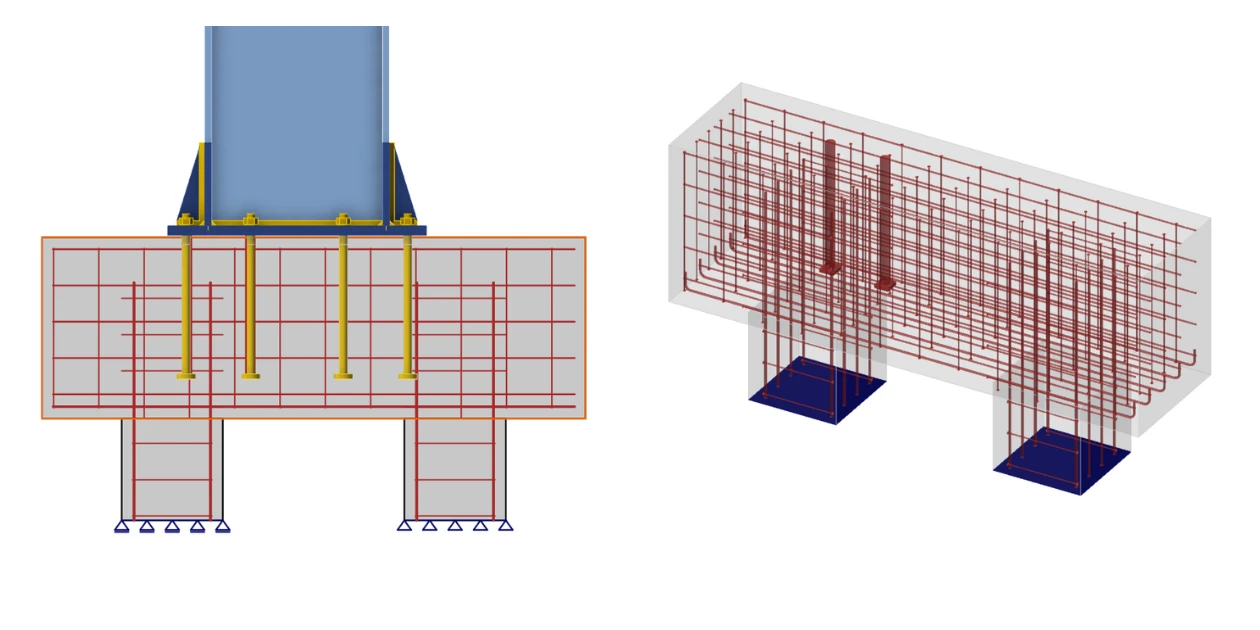


Quando si ancora l'acciaio al calcestruzzo, vengono tipicamente utilizzati bulloni di ancoraggio o ancoraggi chimici per garantire la stabilità strutturale e la capacità portante nei progetti di costruzione. Il modello viene analizzato nell'app IDEA StatiCa Detail.
Widget #NaN: widget_content_image_collapse_item
Name: IDEA StatiCa Detail
ID: b3110a59-a173-4dde-81ac-e4d2ed554ff5
Show Raw Data
{
"title": {
"name": "Title",
"type": "text",
"value": "IDEA StatiCa Detail"
},
"description": {
"images": [],
"linkedItemCodenames": [],
"linkedItems": [],
"links": [],
"name": "Description",
"type": "rich_text",
"value": "<p>Ideale per elementi con regioni D, aperture e mensole rastremate, e elementi 2D di forma generale </p>\n<ul>\n <li>Metodo CSFM non lineare </li>\n <li>Tensione e deformazione del calcestruzzo e di tutte le barre di armatura</li>\n <li>Verifica dell'ampiezza delle fessure</li>\n <li>Verifica della limitazione delle tensioni</li>\n <li>Freccia non lineare</li>\n <li>Importazione dati dall'applicazione Beam</li>\n</ul>"
},
"link_text": {
"name": "Link text",
"type": "text",
"value": "Ulteriori informazioni sui calcoli"
},
"link_url": {
"name": "Link URL",
"type": "text",
"value": ""
},
"content_item_link": {
"name": "Content item link",
"type": "modular_content",
"value": [
"detail_theoretical_background"
],
"linkedItems": [
{
"elements": {
"title": {
"name": "Main headline (H1)",
"type": "text",
"value": "IDEA StatiCa Detail – Progettazione strutturale di discontinuità in calcestruzzo"
},
"preview_image": {
"name": "Preview image",
"type": "asset",
"value": [
{
"name": "Structural design of concrete members in IDEA StatiCa Detail.png",
"description": null,
"type": "image/png",
"size": 163091,
"url": "https://assets-us-01.kc-usercontent.com:443/66e7a155-be94-0096-73e6-c55dfc7e5788/7885cdc1-8e4a-4744-834e-72ea84ebbaf4/Structural%20design%20of%20concrete%20members%20in%20IDEA%20StatiCa%20Detail.png",
"width": 1200,
"height": 630,
"renditions": {}
}
]
},
"post_date": {
"name": "Post date",
"type": "date_time",
"value": null,
"displayTimeZone": null
},
"perex_content": {
"name": "Lead paragraph",
"type": "text",
"value": ""
},
"content": {
"images": [],
"linkedItemCodenames": [
"n3c747ae6_5366_01c2_5bd8_31a08c4a3248",
"theoretical_background_detail___general",
"c7bcceba_3437_01b1_de00_8c1bd1b85fc2",
"theoretical_background_detail___main_assumptions_a",
"n770efcf3_bcf4_01bc_f4d2_b0c9c2b79bb1",
"theoretical_background_detail___general___reinforc",
"f714f21d_d9a2_0137_f2b7_93fdbcb8df7d",
"theoretical_background_detail___general___finite_e",
"ec67f3f5_4f30_01bb_fbfc_78f155ee3d65",
"theoretical_background_detail___supports_and_load_",
"n8a164d29_a1f6_0161_0e7b_241930b83ec5",
"theoretical_background_detail___load_transfer_at_t",
"n75c90b62_94f4_01a6_0730_02d484440aab",
"theoretical_background_detail___geometric_modifica",
"n43b7cc06_5a1f_0144_a06b_a341687be703",
"theoretical_background_detail___finite_element_typ",
"n86597ad2_27ba_01a7_8797_f25a80a3ee60",
"theoretical_background_detail___meshing",
"n08f8ec6b_cb7a_0164_a848_5ffdda363ad5",
"theoretical_background_detail___solution_method_an",
"e595dafd_5a37_01b6_a7df_73e12f8e5fa1",
"theoretical_background_detail___presentation_of_re",
"e8e2ce48_fab4_0174_8c85_77bb7ad55cce",
"theoretical_background_detail___general___verifica",
"d91ff4de_cf5a_01a5_44e1_b911e9d38646",
"theoretical_background_detail___material_models__e",
"adae3cc0_3b73_01f8_8c96_1f34fb053b09",
"theoretical_background_detail___safety_factors",
"efca0f76_113f_011d_9b84_d8e9d3cebf69",
"theoretical_background_detail___ultimate_limit_sta",
"n3ab94eeb_f890_01c8_d315_afcc2210ca76",
"theoretical_background_detail___partially_loaded_a",
"n827ba237_6d99_019c_0cd8_2b2e55fc66d7",
"theoretical_background_detail___serviceability_lim",
"b46955d5_dadb_01a1_d999_d2f5b3793639",
"theoretical_background_detail___material_models__a",
"n539db23d_cb06_0105_a01e_58d8aad07989",
"theoretical_background_detail___factors___aci",
"n340fc7d6_ded5_01d2_a043_f89c319a8615",
"theoretical_background_detail___strength_analysis_",
"n7e3b3c4d_2142_0176_ba42_5c9bd9c5f8de",
"theoretical_background_detail___bearing_and_anchor",
"n7f156362_9b5c_01fd_4a76_a8dc5af59d8a",
"theoretical_background_detail___serviceability_ver",
"n813037e0_e622_0113_b7ef_d859866dc1ba",
"theoretical_background_detail___material_models__a_0b99d24",
"n011ce1a4_4d9f_01f0_f775_155c61a3e75b",
"theoretical_background_detail___resistance_and_loa",
"n661b91ca_1a68_01bd_a0d7_6d6412b0e9d0",
"theoretical_background_detail___strength_limit_sta",
"dff774a5_49fd_013b_1c0c_4cdf532b89b9",
"theoretical_background_detail___bearing_and_anchor_69cbe39",
"e61aa2e4_cb52_0170_7aa0_5ed58d194ee0",
"theoretical_background_detail___service_limit_stat",
"n3d7eae35_2c6b_01d9_39d4_107256e74d0d",
"theoretical_background_detail___material_models__a_b7035a6",
"n122bb805_faa2_0117_6f78_4c3940e32c17",
"theoretical_background_detail___stress_reduction_a",
"n54d25a60_3149_01e5_e832_b4629ffb372a",
"theoretical_background_detail___strength_analysis__8bc3bfe",
"c60d8a6b_360f_010c_9412_16e10594f7a9",
"theoretical_background_detail___serviceability_ver_77b5f2c",
"n5cf9ef9f_6fe1_0197_e156_2fcf8aca85d0",
"prestressing_in_detail___model_description__body_",
"n85a4cf5d_ea33_0123_0d8a_e412db112e28"
],
"linkedItems": [
{
"elements": {
"title": {
"name": "Title",
"type": "text",
"value": "1.1 General introduction"
},
"id": {
"name": "ID",
"type": "text",
"value": "general-introduction"
},
"printable_anchor": {
"name": "Printable anchor used in PDF content table",
"type": "multiple_choice",
"value": []
},
"translation__translation_connector": {
"name": "Translation Connector",
"type": "taxonomy",
"value": [],
"taxonomyGroup": "languages"
},
"translation__force_translation": {
"name": "Force translation",
"type": "multiple_choice",
"value": []
},
"translation__translate_standalone_nested_content_items": {
"name": "Translate standalone nested content items",
"type": "multiple_choice",
"value": []
},
"translation__last_translation": {
"images": [],
"linkedItemCodenames": [],
"linkedItems": [],
"links": [],
"name": "Last translation",
"type": "rich_text",
"value": "<p><br></p>"
},
"translation__ai_translated": {
"name": "AI translated",
"type": "multiple_choice",
"value": []
},
"translation___experimental__synchronize_content_references": {
"name": "[Experimental] Synchronize content references",
"type": "multiple_choice",
"value": []
},
"translation___experimental__selective_element_translation": {
"name": "[Experimental] Selective translation",
"type": "multiple_choice",
"value": []
},
"translation__selectivetranslationelementid": {
"name": "selectiveTranslationElementId",
"type": "custom",
"value": null
}
},
"system": {
"codename": "n3c747ae6_5366_01c2_5bd8_31a08c4a3248",
"collection": "default",
"id": "3c747ae6-5366-01c2-5bd8-31a08c4a3248",
"language": "it-IT",
"lastModified": "2026-08-14T13:07:44.0036713Z",
"name": "3c747ae6-5366-01c2-5bd8-31a08c4a3248",
"sitemapLocations": [],
"type": "widget_anchor_target",
"workflowStep": null,
"workflow": null
}
},
{
"elements": {
"title": {
"name": "Main headline (H1)",
"type": "text",
"value": "1.1 Introduzione generale alla progettazione strutturale dei dettagli in calcestruzzo"
},
"preview_image": {
"name": "Preview image",
"type": "asset",
"value": [
{
"name": "General introduction for the structural design of concrete details.png",
"description": null,
"type": "image/png",
"size": 151821,
"url": "https://assets-us-01.kc-usercontent.com:443/66e7a155-be94-0096-73e6-c55dfc7e5788/918cd80e-191a-437a-8d6a-d2f8c7f688c2/General%20introduction%20for%20the%20structural%20design%20of%20concrete%20details.png",
"width": 1200,
"height": 630,
"renditions": {}
}
]
},
"post_date": {
"name": "Post date",
"type": "date_time",
"value": null,
"displayTimeZone": null
},
"perex_content": {
"name": "Lead paragraph",
"type": "text",
"value": ""
},
"content": {
"images": [
{
"description": null,
"imageId": "874c8092-fb41-44c6-804d-52727044d470",
"url": "https://assets-us-01.kc-usercontent.com:443/66e7a155-be94-0096-73e6-c55dfc7e5788/dc96c2fd-25aa-43fd-b6d5-556b5242b9cf/Discontinuity%20regions.png",
"height": 939,
"width": 1394
}
],
"linkedItemCodenames": [],
"linkedItems": [],
"links": [],
"name": "Content",
"type": "rich_text",
"value": "<p>La progettazione e la verifica degli elementi in calcestruzzo vengono normalmente eseguite a livello sezionale (elemento 1D) o puntuale (elemento 2D). Questa procedura è descritta in tutte le norme per la progettazione strutturale, ad esempio in (EN 1992-1-1 o ACI 318-19), ed è utilizzata nella pratica quotidiana dell'ingegneria strutturale. Tuttavia, non è sempre noto o rispettato il fatto che tale procedura sia accettabile solo nelle zone in cui si applica l'ipotesi di Bernoulli-Navier di distribuzione piana delle deformazioni (dette regioni B). I luoghi in cui questa ipotesi non si applica sono chiamati regioni di discontinuità o regioni disturbate (regioni D). Esempi di regioni B e D di elementi 1D sono riportati in (Fig. 1). Si tratta, ad esempio, di aree di appoggio, parti in cui vengono applicati carichi concentrati, punti in cui si verifica una brusca variazione della sezione trasversale, aperture, ecc. Nella progettazione di strutture in calcestruzzo, si incontrano molte altre regioni D, come pareti, diaframmi di ponti, mensole corte, ecc. </p>\n<figure data-asset-id=\"874c8092-fb41-44c6-804d-52727044d470\" data-image-id=\"874c8092-fb41-44c6-804d-52727044d470\"><img src=\"https://assets-us-01.kc-usercontent.com:443/66e7a155-be94-0096-73e6-c55dfc7e5788/dc96c2fd-25aa-43fd-b6d5-556b5242b9cf/Discontinuity%20regions.png\" data-asset-id=\"874c8092-fb41-44c6-804d-52727044d470\" data-image-id=\"874c8092-fb41-44c6-804d-52727044d470\" alt=\"\"></figure>\n<p><em>\\[ \\textsf{\\textit{\\footnotesize{Fig. 1\\qquad Regioni di discontinuità (Navrátil et al. 2017)}}}\\]</em></p>\n<p>In passato, per il dimensionamento delle regioni di discontinuità venivano utilizzate regole di progettazione semi-empiriche. Fortunatamente, negli ultimi decenni queste regole sono state in gran parte superate dai modelli puntone-e-tirante (Schlaich et al., 1987) e dai campi di tensione (Marti 1985), che sono presenti nelle attuali norme di progettazione e frequentemente utilizzati dai progettisti oggi. Questi modelli sono strumenti meccanicamente coerenti e potenti. Si noti che i campi di tensione possono generalmente essere continui o discontinui, e che i modelli puntone-e-tirante rappresentano un caso particolare di campi di tensione discontinui.</p>\n<p>Nonostante l'evoluzione degli strumenti di calcolo negli ultimi decenni, i modelli Puntone-e-Tirante sono essenzialmente ancora utilizzati come calcoli manuali. La loro applicazione a strutture reali è tediosa e richiede molto tempo, poiché sono necessarie iterazioni e devono essere considerate diverse combinazioni di carico. Inoltre, questo metodo non è adatto per la verifica dei criteri di esercizio (deformazioni, ampiezza delle fessure, ecc.).</p>\n<p>L'interesse degli ingegneri strutturali per uno strumento affidabile e rapido per la progettazione delle regioni D ha portato alla decisione di sviluppare il nuovo Metodo del Campo di Tensioni Compatibile, un metodo per la progettazione di campi di tensione assistita da computer che consente la progettazione e la verifica automatica di elementi strutturali in calcestruzzo soggetti a carichi nel piano.</p>\n<p>Il Metodo del Campo di Tensioni Compatibile (CSFM) è un metodo di analisi continua dei campi di tensione basato su elementi finiti, in cui le soluzioni classiche dei campi di tensione sono integrate da considerazioni cinematiche, ovvero lo stato di deformazione viene valutato in tutta la struttura. Di conseguenza, la resistenza a compressione efficace del calcestruzzo può essere calcolata automaticamente in base allo stato di deformazione trasversale, in modo simile a quanto avviene nelle analisi dei campi di compressione che tengono conto dell'ammorbidimento a compressione (Vecchio e Collins 1986; Kaufmann e Marti 1998) e nel metodo EPSF (Fernández Ruiz e Muttoni 2007). Inoltre, il CSFM considera l'irrigidimento a trazione, fornendo rigidezze realistiche agli elementi, e copre tutte le prescrizioni normative (compresi gli aspetti di esercizio e di capacità deformativa) non affrontate in modo coerente dagli approcci precedenti. Il CSFM utilizza le comuni leggi costitutive uniassiali fornite dagli standard di progettazione per il calcestruzzo e l'armatura. Queste sono note già in fase di progettazione, il che consente di utilizzare il metodo dei coefficienti parziali di sicurezza. Pertanto, i progettisti non devono fornire proprietà dei materiali aggiuntive, spesso arbitrarie, come tipicamente richiesto per le analisi FE non lineari, rendendo il metodo perfettamente adatto alla pratica ingegneristica.</p>\n<p>Per favorire l'utilizzo dei campi di tensione assistiti da computer da parte degli ingegneri strutturali, questi metodi dovrebbero essere implementati in ambienti software di facile utilizzo. A tal fine, il CSFM è stato implementato in <em>IDEA StatiCa Detail</em>; un nuovo software commerciale di facile utilizzo sviluppato congiuntamente dal Politecnico Federale di Zurigo (ETH Zurich) e dall'azienda software IDEA StatiCa nell'ambito del progetto DR-Design Eurostars-10571.</p>"
},
"linked_items": {
"name": "Linked items",
"type": "modular_content",
"value": [
"detail_theoretical_background",
"theoretical_background_detail___general___reinforc",
"dimenzovani_zb_konstrukci_podle_csfm",
"prestressed_i_section"
],
"linkedItems": [
"[Circular Reference]",
{
"elements": {
"title": {
"name": "Main headline (H1)",
"type": "text",
"value": "1.3 Strumenti di progettazione per l'armatura"
},
"preview_image": {
"name": "Preview image",
"type": "asset",
"value": [
{
"name": "Reinforcement structural design.png",
"description": null,
"type": "image/png",
"size": 61765,
"url": "https://assets-us-01.kc-usercontent.com:443/66e7a155-be94-0096-73e6-c55dfc7e5788/8d4e1ab7-8d44-491e-873f-8ea42d620992/Reinforcement%20structural%20design.png",
"width": 1200,
"height": 630,
"renditions": {}
}
]
},
"post_date": {
"name": "Post date",
"type": "date_time",
"value": null,
"displayTimeZone": null
},
"perex_content": {
"name": "Lead paragraph",
"type": "text",
"value": ""
},
"content": {
"images": [
{
"description": null,
"imageId": "eee2b9e4-83cd-4b9c-98e7-f575b2ff9cff",
"url": "https://assets-us-01.kc-usercontent.com:443/66e7a155-be94-0096-73e6-c55dfc7e5788/9b0c4840-5a55-46f3-95ba-86a9baabbf0c/Model%20used%20to%20illustrate%20the%20use%20of%20the%20reinforcement%20design%20tools.png",
"height": 603,
"width": 864
},
{
"description": null,
"imageId": "f6c14a09-4d2b-40e6-ac82-5ff08c10439a",
"url": "https://assets-us-01.kc-usercontent.com:443/66e7a155-be94-0096-73e6-c55dfc7e5788/ea7896d1-8276-4d08-b811-066cca73b455/Results%20from%20the%20linear%20analysis%20tool.jpg",
"height": 315,
"width": 1177
},
{
"description": null,
"imageId": "f4f47d5e-3196-4a88-96ca-7162b0c8c271",
"url": "https://assets-us-01.kc-usercontent.com:443/66e7a155-be94-0096-73e6-c55dfc7e5788/f4d37064-76c7-4413-b1aa-87455a32852c/Results%20from%20the%20topology%20optimization%201.jpg",
"height": 320,
"width": 1179
},
{
"description": null,
"imageId": "7ddd1329-64ea-4a47-be5d-64994439e729",
"url": "https://assets-us-01.kc-usercontent.com:443/66e7a155-be94-0096-73e6-c55dfc7e5788/d81f2841-8274-414a-8f30-b55427216169/Results%20from%20the%20topology%20optimization%202.png",
"height": 315,
"width": 1179
}
],
"linkedItemCodenames": [],
"linkedItems": [],
"links": [
{
"codename": "csfm_concrete_verification",
"linkId": "42ce7f6b-6491-4224-a01e-c4c0072ed1cd",
"urlSlug": "design-your-structural-concrete-details-with-confidence",
"type": "blog_post"
},
{
"codename": "topology_optimization_for_reinforced_concrete",
"linkId": "decdf07d-a46b-5894-9a22-793436e318c7",
"urlSlug": "ottimizzazione-topologica-per-il-calcestruzzo-armato",
"type": "blog_post"
}
],
"name": "Content",
"type": "rich_text",
"value": "<h3>Flusso di lavoro e obiettivi</h3>\n<p>L'obiettivo degli strumenti di progettazione dell'armatura nel <a data-item-id=\"42ce7f6b-6491-4224-a01e-c4c0072ed1cd\" href=\"\">CSFM</a> è aiutare i progettisti a determinare in modo efficiente la posizione e la quantità necessaria di barre di armatura. I seguenti strumenti sono disponibili per assistere/guidare l'utente in questo processo: calcolo lineare e <a data-item-id=\"decdf07d-a46b-5894-9a22-793436e318c7\" href=\"\">ottimizzazione topologica</a>.</p>\n<p>Gli strumenti di progettazione dell'armatura considerano modelli costitutivi più semplificati rispetto ai modelli utilizzati per la verifica finale della struttura. Pertanto, la definizione dell'armatura in questa fase deve essere considerata un pre-dimensionamento da confermare/perfezionare durante la fase di verifica finale. L'utilizzo dei diversi strumenti di progettazione dell'armatura sarà illustrato nel modello mostrato in Fig. 3, che consiste in un'estremità di una trave semplicemente appoggiata con altezza variabile soggetta a un carico uniformemente distribuito.</p>\n<figure data-asset-id=\"eee2b9e4-83cd-4b9c-98e7-f575b2ff9cff\" data-image-id=\"eee2b9e4-83cd-4b9c-98e7-f575b2ff9cff\"><img src=\"https://assets-us-01.kc-usercontent.com:443/66e7a155-be94-0096-73e6-c55dfc7e5788/9b0c4840-5a55-46f3-95ba-86a9baabbf0c/Model%20used%20to%20illustrate%20the%20use%20of%20the%20reinforcement%20design%20tools.png\" data-asset-id=\"eee2b9e4-83cd-4b9c-98e7-f575b2ff9cff\" data-image-id=\"eee2b9e4-83cd-4b9c-98e7-f575b2ff9cff\" alt=\"\"></figure>\n<p><em>\\[ \\textsf{\\textit{\\footnotesize{Fig. 3\\qquad Modello utilizzato per illustrare l'utilizzo degli strumenti di progettazione dell'armatura.}}}\\]</em></p>\n<h3>Analisi lineare</h3>\n<p>L'analisi lineare considera proprietà del materiale elastico lineari e trascura l'armatura nella regione di calcestruzzo. Si tratta quindi di un calcolo molto rapido che fornisce una prima indicazione delle zone di trazione e compressione. Un esempio di tale calcolo è mostrato in Fig. 4.</p>\n<figure data-asset-id=\"f6c14a09-4d2b-40e6-ac82-5ff08c10439a\" data-image-id=\"f6c14a09-4d2b-40e6-ac82-5ff08c10439a\"><img src=\"https://assets-us-01.kc-usercontent.com:443/66e7a155-be94-0096-73e6-c55dfc7e5788/ea7896d1-8276-4d08-b811-066cca73b455/Results%20from%20the%20linear%20analysis%20tool.jpg\" data-asset-id=\"f6c14a09-4d2b-40e6-ac82-5ff08c10439a\" data-image-id=\"f6c14a09-4d2b-40e6-ac82-5ff08c10439a\" alt=\"\"></figure>\n<p><em>\\[ \\textsf{\\textit{\\footnotesize{Fig. 4\\qquad Risultati dello strumento di analisi lineare per la definizione della disposizione dell'armatura}}}\\]</em></p>\n<p><em>\\[ \\textsf{\\textit{\\footnotesize{(rosso: zone in compressione, blu: zone in trazione).}}}\\]</em></p>\n<h3>Ottimizzazione topologica</h3>\n<p>L'ottimizzazione topologica è un metodo che mira a trovare la distribuzione ottimale del materiale in un dato volume per una determinata configurazione di carico. L'ottimizzazione topologica implementata in <em>Idea StatiCa Detail</em> utilizza un modello lineare a elementi finiti. Ogni elemento finito può avere una densità relativa da 0 a 100 %, che rappresenta la quantità relativa di materiale utilizzato. Queste densità degli elementi sono i parametri di ottimizzazione nel problema di ottimizzazione. La distribuzione di materiale risultante è considerata ottimale per il dato insieme di carichi se minimizza l'energia di deformazione totale del sistema. Per definizione, la distribuzione ottimale è anche la geometria che presenta la massima rigidezza possibile per i carichi dati.</p>\n<p>Il processo di ottimizzazione iterativo inizia con una distribuzione di densità omogenea.<em> </em>Il calcolo viene eseguito per più frazioni di volume totale (20%, 40%, 60% e 80%), il che consente all'utente di selezionare il risultato più pratico. La forma risultante è costituita da traliccio con puntoni e tiranti e rappresenta la forma ottimale per i casi di carico dati (Fig. 5).</p>\n<figure data-asset-id=\"f4f47d5e-3196-4a88-96ca-7162b0c8c271\" data-image-id=\"f4f47d5e-3196-4a88-96ca-7162b0c8c271\"><img src=\"https://assets-us-01.kc-usercontent.com:443/66e7a155-be94-0096-73e6-c55dfc7e5788/f4d37064-76c7-4413-b1aa-87455a32852c/Results%20from%20the%20topology%20optimization%201.jpg\" data-asset-id=\"f4f47d5e-3196-4a88-96ca-7162b0c8c271\" data-image-id=\"f4f47d5e-3196-4a88-96ca-7162b0c8c271\" alt=\"\"></figure>\n<figure data-asset-id=\"7ddd1329-64ea-4a47-be5d-64994439e729\" data-image-id=\"7ddd1329-64ea-4a47-be5d-64994439e729\"><img src=\"https://assets-us-01.kc-usercontent.com:443/66e7a155-be94-0096-73e6-c55dfc7e5788/d81f2841-8274-414a-8f30-b55427216169/Results%20from%20the%20topology%20optimization%202.png\" data-asset-id=\"7ddd1329-64ea-4a47-be5d-64994439e729\" data-image-id=\"7ddd1329-64ea-4a47-be5d-64994439e729\" alt=\"\"></figure>\n<p><em>\\[ \\textsf{\\textit{\\footnotesize{Fig. 5\\qquad Risultati dello strumento di progettazione con ottimizzazione topologica con 20\\% e 40\\% di volume effettivo}}}\\]</em></p>\n<p><em>\\[ \\textsf{\\textit{\\footnotesize{(rosso: zone in compressione, blu: zone in trazione).}}}\\]</em></p>\n<p><br></p>"
},
"linked_items": {
"name": "Linked items",
"type": "modular_content",
"value": [
"theoretical_background_detail___general",
"theoretical_background_detail___general___finite_e",
"dimenzovani_zb_konstrukci_podle_csfm"
],
"linkedItems": [
"[Circular Reference]",
{
"elements": {
"title": {
"name": "Main headline (H1)",
"type": "text",
"value": "2.1 Introduzione all'implementazione del metodo degli elementi finiti"
},
"preview_image": {
"name": "Preview image",
"type": "asset",
"value": [
{
"name": "Finite element implementation in IDEA StatiCa Detail.png",
"description": null,
"type": "image/png",
"size": 481046,
"url": "https://assets-us-01.kc-usercontent.com:443/66e7a155-be94-0096-73e6-c55dfc7e5788/0388381a-906d-48f1-a5b2-ce00188fded9/Finite%20element%20implementation%20in%20IDEA%20StatiCa%20Detail.png",
"width": 1200,
"height": 630,
"renditions": {}
}
]
},
"post_date": {
"name": "Post date",
"type": "date_time",
"value": null,
"displayTimeZone": null
},
"perex_content": {
"name": "Lead paragraph",
"type": "text",
"value": ""
},
"content": {
"images": [
{
"description": null,
"imageId": "9e86fe68-36a5-433d-9451-40d2b5078b86",
"url": "https://assets-us-01.kc-usercontent.com:443/66e7a155-be94-0096-73e6-c55dfc7e5788/3f70008c-0c34-4dbe-8219-4d8aa7079bb5/Visualization%20of%20the%20calculation%20model.png",
"height": 562,
"width": 847
}
],
"linkedItemCodenames": [],
"linkedItems": [],
"links": [
{
"codename": "untitled_content_item_a11adc2",
"linkId": "a11adc2d-9c84-4667-8061-600660e1ad87",
"urlSlug": "concrete-walls-challenge-or-routine",
"type": "blog_post"
}
],
"name": "Content",
"type": "rich_text",
"value": "<p>Il CSFM considera campi di tensione continui nel calcestruzzo (elementi finiti 2D), integrati da elementi discreti a \"barra\" che rappresentano l'armatura (elementi finiti 1D). Pertanto, l'armatura non è annegata in modo diffuso negli elementi finiti 2D del calcestruzzo, ma modellata esplicitamente e collegata ad essi. Nel modello di calcolo si considera uno stato di tensione piana.</p>\n<figure data-asset-id=\"9e86fe68-36a5-433d-9451-40d2b5078b86\" data-image-id=\"9e86fe68-36a5-433d-9451-40d2b5078b86\"><img src=\"https://assets-us-01.kc-usercontent.com:443/66e7a155-be94-0096-73e6-c55dfc7e5788/3f70008c-0c34-4dbe-8219-4d8aa7079bb5/Visualization%20of%20the%20calculation%20model.png\" data-asset-id=\"9e86fe68-36a5-433d-9451-40d2b5078b86\" data-image-id=\"9e86fe68-36a5-433d-9451-40d2b5078b86\" alt=\"\"></figure>\n<p><em>\\[ \\textsf{\\textit{\\footnotesize{Fig. 6\\qquad Visualizzazione del modello di calcolo di un elemento strutturale (trave tagliata) in Idea StatiCa Detail.}}}\\]</em></p>\n<p>Possono essere modellate sia intere <a data-item-id=\"a11adc2d-9c84-4667-8061-600660e1ad87\" href=\"\">pareti</a> e travi, sia dettagli (parti) di travi (regione di discontinuità isolata, detta anche estremità tagliata). Nel caso di pareti e travi intere, i vincoli devono essere definiti in modo tale da ottenere una struttura (esternamente) isostatica (staticamente determinata) o iperstatica (staticamente indeterminata). Il trasferimento del carico alle estremità tagliate delle travi viene introdotto tramite una speciale zona di trasferimento di Saint-Venant, che garantisce una distribuzione realistica delle tensioni nella regione di dettaglio analizzata.</p>"
},
"linked_items": {
"name": "Linked items",
"type": "modular_content",
"value": [
"theoretical_background_detail___general___reinforc",
"theoretical_background_detail___general___verifica",
"n2017_solution_for_walls_and_details_of_concrete_st",
"fire_resistance_check_of_concrete_structures"
],
"linkedItems": [
"[Circular Reference]",
{
"elements": {
"title": {
"name": "Main headline (H1)",
"type": "text",
"value": "3.1 Stati limite e calcolo dell'ampiezza delle fessure"
},
"preview_image": {
"name": "Preview image",
"type": "asset",
"value": [
{
"name": "Structural element verification in IDEA StatiCa Detail.png",
"description": null,
"type": "image/png",
"size": 174643,
"url": "https://assets-us-01.kc-usercontent.com:443/66e7a155-be94-0096-73e6-c55dfc7e5788/3ab2c71e-930c-4975-88fe-72502fad03d5/Structural%20element%20verification%20in%20IDEA%20StatiCa%20Detail.png",
"width": 1200,
"height": 630,
"renditions": {}
}
]
},
"post_date": {
"name": "Post date",
"type": "date_time",
"value": null,
"displayTimeZone": null
},
"perex_content": {
"name": "Lead paragraph",
"type": "text",
"value": ""
},
"content": {
"images": [
{
"description": null,
"imageId": "8c27dc0f-1cfe-4026-bbf5-4b51604c3558",
"url": "https://assets-us-01.kc-usercontent.com:443/66e7a155-be94-0096-73e6-c55dfc7e5788/aabe4d74-d599-4c9d-a62d-8e448a66360a/Mesh%20multiplier.PNG",
"height": 55,
"width": 421
}
],
"linkedItemCodenames": [
"theoretical_background_detail___crack_width_calcul"
],
"linkedItems": [],
"links": [],
"name": "Content",
"type": "rich_text",
"value": "<p>Nella valutazione della struttura mediante il CSFM vengono eseguite due analisi distinte: una per le combinazioni di carico allo stato limite di esercizio e una per lo stato limite ultimo. L'analisi allo stato limite di esercizio presuppone che il comportamento ultimo dell'elemento sia soddisfacente e che le condizioni di snervamento del materiale non vengano raggiunte ai livelli di carico di esercizio. Questo approccio consente l'utilizzo di modelli costitutivi semplificati (con un ramo lineare del diagramma tensione-deformazione del calcestruzzo) per l'analisi allo stato limite di esercizio, al fine di migliorare la stabilità numerica e la velocità di calcolo. Pertanto, si raccomanda di utilizzare il flusso di lavoro presentato di seguito, in cui l'analisi allo stato limite ultimo viene eseguita come primo passaggio.</p>\n<h3>Analisi allo stato limite ultimo</h3>\n<p>Le diverse verifiche richieste da specifiche normative di progettazione vengono valutate sulla base dei risultati diretti forniti dal modello. Le verifiche SLU vengono eseguite per la resistenza del calcestruzzo, la resistenza dell'armatura e l'ancoraggio (tensioni tangenziali di aderenza).</p>\n<p>Per garantire che un elemento strutturale abbia una progettazione efficiente, si raccomanda vivamente di eseguire un'analisi preliminare che tenga conto dei seguenti passaggi:</p>\n<ul>\n <li>Scegliere una selezione delle combinazioni di carico più critiche.</li>\n <li>Calcolare solo le combinazioni di carico allo Stato Limite Ultimo (SLU).</li>\n <li>Utilizzare una rete grossolana (aumentando il moltiplicatore della dimensione predefinita della rete in Setup (Fig. 19)).</li>\n</ul>\n<figure data-asset-id=\"8c27dc0f-1cfe-4026-bbf5-4b51604c3558\" data-image-id=\"8c27dc0f-1cfe-4026-bbf5-4b51604c3558\"><img src=\"https://assets-us-01.kc-usercontent.com:443/66e7a155-be94-0096-73e6-c55dfc7e5788/aabe4d74-d599-4c9d-a62d-8e448a66360a/Mesh%20multiplier.PNG\" data-asset-id=\"8c27dc0f-1cfe-4026-bbf5-4b51604c3558\" data-image-id=\"8c27dc0f-1cfe-4026-bbf5-4b51604c3558\" alt=\"\"></figure>\n<p><em>\\[ \\textsf{\\textit{\\footnotesize{Fig. 19\\qquad Moltiplicatore della rete.}}}\\]</em></p>\n<p>Un tale modello verrà calcolato molto rapidamente, consentendo ai progettisti di rivedere il dettaglio costruttivo dell'elemento strutturale in modo efficiente e di rieseguire l'analisi finché tutti i requisiti di verifica non siano soddisfatti per le combinazioni di carico più critiche. Una volta soddisfatti tutti i requisiti di verifica di questa analisi preliminare, si suggerisce di includere le combinazioni di carico ultime complete e di utilizzare una dimensione di rete fine (la dimensione della rete raccomandata dal programma). L'utente può modificare la dimensione della rete tramite il moltiplicatore, che può raggiungere valori da 0,5 a 5 (Fig. 19).</p>\n<p>I risultati e le verifiche di base (tensione, deformazione e sfruttamento (ossia, il valore calcolato/valore limite dalla normativa), nonché la direzione delle tensioni principali nel caso di elementi in calcestruzzo) vengono visualizzati mediante diversi grafici in cui la compressione è generalmente presentata in rosso e la trazione in blu. I valori minimo e massimo globali per l'intera struttura possono essere evidenziati, così come i valori minimo e massimo per ogni parte definita dall'utente. In una scheda separata del programma, è possibile visualizzare risultati avanzati come i valori tensoriali, le deformazioni della struttura e i rapporti di armatura (efficace e geometrico) utilizzati per il calcolo dell'irrigidimento a trazione delle barre di armatura. Inoltre, è possibile presentare i carichi e le reazioni per le combinazioni o i casi di carico selezionati.</p>\n<h3>Analisi allo stato limite di esercizio</h3>\n<p>Le valutazioni SLE vengono eseguite per la limitazione delle tensioni, l'ampiezza delle fessure e i limiti di deformazione. Le tensioni vengono verificate negli elementi in calcestruzzo e in armatura secondo la normativa applicabile, in modo simile a quanto specificato per lo SLU.</p>\n<p>L'analisi allo stato limite di esercizio contiene alcune semplificazioni dei modelli costitutivi utilizzati per l'analisi allo stato limite ultimo. Si presuppone un'aderenza perfetta, ossia la lunghezza di ancoraggio non viene verificata all'esercizio. Inoltre, il ramo plastico della curva tensione-deformazione del calcestruzzo in compressione viene trascurato, mentre il ramo elastico è lineare e infinito. Queste semplificazioni migliorano la stabilità numerica e la velocità di calcolo, e non riducono la generalità della soluzione, purché i limiti di tensione risultanti del materiale all'esercizio siano chiaramente al di sotto dei rispettivi punti di snervamento (come richiesto dalle normative). Pertanto, i modelli semplificati utilizzati per l'esercizio sono validi solo se tutti i requisiti di verifica sono soddisfatti.</p>\n<object type=\"application/kenticocloud\" data-type=\"item\" data-rel=\"link\" data-codename=\"theoretical_background_detail___crack_width_calcul\"></object>"
},
"linked_items": {
"name": "Linked items",
"type": "modular_content",
"value": [
"theoretical_background_detail___general___finite_e",
"theoretical_background_detail___finite_element_typ",
"general_description_of_sls_results_in_detail_appli"
],
"linkedItems": [
"[Circular Reference]",
{
"elements": {
"title": {
"name": "Main headline (H1)",
"type": "text",
"value": "2.5 Tipi di elementi finiti"
},
"preview_image": {
"name": "Preview image",
"type": "asset",
"value": [
{
"name": "finite elements.png",
"description": null,
"type": "image/png",
"size": 219517,
"url": "https://assets-us-01.kc-usercontent.com:443/66e7a155-be94-0096-73e6-c55dfc7e5788/48fa7d1e-4cae-4946-924d-ec19029fa362/finite%20elements.png",
"width": 1230,
"height": 630,
"renditions": {}
}
]
},
"post_date": {
"name": "Post date",
"type": "date_time",
"value": null,
"displayTimeZone": null
},
"perex_content": {
"name": "Lead paragraph",
"type": "text",
"value": ""
},
"content": {
"images": [
{
"description": null,
"imageId": "03fd72f4-b362-492a-8885-349785eaa70a",
"url": "https://assets-us-01.kc-usercontent.com:443/66e7a155-be94-0096-73e6-c55dfc7e5788/511cc4d5-618a-4542-ac53-52a29549070f/Finite%20element%20model.png",
"height": 449,
"width": 1177
},
{
"description": null,
"imageId": "a031a0ff-a5a7-4a37-b59f-cb1c408f080b",
"url": "https://assets-us-01.kc-usercontent.com:443/66e7a155-be94-0096-73e6-c55dfc7e5788/1cc20fd2-92d7-42dc-ac17-24f318cbd45c/Bond.PNG",
"height": 707,
"width": 1773
},
{
"description": null,
"imageId": "6e05f6d3-2d4c-4c6c-90f0-89e34117415c",
"url": "https://assets-us-01.kc-usercontent.com:443/66e7a155-be94-0096-73e6-c55dfc7e5788/748b5346-4251-4154-b923-919c94d0c6d0/Model%20for%20the%20reduction%20of%20the%20anchorage%20length.PNG",
"height": 702,
"width": 1792
}
],
"linkedItemCodenames": [],
"linkedItems": [],
"links": [],
"name": "Content",
"type": "rich_text",
"value": "<p>Il modello di analisi agli elementi finiti non lineare (anelastico) viene creato utilizzando diversi tipi di elementi finiti per modellare il calcestruzzo, l'armatura e l'aderenza tra di essi. Gli elementi di calcestruzzo e di armatura vengono prima discretizzati (mesh) in modo indipendente e poi collegati tra loro tramite vincoli multi-punto (elementi MPC). Questo permette all'armatura di occupare una posizione relativa arbitraria rispetto al calcestruzzo. Se deve essere calcolata la verifica della lunghezza di ancoraggio, tra l'armatura e gli elementi MPC vengono inseriti elementi molla di aderenza e di estremità di ancoraggio.</p>\n<figure data-asset-id=\"03fd72f4-b362-492a-8885-349785eaa70a\" data-image-id=\"03fd72f4-b362-492a-8885-349785eaa70a\"><img src=\"https://assets-us-01.kc-usercontent.com:443/66e7a155-be94-0096-73e6-c55dfc7e5788/511cc4d5-618a-4542-ac53-52a29549070f/Finite%20element%20model.png\" data-asset-id=\"03fd72f4-b362-492a-8885-349785eaa70a\" data-image-id=\"03fd72f4-b362-492a-8885-349785eaa70a\" alt=\"\"></figure>\n<p><em>\\[ \\textsf{\\textit{\\footnotesize{Fig. 13\\qquad Finite element model: reinforcement elements mapped to concrete mesh using MPC elements and bond elements.}}}\\]</em></p>\n<h3>Calcestruzzo</h3>\n<p>Il calcestruzzo è modellato utilizzando elementi shell quadrilateri e trilateri, CQUAD4 e CTRIA3. Questi possono essere definiti rispettivamente da quattro o tre nodi. In questi elementi si assume l'esistenza esclusiva dello stato piano di tensione, ovvero le tensioni o deformazioni nella direzione z non vengono considerate.</p>\n<p>Ogni elemento presenta quattro o tre punti di integrazione, posizionati approssimativamente a 1/4 della sua dimensione. In ogni punto di integrazione di ciascun elemento vengono calcolate le direzioni delle deformazioni principali α<sub>1</sub>, α<sub>2</sub>. In entrambe queste direzioni, le tensioni principali σ<em><sub>c</sub></em><sub>1</sub>, σ<em><sub>c</sub></em><sub>2</sub> e le rigidezze <em>E</em><sub>1</sub>, <em>E</em><sub>2</sub> vengono valutate in base al diagramma tensione-deformazione del calcestruzzo specificato, come mostrato in Fig. 2. Va notato che l'effetto dell'ammorbidimento a compressione accoppia il comportamento della direzione di compressione principale allo stato attuale dell'altra direzione principale.</p>\n<h3>Armatura</h3>\n<p>Le barre di armatura sono modellate mediante elementi \"asta\" 1D a due nodi (CROD), che possiedono solo rigidezza assiale. Questi elementi sono collegati a speciali elementi di \"aderenza\" sviluppati per modellare il comportamento di scorrimento tra una barra di armatura e il calcestruzzo circostante. Questi elementi di aderenza sono successivamente collegati tramite elementi MPC (vincolo multi-punto) alla mesh che rappresenta il calcestruzzo. Questo approccio consente la discretizzazione indipendente dell'armatura e del calcestruzzo, garantendo comunque la loro interconnessione in una fase successiva.</p>\n<h3>Elementi di aderenza</h3>\n<p>La lunghezza di ancoraggio viene verificata implementando le tensioni tangenziali di aderenza tra gli elementi di calcestruzzo (2D) e gli elementi della barra di armatura (1D) nel modello agli elementi finiti. A tal fine, è stato sviluppato un tipo di elemento finito di \"aderenza\".</p>\n<p>La definizione dell'elemento di aderenza è simile a quella di un elemento shell (CQUAD4). È anch'esso definito da 4 nodi, ma a differenza di uno shell, possiede una rigidezza non nulla solo a taglio tra i due nodi superiori e i due nodi inferiori. Nel modello, i nodi superiori sono collegati agli elementi che rappresentano l'armatura e i nodi inferiori a quelli che rappresentano il calcestruzzo. Il comportamento di questo elemento è descritto dalla tensione di aderenza, τ<em><sub>b</sub></em>, come funzione bilineare dello scorrimento tra i nodi superiori e inferiori, δ<em><sub>u</sub></em>, vedere Fig. 14.</p>\n<figure data-asset-id=\"a031a0ff-a5a7-4a37-b59f-cb1c408f080b\" data-image-id=\"a031a0ff-a5a7-4a37-b59f-cb1c408f080b\"><img src=\"https://assets-us-01.kc-usercontent.com:443/66e7a155-be94-0096-73e6-c55dfc7e5788/1cc20fd2-92d7-42dc-ac17-24f318cbd45c/Bond.PNG\" data-asset-id=\"a031a0ff-a5a7-4a37-b59f-cb1c408f080b\" data-image-id=\"a031a0ff-a5a7-4a37-b59f-cb1c408f080b\" alt=\"\"></figure>\n<p><em>\\[ \\textsf{\\textit{\\footnotesize{Fig. 14\\qquad (a) conceptual illustration of the deformation of a bond element; (b) a stress-deformation function.}}}\\]</em></p>\n<p><br></p>\n<p>Il modulo di rigidezza elastico della relazione aderenza-scorrimento, <em>G</em><em><sub>b</sub></em>, è definito come segue:</p>\n<p>\\[G_b = k_g \\cdot \\frac{E_c}{Ø}\\]</p>\n<p>dove:</p>\n<p><em>k</em><em><sub>g</sub></em> coefficiente dipendente dalla superficie della barra di armatura (per impostazione predefinita <em>k</em><em><sub>g</sub></em><sub> </sub>= 0,2)</p>\n<p><em>E</em><em><sub>c</sub></em> modulo elastico del calcestruzzo (assunto pari a <em>E</em><em><sub>cm</sub></em> nel caso della normativa EN)</p>\n<p>Ø il diametro della barra di armatura</p>\n<p>I valori di progetto (valori fattorizzati) della tensione tangenziale di aderenza ultima, <em>f</em><em><sub>bd</sub></em>, forniti nelle rispettive normative di progetto selezionate EN 1992-1-1 o ACI 318-19, vengono utilizzati per verificare la lunghezza di ancoraggio. L'incrudimento del ramo plastico viene calcolato per impostazione predefinita come <em>G</em><em><sub>b</sub></em>/10<sup>5</sup>.</p>\n<h3>Molla di ancoraggio</h3>\n<p>La predisposizione di estremità di ancoraggio per le barre di armatura (ad esempio, piegature, uncini, anelli…), conforme alle prescrizioni delle normative di progetto, consente di ridurre la lunghezza di ancoraggio di base delle barre (<em>l</em><em><sub>b,net</sub></em>) di un determinato fattore β (di seguito denominato \"coefficiente di ancoraggio\"). Il valore di progetto della lunghezza di ancoraggio (<em>l</em><em><sub>b</sub></em>) viene quindi calcolato come segue:</p>\n<p>\\[l_b = \\left(1 - \\beta\\right)l_{b,net}\\]</p>\n<p>La riduzione prevista in <em>l</em><em><sub>b,net</sub></em> equivale all'attivazione della barra di armatura alla sua estremità a una percentuale della sua capacità massima determinata dal coefficiente di riduzione di ancoraggio, come mostrato in Fig. 15a.</p>\n<figure data-asset-id=\"6e05f6d3-2d4c-4c6c-90f0-89e34117415c\" data-image-id=\"6e05f6d3-2d4c-4c6c-90f0-89e34117415c\"><img src=\"https://assets-us-01.kc-usercontent.com:443/66e7a155-be94-0096-73e6-c55dfc7e5788/748b5346-4251-4154-b923-919c94d0c6d0/Model%20for%20the%20reduction%20of%20the%20anchorage%20length.PNG\" data-asset-id=\"6e05f6d3-2d4c-4c6c-90f0-89e34117415c\" data-image-id=\"6e05f6d3-2d4c-4c6c-90f0-89e34117415c\" alt=\"\"></figure>\n<p><em>\\[ \\textsf{\\textit{\\footnotesize{Fig. 15\\qquad Model for the reduction of the anchorage length:}}}\\]</em></p>\n<p><em>\\[ \\textsf{\\textit{\\footnotesize{(a) anchorage force along the anchorage length of the reinforcing bar; (b) slip-anchorage force constitutive relationship.}}}\\]</em></p>\n<p>La riduzione della lunghezza di ancoraggio è inclusa nel modello agli elementi finiti mediante un elemento molla all'estremità della barra (Fig. 15), definito dal modello costitutivo mostrato in Fig. 15b. La forza massima trasmessa da questa molla (<em>F</em><em><sub>au</sub></em>) è:</p>\n<p>\\[F_{au} = \\beta \\cdot A_s \\cdot f_{yd}\\]</p>\n<p>dove:</p>\n<p><em>β</em> il coefficiente di ancoraggio basato sul tipo di ancoraggio,</p>\n<p><em>A</em><em><sub>s</sub></em> la sezione trasversale della barra di armatura,</p>\n<p><em>f</em><em><sub>yd</sub></em><em> </em> il valore di progetto (valore fattorizzato) della resistenza a snervamento dell'armatura.</p>"
},
"linked_items": {
"name": "Linked items",
"type": "modular_content",
"value": [
"theoretical_background_detail___general___reinforc",
"theoretical_background_detail___general___verifica",
"n2017_solution_for_walls_and_details_of_concrete_st",
"fire_resistance_check_of_concrete_structures"
],
"linkedItems": [
"[Circular Reference]",
"[Circular Reference]"
]
},
"regions": {
"name": "Region",
"type": "taxonomy",
"value": [
{
"name": "AMER",
"codename": "amer"
},
{
"name": "EMEA",
"codename": "emea"
},
{
"name": "APAC",
"codename": "apac"
}
],
"taxonomyGroup": "region"
},
"product_groups": {
"name": "Product group",
"type": "taxonomy",
"value": [
{
"name": "Concrete",
"codename": "concrete"
}
],
"taxonomyGroup": "product_group"
},
"support_center_article_types": {
"name": "Support center article",
"type": "taxonomy",
"value": [
{
"name": "Knowledge base",
"codename": "knowledgebase_article"
}
],
"taxonomyGroup": "support_center_article"
},
"expertise_levels": {
"name": "Expertise level",
"type": "taxonomy",
"value": [],
"taxonomyGroup": "expertise_level"
},
"labels": {
"name": "Labels",
"type": "taxonomy",
"value": [
{
"name": "Detail 2D",
"codename": "detail"
},
{
"name": "ACI (USA)",
"codename": "aci__usa_"
},
{
"name": "EN (Eurocode)",
"codename": "eurocode"
}
],
"taxonomyGroup": "labels"
},
"attachments__files": {
"name": "Attachments",
"type": "asset",
"value": []
},
"content_priority__value": {
"name": "Content priority value",
"type": "number",
"value": 7100
},
"options": {
"name": "Options",
"type": "multiple_choice",
"value": []
},
"url_slug": {
"name": "Url slug",
"type": "url_slug",
"value": "2-5-finite-element-types"
},
"unique_url_slug": {
"name": "Unique URL slug",
"type": "custom",
"value": "[\"finite-element-types\",\"[autogenerated]\"]"
},
"content_settings__sitemap": {
"name": "Show in sitemap",
"type": "multiple_choice",
"value": []
},
"content_settings__robots": {
"name": "Search engine indexing",
"type": "multiple_choice",
"value": []
},
"content_settings__is_hidden": {
"name": "Hidden nested content",
"type": "multiple_choice",
"value": [
{
"name": "yes",
"codename": "yes"
}
]
},
"content_settings__is_topped": {
"name": "Topped",
"type": "multiple_choice",
"value": []
},
"metadata__page_title": {
"name": "Page title",
"type": "text",
"value": ""
},
"metadata__page_description": {
"name": "Page description",
"type": "text",
"value": ""
},
"metadata__page_keywords": {
"name": "Page keywords",
"type": "text",
"value": ""
},
"metadata__canonical_url": {
"name": "Canonical URL",
"type": "text",
"value": ""
},
"metadata__og_title": {
"name": "OG:title",
"type": "text",
"value": ""
},
"metadata__og_description": {
"name": "OG:description",
"type": "text",
"value": ""
},
"metadata__og_image": {
"name": "OG:image",
"type": "asset",
"value": []
},
"translation__translation_connector": {
"name": "Translation Connector",
"type": "taxonomy",
"value": [],
"taxonomyGroup": "languages"
},
"translation__force_translation": {
"name": "Force translation",
"type": "multiple_choice",
"value": []
},
"translation__translate_standalone_nested_content_items": {
"name": "Translate standalone nested content items",
"type": "multiple_choice",
"value": []
},
"translation__last_translation": {
"images": [],
"linkedItemCodenames": [],
"linkedItems": [],
"links": [],
"name": "Last translation",
"type": "rich_text",
"value": "<p>Translation info:</p>\n<ul>\n <li>cs-CZ: Translated on 14.8.2026 10:51</li>\n <li>de-DE: Translated on 14.8.2026 12:19</li>\n <li>en-US: Never translated</li>\n <li>es-ES: Translated on 14.8.2026 08:47</li>\n <li>fr-FR: Translated on 14.8.2026 13:34</li>\n <li>hu-HU: Translated on 12.5.2026 15:05</li>\n <li>it-IT: Translated on 14.8.2026 14:44</li>\n <li>ja-JP: Never translated</li>\n <li>ko-KR: Translated on 12.5.2026 19:58</li>\n <li>nl-NL: Translated on 12.5.2026 14:15</li>\n <li>pl-PL: Translated on 12.5.2026 19:09</li>\n <li>pt-PT: Translated on 12.5.2026 18:24</li>\n <li>ro-RO: Translated on 12.5.2026 15:59</li>\n <li>ru-RU: Never translated</li>\n <li>th-TH: Never translated</li>\n <li>tr-TR: Never translated</li>\n <li>vi-VN: Never translated</li>\n <li>zh-CN: Never translated</li>\n</ul>\n<p>Publish info:</p>\n<ul>\n <li>Publish info is available only in the main language</li>\n</ul>"
},
"translation__ai_translated": {
"name": "AI translated",
"type": "multiple_choice",
"value": [
{
"name": "Translated",
"codename": "translated"
}
]
},
"translation___experimental__synchronize_content_references": {
"name": "[Experimental] Synchronize content references",
"type": "multiple_choice",
"value": []
},
"translation___experimental__selective_element_translation": {
"name": "[Experimental] Selective translation",
"type": "multiple_choice",
"value": []
},
"translation__selectivetranslationelementid": {
"name": "selectiveTranslationElementId",
"type": "custom",
"value": null
},
"page_tree_settings__page_label": {
"name": "Page label",
"type": "text",
"value": ""
},
"page_tree_settings__path_segment": {
"name": "Path segment",
"type": "text",
"value": ""
},
"page_tree_settings__breadcrumb_style": {
"name": "Breadcrumb style",
"type": "multiple_choice",
"value": []
},
"page_tree_settings__hide_in_breadcrumbs": {
"name": "Hide in breadcrumbs",
"type": "multiple_choice",
"value": []
}
},
"system": {
"codename": "theoretical_background_detail___finite_element_typ",
"collection": "default",
"id": "85424e98-41cd-4bdd-a978-e4b540a10be5",
"language": "it-IT",
"lastModified": "2026-08-14T12:44:51.3650436Z",
"name": "Theoretical background Detail - Finite element types",
"sitemapLocations": [],
"type": "support_center_article",
"workflowStep": "published",
"workflow": "default"
}
}
]
},
"regions": {
"name": "Region",
"type": "taxonomy",
"value": [
{
"name": "AMER",
"codename": "amer"
},
{
"name": "EMEA",
"codename": "emea"
},
{
"name": "APAC",
"codename": "apac"
}
],
"taxonomyGroup": "region"
},
"product_groups": {
"name": "Product group",
"type": "taxonomy",
"value": [
{
"name": "Concrete",
"codename": "concrete"
}
],
"taxonomyGroup": "product_group"
},
"support_center_article_types": {
"name": "Support center article",
"type": "taxonomy",
"value": [
{
"name": "Knowledge base",
"codename": "knowledgebase_article"
}
],
"taxonomyGroup": "support_center_article"
},
"expertise_levels": {
"name": "Expertise level",
"type": "taxonomy",
"value": [],
"taxonomyGroup": "expertise_level"
},
"labels": {
"name": "Labels",
"type": "taxonomy",
"value": [
{
"name": "Detail 2D",
"codename": "detail"
},
{
"name": "ACI (USA)",
"codename": "aci__usa_"
},
{
"name": "EN (Eurocode)",
"codename": "eurocode"
}
],
"taxonomyGroup": "labels"
},
"attachments__files": {
"name": "Attachments",
"type": "asset",
"value": []
},
"content_priority__value": {
"name": "Content priority value",
"type": "number",
"value": 7000
},
"options": {
"name": "Options",
"type": "multiple_choice",
"value": []
},
"url_slug": {
"name": "Url slug",
"type": "url_slug",
"value": "3-1-limit-states-and-crack-width-calculation"
},
"unique_url_slug": {
"name": "Unique URL slug",
"type": "custom",
"value": "[\"3-1-limit-states-and-crack-width-calculation\",\"[autogenerated]\"]"
},
"content_settings__sitemap": {
"name": "Show in sitemap",
"type": "multiple_choice",
"value": []
},
"content_settings__robots": {
"name": "Search engine indexing",
"type": "multiple_choice",
"value": []
},
"content_settings__is_hidden": {
"name": "Hidden nested content",
"type": "multiple_choice",
"value": [
{
"name": "yes",
"codename": "yes"
}
]
},
"content_settings__is_topped": {
"name": "Topped",
"type": "multiple_choice",
"value": []
},
"metadata__page_title": {
"name": "Page title",
"type": "text",
"value": "Verifica dell'elemento strutturale in IDEA StatiCa Detail"
},
"metadata__page_description": {
"name": "Page description",
"type": "text",
"value": "La valutazione della struttura mediante il CSFM viene eseguita tramite due analisi distinte: una per le combinazioni di carico allo stato limite di esercizio e una per lo stato limite ultimo. IDEA StatiCa Detail - un software di progettazione strutturale."
},
"metadata__page_keywords": {
"name": "Page keywords",
"type": "text",
"value": ""
},
"metadata__canonical_url": {
"name": "Canonical URL",
"type": "text",
"value": ""
},
"metadata__og_title": {
"name": "OG:title",
"type": "text",
"value": ""
},
"metadata__og_description": {
"name": "OG:description",
"type": "text",
"value": ""
},
"metadata__og_image": {
"name": "OG:image",
"type": "asset",
"value": []
},
"translation__translation_connector": {
"name": "Translation Connector",
"type": "taxonomy",
"value": [],
"taxonomyGroup": "languages"
},
"translation__force_translation": {
"name": "Force translation",
"type": "multiple_choice",
"value": []
},
"translation__translate_standalone_nested_content_items": {
"name": "Translate standalone nested content items",
"type": "multiple_choice",
"value": []
},
"translation__last_translation": {
"images": [],
"linkedItemCodenames": [],
"linkedItems": [],
"links": [],
"name": "Last translation",
"type": "rich_text",
"value": "<p>Translation info:</p>\n<ul>\n <li>cs-CZ: Translated on 14.8.2026 10:52</li>\n <li>de-DE: Translated on 14.8.2026 12:20</li>\n <li>en-US: Never translated</li>\n <li>es-ES: Translated on 14.8.2026 08:48</li>\n <li>fr-FR: Translated on 14.8.2026 13:35</li>\n <li>hu-HU: Translated on 12.5.2026 15:07</li>\n <li>it-IT: Translated on 14.8.2026 14:45</li>\n <li>ja-JP: Never translated</li>\n <li>ko-KR: Translated on 12.5.2026 20:00</li>\n <li>nl-NL: Translated on 12.5.2026 14:17</li>\n <li>pl-PL: Translated on 12.5.2026 19:11</li>\n <li>pt-PT: Translated on 12.5.2026 18:26</li>\n <li>ro-RO: Translated on 12.5.2026 16:01</li>\n <li>ru-RU: Never translated</li>\n <li>th-TH: Never translated</li>\n <li>tr-TR: Never translated</li>\n <li>vi-VN: Never translated</li>\n <li>zh-CN: Never translated</li>\n</ul>\n<p>Publish info:</p>\n<ul>\n <li>Publish info is available only in the main language</li>\n</ul>"
},
"translation__ai_translated": {
"name": "AI translated",
"type": "multiple_choice",
"value": [
{
"name": "Translated",
"codename": "translated"
}
]
},
"translation___experimental__synchronize_content_references": {
"name": "[Experimental] Synchronize content references",
"type": "multiple_choice",
"value": []
},
"translation___experimental__selective_element_translation": {
"name": "[Experimental] Selective translation",
"type": "multiple_choice",
"value": []
},
"translation__selectivetranslationelementid": {
"name": "selectiveTranslationElementId",
"type": "custom",
"value": null
},
"page_tree_settings__page_label": {
"name": "Page label",
"type": "text",
"value": ""
},
"page_tree_settings__path_segment": {
"name": "Path segment",
"type": "text",
"value": ""
},
"page_tree_settings__breadcrumb_style": {
"name": "Breadcrumb style",
"type": "multiple_choice",
"value": []
},
"page_tree_settings__hide_in_breadcrumbs": {
"name": "Hide in breadcrumbs",
"type": "multiple_choice",
"value": []
}
},
"system": {
"codename": "theoretical_background_detail___general___verifica",
"collection": "default",
"id": "b42f7f51-b2ee-464e-bfeb-5170776cbd10",
"language": "it-IT",
"lastModified": "2026-08-14T12:45:57.6442521Z",
"name": "Theoretical background Detail - General - Verification of the structural element",
"sitemapLocations": [],
"type": "support_center_article",
"workflowStep": "published",
"workflow": "default"
}
}
]
},
"regions": {
"name": "Region",
"type": "taxonomy",
"value": [
{
"name": "AMER",
"codename": "amer"
},
{
"name": "EMEA",
"codename": "emea"
},
{
"name": "APAC",
"codename": "apac"
}
],
"taxonomyGroup": "region"
},
"product_groups": {
"name": "Product group",
"type": "taxonomy",
"value": [
{
"name": "Concrete",
"codename": "concrete"
}
],
"taxonomyGroup": "product_group"
},
"support_center_article_types": {
"name": "Support center article",
"type": "taxonomy",
"value": [
{
"name": "Knowledge base",
"codename": "knowledgebase_article"
}
],
"taxonomyGroup": "support_center_article"
},
"expertise_levels": {
"name": "Expertise level",
"type": "taxonomy",
"value": [],
"taxonomyGroup": "expertise_level"
},
"labels": {
"name": "Labels",
"type": "taxonomy",
"value": [
{
"name": "Detail 2D",
"codename": "detail"
},
{
"name": "ACI (USA)",
"codename": "aci__usa_"
},
{
"name": "EN (Eurocode)",
"codename": "eurocode"
}
],
"taxonomyGroup": "labels"
},
"attachments__files": {
"name": "Attachments",
"type": "asset",
"value": []
},
"content_priority__value": {
"name": "Content priority value",
"type": "number",
"value": 7100
},
"options": {
"name": "Options",
"type": "multiple_choice",
"value": []
},
"url_slug": {
"name": "Url slug",
"type": "url_slug",
"value": "finite-element-implementation"
},
"unique_url_slug": {
"name": "Unique URL slug",
"type": "custom",
"value": "[\"finite-element-implementation\",\"[autogenerated]\"]"
},
"content_settings__sitemap": {
"name": "Show in sitemap",
"type": "multiple_choice",
"value": []
},
"content_settings__robots": {
"name": "Search engine indexing",
"type": "multiple_choice",
"value": []
},
"content_settings__is_hidden": {
"name": "Hidden nested content",
"type": "multiple_choice",
"value": [
{
"name": "yes",
"codename": "yes"
}
]
},
"content_settings__is_topped": {
"name": "Topped",
"type": "multiple_choice",
"value": []
},
"metadata__page_title": {
"name": "Page title",
"type": "text",
"value": "Implementazione del metodo degli elementi finiti in IDEA StatiCa Detail"
},
"metadata__page_description": {
"name": "Page description",
"type": "text",
"value": "Descrizione dettagliata dell'implementazione del metodo degli elementi finiti in IDEA StatiCa Detail. IDEA StatiCa Detail - un software per la progettazione del calcestruzzo."
},
"metadata__page_keywords": {
"name": "Page keywords",
"type": "text",
"value": ""
},
"metadata__canonical_url": {
"name": "Canonical URL",
"type": "text",
"value": ""
},
"metadata__og_title": {
"name": "OG:title",
"type": "text",
"value": ""
},
"metadata__og_description": {
"name": "OG:description",
"type": "text",
"value": ""
},
"metadata__og_image": {
"name": "OG:image",
"type": "asset",
"value": []
},
"translation__translation_connector": {
"name": "Translation Connector",
"type": "taxonomy",
"value": [],
"taxonomyGroup": "languages"
},
"translation__force_translation": {
"name": "Force translation",
"type": "multiple_choice",
"value": []
},
"translation__translate_standalone_nested_content_items": {
"name": "Translate standalone nested content items",
"type": "multiple_choice",
"value": []
},
"translation__last_translation": {
"images": [],
"linkedItemCodenames": [],
"linkedItems": [],
"links": [],
"name": "Last translation",
"type": "rich_text",
"value": "<p>Translation info:</p>\n<ul>\n <li>cs-CZ: Translated on 14.8.2026 10:50</li>\n <li>de-DE: Translated on 14.8.2026 12:19</li>\n <li>en-US: Never translated</li>\n <li>es-ES: Translated on 14.8.2026 08:47</li>\n <li>fr-FR: Translated on 14.8.2026 13:33</li>\n <li>hu-HU: Translated on 12.5.2026 15:02</li>\n <li>it-IT: Translated on 14.8.2026 14:44</li>\n <li>ja-JP: Never translated</li>\n <li>ko-KR: Translated on 12.5.2026 19:55</li>\n <li>nl-NL: Translated on 12.5.2026 14:12</li>\n <li>pl-PL: Translated on 12.5.2026 19:07</li>\n <li>pt-PT: Translated on 12.5.2026 18:22</li>\n <li>ro-RO: Translated on 12.5.2026 15:57</li>\n <li>ru-RU: Never translated</li>\n <li>th-TH: Never translated</li>\n <li>tr-TR: Never translated</li>\n <li>vi-VN: Never translated</li>\n <li>zh-CN: Never translated</li>\n</ul>\n<p>Publish info:</p>\n<ul>\n <li>Publish info is available only in the main language</li>\n</ul>"
},
"translation__ai_translated": {
"name": "AI translated",
"type": "multiple_choice",
"value": [
{
"name": "Translated",
"codename": "translated"
}
]
},
"translation___experimental__synchronize_content_references": {
"name": "[Experimental] Synchronize content references",
"type": "multiple_choice",
"value": []
},
"translation___experimental__selective_element_translation": {
"name": "[Experimental] Selective translation",
"type": "multiple_choice",
"value": []
},
"translation__selectivetranslationelementid": {
"name": "selectiveTranslationElementId",
"type": "custom",
"value": null
},
"page_tree_settings__page_label": {
"name": "Page label",
"type": "text",
"value": ""
},
"page_tree_settings__path_segment": {
"name": "Path segment",
"type": "text",
"value": ""
},
"page_tree_settings__breadcrumb_style": {
"name": "Breadcrumb style",
"type": "multiple_choice",
"value": []
},
"page_tree_settings__hide_in_breadcrumbs": {
"name": "Hide in breadcrumbs",
"type": "multiple_choice",
"value": []
}
},
"system": {
"codename": "theoretical_background_detail___general___finite_e",
"collection": "default",
"id": "1638f9e0-9e47-421b-9191-15d040e77c8a",
"language": "it-IT",
"lastModified": "2026-08-14T12:44:10.2137261Z",
"name": "Theoretical background Detail - General - Finite element implementation",
"sitemapLocations": [],
"type": "support_center_article",
"workflowStep": "published",
"workflow": "default"
}
}
]
},
"regions": {
"name": "Region",
"type": "taxonomy",
"value": [
{
"name": "AMER",
"codename": "amer"
},
{
"name": "EMEA",
"codename": "emea"
},
{
"name": "APAC",
"codename": "apac"
}
],
"taxonomyGroup": "region"
},
"product_groups": {
"name": "Product group",
"type": "taxonomy",
"value": [
{
"name": "Concrete",
"codename": "concrete"
}
],
"taxonomyGroup": "product_group"
},
"support_center_article_types": {
"name": "Support center article",
"type": "taxonomy",
"value": [
{
"name": "Knowledge base",
"codename": "knowledgebase_article"
}
],
"taxonomyGroup": "support_center_article"
},
"expertise_levels": {
"name": "Expertise level",
"type": "taxonomy",
"value": [],
"taxonomyGroup": "expertise_level"
},
"labels": {
"name": "Labels",
"type": "taxonomy",
"value": [
{
"name": "Detail 2D",
"codename": "detail"
},
{
"name": "EN (Eurocode)",
"codename": "eurocode"
},
{
"name": "Reinforcement",
"codename": "reinforcement"
},
{
"name": "ACI (USA)",
"codename": "aci__usa_"
}
],
"taxonomyGroup": "labels"
},
"attachments__files": {
"name": "Attachments",
"type": "asset",
"value": []
},
"content_priority__value": {
"name": "Content priority value",
"type": "number",
"value": 7200
},
"options": {
"name": "Options",
"type": "multiple_choice",
"value": []
},
"url_slug": {
"name": "Url slug",
"type": "url_slug",
"value": "2-reinforcement-design"
},
"unique_url_slug": {
"name": "Unique URL slug",
"type": "custom",
"value": "[\"2-reinforcement-design\",\"[autogenerated]\"]"
},
"content_settings__sitemap": {
"name": "Show in sitemap",
"type": "multiple_choice",
"value": []
},
"content_settings__robots": {
"name": "Search engine indexing",
"type": "multiple_choice",
"value": []
},
"content_settings__is_hidden": {
"name": "Hidden nested content",
"type": "multiple_choice",
"value": [
{
"name": "yes",
"codename": "yes"
}
]
},
"content_settings__is_topped": {
"name": "Topped",
"type": "multiple_choice",
"value": []
},
"metadata__page_title": {
"name": "Page title",
"type": "text",
"value": "Progettazione strutturale dell'armatura"
},
"metadata__page_description": {
"name": "Page description",
"type": "text",
"value": "IDEA StatiCa Detail: background teorico per la progettazione strutturale dell'armatura del calcestruzzo. IDEA StatiCa Detail - un software di progettazione per il calcestruzzo."
},
"metadata__page_keywords": {
"name": "Page keywords",
"type": "text",
"value": ""
},
"metadata__canonical_url": {
"name": "Canonical URL",
"type": "text",
"value": ""
},
"metadata__og_title": {
"name": "OG:title",
"type": "text",
"value": ""
},
"metadata__og_description": {
"name": "OG:description",
"type": "text",
"value": ""
},
"metadata__og_image": {
"name": "OG:image",
"type": "asset",
"value": []
},
"translation__translation_connector": {
"name": "Translation Connector",
"type": "taxonomy",
"value": [],
"taxonomyGroup": "languages"
},
"translation__force_translation": {
"name": "Force translation",
"type": "multiple_choice",
"value": []
},
"translation__translate_standalone_nested_content_items": {
"name": "Translate standalone nested content items",
"type": "multiple_choice",
"value": []
},
"translation__last_translation": {
"images": [],
"linkedItemCodenames": [],
"linkedItems": [],
"links": [],
"name": "Last translation",
"type": "rich_text",
"value": "<p>Translation info:</p>\n<ul>\n <li>cs-CZ: Translated on 14.8.2026 10:56</li>\n <li>de-DE: Translated on 14.8.2026 12:23</li>\n <li>en-US: Never translated</li>\n <li>es-ES: Translated on 14.8.2026 08:51</li>\n <li>fr-FR: Translated on 14.8.2026 13:38</li>\n <li>hu-HU: Translated on 12.5.2026 15:02</li>\n <li>it-IT: Translated on 14.8.2026 14:48</li>\n <li>ja-JP: Never translated</li>\n <li>ko-KR: Translated on 12.5.2026 19:55</li>\n <li>nl-NL: Translated on 12.5.2026 14:12</li>\n <li>pl-PL: Translated on 12.5.2026 19:07</li>\n <li>pt-PT: Translated on 12.5.2026 18:22</li>\n <li>ro-RO: Translated on 12.5.2026 15:56</li>\n <li>ru-RU: Never translated</li>\n <li>th-TH: Never translated</li>\n <li>tr-TR: Never translated</li>\n <li>vi-VN: Never translated</li>\n <li>zh-CN: Never translated</li>\n</ul>\n<p>Publish info:</p>\n<ul>\n <li>Publish info is available only in the main language</li>\n</ul>"
},
"translation__ai_translated": {
"name": "AI translated",
"type": "multiple_choice",
"value": [
{
"name": "Translated",
"codename": "translated"
}
]
},
"translation___experimental__synchronize_content_references": {
"name": "[Experimental] Synchronize content references",
"type": "multiple_choice",
"value": []
},
"translation___experimental__selective_element_translation": {
"name": "[Experimental] Selective translation",
"type": "multiple_choice",
"value": []
},
"translation__selectivetranslationelementid": {
"name": "selectiveTranslationElementId",
"type": "custom",
"value": null
},
"page_tree_settings__page_label": {
"name": "Page label",
"type": "text",
"value": ""
},
"page_tree_settings__path_segment": {
"name": "Path segment",
"type": "text",
"value": ""
},
"page_tree_settings__breadcrumb_style": {
"name": "Breadcrumb style",
"type": "multiple_choice",
"value": []
},
"page_tree_settings__hide_in_breadcrumbs": {
"name": "Hide in breadcrumbs",
"type": "multiple_choice",
"value": []
}
},
"system": {
"codename": "theoretical_background_detail___general___reinforc",
"collection": "default",
"id": "0e906322-2262-4075-a13c-2f864a41b7ee",
"language": "it-IT",
"lastModified": "2026-08-14T12:48:29.3801667Z",
"name": "Theoretical background Detail - General - Reinforcement design",
"sitemapLocations": [],
"type": "support_center_article",
"workflowStep": "published",
"workflow": "default"
}
}
]
},
"regions": {
"name": "Region",
"type": "taxonomy",
"value": [
{
"name": "EMEA",
"codename": "emea"
},
{
"name": "APAC",
"codename": "apac"
}
],
"taxonomyGroup": "region"
},
"product_groups": {
"name": "Product group",
"type": "taxonomy",
"value": [
{
"name": "Concrete",
"codename": "concrete"
}
],
"taxonomyGroup": "product_group"
},
"support_center_article_types": {
"name": "Support center article",
"type": "taxonomy",
"value": [
{
"name": "Knowledge base",
"codename": "knowledgebase_article"
}
],
"taxonomyGroup": "support_center_article"
},
"expertise_levels": {
"name": "Expertise level",
"type": "taxonomy",
"value": [],
"taxonomyGroup": "expertise_level"
},
"labels": {
"name": "Labels",
"type": "taxonomy",
"value": [
{
"name": "Detail 2D",
"codename": "detail"
},
{
"name": "EN (Eurocode)",
"codename": "eurocode"
},
{
"name": "CSFM",
"codename": "csfm"
},
{
"name": "ACI (USA)",
"codename": "aci__usa_"
}
],
"taxonomyGroup": "labels"
},
"attachments__files": {
"name": "Attachments",
"type": "asset",
"value": []
},
"content_priority__value": {
"name": "Content priority value",
"type": "number",
"value": 7300
},
"options": {
"name": "Options",
"type": "multiple_choice",
"value": []
},
"url_slug": {
"name": "Url slug",
"type": "url_slug",
"value": "1-1-general-introduction-for-the-structural-design-of-concrete-details"
},
"unique_url_slug": {
"name": "Unique URL slug",
"type": "custom",
"value": "[\"general-introduction-for-the-structural-design-of-concrete-details\",\"[autogenerated]\"]"
},
"content_settings__sitemap": {
"name": "Show in sitemap",
"type": "multiple_choice",
"value": []
},
"content_settings__robots": {
"name": "Search engine indexing",
"type": "multiple_choice",
"value": []
},
"content_settings__is_hidden": {
"name": "Hidden nested content",
"type": "multiple_choice",
"value": [
{
"name": "yes",
"codename": "yes"
}
]
},
"content_settings__is_topped": {
"name": "Topped",
"type": "multiple_choice",
"value": []
},
"metadata__page_title": {
"name": "Page title",
"type": "text",
"value": "Introduzione generale alla progettazione strutturale dei dettagli in calcestruzzo"
},
"metadata__page_description": {
"name": "Page description",
"type": "text",
"value": "IDEA StatiCa Detail: background teorico per la progettazione strutturale avanzata dei dettagli in calcestruzzo. Progettazione strutturale di elementi in calcestruzzo che implementa il metodo CSFM. IDEA StatiCa Detail: un software per la progettazione del calcestruzzo."
},
"metadata__page_keywords": {
"name": "Page keywords",
"type": "text",
"value": ""
},
"metadata__canonical_url": {
"name": "Canonical URL",
"type": "text",
"value": ""
},
"metadata__og_title": {
"name": "OG:title",
"type": "text",
"value": ""
},
"metadata__og_description": {
"name": "OG:description",
"type": "text",
"value": ""
},
"metadata__og_image": {
"name": "OG:image",
"type": "asset",
"value": []
},
"translation__translation_connector": {
"name": "Translation Connector",
"type": "taxonomy",
"value": [],
"taxonomyGroup": "languages"
},
"translation__force_translation": {
"name": "Force translation",
"type": "multiple_choice",
"value": []
},
"translation__translate_standalone_nested_content_items": {
"name": "Translate standalone nested content items",
"type": "multiple_choice",
"value": []
},
"translation__last_translation": {
"images": [],
"linkedItemCodenames": [],
"linkedItems": [],
"links": [],
"name": "Last translation",
"type": "rich_text",
"value": "<p>Translation info:</p>\n<ul>\n <li>cs-CZ: Translated on 14.8.2026 10:54</li>\n <li>de-DE: Translated on 14.8.2026 12:22</li>\n <li>en-US: Never translated</li>\n <li>es-ES: Translated on 14.8.2026 08:49</li>\n <li>fr-FR: Translated on 14.8.2026 13:36</li>\n <li>hu-HU: Translated on 12.5.2026 15:00</li>\n <li>it-IT: Translated on 14.8.2026 14:47</li>\n <li>ja-JP: Never translated</li>\n <li>ko-KR: Translated on 12.5.2026 19:53</li>\n <li>nl-NL: Translated on 12.5.2026 14:10</li>\n <li>pl-PL: Translated on 12.5.2026 19:05</li>\n <li>pt-PT: Translated on 12.5.2026 18:20</li>\n <li>ro-RO: Translated on 12.5.2026 15:54</li>\n <li>ru-RU: Never translated</li>\n <li>th-TH: Never translated</li>\n <li>tr-TR: Never translated</li>\n <li>vi-VN: Never translated</li>\n <li>zh-CN: Never translated</li>\n</ul>\n<p>Publish info:</p>\n<ul>\n <li>Publish info is available only in the main language</li>\n</ul>"
},
"translation__ai_translated": {
"name": "AI translated",
"type": "multiple_choice",
"value": [
{
"name": "Translated",
"codename": "translated"
}
]
},
"translation___experimental__synchronize_content_references": {
"name": "[Experimental] Synchronize content references",
"type": "multiple_choice",
"value": []
},
"translation___experimental__selective_element_translation": {
"name": "[Experimental] Selective translation",
"type": "multiple_choice",
"value": []
},
"translation__selectivetranslationelementid": {
"name": "selectiveTranslationElementId",
"type": "custom",
"value": null
},
"page_tree_settings__page_label": {
"name": "Page label",
"type": "text",
"value": ""
},
"page_tree_settings__path_segment": {
"name": "Path segment",
"type": "text",
"value": ""
},
"page_tree_settings__breadcrumb_style": {
"name": "Breadcrumb style",
"type": "multiple_choice",
"value": []
},
"page_tree_settings__hide_in_breadcrumbs": {
"name": "Hide in breadcrumbs",
"type": "multiple_choice",
"value": []
}
},
"system": {
"codename": "theoretical_background_detail___general",
"collection": "default",
"id": "2b523983-1e01-41c9-bad0-5807b5485059",
"language": "it-IT",
"lastModified": "2026-08-14T12:47:10.1656692Z",
"name": "Theoretical background Detail - General - Introduction",
"sitemapLocations": [],
"type": "support_center_article",
"workflowStep": "published",
"workflow": "default"
}
},
{
"elements": {
"title": {
"name": "Title",
"type": "text",
"value": "1.2 Main assumptions and limitations"
},
"id": {
"name": "ID",
"type": "text",
"value": "main-assumptions-and-limitations"
},
"printable_anchor": {
"name": "Printable anchor used in PDF content table",
"type": "multiple_choice",
"value": []
},
"translation__translation_connector": {
"name": "Translation Connector",
"type": "taxonomy",
"value": [],
"taxonomyGroup": "languages"
},
"translation__force_translation": {
"name": "Force translation",
"type": "multiple_choice",
"value": []
},
"translation__translate_standalone_nested_content_items": {
"name": "Translate standalone nested content items",
"type": "multiple_choice",
"value": []
},
"translation__last_translation": {
"images": [],
"linkedItemCodenames": [],
"linkedItems": [],
"links": [],
"name": "Last translation",
"type": "rich_text",
"value": "<p><br></p>"
},
"translation__ai_translated": {
"name": "AI translated",
"type": "multiple_choice",
"value": []
},
"translation___experimental__synchronize_content_references": {
"name": "[Experimental] Synchronize content references",
"type": "multiple_choice",
"value": []
},
"translation___experimental__selective_element_translation": {
"name": "[Experimental] Selective translation",
"type": "multiple_choice",
"value": []
},
"translation__selectivetranslationelementid": {
"name": "selectiveTranslationElementId",
"type": "custom",
"value": null
}
},
"system": {
"codename": "c7bcceba_3437_01b1_de00_8c1bd1b85fc2",
"collection": "default",
"id": "c7bcceba-3437-01b1-de00-8c1bd1b85fc2",
"language": "it-IT",
"lastModified": "2026-08-14T13:07:44.0036713Z",
"name": "c7bcceba-3437-01b1-de00-8c1bd1b85fc2",
"sitemapLocations": [],
"type": "widget_anchor_target",
"workflowStep": null,
"workflow": null
}
},
{
"elements": {
"title": {
"name": "Main headline (H1)",
"type": "text",
"value": "1.2 Ipotesi principali e limitazioni per CSFM in 2D"
},
"preview_image": {
"name": "Preview image",
"type": "asset",
"value": [
{
"name": "Fig. 2 - Basic assumptions of CSFM.png",
"description": null,
"type": "image/png",
"size": 187222,
"url": "https://assets-us-01.kc-usercontent.com:443/66e7a155-be94-0096-73e6-c55dfc7e5788/70d687dc-a209-4d67-aeb9-c0bdabacd5c1/Fig.%202%20-%20Basic%20assumptions%20of%20CSFM.png",
"width": 1343,
"height": 824,
"renditions": {}
}
]
},
"post_date": {
"name": "Post date",
"type": "date_time",
"value": null,
"displayTimeZone": null
},
"perex_content": {
"name": "Lead paragraph",
"type": "text",
"value": ""
},
"content": {
"images": [
{
"description": null,
"imageId": "a5b4f7ac-3fc1-4050-9269-afdb9901a92e",
"url": "https://assets-us-01.kc-usercontent.com:443/66e7a155-be94-0096-73e6-c55dfc7e5788/70d687dc-a209-4d67-aeb9-c0bdabacd5c1/Fig.%202%20-%20Basic%20assumptions%20of%20CSFM.png",
"height": 824,
"width": 1343
}
],
"linkedItemCodenames": [],
"linkedItems": [],
"links": [
{
"codename": "concrete",
"linkId": "b4790cf9-a605-45b3-b41b-e36909ad4291",
"urlSlug": "concrete",
"type": "landing_page"
}
],
"name": "Content",
"type": "rich_text",
"value": "<p><strong>Il CSFM considera la tensione principale massima di compressione nel calcestruzzo (σ</strong><em><strong><sub>c</sub></strong></em><strong><sub>2</sub></strong><em><strong><sub>r</sub></strong></em><strong>) e le tensioni nell'armatura (σ</strong><em><strong><sub>sr</sub></strong></em><strong>) alle fessure, trascurando la resistenza a trazione del calcestruzzo (σ</strong><em><strong><sub>c</sub></strong></em><strong><sub>1</sub></strong><em><strong><sub>r</sub></strong></em><strong> = 0), tranne che per il suo effetto di irrigidimento sull'armatura.</strong> La considerazione dell'irrigidimento a trazione consente di simulare le deformazioni medie dell'armatura (ε<em><sub>m</sub></em>). Vengono considerate fessure fittizie, rotanti e prive di tensione che si aprono senza scorrimento (Fig. 2a), e viene tenuto in conto anche l'equilibrio alle fessure insieme alle deformazioni medie dell'armatura. </p>\n<figure data-asset-id=\"a5b4f7ac-3fc1-4050-9269-afdb9901a92e\" data-image-id=\"a5b4f7ac-3fc1-4050-9269-afdb9901a92e\"><img src=\"https://assets-us-01.kc-usercontent.com:443/66e7a155-be94-0096-73e6-c55dfc7e5788/70d687dc-a209-4d67-aeb9-c0bdabacd5c1/Fig.%202%20-%20Basic%20assumptions%20of%20CSFM.png\" data-asset-id=\"a5b4f7ac-3fc1-4050-9269-afdb9901a92e\" data-image-id=\"a5b4f7ac-3fc1-4050-9269-afdb9901a92e\" alt=\"\"></figure>\n<p><em>\\( \\textsf{\\textit{\\footnotesize{Fig. 2\\qquad Ipotesi di base del CSFM: (a) tensioni principali nel calcestruzzo; (b) tensioni nella direzione dell'armatura;}}}\\) \\( \\textsf{\\textit{\\footnotesize{(c) diagramma tensione-deformazione del calcestruzzo in termini di tensioni massime con considerazione dell'ammorbidimento a compressione;}}}\\) \\( \\textsf{\\textit{\\footnotesize{(d) diagramma tensione-deformazione dell'armatura in termini di tensioni alle fessure e deformazioni medie; (e) legge di ammorbidimento}}}\\) \\( \\textsf{\\textit{\\footnotesize{a compressione; (f) relazione tensione tangenziale di aderenza-scorrimento per le verifiche di lunghezza di ancoraggio.}}}\\)</em></p>\n<p><br></p>\n<p>Nonostante la loro semplicità, ipotesi simili hanno dimostrato di fornire previsioni accurate per elementi armati soggetti a carichi nel piano (Kaufmann 1998; Kaufmann e Marti 1998), a condizione che l'armatura prevista eviti rotture fragili in corrispondenza delle fessure. Inoltre, la non considerazione di alcun contributo della resistenza a trazione del calcestruzzo al carico ultimo è coerente con i principi delle moderne normative di progettazione, che si basano prevalentemente sulla teoria della plasticità.</p>\n<p>Tuttavia, <strong>il CSFM non è adatto per elementi snelli</strong> privi di armatura trasversale, poiché meccanismi rilevanti per tali elementi, come l'ingranamento degli inerti, le tensioni di trazione residue all'apice della fessura e l'effetto spinotto – tutti basati direttamente o indirettamente sulla resistenza a trazione del calcestruzzo – vengono trascurati. Sebbene alcune normative di progettazione consentano la progettazione di tali elementi sulla base di disposizioni semi-empiriche, il CSFM non è destinato a questo tipo di struttura potenzialmente fragile.</p>\n<h4>Calcestruzzo</h4>\n<p>Il modello di calcestruzzo implementato nel CSFM si basa sulle leggi costitutive di compressione uniassiale prescritte dalle normative di progettazione per la progettazione delle sezioni trasversali, che dipendono solo dalla resistenza a compressione. Il diagramma parabola-rettangolo (Fig. 2c) viene utilizzato per impostazione predefinita nel CSFM, ma i progettisti possono anche scegliere una relazione elastica-perfettamente plastica più semplificata. Quando si esegue la verifica secondo la normativa ACI, è possibile utilizzare solo il diagramma tensione-deformazione parabola-rettangolo. Come precedentemente menzionato, la resistenza a trazione viene trascurata, come avviene nella progettazione classica del calcestruzzo armato.</p>\n<p>La resistenza a compressione efficace viene valutata automaticamente per il calcestruzzo fessurato in base alla deformazione principale di trazione (ε<sub>1</sub>) mediante il fattore di riduzione <em>k</em><em><sub>c</sub></em><sub>2</sub>, come mostrato in Fig. 2c ed e. La relazione di riduzione implementata (Fig. 2e) è una generalizzazione della proposta del Model Code 2010 della <em>fib</em> per le verifiche a taglio, che contiene un valore limite di 0,65 per il rapporto massimo tra la resistenza efficace del calcestruzzo e la resistenza a compressione del calcestruzzo, non applicabile ad altri casi di carico.</p>\n<p>Il CSFM in <a data-item-id=\"b4790cf9-a605-45b3-b41b-e36909ad4291\" href=\"\"><em>IDEA StatiCa Detail</em></a> non considera un criterio di rottura esplicito in termini di deformazioni per il calcestruzzo in compressione (cioè considera un ramo infinitamente plastico dopo il raggiungimento della tensione di picco). Questa semplificazione non consente di verificare la capacità di deformazione delle strutture che si rompono per compressione. Tuttavia, la loro capacità ultima viene correttamente prevista quando, oltre al fattore del calcestruzzo fessurato (<em>k</em><em><sub>c</sub></em><sub>2</sub>) definito in (Fig. 2e), viene considerato l'aumento della fragilità del calcestruzzo all'aumentare della sua resistenza, mediante il fattore di riduzione <em>\\( \\eta_{fc} \\)</em> definito nel Model Code 2010 della <em>fib</em> come segue:</p>\n<p>\\[f_{c,red} = k_c \\cdot f_{c} = \\eta _{fc} \\cdot k_{c2} \\cdot f_{c}\\]</p>\n<p>\\[{\\eta _{fc}} = {\\left( {\\frac{{30}}{{{f_{c}}}}} \\right)^{\\frac{1}{3}}} \\le 1\\]</p>\n<p>dove:</p>\n<p><em>k</em><em><sub>c </sub></em>è il fattore di riduzione globale della resistenza a compressione</p>\n<p><em>k</em><em><sub>c</sub></em><sub>2</sub> è il fattore di riduzione dovuto alla presenza di fessurazione trasversale</p>\n<p><em>f</em><em><sub>c</sub></em> è la resistenza caratteristica cilindrica del calcestruzzo (in MPa per la definizione di <em>\\( \\eta_{fc} \\)</em>).</p>\n<p>Si ha anche una riduzione del fattore <em>k</em><em><sub>c</sub></em><sub>2</sub> a causa della stabilità del calcolo. Questa riduzione non influenza la resistenza totale degli elementi. Assumendo il valore <em>f</em><em><sub>cd</sub></em> come resistenza fattorizzata del calcestruzzo (valore di progetto), il valore di <em>k</em><em><sub>c</sub></em><sub>2</sub> viene ridotto secondo le seguenti regole.</p>\n<p>σ<em><sub>c</sub></em><sub>2</sub><em><sub>r</sub></em><em> < 0.11f</em><em><sub>cd</sub></em><em> k</em><em><sub>c</sub></em><sub>2</sub><em>=1.0<br>0.11f</em><em><sub>cd</sub></em><em> < </em>σ<em><sub>c</sub></em><sub>2</sub><em><sub>r</sub></em><em> < 0.37f</em><em><sub>cd</sub></em><em> k</em><em><sub>c</sub></em><sub>2</sub><em> </em>è un'interpolazione lineare tra 1.0 e il valore ricavato dal<br> grafico mostrato in Fig. 2f<em><br></em>σ<em><sub>c</sub></em><sub>2</sub><em><sub>r</sub></em><em> > 0.37f</em><em><sub>cd</sub></em><em> k</em><em><sub>c</sub></em><sub>2</sub><em> </em>viene ricavato direttamente dal grafico di Fig. 2f</p>\n<h4>Armatura</h4>\n<p>Viene considerato il diagramma tensione-deformazione bilineare idealizzato per le barre di armatura nude, tipicamente definito dalle normative di progettazione (Fig. 2d). La definizione di questo diagramma richiede solo la conoscenza delle proprietà di base dell'armatura durante la fase di progettazione (classe di resistenza e duttilità). È possibile definire anche una relazione tensione-deformazione definita dall'utente.</p>\n<p>L'irrigidimento a trazione viene considerato modificando la relazione tensione-deformazione in ingresso della barra di armatura nuda, al fine di catturare la rigidezza media delle barre annegate nel calcestruzzo (ε<em><sub>m</sub></em>).</p>\n<h4>Modello di aderenza</h4>\n<p>L'aderenza-scorrimento tra armatura e calcestruzzo viene introdotta nel modello a elementi finiti considerando la relazione costitutiva semplificata rigido-perfettamente plastica presentata in Fig. 2f, con <em>f</em><em><sub>bd</sub></em> come valore di progetto (valore fattorizzato) della tensione di aderenza ultima specificata dalla normativa di progettazione per le specifiche condizioni di aderenza.</p>\n<p>Questo è un modello semplificato con l'unico scopo di verificare le prescrizioni di aderenza secondo le normative di progettazione (ossia l'ancoraggio dell'armatura). La riduzione della lunghezza di ancoraggio quando si utilizzano ganci, anelli e forme di barra simili può essere considerata definendo una determinata capacità all'estremità dell'armatura, come verrà descritto in seguito. </p>"
},
"linked_items": {
"name": "Linked items",
"type": "modular_content",
"value": [
"detail_theoretical_background",
"theoretical_background_detail___general___reinforc",
"dimenzovani_zb_konstrukci_podle_csfm",
"prestressed_i_section"
],
"linkedItems": [
"[Circular Reference]",
"[Circular Reference]"
]
},
"regions": {
"name": "Region",
"type": "taxonomy",
"value": [
{
"name": "AMER",
"codename": "amer"
},
{
"name": "EMEA",
"codename": "emea"
},
{
"name": "APAC",
"codename": "apac"
}
],
"taxonomyGroup": "region"
},
"product_groups": {
"name": "Product group",
"type": "taxonomy",
"value": [
{
"name": "Concrete",
"codename": "concrete"
}
],
"taxonomyGroup": "product_group"
},
"support_center_article_types": {
"name": "Support center article",
"type": "taxonomy",
"value": [
{
"name": "Knowledge base",
"codename": "knowledgebase_article"
}
],
"taxonomyGroup": "support_center_article"
},
"expertise_levels": {
"name": "Expertise level",
"type": "taxonomy",
"value": [],
"taxonomyGroup": "expertise_level"
},
"labels": {
"name": "Labels",
"type": "taxonomy",
"value": [
{
"name": "Detail 2D",
"codename": "detail"
},
{
"name": "EN (Eurocode)",
"codename": "eurocode"
},
{
"name": "CSFM",
"codename": "csfm"
},
{
"name": "ACI (USA)",
"codename": "aci__usa_"
}
],
"taxonomyGroup": "labels"
},
"attachments__files": {
"name": "Attachments",
"type": "asset",
"value": []
},
"content_priority__value": {
"name": "Content priority value",
"type": "number",
"value": 7300
},
"options": {
"name": "Options",
"type": "multiple_choice",
"value": []
},
"url_slug": {
"name": "Url slug",
"type": "url_slug",
"value": "main-assumptions-and-limitations-for-csfm"
},
"unique_url_slug": {
"name": "Unique URL slug",
"type": "custom",
"value": "[\"main-assumptions-and-limitations-for-csfm\",\"[autogenerated]\"]"
},
"content_settings__sitemap": {
"name": "Show in sitemap",
"type": "multiple_choice",
"value": []
},
"content_settings__robots": {
"name": "Search engine indexing",
"type": "multiple_choice",
"value": []
},
"content_settings__is_hidden": {
"name": "Hidden nested content",
"type": "multiple_choice",
"value": [
{
"name": "yes",
"codename": "yes"
}
]
},
"content_settings__is_topped": {
"name": "Topped",
"type": "multiple_choice",
"value": []
},
"metadata__page_title": {
"name": "Page title",
"type": "text",
"value": ""
},
"metadata__page_description": {
"name": "Page description",
"type": "text",
"value": ""
},
"metadata__page_keywords": {
"name": "Page keywords",
"type": "text",
"value": ""
},
"metadata__canonical_url": {
"name": "Canonical URL",
"type": "text",
"value": ""
},
"metadata__og_title": {
"name": "OG:title",
"type": "text",
"value": ""
},
"metadata__og_description": {
"name": "OG:description",
"type": "text",
"value": ""
},
"metadata__og_image": {
"name": "OG:image",
"type": "asset",
"value": []
},
"translation__translation_connector": {
"name": "Translation Connector",
"type": "taxonomy",
"value": [],
"taxonomyGroup": "languages"
},
"translation__force_translation": {
"name": "Force translation",
"type": "multiple_choice",
"value": []
},
"translation__translate_standalone_nested_content_items": {
"name": "Translate standalone nested content items",
"type": "multiple_choice",
"value": []
},
"translation__last_translation": {
"images": [],
"linkedItemCodenames": [],
"linkedItems": [],
"links": [],
"name": "Last translation",
"type": "rich_text",
"value": "<p>Translation info:</p>\n<ul>\n <li>cs-CZ: Translated on 14.8.2026 10:55</li>\n <li>de-DE: Translated on 14.8.2026 12:23</li>\n <li>en-US: Never translated</li>\n <li>es-ES: Translated on 14.8.2026 08:50</li>\n <li>fr-FR: Translated on 14.8.2026 13:37</li>\n <li>hu-HU: Translated on 12.5.2026 15:01</li>\n <li>it-IT: Translated on 14.8.2026 14:47</li>\n <li>ja-JP: Never translated</li>\n <li>ko-KR: Translated on 12.5.2026 19:54</li>\n <li>nl-NL: Translated on 12.5.2026 14:11</li>\n <li>pl-PL: Translated on 12.5.2026 19:06</li>\n <li>pt-PT: Translated on 12.5.2026 18:21</li>\n <li>ro-RO: Translated on 12.5.2026 15:56</li>\n <li>ru-RU: Never translated</li>\n <li>th-TH: Never translated</li>\n <li>tr-TR: Never translated</li>\n <li>vi-VN: Never translated</li>\n <li>zh-CN: Never translated</li>\n</ul>\n<p>Publish info:</p>\n<ul>\n <li>Publish info is available only in the main language</li>\n</ul>"
},
"translation__ai_translated": {
"name": "AI translated",
"type": "multiple_choice",
"value": [
{
"name": "Translated",
"codename": "translated"
}
]
},
"translation___experimental__synchronize_content_references": {
"name": "[Experimental] Synchronize content references",
"type": "multiple_choice",
"value": []
},
"translation___experimental__selective_element_translation": {
"name": "[Experimental] Selective translation",
"type": "multiple_choice",
"value": []
},
"translation__selectivetranslationelementid": {
"name": "selectiveTranslationElementId",
"type": "custom",
"value": null
},
"page_tree_settings__page_label": {
"name": "Page label",
"type": "text",
"value": ""
},
"page_tree_settings__path_segment": {
"name": "Path segment",
"type": "text",
"value": ""
},
"page_tree_settings__breadcrumb_style": {
"name": "Breadcrumb style",
"type": "multiple_choice",
"value": []
},
"page_tree_settings__hide_in_breadcrumbs": {
"name": "Hide in breadcrumbs",
"type": "multiple_choice",
"value": []
}
},
"system": {
"codename": "theoretical_background_detail___main_assumptions_a",
"collection": "default",
"id": "2ebdaf9c-827f-4fd6-9f82-28bc96970a64",
"language": "it-IT",
"lastModified": "2026-08-14T12:47:59.5513229Z",
"name": "Theoretical background Detail - Main assumptions and limitations",
"sitemapLocations": [],
"type": "support_center_article",
"workflowStep": "published",
"workflow": "default"
}
},
{
"elements": {
"title": {
"name": "Title",
"type": "text",
"value": "1.3 Design tools for reinforcement"
},
"id": {
"name": "ID",
"type": "text",
"value": "design-tools-for-reinforcement"
},
"printable_anchor": {
"name": "Printable anchor used in PDF content table",
"type": "multiple_choice",
"value": []
},
"translation__translation_connector": {
"name": "Translation Connector",
"type": "taxonomy",
"value": [],
"taxonomyGroup": "languages"
},
"translation__force_translation": {
"name": "Force translation",
"type": "multiple_choice",
"value": []
},
"translation__translate_standalone_nested_content_items": {
"name": "Translate standalone nested content items",
"type": "multiple_choice",
"value": []
},
"translation__last_translation": {
"images": [],
"linkedItemCodenames": [],
"linkedItems": [],
"links": [],
"name": "Last translation",
"type": "rich_text",
"value": "<p><br></p>"
},
"translation__ai_translated": {
"name": "AI translated",
"type": "multiple_choice",
"value": []
},
"translation___experimental__synchronize_content_references": {
"name": "[Experimental] Synchronize content references",
"type": "multiple_choice",
"value": []
},
"translation___experimental__selective_element_translation": {
"name": "[Experimental] Selective translation",
"type": "multiple_choice",
"value": []
},
"translation__selectivetranslationelementid": {
"name": "selectiveTranslationElementId",
"type": "custom",
"value": null
}
},
"system": {
"codename": "n770efcf3_bcf4_01bc_f4d2_b0c9c2b79bb1",
"collection": "default",
"id": "770efcf3-bcf4-01bc-f4d2-b0c9c2b79bb1",
"language": "it-IT",
"lastModified": "2026-08-14T13:07:44.0036713Z",
"name": "770efcf3-bcf4-01bc-f4d2-b0c9c2b79bb1",
"sitemapLocations": [],
"type": "widget_anchor_target",
"workflowStep": null,
"workflow": null
}
},
"[Circular Reference]",
{
"elements": {
"title": {
"name": "Title",
"type": "text",
"value": "2.1 Introduction to finite element implementation"
},
"id": {
"name": "ID",
"type": "text",
"value": "introduction-to-finite-element-implementation"
},
"printable_anchor": {
"name": "Printable anchor used in PDF content table",
"type": "multiple_choice",
"value": []
},
"translation__translation_connector": {
"name": "Translation Connector",
"type": "taxonomy",
"value": [],
"taxonomyGroup": "languages"
},
"translation__force_translation": {
"name": "Force translation",
"type": "multiple_choice",
"value": []
},
"translation__translate_standalone_nested_content_items": {
"name": "Translate standalone nested content items",
"type": "multiple_choice",
"value": []
},
"translation__last_translation": {
"images": [],
"linkedItemCodenames": [],
"linkedItems": [],
"links": [],
"name": "Last translation",
"type": "rich_text",
"value": "<p><br></p>"
},
"translation__ai_translated": {
"name": "AI translated",
"type": "multiple_choice",
"value": []
},
"translation___experimental__synchronize_content_references": {
"name": "[Experimental] Synchronize content references",
"type": "multiple_choice",
"value": []
},
"translation___experimental__selective_element_translation": {
"name": "[Experimental] Selective translation",
"type": "multiple_choice",
"value": []
},
"translation__selectivetranslationelementid": {
"name": "selectiveTranslationElementId",
"type": "custom",
"value": null
}
},
"system": {
"codename": "f714f21d_d9a2_0137_f2b7_93fdbcb8df7d",
"collection": "default",
"id": "f714f21d-d9a2-0137-f2b7-93fdbcb8df7d",
"language": "it-IT",
"lastModified": "2026-08-14T13:07:44.0036713Z",
"name": "f714f21d-d9a2-0137-f2b7-93fdbcb8df7d",
"sitemapLocations": [],
"type": "widget_anchor_target",
"workflowStep": null,
"workflow": null
}
},
"[Circular Reference]",
{
"elements": {
"title": {
"name": "Title",
"type": "text",
"value": "2.2 Supports and load transmitting components"
},
"id": {
"name": "ID",
"type": "text",
"value": "supports-and-load-transmitting-components"
},
"printable_anchor": {
"name": "Printable anchor used in PDF content table",
"type": "multiple_choice",
"value": []
},
"translation__translation_connector": {
"name": "Translation Connector",
"type": "taxonomy",
"value": [],
"taxonomyGroup": "languages"
},
"translation__force_translation": {
"name": "Force translation",
"type": "multiple_choice",
"value": []
},
"translation__translate_standalone_nested_content_items": {
"name": "Translate standalone nested content items",
"type": "multiple_choice",
"value": []
},
"translation__last_translation": {
"images": [],
"linkedItemCodenames": [],
"linkedItems": [],
"links": [],
"name": "Last translation",
"type": "rich_text",
"value": "<p><br></p>"
},
"translation__ai_translated": {
"name": "AI translated",
"type": "multiple_choice",
"value": []
},
"translation___experimental__synchronize_content_references": {
"name": "[Experimental] Synchronize content references",
"type": "multiple_choice",
"value": []
},
"translation___experimental__selective_element_translation": {
"name": "[Experimental] Selective translation",
"type": "multiple_choice",
"value": []
},
"translation__selectivetranslationelementid": {
"name": "selectiveTranslationElementId",
"type": "custom",
"value": null
}
},
"system": {
"codename": "ec67f3f5_4f30_01bb_fbfc_78f155ee3d65",
"collection": "default",
"id": "ec67f3f5-4f30-01bb-fbfc-78f155ee3d65",
"language": "it-IT",
"lastModified": "2026-08-14T13:07:44.0036713Z",
"name": "ec67f3f5-4f30-01bb-fbfc-78f155ee3d65",
"sitemapLocations": [],
"type": "widget_anchor_target",
"workflowStep": null,
"workflow": null
}
},
{
"elements": {
"title": {
"name": "Main headline (H1)",
"type": "text",
"value": "2.2 Supporti e componenti di trasmissione del carico"
},
"preview_image": {
"name": "Preview image",
"type": "asset",
"value": [
{
"name": "supports and load transmitting components.png",
"description": null,
"type": "image/png",
"size": 61630,
"url": "https://assets-us-01.kc-usercontent.com:443/66e7a155-be94-0096-73e6-c55dfc7e5788/5a3640a9-3cfd-49bc-a306-ef899e97e9a7/supports%20and%20load%20transmitting%20components.png",
"width": 1230,
"height": 630,
"renditions": {}
}
]
},
"post_date": {
"name": "Post date",
"type": "date_time",
"value": null,
"displayTimeZone": null
},
"perex_content": {
"name": "Lead paragraph",
"type": "text",
"value": ""
},
"content": {
"images": [
{
"description": null,
"imageId": "168a03f0-9bf7-4893-87d9-9744163d0453",
"url": "https://assets-us-01.kc-usercontent.com:443/66e7a155-be94-0096-73e6-c55dfc7e5788/e51c52f3-be54-4b55-bb4d-c4089b8239a5/Supports.png",
"height": 119,
"width": 606
},
{
"description": null,
"imageId": "d0cdeffe-373f-419a-8e49-d714b8494a68",
"url": "https://assets-us-01.kc-usercontent.com:443/66e7a155-be94-0096-73e6-c55dfc7e5788/069fe6fe-74e0-41a9-90ba-1aeeede8a0fb/Load%20transmitting%20devices.png",
"height": 129,
"width": 557
},
{
"description": null,
"imageId": "04324fc6-7d2d-43a7-9248-3056e9bcc513",
"url": "https://assets-us-01.kc-usercontent.com:443/66e7a155-be94-0096-73e6-c55dfc7e5788/38d4656d-6c90-445a-858b-cd97d4b29730/Patch%20support.png",
"height": 434,
"width": 1311
}
],
"linkedItemCodenames": [],
"linkedItems": [],
"links": [
{
"codename": "types_of_supports_in_idea_statica_detail__csfm_",
"linkId": "5a121972-f384-4f14-8788-9da298e1aae1",
"urlSlug": "types-of-supports-in-idea-statica-detail",
"type": "support_center_article"
}
],
"name": "Content",
"type": "rich_text",
"value": "<p>Per modellare la maggior parte delle situazioni durante il processo costruttivo, nel CSFM sono disponibili molti tipi di supporti (Fig. 7) e componenti utilizzati per il trasferimento del carico (Fig. 8).</p>\n<h3>Supporti</h3>\n<p>Il supporto puntuale può essere modellato in diversi modi per garantire che le tensioni non siano localizzate in un solo punto, ma piuttosto distribuite su un'area più ampia. La prima opzione è un supporto puntuale distribuito (Fig. 7a), che distribuisce uniformemente il carico sul bordo dell'elemento lungo la larghezza specificata.</p>\n<figure data-asset-id=\"168a03f0-9bf7-4893-87d9-9744163d0453\" data-image-id=\"168a03f0-9bf7-4893-87d9-9744163d0453\"><img src=\"https://assets-us-01.kc-usercontent.com:443/66e7a155-be94-0096-73e6-c55dfc7e5788/e51c52f3-be54-4b55-bb4d-c4089b8239a5/Supports.png\" data-asset-id=\"168a03f0-9bf7-4893-87d9-9744163d0453\" data-image-id=\"168a03f0-9bf7-4893-87d9-9744163d0453\" alt=\"\"></figure>\n<p><em>\\[ \\textsf{\\textit{\\footnotesize{Fig. 7\\qquad Vari tipi di supporti:}}}\\]</em></p>\n<p><em>\\[ \\textsf{\\textit{\\footnotesize{(a) puntuale distribuito; (b) piastra di appoggio; (c) supporto lineare; (d) supporto patch; (e) sospeso.}}}\\]</em></p>\n<p>Il supporto patch (Fig. 7d), invece, può essere posizionato solo all'interno di un volume di calcestruzzo con un raggio di influenza definito. Viene quindi collegato tramite elementi rigidi ai nodi della rete di armatura all'interno di questo raggio. È pertanto necessario definire una gabbia di armatura attorno al supporto patch.</p>\n<p>Per una modellazione più precisa di alcuni scenari reali, sono disponibili altre due opzioni per il supporto puntuale. In primo luogo, esiste il supporto puntuale con piastra di appoggio di larghezza e spessore definiti (Fig. 7b). Il materiale della piastra di appoggio può essere specificato, e l'intera piastra di appoggio viene discretizzata (mesh) indipendentemente. In secondo luogo, è disponibile il supporto sospeso (Fig. 7e), che può essere utilizzato per modellare ancoraggi di sollevamento o pioli di sollevamento.</p>\n<p>Il supporto lineare (Fig. 7c) può essere definito su un bordo (specificandone la lunghezza) o all'interno di un elemento (tramite una polilinea). È inoltre possibile specificarne la rigidezza e/o il comportamento non lineare (supporto in compressione/trazione o solo in compressione).</p>\n<ul>\n <li>Leggi le descrizioni dettagliate in<strong> </strong><a data-item-id=\"5a121972-f384-4f14-8788-9da298e1aae1\" href=\"\"><strong>Tipi di supporti in IDEA StatiCa Detail</strong></a></li>\n</ul>\n<h3>Componenti di trasmissione del carico</h3>\n<p>Anche l'introduzione dei carichi nella struttura può essere modellata in diversi modi. Per i carichi puntuali, è possibile utilizzare una piastra di appoggio (Fig. 8a), analogamente al supporto puntuale, per distribuire il carico concentrato su un'area più ampia grazie a una piastra in acciaio di larghezza e spessore definiti. </p>\n<figure data-asset-id=\"d0cdeffe-373f-419a-8e49-d714b8494a68\" data-image-id=\"d0cdeffe-373f-419a-8e49-d714b8494a68\"><img src=\"https://assets-us-01.kc-usercontent.com:443/66e7a155-be94-0096-73e6-c55dfc7e5788/069fe6fe-74e0-41a9-90ba-1aeeede8a0fb/Load%20transmitting%20devices.png\" data-asset-id=\"d0cdeffe-373f-419a-8e49-d714b8494a68\" data-image-id=\"d0cdeffe-373f-419a-8e49-d714b8494a68\" alt=\"\"></figure>\n<p><em>\\[ \\textsf{\\textit{\\footnotesize{Fig. 8\\qquad Vari tipi di componenti di trasferimento del carico:}}}\\]</em></p>\n<p><em>\\[ \\textsf{\\textit{\\footnotesize{(a) piastra di appoggio; (b) carico patch; (c) sospeso; (d) area parzialmente caricata.}}}\\]</em></p>\n<p>Il carico puntuale può essere applicato direttamente sulla superficie della struttura con un raggio d'azione definito (il carico viene applicato agli elementi in calcestruzzo), oppure tramite un dispositivo di trasmissione speciale chiamato carico patch (Fig. 8b e Fig. 9). Il carico patch consente di trasmettere il carico direttamente all'armatura definita situata all'interno dell'area del raggio efficace. Per garantire il corretto funzionamento del carico patch, è necessario definire un gruppo di barre di armatura che saranno interconnesse con il carico (nelle proprietà dell'armatura). Quando l'armatura interconnessa non è definita, il meccanismo di trasferimento del carico è lo stesso del carico puntuale posizionato sulla superficie di un elemento, e il carico viene trasferito tramite i vincoli agli elementi in calcestruzzo, non direttamente all'armatura. </p>\n<figure data-asset-id=\"04324fc6-7d2d-43a7-9248-3056e9bcc513\" data-image-id=\"04324fc6-7d2d-43a7-9248-3056e9bcc513\"><img src=\"https://assets-us-01.kc-usercontent.com:443/66e7a155-be94-0096-73e6-c55dfc7e5788/38d4656d-6c90-445a-858b-cd97d4b29730/Patch%20support.png\" data-asset-id=\"04324fc6-7d2d-43a7-9248-3056e9bcc513\" data-image-id=\"04324fc6-7d2d-43a7-9248-3056e9bcc513\" alt=\"\"></figure>\n<p><em>\\[ \\textsf{\\textit{\\footnotesize{Fig. 9\\qquad Carico patch: (a) applicazione del carico; (b) carico trasferito tramite barre di armatura (è definito un gruppo di barre per il trasferimento del carico);}}}\\]</em></p>\n<p><em>\\[ \\textsf{\\textit{\\footnotesize{(c) carico trasferito tramite il calcestruzzo (non è definito un gruppo di barre per il trasferimento del carico).}}}\\]</em></p>\n<p>Gli ancoraggi di sollevamento o i pioli di sollevamento possono essere modellati tramite un carico sospeso (Fig. 8c). L'utente può utilizzare un'area parzialmente caricata (Fig. 8d), che consente di aumentare la capacità portante del calcestruzzo in compressione secondo l'Eurocodice (non è possibile utilizzare questo tipo di componente di trasmissione del carico quando è impostato ACI). La struttura può anche essere caricata con carichi lineari sui bordi, tramite una polilinea generale, o con carichi superficiali. L'applicazione Detail è in grado di considerare automaticamente il peso proprio nell'analisi.</p>\n<p><br></p>"
},
"linked_items": {
"name": "Linked items",
"type": "modular_content",
"value": [
"theoretical_background_detail___general___reinforc",
"theoretical_background_detail___general___verifica",
"n2017_solution_for_walls_and_details_of_concrete_st",
"fire_resistance_check_of_concrete_structures"
],
"linkedItems": [
"[Circular Reference]",
"[Circular Reference]"
]
},
"regions": {
"name": "Region",
"type": "taxonomy",
"value": [
{
"name": "AMER",
"codename": "amer"
},
{
"name": "EMEA",
"codename": "emea"
},
{
"name": "APAC",
"codename": "apac"
}
],
"taxonomyGroup": "region"
},
"product_groups": {
"name": "Product group",
"type": "taxonomy",
"value": [
{
"name": "Concrete",
"codename": "concrete"
}
],
"taxonomyGroup": "product_group"
},
"support_center_article_types": {
"name": "Support center article",
"type": "taxonomy",
"value": [
{
"name": "Knowledge base",
"codename": "knowledgebase_article"
}
],
"taxonomyGroup": "support_center_article"
},
"expertise_levels": {
"name": "Expertise level",
"type": "taxonomy",
"value": [],
"taxonomyGroup": "expertise_level"
},
"labels": {
"name": "Labels",
"type": "taxonomy",
"value": [
{
"name": "Detail 2D",
"codename": "detail"
},
{
"name": "EN (Eurocode)",
"codename": "eurocode"
}
],
"taxonomyGroup": "labels"
},
"attachments__files": {
"name": "Attachments",
"type": "asset",
"value": []
},
"content_priority__value": {
"name": "Content priority value",
"type": "number",
"value": 7100
},
"options": {
"name": "Options",
"type": "multiple_choice",
"value": []
},
"url_slug": {
"name": "Url slug",
"type": "url_slug",
"value": "2-2-supports-and-load-transmitting-components"
},
"unique_url_slug": {
"name": "Unique URL slug",
"type": "custom",
"value": "[\"supports-and-load-transmitting-components\",\"[autogenerated]\"]"
},
"content_settings__sitemap": {
"name": "Show in sitemap",
"type": "multiple_choice",
"value": []
},
"content_settings__robots": {
"name": "Search engine indexing",
"type": "multiple_choice",
"value": []
},
"content_settings__is_hidden": {
"name": "Hidden nested content",
"type": "multiple_choice",
"value": [
{
"name": "yes",
"codename": "yes"
}
]
},
"content_settings__is_topped": {
"name": "Topped",
"type": "multiple_choice",
"value": []
},
"metadata__page_title": {
"name": "Page title",
"type": "text",
"value": ""
},
"metadata__page_description": {
"name": "Page description",
"type": "text",
"value": ""
},
"metadata__page_keywords": {
"name": "Page keywords",
"type": "text",
"value": ""
},
"metadata__canonical_url": {
"name": "Canonical URL",
"type": "text",
"value": ""
},
"metadata__og_title": {
"name": "OG:title",
"type": "text",
"value": ""
},
"metadata__og_description": {
"name": "OG:description",
"type": "text",
"value": ""
},
"metadata__og_image": {
"name": "OG:image",
"type": "asset",
"value": []
},
"translation__translation_connector": {
"name": "Translation Connector",
"type": "taxonomy",
"value": [],
"taxonomyGroup": "languages"
},
"translation__force_translation": {
"name": "Force translation",
"type": "multiple_choice",
"value": []
},
"translation__translate_standalone_nested_content_items": {
"name": "Translate standalone nested content items",
"type": "multiple_choice",
"value": []
},
"translation__last_translation": {
"images": [],
"linkedItemCodenames": [],
"linkedItems": [],
"links": [],
"name": "Last translation",
"type": "rich_text",
"value": "<p>Translation info:</p>\n<ul>\n <li>cs-CZ: Translated on 14.8.2026 10:56</li>\n <li>de-DE: Translated on 14.8.2026 12:24</li>\n <li>en-US: Never translated</li>\n <li>es-ES: Translated on 14.8.2026 08:51</li>\n <li>fr-FR: Translated on 14.8.2026 13:38</li>\n <li>hu-HU: Translated on 12.5.2026 15:03</li>\n <li>it-IT: Translated on 14.8.2026 14:48</li>\n <li>ja-JP: Never translated</li>\n <li>ko-KR: Translated on 12.5.2026 19:56</li>\n <li>nl-NL: Translated on 12.5.2026 14:13</li>\n <li>pl-PL: Translated on 12.5.2026 19:08</li>\n <li>pt-PT: Translated on 12.5.2026 18:23</li>\n <li>ro-RO: Translated on 12.5.2026 15:57</li>\n <li>ru-RU: Never translated</li>\n <li>th-TH: Never translated</li>\n <li>tr-TR: Never translated</li>\n <li>vi-VN: Never translated</li>\n <li>zh-CN: Never translated</li>\n</ul>\n<p>Publish info:</p>\n<ul>\n <li>Publish info is available only in the main language</li>\n</ul>"
},
"translation__ai_translated": {
"name": "AI translated",
"type": "multiple_choice",
"value": [
{
"name": "Translated",
"codename": "translated"
}
]
},
"translation___experimental__synchronize_content_references": {
"name": "[Experimental] Synchronize content references",
"type": "multiple_choice",
"value": []
},
"translation___experimental__selective_element_translation": {
"name": "[Experimental] Selective translation",
"type": "multiple_choice",
"value": []
},
"translation__selectivetranslationelementid": {
"name": "selectiveTranslationElementId",
"type": "custom",
"value": null
},
"page_tree_settings__page_label": {
"name": "Page label",
"type": "text",
"value": ""
},
"page_tree_settings__path_segment": {
"name": "Path segment",
"type": "text",
"value": ""
},
"page_tree_settings__breadcrumb_style": {
"name": "Breadcrumb style",
"type": "multiple_choice",
"value": []
},
"page_tree_settings__hide_in_breadcrumbs": {
"name": "Hide in breadcrumbs",
"type": "multiple_choice",
"value": []
}
},
"system": {
"codename": "theoretical_background_detail___supports_and_load_",
"collection": "default",
"id": "50ed723b-9b87-4870-a69f-e05b5a8a8150",
"language": "it-IT",
"lastModified": "2026-08-14T12:48:59.1353293Z",
"name": "Theoretical background Detail - Supports and load transmitting components",
"sitemapLocations": [],
"type": "support_center_article",
"workflowStep": "published",
"workflow": "default"
}
},
{
"elements": {
"title": {
"name": "Title",
"type": "text",
"value": "2.3 Load transfer at trimmed ends of beams"
},
"id": {
"name": "ID",
"type": "text",
"value": "load-transfer-at-trimmed-ends-of-beams"
},
"printable_anchor": {
"name": "Printable anchor used in PDF content table",
"type": "multiple_choice",
"value": []
},
"translation__translation_connector": {
"name": "Translation Connector",
"type": "taxonomy",
"value": [],
"taxonomyGroup": "languages"
},
"translation__force_translation": {
"name": "Force translation",
"type": "multiple_choice",
"value": []
},
"translation__translate_standalone_nested_content_items": {
"name": "Translate standalone nested content items",
"type": "multiple_choice",
"value": []
},
"translation__last_translation": {
"images": [],
"linkedItemCodenames": [],
"linkedItems": [],
"links": [],
"name": "Last translation",
"type": "rich_text",
"value": "<p><br></p>"
},
"translation__ai_translated": {
"name": "AI translated",
"type": "multiple_choice",
"value": []
},
"translation___experimental__synchronize_content_references": {
"name": "[Experimental] Synchronize content references",
"type": "multiple_choice",
"value": []
},
"translation___experimental__selective_element_translation": {
"name": "[Experimental] Selective translation",
"type": "multiple_choice",
"value": []
},
"translation__selectivetranslationelementid": {
"name": "selectiveTranslationElementId",
"type": "custom",
"value": null
}
},
"system": {
"codename": "n8a164d29_a1f6_0161_0e7b_241930b83ec5",
"collection": "default",
"id": "8a164d29-a1f6-0161-0e7b-241930b83ec5",
"language": "it-IT",
"lastModified": "2026-08-14T13:07:44.0036713Z",
"name": "8a164d29-a1f6-0161-0e7b-241930b83ec5",
"sitemapLocations": [],
"type": "widget_anchor_target",
"workflowStep": null,
"workflow": null
}
},
{
"elements": {
"title": {
"name": "Main headline (H1)",
"type": "text",
"value": "2.3 Trasferimento del carico alle estremità tagliate delle travi"
},
"preview_image": {
"name": "Preview image",
"type": "asset",
"value": [
{
"name": "trimmed end.png",
"description": null,
"type": "image/png",
"size": 103606,
"url": "https://assets-us-01.kc-usercontent.com:443/66e7a155-be94-0096-73e6-c55dfc7e5788/4af393d0-87fd-40a9-b70f-c259c02b14aa/trimmed%20end.png",
"width": 1230,
"height": 630,
"renditions": {}
}
]
},
"post_date": {
"name": "Post date",
"type": "date_time",
"value": null,
"displayTimeZone": null
},
"perex_content": {
"name": "Lead paragraph",
"type": "text",
"value": ""
},
"content": {
"images": [
{
"description": null,
"imageId": "aa4c7293-3a3e-4c89-b88b-f6a84b0c457f",
"url": "https://assets-us-01.kc-usercontent.com:443/66e7a155-be94-0096-73e6-c55dfc7e5788/a2eb228a-7276-410a-a213-edf91bcfb6e9/Saint-Venant%20zone.PNG",
"height": 640,
"width": 1778
}
],
"linkedItemCodenames": [],
"linkedItems": [],
"links": [],
"name": "Content",
"type": "rich_text",
"value": "<p>In molti casi, è necessario modellare solo un dettaglio (parte) di un elemento strutturale, come l'appoggio di una trave, un'apertura al centro della trave, ecc. Questo approccio può portare a configurazioni di appoggio instabili ma ammissibili in <em>IDEA StatiCa Detail</em> (incluso il caso di assenza di appoggi). Tuttavia, in tali casi, è anche necessario modellare la sezione che rappresenta il collegamento alla regione B adiacente, incluse le forze interne su questa sezione che soddisfano l'equilibrio. In alcuni casi (ad esempio, quando si modella l'appoggio di una trave), queste forze interne possono essere determinate automaticamente dal programma.</p>\n<p>Tra la regione B e la regione di discontinuità analizzata, viene creata automaticamente una zona di transizione di Saint-Venant per garantire una distribuzione realistica delle tensioni nella regione analizzata. La larghezza della zona di transizione è determinata come metà dell'altezza della sezione. Poiché l'unico scopo della zona di Saint-Venant è ottenere una corretta distribuzione delle tensioni nel resto del modello, nessun risultato di quest'area viene mostrato nella verifica, e qui non vengono considerati criteri di arresto.</p>\n<p>Il bordo della zona di Saint-Venant che rappresenta l'estremità tagliata della trave viene modellato come rigido, cioè può ruotare ma deve rimanere piano. Ciò si ottiene collegando tutti i nodi FEM del bordo a un nodo separato posto nel centro d'inerzia della sezione, mediante un elemento rigido<em> </em>(RBE2). Le forze interne dell'elemento possono quindi essere applicate a questo nodo, come mostrato in Fig. 10.</p>\n<figure data-asset-id=\"aa4c7293-3a3e-4c89-b88b-f6a84b0c457f\" data-image-id=\"aa4c7293-3a3e-4c89-b88b-f6a84b0c457f\"><img src=\"https://assets-us-01.kc-usercontent.com:443/66e7a155-be94-0096-73e6-c55dfc7e5788/a2eb228a-7276-410a-a213-edf91bcfb6e9/Saint-Venant%20zone.PNG\" data-asset-id=\"aa4c7293-3a3e-4c89-b88b-f6a84b0c457f\" data-image-id=\"aa4c7293-3a3e-4c89-b88b-f6a84b0c457f\" alt=\"\"></figure>\n<p><em>\\[ \\textsf{\\textit{\\footnotesize{Fig. 10\\qquad Trasferimento delle forze interne a un'estremità tagliata.}}}\\]</em></p>"
},
"linked_items": {
"name": "Linked items",
"type": "modular_content",
"value": [
"theoretical_background_detail___general___reinforc",
"theoretical_background_detail___general___verifica",
"n2017_solution_for_walls_and_details_of_concrete_st",
"fire_resistance_check_of_concrete_structures"
],
"linkedItems": [
"[Circular Reference]",
"[Circular Reference]"
]
},
"regions": {
"name": "Region",
"type": "taxonomy",
"value": [
{
"name": "AMER",
"codename": "amer"
},
{
"name": "EMEA",
"codename": "emea"
},
{
"name": "APAC",
"codename": "apac"
}
],
"taxonomyGroup": "region"
},
"product_groups": {
"name": "Product group",
"type": "taxonomy",
"value": [
{
"name": "Concrete",
"codename": "concrete"
}
],
"taxonomyGroup": "product_group"
},
"support_center_article_types": {
"name": "Support center article",
"type": "taxonomy",
"value": [
{
"name": "Knowledge base",
"codename": "knowledgebase_article"
}
],
"taxonomyGroup": "support_center_article"
},
"expertise_levels": {
"name": "Expertise level",
"type": "taxonomy",
"value": [],
"taxonomyGroup": "expertise_level"
},
"labels": {
"name": "Labels",
"type": "taxonomy",
"value": [
{
"name": "Detail 2D",
"codename": "detail"
},
{
"name": "ACI (USA)",
"codename": "aci__usa_"
},
{
"name": "EN (Eurocode)",
"codename": "eurocode"
}
],
"taxonomyGroup": "labels"
},
"attachments__files": {
"name": "Attachments",
"type": "asset",
"value": []
},
"content_priority__value": {
"name": "Content priority value",
"type": "number",
"value": 7100
},
"options": {
"name": "Options",
"type": "multiple_choice",
"value": []
},
"url_slug": {
"name": "Url slug",
"type": "url_slug",
"value": "2-3-load-transfer-at-trimmed-ends-of-beams"
},
"unique_url_slug": {
"name": "Unique URL slug",
"type": "custom",
"value": "[\"2-3-load-transfer-at-trimmed-ends-of-beams\",\"[autogenerated]\"]"
},
"content_settings__sitemap": {
"name": "Show in sitemap",
"type": "multiple_choice",
"value": []
},
"content_settings__robots": {
"name": "Search engine indexing",
"type": "multiple_choice",
"value": []
},
"content_settings__is_hidden": {
"name": "Hidden nested content",
"type": "multiple_choice",
"value": [
{
"name": "yes",
"codename": "yes"
}
]
},
"content_settings__is_topped": {
"name": "Topped",
"type": "multiple_choice",
"value": []
},
"metadata__page_title": {
"name": "Page title",
"type": "text",
"value": ""
},
"metadata__page_description": {
"name": "Page description",
"type": "text",
"value": ""
},
"metadata__page_keywords": {
"name": "Page keywords",
"type": "text",
"value": ""
},
"metadata__canonical_url": {
"name": "Canonical URL",
"type": "text",
"value": ""
},
"metadata__og_title": {
"name": "OG:title",
"type": "text",
"value": ""
},
"metadata__og_description": {
"name": "OG:description",
"type": "text",
"value": ""
},
"metadata__og_image": {
"name": "OG:image",
"type": "asset",
"value": []
},
"translation__translation_connector": {
"name": "Translation Connector",
"type": "taxonomy",
"value": [],
"taxonomyGroup": "languages"
},
"translation__force_translation": {
"name": "Force translation",
"type": "multiple_choice",
"value": []
},
"translation__translate_standalone_nested_content_items": {
"name": "Translate standalone nested content items",
"type": "multiple_choice",
"value": []
},
"translation__last_translation": {
"images": [],
"linkedItemCodenames": [],
"linkedItems": [],
"links": [],
"name": "Last translation",
"type": "rich_text",
"value": "<p>Translation info:</p>\n<ul>\n <li>cs-CZ: Translated on 14.8.2026 10:57</li>\n <li>de-DE: Translated on 14.8.2026 12:24</li>\n <li>en-US: Never translated</li>\n <li>es-ES: Translated on 14.8.2026 08:51</li>\n <li>fr-FR: Translated on 14.8.2026 13:38</li>\n <li>hu-HU: Translated on 12.5.2026 15:03</li>\n <li>it-IT: Translated on 14.8.2026 14:49</li>\n <li>ja-JP: Never translated</li>\n <li>ko-KR: Translated on 12.5.2026 19:56</li>\n <li>nl-NL: Translated on 12.5.2026 14:14</li>\n <li>pl-PL: Translated on 12.5.2026 19:08</li>\n <li>pt-PT: Translated on 12.5.2026 18:23</li>\n <li>ro-RO: Translated on 12.5.2026 15:58</li>\n <li>ru-RU: Never translated</li>\n <li>th-TH: Never translated</li>\n <li>tr-TR: Never translated</li>\n <li>vi-VN: Never translated</li>\n <li>zh-CN: Never translated</li>\n</ul>\n<p>Publish info:</p>\n<ul>\n <li>Publish info is available only in the main language</li>\n</ul>"
},
"translation__ai_translated": {
"name": "AI translated",
"type": "multiple_choice",
"value": [
{
"name": "Translated",
"codename": "translated"
}
]
},
"translation___experimental__synchronize_content_references": {
"name": "[Experimental] Synchronize content references",
"type": "multiple_choice",
"value": []
},
"translation___experimental__selective_element_translation": {
"name": "[Experimental] Selective translation",
"type": "multiple_choice",
"value": []
},
"translation__selectivetranslationelementid": {
"name": "selectiveTranslationElementId",
"type": "custom",
"value": null
},
"page_tree_settings__page_label": {
"name": "Page label",
"type": "text",
"value": ""
},
"page_tree_settings__path_segment": {
"name": "Path segment",
"type": "text",
"value": ""
},
"page_tree_settings__breadcrumb_style": {
"name": "Breadcrumb style",
"type": "multiple_choice",
"value": []
},
"page_tree_settings__hide_in_breadcrumbs": {
"name": "Hide in breadcrumbs",
"type": "multiple_choice",
"value": []
}
},
"system": {
"codename": "theoretical_background_detail___load_transfer_at_t",
"collection": "default",
"id": "aa1a5fc8-a069-4196-9c2e-cde472068193",
"language": "it-IT",
"lastModified": "2026-08-14T12:49:17.3769072Z",
"name": "Theoretical background Detail - Load transfer at trimmed ends of beams",
"sitemapLocations": [],
"type": "support_center_article",
"workflowStep": "published",
"workflow": "default"
}
},
{
"elements": {
"title": {
"name": "Title",
"type": "text",
"value": "2.4 Geometric modification of cross-sections"
},
"id": {
"name": "ID",
"type": "text",
"value": "geometric-modification-of-cross-sections"
},
"printable_anchor": {
"name": "Printable anchor used in PDF content table",
"type": "multiple_choice",
"value": []
},
"translation__translation_connector": {
"name": "Translation Connector",
"type": "taxonomy",
"value": [],
"taxonomyGroup": "languages"
},
"translation__force_translation": {
"name": "Force translation",
"type": "multiple_choice",
"value": []
},
"translation__translate_standalone_nested_content_items": {
"name": "Translate standalone nested content items",
"type": "multiple_choice",
"value": []
},
"translation__last_translation": {
"images": [],
"linkedItemCodenames": [],
"linkedItems": [],
"links": [],
"name": "Last translation",
"type": "rich_text",
"value": "<p><br></p>"
},
"translation__ai_translated": {
"name": "AI translated",
"type": "multiple_choice",
"value": []
},
"translation___experimental__synchronize_content_references": {
"name": "[Experimental] Synchronize content references",
"type": "multiple_choice",
"value": []
},
"translation___experimental__selective_element_translation": {
"name": "[Experimental] Selective translation",
"type": "multiple_choice",
"value": []
},
"translation__selectivetranslationelementid": {
"name": "selectiveTranslationElementId",
"type": "custom",
"value": null
}
},
"system": {
"codename": "n75c90b62_94f4_01a6_0730_02d484440aab",
"collection": "default",
"id": "75c90b62-94f4-01a6-0730-02d484440aab",
"language": "it-IT",
"lastModified": "2026-08-14T13:07:44.0036713Z",
"name": "75c90b62-94f4-01a6-0730-02d484440aab",
"sitemapLocations": [],
"type": "widget_anchor_target",
"workflowStep": null,
"workflow": null
}
},
{
"elements": {
"title": {
"name": "Main headline (H1)",
"type": "text",
"value": "2.4 Modifica geometrica delle sezioni trasversali"
},
"preview_image": {
"name": "Preview image",
"type": "asset",
"value": [
{
"name": "cross section.png",
"description": null,
"type": "image/png",
"size": 4944,
"url": "https://assets-us-01.kc-usercontent.com:443/66e7a155-be94-0096-73e6-c55dfc7e5788/f7db528e-c5cc-4a96-b054-b9db8dc23939/cross%20section.png",
"width": 1230,
"height": 630,
"renditions": {}
}
]
},
"post_date": {
"name": "Post date",
"type": "date_time",
"value": null,
"displayTimeZone": null
},
"perex_content": {
"name": "Lead paragraph",
"type": "text",
"value": ""
},
"content": {
"images": [
{
"description": null,
"imageId": "ce95f78c-b3c0-4954-9fb1-7a5435c91008",
"url": "https://assets-us-01.kc-usercontent.com:443/66e7a155-be94-0096-73e6-c55dfc7e5788/4e366c46-e62a-448b-8a80-26ed25dda17d/Cross-section%20reduction.png",
"height": 441,
"width": 1200
},
{
"description": null,
"imageId": "1068a23c-e975-4022-afc5-3143ddacfdd2",
"url": "https://assets-us-01.kc-usercontent.com:443/66e7a155-be94-0096-73e6-c55dfc7e5788/0baf2a09-9999-4a25-b83b-8433d9fae04d/Horizontal%20haunch.png",
"height": 605,
"width": 1384
}
],
"linkedItemCodenames": [],
"linkedItems": [],
"links": [],
"name": "Content",
"type": "rich_text",
"value": "<p>La riduzione della sezione trasversale viene eseguita automaticamente per le strutture definite come giunto trave o telaio (definito dall'asse x e da una sezione trasversale). Questa modifica viene applicata automaticamente sulle sezioni trasversali con ali molto larghe (Fig. 11) e si basa sull'assunzione che un campo di tensioni di compressione si espanderebbe dalla parete con un angolo di 45°, quindi la larghezza ridotta summenzionata sarebbe la larghezza massima in grado di trasferire i carichi</p>\n<p>Si noti che il metodo di determinazione della larghezza efficace dell'ala implementato nel CSFM è diverso da quello indicato nel punto 5.3.2.1 dell'EN 1992-1-1 (2015) o nel punto 9.2.4.4 dell'ACI 318-19. Oltre alla geometria, la larghezza efficace dell'ala basata sull'Eurocodice è esplicitamente influenzata dalle luci di campata e dalle condizioni al contorno di una struttura.</p>\n<figure data-asset-id=\"ce95f78c-b3c0-4954-9fb1-7a5435c91008\" data-image-id=\"ce95f78c-b3c0-4954-9fb1-7a5435c91008\"><img src=\"https://assets-us-01.kc-usercontent.com:443/66e7a155-be94-0096-73e6-c55dfc7e5788/4e366c46-e62a-448b-8a80-26ed25dda17d/Cross-section%20reduction.png\" data-asset-id=\"ce95f78c-b3c0-4954-9fb1-7a5435c91008\" data-image-id=\"ce95f78c-b3c0-4954-9fb1-7a5435c91008\" alt=\"\"></figure>\n<p><em>\\[ \\textsf{\\textit{\\footnotesize{Fig. 11\\qquad Width reduction of a cross-section: (a) user input; (b) FE model – automatically determined reduced flange width.}}}\\]</em></p>\n<p>Nel caso di mensole rastremate giacenti sul piano orizzontale (Fig. 12), ciascuna mensola rastremata viene suddivisa in cinque sezioni lungo la sua lunghezza. Ciascuna di queste sezioni viene quindi modellata come una parete con spessore costante, pari allo spessore reale nel punto medio della rispettiva sezione.</p>\n<figure data-asset-id=\"1068a23c-e975-4022-afc5-3143ddacfdd2\" data-image-id=\"1068a23c-e975-4022-afc5-3143ddacfdd2\"><img src=\"https://assets-us-01.kc-usercontent.com:443/66e7a155-be94-0096-73e6-c55dfc7e5788/0baf2a09-9999-4a25-b83b-8433d9fae04d/Horizontal%20haunch.png\" data-asset-id=\"1068a23c-e975-4022-afc5-3143ddacfdd2\" data-image-id=\"1068a23c-e975-4022-afc5-3143ddacfdd2\" alt=\"\"></figure>\n<p><em>\\[ \\textsf{\\textit{\\footnotesize{Fig. 12\\qquad Horizontal haunch: (a) user input; (b) FE model – a haunch automatically divided into five sections.}}}\\]</em></p>"
},
"linked_items": {
"name": "Linked items",
"type": "modular_content",
"value": [
"theoretical_background_detail___general___reinforc",
"theoretical_background_detail___general___verifica",
"n2017_solution_for_walls_and_details_of_concrete_st",
"fire_resistance_check_of_concrete_structures"
],
"linkedItems": [
"[Circular Reference]",
"[Circular Reference]"
]
},
"regions": {
"name": "Region",
"type": "taxonomy",
"value": [
{
"name": "AMER",
"codename": "amer"
},
{
"name": "EMEA",
"codename": "emea"
},
{
"name": "APAC",
"codename": "apac"
}
],
"taxonomyGroup": "region"
},
"product_groups": {
"name": "Product group",
"type": "taxonomy",
"value": [
{
"name": "Concrete",
"codename": "concrete"
}
],
"taxonomyGroup": "product_group"
},
"support_center_article_types": {
"name": "Support center article",
"type": "taxonomy",
"value": [
{
"name": "Knowledge base",
"codename": "knowledgebase_article"
}
],
"taxonomyGroup": "support_center_article"
},
"expertise_levels": {
"name": "Expertise level",
"type": "taxonomy",
"value": [],
"taxonomyGroup": "expertise_level"
},
"labels": {
"name": "Labels",
"type": "taxonomy",
"value": [
{
"name": "Detail 2D",
"codename": "detail"
},
{
"name": "ACI (USA)",
"codename": "aci__usa_"
},
{
"name": "EN (Eurocode)",
"codename": "eurocode"
}
],
"taxonomyGroup": "labels"
},
"attachments__files": {
"name": "Attachments",
"type": "asset",
"value": []
},
"content_priority__value": {
"name": "Content priority value",
"type": "number",
"value": 7100
},
"options": {
"name": "Options",
"type": "multiple_choice",
"value": []
},
"url_slug": {
"name": "Url slug",
"type": "url_slug",
"value": "2-4-geometric-modification-of-cross-sections"
},
"unique_url_slug": {
"name": "Unique URL slug",
"type": "custom",
"value": "[\"2-4-geometric-modification-of-cross-sections\",\"[autogenerated]\"]"
},
"content_settings__sitemap": {
"name": "Show in sitemap",
"type": "multiple_choice",
"value": []
},
"content_settings__robots": {
"name": "Search engine indexing",
"type": "multiple_choice",
"value": []
},
"content_settings__is_hidden": {
"name": "Hidden nested content",
"type": "multiple_choice",
"value": [
{
"name": "yes",
"codename": "yes"
}
]
},
"content_settings__is_topped": {
"name": "Topped",
"type": "multiple_choice",
"value": []
},
"metadata__page_title": {
"name": "Page title",
"type": "text",
"value": ""
},
"metadata__page_description": {
"name": "Page description",
"type": "text",
"value": ""
},
"metadata__page_keywords": {
"name": "Page keywords",
"type": "text",
"value": ""
},
"metadata__canonical_url": {
"name": "Canonical URL",
"type": "text",
"value": ""
},
"metadata__og_title": {
"name": "OG:title",
"type": "text",
"value": ""
},
"metadata__og_description": {
"name": "OG:description",
"type": "text",
"value": ""
},
"metadata__og_image": {
"name": "OG:image",
"type": "asset",
"value": []
},
"translation__translation_connector": {
"name": "Translation Connector",
"type": "taxonomy",
"value": [],
"taxonomyGroup": "languages"
},
"translation__force_translation": {
"name": "Force translation",
"type": "multiple_choice",
"value": []
},
"translation__translate_standalone_nested_content_items": {
"name": "Translate standalone nested content items",
"type": "multiple_choice",
"value": []
},
"translation__last_translation": {
"images": [],
"linkedItemCodenames": [],
"linkedItems": [],
"links": [],
"name": "Last translation",
"type": "rich_text",
"value": "<p>Translation info:</p>\n<ul>\n <li>cs-CZ: Translated on 14.8.2026 10:57</li>\n <li>de-DE: Translated on 14.8.2026 12:24</li>\n <li>en-US: Never translated</li>\n <li>es-ES: Translated on 14.8.2026 08:52</li>\n <li>fr-FR: Translated on 14.8.2026 13:39</li>\n <li>hu-HU: Translated on 12.5.2026 15:04</li>\n <li>it-IT: Translated on 14.8.2026 14:49</li>\n <li>ja-JP: Never translated</li>\n <li>ko-KR: Translated on 12.5.2026 19:57</li>\n <li>nl-NL: Translated on 12.5.2026 14:14</li>\n <li>pl-PL: Translated on 12.5.2026 19:08</li>\n <li>pt-PT: Translated on 12.5.2026 18:23</li>\n <li>ro-RO: Translated on 12.5.2026 15:58</li>\n <li>ru-RU: Never translated</li>\n <li>th-TH: Never translated</li>\n <li>tr-TR: Never translated</li>\n <li>vi-VN: Never translated</li>\n <li>zh-CN: Never translated</li>\n</ul>\n<p>Publish info:</p>\n<ul>\n <li>Publish info is available only in the main language</li>\n</ul>"
},
"translation__ai_translated": {
"name": "AI translated",
"type": "multiple_choice",
"value": [
{
"name": "Translated",
"codename": "translated"
}
]
},
"translation___experimental__synchronize_content_references": {
"name": "[Experimental] Synchronize content references",
"type": "multiple_choice",
"value": []
},
"translation___experimental__selective_element_translation": {
"name": "[Experimental] Selective translation",
"type": "multiple_choice",
"value": []
},
"translation__selectivetranslationelementid": {
"name": "selectiveTranslationElementId",
"type": "custom",
"value": null
},
"page_tree_settings__page_label": {
"name": "Page label",
"type": "text",
"value": ""
},
"page_tree_settings__path_segment": {
"name": "Path segment",
"type": "text",
"value": ""
},
"page_tree_settings__breadcrumb_style": {
"name": "Breadcrumb style",
"type": "multiple_choice",
"value": []
},
"page_tree_settings__hide_in_breadcrumbs": {
"name": "Hide in breadcrumbs",
"type": "multiple_choice",
"value": []
}
},
"system": {
"codename": "theoretical_background_detail___geometric_modifica",
"collection": "default",
"id": "5cff133b-460c-4bf2-94c2-3957a7b88e47",
"language": "it-IT",
"lastModified": "2026-08-14T12:49:35.4761033Z",
"name": "Theoretical background Detail - Geometric modification of cross-sections",
"sitemapLocations": [],
"type": "support_center_article",
"workflowStep": "published",
"workflow": "default"
}
},
{
"elements": {
"title": {
"name": "Title",
"type": "text",
"value": "2.5 Finite element types"
},
"id": {
"name": "ID",
"type": "text",
"value": "finite-element-types"
},
"printable_anchor": {
"name": "Printable anchor used in PDF content table",
"type": "multiple_choice",
"value": []
},
"translation__translation_connector": {
"name": "Translation Connector",
"type": "taxonomy",
"value": [],
"taxonomyGroup": "languages"
},
"translation__force_translation": {
"name": "Force translation",
"type": "multiple_choice",
"value": []
},
"translation__translate_standalone_nested_content_items": {
"name": "Translate standalone nested content items",
"type": "multiple_choice",
"value": []
},
"translation__last_translation": {
"images": [],
"linkedItemCodenames": [],
"linkedItems": [],
"links": [],
"name": "Last translation",
"type": "rich_text",
"value": "<p><br></p>"
},
"translation__ai_translated": {
"name": "AI translated",
"type": "multiple_choice",
"value": []
},
"translation___experimental__synchronize_content_references": {
"name": "[Experimental] Synchronize content references",
"type": "multiple_choice",
"value": []
},
"translation___experimental__selective_element_translation": {
"name": "[Experimental] Selective translation",
"type": "multiple_choice",
"value": []
},
"translation__selectivetranslationelementid": {
"name": "selectiveTranslationElementId",
"type": "custom",
"value": null
}
},
"system": {
"codename": "n43b7cc06_5a1f_0144_a06b_a341687be703",
"collection": "default",
"id": "43b7cc06-5a1f-0144-a06b-a341687be703",
"language": "it-IT",
"lastModified": "2026-08-14T13:07:44.0036713Z",
"name": "43b7cc06-5a1f-0144-a06b-a341687be703",
"sitemapLocations": [],
"type": "widget_anchor_target",
"workflowStep": null,
"workflow": null
}
},
"[Circular Reference]",
{
"elements": {
"title": {
"name": "Title",
"type": "text",
"value": "2.6 Meshing"
},
"id": {
"name": "ID",
"type": "text",
"value": "meshing"
},
"printable_anchor": {
"name": "Printable anchor used in PDF content table",
"type": "multiple_choice",
"value": []
},
"translation__translation_connector": {
"name": "Translation Connector",
"type": "taxonomy",
"value": [],
"taxonomyGroup": "languages"
},
"translation__force_translation": {
"name": "Force translation",
"type": "multiple_choice",
"value": []
},
"translation__translate_standalone_nested_content_items": {
"name": "Translate standalone nested content items",
"type": "multiple_choice",
"value": []
},
"translation__last_translation": {
"images": [],
"linkedItemCodenames": [],
"linkedItems": [],
"links": [],
"name": "Last translation",
"type": "rich_text",
"value": "<p><br></p>"
},
"translation__ai_translated": {
"name": "AI translated",
"type": "multiple_choice",
"value": []
},
"translation___experimental__synchronize_content_references": {
"name": "[Experimental] Synchronize content references",
"type": "multiple_choice",
"value": []
},
"translation___experimental__selective_element_translation": {
"name": "[Experimental] Selective translation",
"type": "multiple_choice",
"value": []
},
"translation__selectivetranslationelementid": {
"name": "selectiveTranslationElementId",
"type": "custom",
"value": null
}
},
"system": {
"codename": "n86597ad2_27ba_01a7_8797_f25a80a3ee60",
"collection": "default",
"id": "86597ad2-27ba-01a7-8797-f25a80a3ee60",
"language": "it-IT",
"lastModified": "2026-08-14T13:07:44.0036713Z",
"name": "86597ad2-27ba-01a7-8797-f25a80a3ee60",
"sitemapLocations": [],
"type": "widget_anchor_target",
"workflowStep": null,
"workflow": null
}
},
{
"elements": {
"title": {
"name": "Main headline (H1)",
"type": "text",
"value": "2.6 Discretizzazione"
},
"preview_image": {
"name": "Preview image",
"type": "asset",
"value": [
{
"name": "meshing.png",
"description": null,
"type": "image/png",
"size": 97183,
"url": "https://assets-us-01.kc-usercontent.com:443/66e7a155-be94-0096-73e6-c55dfc7e5788/5d7b4b67-07f2-43de-aeb0-425cd2860402/meshing.png",
"width": 1230,
"height": 630,
"renditions": {}
}
]
},
"post_date": {
"name": "Post date",
"type": "date_time",
"value": null,
"displayTimeZone": null
},
"perex_content": {
"name": "Lead paragraph",
"type": "text",
"value": ""
},
"content": {
"images": [
{
"description": null,
"imageId": "fdb308bd-ea8c-424d-84fd-7203d42e3a8d",
"url": "https://assets-us-01.kc-usercontent.com:443/66e7a155-be94-0096-73e6-c55dfc7e5788/addaaf72-0c44-4147-8ec2-03986c3fa271/Patch%20load%20mapping.png",
"height": 435,
"width": 1400
}
],
"linkedItemCodenames": [],
"linkedItems": [],
"links": [
{
"codename": "general_description_of_load_impulses_in_detail_app",
"linkId": "38cbe005-0e1e-4d75-ae8a-2ef9dcee4c2b",
"urlSlug": "general-description-of-load-impulses-in-detail-application",
"type": "support_center_article"
}
],
"name": "Content",
"type": "rich_text",
"value": "<p>Gli elementi finiti sono implementati internamente e il modello di analisi viene generato automaticamente senza necessità di un'interazione esperta da parte dell'utente. Una parte importante di questo processo è la discretizzazione.</p>\n<h3>Calcestruzzo</h3>\n<p>Tutti gli elementi in calcestruzzo vengono discretizzati insieme. Una dimensione consigliata degli elementi viene calcolata automaticamente dall'applicazione in base alle dimensioni e alla forma della struttura, tenendo conto del diametro della barra di armatura più grande. Inoltre, la dimensione consigliata degli elementi garantisce che vengano generati almeno 4 elementi nelle parti sottili della struttura, come colonne snelle o solette sottili, per assicurare risultati affidabili in queste zone. Il numero massimo di elementi in calcestruzzo è limitato a 5000, ma questo valore è sufficiente per garantire la dimensione consigliata degli elementi nella maggior parte delle strutture. I progettisti possono sempre selezionare una dimensione dell'elemento in calcestruzzo definita dall'utente modificando il moltiplicatore della dimensione predefinita della rete.</p>\n<h3>Armatura</h3>\n<p>L'armatura è suddivisa in elementi con una lunghezza approssimativamente uguale alla dimensione dell'elemento in calcestruzzo. Una volta generate le reti dell'armatura e del calcestruzzo, esse vengono interconnesse con elementi di aderenza, come mostrato in Fig. 13.</p>\n<h3>Piastre di appoggio</h3>\n<p>Le parti strutturali ausiliarie, come le piastre di appoggio, vengono discretizzate in modo indipendente. La dimensione di questi elementi viene calcolata come 2/3 della dimensione degli elementi in calcestruzzo nell'area del collegamento. I nodi della rete della piastra di appoggio vengono quindi collegati ai nodi del bordo della rete di calcestruzzo mediante elementi vincolari di interpolazione (RBE3).</p>\n<h3>Carichi e appoggi</h3>\n<p>I carichi patch e gli appoggi patch sono collegati solo all'armatura, come mostrato in Fig. 16. Pertanto, è necessario definire l'armatura attorno ad essi. Il collegamento a tutti i nodi dell'armatura all'interno del raggio efficace è garantito da elementi RBE3 con peso uguale.</p>\n<figure data-asset-id=\"fdb308bd-ea8c-424d-84fd-7203d42e3a8d\" data-image-id=\"fdb308bd-ea8c-424d-84fd-7203d42e3a8d\"><img src=\"https://assets-us-01.kc-usercontent.com:443/66e7a155-be94-0096-73e6-c55dfc7e5788/addaaf72-0c44-4147-8ec2-03986c3fa271/Patch%20load%20mapping.png\" data-asset-id=\"fdb308bd-ea8c-424d-84fd-7203d42e3a8d\" data-image-id=\"fdb308bd-ea8c-424d-84fd-7203d42e3a8d\" alt=\"\"></figure>\n<p><em>\\[ \\textsf{\\textit{\\footnotesize{Fig. 16\\qquad Patch load mapping to reinforcement mesh.}}}\\]</em></p>\n<p>Gli appoggi lineari e i carichi lineari sono collegati ai nodi della rete di calcestruzzo mediante elementi RBE3 in base alla larghezza specificata o al raggio efficace. Il peso dei collegamenti è inversamente proporzionale alla distanza dall'appoggio o dall'impulso di carico.</p>\n<ul>\n <li>Per saperne di più sull'interconnessione tra i singoli carichi e la rete, consulta <a data-item-id=\"38cbe005-0e1e-4d75-ae8a-2ef9dcee4c2b\" href=\"\"><strong>Descrizione generale degli impulsi di carico nell'applicazione Detail</strong></a></li>\n</ul>"
},
"linked_items": {
"name": "Linked items",
"type": "modular_content",
"value": [
"theoretical_background_detail___general___reinforc",
"theoretical_background_detail___general___verifica",
"n2017_solution_for_walls_and_details_of_concrete_st",
"fire_resistance_check_of_concrete_structures"
],
"linkedItems": [
"[Circular Reference]",
"[Circular Reference]"
]
},
"regions": {
"name": "Region",
"type": "taxonomy",
"value": [
{
"name": "AMER",
"codename": "amer"
},
{
"name": "EMEA",
"codename": "emea"
},
{
"name": "APAC",
"codename": "apac"
}
],
"taxonomyGroup": "region"
},
"product_groups": {
"name": "Product group",
"type": "taxonomy",
"value": [
{
"name": "Concrete",
"codename": "concrete"
}
],
"taxonomyGroup": "product_group"
},
"support_center_article_types": {
"name": "Support center article",
"type": "taxonomy",
"value": [
{
"name": "Knowledge base",
"codename": "knowledgebase_article"
}
],
"taxonomyGroup": "support_center_article"
},
"expertise_levels": {
"name": "Expertise level",
"type": "taxonomy",
"value": [],
"taxonomyGroup": "expertise_level"
},
"labels": {
"name": "Labels",
"type": "taxonomy",
"value": [
{
"name": "Detail 2D",
"codename": "detail"
},
{
"name": "ACI (USA)",
"codename": "aci__usa_"
},
{
"name": "EN (Eurocode)",
"codename": "eurocode"
}
],
"taxonomyGroup": "labels"
},
"attachments__files": {
"name": "Attachments",
"type": "asset",
"value": []
},
"content_priority__value": {
"name": "Content priority value",
"type": "number",
"value": 7100
},
"options": {
"name": "Options",
"type": "multiple_choice",
"value": []
},
"url_slug": {
"name": "Url slug",
"type": "url_slug",
"value": "2-6-meshing"
},
"unique_url_slug": {
"name": "Unique URL slug",
"type": "custom",
"value": "[\"2-6-meshing\",\"[autogenerated]\"]"
},
"content_settings__sitemap": {
"name": "Show in sitemap",
"type": "multiple_choice",
"value": []
},
"content_settings__robots": {
"name": "Search engine indexing",
"type": "multiple_choice",
"value": []
},
"content_settings__is_hidden": {
"name": "Hidden nested content",
"type": "multiple_choice",
"value": [
{
"name": "yes",
"codename": "yes"
}
]
},
"content_settings__is_topped": {
"name": "Topped",
"type": "multiple_choice",
"value": []
},
"metadata__page_title": {
"name": "Page title",
"type": "text",
"value": ""
},
"metadata__page_description": {
"name": "Page description",
"type": "text",
"value": ""
},
"metadata__page_keywords": {
"name": "Page keywords",
"type": "text",
"value": ""
},
"metadata__canonical_url": {
"name": "Canonical URL",
"type": "text",
"value": ""
},
"metadata__og_title": {
"name": "OG:title",
"type": "text",
"value": ""
},
"metadata__og_description": {
"name": "OG:description",
"type": "text",
"value": ""
},
"metadata__og_image": {
"name": "OG:image",
"type": "asset",
"value": []
},
"translation__translation_connector": {
"name": "Translation Connector",
"type": "taxonomy",
"value": [],
"taxonomyGroup": "languages"
},
"translation__force_translation": {
"name": "Force translation",
"type": "multiple_choice",
"value": []
},
"translation__translate_standalone_nested_content_items": {
"name": "Translate standalone nested content items",
"type": "multiple_choice",
"value": []
},
"translation__last_translation": {
"images": [],
"linkedItemCodenames": [],
"linkedItems": [],
"links": [],
"name": "Last translation",
"type": "rich_text",
"value": "<p>Translation info:</p>\n<ul>\n <li>cs-CZ: Translated on 14.8.2026 10:58</li>\n <li>de-DE: Translated on 14.8.2026 12:25</li>\n <li>en-US: Never translated</li>\n <li>es-ES: Translated on 14.8.2026 08:52</li>\n <li>fr-FR: Translated on 14.8.2026 13:39</li>\n <li>hu-HU: Translated on 12.5.2026 15:05</li>\n <li>it-IT: Translated on 14.8.2026 14:49</li>\n <li>ja-JP: Never translated</li>\n <li>ko-KR: Translated on 12.5.2026 19:58</li>\n <li>nl-NL: Translated on 12.5.2026 14:15</li>\n <li>pl-PL: Translated on 12.5.2026 19:09</li>\n <li>pt-PT: Translated on 12.5.2026 18:25</li>\n <li>ro-RO: Translated on 12.5.2026 16:00</li>\n <li>ru-RU: Never translated</li>\n <li>th-TH: Never translated</li>\n <li>tr-TR: Never translated</li>\n <li>vi-VN: Never translated</li>\n <li>zh-CN: Never translated</li>\n</ul>\n<p>Publish info:</p>\n<ul>\n <li>Publish info is available only in the main language</li>\n</ul>"
},
"translation__ai_translated": {
"name": "AI translated",
"type": "multiple_choice",
"value": [
{
"name": "Translated",
"codename": "translated"
}
]
},
"translation___experimental__synchronize_content_references": {
"name": "[Experimental] Synchronize content references",
"type": "multiple_choice",
"value": []
},
"translation___experimental__selective_element_translation": {
"name": "[Experimental] Selective translation",
"type": "multiple_choice",
"value": []
},
"translation__selectivetranslationelementid": {
"name": "selectiveTranslationElementId",
"type": "custom",
"value": null
},
"page_tree_settings__page_label": {
"name": "Page label",
"type": "text",
"value": ""
},
"page_tree_settings__path_segment": {
"name": "Path segment",
"type": "text",
"value": ""
},
"page_tree_settings__breadcrumb_style": {
"name": "Breadcrumb style",
"type": "multiple_choice",
"value": []
},
"page_tree_settings__hide_in_breadcrumbs": {
"name": "Hide in breadcrumbs",
"type": "multiple_choice",
"value": []
}
},
"system": {
"codename": "theoretical_background_detail___meshing",
"collection": "default",
"id": "5ac4303b-fbe3-4ca1-b1a4-850fd7a9657f",
"language": "it-IT",
"lastModified": "2026-08-14T12:49:55.9703063Z",
"name": "Theoretical background Detail - Meshing",
"sitemapLocations": [],
"type": "support_center_article",
"workflowStep": "published",
"workflow": "default"
}
},
{
"elements": {
"title": {
"name": "Title",
"type": "text",
"value": "2.7 Solution method and load control algorithm"
},
"id": {
"name": "ID",
"type": "text",
"value": "solution-method-and-load-control-algorithm"
},
"printable_anchor": {
"name": "Printable anchor used in PDF content table",
"type": "multiple_choice",
"value": []
},
"translation__translation_connector": {
"name": "Translation Connector",
"type": "taxonomy",
"value": [],
"taxonomyGroup": "languages"
},
"translation__force_translation": {
"name": "Force translation",
"type": "multiple_choice",
"value": []
},
"translation__translate_standalone_nested_content_items": {
"name": "Translate standalone nested content items",
"type": "multiple_choice",
"value": []
},
"translation__last_translation": {
"images": [],
"linkedItemCodenames": [],
"linkedItems": [],
"links": [],
"name": "Last translation",
"type": "rich_text",
"value": "<p><br></p>"
},
"translation__ai_translated": {
"name": "AI translated",
"type": "multiple_choice",
"value": []
},
"translation___experimental__synchronize_content_references": {
"name": "[Experimental] Synchronize content references",
"type": "multiple_choice",
"value": []
},
"translation___experimental__selective_element_translation": {
"name": "[Experimental] Selective translation",
"type": "multiple_choice",
"value": []
},
"translation__selectivetranslationelementid": {
"name": "selectiveTranslationElementId",
"type": "custom",
"value": null
}
},
"system": {
"codename": "n08f8ec6b_cb7a_0164_a848_5ffdda363ad5",
"collection": "default",
"id": "08f8ec6b-cb7a-0164-a848-5ffdda363ad5",
"language": "it-IT",
"lastModified": "2026-08-14T13:07:44.0036713Z",
"name": "08f8ec6b-cb7a-0164-a848-5ffdda363ad5",
"sitemapLocations": [],
"type": "widget_anchor_target",
"workflowStep": null,
"workflow": null
}
},
{
"elements": {
"title": {
"name": "Main headline (H1)",
"type": "text",
"value": "2.7 Metodo di soluzione e algoritmo di controllo del carico"
},
"preview_image": {
"name": "Preview image",
"type": "asset",
"value": [
{
"name": "solution method.png",
"description": null,
"type": "image/png",
"size": 17501,
"url": "https://assets-us-01.kc-usercontent.com:443/66e7a155-be94-0096-73e6-c55dfc7e5788/30d885ad-5360-4a31-bafe-34519ace3c53/solution%20method.png",
"width": 1200,
"height": 630,
"renditions": {}
}
]
},
"post_date": {
"name": "Post date",
"type": "date_time",
"value": null,
"displayTimeZone": null
},
"perex_content": {
"name": "Lead paragraph",
"type": "text",
"value": ""
},
"content": {
"images": [
{
"description": null,
"imageId": "883637b4-6077-43ff-b6e8-ac1e86785345",
"url": "https://assets-us-01.kc-usercontent.com:443/66e7a155-be94-0096-73e6-c55dfc7e5788/c1026dcf-91ed-47ab-af2e-705ca886a9ed/Constitutive%20relationship%20of%20bond%20and%20anchorage.PNG",
"height": 603,
"width": 1788
}
],
"linkedItemCodenames": [],
"linkedItems": [],
"links": [],
"name": "Content",
"type": "rich_text",
"value": "<p>Per trovare la soluzione di un problema FEM non lineare viene utilizzato un algoritmo standard di Newton-Raphson (NR) completo. </p>\n<p>In generale, l'algoritmo NR spesso non converge quando il carico totale viene applicato in un unico passo. Un approccio comune, utilizzato anche in questo caso, consiste nell'applicare il carico in sequenza mediante più incrementi e nell'utilizzare il risultato dell'incremento di carico precedente per avviare la soluzione di Newton di quello successivo. A tale scopo, è stato implementato un algoritmo di controllo del carico sopra il Newton-Raphson. Nel caso in cui le iterazioni NR non convergano, l'incremento di carico corrente viene ridotto alla metà del suo valore e le iterazioni NR vengono ritentate.</p>\n<p>Un secondo scopo dell'algoritmo di controllo del carico è trovare il carico critico, che corrisponde a determinati \"criteri di arresto\" – nello specifico la deformazione massima nel calcestruzzo, lo scorrimento massimo negli elementi di aderenza, lo spostamento massimo negli elementi di ancoraggio e la deformazione massima nelle barre di armatura. Il carico critico viene trovato utilizzando il metodo di bisezione. Nel caso in cui il criterio di arresto venga superato in qualsiasi punto del modello, i risultati dell'ultimo incremento di carico vengono scartati e viene calcolato un nuovo incremento pari alla metà di quello precedente. Questo processo viene ripetuto finché il carico critico non viene trovato con una determinata tolleranza di errore.</p>\n<p>Per il calcestruzzo, il criterio di arresto è stato impostato su una deformazione del 5% in compressione (ossia circa un ordine di grandezza maggiore rispetto alla deformazione di rottura effettiva del calcestruzzo) e del 7% in trazione ai punti di integrazione degli elementi shell. In trazione, il valore è stato impostato per consentire di raggiungere prima il limite di deformazione nell'armatura, che di solito è circa il 5% senza tenere conto dell'irrigidimento a trazione. In compressione, il valore è stato scelto tra diverse alternative come quello sufficientemente grande da rendere visibili negli risultati gli effetti dello schiacciamento, ma abbastanza piccolo da non causare troppi problemi di stabilità numerica.</p>\n<figure data-asset-id=\"883637b4-6077-43ff-b6e8-ac1e86785345\" data-image-id=\"883637b4-6077-43ff-b6e8-ac1e86785345\"><img src=\"https://assets-us-01.kc-usercontent.com:443/66e7a155-be94-0096-73e6-c55dfc7e5788/c1026dcf-91ed-47ab-af2e-705ca886a9ed/Constitutive%20relationship%20of%20bond%20and%20anchorage.PNG\" data-asset-id=\"883637b4-6077-43ff-b6e8-ac1e86785345\" data-image-id=\"883637b4-6077-43ff-b6e8-ac1e86785345\" alt=\"\"></figure>\n<p><em>\\[ \\textsf{\\textit{\\footnotesize{Fig. 17\\qquad Relazione costitutiva degli elementi di aderenza e ancoraggio utilizzata per la verifica della lunghezza di ancoraggio:}}}\\]</em></p>\n<p><em>\\[ \\textsf{\\textit{\\footnotesize{(a) risposta tensione di taglio-scorrimento di aderenza di un elemento di aderenza; (b) risposta forza-spostamento di un elemento di ancoraggio.}}}\\]</em></p>\n<p>Per l'armatura, il criterio di arresto è definito in termini di tensioni. Poiché vengono modellate le tensioni alla fessura, il criterio in trazione corrisponde alla resistenza a trazione dell'armatura tenendo conto del coefficiente di sicurezza. Lo stesso valore viene utilizzato per il criterio in compressione.</p>\n<p>Il criterio di arresto negli elementi di aderenza e nelle molle di ancoraggio è α·δ<em>u</em><em><sub>max</sub></em>, dove δ<em>u</em><em><sub>max</sub></em> è lo scorrimento massimo utilizzato nelle verifiche normative e α = 10.</p>"
},
"linked_items": {
"name": "Linked items",
"type": "modular_content",
"value": [
"theoretical_background_detail___general___reinforc",
"theoretical_background_detail___general___verifica",
"n2017_solution_for_walls_and_details_of_concrete_st",
"fire_resistance_check_of_concrete_structures"
],
"linkedItems": [
"[Circular Reference]",
"[Circular Reference]"
]
},
"regions": {
"name": "Region",
"type": "taxonomy",
"value": [
{
"name": "AMER",
"codename": "amer"
},
{
"name": "EMEA",
"codename": "emea"
},
{
"name": "APAC",
"codename": "apac"
}
],
"taxonomyGroup": "region"
},
"product_groups": {
"name": "Product group",
"type": "taxonomy",
"value": [
{
"name": "Concrete",
"codename": "concrete"
}
],
"taxonomyGroup": "product_group"
},
"support_center_article_types": {
"name": "Support center article",
"type": "taxonomy",
"value": [
{
"name": "Knowledge base",
"codename": "knowledgebase_article"
}
],
"taxonomyGroup": "support_center_article"
},
"expertise_levels": {
"name": "Expertise level",
"type": "taxonomy",
"value": [],
"taxonomyGroup": "expertise_level"
},
"labels": {
"name": "Labels",
"type": "taxonomy",
"value": [
{
"name": "Detail 2D",
"codename": "detail"
},
{
"name": "ACI (USA)",
"codename": "aci__usa_"
},
{
"name": "EN (Eurocode)",
"codename": "eurocode"
}
],
"taxonomyGroup": "labels"
},
"attachments__files": {
"name": "Attachments",
"type": "asset",
"value": []
},
"content_priority__value": {
"name": "Content priority value",
"type": "number",
"value": 7100
},
"options": {
"name": "Options",
"type": "multiple_choice",
"value": []
},
"url_slug": {
"name": "Url slug",
"type": "url_slug",
"value": "2-7-solution-method-and-load-control-algorithm"
},
"unique_url_slug": {
"name": "Unique URL slug",
"type": "custom",
"value": "[\"2-7-solution-method-and-load-control-algorithm\",\"[autogenerated]\"]"
},
"content_settings__sitemap": {
"name": "Show in sitemap",
"type": "multiple_choice",
"value": []
},
"content_settings__robots": {
"name": "Search engine indexing",
"type": "multiple_choice",
"value": []
},
"content_settings__is_hidden": {
"name": "Hidden nested content",
"type": "multiple_choice",
"value": [
{
"name": "yes",
"codename": "yes"
}
]
},
"content_settings__is_topped": {
"name": "Topped",
"type": "multiple_choice",
"value": []
},
"metadata__page_title": {
"name": "Page title",
"type": "text",
"value": ""
},
"metadata__page_description": {
"name": "Page description",
"type": "text",
"value": ""
},
"metadata__page_keywords": {
"name": "Page keywords",
"type": "text",
"value": ""
},
"metadata__canonical_url": {
"name": "Canonical URL",
"type": "text",
"value": ""
},
"metadata__og_title": {
"name": "OG:title",
"type": "text",
"value": ""
},
"metadata__og_description": {
"name": "OG:description",
"type": "text",
"value": ""
},
"metadata__og_image": {
"name": "OG:image",
"type": "asset",
"value": []
},
"translation__translation_connector": {
"name": "Translation Connector",
"type": "taxonomy",
"value": [],
"taxonomyGroup": "languages"
},
"translation__force_translation": {
"name": "Force translation",
"type": "multiple_choice",
"value": []
},
"translation__translate_standalone_nested_content_items": {
"name": "Translate standalone nested content items",
"type": "multiple_choice",
"value": []
},
"translation__last_translation": {
"images": [],
"linkedItemCodenames": [],
"linkedItems": [],
"links": [],
"name": "Last translation",
"type": "rich_text",
"value": "<p>Translation info:</p>\n<ul>\n <li>cs-CZ: Translated on 14.8.2026 10:58</li>\n <li>de-DE: Translated on 14.8.2026 12:25</li>\n <li>en-US: Never translated</li>\n <li>es-ES: Translated on 14.8.2026 08:52</li>\n <li>fr-FR: Translated on 14.8.2026 13:39</li>\n <li>hu-HU: Translated on 12.5.2026 15:06</li>\n <li>it-IT: Translated on 14.8.2026 14:50</li>\n <li>ja-JP: Never translated</li>\n <li>ko-KR: Translated on 12.5.2026 19:59</li>\n <li>nl-NL: Translated on 12.5.2026 14:16</li>\n <li>pl-PL: Translated on 12.5.2026 19:10</li>\n <li>pt-PT: Translated on 12.5.2026 18:25</li>\n <li>ro-RO: Translated on 12.5.2026 16:00</li>\n <li>ru-RU: Never translated</li>\n <li>th-TH: Never translated</li>\n <li>tr-TR: Never translated</li>\n <li>vi-VN: Never translated</li>\n <li>zh-CN: Never translated</li>\n</ul>\n<p>Publish info:</p>\n<ul>\n <li>Publish info is available only in the main language</li>\n</ul>"
},
"translation__ai_translated": {
"name": "AI translated",
"type": "multiple_choice",
"value": [
{
"name": "Translated",
"codename": "translated"
}
]
},
"translation___experimental__synchronize_content_references": {
"name": "[Experimental] Synchronize content references",
"type": "multiple_choice",
"value": []
},
"translation___experimental__selective_element_translation": {
"name": "[Experimental] Selective translation",
"type": "multiple_choice",
"value": []
},
"translation__selectivetranslationelementid": {
"name": "selectiveTranslationElementId",
"type": "custom",
"value": null
},
"page_tree_settings__page_label": {
"name": "Page label",
"type": "text",
"value": ""
},
"page_tree_settings__path_segment": {
"name": "Path segment",
"type": "text",
"value": ""
},
"page_tree_settings__breadcrumb_style": {
"name": "Breadcrumb style",
"type": "multiple_choice",
"value": []
},
"page_tree_settings__hide_in_breadcrumbs": {
"name": "Hide in breadcrumbs",
"type": "multiple_choice",
"value": []
}
},
"system": {
"codename": "theoretical_background_detail___solution_method_an",
"collection": "default",
"id": "b1a7fc51-513b-4798-bbdb-4f9488d24004",
"language": "it-IT",
"lastModified": "2026-08-14T12:50:17.6603035Z",
"name": "Theoretical background Detail - Solution method and load-control algorithm",
"sitemapLocations": [],
"type": "support_center_article",
"workflowStep": "published",
"workflow": "default"
}
},
{
"elements": {
"title": {
"name": "Title",
"type": "text",
"value": "2.8 Presentation of results"
},
"id": {
"name": "ID",
"type": "text",
"value": "presentation-of-results"
},
"printable_anchor": {
"name": "Printable anchor used in PDF content table",
"type": "multiple_choice",
"value": []
},
"translation__translation_connector": {
"name": "Translation Connector",
"type": "taxonomy",
"value": [],
"taxonomyGroup": "languages"
},
"translation__force_translation": {
"name": "Force translation",
"type": "multiple_choice",
"value": []
},
"translation__translate_standalone_nested_content_items": {
"name": "Translate standalone nested content items",
"type": "multiple_choice",
"value": []
},
"translation__last_translation": {
"images": [],
"linkedItemCodenames": [],
"linkedItems": [],
"links": [],
"name": "Last translation",
"type": "rich_text",
"value": "<p><br></p>"
},
"translation__ai_translated": {
"name": "AI translated",
"type": "multiple_choice",
"value": []
},
"translation___experimental__synchronize_content_references": {
"name": "[Experimental] Synchronize content references",
"type": "multiple_choice",
"value": []
},
"translation___experimental__selective_element_translation": {
"name": "[Experimental] Selective translation",
"type": "multiple_choice",
"value": []
},
"translation__selectivetranslationelementid": {
"name": "selectiveTranslationElementId",
"type": "custom",
"value": null
}
},
"system": {
"codename": "e595dafd_5a37_01b6_a7df_73e12f8e5fa1",
"collection": "default",
"id": "e595dafd-5a37-01b6-a7df-73e12f8e5fa1",
"language": "it-IT",
"lastModified": "2026-08-14T13:07:44.0036713Z",
"name": "e595dafd-5a37-01b6-a7df-73e12f8e5fa1",
"sitemapLocations": [],
"type": "widget_anchor_target",
"workflowStep": null,
"workflow": null
}
},
{
"elements": {
"title": {
"name": "Main headline (H1)",
"type": "text",
"value": "2.8 Presentazione dei risultati"
},
"preview_image": {
"name": "Preview image",
"type": "asset",
"value": [
{
"name": "presentation_results_preview2.png",
"description": null,
"type": "image/png",
"size": 258008,
"url": "https://assets-us-01.kc-usercontent.com:443/66e7a155-be94-0096-73e6-c55dfc7e5788/b8b2eaf9-d685-410f-bf37-89ac34e16a40/presentation_results_preview2.png",
"width": 1200,
"height": 630,
"renditions": {}
}
]
},
"post_date": {
"name": "Post date",
"type": "date_time",
"value": null,
"displayTimeZone": null
},
"perex_content": {
"name": "Lead paragraph",
"type": "text",
"value": ""
},
"content": {
"images": [
{
"description": null,
"imageId": "5633d094-25c8-46e3-a481-843b6082214b",
"url": "https://assets-us-01.kc-usercontent.com:443/66e7a155-be94-0096-73e6-c55dfc7e5788/9dac87f5-fd94-41db-bcb2-c56897b22a45/Result%20presentation.PNG",
"height": 801,
"width": 2000
}
],
"linkedItemCodenames": [],
"linkedItems": [],
"links": [],
"name": "Content",
"type": "rich_text",
"value": "<p>I risultati vengono presentati in modo indipendente per il calcestruzzo e per gli elementi di armatura. I valori di tensione e deformazione nel calcestruzzo sono calcolati nei punti di integrazione degli elementi shell. Tuttavia, poiché non è pratico presentare i dati in questo modo, i risultati vengono presentati di default nei nodi, come il valore massimo della tensione di compressione tra i punti di integrazione di Gauss adiacenti negli elementi collegati (Fig. 18). Va notato che questa rappresentazione potrebbe sottostimare localmente i risultati ai bordi compressi degli elementi nel caso in cui la dimensione dell'elemento finito sia simile alla profondità della zona compressa.</p>\n<figure data-asset-id=\"5633d094-25c8-46e3-a481-843b6082214b\" data-image-id=\"5633d094-25c8-46e3-a481-843b6082214b\"><img src=\"https://assets-us-01.kc-usercontent.com:443/66e7a155-be94-0096-73e6-c55dfc7e5788/9dac87f5-fd94-41db-bcb2-c56897b22a45/Result%20presentation.PNG\" data-asset-id=\"5633d094-25c8-46e3-a481-843b6082214b\" data-image-id=\"5633d094-25c8-46e3-a481-843b6082214b\" alt=\"\"></figure>\n<p><em>Fig. 18 - Elemento finito in calcestruzzo con punti di integrazione e nodi: presentazione dei risultati per il calcestruzzo nei nodi e negli elementi finiti.</em></p>\n<p>I risultati per gli elementi finiti di armatura sono costanti per ciascun elemento (un valore – ad esempio, per le tensioni dell'acciaio) oppure lineari (due valori – per i risultati di aderenza). Per gli elementi ausiliari, come gli elementi delle piastre di appoggio, vengono presentate solo le deformazioni.</p>"
},
"linked_items": {
"name": "Linked items",
"type": "modular_content",
"value": [
"theoretical_background_detail___general___reinforc",
"theoretical_background_detail___general___verifica",
"n2017_solution_for_walls_and_details_of_concrete_st",
"fire_resistance_check_of_concrete_structures"
],
"linkedItems": [
"[Circular Reference]",
"[Circular Reference]"
]
},
"regions": {
"name": "Region",
"type": "taxonomy",
"value": [
{
"name": "AMER",
"codename": "amer"
},
{
"name": "EMEA",
"codename": "emea"
},
{
"name": "APAC",
"codename": "apac"
}
],
"taxonomyGroup": "region"
},
"product_groups": {
"name": "Product group",
"type": "taxonomy",
"value": [
{
"name": "Concrete",
"codename": "concrete"
}
],
"taxonomyGroup": "product_group"
},
"support_center_article_types": {
"name": "Support center article",
"type": "taxonomy",
"value": [
{
"name": "Knowledge base",
"codename": "knowledgebase_article"
}
],
"taxonomyGroup": "support_center_article"
},
"expertise_levels": {
"name": "Expertise level",
"type": "taxonomy",
"value": [],
"taxonomyGroup": "expertise_level"
},
"labels": {
"name": "Labels",
"type": "taxonomy",
"value": [
{
"name": "Detail 2D",
"codename": "detail"
},
{
"name": "ACI (USA)",
"codename": "aci__usa_"
},
{
"name": "EN (Eurocode)",
"codename": "eurocode"
}
],
"taxonomyGroup": "labels"
},
"attachments__files": {
"name": "Attachments",
"type": "asset",
"value": []
},
"content_priority__value": {
"name": "Content priority value",
"type": "number",
"value": 7100
},
"options": {
"name": "Options",
"type": "multiple_choice",
"value": []
},
"url_slug": {
"name": "Url slug",
"type": "url_slug",
"value": "2-8-presentation-of-results"
},
"unique_url_slug": {
"name": "Unique URL slug",
"type": "custom",
"value": "[\"2-8-presentation-of-results\",\"[autogenerated]\"]"
},
"content_settings__sitemap": {
"name": "Show in sitemap",
"type": "multiple_choice",
"value": []
},
"content_settings__robots": {
"name": "Search engine indexing",
"type": "multiple_choice",
"value": []
},
"content_settings__is_hidden": {
"name": "Hidden nested content",
"type": "multiple_choice",
"value": [
{
"name": "yes",
"codename": "yes"
}
]
},
"content_settings__is_topped": {
"name": "Topped",
"type": "multiple_choice",
"value": []
},
"metadata__page_title": {
"name": "Page title",
"type": "text",
"value": ""
},
"metadata__page_description": {
"name": "Page description",
"type": "text",
"value": ""
},
"metadata__page_keywords": {
"name": "Page keywords",
"type": "text",
"value": ""
},
"metadata__canonical_url": {
"name": "Canonical URL",
"type": "text",
"value": ""
},
"metadata__og_title": {
"name": "OG:title",
"type": "text",
"value": ""
},
"metadata__og_description": {
"name": "OG:description",
"type": "text",
"value": ""
},
"metadata__og_image": {
"name": "OG:image",
"type": "asset",
"value": []
},
"translation__translation_connector": {
"name": "Translation Connector",
"type": "taxonomy",
"value": [],
"taxonomyGroup": "languages"
},
"translation__force_translation": {
"name": "Force translation",
"type": "multiple_choice",
"value": []
},
"translation__translate_standalone_nested_content_items": {
"name": "Translate standalone nested content items",
"type": "multiple_choice",
"value": []
},
"translation__last_translation": {
"images": [],
"linkedItemCodenames": [],
"linkedItems": [],
"links": [],
"name": "Last translation",
"type": "rich_text",
"value": "<p>Translation info:</p>\n<ul>\n <li>cs-CZ: Translated on 14.8.2026 10:58</li>\n <li>de-DE: Translated on 14.8.2026 12:25</li>\n <li>en-US: Never translated</li>\n <li>es-ES: Translated on 14.8.2026 08:53</li>\n <li>fr-FR: Translated on 14.8.2026 13:40</li>\n <li>hu-HU: Translated on 12.5.2026 15:06</li>\n <li>it-IT: Translated on 14.8.2026 14:50</li>\n <li>ja-JP: Never translated</li>\n <li>ko-KR: Translated on 12.5.2026 19:59</li>\n <li>nl-NL: Translated on 12.5.2026 14:16</li>\n <li>pl-PL: Translated on 12.5.2026 19:10</li>\n <li>pt-PT: Translated on 12.5.2026 18:25</li>\n <li>ro-RO: Translated on 12.5.2026 16:00</li>\n <li>ru-RU: Never translated</li>\n <li>th-TH: Never translated</li>\n <li>tr-TR: Never translated</li>\n <li>vi-VN: Never translated</li>\n <li>zh-CN: Never translated</li>\n</ul>\n<p>Publish info:</p>\n<ul>\n <li>Publish info is available only in the main language</li>\n</ul>"
},
"translation__ai_translated": {
"name": "AI translated",
"type": "multiple_choice",
"value": [
{
"name": "Translated",
"codename": "translated"
}
]
},
"translation___experimental__synchronize_content_references": {
"name": "[Experimental] Synchronize content references",
"type": "multiple_choice",
"value": []
},
"translation___experimental__selective_element_translation": {
"name": "[Experimental] Selective translation",
"type": "multiple_choice",
"value": []
},
"translation__selectivetranslationelementid": {
"name": "selectiveTranslationElementId",
"type": "custom",
"value": null
},
"page_tree_settings__page_label": {
"name": "Page label",
"type": "text",
"value": ""
},
"page_tree_settings__path_segment": {
"name": "Path segment",
"type": "text",
"value": ""
},
"page_tree_settings__breadcrumb_style": {
"name": "Breadcrumb style",
"type": "multiple_choice",
"value": []
},
"page_tree_settings__hide_in_breadcrumbs": {
"name": "Hide in breadcrumbs",
"type": "multiple_choice",
"value": []
}
},
"system": {
"codename": "theoretical_background_detail___presentation_of_re",
"collection": "default",
"id": "8b9399db-b927-491a-a50f-c66ad97560af",
"language": "it-IT",
"lastModified": "2026-08-14T12:50:33.2671103Z",
"name": "Theoretical background Detail - Presentation of results",
"sitemapLocations": [],
"type": "support_center_article",
"workflowStep": "published",
"workflow": "default"
}
},
{
"elements": {
"title": {
"name": "Title",
"type": "text",
"value": "3.1 Limit states and crack width calculation"
},
"id": {
"name": "ID",
"type": "text",
"value": "limit-states-and-crack-width-calculation"
},
"printable_anchor": {
"name": "Printable anchor used in PDF content table",
"type": "multiple_choice",
"value": []
},
"translation__translation_connector": {
"name": "Translation Connector",
"type": "taxonomy",
"value": [],
"taxonomyGroup": "languages"
},
"translation__force_translation": {
"name": "Force translation",
"type": "multiple_choice",
"value": []
},
"translation__translate_standalone_nested_content_items": {
"name": "Translate standalone nested content items",
"type": "multiple_choice",
"value": []
},
"translation__last_translation": {
"images": [],
"linkedItemCodenames": [],
"linkedItems": [],
"links": [],
"name": "Last translation",
"type": "rich_text",
"value": "<p><br></p>"
},
"translation__ai_translated": {
"name": "AI translated",
"type": "multiple_choice",
"value": []
},
"translation___experimental__synchronize_content_references": {
"name": "[Experimental] Synchronize content references",
"type": "multiple_choice",
"value": []
},
"translation___experimental__selective_element_translation": {
"name": "[Experimental] Selective translation",
"type": "multiple_choice",
"value": []
},
"translation__selectivetranslationelementid": {
"name": "selectiveTranslationElementId",
"type": "custom",
"value": null
}
},
"system": {
"codename": "e8e2ce48_fab4_0174_8c85_77bb7ad55cce",
"collection": "default",
"id": "e8e2ce48-fab4-0174-8c85-77bb7ad55cce",
"language": "it-IT",
"lastModified": "2026-08-14T13:07:44.0036713Z",
"name": "e8e2ce48-fab4-0174-8c85-77bb7ad55cce",
"sitemapLocations": [],
"type": "widget_anchor_target",
"workflowStep": null,
"workflow": null
}
},
"[Circular Reference]",
{
"elements": {
"title": {
"name": "Title",
"type": "text",
"value": "4.1 Material models EN"
},
"id": {
"name": "ID",
"type": "text",
"value": "material-models-en"
},
"printable_anchor": {
"name": "Printable anchor used in PDF content table",
"type": "multiple_choice",
"value": []
},
"translation__translation_connector": {
"name": "Translation Connector",
"type": "taxonomy",
"value": [],
"taxonomyGroup": "languages"
},
"translation__force_translation": {
"name": "Force translation",
"type": "multiple_choice",
"value": []
},
"translation__translate_standalone_nested_content_items": {
"name": "Translate standalone nested content items",
"type": "multiple_choice",
"value": []
},
"translation__last_translation": {
"images": [],
"linkedItemCodenames": [],
"linkedItems": [],
"links": [],
"name": "Last translation",
"type": "rich_text",
"value": "<p><br></p>"
},
"translation__ai_translated": {
"name": "AI translated",
"type": "multiple_choice",
"value": []
},
"translation___experimental__synchronize_content_references": {
"name": "[Experimental] Synchronize content references",
"type": "multiple_choice",
"value": []
},
"translation___experimental__selective_element_translation": {
"name": "[Experimental] Selective translation",
"type": "multiple_choice",
"value": []
},
"translation__selectivetranslationelementid": {
"name": "selectiveTranslationElementId",
"type": "custom",
"value": null
}
},
"system": {
"codename": "d91ff4de_cf5a_01a5_44e1_b911e9d38646",
"collection": "default",
"id": "d91ff4de-cf5a-01a5-44e1-b911e9d38646",
"language": "it-IT",
"lastModified": "2026-08-14T13:07:44.0036713Z",
"name": "d91ff4de-cf5a-01a5-44e1-b911e9d38646",
"sitemapLocations": [],
"type": "widget_anchor_target",
"workflowStep": null,
"workflow": null
}
},
{
"elements": {
"title": {
"name": "Main headline (H1)",
"type": "text",
"value": "4.1 Modelli di materiale (EN)"
},
"preview_image": {
"name": "Preview image",
"type": "asset",
"value": [
{
"name": "Verification of the structural concrete elements (EN).png",
"description": null,
"type": "image/png",
"size": 69784,
"url": "https://assets-us-01.kc-usercontent.com:443/66e7a155-be94-0096-73e6-c55dfc7e5788/5787011f-bbfb-47f8-8496-0401101a4bd0/Verification%20of%20the%20structural%20concrete%20elements%20%28EN%29.png",
"width": 1200,
"height": 630,
"renditions": {}
}
]
},
"post_date": {
"name": "Post date",
"type": "date_time",
"value": null,
"displayTimeZone": null
},
"perex_content": {
"name": "Lead paragraph",
"type": "text",
"value": ""
},
"content": {
"images": [
{
"description": null,
"imageId": "d99ce820-6afd-4050-a438-c0bd6d3e5e29",
"url": "https://assets-us-01.kc-usercontent.com:443/66e7a155-be94-0096-73e6-c55dfc7e5788/e72b03ac-c1db-4c39-bbc2-f4d87b7522f2/Concrete%20stress-strain%20diagram%20CSFM.PNG",
"height": 571,
"width": 1739
},
{
"description": null,
"imageId": "b9d5ff6a-d0b5-43f3-a686-dddbe6675ac1",
"url": "https://assets-us-01.kc-usercontent.com:443/66e7a155-be94-0096-73e6-c55dfc7e5788/085222c7-055a-4870-9bcb-8f18bd65620f/Compression%20softening%20CSFM.PNG",
"height": 574,
"width": 1500
},
{
"description": null,
"imageId": "78f0e024-ae44-4ec0-b939-6ac74688ae23",
"url": "https://assets-us-01.kc-usercontent.com:443/66e7a155-be94-0096-73e6-c55dfc7e5788/bca48b51-2839-4b96-8dac-078574e47c12/Fig.%2011%20-%20Concrete%20stress-strain%20for%20serviceability%20.png",
"height": 908,
"width": 1750
},
{
"description": null,
"imageId": "ba3b27c3-ad63-46d8-b734-279c1a98639f",
"url": "https://assets-us-01.kc-usercontent.com:443/66e7a155-be94-0096-73e6-c55dfc7e5788/47fb26f0-9509-403c-ac42-7d68821d59d1/Steel%20stress-strain%20diagram%20CSFM.PNG",
"height": 719,
"width": 1822
},
{
"description": null,
"imageId": "4a23c310-98c5-488d-a3a0-2ec9064a2f61",
"url": "https://assets-us-01.kc-usercontent.com:443/66e7a155-be94-0096-73e6-c55dfc7e5788/111ff130-8480-486a-adca-4c0068bcf66e/Tension%20stiffening%20CSFM.PNG",
"height": 569,
"width": 1761
}
],
"linkedItemCodenames": [],
"linkedItems": [],
"links": [],
"name": "Content",
"type": "rich_text",
"value": "<h3>Calcestruzzo - SLU</h3>\n<p>Il modello di calcestruzzo implementato nel CSFM si basa sulle leggi costitutive uniassiali di compressione prescritte dalla EN 1992-1-1 per la progettazione delle sezioni trasversali, che dipendono unicamente dalla resistenza a compressione. Il diagramma parabola-rettangolo specificato nella EN 1992-1-1 Cl. 3.1.7 (1) (Fig. 24a) è utilizzato di default nel CSFM, ma i progettisti possono anche scegliere una relazione elastico-perfettamente plastica più semplificata secondo la EN 1992-1-1 Cl. 3.1.7 (2) (Fig. 24b). La resistenza a trazione viene trascurata, come nella progettazione classica del calcestruzzo armato.</p>\n<figure data-asset-id=\"d99ce820-6afd-4050-a438-c0bd6d3e5e29\" data-image-id=\"d99ce820-6afd-4050-a438-c0bd6d3e5e29\"><img src=\"https://assets-us-01.kc-usercontent.com:443/66e7a155-be94-0096-73e6-c55dfc7e5788/e72b03ac-c1db-4c39-bbc2-f4d87b7522f2/Concrete%20stress-strain%20diagram%20CSFM.PNG\" data-asset-id=\"d99ce820-6afd-4050-a438-c0bd6d3e5e29\" data-image-id=\"d99ce820-6afd-4050-a438-c0bd6d3e5e29\" alt=\"\"></figure>\n<p><em>\\[ \\textsf{\\textit{\\footnotesize{Fig. 24\\qquad The stress-strain diagrams of concrete for ULS: a) parabola-rectangle diagram; b) bilinear diagram.}}}\\]</em></p>\n<p>L'implementazione del CSFM in <em>IDEA StatiCa Detail</em> non considera un criterio di rottura esplicito in termini di deformazioni per il calcestruzzo in compressione (cioè, dopo il raggiungimento della tensione di picco, considera un ramo plastico con ε<em><sub>cu</sub></em><sub>2</sub> (ε<em><sub>cu</sub></em><sub>3</sub>) con valore del 5%, mentre la EN 1992-1-1 assume una deformazione ultima inferiore allo 0,35%). Questa semplificazione non consente di verificare la capacità deformativa delle strutture che vanno in rottura per compressione. Tuttavia, la loro capacità ultima <em>f</em><em><sub>cd</sub></em> secondo la EN 1992-1-1 3.1.3 viene correttamente prevista quando, oltre al fattore del calcestruzzo fessurato (<em>k</em><em><sub>c</sub></em><sub>2</sub> definito in (Fig. 25)), si considera l'aumento della fragilità del calcestruzzo all'aumentare della sua resistenza mediante il fattore di riduzione <em>\\(\\eta_{fc}\\)</em> definito nel <em>fib</em> Model Code 2010 come segue:</p>\n<p>\\[f_{cd}={\\alpha_{cc}} \\cdot \\frac{f_{ck,red}}{γ_c} = {\\alpha_{cc}} \\cdot \\frac{k_c \\cdot f_{ck}}{γ_c} = {\\alpha_{cc}} \\cdot \\frac{\\eta _{fc} \\cdot k_{c2} \\cdot f_{ck}}{γ_c}\\]</p>\n<p>\\[{\\eta _{fc}} = {\\left( {\\frac{{30}}{{{f_{ck}}}}} \\right)^{\\frac{1}{3}}} \\le 1\\]</p>\n<p>dove:</p>\n<p>α<em><sub>cc</sub></em> è il coefficiente che tiene conto degli effetti a lungo termine sulla resistenza a compressione e degli effetti sfavorevoli derivanti dal modo in cui il carico viene applicato. È definito secondo la EN 1992-1-1 Cl. 3.1.6 (1). Il valore predefinito è 1,0.</p>\n<p><em>k</em><em><sub>c </sub></em>è il fattore di riduzione globale della resistenza a compressione</p>\n<p><em>k</em><em><sub>c</sub></em><sub>2</sub> è il fattore di riduzione dovuto alla presenza di fessurazione trasversale</p>\n<p><em>f</em><em><sub>ck</sub></em> è la resistenza caratteristica cilindrica del calcestruzzo (in MPa per la definizione di <em>\\( \\eta_{fc} \\)</em>).</p>\n<figure data-asset-id=\"b9d5ff6a-d0b5-43f3-a686-dddbe6675ac1\" data-image-id=\"b9d5ff6a-d0b5-43f3-a686-dddbe6675ac1\"><img src=\"https://assets-us-01.kc-usercontent.com:443/66e7a155-be94-0096-73e6-c55dfc7e5788/085222c7-055a-4870-9bcb-8f18bd65620f/Compression%20softening%20CSFM.PNG\" data-asset-id=\"b9d5ff6a-d0b5-43f3-a686-dddbe6675ac1\" data-image-id=\"b9d5ff6a-d0b5-43f3-a686-dddbe6675ac1\" alt=\"\"></figure>\n<p><em>\\[ \\textsf{\\textit{\\footnotesize{Fig. 25\\qquad The compression softening law.}}}\\]</em></p>\n<h3>Calcestruzzo - SLE</h3>\n<p>L'analisi agli stati limite di esercizio contiene alcune semplificazioni dei modelli costitutivi utilizzati per l'analisi allo stato limite ultimo. Il ramo plastico della curva tensione-deformazione del calcestruzzo in compressione viene trascurato, mentre il ramo elastico è lineare e infinito. La legge di ammorbidimento a compressione non viene considerata. Queste semplificazioni migliorano la stabilità numerica e la velocità di calcolo e non riducono la generalità della soluzione, purché le tensioni risultanti del materiale agli stati limite di esercizio siano chiaramente al di sotto dei rispettivi punti di snervamento (come richiesto dall'Eurocodice). Pertanto, i modelli semplificati utilizzati per l'esercizio sono validi solo se tutti i requisiti di verifica sono soddisfatti.</p>\n<figure data-asset-id=\"78f0e024-ae44-4ec0-b939-6ac74688ae23\" data-image-id=\"78f0e024-ae44-4ec0-b939-6ac74688ae23\"><img src=\"https://assets-us-01.kc-usercontent.com:443/66e7a155-be94-0096-73e6-c55dfc7e5788/bca48b51-2839-4b96-8dac-078574e47c12/Fig.%2011%20-%20Concrete%20stress-strain%20for%20serviceability%20.png\" data-asset-id=\"78f0e024-ae44-4ec0-b939-6ac74688ae23\" data-image-id=\"78f0e024-ae44-4ec0-b939-6ac74688ae23\" alt=\"\"></figure>\n<p><em>\\[ \\textsf{\\textit{\\footnotesize{Fig. 26\\qquad Concrete stress-strain diagrams implemented for serviceability analysis: short- and long-term verifications.}}}\\]</em></p>\n<p><br></p>\n<p><strong>Effetti a lungo termine</strong></p>\n<p>Nell'analisi agli stati limite di esercizio, gli effetti a lungo termine del calcestruzzo sono considerati utilizzando un coefficiente di viscosità efficace infinito (\\(\\varphi\\), assunto pari a 2,5 per default) che modifica il modulo di elasticità secante del calcestruzzo (<em>E</em><em><sub>cm</sub></em>) secondo la EN 1992-1-1, sezione 3.1.4 (3) risp. 7.4.3 (5) come segue:</p>\n<p>\\[E_{c,eff} = \\frac{E_{cm}}{1+\\varphi}\\]</p>\n<p>Quando si considerano gli effetti a lungo termine, viene prima calcolato uno step di carico con tutti i carichi permanenti tenendo conto del coefficiente di viscosità (cioè utilizzando il modulo di elasticità efficace del calcestruzzo, <em>E</em><em><sub>c,eff</sub></em>) e successivamente i carichi aggiuntivi vengono calcolati senza il coefficiente di viscosità (cioè utilizzando <em>E</em><em><sub>cm</sub></em>). Inoltre, per condurre le verifiche a breve termine, viene eseguito un ulteriore calcolo in cui tutti i carichi vengono calcolati senza il coefficiente di viscosità. Entrambi i calcoli per le verifiche a lungo e breve termine sono rappresentati in Fig. 26.</p>\n<p>I fattori di viscosità sono definiti dall'utente nelle proprietà del materiale e devono essere calcolati secondo la EN 1992-1-1, Fig 3.1.</p>\n<h3>Armatura</h3>\n<p>Per default, viene considerato il diagramma tensione-deformazione bilineare idealizzato per le barre di armatura nude definito nella EN 1992-1-1, sezione 3.2.7 (Fig. 27). La definizione di questo diagramma richiede unicamente la conoscenza delle proprietà di base dell'armatura durante la fase di progettazione (classe di resistenza e duttilità). Ove note, può essere considerata l'effettiva relazione tensione-deformazione dell'armatura (laminata a caldo, lavorata a freddo, temprata e autorinvenuta, …). Il diagramma tensione-deformazione dell'armatura può essere definito dall'utente, ma in questo caso non è possibile considerare l'effetto di irrigidimento a trazione (non è possibile calcolare l'ampiezza della fessura). L'utilizzo del diagramma tensione-deformazione con ramo superiore orizzontale non consente la verifica della durabilità strutturale. Pertanto, è necessaria una verifica manuale dei requisiti standard di duttilità.</p>\n<figure data-asset-id=\"ba3b27c3-ad63-46d8-b734-279c1a98639f\" data-image-id=\"ba3b27c3-ad63-46d8-b734-279c1a98639f\"><img src=\"https://assets-us-01.kc-usercontent.com:443/66e7a155-be94-0096-73e6-c55dfc7e5788/47fb26f0-9509-403c-ac42-7d68821d59d1/Steel%20stress-strain%20diagram%20CSFM.PNG\" data-asset-id=\"ba3b27c3-ad63-46d8-b734-279c1a98639f\" data-image-id=\"ba3b27c3-ad63-46d8-b734-279c1a98639f\" alt=\"\"></figure>\n<p><em>\\( \\textsf{\\textit{\\footnotesize{Fig. 27 \\qquad Stress-strain diagram of reinforcement: a) bilinear diagram with an inclined top branch; b) bilinear diagram}}}\\) \\( \\textsf{\\textit{\\footnotesize{with a horizontal top branch.}}}\\)</em></p>\n<p><br></p>\n<p>L'irrigidimento a trazione (Fig. 28) viene considerato automaticamente modificando la relazione tensione-deformazione in ingresso della barra di armatura nuda al fine di catturare la rigidezza media delle barre annegate nel calcestruzzo (ε<em><sub>m</sub></em>).</p>\n<figure data-asset-id=\"4a23c310-98c5-488d-a3a0-2ec9064a2f61\" data-image-id=\"4a23c310-98c5-488d-a3a0-2ec9064a2f61\"><img src=\"https://assets-us-01.kc-usercontent.com:443/66e7a155-be94-0096-73e6-c55dfc7e5788/111ff130-8480-486a-adca-4c0068bcf66e/Tension%20stiffening%20CSFM.PNG\" data-asset-id=\"4a23c310-98c5-488d-a3a0-2ec9064a2f61\" data-image-id=\"4a23c310-98c5-488d-a3a0-2ec9064a2f61\" alt=\"\"></figure>\n<p><em>\\[ \\textsf{\\textit{\\footnotesize{Fig. 28\\qquad Scheme of tension stiffening.}}}\\]</em></p>"
},
"linked_items": {
"name": "Linked items",
"type": "modular_content",
"value": [
"theoretical_background_detail___general___verifica",
"detail_theoretical_background",
"reinforcement_template_in_idea_statica_detail",
"n2022_03_16_code_check_of_walls_and_deep_beams"
],
"linkedItems": [
"[Circular Reference]",
"[Circular Reference]"
]
},
"regions": {
"name": "Region",
"type": "taxonomy",
"value": [
{
"name": "AMER",
"codename": "amer"
},
{
"name": "EMEA",
"codename": "emea"
},
{
"name": "APAC",
"codename": "apac"
}
],
"taxonomyGroup": "region"
},
"product_groups": {
"name": "Product group",
"type": "taxonomy",
"value": [
{
"name": "Concrete",
"codename": "concrete"
}
],
"taxonomyGroup": "product_group"
},
"support_center_article_types": {
"name": "Support center article",
"type": "taxonomy",
"value": [
{
"name": "Knowledge base",
"codename": "knowledgebase_article"
}
],
"taxonomyGroup": "support_center_article"
},
"expertise_levels": {
"name": "Expertise level",
"type": "taxonomy",
"value": [],
"taxonomyGroup": "expertise_level"
},
"labels": {
"name": "Labels",
"type": "taxonomy",
"value": [
{
"name": "Detail 2D",
"codename": "detail"
},
{
"name": "EN (Eurocode)",
"codename": "eurocode"
},
{
"name": "Cracks",
"codename": "cracks"
},
{
"name": "Reinforcement",
"codename": "reinforcement"
}
],
"taxonomyGroup": "labels"
},
"attachments__files": {
"name": "Attachments",
"type": "asset",
"value": []
},
"content_priority__value": {
"name": "Content priority value",
"type": "number",
"value": 6900
},
"options": {
"name": "Options",
"type": "multiple_choice",
"value": []
},
"url_slug": {
"name": "Url slug",
"type": "url_slug",
"value": "4-1-material-models-en"
},
"unique_url_slug": {
"name": "Unique URL slug",
"type": "custom",
"value": "[\"4-1-material-models-en\",\"[autogenerated]\"]"
},
"content_settings__sitemap": {
"name": "Show in sitemap",
"type": "multiple_choice",
"value": []
},
"content_settings__robots": {
"name": "Search engine indexing",
"type": "multiple_choice",
"value": []
},
"content_settings__is_hidden": {
"name": "Hidden nested content",
"type": "multiple_choice",
"value": [
{
"name": "yes",
"codename": "yes"
}
]
},
"content_settings__is_topped": {
"name": "Topped",
"type": "multiple_choice",
"value": []
},
"metadata__page_title": {
"name": "Page title",
"type": "text",
"value": ""
},
"metadata__page_description": {
"name": "Page description",
"type": "text",
"value": ""
},
"metadata__page_keywords": {
"name": "Page keywords",
"type": "text",
"value": ""
},
"metadata__canonical_url": {
"name": "Canonical URL",
"type": "text",
"value": ""
},
"metadata__og_title": {
"name": "OG:title",
"type": "text",
"value": ""
},
"metadata__og_description": {
"name": "OG:description",
"type": "text",
"value": ""
},
"metadata__og_image": {
"name": "OG:image",
"type": "asset",
"value": []
},
"translation__translation_connector": {
"name": "Translation Connector",
"type": "taxonomy",
"value": [],
"taxonomyGroup": "languages"
},
"translation__force_translation": {
"name": "Force translation",
"type": "multiple_choice",
"value": []
},
"translation__translate_standalone_nested_content_items": {
"name": "Translate standalone nested content items",
"type": "multiple_choice",
"value": []
},
"translation__last_translation": {
"images": [],
"linkedItemCodenames": [],
"linkedItems": [],
"links": [],
"name": "Last translation",
"type": "rich_text",
"value": "<p>Translation info:</p>\n<ul>\n <li>cs-CZ: Translated on 14.8.2026 10:59</li>\n <li>de-DE: Translated on 14.8.2026 12:26</li>\n <li>en-US: Never translated</li>\n <li>es-ES: Translated on 14.8.2026 08:53</li>\n <li>fr-FR: Translated on 14.8.2026 13:40</li>\n <li>hu-HU: Translated on 12.5.2026 15:08</li>\n <li>it-IT: Translated on 14.8.2026 14:51</li>\n <li>ja-JP: Never translated</li>\n <li>ko-KR: Translated on 12.5.2026 20:01</li>\n <li>nl-NL: Translated on 12.5.2026 14:17</li>\n <li>pl-PL: Translated on 12.5.2026 19:12</li>\n <li>pt-PT: Translated on 12.5.2026 18:27</li>\n <li>ro-RO: Translated on 12.5.2026 16:02</li>\n <li>ru-RU: Never translated</li>\n <li>th-TH: Never translated</li>\n <li>tr-TR: Never translated</li>\n <li>vi-VN: Never translated</li>\n <li>zh-CN: Never translated</li>\n</ul>\n<p>Publish info:</p>\n<ul>\n <li>Publish info is available only in the main language</li>\n</ul>"
},
"translation__ai_translated": {
"name": "AI translated",
"type": "multiple_choice",
"value": [
{
"name": "Translated",
"codename": "translated"
}
]
},
"translation___experimental__synchronize_content_references": {
"name": "[Experimental] Synchronize content references",
"type": "multiple_choice",
"value": []
},
"translation___experimental__selective_element_translation": {
"name": "[Experimental] Selective translation",
"type": "multiple_choice",
"value": []
},
"translation__selectivetranslationelementid": {
"name": "selectiveTranslationElementId",
"type": "custom",
"value": null
},
"page_tree_settings__page_label": {
"name": "Page label",
"type": "text",
"value": ""
},
"page_tree_settings__path_segment": {
"name": "Path segment",
"type": "text",
"value": ""
},
"page_tree_settings__breadcrumb_style": {
"name": "Breadcrumb style",
"type": "multiple_choice",
"value": []
},
"page_tree_settings__hide_in_breadcrumbs": {
"name": "Hide in breadcrumbs",
"type": "multiple_choice",
"value": []
}
},
"system": {
"codename": "theoretical_background_detail___material_models__e",
"collection": "default",
"id": "1838439f-0398-4754-b0c9-6f627127a407",
"language": "it-IT",
"lastModified": "2026-08-14T12:51:14.2894873Z",
"name": "Theoretical background Detail - Material models (EN)",
"sitemapLocations": [],
"type": "support_center_article",
"workflowStep": "published",
"workflow": "default"
}
},
{
"elements": {
"title": {
"name": "Title",
"type": "text",
"value": "4.2 Safety factors"
},
"id": {
"name": "ID",
"type": "text",
"value": "safety-factors"
},
"printable_anchor": {
"name": "Printable anchor used in PDF content table",
"type": "multiple_choice",
"value": []
},
"translation__translation_connector": {
"name": "Translation Connector",
"type": "taxonomy",
"value": [],
"taxonomyGroup": "languages"
},
"translation__force_translation": {
"name": "Force translation",
"type": "multiple_choice",
"value": []
},
"translation__translate_standalone_nested_content_items": {
"name": "Translate standalone nested content items",
"type": "multiple_choice",
"value": []
},
"translation__last_translation": {
"images": [],
"linkedItemCodenames": [],
"linkedItems": [],
"links": [],
"name": "Last translation",
"type": "rich_text",
"value": "<p><br></p>"
},
"translation__ai_translated": {
"name": "AI translated",
"type": "multiple_choice",
"value": []
},
"translation___experimental__synchronize_content_references": {
"name": "[Experimental] Synchronize content references",
"type": "multiple_choice",
"value": []
},
"translation___experimental__selective_element_translation": {
"name": "[Experimental] Selective translation",
"type": "multiple_choice",
"value": []
},
"translation__selectivetranslationelementid": {
"name": "selectiveTranslationElementId",
"type": "custom",
"value": null
}
},
"system": {
"codename": "adae3cc0_3b73_01f8_8c96_1f34fb053b09",
"collection": "default",
"id": "adae3cc0-3b73-01f8-8c96-1f34fb053b09",
"language": "it-IT",
"lastModified": "2026-08-14T13:07:44.0036713Z",
"name": "adae3cc0-3b73-01f8-8c96-1f34fb053b09",
"sitemapLocations": [],
"type": "widget_anchor_target",
"workflowStep": null,
"workflow": null
}
},
{
"elements": {
"title": {
"name": "Main headline (H1)",
"type": "text",
"value": "4.2 Fattori di sicurezza"
},
"preview_image": {
"name": "Preview image",
"type": "asset",
"value": [
{
"name": "safety factors.png",
"description": null,
"type": "image/png",
"size": 163446,
"url": "https://assets-us-01.kc-usercontent.com:443/66e7a155-be94-0096-73e6-c55dfc7e5788/776e0780-6d49-4fbc-9056-8923de185410/safety%20factors.png",
"width": 1200,
"height": 630,
"renditions": {}
}
]
},
"post_date": {
"name": "Post date",
"type": "date_time",
"value": null,
"displayTimeZone": null
},
"perex_content": {
"name": "Lead paragraph",
"type": "text",
"value": ""
},
"content": {
"images": [
{
"description": null,
"imageId": "7b26aa26-7ec4-4296-9296-645d3d6041b5",
"url": "https://assets-us-01.kc-usercontent.com:443/66e7a155-be94-0096-73e6-c55dfc7e5788/4cadae4a-9a8a-4f9b-935c-51395116ed4e/Material%20factors.png",
"height": 124,
"width": 417
},
{
"description": null,
"imageId": "99632028-f378-4338-b74b-bef12aec3f6a",
"url": "https://assets-us-01.kc-usercontent.com:443/66e7a155-be94-0096-73e6-c55dfc7e5788/2d2607d1-29e9-4dfd-80ef-db2ba7d172bf/Combination%20factors.png",
"height": 164,
"width": 522
}
],
"linkedItemCodenames": [],
"linkedItems": [],
"links": [
{
"codename": "concrete",
"linkId": "b4790cf9-a605-45b3-b41b-e36909ad4291",
"urlSlug": "concrete",
"type": "landing_page"
}
],
"name": "Content",
"type": "rich_text",
"value": "<p>Il Metodo del Campo di Tensioni Compatibile è conforme alle moderne normative di progettazione. Poiché i modelli di calcolo utilizzano esclusivamente proprietà standard dei materiali, il formato dei coefficienti parziali di sicurezza prescritto dalle normative di progettazione può essere applicato senza alcun adattamento. In questo modo, i carichi in ingresso vengono amplificati e le proprietà caratteristiche dei materiali vengono ridotte utilizzando i rispettivi coefficienti di sicurezza prescritti dalle normative di progettazione, esattamente come nell'analisi convenzionale del calcestruzzo. I valori dei fattori di sicurezza dei materiali prescritti in EN 1992-1-1 cap. 2.4.2.4 sono impostati per impostazione predefinita, ma l'utente può modificare i fattori di sicurezza in Code and calculation settings (Fig. 29).</p>\n<figure data-asset-id=\"7b26aa26-7ec4-4296-9296-645d3d6041b5\" data-image-id=\"7b26aa26-7ec4-4296-9296-645d3d6041b5\"><img src=\"https://assets-us-01.kc-usercontent.com:443/66e7a155-be94-0096-73e6-c55dfc7e5788/4cadae4a-9a8a-4f9b-935c-51395116ed4e/Material%20factors.png\" data-asset-id=\"7b26aa26-7ec4-4296-9296-645d3d6041b5\" data-image-id=\"7b26aa26-7ec4-4296-9296-645d3d6041b5\" alt=\"\"></figure>\n<p><em>\\[ \\textsf{\\textit{\\footnotesize{Fig. 29\\qquad The setting of material safety factors in Idea StatiCa Detail.}}}\\]</em></p>\n<p><br></p>\n<p>I fattori di sicurezza dei carichi devono essere definiti dall'utente in Combination rules per ciascuna combinazione non lineare dei casi di carico (Fig. 30). Per tutti i modelli implementati in <a data-item-id=\"b4790cf9-a605-45b3-b41b-e36909ad4291\" href=\"\">Idea StatiCa Detail</a>, i coefficienti parziali di sicurezza sono già predefiniti.</p>\n<figure data-asset-id=\"99632028-f378-4338-b74b-bef12aec3f6a\" data-image-id=\"99632028-f378-4338-b74b-bef12aec3f6a\"><img src=\"https://assets-us-01.kc-usercontent.com:443/66e7a155-be94-0096-73e6-c55dfc7e5788/2d2607d1-29e9-4dfd-80ef-db2ba7d172bf/Combination%20factors.png\" data-asset-id=\"99632028-f378-4338-b74b-bef12aec3f6a\" data-image-id=\"99632028-f378-4338-b74b-bef12aec3f6a\" alt=\"\"></figure>\n<p><em>\\[ \\textsf{\\textit{\\footnotesize{Fig. 30\\qquad The setting of load partial factors in Idea StatiCa Detail.}}}\\]</em></p>\n<p><br></p>\n<p>Utilizzando opportune combinazioni definite dall'utente dei coefficienti parziali di sicurezza, gli utenti possono anche calcolare con il CSFM utilizzando il metodo del fattore di resistenza globale (Navrátil, et al. 2017), ma questo approccio è raramente utilizzato nella pratica progettuale. Alcune linee guida raccomandano l'utilizzo del metodo del fattore di resistenza globale per l'analisi non lineare. Tuttavia, nelle analisi non lineari semplificate (come il CSFM), che richiedono solo le proprietà dei materiali utilizzate nei calcoli manuali convenzionali, è comunque preferibile utilizzare il formato dei coefficienti parziali di sicurezza.</p>"
},
"linked_items": {
"name": "Linked items",
"type": "modular_content",
"value": [
"theoretical_background_detail___general___verifica",
"detail_theoretical_background",
"reinforcement_template_in_idea_statica_detail",
"n2022_03_16_code_check_of_walls_and_deep_beams"
],
"linkedItems": [
"[Circular Reference]",
"[Circular Reference]"
]
},
"regions": {
"name": "Region",
"type": "taxonomy",
"value": [
{
"name": "AMER",
"codename": "amer"
},
{
"name": "EMEA",
"codename": "emea"
},
{
"name": "APAC",
"codename": "apac"
}
],
"taxonomyGroup": "region"
},
"product_groups": {
"name": "Product group",
"type": "taxonomy",
"value": [
{
"name": "Concrete",
"codename": "concrete"
}
],
"taxonomyGroup": "product_group"
},
"support_center_article_types": {
"name": "Support center article",
"type": "taxonomy",
"value": [
{
"name": "Knowledge base",
"codename": "knowledgebase_article"
}
],
"taxonomyGroup": "support_center_article"
},
"expertise_levels": {
"name": "Expertise level",
"type": "taxonomy",
"value": [],
"taxonomyGroup": "expertise_level"
},
"labels": {
"name": "Labels",
"type": "taxonomy",
"value": [
{
"name": "Detail 2D",
"codename": "detail"
},
{
"name": "EN (Eurocode)",
"codename": "eurocode"
},
{
"name": "Cracks",
"codename": "cracks"
},
{
"name": "Reinforcement",
"codename": "reinforcement"
}
],
"taxonomyGroup": "labels"
},
"attachments__files": {
"name": "Attachments",
"type": "asset",
"value": []
},
"content_priority__value": {
"name": "Content priority value",
"type": "number",
"value": 6900
},
"options": {
"name": "Options",
"type": "multiple_choice",
"value": []
},
"url_slug": {
"name": "Url slug",
"type": "url_slug",
"value": "4-2-safety-factors"
},
"unique_url_slug": {
"name": "Unique URL slug",
"type": "custom",
"value": "[\"4-2-safety-factors\",\"[autogenerated]\"]"
},
"content_settings__sitemap": {
"name": "Show in sitemap",
"type": "multiple_choice",
"value": []
},
"content_settings__robots": {
"name": "Search engine indexing",
"type": "multiple_choice",
"value": []
},
"content_settings__is_hidden": {
"name": "Hidden nested content",
"type": "multiple_choice",
"value": [
{
"name": "yes",
"codename": "yes"
}
]
},
"content_settings__is_topped": {
"name": "Topped",
"type": "multiple_choice",
"value": []
},
"metadata__page_title": {
"name": "Page title",
"type": "text",
"value": ""
},
"metadata__page_description": {
"name": "Page description",
"type": "text",
"value": ""
},
"metadata__page_keywords": {
"name": "Page keywords",
"type": "text",
"value": ""
},
"metadata__canonical_url": {
"name": "Canonical URL",
"type": "text",
"value": ""
},
"metadata__og_title": {
"name": "OG:title",
"type": "text",
"value": ""
},
"metadata__og_description": {
"name": "OG:description",
"type": "text",
"value": ""
},
"metadata__og_image": {
"name": "OG:image",
"type": "asset",
"value": []
},
"translation__translation_connector": {
"name": "Translation Connector",
"type": "taxonomy",
"value": [],
"taxonomyGroup": "languages"
},
"translation__force_translation": {
"name": "Force translation",
"type": "multiple_choice",
"value": []
},
"translation__translate_standalone_nested_content_items": {
"name": "Translate standalone nested content items",
"type": "multiple_choice",
"value": []
},
"translation__last_translation": {
"images": [],
"linkedItemCodenames": [],
"linkedItems": [],
"links": [],
"name": "Last translation",
"type": "rich_text",
"value": "<p>Translation info:</p>\n<ul>\n <li>cs-CZ: Translated on 14.8.2026 11:00</li>\n <li>de-DE: Translated on 14.8.2026 12:27</li>\n <li>en-US: Never translated</li>\n <li>es-ES: Translated on 14.8.2026 08:54</li>\n <li>fr-FR: Translated on 14.8.2026 13:41</li>\n <li>hu-HU: Translated on 12.5.2026 15:09</li>\n <li>it-IT: Translated on 14.8.2026 14:51</li>\n <li>ja-JP: Never translated</li>\n <li>ko-KR: Translated on 12.5.2026 20:01</li>\n <li>nl-NL: Translated on 12.5.2026 14:18</li>\n <li>pl-PL: Translated on 12.5.2026 19:12</li>\n <li>pt-PT: Translated on 12.5.2026 18:27</li>\n <li>ro-RO: Translated on 12.5.2026 16:02</li>\n <li>ru-RU: Never translated</li>\n <li>th-TH: Never translated</li>\n <li>tr-TR: Never translated</li>\n <li>vi-VN: Never translated</li>\n <li>zh-CN: Never translated</li>\n</ul>\n<p>Publish info:</p>\n<ul>\n <li>Publish info is available only in the main language</li>\n</ul>"
},
"translation__ai_translated": {
"name": "AI translated",
"type": "multiple_choice",
"value": [
{
"name": "Translated",
"codename": "translated"
}
]
},
"translation___experimental__synchronize_content_references": {
"name": "[Experimental] Synchronize content references",
"type": "multiple_choice",
"value": []
},
"translation___experimental__selective_element_translation": {
"name": "[Experimental] Selective translation",
"type": "multiple_choice",
"value": []
},
"translation__selectivetranslationelementid": {
"name": "selectiveTranslationElementId",
"type": "custom",
"value": null
},
"page_tree_settings__page_label": {
"name": "Page label",
"type": "text",
"value": ""
},
"page_tree_settings__path_segment": {
"name": "Path segment",
"type": "text",
"value": ""
},
"page_tree_settings__breadcrumb_style": {
"name": "Breadcrumb style",
"type": "multiple_choice",
"value": []
},
"page_tree_settings__hide_in_breadcrumbs": {
"name": "Hide in breadcrumbs",
"type": "multiple_choice",
"value": []
}
},
"system": {
"codename": "theoretical_background_detail___safety_factors",
"collection": "default",
"id": "3cbd210f-4490-4b0e-9de8-c84044452bc1",
"language": "it-IT",
"lastModified": "2026-08-14T12:51:32.9050636Z",
"name": "Theoretical background Detail - Safety factors",
"sitemapLocations": [],
"type": "support_center_article",
"workflowStep": "published",
"workflow": "default"
}
},
{
"elements": {
"title": {
"name": "Title",
"type": "text",
"value": "4.3 Ultimate limit state analysis"
},
"id": {
"name": "ID",
"type": "text",
"value": "ultimate-limit-state-analysis"
},
"printable_anchor": {
"name": "Printable anchor used in PDF content table",
"type": "multiple_choice",
"value": []
},
"translation__translation_connector": {
"name": "Translation Connector",
"type": "taxonomy",
"value": [],
"taxonomyGroup": "languages"
},
"translation__force_translation": {
"name": "Force translation",
"type": "multiple_choice",
"value": []
},
"translation__translate_standalone_nested_content_items": {
"name": "Translate standalone nested content items",
"type": "multiple_choice",
"value": []
},
"translation__last_translation": {
"images": [],
"linkedItemCodenames": [],
"linkedItems": [],
"links": [],
"name": "Last translation",
"type": "rich_text",
"value": "<p><br></p>"
},
"translation__ai_translated": {
"name": "AI translated",
"type": "multiple_choice",
"value": []
},
"translation___experimental__synchronize_content_references": {
"name": "[Experimental] Synchronize content references",
"type": "multiple_choice",
"value": []
},
"translation___experimental__selective_element_translation": {
"name": "[Experimental] Selective translation",
"type": "multiple_choice",
"value": []
},
"translation__selectivetranslationelementid": {
"name": "selectiveTranslationElementId",
"type": "custom",
"value": null
}
},
"system": {
"codename": "efca0f76_113f_011d_9b84_d8e9d3cebf69",
"collection": "default",
"id": "efca0f76-113f-011d-9b84-d8e9d3cebf69",
"language": "it-IT",
"lastModified": "2026-08-14T13:07:44.0036713Z",
"name": "efca0f76-113f-011d-9b84-d8e9d3cebf69",
"sitemapLocations": [],
"type": "widget_anchor_target",
"workflowStep": null,
"workflow": null
}
},
{
"elements": {
"title": {
"name": "Main headline (H1)",
"type": "text",
"value": "4.3 Analisi allo stato limite ultimo"
},
"preview_image": {
"name": "Preview image",
"type": "asset",
"value": [
{
"name": "eurocodes.png",
"description": null,
"type": "image/png",
"size": 295317,
"url": "https://assets-us-01.kc-usercontent.com:443/66e7a155-be94-0096-73e6-c55dfc7e5788/44f1ebbb-483c-4c24-bf68-64ec39607c70/eurocodes.png",
"width": 1200,
"height": 630,
"renditions": {}
}
]
},
"post_date": {
"name": "Post date",
"type": "date_time",
"value": null,
"displayTimeZone": null
},
"perex_content": {
"name": "Lead paragraph",
"type": "text",
"value": ""
},
"content": {
"images": [
{
"description": null,
"imageId": "c6ca9e31-4172-4034-a8b0-cdb2ad98d82a",
"url": "https://assets-us-01.kc-usercontent.com:443/66e7a155-be94-0096-73e6-c55dfc7e5788/7aa307dc-3cd6-4d42-8dd8-d0ff97994677/Bond%20conditions.PNG",
"height": 701,
"width": 1116
},
{
"description": null,
"imageId": "8a2ed21c-590e-4061-8c46-c5cc4c60ade1",
"url": "https://assets-us-01.kc-usercontent.com:443/66e7a155-be94-0096-73e6-c55dfc7e5788/e00845bc-3d60-4315-a8b3-67d4a52666a4/Direction%20of%20concreting.png",
"height": 442,
"width": 1011
},
{
"description": null,
"imageId": "d3675eaf-0adb-4512-9366-58e4bdf171b1",
"url": "https://assets-us-01.kc-usercontent.com:443/66e7a155-be94-0096-73e6-c55dfc7e5788/1a6bbdca-e56b-47e1-a85f-00d4317689a8/Flim.png",
"height": 520,
"width": 1463
},
{
"description": null,
"imageId": "a4b32213-4a43-4c1d-a3c3-21d42d5dfbad",
"url": "https://assets-us-01.kc-usercontent.com:443/66e7a155-be94-0096-73e6-c55dfc7e5788/b16975dc-aeea-4e7e-bfc7-23a8f8b28c7e/Available%20anchorage%20types%20for%20longitudinal%20rebars.png",
"height": 141,
"width": 1200
},
{
"description": null,
"imageId": "ec5159ea-3a7f-43fa-a807-a217b79d6cc9",
"url": "https://assets-us-01.kc-usercontent.com:443/66e7a155-be94-0096-73e6-c55dfc7e5788/86ffb525-5912-4a7f-9576-fff17481b7a1/Available%20anchorage%20types%20for%20stirrups.png",
"height": 230,
"width": 1200
}
],
"linkedItemCodenames": [],
"linkedItems": [],
"links": [
{
"codename": "rn_25_1__smooth_rebars_in_detail",
"linkId": "182f8ba8-899b-44fc-a1c7-59d562ef8c6c",
"urlSlug": "smooth-rebars-in-detail",
"type": "support_center_article"
}
],
"name": "Content",
"type": "rich_text",
"value": "<p>Le diverse verifiche richieste dalla EN 1992-1-1 sono valutate sulla base dei risultati diretti forniti dal modello. Le verifiche SLU vengono eseguite per la resistenza del calcestruzzo, la resistenza dell'armatura e l'ancoraggio (tensioni tangenziali di aderenza).</p>\n<p>La <strong>resistenza del calcestruzzo</strong> a compressione viene valutata come rapporto tra la tensione principale di compressione massima σ<em><sub>c </sub></em>= σ<em><sub>c</sub></em><sub>2</sub> ottenuta dall'analisi FE e il valore limite σ<em><sub>c,lim</sub></em> = <em>f</em><em><sub>cd</sub></em>. </p>\n<p>La <strong>resistenza dell'armatura</strong> viene valutata sia a trazione che a compressione come rapporto tra la tensione nell'armatura in corrispondenza delle fessure σ<em><sub>sr</sub></em> e il valore limite specificato σ<em><sub>s,lim</sub></em>:</p>\n<p>\\(σ_{s,lim} = \\frac{k \\cdot f_{yk}}{γ_s}\\qquad\\qquad\\textsf{\\small{per diagramma bilineare con ramo superiore inclinato}}\\)</p>\n<p>\\(σ_{s,lim} = \\frac{f_{yk}}{γ_s}\\qquad\\qquad\\,\\,\\,\\,\\textsf{\\small{per diagramma bilineare con ramo superiore orizzontale}}\\)</p>\n<p>dove:</p>\n<p><em>f</em><em><sub>yk</sub></em> resistenza a snervamento dell'armatura secondo EN 1992-1-1 Cl. 3.2.3,</p>\n<p><em>k</em> il rapporto tra la resistenza a trazione <em>f</em><em><sub>tk</sub></em> e la tensione di snervamento,<br> \\(k = \\frac{f_{tk}}{f_{yk}}\\)</p>\n<p><em>γ</em><em><sub>s </sub></em><sub> </sub>è il coefficiente parziale di sicurezza per l'armatura</p>\n<p>La <strong>tensione tangenziale di aderenza</strong> viene valutata in modo indipendente come rapporto tra la tensione di aderenza τ<em><sub>b</sub></em> calcolata dall'analisi FE e la resistenza di aderenza ultima <em>f</em><em><sub>bd</sub></em><sub>,</sub> secondo EN 1992-1-1 cap. 8.4.2:</p>\n<p>\\[\\frac{τ_{b}}{f_{bd}}\\]</p>\n<p>\\[f_{bd} = 2.25 \\cdot η_1\\cdot η_2\\cdot f_{ctd}\\]</p>\n<p>dove:</p>\n<p><em>f</em><em><sub>ctd</sub></em><sub> </sub> è il valore di progetto della resistenza a trazione del calcestruzzo secondo EN 1992-1-1 Cl. 3.1.6 (2). A causa della fragilità crescente del calcestruzzo ad alta resistenza, <em>f</em><em><sub>ctk,0.05</sub></em><sub> </sub>è limitato al valore per C60/75 secondo EN 1992-1-1 Cl. 8.4.2 (2)</p>\n<p>η<sub>1</sub> è un coefficiente relativo alla qualità della condizione di aderenza e alla posizione della barra durante il getto (Fig. 31).</p>\n<p>η<sub>1</sub> = 1.0 quando si ottengono condizioni 'buone' e</p>\n<p>η<sub>1</sub> = 0.7 per tutti gli altri casi e per le barre in elementi strutturali realizzati con casseri scorrevoli, a meno che non si possa dimostrare che esistono condizioni di aderenza 'buone'</p>\n<p>η<sub>2</sub> è relativo al diametro della barra:</p>\n<p> η<sub>2</sub> = 1.0 per Ø ≤ 32 mm</p>\n<p> η<sub>2</sub> = (132 - Ø)/100 per Ø > 32 mm</p>\n<figure data-asset-id=\"c6ca9e31-4172-4034-a8b0-cdb2ad98d82a\" data-image-id=\"c6ca9e31-4172-4034-a8b0-cdb2ad98d82a\"><img src=\"https://assets-us-01.kc-usercontent.com:443/66e7a155-be94-0096-73e6-c55dfc7e5788/7aa307dc-3cd6-4d42-8dd8-d0ff97994677/Bond%20conditions.PNG\" data-asset-id=\"c6ca9e31-4172-4034-a8b0-cdb2ad98d82a\" data-image-id=\"c6ca9e31-4172-4034-a8b0-cdb2ad98d82a\" alt=\"\"></figure>\n<p><em>\\[ \\textsf{\\textit{\\footnotesize{Fig. 31\\qquad EN 1992-1-1 Figura 8.2 - Descrizione delle condizioni di aderenza.}}}\\]</em></p>\n<p>In IDEA StatiCa Detail le condizioni di aderenza sono prese in considerazione secondo la Fig. 31 c) e d). La direzione del getto può essere impostata nell'applicazione per ogni elemento del progetto come segue.</p>\n<figure data-asset-id=\"8a2ed21c-590e-4061-8c46-c5cc4c60ade1\" data-image-id=\"8a2ed21c-590e-4061-8c46-c5cc4c60ade1\"><img src=\"https://assets-us-01.kc-usercontent.com:443/66e7a155-be94-0096-73e6-c55dfc7e5788/e00845bc-3d60-4315-a8b3-67d4a52666a4/Direction%20of%20concreting.png\" data-asset-id=\"8a2ed21c-590e-4061-8c46-c5cc4c60ade1\" data-image-id=\"8a2ed21c-590e-4061-8c46-c5cc4c60ade1\" alt=\"\"></figure>\n<p>Queste verifiche vengono eseguite rispetto ai valori limite appropriati per le rispettive parti della struttura (ossia, nonostante si abbia un'unica classe sia per il calcestruzzo che per il materiale di armatura, i diagrammi tensione-deformazione finali differiranno in ciascuna parte della struttura a causa degli effetti di irrigidimento a trazione e di ammorbidimento a compressione).</p>\n<p>È inoltre disponibile un'opzione per modellare <strong>armature lisce</strong>. Ulteriori informazioni sono disponibili qui: <a data-item-id=\"182f8ba8-899b-44fc-a1c7-59d562ef8c6c\" href=\"\">Armature lisce in Detail</a></p>\n<p><strong>Forza totale </strong><em><strong>F</strong></em><em><strong><sub>tot</sub></strong></em><strong> e Forza limite </strong><em><strong>F</strong></em><em><strong><sub>lim</sub></strong></em></p>\n<p>La forza totale <em><strong>F</strong></em><em><strong><sub>tot</sub></strong></em> è un risultato dell'analisi agli elementi finiti e può essere definita in due modi.</p>\n<p>\\[F_{tot}=A_{s}\\cdot \\sigma_{s}\\]</p>\n<p>dove <em>A</em><em><sub>s</sub></em> è l'area della barra di armatura e <em>σ</em><em><sub>s</sub></em> è la tensione nella barra.</p>\n<p>Oppure come somma della forza di ancoraggio <em>F</em><em><sub>a </sub></em>e della forza di aderenza <em>F</em><em><sub>bond</sub></em><em>.</em></p>\n<p>\\[F_{tot}=F_{a}+F_{bond}\\]</p>\n<p>dove <em>F</em><em><sub>a</sub></em> è la forza effettiva nella molla di ancoraggio e <em>F</em><em><sub>bond</sub></em> è la forza di aderenza che può essere ottenuta integrando la tensione di aderenza <em>τ</em><em><sub>b</sub></em> lungo la lunghezza della barra di armatura <em>l.</em></p>\n<p>\\[F_{bond}=C_{s} \\cdot \\int_{0}^{l}\\tau_{b}\\left( x \\right)dx\\]</p>\n<p>C<sub>s</sub> è la circonferenza della barra di armatura.</p>\n<p>La forza limite <em><strong>F</strong></em><em><strong><sub>lim</sub></strong></em> è la forza massima nell'elemento della barra di armatura considerando la <strong>resistenza ultima</strong> della barra e anche le <strong>condizioni di ancoraggio </strong>(aderenza tra calcestruzzo e armatura e ganci di ancoraggio, cappi, ecc.).</p>\n<p>\\[F_{lim}=min\\left( F_{lim,bond}+F_{au},F_{u} \\right)\\]</p>\n<p>\\[F_{u}=k\\cdot f_{yd}\\cdot A_{s}\\]</p>\n<p>\\[F_{au}=\\beta\\cdot k\\cdot f_{yd}\\cdot A_{s}\\]</p>\n<p>\\[F_{lim,bond}=C_{s}\\cdot l \\cdot f_{bd}\\]</p>\n<p>dove C<sub>s</sub> è la circonferenza della barra di armatura, e <em>l</em> è la lunghezza dall'inizio della barra al punto di interesse.</p>\n<figure data-asset-id=\"d3675eaf-0adb-4512-9366-58e4bdf171b1\" data-image-id=\"d3675eaf-0adb-4512-9366-58e4bdf171b1\"><img src=\"https://assets-us-01.kc-usercontent.com:443/66e7a155-be94-0096-73e6-c55dfc7e5788/1a6bbdca-e56b-47e1-a85f-00d4317689a8/Flim.png\" data-asset-id=\"d3675eaf-0adb-4512-9366-58e4bdf171b1\" data-image-id=\"d3675eaf-0adb-4512-9366-58e4bdf171b1\" alt=\"\"></figure>\n<p><em>\\[ \\textsf{\\textit{\\footnotesize{Fig. 32\\qquad Definizione della forza limite Flim}}}\\]</em></p>\n<p><br></p>\n<p>\\[F_{lim,2}=F_{lim,1}+F_{lim,add}\\]</p>\n<p>dove <em>F</em><em><sub>lim,add</sub></em> è la forza aggiuntiva calcolata dall'entità dell'angolo tra elementi adiacenti. <em>F</em><em><sub>lim,2</sub></em> deve essere sempre inferiore a <em>F</em><em><sub>u</sub></em>.</p>\n<p><br></p>\n<p>I <strong>tipi di ancoraggio</strong> disponibili nel CSFM includono barra dritta (ossia, nessuna riduzione all'estremità dell'ancoraggio), piega, gancio, cappio, barra trasversale saldata, aderenza perfetta e barra continua. Tutti questi tipi, insieme ai rispettivi coefficienti di ancoraggio β, sono mostrati in Fig. 32 per l'armatura longitudinale e in Fig. 33 per le staffe. I valori dei coefficienti di ancoraggio adottati sono conformi a EN 1992-1-1 sezione 8.4.4 Tab. 8.2. Va notato che, nonostante le diverse opzioni disponibili, il CSFM distingue tre tipi di estremità di ancoraggio: (i) nessuna riduzione della lunghezza di ancoraggio, (ii) una riduzione del 30 % della lunghezza di ancoraggio nel caso di un ancoraggio normalizzato e (iii) aderenza perfetta.</p>\n<figure data-asset-id=\"a4b32213-4a43-4c1d-a3c3-21d42d5dfbad\" data-image-id=\"a4b32213-4a43-4c1d-a3c3-21d42d5dfbad\"><img src=\"https://assets-us-01.kc-usercontent.com:443/66e7a155-be94-0096-73e6-c55dfc7e5788/b16975dc-aeea-4e7e-bfc7-23a8f8b28c7e/Available%20anchorage%20types%20for%20longitudinal%20rebars.png\" data-asset-id=\"a4b32213-4a43-4c1d-a3c3-21d42d5dfbad\" data-image-id=\"a4b32213-4a43-4c1d-a3c3-21d42d5dfbad\" alt=\"\"></figure>\n<p><em>\\[ \\textsf{\\textit{\\footnotesize{Fig. 33\\qquad Tipi di ancoraggio disponibili e rispettivi coefficienti di ancoraggio per barre di armatura longitudinali nel CSFM:}}}\\]</em></p>\n<p><em>\\[ \\textsf{\\textit{\\footnotesize{(a) barra dritta; (b) piega; (c) gancio; (d) cappio; (e) barra trasversale saldata; (f) aderenza perfetta; (g) barra continua.}}}\\]</em></p>\n<p><br></p>\n<figure data-asset-id=\"ec5159ea-3a7f-43fa-a807-a217b79d6cc9\" data-image-id=\"ec5159ea-3a7f-43fa-a807-a217b79d6cc9\"><img src=\"https://assets-us-01.kc-usercontent.com:443/66e7a155-be94-0096-73e6-c55dfc7e5788/86ffb525-5912-4a7f-9576-fff17481b7a1/Available%20anchorage%20types%20for%20stirrups.png\" data-asset-id=\"ec5159ea-3a7f-43fa-a807-a217b79d6cc9\" data-image-id=\"ec5159ea-3a7f-43fa-a807-a217b79d6cc9\" alt=\"\"></figure>\n<p><em>\\[ \\textsf{\\textit{\\footnotesize{Fig. 33\\qquad Tipi di ancoraggio disponibili e rispettivi coefficienti di ancoraggio per le staffe.}}}\\]</em></p>\n<p><em>\\[ \\textsf{\\textit{\\footnotesize{Staffe chiuse: (a) gancio; (b) piega; (c) sovrapposizione. Staffe aperte: (d) gancio; (e) barra continua.}}}\\]</em></p>\n<p>Al fine di conformarsi alla EN 1992-1-1, nel calcolo deve essere utilizzata la molla di ancoraggio; la molla di ancoraggio viene modificata dal coefficiente β, pertanto l'utente deve utilizzare uno dei tipi di ancoraggio disponibili quando definisce le condizioni di inizio e fine dell'armatura. </p>"
},
"linked_items": {
"name": "Linked items",
"type": "modular_content",
"value": [
"theoretical_background_detail___general___verifica",
"detail_theoretical_background",
"reinforcement_template_in_idea_statica_detail",
"n2022_03_16_code_check_of_walls_and_deep_beams"
],
"linkedItems": [
"[Circular Reference]",
"[Circular Reference]"
]
},
"regions": {
"name": "Region",
"type": "taxonomy",
"value": [
{
"name": "AMER",
"codename": "amer"
},
{
"name": "EMEA",
"codename": "emea"
},
{
"name": "APAC",
"codename": "apac"
}
],
"taxonomyGroup": "region"
},
"product_groups": {
"name": "Product group",
"type": "taxonomy",
"value": [
{
"name": "Concrete",
"codename": "concrete"
}
],
"taxonomyGroup": "product_group"
},
"support_center_article_types": {
"name": "Support center article",
"type": "taxonomy",
"value": [
{
"name": "Knowledge base",
"codename": "knowledgebase_article"
}
],
"taxonomyGroup": "support_center_article"
},
"expertise_levels": {
"name": "Expertise level",
"type": "taxonomy",
"value": [],
"taxonomyGroup": "expertise_level"
},
"labels": {
"name": "Labels",
"type": "taxonomy",
"value": [
{
"name": "Detail 2D",
"codename": "detail"
},
{
"name": "EN (Eurocode)",
"codename": "eurocode"
},
{
"name": "Cracks",
"codename": "cracks"
},
{
"name": "Reinforcement",
"codename": "reinforcement"
}
],
"taxonomyGroup": "labels"
},
"attachments__files": {
"name": "Attachments",
"type": "asset",
"value": []
},
"content_priority__value": {
"name": "Content priority value",
"type": "number",
"value": 6900
},
"options": {
"name": "Options",
"type": "multiple_choice",
"value": []
},
"url_slug": {
"name": "Url slug",
"type": "url_slug",
"value": "4-3-ultimate-limit-state-analysis"
},
"unique_url_slug": {
"name": "Unique URL slug",
"type": "custom",
"value": "[\"ultimate-limit-state-analysis\",\"[autogenerated]\"]"
},
"content_settings__sitemap": {
"name": "Show in sitemap",
"type": "multiple_choice",
"value": []
},
"content_settings__robots": {
"name": "Search engine indexing",
"type": "multiple_choice",
"value": []
},
"content_settings__is_hidden": {
"name": "Hidden nested content",
"type": "multiple_choice",
"value": [
{
"name": "yes",
"codename": "yes"
}
]
},
"content_settings__is_topped": {
"name": "Topped",
"type": "multiple_choice",
"value": []
},
"metadata__page_title": {
"name": "Page title",
"type": "text",
"value": ""
},
"metadata__page_description": {
"name": "Page description",
"type": "text",
"value": ""
},
"metadata__page_keywords": {
"name": "Page keywords",
"type": "text",
"value": ""
},
"metadata__canonical_url": {
"name": "Canonical URL",
"type": "text",
"value": ""
},
"metadata__og_title": {
"name": "OG:title",
"type": "text",
"value": ""
},
"metadata__og_description": {
"name": "OG:description",
"type": "text",
"value": ""
},
"metadata__og_image": {
"name": "OG:image",
"type": "asset",
"value": []
},
"translation__translation_connector": {
"name": "Translation Connector",
"type": "taxonomy",
"value": [],
"taxonomyGroup": "languages"
},
"translation__force_translation": {
"name": "Force translation",
"type": "multiple_choice",
"value": []
},
"translation__translate_standalone_nested_content_items": {
"name": "Translate standalone nested content items",
"type": "multiple_choice",
"value": []
},
"translation__last_translation": {
"images": [],
"linkedItemCodenames": [],
"linkedItems": [],
"links": [],
"name": "Last translation",
"type": "rich_text",
"value": "<p>Translation info:</p>\n<ul>\n <li>cs-CZ: Translated on 14.8.2026 11:01</li>\n <li>de-DE: Translated on 14.8.2026 12:27</li>\n <li>en-US: Never translated</li>\n <li>es-ES: Translated on 14.8.2026 08:54</li>\n <li>fr-FR: Translated on 14.8.2026 13:41</li>\n <li>hu-HU: Translated on 12.5.2026 15:10</li>\n <li>it-IT: Translated on 14.8.2026 14:52</li>\n <li>ja-JP: Never translated</li>\n <li>ko-KR: Translated on 12.5.2026 20:02</li>\n <li>nl-NL: Translated on 12.5.2026 14:19</li>\n <li>pl-PL: Translated on 12.5.2026 19:13</li>\n <li>pt-PT: Translated on 12.5.2026 18:28</li>\n <li>ro-RO: Translated on 12.5.2026 16:04</li>\n <li>ru-RU: Never translated</li>\n <li>th-TH: Never translated</li>\n <li>tr-TR: Never translated</li>\n <li>vi-VN: Never translated</li>\n <li>zh-CN: Never translated</li>\n</ul>\n<p>Publish info:</p>\n<ul>\n <li>Publish info is available only in the main language</li>\n</ul>"
},
"translation__ai_translated": {
"name": "AI translated",
"type": "multiple_choice",
"value": [
{
"name": "Translated",
"codename": "translated"
}
]
},
"translation___experimental__synchronize_content_references": {
"name": "[Experimental] Synchronize content references",
"type": "multiple_choice",
"value": []
},
"translation___experimental__selective_element_translation": {
"name": "[Experimental] Selective translation",
"type": "multiple_choice",
"value": []
},
"translation__selectivetranslationelementid": {
"name": "selectiveTranslationElementId",
"type": "custom",
"value": null
},
"page_tree_settings__page_label": {
"name": "Page label",
"type": "text",
"value": ""
},
"page_tree_settings__path_segment": {
"name": "Path segment",
"type": "text",
"value": ""
},
"page_tree_settings__breadcrumb_style": {
"name": "Breadcrumb style",
"type": "multiple_choice",
"value": []
},
"page_tree_settings__hide_in_breadcrumbs": {
"name": "Hide in breadcrumbs",
"type": "multiple_choice",
"value": []
}
},
"system": {
"codename": "theoretical_background_detail___ultimate_limit_sta",
"collection": "default",
"id": "49596809-9b1e-4b70-8cf6-27aa7f840b83",
"language": "it-IT",
"lastModified": "2026-08-14T12:52:20.799022Z",
"name": "Theoretical background Detail - Ultimate limit state analysis",
"sitemapLocations": [],
"type": "support_center_article",
"workflowStep": "published",
"workflow": "default"
}
},
{
"elements": {
"title": {
"name": "Title",
"type": "text",
"value": "4.4 Partially loaded areas (PLA)"
},
"id": {
"name": "ID",
"type": "text",
"value": "partially-loaded-areas"
},
"printable_anchor": {
"name": "Printable anchor used in PDF content table",
"type": "multiple_choice",
"value": []
},
"translation__translation_connector": {
"name": "Translation Connector",
"type": "taxonomy",
"value": [],
"taxonomyGroup": "languages"
},
"translation__force_translation": {
"name": "Force translation",
"type": "multiple_choice",
"value": []
},
"translation__translate_standalone_nested_content_items": {
"name": "Translate standalone nested content items",
"type": "multiple_choice",
"value": []
},
"translation__last_translation": {
"images": [],
"linkedItemCodenames": [],
"linkedItems": [],
"links": [],
"name": "Last translation",
"type": "rich_text",
"value": "<p><br></p>"
},
"translation__ai_translated": {
"name": "AI translated",
"type": "multiple_choice",
"value": []
},
"translation___experimental__synchronize_content_references": {
"name": "[Experimental] Synchronize content references",
"type": "multiple_choice",
"value": []
},
"translation___experimental__selective_element_translation": {
"name": "[Experimental] Selective translation",
"type": "multiple_choice",
"value": []
},
"translation__selectivetranslationelementid": {
"name": "selectiveTranslationElementId",
"type": "custom",
"value": null
}
},
"system": {
"codename": "n3ab94eeb_f890_01c8_d315_afcc2210ca76",
"collection": "default",
"id": "3ab94eeb-f890-01c8-d315-afcc2210ca76",
"language": "it-IT",
"lastModified": "2026-08-14T13:07:44.0036713Z",
"name": "3ab94eeb-f890-01c8-d315-afcc2210ca76",
"sitemapLocations": [],
"type": "widget_anchor_target",
"workflowStep": null,
"workflow": null
}
},
{
"elements": {
"title": {
"name": "Main headline (H1)",
"type": "text",
"value": "4.4 Aree parzialmente caricate (PLA)"
},
"preview_image": {
"name": "Preview image",
"type": "asset",
"value": [
{
"name": "Partially loaded areas.png",
"description": null,
"type": "image/png",
"size": 105195,
"url": "https://assets-us-01.kc-usercontent.com:443/66e7a155-be94-0096-73e6-c55dfc7e5788/3a60077b-3642-4e6c-b93e-e264a9f4609e/Partially%20loaded%20areas.png",
"width": 1200,
"height": 630,
"renditions": {}
}
]
},
"post_date": {
"name": "Post date",
"type": "date_time",
"value": null,
"displayTimeZone": null
},
"perex_content": {
"name": "Lead paragraph",
"type": "text",
"value": ""
},
"content": {
"images": [
{
"description": null,
"imageId": "d2ebd9b3-ebcd-4cb6-a090-4b0a9a1d2566",
"url": "https://assets-us-01.kc-usercontent.com:443/66e7a155-be94-0096-73e6-c55dfc7e5788/94ecb791-703a-44b7-8665-2f1526a20c1e/Partially%20loaded%20areas%20EC.PNG",
"height": 480,
"width": 1191
},
{
"description": null,
"imageId": "77fdebe4-afac-4ee7-aee5-716984d4e6d3",
"url": "https://assets-us-01.kc-usercontent.com:443/66e7a155-be94-0096-73e6-c55dfc7e5788/3dcea2b1-7700-46f3-a938-4c08204d52e8/Fictitious%20struts.PNG",
"height": 420,
"width": 1633
},
{
"description": null,
"imageId": "05c2e193-bc14-42b5-bc07-da8610febda8",
"url": "https://assets-us-01.kc-usercontent.com:443/66e7a155-be94-0096-73e6-c55dfc7e5788/6ae87bd2-682b-4b92-ab1f-4b12e9d3a0df/Cone%20geometry.png",
"height": 406,
"width": 1857
},
{
"description": null,
"imageId": "47a5fe4b-0b51-4d87-a9cd-8e59e61835e4",
"url": "https://assets-us-01.kc-usercontent.com:443/66e7a155-be94-0096-73e6-c55dfc7e5788/c4ff37a9-9d49-493b-946e-f048713b05cf/Partially%20loaded%20areas.PNG",
"height": 474,
"width": 1791
}
],
"linkedItemCodenames": [],
"linkedItems": [],
"links": [],
"name": "Content",
"type": "rich_text",
"value": "<p>Nella progettazione di strutture in calcestruzzo, si incontrano due grandi gruppi di aree parzialmente caricate (PLA): il primo comprende gli appoggi, mentre l'altro è costituito dalle aree di ancoraggio. Secondo le norme attualmente vigenti per la progettazione di strutture in calcestruzzo armato EN 1992-1-1 cap. 6.7 (<em>Fig. 34</em>), per le aree parzialmente caricate occorre considerare lo schiacciamento locale del calcestruzzo e le forze di trazione trasversali. Per un carico uniformemente distribuito su un'area <em>A</em><em><sub>c0</sub></em>, la capacità a compressione del calcestruzzo può essere aumentata fino a tre volte a seconda dell'area di distribuzione di progetto <em>A</em><em><sub>c1.</sub></em></p>\n<figure data-asset-id=\"d2ebd9b3-ebcd-4cb6-a090-4b0a9a1d2566\" data-image-id=\"d2ebd9b3-ebcd-4cb6-a090-4b0a9a1d2566\"><img src=\"https://assets-us-01.kc-usercontent.com:443/66e7a155-be94-0096-73e6-c55dfc7e5788/94ecb791-703a-44b7-8665-2f1526a20c1e/Partially%20loaded%20areas%20EC.PNG\" data-asset-id=\"d2ebd9b3-ebcd-4cb6-a090-4b0a9a1d2566\" data-image-id=\"d2ebd9b3-ebcd-4cb6-a090-4b0a9a1d2566\" alt=\"\"></figure>\n<p><em>\\[ \\textsf{\\textit{\\footnotesize{Fig. 34\\qquad Aree parzialmente caricate secondo EN 1992-1-1.}}}\\]</em></p>\n<p>L'area parzialmente caricata deve essere adeguatamente armata con armatura trasversale progettata per trasmettere le forze di scoppio (bursting forces) che si generano nell'area. Per la progettazione dell'armatura trasversale nelle aree parzialmente caricate, si utilizza il metodo Puntone-e-tirante secondo l'Eurocodice. Senza l'armatura trasversale richiesta, non è possibile considerare l'aumento della capacità a compressione del calcestruzzo.</p>\n<p><br></p>\n<p><strong>Aree parzialmente caricate nel CSFM</strong></p>\n<figure data-asset-id=\"77fdebe4-afac-4ee7-aee5-716984d4e6d3\" data-image-id=\"77fdebe4-afac-4ee7-aee5-716984d4e6d3\"><img src=\"https://assets-us-01.kc-usercontent.com:443/66e7a155-be94-0096-73e6-c55dfc7e5788/3dcea2b1-7700-46f3-a938-4c08204d52e8/Fictitious%20struts.PNG\" data-asset-id=\"77fdebe4-afac-4ee7-aee5-716984d4e6d3\" data-image-id=\"77fdebe4-afac-4ee7-aee5-716984d4e6d3\" alt=\"\"></figure>\n<p><em>\\[ \\textsf{\\textit{\\footnotesize{Fig. 35\\qquad Puntoni fittizi con mesh a elementi finiti del calcestruzzo.}}}\\]</em></p>\n<p>Utilizzando il CSFM, è possibile progettare e verificare strutture in calcestruzzo armato includendo l'influenza dell'aumento della resistenza a compressione del calcestruzzo nelle aree parzialmente caricate. Poiché il CSFM è un modello a parete (2D) e le aree parzialmente caricate sono un problema spaziale (3D), è stato necessario trovare una soluzione che combinasse questi due diversi tipi di problemi (<em>Fig. 35</em>). Se la funzione \"aree parzialmente caricate\" è attivata, la geometria del cono ammissibile viene creata secondo l'Eurocodice (<em>Fig. 34</em>). Tutte le collisioni geometriche vengono risolte completamente in 3D per la geometria specificata dell'elemento in calcestruzzo e le dimensioni di ciascuna PLA. Successivamente, viene creato un modello di calcolo dell'area parzialmente caricata.</p>\n<figure data-asset-id=\"05c2e193-bc14-42b5-bc07-da8610febda8\" data-image-id=\"05c2e193-bc14-42b5-bc07-da8610febda8\"><img src=\"https://assets-us-01.kc-usercontent.com:443/66e7a155-be94-0096-73e6-c55dfc7e5788/6ae87bd2-682b-4b92-ab1f-4b12e9d3a0df/Cone%20geometry.png\" data-asset-id=\"05c2e193-bc14-42b5-bc07-da8610febda8\" data-image-id=\"05c2e193-bc14-42b5-bc07-da8610febda8\" alt=\"\"></figure>\n<p><em>\\[ \\textsf{\\textit{\\footnotesize{Fig. 36\\qquad Geometrie del cono ammissibili.}}}\\]</em></p>\n<p>La modifica del modello del materiale si è rivelata un approccio inadatto, principalmente perché la mappatura delle proprietà sulla mesh a elementi finiti è problematica. È stato stabilito che un approccio indipendente dalla mesh a elementi finiti è una soluzione più appropriata. Per la geometria nota del cono di compressione vengono creati puntoni fittizi assolutamente coerenti (<em>Fig. 35</em> <em>e Fig. 37</em>). Questi puntoni hanno proprietà del materiale identiche a quelle del calcestruzzo utilizzato nel modello, incluso il diagramma tensione-deformazione. La forma del cono determina la direzione dei puntoni, che distribuiscono gradualmente il carico sulla PLA fino all'area di distribuzione di progetto. La densità areale dei puntoni fittizi è variabile in ogni parte del cono e aggiunge un'area di calcestruzzo fittizia nella direzione del carico. Al livello dell'area caricata (<em>A</em><em><sub>c0</sub></em>), viene aggiunta un'area di calcestruzzo fittizia secondo il rapporto \\(\\sqrt{A_{c0} \\cdot A_{c1}} - A_{real}\\) (dove <em>A</em><em><sub>real</sub></em> è un'area dell'appoggio assunta nel modello di calcolo 2D), e quest'area diminuisce linearmente fino a zero verso l'area di distribuzione di progetto (<em>A</em><em><sub>c1</sub></em>). Questa soluzione garantisce che la tensione di compressione nel calcestruzzo sia costante su tutto il volume del cono.</p>\n<figure data-asset-id=\"47a5fe4b-0b51-4d87-a9cd-8e59e61835e4\" data-image-id=\"47a5fe4b-0b51-4d87-a9cd-8e59e61835e4\"><img src=\"https://assets-us-01.kc-usercontent.com:443/66e7a155-be94-0096-73e6-c55dfc7e5788/c4ff37a9-9d49-493b-946e-f048713b05cf/Partially%20loaded%20areas.PNG\" data-asset-id=\"47a5fe4b-0b51-4d87-a9cd-8e59e61835e4\" data-image-id=\"47a5fe4b-0b51-4d87-a9cd-8e59e61835e4\" alt=\"\"></figure>\n<p>\\[\\rho \\left( {\\beta ,z} \\right) = \\left( {\\sqrt {\\frac{A_{c1}}{A_{c0}}} - \\frac{A_{real}}{A_{c0}}} \\right)\\,\\cdot\\,\\left( {1 - \\frac{z}{h}} \\right)\\,\\cdot\\,\\frac{1}{{\\cos \\beta }}\\]</p>\n<p><em>\\[ \\textsf{\\textit{\\footnotesize{Fig. 37\\qquad Puntoni fittizi nel modello di calcolo}}}\\]</em></p>\n<p>La resistenza dell'area parzialmente caricata viene aumentata secondo il rapporto tra l'area di distribuzione di progetto e l'area caricata definito nella EN 1992-1-1 (6.7). Va ricordato che si tratta di un modello di progetto che non può descrivere con precisione lo stato tensionale su un'area parzialmente caricata il cui flusso reale è molto più complicato. Tuttavia, questa soluzione consente la corretta distribuzione del carico all'intero modello rispettando l'aumentata capacità di carico dell'area parzialmente caricata. Inoltre, introduce correttamente le tensioni trasversali in questa area.</p>\n<p>Quando si utilizza la funzione delle aree parzialmente caricate per simulare l'aumento della capacità a compressione del calcestruzzo, è necessario eseguire la verifica normativa separatamente secondo la EN 1992-1-1, sezione 6.7 (2). Le forze di trazione trasversali (forze di splitting) trasferite dall'armatura vengono verificate automaticamente.</p>"
},
"linked_items": {
"name": "Linked items",
"type": "modular_content",
"value": [
"theoretical_background_detail___general___verifica",
"detail_theoretical_background",
"reinforcement_template_in_idea_statica_detail",
"n2022_03_16_code_check_of_walls_and_deep_beams"
],
"linkedItems": [
"[Circular Reference]",
"[Circular Reference]"
]
},
"regions": {
"name": "Region",
"type": "taxonomy",
"value": [
{
"name": "EMEA",
"codename": "emea"
},
{
"name": "APAC",
"codename": "apac"
}
],
"taxonomyGroup": "region"
},
"product_groups": {
"name": "Product group",
"type": "taxonomy",
"value": [
{
"name": "Concrete",
"codename": "concrete"
}
],
"taxonomyGroup": "product_group"
},
"support_center_article_types": {
"name": "Support center article",
"type": "taxonomy",
"value": [
{
"name": "Knowledge base",
"codename": "knowledgebase_article"
}
],
"taxonomyGroup": "support_center_article"
},
"expertise_levels": {
"name": "Expertise level",
"type": "taxonomy",
"value": [],
"taxonomyGroup": "expertise_level"
},
"labels": {
"name": "Labels",
"type": "taxonomy",
"value": [
{
"name": "Detail 2D",
"codename": "detail"
},
{
"name": "EN (Eurocode)",
"codename": "eurocode"
},
{
"name": "ACI (USA)",
"codename": "aci__usa_"
},
{
"name": "Cracks",
"codename": "cracks"
},
{
"name": "Reinforcement",
"codename": "reinforcement"
}
],
"taxonomyGroup": "labels"
},
"attachments__files": {
"name": "Attachments",
"type": "asset",
"value": []
},
"content_priority__value": {
"name": "Content priority value",
"type": "number",
"value": 6900
},
"options": {
"name": "Options",
"type": "multiple_choice",
"value": []
},
"url_slug": {
"name": "Url slug",
"type": "url_slug",
"value": "4-4-partially-loaded-areas-pla"
},
"unique_url_slug": {
"name": "Unique URL slug",
"type": "custom",
"value": "[\"partially-loaded-areas-pla\",\"[autogenerated]\"]"
},
"content_settings__sitemap": {
"name": "Show in sitemap",
"type": "multiple_choice",
"value": []
},
"content_settings__robots": {
"name": "Search engine indexing",
"type": "multiple_choice",
"value": []
},
"content_settings__is_hidden": {
"name": "Hidden nested content",
"type": "multiple_choice",
"value": [
{
"name": "yes",
"codename": "yes"
}
]
},
"content_settings__is_topped": {
"name": "Topped",
"type": "multiple_choice",
"value": []
},
"metadata__page_title": {
"name": "Page title",
"type": "text",
"value": ""
},
"metadata__page_description": {
"name": "Page description",
"type": "text",
"value": ""
},
"metadata__page_keywords": {
"name": "Page keywords",
"type": "text",
"value": ""
},
"metadata__canonical_url": {
"name": "Canonical URL",
"type": "text",
"value": ""
},
"metadata__og_title": {
"name": "OG:title",
"type": "text",
"value": ""
},
"metadata__og_description": {
"name": "OG:description",
"type": "text",
"value": ""
},
"metadata__og_image": {
"name": "OG:image",
"type": "asset",
"value": []
},
"translation__translation_connector": {
"name": "Translation Connector",
"type": "taxonomy",
"value": [],
"taxonomyGroup": "languages"
},
"translation__force_translation": {
"name": "Force translation",
"type": "multiple_choice",
"value": []
},
"translation__translate_standalone_nested_content_items": {
"name": "Translate standalone nested content items",
"type": "multiple_choice",
"value": []
},
"translation__last_translation": {
"images": [],
"linkedItemCodenames": [],
"linkedItems": [],
"links": [],
"name": "Last translation",
"type": "rich_text",
"value": "<p>Translation info:</p>\n<ul>\n <li>cs-CZ: Translated on 14.8.2026 11:01</li>\n <li>de-DE: Translated on 14.8.2026 12:28</li>\n <li>en-US: Never translated</li>\n <li>es-ES: Translated on 14.8.2026 08:55</li>\n <li>fr-FR: Translated on 14.8.2026 13:42</li>\n <li>hu-HU: Translated on 12.5.2026 15:11</li>\n <li>it-IT: Translated on 14.8.2026 14:52</li>\n <li>ja-JP: Never translated</li>\n <li>ko-KR: Translated on 12.5.2026 20:03</li>\n <li>nl-NL: Translated on 12.5.2026 14:19</li>\n <li>pl-PL: Translated on 12.5.2026 19:14</li>\n <li>pt-PT: Translated on 12.5.2026 18:29</li>\n <li>ro-RO: Translated on 12.5.2026 16:04</li>\n <li>ru-RU: Never translated</li>\n <li>th-TH: Never translated</li>\n <li>tr-TR: Never translated</li>\n <li>vi-VN: Never translated</li>\n <li>zh-CN: Never translated</li>\n</ul>\n<p>Publish info:</p>\n<ul>\n <li>Publish info is available only in the main language</li>\n</ul>"
},
"translation__ai_translated": {
"name": "AI translated",
"type": "multiple_choice",
"value": [
{
"name": "Translated",
"codename": "translated"
}
]
},
"translation___experimental__synchronize_content_references": {
"name": "[Experimental] Synchronize content references",
"type": "multiple_choice",
"value": []
},
"translation___experimental__selective_element_translation": {
"name": "[Experimental] Selective translation",
"type": "multiple_choice",
"value": []
},
"translation__selectivetranslationelementid": {
"name": "selectiveTranslationElementId",
"type": "custom",
"value": null
},
"page_tree_settings__page_label": {
"name": "Page label",
"type": "text",
"value": ""
},
"page_tree_settings__path_segment": {
"name": "Path segment",
"type": "text",
"value": ""
},
"page_tree_settings__breadcrumb_style": {
"name": "Breadcrumb style",
"type": "multiple_choice",
"value": []
},
"page_tree_settings__hide_in_breadcrumbs": {
"name": "Hide in breadcrumbs",
"type": "multiple_choice",
"value": []
}
},
"system": {
"codename": "theoretical_background_detail___partially_loaded_a",
"collection": "default",
"id": "9fd288fa-b420-4063-981c-e44e8a4daf55",
"language": "it-IT",
"lastModified": "2026-08-14T12:52:52.2029977Z",
"name": "Theoretical background Detail - Partially loaded areas",
"sitemapLocations": [],
"type": "support_center_article",
"workflowStep": "published",
"workflow": "default"
}
},
{
"elements": {
"title": {
"name": "Title",
"type": "text",
"value": "4.5 Serviceability limit state analysis"
},
"id": {
"name": "ID",
"type": "text",
"value": "serviceability-limit-state-analysis"
},
"printable_anchor": {
"name": "Printable anchor used in PDF content table",
"type": "multiple_choice",
"value": []
},
"translation__translation_connector": {
"name": "Translation Connector",
"type": "taxonomy",
"value": [],
"taxonomyGroup": "languages"
},
"translation__force_translation": {
"name": "Force translation",
"type": "multiple_choice",
"value": []
},
"translation__translate_standalone_nested_content_items": {
"name": "Translate standalone nested content items",
"type": "multiple_choice",
"value": []
},
"translation__last_translation": {
"images": [],
"linkedItemCodenames": [],
"linkedItems": [],
"links": [],
"name": "Last translation",
"type": "rich_text",
"value": "<p><br></p>"
},
"translation__ai_translated": {
"name": "AI translated",
"type": "multiple_choice",
"value": []
},
"translation___experimental__synchronize_content_references": {
"name": "[Experimental] Synchronize content references",
"type": "multiple_choice",
"value": []
},
"translation___experimental__selective_element_translation": {
"name": "[Experimental] Selective translation",
"type": "multiple_choice",
"value": []
},
"translation__selectivetranslationelementid": {
"name": "selectiveTranslationElementId",
"type": "custom",
"value": null
}
},
"system": {
"codename": "n827ba237_6d99_019c_0cd8_2b2e55fc66d7",
"collection": "default",
"id": "827ba237-6d99-019c-0cd8-2b2e55fc66d7",
"language": "it-IT",
"lastModified": "2026-08-14T13:07:44.0036713Z",
"name": "827ba237-6d99-019c-0cd8-2b2e55fc66d7",
"sitemapLocations": [],
"type": "widget_anchor_target",
"workflowStep": null,
"workflow": null
}
},
{
"elements": {
"title": {
"name": "Main headline (H1)",
"type": "text",
"value": "4.5 Analisi allo stato limite di esercizio"
},
"preview_image": {
"name": "Preview image",
"type": "asset",
"value": [
{
"name": "eurocodes.png",
"description": null,
"type": "image/png",
"size": 295317,
"url": "https://assets-us-01.kc-usercontent.com:443/66e7a155-be94-0096-73e6-c55dfc7e5788/44f1ebbb-483c-4c24-bf68-64ec39607c70/eurocodes.png",
"width": 1200,
"height": 630,
"renditions": {}
}
]
},
"post_date": {
"name": "Post date",
"type": "date_time",
"value": null,
"displayTimeZone": null
},
"perex_content": {
"name": "Lead paragraph",
"type": "text",
"value": ""
},
"content": {
"images": [],
"linkedItemCodenames": [],
"linkedItems": [],
"links": [],
"name": "Content",
"type": "rich_text",
"value": "<p>Le verifiche SLE vengono eseguite per la limitazione delle tensioni, l'ampiezza delle fessure e i limiti di deformazione. Le tensioni vengono verificate negli elementi in calcestruzzo e armatura secondo EN 1992-1-1 in modo simile a quanto specificato per lo SLU.</p>\n<h3>Limitazione delle tensioni</h3>\n<p>La tensione di compressione nel calcestruzzo deve essere limitata al fine di evitare fessure longitudinali. Secondo EN 1992-1-1 cap. 7.2 (2), possono verificarsi fessure longitudinali se il livello di tensione sotto la combinazione caratteristica dei carichi supera un valore <em>k</em><sub>1</sub><em>f</em><em><sub>ck</sub></em>. La tensione di compressione nel calcestruzzo è valutata come rapporto tra la tensione principale di compressione massima σ<em><sub>c</sub></em> <em>= σ</em><em><sub>c</sub></em><sub>2</sub><em><sub> </sub></em>ottenuta dall'analisi FE per gli stati limite di esercizio e il valore limite σ<em><sub>c,lim</sub></em>. Quindi:</p>\n<p>\\[\\frac{σ_{c}}{σ_{c,lim}}\\]</p>\n<p>\\[σ_{c,lim} = k_1\\cdot f_{ck}\\]</p>\n<p>dove:</p>\n<p><em>f</em><em><sub>ck</sub></em> resistenza cilindrica caratteristica del calcestruzzo,</p>\n<p><em>k</em><sub>1</sub> =0,6.</p>\n<p>Se la tensione nel calcestruzzo sotto i carichi quasi-permanenti è inferiore a <em>k</em><sub>2</sub><em>f</em><em><sub>ck</sub></em> secondo EN 1992-1-1 Cl. 7.2(3), si può assumere un comportamento viscoso lineare. Se la tensione nel calcestruzzo supera <em>k</em><sub>2</sub><em>f</em><em><sub>ck</sub></em>, deve essere considerato un comportamento viscoso non lineare (vedere EN 1992-1-1 Cl. 3.1.4). In IDEA StatiCa Detail può essere assunta solo la viscosità lineare secondo EN 1992-1-1 Cl. 3.1.4 (3) (vedere Modelli di materiale (EN)).</p>\n<p>Si può ritenere evitata una fessurazione o deformazione inaccettabile se, sotto la combinazione caratteristica dei carichi, la tensione di trazione nell'armatura non supera <em>k</em><sub>3</sub><em>f</em><em><sub>yk</sub></em> (EN 1992-1-1 cap. 7.2 (5)). La resistenza dell'armatura è valutata come rapporto tra la tensione nell'armatura in corrispondenza delle fessure σ<em><sub>s</sub></em> <em>= </em>σ<em><sub>sr</sub></em> e il valore limite specificato σ<em><sub>s,lim</sub></em>:</p>\n<p>\\[\\frac{σ_{s}}{σ_{s,lim}}\\]</p>\n<p>\\[σ_{s,lim} = k_3\\cdot f_{yk}\\]</p>\n<p>dove:</p>\n<p><em>f</em><em><sub>yk</sub></em> resistenza allo snervamento dell'armatura,</p>\n<p><em>k</em><sub>3</sub> =0,8.</p>\n<h3>Deformazione</h3>\n<p>Le deformazioni possono essere valutate solo per pareti o travi isostatiche (staticamente determinate) o iperstatiche (staticamente indeterminate). In questi casi, viene considerato il valore assoluto delle deformazioni (rispetto allo stato iniziale prima del carico), e il valore massimo ammissibile delle deformazioni deve essere impostato dall'utente. Le deformazioni alle estremità troncate non possono essere verificate poiché si tratta essenzialmente di strutture instabili in cui l'equilibrio è soddisfatto aggiungendo forze alle estremità, e quindi le deformazioni non sono realistiche. La deformazione a breve termine <em>u</em><em><sub>z,st</sub></em> o a lungo termine <em>u</em><em><sub>z,lt</sub></em> può essere calcolata e verificata rispetto a valori limite definiti dall'utente:</p>\n<p>\\[\\frac{u_ z}{u_{z,lim}}\\]</p>\n<p>dove:</p>\n<p><em>u</em><em><sub>z</sub></em> deformazione a breve o lungo termine calcolata dall'analisi FE,</p>\n<p><em>u</em><em><sub>z,lim</sub></em> valore limite della deformazione definito dall'utente.</p>\n<h3>Ampiezza delle fessure</h3>\n<p>Le ampiezze e le orientazioni delle fessure vengono calcolate solo per gli effetti a lungo termine (utilizzando <em>E</em><em><sub>c,eff</sub></em>) per le combinazioni in cui è abilitata la valutazione dell'ampiezza delle fessure. Le verifiche basate sui valori limite specificati dall'utente in conformità con l'Eurocodice sono presentate come segue:</p>\n<p>\\[\\frac{w}{w_{lim}}\\]</p>\n<p>dove:</p>\n<p><em>w</em> ampiezza della fessura calcolata dall'analisi FE,</p>\n<p><em>w</em><em><sub>lim</sub></em> valore limite dell'ampiezza della fessura definito dall'utente.</p>\n<p><br></p>\n<p>Esistono due modi per calcolare l'ampiezza delle fessure (fessurazione stabilizzata e non stabilizzata). Nel caso generale (fessurazione stabilizzata), l'ampiezza della fessura viene calcolata integrando le deformazioni sugli elementi 1D delle barre di armatura. La direzione della fessura viene quindi calcolata a partire dai tre punti di integrazione più vicini (dal centro del dato elemento finito 1D dell'armatura) degli elementi 2D in calcestruzzo. Sebbene questo approccio al calcolo delle direzioni delle fessure non corrisponda alla posizione reale delle fessure, esso fornisce comunque valori rappresentativi che portano a risultati di ampiezza delle fessure confrontabili con i valori di ampiezza delle fessure richiesti dalla normativa nella posizione della barra di armatura.</p>"
},
"linked_items": {
"name": "Linked items",
"type": "modular_content",
"value": [
"theoretical_background_detail___general___verifica",
"detail_theoretical_background",
"reinforcement_template_in_idea_statica_detail",
"n2022_03_16_code_check_of_walls_and_deep_beams"
],
"linkedItems": [
"[Circular Reference]",
"[Circular Reference]"
]
},
"regions": {
"name": "Region",
"type": "taxonomy",
"value": [
{
"name": "EMEA",
"codename": "emea"
},
{
"name": "APAC",
"codename": "apac"
}
],
"taxonomyGroup": "region"
},
"product_groups": {
"name": "Product group",
"type": "taxonomy",
"value": [
{
"name": "Concrete",
"codename": "concrete"
}
],
"taxonomyGroup": "product_group"
},
"support_center_article_types": {
"name": "Support center article",
"type": "taxonomy",
"value": [
{
"name": "Knowledge base",
"codename": "knowledgebase_article"
}
],
"taxonomyGroup": "support_center_article"
},
"expertise_levels": {
"name": "Expertise level",
"type": "taxonomy",
"value": [],
"taxonomyGroup": "expertise_level"
},
"labels": {
"name": "Labels",
"type": "taxonomy",
"value": [
{
"name": "Detail 2D",
"codename": "detail"
},
{
"name": "EN (Eurocode)",
"codename": "eurocode"
},
{
"name": "Cracks",
"codename": "cracks"
},
{
"name": "Reinforcement",
"codename": "reinforcement"
}
],
"taxonomyGroup": "labels"
},
"attachments__files": {
"name": "Attachments",
"type": "asset",
"value": []
},
"content_priority__value": {
"name": "Content priority value",
"type": "number",
"value": 6900
},
"options": {
"name": "Options",
"type": "multiple_choice",
"value": []
},
"url_slug": {
"name": "Url slug",
"type": "url_slug",
"value": "4-5-serviceability-limit-state-analysis"
},
"unique_url_slug": {
"name": "Unique URL slug",
"type": "custom",
"value": "[\"serviceability-limit-state-analysis\",\"[autogenerated]\"]"
},
"content_settings__sitemap": {
"name": "Show in sitemap",
"type": "multiple_choice",
"value": []
},
"content_settings__robots": {
"name": "Search engine indexing",
"type": "multiple_choice",
"value": []
},
"content_settings__is_hidden": {
"name": "Hidden nested content",
"type": "multiple_choice",
"value": [
{
"name": "yes",
"codename": "yes"
}
]
},
"content_settings__is_topped": {
"name": "Topped",
"type": "multiple_choice",
"value": []
},
"metadata__page_title": {
"name": "Page title",
"type": "text",
"value": ""
},
"metadata__page_description": {
"name": "Page description",
"type": "text",
"value": ""
},
"metadata__page_keywords": {
"name": "Page keywords",
"type": "text",
"value": ""
},
"metadata__canonical_url": {
"name": "Canonical URL",
"type": "text",
"value": ""
},
"metadata__og_title": {
"name": "OG:title",
"type": "text",
"value": ""
},
"metadata__og_description": {
"name": "OG:description",
"type": "text",
"value": ""
},
"metadata__og_image": {
"name": "OG:image",
"type": "asset",
"value": []
},
"translation__translation_connector": {
"name": "Translation Connector",
"type": "taxonomy",
"value": [],
"taxonomyGroup": "languages"
},
"translation__force_translation": {
"name": "Force translation",
"type": "multiple_choice",
"value": []
},
"translation__translate_standalone_nested_content_items": {
"name": "Translate standalone nested content items",
"type": "multiple_choice",
"value": []
},
"translation__last_translation": {
"images": [],
"linkedItemCodenames": [],
"linkedItems": [],
"links": [],
"name": "Last translation",
"type": "rich_text",
"value": "<p>Translation info:</p>\n<ul>\n <li>cs-CZ: Translated on 14.8.2026 11:02</li>\n <li>de-DE: Translated on 14.8.2026 12:29</li>\n <li>en-US: Never translated</li>\n <li>es-ES: Translated on 14.8.2026 08:55</li>\n <li>fr-FR: Translated on 14.8.2026 13:42</li>\n <li>hu-HU: Translated on 12.5.2026 15:11</li>\n <li>it-IT: Translated on 14.8.2026 14:53</li>\n <li>ja-JP: Never translated</li>\n <li>ko-KR: Translated on 12.5.2026 20:03</li>\n <li>nl-NL: Translated on 12.5.2026 14:20</li>\n <li>pl-PL: Translated on 12.5.2026 19:14</li>\n <li>pt-PT: Translated on 12.5.2026 18:29</li>\n <li>ro-RO: Translated on 12.5.2026 16:05</li>\n <li>ru-RU: Never translated</li>\n <li>th-TH: Never translated</li>\n <li>tr-TR: Never translated</li>\n <li>vi-VN: Never translated</li>\n <li>zh-CN: Never translated</li>\n</ul>\n<p>Publish info:</p>\n<ul>\n <li>Publish info is available only in the main language</li>\n</ul>"
},
"translation__ai_translated": {
"name": "AI translated",
"type": "multiple_choice",
"value": [
{
"name": "Translated",
"codename": "translated"
}
]
},
"translation___experimental__synchronize_content_references": {
"name": "[Experimental] Synchronize content references",
"type": "multiple_choice",
"value": []
},
"translation___experimental__selective_element_translation": {
"name": "[Experimental] Selective translation",
"type": "multiple_choice",
"value": []
},
"translation__selectivetranslationelementid": {
"name": "selectiveTranslationElementId",
"type": "custom",
"value": null
},
"page_tree_settings__page_label": {
"name": "Page label",
"type": "text",
"value": ""
},
"page_tree_settings__path_segment": {
"name": "Path segment",
"type": "text",
"value": ""
},
"page_tree_settings__breadcrumb_style": {
"name": "Breadcrumb style",
"type": "multiple_choice",
"value": []
},
"page_tree_settings__hide_in_breadcrumbs": {
"name": "Hide in breadcrumbs",
"type": "multiple_choice",
"value": []
}
},
"system": {
"codename": "theoretical_background_detail___serviceability_lim",
"collection": "default",
"id": "70b033ed-8364-4692-a84d-8eda80f00dce",
"language": "it-IT",
"lastModified": "2026-08-14T12:53:23.0626364Z",
"name": "Theoretical background Detail - Serviceability limit state analysis",
"sitemapLocations": [],
"type": "support_center_article",
"workflowStep": "published",
"workflow": "default"
}
},
{
"elements": {
"title": {
"name": "Title",
"type": "text",
"value": "5.1 Material models (ACI)"
},
"id": {
"name": "ID",
"type": "text",
"value": "material-models-aci"
},
"printable_anchor": {
"name": "Printable anchor used in PDF content table",
"type": "multiple_choice",
"value": []
},
"translation__translation_connector": {
"name": "Translation Connector",
"type": "taxonomy",
"value": [],
"taxonomyGroup": "languages"
},
"translation__force_translation": {
"name": "Force translation",
"type": "multiple_choice",
"value": []
},
"translation__translate_standalone_nested_content_items": {
"name": "Translate standalone nested content items",
"type": "multiple_choice",
"value": []
},
"translation__last_translation": {
"images": [],
"linkedItemCodenames": [],
"linkedItems": [],
"links": [],
"name": "Last translation",
"type": "rich_text",
"value": "<p><br></p>"
},
"translation__ai_translated": {
"name": "AI translated",
"type": "multiple_choice",
"value": []
},
"translation___experimental__synchronize_content_references": {
"name": "[Experimental] Synchronize content references",
"type": "multiple_choice",
"value": []
},
"translation___experimental__selective_element_translation": {
"name": "[Experimental] Selective translation",
"type": "multiple_choice",
"value": []
},
"translation__selectivetranslationelementid": {
"name": "selectiveTranslationElementId",
"type": "custom",
"value": null
}
},
"system": {
"codename": "b46955d5_dadb_01a1_d999_d2f5b3793639",
"collection": "default",
"id": "b46955d5-dadb-01a1-d999-d2f5b3793639",
"language": "it-IT",
"lastModified": "2026-08-14T13:07:44.0036713Z",
"name": "b46955d5-dadb-01a1-d999-d2f5b3793639",
"sitemapLocations": [],
"type": "widget_anchor_target",
"workflowStep": null,
"workflow": null
}
},
{
"elements": {
"title": {
"name": "Main headline (H1)",
"type": "text",
"value": "5.1 Modelli di materiale (ACI)"
},
"preview_image": {
"name": "Preview image",
"type": "asset",
"value": [
{
"name": "Material models (ACI)_00.png",
"description": null,
"type": "image/png",
"size": 62814,
"url": "https://assets-us-01.kc-usercontent.com:443/66e7a155-be94-0096-73e6-c55dfc7e5788/d34cdf5e-0275-4137-8744-a69bc4303153/Material%20models%20%28ACI%29_00.png",
"width": 1200,
"height": 630,
"renditions": {}
}
]
},
"post_date": {
"name": "Post date",
"type": "date_time",
"value": null,
"displayTimeZone": null
},
"perex_content": {
"name": "Lead paragraph",
"type": "text",
"value": ""
},
"content": {
"images": [
{
"description": null,
"imageId": "a84d11ec-b1f2-431e-afad-b6e1b7e8a83c",
"url": "https://assets-us-01.kc-usercontent.com:443/66e7a155-be94-0096-73e6-c55dfc7e5788/f578dd02-9167-45e0-b80f-4a1331dfe20a/Concrete%20stress-strain%20diagram%20CSFM%20-%20ACI.png",
"height": 571,
"width": 859
},
{
"description": null,
"imageId": "b9d5ff6a-d0b5-43f3-a686-dddbe6675ac1",
"url": "https://assets-us-01.kc-usercontent.com:443/66e7a155-be94-0096-73e6-c55dfc7e5788/085222c7-055a-4870-9bcb-8f18bd65620f/Compression%20softening%20CSFM.PNG",
"height": 574,
"width": 1500
},
{
"description": null,
"imageId": "0d015331-6ce6-4a70-b087-58766f33e248",
"url": "https://assets-us-01.kc-usercontent.com:443/66e7a155-be94-0096-73e6-c55dfc7e5788/07b977ad-1511-48d6-b96e-12b3c67bb3b9/Concrete%20stress-strain%20for%20serviceability%20-%20ACI.png",
"height": 858,
"width": 1235
},
{
"description": null,
"imageId": "f5a1e9f7-76c9-4bdf-9d6b-a28ade763397",
"url": "https://assets-us-01.kc-usercontent.com:443/66e7a155-be94-0096-73e6-c55dfc7e5788/1bb4b6d8-065d-4c52-a7e0-66ed3c01281f/Sustained%20load%20duration%20-%20ACI.png",
"height": 220,
"width": 690
},
{
"description": null,
"imageId": "2d9c6401-28af-4bfe-bc92-1d6f830f7c93",
"url": "https://assets-us-01.kc-usercontent.com:443/66e7a155-be94-0096-73e6-c55dfc7e5788/77dadff9-85d4-402e-94e5-a3725f908933/Steel%20stress-strain%20diagram%20CSFM%20-%20ACI.png",
"height": 719,
"width": 938
},
{
"description": null,
"imageId": "c9add949-2ad5-4922-8e6c-0d75fb47cb70",
"url": "https://assets-us-01.kc-usercontent.com:443/66e7a155-be94-0096-73e6-c55dfc7e5788/c045fcb6-32c6-4a92-aa15-24530fb11484/Tension%20stiffening%20CSFM%20-%20ACI.png",
"height": 569,
"width": 883
}
],
"linkedItemCodenames": [],
"linkedItems": [],
"links": [],
"name": "Content",
"type": "rich_text",
"value": "<h3>Calcestruzzo - Resistenza</h3>\n<p>Il modello di calcestruzzo implementato per i calcoli di resistenza nel CSFM si basa sulla curva tensione-deformazione parabolico-plastica del calcestruzzo, basata sulla curva tensione-deformazione parabolica della Portland Cement Association descritta nelle PCA's Notes on ACI 318-99 Building Code Requirements for Structural Concrete, Figura 6-8. La resistenza a trazione viene trascurata, come avviene nella progettazione classica del calcestruzzo armato.</p>\n<figure data-asset-id=\"a84d11ec-b1f2-431e-afad-b6e1b7e8a83c\" data-image-id=\"a84d11ec-b1f2-431e-afad-b6e1b7e8a83c\"><img src=\"https://assets-us-01.kc-usercontent.com:443/66e7a155-be94-0096-73e6-c55dfc7e5788/f578dd02-9167-45e0-b80f-4a1331dfe20a/Concrete%20stress-strain%20diagram%20CSFM%20-%20ACI.png\" data-asset-id=\"a84d11ec-b1f2-431e-afad-b6e1b7e8a83c\" data-image-id=\"a84d11ec-b1f2-431e-afad-b6e1b7e8a83c\" alt=\"\"></figure>\n<p><em>\\[ \\textsf{\\textit{\\footnotesize{Fig. 38\\qquad Il diagramma tensione-deformazione del calcestruzzo per l'analisi di Resistenza}}}\\]</em></p>\n<p>L'implementazione del CSFM in <em>IDEA StatiCa Detail</em> non considera un criterio di rottura esplicito in termini di deformazioni per il calcestruzzo in compressione (cioè, dopo il raggiungimento della tensione di picco, considera un ramo plastico con ε<em><sub>c</sub></em><sub>0</sub> con valore massimo del 5%, mentre l'ACI 318-19 Cl. 22.2.2.1 assume una deformazione ultima inferiore allo 0,3%). Questa semplificazione non consente di verificare la capacità di deformazione delle strutture che si rompono per compressione. Tuttavia, la resistenza viene correttamente prevista quando, oltre al fattore del calcestruzzo fessurato (<em>k</em><em><sub>c</sub></em><sub>2</sub> definito in (Fig. 39)), si considera l'aumento della fragilità del calcestruzzo all'aumentare della sua resistenza mediante il fattore di riduzione <em>\\(\\eta_{fc}\\)</em> definito nel Model Code 2010 della <em>fib</em> come segue:</p>\n<p>\\[f'_{c,lim}=\\alpha_{1}\\cdot\\phi_{c}\\cdot k_{c}\\cdot f'_{c}\\]</p>\n<p>\\[k_{c}=\\eta_{fc}\\cdot k_{c2}\\]</p>\n<p>\\[{\\eta _{fc}} = {\\left( {\\frac{{30}}{{{f'_{c}}}}} \\right)^{\\frac{1}{3}}} \\le 1\\]</p>\n<p>dove:</p>\n<p><em>α</em><sub>1</sub> è il fattore di riduzione della resistenza a compressione del calcestruzzo definito nell'ACI 318-19 Cl. 22.2.2.4.1. Quando si utilizza un diagramma tensione-deformazione parabola-rettangolo, è necessario ridurre la tensione di compressione massima mediante questo fattore. Ciò media la distribuzione delle tensioni nella zona compressa in modo tale che la resistenza a compressione risultante sia inferiore o uguale alla resistenza a compressione calcolata utilizzando un diagramma tensione-deformazione con un ramo plastico decrescente<em>.</em></p>\n<p><em>Φ</em><em><sub>c </sub></em>è il fattore di riduzione della resistenza per il calcestruzzo. Il valore predefinito è impostato in base all'ACI 318-19 Tabella 24.2.1 (b)(f).</p>\n<p><em>k</em><em><sub>c</sub></em><sub>2</sub> è il fattore di riduzione dovuto alla presenza di fessurazione trasversale.</p>\n<p><em>f'</em><em><sub>c</sub></em> è la resistenza cilindrica del calcestruzzo (in MPa per la definizione di <em>\\( \\eta_{fc} \\)</em>).</p>\n<figure data-asset-id=\"b9d5ff6a-d0b5-43f3-a686-dddbe6675ac1\" data-image-id=\"b9d5ff6a-d0b5-43f3-a686-dddbe6675ac1\"><img src=\"https://assets-us-01.kc-usercontent.com:443/66e7a155-be94-0096-73e6-c55dfc7e5788/085222c7-055a-4870-9bcb-8f18bd65620f/Compression%20softening%20CSFM.PNG\" data-asset-id=\"b9d5ff6a-d0b5-43f3-a686-dddbe6675ac1\" data-image-id=\"b9d5ff6a-d0b5-43f3-a686-dddbe6675ac1\" alt=\"\"></figure>\n<p><em>\\[ \\textsf{\\textit{\\footnotesize{Fig. 39\\qquad La legge di ammorbidimento a compressione.}}}\\]</em></p>\n<p><em>k</em><em><sub>c</sub></em><sub>2</sub> è un fattore di riduzione basato sulle stesse ipotesi del coefficiente della zona nodale <em>β</em><em><sub>n</sub></em> riportato nell'ACI 318-19 Tabella 23.9.2, con la differenza che nel CSFM la presenza di una tensione principale di trazione perpendicolare alla tensione principale di compressione viene verificata per ciascun elemento finito (non solo per i nodi del modello Puntone e Tirante).</p>\n<h3>Calcestruzzo – Esercizio</h3>\n<p>L'analisi in esercizio contiene alcune semplificazioni dei modelli costitutivi utilizzati per l'analisi di resistenza. Il ramo plastico della curva tensione-deformazione del calcestruzzo in compressione viene trascurato, mentre il ramo elastico è lineare e infinito. La legge di ammorbidimento a compressione non viene considerata. Queste semplificazioni migliorano la stabilità numerica e la velocità di calcolo e non riducono la generalità della soluzione, purché i limiti di tensione del materiale risultanti in esercizio siano chiaramente al di sotto dei rispettivi punti di snervamento (come richiesto dall'ACI). Pertanto, i modelli semplificati utilizzati per l'esercizio sono validi solo se tutti i requisiti di verifica sono soddisfatti.</p>\n<figure data-asset-id=\"0d015331-6ce6-4a70-b087-58766f33e248\" data-image-id=\"0d015331-6ce6-4a70-b087-58766f33e248\"><img src=\"https://assets-us-01.kc-usercontent.com:443/66e7a155-be94-0096-73e6-c55dfc7e5788/07b977ad-1511-48d6-b96e-12b3c67bb3b9/Concrete%20stress-strain%20for%20serviceability%20-%20ACI.png\" data-asset-id=\"0d015331-6ce6-4a70-b087-58766f33e248\" data-image-id=\"0d015331-6ce6-4a70-b087-58766f33e248\" alt=\"\"></figure>\n<p><em>\\[ \\textsf{\\textit{\\footnotesize{Fig. 40\\qquad Diagrammi tensione-deformazione del calcestruzzo implementati per l'analisi in esercizio: verifiche a breve e lungo termine.}}}\\]</em></p>\n<p><br></p>\n<p><strong>Effetti a lungo termine</strong></p>\n<p>Il comportamento a lungo termine della struttura, come le frecce a lungo termine o il calcolo dell'ampiezza delle fessure causate da carichi permanenti, è influenzato dalla viscosità del calcestruzzo. L'ACI 318-19, al paragrafo 24.2.4.1.3, definisce il fattore dipendente dal tempo per carichi permanenti – ξ, che rappresenta l'effetto della viscosità per una durata specificata del carico permanente.</p>\n<p>Nell'applicazione Detail, il modulo elastico <em>E</em><em><sub>c</sub></em> viene modificato per determinare il comportamento a lungo termine della struttura mediante il fattore ξ. Il modulo elastico modificato è indicato come <em>E</em><em><sub>c,eff</sub></em> – vedere la Figura 40.</p>\n<p>Assumendo che la deformazione dell'elemento sia espressa tramite la deformazione unitaria, si può scrivere che:</p>\n<p>\\[\\epsilon_{tot} = \\epsilon_{0} + \\epsilon_{creep} = \\epsilon_{0} \\cdot (1+\\xi)\\]</p>\n<p>dove:</p>\n<p><em>ε</em><em><sub>0</sub></em> è una deformazione a breve termine (senza l'influenza della viscosità) ed <em>ε</em><em><sub>creep</sub></em> è la deformazione causata dalla viscosità.</p>\n<p>Utilizzando la legge di Hooke, possiamo scrivere:</p>\n<p>\\[E_{c,eff} = \\frac{f_{c}}{\\epsilon_{tot}}\\]</p>\n<p>Sostituendo \\(\\epsilon_{tot} = \\epsilon_{0} \\cdot (1+\\xi)\\) e \\(\\epsilon_{0} = f_{c} / E_{c}\\) otteniamo:</p>\n<p>\\[E_{c,eff} = \\frac{E_{c}}{1+\\xi}\\]</p>\n<p>La durata del carico permanente per la determinazione del fattore ξ può essere impostata individualmente per ciascuna combinazione a lungo termine di esercizio.</p>\n<figure data-asset-id=\"f5a1e9f7-76c9-4bdf-9d6b-a28ade763397\" data-image-id=\"f5a1e9f7-76c9-4bdf-9d6b-a28ade763397\"><img src=\"https://assets-us-01.kc-usercontent.com:443/66e7a155-be94-0096-73e6-c55dfc7e5788/1bb4b6d8-065d-4c52-a7e0-66ed3c01281f/Sustained%20load%20duration%20-%20ACI.png\" data-asset-id=\"f5a1e9f7-76c9-4bdf-9d6b-a28ade763397\" data-image-id=\"f5a1e9f7-76c9-4bdf-9d6b-a28ade763397\" alt=\"\"></figure>\n<p><em>\\[ \\textsf{\\textit{\\footnotesize{Fig. 41\\qquad Durata del carico permanente}}}\\]</em></p>\n<p>Le frecce, le tensioni e l'ampiezza delle fessure dipendenti dal tempo vengono quindi calcolate con un modello di materiale modificato, in cui l'effetto del raffinamento a compressione viene tenuto in considerazione automaticamente dalla natura dell'analisi FE. Non è quindi necessario moltiplicarle ulteriormente per il fattore definito nel paragrafo 24.2.4.1.1.</p>\n<p><strong>Effetti a breve termine</strong></p>\n<p>Per effettuare le verifiche a breve termine, viene eseguito un ulteriore calcolo in cui tutti i carichi vengono calcolati senza il fattore dipendente dal tempo per i carichi permanenti. Entrambi i calcoli per le verifiche a lungo e a breve termine sono rappresentati nella Fig. 40.</p>\n<h3>Armatura</h3>\n<p>Per l'armatura non pretesa si considera un diagramma tensione-deformazione perfettamente elasto-plastico con un punto di snervamento definito, vedere ACI 319-19 Cl. 20.2.1. La definizione di questo diagramma richiede solo la conoscenza delle proprietà di base dell'armatura – la resistenza e il modulo elastico.</p>\n<p>Il diagramma tensione-deformazione dell'armatura può essere definito anche dall'utente, ma in questo caso non è possibile considerare l'effetto di irrigidimento a trazione (non è possibile calcolare l'ampiezza delle fessure). </p>\n<figure data-asset-id=\"2d9c6401-28af-4bfe-bc92-1d6f830f7c93\" data-image-id=\"2d9c6401-28af-4bfe-bc92-1d6f830f7c93\"><img src=\"https://assets-us-01.kc-usercontent.com:443/66e7a155-be94-0096-73e6-c55dfc7e5788/77dadff9-85d4-402e-94e5-a3725f908933/Steel%20stress-strain%20diagram%20CSFM%20-%20ACI.png\" data-asset-id=\"2d9c6401-28af-4bfe-bc92-1d6f830f7c93\" data-image-id=\"2d9c6401-28af-4bfe-bc92-1d6f830f7c93\" alt=\"\"></figure>\n<p><em>\\[ \\textsf{\\textit{\\footnotesize{Fig. 42 \\qquad Diagramma tensione-deformazione dell'armatura}}}\\]</em></p>\n<p>dove:</p>\n<p><em>Φ</em><em><sub>s </sub></em>è il fattore di riduzione della resistenza per l'armatura. Il valore predefinito è impostato in base all'ACI 318-19 Tabella 24.2.1.</p>\n<p><em>f</em><em><sub>y</sub></em> è la resistenza allo snervamento dell'armatura</p>\n<p><em>E</em><em><sub>s</sub></em> modulo elastico dell'armatura</p>\n<p>Come deformazione limite alla quale il calcolo viene arrestato è selezionato il 10%. Questo valore è considerato sicuro in base all'ASTM A955/A955M-20c Articolo 7.</p>\n<p>L'irrigidimento a trazione (Fig. 43) viene considerato automaticamente modificando la relazione tensione-deformazione in ingresso della barra di armatura nuda, al fine di cogliere la rigidezza media delle barre annegate nel calcestruzzo (ε<em><sub>m</sub></em>).</p>\n<figure data-asset-id=\"c9add949-2ad5-4922-8e6c-0d75fb47cb70\" data-image-id=\"c9add949-2ad5-4922-8e6c-0d75fb47cb70\"><img src=\"https://assets-us-01.kc-usercontent.com:443/66e7a155-be94-0096-73e6-c55dfc7e5788/c045fcb6-32c6-4a92-aa15-24530fb11484/Tension%20stiffening%20CSFM%20-%20ACI.png\" data-asset-id=\"c9add949-2ad5-4922-8e6c-0d75fb47cb70\" data-image-id=\"c9add949-2ad5-4922-8e6c-0d75fb47cb70\" alt=\"\"></figure>\n<p><em>\\[ \\textsf{\\textit{\\footnotesize{Fig. 43\\qquad Schema dell'irrigidimento a trazione.}}}\\]</em></p>"
},
"linked_items": {
"name": "Linked items",
"type": "modular_content",
"value": [
"theoretical_background_detail___general___verifica",
"detail_theoretical_background",
"reinforcement_template_in_idea_statica_detail",
"n2022_03_16_code_check_of_walls_and_deep_beams"
],
"linkedItems": [
"[Circular Reference]",
"[Circular Reference]"
]
},
"regions": {
"name": "Region",
"type": "taxonomy",
"value": [
{
"name": "AMER",
"codename": "amer"
},
{
"name": "EMEA",
"codename": "emea"
},
{
"name": "APAC",
"codename": "apac"
}
],
"taxonomyGroup": "region"
},
"product_groups": {
"name": "Product group",
"type": "taxonomy",
"value": [
{
"name": "Concrete",
"codename": "concrete"
},
{
"name": "Reinforced concrete",
"codename": "reinforced_concrete"
},
{
"name": "Prestressed concrete",
"codename": "prestressed_concrete"
}
],
"taxonomyGroup": "product_group"
},
"support_center_article_types": {
"name": "Support center article",
"type": "taxonomy",
"value": [
{
"name": "Knowledge base",
"codename": "knowledgebase_article"
}
],
"taxonomyGroup": "support_center_article"
},
"expertise_levels": {
"name": "Expertise level",
"type": "taxonomy",
"value": [],
"taxonomyGroup": "expertise_level"
},
"labels": {
"name": "Labels",
"type": "taxonomy",
"value": [
{
"name": "Detail 2D",
"codename": "detail"
},
{
"name": "Cracks",
"codename": "cracks"
},
{
"name": "Reinforcement",
"codename": "reinforcement"
},
{
"name": "ACI (USA)",
"codename": "aci__usa_"
}
],
"taxonomyGroup": "labels"
},
"attachments__files": {
"name": "Attachments",
"type": "asset",
"value": []
},
"content_priority__value": {
"name": "Content priority value",
"type": "number",
"value": 6900
},
"options": {
"name": "Options",
"type": "multiple_choice",
"value": []
},
"url_slug": {
"name": "Url slug",
"type": "url_slug",
"value": "5-1-material-models-aci"
},
"unique_url_slug": {
"name": "Unique URL slug",
"type": "custom",
"value": "[\"5-1-material-models-aci\",\"[autogenerated]\"]"
},
"content_settings__sitemap": {
"name": "Show in sitemap",
"type": "multiple_choice",
"value": []
},
"content_settings__robots": {
"name": "Search engine indexing",
"type": "multiple_choice",
"value": []
},
"content_settings__is_hidden": {
"name": "Hidden nested content",
"type": "multiple_choice",
"value": [
{
"name": "yes",
"codename": "yes"
}
]
},
"content_settings__is_topped": {
"name": "Topped",
"type": "multiple_choice",
"value": []
},
"metadata__page_title": {
"name": "Page title",
"type": "text",
"value": ""
},
"metadata__page_description": {
"name": "Page description",
"type": "text",
"value": ""
},
"metadata__page_keywords": {
"name": "Page keywords",
"type": "text",
"value": ""
},
"metadata__canonical_url": {
"name": "Canonical URL",
"type": "text",
"value": ""
},
"metadata__og_title": {
"name": "OG:title",
"type": "text",
"value": ""
},
"metadata__og_description": {
"name": "OG:description",
"type": "text",
"value": ""
},
"metadata__og_image": {
"name": "OG:image",
"type": "asset",
"value": []
},
"translation__translation_connector": {
"name": "Translation Connector",
"type": "taxonomy",
"value": [],
"taxonomyGroup": "languages"
},
"translation__force_translation": {
"name": "Force translation",
"type": "multiple_choice",
"value": []
},
"translation__translate_standalone_nested_content_items": {
"name": "Translate standalone nested content items",
"type": "multiple_choice",
"value": []
},
"translation__last_translation": {
"images": [],
"linkedItemCodenames": [],
"linkedItems": [],
"links": [],
"name": "Last translation",
"type": "rich_text",
"value": "<p>Translation info:</p>\n<ul>\n <li>cs-CZ: Translated on 14.8.2026 11:03</li>\n <li>de-DE: Translated on 14.8.2026 12:29</li>\n <li>en-US: Never translated</li>\n <li>es-ES: Translated on 14.8.2026 08:56</li>\n <li>fr-FR: Translated on 14.8.2026 13:43</li>\n <li>hu-HU: Translated on 12.5.2026 15:13</li>\n <li>it-IT: Translated on 14.8.2026 14:54</li>\n <li>ja-JP: Never translated</li>\n <li>ko-KR: Translated on 12.5.2026 20:05</li>\n <li>nl-NL: Translated on 12.5.2026 14:21</li>\n <li>pl-PL: Translated on 12.5.2026 19:15</li>\n <li>pt-PT: Translated on 12.5.2026 18:30</li>\n <li>ro-RO: Translated on 12.5.2026 16:06</li>\n <li>ru-RU: Never translated</li>\n <li>th-TH: Never translated</li>\n <li>tr-TR: Never translated</li>\n <li>vi-VN: Never translated</li>\n <li>zh-CN: Never translated</li>\n</ul>\n<p>Publish info:</p>\n<ul>\n <li>Publish info is available only in the main language</li>\n</ul>"
},
"translation__ai_translated": {
"name": "AI translated",
"type": "multiple_choice",
"value": [
{
"name": "Translated",
"codename": "translated"
}
]
},
"translation___experimental__synchronize_content_references": {
"name": "[Experimental] Synchronize content references",
"type": "multiple_choice",
"value": []
},
"translation___experimental__selective_element_translation": {
"name": "[Experimental] Selective translation",
"type": "multiple_choice",
"value": []
},
"translation__selectivetranslationelementid": {
"name": "selectiveTranslationElementId",
"type": "custom",
"value": null
},
"page_tree_settings__page_label": {
"name": "Page label",
"type": "text",
"value": ""
},
"page_tree_settings__path_segment": {
"name": "Path segment",
"type": "text",
"value": ""
},
"page_tree_settings__breadcrumb_style": {
"name": "Breadcrumb style",
"type": "multiple_choice",
"value": []
},
"page_tree_settings__hide_in_breadcrumbs": {
"name": "Hide in breadcrumbs",
"type": "multiple_choice",
"value": []
}
},
"system": {
"codename": "theoretical_background_detail___material_models__a",
"collection": "default",
"id": "068aeaae-4e4d-4b95-904a-fe6148f87287",
"language": "it-IT",
"lastModified": "2026-08-14T12:54:09.2679554Z",
"name": "Theoretical background Detail - Material models (ACI)",
"sitemapLocations": [],
"type": "support_center_article",
"workflowStep": "published",
"workflow": "default"
}
},
{
"elements": {
"title": {
"name": "Title",
"type": "text",
"value": "5.2 Strength reduction and load factors"
},
"id": {
"name": "ID",
"type": "text",
"value": "strength-reduction-and-load-factors"
},
"printable_anchor": {
"name": "Printable anchor used in PDF content table",
"type": "multiple_choice",
"value": []
},
"translation__translation_connector": {
"name": "Translation Connector",
"type": "taxonomy",
"value": [],
"taxonomyGroup": "languages"
},
"translation__force_translation": {
"name": "Force translation",
"type": "multiple_choice",
"value": []
},
"translation__translate_standalone_nested_content_items": {
"name": "Translate standalone nested content items",
"type": "multiple_choice",
"value": []
},
"translation__last_translation": {
"images": [],
"linkedItemCodenames": [],
"linkedItems": [],
"links": [],
"name": "Last translation",
"type": "rich_text",
"value": "<p><br></p>"
},
"translation__ai_translated": {
"name": "AI translated",
"type": "multiple_choice",
"value": []
},
"translation___experimental__synchronize_content_references": {
"name": "[Experimental] Synchronize content references",
"type": "multiple_choice",
"value": []
},
"translation___experimental__selective_element_translation": {
"name": "[Experimental] Selective translation",
"type": "multiple_choice",
"value": []
},
"translation__selectivetranslationelementid": {
"name": "selectiveTranslationElementId",
"type": "custom",
"value": null
}
},
"system": {
"codename": "n539db23d_cb06_0105_a01e_58d8aad07989",
"collection": "default",
"id": "539db23d-cb06-0105-a01e-58d8aad07989",
"language": "it-IT",
"lastModified": "2026-08-14T13:07:44.0036713Z",
"name": "539db23d-cb06-0105-a01e-58d8aad07989",
"sitemapLocations": [],
"type": "widget_anchor_target",
"workflowStep": null,
"workflow": null
}
},
{
"elements": {
"title": {
"name": "Main headline (H1)",
"type": "text",
"value": "5.2 Riduzione della resistenza e fattori di carico"
},
"preview_image": {
"name": "Preview image",
"type": "asset",
"value": []
},
"post_date": {
"name": "Post date",
"type": "date_time",
"value": null,
"displayTimeZone": null
},
"perex_content": {
"name": "Lead paragraph",
"type": "text",
"value": ""
},
"content": {
"images": [
{
"description": null,
"imageId": "1fa1394b-aa7d-4e35-ba1b-74d51ffa7f89",
"url": "https://assets-us-01.kc-usercontent.com:443/66e7a155-be94-0096-73e6-c55dfc7e5788/7f5c8c73-4050-4623-9f74-04bee16498f2/Strength%20reduction%20factors%20-%20ACI.png",
"height": 496,
"width": 879
},
{
"description": null,
"imageId": "fe8369c9-e929-4d00-b389-fa2c8d9c0cca",
"url": "https://assets-us-01.kc-usercontent.com:443/66e7a155-be94-0096-73e6-c55dfc7e5788/db9f1517-72eb-45bd-9f0c-6c748d7c9146/Load%20factors%20-%20ACI.png",
"height": 339,
"width": 678
}
],
"linkedItemCodenames": [],
"linkedItems": [],
"links": [],
"name": "Content",
"type": "rich_text",
"value": "<p>Il Metodo del Campo di Tensioni Compatibile è conforme alle normative di progettazione moderne. Poiché i modelli di calcolo utilizzano solo proprietà standard dei materiali, il formato dei coefficienti di sicurezza parziali prescritto dalle normative di progettazione può essere applicato senza alcun adattamento. In questo modo, i carichi in ingresso vengono amplificati e le proprietà caratteristiche dei materiali vengono ridotte utilizzando i rispettivi fattori di riduzione della resistenza, esattamente come nell'analisi convenzionale del calcestruzzo.</p>\n<p>I valori dei <strong>fattori di riduzione della resistenza</strong> sono prescritti nell'ACI 318-19 Cl. 21.2. I valori predefiniti per il calcestruzzo e l'armatura sono scelti sulla base dell'assunzione che l'esempio tipico risolto nell'applicazione sia controllato dal taglio (in base alla Tabella 21.2.1 (b), (f), (g)). Tuttavia, è possibile modellare qualsiasi tipo di elemento. Pertanto, se viene valutato un elemento controllato a compressione o a trazione, l'utente ha la possibilità di modificare il valore del fattore di riduzione della resistenza nelle Preferenze.</p>\n<figure data-asset-id=\"1fa1394b-aa7d-4e35-ba1b-74d51ffa7f89\" data-image-id=\"1fa1394b-aa7d-4e35-ba1b-74d51ffa7f89\"><img src=\"https://assets-us-01.kc-usercontent.com:443/66e7a155-be94-0096-73e6-c55dfc7e5788/7f5c8c73-4050-4623-9f74-04bee16498f2/Strength%20reduction%20factors%20-%20ACI.png\" data-asset-id=\"1fa1394b-aa7d-4e35-ba1b-74d51ffa7f89\" data-image-id=\"1fa1394b-aa7d-4e35-ba1b-74d51ffa7f89\" alt=\"\"></figure>\n<p><em>\\[ \\textsf{\\textit{\\footnotesize{Fig. 44\\qquad Impostazione dei fattori di riduzione della resistenza in IDEA StatiCa Detail.}}}\\]</em></p>\n<p><br></p>\n<p>I <strong>fattori di carico</strong> per le combinazioni di resistenza devono essere definiti secondo la Tabella 5.3.1 dell'ACI 318-19.</p>\n<p>Fatto salvo quanto indicato nel Capitolo 34, le combinazioni di carico a livello di esercizio non sono definite nell'ACI 318-19. Si raccomanda di utilizzare le regole di combinazione basate sull'Appendice C dell'ASCE/SEI 7-16. Per tutti i modelli, i fattori di carico sono già predefiniti.</p>\n<figure data-asset-id=\"fe8369c9-e929-4d00-b389-fa2c8d9c0cca\" data-image-id=\"fe8369c9-e929-4d00-b389-fa2c8d9c0cca\"><img src=\"https://assets-us-01.kc-usercontent.com:443/66e7a155-be94-0096-73e6-c55dfc7e5788/db9f1517-72eb-45bd-9f0c-6c748d7c9146/Load%20factors%20-%20ACI.png\" data-asset-id=\"fe8369c9-e929-4d00-b389-fa2c8d9c0cca\" data-image-id=\"fe8369c9-e929-4d00-b389-fa2c8d9c0cca\" alt=\"\"></figure>\n<p><em>\\[ \\textsf{\\textit{\\footnotesize{Fig. 45\\qquad Impostazione dei fattori di carico in Idea StatiCa Detail.}}}\\]</em></p>"
},
"linked_items": {
"name": "Linked items",
"type": "modular_content",
"value": [
"theoretical_background_detail___general___verifica",
"detail_theoretical_background",
"reinforcement_template_in_idea_statica_detail",
"n2022_03_16_code_check_of_walls_and_deep_beams"
],
"linkedItems": [
"[Circular Reference]",
"[Circular Reference]"
]
},
"regions": {
"name": "Region",
"type": "taxonomy",
"value": [
{
"name": "AMER",
"codename": "amer"
},
{
"name": "EMEA",
"codename": "emea"
},
{
"name": "APAC",
"codename": "apac"
}
],
"taxonomyGroup": "region"
},
"product_groups": {
"name": "Product group",
"type": "taxonomy",
"value": [
{
"name": "Concrete",
"codename": "concrete"
}
],
"taxonomyGroup": "product_group"
},
"support_center_article_types": {
"name": "Support center article",
"type": "taxonomy",
"value": [
{
"name": "Knowledge base",
"codename": "knowledgebase_article"
}
],
"taxonomyGroup": "support_center_article"
},
"expertise_levels": {
"name": "Expertise level",
"type": "taxonomy",
"value": [],
"taxonomyGroup": "expertise_level"
},
"labels": {
"name": "Labels",
"type": "taxonomy",
"value": [
{
"name": "Detail 2D",
"codename": "detail"
},
{
"name": "EN (Eurocode)",
"codename": "eurocode"
},
{
"name": "Cracks",
"codename": "cracks"
},
{
"name": "Reinforcement",
"codename": "reinforcement"
}
],
"taxonomyGroup": "labels"
},
"attachments__files": {
"name": "Attachments",
"type": "asset",
"value": []
},
"content_priority__value": {
"name": "Content priority value",
"type": "number",
"value": 6900
},
"options": {
"name": "Options",
"type": "multiple_choice",
"value": []
},
"url_slug": {
"name": "Url slug",
"type": "url_slug",
"value": "5-2-strength-reduction-and-load-factors"
},
"unique_url_slug": {
"name": "Unique URL slug",
"type": "custom",
"value": "[\"5-2-strength-reduction-and-load-factors\",\"[autogenerated]\"]"
},
"content_settings__sitemap": {
"name": "Show in sitemap",
"type": "multiple_choice",
"value": []
},
"content_settings__robots": {
"name": "Search engine indexing",
"type": "multiple_choice",
"value": []
},
"content_settings__is_hidden": {
"name": "Hidden nested content",
"type": "multiple_choice",
"value": [
{
"name": "yes",
"codename": "yes"
}
]
},
"content_settings__is_topped": {
"name": "Topped",
"type": "multiple_choice",
"value": []
},
"metadata__page_title": {
"name": "Page title",
"type": "text",
"value": ""
},
"metadata__page_description": {
"name": "Page description",
"type": "text",
"value": ""
},
"metadata__page_keywords": {
"name": "Page keywords",
"type": "text",
"value": ""
},
"metadata__canonical_url": {
"name": "Canonical URL",
"type": "text",
"value": ""
},
"metadata__og_title": {
"name": "OG:title",
"type": "text",
"value": ""
},
"metadata__og_description": {
"name": "OG:description",
"type": "text",
"value": ""
},
"metadata__og_image": {
"name": "OG:image",
"type": "asset",
"value": []
},
"translation__translation_connector": {
"name": "Translation Connector",
"type": "taxonomy",
"value": [],
"taxonomyGroup": "languages"
},
"translation__force_translation": {
"name": "Force translation",
"type": "multiple_choice",
"value": []
},
"translation__translate_standalone_nested_content_items": {
"name": "Translate standalone nested content items",
"type": "multiple_choice",
"value": []
},
"translation__last_translation": {
"images": [],
"linkedItemCodenames": [],
"linkedItems": [],
"links": [],
"name": "Last translation",
"type": "rich_text",
"value": "<p>Translation info:</p>\n<ul>\n <li>cs-CZ: Translated on 14.8.2026 11:03</li>\n <li>de-DE: Translated on 14.8.2026 12:30</li>\n <li>en-US: Never translated</li>\n <li>es-ES: Translated on 14.8.2026 08:56</li>\n <li>fr-FR: Translated on 14.8.2026 13:43</li>\n <li>hu-HU: Translated on 12.5.2026 15:13</li>\n <li>it-IT: Translated on 14.8.2026 14:54</li>\n <li>ja-JP: Never translated</li>\n <li>ko-KR: Translated on 12.5.2026 20:05</li>\n <li>nl-NL: Translated on 12.5.2026 14:21</li>\n <li>pl-PL: Translated on 12.5.2026 19:16</li>\n <li>pt-PT: Translated on 12.5.2026 18:31</li>\n <li>ro-RO: Translated on 12.5.2026 16:07</li>\n <li>ru-RU: Never translated</li>\n <li>th-TH: Never translated</li>\n <li>tr-TR: Never translated</li>\n <li>vi-VN: Never translated</li>\n <li>zh-CN: Never translated</li>\n</ul>\n<p>Publish info:</p>\n<ul>\n <li>Publish info is available only in the main language</li>\n</ul>"
},
"translation__ai_translated": {
"name": "AI translated",
"type": "multiple_choice",
"value": [
{
"name": "Translated",
"codename": "translated"
}
]
},
"translation___experimental__synchronize_content_references": {
"name": "[Experimental] Synchronize content references",
"type": "multiple_choice",
"value": []
},
"translation___experimental__selective_element_translation": {
"name": "[Experimental] Selective translation",
"type": "multiple_choice",
"value": []
},
"translation__selectivetranslationelementid": {
"name": "selectiveTranslationElementId",
"type": "custom",
"value": null
},
"page_tree_settings__page_label": {
"name": "Page label",
"type": "text",
"value": ""
},
"page_tree_settings__path_segment": {
"name": "Path segment",
"type": "text",
"value": ""
},
"page_tree_settings__breadcrumb_style": {
"name": "Breadcrumb style",
"type": "multiple_choice",
"value": []
},
"page_tree_settings__hide_in_breadcrumbs": {
"name": "Hide in breadcrumbs",
"type": "multiple_choice",
"value": []
}
},
"system": {
"codename": "theoretical_background_detail___factors___aci",
"collection": "default",
"id": "bc990646-f698-490d-851e-4ab70850a3bc",
"language": "it-IT",
"lastModified": "2026-08-14T12:54:32.2575011Z",
"name": "Theoretical background Detail - Strength reduction and load factors - ACI",
"sitemapLocations": [],
"type": "support_center_article",
"workflowStep": "published",
"workflow": "default"
}
},
{
"elements": {
"title": {
"name": "Title",
"type": "text",
"value": "5.3 Strength verifications"
},
"id": {
"name": "ID",
"type": "text",
"value": "strength-verifications"
},
"printable_anchor": {
"name": "Printable anchor used in PDF content table",
"type": "multiple_choice",
"value": []
},
"translation__translation_connector": {
"name": "Translation Connector",
"type": "taxonomy",
"value": [],
"taxonomyGroup": "languages"
},
"translation__force_translation": {
"name": "Force translation",
"type": "multiple_choice",
"value": []
},
"translation__translate_standalone_nested_content_items": {
"name": "Translate standalone nested content items",
"type": "multiple_choice",
"value": []
},
"translation__last_translation": {
"images": [],
"linkedItemCodenames": [],
"linkedItems": [],
"links": [],
"name": "Last translation",
"type": "rich_text",
"value": "<p><br></p>"
},
"translation__ai_translated": {
"name": "AI translated",
"type": "multiple_choice",
"value": []
},
"translation___experimental__synchronize_content_references": {
"name": "[Experimental] Synchronize content references",
"type": "multiple_choice",
"value": []
},
"translation___experimental__selective_element_translation": {
"name": "[Experimental] Selective translation",
"type": "multiple_choice",
"value": []
},
"translation__selectivetranslationelementid": {
"name": "selectiveTranslationElementId",
"type": "custom",
"value": null
}
},
"system": {
"codename": "n340fc7d6_ded5_01d2_a043_f89c319a8615",
"collection": "default",
"id": "340fc7d6-ded5-01d2-a043-f89c319a8615",
"language": "it-IT",
"lastModified": "2026-08-14T13:07:44.0036713Z",
"name": "340fc7d6-ded5-01d2-a043-f89c319a8615",
"sitemapLocations": [],
"type": "widget_anchor_target",
"workflowStep": null,
"workflow": null
}
},
{
"elements": {
"title": {
"name": "Main headline (H1)",
"type": "text",
"value": "5.3 Verifiche di resistenza"
},
"preview_image": {
"name": "Preview image",
"type": "asset",
"value": []
},
"post_date": {
"name": "Post date",
"type": "date_time",
"value": null,
"displayTimeZone": null
},
"perex_content": {
"name": "Lead paragraph",
"type": "text",
"value": ""
},
"content": {
"images": [
{
"description": null,
"imageId": "8a2ed21c-590e-4061-8c46-c5cc4c60ade1",
"url": "https://assets-us-01.kc-usercontent.com:443/66e7a155-be94-0096-73e6-c55dfc7e5788/e00845bc-3d60-4315-a8b3-67d4a52666a4/Direction%20of%20concreting.png",
"height": 442,
"width": 1011
},
{
"description": null,
"imageId": "d3675eaf-0adb-4512-9366-58e4bdf171b1",
"url": "https://assets-us-01.kc-usercontent.com:443/66e7a155-be94-0096-73e6-c55dfc7e5788/1a6bbdca-e56b-47e1-a85f-00d4317689a8/Flim.png",
"height": 520,
"width": 1463
},
{
"description": null,
"imageId": "85c164c0-d864-4723-8c34-a84a426100b2",
"url": "https://assets-us-01.kc-usercontent.com:443/66e7a155-be94-0096-73e6-c55dfc7e5788/b76bc446-995d-4d16-8ef9-4aa26671edda/Available%20anchorage%20types%20for%20longitudinal%20rebars.png",
"height": 140,
"width": 951
}
],
"linkedItemCodenames": [],
"linkedItems": [],
"links": [
{
"codename": "rn_25_1__smooth_rebars_in_detail",
"linkId": "182f8ba8-899b-44fc-a1c7-59d562ef8c6c",
"urlSlug": "smooth-rebars-in-detail",
"type": "support_center_article"
}
],
"name": "Content",
"type": "rich_text",
"value": "<p>Le diverse verifiche richieste dall'ACI 318-19 sono valutate in base ai risultati diretti forniti dal modello. Le verifiche sono eseguite per la resistenza del calcestruzzo, la resistenza dell'armatura e l'ancoraggio (tensioni tangenziali di aderenza).</p>\n<p>La <strong>resistenza del calcestruzzo</strong> a compressione è valutata come rapporto tra la tensione principale massima di compressione <em>f</em><em><sub>c</sub></em> (indicata anche come σ<sub>2</sub> nei Risultati ausiliari) ottenuta dall'analisi FE e il valore limite <em>f'</em><em><sub>c,lim</sub></em>.</p>\n<p>La <strong>resistenza dell'armatura</strong> è valutata sia a trazione sia a compressione come rapporto tra la tensione nell'armatura in corrispondenza delle fessure <em>f</em><em><sub>s</sub></em> e il valore limite specificato <em>f</em><em><sub>y,lim</sub></em>.</p>\n<p>La <strong>tensione tangenziale di aderenza</strong> è valutata indipendentemente come rapporto tra la tensione di aderenza τ<em><sub>b</sub></em> calcolata dall'analisi FE e la resistenza di aderenza <em>f</em><em><sub>bu</sub></em>.</p>\n<p>Tuttavia, la normativa ACI non tratta esplicitamente la resistenza di aderenza, ma opera piuttosto con il calcolo della cosiddetta lunghezza di sviluppo, descritta nella Sezione 25.4.2. Poiché la resistenza di aderenza è un parametro di input fondamentale per determinare la lunghezza di sviluppo, si veda R25.4.1.1 e ACI Committee 408 1966, la resistenza di aderenza può essere calcolata come segue:</p>\n<p>Supponiamo che, ancorando la barra di armatura in un blocco di calcestruzzo per una lunghezza di sviluppo <em>l</em><em><sub>d</sub></em> o superiore, l'estrazione dell'armatura porti alla rottura dell'armatura stessa e non allo sfilamento dal calcestruzzo. Questo può essere scritto con la formula seguente.</p>\n<p>\\[\\pi\\cdot d_{b} \\cdot l_{d} \\cdot f_{bu}=f_{y}\\cdot A_{s}\\]</p>\n<p>dove:</p>\n<p><em>d</em><em><sub>b</sub></em> è il diametro della barra di armatura, <em>l</em><em><sub>d</sub></em> è la lunghezza di sviluppo, <em>f</em><em><sub>bu</sub></em> è la resistenza di aderenza, <em>f</em><em><sub>y</sub></em> è la resistenza allo snervamento dell'armatura, e <em>A</em><em><sub>s</sub></em> è l'area della barra di armatura.</p>\n<p>Da quanto precede, la formula per calcolare la resistenza di aderenza può essere facilmente ricavata:</p>\n<p>\\[f_{bu}=\\frac{f_{y}\\cdot A_{s}}{\\pi\\cdot d_{b} \\cdot l_{d} }\\]</p>\n<p>La lunghezza di sviluppo <em>l</em><em><sub>d</sub></em> viene quindi determinata secondo la Tabella 25.4.2.3 dell'ACI 318-19 come segue:</p>\n<p>\\[l_{d}=\\left( \\frac{f_{y}\\cdot\\psi_{t}\\cdot\\psi_{e}\\cdot\\psi_{g}}{C\\cdot\\lambda\\sqrt{f'_{c}}} \\right)\\cdot d_{b}\\]</p>\n<p>dove:</p>\n<p><em>C = 25</em> (2,1 per il sistema metrico) per barre n. 6 e inferiori e fili deformati, <em>C = 20</em> (1,7 per il sistema metrico) per barre n. 7 e superiori, λ = 1,0 per calcestruzzo di peso normale, <em>ψ</em><em><sub>t</sub></em>, <em>ψ</em><em><sub>e</sub></em><sub>,</sub> <em>ψ</em><em><sub>g</sub></em> sono determinati secondo la Tabella 25.4.2.3 dell'ACI 318-19. </p>\n<p>È supportata solo armatura non rivestita o zincata (galvanizzata), quindi <em>ψ</em><em><sub>e</sub></em><em> = 1,0</em>. <em>ψ</em><em><sub>g</sub></em> viene determinato automaticamente in base alla classe dell'armatura, e <em>ψ</em><em><sub>t</sub></em> viene derivato automaticamente dalla posizione dell'armatura nel modello e dalla direzione di getto, che può essere impostata nell'applicazione per ciascun elemento del progetto come segue.</p>\n<figure data-asset-id=\"8a2ed21c-590e-4061-8c46-c5cc4c60ade1\" data-image-id=\"8a2ed21c-590e-4061-8c46-c5cc4c60ade1\"><img src=\"https://assets-us-01.kc-usercontent.com:443/66e7a155-be94-0096-73e6-c55dfc7e5788/e00845bc-3d60-4315-a8b3-67d4a52666a4/Direction%20of%20concreting.png\" data-asset-id=\"8a2ed21c-590e-4061-8c46-c5cc4c60ade1\" data-image-id=\"8a2ed21c-590e-4061-8c46-c5cc4c60ade1\" alt=\"\"></figure>\n<p><em>\\[ \\textsf{\\textit{\\footnotesize{Fig. 46\\qquad Direction of concreting}}}\\]</em></p>\n<p>Queste verifiche vengono eseguite rispetto ai valori limite appropriati per le rispettive parti della struttura (ovvero, nonostante vi sia un'unica classe sia per il calcestruzzo sia per il materiale dell'armatura, i diagrammi tensione-deformazione finali differiranno in ciascuna parte della struttura a causa degli effetti di irrigidimento a trazione e di ammorbidimento a compressione).</p>\n<p>È inoltre disponibile un'opzione per modellare <strong>barre lisce</strong>. Ulteriori informazioni sono disponibili qui: <a data-item-id=\"182f8ba8-899b-44fc-a1c7-59d562ef8c6c\" href=\"\">Barre lisce in Detail</a></p>\n<p><strong>Forza totale </strong><em><strong>F</strong></em><em><strong><sub>tot</sub></strong></em><strong> e forza limite </strong><em><strong>F</strong></em><em><strong><sub>lim</sub></strong></em></p>\n<p>La forza totale <em><strong>F</strong></em><em><strong><sub>tot</sub></strong></em> è un risultato dell'analisi agli elementi finiti e può essere definita in due modi.</p>\n<p>\\[F_{tot}=A_{s} \\cdot f_{s}\\]</p>\n<p>dove <em>A</em><em><sub>s</sub></em> è l'area della barra di armatura e <em>f</em><em><sub>s</sub></em> è la tensione nella barra.</p>\n<p>Oppure come somma della forza di ancoraggio <em>F</em><em><sub>a </sub></em>e della forza di aderenza <em>F</em><em><sub>bond</sub></em><em>.</em></p>\n<p>\\[F_{tot}=F_{a}+F_{bond}\\]</p>\n<p>dove <em>F</em><em><sub>a</sub></em> è la forza effettiva nella molla di ancoraggio e <em>F</em><em><sub>bond</sub></em> è la forza di aderenza ottenibile integrando la tensione di aderenza <em>τ</em><em><sub>b</sub></em> lungo la lunghezza della barra di armatura <em>l.</em></p>\n<p>\\[F_{bond}=C_{s} \\cdot \\int_{0}^{l}\\tau_{b}\\left( x \\right)dx\\]</p>\n<p>C<sub>s</sub> è la circonferenza della barra di armatura.</p>\n<p>La forza limite <em><strong>F</strong></em><em><strong><sub>lim</sub></strong></em> è la forza massima nell'elemento della barra di armatura considerando la <strong>resistenza</strong> della barra e anche le <strong>condizioni di ancoraggio</strong> (aderenza tra calcestruzzo e armatura e ganci, anelli di ancoraggio, ecc.).</p>\n<p>\\[F_{lim}=min\\left( F_{lim,bond}+F_{au},F_{u} \\right)\\]</p>\n<p>\\[F_{u}=f_{y,lim}\\cdot A_{s}\\]</p>\n<p>\\[F_{au}=\\beta\\cdot f_{y,lim}\\cdot A_{s}\\]</p>\n<p>\\[F_{lim,bond}=C_{s}\\cdot l \\cdot f_{bu}\\]</p>\n<p>dove C<sub>s</sub> è la circonferenza della barra di armatura, e <em>l</em> è la lunghezza dall'inizio della barra fino al punto di interesse.</p>\n<figure data-asset-id=\"d3675eaf-0adb-4512-9366-58e4bdf171b1\" data-image-id=\"d3675eaf-0adb-4512-9366-58e4bdf171b1\"><img src=\"https://assets-us-01.kc-usercontent.com:443/66e7a155-be94-0096-73e6-c55dfc7e5788/1a6bbdca-e56b-47e1-a85f-00d4317689a8/Flim.png\" data-asset-id=\"d3675eaf-0adb-4512-9366-58e4bdf171b1\" data-image-id=\"d3675eaf-0adb-4512-9366-58e4bdf171b1\" alt=\"\"></figure>\n<p><em>\\[ \\textsf{\\textit{\\footnotesize{Fig. 47\\qquad Definition of the limit force Flim}}}\\]</em></p>\n<p><br></p>\n<p>\\[F_{lim,2}=F_{lim,1}+F_{lim,add}\\]</p>\n<p>dove <em>F</em><em><sub>lim,add</sub></em> è la forza aggiuntiva calcolata a partire dall'ampiezza dell'angolo tra elementi adiacenti. <em>F</em><em><sub>lim,2</sub></em> deve essere sempre inferiore a <em>F</em><em><sub>u</sub></em>.</p>\n<p><br></p>\n<p>I <strong>tipi di ancoraggio</strong> disponibili nel CSFM includono barra dritta (ovvero senza riduzione dell'estremità di ancoraggio), gancio a 90 gradi, gancio a 180 gradi, aderenza perfetta e barra continua. Tutti questi tipi, insieme ai rispettivi coefficienti di ancoraggio β, sono mostrati in Fig. 48 per l'armatura longitudinale. I valori dei coefficienti di ancoraggio adottati sono derivati dal confronto tra l'equazione della sezione ACI 318-19 25.4.3.1 e le equazioni tratte dalla sezione ACI 318-19 25.4.2.3. Va notato che, nonostante le diverse opzioni disponibili, il CSFM distingue tre tipi di estremità di ancoraggio: (i) nessuna riduzione della lunghezza di ancoraggio, (ii) una riduzione del 30% della lunghezza di ancoraggio nel caso di ancoraggio normalizzato, e (iii) aderenza perfetta.</p>\n<figure data-asset-id=\"85c164c0-d864-4723-8c34-a84a426100b2\" data-image-id=\"85c164c0-d864-4723-8c34-a84a426100b2\"><img src=\"https://assets-us-01.kc-usercontent.com:443/66e7a155-be94-0096-73e6-c55dfc7e5788/b76bc446-995d-4d16-8ef9-4aa26671edda/Available%20anchorage%20types%20for%20longitudinal%20rebars.png\" data-asset-id=\"85c164c0-d864-4723-8c34-a84a426100b2\" data-image-id=\"85c164c0-d864-4723-8c34-a84a426100b2\" alt=\"\"></figure>\n<p><em>\\[ \\textsf{\\textit{\\footnotesize{Fig. 48\\qquad Available anchorage types and respective anchorage coefficients for longitudinal reinforcing bars in CSFM:}}}\\]</em></p>\n<p><em>\\[ \\textsf{\\textit{\\footnotesize{(a) straight bar; (b) 90-degree hook; (c) 180-degree hook; (d) perfect bond; (e) continuous bar}}}\\]</em></p>\n<p>Il coefficiente di ancoraggio per le staffe è sempre - β = 1,0.</p>\n<p>Per conformarsi all'ACI, la molla di ancoraggio deve essere utilizzata nel calcolo; la molla di ancoraggio viene modificata dal coefficiente β, quindi l'utente deve utilizzare uno dei tipi di ancoraggio disponibili nella definizione delle condizioni di inizio e fine dell'armatura. </p>"
},
"linked_items": {
"name": "Linked items",
"type": "modular_content",
"value": [
"theoretical_background_detail___general___verifica",
"detail_theoretical_background",
"reinforcement_template_in_idea_statica_detail",
"n2022_03_16_code_check_of_walls_and_deep_beams"
],
"linkedItems": [
"[Circular Reference]",
"[Circular Reference]"
]
},
"regions": {
"name": "Region",
"type": "taxonomy",
"value": [
{
"name": "AMER",
"codename": "amer"
},
{
"name": "EMEA",
"codename": "emea"
},
{
"name": "APAC",
"codename": "apac"
}
],
"taxonomyGroup": "region"
},
"product_groups": {
"name": "Product group",
"type": "taxonomy",
"value": [
{
"name": "Concrete",
"codename": "concrete"
}
],
"taxonomyGroup": "product_group"
},
"support_center_article_types": {
"name": "Support center article",
"type": "taxonomy",
"value": [
{
"name": "Knowledge base",
"codename": "knowledgebase_article"
}
],
"taxonomyGroup": "support_center_article"
},
"expertise_levels": {
"name": "Expertise level",
"type": "taxonomy",
"value": [],
"taxonomyGroup": "expertise_level"
},
"labels": {
"name": "Labels",
"type": "taxonomy",
"value": [
{
"name": "Detail 2D",
"codename": "detail"
},
{
"name": "EN (Eurocode)",
"codename": "eurocode"
},
{
"name": "Cracks",
"codename": "cracks"
},
{
"name": "Reinforcement",
"codename": "reinforcement"
}
],
"taxonomyGroup": "labels"
},
"attachments__files": {
"name": "Attachments",
"type": "asset",
"value": []
},
"content_priority__value": {
"name": "Content priority value",
"type": "number",
"value": 6900
},
"options": {
"name": "Options",
"type": "multiple_choice",
"value": []
},
"url_slug": {
"name": "Url slug",
"type": "url_slug",
"value": "5-3-strength-verifications"
},
"unique_url_slug": {
"name": "Unique URL slug",
"type": "custom",
"value": "[\"5-3-strength-verifications\",\"[autogenerated]\"]"
},
"content_settings__sitemap": {
"name": "Show in sitemap",
"type": "multiple_choice",
"value": []
},
"content_settings__robots": {
"name": "Search engine indexing",
"type": "multiple_choice",
"value": []
},
"content_settings__is_hidden": {
"name": "Hidden nested content",
"type": "multiple_choice",
"value": [
{
"name": "yes",
"codename": "yes"
}
]
},
"content_settings__is_topped": {
"name": "Topped",
"type": "multiple_choice",
"value": []
},
"metadata__page_title": {
"name": "Page title",
"type": "text",
"value": ""
},
"metadata__page_description": {
"name": "Page description",
"type": "text",
"value": ""
},
"metadata__page_keywords": {
"name": "Page keywords",
"type": "text",
"value": ""
},
"metadata__canonical_url": {
"name": "Canonical URL",
"type": "text",
"value": ""
},
"metadata__og_title": {
"name": "OG:title",
"type": "text",
"value": ""
},
"metadata__og_description": {
"name": "OG:description",
"type": "text",
"value": ""
},
"metadata__og_image": {
"name": "OG:image",
"type": "asset",
"value": []
},
"translation__translation_connector": {
"name": "Translation Connector",
"type": "taxonomy",
"value": [],
"taxonomyGroup": "languages"
},
"translation__force_translation": {
"name": "Force translation",
"type": "multiple_choice",
"value": []
},
"translation__translate_standalone_nested_content_items": {
"name": "Translate standalone nested content items",
"type": "multiple_choice",
"value": []
},
"translation__last_translation": {
"images": [],
"linkedItemCodenames": [],
"linkedItems": [],
"links": [],
"name": "Last translation",
"type": "rich_text",
"value": "<p>Translation info:</p>\n<ul>\n <li>cs-CZ: Translated on 14.8.2026 11:04</li>\n <li>de-DE: Translated on 14.8.2026 12:30</li>\n <li>en-US: Never translated</li>\n <li>es-ES: Translated on 14.8.2026 08:57</li>\n <li>fr-FR: Translated on 14.8.2026 13:44</li>\n <li>hu-HU: Translated on 12.5.2026 15:14</li>\n <li>it-IT: Translated on 14.8.2026 14:55</li>\n <li>ja-JP: Never translated</li>\n <li>ko-KR: Translated on 12.5.2026 20:06</li>\n <li>nl-NL: Translated on 12.5.2026 14:22</li>\n <li>pl-PL: Translated on 12.5.2026 19:17</li>\n <li>pt-PT: Translated on 12.5.2026 18:31</li>\n <li>ro-RO: Translated on 12.5.2026 16:08</li>\n <li>ru-RU: Never translated</li>\n <li>th-TH: Never translated</li>\n <li>tr-TR: Never translated</li>\n <li>vi-VN: Never translated</li>\n <li>zh-CN: Never translated</li>\n</ul>\n<p>Publish info:</p>\n<ul>\n <li>Publish info is available only in the main language</li>\n</ul>"
},
"translation__ai_translated": {
"name": "AI translated",
"type": "multiple_choice",
"value": [
{
"name": "Translated",
"codename": "translated"
}
]
},
"translation___experimental__synchronize_content_references": {
"name": "[Experimental] Synchronize content references",
"type": "multiple_choice",
"value": []
},
"translation___experimental__selective_element_translation": {
"name": "[Experimental] Selective translation",
"type": "multiple_choice",
"value": []
},
"translation__selectivetranslationelementid": {
"name": "selectiveTranslationElementId",
"type": "custom",
"value": null
},
"page_tree_settings__page_label": {
"name": "Page label",
"type": "text",
"value": ""
},
"page_tree_settings__path_segment": {
"name": "Path segment",
"type": "text",
"value": ""
},
"page_tree_settings__breadcrumb_style": {
"name": "Breadcrumb style",
"type": "multiple_choice",
"value": []
},
"page_tree_settings__hide_in_breadcrumbs": {
"name": "Hide in breadcrumbs",
"type": "multiple_choice",
"value": []
}
},
"system": {
"codename": "theoretical_background_detail___strength_analysis_",
"collection": "default",
"id": "6364de3b-5531-4046-a57b-f8150ac0e9f6",
"language": "it-IT",
"lastModified": "2026-08-14T12:55:14.2330386Z",
"name": "Theoretical background Detail - Strength analysis - ACI",
"sitemapLocations": [],
"type": "support_center_article",
"workflowStep": "published",
"workflow": "default"
}
},
{
"elements": {
"title": {
"name": "Title",
"type": "text",
"value": "5.4 Bearing and anchorage zones - Partially loaded areas"
},
"id": {
"name": "ID",
"type": "text",
"value": "bearing-and-anchorage-zones-partially-loaded-areas"
},
"printable_anchor": {
"name": "Printable anchor used in PDF content table",
"type": "multiple_choice",
"value": []
},
"translation__translation_connector": {
"name": "Translation Connector",
"type": "taxonomy",
"value": [],
"taxonomyGroup": "languages"
},
"translation__force_translation": {
"name": "Force translation",
"type": "multiple_choice",
"value": []
},
"translation__translate_standalone_nested_content_items": {
"name": "Translate standalone nested content items",
"type": "multiple_choice",
"value": []
},
"translation__last_translation": {
"images": [],
"linkedItemCodenames": [],
"linkedItems": [],
"links": [],
"name": "Last translation",
"type": "rich_text",
"value": "<p><br></p>"
},
"translation__ai_translated": {
"name": "AI translated",
"type": "multiple_choice",
"value": []
},
"translation___experimental__synchronize_content_references": {
"name": "[Experimental] Synchronize content references",
"type": "multiple_choice",
"value": []
},
"translation___experimental__selective_element_translation": {
"name": "[Experimental] Selective translation",
"type": "multiple_choice",
"value": []
},
"translation__selectivetranslationelementid": {
"name": "selectiveTranslationElementId",
"type": "custom",
"value": null
}
},
"system": {
"codename": "n7e3b3c4d_2142_0176_ba42_5c9bd9c5f8de",
"collection": "default",
"id": "7e3b3c4d-2142-0176-ba42-5c9bd9c5f8de",
"language": "it-IT",
"lastModified": "2026-08-14T13:07:44.0036713Z",
"name": "7e3b3c4d-2142-0176-ba42-5c9bd9c5f8de",
"sitemapLocations": [],
"type": "widget_anchor_target",
"workflowStep": null,
"workflow": null
}
},
{
"elements": {
"title": {
"name": "Main headline (H1)",
"type": "text",
"value": "5.4 Zone di appoggio e di ancoraggio – Aree parzialmente caricate"
},
"preview_image": {
"name": "Preview image",
"type": "asset",
"value": []
},
"post_date": {
"name": "Post date",
"type": "date_time",
"value": null,
"displayTimeZone": null
},
"perex_content": {
"name": "Lead paragraph",
"type": "text",
"value": ""
},
"content": {
"images": [
{
"description": null,
"imageId": "0d1d9eab-8cca-488d-a1fc-a0e55a22ba6e",
"url": "https://assets-us-01.kc-usercontent.com:443/66e7a155-be94-0096-73e6-c55dfc7e5788/2d1db553-b91c-4327-8c20-396cc2144140/Partially%20loaded%20areas%20Bearings.png",
"height": 659,
"width": 1059
},
{
"description": null,
"imageId": "77fdebe4-afac-4ee7-aee5-716984d4e6d3",
"url": "https://assets-us-01.kc-usercontent.com:443/66e7a155-be94-0096-73e6-c55dfc7e5788/3dcea2b1-7700-46f3-a938-4c08204d52e8/Fictitious%20struts.PNG",
"height": 420,
"width": 1633
},
{
"description": null,
"imageId": "05c2e193-bc14-42b5-bc07-da8610febda8",
"url": "https://assets-us-01.kc-usercontent.com:443/66e7a155-be94-0096-73e6-c55dfc7e5788/6ae87bd2-682b-4b92-ab1f-4b12e9d3a0df/Cone%20geometry.png",
"height": 406,
"width": 1857
},
{
"description": null,
"imageId": "aff079fa-74f7-4575-a46b-8e589950238a",
"url": "https://assets-us-01.kc-usercontent.com:443/66e7a155-be94-0096-73e6-c55dfc7e5788/1dae350c-2f3a-445d-930f-f383e991dcca/Partially%20loaded%20areas%20-%20ACI.png",
"height": 474,
"width": 1791
}
],
"linkedItemCodenames": [],
"linkedItems": [],
"links": [],
"name": "Content",
"type": "rich_text",
"value": "<p>Nella progettazione delle strutture in calcestruzzo, si incontrano due grandi gruppi di aree parzialmente caricate (PLA) – il primo comprende gli <strong>appoggi</strong>, mentre l'altro è costituito dalle <strong>zone di ancoraggio</strong>. </p>\n<p>Secondo le norme attualmente vigenti per la progettazione di strutture in calcestruzzo armato ACI 318-19 cap. 22.8, per gli <strong>appoggi</strong> devono essere considerati lo schiacciamento locale del calcestruzzo e le forze di trazione trasversali. Per un carico uniformemente distribuito su un'area, <em>A</em><em><sub>c1</sub></em>, la capacità a compressione del calcestruzzo può essere aumentata fino a due volte a seconda dell'area di distribuzione di progetto <em>A</em><em><sub>c2</sub></em>. Vedere la tabella 22.8.3.2 di ACI 318-19.</p>\n<figure data-asset-id=\"0d1d9eab-8cca-488d-a1fc-a0e55a22ba6e\" data-image-id=\"0d1d9eab-8cca-488d-a1fc-a0e55a22ba6e\"><img src=\"https://assets-us-01.kc-usercontent.com:443/66e7a155-be94-0096-73e6-c55dfc7e5788/2d1db553-b91c-4327-8c20-396cc2144140/Partially%20loaded%20areas%20Bearings.png\" data-asset-id=\"0d1d9eab-8cca-488d-a1fc-a0e55a22ba6e\" data-image-id=\"0d1d9eab-8cca-488d-a1fc-a0e55a22ba6e\" alt=\"\"></figure>\n<p><em>\\[ \\textsf{\\textit{\\footnotesize{Fig. 49\\qquad Aree parzialmente caricate per gli appoggi secondo ACI 318-19}}}\\]</em></p>\n<p>Per le <strong>zone di ancoraggio</strong> post-tese, deve essere seguito il cap. 25.9 di ACI 318-19.</p>\n<p>L'area parzialmente caricata deve essere adeguatamente armata con armatura trasversale progettata per trasmettere le forze di splitting che si verificano nell'area. Senza l'armatura trasversale richiesta, non è possibile considerare un aumento della capacità a compressione del calcestruzzo.</p>\n<p><br></p>\n<p><strong>Aree parzialmente caricate nel CSFM</strong></p>\n<figure data-asset-id=\"77fdebe4-afac-4ee7-aee5-716984d4e6d3\" data-image-id=\"77fdebe4-afac-4ee7-aee5-716984d4e6d3\"><img src=\"https://assets-us-01.kc-usercontent.com:443/66e7a155-be94-0096-73e6-c55dfc7e5788/3dcea2b1-7700-46f3-a938-4c08204d52e8/Fictitious%20struts.PNG\" data-asset-id=\"77fdebe4-afac-4ee7-aee5-716984d4e6d3\" data-image-id=\"77fdebe4-afac-4ee7-aee5-716984d4e6d3\" alt=\"\"></figure>\n<p><em>\\[ \\textsf{\\textit{\\footnotesize{Fig. 50\\qquad Puntoni fittizi con rete di elementi finiti del calcestruzzo.}}}\\]</em></p>\n<p>Utilizzando il CSFM, è possibile progettare e verificare strutture in calcestruzzo armato includendo l'influenza dell'aumento della resistenza a compressione del calcestruzzo nelle aree parzialmente caricate. Poiché il CSFM è un modello a parete (2D) e le aree parzialmente caricate rappresentano un problema spaziale (3D), è stato necessario trovare una soluzione che combini questi due diversi tipi di problemi (<em>Fig. 50</em>). Se la funzione \"aree parzialmente caricate\" è attivata, la geometria del cono ammissibile viene creata secondo l'ACI (<em>Fig. 49</em>). Tutte le collisioni geometriche vengono risolte completamente in 3D per la geometria specificata dell'elemento in calcestruzzo e le dimensioni di ciascuna PLA. Successivamente, viene creato un modello computazionale dell'area parzialmente caricata.</p>\n<figure data-asset-id=\"05c2e193-bc14-42b5-bc07-da8610febda8\" data-image-id=\"05c2e193-bc14-42b5-bc07-da8610febda8\"><img src=\"https://assets-us-01.kc-usercontent.com:443/66e7a155-be94-0096-73e6-c55dfc7e5788/6ae87bd2-682b-4b92-ab1f-4b12e9d3a0df/Cone%20geometry.png\" data-asset-id=\"05c2e193-bc14-42b5-bc07-da8610febda8\" data-image-id=\"05c2e193-bc14-42b5-bc07-da8610febda8\" alt=\"\"></figure>\n<p><em>\\[ \\textsf{\\textit{\\footnotesize{Fig. 51\\qquad Geometrie del cono ammissibili.}}}\\]</em></p>\n<p>La modifica del modello di materiale si è rivelata un approccio inadeguato, principalmente perché la mappatura delle proprietà sulla rete di elementi finiti è problematica. È stato stabilito che un approccio indipendente dalla rete di elementi finiti costituisce una soluzione più appropriata. Vengono creati puntoni fittizi assolutamente coerenti per la geometria nota del cono di compressione (<em>Fig. 51</em> <em>e Fig. 52</em>). Questi puntoni hanno proprietà del materiale identiche al calcestruzzo utilizzato nel modello, incluso il diagramma tensione-deformazione. La forma del cono determina la direzione dei puntoni, che distribuisce gradualmente il carico dalla PLA all'area di distribuzione di progetto. La densità dell'area dei puntoni fittizi è variabile in ciascuna parte del cono e aggiunge un'area di calcestruzzo fittizia nella direzione del carico. A livello dell'area caricata (<em>A</em><em><sub>c1</sub></em>), viene aggiunta un'area di calcestruzzo fittizia secondo il rapporto \\(\\sqrt{A_{c1} \\cdot A_{c2}} - A_{real}\\) (dove <em>A</em><em><sub>real</sub></em> è un'area dell'appoggio assunta nel modello computazionale 2D), e quest'area diminuisce linearmente fino a zero verso l'area di distribuzione di progetto (<em>A</em><em><sub>c2</sub></em>). Questa soluzione garantisce che la tensione di compressione nel calcestruzzo sia costante su tutto il volume del cono.</p>\n<figure data-asset-id=\"aff079fa-74f7-4575-a46b-8e589950238a\" data-image-id=\"aff079fa-74f7-4575-a46b-8e589950238a\"><img src=\"https://assets-us-01.kc-usercontent.com:443/66e7a155-be94-0096-73e6-c55dfc7e5788/1dae350c-2f3a-445d-930f-f383e991dcca/Partially%20loaded%20areas%20-%20ACI.png\" data-asset-id=\"aff079fa-74f7-4575-a46b-8e589950238a\" data-image-id=\"aff079fa-74f7-4575-a46b-8e589950238a\" alt=\"\"></figure>\n<p>\\[\\rho \\left( {\\beta ,z} \\right) = \\left( {\\sqrt {\\frac{A_{c2}}{A_{c1}}} - \\frac{A_{real}}{A_{c1}}} \\right)\\,\\cdot\\,\\left( {1 - \\frac{z}{h}} \\right)\\,\\cdot\\,\\frac{1}{{\\cos \\beta }}\\]</p>\n<p><em>\\[ \\textsf{\\textit{\\footnotesize{Fig. 52\\qquad Puntoni fittizi nel modello computazionale}}}\\]</em></p>\n<p>La resistenza dell'area parzialmente caricata viene aumentata secondo il rapporto tra l'area di distribuzione di progetto e l'area caricata, stabilito nel cap. 22.8 di ACI 318-19. Va ricordato che si tratta di un modello di progetto che non può descrivere con precisione lo stato tensionale su un'area parzialmente caricata, il cui flusso effettivo è molto più complesso. Tuttavia, questa soluzione consente la corretta distribuzione del carico sull'intero modello, rispettando al contempo la maggiore capacità di carico dell'area parzialmente caricata. Inoltre, introduce correttamente le tensioni trasversali in quest'area per progettare correttamente l'armatura per le forze di splitting.</p>\n<p>La tensione di <strong>appoggio</strong> ammissibile di <em>0,85f</em><em><sub>c</sub></em><em>'</em> è riportata nella Tabella 22.8.3.2. La densità è limitata in modo che non venga superata la capacità doppia massima indicata nella formula della Tabella 22.8.3.2(b). </p>\n<p>Per le <strong>zone di ancoraggio</strong>, la PLA viene utilizzata nell'applicazione allo stesso modo degli appoggi. Per questo motivo, le zone locali definite nel capitolo 25.9 di ACI 318-19 devono essere verificate manualmente secondo ACI 318-19 25.9.3. La PLA viene quindi utilizzata solo per evitare il superamento del criterio di deformazione nella zona locale, evitando così l'interruzione prematura del calcolo. D'altra parte, secondo ACI 318-19, Cl. 25.9.4.3.1 (b), l'armatura che resiste alle tensioni nel piano di bursting e spalling può essere verificata direttamente e vantaggiosamente nell'applicazione.</p>"
},
"linked_items": {
"name": "Linked items",
"type": "modular_content",
"value": [
"theoretical_background_detail___general___verifica",
"detail_theoretical_background",
"reinforcement_template_in_idea_statica_detail",
"n2022_03_16_code_check_of_walls_and_deep_beams"
],
"linkedItems": [
"[Circular Reference]",
"[Circular Reference]"
]
},
"regions": {
"name": "Region",
"type": "taxonomy",
"value": [
{
"name": "EMEA",
"codename": "emea"
},
{
"name": "APAC",
"codename": "apac"
},
{
"name": "AMER",
"codename": "amer"
}
],
"taxonomyGroup": "region"
},
"product_groups": {
"name": "Product group",
"type": "taxonomy",
"value": [
{
"name": "Concrete",
"codename": "concrete"
},
{
"name": "Reinforced concrete",
"codename": "reinforced_concrete"
},
{
"name": "Prestressed concrete",
"codename": "prestressed_concrete"
}
],
"taxonomyGroup": "product_group"
},
"support_center_article_types": {
"name": "Support center article",
"type": "taxonomy",
"value": [
{
"name": "Knowledge base",
"codename": "knowledgebase_article"
}
],
"taxonomyGroup": "support_center_article"
},
"expertise_levels": {
"name": "Expertise level",
"type": "taxonomy",
"value": [],
"taxonomyGroup": "expertise_level"
},
"labels": {
"name": "Labels",
"type": "taxonomy",
"value": [
{
"name": "Detail 2D",
"codename": "detail"
},
{
"name": "EN (Eurocode)",
"codename": "eurocode"
},
{
"name": "ACI (USA)",
"codename": "aci__usa_"
},
{
"name": "Cracks",
"codename": "cracks"
},
{
"name": "Reinforcement",
"codename": "reinforcement"
}
],
"taxonomyGroup": "labels"
},
"attachments__files": {
"name": "Attachments",
"type": "asset",
"value": []
},
"content_priority__value": {
"name": "Content priority value",
"type": "number",
"value": 6900
},
"options": {
"name": "Options",
"type": "multiple_choice",
"value": []
},
"url_slug": {
"name": "Url slug",
"type": "url_slug",
"value": "5-4-bearing-and-anchorage-zones-partially-loaded-areas"
},
"unique_url_slug": {
"name": "Unique URL slug",
"type": "custom",
"value": "[\"bearing-and-anchorage-zones-partially-loaded-areas\",\"[autogenerated]\"]"
},
"content_settings__sitemap": {
"name": "Show in sitemap",
"type": "multiple_choice",
"value": []
},
"content_settings__robots": {
"name": "Search engine indexing",
"type": "multiple_choice",
"value": []
},
"content_settings__is_hidden": {
"name": "Hidden nested content",
"type": "multiple_choice",
"value": [
{
"name": "yes",
"codename": "yes"
}
]
},
"content_settings__is_topped": {
"name": "Topped",
"type": "multiple_choice",
"value": []
},
"metadata__page_title": {
"name": "Page title",
"type": "text",
"value": ""
},
"metadata__page_description": {
"name": "Page description",
"type": "text",
"value": ""
},
"metadata__page_keywords": {
"name": "Page keywords",
"type": "text",
"value": ""
},
"metadata__canonical_url": {
"name": "Canonical URL",
"type": "text",
"value": ""
},
"metadata__og_title": {
"name": "OG:title",
"type": "text",
"value": ""
},
"metadata__og_description": {
"name": "OG:description",
"type": "text",
"value": ""
},
"metadata__og_image": {
"name": "OG:image",
"type": "asset",
"value": []
},
"translation__translation_connector": {
"name": "Translation Connector",
"type": "taxonomy",
"value": [],
"taxonomyGroup": "languages"
},
"translation__force_translation": {
"name": "Force translation",
"type": "multiple_choice",
"value": []
},
"translation__translate_standalone_nested_content_items": {
"name": "Translate standalone nested content items",
"type": "multiple_choice",
"value": []
},
"translation__last_translation": {
"images": [],
"linkedItemCodenames": [],
"linkedItems": [],
"links": [],
"name": "Last translation",
"type": "rich_text",
"value": "<p>Translation info:</p>\n<ul>\n <li>cs-CZ: Translated on 14.8.2026 11:05</li>\n <li>de-DE: Translated on 14.8.2026 12:31</li>\n <li>en-US: Never translated</li>\n <li>es-ES: Translated on 14.8.2026 08:58</li>\n <li>fr-FR: Translated on 14.8.2026 13:45</li>\n <li>hu-HU: Translated on 12.5.2026 15:15</li>\n <li>it-IT: Translated on 14.8.2026 14:55</li>\n <li>ja-JP: Never translated</li>\n <li>ko-KR: Translated on 12.5.2026 20:07</li>\n <li>nl-NL: Translated on 12.5.2026 14:23</li>\n <li>pl-PL: Translated on 12.5.2026 19:17</li>\n <li>pt-PT: Translated on 12.5.2026 18:32</li>\n <li>ro-RO: Translated on 12.5.2026 16:09</li>\n <li>ru-RU: Never translated</li>\n <li>th-TH: Never translated</li>\n <li>tr-TR: Never translated</li>\n <li>vi-VN: Never translated</li>\n <li>zh-CN: Never translated</li>\n</ul>\n<p>Publish info:</p>\n<ul>\n <li>Publish info is available only in the main language</li>\n</ul>"
},
"translation__ai_translated": {
"name": "AI translated",
"type": "multiple_choice",
"value": [
{
"name": "Translated",
"codename": "translated"
}
]
},
"translation___experimental__synchronize_content_references": {
"name": "[Experimental] Synchronize content references",
"type": "multiple_choice",
"value": []
},
"translation___experimental__selective_element_translation": {
"name": "[Experimental] Selective translation",
"type": "multiple_choice",
"value": []
},
"translation__selectivetranslationelementid": {
"name": "selectiveTranslationElementId",
"type": "custom",
"value": null
},
"page_tree_settings__page_label": {
"name": "Page label",
"type": "text",
"value": ""
},
"page_tree_settings__path_segment": {
"name": "Path segment",
"type": "text",
"value": ""
},
"page_tree_settings__breadcrumb_style": {
"name": "Breadcrumb style",
"type": "multiple_choice",
"value": []
},
"page_tree_settings__hide_in_breadcrumbs": {
"name": "Hide in breadcrumbs",
"type": "multiple_choice",
"value": []
}
},
"system": {
"codename": "theoretical_background_detail___bearing_and_anchor",
"collection": "default",
"id": "e1ddec17-9dd8-4216-bef1-8157fd1a576d",
"language": "it-IT",
"lastModified": "2026-08-14T12:55:48.6566005Z",
"name": "Theoretical background Detail – Bearing and anchorage zones – Partially loaded areas - ACI",
"sitemapLocations": [],
"type": "support_center_article",
"workflowStep": "published",
"workflow": "default"
}
},
{
"elements": {
"title": {
"name": "Title",
"type": "text",
"value": "5.5 Serviceability verifications"
},
"id": {
"name": "ID",
"type": "text",
"value": "serviceability-verifications"
},
"printable_anchor": {
"name": "Printable anchor used in PDF content table",
"type": "multiple_choice",
"value": []
},
"translation__translation_connector": {
"name": "Translation Connector",
"type": "taxonomy",
"value": [],
"taxonomyGroup": "languages"
},
"translation__force_translation": {
"name": "Force translation",
"type": "multiple_choice",
"value": []
},
"translation__translate_standalone_nested_content_items": {
"name": "Translate standalone nested content items",
"type": "multiple_choice",
"value": []
},
"translation__last_translation": {
"images": [],
"linkedItemCodenames": [],
"linkedItems": [],
"links": [],
"name": "Last translation",
"type": "rich_text",
"value": "<p><br></p>"
},
"translation__ai_translated": {
"name": "AI translated",
"type": "multiple_choice",
"value": []
},
"translation___experimental__synchronize_content_references": {
"name": "[Experimental] Synchronize content references",
"type": "multiple_choice",
"value": []
},
"translation___experimental__selective_element_translation": {
"name": "[Experimental] Selective translation",
"type": "multiple_choice",
"value": []
},
"translation__selectivetranslationelementid": {
"name": "selectiveTranslationElementId",
"type": "custom",
"value": null
}
},
"system": {
"codename": "n7f156362_9b5c_01fd_4a76_a8dc5af59d8a",
"collection": "default",
"id": "7f156362-9b5c-01fd-4a76-a8dc5af59d8a",
"language": "it-IT",
"lastModified": "2026-08-14T13:07:44.0036713Z",
"name": "7f156362-9b5c-01fd-4a76-a8dc5af59d8a",
"sitemapLocations": [],
"type": "widget_anchor_target",
"workflowStep": null,
"workflow": null
}
},
{
"elements": {
"title": {
"name": "Main headline (H1)",
"type": "text",
"value": "5.5 Verifiche di esercizio"
},
"preview_image": {
"name": "Preview image",
"type": "asset",
"value": []
},
"post_date": {
"name": "Post date",
"type": "date_time",
"value": null,
"displayTimeZone": null
},
"perex_content": {
"name": "Lead paragraph",
"type": "text",
"value": ""
},
"content": {
"images": [
{
"description": null,
"imageId": "aebd4701-afaa-4f1f-b7f6-e531c65ed403",
"url": "https://assets-us-01.kc-usercontent.com:443/66e7a155-be94-0096-73e6-c55dfc7e5788/5dff4f86-fd02-432a-812c-cf520aabe92b/Prestressed%20member%20class.png",
"height": 445,
"width": 856
},
{
"description": null,
"imageId": "5f5abc59-7c83-43de-9aa6-045ba160e215",
"url": "https://assets-us-01.kc-usercontent.com:443/66e7a155-be94-0096-73e6-c55dfc7e5788/26aa9ff8-a409-41a2-b69b-b28fc2841ec0/Concrete%20compressive%20stress%20limits%20at%20service%20loads%20-%20ACI.png",
"height": 156,
"width": 455
},
{
"description": null,
"imageId": "977137a7-f1f0-4e67-8f44-06634328b1a4",
"url": "https://assets-us-01.kc-usercontent.com:443/66e7a155-be94-0096-73e6-c55dfc7e5788/35ae9de1-6a34-4952-a6e7-ffc528e1e5aa/Deflection%20limit%20value%20selection.png",
"height": 94,
"width": 588
},
{
"description": null,
"imageId": "00675749-f338-4b86-80b7-14648ef6e0b5",
"url": "https://assets-us-01.kc-usercontent.com:443/66e7a155-be94-0096-73e6-c55dfc7e5788/4af498a4-6b3b-4043-be8f-f10522f5b188/Reasonable%20crack%20widths%20-%20ACI.png",
"height": 414,
"width": 1150
}
],
"linkedItemCodenames": [],
"linkedItems": [],
"links": [],
"name": "Content",
"type": "rich_text",
"value": "<p>Le verifiche di esercizio vengono eseguite per la limitazione delle tensioni, l'ampiezza delle fessure e i limiti di deformazione. Le tensioni vengono verificate negli elementi di calcestruzzo e armatura secondo ACI 318-19 in modo simile a quanto specificato per la Resistenza.</p>\n<h3>Limitazione delle tensioni</h3>\n<p>Le tensioni di compressione ammissibili nel calcestruzzo a carico di esercizio devono essere verificate per gli elementi precompressi di Classe U e T. In base alla Tabella R24.5.2.1, non è richiesta alcuna verifica di limitazione delle tensioni per il calcestruzzo che si presume fessurato. L'utente deve impostare la classe dell'elemento precompresso nelle impostazioni dell'elemento di progetto.</p>\n<figure data-asset-id=\"aebd4701-afaa-4f1f-b7f6-e531c65ed403\" data-image-id=\"aebd4701-afaa-4f1f-b7f6-e531c65ed403\"><img src=\"https://assets-us-01.kc-usercontent.com:443/66e7a155-be94-0096-73e6-c55dfc7e5788/5dff4f86-fd02-432a-812c-cf520aabe92b/Prestressed%20member%20class.png\" data-asset-id=\"aebd4701-afaa-4f1f-b7f6-e531c65ed403\" data-image-id=\"aebd4701-afaa-4f1f-b7f6-e531c65ed403\" alt=\"\"></figure>\n<p><em>\\[ \\textsf{\\textit{\\footnotesize{Fig. 53\\qquad Selezione della classe dell'elemento inflesso precompresso}}}\\]</em></p>\n<p>La tensione di compressione ammissibile per gli elementi soggetti a carichi transitori è specificata da ACI 318-19 24.5.4.1 come <em>0.6f</em><em><sub>c</sub></em><em>'. </em>Il limite di tensione di compressione di <em>0.45f</em><em><sub>c</sub></em><em>'</em> è stato stabilito per ridurre la probabilità di rottura degli elementi in calcestruzzo precompresso dovuta a carichi ripetuti. Questo limite è sembrato anche ragionevole per prevenire una deformazione da viscosità eccessiva. A valori di tensione più elevati, le deformazioni da viscosità tendono ad aumentare più rapidamente all'aumentare della tensione applicata.</p>\n<p>La tensione di compressione nel calcestruzzo viene valutata come rapporto tra la tensione principale di compressione massima <em>f</em><em><sub>c</sub></em> <em>= σ</em><em><sub>c</sub></em><sub>2</sub><em><sub> </sub></em>ottenuta dall'analisi FE per l'esercizio e il valore limite, che viene impostato in base alla Tabella 24.5.4.1.</p>\n<figure data-asset-id=\"5f5abc59-7c83-43de-9aa6-045ba160e215\" data-image-id=\"5f5abc59-7c83-43de-9aa6-045ba160e215\"><img src=\"https://assets-us-01.kc-usercontent.com:443/66e7a155-be94-0096-73e6-c55dfc7e5788/26aa9ff8-a409-41a2-b69b-b28fc2841ec0/Concrete%20compressive%20stress%20limits%20at%20service%20loads%20-%20ACI.png\" data-asset-id=\"5f5abc59-7c83-43de-9aa6-045ba160e215\" data-image-id=\"5f5abc59-7c83-43de-9aa6-045ba160e215\" alt=\"\"></figure>\n<p><em>\\[ \\textsf{\\textit{\\footnotesize{Fig. 54\\qquad Limiti di tensione di compressione del calcestruzzo a carichi di esercizio}}}\\]</em></p>\n<p>Nell'applicazione, <em>Precompressione più carico permanente</em> viene trattata come una combinazione a Lungo termine, e <em>Precompressione più carico totale</em> come una combinazione a Breve termine.</p>\n<h3>Deformazione</h3>\n<p>In base al tipo di combinazione selezionato (a lungo o a breve termine), viene valutata la deformazione a lungo o a breve termine. Il valore massimo di deformazione ammissibile deve essere determinato dall'utente e deve essere considerato in conformità con ACI 138-19 24.2. </p>\n<figure data-asset-id=\"977137a7-f1f0-4e67-8f44-06634328b1a4\" data-image-id=\"977137a7-f1f0-4e67-8f44-06634328b1a4\"><img src=\"https://assets-us-01.kc-usercontent.com:443/66e7a155-be94-0096-73e6-c55dfc7e5788/35ae9de1-6a34-4952-a6e7-ffc528e1e5aa/Deflection%20limit%20value%20selection.png\" data-asset-id=\"977137a7-f1f0-4e67-8f44-06634328b1a4\" data-image-id=\"977137a7-f1f0-4e67-8f44-06634328b1a4\" alt=\"\"></figure>\n<p><em>\\[ \\textsf{\\textit{\\footnotesize{Fig. 55\\qquad Valore massimo di deformazione ammissibile}}}\\]</em></p>\n<p>Nell'applicazione, è possibile visualizzare separatamente le deformazioni dovute al carico permanente <em>Δ</em><em><sub>DL</sub></em> e al carico variabile <em>Δ</em><em><sub>LL</sub></em>, così come la deformazione totale <em>Δ</em><em><sub>Tot</sub></em><sub> </sub>(permanente+variabile), il tutto visualizzando la forma deformata.</p>\n<p>Le deformazioni alle estremità troncate non possono essere verificate.</p>\n<h3>Ampiezza delle fessure</h3>\n<p><br></p>\n<p>Le ampiezze e gli orientamenti delle fessure vengono calcolati per le combinazioni di esercizio a breve o a lungo termine. Poiché ACI non prescrive direttamente i limiti di ampiezza delle fessure, l'utente deve specificare un'ampiezza limite della fessura <em>w</em><em><sub>lim</sub></em>.</p>\n<p>Le verifiche sono presentate come segue:</p>\n<p>\\[\\frac{w}{w_{lim}}\\]</p>\n<p>dove:</p>\n<p><em>w</em> ampiezza della fessura a breve o lungo termine calcolata dall'analisi FE,</p>\n<p><em>w</em><em><sub>lim</sub></em> valore limite dell'ampiezza della fessura definito dall'utente.</p>\n<p>Il metodo di calcolo dell'ampiezza delle fessure utilizzato nell'applicazione, descritto anche più in dettaglio in questo documento, è conforme ad ACI 224R-01. È quindi possibile utilizzare la Tabella 4.1 di ACI 224R-01 per determinare il valore limite dell'ampiezza delle fessure.</p>\n<figure data-asset-id=\"00675749-f338-4b86-80b7-14648ef6e0b5\" data-image-id=\"00675749-f338-4b86-80b7-14648ef6e0b5\"><img src=\"https://assets-us-01.kc-usercontent.com:443/66e7a155-be94-0096-73e6-c55dfc7e5788/4af498a4-6b3b-4043-be8f-f10522f5b188/Reasonable%20crack%20widths%20-%20ACI.png\" data-asset-id=\"00675749-f338-4b86-80b7-14648ef6e0b5\" data-image-id=\"00675749-f338-4b86-80b7-14648ef6e0b5\" alt=\"\"></figure>\n<p><em>\\[ \\textsf{\\textit{\\footnotesize{Fig. 56\\qquad Ampiezze di fessura ragionevoli per il calcestruzzo armato sotto carico di esercizio}}}\\]</em></p>\n<p>Esistono due modi per calcolare l'ampiezza delle fessure (fessurazione stabilizzata e non stabilizzata). Nel caso generale (fessurazione stabilizzata), l'ampiezza della fessura viene calcolata integrando le deformazioni sugli elementi 1D delle barre di armatura. La direzione della fessura viene quindi calcolata a partire dai tre punti di integrazione più vicini (rispetto al centro del dato elemento finito 1D dell'armatura) degli elementi 2D di calcestruzzo. Sebbene questo approccio al calcolo delle direzioni delle fessure non corrisponda alla posizione reale delle fessure, esso fornisce comunque valori rappresentativi che portano a risultati di ampiezza delle fessure confrontabili con i valori di ampiezza delle fessure richiesti dalla normativa in corrispondenza della posizione della barra di armatura.</p>"
},
"linked_items": {
"name": "Linked items",
"type": "modular_content",
"value": [
"theoretical_background_detail___general___verifica",
"detail_theoretical_background",
"reinforcement_template_in_idea_statica_detail",
"n2022_03_16_code_check_of_walls_and_deep_beams"
],
"linkedItems": [
"[Circular Reference]",
"[Circular Reference]"
]
},
"regions": {
"name": "Region",
"type": "taxonomy",
"value": [
{
"name": "EMEA",
"codename": "emea"
},
{
"name": "APAC",
"codename": "apac"
},
{
"name": "AMER",
"codename": "amer"
}
],
"taxonomyGroup": "region"
},
"product_groups": {
"name": "Product group",
"type": "taxonomy",
"value": [
{
"name": "Concrete",
"codename": "concrete"
},
{
"name": "Reinforced concrete",
"codename": "reinforced_concrete"
},
{
"name": "Prestressed concrete",
"codename": "prestressed_concrete"
}
],
"taxonomyGroup": "product_group"
},
"support_center_article_types": {
"name": "Support center article",
"type": "taxonomy",
"value": [
{
"name": "Knowledge base",
"codename": "knowledgebase_article"
}
],
"taxonomyGroup": "support_center_article"
},
"expertise_levels": {
"name": "Expertise level",
"type": "taxonomy",
"value": [],
"taxonomyGroup": "expertise_level"
},
"labels": {
"name": "Labels",
"type": "taxonomy",
"value": [
{
"name": "Detail 2D",
"codename": "detail"
},
{
"name": "Cracks",
"codename": "cracks"
},
{
"name": "Reinforcement",
"codename": "reinforcement"
},
{
"name": "ACI (USA)",
"codename": "aci__usa_"
}
],
"taxonomyGroup": "labels"
},
"attachments__files": {
"name": "Attachments",
"type": "asset",
"value": []
},
"content_priority__value": {
"name": "Content priority value",
"type": "number",
"value": 6900
},
"options": {
"name": "Options",
"type": "multiple_choice",
"value": []
},
"url_slug": {
"name": "Url slug",
"type": "url_slug",
"value": "5-5-serviceability-verifications"
},
"unique_url_slug": {
"name": "Unique URL slug",
"type": "custom",
"value": "[\"serviceability-verifications\",\"[autogenerated]\"]"
},
"content_settings__sitemap": {
"name": "Show in sitemap",
"type": "multiple_choice",
"value": []
},
"content_settings__robots": {
"name": "Search engine indexing",
"type": "multiple_choice",
"value": []
},
"content_settings__is_hidden": {
"name": "Hidden nested content",
"type": "multiple_choice",
"value": [
{
"name": "yes",
"codename": "yes"
}
]
},
"content_settings__is_topped": {
"name": "Topped",
"type": "multiple_choice",
"value": []
},
"metadata__page_title": {
"name": "Page title",
"type": "text",
"value": ""
},
"metadata__page_description": {
"name": "Page description",
"type": "text",
"value": ""
},
"metadata__page_keywords": {
"name": "Page keywords",
"type": "text",
"value": ""
},
"metadata__canonical_url": {
"name": "Canonical URL",
"type": "text",
"value": ""
},
"metadata__og_title": {
"name": "OG:title",
"type": "text",
"value": ""
},
"metadata__og_description": {
"name": "OG:description",
"type": "text",
"value": ""
},
"metadata__og_image": {
"name": "OG:image",
"type": "asset",
"value": []
},
"translation__translation_connector": {
"name": "Translation Connector",
"type": "taxonomy",
"value": [],
"taxonomyGroup": "languages"
},
"translation__force_translation": {
"name": "Force translation",
"type": "multiple_choice",
"value": []
},
"translation__translate_standalone_nested_content_items": {
"name": "Translate standalone nested content items",
"type": "multiple_choice",
"value": []
},
"translation__last_translation": {
"images": [],
"linkedItemCodenames": [],
"linkedItems": [],
"links": [],
"name": "Last translation",
"type": "rich_text",
"value": "<p>Translation info:</p>\n<ul>\n <li>cs-CZ: Translated on 14.8.2026 11:06</li>\n <li>de-DE: Translated on 14.8.2026 12:32</li>\n <li>en-US: Never translated</li>\n <li>es-ES: Translated on 14.8.2026 08:58</li>\n <li>fr-FR: Translated on 14.8.2026 13:45</li>\n <li>hu-HU: Translated on 12.5.2026 15:16</li>\n <li>it-IT: Translated on 14.8.2026 14:56</li>\n <li>ja-JP: Never translated</li>\n <li>ko-KR: Translated on 12.5.2026 20:07</li>\n <li>nl-NL: Translated on 12.5.2026 14:23</li>\n <li>pl-PL: Translated on 12.5.2026 19:18</li>\n <li>pt-PT: Translated on 12.5.2026 18:33</li>\n <li>ro-RO: Translated on 12.5.2026 16:09</li>\n <li>ru-RU: Never translated</li>\n <li>th-TH: Never translated</li>\n <li>tr-TR: Never translated</li>\n <li>vi-VN: Never translated</li>\n <li>zh-CN: Never translated</li>\n</ul>\n<p>Publish info:</p>\n<ul>\n <li>Publish info is available only in the main language</li>\n</ul>"
},
"translation__ai_translated": {
"name": "AI translated",
"type": "multiple_choice",
"value": [
{
"name": "Translated",
"codename": "translated"
}
]
},
"translation___experimental__synchronize_content_references": {
"name": "[Experimental] Synchronize content references",
"type": "multiple_choice",
"value": []
},
"translation___experimental__selective_element_translation": {
"name": "[Experimental] Selective translation",
"type": "multiple_choice",
"value": []
},
"translation__selectivetranslationelementid": {
"name": "selectiveTranslationElementId",
"type": "custom",
"value": null
},
"page_tree_settings__page_label": {
"name": "Page label",
"type": "text",
"value": ""
},
"page_tree_settings__path_segment": {
"name": "Path segment",
"type": "text",
"value": ""
},
"page_tree_settings__breadcrumb_style": {
"name": "Breadcrumb style",
"type": "multiple_choice",
"value": []
},
"page_tree_settings__hide_in_breadcrumbs": {
"name": "Hide in breadcrumbs",
"type": "multiple_choice",
"value": []
}
},
"system": {
"codename": "theoretical_background_detail___serviceability_ver",
"collection": "default",
"id": "6a23f6dd-ff47-4acc-8fab-37165f10b585",
"language": "it-IT",
"lastModified": "2026-08-14T12:56:21.3971327Z",
"name": "Theoretical background Detail – Serviceability verifications – ACI",
"sitemapLocations": [],
"type": "support_center_article",
"workflowStep": "published",
"workflow": "default"
}
},
{
"elements": {
"title": {
"name": "Title",
"type": "text",
"value": "6.1 Material models (AASHTO)"
},
"id": {
"name": "ID",
"type": "text",
"value": "material-models-aahsto"
},
"printable_anchor": {
"name": "Printable anchor used in PDF content table",
"type": "multiple_choice",
"value": []
},
"translation__translation_connector": {
"name": "Translation Connector",
"type": "taxonomy",
"value": [],
"taxonomyGroup": "languages"
},
"translation__force_translation": {
"name": "Force translation",
"type": "multiple_choice",
"value": []
},
"translation__translate_standalone_nested_content_items": {
"name": "Translate standalone nested content items",
"type": "multiple_choice",
"value": []
},
"translation__last_translation": {
"images": [],
"linkedItemCodenames": [],
"linkedItems": [],
"links": [],
"name": "Last translation",
"type": "rich_text",
"value": "<p><br></p>"
},
"translation__ai_translated": {
"name": "AI translated",
"type": "multiple_choice",
"value": []
},
"translation___experimental__synchronize_content_references": {
"name": "[Experimental] Synchronize content references",
"type": "multiple_choice",
"value": []
},
"translation___experimental__selective_element_translation": {
"name": "[Experimental] Selective translation",
"type": "multiple_choice",
"value": []
},
"translation__selectivetranslationelementid": {
"name": "selectiveTranslationElementId",
"type": "custom",
"value": null
}
},
"system": {
"codename": "n813037e0_e622_0113_b7ef_d859866dc1ba",
"collection": "default",
"id": "813037e0-e622-0113-b7ef-d859866dc1ba",
"language": "it-IT",
"lastModified": "2026-08-14T13:07:44.0036713Z",
"name": "813037e0-e622-0113-b7ef-d859866dc1ba",
"sitemapLocations": [],
"type": "widget_anchor_target",
"workflowStep": null,
"workflow": null
}
},
{
"elements": {
"title": {
"name": "Main headline (H1)",
"type": "text",
"value": "6.1 Modelli di materiale (AASHTO)"
},
"preview_image": {
"name": "Preview image",
"type": "asset",
"value": [
{
"name": "Material models (ACI)_00.png",
"description": null,
"type": "image/png",
"size": 62814,
"url": "https://assets-us-01.kc-usercontent.com:443/66e7a155-be94-0096-73e6-c55dfc7e5788/d34cdf5e-0275-4137-8744-a69bc4303153/Material%20models%20%28ACI%29_00.png",
"width": 1200,
"height": 630,
"renditions": {}
}
]
},
"post_date": {
"name": "Post date",
"type": "date_time",
"value": null,
"displayTimeZone": null
},
"perex_content": {
"name": "Lead paragraph",
"type": "text",
"value": ""
},
"content": {
"images": [
{
"description": null,
"imageId": "a84d11ec-b1f2-431e-afad-b6e1b7e8a83c",
"url": "https://assets-us-01.kc-usercontent.com:443/66e7a155-be94-0096-73e6-c55dfc7e5788/f578dd02-9167-45e0-b80f-4a1331dfe20a/Concrete%20stress-strain%20diagram%20CSFM%20-%20ACI.png",
"height": 571,
"width": 859
},
{
"description": null,
"imageId": "b9d5ff6a-d0b5-43f3-a686-dddbe6675ac1",
"url": "https://assets-us-01.kc-usercontent.com:443/66e7a155-be94-0096-73e6-c55dfc7e5788/085222c7-055a-4870-9bcb-8f18bd65620f/Compression%20softening%20CSFM.PNG",
"height": 574,
"width": 1500
},
{
"description": null,
"imageId": "fdcc5f99-090b-4af6-af2f-efa12840c367",
"url": "https://assets-us-01.kc-usercontent.com:443/66e7a155-be94-0096-73e6-c55dfc7e5788/be2c4149-9e8e-4595-b5a5-7e9fa87c20f3/Concrete%20stress-strain%20for%20serviceability%20-%20AASHTO.png",
"height": 1241,
"width": 2349
},
{
"description": null,
"imageId": "2d9c6401-28af-4bfe-bc92-1d6f830f7c93",
"url": "https://assets-us-01.kc-usercontent.com:443/66e7a155-be94-0096-73e6-c55dfc7e5788/77dadff9-85d4-402e-94e5-a3725f908933/Steel%20stress-strain%20diagram%20CSFM%20-%20ACI.png",
"height": 719,
"width": 938
},
{
"description": null,
"imageId": "c9add949-2ad5-4922-8e6c-0d75fb47cb70",
"url": "https://assets-us-01.kc-usercontent.com:443/66e7a155-be94-0096-73e6-c55dfc7e5788/c045fcb6-32c6-4a92-aa15-24530fb11484/Tension%20stiffening%20CSFM%20-%20ACI.png",
"height": 569,
"width": 883
}
],
"linkedItemCodenames": [],
"linkedItems": [],
"links": [],
"name": "Content",
"type": "rich_text",
"value": "<h3>Calcestruzzo - Resistenza</h3>\n<p>Il modello di calcestruzzo implementato per i calcoli di resistenza nel CSFM si basa sulle ipotesi di progetto a resistenza AASHTO LRFD di equilibrio e compatibilità delle deformazioni. In conformità con l'articolo 5.6.2.1 di AASHTO LRFD (2024), la resistenza a trazione del calcestruzzo viene trascurata.</p>\n<figure data-asset-id=\"a84d11ec-b1f2-431e-afad-b6e1b7e8a83c\" data-image-id=\"a84d11ec-b1f2-431e-afad-b6e1b7e8a83c\"><img src=\"https://assets-us-01.kc-usercontent.com:443/66e7a155-be94-0096-73e6-c55dfc7e5788/f578dd02-9167-45e0-b80f-4a1331dfe20a/Concrete%20stress-strain%20diagram%20CSFM%20-%20ACI.png\" data-asset-id=\"a84d11ec-b1f2-431e-afad-b6e1b7e8a83c\" data-image-id=\"a84d11ec-b1f2-431e-afad-b6e1b7e8a83c\" alt=\"\"></figure>\n<p><em>\\[ \\textsf{\\textit{\\footnotesize{Fig. 57\\qquad Il diagramma tensione-deformazione del calcestruzzo per l'analisi di resistenza}}}\\]</em></p>\n<p>L'implementazione del CSFM in <em>IDEA StatiCa Detail</em> non considera un criterio di rottura esplicito in termini di deformazioni per il calcestruzzo in compressione (cioè, dopo il raggiungimento della tensione di picco, considera un ramo plastico con ε<em><sub>c</sub></em><sub>0</sub> con valore massimo del 5%, mentre l'articolo 5.6.2.1 di AASHTO LRFD (2024) assume una deformazione ultima inferiore allo 0,3%). Questa semplificazione non consente di verificare la capacità deformativa delle strutture che collassano per compressione. Tuttavia, la resistenza è correttamente prevista quando, oltre al fattore di calcestruzzo fessurato (<em>k</em><em><sub>c</sub></em><sub>2</sub> definito in (Fig. 57)), si considera l'aumento della fragilità del calcestruzzo all'aumentare della sua resistenza mediante il fattore di riduzione <em>\\(\\eta_{fc}\\)</em> definito nel <em>fib</em> Model Code 2010 come segue:</p>\n<p>\\[f'_{c,lim}=\\alpha_{1}\\cdot\\phi_{c}\\cdot k_{c}\\cdot f'_{c}\\]</p>\n<p>\\[k_{c}=\\eta_{fc}\\cdot k_{c2}\\]</p>\n<p>\\[{\\eta _{fc}} = {\\left( {\\frac{{30}}{{{f'_{c}}}}} \\right)^{\\frac{1}{3}}} \\le 1\\]</p>\n<p>dove:</p>\n<p><em>α</em><sub>1</sub> è il fattore di riduzione della resistenza a compressione del calcestruzzo definito nell'articolo 5.6.2.2 di AASHTO LRFD (2024). Quando si utilizza un diagramma tensione-deformazione parabola-rettangolo, è necessario ridurre la tensione di compressione massima mediante questo fattore. Questo mediazza la distribuzione delle tensioni nella zona compressa in modo tale che la resistenza a compressione risultante sia inferiore o uguale alla resistenza a compressione calcolata utilizzando un diagramma tensione-deformazione con un ramo plastico decrescente<em>.</em></p>\n<p><em>Φ</em><em><sub>c </sub></em>è il fattore di resistenza per il calcestruzzo. Il valore predefinito è impostato secondo l'articolo 5.5.4.2 di AASHTO LRFD (2024).</p>\n<p><em>k</em><em><sub>c</sub></em><sub>2</sub> è il fattore di riduzione dovuto alla presenza di fessurazione trasversale.</p>\n<p><em>f'</em><em><sub>c</sub></em> è la resistenza cilindrica del calcestruzzo (in MPa per la definizione di <em>\\( \\eta_{fc} \\)</em>).</p>\n<figure data-asset-id=\"b9d5ff6a-d0b5-43f3-a686-dddbe6675ac1\" data-image-id=\"b9d5ff6a-d0b5-43f3-a686-dddbe6675ac1\"><img src=\"https://assets-us-01.kc-usercontent.com:443/66e7a155-be94-0096-73e6-c55dfc7e5788/085222c7-055a-4870-9bcb-8f18bd65620f/Compression%20softening%20CSFM.PNG\" data-asset-id=\"b9d5ff6a-d0b5-43f3-a686-dddbe6675ac1\" data-image-id=\"b9d5ff6a-d0b5-43f3-a686-dddbe6675ac1\" alt=\"\"></figure>\n<p><em>\\[ \\textsf{\\textit{\\footnotesize{Fig. 58\\qquad La legge di ammorbidimento a compressione.}}}\\]</em></p>\n<p><em>k</em><em><sub>c</sub></em><sub>2</sub> è un fattore di riduzione basato sulle stesse ipotesi del fattore di efficienza del calcestruzzo <em>ν</em> riportato in AASHTO LRFD (2024) 5.8.2.5.3a e Tabella 5.8.2.5.3a-1, con la differenza che nel CSFM la presenza di una tensione principale di trazione perpendicolare alla tensione principale di compressione viene verificata per ciascun elemento finito (non solo per i nodi del modello Puntone e tirante).</p>\n<h3>Calcestruzzo – Esercizio</h3>\n<p>L'analisi di esercizio contiene alcune semplificazioni dei modelli costitutivi utilizzati per l'analisi di resistenza. Il ramo plastico della curva tensione-deformazione del calcestruzzo in compressione viene trascurato, mentre il ramo elastico è lineare e infinito. La legge di ammorbidimento a compressione non viene considerata. Queste semplificazioni migliorano la stabilità numerica e la velocità di calcolo e non riducono la generalità della soluzione, purché i limiti di tensione del materiale risultante allo stato limite di esercizio siano chiaramente al di sotto dei rispettivi punti di snervamento (coerentemente con l'approccio dello stato limite di esercizio di AASHTO LRFD). Pertanto, i modelli semplificati utilizzati per l'esercizio sono validi solo se tutti i requisiti di verifica sono soddisfatti.</p>\n<figure data-asset-id=\"fdcc5f99-090b-4af6-af2f-efa12840c367\" data-image-id=\"fdcc5f99-090b-4af6-af2f-efa12840c367\"><img src=\"https://assets-us-01.kc-usercontent.com:443/66e7a155-be94-0096-73e6-c55dfc7e5788/be2c4149-9e8e-4595-b5a5-7e9fa87c20f3/Concrete%20stress-strain%20for%20serviceability%20-%20AASHTO.png\" data-asset-id=\"fdcc5f99-090b-4af6-af2f-efa12840c367\" data-image-id=\"fdcc5f99-090b-4af6-af2f-efa12840c367\" alt=\"\"></figure>\n<p><em>\\[ \\textsf{\\textit{\\footnotesize{Fig. 59\\qquad Diagrammi tensione-deformazione del calcestruzzo implementati per l'analisi di esercizio: verifiche a breve e lungo termine.}}}\\]</em></p>\n<p><br></p>\n<p><strong>Effetti a lungo termine</strong></p>\n<p>La legge costitutiva a lungo termine (la curva rossa in Fig. 59) viene utilizzata per il calcolo dell'ampiezza delle fessure, la deflessione totale e la limitazione delle tensioni degli elementi precompressi quando l'effetto a lungo termine è selezionato nella barra multifunzione superiore. Nell'applicazione IDEA StatiCa Detail, il modulo di elasticità efficace viene utilizzato per la verifica degli effetti a lungo termine, come indicato in AASHTO LRFD (2024) C5.12.5.3.6-1.</p>\n<p>\\[E_{eff} = \\frac{E_{c}}{1+\\psi}\\]</p>\n<p>dove:<br><em>E</em><em><sub>c</sub></em> è il modulo di elasticità definito nell'articolo 5.4.2.4 di AASHTO LRFD (2024)<br><em>ψ</em> è il coefficiente di viscosità definito nell'articolo 5.4.2.3.2 di AASHTO LRFD (2024)</p>\n<p>I fattori di viscosità sono definiti dall'utente nelle proprietà del materiale.</p>\n<p><strong>Effetti a breve termine</strong></p>\n<p>Per eseguire le verifiche a breve termine, viene effettuato un ulteriore calcolo in cui tutti i carichi sono calcolati senza il fattore di viscosità. Entrambi i calcoli per le verifiche a lungo e breve termine sono rappresentati in Fig. 59.</p>\n<h3>Armatura</h3>\n<p>Per l'armatura non precompressa si considera un diagramma tensione-deformazione perfettamente elasto-plastico con un punto di snervamento definito, vedi l'articolo 5.4.3 di AASHTO LRFD (2024). La definizione di questo diagramma richiede solo la conoscenza delle proprietà di base dell'armatura – la resistenza e il modulo di elasticità.</p>\n<p>Il diagramma tensione-deformazione dell'armatura può anche essere definito dall'utente, ma in questo caso non è possibile considerare l'effetto di irrigidimento a trazione (non è possibile calcolare l'ampiezza delle fessure). </p>\n<figure data-asset-id=\"2d9c6401-28af-4bfe-bc92-1d6f830f7c93\" data-image-id=\"2d9c6401-28af-4bfe-bc92-1d6f830f7c93\"><img src=\"https://assets-us-01.kc-usercontent.com:443/66e7a155-be94-0096-73e6-c55dfc7e5788/77dadff9-85d4-402e-94e5-a3725f908933/Steel%20stress-strain%20diagram%20CSFM%20-%20ACI.png\" data-asset-id=\"2d9c6401-28af-4bfe-bc92-1d6f830f7c93\" data-image-id=\"2d9c6401-28af-4bfe-bc92-1d6f830f7c93\" alt=\"\"></figure>\n<p><em>\\[ \\textsf{\\textit{\\footnotesize{Fig. 60 \\qquad Diagramma tensione-deformazione dell'armatura}}}\\]</em></p>\n<p>dove:</p>\n<p><em>Φ</em><em><sub>s </sub></em>è il fattore di resistenza per l'armatura. Il valore predefinito è impostato secondo l'articolo 5.5.4.2 di AASHTO LRFD (2024).</p>\n<p><em>f</em><em><sub>y</sub></em> è la tensione di snervamento dell'armatura</p>\n<p><em>E</em><em><sub>s</sub></em> modulo di elasticità dell'armatura</p>\n<p>Il 10% viene selezionato come deformazione limite alla quale il calcolo viene interrotto. Questo valore è considerato sicuro sulla base dell'articolo 7 di ASTM A955/A955M-20c.</p>\n<p>L'irrigidimento a trazione (Fig. 61) viene considerato automaticamente modificando la relazione tensione-deformazione in ingresso della barra di armatura nuda al fine di cogliere la rigidezza media delle barre annegate nel calcestruzzo (ε<em><sub>m</sub></em>).</p>\n<figure data-asset-id=\"c9add949-2ad5-4922-8e6c-0d75fb47cb70\" data-image-id=\"c9add949-2ad5-4922-8e6c-0d75fb47cb70\"><img src=\"https://assets-us-01.kc-usercontent.com:443/66e7a155-be94-0096-73e6-c55dfc7e5788/c045fcb6-32c6-4a92-aa15-24530fb11484/Tension%20stiffening%20CSFM%20-%20ACI.png\" data-asset-id=\"c9add949-2ad5-4922-8e6c-0d75fb47cb70\" data-image-id=\"c9add949-2ad5-4922-8e6c-0d75fb47cb70\" alt=\"\"></figure>\n<p><em>\\[ \\textsf{\\textit{\\footnotesize{Fig. 61\\qquad Schema dell'irrigidimento a trazione.}}}\\]</em></p>"
},
"linked_items": {
"name": "Linked items",
"type": "modular_content",
"value": [
"theoretical_background_detail___general___verifica",
"detail_theoretical_background",
"reinforcement_template_in_idea_statica_detail",
"n2022_03_16_code_check_of_walls_and_deep_beams"
],
"linkedItems": [
"[Circular Reference]",
"[Circular Reference]"
]
},
"regions": {
"name": "Region",
"type": "taxonomy",
"value": [
{
"name": "AMER",
"codename": "amer"
},
{
"name": "EMEA",
"codename": "emea"
},
{
"name": "APAC",
"codename": "apac"
}
],
"taxonomyGroup": "region"
},
"product_groups": {
"name": "Product group",
"type": "taxonomy",
"value": [
{
"name": "Concrete",
"codename": "concrete"
},
{
"name": "Reinforced concrete",
"codename": "reinforced_concrete"
},
{
"name": "Prestressed concrete",
"codename": "prestressed_concrete"
}
],
"taxonomyGroup": "product_group"
},
"support_center_article_types": {
"name": "Support center article",
"type": "taxonomy",
"value": [
{
"name": "Knowledge base",
"codename": "knowledgebase_article"
}
],
"taxonomyGroup": "support_center_article"
},
"expertise_levels": {
"name": "Expertise level",
"type": "taxonomy",
"value": [],
"taxonomyGroup": "expertise_level"
},
"labels": {
"name": "Labels",
"type": "taxonomy",
"value": [
{
"name": "Detail 2D",
"codename": "detail"
},
{
"name": "Cracks",
"codename": "cracks"
},
{
"name": "Reinforcement",
"codename": "reinforcement"
},
{
"name": "ACI (USA)",
"codename": "aci__usa_"
}
],
"taxonomyGroup": "labels"
},
"attachments__files": {
"name": "Attachments",
"type": "asset",
"value": []
},
"content_priority__value": {
"name": "Content priority value",
"type": "number",
"value": 6900
},
"options": {
"name": "Options",
"type": "multiple_choice",
"value": []
},
"url_slug": {
"name": "Url slug",
"type": "url_slug",
"value": "6-1-material-models-aashto"
},
"unique_url_slug": {
"name": "Unique URL slug",
"type": "custom",
"value": "[\"6-1-material-models-aashto\",\"[autogenerated]\"]"
},
"content_settings__sitemap": {
"name": "Show in sitemap",
"type": "multiple_choice",
"value": []
},
"content_settings__robots": {
"name": "Search engine indexing",
"type": "multiple_choice",
"value": []
},
"content_settings__is_hidden": {
"name": "Hidden nested content",
"type": "multiple_choice",
"value": [
{
"name": "yes",
"codename": "yes"
}
]
},
"content_settings__is_topped": {
"name": "Topped",
"type": "multiple_choice",
"value": []
},
"metadata__page_title": {
"name": "Page title",
"type": "text",
"value": ""
},
"metadata__page_description": {
"name": "Page description",
"type": "text",
"value": ""
},
"metadata__page_keywords": {
"name": "Page keywords",
"type": "text",
"value": ""
},
"metadata__canonical_url": {
"name": "Canonical URL",
"type": "text",
"value": ""
},
"metadata__og_title": {
"name": "OG:title",
"type": "text",
"value": ""
},
"metadata__og_description": {
"name": "OG:description",
"type": "text",
"value": ""
},
"metadata__og_image": {
"name": "OG:image",
"type": "asset",
"value": []
},
"translation__translation_connector": {
"name": "Translation Connector",
"type": "taxonomy",
"value": [],
"taxonomyGroup": "languages"
},
"translation__force_translation": {
"name": "Force translation",
"type": "multiple_choice",
"value": []
},
"translation__translate_standalone_nested_content_items": {
"name": "Translate standalone nested content items",
"type": "multiple_choice",
"value": []
},
"translation__last_translation": {
"images": [],
"linkedItemCodenames": [],
"linkedItems": [],
"links": [],
"name": "Last translation",
"type": "rich_text",
"value": "<p>Translation info:</p>\n<ul>\n <li>cs-CZ: Translated on 14.8.2026 11:07</li>\n <li>de-DE: Translated on 14.8.2026 12:32</li>\n <li>en-US: Never translated</li>\n <li>es-ES: Translated on 14.8.2026 08:59</li>\n <li>fr-FR: Translated on 14.8.2026 13:46</li>\n <li>hu-HU: Translated on 12.5.2026 15:17</li>\n <li>it-IT: Translated on 14.8.2026 14:57</li>\n <li>ja-JP: Never translated</li>\n <li>ko-KR: Translated on 12.5.2026 20:08</li>\n <li>nl-NL: Translated on 12.5.2026 14:24</li>\n <li>pl-PL: Translated on 12.5.2026 19:19</li>\n <li>pt-PT: Translated on 12.5.2026 18:33</li>\n <li>ro-RO: Translated on 12.5.2026 16:10</li>\n <li>ru-RU: Never translated</li>\n <li>th-TH: Never translated</li>\n <li>tr-TR: Never translated</li>\n <li>vi-VN: Never translated</li>\n <li>zh-CN: Never translated</li>\n</ul>\n<p>Publish info:</p>\n<ul>\n <li>Publish info is available only in the main language</li>\n</ul>"
},
"translation__ai_translated": {
"name": "AI translated",
"type": "multiple_choice",
"value": [
{
"name": "Translated",
"codename": "translated"
}
]
},
"translation___experimental__synchronize_content_references": {
"name": "[Experimental] Synchronize content references",
"type": "multiple_choice",
"value": []
},
"translation___experimental__selective_element_translation": {
"name": "[Experimental] Selective translation",
"type": "multiple_choice",
"value": []
},
"translation__selectivetranslationelementid": {
"name": "selectiveTranslationElementId",
"type": "custom",
"value": null
},
"page_tree_settings__page_label": {
"name": "Page label",
"type": "text",
"value": ""
},
"page_tree_settings__path_segment": {
"name": "Path segment",
"type": "text",
"value": ""
},
"page_tree_settings__breadcrumb_style": {
"name": "Breadcrumb style",
"type": "multiple_choice",
"value": []
},
"page_tree_settings__hide_in_breadcrumbs": {
"name": "Hide in breadcrumbs",
"type": "multiple_choice",
"value": []
}
},
"system": {
"codename": "theoretical_background_detail___material_models__a_0b99d24",
"collection": "default",
"id": "0b99d249-5c32-434f-8f94-5df6cabb8f16",
"language": "it-IT",
"lastModified": "2026-08-14T12:57:01.4983573Z",
"name": "Theoretical background Detail - Material models (AASHTO)",
"sitemapLocations": [],
"type": "support_center_article",
"workflowStep": "published",
"workflow": "default"
}
},
{
"elements": {
"title": {
"name": "Title",
"type": "text",
"value": "6.2 Resistance and load factors"
},
"id": {
"name": "ID",
"type": "text",
"value": "resistance-and-load-factors"
},
"printable_anchor": {
"name": "Printable anchor used in PDF content table",
"type": "multiple_choice",
"value": []
},
"translation__translation_connector": {
"name": "Translation Connector",
"type": "taxonomy",
"value": [],
"taxonomyGroup": "languages"
},
"translation__force_translation": {
"name": "Force translation",
"type": "multiple_choice",
"value": []
},
"translation__translate_standalone_nested_content_items": {
"name": "Translate standalone nested content items",
"type": "multiple_choice",
"value": []
},
"translation__last_translation": {
"images": [],
"linkedItemCodenames": [],
"linkedItems": [],
"links": [],
"name": "Last translation",
"type": "rich_text",
"value": "<p><br></p>"
},
"translation__ai_translated": {
"name": "AI translated",
"type": "multiple_choice",
"value": []
},
"translation___experimental__synchronize_content_references": {
"name": "[Experimental] Synchronize content references",
"type": "multiple_choice",
"value": []
},
"translation___experimental__selective_element_translation": {
"name": "[Experimental] Selective translation",
"type": "multiple_choice",
"value": []
},
"translation__selectivetranslationelementid": {
"name": "selectiveTranslationElementId",
"type": "custom",
"value": null
}
},
"system": {
"codename": "n011ce1a4_4d9f_01f0_f775_155c61a3e75b",
"collection": "default",
"id": "011ce1a4-4d9f-01f0-f775-155c61a3e75b",
"language": "it-IT",
"lastModified": "2026-08-14T13:07:44.0036713Z",
"name": "011ce1a4-4d9f-01f0-f775-155c61a3e75b",
"sitemapLocations": [],
"type": "widget_anchor_target",
"workflowStep": null,
"workflow": null
}
},
{
"elements": {
"title": {
"name": "Main headline (H1)",
"type": "text",
"value": "6.2 Fattori di resistenza e di carico"
},
"preview_image": {
"name": "Preview image",
"type": "asset",
"value": []
},
"post_date": {
"name": "Post date",
"type": "date_time",
"value": null,
"displayTimeZone": null
},
"perex_content": {
"name": "Lead paragraph",
"type": "text",
"value": ""
},
"content": {
"images": [
{
"description": null,
"imageId": "4d2e1aae-3ec0-4e09-9461-ce5d5cb329b4",
"url": "https://assets-us-01.kc-usercontent.com:443/66e7a155-be94-0096-73e6-c55dfc7e5788/22c831e5-30cb-49da-9661-edf4748ca6aa/Resistance%20factors%20-%20AASHTO.png",
"height": 494,
"width": 796
},
{
"description": null,
"imageId": "d3234a33-200e-46f1-99bd-ef3eb153e6ee",
"url": "https://assets-us-01.kc-usercontent.com:443/66e7a155-be94-0096-73e6-c55dfc7e5788/b3a557f2-2e6a-4b2c-8ba8-bfd210e04c3f/Load%20factors%20AASHTO.png",
"height": 291,
"width": 717
}
],
"linkedItemCodenames": [],
"linkedItems": [],
"links": [],
"name": "Content",
"type": "rich_text",
"value": "<p>Il Metodo del Campo di Tensioni Compatibile è conforme ai codici di progettazione moderni. Poiché i modelli di calcolo utilizzano solo proprietà standard dei materiali, il formato dei coefficienti di sicurezza parziali prescritto dai codici di progettazione può essere applicato senza alcun adattamento. In questo modo, i carichi di ingresso vengono fattorizzati e le proprietà caratteristiche dei materiali vengono ridotte utilizzando i rispettivi fattori di resistenza, esattamente come nell'analisi convenzionale del calcestruzzo.</p>\n<p>I valori dei <strong>fattori di resistenza</strong> sono prescritti nell'AASHTO LRFD (2024), Articolo 5.5.4. I valori predefiniti per calcestruzzo e armatura sono scelti in modo conservativo, sulla base dell'assunzione che l'esempio tipico risolto sia una regione D - un caso tipico per il metodo SaT. Tuttavia, è possibile modellare qualsiasi tipo di elemento. Pertanto, se viene valutato un elemento controllato a compressione o a trazione, l'utente ha la possibilità di modificare il valore del fattore di riduzione della resistenza nelle Preferenze.</p>\n<figure data-asset-id=\"4d2e1aae-3ec0-4e09-9461-ce5d5cb329b4\" data-image-id=\"4d2e1aae-3ec0-4e09-9461-ce5d5cb329b4\"><img src=\"https://assets-us-01.kc-usercontent.com:443/66e7a155-be94-0096-73e6-c55dfc7e5788/22c831e5-30cb-49da-9661-edf4748ca6aa/Resistance%20factors%20-%20AASHTO.png\" data-asset-id=\"4d2e1aae-3ec0-4e09-9461-ce5d5cb329b4\" data-image-id=\"4d2e1aae-3ec0-4e09-9461-ce5d5cb329b4\" alt=\"\"></figure>\n<p><em>\\[ \\textsf{\\textit{\\footnotesize{Fig. 62\\qquad Impostazione dei fattori di resistenza in IDEA StatiCa Detail.}}}\\]</em></p>\n<p><br></p>\n<p>I fattori di carico e le combinazioni di carico devono essere definiti secondo AASHTO LRFD Bridge Design Specifications (2024), Articolo 3.4.1 e Tabelle da 3.4.1-1 a 3.4.1-6. L'AASHTO LRFD specifica esplicitamente le combinazioni di carico allo stato limite di resistenza (Strength I - Strength V) così come le combinazioni di carico a livello di esercizio (Service I - Service IV), inclusi i corrispondenti fattori di carico per ciascun caso.</p>\n<p>Per ciascun modello, il programma include combinazioni di base predefinite che richiedono il completamento a seconda dell'elemento in elaborazione.</p>\n<figure data-asset-id=\"d3234a33-200e-46f1-99bd-ef3eb153e6ee\" data-image-id=\"d3234a33-200e-46f1-99bd-ef3eb153e6ee\"><img src=\"https://assets-us-01.kc-usercontent.com:443/66e7a155-be94-0096-73e6-c55dfc7e5788/b3a557f2-2e6a-4b2c-8ba8-bfd210e04c3f/Load%20factors%20AASHTO.png\" data-asset-id=\"d3234a33-200e-46f1-99bd-ef3eb153e6ee\" data-image-id=\"d3234a33-200e-46f1-99bd-ef3eb153e6ee\" alt=\"\"></figure>\n<p><em>\\[ \\textsf{\\textit{\\footnotesize{Fig. 63\\qquad Impostazione dei fattori di carico in Idea StatiCa Detail.}}}\\]</em></p>"
},
"linked_items": {
"name": "Linked items",
"type": "modular_content",
"value": [
"theoretical_background_detail___general___verifica",
"detail_theoretical_background",
"reinforcement_template_in_idea_statica_detail",
"n2022_03_16_code_check_of_walls_and_deep_beams"
],
"linkedItems": [
"[Circular Reference]",
"[Circular Reference]"
]
},
"regions": {
"name": "Region",
"type": "taxonomy",
"value": [
{
"name": "AMER",
"codename": "amer"
},
{
"name": "EMEA",
"codename": "emea"
},
{
"name": "APAC",
"codename": "apac"
}
],
"taxonomyGroup": "region"
},
"product_groups": {
"name": "Product group",
"type": "taxonomy",
"value": [
{
"name": "Concrete",
"codename": "concrete"
}
],
"taxonomyGroup": "product_group"
},
"support_center_article_types": {
"name": "Support center article",
"type": "taxonomy",
"value": [
{
"name": "Knowledge base",
"codename": "knowledgebase_article"
}
],
"taxonomyGroup": "support_center_article"
},
"expertise_levels": {
"name": "Expertise level",
"type": "taxonomy",
"value": [],
"taxonomyGroup": "expertise_level"
},
"labels": {
"name": "Labels",
"type": "taxonomy",
"value": [
{
"name": "Detail 2D",
"codename": "detail"
},
{
"name": "EN (Eurocode)",
"codename": "eurocode"
},
{
"name": "Cracks",
"codename": "cracks"
},
{
"name": "Reinforcement",
"codename": "reinforcement"
}
],
"taxonomyGroup": "labels"
},
"attachments__files": {
"name": "Attachments",
"type": "asset",
"value": []
},
"content_priority__value": {
"name": "Content priority value",
"type": "number",
"value": 6900
},
"options": {
"name": "Options",
"type": "multiple_choice",
"value": []
},
"url_slug": {
"name": "Url slug",
"type": "url_slug",
"value": "6-2-resistance-and-load-factors"
},
"unique_url_slug": {
"name": "Unique URL slug",
"type": "custom",
"value": "[\"6-2-resistance-and-load-factors\",\"[autogenerated]\"]"
},
"content_settings__sitemap": {
"name": "Show in sitemap",
"type": "multiple_choice",
"value": []
},
"content_settings__robots": {
"name": "Search engine indexing",
"type": "multiple_choice",
"value": []
},
"content_settings__is_hidden": {
"name": "Hidden nested content",
"type": "multiple_choice",
"value": [
{
"name": "yes",
"codename": "yes"
}
]
},
"content_settings__is_topped": {
"name": "Topped",
"type": "multiple_choice",
"value": []
},
"metadata__page_title": {
"name": "Page title",
"type": "text",
"value": ""
},
"metadata__page_description": {
"name": "Page description",
"type": "text",
"value": ""
},
"metadata__page_keywords": {
"name": "Page keywords",
"type": "text",
"value": ""
},
"metadata__canonical_url": {
"name": "Canonical URL",
"type": "text",
"value": ""
},
"metadata__og_title": {
"name": "OG:title",
"type": "text",
"value": ""
},
"metadata__og_description": {
"name": "OG:description",
"type": "text",
"value": ""
},
"metadata__og_image": {
"name": "OG:image",
"type": "asset",
"value": []
},
"translation__translation_connector": {
"name": "Translation Connector",
"type": "taxonomy",
"value": [],
"taxonomyGroup": "languages"
},
"translation__force_translation": {
"name": "Force translation",
"type": "multiple_choice",
"value": []
},
"translation__translate_standalone_nested_content_items": {
"name": "Translate standalone nested content items",
"type": "multiple_choice",
"value": []
},
"translation__last_translation": {
"images": [],
"linkedItemCodenames": [],
"linkedItems": [],
"links": [],
"name": "Last translation",
"type": "rich_text",
"value": "<p>Translation info:</p>\n<ul>\n <li>cs-CZ: Translated on 14.8.2026 11:07</li>\n <li>de-DE: Translated on 14.8.2026 12:33</li>\n <li>en-US: Never translated</li>\n <li>es-ES: Translated on 14.8.2026 08:59</li>\n <li>fr-FR: Translated on 14.8.2026 13:46</li>\n <li>hu-HU: Translated on 12.5.2026 15:17</li>\n <li>it-IT: Translated on 14.8.2026 14:57</li>\n <li>ja-JP: Never translated</li>\n <li>ko-KR: Translated on 12.5.2026 20:09</li>\n <li>nl-NL: Translated on 12.5.2026 14:25</li>\n <li>pl-PL: Translated on 12.5.2026 19:19</li>\n <li>pt-PT: Translated on 12.5.2026 18:34</li>\n <li>ro-RO: Translated on 12.5.2026 16:11</li>\n <li>ru-RU: Never translated</li>\n <li>th-TH: Never translated</li>\n <li>tr-TR: Never translated</li>\n <li>vi-VN: Never translated</li>\n <li>zh-CN: Never translated</li>\n</ul>\n<p>Publish info:</p>\n<ul>\n <li>Publish info is available only in the main language</li>\n</ul>"
},
"translation__ai_translated": {
"name": "AI translated",
"type": "multiple_choice",
"value": [
{
"name": "Translated",
"codename": "translated"
}
]
},
"translation___experimental__synchronize_content_references": {
"name": "[Experimental] Synchronize content references",
"type": "multiple_choice",
"value": []
},
"translation___experimental__selective_element_translation": {
"name": "[Experimental] Selective translation",
"type": "multiple_choice",
"value": []
},
"translation__selectivetranslationelementid": {
"name": "selectiveTranslationElementId",
"type": "custom",
"value": null
},
"page_tree_settings__page_label": {
"name": "Page label",
"type": "text",
"value": ""
},
"page_tree_settings__path_segment": {
"name": "Path segment",
"type": "text",
"value": ""
},
"page_tree_settings__breadcrumb_style": {
"name": "Breadcrumb style",
"type": "multiple_choice",
"value": []
},
"page_tree_settings__hide_in_breadcrumbs": {
"name": "Hide in breadcrumbs",
"type": "multiple_choice",
"value": []
}
},
"system": {
"codename": "theoretical_background_detail___resistance_and_loa",
"collection": "default",
"id": "1d3ee7ff-bce3-4aa5-b98c-7b3461b77650",
"language": "it-IT",
"lastModified": "2026-08-14T12:57:20.7757542Z",
"name": "Theoretical background Detail - Resistance and load factors - AASHTO",
"sitemapLocations": [],
"type": "support_center_article",
"workflowStep": "published",
"workflow": "default"
}
},
{
"elements": {
"title": {
"name": "Title",
"type": "text",
"value": "6.3 Strength limit state"
},
"id": {
"name": "ID",
"type": "text",
"value": "strength-limit-state"
},
"printable_anchor": {
"name": "Printable anchor used in PDF content table",
"type": "multiple_choice",
"value": []
},
"translation__translation_connector": {
"name": "Translation Connector",
"type": "taxonomy",
"value": [],
"taxonomyGroup": "languages"
},
"translation__force_translation": {
"name": "Force translation",
"type": "multiple_choice",
"value": []
},
"translation__translate_standalone_nested_content_items": {
"name": "Translate standalone nested content items",
"type": "multiple_choice",
"value": []
},
"translation__last_translation": {
"images": [],
"linkedItemCodenames": [],
"linkedItems": [],
"links": [],
"name": "Last translation",
"type": "rich_text",
"value": "<p><br></p>"
},
"translation__ai_translated": {
"name": "AI translated",
"type": "multiple_choice",
"value": []
},
"translation___experimental__synchronize_content_references": {
"name": "[Experimental] Synchronize content references",
"type": "multiple_choice",
"value": []
},
"translation___experimental__selective_element_translation": {
"name": "[Experimental] Selective translation",
"type": "multiple_choice",
"value": []
},
"translation__selectivetranslationelementid": {
"name": "selectiveTranslationElementId",
"type": "custom",
"value": null
}
},
"system": {
"codename": "n661b91ca_1a68_01bd_a0d7_6d6412b0e9d0",
"collection": "default",
"id": "661b91ca-1a68-01bd-a0d7-6d6412b0e9d0",
"language": "it-IT",
"lastModified": "2026-08-14T13:07:44.0036713Z",
"name": "661b91ca-1a68-01bd-a0d7-6d6412b0e9d0",
"sitemapLocations": [],
"type": "widget_anchor_target",
"workflowStep": null,
"workflow": null
}
},
{
"elements": {
"title": {
"name": "Main headline (H1)",
"type": "text",
"value": "6.3 Stato limite di resistenza"
},
"preview_image": {
"name": "Preview image",
"type": "asset",
"value": []
},
"post_date": {
"name": "Post date",
"type": "date_time",
"value": null,
"displayTimeZone": null
},
"perex_content": {
"name": "Lead paragraph",
"type": "text",
"value": ""
},
"content": {
"images": [
{
"description": null,
"imageId": "bdffaabf-ad2b-43bf-b943-deeafb3d57b3",
"url": "https://assets-us-01.kc-usercontent.com:443/66e7a155-be94-0096-73e6-c55dfc7e5788/9daaedd3-8368-4677-b72f-1dbc0933690e/Bond%20conditions%20-%20AASHTO.png",
"height": 286,
"width": 587
},
{
"description": null,
"imageId": "8a2ed21c-590e-4061-8c46-c5cc4c60ade1",
"url": "https://assets-us-01.kc-usercontent.com:443/66e7a155-be94-0096-73e6-c55dfc7e5788/e00845bc-3d60-4315-a8b3-67d4a52666a4/Direction%20of%20concreting.png",
"height": 442,
"width": 1011
},
{
"description": null,
"imageId": "d3675eaf-0adb-4512-9366-58e4bdf171b1",
"url": "https://assets-us-01.kc-usercontent.com:443/66e7a155-be94-0096-73e6-c55dfc7e5788/1a6bbdca-e56b-47e1-a85f-00d4317689a8/Flim.png",
"height": 520,
"width": 1463
},
{
"description": null,
"imageId": "85c164c0-d864-4723-8c34-a84a426100b2",
"url": "https://assets-us-01.kc-usercontent.com:443/66e7a155-be94-0096-73e6-c55dfc7e5788/b76bc446-995d-4d16-8ef9-4aa26671edda/Available%20anchorage%20types%20for%20longitudinal%20rebars.png",
"height": 140,
"width": 951
}
],
"linkedItemCodenames": [],
"linkedItems": [],
"links": [
{
"codename": "rn_25_1__smooth_rebars_in_detail",
"linkId": "182f8ba8-899b-44fc-a1c7-59d562ef8c6c",
"urlSlug": "smooth-rebars-in-detail",
"type": "support_center_article"
}
],
"name": "Content",
"type": "rich_text",
"value": "<p>Le diverse verifiche richieste da AASHTO sono valutate sulla base dei risultati diretti forniti dal modello. Le verifiche vengono eseguite per la resistenza del calcestruzzo, la resistenza dell'armatura e l'ancoraggio (tensioni tangenziali di aderenza).</p>\n<p>La <strong>resistenza del calcestruzzo</strong> a compressione è valutata come il rapporto tra la massima tensione principale di compressione <em>f</em><em><sub>c</sub></em> (anche σ<sub>2</sub> nei risultati ausiliari) ottenuta dall'analisi FE e il valore limite <em>f'</em><em><sub>c,lim</sub></em>.</p>\n<p>La <strong>resistenza dell'armatura</strong> è valutata sia a trazione che a compressione come il rapporto tra la tensione nell'armatura alle fessure <em>f</em><em><sub>s</sub></em> e il valore limite specificato <em>f</em><em><sub>y,lim</sub></em>.</p>\n<p>La <strong>tensione tangenziale di aderenza</strong> è valutata indipendentemente come il rapporto tra la tensione di aderenza τ<em><sub>b</sub></em> calcolata dall'analisi FE e la resistenza di aderenza <em>f</em><em><sub>bu</sub></em>.</p>\n<p>Tuttavia, poiché la resistenza di aderenza non è esplicitamente definita in AASHTO, il suo valore deve essere determinato utilizzando le equazioni che definiscono la lunghezza di ancoraggio. La resistenza di aderenza è, di fatto, il parametro di ingresso principale per determinare la lunghezza di ancoraggio; si veda, ad esempio, l'articolo AASHTO LRFD (2024) C5.10.8.2 o il Rapporto NCHRP 733, Allegato E pagina E-9.</p>\n<p>Il calcolo descritto negli articoli AASHTO LRFD (2024) 5.10.8.2.1 e 5.10.8.2.2, che richiede la conoscenza dell'interasse massimo tra le armature trasversali all'interno di <em>l</em><em><sub>d</sub></em>, il numero di barre o fili sviluppati lungo il piano di fessurazione, l'area della sezione trasversale totale di tutta l'armatura trasversale e altre grandezze geometriche che non possono essere determinate in modo affidabile nel modello dell'applicazione Detail per un input generico, è stato adottato un approccio dall'articolo AASHTO LRFD (2014) 5.11.2.1.1 nel modo seguente:</p>\n<p>Si supponga che, ancorando la barra di armatura in un blocco di calcestruzzo per una lunghezza pari alla lunghezza di ancoraggio <em>l</em><em><sub>d</sub></em> o superiore, l'estrazione dell'armatura porti alla rottura dell'armatura stessa e non all'estrazione dal calcestruzzo. Ciò può essere espresso con la seguente formula.</p>\n<p>\\[\\pi\\cdot d_{b} \\cdot l_{d} \\cdot f_{bu}=f_{y}\\cdot A_{b}\\]</p>\n<p>dove:</p>\n<ul>\n <li><em>d</em><em><sub>b</sub></em> è il diametro della barra di armatura</li>\n <li><em>l</em><em><sub>d</sub></em> è la lunghezza di ancoraggio</li>\n <li><em>f</em><em><sub>bu</sub></em> è la resistenza di aderenza</li>\n <li><em>f</em><em><sub>y</sub></em> è la tensione di snervamento dell'armatura</li>\n <li><em>A</em><em><sub>b</sub></em> è l'area della sezione trasversale della barra di armatura</li>\n</ul>\n<p>Da quanto precede, la formula per il calcolo della resistenza di aderenza può essere facilmente derivata.</p>\n<p> \\[f_{bu}=\\frac{f_{y}\\cdot A_{b}}{\\pi\\cdot d_{b} \\cdot l_{d} }\\]</p>\n<p><br></p>\n<p>La lunghezza di ancoraggio di base a trazione <em>l</em><em><sub>db</sub></em> è determinata nell'articolo AASHTO LRFD (2014) 5.11.2.1.1 come segue:</p>\n<p>Per barre n. 11 e inferiori: \\(l_{bd}=\\max\\left(1.25\\cdot\\dfrac{A_{b}\\cdot f_{y}}{\\sqrt{f'_{c}}},\\ 0.4\\cdot d_{b}\\cdot f_{y}\\right)\\)</p>\n<p>Per barre n. 14: \\(l_{bd}=\\dfrac{2.70\\cdot f_{y}}{\\sqrt{f'_{c}}}\\)</p>\n<p>Per barre n. 18: \\(l_{bd}=\\dfrac{3.5\\cdot f_{y}}{\\sqrt{f'_{c}}}\\)</p>\n<p>dove:</p>\n<ul>\n <li><em>A</em><em><sub>b</sub></em> è l'area della sezione trasversale della barra di armatura (in<sup>2</sup>)</li>\n <li><em>f</em><em><sub>y</sub></em> è la tensione di snervamento specificata dell'armatura (ksi)</li>\n <li><em>f'</em><em><sub>c</sub></em> resistenza a compressione specificata del calcestruzzo a 28 giorni, salvo diversa indicazione di età (ksi)</li>\n <li><em>d</em><em><sub>b</sub></em> è il diametro della barra di armatura (in)</li>\n</ul>\n<p>Quindi, moltiplicando la lunghezza di ancoraggio di base <em>l</em><em><sub>db</sub></em> per i fattori descritti negli articoli AASHTO LRFD (2014) 5.11.2.1.2 e 5.11.2.1.3, viene determinata la lunghezza di ancoraggio <em>l</em><em><sub>d</sub></em> come dato di ingresso.</p>\n<p>I fattori di modifica che riducono la lunghezza di ancoraggio secondo il punto 5.11.2.1.3 sono sempre pari a 1,0 nell'applicazione. Il fattore di modifica per l'armatura orizzontale superiore o quasi orizzontale è pari a 1,4 per condizioni di aderenza 'scarse', secondo la figura seguente:</p>\n<figure data-asset-id=\"bdffaabf-ad2b-43bf-b943-deeafb3d57b3\" data-image-id=\"bdffaabf-ad2b-43bf-b943-deeafb3d57b3\"><img src=\"https://assets-us-01.kc-usercontent.com:443/66e7a155-be94-0096-73e6-c55dfc7e5788/9daaedd3-8368-4677-b72f-1dbc0933690e/Bond%20conditions%20-%20AASHTO.png\" data-asset-id=\"bdffaabf-ad2b-43bf-b943-deeafb3d57b3\" data-image-id=\"bdffaabf-ad2b-43bf-b943-deeafb3d57b3\" alt=\"\"></figure>\n<p><em>\\[ \\textsf{\\textit{\\footnotesize{Fig. 64\\qquad Description of bond conditions; a) b) 'good' bond conditions for all bars; c) d) unhatched zone – 'good' bond conditions, hatched zone – 'poor' bond conditions}}}\\]</em></p>\n<p>La direzione del getto di calcestruzzo può essere impostata nell'applicazione.</p>\n<figure data-asset-id=\"8a2ed21c-590e-4061-8c46-c5cc4c60ade1\" data-image-id=\"8a2ed21c-590e-4061-8c46-c5cc4c60ade1\"><img src=\"https://assets-us-01.kc-usercontent.com:443/66e7a155-be94-0096-73e6-c55dfc7e5788/e00845bc-3d60-4315-a8b3-67d4a52666a4/Direction%20of%20concreting.png\" data-asset-id=\"8a2ed21c-590e-4061-8c46-c5cc4c60ade1\" data-image-id=\"8a2ed21c-590e-4061-8c46-c5cc4c60ade1\" alt=\"\"></figure>\n<p><em>\\[ \\textsf{\\textit{\\footnotesize{Fig. 65\\qquad Direction of concreting}}}\\]</em></p>\n<p>Tutti gli altri fattori determinati al punto 5.11.2.1.2 sono pari a 1,0 poiché è supportato solo il calcestruzzo a peso normale e solo l'armatura non rivestita.</p>\n<p>La tensione tangenziale di aderenza e la resistenza di aderenza delle barre a compressione sono calcolate in modo analogo alle barre a trazione, ma vengono utilizzate le equazioni dell'articolo AASHTO LRFD (2014) 5.11.2.2.</p>\n<p>È inoltre disponibile un'opzione per modellare <strong>barre lisce</strong>. Ulteriori informazioni sono disponibili qui: <a data-item-id=\"182f8ba8-899b-44fc-a1c7-59d562ef8c6c\" href=\"\">Barre lisce in Detail</a></p>\n<p><br></p>\n<p><strong>Forza totale </strong><em><strong>F</strong></em><em><strong><sub>tot</sub></strong></em><strong> e forza limite </strong><em><strong>F</strong></em><em><strong><sub>lim</sub></strong></em></p>\n<p>La forza totale <em><strong>F</strong></em><em><strong><sub>tot</sub></strong></em> è un risultato dell'analisi agli elementi finiti e può essere definita in due modi.</p>\n<p>\\[F_{tot}=A_{b} \\cdot f_{s}\\]</p>\n<p>dove <em>A</em><em><sub>b</sub></em> è l'area della barra di armatura e <em>f</em><em><sub>s</sub></em> è la tensione nella barra.</p>\n<p>Oppure come somma della forza di ancoraggio <em>F</em><em><sub>a </sub></em>e della forza di aderenza <em>F</em><em><sub>bond</sub></em><em>.</em></p>\n<p>\\[F_{tot}=F_{a}+F_{bond}\\]</p>\n<p>dove <em>F</em><em><sub>a</sub></em> è la forza effettiva nella molla di ancoraggio e <em>F</em><em><sub>bond</sub></em> è la forza di aderenza che può essere ottenuta integrando la tensione di aderenza <em>τ</em><em><sub>b</sub></em> lungo la lunghezza della barra di armatura <em>l.</em></p>\n<p>\\[F_{bond}=C_{s} \\cdot \\int_{0}^{l}\\tau_{b}\\left( x \\right)dx\\]</p>\n<p>C<sub>s</sub> è la circonferenza della barra di armatura.</p>\n<p>La forza limite <em><strong>F</strong></em><em><strong><sub>lim</sub></strong></em> è la forza massima nell'elemento della barra considerando la <strong>resistenza</strong> della barra e le <strong>condizioni di ancoraggio</strong> (aderenza tra calcestruzzo e armatura e ganci di ancoraggio, anelli, ecc.).</p>\n<p>\\[F_{lim}=min\\left( F_{lim,bond}+F_{au},F_{u} \\right)\\]</p>\n<p>\\[F_{u}=f_{y,lim}\\cdot A_{b}\\]</p>\n<p>\\[F_{au}=\\beta\\cdot f_{y,lim}\\cdot A_{b}\\]</p>\n<p>\\[F_{lim,bond}=C_{s}\\cdot l \\cdot f_{bu}\\]</p>\n<p>dove C<sub>s</sub> è la circonferenza della barra di armatura e <em>l</em> è la lunghezza dall'inizio della barra al punto di interesse.</p>\n<figure data-asset-id=\"d3675eaf-0adb-4512-9366-58e4bdf171b1\" data-image-id=\"d3675eaf-0adb-4512-9366-58e4bdf171b1\"><img src=\"https://assets-us-01.kc-usercontent.com:443/66e7a155-be94-0096-73e6-c55dfc7e5788/1a6bbdca-e56b-47e1-a85f-00d4317689a8/Flim.png\" data-asset-id=\"d3675eaf-0adb-4512-9366-58e4bdf171b1\" data-image-id=\"d3675eaf-0adb-4512-9366-58e4bdf171b1\" alt=\"\"></figure>\n<p><em>\\[ \\textsf{\\textit{\\footnotesize{Fig. 66\\qquad Definition of the limit force Flim}}}\\]</em></p>\n<p><br></p>\n<p>\\[F_{lim,2}=F_{lim,1}+F_{lim,add}\\]</p>\n<p>dove <em>F</em><em><sub>lim,add</sub></em> è la forza aggiuntiva calcolata in funzione dell'ampiezza dell'angolo tra elementi adiacenti. <em>F</em><em><sub>lim,2</sub></em> deve essere sempre inferiore a <em>F</em><em><sub>u</sub></em>.</p>\n<p><br></p>\n<p>I <strong>tipi di ancoraggio</strong> disponibili in CSFM comprendono una barra diritta (ovvero senza riduzione dell'estremità di ancoraggio), gancio a 90 gradi, gancio a 180 gradi, aderenza perfetta e barra continua. Tutti questi tipi, insieme ai rispettivi coefficienti di ancoraggio β, sono mostrati nella Fig. 67 per l'armatura longitudinale. I valori dei coefficienti di ancoraggio adottati sono derivati dal confronto tra l'equazione della sezione AASHTO LRFD (2014) 5.11.2.1 e le equazioni della sezione AASHTO LRFD (2014) 5.11.2.4.1. È opportuno notare che, nonostante le diverse opzioni disponibili, CSFM distingue tre tipi di estremità di ancoraggio: (i) nessuna riduzione della lunghezza di ancoraggio, (ii) una riduzione del 30% della lunghezza di ancoraggio nel caso di ancoraggio normalizzato, e (iii) aderenza perfetta.</p>\n<figure data-asset-id=\"85c164c0-d864-4723-8c34-a84a426100b2\" data-image-id=\"85c164c0-d864-4723-8c34-a84a426100b2\"><img src=\"https://assets-us-01.kc-usercontent.com:443/66e7a155-be94-0096-73e6-c55dfc7e5788/b76bc446-995d-4d16-8ef9-4aa26671edda/Available%20anchorage%20types%20for%20longitudinal%20rebars.png\" data-asset-id=\"85c164c0-d864-4723-8c34-a84a426100b2\" data-image-id=\"85c164c0-d864-4723-8c34-a84a426100b2\" alt=\"\"></figure>\n<p><em>\\[ \\textsf{\\textit{\\footnotesize{Fig. 67\\qquad Available anchorage types and respective anchorage coefficients for longitudinal reinforcing bars in CSFM:}}}\\]</em></p>\n<p><em>\\[ \\textsf{\\textit{\\footnotesize{(a) straight bar; (b) 90-degree hook; (c) 180-degree hook; (d) perfect bond; (e) continuous bar}}}\\]</em></p>\n<p>Il coefficiente di ancoraggio per le staffe (disponibile per l'elemento trave) è sempre β = 1,0.</p>\n<p>Per conformarsi ad AASHTO, nel calcolo deve essere utilizzata la molla di ancoraggio. La molla di ancoraggio è modificata dal coefficiente β, pertanto l'utente deve utilizzare uno dei tipi di ancoraggio disponibili quando definisce le condizioni di inizio e fine dell'armatura. </p>"
},
"linked_items": {
"name": "Linked items",
"type": "modular_content",
"value": [
"theoretical_background_detail___general___verifica",
"detail_theoretical_background",
"reinforcement_template_in_idea_statica_detail",
"n2022_03_16_code_check_of_walls_and_deep_beams"
],
"linkedItems": [
"[Circular Reference]",
"[Circular Reference]"
]
},
"regions": {
"name": "Region",
"type": "taxonomy",
"value": [
{
"name": "AMER",
"codename": "amer"
},
{
"name": "EMEA",
"codename": "emea"
},
{
"name": "APAC",
"codename": "apac"
}
],
"taxonomyGroup": "region"
},
"product_groups": {
"name": "Product group",
"type": "taxonomy",
"value": [
{
"name": "Concrete",
"codename": "concrete"
}
],
"taxonomyGroup": "product_group"
},
"support_center_article_types": {
"name": "Support center article",
"type": "taxonomy",
"value": [
{
"name": "Knowledge base",
"codename": "knowledgebase_article"
}
],
"taxonomyGroup": "support_center_article"
},
"expertise_levels": {
"name": "Expertise level",
"type": "taxonomy",
"value": [],
"taxonomyGroup": "expertise_level"
},
"labels": {
"name": "Labels",
"type": "taxonomy",
"value": [
{
"name": "Detail 2D",
"codename": "detail"
},
{
"name": "EN (Eurocode)",
"codename": "eurocode"
},
{
"name": "Cracks",
"codename": "cracks"
},
{
"name": "Reinforcement",
"codename": "reinforcement"
}
],
"taxonomyGroup": "labels"
},
"attachments__files": {
"name": "Attachments",
"type": "asset",
"value": []
},
"content_priority__value": {
"name": "Content priority value",
"type": "number",
"value": 6900
},
"options": {
"name": "Options",
"type": "multiple_choice",
"value": []
},
"url_slug": {
"name": "Url slug",
"type": "url_slug",
"value": "6-3-strength-limit-state"
},
"unique_url_slug": {
"name": "Unique URL slug",
"type": "custom",
"value": "[\"6-3-strength-limit-state\",\"[autogenerated]\"]"
},
"content_settings__sitemap": {
"name": "Show in sitemap",
"type": "multiple_choice",
"value": []
},
"content_settings__robots": {
"name": "Search engine indexing",
"type": "multiple_choice",
"value": []
},
"content_settings__is_hidden": {
"name": "Hidden nested content",
"type": "multiple_choice",
"value": [
{
"name": "yes",
"codename": "yes"
}
]
},
"content_settings__is_topped": {
"name": "Topped",
"type": "multiple_choice",
"value": []
},
"metadata__page_title": {
"name": "Page title",
"type": "text",
"value": ""
},
"metadata__page_description": {
"name": "Page description",
"type": "text",
"value": ""
},
"metadata__page_keywords": {
"name": "Page keywords",
"type": "text",
"value": ""
},
"metadata__canonical_url": {
"name": "Canonical URL",
"type": "text",
"value": ""
},
"metadata__og_title": {
"name": "OG:title",
"type": "text",
"value": ""
},
"metadata__og_description": {
"name": "OG:description",
"type": "text",
"value": ""
},
"metadata__og_image": {
"name": "OG:image",
"type": "asset",
"value": []
},
"translation__translation_connector": {
"name": "Translation Connector",
"type": "taxonomy",
"value": [],
"taxonomyGroup": "languages"
},
"translation__force_translation": {
"name": "Force translation",
"type": "multiple_choice",
"value": []
},
"translation__translate_standalone_nested_content_items": {
"name": "Translate standalone nested content items",
"type": "multiple_choice",
"value": []
},
"translation__last_translation": {
"images": [],
"linkedItemCodenames": [],
"linkedItems": [],
"links": [],
"name": "Last translation",
"type": "rich_text",
"value": "<p>Translation info:</p>\n<ul>\n <li>cs-CZ: Never translated</li>\n <li>de-DE: Never translated</li>\n <li>en-US: Never translated</li>\n <li>es-ES: Translated on 12.5.2026 11:45</li>\n <li>fr-FR: Translated on 7.5.2026 17:06</li>\n <li>hu-HU: Never translated</li>\n <li>it-IT: Translated on 12.5.2026 13:25</li>\n <li>ko-KR: Never translated</li>\n <li>nl-NL: Never translated</li>\n <li>pl-PL: Never translated</li>\n <li>pt-PT: Never translated</li>\n <li>ro-RO: Never translated</li>\n <li>ru-RU: Never translated</li>\n <li>th-TH: Never translated</li>\n <li>tr-TR: Never translated</li>\n <li>vi-VN: Never translated</li>\n <li>zh-CN: Never translated</li>\n</ul>\n<p>Publish info:</p>\n<ul>\n <li>Publish info is available only in the main language</li>\n</ul>"
},
"translation__ai_translated": {
"name": "AI translated",
"type": "multiple_choice",
"value": [
{
"name": "Translated",
"codename": "translated"
}
]
},
"translation___experimental__synchronize_content_references": {
"name": "[Experimental] Synchronize content references",
"type": "multiple_choice",
"value": []
},
"translation___experimental__selective_element_translation": {
"name": "[Experimental] Selective translation",
"type": "multiple_choice",
"value": []
},
"translation__selectivetranslationelementid": {
"name": "selectiveTranslationElementId",
"type": "custom",
"value": null
},
"page_tree_settings__page_label": {
"name": "Page label",
"type": "text",
"value": ""
},
"page_tree_settings__path_segment": {
"name": "Path segment",
"type": "text",
"value": ""
},
"page_tree_settings__breadcrumb_style": {
"name": "Breadcrumb style",
"type": "multiple_choice",
"value": []
},
"page_tree_settings__hide_in_breadcrumbs": {
"name": "Hide in breadcrumbs",
"type": "multiple_choice",
"value": []
}
},
"system": {
"codename": "theoretical_background_detail___strength_limit_sta",
"collection": "default",
"id": "a3ff905f-f430-4f50-9411-e44b10d46e90",
"language": "it-IT",
"lastModified": "2026-05-12T11:25:48.3958789Z",
"name": "Theoretical background Detail - Strength limit state - AASHTO",
"sitemapLocations": [],
"type": "support_center_article",
"workflowStep": "published",
"workflow": "default"
}
},
{
"elements": {
"title": {
"name": "Title",
"type": "text",
"value": "6.4 Bearing and anchorage zones resistance partially loaded areas"
},
"id": {
"name": "ID",
"type": "text",
"value": "bearing-and-anchorage-zones-resistance-partially-loaded-areas"
},
"printable_anchor": {
"name": "Printable anchor used in PDF content table",
"type": "multiple_choice",
"value": []
},
"translation__translation_connector": {
"name": "Translation Connector",
"type": "taxonomy",
"value": [],
"taxonomyGroup": "languages"
},
"translation__force_translation": {
"name": "Force translation",
"type": "multiple_choice",
"value": []
},
"translation__translate_standalone_nested_content_items": {
"name": "Translate standalone nested content items",
"type": "multiple_choice",
"value": []
},
"translation__last_translation": {
"images": [],
"linkedItemCodenames": [],
"linkedItems": [],
"links": [],
"name": "Last translation",
"type": "rich_text",
"value": "<p><br></p>"
},
"translation__ai_translated": {
"name": "AI translated",
"type": "multiple_choice",
"value": []
},
"translation___experimental__synchronize_content_references": {
"name": "[Experimental] Synchronize content references",
"type": "multiple_choice",
"value": []
},
"translation___experimental__selective_element_translation": {
"name": "[Experimental] Selective translation",
"type": "multiple_choice",
"value": []
},
"translation__selectivetranslationelementid": {
"name": "selectiveTranslationElementId",
"type": "custom",
"value": null
}
},
"system": {
"codename": "dff774a5_49fd_013b_1c0c_4cdf532b89b9",
"collection": "default",
"id": "dff774a5-49fd-013b-1c0c-4cdf532b89b9",
"language": "it-IT",
"lastModified": "2026-08-14T13:07:44.0036713Z",
"name": "dff774a5-49fd-013b-1c0c-4cdf532b89b9",
"sitemapLocations": [],
"type": "widget_anchor_target",
"workflowStep": null,
"workflow": null
}
},
{
"elements": {
"title": {
"name": "Main headline (H1)",
"type": "text",
"value": "6.4 Resistenza delle zone di appoggio e di ancoraggio – Aree parzialmente caricate"
},
"preview_image": {
"name": "Preview image",
"type": "asset",
"value": []
},
"post_date": {
"name": "Post date",
"type": "date_time",
"value": null,
"displayTimeZone": null
},
"perex_content": {
"name": "Lead paragraph",
"type": "text",
"value": ""
},
"content": {
"images": [
{
"description": null,
"imageId": "635e6258-ee56-41b1-8137-b791039b6b3b",
"url": "https://assets-us-01.kc-usercontent.com:443/66e7a155-be94-0096-73e6-c55dfc7e5788/e777285d-ac56-4c61-801e-d2edd9ae0318/PLA%20AASHTO.png",
"height": 725,
"width": 1006
},
{
"description": null,
"imageId": "77fdebe4-afac-4ee7-aee5-716984d4e6d3",
"url": "https://assets-us-01.kc-usercontent.com:443/66e7a155-be94-0096-73e6-c55dfc7e5788/3dcea2b1-7700-46f3-a938-4c08204d52e8/Fictitious%20struts.PNG",
"height": 420,
"width": 1633
},
{
"description": null,
"imageId": "05c2e193-bc14-42b5-bc07-da8610febda8",
"url": "https://assets-us-01.kc-usercontent.com:443/66e7a155-be94-0096-73e6-c55dfc7e5788/6ae87bd2-682b-4b92-ab1f-4b12e9d3a0df/Cone%20geometry.png",
"height": 406,
"width": 1857
},
{
"description": null,
"imageId": "aff079fa-74f7-4575-a46b-8e589950238a",
"url": "https://assets-us-01.kc-usercontent.com:443/66e7a155-be94-0096-73e6-c55dfc7e5788/1dae350c-2f3a-445d-930f-f383e991dcca/Partially%20loaded%20areas%20-%20ACI.png",
"height": 474,
"width": 1791
}
],
"linkedItemCodenames": [],
"linkedItems": [],
"links": [],
"name": "Content",
"type": "rich_text",
"value": "<p>Quando si progettano strutture in calcestruzzo, si incontrano due grandi gruppi di aree parzialmente caricate (PLA) – il primo comprende gli <strong>appoggi</strong>, mentre l'altro consiste nelle <strong>zone di ancoraggio</strong>. </p>\n<p>Secondo le norme attualmente vigenti per la progettazione di strutture in calcestruzzo armato, per gli <strong>appoggi</strong> devono essere considerati lo schiacciamento locale del calcestruzzo e le forze di trazione trasversali. Per un carico uniformemente distribuito su un'area, <em>A</em><em><sub>1</sub></em>, la capacità a compressione del calcestruzzo può essere aumentata fino a due volte a seconda dell'area di distribuzione di progetto <em>A</em><em><sub>2</sub></em>. Vedere AASHTO LRFD (2024) Articolo 5.6.5.<br></p>\n<figure data-asset-id=\"635e6258-ee56-41b1-8137-b791039b6b3b\" data-image-id=\"635e6258-ee56-41b1-8137-b791039b6b3b\"><img src=\"https://assets-us-01.kc-usercontent.com:443/66e7a155-be94-0096-73e6-c55dfc7e5788/e777285d-ac56-4c61-801e-d2edd9ae0318/PLA%20AASHTO.png\" data-asset-id=\"635e6258-ee56-41b1-8137-b791039b6b3b\" data-image-id=\"635e6258-ee56-41b1-8137-b791039b6b3b\" alt=\"\"></figure>\n<p><em>\\[ \\textsf{\\textit{\\footnotesize{Fig. 68\\qquad Aree parzialmente caricate per appoggi secondo AASHTO LRFD (2024) Articolo 5.6.5}}}\\]</em></p>\n<p>Per le <strong>zone di ancoraggio</strong> post-tese, deve essere seguito AASHTO LRFD (2024) Articolo 5.8.4.4.</p>\n<p>L'area parzialmente caricata deve essere adeguatamente armata con armatura trasversale progettata per trasmettere le forze di splitting che si verificano nell'area. Senza l'armatura trasversale richiesta, non è possibile considerare l'aumento della capacità a compressione del calcestruzzo.</p>\n<p><br></p>\n<p><strong>Aree parzialmente caricate nel CSFM</strong></p>\n<figure data-asset-id=\"77fdebe4-afac-4ee7-aee5-716984d4e6d3\" data-image-id=\"77fdebe4-afac-4ee7-aee5-716984d4e6d3\"><img src=\"https://assets-us-01.kc-usercontent.com:443/66e7a155-be94-0096-73e6-c55dfc7e5788/3dcea2b1-7700-46f3-a938-4c08204d52e8/Fictitious%20struts.PNG\" data-asset-id=\"77fdebe4-afac-4ee7-aee5-716984d4e6d3\" data-image-id=\"77fdebe4-afac-4ee7-aee5-716984d4e6d3\" alt=\"\"></figure>\n<p><em>\\[ \\textsf{\\textit{\\footnotesize{Fig. 69\\qquad Puntoni fittizi con mesh a elementi finiti del calcestruzzo.}}}\\]</em></p>\n<p>Utilizzando il CSFM, è possibile progettare e verificare strutture in calcestruzzo armato includendo l'influenza dell'aumento della resistenza a compressione del calcestruzzo nelle aree parzialmente caricate. Poiché il CSFM è un modello a parete (2D) e le aree parzialmente caricate sono un problema spaziale (3D), è stato necessario trovare una soluzione che combini questi due diversi tipi di problemi (<em>Fig. 69</em>). Se la funzione \"aree parzialmente caricate\" è attivata, viene creata la geometria del cono ammissibile secondo l'ACI (<em>Fig. 68</em>). Tutte le collisioni geometriche sono risolte completamente in 3D per la geometria specificata dell'elemento in calcestruzzo e le dimensioni di ciascuna PLA. Successivamente, viene creato un modello di calcolo dell'area parzialmente caricata.</p>\n<figure data-asset-id=\"05c2e193-bc14-42b5-bc07-da8610febda8\" data-image-id=\"05c2e193-bc14-42b5-bc07-da8610febda8\"><img src=\"https://assets-us-01.kc-usercontent.com:443/66e7a155-be94-0096-73e6-c55dfc7e5788/6ae87bd2-682b-4b92-ab1f-4b12e9d3a0df/Cone%20geometry.png\" data-asset-id=\"05c2e193-bc14-42b5-bc07-da8610febda8\" data-image-id=\"05c2e193-bc14-42b5-bc07-da8610febda8\" alt=\"\"></figure>\n<p><em>\\[ \\textsf{\\textit{\\footnotesize{Fig. 70\\qquad Geometrie del cono ammissibili.}}}\\]</em></p>\n<p>La modifica del modello del materiale si è dimostrata un approccio non idoneo, principalmente perché la mappatura delle proprietà sulla mesh a elementi finiti risulta problematica. È stato stabilito che un approccio indipendente dalla mesh a elementi finiti rappresenta una soluzione più appropriata. Vengono creati puntoni fittizi assolutamente coerenti per la geometria nota del cono di compressione (<em>Fig. 70</em> <em>e Fig. 71</em>). Questi puntoni hanno proprietà del materiale identiche al calcestruzzo utilizzato nel modello, incluso il diagramma tensione-deformazione. La forma del cono determina la direzione dei puntoni, che distribuiscono gradualmente il carico dalla PLA all'area di distribuzione di progetto. La densità dell'area dei puntoni fittizi è variabile in ciascuna parte del cono e aggiunge un'area di calcestruzzo fittizia nella direzione del carico. Al livello dell'area caricata (<em>A</em><em><sub>1</sub></em>), viene aggiunta un'area di calcestruzzo fittizia secondo il rapporto \\(\\sqrt{A_{1} \\cdot A_{2}} - A_{real}\\) (dove <em>A</em><em><sub>real</sub></em> è un'area dell'appoggio assunta nel modello di calcolo 2D), e quest'area diminuisce linearmente fino a zero verso l'area di distribuzione di progetto (<em>A</em><em><sub>2</sub></em>). Questa soluzione garantisce che la tensione di compressione nel calcestruzzo sia costante su tutto il volume del cono.</p>\n<figure data-asset-id=\"aff079fa-74f7-4575-a46b-8e589950238a\" data-image-id=\"aff079fa-74f7-4575-a46b-8e589950238a\"><img src=\"https://assets-us-01.kc-usercontent.com:443/66e7a155-be94-0096-73e6-c55dfc7e5788/1dae350c-2f3a-445d-930f-f383e991dcca/Partially%20loaded%20areas%20-%20ACI.png\" data-asset-id=\"aff079fa-74f7-4575-a46b-8e589950238a\" data-image-id=\"aff079fa-74f7-4575-a46b-8e589950238a\" alt=\"\"></figure>\n<p>\\[\\rho \\left( {\\beta ,z} \\right) = \\left( {\\sqrt {\\frac{A_{2}}{A_{1}}} - \\frac{A_{real}}{A_{1}}} \\right)\\,\\cdot\\,\\left( {1 - \\frac{z}{h}} \\right)\\,\\cdot\\,\\frac{1}{{\\cos \\beta }}\\]</p>\n<p><em>\\[ \\textsf{\\textit{\\footnotesize{Fig. 71\\qquad Puntoni fittizi nel modello di calcolo}}}\\]</em></p>\n<p>La resistenza dell'area parzialmente caricata è aumentata secondo il rapporto tra l'area di distribuzione di progetto e l'area caricata, come stabilito in AASHTO LRFD (2024) Articolo 5.6.5. Va ricordato che si tratta di un modello di progetto che non può descrivere con precisione lo stato tensionale su un'area parzialmente caricata, il cui flusso reale è molto più complicato. Tuttavia, questa soluzione consente la corretta distribuzione del carico all'intero modello, rispettando al contempo l'aumentata capacità di carico dell'area parzialmente caricata. Inoltre, introduce correttamente le tensioni trasversali in quest'area per progettare correttamente l'armatura contro le forze di splitting.</p>\n<p>La tensione ammissibile di <strong>appoggio</strong> pari a <em>0.85f</em><em><sub>c</sub></em><em>'</em> è indicata in AASHTO LRFD (2024) Articolo 5.8.4.4. La densità è limitata in modo che la massima capacità doppia indicata nella formula 5.6.5-3 non venga superata. </p>\n<p>Per le <strong>zone di ancoraggio</strong>, la PLA viene utilizzata nell'applicazione allo stesso modo degli appoggi. Per questo motivo, le tensioni di compressione nelle zone locali e globali definite negli Articoli 5.8.4.4 e 5.8.4.5 devono essere verificate manualmente. La PLA viene quindi utilizzata solo per evitare di superare il criterio di deformazione nella zona locale e quindi per evitare l'interruzione prematura del calcolo. D'altra parte, l'armatura resistente alle tensioni di bursting, di spalling nel piano e di trazione al bordo nelle zone generali (definite nell'Articolo 5.8.4.5) può essere verificata direttamente e vantaggiosamente nell'applicazione.</p>"
},
"linked_items": {
"name": "Linked items",
"type": "modular_content",
"value": [
"theoretical_background_detail___general___verifica",
"detail_theoretical_background",
"reinforcement_template_in_idea_statica_detail",
"n2022_03_16_code_check_of_walls_and_deep_beams"
],
"linkedItems": [
"[Circular Reference]",
"[Circular Reference]"
]
},
"regions": {
"name": "Region",
"type": "taxonomy",
"value": [
{
"name": "EMEA",
"codename": "emea"
},
{
"name": "APAC",
"codename": "apac"
},
{
"name": "AMER",
"codename": "amer"
}
],
"taxonomyGroup": "region"
},
"product_groups": {
"name": "Product group",
"type": "taxonomy",
"value": [
{
"name": "Concrete",
"codename": "concrete"
},
{
"name": "Reinforced concrete",
"codename": "reinforced_concrete"
},
{
"name": "Prestressed concrete",
"codename": "prestressed_concrete"
}
],
"taxonomyGroup": "product_group"
},
"support_center_article_types": {
"name": "Support center article",
"type": "taxonomy",
"value": [
{
"name": "Knowledge base",
"codename": "knowledgebase_article"
}
],
"taxonomyGroup": "support_center_article"
},
"expertise_levels": {
"name": "Expertise level",
"type": "taxonomy",
"value": [],
"taxonomyGroup": "expertise_level"
},
"labels": {
"name": "Labels",
"type": "taxonomy",
"value": [
{
"name": "Detail 2D",
"codename": "detail"
},
{
"name": "EN (Eurocode)",
"codename": "eurocode"
},
{
"name": "ACI (USA)",
"codename": "aci__usa_"
},
{
"name": "Cracks",
"codename": "cracks"
},
{
"name": "Reinforcement",
"codename": "reinforcement"
}
],
"taxonomyGroup": "labels"
},
"attachments__files": {
"name": "Attachments",
"type": "asset",
"value": []
},
"content_priority__value": {
"name": "Content priority value",
"type": "number",
"value": 6900
},
"options": {
"name": "Options",
"type": "multiple_choice",
"value": []
},
"url_slug": {
"name": "Url slug",
"type": "url_slug",
"value": "6-4-bearing-and-anchorage-zones-resistance-partially-loaded-areas"
},
"unique_url_slug": {
"name": "Unique URL slug",
"type": "custom",
"value": "[\"6-4-bearing-and-anchorage-zones-resistance-partially-loaded-areas\",\"[autogenerated]\"]"
},
"content_settings__sitemap": {
"name": "Show in sitemap",
"type": "multiple_choice",
"value": []
},
"content_settings__robots": {
"name": "Search engine indexing",
"type": "multiple_choice",
"value": []
},
"content_settings__is_hidden": {
"name": "Hidden nested content",
"type": "multiple_choice",
"value": [
{
"name": "yes",
"codename": "yes"
}
]
},
"content_settings__is_topped": {
"name": "Topped",
"type": "multiple_choice",
"value": []
},
"metadata__page_title": {
"name": "Page title",
"type": "text",
"value": ""
},
"metadata__page_description": {
"name": "Page description",
"type": "text",
"value": ""
},
"metadata__page_keywords": {
"name": "Page keywords",
"type": "text",
"value": ""
},
"metadata__canonical_url": {
"name": "Canonical URL",
"type": "text",
"value": ""
},
"metadata__og_title": {
"name": "OG:title",
"type": "text",
"value": ""
},
"metadata__og_description": {
"name": "OG:description",
"type": "text",
"value": ""
},
"metadata__og_image": {
"name": "OG:image",
"type": "asset",
"value": []
},
"translation__translation_connector": {
"name": "Translation Connector",
"type": "taxonomy",
"value": [],
"taxonomyGroup": "languages"
},
"translation__force_translation": {
"name": "Force translation",
"type": "multiple_choice",
"value": []
},
"translation__translate_standalone_nested_content_items": {
"name": "Translate standalone nested content items",
"type": "multiple_choice",
"value": []
},
"translation__last_translation": {
"images": [],
"linkedItemCodenames": [],
"linkedItems": [],
"links": [],
"name": "Last translation",
"type": "rich_text",
"value": "<p>Translation info:</p>\n<ul>\n <li>cs-CZ: Translated on 14.8.2026 11:09</li>\n <li>de-DE: Translated on 14.8.2026 12:34</li>\n <li>en-US: Never translated</li>\n <li>es-ES: Translated on 14.8.2026 09:01</li>\n <li>fr-FR: Translated on 14.8.2026 13:48</li>\n <li>hu-HU: Translated on 12.5.2026 15:19</li>\n <li>it-IT: Translated on 14.8.2026 14:58</li>\n <li>ja-JP: Never translated</li>\n <li>ko-KR: Translated on 12.5.2026 20:11</li>\n <li>nl-NL: Translated on 12.5.2026 14:26</li>\n <li>pl-PL: Translated on 12.5.2026 19:21</li>\n <li>pt-PT: Translated on 12.5.2026 18:35</li>\n <li>ro-RO: Translated on 12.5.2026 16:13</li>\n <li>ru-RU: Never translated</li>\n <li>th-TH: Never translated</li>\n <li>tr-TR: Never translated</li>\n <li>vi-VN: Never translated</li>\n <li>zh-CN: Never translated</li>\n</ul>\n<p>Publish info:</p>\n<ul>\n <li>Publish info is available only in the main language</li>\n</ul>"
},
"translation__ai_translated": {
"name": "AI translated",
"type": "multiple_choice",
"value": [
{
"name": "Translated",
"codename": "translated"
}
]
},
"translation___experimental__synchronize_content_references": {
"name": "[Experimental] Synchronize content references",
"type": "multiple_choice",
"value": []
},
"translation___experimental__selective_element_translation": {
"name": "[Experimental] Selective translation",
"type": "multiple_choice",
"value": []
},
"translation__selectivetranslationelementid": {
"name": "selectiveTranslationElementId",
"type": "custom",
"value": null
},
"page_tree_settings__page_label": {
"name": "Page label",
"type": "text",
"value": ""
},
"page_tree_settings__path_segment": {
"name": "Path segment",
"type": "text",
"value": ""
},
"page_tree_settings__breadcrumb_style": {
"name": "Breadcrumb style",
"type": "multiple_choice",
"value": []
},
"page_tree_settings__hide_in_breadcrumbs": {
"name": "Hide in breadcrumbs",
"type": "multiple_choice",
"value": []
}
},
"system": {
"codename": "theoretical_background_detail___bearing_and_anchor_69cbe39",
"collection": "default",
"id": "69cbe393-59e2-4587-a72e-45cf2c2b0e45",
"language": "it-IT",
"lastModified": "2026-08-14T12:58:46.7244492Z",
"name": "Theoretical background Detail – Bearing and anchorage zones – Partially loaded areas - AASHTO",
"sitemapLocations": [],
"type": "support_center_article",
"workflowStep": "published",
"workflow": "default"
}
},
{
"elements": {
"title": {
"name": "Title",
"type": "text",
"value": "6.5 Service limit state"
},
"id": {
"name": "ID",
"type": "text",
"value": "service-limit-state"
},
"printable_anchor": {
"name": "Printable anchor used in PDF content table",
"type": "multiple_choice",
"value": []
},
"translation__translation_connector": {
"name": "Translation Connector",
"type": "taxonomy",
"value": [],
"taxonomyGroup": "languages"
},
"translation__force_translation": {
"name": "Force translation",
"type": "multiple_choice",
"value": []
},
"translation__translate_standalone_nested_content_items": {
"name": "Translate standalone nested content items",
"type": "multiple_choice",
"value": []
},
"translation__last_translation": {
"images": [],
"linkedItemCodenames": [],
"linkedItems": [],
"links": [],
"name": "Last translation",
"type": "rich_text",
"value": "<p><br></p>"
},
"translation__ai_translated": {
"name": "AI translated",
"type": "multiple_choice",
"value": []
},
"translation___experimental__synchronize_content_references": {
"name": "[Experimental] Synchronize content references",
"type": "multiple_choice",
"value": []
},
"translation___experimental__selective_element_translation": {
"name": "[Experimental] Selective translation",
"type": "multiple_choice",
"value": []
},
"translation__selectivetranslationelementid": {
"name": "selectiveTranslationElementId",
"type": "custom",
"value": null
}
},
"system": {
"codename": "e61aa2e4_cb52_0170_7aa0_5ed58d194ee0",
"collection": "default",
"id": "e61aa2e4-cb52-0170-7aa0-5ed58d194ee0",
"language": "it-IT",
"lastModified": "2026-08-14T13:07:44.0036713Z",
"name": "e61aa2e4-cb52-0170-7aa0-5ed58d194ee0",
"sitemapLocations": [],
"type": "widget_anchor_target",
"workflowStep": null,
"workflow": null
}
},
{
"elements": {
"title": {
"name": "Main headline (H1)",
"type": "text",
"value": "6.5 Stato limite di esercizio"
},
"preview_image": {
"name": "Preview image",
"type": "asset",
"value": []
},
"post_date": {
"name": "Post date",
"type": "date_time",
"value": null,
"displayTimeZone": null
},
"perex_content": {
"name": "Lead paragraph",
"type": "text",
"value": ""
},
"content": {
"images": [
{
"description": null,
"imageId": "0946a8a5-4fdf-4626-ad28-c49499d4d6eb",
"url": "https://assets-us-01.kc-usercontent.com:443/66e7a155-be94-0096-73e6-c55dfc7e5788/aacf656a-eb2c-4aae-a8b2-6b1c16cdc864/Compressive%20Stress%20Limits%20in%20Prestressed%20Concrete%20at%20Service%20Limit%20State%20-%20AASHTO.png",
"height": 141,
"width": 1110
},
{
"description": null,
"imageId": "ac528856-0620-4e95-9877-ea4415ba38b5",
"url": "https://assets-us-01.kc-usercontent.com:443/66e7a155-be94-0096-73e6-c55dfc7e5788/bf637c0b-a972-4836-a119-45f59df9ed58/Combination%20types%20-%20AASHTO.png",
"height": 208,
"width": 972
},
{
"description": null,
"imageId": "ceefbba0-847a-4d2d-8c6c-5430e5e9c43d",
"url": "https://assets-us-01.kc-usercontent.com:443/66e7a155-be94-0096-73e6-c55dfc7e5788/74bf96e4-46c2-4bb5-9b9f-2ab9ebf8f58b/Stress%20limitation%20model%20type%20-%20AASHTO.png",
"height": 415,
"width": 2559
},
{
"description": null,
"imageId": "ddf1f284-82ac-44ca-a815-6e64b4471afe",
"url": "https://assets-us-01.kc-usercontent.com:443/66e7a155-be94-0096-73e6-c55dfc7e5788/b95113f5-c76d-4a13-8962-99fd504ce2f2/Deflection%20check%20AASHTO.png",
"height": 97,
"width": 674
}
],
"linkedItemCodenames": [],
"linkedItems": [],
"links": [],
"name": "Content",
"type": "rich_text",
"value": "<p>Le verifiche di esercizio vengono eseguite per la limitazione delle tensioni, l'ampiezza delle fessure e i limiti di deformazione. Le tensioni vengono verificate nel calcestruzzo e negli elementi di armatura secondo AASHTO LRFD in modo analogo a quanto specificato per la Resistenza.</p>\n<h3>Limitazione delle tensioni</h3>\n<p>La tensione di compressione nel calcestruzzo viene valutata solo per gli elementi precompressi (quando la condizione di carico Prestressing è presente nel modello) come rapporto tra la tensione principale massima di compressione <em>f</em><em><sub>c</sub></em> <em>= σ</em><em><sub>c</sub></em><sub>2</sub><em><sub> </sub></em>ottenuta dall'analisi FE per l'esercizio e i valori limite, che sono impostati in base alla Tabella 5.9.2.3.2a-1 di AASHTO LRFD.</p>\n<figure data-asset-id=\"0946a8a5-4fdf-4626-ad28-c49499d4d6eb\" data-image-id=\"0946a8a5-4fdf-4626-ad28-c49499d4d6eb\"><img src=\"https://assets-us-01.kc-usercontent.com:443/66e7a155-be94-0096-73e6-c55dfc7e5788/aacf656a-eb2c-4aae-a8b2-6b1c16cdc864/Compressive%20Stress%20Limits%20in%20Prestressed%20Concrete%20at%20Service%20Limit%20State%20-%20AASHTO.png\" data-asset-id=\"0946a8a5-4fdf-4626-ad28-c49499d4d6eb\" data-image-id=\"0946a8a5-4fdf-4626-ad28-c49499d4d6eb\" alt=\"\"></figure>\n<p><em>\\[ \\textsf{\\textit{\\footnotesize{Fig. 72\\qquad Concrete compressive stress limits at service loads}}}\\]</em></p>\n<p>Nell'applicazione, <em>Prestress plus permanent load</em> è trattato come un carico Sustain, e <em>Prestress, permanent, and transient load</em> come un carico Total.</p>\n<figure data-asset-id=\"ac528856-0620-4e95-9877-ea4415ba38b5\" data-image-id=\"ac528856-0620-4e95-9877-ea4415ba38b5\"><img src=\"https://assets-us-01.kc-usercontent.com:443/66e7a155-be94-0096-73e6-c55dfc7e5788/bf637c0b-a972-4836-a119-45f59df9ed58/Combination%20types%20-%20AASHTO.png\" data-asset-id=\"ac528856-0620-4e95-9877-ea4415ba38b5\" data-image-id=\"ac528856-0620-4e95-9877-ea4415ba38b5\" alt=\"\"></figure>\n<p><em>\\[ \\textsf{\\textit{\\footnotesize{Fig. 73\\qquad Serviceability combination types}}}\\]</em></p>\n<p>Inoltre, è sempre possibile eseguire un'analisi sia per gli effetti a breve termine che a lungo termine, utilizzando modelli di materiale che tengono conto o meno del coefficiente di viscosità (creep)—vedere la sezione \"Modelli di materiale (AASHTO)\".</p>\n<figure data-asset-id=\"ceefbba0-847a-4d2d-8c6c-5430e5e9c43d\" data-image-id=\"ceefbba0-847a-4d2d-8c6c-5430e5e9c43d\"><img src=\"https://assets-us-01.kc-usercontent.com:443/66e7a155-be94-0096-73e6-c55dfc7e5788/74bf96e4-46c2-4bb5-9b9f-2ab9ebf8f58b/Stress%20limitation%20model%20type%20-%20AASHTO.png\" data-asset-id=\"ceefbba0-847a-4d2d-8c6c-5430e5e9c43d\" data-image-id=\"ceefbba0-847a-4d2d-8c6c-5430e5e9c43d\" alt=\"\"></figure>\n<p><em>\\[ \\textsf{\\textit{\\footnotesize{Fig. 74\\qquad Serviceability material models}}}\\]</em></p>\n<h3>Deformazione</h3>\n<p>Le deformazioni istantanee e le deformazioni totali vengono valutate per ciascuna combinazione in cui la valutazione della deformazione è abilitata. </p>\n<ul>\n <li>Per le deformazioni istantanee, viene utilizzato il modulo di elasticità <em>E</em><em><sub>c</sub></em> secondo l'articolo 5.4.2.4 di AASHTO LRFD (2024). </li>\n <li>Per le deformazioni totali, viene utilizzato il modulo di elasticità efficace <em>E</em><em><sub>c,eff</sub></em> secondo l'articolo C5.12.5.3.6 di AASHTO LRFD (2024). </li>\n</ul>\n<p>Vedere il capitolo '<em>Modelli di materiale (AASHTO) - Calcestruzzo – Esercizio</em>' in questo documento.</p>\n<p>La verifica della deformazione viene abilitata nella barra multifunzione superiore. L'utente imposta i valori limite di deformazione secondo l'articolo 2.5.2.6.2 di AASHTO LRFD (2024), a seconda del tipo di elemento analizzato.</p>\n<figure data-asset-id=\"ddf1f284-82ac-44ca-a815-6e64b4471afe\" data-image-id=\"ddf1f284-82ac-44ca-a815-6e64b4471afe\"><img src=\"https://assets-us-01.kc-usercontent.com:443/66e7a155-be94-0096-73e6-c55dfc7e5788/b95113f5-c76d-4a13-8962-99fd504ce2f2/Deflection%20check%20AASHTO.png\" data-asset-id=\"ddf1f284-82ac-44ca-a815-6e64b4471afe\" data-image-id=\"ddf1f284-82ac-44ca-a815-6e64b4471afe\" alt=\"\"></figure>\n<p><em>\\[ \\textsf{\\textit{\\footnotesize{Fig. 75\\qquad Maximum allowable deflection value}}}\\]</em></p>\n<p>Le deformazioni alle estremità troncate non possono essere verificate.</p>\n<h3>Ampiezza delle fessure</h3>\n<p>Le ampiezze e le orientazioni delle fessure vengono calcolate solo per gli effetti a lungo termine (utilizzando <em>E</em><em><sub>c,eff</sub></em> secondo l'articolo C5.12.5.3.6 di AASHTO LRFD (2024)) per le combinazioni in cui la valutazione dell'ampiezza delle fessure è abilitata. Le verifiche basate sui valori limite specificati dall'utente sono le seguenti:</p>\n<p>\\[\\frac{w}{w_{lim}}\\]</p>\n<p>dove:</p>\n<p><em>w</em> ampiezza della fessura calcolata dall'analisi FE,</p>\n<p><em>w</em><em><sub>lim</sub></em> valore limite dell'ampiezza della fessura definito dall'utente.</p>\n<p>Il valore limite <em>w</em><em><sub>lim</sub></em> deve essere determinato in base al tipo di elemento e alla classe di esposizione in conformità con l'articolo 5.6.7 di AASHTO LRFD (2024) e il relativo commento. </p>\n<p>Esistono due modi per calcolare l'ampiezza delle fessure (fessurazione stabilizzata e non stabilizzata). Nel caso generale (fessurazione stabilizzata), l'ampiezza della fessura viene calcolata integrando le deformazioni sugli elementi 1D delle barre di armatura. La direzione della fessura viene quindi calcolata a partire dai tre punti di integrazione più vicini (rispetto al centro del dato elemento finito 1D di armatura) degli elementi 2D di calcestruzzo. Sebbene questo approccio per il calcolo delle direzioni delle fessure non corrisponda alla posizione reale delle fessure, esso fornisce comunque valori rappresentativi che portano a risultati di ampiezza delle fessure confrontabili con i valori di ampiezza delle fessure richiesti dalla normativa nella posizione della barra di armatura.</p>"
},
"linked_items": {
"name": "Linked items",
"type": "modular_content",
"value": [
"theoretical_background_detail___general___verifica",
"detail_theoretical_background",
"reinforcement_template_in_idea_statica_detail",
"n2022_03_16_code_check_of_walls_and_deep_beams"
],
"linkedItems": [
"[Circular Reference]",
"[Circular Reference]"
]
},
"regions": {
"name": "Region",
"type": "taxonomy",
"value": [
{
"name": "EMEA",
"codename": "emea"
},
{
"name": "APAC",
"codename": "apac"
},
{
"name": "AMER",
"codename": "amer"
}
],
"taxonomyGroup": "region"
},
"product_groups": {
"name": "Product group",
"type": "taxonomy",
"value": [
{
"name": "Concrete",
"codename": "concrete"
},
{
"name": "Reinforced concrete",
"codename": "reinforced_concrete"
},
{
"name": "Prestressed concrete",
"codename": "prestressed_concrete"
}
],
"taxonomyGroup": "product_group"
},
"support_center_article_types": {
"name": "Support center article",
"type": "taxonomy",
"value": [
{
"name": "Knowledge base",
"codename": "knowledgebase_article"
}
],
"taxonomyGroup": "support_center_article"
},
"expertise_levels": {
"name": "Expertise level",
"type": "taxonomy",
"value": [],
"taxonomyGroup": "expertise_level"
},
"labels": {
"name": "Labels",
"type": "taxonomy",
"value": [
{
"name": "Detail 2D",
"codename": "detail"
},
{
"name": "Cracks",
"codename": "cracks"
},
{
"name": "Reinforcement",
"codename": "reinforcement"
},
{
"name": "ACI (USA)",
"codename": "aci__usa_"
}
],
"taxonomyGroup": "labels"
},
"attachments__files": {
"name": "Attachments",
"type": "asset",
"value": []
},
"content_priority__value": {
"name": "Content priority value",
"type": "number",
"value": 6900
},
"options": {
"name": "Options",
"type": "multiple_choice",
"value": []
},
"url_slug": {
"name": "Url slug",
"type": "url_slug",
"value": "6-5-service-limit-state"
},
"unique_url_slug": {
"name": "Unique URL slug",
"type": "custom",
"value": "[\"6-5-service-limit-state\",\"[autogenerated]\"]"
},
"content_settings__sitemap": {
"name": "Show in sitemap",
"type": "multiple_choice",
"value": []
},
"content_settings__robots": {
"name": "Search engine indexing",
"type": "multiple_choice",
"value": []
},
"content_settings__is_hidden": {
"name": "Hidden nested content",
"type": "multiple_choice",
"value": [
{
"name": "yes",
"codename": "yes"
}
]
},
"content_settings__is_topped": {
"name": "Topped",
"type": "multiple_choice",
"value": []
},
"metadata__page_title": {
"name": "Page title",
"type": "text",
"value": ""
},
"metadata__page_description": {
"name": "Page description",
"type": "text",
"value": ""
},
"metadata__page_keywords": {
"name": "Page keywords",
"type": "text",
"value": ""
},
"metadata__canonical_url": {
"name": "Canonical URL",
"type": "text",
"value": ""
},
"metadata__og_title": {
"name": "OG:title",
"type": "text",
"value": ""
},
"metadata__og_description": {
"name": "OG:description",
"type": "text",
"value": ""
},
"metadata__og_image": {
"name": "OG:image",
"type": "asset",
"value": []
},
"translation__translation_connector": {
"name": "Translation Connector",
"type": "taxonomy",
"value": [],
"taxonomyGroup": "languages"
},
"translation__force_translation": {
"name": "Force translation",
"type": "multiple_choice",
"value": []
},
"translation__translate_standalone_nested_content_items": {
"name": "Translate standalone nested content items",
"type": "multiple_choice",
"value": []
},
"translation__last_translation": {
"images": [],
"linkedItemCodenames": [],
"linkedItems": [],
"links": [],
"name": "Last translation",
"type": "rich_text",
"value": "<p>Translation info:</p>\n<ul>\n <li>cs-CZ: Translated on 14.8.2026 11:10</li>\n <li>de-DE: Translated on 14.8.2026 12:35</li>\n <li>en-US: Never translated</li>\n <li>es-ES: Translated on 14.8.2026 09:01</li>\n <li>fr-FR: Translated on 14.8.2026 13:48</li>\n <li>hu-HU: Translated on 12.5.2026 15:20</li>\n <li>it-IT: Translated on 14.8.2026 14:59</li>\n <li>ja-JP: Never translated</li>\n <li>ko-KR: Translated on 12.5.2026 20:11</li>\n <li>nl-NL: Translated on 12.5.2026 14:27</li>\n <li>pl-PL: Translated on 12.5.2026 19:22</li>\n <li>pt-PT: Translated on 12.5.2026 18:36</li>\n <li>ro-RO: Translated on 12.5.2026 16:14</li>\n <li>ru-RU: Never translated</li>\n <li>th-TH: Never translated</li>\n <li>tr-TR: Never translated</li>\n <li>vi-VN: Never translated</li>\n <li>zh-CN: Never translated</li>\n</ul>\n<p>Publish info:</p>\n<ul>\n <li>Publish info is available only in the main language</li>\n</ul>"
},
"translation__ai_translated": {
"name": "AI translated",
"type": "multiple_choice",
"value": [
{
"name": "Translated",
"codename": "translated"
}
]
},
"translation___experimental__synchronize_content_references": {
"name": "[Experimental] Synchronize content references",
"type": "multiple_choice",
"value": []
},
"translation___experimental__selective_element_translation": {
"name": "[Experimental] Selective translation",
"type": "multiple_choice",
"value": []
},
"translation__selectivetranslationelementid": {
"name": "selectiveTranslationElementId",
"type": "custom",
"value": null
},
"page_tree_settings__page_label": {
"name": "Page label",
"type": "text",
"value": ""
},
"page_tree_settings__path_segment": {
"name": "Path segment",
"type": "text",
"value": ""
},
"page_tree_settings__breadcrumb_style": {
"name": "Breadcrumb style",
"type": "multiple_choice",
"value": []
},
"page_tree_settings__hide_in_breadcrumbs": {
"name": "Hide in breadcrumbs",
"type": "multiple_choice",
"value": []
}
},
"system": {
"codename": "theoretical_background_detail___service_limit_stat",
"collection": "default",
"id": "740b1c37-551b-4c6b-9841-f493f718cd47",
"language": "it-IT",
"lastModified": "2026-08-14T12:59:16.1735977Z",
"name": "Theoretical background Detail – Service limit state – AASHTO",
"sitemapLocations": [],
"type": "support_center_article",
"workflowStep": "published",
"workflow": "default"
}
},
{
"elements": {
"title": {
"name": "Title",
"type": "text",
"value": "7.1 Material models (AUS)"
},
"id": {
"name": "ID",
"type": "text",
"value": "material-models-aus"
},
"printable_anchor": {
"name": "Printable anchor used in PDF content table",
"type": "multiple_choice",
"value": []
},
"translation__translation_connector": {
"name": "Translation Connector",
"type": "taxonomy",
"value": [],
"taxonomyGroup": "languages"
},
"translation__force_translation": {
"name": "Force translation",
"type": "multiple_choice",
"value": []
},
"translation__translate_standalone_nested_content_items": {
"name": "Translate standalone nested content items",
"type": "multiple_choice",
"value": []
},
"translation__last_translation": {
"images": [],
"linkedItemCodenames": [],
"linkedItems": [],
"links": [],
"name": "Last translation",
"type": "rich_text",
"value": "<p><br></p>"
},
"translation__ai_translated": {
"name": "AI translated",
"type": "multiple_choice",
"value": []
},
"translation___experimental__synchronize_content_references": {
"name": "[Experimental] Synchronize content references",
"type": "multiple_choice",
"value": []
},
"translation___experimental__selective_element_translation": {
"name": "[Experimental] Selective translation",
"type": "multiple_choice",
"value": []
},
"translation__selectivetranslationelementid": {
"name": "selectiveTranslationElementId",
"type": "custom",
"value": null
}
},
"system": {
"codename": "n3d7eae35_2c6b_01d9_39d4_107256e74d0d",
"collection": "default",
"id": "3d7eae35-2c6b-01d9-39d4-107256e74d0d",
"language": "it-IT",
"lastModified": "2026-08-14T13:07:44.0036713Z",
"name": "3d7eae35-2c6b-01d9-39d4-107256e74d0d",
"sitemapLocations": [],
"type": "widget_anchor_target",
"workflowStep": null,
"workflow": null
}
},
{
"elements": {
"title": {
"name": "Main headline (H1)",
"type": "text",
"value": "7.1 Modelli di materiale (AS 3600)"
},
"preview_image": {
"name": "Preview image",
"type": "asset",
"value": []
},
"post_date": {
"name": "Post date",
"type": "date_time",
"value": null,
"displayTimeZone": null
},
"perex_content": {
"name": "Lead paragraph",
"type": "text",
"value": ""
},
"content": {
"images": [
{
"description": null,
"imageId": "1ce5c049-0015-4d84-8bd2-9bacc8e4b5b4",
"url": "https://assets-us-01.kc-usercontent.com:443/66e7a155-be94-0096-73e6-c55dfc7e5788/dc47139c-3c53-4397-bfa6-71fe09d5c24b/Concrete%20stress-strain%20diagram%20CSFM%20-%20AUS.png",
"height": 571,
"width": 859
},
{
"description": null,
"imageId": "b9d5ff6a-d0b5-43f3-a686-dddbe6675ac1",
"url": "https://assets-us-01.kc-usercontent.com:443/66e7a155-be94-0096-73e6-c55dfc7e5788/085222c7-055a-4870-9bcb-8f18bd65620f/Compression%20softening%20CSFM.PNG",
"height": 574,
"width": 1500
},
{
"description": null,
"imageId": "1a187098-8984-42f2-b203-d261cab0f727",
"url": "https://assets-us-01.kc-usercontent.com:443/66e7a155-be94-0096-73e6-c55dfc7e5788/5b3dc17b-2a5b-4258-8495-b5d436e4885b/Concrete%20stress-strain%20for%20serviceability%20-%20AUS.png",
"height": 628,
"width": 1181
},
{
"description": null,
"imageId": "7c1e2af1-4d0f-46da-8cf0-d5bee4931cf3",
"url": "https://assets-us-01.kc-usercontent.com:443/66e7a155-be94-0096-73e6-c55dfc7e5788/f9c75c70-4a16-4077-963e-7ccbed22202a/Desgn%20creep%20factor%20-%20AUS.png",
"height": 649,
"width": 1916
},
{
"description": null,
"imageId": "b5b99d46-a4ed-4625-853e-cdc4c4ede122",
"url": "https://assets-us-01.kc-usercontent.com:443/66e7a155-be94-0096-73e6-c55dfc7e5788/4e33b934-9d0f-4ba7-9764-4f31801c752b/Steel%20stress-strain%20diagram%20CSFM%20-%20AUS.png",
"height": 719,
"width": 938
},
{
"description": null,
"imageId": "c9465d3e-05e3-4514-a218-3a96876ed503",
"url": "https://assets-us-01.kc-usercontent.com:443/66e7a155-be94-0096-73e6-c55dfc7e5788/b27b5ab6-24ea-410b-901a-fccbd7e4005f/Tension%20stiffening%20CSFM%20-%20AUS.png",
"height": 569,
"width": 883
}
],
"linkedItemCodenames": [],
"linkedItems": [],
"links": [],
"name": "Content",
"type": "rich_text",
"value": "<h3>Calcestruzzo - Resistenza</h3>\n<p>Il modello di calcestruzzo implementato per i calcoli di resistenza nel CSFM si basa sul diagramma tensione-deformazione parabola-plastico. La resistenza a trazione è trascurata, come nel progetto classico del calcestruzzo armato.</p>\n<figure data-asset-id=\"1ce5c049-0015-4d84-8bd2-9bacc8e4b5b4\" data-image-id=\"1ce5c049-0015-4d84-8bd2-9bacc8e4b5b4\"><img src=\"https://assets-us-01.kc-usercontent.com:443/66e7a155-be94-0096-73e6-c55dfc7e5788/dc47139c-3c53-4397-bfa6-71fe09d5c24b/Concrete%20stress-strain%20diagram%20CSFM%20-%20AUS.png\" data-asset-id=\"1ce5c049-0015-4d84-8bd2-9bacc8e4b5b4\" data-image-id=\"1ce5c049-0015-4d84-8bd2-9bacc8e4b5b4\" alt=\"\"></figure>\n<p><em>\\[ \\textsf{\\textit{\\footnotesize{Fig. 76\\qquad The stress-strain diagram of concrete for Strength analysis}}}\\]</em></p>\n<p>L'implementazione del CSFM in <em>IDEA StatiCa Detail</em> non considera un criterio di rottura esplicito in termini di deformazioni per il calcestruzzo in compressione (cioè, dopo il raggiungimento della tensione di picco, considera un ramo plastico con ε<em><sub>c</sub></em><sub>0</sub> con valore massimo del 5%, mentre la norma AS 3600 Cl. 8.3.1 assume una deformazione ultima inferiore allo 0,3%). Questa semplificazione non consente di verificare la capacità di deformazione delle strutture che collassano per compressione. Tuttavia, la resistenza viene correttamente prevista quando, oltre al fattore di calcestruzzo fessurato (<em>k</em><em><sub>c</sub></em><sub>2</sub> definito in (Fig. 77)), si considera l'aumento della fragilità del calcestruzzo all'aumentare della sua resistenza, mediante il fattore di riduzione <em>\\(\\eta_{fc}\\)</em> definito nel Model Code 2010 della <em>fib</em> come segue:</p>\n<p>\\[f'_{c,lim}=\\alpha_{2}\\cdot\\phi_{s}\\cdot \\beta \\cdot \\eta_{fc}\\cdot f'_{c}\\]</p>\n<p>\\[{\\eta _{fc}} = {\\left( {\\frac{{30}}{{{f'_{c}}}}} \\right)^{\\frac{1}{3}}} \\le 1\\]</p>\n<p>dove:</p>\n<p><em>α</em><sub>2</sub> è il fattore di riduzione della resistenza a compressione del calcestruzzo definito nella norma AS 3600 Cl. 8.3.1<br>Quando si utilizza un diagramma tensione-deformazione parabola-rettangolo, è necessario ridurre la tensione di compressione massima mediante questo fattore. Ciò media la distribuzione delle tensioni nella zona compressa in modo tale che la resistenza a compressione risultante sia minore o uguale alla resistenza a compressione calcolata utilizzando un diagramma tensione-deformazione con un ramo plastico decrescente<em>. </em>Un approccio analogo è definito per il blocco di tensioni rettangolare nel Capitolo 8.1.3.</p>\n<p><em>Φ</em><em><sub>s </sub></em>è il fattore di riduzione della tensione per il calcestruzzo. Il valore predefinito è impostato secondo la norma AS 3600 Tabella 2.2.3.</p>\n<p><em>β</em> è il fattore di riduzione dovuto alla presenza di fessurazione trasversale (indicato anche come <em>k</em><em><sub>c</sub></em><sub>2</sub> in questo testo)</p>\n<p><em>f'</em><em><sub>c</sub></em> è la resistenza cilindrica del calcestruzzo (in MPa per la definizione di <em>\\( \\eta_{fc} \\)</em>).</p>\n<figure data-asset-id=\"b9d5ff6a-d0b5-43f3-a686-dddbe6675ac1\" data-image-id=\"b9d5ff6a-d0b5-43f3-a686-dddbe6675ac1\"><img src=\"https://assets-us-01.kc-usercontent.com:443/66e7a155-be94-0096-73e6-c55dfc7e5788/085222c7-055a-4870-9bcb-8f18bd65620f/Compression%20softening%20CSFM.PNG\" data-asset-id=\"b9d5ff6a-d0b5-43f3-a686-dddbe6675ac1\" data-image-id=\"b9d5ff6a-d0b5-43f3-a686-dddbe6675ac1\" alt=\"\"></figure>\n<p><em>\\[ \\textsf{\\textit{\\footnotesize{Fig. 77\\qquad The compression softening law.}}}\\]</em></p>\n<p><em>β</em> è un fattore di riduzione basato sugli stessi principi di un fattore di resistenza a compressione efficace definito nel Capitolo 2.2.3. La letteratura rispetto alla quale questo fattore è stato determinato può essere trovata (incluso il contesto della norma AS3600) in AS3600:2018 Sup 1:2022 CL. C2.2.3.</p>\n<h3>Calcestruzzo – Esercizio</h3>\n<p>L'analisi di esercizio contiene alcune semplificazioni dei modelli costitutivi utilizzati per l'analisi di resistenza. Il ramo plastico del diagramma tensione-deformazione del calcestruzzo in compressione viene trascurato, mentre il ramo elastico è lineare e infinito. La legge di ammorbidimento a compressione non viene considerata. Queste semplificazioni migliorano la stabilità numerica e la velocità di calcolo e non riducono la generalità della soluzione, purché i limiti di tensione risultanti del materiale allo stato limite di esercizio siano chiaramente al di sotto dei rispettivi punti di snervamento (come richiesto dalla norma AS3600). Pertanto, i modelli semplificati utilizzati per l'esercizio sono validi solo se tutti i requisiti di verifica sono soddisfatti.</p>\n<figure data-asset-id=\"1a187098-8984-42f2-b203-d261cab0f727\" data-image-id=\"1a187098-8984-42f2-b203-d261cab0f727\"><img src=\"https://assets-us-01.kc-usercontent.com:443/66e7a155-be94-0096-73e6-c55dfc7e5788/5b3dc17b-2a5b-4258-8495-b5d436e4885b/Concrete%20stress-strain%20for%20serviceability%20-%20AUS.png\" data-asset-id=\"1a187098-8984-42f2-b203-d261cab0f727\" data-image-id=\"1a187098-8984-42f2-b203-d261cab0f727\" alt=\"\"></figure>\n<p><em>\\[ \\textsf{\\textit{\\footnotesize{Fig. 78\\qquad Concrete stress-strain diagrams implemented for serviceability analysis: short- and long-term verifications.}}}\\]</em></p>\n<p><br></p>\n<p><strong>Effetti a lungo termine</strong></p>\n<p>Nell'analisi di esercizio, gli effetti a lungo termine del calcestruzzo sono considerati utilizzando il coefficiente di viscosità di progetto secondo la norma AS 3600 CL 3.1.8 (<em>φ</em><em><sub>cc</sub></em>, assunto come valore predefinito pari a 2,5), che modifica il modulo di elasticità secante del calcestruzzo (<em>E</em><em><sub>c</sub></em>) come segue:</p>\n<p>\\[E_{c,eff} = \\frac{E_{c}}{1+\\varphi_{cc}}\\]</p>\n<p>Gli incrementi di carico vengono calcolati in sequenza nell'ordine: Precompressione - Permanente - Variabile, utilizzando il modulo di elasticità efficace appropriato per ciascun incremento, come mostrato in Fig. 78. I fattori di viscosità sono definiti dall'utente nelle proprietà del materiale e devono essere calcolati secondo la norma AS 3600 CL 3.1.8.3</p>\n<figure data-asset-id=\"7c1e2af1-4d0f-46da-8cf0-d5bee4931cf3\" data-image-id=\"7c1e2af1-4d0f-46da-8cf0-d5bee4931cf3\"><img src=\"https://assets-us-01.kc-usercontent.com:443/66e7a155-be94-0096-73e6-c55dfc7e5788/f9c75c70-4a16-4077-963e-7ccbed22202a/Desgn%20creep%20factor%20-%20AUS.png\" data-asset-id=\"7c1e2af1-4d0f-46da-8cf0-d5bee4931cf3\" data-image-id=\"7c1e2af1-4d0f-46da-8cf0-d5bee4931cf3\" alt=\"\"></figure>\n<p><em>\\[ \\textsf{\\textit{\\footnotesize{Fig. 79\\qquad Definition of the design creep factor}}}\\]</em></p>\n<p><strong>Effetti a breve termine</strong></p>\n<p>Per condurre le verifiche a breve termine, viene eseguito un ulteriore calcolo in cui tutti i carichi sono calcolati senza il fattore dipendente dal tempo per i carichi permanenti. Entrambi i calcoli per le verifiche a lungo e breve termine sono illustrati nella Fig. 78.</p>\n<h3>Armatura</h3>\n<p>Per l'armatura non precompressa si considera un diagramma tensione-deformazione perfettamente elasto-plastico con un punto di snervamento definito, si veda la norma AS 3600 Sezione 3.2. La definizione di questo diagramma richiede solo la conoscenza delle proprietà di base dell'armatura – la resistenza e il modulo di elasticità.</p>\n<p>Il diagramma tensione-deformazione dell'armatura può anche essere definito dall'utente, ma in questo caso non è possibile considerare l'effetto di irrigidimento a trazione (non è possibile calcolare l'ampiezza della fessura). </p>\n<figure data-asset-id=\"b5b99d46-a4ed-4625-853e-cdc4c4ede122\" data-image-id=\"b5b99d46-a4ed-4625-853e-cdc4c4ede122\"><img src=\"https://assets-us-01.kc-usercontent.com:443/66e7a155-be94-0096-73e6-c55dfc7e5788/4e33b934-9d0f-4ba7-9764-4f31801c752b/Steel%20stress-strain%20diagram%20CSFM%20-%20AUS.png\" data-asset-id=\"b5b99d46-a4ed-4625-853e-cdc4c4ede122\" data-image-id=\"b5b99d46-a4ed-4625-853e-cdc4c4ede122\" alt=\"\"></figure>\n<p><em>\\[ \\textsf{\\textit{\\footnotesize{Fig. 80 \\qquad Stress-strain diagram of reinforcement}}}\\]</em></p>\n<p>dove:</p>\n<p><em>Φ</em><em><sub>s </sub></em>è il fattore di riduzione della resistenza per l'armatura. Il valore predefinito è impostato secondo la norma AS 3600 Tabella 2.2.3.</p>\n<p><em>f</em><em><sub>y</sub></em> è la resistenza a snervamento dell'armatura</p>\n<p><em>E</em><em><sub>s</sub></em> modulo di elasticità dell'armatura</p>\n<p>L'irrigidimento a trazione (Fig. 81) viene considerato automaticamente modificando la relazione tensione-deformazione in ingresso della barra di armatura nuda, al fine di cogliere la rigidezza media delle barre annegate nel calcestruzzo (ε<em><sub>m</sub></em>).</p>\n<figure data-asset-id=\"c9465d3e-05e3-4514-a218-3a96876ed503\" data-image-id=\"c9465d3e-05e3-4514-a218-3a96876ed503\"><img src=\"https://assets-us-01.kc-usercontent.com:443/66e7a155-be94-0096-73e6-c55dfc7e5788/b27b5ab6-24ea-410b-901a-fccbd7e4005f/Tension%20stiffening%20CSFM%20-%20AUS.png\" data-asset-id=\"c9465d3e-05e3-4514-a218-3a96876ed503\" data-image-id=\"c9465d3e-05e3-4514-a218-3a96876ed503\" alt=\"\"></figure>\n<p><em>\\[ \\textsf{\\textit{\\footnotesize{Fig. 81\\qquad Scheme of tension stiffening.}}}\\]</em></p>"
},
"linked_items": {
"name": "Linked items",
"type": "modular_content",
"value": [
"theoretical_background_detail___general___verifica",
"detail_theoretical_background",
"reinforcement_template_in_idea_statica_detail",
"n2022_03_16_code_check_of_walls_and_deep_beams"
],
"linkedItems": [
"[Circular Reference]",
"[Circular Reference]"
]
},
"regions": {
"name": "Region",
"type": "taxonomy",
"value": [
{
"name": "AMER",
"codename": "amer"
},
{
"name": "EMEA",
"codename": "emea"
},
{
"name": "APAC",
"codename": "apac"
}
],
"taxonomyGroup": "region"
},
"product_groups": {
"name": "Product group",
"type": "taxonomy",
"value": [
{
"name": "Concrete",
"codename": "concrete"
},
{
"name": "Reinforced concrete",
"codename": "reinforced_concrete"
},
{
"name": "Prestressed concrete",
"codename": "prestressed_concrete"
}
],
"taxonomyGroup": "product_group"
},
"support_center_article_types": {
"name": "Support center article",
"type": "taxonomy",
"value": [
{
"name": "Knowledge base",
"codename": "knowledgebase_article"
}
],
"taxonomyGroup": "support_center_article"
},
"expertise_levels": {
"name": "Expertise level",
"type": "taxonomy",
"value": [],
"taxonomyGroup": "expertise_level"
},
"labels": {
"name": "Labels",
"type": "taxonomy",
"value": [
{
"name": "Detail 2D",
"codename": "detail"
},
{
"name": "Cracks",
"codename": "cracks"
},
{
"name": "Reinforcement",
"codename": "reinforcement"
},
{
"name": "ACI (USA)",
"codename": "aci__usa_"
}
],
"taxonomyGroup": "labels"
},
"attachments__files": {
"name": "Attachments",
"type": "asset",
"value": []
},
"content_priority__value": {
"name": "Content priority value",
"type": "number",
"value": 6900
},
"options": {
"name": "Options",
"type": "multiple_choice",
"value": []
},
"url_slug": {
"name": "Url slug",
"type": "url_slug",
"value": "7-1-material-models-as-3600"
},
"unique_url_slug": {
"name": "Unique URL slug",
"type": "custom",
"value": "[\"material-models-aci\",\"[autogenerated]\"]"
},
"content_settings__sitemap": {
"name": "Show in sitemap",
"type": "multiple_choice",
"value": []
},
"content_settings__robots": {
"name": "Search engine indexing",
"type": "multiple_choice",
"value": []
},
"content_settings__is_hidden": {
"name": "Hidden nested content",
"type": "multiple_choice",
"value": []
},
"content_settings__is_topped": {
"name": "Topped",
"type": "multiple_choice",
"value": []
},
"metadata__page_title": {
"name": "Page title",
"type": "text",
"value": ""
},
"metadata__page_description": {
"name": "Page description",
"type": "text",
"value": ""
},
"metadata__page_keywords": {
"name": "Page keywords",
"type": "text",
"value": ""
},
"metadata__canonical_url": {
"name": "Canonical URL",
"type": "text",
"value": ""
},
"metadata__og_title": {
"name": "OG:title",
"type": "text",
"value": ""
},
"metadata__og_description": {
"name": "OG:description",
"type": "text",
"value": ""
},
"metadata__og_image": {
"name": "OG:image",
"type": "asset",
"value": []
},
"translation__translation_connector": {
"name": "Translation Connector",
"type": "taxonomy",
"value": [],
"taxonomyGroup": "languages"
},
"translation__force_translation": {
"name": "Force translation",
"type": "multiple_choice",
"value": []
},
"translation__translate_standalone_nested_content_items": {
"name": "Translate standalone nested content items",
"type": "multiple_choice",
"value": []
},
"translation__last_translation": {
"images": [],
"linkedItemCodenames": [],
"linkedItems": [],
"links": [],
"name": "Last translation",
"type": "rich_text",
"value": "<p>Translation info:</p>\n<ul>\n <li>cs-CZ: Translated on 14.8.2026 11:10</li>\n <li>de-DE: Translated on 14.8.2026 12:36</li>\n <li>en-US: Never translated</li>\n <li>es-ES: Translated on 14.8.2026 09:02</li>\n <li>fr-FR: Translated on 14.8.2026 13:49</li>\n <li>hu-HU: Translated on 12.5.2026 15:21</li>\n <li>it-IT: Translated on 14.8.2026 14:59</li>\n <li>ja-JP: Never translated</li>\n <li>ko-KR: Translated on 12.5.2026 20:12</li>\n <li>nl-NL: Translated on 12.5.2026 14:28</li>\n <li>pl-PL: Translated on 12.5.2026 19:23</li>\n <li>pt-PT: Translated on 12.5.2026 18:37</li>\n <li>ro-RO: Translated on 12.5.2026 16:15</li>\n <li>ru-RU: Never translated</li>\n <li>th-TH: Never translated</li>\n <li>tr-TR: Never translated</li>\n <li>vi-VN: Never translated</li>\n <li>zh-CN: Never translated</li>\n</ul>\n<p>Publish info:</p>\n<ul>\n <li>Publish info is available only in the main language</li>\n</ul>"
},
"translation__ai_translated": {
"name": "AI translated",
"type": "multiple_choice",
"value": [
{
"name": "Translated",
"codename": "translated"
}
]
},
"translation___experimental__synchronize_content_references": {
"name": "[Experimental] Synchronize content references",
"type": "multiple_choice",
"value": []
},
"translation___experimental__selective_element_translation": {
"name": "[Experimental] Selective translation",
"type": "multiple_choice",
"value": []
},
"translation__selectivetranslationelementid": {
"name": "selectiveTranslationElementId",
"type": "custom",
"value": null
},
"page_tree_settings__page_label": {
"name": "Page label",
"type": "text",
"value": ""
},
"page_tree_settings__path_segment": {
"name": "Path segment",
"type": "text",
"value": ""
},
"page_tree_settings__breadcrumb_style": {
"name": "Breadcrumb style",
"type": "multiple_choice",
"value": []
},
"page_tree_settings__hide_in_breadcrumbs": {
"name": "Hide in breadcrumbs",
"type": "multiple_choice",
"value": []
}
},
"system": {
"codename": "theoretical_background_detail___material_models__a_b7035a6",
"collection": "default",
"id": "b7035a6c-2e63-49b0-9f5a-4924322cc969",
"language": "it-IT",
"lastModified": "2026-08-14T12:59:57.7799369Z",
"name": "Theoretical background Detail - Material models (AS 3600)",
"sitemapLocations": [],
"type": "support_center_article",
"workflowStep": "published",
"workflow": "default"
}
},
{
"elements": {
"title": {
"name": "Title",
"type": "text",
"value": "7.2 Stress reduction and load factors"
},
"id": {
"name": "ID",
"type": "text",
"value": "stress-reduction-and-load-factors"
},
"printable_anchor": {
"name": "Printable anchor used in PDF content table",
"type": "multiple_choice",
"value": []
},
"translation__translation_connector": {
"name": "Translation Connector",
"type": "taxonomy",
"value": [],
"taxonomyGroup": "languages"
},
"translation__force_translation": {
"name": "Force translation",
"type": "multiple_choice",
"value": []
},
"translation__translate_standalone_nested_content_items": {
"name": "Translate standalone nested content items",
"type": "multiple_choice",
"value": []
},
"translation__last_translation": {
"images": [],
"linkedItemCodenames": [],
"linkedItems": [],
"links": [],
"name": "Last translation",
"type": "rich_text",
"value": "<p><br></p>"
},
"translation__ai_translated": {
"name": "AI translated",
"type": "multiple_choice",
"value": []
},
"translation___experimental__synchronize_content_references": {
"name": "[Experimental] Synchronize content references",
"type": "multiple_choice",
"value": []
},
"translation___experimental__selective_element_translation": {
"name": "[Experimental] Selective translation",
"type": "multiple_choice",
"value": []
},
"translation__selectivetranslationelementid": {
"name": "selectiveTranslationElementId",
"type": "custom",
"value": null
}
},
"system": {
"codename": "n122bb805_faa2_0117_6f78_4c3940e32c17",
"collection": "default",
"id": "122bb805-faa2-0117-6f78-4c3940e32c17",
"language": "it-IT",
"lastModified": "2026-08-14T13:07:44.0036713Z",
"name": "122bb805-faa2-0117-6f78-4c3940e32c17",
"sitemapLocations": [],
"type": "widget_anchor_target",
"workflowStep": null,
"workflow": null
}
},
{
"elements": {
"title": {
"name": "Main headline (H1)",
"type": "text",
"value": "7.2 Riduzione della tensione e fattori di carico"
},
"preview_image": {
"name": "Preview image",
"type": "asset",
"value": []
},
"post_date": {
"name": "Post date",
"type": "date_time",
"value": null,
"displayTimeZone": null
},
"perex_content": {
"name": "Lead paragraph",
"type": "text",
"value": ""
},
"content": {
"images": [
{
"description": null,
"imageId": "61735d28-361b-4275-b2d7-9ca00e01ebcf",
"url": "https://assets-us-01.kc-usercontent.com:443/66e7a155-be94-0096-73e6-c55dfc7e5788/1d32796c-ae70-42fb-a3d3-4542e785f5b1/Stress%20reduction%20factors_AUS.png",
"height": 496,
"width": 876
},
{
"description": null,
"imageId": "c986c0fc-2e9a-42e1-95b4-1055d3ae76e2",
"url": "https://assets-us-01.kc-usercontent.com:443/66e7a155-be94-0096-73e6-c55dfc7e5788/887ee546-c598-41fd-b494-c43ccbc55194/Load%20factors%20AUS.png",
"height": 217,
"width": 609
}
],
"linkedItemCodenames": [],
"linkedItems": [],
"links": [],
"name": "Content",
"type": "rich_text",
"value": "<p>Il Metodo del Campo di Tensioni Compatibile è conforme alle moderne normative di progettazione. Poiché i modelli di calcolo utilizzano solo proprietà standard dei materiali, il formato dei coefficienti di sicurezza parziali prescritto dalle normative di progettazione può essere applicato senza alcun adattamento. In questo modo, i carichi in ingresso vengono amplificati e le proprietà caratteristiche dei materiali vengono ridotte utilizzando i rispettivi fattori di riduzione della tensione, esattamente come nell'analisi convenzionale del calcestruzzo.</p>\n<p>I valori dei <strong>fattori di riduzione della tensione</strong> sono prescritti in AUS 3600 Cl. 2.2.3. I valori predefiniti per il calcestruzzo e l'armatura sono impostati secondo la Tabella 2.2.3</p>\n<figure data-asset-id=\"61735d28-361b-4275-b2d7-9ca00e01ebcf\" data-image-id=\"61735d28-361b-4275-b2d7-9ca00e01ebcf\"><img src=\"https://assets-us-01.kc-usercontent.com:443/66e7a155-be94-0096-73e6-c55dfc7e5788/1d32796c-ae70-42fb-a3d3-4542e785f5b1/Stress%20reduction%20factors_AUS.png\" data-asset-id=\"61735d28-361b-4275-b2d7-9ca00e01ebcf\" data-image-id=\"61735d28-361b-4275-b2d7-9ca00e01ebcf\" alt=\"\"></figure>\n<p><em>\\[ \\textsf{\\textit{\\footnotesize{Fig. 82\\qquad The setting of stress reduction factors in IDEA StatiCa Detail.}}}\\]</em></p>\n<p><br></p>\n<p>I <strong>fattori di carico</strong> per le combinazioni allo Stato Limite Ultimo devono essere definiti secondo AS 3600 Cl. 4.2.2. I fattori di carico per le combinazioni di esercizio devono essere determinati secondo la Tabella 4.1. Per tutti i modelli, i fattori di carico sono già predefiniti.</p>\n<figure data-asset-id=\"c986c0fc-2e9a-42e1-95b4-1055d3ae76e2\" data-image-id=\"c986c0fc-2e9a-42e1-95b4-1055d3ae76e2\"><img src=\"https://assets-us-01.kc-usercontent.com:443/66e7a155-be94-0096-73e6-c55dfc7e5788/887ee546-c598-41fd-b494-c43ccbc55194/Load%20factors%20AUS.png\" data-asset-id=\"c986c0fc-2e9a-42e1-95b4-1055d3ae76e2\" data-image-id=\"c986c0fc-2e9a-42e1-95b4-1055d3ae76e2\" alt=\"\"></figure>\n<p><em>\\[ \\textsf{\\textit{\\footnotesize{Fig. 83\\qquad The setting of load factors in Idea StatiCa Detail.}}}\\]</em></p>"
},
"linked_items": {
"name": "Linked items",
"type": "modular_content",
"value": [
"theoretical_background_detail___general___verifica",
"detail_theoretical_background",
"reinforcement_template_in_idea_statica_detail",
"n2022_03_16_code_check_of_walls_and_deep_beams"
],
"linkedItems": [
"[Circular Reference]",
"[Circular Reference]"
]
},
"regions": {
"name": "Region",
"type": "taxonomy",
"value": [
{
"name": "AMER",
"codename": "amer"
},
{
"name": "EMEA",
"codename": "emea"
},
{
"name": "APAC",
"codename": "apac"
}
],
"taxonomyGroup": "region"
},
"product_groups": {
"name": "Product group",
"type": "taxonomy",
"value": [
{
"name": "Concrete",
"codename": "concrete"
}
],
"taxonomyGroup": "product_group"
},
"support_center_article_types": {
"name": "Support center article",
"type": "taxonomy",
"value": [
{
"name": "Knowledge base",
"codename": "knowledgebase_article"
}
],
"taxonomyGroup": "support_center_article"
},
"expertise_levels": {
"name": "Expertise level",
"type": "taxonomy",
"value": [],
"taxonomyGroup": "expertise_level"
},
"labels": {
"name": "Labels",
"type": "taxonomy",
"value": [
{
"name": "Detail 2D",
"codename": "detail"
},
{
"name": "EN (Eurocode)",
"codename": "eurocode"
},
{
"name": "Cracks",
"codename": "cracks"
},
{
"name": "Reinforcement",
"codename": "reinforcement"
}
],
"taxonomyGroup": "labels"
},
"attachments__files": {
"name": "Attachments",
"type": "asset",
"value": []
},
"content_priority__value": {
"name": "Content priority value",
"type": "number",
"value": 6900
},
"options": {
"name": "Options",
"type": "multiple_choice",
"value": []
},
"url_slug": {
"name": "Url slug",
"type": "url_slug",
"value": "7-2-stress-reduction-and-load-factors"
},
"unique_url_slug": {
"name": "Unique URL slug",
"type": "custom",
"value": "[\"stress-reduction-and-load-factors\",\"[autogenerated]\"]"
},
"content_settings__sitemap": {
"name": "Show in sitemap",
"type": "multiple_choice",
"value": []
},
"content_settings__robots": {
"name": "Search engine indexing",
"type": "multiple_choice",
"value": []
},
"content_settings__is_hidden": {
"name": "Hidden nested content",
"type": "multiple_choice",
"value": [
{
"name": "yes",
"codename": "yes"
}
]
},
"content_settings__is_topped": {
"name": "Topped",
"type": "multiple_choice",
"value": []
},
"metadata__page_title": {
"name": "Page title",
"type": "text",
"value": ""
},
"metadata__page_description": {
"name": "Page description",
"type": "text",
"value": ""
},
"metadata__page_keywords": {
"name": "Page keywords",
"type": "text",
"value": ""
},
"metadata__canonical_url": {
"name": "Canonical URL",
"type": "text",
"value": ""
},
"metadata__og_title": {
"name": "OG:title",
"type": "text",
"value": ""
},
"metadata__og_description": {
"name": "OG:description",
"type": "text",
"value": ""
},
"metadata__og_image": {
"name": "OG:image",
"type": "asset",
"value": []
},
"translation__translation_connector": {
"name": "Translation Connector",
"type": "taxonomy",
"value": [],
"taxonomyGroup": "languages"
},
"translation__force_translation": {
"name": "Force translation",
"type": "multiple_choice",
"value": []
},
"translation__translate_standalone_nested_content_items": {
"name": "Translate standalone nested content items",
"type": "multiple_choice",
"value": []
},
"translation__last_translation": {
"images": [],
"linkedItemCodenames": [],
"linkedItems": [],
"links": [],
"name": "Last translation",
"type": "rich_text",
"value": "<p>Translation info:</p>\n<ul>\n <li>cs-CZ: Translated on 14.8.2026 11:11</li>\n <li>de-DE: Translated on 14.8.2026 12:36</li>\n <li>en-US: Never translated</li>\n <li>es-ES: Translated on 14.8.2026 09:02</li>\n <li>fr-FR: Translated on 14.8.2026 13:49</li>\n <li>hu-HU: Translated on 12.5.2026 15:21</li>\n <li>it-IT: Translated on 14.8.2026 15:00</li>\n <li>ja-JP: Never translated</li>\n <li>ko-KR: Translated on 12.5.2026 20:12</li>\n <li>nl-NL: Translated on 12.5.2026 14:28</li>\n <li>pl-PL: Translated on 12.5.2026 19:23</li>\n <li>pt-PT: Translated on 12.5.2026 18:37</li>\n <li>ro-RO: Translated on 12.5.2026 16:15</li>\n <li>ru-RU: Never translated</li>\n <li>th-TH: Never translated</li>\n <li>tr-TR: Never translated</li>\n <li>vi-VN: Never translated</li>\n <li>zh-CN: Never translated</li>\n</ul>\n<p>Publish info:</p>\n<ul>\n <li>Publish info is available only in the main language</li>\n</ul>"
},
"translation__ai_translated": {
"name": "AI translated",
"type": "multiple_choice",
"value": [
{
"name": "Translated",
"codename": "translated"
}
]
},
"translation___experimental__synchronize_content_references": {
"name": "[Experimental] Synchronize content references",
"type": "multiple_choice",
"value": []
},
"translation___experimental__selective_element_translation": {
"name": "[Experimental] Selective translation",
"type": "multiple_choice",
"value": []
},
"translation__selectivetranslationelementid": {
"name": "selectiveTranslationElementId",
"type": "custom",
"value": null
},
"page_tree_settings__page_label": {
"name": "Page label",
"type": "text",
"value": ""
},
"page_tree_settings__path_segment": {
"name": "Path segment",
"type": "text",
"value": ""
},
"page_tree_settings__breadcrumb_style": {
"name": "Breadcrumb style",
"type": "multiple_choice",
"value": []
},
"page_tree_settings__hide_in_breadcrumbs": {
"name": "Hide in breadcrumbs",
"type": "multiple_choice",
"value": []
}
},
"system": {
"codename": "theoretical_background_detail___stress_reduction_a",
"collection": "default",
"id": "86837551-3791-4e0a-bdac-5523ce25f882",
"language": "it-IT",
"lastModified": "2026-08-14T13:00:18.0539066Z",
"name": "Theoretical background Detail - Stress reduction and load factors - AUS",
"sitemapLocations": [],
"type": "support_center_article",
"workflowStep": "published",
"workflow": "default"
}
},
{
"elements": {
"title": {
"name": "Title",
"type": "text",
"value": "7.3 Strength and anchorage verifications"
},
"id": {
"name": "ID",
"type": "text",
"value": "strength-and-anchorage-verifications"
},
"printable_anchor": {
"name": "Printable anchor used in PDF content table",
"type": "multiple_choice",
"value": []
},
"translation__translation_connector": {
"name": "Translation Connector",
"type": "taxonomy",
"value": [],
"taxonomyGroup": "languages"
},
"translation__force_translation": {
"name": "Force translation",
"type": "multiple_choice",
"value": []
},
"translation__translate_standalone_nested_content_items": {
"name": "Translate standalone nested content items",
"type": "multiple_choice",
"value": []
},
"translation__last_translation": {
"images": [],
"linkedItemCodenames": [],
"linkedItems": [],
"links": [],
"name": "Last translation",
"type": "rich_text",
"value": "<p><br></p>"
},
"translation__ai_translated": {
"name": "AI translated",
"type": "multiple_choice",
"value": []
},
"translation___experimental__synchronize_content_references": {
"name": "[Experimental] Synchronize content references",
"type": "multiple_choice",
"value": []
},
"translation___experimental__selective_element_translation": {
"name": "[Experimental] Selective translation",
"type": "multiple_choice",
"value": []
},
"translation__selectivetranslationelementid": {
"name": "selectiveTranslationElementId",
"type": "custom",
"value": null
}
},
"system": {
"codename": "n54d25a60_3149_01e5_e832_b4629ffb372a",
"collection": "default",
"id": "54d25a60-3149-01e5-e832-b4629ffb372a",
"language": "it-IT",
"lastModified": "2026-08-14T13:07:44.0036713Z",
"name": "54d25a60-3149-01e5-e832-b4629ffb372a",
"sitemapLocations": [],
"type": "widget_anchor_target",
"workflowStep": null,
"workflow": null
}
},
{
"elements": {
"title": {
"name": "Main headline (H1)",
"type": "text",
"value": "7.3 Verifiche di resistenza e ancoraggio"
},
"preview_image": {
"name": "Preview image",
"type": "asset",
"value": []
},
"post_date": {
"name": "Post date",
"type": "date_time",
"value": null,
"displayTimeZone": null
},
"perex_content": {
"name": "Lead paragraph",
"type": "text",
"value": ""
},
"content": {
"images": [
{
"description": null,
"imageId": "8a2ed21c-590e-4061-8c46-c5cc4c60ade1",
"url": "https://assets-us-01.kc-usercontent.com:443/66e7a155-be94-0096-73e6-c55dfc7e5788/e00845bc-3d60-4315-a8b3-67d4a52666a4/Direction%20of%20concreting.png",
"height": 442,
"width": 1011
},
{
"description": null,
"imageId": "d3675eaf-0adb-4512-9366-58e4bdf171b1",
"url": "https://assets-us-01.kc-usercontent.com:443/66e7a155-be94-0096-73e6-c55dfc7e5788/1a6bbdca-e56b-47e1-a85f-00d4317689a8/Flim.png",
"height": 520,
"width": 1463
},
{
"description": null,
"imageId": "ea687a47-41cc-487f-b7b9-2ed97bfb2932",
"url": "https://assets-us-01.kc-usercontent.com:443/66e7a155-be94-0096-73e6-c55dfc7e5788/021688e6-24c8-441b-8210-9f0bb4377e75/Available%20anchorage%20types%20for%20longitudinal%20rebars_AUS.png",
"height": 140,
"width": 951
}
],
"linkedItemCodenames": [],
"linkedItems": [],
"links": [
{
"codename": "rn_25_1__smooth_rebars_in_detail",
"linkId": "182f8ba8-899b-44fc-a1c7-59d562ef8c6c",
"urlSlug": "smooth-rebars-in-detail",
"type": "support_center_article"
}
],
"name": "Content",
"type": "rich_text",
"value": "<p>Le diverse verifiche richieste dalla AS 3600 vengono valutate sulla base dei risultati diretti forniti dal modello. Le verifiche vengono eseguite per la resistenza del calcestruzzo, la resistenza dell'armatura e l'ancoraggio (tensioni tangenziali di aderenza).</p>\n<p>La <strong>resistenza del calcestruzzo</strong> a compressione viene valutata come rapporto tra la tensione principale di compressione massima <em>f</em><em><sub>c</sub></em> (anche σ<sub>2</sub> nei Risultati ausiliari) ottenuta dall'analisi FE e il valore limite <em>f'</em><em><sub>c,lim</sub></em>.</p>\n<p>La <strong>resistenza dell'armatura</strong> viene valutata sia a trazione che a compressione come rapporto tra la tensione nell'armatura in corrispondenza delle fessure <em>f</em><em><sub>s</sub></em> e il valore limite specificato <em>f</em><em><sub>sy,lim</sub></em>.</p>\n<p>La <strong>tensione tangenziale di aderenza</strong> viene valutata in modo indipendente come rapporto tra la tensione di aderenza τ<em><sub>b</sub></em> calcolata dall'analisi FE e la tensione di aderenza ultima di progetto <em>f</em><em><sub>bu</sub></em>.</p>\n<p>Per la determinazione della tensione di aderenza ultima di progetto <em>f</em><em><sub>bu</sub></em>, nell'applicazione viene considerata la formula C13.1.2.2 definita nella AS3600:2018 Sup 1:2022.</p>\n<p>\\[f_{bu}=\\frac{k_{2}}{k_{1} \\cdot k_{3}} \\cdot (0.5 \\cdot \\sqrt{f'_{c}})\\]</p>\n<p>Dove <em>f'</em><em><sub>c</sub></em><em> ≤ 65 MPa</em> (nella formula è espresso in MPa), e i fattori <em>k</em> sono determinati dalla AS 3600 Cl. 13.1.2.2 come segue:</p>\n<p><em>k</em><em><sub>3</sub></em><em> = 0.7</em> (valore conservativo per tutte le armature)<br><em>k</em><em><sub>2</sub></em><em> = (132 - d</em><em><sub>b</sub></em><em>) / 100</em> (<em>d</em><em><sub>b</sub></em> è il diametro della barra d'armatura in millimetri)<br>= 1.3 per una barra orizzontale con più di 300 mm di calcestruzzo gettato sotto la barra, oppure 1.0 altrimenti</p>\n<p><em>k</em><em><sub>1</sub></em> viene derivato automaticamente dalla posizione dell'armatura nel modello e dalla direzione di getto del calcestruzzo, che può essere impostata nell'applicazione per ciascun elemento di progetto come segue.</p>\n<figure data-asset-id=\"8a2ed21c-590e-4061-8c46-c5cc4c60ade1\" data-image-id=\"8a2ed21c-590e-4061-8c46-c5cc4c60ade1\"><img src=\"https://assets-us-01.kc-usercontent.com:443/66e7a155-be94-0096-73e6-c55dfc7e5788/e00845bc-3d60-4315-a8b3-67d4a52666a4/Direction%20of%20concreting.png\" data-asset-id=\"8a2ed21c-590e-4061-8c46-c5cc4c60ade1\" data-image-id=\"8a2ed21c-590e-4061-8c46-c5cc4c60ade1\" alt=\"\"></figure>\n<p><em>\\[ \\textsf{\\textit{\\footnotesize{Fig. 84\\qquad Direction of concreting}}}\\]</em></p>\n<p>La lunghezza di ancoraggio di base <em>L</em><em><sub>sy,tb</sub></em> viene calcolata secondo la formula 13.1.2.2 della AS 3600 come segue:</p>\n<p>\\[L_{sy,tb}=\\frac{0.5\\cdot k_{1}\\cdot k_{3}\\cdot f_{sy}\\cdot d_{b}}{k_{2}\\cdot \\sqrt{f'_{c}}}\\ge 29 \\cdot k_{1}\\cdot d_{b}\\]</p>\n<p>Come si può notare dalla formula, la lunghezza di ancoraggio di base <em>L</em><em><sub>sy,tb</sub></em> è limitata inferiormente, e pertanto la tensione di aderenza ultima di progetto <em>f</em><em><sub>bu</sub></em> deve essere limitata allo stesso modo nell'applicazione, per cui vale quanto segue:</p>\n<p>\\[f_{bu}\\le \\frac{f_{sy}}{116 \\cdot k_{1}} \\]</p>\n<p>Dove <em>f</em><em><sub>sy</sub></em> è espresso in MPa.</p>\n<p>La derivazione della limitazione di <em>f</em><em><sub>bu</sub></em> è la seguente:</p>\n<p>\\[f_{bu}= \\frac{f_{sy}\\cdot A_{s}}{ \\pi \\cdot d_{b} \\cdot L_{sy,tb}}=\\frac{f_{sy}\\cdot \\pi \\cdot d_{b}^{2}}{4 \\cdot \\pi \\cdot d_{b} \\cdot 29 \\cdot k{1} \\cdot d_{b}} =\\frac{f_{sy}}{116 \\cdot k_{1}} \\]</p>\n<p>È inoltre disponibile un'opzione per modellare <strong>barre lisce</strong>. Ulteriori informazioni sono disponibili qui: <a data-item-id=\"182f8ba8-899b-44fc-a1c7-59d562ef8c6c\" href=\"\">Barre lisce in Detail</a></p>\n<p><br></p>\n<p><strong>Forza totale </strong><em><strong>F</strong></em><em><strong><sub>tot</sub></strong></em><strong> e forza limite </strong><em><strong>F</strong></em><em><strong><sub>lim</sub></strong></em></p>\n<p>La forza totale <em><strong>F</strong></em><em><strong><sub>tot</sub></strong></em> è un risultato dell'analisi agli elementi finiti e può essere definita in due modi.</p>\n<p>\\[F_{tot}=A_{s} \\cdot f_{s}\\]</p>\n<p>dove <em>A</em><em><sub>s</sub></em> è l'area della barra di armatura e <em>f</em><em><sub>s</sub></em> è la tensione nella barra.</p>\n<p>Oppure come somma della forza di ancoraggio <em>F</em><em><sub>a </sub></em>e della forza di aderenza <em>F</em><em><sub>bond</sub></em><em>.</em></p>\n<p>\\[F_{tot}=F_{a}+F_{bond}\\]</p>\n<p>dove <em>F</em><em><sub>a</sub></em> è la forza effettiva nella molla di ancoraggio e <em>F</em><em><sub>bond</sub></em> è la forza di aderenza che può essere ottenuta integrando la tensione di aderenza <em>τ</em><em><sub>b</sub></em> lungo la lunghezza della barra di armatura <em>l.</em></p>\n<p>\\[F_{bond}=C_{s} \\cdot \\int_{0}^{l}\\tau_{b}\\left( x \\right)dx\\]</p>\n<p>C<sub>s</sub> è la circonferenza della barra di armatura.</p>\n<p>La forza limite <em><strong>F</strong></em><em><strong><sub>lim</sub></strong></em> è la forza massima nell'elemento della barra d'armatura considerando la <strong>resistenza</strong> della barra e anche le <strong>condizioni di ancoraggio</strong> (aderenza tra calcestruzzo e armatura e ganci di ancoraggio, anelli, ecc.).</p>\n<p>\\[F_{lim}=min\\left( F_{lim,bond}+F_{au},F_{u} \\right)\\]</p>\n<p>\\[F_{u}=f_{y,lim}\\cdot A_{s}\\]</p>\n<p>\\[F_{au}=\\beta\\cdot f_{y,lim}\\cdot A_{s}\\]</p>\n<p>\\[F_{lim,bond}=C_{s}\\cdot l \\cdot f_{bu}\\]</p>\n<p>dove C<sub>s</sub> è la circonferenza della barra di armatura, e <em>l</em> è la lunghezza dall'inizio della barra fino al punto di interesse.</p>\n<figure data-asset-id=\"d3675eaf-0adb-4512-9366-58e4bdf171b1\" data-image-id=\"d3675eaf-0adb-4512-9366-58e4bdf171b1\"><img src=\"https://assets-us-01.kc-usercontent.com:443/66e7a155-be94-0096-73e6-c55dfc7e5788/1a6bbdca-e56b-47e1-a85f-00d4317689a8/Flim.png\" data-asset-id=\"d3675eaf-0adb-4512-9366-58e4bdf171b1\" data-image-id=\"d3675eaf-0adb-4512-9366-58e4bdf171b1\" alt=\"\"></figure>\n<p><em>\\[ \\textsf{\\textit{\\footnotesize{Fig. 85\\qquad Definition of the limit force Flim}}}\\]</em></p>\n<p><br></p>\n<p>\\[F_{lim,2}=F_{lim,1}+F_{lim,add}\\]</p>\n<p>dove <em>F</em><em><sub>lim,add</sub></em> è la forza aggiuntiva calcolata dall'ampiezza dell'angolo tra elementi adiacenti. <em>F</em><em><sub>lim,2</sub></em> deve essere sempre inferiore a <em>F</em><em><sub>u</sub></em>.</p>\n<p><br></p>\n<p>I <strong>tipi di ancoraggio</strong> disponibili nel CSFM includono una barra dritta (ovvero, nessuna riduzione dell'estremità di ancoraggio), piegatura standard (Standard cog), gancio standard (Standard hook), aderenza perfetta e barra continua. Tutti questi tipi, insieme ai rispettivi coefficienti di ancoraggio β, sono mostrati in Fig. 86 per l'armatura longitudinale. I valori dei coefficienti di ancoraggio adottati sono derivati dalla AS 3600 Cl. 13.1.2. Va notato che il CSFM distingue tre tipi di estremità di ancoraggio: (i) nessuna riduzione della lunghezza di ancoraggio, (ii) una riduzione del 50% della lunghezza di ancoraggio nel caso di un ancoraggio normalizzato, e (iii) aderenza perfetta.</p>\n<figure data-asset-id=\"ea687a47-41cc-487f-b7b9-2ed97bfb2932\" data-image-id=\"ea687a47-41cc-487f-b7b9-2ed97bfb2932\"><img src=\"https://assets-us-01.kc-usercontent.com:443/66e7a155-be94-0096-73e6-c55dfc7e5788/021688e6-24c8-441b-8210-9f0bb4377e75/Available%20anchorage%20types%20for%20longitudinal%20rebars_AUS.png\" data-asset-id=\"ea687a47-41cc-487f-b7b9-2ed97bfb2932\" data-image-id=\"ea687a47-41cc-487f-b7b9-2ed97bfb2932\" alt=\"\"></figure>\n<p><em>\\[ \\textsf{\\textit{\\footnotesize{Fig. 86\\qquad Available anchorage types and respective anchorage coefficients for longitudinal reinforcing bars in CSFM:}}}\\]</em></p>\n<p><em>\\[ \\textsf{\\textit{\\footnotesize{(a) straight bar; (b) Standard cog; (c) Standard hook; (d) perfect bond; (e) continuous bar}}}\\]</em></p>\n<p>Il coefficiente di ancoraggio per le staffe è sempre - β = 1.0.</p>\n<p>Per conformarsi alla AS 3600, nel calcolo deve essere utilizzata la molla di ancoraggio; la molla di ancoraggio viene modificata dal coefficiente β, pertanto l'utente deve utilizzare uno dei tipi di ancoraggio disponibili quando definisce le condizioni di inizio e fine dell'armatura. </p>"
},
"linked_items": {
"name": "Linked items",
"type": "modular_content",
"value": [
"theoretical_background_detail___general___verifica",
"detail_theoretical_background",
"reinforcement_template_in_idea_statica_detail",
"n2022_03_16_code_check_of_walls_and_deep_beams"
],
"linkedItems": [
"[Circular Reference]",
"[Circular Reference]"
]
},
"regions": {
"name": "Region",
"type": "taxonomy",
"value": [
{
"name": "AMER",
"codename": "amer"
},
{
"name": "EMEA",
"codename": "emea"
},
{
"name": "APAC",
"codename": "apac"
}
],
"taxonomyGroup": "region"
},
"product_groups": {
"name": "Product group",
"type": "taxonomy",
"value": [
{
"name": "Concrete",
"codename": "concrete"
}
],
"taxonomyGroup": "product_group"
},
"support_center_article_types": {
"name": "Support center article",
"type": "taxonomy",
"value": [
{
"name": "Knowledge base",
"codename": "knowledgebase_article"
}
],
"taxonomyGroup": "support_center_article"
},
"expertise_levels": {
"name": "Expertise level",
"type": "taxonomy",
"value": [],
"taxonomyGroup": "expertise_level"
},
"labels": {
"name": "Labels",
"type": "taxonomy",
"value": [
{
"name": "Detail 2D",
"codename": "detail"
},
{
"name": "EN (Eurocode)",
"codename": "eurocode"
},
{
"name": "Cracks",
"codename": "cracks"
},
{
"name": "Reinforcement",
"codename": "reinforcement"
}
],
"taxonomyGroup": "labels"
},
"attachments__files": {
"name": "Attachments",
"type": "asset",
"value": []
},
"content_priority__value": {
"name": "Content priority value",
"type": "number",
"value": 6900
},
"options": {
"name": "Options",
"type": "multiple_choice",
"value": []
},
"url_slug": {
"name": "Url slug",
"type": "url_slug",
"value": "7-3-strength-and-anchorage-verifications"
},
"unique_url_slug": {
"name": "Unique URL slug",
"type": "custom",
"value": "[\"7-3-strength-and-anchorage-verifications\",\"[autogenerated]\"]"
},
"content_settings__sitemap": {
"name": "Show in sitemap",
"type": "multiple_choice",
"value": []
},
"content_settings__robots": {
"name": "Search engine indexing",
"type": "multiple_choice",
"value": []
},
"content_settings__is_hidden": {
"name": "Hidden nested content",
"type": "multiple_choice",
"value": [
{
"name": "yes",
"codename": "yes"
}
]
},
"content_settings__is_topped": {
"name": "Topped",
"type": "multiple_choice",
"value": []
},
"metadata__page_title": {
"name": "Page title",
"type": "text",
"value": ""
},
"metadata__page_description": {
"name": "Page description",
"type": "text",
"value": ""
},
"metadata__page_keywords": {
"name": "Page keywords",
"type": "text",
"value": ""
},
"metadata__canonical_url": {
"name": "Canonical URL",
"type": "text",
"value": ""
},
"metadata__og_title": {
"name": "OG:title",
"type": "text",
"value": ""
},
"metadata__og_description": {
"name": "OG:description",
"type": "text",
"value": ""
},
"metadata__og_image": {
"name": "OG:image",
"type": "asset",
"value": []
},
"translation__translation_connector": {
"name": "Translation Connector",
"type": "taxonomy",
"value": [],
"taxonomyGroup": "languages"
},
"translation__force_translation": {
"name": "Force translation",
"type": "multiple_choice",
"value": [
{
"name": "Re-translate and overwrite already translated content",
"codename": "forced"
}
]
},
"translation__translate_standalone_nested_content_items": {
"name": "Translate standalone nested content items",
"type": "multiple_choice",
"value": []
},
"translation__last_translation": {
"images": [],
"linkedItemCodenames": [],
"linkedItems": [],
"links": [],
"name": "Last translation",
"type": "rich_text",
"value": "<p>Translation info:</p>\n<ul>\n <li>cs-CZ: Translated on 31.8.2026 12:42</li>\n <li>de-DE: Translated on 31.8.2026 12:43</li>\n <li>en-US: Never translated</li>\n <li>es-ES: Translated on 31.8.2026 12:45</li>\n <li>fr-FR: Translated on 31.8.2026 12:44</li>\n <li>hu-HU: Translated on 31.8.2026 12:47</li>\n <li>it-IT: Translated on 31.8.2026 12:44</li>\n <li>ja-JP: Translated on 31.8.2026 12:52</li>\n <li>ko-KR: Translated on 31.8.2026 12:50</li>\n <li>nl-NL: Translated on 31.8.2026 12:46</li>\n <li>pl-PL: Translated on 31.8.2026 12:48</li>\n <li>pt-PT: Translated on 31.8.2026 12:46</li>\n <li>ro-RO: Translated on 31.8.2026 12:48</li>\n <li>ru-RU: Never translated</li>\n <li>th-TH: Translated on 31.8.2026 12:50</li>\n <li>tr-TR: Translated on 31.8.2026 12:52</li>\n <li>vi-VN: Translated on 31.8.2026 12:51</li>\n <li>zh-CN: Translated on 31.8.2026 12:49</li>\n</ul>\n<p>Publish info:</p>\n<ul>\n <li>Publish info is available only in the main language</li>\n</ul>"
},
"translation__ai_translated": {
"name": "AI translated",
"type": "multiple_choice",
"value": [
{
"name": "Translated",
"codename": "translated"
}
]
},
"translation___experimental__synchronize_content_references": {
"name": "[Experimental] Synchronize content references",
"type": "multiple_choice",
"value": []
},
"translation___experimental__selective_element_translation": {
"name": "[Experimental] Selective translation",
"type": "multiple_choice",
"value": []
},
"translation__selectivetranslationelementid": {
"name": "selectiveTranslationElementId",
"type": "custom",
"value": "{\"version\":1,\"requestId\":\"9aaf5d4e-e299-45be-b8ee-1e69bcaf2f23\",\"selections\":[{\"kind\":\"element\",\"path\":{\"rootElementId\":\"8c772882-d641-44d1-8dd1-be528f66940b\",\"componentIds\":[],\"elementId\":\"8c772882-d641-44d1-8dd1-be528f66940b\"}},{\"kind\":\"element\",\"path\":{\"rootElementId\":\"1dc89cef-ec7f-4a81-81ac-25c92f5d92e1\",\"componentIds\":[],\"elementId\":\"1dc89cef-ec7f-4a81-81ac-25c92f5d92e1\"}},{\"kind\":\"element\",\"path\":{\"rootElementId\":\"7da4e48e-b90c-4710-a37c-0a14a5a3a5eb\",\"componentIds\":[],\"elementId\":\"7da4e48e-b90c-4710-a37c-0a14a5a3a5eb\"}}]}"
},
"page_tree_settings__page_label": {
"name": "Page label",
"type": "text",
"value": ""
},
"page_tree_settings__path_segment": {
"name": "Path segment",
"type": "text",
"value": ""
},
"page_tree_settings__breadcrumb_style": {
"name": "Breadcrumb style",
"type": "multiple_choice",
"value": []
},
"page_tree_settings__hide_in_breadcrumbs": {
"name": "Hide in breadcrumbs",
"type": "multiple_choice",
"value": []
}
},
"system": {
"codename": "theoretical_background_detail___strength_analysis__8bc3bfe",
"collection": "default",
"id": "8bc3bfea-3de7-4f48-bc7e-4b5c199c56ba",
"language": "it-IT",
"lastModified": "2026-08-31T10:52:54.9252855Z",
"name": "Theoretical background Detail - Strength analysis - AUS",
"sitemapLocations": [],
"type": "support_center_article",
"workflowStep": "published",
"workflow": "default"
}
},
{
"elements": {
"title": {
"name": "Title",
"type": "text",
"value": "7.4 Serviceability checks"
},
"id": {
"name": "ID",
"type": "text",
"value": "serviceability-checks"
},
"printable_anchor": {
"name": "Printable anchor used in PDF content table",
"type": "multiple_choice",
"value": []
},
"translation__translation_connector": {
"name": "Translation Connector",
"type": "taxonomy",
"value": [],
"taxonomyGroup": "languages"
},
"translation__force_translation": {
"name": "Force translation",
"type": "multiple_choice",
"value": []
},
"translation__translate_standalone_nested_content_items": {
"name": "Translate standalone nested content items",
"type": "multiple_choice",
"value": []
},
"translation__last_translation": {
"images": [],
"linkedItemCodenames": [],
"linkedItems": [],
"links": [],
"name": "Last translation",
"type": "rich_text",
"value": "<p><br></p>"
},
"translation__ai_translated": {
"name": "AI translated",
"type": "multiple_choice",
"value": []
},
"translation___experimental__synchronize_content_references": {
"name": "[Experimental] Synchronize content references",
"type": "multiple_choice",
"value": []
},
"translation___experimental__selective_element_translation": {
"name": "[Experimental] Selective translation",
"type": "multiple_choice",
"value": []
},
"translation__selectivetranslationelementid": {
"name": "selectiveTranslationElementId",
"type": "custom",
"value": null
}
},
"system": {
"codename": "c60d8a6b_360f_010c_9412_16e10594f7a9",
"collection": "default",
"id": "c60d8a6b-360f-010c-9412-16e10594f7a9",
"language": "it-IT",
"lastModified": "2026-08-14T13:07:44.0036713Z",
"name": "c60d8a6b-360f-010c-9412-16e10594f7a9",
"sitemapLocations": [],
"type": "widget_anchor_target",
"workflowStep": null,
"workflow": null
}
},
{
"elements": {
"title": {
"name": "Main headline (H1)",
"type": "text",
"value": "7.4 Verifiche allo stato limite di esercizio (SLE)"
},
"preview_image": {
"name": "Preview image",
"type": "asset",
"value": []
},
"post_date": {
"name": "Post date",
"type": "date_time",
"value": null,
"displayTimeZone": null
},
"perex_content": {
"name": "Lead paragraph",
"type": "text",
"value": ""
},
"content": {
"images": [
{
"description": null,
"imageId": "c0d94b19-9672-487a-ac1b-41ee34a7f969",
"url": "https://assets-us-01.kc-usercontent.com:443/66e7a155-be94-0096-73e6-c55dfc7e5788/b1e12226-ebe6-4ecf-be42-0f9857c02cf9/Maximum%20allowable%20deflections.png",
"height": 96,
"width": 587
},
{
"description": null,
"imageId": "58beec32-b322-44cc-8a6f-af552cb75f67",
"url": "https://assets-us-01.kc-usercontent.com:443/66e7a155-be94-0096-73e6-c55dfc7e5788/34472a7f-e0a5-4d30-b990-361d7cd59f2b/REcommended%20final%20design%20crack%20widths%20-%20AUS.png",
"height": 619,
"width": 1035
},
{
"description": null,
"imageId": "709c3d3e-e2bf-4160-9dc7-8edfba902ee0",
"url": "https://assets-us-01.kc-usercontent.com:443/66e7a155-be94-0096-73e6-c55dfc7e5788/e16caacd-4f7b-4ba4-a7d1-48dd71a47890/Reccomended%20max%20cracks%20widths%20values%20for%20long-term%20loads.png",
"height": 310,
"width": 1130
}
],
"linkedItemCodenames": [],
"linkedItems": [],
"links": [],
"name": "Content",
"type": "rich_text",
"value": "<p>Le verifiche di esercizio vengono eseguite per i limiti di ampiezza delle fessure e di freccia. </p>\n<h3>Freccia</h3>\n<p>In base al tipo di combinazione selezionata (a lungo termine o a breve termine), viene valutata la freccia a lungo termine o a breve termine. Il valore massimo ammissibile della freccia deve essere determinato dall'utente e considerato in accordo con AS 3600 Cl. 2.3.2. </p>\n<figure data-asset-id=\"c0d94b19-9672-487a-ac1b-41ee34a7f969\" data-image-id=\"c0d94b19-9672-487a-ac1b-41ee34a7f969\"><img src=\"https://assets-us-01.kc-usercontent.com:443/66e7a155-be94-0096-73e6-c55dfc7e5788/b1e12226-ebe6-4ecf-be42-0f9857c02cf9/Maximum%20allowable%20deflections.png\" data-asset-id=\"c0d94b19-9672-487a-ac1b-41ee34a7f969\" data-image-id=\"c0d94b19-9672-487a-ac1b-41ee34a7f969\" alt=\"\"></figure>\n<p><em>\\[ \\textsf{\\textit{\\footnotesize{Fig. 87\\qquad Valori massimi ammissibili della freccia}}}\\]</em></p>\n<p>Nell'applicazione è possibile visualizzare separatamente le frecce dovute al carico permanente <em>Δ</em><em><sub>PL</sub></em> e al carico variabile <em>Δ</em><em><sub>IL</sub></em>, nonché la freccia totale <em>Δ</em><em><sub>Tot</sub></em><sub> </sub>(permanente + variabile), mostrando in ogni caso la forma deformata.</p>\n<p>Le frecce alle estremità tagliate non possono essere verificate.</p>\n<h3>Ampiezza delle fessure</h3>\n<p>Le ampiezze delle fessure e gli orientamenti delle fessure vengono calcolati per le combinazioni di esercizio a breve termine o a lungo termine. Il metodo di calcolo diretto dell'ampiezza delle fessure nell'applicazione è conforme (basato su) al metodo riportato in AS 3600 8.6.2.3. </p>\n<p>Le verifiche sono presentate come segue:</p>\n<p>\\[\\frac{w}{w_{lim}}\\]</p>\n<p>dove:</p>\n<p><em>w</em> ampiezza della fessura a breve o lungo termine calcolata mediante analisi FE,</p>\n<p><em>w</em><em><sub>lim</sub></em> valore limite dell'ampiezza della fessura definito dall'utente.</p>\n<p>I valori massimi raccomandati per l'ampiezza delle fessure si trovano in AS3600:2018 Sup 1:2022 Tabella C2.3.3.1.</p>\n<figure data-asset-id=\"58beec32-b322-44cc-8a6f-af552cb75f67\" data-image-id=\"58beec32-b322-44cc-8a6f-af552cb75f67\"><img src=\"https://assets-us-01.kc-usercontent.com:443/66e7a155-be94-0096-73e6-c55dfc7e5788/34472a7f-e0a5-4d30-b990-361d7cd59f2b/REcommended%20final%20design%20crack%20widths%20-%20AUS.png\" data-asset-id=\"58beec32-b322-44cc-8a6f-af552cb75f67\" data-image-id=\"58beec32-b322-44cc-8a6f-af552cb75f67\" alt=\"\"></figure>\n<p><em>\\[ \\textsf{\\textit{\\footnotesize{Fig. 88\\qquad Ampiezze delle fessure di progetto finale raccomandate}}}\\]</em></p>\n<p>In alternativa, secondo AS3600:2018 Sup 1:2022 Cl. C8.6.1 - Per le strutture soggette a carichi di esercizio a lungo termine, i valori raccomandati per <em>w</em><em><sub>lim</sub></em> sono i seguenti:</p>\n<figure data-asset-id=\"709c3d3e-e2bf-4160-9dc7-8edfba902ee0\" data-image-id=\"709c3d3e-e2bf-4160-9dc7-8edfba902ee0\"><img src=\"https://assets-us-01.kc-usercontent.com:443/66e7a155-be94-0096-73e6-c55dfc7e5788/e16caacd-4f7b-4ba4-a7d1-48dd71a47890/Reccomended%20max%20cracks%20widths%20values%20for%20long-term%20loads.png\" data-asset-id=\"709c3d3e-e2bf-4160-9dc7-8edfba902ee0\" data-image-id=\"709c3d3e-e2bf-4160-9dc7-8edfba902ee0\" alt=\"\"></figure>\n<p><em>\\[ \\textsf{\\textit{\\footnotesize{Fig. 89\\qquad Valori raccomandati per il valore limite dell'ampiezza della fessura per travi in base alle classi di esposizione}}}\\]</em></p>\n<p>Esistono due modi per calcolare l'ampiezza delle fessure (fessurazione stabilizzata e non stabilizzata). Nel caso generale (fessurazione stabilizzata), l'ampiezza della fessura viene calcolata integrando le deformazioni sugli elementi 1D delle barre di armatura. La direzione della fessura viene quindi calcolata a partire dai tre punti di integrazione più vicini (rispetto al centro del dato elemento finito 1D dell'armatura) degli elementi 2D del calcestruzzo. Sebbene questo approccio al calcolo delle direzioni delle fessure non corrisponda alla posizione reale delle fessure, esso fornisce comunque valori rappresentativi che portano a risultati di ampiezza delle fessure confrontabili con i valori di ampiezza delle fessure richiesti dalla normativa in corrispondenza della posizione della barra di armatura.</p>"
},
"linked_items": {
"name": "Linked items",
"type": "modular_content",
"value": [
"theoretical_background_detail___general___verifica",
"detail_theoretical_background",
"reinforcement_template_in_idea_statica_detail",
"n2022_03_16_code_check_of_walls_and_deep_beams"
],
"linkedItems": [
"[Circular Reference]",
"[Circular Reference]"
]
},
"regions": {
"name": "Region",
"type": "taxonomy",
"value": [
{
"name": "EMEA",
"codename": "emea"
},
{
"name": "APAC",
"codename": "apac"
},
{
"name": "AMER",
"codename": "amer"
}
],
"taxonomyGroup": "region"
},
"product_groups": {
"name": "Product group",
"type": "taxonomy",
"value": [
{
"name": "Concrete",
"codename": "concrete"
},
{
"name": "Reinforced concrete",
"codename": "reinforced_concrete"
},
{
"name": "Prestressed concrete",
"codename": "prestressed_concrete"
}
],
"taxonomyGroup": "product_group"
},
"support_center_article_types": {
"name": "Support center article",
"type": "taxonomy",
"value": [
{
"name": "Knowledge base",
"codename": "knowledgebase_article"
}
],
"taxonomyGroup": "support_center_article"
},
"expertise_levels": {
"name": "Expertise level",
"type": "taxonomy",
"value": [],
"taxonomyGroup": "expertise_level"
},
"labels": {
"name": "Labels",
"type": "taxonomy",
"value": [
{
"name": "Detail 2D",
"codename": "detail"
},
{
"name": "EN (Eurocode)",
"codename": "eurocode"
},
{
"name": "Cracks",
"codename": "cracks"
},
{
"name": "Reinforcement",
"codename": "reinforcement"
}
],
"taxonomyGroup": "labels"
},
"attachments__files": {
"name": "Attachments",
"type": "asset",
"value": []
},
"content_priority__value": {
"name": "Content priority value",
"type": "number",
"value": 6900
},
"options": {
"name": "Options",
"type": "multiple_choice",
"value": []
},
"url_slug": {
"name": "Url slug",
"type": "url_slug",
"value": "7-4-serviceability-checks"
},
"unique_url_slug": {
"name": "Unique URL slug",
"type": "custom",
"value": "[\"7-4-serviceability-checks\",\"[autogenerated]\"]"
},
"content_settings__sitemap": {
"name": "Show in sitemap",
"type": "multiple_choice",
"value": []
},
"content_settings__robots": {
"name": "Search engine indexing",
"type": "multiple_choice",
"value": []
},
"content_settings__is_hidden": {
"name": "Hidden nested content",
"type": "multiple_choice",
"value": [
{
"name": "yes",
"codename": "yes"
}
]
},
"content_settings__is_topped": {
"name": "Topped",
"type": "multiple_choice",
"value": []
},
"metadata__page_title": {
"name": "Page title",
"type": "text",
"value": ""
},
"metadata__page_description": {
"name": "Page description",
"type": "text",
"value": ""
},
"metadata__page_keywords": {
"name": "Page keywords",
"type": "text",
"value": ""
},
"metadata__canonical_url": {
"name": "Canonical URL",
"type": "text",
"value": ""
},
"metadata__og_title": {
"name": "OG:title",
"type": "text",
"value": ""
},
"metadata__og_description": {
"name": "OG:description",
"type": "text",
"value": ""
},
"metadata__og_image": {
"name": "OG:image",
"type": "asset",
"value": []
},
"translation__translation_connector": {
"name": "Translation Connector",
"type": "taxonomy",
"value": [],
"taxonomyGroup": "languages"
},
"translation__force_translation": {
"name": "Force translation",
"type": "multiple_choice",
"value": []
},
"translation__translate_standalone_nested_content_items": {
"name": "Translate standalone nested content items",
"type": "multiple_choice",
"value": []
},
"translation__last_translation": {
"images": [],
"linkedItemCodenames": [],
"linkedItems": [],
"links": [],
"name": "Last translation",
"type": "rich_text",
"value": "<p>Translation info:</p>\n<ul>\n <li>cs-CZ: Translated on 14.8.2026 11:12</li>\n <li>de-DE: Translated on 14.8.2026 12:37</li>\n <li>en-US: Never translated</li>\n <li>es-ES: Translated on 14.8.2026 09:03</li>\n <li>fr-FR: Translated on 14.8.2026 13:50</li>\n <li>hu-HU: Translated on 12.5.2026 15:23</li>\n <li>it-IT: Translated on 14.8.2026 15:01</li>\n <li>ja-JP: Never translated</li>\n <li>ko-KR: Translated on 12.5.2026 20:14</li>\n <li>nl-NL: Language translation error (when inserting into Kontent.ai)</li>\n <li>pl-PL: Translated on 12.5.2026 19:24</li>\n <li>pt-PT: Translated on 12.5.2026 18:38</li>\n <li>ro-RO: Translated on 12.5.2026 16:17</li>\n <li>ru-RU: Never translated</li>\n <li>th-TH: Never translated</li>\n <li>tr-TR: Never translated</li>\n <li>vi-VN: Never translated</li>\n <li>zh-CN: Never translated</li>\n</ul>\n<p>Publish info:</p>\n<ul>\n <li>Publish info is available only in the main language</li>\n</ul>"
},
"translation__ai_translated": {
"name": "AI translated",
"type": "multiple_choice",
"value": [
{
"name": "Translated",
"codename": "translated"
}
]
},
"translation___experimental__synchronize_content_references": {
"name": "[Experimental] Synchronize content references",
"type": "multiple_choice",
"value": []
},
"translation___experimental__selective_element_translation": {
"name": "[Experimental] Selective translation",
"type": "multiple_choice",
"value": []
},
"translation__selectivetranslationelementid": {
"name": "selectiveTranslationElementId",
"type": "custom",
"value": null
},
"page_tree_settings__page_label": {
"name": "Page label",
"type": "text",
"value": ""
},
"page_tree_settings__path_segment": {
"name": "Path segment",
"type": "text",
"value": ""
},
"page_tree_settings__breadcrumb_style": {
"name": "Breadcrumb style",
"type": "multiple_choice",
"value": []
},
"page_tree_settings__hide_in_breadcrumbs": {
"name": "Hide in breadcrumbs",
"type": "multiple_choice",
"value": []
}
},
"system": {
"codename": "theoretical_background_detail___serviceability_ver_77b5f2c",
"collection": "default",
"id": "77b5f2cf-4383-4009-baad-662643d8f2ad",
"language": "it-IT",
"lastModified": "2026-08-14T13:01:26.8058613Z",
"name": "Theoretical background Detail – Serviceability verifications – AUS",
"sitemapLocations": [],
"type": "support_center_article",
"workflowStep": "published",
"workflow": "default"
}
},
{
"elements": {
"title": {
"name": "Title",
"type": "text",
"value": "8 Prestressing in Detail - Model description"
},
"id": {
"name": "ID",
"type": "text",
"value": "prestressing-in-detail-model-description"
},
"printable_anchor": {
"name": "Printable anchor used in PDF content table",
"type": "multiple_choice",
"value": []
},
"translation__translation_connector": {
"name": "Translation Connector",
"type": "taxonomy",
"value": [],
"taxonomyGroup": "languages"
},
"translation__force_translation": {
"name": "Force translation",
"type": "multiple_choice",
"value": []
},
"translation__translate_standalone_nested_content_items": {
"name": "Translate standalone nested content items",
"type": "multiple_choice",
"value": []
},
"translation__last_translation": {
"images": [],
"linkedItemCodenames": [],
"linkedItems": [],
"links": [],
"name": "Last translation",
"type": "rich_text",
"value": "<p><br></p>"
},
"translation__ai_translated": {
"name": "AI translated",
"type": "multiple_choice",
"value": []
},
"translation___experimental__synchronize_content_references": {
"name": "[Experimental] Synchronize content references",
"type": "multiple_choice",
"value": []
},
"translation___experimental__selective_element_translation": {
"name": "[Experimental] Selective translation",
"type": "multiple_choice",
"value": []
},
"translation__selectivetranslationelementid": {
"name": "selectiveTranslationElementId",
"type": "custom",
"value": null
}
},
"system": {
"codename": "n5cf9ef9f_6fe1_0197_e156_2fcf8aca85d0",
"collection": "default",
"id": "5cf9ef9f-6fe1-0197-e156-2fcf8aca85d0",
"language": "it-IT",
"lastModified": "2026-08-14T13:07:44.0036713Z",
"name": "5cf9ef9f-6fe1-0197-e156-2fcf8aca85d0",
"sitemapLocations": [],
"type": "widget_anchor_target",
"workflowStep": null,
"workflow": null
}
},
{
"elements": {
"title": {
"name": "Main headline (H1)",
"type": "text",
"value": "8 Introduzione e modelli di materiale"
},
"preview_image": {
"name": "Preview image",
"type": "asset",
"value": []
},
"post_date": {
"name": "Post date",
"type": "date_time",
"value": null,
"displayTimeZone": "Europe/Prague"
},
"perex_content": {
"name": "Lead paragraph",
"type": "text",
"value": ""
},
"content": {
"images": [
{
"description": null,
"imageId": "7d9fac4b-fa97-49d3-a624-ddfab1bf7dee",
"url": "https://assets-us-01.kc-usercontent.com:443/66e7a155-be94-0096-73e6-c55dfc7e5788/aa25e678-c691-4887-9f8f-b5ae0c4a4fb2/prestressing%20model_Detail_01.png",
"height": 605,
"width": 2141
},
{
"description": null,
"imageId": "7b26f280-9951-4255-98c4-90f558de030f",
"url": "https://assets-us-01.kc-usercontent.com:443/66e7a155-be94-0096-73e6-c55dfc7e5788/1c112ef0-c06a-4141-9d09-1e3cfa42d079/prestressing%20model_Detail__ACI.png",
"height": 605,
"width": 2141
},
{
"description": null,
"imageId": "cd6cee68-68e6-44b3-921a-4ccf8cd4df35",
"url": "https://assets-us-01.kc-usercontent.com:443/66e7a155-be94-0096-73e6-c55dfc7e5788/035bbeed-4b37-4477-b848-8ee98b174f72/prestressing%20model_Detail_02.png",
"height": 361,
"width": 1387
},
{
"description": null,
"imageId": "3b267c80-ee0e-457f-af00-f74c91a48d7d",
"url": "https://assets-us-01.kc-usercontent.com:443/66e7a155-be94-0096-73e6-c55dfc7e5788/a028db63-b458-44e7-945b-bedabb1a6785/prestressing%20model_Detail_03.png",
"height": 309,
"width": 1011
}
],
"linkedItemCodenames": [],
"linkedItems": [],
"links": [
{
"codename": "theoretical_background_detail___finite_element_typ",
"linkId": "85424e98-41cd-4bdd-a978-e4b540a10be5",
"urlSlug": "2-5-finite-element-types",
"type": "support_center_article"
}
],
"name": "Content",
"type": "rich_text",
"value": "<p>Il Metodo del Campo di Tensioni Compatibile (CSFM) è un metodo di calcolo basato su tensioni piane 2D in cui il calcestruzzo è modellato utilizzando elementi finiti 2D ai quali sono collegati elementi di armatura 1D tramite vincoli. Possono essere presenti anche tipi speciali di elementi 1D che rappresentano l'armatura di precompressione aderente aggiunta al modello, che può essere modellata come pre-tesa o post-tesa.</p>\n<p>L'armatura precompressa è modellata in modo simile all'armatura convenzionale utilizzando elementi lineari che trasmettono la forza assiale. Ogni singolo elemento di armatura precompressa è caratterizzato dalla propria area e dalle proprietà del materiale. Queste proprietà sono definite dalla curva caratteristica del materiale secondo la normativa utilizzata (EN 1992-1-1, ACI 318-19, ecc.)</p>\n<p><strong>EUROCODICE</strong></p>\n<p>Diagramma tensione-deformazione dell'armatura di precompressione: a) diagramma tensione-deformazione come definito nella EN 1992-1-1; b) deformazione iniziale per l'armatura pre-tesa</p>\n<figure data-asset-id=\"7d9fac4b-fa97-49d3-a624-ddfab1bf7dee\" data-image-id=\"7d9fac4b-fa97-49d3-a624-ddfab1bf7dee\"><img src=\"https://assets-us-01.kc-usercontent.com:443/66e7a155-be94-0096-73e6-c55dfc7e5788/aa25e678-c691-4887-9f8f-b5ae0c4a4fb2/prestressing%20model_Detail_01.png\" data-asset-id=\"7d9fac4b-fa97-49d3-a624-ddfab1bf7dee\" data-image-id=\"7d9fac4b-fa97-49d3-a624-ddfab1bf7dee\" alt=\"\"></figure>\n<p><strong>ACI</strong></p>\n<p>Diagramma tensione-deformazione dell'armatura di precompressione: a) diagramma tensione-deformazione; b) deformazione iniziale per l'armatura pre-tesa</p>\n<figure data-asset-id=\"7b26f280-9951-4255-98c4-90f558de030f\" data-image-id=\"7b26f280-9951-4255-98c4-90f558de030f\"><img src=\"https://assets-us-01.kc-usercontent.com:443/66e7a155-be94-0096-73e6-c55dfc7e5788/1c112ef0-c06a-4141-9d09-1e3cfa42d079/prestressing%20model_Detail__ACI.png\" data-asset-id=\"7b26f280-9951-4255-98c4-90f558de030f\" data-image-id=\"7b26f280-9951-4255-98c4-90f558de030f\" alt=\"\"></figure>\n<p><br></p>\n<p>Gli elementi di armatura sono collegati agli elementi 2D del modello di calcestruzzo tramite un modello di aderenza, allo stesso modo dell'armatura classica del calcestruzzo. </p>\n<ul>\n <li>Leggi <a data-item-id=\"85424e98-41cd-4bdd-a978-e4b540a10be5\" href=\"\">Tipi di elementi finiti</a></li>\n</ul>\n<p>Gli elementi del modello di aderenza consentono la deformazione relativa dell'armatura precompressa e del calcestruzzo con appropriate caratteristiche non lineari. Questo modella correttamente la coesione dell'armatura con il calcestruzzo e anche il modello di ancoraggio dell'armatura pre-tesa. Le modifiche alle estremità dell'armatura post-tesa, ad esempio la piastra di ancoraggio, sono modellate tramite un elemento con una rigidezza corrispondente all'ancoraggio all'estremità dell'armatura di precompressione, e la forza di precompressione finale è applicata come carico d'area nel modello di calcestruzzo su un'area corrispondente alle dimensioni della piastra di ancoraggio. Il modello non può descrivere correttamente la tensione triassiale locale nella regione sotto l'ancoraggio, e questa regione deve essere considerata separatamente. </p>\n<p>L'irrigidimento a trazione dell'armatura dovuto alle interazioni con il calcestruzzo non è considerato per l'armatura di precompressione, poiché si presume che il calcestruzzo nelle vicinanze dell'armatura di precompressione sia in compressione.</p>\n<h2>Armatura pre-tesa</h2>\n<p>L'armatura pre-tesa è precompressa prima del getto dell'elemento; l'armatura di precompressione è quasi sempre disposta in linea retta, quindi non si verificano perdite di precompressione per attrito. Una volta raggiunta la resistenza del calcestruzzo richiesta, l'armatura viene rilasciata dai blocchi di ancoraggio, attivando così l'armatura precompressa e trasferendo le forze dall'armatura al calcestruzzo. Questo effetto è fisicamente equivalente al raffreddamento dell'armatura ed è modellato tramite una deformazione iniziale simile a quella di un carico termico. Questo fornisce un diagramma tensione-deformazione dell'armatura precompressa come mostrato nella figura sopra al punto b). Il modello di calcolo determina automaticamente la risposta deformativa della struttura alla precompressione applicata, e quindi determina direttamente le perdite di precompressione dovute alla deformazione elastica dell'elemento.</p>\n<p>Poiché la forza di precompressione è nota, e quindi anche la tensione di precompressione <em>σ</em><em><sub>pmo</sub></em>, il diagramma del materiale dell'armatura viene utilizzato per la dipendenza della tensione dalla deformazione e può essere scritto come:</p>\n<p><em>\\[{{σ}_{p}}=~{{f}}({{ε}}-{{ε}_{0}})\\]</em></p>\n<p>Supponendo che la precompressione nell'armatura sia inferiore alla resistenza di snervamento (ossia che siano soddisfatte le condizioni definite nella EN 1992-1-1, capitolo 5.10.3), la deformazione iniziale può anche essere calcolata come:</p>\n<p><em>\\[{{ε}_{0}}=\\frac{{{σ}_{pm0}}}{{{E}_{p}}}\\]</em></p>\n<p><em>ε</em><em><sub>0</sub></em> - deformazione iniziale dovuta alla precompressione<br><em>σ</em><em><sub>pm0</sub></em> - tensione immediatamente prima del rilascio<br><em>E</em><em><sub>p</sub></em> - modulo di elasticità dell'armatura di precompressione</p>\n<p>L'armatura pre-tesa è specifica in quanto l'ancoraggio delle estremità è realizzato tramite diversi meccanismi: l'adesione tra armatura e calcestruzzo a livello molecolare, l'attrito generato all'interfaccia tra la superficie dell'armatura e il calcestruzzo, la spinta meccanica dell'armatura a spirale nel calcestruzzo, e un aumento del diametro dell'armatura di precompressione noto come meccanismo a cuneo o effetto Hoyer. Questi effetti sono inclusi nel modello di calcolo CSFM modificando le proprietà del modello di ancoraggio nella regione terminale dell'armatura pre-tesa.</p>\n<p>Interazione tra armatura pre-tesa e calcestruzzo: a) armatura a spirale che si spinge nel calcestruzzo; b) effetto Hoyer</p>\n<figure data-asset-id=\"cd6cee68-68e6-44b3-921a-4ccf8cd4df35\" data-image-id=\"cd6cee68-68e6-44b3-921a-4ccf8cd4df35\"><img src=\"https://assets-us-01.kc-usercontent.com:443/66e7a155-be94-0096-73e6-c55dfc7e5788/035bbeed-4b37-4477-b848-8ee98b174f72/prestressing%20model_Detail_02.png\" data-asset-id=\"cd6cee68-68e6-44b3-921a-4ccf8cd4df35\" data-image-id=\"cd6cee68-68e6-44b3-921a-4ccf8cd4df35\" alt=\"\"></figure>\n<h2>Armatura post-tesa</h2>\n<p>L'armatura post-tesa è precompressa dopo il getto della struttura. Il dispositivo di precompressione è supportato direttamente dalla struttura, eliminando così le perdite dovute alla deformazione elastica della struttura causate dalla precompressione. Una volta raggiunta la forza di precompressione desiderata, l'armatura viene ancorata, quindi le guaine dei cavi vengono iniettate con malta, ottenendo così l'aderenza dell'armatura con la struttura. Nella modellazione dell'armatura post-tesa, il calcolo è quindi suddiviso in diverse fasi di carico: precompressione, applicazione degli altri carichi permanenti e applicazione dei carichi variabili.</p>\n<p>Rete di elementi finiti del calcestruzzo con elementi 1D di armatura di precompressione collegati:</p>\n<figure data-asset-id=\"3b267c80-ee0e-457f-af00-f74c91a48d7d\" data-image-id=\"3b267c80-ee0e-457f-af00-f74c91a48d7d\"><img src=\"https://assets-us-01.kc-usercontent.com:443/66e7a155-be94-0096-73e6-c55dfc7e5788/a028db63-b458-44e7-945b-bedabb1a6785/prestressing%20model_Detail_03.png\" data-asset-id=\"3b267c80-ee0e-457f-af00-f74c91a48d7d\" data-image-id=\"3b267c80-ee0e-457f-af00-f74c91a48d7d\" alt=\"\"></figure>\n<h4>Fase di carico \"precompressione\"</h4>\n<p>Durante la precompressione dell'armatura, la rigidezza dell'armatura non è incorporata nella rigidezza della struttura. In questa fase di carico, la rigidezza dell'elemento lineare non è considerata nel modello; gli elementi di armatura sono sostituiti da un carico equivalente corrispondente alla tensione di precompressione e all'area dell'armatura, come mostrato nella figura sopra. Dopo aver raggiunto il carico completo dovuto alla precompressione e la convergenza di questa fase di carico, viene letta la deformazione del singolo elemento lineare; sulla base di tale deformazione viene determinata la deformazione iniziale <em>ε</em><em><sub>0</sub></em> dei singoli elementi lineari dell'armatura di precompressione.</p>\n<p>La tensione di precompressione può essere definita manualmente lungo la lunghezza dell'armatura oppure calcolata automaticamente in base alla geometria dell'armatura. Se si sceglie il calcolo automatico delle perdite, vengono considerate la perdita per attrito (secondo EN 1992-1-1, 5.10.5.2, oppure ACI 318-19, 20.3.2) e lo scorrimento dell'armatura (schiacciamento dei cunei di ancoraggio) durante l'ancoraggio. Poiché tutta l'armatura di precompressione viene applicata in un'unica fase, la perdita dovuta alla precompressione successiva non viene considerata.</p>\n<h4>Fasi di carico successive con l'armatura di precompressione attivata</h4>\n<p>Nelle fasi di carico successive (applicazione di altri carichi permanenti e variabili) si segue la stessa procedura prevista per l'armatura pre-tesa. Viene considerata la rigidezza completa dell'armatura precompressa, viene considerata l'aderenza tra l'armatura e il calcestruzzo circostante, e il diagramma tensione-deformazione dell'armatura precompressa viene modificato tramite la deformazione iniziale <em>ε</em><em><sub>0</sub></em>. Questa deformazione è diversa per ciascun elemento ed è stata ottenuta dalla precedente fase di carico \"precompressione\". Grazie all'aderenza tra armatura e calcestruzzo, la variazione della precompressione dovuta alla deformazione elastica della struttura causata dal carico esterno è correttamente considerata nel modello.</p>"
},
"linked_items": {
"name": "Linked items",
"type": "modular_content",
"value": [],
"linkedItems": []
},
"regions": {
"name": "Region",
"type": "taxonomy",
"value": [
{
"name": "AMER",
"codename": "amer"
},
{
"name": "EMEA",
"codename": "emea"
},
{
"name": "APAC",
"codename": "apac"
}
],
"taxonomyGroup": "region"
},
"product_groups": {
"name": "Product group",
"type": "taxonomy",
"value": [
{
"name": "Concrete",
"codename": "concrete"
},
{
"name": "Reinforced concrete",
"codename": "reinforced_concrete"
},
{
"name": "Prestressed concrete",
"codename": "prestressed_concrete"
}
],
"taxonomyGroup": "product_group"
},
"support_center_article_types": {
"name": "Support center article",
"type": "taxonomy",
"value": [
{
"name": "Knowledge base",
"codename": "knowledgebase_article"
}
],
"taxonomyGroup": "support_center_article"
},
"expertise_levels": {
"name": "Expertise level",
"type": "taxonomy",
"value": [
{
"name": "Beginner",
"codename": "beginner"
},
{
"name": "Intermediate",
"codename": "intermediate"
},
{
"name": "Expert",
"codename": "expert"
}
],
"taxonomyGroup": "expertise_level"
},
"labels": {
"name": "Labels",
"type": "taxonomy",
"value": [
{
"name": "Detail 2D",
"codename": "detail"
},
{
"name": "CSFM",
"codename": "csfm"
},
{
"name": "Prestressed members",
"codename": "prestressed_members"
},
{
"name": "Prestressing losses",
"codename": "prestressing_losses"
},
{
"name": "Reinforcement",
"codename": "reinforcement"
},
{
"name": "EN (Eurocode)",
"codename": "eurocode"
},
{
"name": "AISC (USA)",
"codename": "aisc"
}
],
"taxonomyGroup": "labels"
},
"attachments__files": {
"name": "Attachments",
"type": "asset",
"value": []
},
"content_priority__value": {
"name": "Content priority value",
"type": "number",
"value": null
},
"options": {
"name": "Options",
"type": "multiple_choice",
"value": []
},
"url_slug": {
"name": "Url slug",
"type": "url_slug",
"value": "8-introduction-and-material-models"
},
"unique_url_slug": {
"name": "Unique URL slug",
"type": "custom",
"value": "[\"introduction-and-material-models\",\"[autogenerated]\"]"
},
"content_settings__sitemap": {
"name": "Show in sitemap",
"type": "multiple_choice",
"value": []
},
"content_settings__robots": {
"name": "Search engine indexing",
"type": "multiple_choice",
"value": []
},
"content_settings__is_hidden": {
"name": "Hidden nested content",
"type": "multiple_choice",
"value": [
{
"name": "yes",
"codename": "yes"
}
]
},
"content_settings__is_topped": {
"name": "Topped",
"type": "multiple_choice",
"value": []
},
"metadata__page_title": {
"name": "Page title",
"type": "text",
"value": ""
},
"metadata__page_description": {
"name": "Page description",
"type": "text",
"value": ""
},
"metadata__page_keywords": {
"name": "Page keywords",
"type": "text",
"value": ""
},
"metadata__canonical_url": {
"name": "Canonical URL",
"type": "text",
"value": ""
},
"metadata__og_title": {
"name": "OG:title",
"type": "text",
"value": ""
},
"metadata__og_description": {
"name": "OG:description",
"type": "text",
"value": ""
},
"metadata__og_image": {
"name": "OG:image",
"type": "asset",
"value": []
},
"translation__translation_connector": {
"name": "Translation Connector",
"type": "taxonomy",
"value": [],
"taxonomyGroup": "languages"
},
"translation__force_translation": {
"name": "Force translation",
"type": "multiple_choice",
"value": []
},
"translation__translate_standalone_nested_content_items": {
"name": "Translate standalone nested content items",
"type": "multiple_choice",
"value": []
},
"translation__last_translation": {
"images": [],
"linkedItemCodenames": [],
"linkedItems": [],
"links": [],
"name": "Last translation",
"type": "rich_text",
"value": "<p>Translation info:</p>\n<ul>\n <li>cs-CZ: Translated on 14.8.2026 11:13</li>\n <li>de-DE: Translated on 14.8.2026 12:38</li>\n <li>en-US: Never translated</li>\n <li>es-ES: Translated on 14.8.2026 09:04</li>\n <li>fr-FR: Translated on 14.8.2026 13:51</li>\n <li>hu-HU: Translated on 12.5.2026 15:24</li>\n <li>it-IT: Translated on 14.8.2026 15:02</li>\n <li>ja-JP: Never translated</li>\n <li>ko-KR: Translated on 12.5.2026 20:15</li>\n <li>nl-NL: Translated on 12.5.2026 14:30</li>\n <li>pl-PL: Translated on 12.5.2026 19:25</li>\n <li>pt-PT: Translated on 12.5.2026 18:39</li>\n <li>ro-RO: Translated on 12.5.2026 16:18</li>\n <li>ru-RU: Never translated</li>\n <li>th-TH: Never translated</li>\n <li>tr-TR: Never translated</li>\n <li>vi-VN: Never translated</li>\n <li>zh-CN: Never translated</li>\n</ul>\n<p>Publish info:</p>\n<ul>\n <li>Publish info is available only in the main language</li>\n</ul>"
},
"translation__ai_translated": {
"name": "AI translated",
"type": "multiple_choice",
"value": [
{
"name": "Translated",
"codename": "translated"
}
]
},
"translation___experimental__synchronize_content_references": {
"name": "[Experimental] Synchronize content references",
"type": "multiple_choice",
"value": []
},
"translation___experimental__selective_element_translation": {
"name": "[Experimental] Selective translation",
"type": "multiple_choice",
"value": []
},
"translation__selectivetranslationelementid": {
"name": "selectiveTranslationElementId",
"type": "custom",
"value": null
},
"page_tree_settings__page_label": {
"name": "Page label",
"type": "text",
"value": ""
},
"page_tree_settings__path_segment": {
"name": "Path segment",
"type": "text",
"value": ""
},
"page_tree_settings__breadcrumb_style": {
"name": "Breadcrumb style",
"type": "multiple_choice",
"value": []
},
"page_tree_settings__hide_in_breadcrumbs": {
"name": "Hide in breadcrumbs",
"type": "multiple_choice",
"value": []
}
},
"system": {
"codename": "prestressing_in_detail___model_description__body_",
"collection": "default",
"id": "9e466f52-e5a6-4543-9d32-164897c5165e",
"language": "it-IT",
"lastModified": "2026-08-14T13:02:09.6798068Z",
"name": "Prestressing in Detail - Model description (body)",
"sitemapLocations": [],
"type": "support_center_article",
"workflowStep": "published",
"workflow": "default"
}
},
{
"elements": {
"title": {
"name": "Title",
"type": "text",
"value": ""
},
"event_id": {
"name": "Event ID",
"type": "text",
"value": ""
},
"description_top": {
"name": "Description before",
"type": "text",
"value": ""
},
"link_text": {
"name": "Link text",
"type": "text",
"value": "Inizia la prova GRATUITA"
},
"link_url": {
"name": "Link URL",
"type": "text",
"value": ""
},
"content_item_link": {
"name": "Content Item Link",
"type": "modular_content",
"value": [
"landing_page_role_navigation"
],
"linkedItems": [
{
"elements": {
"title": {
"name": "Main headline (H1)",
"type": "text",
"value": "Inizia GRATIS"
},
"subtitle": {
"name": "Subtitle",
"type": "text",
"value": ""
},
"breadcrumbs_page_title": {
"name": "Breadcrumbs page title",
"type": "text",
"value": ""
},
"breadcrumbs_parent": {
"name": "Breadcrumbs parent",
"type": "modular_content",
"value": [],
"linkedItems": []
},
"content": {
"images": [],
"linkedItemCodenames": [],
"linkedItems": [],
"links": [],
"name": "Content",
"type": "rich_text",
"value": "<p>Seleziona il tuo ruolo qui sotto e ti invieremo la licenza gratuita di IDEA StatiCa più adatta alle tue esigenze.</p>"
},
"shared_content": {
"images": [],
"linkedItemCodenames": [],
"linkedItems": [],
"links": [
{
"codename": "portal_dashboard_landing_page",
"linkId": "2f0412c5-5b52-423c-a352-8af4da02be92",
"urlSlug": "dashboard",
"type": "portal_landing_page"
}
],
"name": "Shared content",
"type": "rich_text",
"value": "<h3>Hai già un account? <a data-item-id=\"2f0412c5-5b52-423c-a352-8af4da02be92\" href=\"\">Accedi</a></h3>"
},
"design": {
"name": "Design",
"type": "multiple_choice",
"value": []
},
"asset": {
"name": "Asset",
"type": "asset",
"value": []
},
"header_link": {
"name": "Header link",
"type": "text",
"value": ""
},
"header_content_item_link": {
"name": "Header Content Item Link",
"type": "modular_content",
"value": [],
"linkedItems": []
},
"header_cross_links": {
"name": "Header cross links",
"type": "modular_content",
"value": [],
"linkedItems": []
},
"header_content": {
"images": [],
"linkedItemCodenames": [],
"linkedItems": [],
"links": [],
"name": "Header content",
"type": "rich_text",
"value": "<p><br></p>"
},
"header_title": {
"name": "Header title",
"type": "text",
"value": ""
},
"header_alignment": {
"name": "Header alignment",
"type": "multiple_choice",
"value": []
},
"header_button_text": {
"name": "Header button text",
"type": "text",
"value": ""
},
"is_breadcrumbs_hidden": {
"name": "Hide breadcrumbs",
"type": "multiple_choice",
"value": []
},
"header_background_image": {
"name": "Background image",
"type": "asset",
"value": []
},
"header_background_image_effects": {
"name": "Background image effect",
"type": "multiple_choice",
"value": []
},
"is_header_full_height": {
"name": "Small height header",
"type": "multiple_choice",
"value": []
},
"header_background_video": {
"name": "Background video",
"type": "asset",
"value": []
},
"url_slug": {
"name": "URL slug",
"type": "url_slug",
"value": "role-navigation"
},
"unique_url_slug": {
"name": "Unique URL slug",
"type": "custom",
"value": "[\"role-navigation\",\"[autogenerated]\"]"
},
"content_settings__sitemap": {
"name": "Show in sitemap",
"type": "multiple_choice",
"value": []
},
"content_settings__robots": {
"name": "Search engine indexing",
"type": "multiple_choice",
"value": []
},
"content_settings__is_hidden": {
"name": "Hidden nested content",
"type": "multiple_choice",
"value": []
},
"content_settings__is_topped": {
"name": "Topped",
"type": "multiple_choice",
"value": []
},
"metadata__page_title": {
"name": "Page title",
"type": "text",
"value": "Prova gratuita di 14 giorni"
},
"metadata__page_description": {
"name": "Page description",
"type": "text",
"value": "Ottieni la licenza gratuita più adatta a te. Per gli utenti aziendali offriamo una licenza di prova gratuita di 14 giorni, mentre gli studenti possono usufruire di una licenza didattica di 1 anno."
},
"metadata__page_keywords": {
"name": "Page keywords",
"type": "text",
"value": ""
},
"metadata__canonical_url": {
"name": "Canonical URL",
"type": "text",
"value": ""
},
"metadata__og_title": {
"name": "OG:title",
"type": "text",
"value": ""
},
"metadata__og_description": {
"name": "OG:description",
"type": "text",
"value": ""
},
"metadata__og_image": {
"name": "OG:image",
"type": "asset",
"value": []
},
"translation__translation_connector": {
"name": "Translation Connector",
"type": "taxonomy",
"value": [],
"taxonomyGroup": "languages"
},
"translation__force_translation": {
"name": "Force translation",
"type": "multiple_choice",
"value": []
},
"translation__translate_standalone_nested_content_items": {
"name": "Translate standalone nested content items",
"type": "multiple_choice",
"value": []
},
"translation__last_translation": {
"images": [],
"linkedItemCodenames": [],
"linkedItems": [],
"links": [],
"name": "Last translation",
"type": "rich_text",
"value": "<p>Translation info:</p>\n<ul>\n <li>cs-CZ: Translated on 30.9.2026 16:56</li>\n <li>de-DE: Translated on 30.9.2026 16:58</li>\n <li>en-US: Never translated</li>\n <li>es-ES: Translated on 14.8.2026 08:49</li>\n <li>fr-FR: Translated on 30.9.2026 17:00</li>\n <li>hu-HU: Translated on 14.8.2026 18:26</li>\n <li>it-IT: Translated on 30.9.2026 17:01</li>\n <li>ja-JP: Translated on 11.8.2026 04:10</li>\n <li>ko-KR: Translated on 15.8.2026 01:59</li>\n <li>nl-NL: Translated on 14.8.2026 15:59</li>\n <li>pl-PL: Translated on 14.8.2026 21:35</li>\n <li>pt-PT: Translated on 14.8.2026 17:14</li>\n <li>ro-RO: Translated on 14.8.2026 20:08</li>\n <li>ru-RU: Translated on 12.6.2026 11:20</li>\n <li>th-TH: Translated on 15.8.2026 00:10</li>\n <li>tr-TR: Translated on 15.8.2026 04:36</li>\n <li>vi-VN: Translated on 15.8.2026 03:11</li>\n <li>zh-CN: Translated on 14.8.2026 22:57</li>\n</ul>\n<p>Publish info:</p>\n<ul>\n <li>Publish info is available only in the main language</li>\n</ul>"
},
"translation__ai_translated": {
"name": "AI translated",
"type": "multiple_choice",
"value": [
{
"name": "Translated",
"codename": "translated"
}
]
},
"translation___experimental__synchronize_content_references": {
"name": "[Experimental] Synchronize content references",
"type": "multiple_choice",
"value": []
},
"translation___experimental__selective_element_translation": {
"name": "[Experimental] Selective translation",
"type": "multiple_choice",
"value": []
},
"translation__selectivetranslationelementid": {
"name": "selectiveTranslationElementId",
"type": "custom",
"value": null
},
"page_tree_settings__page_label": {
"name": "Page label",
"type": "text",
"value": ""
},
"page_tree_settings__path_segment": {
"name": "Path segment",
"type": "text",
"value": ""
},
"page_tree_settings__breadcrumb_style": {
"name": "Breadcrumb style",
"type": "multiple_choice",
"value": []
},
"page_tree_settings__hide_in_breadcrumbs": {
"name": "Hide in breadcrumbs",
"type": "multiple_choice",
"value": []
}
},
"system": {
"codename": "landing_page_role_navigation",
"collection": "default",
"id": "0c872071-6a3f-4b99-8cd4-66440db9cc0d",
"language": "it-IT",
"lastModified": "2026-09-30T15:01:39.1403745Z",
"name": "Free trial / EDU license request – Role-navigation",
"sitemapLocations": [],
"type": "landing_page",
"workflowStep": "published",
"workflow": "default"
}
}
]
},
"description_bottom": {
"name": "Description after",
"type": "text",
"value": ""
},
"button_styles": {
"name": "Button style",
"type": "multiple_choice",
"value": [
{
"name": "filled button",
"codename": "filled_button"
}
]
},
"button_position": {
"name": "Button position",
"type": "multiple_choice",
"value": [
{
"name": "center",
"codename": "center"
}
]
},
"visibleinregion": {
"name": "VisibleInRegion",
"type": "multiple_choice",
"value": []
},
"regions": {
"name": "Region",
"type": "taxonomy",
"value": [],
"taxonomyGroup": "region"
},
"translation__translation_connector": {
"name": "Translation Connector",
"type": "taxonomy",
"value": [],
"taxonomyGroup": "languages"
},
"translation__force_translation": {
"name": "Force translation",
"type": "multiple_choice",
"value": []
},
"translation__translate_standalone_nested_content_items": {
"name": "Translate standalone nested content items",
"type": "multiple_choice",
"value": []
},
"translation__last_translation": {
"images": [],
"linkedItemCodenames": [],
"linkedItems": [],
"links": [],
"name": "Last translation",
"type": "rich_text",
"value": "<p><br></p>"
},
"translation__ai_translated": {
"name": "AI translated",
"type": "multiple_choice",
"value": []
},
"translation___experimental__synchronize_content_references": {
"name": "[Experimental] Synchronize content references",
"type": "multiple_choice",
"value": []
},
"translation___experimental__selective_element_translation": {
"name": "[Experimental] Selective translation",
"type": "multiple_choice",
"value": []
},
"translation__selectivetranslationelementid": {
"name": "selectiveTranslationElementId",
"type": "custom",
"value": null
}
},
"system": {
"codename": "n85a4cf5d_ea33_0123_0d8a_e412db112e28",
"collection": "default",
"id": "85a4cf5d-ea33-0123-0d8a-e412db112e28",
"language": "it-IT",
"lastModified": "2026-08-14T13:07:44.0036713Z",
"name": "85a4cf5d-ea33-0123-0d8a-e412db112e28",
"sitemapLocations": [],
"type": "widget_cta_button",
"workflowStep": null,
"workflow": null
}
}
],
"links": [],
"name": "Content",
"type": "rich_text",
"value": "<p><br></p>\n<p>Il background teorico si basa su COMPATIBLE STRESS FIELD DESIGN OF STRUCTURAL CONCRETE<br>(Kaufmann et al., 2020)</p>\n<h2>Progettazione strutturale delle discontinuità in calcestruzzo in IDEA StatiCa Detail</h2>\n<h3>1 Introduzione al metodo CSFM</h3>\n<p><a href=\"#general-introduction\">1.1 Introduzione generale alla progettazione strutturale dei dettagli in calcestruzzo</a><br><a href=\"#main-assumptions-and-limitations\">1.2 Ipotesi principali e limitazioni</a><br><a href=\"#design-tools-for-reinforcement\">1.3 Strumenti di progettazione per l'armatura</a></p>\n<h3>2 Modello di analisi di IDEA StatiCa Detail</h3>\n<p><a href=\"#introduction-to-finite-element-implementation\">2.1 Introduzione all'implementazione degli elementi finiti</a><br><a href=\"#supports-and-load-transmitting-components\">2.2 Supporti e componenti di trasmissione del carico</a><br><a href=\"#load-transfer-at-trimmed-ends-of-beams\">2.3 Trasferimento del carico alle estremità tagliate delle travi</a><br><a href=\"#geometric-modification-of-cross-sections\">2.4 Modifica geometrica delle sezioni trasversali</a><br><a href=\"#finite-element-types\">2.5 Tipi di elementi finiti</a><br><a href=\"#meshing\">2.6 Discretizzazione (Meshing)</a><br><a href=\"#solution-method-and-load-control-algorithm\">2.7 Metodo di soluzione e algoritmo di controllo del carico</a><br><a href=\"#presentation-of-results\">2.8 Presentazione dei risultati</a></p>\n<h3>3 Verifica del modello</h3>\n<p><a href=\"#limit-states-and-crack-width-calculation\">3.1 Stati limite, calcolo dell'ampiezza delle fessure e irrigidimento a trazione</a></p>\n<h3>4 Verifiche strutturali secondo EUROCODICE</h3>\n<p><a href=\"#material-models-en\">4.1 Modelli di materiale (EN)</a><br><a href=\"#safety-factors\">4.2 Coefficienti di sicurezza</a><br><a href=\"#ultimate-limit-state-analysis\">4.3 Analisi allo stato limite ultimo</a><br><a href=\"#partially-loaded-areas\">4.4 Aree parzialmente caricate (PLA)<br></a><a href=\"#serviceability-limit-state-analysis\">4.5 Analisi allo stato limite di esercizio</a></p>\n<h3>5 Verifiche strutturali secondo ACI 318-19</h3>\n<p><a href=\"#material-models-aci\">5.1 Modelli di materiale (ACI)</a><br><a href=\"#strength-reduction-and-load-factors\">5.2 Coefficienti di riduzione della resistenza e di carico</a><br><a href=\"#strength-verifications\">5.3 Verifiche di resistenza</a><br><a href=\"#bearing-and-anchorage-zones-partially-loaded-areas\">5.4 Zone di appoggio e ancoraggio - Aree parzialmente caricate<br></a><a href=\"#serviceability-verifications\">5.5 Verifiche di esercizio</a></p>\n<h3>6 Verifiche strutturali secondo AASHTO</h3>\n<p><a href=\"#material-models-aahsto\">6.1 Modelli di materiale (AASHTO)</a><br><a href=\"#resistance-and-load-factors\">6.2 Coefficienti di resistenza e di carico</a><br><a href=\"#strength-limit-state\">6.3 Stato limite di resistenza</a><br><a href=\"#bearing-and-anchorage-zones-resistance-partially-loaded-areas\">6.4 Resistenza delle zone di appoggio e ancoraggio – Aree parzialmente caricate</a><br><a href=\"#service-limit-state\">6.5 Stato limite di esercizio</a></p>\n<h3>7 Verifiche strutturali secondo AS 3600</h3>\n<p><a href=\"#material-models-aus\">7.1 Modelli di materiale (AUS)</a><br><a href=\"#stress-reduction-and-load-factors\">7.2 Coefficienti di riduzione della tensione e di carico</a><br><a href=\"#strength-and-anchorage-verifications\">7.3 Verifiche di resistenza e ancoraggio</a><a href=\"#bearing-and-anchorage-zones-partially-loaded-areas\"><br></a><a href=\"#serviceability-checks\">7.4 Verifiche di esercizio</a></p>\n<h3><a href=\"#prestressing-in-detail-model-description\">8 Precompressione in Detail - Descrizione del modello</a></h3>\n<p><br></p>\n<p><br></p>\n<h2>1 Introduzione al metodo CSFM</h2>\n<object type=\"application/kenticocloud\" data-type=\"item\" data-rel=\"component\" data-codename=\"n3c747ae6_5366_01c2_5bd8_31a08c4a3248\"></object>\n<object type=\"application/kenticocloud\" data-type=\"item\" data-rel=\"link\" data-codename=\"theoretical_background_detail___general\"></object>\n<object type=\"application/kenticocloud\" data-type=\"item\" data-rel=\"component\" data-codename=\"c7bcceba_3437_01b1_de00_8c1bd1b85fc2\"></object>\n<object type=\"application/kenticocloud\" data-type=\"item\" data-rel=\"link\" data-codename=\"theoretical_background_detail___main_assumptions_a\"></object>\n<object type=\"application/kenticocloud\" data-type=\"item\" data-rel=\"component\" data-codename=\"n770efcf3_bcf4_01bc_f4d2_b0c9c2b79bb1\"></object>\n<object type=\"application/kenticocloud\" data-type=\"item\" data-rel=\"link\" data-codename=\"theoretical_background_detail___general___reinforc\"></object>\n<h1><br></h1>\n<h2>2 Modello di analisi di IDEA StatiCa Detail</h2>\n<object type=\"application/kenticocloud\" data-type=\"item\" data-rel=\"component\" data-codename=\"f714f21d_d9a2_0137_f2b7_93fdbcb8df7d\"></object>\n<object type=\"application/kenticocloud\" data-type=\"item\" data-rel=\"link\" data-codename=\"theoretical_background_detail___general___finite_e\"></object>\n<object type=\"application/kenticocloud\" data-type=\"item\" data-rel=\"component\" data-codename=\"ec67f3f5_4f30_01bb_fbfc_78f155ee3d65\"></object>\n<object type=\"application/kenticocloud\" data-type=\"item\" data-rel=\"link\" data-codename=\"theoretical_background_detail___supports_and_load_\"></object>\n<object type=\"application/kenticocloud\" data-type=\"item\" data-rel=\"component\" data-codename=\"n8a164d29_a1f6_0161_0e7b_241930b83ec5\"></object>\n<object type=\"application/kenticocloud\" data-type=\"item\" data-rel=\"link\" data-codename=\"theoretical_background_detail___load_transfer_at_t\"></object>\n<object type=\"application/kenticocloud\" data-type=\"item\" data-rel=\"component\" data-codename=\"n75c90b62_94f4_01a6_0730_02d484440aab\"></object>\n<object type=\"application/kenticocloud\" data-type=\"item\" data-rel=\"link\" data-codename=\"theoretical_background_detail___geometric_modifica\"></object>\n<object type=\"application/kenticocloud\" data-type=\"item\" data-rel=\"component\" data-codename=\"n43b7cc06_5a1f_0144_a06b_a341687be703\"></object>\n<object type=\"application/kenticocloud\" data-type=\"item\" data-rel=\"link\" data-codename=\"theoretical_background_detail___finite_element_typ\"></object>\n<object type=\"application/kenticocloud\" data-type=\"item\" data-rel=\"component\" data-codename=\"n86597ad2_27ba_01a7_8797_f25a80a3ee60\"></object>\n<object type=\"application/kenticocloud\" data-type=\"item\" data-rel=\"link\" data-codename=\"theoretical_background_detail___meshing\"></object>\n<object type=\"application/kenticocloud\" data-type=\"item\" data-rel=\"component\" data-codename=\"n08f8ec6b_cb7a_0164_a848_5ffdda363ad5\"></object>\n<object type=\"application/kenticocloud\" data-type=\"item\" data-rel=\"link\" data-codename=\"theoretical_background_detail___solution_method_an\"></object>\n<object type=\"application/kenticocloud\" data-type=\"item\" data-rel=\"component\" data-codename=\"e595dafd_5a37_01b6_a7df_73e12f8e5fa1\"></object>\n<object type=\"application/kenticocloud\" data-type=\"item\" data-rel=\"link\" data-codename=\"theoretical_background_detail___presentation_of_re\"></object>\n<h1><br></h1>\n<h2>3 Verifica del modello</h2>\n<object type=\"application/kenticocloud\" data-type=\"item\" data-rel=\"component\" data-codename=\"e8e2ce48_fab4_0174_8c85_77bb7ad55cce\"></object>\n<object type=\"application/kenticocloud\" data-type=\"item\" data-rel=\"link\" data-codename=\"theoretical_background_detail___general___verifica\"></object>\n<h1><br></h1>\n<h2>4 Verifiche strutturali secondo Eurocodice</h2>\n<p>La valutazione della struttura mediante CSFM viene eseguita attraverso due diverse analisi: una per l'esercizio e una per le combinazioni di carico allo stato limite ultimo. L'analisi di esercizio presuppone che il comportamento ultimo dell'elemento sia soddisfacente e che le condizioni di snervamento del materiale non vengano raggiunte ai livelli di carico di esercizio. Questo approccio consente l'utilizzo di modelli costitutivi semplificati (con un ramo lineare del diagramma tensione-deformazione del calcestruzzo) per l'analisi di esercizio, al fine di migliorare la stabilità numerica e la velocità di calcolo.</p>\n<p><br></p>\n<object type=\"application/kenticocloud\" data-type=\"item\" data-rel=\"component\" data-codename=\"d91ff4de_cf5a_01a5_44e1_b911e9d38646\"></object>\n<object type=\"application/kenticocloud\" data-type=\"item\" data-rel=\"link\" data-codename=\"theoretical_background_detail___material_models__e\"></object>\n<object type=\"application/kenticocloud\" data-type=\"item\" data-rel=\"component\" data-codename=\"adae3cc0_3b73_01f8_8c96_1f34fb053b09\"></object>\n<object type=\"application/kenticocloud\" data-type=\"item\" data-rel=\"link\" data-codename=\"theoretical_background_detail___safety_factors\"></object>\n<object type=\"application/kenticocloud\" data-type=\"item\" data-rel=\"component\" data-codename=\"efca0f76_113f_011d_9b84_d8e9d3cebf69\"></object>\n<object type=\"application/kenticocloud\" data-type=\"item\" data-rel=\"link\" data-codename=\"theoretical_background_detail___ultimate_limit_sta\"></object>\n<object type=\"application/kenticocloud\" data-type=\"item\" data-rel=\"component\" data-codename=\"n3ab94eeb_f890_01c8_d315_afcc2210ca76\"></object>\n<object type=\"application/kenticocloud\" data-type=\"item\" data-rel=\"link\" data-codename=\"theoretical_background_detail___partially_loaded_a\"></object>\n<object type=\"application/kenticocloud\" data-type=\"item\" data-rel=\"component\" data-codename=\"n827ba237_6d99_019c_0cd8_2b2e55fc66d7\"></object>\n<object type=\"application/kenticocloud\" data-type=\"item\" data-rel=\"link\" data-codename=\"theoretical_background_detail___serviceability_lim\"></object>\n<h1><br></h1>\n<h2>5 Verifiche strutturali secondo ACI 318-19</h2>\n<p>La valutazione della struttura mediante il CSFM viene eseguita attraverso due diverse analisi: una per l'esercizio e una per le combinazioni di carico di resistenza. L'analisi di esercizio presuppone che il comportamento sotto i carichi maggiorati sia soddisfacente e che le condizioni di snervamento del materiale non vengano raggiunte ai livelli di carico di esercizio. Questo approccio consente l'utilizzo di modelli costitutivi semplificati (con un ramo lineare del diagramma tensione-deformazione del calcestruzzo) per l'analisi di esercizio, al fine di migliorare la stabilità numerica e la velocità di calcolo.</p>\n<p>Il CSFM è conforme all'ACI 318-19, capitolo 6.8.1.1. Affinché il CSFM soddisfi i requisiti della Sezione 6.8.1.2 dell'ACI 318-19, sono stati condotti numerosi test di verifica presso diverse università. I singoli articoli che riassumono i risultati della verifica e della validazione sono disponibili al seguente link.</p>\n<ul>\n <li><a href=\"https://www.ideastatica.com/support-center-verifications?label=detail\">Verifiche: Detail 2D</a></li>\n</ul>\n<object type=\"application/kenticocloud\" data-type=\"item\" data-rel=\"component\" data-codename=\"b46955d5_dadb_01a1_d999_d2f5b3793639\"></object>\n<object type=\"application/kenticocloud\" data-type=\"item\" data-rel=\"link\" data-codename=\"theoretical_background_detail___material_models__a\"></object>\n<object type=\"application/kenticocloud\" data-type=\"item\" data-rel=\"component\" data-codename=\"n539db23d_cb06_0105_a01e_58d8aad07989\"></object>\n<object type=\"application/kenticocloud\" data-type=\"item\" data-rel=\"link\" data-codename=\"theoretical_background_detail___factors___aci\"></object>\n<object type=\"application/kenticocloud\" data-type=\"item\" data-rel=\"component\" data-codename=\"n340fc7d6_ded5_01d2_a043_f89c319a8615\"></object>\n<object type=\"application/kenticocloud\" data-type=\"item\" data-rel=\"link\" data-codename=\"theoretical_background_detail___strength_analysis_\"></object>\n<object type=\"application/kenticocloud\" data-type=\"item\" data-rel=\"component\" data-codename=\"n7e3b3c4d_2142_0176_ba42_5c9bd9c5f8de\"></object>\n<object type=\"application/kenticocloud\" data-type=\"item\" data-rel=\"link\" data-codename=\"theoretical_background_detail___bearing_and_anchor\"></object>\n<object type=\"application/kenticocloud\" data-type=\"item\" data-rel=\"component\" data-codename=\"n7f156362_9b5c_01fd_4a76_a8dc5af59d8a\"></object>\n<object type=\"application/kenticocloud\" data-type=\"item\" data-rel=\"link\" data-codename=\"theoretical_background_detail___serviceability_ver\"></object>\n<h1><br></h1>\n<h2>6 Verifiche strutturali secondo AASHTO</h2>\n<object type=\"application/kenticocloud\" data-type=\"item\" data-rel=\"component\" data-codename=\"n813037e0_e622_0113_b7ef_d859866dc1ba\"></object>\n<object type=\"application/kenticocloud\" data-type=\"item\" data-rel=\"link\" data-codename=\"theoretical_background_detail___material_models__a_0b99d24\"></object>\n<object type=\"application/kenticocloud\" data-type=\"item\" data-rel=\"component\" data-codename=\"n011ce1a4_4d9f_01f0_f775_155c61a3e75b\"></object>\n<object type=\"application/kenticocloud\" data-type=\"item\" data-rel=\"link\" data-codename=\"theoretical_background_detail___resistance_and_loa\"></object>\n<object type=\"application/kenticocloud\" data-type=\"item\" data-rel=\"component\" data-codename=\"n661b91ca_1a68_01bd_a0d7_6d6412b0e9d0\"></object>\n<object type=\"application/kenticocloud\" data-type=\"item\" data-rel=\"link\" data-codename=\"theoretical_background_detail___strength_limit_sta\"></object>\n<object type=\"application/kenticocloud\" data-type=\"item\" data-rel=\"component\" data-codename=\"dff774a5_49fd_013b_1c0c_4cdf532b89b9\"></object>\n<object type=\"application/kenticocloud\" data-type=\"item\" data-rel=\"link\" data-codename=\"theoretical_background_detail___bearing_and_anchor_69cbe39\"></object>\n<object type=\"application/kenticocloud\" data-type=\"item\" data-rel=\"component\" data-codename=\"e61aa2e4_cb52_0170_7aa0_5ed58d194ee0\"></object>\n<object type=\"application/kenticocloud\" data-type=\"item\" data-rel=\"link\" data-codename=\"theoretical_background_detail___service_limit_stat\"></object>\n<h1><br></h1>\n<h2>7 Verifiche strutturali secondo la normativa australiana AS 3600 (2018)</h2>\n<p>La valutazione della struttura mediante il CSFM viene eseguita attraverso due diverse analisi: una per l'esercizio e una per le combinazioni di carico di resistenza. L'analisi di esercizio presuppone che il comportamento sotto i carichi maggiorati sia soddisfacente e che le condizioni di snervamento del materiale non vengano raggiunte ai livelli di carico di esercizio. Questo approccio consente l'utilizzo di modelli costitutivi semplificati (con un ramo lineare del diagramma tensione-deformazione del calcestruzzo) per l'analisi di esercizio, al fine di migliorare la stabilità numerica e la velocità di calcolo.</p>\n<p>Il CSFM è un metodo di analisi strutturale che soddisfa le regole generali dei Capitoli 6.1.1 e 6.1.2 ed è definito come (f) analisi tensionale non lineare nel Capitolo 6.1.3 - ulteriormente approfondito nel Capitolo 6.6. </p>\n<p>L'analisi mediante CSFM tiene conto di tutti gli effetti non lineari e anelastici rilevanti (ad eccezione del ritiro) definiti nel paragrafo 6.6.3. </p>\n<p>Al fine di soddisfare i requisiti delle Sezioni 6.6.4 e 6.6.5 - ulteriori informazioni sono disponibili in AS3600:2018 Sup 1:2022 Sezione C6.6 - sono state condotte verifiche e validazioni del metodo presso diverse università. I singoli articoli che riassumono i risultati della verifica e della validazione sono disponibili al seguente link.</p>\n<ul>\n <li><a href=\"https://www.ideastatica.com/support-center-verifications?label=detail\">Verifiche: Detail 2D</a></li>\n</ul>\n<p>Poiché IDEA StatiCa Detail è un programma di progettazione pratico, per i calcoli viene utilizzata la resistenza cilindrica caratteristica a compressione a 28 giorni maggiorata <em>f'</em><em><sub>c</sub></em>, come descritto nel capitolo successivo.</p>\n<object type=\"application/kenticocloud\" data-type=\"item\" data-rel=\"component\" data-codename=\"n3d7eae35_2c6b_01d9_39d4_107256e74d0d\"></object>\n<object type=\"application/kenticocloud\" data-type=\"item\" data-rel=\"link\" data-codename=\"theoretical_background_detail___material_models__a_b7035a6\"></object>\n<object type=\"application/kenticocloud\" data-type=\"item\" data-rel=\"component\" data-codename=\"n122bb805_faa2_0117_6f78_4c3940e32c17\"></object>\n<object type=\"application/kenticocloud\" data-type=\"item\" data-rel=\"link\" data-codename=\"theoretical_background_detail___stress_reduction_a\"></object>\n<object type=\"application/kenticocloud\" data-type=\"item\" data-rel=\"component\" data-codename=\"n54d25a60_3149_01e5_e832_b4629ffb372a\"></object>\n<object type=\"application/kenticocloud\" data-type=\"item\" data-rel=\"link\" data-codename=\"theoretical_background_detail___strength_analysis__8bc3bfe\"></object>\n<object type=\"application/kenticocloud\" data-type=\"item\" data-rel=\"component\" data-codename=\"c60d8a6b_360f_010c_9412_16e10594f7a9\"></object>\n<object type=\"application/kenticocloud\" data-type=\"item\" data-rel=\"link\" data-codename=\"theoretical_background_detail___serviceability_ver_77b5f2c\"></object>\n<h1><br></h1>\n<h2>8 Precompressione - descrizione del modello</h2>\n<object type=\"application/kenticocloud\" data-type=\"item\" data-rel=\"component\" data-codename=\"n5cf9ef9f_6fe1_0197_e156_2fcf8aca85d0\"></object>\n<object type=\"application/kenticocloud\" data-type=\"item\" data-rel=\"link\" data-codename=\"prestressing_in_detail___model_description__body_\"></object>\n<object type=\"application/kenticocloud\" data-type=\"item\" data-rel=\"component\" data-codename=\"n85a4cf5d_ea33_0123_0d8a_e412db112e28\"></object>\n<h1><br></h1>\n<h2>Riferimenti bibliografici</h2>\n<p>ACI Committee 318. 2019. <em>Building Code Requirements for Structural Concrete (ACI 318-19) and Commentary</em>. Farmington Hills, MI: American Concrete Institute.</p>\n<p><br></p>\n<p>Alvarez, Manuel. 1998. <em>Einfluss des Verbundverhaltens auf das Verformungsvermögen von Stahlbeton</em>. IBK Bericht 236. Basel: Institut für Baustatik und Konstruktion, ETH Zurich, Birkhäuser Verlag.</p>\n<p><br></p>\n<p>Beeby, A. W. 1979. “The Prediction of Crack Widths in Hardened Concrete.” <em>The Structural Engineer</em> 57A (1): 9–17.</p>\n<p><br></p>\n<p>Broms, Bengt B. 1965. “Crack Width and Crack Spacing In Reinforced Concrete Members.” <em>ACI Journal Proceedings</em> 62 (10): 1237–56. https://doi.org/10.14359/7742.</p>\n<p><br></p>\n<p>Burns, C.. 2012. “Serviceability Analysis of Reinforced Concrete Members Based on the Tension Chord Model.” IBK Report Nr. 342, Zurich, Switzerland: ETH Zurich.</p>\n<p><br></p>\n<p>Crisfield, M. A. 1997. <em>Non-Linear Finite Element Analysis of Solids and Structures</em>. Wiley.</p>\n<p><br></p>\n<p>European Committee for Standardization (CEN). 2015. <em>1 Eurocode 2: Design of concrete structures - Part 1-1: General rules and rules for buildings</em>. Brussels: CEN, 2005.</p>\n<p><br></p>\n<p>Fernández Ruiz, M., and A. Muttoni. 2007. “On Development of Suitable Stress Fields for Structural Concrete.” <em>ACI Structural Journal</em> 104 (4): 495–502.</p>\n<p><br></p>\n<p>Kaufmann, W., J. Mata-Falcón, M. Weber, T. Galkovski, D. Thong Tran, J. Kabelac, M. Konecny, J. Navratil, M. Cihal, and P. Komarkova. 2020. “<em>Compatible Stress Field Design Of Structural Concrete</em>. Berlin, Germany.”AZ Druck und Datentechnik GmbH, ISBN 978-3-906916-95-8.</p>\n<p><br></p>\n<p>Kaufmann, W., and P. Marti. 1998. “Structural Concrete: Cracked Membrane Model.” <em>Journal of Structural Engineering</em> 124 (12): 1467–75. https://doi.org/10.1061/(ASCE)0733-9445(1998)124:12(1467).</p>\n<p><br></p>\n<p>Kaufmann, W.. 1998. “Strength and Deformations of Structural Concrete Subjected to In-Plane Shear and Normal Forces.” Doctoral dissertation, Basel: Institut für Baustatik und Konstruktion, ETH Zürich. https://doi.org/10.1007/978-3-0348-7612-4.</p>\n<p><br></p>\n<p>Konečný, M., J. Kabeláč, and J. Navrátil. 2017. <em>Use of Topology Optimization in Concrete Reinforcement Design</em>. 24. Czech Concrete Days (2017). ČBS ČSSI. https://resources.ideastatica.com/Content/06_Detail/Verification/Articles/Topology_optimization_US.pdf.</p>\n<p><br></p>\n<p>Marti, P. 1985. “Truss Models in Detailing.” <em>Concrete International</em> 7 (12): 66–73.</p>\n<p><br></p>\n<p>Marti, P. 2013. <em>Theory of Structures: Fundamentals, Framed Structures, Plates and Shells</em>. First edition. Berlin, Germany: Wiley Ernst & Sohn.</p>\n<p>http://sfx.ethz.ch/sfx_locater?sid=ALEPH:EBI01&genre=book&isbn=9783433029916.</p>\n<p><br></p>\n<p>Marti, P., M.Alvarez, W. Kaufmann, and V. Sigrist. 1998. “Tension Chord Model for Structural Concrete.” <em>Structural Engineering International</em> 8 (4): 287–298.</p>\n<p>https://doi.org/10.2749/101686698780488875.</p>\n<p><br></p>\n<p>Mata-Falcón, J. 2015. “Serviceability and Ultimate Behaviour of Dapped-End Beams (In Spanish: Estudio Del Comportamiento En Servicio y Rotura de Los Apoyos a Media Madera).” PhD thesis, Valencia: Universitat Politècnica de València.</p>\n<p><br></p>\n<p>Meier, H. 1983. “Berücksichtigung Des Wirklichkeitsnahen Werkstoffverhaltens Beim Standsicherheitsnachweis Turmartiger Stahlbetonbauwerke.” Institut für Massivbau, Universität Stuttgart.</p>\n<p><br></p>\n<p>Navrátil, J., P. Ševčík, L. Michalčík, P. Foltyn, and J. Kabeláč. 2017. <em>A Solution for Walls and Details of Concrete Structures</em>. 24. Czech Concrete Days.</p>\n<p><br></p>\n<p>Schlaich, J., K. Schäfer, and M. Jennewein. 1987a. “Toward a Consistent Design of Structural Concrete.” <em>PCI Journal</em> 32 (3): 74–150.</p>\n<p><br></p>\n<p>Standards Australia. 2018. <em>Concrete Structures (AS 3600:2018)</em>. Sydney, NSW: Standards Australia.</p>\n<p><br></p>\n<p>Standards Australia. 2022. <em>Concrete Structures – Commentary (Supplement 1 to AS 3600:2018)</em>. Sydney, NSW: Standards Australia.</p>\n<p><br></p>\n<p>Vecchio, F.J., and M.P. Collins. 1986. “The Modified Compression Field Theory for Reinforced Concrete Elements Subjected to Shear.” <em>ACI Journal</em> 83 (2): 219–31. </p>"
},
"linked_items": {
"name": "Linked items",
"type": "modular_content",
"value": [
"csfm___how_it_works__code_compliance__validation_a",
"n2026_02_25_webinar_concrete___bridge_detail",
"donaucitytower_2__vienna__austria",
"detail_verification__shear_tests_in_beams_with_low"
],
"linkedItems": [
{
"elements": {
"title": {
"name": "Main headline (H1)",
"type": "text",
"value": "CSFM spiegato"
},
"preview_image": {
"name": "Preview image",
"type": "asset",
"value": [
{
"name": "Plain strain (4).png",
"description": null,
"type": "image/png",
"size": 373017,
"url": "https://assets-us-01.kc-usercontent.com:443/66e7a155-be94-0096-73e6-c55dfc7e5788/3b429490-28c0-4b4d-9dc3-9b36a136fbec/Plain%20strain%20%284%29.png",
"width": 1200,
"height": 630,
"renditions": {}
}
]
},
"post_date": {
"name": "Post date",
"type": "date_time",
"value": null,
"displayTimeZone": "Asia/Singapore"
},
"perex_content": {
"name": "Lead paragraph",
"type": "text",
"value": "Il Metodo del Campo di Tensioni Compatibile (CSFM) è un'estensione dei metodi consolidati utilizzati per risolvere le regioni di discontinuità. Qual è la differenza tra il CSFM e il metodo Puntone e tirante? E quali risultati si ottengono? Ed è conforme alla normativa? Leggi il seguente articolo e scoprilo!"
},
"content": {
"images": [
{
"description": null,
"imageId": "a7b3dcf1-10ed-4b44-99e3-f59b4bd2a7fe",
"url": "https://assets-us-01.kc-usercontent.com:443/66e7a155-be94-0096-73e6-c55dfc7e5788/7fd8d041-20d1-40a8-9a71-eb9cdce27155/7.png",
"height": 1200,
"width": 1862
},
{
"description": null,
"imageId": "59f28d4a-b793-4501-a11a-6ae6245cab70",
"url": "https://assets-us-01.kc-usercontent.com:443/66e7a155-be94-0096-73e6-c55dfc7e5788/7aecb55f-dac0-47db-a25c-48082e5e70c4/Untitled%20design.png",
"height": 2000,
"width": 1414
},
{
"description": null,
"imageId": "6552ad81-c0fa-4071-9b95-00d09eb9fea4",
"url": "https://assets-us-01.kc-usercontent.com:443/66e7a155-be94-0096-73e6-c55dfc7e5788/9e760312-8401-44c8-aae1-020b514876fb/2.png",
"height": 747,
"width": 1900
},
{
"description": null,
"imageId": "9739b6d6-2cbc-4745-a590-4a85f7e1862f",
"url": "https://assets-us-01.kc-usercontent.com:443/66e7a155-be94-0096-73e6-c55dfc7e5788/dc56c80f-67f3-481d-a2c8-26dacc258bb2/csfm%20explained%20%281%29.png",
"height": 789,
"width": 1476
},
{
"description": null,
"imageId": "c5bf3113-2223-4ddc-bbab-2131db37ac0c",
"url": "https://assets-us-01.kc-usercontent.com:443/66e7a155-be94-0096-73e6-c55dfc7e5788/40e41bf7-4a81-4245-bd1b-843963c104e8/3.png",
"height": 883,
"width": 1900
},
{
"description": null,
"imageId": "6c73faf0-64d4-41ce-b816-520ccadff05a",
"url": "https://assets-us-01.kc-usercontent.com:443/66e7a155-be94-0096-73e6-c55dfc7e5788/51628156-5014-4501-8f28-9f3b93783840/1.png",
"height": 918,
"width": 1900
},
{
"description": null,
"imageId": "6c090b06-f906-4e6e-9016-d73de172f321",
"url": "https://assets-us-01.kc-usercontent.com:443/66e7a155-be94-0096-73e6-c55dfc7e5788/8fd3f66a-63b9-4aba-bb10-9e12889ed7d4/Finite%20element%20model.png",
"height": 449,
"width": 1177
},
{
"description": null,
"imageId": "9d541a10-b879-4d35-a6f8-4e85fa9843a6",
"url": "https://assets-us-01.kc-usercontent.com:443/66e7a155-be94-0096-73e6-c55dfc7e5788/7bd9ebbf-5d30-448a-93e2-c89641d05677/4.png",
"height": 1900,
"width": 1232
}
],
"linkedItemCodenames": [],
"linkedItems": [],
"links": [
{
"codename": "concrete",
"linkId": "b4790cf9-a605-45b3-b41b-e36909ad4291",
"urlSlug": "concrete",
"type": "landing_page"
},
{
"codename": "landing_page___verifications",
"linkId": "1e879886-9e36-49e1-acb1-e6001361531f",
"urlSlug": "support-center-verifications",
"type": "landing_page_support_center"
},
{
"codename": "detail_theoretical_background",
"linkId": "0000c94c-b603-48c4-8d31-bc56d7c95886",
"urlSlug": "theoretical-background-for-idea-statica-detail",
"type": "support_center_article"
},
{
"codename": "csfm_book___compatible_stress_field_design_of_stru",
"linkId": "0dd36e25-63b2-4d63-a33e-6043644fda4f",
"urlSlug": "csfm-book-compatible-stress-field-design-of-structural-concrete",
"type": "support_center_article"
}
],
"name": "Content",
"type": "rich_text",
"value": "<p>In pratica, i metodi <strong>Puntone-e-Tirante (S&T)</strong> e <strong>Campo di Tensioni</strong> sono comunemente utilizzati per progettare le regioni di discontinuità nelle strutture in calcestruzzo armato e precompresso. Il <strong>Metodo del Campo di Tensioni Compatibile (CSFM)</strong> è stato sviluppato estendendo queste teorie classiche, consentendo un elevato grado di automazione ed è conforme alla normativa di progettazione. Nonostante la sua semplicità, il metodo fornisce una descrizione molto realistica della risposta di una struttura in calcestruzzo sia allo stato limite ultimo (SLU) che allo stato limite di esercizio (SLE). Il CSFM è implementato in <a data-item-id=\"b4790cf9-a605-45b3-b41b-e36909ad4291\" href=\"\">IDEA StatiCa Detail</a>. </p>\n<figure data-asset-id=\"a7b3dcf1-10ed-4b44-99e3-f59b4bd2a7fe\" data-image-id=\"a7b3dcf1-10ed-4b44-99e3-f59b4bd2a7fe\"><img src=\"https://assets-us-01.kc-usercontent.com:443/66e7a155-be94-0096-73e6-c55dfc7e5788/7fd8d041-20d1-40a8-9a71-eb9cdce27155/7.png\" data-asset-id=\"a7b3dcf1-10ed-4b44-99e3-f59b4bd2a7fe\" data-image-id=\"a7b3dcf1-10ed-4b44-99e3-f59b4bd2a7fe\" alt=\"\"></figure>\n<p><em>Fig. 1 a) Parete con aperture b) Parete di taglio c) Trave con estremità ribassate e aperture d) Pila di ponte e) Diaframma di ponte </em></p>\n<p>Le procedure standard per la progettazione delle sezioni trasversali di strutture in calcestruzzo sono applicabili nelle parti in cui vale l'ipotesi di Bernoulli-Navier di distribuzione piana delle deformazioni (regione B). I punti in cui questa ipotesi non è applicabile sono chiamati <strong>regioni di discontinuità (regioni D)</strong>. Queste includono parti di strutture in cui compaiono carichi concentrati o dove si verifica un brusco cambiamento di sezione, come le estremità ribassate (Fig. 1c), le travi alte, le pareti con aperture (Figg. 1a, 1b), oppure mensole corte e plinti su pali. Nel campo dell'ingegneria dei ponti, si tratta ad esempio di traversi di pila (Fig. 1d), diaframmi (Fig. 1e), deviatori, ecc.</p>\n<h2>1. Metodo Puntone e Tirante</h2>\n<p>L'ipotesi di base nella definizione di un modello S&T è che la resistenza a trazione del calcestruzzo venga trascurata. Un semplice modello a traliccio è costituito da elementi che agiscono in compressione e in trazione, rappresentando il comportamento allo SLU. In generale, questo non è un problema complesso, e definire un modello S&T di base (Fig. 2a) non dovrebbe rappresentare un problema per un ingegnere esperto. Tuttavia, anche per questo compito di base, la corretta verifica del modello in conformità con la normativa di progettazione può essere un processo manuale, iterativo e laborioso.</p>\n<figure data-asset-id=\"59f28d4a-b793-4501-a11a-6ae6245cab70\" data-image-id=\"59f28d4a-b793-4501-a11a-6ae6245cab70\"><img src=\"https://assets-us-01.kc-usercontent.com:443/66e7a155-be94-0096-73e6-c55dfc7e5788/7aecb55f-dac0-47db-a25c-48082e5e70c4/Untitled%20design.png\" data-asset-id=\"59f28d4a-b793-4501-a11a-6ae6245cab70\" data-image-id=\"59f28d4a-b793-4501-a11a-6ae6245cab70\" alt=\"\"></figure>\n<p><em>Fig. 2 a) Modello S&T opzione 1 b) Modello S&T opzione 2 c) Modello S&T opzione </em></p>\n<p>I tiranti, le zone nodali e la deformazione trasversale di trazione nei puntoni devono essere verificati. Se il modello non supera la verifica, la geometria del modello S&T deve essere adattata, oppure deve essere selezionato un modello S&T diverso (Fig. 2b, 2c). Questo porta spesso l'ingegnere strutturale a scegliere la geometria del modello S&T una sola volta, verificando poi solo l'armatura. Ciò può portare a un errore sostanziale. La scelta del modello è sempre una questione di esperienza. Per dettagli strutturali più complessi, scegliere un modello S&T che corrisponda in modo sufficiente al comportamento reale della struttura potrebbe non essere così semplice come nel caso sopra descritto. Inoltre, il metodo S&T è un metodo esclusivamente per la progettazione degli stati limite ultimi. Non consente la progettazione degli <strong>stati limite di esercizio (deformazione, fessurazione)</strong>, che rappresentano criteri critici, specialmente nelle strutture di rilevante importanza, poiché incidono direttamente sulla vita utile della struttura.</p>\n<h2>2. Metodo del Campo di Tensioni Compatibile - CSFM</h2>\n<p>Il CSFM è un moderno <strong>metodo non lineare</strong> per l'analisi delle regioni D e degli elementi il cui comportamento può essere semplificato a uno stato piano di tensione, ossia un modello 2D. Tuttavia, si basa ancora su un'ipotesi fondamentale e conservativa della normativa: <strong>il calcestruzzo non resiste a trazione</strong>, e tutta la trazione deve essere trasferita dall'armatura. Il Metodo del Campo di Tensioni Compatibile (CSFM) è un'evoluzione dei metodi S&T e del campo di tensioni, eliminando i principali svantaggi sopra menzionati: incertezze nella scelta del modello, difficoltà di automazione e incapacità di verificare gli stati limite di esercizio.</p>\n<figure data-asset-id=\"6552ad81-c0fa-4071-9b95-00d09eb9fea4\" data-image-id=\"6552ad81-c0fa-4071-9b95-00d09eb9fea4\"><img src=\"https://assets-us-01.kc-usercontent.com:443/66e7a155-be94-0096-73e6-c55dfc7e5788/9e760312-8401-44c8-aae1-020b514876fb/2.png\" data-asset-id=\"6552ad81-c0fa-4071-9b95-00d09eb9fea4\" data-image-id=\"6552ad81-c0fa-4071-9b95-00d09eb9fea4\" alt=\"\"></figure>\n<p><em>Fig. 3 a) Deformazione piana b) Tensione principale c) CSFM</em></p>\n<p>Il principio del CSFM può essere spiegato sullo <strong>stato piano di tensione</strong> dell'elemento piano di base di una struttura in calcestruzzo armato. La Fig. 3a mostra l'elemento 2D di base in stato piano di tensione, come lo conosciamo da tutti i libri di testo di elasticità e resistenza dei materiali. Questa è la tensione in un punto della struttura, ottenuta, ad esempio, mediante analisi elastico-lineare con il metodo degli elementi finiti (FEM). L'elemento è soggetto a una tensione normale orizzontale σ<sub>x</sub>, una tensione normale verticale σ<sub>z</sub> e una tensione tangenziale τ<sub>xz</sub>. Da queste tensioni si possono determinare le cosiddette <strong>tensioni principali</strong> e la loro direzione, definita dall'angolo θ (Fig. 3b). L'elemento è quindi soggetto alla tensione principale di trazione σ<sub>1</sub> e alla tensione principale di compressione σ<sub>2</sub>.</p>\n<p>Come apparirà la deformazione dello stesso elemento analizzato con il CSFM? La deformazione è mostrata nella Figura 3c. Il calcestruzzo compresso compare nella direzione della tensione principale di compressione σ<sub>2</sub>. E si genera un campo di tensioni con tensione σ<sub>c2</sub>. Come menzionato sopra, l'ipotesi di base è che il calcestruzzo non resista a trazione. Pertanto, la tensione principale di trazione trasversale σ<sub>1</sub> non sarà trasferita dal calcestruzzo, e si formerà una fessura perpendicolare alla direzione. La tensione σ<sub>c1r</sub> deve quindi essere nulla. Per evitare il collasso del nostro elemento 2D, tutta la tensione di trazione deve essere trasferita dall'armatura (indicata in blu nella Fig. 3c), che deve far parte del modello di calcolo. </p>\n<p>Se questa analisi delle tensioni viene eseguita utilizzando il CSFM <strong>in modo continuo su tutta la regione 2D</strong> da risolvere, il risultato è un campo di compressione continuo nel calcestruzzo, oltre a tensioni di trazione e compressione nell'armatura. Una rappresentazione grafica semplificata del campo di tensioni CSFM è mostrata nella Figura 4. Oltre ai tassi di sfruttamento del calcestruzzo e dell'armatura, la figura indica anche le diverse direzioni delle tensioni calcolate σ<sub>c2</sub> lungo le regioni.</p>\n<figure data-asset-id=\"9739b6d6-2cbc-4745-a590-4a85f7e1862f\" data-image-id=\"9739b6d6-2cbc-4745-a590-4a85f7e1862f\"><img src=\"https://assets-us-01.kc-usercontent.com:443/66e7a155-be94-0096-73e6-c55dfc7e5788/dc56c80f-67f3-481d-a2c8-26dacc258bb2/csfm%20explained%20%281%29.png\" data-asset-id=\"9739b6d6-2cbc-4745-a590-4a85f7e1862f\" data-image-id=\"9739b6d6-2cbc-4745-a590-4a85f7e1862f\" alt=\"\"></figure>\n<p><em>Fig. 4 Risultati complessivi di IDEA StatiCa Detail </em></p>\n<p>L'analisi di un dettaglio o di una struttura mediante il <strong>CSFM si basa sul metodo degli elementi finiti</strong>. Il calcestruzzo è modellato tramite elementi parete 2D, e l'armatura tramite elementi 1D di tipo asta (Fig. 7). L'analisi non viene eseguita in un solo passaggio, poiché si tratta di un problema non lineare. I carichi vengono applicati in modo incrementale durante il calcolo, e la soluzione del sistema di equazioni non lineari viene trovata tramite il <strong>metodo di Newton-Raphson</strong>. </p>\n<p>Le fessure diffuse fittizie (ε<sub>1</sub> è il valore medio) si \"formano\" perpendicolarmente alla direzione delle tensioni principali, che possono variare durante il calcolo non lineare man mano che l'elemento \"si fessura progressivamente\" a ogni incremento di carico. In sintesi, si considera una fessura rotante fittizia priva di tensione. </p>\n<p>Il risultato della soluzione FEM tramite CSFM è un campo di tensioni compatibile (ossia, il calcestruzzo non si scompone in singoli puntoni indipendenti nel modello) e lo stato di deformazione, che sono continui in tutto il dominio 2D risolto. Questo rappresenta un vantaggio significativo rispetto agli approcci classici S&T e consente di automatizzare e affinare il modello di calcolo, come descritto nei paragrafi seguenti.</p>\n<figure data-asset-id=\"c5bf3113-2223-4ddc-bbab-2131db37ac0c\" data-image-id=\"c5bf3113-2223-4ddc-bbab-2131db37ac0c\"><img src=\"https://assets-us-01.kc-usercontent.com:443/66e7a155-be94-0096-73e6-c55dfc7e5788/40e41bf7-4a81-4245-bd1b-843963c104e8/3.png\" data-asset-id=\"c5bf3113-2223-4ddc-bbab-2131db37ac0c\" data-image-id=\"c5bf3113-2223-4ddc-bbab-2131db37ac0c\" alt=\"\"></figure>\n<p><em>Fig. 5 Principio dell'ammorbidimento del calcestruzzo</em></p>\n<p>La semplice formulazione del CSFM consente di utilizzare il diagramma tensione-deformazione uniassiale parabola-rettangolo standard per il calcestruzzo in compressione, secondo la normativa di progettazione. Come è noto, la resistenza a compressione del calcestruzzo diminuisce quando il calcestruzzo è danneggiato da fessure trasversali (Fig. 5). Questo cosiddetto effetto di <strong>ammorbidimento a compressione</strong> è incluso nel metodo tenendo automaticamente conto della resistenza a compressione efficace del calcestruzzo. </p>\n<p>In base al livello delle deformazioni principali di trazione trasversale ε<sub>1</sub>, viene determinato il fattore di riduzione k<sub>c</sub> e il diagramma tensione-deformazione del calcestruzzo viene adeguato (Fig. 5). Poiché il campo di deformazioni in tutta la struttura è noto, la resistenza a compressione efficace del calcestruzzo può essere calcolata automaticamente nelle singole sezioni in funzione del livello locale delle deformazioni principali di trazione trasversale ε<sub>1</sub>.</p>\n<figure data-asset-id=\"6c73faf0-64d4-41ce-b816-520ccadff05a\" data-image-id=\"6c73faf0-64d4-41ce-b816-520ccadff05a\"><img src=\"https://assets-us-01.kc-usercontent.com:443/66e7a155-be94-0096-73e6-c55dfc7e5788/51628156-5014-4501-8f28-9f3b93783840/1.png\" data-asset-id=\"6c73faf0-64d4-41ce-b816-520ccadff05a\" data-image-id=\"6c73faf0-64d4-41ce-b816-520ccadff05a\" alt=\"\"></figure>\n<p><em>Fig. 6 Principio dell'irrigidimento a trazione</em></p>\n<p>Inoltre, il CSFM considera <strong>l'effetto di irrigidimento</strong> del calcestruzzo teso tra le fessure sull'armatura, il cosiddetto irrigidimento a trazione. Nel modello di calcolo si utilizza la deformazione media dell'armatura ε<sub>m</sub>. Il diagramma tensione-deformazione dell'armatura viene quindi modificato (Fig. 6). Ciò consente una rappresentazione realistica della rigidezza di una struttura in calcestruzzo armato danneggiata da fessure. Tuttavia, resta valido che la resistenza a trazione del calcestruzzo non contribuisce alla capacità ultima. La tensione massima nell'armatura σ<sub>sr</sub> nelle fessure è determinante ai fini della progettazione (Fig. 6).</p>\n<p>Il CSFM utilizza i comuni modelli di materiale uniassiali (diagrammi tensione-deformazione) definiti nelle <strong>norme di progettazione</strong>. L'approccio standard, il metodo dei coefficienti parziali di sicurezza, viene quindi utilizzato per la verifica allo SLU. La semplicità del metodo lo rende adatto alla pratica ingegneristica ed è conforme alle norme di progettazione. </p>\n<p>Sebbene si tratti di un'analisi FEM non lineare, l'ingegnere strutturale non deve inserire nel calcolo proprietà aggiuntive dei materiali e caratteristiche del calcestruzzo che potrebbero non essere nemmeno disponibili in fase di progettazione e che sono necessarie, ad esempio, per le analisi FEM non lineari basate sulla meccanica della frattura. Come già indicato, un vantaggio significativo dell'analisi CSFM, oltre agli stati limite ultimi, è la capacità di verificare gli <strong>stati limite di esercizio: frecce, limitazioni di tensione e, in particolare, l'apertura delle fessure</strong>.</p>\n<figure data-asset-id=\"6c090b06-f906-4e6e-9016-d73de172f321\" data-image-id=\"6c090b06-f906-4e6e-9016-d73de172f321\"><img src=\"https://assets-us-01.kc-usercontent.com:443/66e7a155-be94-0096-73e6-c55dfc7e5788/8fd3f66a-63b9-4aba-bb10-9e12889ed7d4/Finite%20element%20model.png\" data-asset-id=\"6c090b06-f906-4e6e-9016-d73de172f321\" data-image-id=\"6c090b06-f906-4e6e-9016-d73de172f321\" alt=\"\"></figure>\n<p><em>Fig. 7 Esempio di rappresentazione del modello a elementi finiti in IDEA StatiCa Detail</em></p>\n<p>(Fig. 7) Il modello FEM nel CSFM è composto da diversi tipi di elementi finiti:</p>\n<ul>\n <li>Elemento 1D con rigidezza assiale per l'armatura</li>\n <li>Elemento isoparametrico 2D per il calcestruzzo</li>\n <li>Molle terminali per il modello di ancoraggio dell'armatura con trattamento delle estremità</li>\n <li>Elemento 2D speciale per modellare l'aderenza tra armatura e calcestruzzo</li>\n <li>Vincoli rigidi e di interpolazione (Multi-Point Constraints, MPC) tra gli elementi di aderenza e il calcestruzzo</li>\n</ul>\n<p>Se l'armatura progettata previene la rottura fragile dell'elemento, è stato dimostrato che il CSFM fornisce previsioni molto accurate della risposta e della capacità ultima della struttura, nonostante la semplicità della formulazione. In altre parole, il metodo non è adatto, ad esempio, per la progettazione di travi prive di armatura a taglio trasversale che presentano un comportamento potenzialmente fragile. Le <a data-item-id=\"1e879886-9e36-49e1-acb1-e6001361531f\" href=\"\">verifiche</a> del metodo, comprese le sperimentazioni, sono riportate in [1]. Una descrizione più dettagliata del metodo esula dallo scopo di questo articolo e può essere trovata anche in <a data-item-id=\"0000c94c-b603-48c4-8d31-bc56d7c95886\" href=\"\">Theoretical Background</a>.</p>\n<p>È chiaro che i principi del CSFM sono generali e, quindi, la sua applicazione non è limitata alle regioni D, ma può essere utilizzata per modellare interi elementi, ad esempio travi prefabbricate, e dove l'elemento può essere semplificato a un modello 2D piano. Il metodo e la sua implementazione nel software (IDEA StatiCa Detail) sono stati inoltre estesi, con la possibilità di specificare <strong>armatura pretesa e post-tesa</strong>.</p>\n<h2>3. Esempio di progettazione di un traverso di pila</h2>\n<p>L'applicazione pratica del CSFM è mostrata nella progettazione del traverso di pila del ponte in Figura 8. Si tratta della seconda pila di un ponte continuo con tre campate di 30,0 m, 42,0 m e 30,0 m. La testa della pila in calcestruzzo armato è progettata in calcestruzzo C40/50 e il suo spessore (nella direzione longitudinale del ponte) è di 2,0 m.</p>\n<figure data-asset-id=\"9d541a10-b879-4d35-a6f8-4e85fa9843a6\" data-image-id=\"9d541a10-b879-4d35-a6f8-4e85fa9843a6\"><img src=\"https://assets-us-01.kc-usercontent.com:443/66e7a155-be94-0096-73e6-c55dfc7e5788/7bd9ebbf-5d30-448a-93e2-c89641d05677/4.png\" data-asset-id=\"9d541a10-b879-4d35-a6f8-4e85fa9843a6\" data-image-id=\"9d541a10-b879-4d35-a6f8-4e85fa9843a6\" alt=\"\"></figure>\n<p><em>Fig. 8 Traverso di pila: a) Progetto riassuntivo; b) Tensione di compressione nel calcestruzzo allo SLU; c) Tensione di trazione nell'armatura allo SLU; d) Apertura delle fessure allo SLE</em></p>\n<p>Nella parte superiore del traverso di pila, è stata inizialmente progettata una trave trasversale con armatura B500 20xϕ28+20xϕ25 - i quattro strati superiori. La Figura 8a mostra un progetto riassuntivo allo stato limite ultimo, che riporta le tensioni di compressione nel calcestruzzo, le direzioni delle tensioni di compressione e le tensioni nell'armatura. Una distribuzione delle tensioni più dettagliata nel calcestruzzo e nell'armatura è quindi documentata nelle Figure 8b e 8c. L'armatura trasversale è appena al di sotto della tensione di snervamento; anche le tensioni nel calcestruzzo (e le relative deformazioni) sono soddisfacenti allo SLU. Tuttavia, il risultato del calcolo dell'apertura delle fessure (Fig. 8d) mostra che il progetto non soddisfa la verifica allo <strong>SLE</strong>: w<sub>max</sub> = 0,36 mm > w<sub>lim</sub> = 0,3 mm. <strong>Per rispettare il limite di apertura delle fessure, è necessario aumentare l'armatura</strong> della trave trasversale a 20xϕ32+20xϕ28. Nel caso di w<sub>lim</sub> = 0,2 mm (ad esempio, una pila vicino a una strada che genera spruzzi salini, livello di influenza ambientale XF2), l'armatura della trave trasversale dovrebbe essere aumentata addirittura a 24xϕ32+24xϕ28.</p>\n<h2>Conclusione</h2>\n<p>Il CSFM è adatto alla pratica ingegneristica perché utilizza <strong>modelli di materiale semplici definiti in una norma di progettazione</strong>. Oltre agli stati limite ultimi, consente anche la progettazione degli stati limite di esercizio, la cui verifica era in precedenza difficile da immaginare utilizzando i modelli S&T. Implementando il metodo in <strong>IDEA StatiCa Detail</strong>, è quindi possibile catturare in modo realistico la risposta della struttura e progettare e verificare in modo efficiente e sicuro le regioni di discontinuità e gli assiemi più estesi.</p>\n<p>Il CSFM è stato sviluppato principalmente grazie al lavoro del Professor Walter Kaufmann, responsabile della cattedra di Ingegneria Strutturale presso il Politecnico Federale Svizzero (ETH) di Zurigo. Lui e il suo team hanno anche <a data-item-id=\"0dd36e25-63b2-4d63-a33e-6043644fda4f\" href=\"\">verificato il metodo e la sua implementazione software</a>.</p>\n<h2>Bibliografia</h2>\n<p>[1] KAUFMANN, Walter, et al.: Compatible stress field design of structural concrete, ETH Zurich, 2020, ISBN 978-3-906916-95-8,</p>\n<p>[2] KAUFMANN, W., MARTI, P.: Structural Concrete: Cracked Membrane Model. Journal of Structural Engineering 124 (12): 1467-75, 1998 https://doi.org/10.1061/(ASCE)0733-9445(1998)124:12(1467)</p>\n<p>[3] KRAUS, M., M. WEBER, W. KAUFMANN, W, BOBEK, L.: Numerical analysis of experimentally tested frame corners with opening moments using the Compatible Stress Field Method (CSFM). In: Computational Modelling of Concrete and Concrete Structures, pp. 694-03. CRC Press, 2022 <a href=\"https://doi.org/10.1201/9781003316404\">https://doi.org/10.1201/9781003316404</a></p>\n<h2>Autore</h2>\n<p>Ing. Pavel Kaláb, Ph.D.</p>\n<p>IDEA StatiCa s.r.o.</p>\n<p><br></p>"
},
"linked_items": {
"name": "Linked items",
"type": "modular_content",
"value": [
"csfm_book___compatible_stress_field_design_of_stru",
"design_of_reinforced_concrete_walls",
"detail_tutorial___prestressed_beam_with_openings_0a8c1ef",
"detail_theoretical_background"
],
"linkedItems": [
"[Circular Reference]"
]
},
"regions": {
"name": "Region",
"type": "taxonomy",
"value": [
{
"name": "EMEA",
"codename": "emea"
},
{
"name": "APAC",
"codename": "apac"
}
],
"taxonomyGroup": "region"
},
"product_groups": {
"name": "Product group",
"type": "taxonomy",
"value": [
{
"name": "Concrete",
"codename": "concrete"
},
{
"name": "Reinforced concrete",
"codename": "reinforced_concrete"
}
],
"taxonomyGroup": "product_group"
},
"support_center_article_types": {
"name": "Support center article",
"type": "taxonomy",
"value": [
{
"name": "Knowledge base",
"codename": "knowledgebase_article"
}
],
"taxonomyGroup": "support_center_article"
},
"expertise_levels": {
"name": "Expertise level",
"type": "taxonomy",
"value": [],
"taxonomyGroup": "expertise_level"
},
"labels": {
"name": "Labels",
"type": "taxonomy",
"value": [
{
"name": "Detail 2D",
"codename": "detail"
},
{
"name": "EN (Eurocode)",
"codename": "eurocode"
},
{
"name": "ACI (USA)",
"codename": "aci__usa_"
},
{
"name": "Corbels/Brackets",
"codename": "corbels_brackets"
},
{
"name": "CSFM",
"codename": "csfm"
},
{
"name": "Coupling beams",
"codename": "coupling_beams"
},
{
"name": "Cracks",
"codename": "cracks"
},
{
"name": "Deflections",
"codename": "deflections"
},
{
"name": "Diaphragms",
"codename": "diaphragms"
},
{
"name": "Pier caps",
"codename": "pier_caps"
},
{
"name": "Openings",
"codename": "openings"
},
{
"name": "Reinforcement",
"codename": "reinforcement"
},
{
"name": "SLS",
"codename": "sls"
},
{
"name": "Stress in reinforcement",
"codename": "stress_in_reinforcement"
},
{
"name": "ULS",
"codename": "uls"
},
{
"name": "Wall",
"codename": "wall"
},
{
"name": "Bridges",
"codename": "bridges"
}
],
"taxonomyGroup": "labels"
},
"attachments__files": {
"name": "Attachments",
"type": "asset",
"value": []
},
"content_priority__value": {
"name": "Content priority value",
"type": "number",
"value": 10000
},
"options": {
"name": "Options",
"type": "multiple_choice",
"value": []
},
"url_slug": {
"name": "Url slug",
"type": "url_slug",
"value": "csfm-explained"
},
"unique_url_slug": {
"name": "Unique URL slug",
"type": "custom",
"value": "[\"csfm-explained\",\"[autogenerated]\"]"
},
"content_settings__sitemap": {
"name": "Show in sitemap",
"type": "multiple_choice",
"value": []
},
"content_settings__robots": {
"name": "Search engine indexing",
"type": "multiple_choice",
"value": []
},
"content_settings__is_hidden": {
"name": "Hidden nested content",
"type": "multiple_choice",
"value": []
},
"content_settings__is_topped": {
"name": "Topped",
"type": "multiple_choice",
"value": []
},
"metadata__page_title": {
"name": "Page title",
"type": "text",
"value": "Metodo del Campo di Tensioni Compatibile (CSFM)"
},
"metadata__page_description": {
"name": "Page description",
"type": "text",
"value": "Il Metodo del Campo di Tensioni Compatibile (CSFM) è un'estensione dei metodi consolidati utilizzati per risolvere le regioni di discontinuità. Qual è la differenza tra il CSFM e il metodo Puntone e tirante? Scopri di più nel nostro articolo introduttivo sul CSFM."
},
"metadata__page_keywords": {
"name": "Page keywords",
"type": "text",
"value": ""
},
"metadata__canonical_url": {
"name": "Canonical URL",
"type": "text",
"value": ""
},
"metadata__og_title": {
"name": "OG:title",
"type": "text",
"value": ""
},
"metadata__og_description": {
"name": "OG:description",
"type": "text",
"value": ""
},
"metadata__og_image": {
"name": "OG:image",
"type": "asset",
"value": []
},
"translation__translation_connector": {
"name": "Translation Connector",
"type": "taxonomy",
"value": [],
"taxonomyGroup": "languages"
},
"translation__force_translation": {
"name": "Force translation",
"type": "multiple_choice",
"value": []
},
"translation__translate_standalone_nested_content_items": {
"name": "Translate standalone nested content items",
"type": "multiple_choice",
"value": []
},
"translation__last_translation": {
"images": [],
"linkedItemCodenames": [],
"linkedItems": [],
"links": [],
"name": "Last translation",
"type": "rich_text",
"value": "<p>Translation info:</p>\n<ul>\n <li>cs-CZ: Translated on 14.8.2026 11:17</li>\n <li>de-DE: Translated on 14.8.2026 12:41</li>\n <li>en-US: Never translated</li>\n <li>es-ES: Translated on 14.8.2026 09:06</li>\n <li>fr-FR: Translated on 14.8.2026 13:54</li>\n <li>hu-HU: Translated on 12.5.2026 15:29</li>\n <li>it-IT: Translated on 14.8.2026 15:04</li>\n <li>ja-JP: Never translated</li>\n <li>ko-KR: Translated on 12.5.2026 20:19</li>\n <li>nl-NL: Translated on 12.5.2026 14:34</li>\n <li>pl-PL: Translated on 12.5.2026 19:29</li>\n <li>pt-PT: Translated on 12.5.2026 18:42</li>\n <li>ro-RO: Translated on 12.5.2026 16:22</li>\n <li>ru-RU: Never translated</li>\n <li>th-TH: Never translated</li>\n <li>tr-TR: Never translated</li>\n <li>vi-VN: Never translated</li>\n <li>zh-CN: Never translated</li>\n</ul>\n<p>Publish info:</p>\n<ul>\n <li>Publish info is available only in the main language</li>\n</ul>"
},
"translation__ai_translated": {
"name": "AI translated",
"type": "multiple_choice",
"value": [
{
"name": "Translated",
"codename": "translated"
}
]
},
"translation___experimental__synchronize_content_references": {
"name": "[Experimental] Synchronize content references",
"type": "multiple_choice",
"value": []
},
"translation___experimental__selective_element_translation": {
"name": "[Experimental] Selective translation",
"type": "multiple_choice",
"value": []
},
"translation__selectivetranslationelementid": {
"name": "selectiveTranslationElementId",
"type": "custom",
"value": null
},
"page_tree_settings__page_label": {
"name": "Page label",
"type": "text",
"value": ""
},
"page_tree_settings__path_segment": {
"name": "Path segment",
"type": "text",
"value": ""
},
"page_tree_settings__breadcrumb_style": {
"name": "Breadcrumb style",
"type": "multiple_choice",
"value": []
},
"page_tree_settings__hide_in_breadcrumbs": {
"name": "Hide in breadcrumbs",
"type": "multiple_choice",
"value": []
}
},
"system": {
"codename": "csfm___how_it_works__code_compliance__validation_a",
"collection": "default",
"id": "eaab962d-ba44-4ee0-8fa7-45193c9f52b5",
"language": "it-IT",
"lastModified": "2026-08-14T13:04:59.0753075Z",
"name": "CSFM explained",
"sitemapLocations": [],
"type": "support_center_article",
"workflowStep": "published",
"workflow": "default"
}
},
{
"elements": {
"title": {
"name": "Title",
"type": "text",
"value": "Nodi d'angolo di telaio – Un problema comune delle regioni D"
},
"preview_image": {
"name": "Preview image",
"type": "asset",
"value": [
{
"name": "preview_frame_corners.png",
"description": null,
"type": "image/png",
"size": 153243,
"url": "https://assets-us-01.kc-usercontent.com:443/66e7a155-be94-0096-73e6-c55dfc7e5788/4ab0945e-2992-4d59-a65c-129c5b32ad8b/preview_frame_corners.png",
"width": 1200,
"height": 630,
"renditions": {}
}
]
},
"post_date": {
"name": "Webinar date",
"type": "date_time",
"value": "2026-02-25T10:00:00Z",
"displayTimeZone": "UTC"
},
"post_date_2": {
"name": "Webinar date 2",
"type": "date_time",
"value": null,
"displayTimeZone": "Europe/Amsterdam"
},
"duration__in_minutes_": {
"name": "Duration (in minutes)",
"type": "text",
"value": ""
},
"agenda": {
"images": [],
"linkedItemCodenames": [],
"linkedItems": [],
"links": [],
"name": "Agenda",
"type": "rich_text",
"value": "<ul>\n <li>Perché i nodi d'angolo di telaio sono regioni D critiche nelle strutture in cemento armato?</li>\n <li>Le sfide del metodo puntone-e-tirante e perché potrebbe non essere sufficiente</li>\n <li>Quali rotture possono verificarsi e come prevenirle?</li>\n <li>Esempio di progettazione passo-passo di un nodo d'angolo di telaio con mensola rastremata</li>\n</ul>"
},
"perex_content": {
"name": "Lead paragraph",
"type": "text",
"value": "I nodi d'angolo di telaio sono tipiche regioni di discontinuità nella progettazione delle strutture in cemento armato. Lo scopo di questo webinar è mostrare come i nodi d'angolo di telaio e regioni D simili—tradizionalmente progettate utilizzando modelli puntone-e-tirante—possano essere analizzati utilizzando l'applicazione Detail e il CSFM (Compatible Stress Field Method)."
},
"content": {
"images": [
{
"description": null,
"imageId": "6abf376c-12d5-4198-8788-f091af429104",
"url": "https://assets-us-01.kc-usercontent.com:443/66e7a155-be94-0096-73e6-c55dfc7e5788/65823418-0ec0-4658-bfa1-31bf83f189a2/Untitled.png",
"height": 662,
"width": 1500
},
{
"description": null,
"imageId": "d134bec5-6945-4748-9abe-ed75602e4247",
"url": "https://assets-us-01.kc-usercontent.com:443/66e7a155-be94-0096-73e6-c55dfc7e5788/bf899ce1-1209-4838-8203-84756669f79b/image%20%283%29.png",
"height": 524,
"width": 773
},
{
"description": null,
"imageId": "10808b63-a505-40b4-98da-a96e9e2326e2",
"url": "https://assets-us-01.kc-usercontent.com:443/66e7a155-be94-0096-73e6-c55dfc7e5788/068eba30-25f2-4fe9-8195-b8e177e1cba4/Detail_results.png",
"height": 700,
"width": 1650
}
],
"linkedItemCodenames": [],
"linkedItems": [],
"links": [
{
"codename": "idea_statica_tutorial___frame_joint_1623b41",
"linkId": "1623b411-ff55-567e-974c-f9e7bbca3ea7",
"urlSlug": "structural-design-of-a-concrete-frame-joint-en",
"type": "support_center_article"
},
{
"codename": "what_is_the_topology_optimization_for",
"linkId": "5d38b30f-eef7-5387-8017-d50064ddfb20",
"urlSlug": "what-is-the-topology-optimization-for",
"type": "support_center_article"
},
{
"codename": "csfm___how_it_works__code_compliance__validation_a",
"linkId": "eaab962d-ba44-4ee0-8fa7-45193c9f52b5",
"urlSlug": "csfm-explained",
"type": "support_center_article"
},
{
"codename": "general_description_of_sls_results_in_detail_appli",
"linkId": "9e7e995c-6e74-422f-af6e-88a8d7fe047f",
"urlSlug": "general-description-of-sls-results-in-detail-application",
"type": "support_center_article"
},
{
"codename": "types_of_supports_in_idea_statica_detail__csfm_",
"linkId": "5a121972-f384-4f14-8788-9da298e1aae1",
"urlSlug": "types-of-supports-in-idea-statica-detail",
"type": "support_center_article"
},
{
"codename": "general_description_of_load_impulses_in_detail_app",
"linkId": "38cbe005-0e1e-4d75-ae8a-2ef9dcee4c2b",
"urlSlug": "general-description-of-load-impulses-in-detail-application",
"type": "support_center_article"
},
{
"codename": "n2025_09_18_master_your_design___precast_and_infra_8a05236",
"linkId": "8a052360-12ef-4eef-bbb9-7ea5dc3e604f",
"urlSlug": "master-your-design-precast-and-infrastructure-beams",
"type": "webinar"
},
{
"codename": "n2025_07_31_design_of_pier_cap",
"linkId": "8584d7a0-afb0-469a-bcd3-f40167a0d3eb",
"urlSlug": "master-your-design-pier-caps",
"type": "webinar"
},
{
"codename": "n2025_08_20_master_your_design___prestressed_beam_",
"linkId": "499c5309-0a5c-4d9f-b492-9dc02f354d36",
"urlSlug": "master-your-design-prestressed-beam-with-openings",
"type": "webinar"
}
],
"name": "Content",
"type": "rich_text",
"value": "<figure data-asset-id=\"6abf376c-12d5-4198-8788-f091af429104\" data-image-id=\"6abf376c-12d5-4198-8788-f091af429104\"><img src=\"https://assets-us-01.kc-usercontent.com:443/66e7a155-be94-0096-73e6-c55dfc7e5788/65823418-0ec0-4658-bfa1-31bf83f189a2/Untitled.png\" data-asset-id=\"6abf376c-12d5-4198-8788-f091af429104\" data-image-id=\"6abf376c-12d5-4198-8788-f091af429104\" alt=\"\"></figure>\n<p>I metodi tradizionali per la progettazione dell'armatura nei <a data-item-id=\"1623b411-ff55-567e-974c-f9e7bbca3ea7\" href=\"\">nodi d'angolo di telaio</a> si basano su una serie di regole di dettaglio e modelli puntone-e-tirante equivalenti. Per varie geometrie e condizioni di carico, sono disponibili numerosi <a data-item-id=\"5d38b30f-eef7-5387-8017-d50064ddfb20\" href=\"\">modelli puntone-e-tirante</a> in letteratura. La scelta del modello appropriato dipende quindi in gran parte dall'esperienza dell'ingegnere.<br>Una verifica dettagliata di un modello puntone-e-tirante—comprensiva delle verifiche di ancoraggio e della considerazione delle tensioni trasversali di trazione nei puntoni compressi—richiede tempo ed è laboriosa.</p>\n<figure data-asset-id=\"d134bec5-6945-4748-9abe-ed75602e4247\" data-image-id=\"d134bec5-6945-4748-9abe-ed75602e4247\"><img src=\"https://assets-us-01.kc-usercontent.com:443/66e7a155-be94-0096-73e6-c55dfc7e5788/bf899ce1-1209-4838-8203-84756669f79b/image%20%283%29.png\" data-asset-id=\"d134bec5-6945-4748-9abe-ed75602e4247\" data-image-id=\"d134bec5-6945-4748-9abe-ed75602e4247\" alt=\"\"></figure>\n<p>L'obiettivo di questo webinar è presentare, utilizzando l'esempio specifico di un nodo d'angolo di telaio nel rivestimento di una galleria interrata, un approccio progettuale basato sul <a data-item-id=\"eaab962d-ba44-4ee0-8fa7-45193c9f52b5\" href=\"\"><strong>CSFM (Compatible Stress Field Method)</strong></a> implementato in <strong>IDEA StatiCa Detail</strong>.<br>Questo metodo non lineare dal punto di vista materiale sostituisce completamente il modello puntone-e-tirante e, oltre alla verifica dello stato limite ultimo, fornisce anche la valutazione dello <a data-item-id=\"9e7e995c-6e74-422f-af6e-88a8d7fe047f\" href=\"\"><strong>stato limite di esercizio</strong></a> (limitazione delle tensioni e ampiezza delle fessure).</p>\n<figure data-asset-id=\"10808b63-a505-40b4-98da-a96e9e2326e2\" data-image-id=\"10808b63-a505-40b4-98da-a96e9e2326e2\"><img src=\"https://assets-us-01.kc-usercontent.com:443/66e7a155-be94-0096-73e6-c55dfc7e5788/068eba30-25f2-4fe9-8195-b8e177e1cba4/Detail_results.png\" data-asset-id=\"10808b63-a505-40b4-98da-a96e9e2326e2\" data-image-id=\"10808b63-a505-40b4-98da-a96e9e2326e2\" alt=\"\"></figure>\n<p>Durante il webinar, il nodo d'angolo di telaio sarà modellato come un segmento ritagliato della struttura. Verranno spiegate le corrette condizioni di <a data-item-id=\"5a121972-f384-4f14-8788-9da298e1aae1\" href=\"\">vincolo</a> e di <a data-item-id=\"38cbe005-0e1e-4d75-ae8a-2ef9dcee4c2b\" href=\"\">carico di questo modello di segmento</a>. <strong>Gli output dell'analisi CSFM e la loro interpretazione saranno discussi in dettaglio.</strong><br>Infine, una dimostrazione dettagliata mostrerà come utilizzare il software per progettare l'armatura per le tensioni trasversali di trazione nella \"diagonale principale\" del nodo d'angolo di telaio e come ottimizzare la disposizione dell'armatura.</p>\n<h3>Vuoi vedere altri webinar?</h3>\n<p>Scopri di più sulla progettazione dei dettagli di discontinuità in calcestruzzo armato e precompresso con IDEA StatiCa:</p>\n<ul>\n <li><a data-item-id=\"8a052360-12ef-4eef-bbb9-7ea5dc3e604f\" href=\"\">Master Your Design - Precast and Infrastructure Beams</a></li>\n <li><a data-item-id=\"8584d7a0-afb0-469a-bcd3-f40167a0d3eb\" href=\"\">Master Your Design - Pier Caps</a></li>\n <li><a data-item-id=\"499c5309-0a5c-4d9f-b492-9dc02f354d36\" href=\"\">Master Your Design - Prestressed Beam with Openings</a></li>\n</ul>"
},
"presenters": {
"name": "Presenters",
"type": "modular_content",
"value": [
"orsolya_kartali",
"adam_kozousek"
],
"linkedItems": []
},
"recorded_video": {
"name": "Recorded video",
"type": "text",
"value": "https://youtu.be/f-76HqkpMgE"
},
"gotowebinar_key": {
"name": "GoToWebinar key",
"type": "text",
"value": ""
},
"marketing_consent": {
"images": [],
"linkedItemCodenames": [],
"linkedItems": [],
"links": [],
"name": "Marketing consent",
"type": "rich_text",
"value": "<p><br></p>"
},
"regions": {
"name": "Region",
"type": "taxonomy",
"value": [
{
"name": "EMEA",
"codename": "emea"
}
],
"taxonomyGroup": "region"
},
"product_groups": {
"name": "Product group",
"type": "taxonomy",
"value": [
{
"name": "Concrete",
"codename": "concrete"
},
{
"name": "Reinforced concrete",
"codename": "reinforced_concrete"
},
{
"name": "Prestressed concrete",
"codename": "prestressed_concrete"
}
],
"taxonomyGroup": "product_group"
},
"labels": {
"name": "Labels",
"type": "taxonomy",
"value": [
{
"name": "Detail 2D",
"codename": "detail"
},
{
"name": "EN (Eurocode)",
"codename": "eurocode"
},
{
"name": "CSFM",
"codename": "csfm"
},
{
"name": "Cracks",
"codename": "cracks"
},
{
"name": "DXF",
"codename": "dxf"
},
{
"name": "SLS",
"codename": "sls"
},
{
"name": "ULS",
"codename": "uls"
}
],
"taxonomyGroup": "labels"
},
"attachments__files": {
"name": "Attachments",
"type": "asset",
"value": [
{
"name": "Frame joint.zip",
"description": null,
"type": "application/x-zip-compressed",
"size": 1184550,
"url": "https://assets-us-01.kc-usercontent.com:443/66e7a155-be94-0096-73e6-c55dfc7e5788/b048684b-df64-4209-b7fa-5cbf4c008986/Frame%20joint.zip",
"renditions": null
}
]
},
"preview_image_amer": {
"name": "Preview image AMER",
"type": "asset",
"value": []
},
"preview_image_emea_apac": {
"name": "Preview image EMEA+APAC",
"type": "asset",
"value": []
},
"url_slug": {
"name": "URL slug",
"type": "url_slug",
"value": "frame-corners-a-common-d-region-problem"
},
"unique_url_slug": {
"name": "Unique URL slug",
"type": "custom",
"value": "[\"frame-corners-a-common-d-region-problem\",\"[autogenerated]\"]"
},
"metadata__page_title": {
"name": "Page title",
"type": "text",
"value": "Nodi d'angolo di telaio – Un problema comune delle regioni D"
},
"metadata__page_description": {
"name": "Page description",
"type": "text",
"value": "I nodi d'angolo di telaio sono tipiche regioni di discontinuità nella progettazione delle strutture in calcestruzzo armato. Questo webinar mostra come i nodi d'angolo di telaio possano essere analizzati utilizzando l'applicazione Detail e il CSFM (Compatible Stress Field Method)."
},
"metadata__page_keywords": {
"name": "Page keywords",
"type": "text",
"value": ""
},
"metadata__canonical_url": {
"name": "Canonical URL",
"type": "text",
"value": ""
},
"metadata__og_title": {
"name": "OG:title",
"type": "text",
"value": ""
},
"metadata__og_description": {
"name": "OG:description",
"type": "text",
"value": ""
},
"metadata__og_image": {
"name": "OG:image",
"type": "asset",
"value": []
},
"content_settings__sitemap": {
"name": "Show in sitemap",
"type": "multiple_choice",
"value": []
},
"content_settings__robots": {
"name": "Search engine indexing",
"type": "multiple_choice",
"value": []
},
"content_settings__is_hidden": {
"name": "Hidden nested content",
"type": "multiple_choice",
"value": []
},
"content_settings__is_topped": {
"name": "Topped",
"type": "multiple_choice",
"value": []
},
"translation__translation_connector": {
"name": "Translation Connector",
"type": "taxonomy",
"value": [],
"taxonomyGroup": "languages"
},
"translation__force_translation": {
"name": "Force translation",
"type": "multiple_choice",
"value": []
},
"translation__translate_standalone_nested_content_items": {
"name": "Translate standalone nested content items",
"type": "multiple_choice",
"value": []
},
"translation__last_translation": {
"images": [],
"linkedItemCodenames": [],
"linkedItems": [],
"links": [],
"name": "Last translation",
"type": "rich_text",
"value": "<p>Translation info:</p>\n<ul>\n <li>cs-CZ: Translated on 14.8.2026 11:17</li>\n <li>de-DE: Translated on 14.8.2026 12:41</li>\n <li>en-US: Never translated</li>\n <li>es-ES: Translated on 14.8.2026 09:07</li>\n <li>fr-FR: Translated on 14.8.2026 13:54</li>\n <li>hu-HU: Translated on 12.5.2026 15:29</li>\n <li>it-IT: Translated on 14.8.2026 15:05</li>\n <li>ja-JP: Never translated</li>\n <li>ko-KR: Translated on 12.5.2026 20:19</li>\n <li>nl-NL: Translated on 12.5.2026 14:35</li>\n <li>pl-PL: Translated on 12.5.2026 19:30</li>\n <li>pt-PT: Translated on 12.5.2026 18:43</li>\n <li>ro-RO: Translated on 12.5.2026 16:23</li>\n <li>ru-RU: Never translated</li>\n <li>th-TH: Never translated</li>\n <li>tr-TR: Never translated</li>\n <li>vi-VN: Never translated</li>\n <li>zh-CN: Never translated</li>\n</ul>\n<p>Publish info:</p>\n<ul>\n <li>Publish info is available only in the main language</li>\n</ul>"
},
"translation__ai_translated": {
"name": "AI translated",
"type": "multiple_choice",
"value": [
{
"name": "Translated",
"codename": "translated"
}
]
},
"translation___experimental__synchronize_content_references": {
"name": "[Experimental] Synchronize content references",
"type": "multiple_choice",
"value": []
},
"translation___experimental__selective_element_translation": {
"name": "[Experimental] Selective translation",
"type": "multiple_choice",
"value": []
},
"translation__selectivetranslationelementid": {
"name": "selectiveTranslationElementId",
"type": "custom",
"value": null
},
"page_tree_settings__page_label": {
"name": "Page label",
"type": "text",
"value": ""
},
"page_tree_settings__path_segment": {
"name": "Path segment",
"type": "text",
"value": ""
},
"page_tree_settings__breadcrumb_style": {
"name": "Breadcrumb style",
"type": "multiple_choice",
"value": []
},
"page_tree_settings__hide_in_breadcrumbs": {
"name": "Hide in breadcrumbs",
"type": "multiple_choice",
"value": []
}
},
"system": {
"codename": "n2026_02_25_webinar_concrete___bridge_detail",
"collection": "default",
"id": "b71255a5-add8-45e4-9f7a-b5e79f6b4dc3",
"language": "it-IT",
"lastModified": "2026-08-14T13:05:36.1622146Z",
"name": "Frame Corners – A Common D-Region Problem",
"sitemapLocations": [],
"type": "webinar",
"workflowStep": "published",
"workflow": "default"
}
},
{
"elements": {
"title": {
"name": "Main headline (H1)",
"type": "text",
"value": "Donau City Tower 2"
},
"location": {
"name": "Location",
"type": "text",
"value": "Vienna"
},
"country_74e5565__countries": {
"name": "Country",
"type": "custom",
"value": "[\"AT\"]"
},
"preview_image": {
"name": "Preview image",
"type": "asset",
"value": [
{
"name": "Donau City Tower 2.png",
"description": null,
"type": "image/png",
"size": 1057868,
"url": "https://assets-us-01.kc-usercontent.com:443/66e7a155-be94-0096-73e6-c55dfc7e5788/2b173586-d786-4ebd-b1a0-759f6c38a9a2/Donau%20City%20Tower%202.png",
"width": 1200,
"height": 630,
"renditions": {}
}
]
},
"header_image": {
"name": "Header image",
"type": "asset",
"value": []
},
"perex_content": {
"name": "Lead paragraph",
"type": "text",
"value": "Donau City Tower 2 è l'ultimo grattacielo dell'area di sviluppo Donau City, nel 22° distretto di Vienna. Insieme alla Donau City Tower 1, forma un duo architettonico nato da un concorso vinto dallo studio Dominique Perrault Architektur. L'azienda ghp gmeiner haferl & partner zt GmbH è stata incaricata dei calcoli per il progetto DC2. Il committente di questo importante progetto è il Gruppo S+B per conto di Commerzreal."
},
"content": {
"images": [
{
"description": null,
"imageId": "2621fdfd-e4ce-40e8-9e9b-1f8c18a1a2de",
"url": "https://assets-us-01.kc-usercontent.com:443/66e7a155-be94-0096-73e6-c55dfc7e5788/5e0bd81a-222c-4f60-9467-6055c255e066/DC1.png",
"height": 500,
"width": 640
},
{
"description": null,
"imageId": "04b8b13b-dc14-4f46-adce-ea93ba9b6fcc",
"url": "https://assets-us-01.kc-usercontent.com:443/66e7a155-be94-0096-73e6-c55dfc7e5788/44c5b18a-04c8-4973-a6be-afe42482a139/DC2.png",
"height": 500,
"width": 640
}
],
"linkedItemCodenames": [
"n4d4820e7_69e9_0153_3e4a_9e6c89694bcb",
"a6ed7a54_1f47_0111_5097_18f51d1fb493",
"a3be3a12_ba9a_01b8_ae57_1822b0e7d266",
"untitled_content_item_1e33271"
],
"linkedItems": [
{
"elements": {
"url": {
"name": "Video URL",
"type": "text",
"value": "https://youtu.be/v9plCHSYS3U"
}
},
"system": {
"codename": "n4d4820e7_69e9_0153_3e4a_9e6c89694bcb",
"collection": "default",
"id": "4d4820e7-69e9-0153-3e4a-9e6c89694bcb",
"language": "it-IT",
"lastModified": "2026-08-14T13:06:18.0837597Z",
"name": "4d4820e7-69e9-0153-3e4a-9e6c89694bcb",
"sitemapLocations": [],
"type": "video",
"workflowStep": null,
"workflow": null
}
},
{
"elements": {
"title": {
"name": "Title",
"type": "text",
"value": ""
},
"description": {
"name": "Description",
"type": "text",
"value": ""
},
"images": {
"name": "Images",
"type": "modular_content",
"value": [
"dc_2_2",
"dc_2_3",
"dc_2",
"dc_2_afe52ba"
],
"linkedItems": []
},
"cta_text": {
"name": "CTA text",
"type": "text",
"value": ""
},
"cta_link_url": {
"name": "CTA link URL",
"type": "text",
"value": ""
},
"cta_content_item_link": {
"name": "CTA content item link",
"type": "modular_content",
"value": [],
"linkedItems": []
},
"visibleinregion": {
"name": "VisibleInRegion",
"type": "multiple_choice",
"value": []
},
"regions": {
"name": "Region",
"type": "taxonomy",
"value": [],
"taxonomyGroup": "region"
},
"translation__translation_connector": {
"name": "Translation Connector",
"type": "taxonomy",
"value": [],
"taxonomyGroup": "languages"
},
"translation__force_translation": {
"name": "Force translation",
"type": "multiple_choice",
"value": []
},
"translation__translate_standalone_nested_content_items": {
"name": "Translate standalone nested content items",
"type": "multiple_choice",
"value": []
},
"translation__last_translation": {
"images": [],
"linkedItemCodenames": [],
"linkedItems": [],
"links": [],
"name": "Last translation",
"type": "rich_text",
"value": "<p><br></p>"
},
"translation__ai_translated": {
"name": "AI translated",
"type": "multiple_choice",
"value": []
},
"translation___experimental__synchronize_content_references": {
"name": "[Experimental] Synchronize content references",
"type": "multiple_choice",
"value": []
},
"translation___experimental__selective_element_translation": {
"name": "[Experimental] Selective translation",
"type": "multiple_choice",
"value": []
},
"translation__selectivetranslationelementid": {
"name": "selectiveTranslationElementId",
"type": "custom",
"value": null
}
},
"system": {
"codename": "a6ed7a54_1f47_0111_5097_18f51d1fb493",
"collection": "default",
"id": "a6ed7a54-1f47-0111-5097-18f51d1fb493",
"language": "it-IT",
"lastModified": "2026-08-14T13:06:18.0837597Z",
"name": "a6ed7a54-1f47-0111-5097-18f51d1fb493",
"sitemapLocations": [],
"type": "widget_grid_gallery",
"workflowStep": null,
"workflow": null
}
},
{
"elements": {
"testimonial": {
"name": "Testimonial",
"type": "modular_content",
"value": [
"untitled_content_item_8d5c39c"
],
"linkedItems": []
}
},
"system": {
"codename": "a3be3a12_ba9a_01b8_ae57_1822b0e7d266",
"collection": "default",
"id": "a3be3a12-ba9a-01b8-ae57-1822b0e7d266",
"language": "it-IT",
"lastModified": "2026-08-14T13:06:18.0837597Z",
"name": "a3be3a12-ba9a-01b8-ae57-1822b0e7d266",
"sitemapLocations": [],
"type": "widget_single_testimonial",
"workflowStep": null,
"workflow": null
}
}
],
"links": [],
"name": "Content",
"type": "rich_text",
"value": "<object type=\"application/kenticocloud\" data-type=\"item\" data-rel=\"component\" data-codename=\"n4d4820e7_69e9_0153_3e4a_9e6c89694bcb\"></object>\n<h1><br></h1>\n<h1>Informazioni sul progetto</h1>\n<p>Con i suoi 52 piani fuori terra, sei piani interrati e un'altezza di 175 metri sopra il livello del suolo, la Donau City Tower 2 offre un'impressionante superficie lorda di 148.000 m². Questo progetto esemplifica la combinazione di architettura moderna ed eccellenza tecnica. Sarà il terzo edificio più alto del paese dopo la Millennium Tower.</p>\n<object type=\"application/kenticocloud\" data-type=\"item\" data-rel=\"component\" data-codename=\"a6ed7a54_1f47_0111_5097_18f51d1fb493\"></object>\n<h1>Sfide ingegneristiche</h1>\n<p>Il progetto ha presentato numerose sfide:</p>\n<ul>\n <li><strong>Rapporto ottimale della superficie calpestabile:</strong> massimizzare la proporzione di spazio utilizzabile rispetto alla superficie totale</li>\n <li><strong>Minimizzazione delle barriere </strong>per gli impianti tecnici e l'uso dell'edificio</li>\n <li><strong>Massima rigidezza strutturale: </strong> stabilità ottimale con il minimo utilizzo di risorse</li>\n <li><strong>Sostenibilità:</strong> la struttura portante dovrebbe poter essere utilizzata per almeno 500 anni e rappresenta quindi una costruzione a zero emissioni per tutti gli utilizzi futuri</li>\n</ul>\n<p>La combinazione di questi aspetti ha richiesto approcci innovativi e una pianificazione tecnica precisa.</p>\n<figure data-asset-id=\"2621fdfd-e4ce-40e8-9e9b-1f8c18a1a2de\" data-image-id=\"2621fdfd-e4ce-40e8-9e9b-1f8c18a1a2de\"><img src=\"https://assets-us-01.kc-usercontent.com:443/66e7a155-be94-0096-73e6-c55dfc7e5788/5e0bd81a-222c-4f60-9467-6055c255e066/DC1.png\" data-asset-id=\"2621fdfd-e4ce-40e8-9e9b-1f8c18a1a2de\" data-image-id=\"2621fdfd-e4ce-40e8-9e9b-1f8c18a1a2de\" alt=\"\"></figure>\n<p><br></p>\n<h1>Il ruolo di IDEA StatiCa</h1>\n<p>IDEA StatiCa è stato uno strumento indispensabile in questo progetto, che ha reso molto più semplice per l'azienda gestire dettagli complessi, in particolare nell'ambito del <a href=\"https://www.ideastatica.com/walls-and-details\" data-new-window=\"true\" target=\"_blank\" rel=\"noopener noreferrer\">modulo calcestruzzo per Detail</a> con carichi locali estremi:</p>\n<ul>\n <li><strong>Travi di accoppiamento: </strong>queste travi collegano le quattro parti del nucleo per formare un nucleo complessivo. Dovevano essere progettate per carichi estremi e verificate e adattate ai requisiti della progettazione impiantistica, spesso in continua evoluzione quotidiana.<br>Senza IDEA StatiCa, queste verifiche non sarebbero state possibili in un breve lasso di tempo.</li>\n <li><strong>Elementi portanti:</strong> una trave alta ha reindirizzato il carico di una colonna del grattacielo sopra la corsia del garage, mentre altrove una parete di taglio ha trasferito la forza di controventamento concentrata di 190.000 kN a una colonna in acciaio.</li>\n</ul>\n<figure data-asset-id=\"04b8b13b-dc14-4f46-adce-ea93ba9b6fcc\" data-image-id=\"04b8b13b-dc14-4f46-adce-ea93ba9b6fcc\"><img src=\"https://assets-us-01.kc-usercontent.com:443/66e7a155-be94-0096-73e6-c55dfc7e5788/44c5b18a-04c8-4973-a6be-afe42482a139/DC2.png\" data-asset-id=\"04b8b13b-dc14-4f46-adce-ea93ba9b6fcc\" data-image-id=\"04b8b13b-dc14-4f46-adce-ea93ba9b6fcc\" alt=\"\"></figure>\n<object type=\"application/kenticocloud\" data-type=\"item\" data-rel=\"component\" data-codename=\"a3be3a12_ba9a_01b8_ae57_1822b0e7d266\"></object>\n<h1>Conclusione</h1>\n<p>La Donau City Tower 2 simboleggia la combinazione di visione architettonica e maestria tecnica. IDEA StatiCa ha fornito un contributo significativo per garantire che questo progetto soddisfi i più elevati standard di sostenibilità, stabilità ed efficienza.</p>\n<p>L'azienda utilizza il modulo per strutture in calcestruzzo da due anni e il modulo per costruzioni in acciaio da molto più tempo. IDEA StatiCa si è dimostrato indispensabile ed è uno strumento che possono raccomandare a ogni ingegnere. Semplifica la pianificazione, fa risparmiare tempo ed è un fattore decisivo per la riuscita realizzazione di progetti impegnativi come la Donau City Tower 2.</p>\n<object type=\"application/kenticocloud\" data-type=\"item\" data-rel=\"link\" data-codename=\"untitled_content_item_1e33271\"></object>"
},
"associated_companies": {
"name": "Associated customer",
"type": "modular_content",
"value": [
"ghp_gmeiner_haferl___partner_zt_gmbh__austria_"
],
"linkedItems": []
},
"regions": {
"name": "Region",
"type": "taxonomy",
"value": [
{
"name": "AMER",
"codename": "amer"
},
{
"name": "EMEA",
"codename": "emea"
},
{
"name": "APAC",
"codename": "apac"
}
],
"taxonomyGroup": "region"
},
"product_groups": {
"name": "Product group",
"type": "taxonomy",
"value": [
{
"name": "Concrete",
"codename": "concrete"
}
],
"taxonomyGroup": "product_group"
},
"labels": {
"name": "Labels",
"type": "taxonomy",
"value": [
{
"name": "Detail 2D",
"codename": "detail"
},
{
"name": "EN (Eurocode)",
"codename": "eurocode"
},
{
"name": "CSFM",
"codename": "csfm"
},
{
"name": "Coupling beams",
"codename": "coupling_beams"
}
],
"taxonomyGroup": "labels"
},
"image_gallery__files": {
"name": "Image gallery",
"type": "asset",
"value": []
},
"options": {
"name": "Options",
"type": "multiple_choice",
"value": []
},
"url_slug": {
"name": "Url slug",
"type": "url_slug",
"value": "donau-city-tower-2"
},
"unique_url_slug": {
"name": "Unique URL slug",
"type": "custom",
"value": "[\"donaucitytower-2\",\"[autogenerated]\"]"
},
"content_settings__sitemap": {
"name": "Show in sitemap",
"type": "multiple_choice",
"value": []
},
"content_settings__robots": {
"name": "Search engine indexing",
"type": "multiple_choice",
"value": []
},
"content_settings__is_hidden": {
"name": "Hidden nested content",
"type": "multiple_choice",
"value": []
},
"content_settings__is_topped": {
"name": "Topped",
"type": "multiple_choice",
"value": []
},
"metadata__page_title": {
"name": "Page title",
"type": "text",
"value": "Case study: la Donau City Tower 2 è l'ultimo grattacielo della Donau City."
},
"metadata__page_description": {
"name": "Page description",
"type": "text",
"value": "Con i suoi 52 piani fuori terra, sei piani interrati e un'altezza di 175 metri sopra il livello del suolo, la Donau City Tower 2 offre un'impressionante superficie lorda di 148.000 m²."
},
"metadata__page_keywords": {
"name": "Page keywords",
"type": "text",
"value": ""
},
"metadata__canonical_url": {
"name": "Canonical URL",
"type": "text",
"value": ""
},
"metadata__og_title": {
"name": "OG:title",
"type": "text",
"value": ""
},
"metadata__og_description": {
"name": "OG:description",
"type": "text",
"value": ""
},
"metadata__og_image": {
"name": "OG:image",
"type": "asset",
"value": []
},
"translation__translation_connector": {
"name": "Translation Connector",
"type": "taxonomy",
"value": [],
"taxonomyGroup": "languages"
},
"translation__force_translation": {
"name": "Force translation",
"type": "multiple_choice",
"value": []
},
"translation__translate_standalone_nested_content_items": {
"name": "Translate standalone nested content items",
"type": "multiple_choice",
"value": []
},
"translation__last_translation": {
"images": [],
"linkedItemCodenames": [],
"linkedItems": [],
"links": [],
"name": "Last translation",
"type": "rich_text",
"value": "<p>Translation info:</p>\n<ul>\n <li>cs-CZ: Translated on 14.8.2026 11:18</li>\n <li>de-DE: Translated on 14.8.2026 12:42</li>\n <li>en-US: Never translated</li>\n <li>es-ES: Translated on 14.8.2026 09:08</li>\n <li>fr-FR: Translated on 14.8.2026 13:55</li>\n <li>hu-HU: Translated on 12.5.2026 15:30</li>\n <li>it-IT: Translated on 14.8.2026 15:06</li>\n <li>ja-JP: Never translated</li>\n <li>ko-KR: Translated on 12.5.2026 20:20</li>\n <li>nl-NL: Translated on 12.5.2026 14:35</li>\n <li>pl-PL: Translated on 12.5.2026 19:30</li>\n <li>pt-PT: Translated on 12.5.2026 18:44</li>\n <li>ro-RO: Translated on 12.5.2026 16:24</li>\n <li>ru-RU: Never translated</li>\n <li>th-TH: Never translated</li>\n <li>tr-TR: Never translated</li>\n <li>vi-VN: Never translated</li>\n <li>zh-CN: Never translated</li>\n</ul>\n<p>Publish info:</p>\n<ul>\n <li>Publish info is available only in the main language</li>\n</ul>"
},
"translation__ai_translated": {
"name": "AI translated",
"type": "multiple_choice",
"value": [
{
"name": "Translated",
"codename": "translated"
}
]
},
"translation___experimental__synchronize_content_references": {
"name": "[Experimental] Synchronize content references",
"type": "multiple_choice",
"value": []
},
"translation___experimental__selective_element_translation": {
"name": "[Experimental] Selective translation",
"type": "multiple_choice",
"value": []
},
"translation__selectivetranslationelementid": {
"name": "selectiveTranslationElementId",
"type": "custom",
"value": null
},
"page_tree_settings__page_label": {
"name": "Page label",
"type": "text",
"value": ""
},
"page_tree_settings__path_segment": {
"name": "Path segment",
"type": "text",
"value": ""
},
"page_tree_settings__breadcrumb_style": {
"name": "Breadcrumb style",
"type": "multiple_choice",
"value": []
},
"page_tree_settings__hide_in_breadcrumbs": {
"name": "Hide in breadcrumbs",
"type": "multiple_choice",
"value": []
}
},
"system": {
"codename": "donaucitytower_2__vienna__austria",
"collection": "default",
"id": "329b1417-6be5-46ca-ba21-6e9394565ad2",
"language": "it-IT",
"lastModified": "2026-08-14T13:06:18.0837597Z",
"name": "Donau City Tower 2",
"sitemapLocations": [],
"type": "case_study",
"workflowStep": "published",
"workflow": "default"
}
},
{
"elements": {
"title": {
"name": "Main headline (H1)",
"type": "text",
"value": "Prove di taglio in travi con basse quantità di staffe"
},
"preview_image": {
"name": "Preview image",
"type": "asset",
"value": [
{
"name": "Shear tests in beams with low amounts of stirrups preview.png",
"description": null,
"type": "image/png",
"size": 451885,
"url": "https://assets-us-01.kc-usercontent.com:443/66e7a155-be94-0096-73e6-c55dfc7e5788/33f4ed1e-7615-4b08-9378-34fc5d51a75d/Shear%20tests%20in%20beams%20with%20low%20amounts%20of%20stirrups%20preview.png",
"width": 1200,
"height": 630,
"renditions": {}
}
]
},
"post_date": {
"name": "Post date",
"type": "date_time",
"value": null,
"displayTimeZone": "Europe/Prague"
},
"perex_content": {
"name": "Lead paragraph",
"type": "text",
"value": ""
},
"content": {
"images": [
{
"description": null,
"imageId": "7a127e09-323a-47c2-bb68-f6d7305df916",
"url": "https://assets-us-01.kc-usercontent.com:443/66e7a155-be94-0096-73e6-c55dfc7e5788/b04ab1b6-8164-42a4-8153-b0bca529109d/Shear%20tests%20in%20beams%20with%20low%20amounts%20of%20stirrups%20fig%206.17.png",
"height": 766,
"width": 1331
},
{
"description": null,
"imageId": "ae1b1eb6-ac3f-45d5-908f-58e08887a726",
"url": "https://assets-us-01.kc-usercontent.com:443/66e7a155-be94-0096-73e6-c55dfc7e5788/f016576c-b58f-4934-8a91-92a8f02ada8b/Shear%20tests%20in%20beams%20with%20low%20amounts%20of%20stirrups%20table%2010.png",
"height": 600,
"width": 1328
},
{
"description": null,
"imageId": "460dd1dc-d307-4f49-b7d8-f46b081238f6",
"url": "https://assets-us-01.kc-usercontent.com:443/66e7a155-be94-0096-73e6-c55dfc7e5788/1c39493d-2611-4b20-8595-b15bd109181c/Shear%20tests%20in%20beams%20with%20low%20amounts%20of%20stirrups%20table%2010-2.png",
"height": 581,
"width": 1320
},
{
"description": null,
"imageId": "8493aef1-7d61-4eca-8e25-aeda94512c10",
"url": "https://assets-us-01.kc-usercontent.com:443/66e7a155-be94-0096-73e6-c55dfc7e5788/d40a91ae-9e7a-4cbe-9980-8bc295693359/Shear%20tests%20in%20beams%20with%20low%20amounts%20of%20stirrups%20table%206.11.png",
"height": 539,
"width": 1328
},
{
"description": null,
"imageId": "b38d80f8-07f0-4992-b707-36da923011d3",
"url": "https://assets-us-01.kc-usercontent.com:443/66e7a155-be94-0096-73e6-c55dfc7e5788/037428f1-0d3f-4404-9321-db2a2a0f0c8c/Shear%20tests%20in%20beams%20with%20low%20amounts%20of%20stirrups%20table%206.11-2.png",
"height": 308,
"width": 1323
},
{
"description": null,
"imageId": "78bf381f-664d-41ad-a30e-cb1dc0204a8e",
"url": "https://assets-us-01.kc-usercontent.com:443/66e7a155-be94-0096-73e6-c55dfc7e5788/6388402c-7243-4c35-9936-241e9bbc86e5/Shear%20tests%20in%20beams%20with%20low%20amounts%20of%20stirrups%20table%206.11-3.png",
"height": 652,
"width": 1329
},
{
"description": null,
"imageId": "be95afab-6efa-4ca2-af2d-187495214492",
"url": "https://assets-us-01.kc-usercontent.com:443/66e7a155-be94-0096-73e6-c55dfc7e5788/ee8f6a35-2573-4491-a59a-c75249bae2ec/Shear%20tests%20in%20beams%20with%20low%20amounts%20of%20stirrups%20fig%206.18.png",
"height": 326,
"width": 1324
},
{
"description": null,
"imageId": "f066bc6c-98fe-48c4-b90d-1eb356184726",
"url": "https://assets-us-01.kc-usercontent.com:443/66e7a155-be94-0096-73e6-c55dfc7e5788/654a5eaa-78a1-4ba4-aa24-c24a2bb360bd/Shear%20tests%20in%20beams%20with%20low%20amounts%20of%20stirrups%20table%206.12.png",
"height": 408,
"width": 1329
},
{
"description": null,
"imageId": "31352232-bbe5-4fb4-b54e-b0809010c318",
"url": "https://assets-us-01.kc-usercontent.com:443/66e7a155-be94-0096-73e6-c55dfc7e5788/4c6d49ee-719b-4472-9a67-06b062b2df81/Shear%20tests%20in%20beams%20with%20low%20amounts%20of%20stirrups%20table%206.13.png",
"height": 345,
"width": 1325
},
{
"description": null,
"imageId": "2fcb4c3b-de08-410f-93c2-989b65091df0",
"url": "https://assets-us-01.kc-usercontent.com:443/66e7a155-be94-0096-73e6-c55dfc7e5788/f3c49504-d203-4f82-a25e-0ab44da27aaa/Shear%20tests%20in%20beams%20with%20low%20amounts%20of%20stirrups%20table%206.13-2.png",
"height": 242,
"width": 1328
},
{
"description": null,
"imageId": "48a1d13e-083a-4eb5-927c-4812e5f4e37d",
"url": "https://assets-us-01.kc-usercontent.com:443/66e7a155-be94-0096-73e6-c55dfc7e5788/6fcfdbf1-9666-447a-988f-40df2e112587/Shear%20tests%20in%20beams%20with%20low%20amounts%20of%20stirrups%20table%206.13-3.png",
"height": 699,
"width": 1325
},
{
"description": null,
"imageId": "82f061b1-5fb4-4ea7-8342-375c6db59907",
"url": "https://assets-us-01.kc-usercontent.com:443/66e7a155-be94-0096-73e6-c55dfc7e5788/23242854-167d-40ac-8182-edd05e68f870/Shear%20tests%20in%20beams%20with%20low%20amounts%20of%20stirrups%20fig%206.19.png",
"height": 425,
"width": 1322
},
{
"description": null,
"imageId": "3ccbbd8a-d639-4133-be1c-6e4e9c0abade",
"url": "https://assets-us-01.kc-usercontent.com:443/66e7a155-be94-0096-73e6-c55dfc7e5788/a1037f6e-2499-4ade-bb10-681d8ea41e54/Shear%20tests%20in%20beams%20with%20low%20amounts%20of%20stirrups%20fig%206.19-2.png",
"height": 411,
"width": 1324
},
{
"description": null,
"imageId": "52e40f52-8d8f-4d36-a4c6-7885d25979c3",
"url": "https://assets-us-01.kc-usercontent.com:443/66e7a155-be94-0096-73e6-c55dfc7e5788/2391dda1-eba7-4458-8142-a7ff352da592/Shear%20tests%20in%20beams%20with%20low%20amounts%20of%20stirrups%20fig%206.19-3.png",
"height": 600,
"width": 1318
},
{
"description": null,
"imageId": "72d9b512-35a8-4c59-bf70-2fa1c8913dba",
"url": "https://assets-us-01.kc-usercontent.com:443/66e7a155-be94-0096-73e6-c55dfc7e5788/86e2648e-f52e-4162-8ad8-a9615fc572c6/Shear%20tests%20in%20beams%20with%20low%20amounts%20of%20stirrups%20fig%206.20.png",
"height": 376,
"width": 1291
},
{
"description": null,
"imageId": "5faec16e-18c3-4336-aaaf-92b23a315aed",
"url": "https://assets-us-01.kc-usercontent.com:443/66e7a155-be94-0096-73e6-c55dfc7e5788/65718f07-1206-42f2-990a-97e7e18d0547/Shear%20tests%20in%20beams%20with%20low%20amounts%20of%20stirrups%20fig%206.20-2.png",
"height": 533,
"width": 1291
},
{
"description": null,
"imageId": "4f5fd5df-0fbe-493e-aab6-f3613ea8a079",
"url": "https://assets-us-01.kc-usercontent.com:443/66e7a155-be94-0096-73e6-c55dfc7e5788/b2a3cfdf-9892-4c29-b6b0-a26d1f47bb22/Shear%20tests%20in%20beams%20with%20low%20amounts%20of%20stirrups%20fig%206.21.png",
"height": 701,
"width": 1327
},
{
"description": null,
"imageId": "43e6f9e6-0867-450f-86f0-447652d4cba9",
"url": "https://assets-us-01.kc-usercontent.com:443/66e7a155-be94-0096-73e6-c55dfc7e5788/e90b12fb-ba6f-4ce8-97c3-ebca7c6212f6/Shear%20tests%20in%20beams%20with%20low%20amounts%20of%20stirrups%20fig%206.21-2.png",
"height": 696,
"width": 1322
},
{
"description": null,
"imageId": "005c3655-78cd-4a12-b72d-adb1628d298d",
"url": "https://assets-us-01.kc-usercontent.com:443/66e7a155-be94-0096-73e6-c55dfc7e5788/ba5f9efa-97c3-461f-b6fc-5e3fdd4f0ff9/Shear%20tests%20in%20beams%20with%20low%20amounts%20of%20stirrups%20fig%206.21-3.png",
"height": 128,
"width": 1319
}
],
"linkedItemCodenames": [
"four_point_bending_tests_on_t_beams__definition_of",
"take_idea_statica_24_0_for_a_test_drive_today"
],
"linkedItems": [],
"links": [
{
"codename": "csfm___how_it_works__code_compliance__validation_a",
"linkId": "eaab962d-ba44-4ee0-8fa7-45193c9f52b5",
"urlSlug": "csfm-explained",
"type": "support_center_article"
},
{
"codename": "theoretical_background_detail___main_assumptions_a",
"linkId": "2ebdaf9c-827f-4fd6-9f82-28bc96970a64",
"urlSlug": "main-assumptions-and-limitations-for-csfm",
"type": "support_center_article"
},
{
"codename": "theoretical_background_detail___supports_and_load_",
"linkId": "50ed723b-9b87-4870-a69f-e05b5a8a8150",
"urlSlug": "2-2-supports-and-load-transmitting-components",
"type": "support_center_article"
},
{
"codename": "theoretical_background_detail___presentation_of_re",
"linkId": "8b9399db-b927-491a-a50f-c66ad97560af",
"urlSlug": "2-8-presentation-of-results",
"type": "support_center_article"
}
],
"name": "Content",
"type": "rich_text",
"value": "<h2>Introduzione </h2>\n<p>Questo articolo tratta l'utilizzo del <a data-item-id=\"eaab962d-ba44-4ee0-8fa7-45193c9f52b5\" href=\"\">CSFM</a> per analizzare le rotture a taglio in travi con basse quantità di staffe. A tal fine, viene analizzata una selezione di prove eseguite su travi in calcestruzzo armato semplicemente appoggiate da Huber (2016), Piyamahant (2002) e Vecchio e Shim (2004). Queste prove comprendevano un ampio numero di parametri, incluse diverse dimensioni, snellezza a taglio e quantità di armatura a taglio e longitudinale. Questa sezione descrive l'analisi di 17 esperimenti provenienti da queste campagne utilizzando il CSFM, esplorando la capacità del CSFM di modellare correttamente modalità di rottura molto diverse, che vanno da rotture a taglio con e senza rottura delle staffe a rotture a flessione e rotture miste taglio-flessione. </p>\n<p>Configurazione sperimentale La Fig. 6.17 mostra la geometria, le configurazioni di prova e le disposizioni di armatura degli esperimenti analizzati. Le informazioni sull'armatura a taglio (diametro (<em>Ø</em><em><sub>t</sub></em>), passo (<em>s</em><em><sub>t</sub></em>) e rapporto geometrico di armatura (<em>ρ</em><em><sub>t,geo</sub></em>)), l'armatura longitudinale (numero (<em>n</em><em><sub>l</sub></em>) e diametro (<em>Ø</em><em><sub>l</sub></em>)) e la geometria (altezza utile (<em>d</em>), snellezza a taglio (<em>a/d</em>) e larghezza delle travi (<em>b</em>)) sono presentate nella Tabella 6.10. Le prove R1000m60 e R500m351 condotte da Huber (2016) avevano ganci a una gamba, mentre in tutte le altre prove sono state utilizzate staffe chiuse a due gambe. Nelle prove analizzate di Piyamahant (2002) la geometria e l'armatura longitudinale sono state mantenute costanti, mentre negli altri due studi sono state variate. </p>\n<figure data-asset-id=\"7a127e09-323a-47c2-bb68-f6d7305df916\" data-image-id=\"7a127e09-323a-47c2-bb68-f6d7305df916\"><img src=\"https://assets-us-01.kc-usercontent.com:443/66e7a155-be94-0096-73e6-c55dfc7e5788/b04ab1b6-8164-42a4-8153-b0bca529109d/Shear%20tests%20in%20beams%20with%20low%20amounts%20of%20stirrups%20fig%206.17.png\" data-asset-id=\"7a127e09-323a-47c2-bb68-f6d7305df916\" data-image-id=\"7a127e09-323a-47c2-bb68-f6d7305df916\" alt=\"\"></figure>\n<figure data-asset-id=\"ae1b1eb6-ac3f-45d5-908f-58e08887a726\" data-image-id=\"ae1b1eb6-ac3f-45d5-908f-58e08887a726\"><img src=\"https://assets-us-01.kc-usercontent.com:443/66e7a155-be94-0096-73e6-c55dfc7e5788/f016576c-b58f-4934-8a91-92a8f02ada8b/Shear%20tests%20in%20beams%20with%20low%20amounts%20of%20stirrups%20table%2010.png\" data-asset-id=\"ae1b1eb6-ac3f-45d5-908f-58e08887a726\" data-image-id=\"ae1b1eb6-ac3f-45d5-908f-58e08887a726\" alt=\"\"></figure>\n<figure data-asset-id=\"460dd1dc-d307-4f49-b7d8-f46b081238f6\" data-image-id=\"460dd1dc-d307-4f49-b7d8-f46b081238f6\"><img src=\"https://assets-us-01.kc-usercontent.com:443/66e7a155-be94-0096-73e6-c55dfc7e5788/1c39493d-2611-4b20-8595-b15bd109181c/Shear%20tests%20in%20beams%20with%20low%20amounts%20of%20stirrups%20table%2010-2.png\" data-asset-id=\"460dd1dc-d307-4f49-b7d8-f46b081238f6\" data-image-id=\"460dd1dc-d307-4f49-b7d8-f46b081238f6\" alt=\"\"></figure>\n<object type=\"application/kenticocloud\" data-type=\"item\" data-rel=\"link\" data-codename=\"four_point_bending_tests_on_t_beams__definition_of\"></object>\n<h2>Proprietà dei materiali</h2>\n<p>Le proprietà dei materiali dell'armatura a taglio, dell'armatura longitudinale e del calcestruzzo utilizzate nell'analisi CSFM sono riassunte nella Tabella 6.11. La maggior parte delle proprietà dei materiali richieste per l'analisi <a data-item-id=\"2ebdaf9c-827f-4fd6-9f82-28bc96970a64\" href=\"\">CSFM</a> erano disponibili nei relativi rapporti di prova. I valori che è stato necessario assumere sono indicati nella Tabella 6.11. </p>\n<figure data-asset-id=\"8493aef1-7d61-4eca-8e25-aeda94512c10\" data-image-id=\"8493aef1-7d61-4eca-8e25-aeda94512c10\"><img src=\"https://assets-us-01.kc-usercontent.com:443/66e7a155-be94-0096-73e6-c55dfc7e5788/d40a91ae-9e7a-4cbe-9980-8bc295693359/Shear%20tests%20in%20beams%20with%20low%20amounts%20of%20stirrups%20table%206.11.png\" data-asset-id=\"8493aef1-7d61-4eca-8e25-aeda94512c10\" data-image-id=\"8493aef1-7d61-4eca-8e25-aeda94512c10\" alt=\"\"></figure>\n<figure data-asset-id=\"b38d80f8-07f0-4992-b707-36da923011d3\" data-image-id=\"b38d80f8-07f0-4992-b707-36da923011d3\"><img src=\"https://assets-us-01.kc-usercontent.com:443/66e7a155-be94-0096-73e6-c55dfc7e5788/037428f1-0d3f-4404-9321-db2a2a0f0c8c/Shear%20tests%20in%20beams%20with%20low%20amounts%20of%20stirrups%20table%206.11-2.png\" data-asset-id=\"b38d80f8-07f0-4992-b707-36da923011d3\" data-image-id=\"b38d80f8-07f0-4992-b707-36da923011d3\" alt=\"\"></figure>\n<figure data-asset-id=\"78bf381f-664d-41ad-a30e-cb1dc0204a8e\" data-image-id=\"78bf381f-664d-41ad-a30e-cb1dc0204a8e\"><img src=\"https://assets-us-01.kc-usercontent.com:443/66e7a155-be94-0096-73e6-c55dfc7e5788/6388402c-7243-4c35-9936-241e9bbc86e5/Shear%20tests%20in%20beams%20with%20low%20amounts%20of%20stirrups%20table%206.11-3.png\" data-asset-id=\"78bf381f-664d-41ad-a30e-cb1dc0204a8e\" data-image-id=\"78bf381f-664d-41ad-a30e-cb1dc0204a8e\" alt=\"\"></figure>\n<h2>Modellazione con il CSFM</h2>\n<p>La geometria, l'armatura, le condizioni <a data-item-id=\"50ed723b-9b87-4870-a69f-e05b5a8a8150\" href=\"\">di appoggio e di carico </a>sono state modellate nel CSFM secondo le configurazioni sperimentali. La Fig. 6.18 mostra la modellazione del Test A3 di Vecchio e Shim (2004) come esempio.</p>\n<figure data-asset-id=\"be95afab-6efa-4ca2-af2d-187495214492\" data-image-id=\"be95afab-6efa-4ca2-af2d-187495214492\"><img src=\"https://assets-us-01.kc-usercontent.com:443/66e7a155-be94-0096-73e6-c55dfc7e5788/ee8f6a35-2573-4491-a59a-c75249bae2ec/Shear%20tests%20in%20beams%20with%20low%20amounts%20of%20stirrups%20fig%206.18.png\" data-asset-id=\"be95afab-6efa-4ca2-af2d-187495214492\" data-image-id=\"be95afab-6efa-4ca2-af2d-187495214492\" alt=\"\"></figure>\n<p>Per ciascuna prova, sono stati eseguiti quattro calcoli numerici utilizzando i seguenti parametri:</p>\n<ul>\n <li>La dimensione della rete, che variava da 5 (valore predefinito per questi esempi particolari), a 10 fino a 20 elementi finiti sull'altezza della trave. Poiché la rete predefinita è già molto grossolana, in questo studio vengono analizzate solo reti più fini, e la rete con 10 elementi è stata utilizzata tranne che in M0. </li>\n <li> La considerazione o meno dell'effetto di irrigidimento a trazione. Per impostazione predefinita, l'irrigidimento a trazione viene considerato nel CSFM. </li>\n <li>La considerazione o meno della fessurazione potenzialmente non stabilizzata nelle staffe. Quando considerato (per impostazione predefinita), il Pull-Out Model (POM) definisce l'irrigidimento a trazione nelle staffe (i rapporti geometrici di armatura di tutte le travi sono al di sotto di (<em>ρ</em><em><sub>cr</sub></em>), quindi il Tension Chord Model non viene mai utilizzato). Quando disattivato, i modelli tengono conto dell'irrigidimento a trazione mediante il TCM.</li>\n</ul>\n<p><em>\\[ρ_{\\text{cr}} = \\frac{f_{\\text{ct}}}{f_{\\text{y}} - (n-1)f_{\\text{ct}}}\\]</em></p>\n<p>dove<em>:</em></p>\n<ul>\n <li>\\(f_y\\)<em> - </em>resistenza allo snervamento dell'armatura</li>\n <li>\\(f_{ct}\\) - resistenza a trazione del calcestruzzo</li>\n <li>\\(n = \\frac{E_s}{E_c}\\) - rapporto modulare</li>\n</ul>\n<p>La Tabella 6.12 mostra i parametri utilizzati in ciascun calcolo numerico. M0 corrisponde al modello con le impostazioni predefinite nel CSFM.</p>\n<figure data-asset-id=\"f066bc6c-98fe-48c4-b90d-1eb356184726\" data-image-id=\"f066bc6c-98fe-48c4-b90d-1eb356184726\"><img src=\"https://assets-us-01.kc-usercontent.com:443/66e7a155-be94-0096-73e6-c55dfc7e5788/654a5eaa-78a1-4ba4-aa24-c24a2bb360bd/Shear%20tests%20in%20beams%20with%20low%20amounts%20of%20stirrups%20table%206.12.png\" data-asset-id=\"f066bc6c-98fe-48c4-b90d-1eb356184726\" data-image-id=\"f066bc6c-98fe-48c4-b90d-1eb356184726\" alt=\"\"></figure>\n<h2>Confronto con i risultati sperimentali</h2>\n<p>Questa sezione contiene confronti tra i carichi ultimi e le modalità di rottura forniti dal <a data-item-id=\"8b9399db-b927-491a-a50f-c66ad97560af\" href=\"\">CSFM</a> e i risultati sperimentali. Al fine di verificare anche il CSFM per il comportamento agli stati limite di esercizio e la capacità di deformazione, le risposte carico-deformazione fornite dal modello sono confrontate con quelle delle prove per travi selezionate.</p>\n<h4>Modalità di rottura e carichi ultimi</h4>\n<p>La Tabella 6.13 riassume le forze di taglio ultime misurate nelle prove (<em>V</em><em><sub>u,exp</sub></em>), le forze di taglio ultime previste dal CSFM (<em>V</em><em><sub>u,calc</sub></em>), e le rispettive modalità di rottura. Questa tabella fornisce anche la media e il coefficiente di variazione (CoV) dei rapporti tra i carichi ultimi misurati e calcolati per ciascun modello numerico. In tutte le analisi (eccetto M3, in cui l'irrigidimento a trazione è stato trascurato) è stata prevista dal CSFM una rottura a taglio nelle staffe. Ciò corrisponde bene ai meccanismi di rottura osservati nelle prove di Huber (2016) e Piyamahant (2002), ma non corrisponde a quelli osservati in Vecchio e Shim (2004). La mancata cattura delle modalità di rottura ha portato in questo caso a stime leggermente conservative del carico ultimo. Nel complesso, i parametri predefiniti forniscono buone stime della resistenza, ma leggermente a favore di sicurezza inferiore (del 6% in media).</p>\n<p>La sensibilità delle previsioni di resistenza del CSFM ai diversi parametri numerici analizzati è mostrata nella Fig. 6.19 mediante il rapporto tra le forze di taglio ultime sperimentali e calcolate (<em>V</em><em><sub>u,exp</sub></em><em>/V</em><em><sub>u,calc</sub></em>). Il carico ultimo è marcatamente sensibile alla dimensione selezionata degli elementi finiti (vedere Fig. 6.19 a). La differenza massima tra la rete più grossolana e quella più fine (M0 e M2) ammonta al 36% (Test 4 di Piyamahant (2002)), con una differenza media di circa il 15%. Le previsioni utilizzando i parametri predefiniti (5 elementi finiti sull'altezza della trave nel modello M0) sovrastimano leggermente la resistenza sperimentale (circa il 5%). Quando si affina la rete a 10 o 20 elementi finiti sull'altezza della trave (modelli M1 e M2, rispettivamente), si possono ottenere eccellenti previsioni di resistenza leggermente a favore di sicurezza dei carichi ultimi. Non sono stati osservati cambiamenti nelle modalità di rottura al variare della dimensione della rete di elementi finiti. Anche i risultati con la dimensione della rete predefinita sono molto soddisfacenti, considerando che diversi esperimenti hanno mostrato rotture a taglio fragili, che sono difficili da prevedere utilizzando approcci di progettazione.</p>\n<p>Il modo in cui viene considerato l'irrigidimento a trazione ha un impatto altamente rilevante sulle previsioni di resistenza, come si può vedere nella Fig. 6.19 b-c. La considerazione dell'irrigidimento a trazione nelle staffe mediante il POM (l'impostazione predefinita nel CSFM) porta in media a un eccellente accordo con i risultati sperimentali (vedere Fig. 6.19 b). Tuttavia, trascurare l'irrigidimento a trazione porta a una sovrastima media del carico ultimo di circa il 22% (vedere Tabella 6.12). Quando si trascura l'irrigidimento a trazione, la modalità di rottura cambia in rottura a flessione (vedere Tabella 6.12) e le modalità di rottura a taglio osservate non corrispondono. I risultati sono anche molto sensibili alla relazione di ammorbidimento a compressione considerata. Come si può vedere nella Fig. 6.19 c, l'uso del Tension Chord Model nelle staffe (modello M4) invece del Pull-out Model (modello M1) fornisce risultati leggermente migliori rispetto a quando si trascura l'irrigidimento a trazione (modello M3), ma sovrastima ancora fortemente i carichi ultimi di circa il 15% (vedere Tabella 6.12). Pertanto, si può concludere che l'uso del Pull-Out-Model è cruciale in questi esempi per la corretta modellazione del comportamento portante. </p>\n<figure data-asset-id=\"31352232-bbe5-4fb4-b54e-b0809010c318\" data-image-id=\"31352232-bbe5-4fb4-b54e-b0809010c318\"><img src=\"https://assets-us-01.kc-usercontent.com:443/66e7a155-be94-0096-73e6-c55dfc7e5788/4c6d49ee-719b-4472-9a67-06b062b2df81/Shear%20tests%20in%20beams%20with%20low%20amounts%20of%20stirrups%20table%206.13.png\" data-asset-id=\"31352232-bbe5-4fb4-b54e-b0809010c318\" data-image-id=\"31352232-bbe5-4fb4-b54e-b0809010c318\" alt=\"\"></figure>\n<figure data-asset-id=\"2fcb4c3b-de08-410f-93c2-989b65091df0\" data-image-id=\"2fcb4c3b-de08-410f-93c2-989b65091df0\"><img src=\"https://assets-us-01.kc-usercontent.com:443/66e7a155-be94-0096-73e6-c55dfc7e5788/f3c49504-d203-4f82-a25e-0ab44da27aaa/Shear%20tests%20in%20beams%20with%20low%20amounts%20of%20stirrups%20table%206.13-2.png\" data-asset-id=\"2fcb4c3b-de08-410f-93c2-989b65091df0\" data-image-id=\"2fcb4c3b-de08-410f-93c2-989b65091df0\" alt=\"\"></figure>\n<figure data-asset-id=\"48a1d13e-083a-4eb5-927c-4812e5f4e37d\" data-image-id=\"48a1d13e-083a-4eb5-927c-4812e5f4e37d\"><img src=\"https://assets-us-01.kc-usercontent.com:443/66e7a155-be94-0096-73e6-c55dfc7e5788/6fcfdbf1-9666-447a-988f-40df2e112587/Shear%20tests%20in%20beams%20with%20low%20amounts%20of%20stirrups%20table%206.13-3.png\" data-asset-id=\"48a1d13e-083a-4eb5-927c-4812e5f4e37d\" data-image-id=\"48a1d13e-083a-4eb5-927c-4812e5f4e37d\" alt=\"\"></figure>\n<figure data-asset-id=\"82f061b1-5fb4-4ea7-8342-375c6db59907\" data-image-id=\"82f061b1-5fb4-4ea7-8342-375c6db59907\"><img src=\"https://assets-us-01.kc-usercontent.com:443/66e7a155-be94-0096-73e6-c55dfc7e5788/23242854-167d-40ac-8182-edd05e68f870/Shear%20tests%20in%20beams%20with%20low%20amounts%20of%20stirrups%20fig%206.19.png\" data-asset-id=\"82f061b1-5fb4-4ea7-8342-375c6db59907\" data-image-id=\"82f061b1-5fb4-4ea7-8342-375c6db59907\" alt=\"\"></figure>\n<figure data-asset-id=\"3ccbbd8a-d639-4133-be1c-6e4e9c0abade\" data-image-id=\"3ccbbd8a-d639-4133-be1c-6e4e9c0abade\"><img src=\"https://assets-us-01.kc-usercontent.com:443/66e7a155-be94-0096-73e6-c55dfc7e5788/a1037f6e-2499-4ade-bb10-681d8ea41e54/Shear%20tests%20in%20beams%20with%20low%20amounts%20of%20stirrups%20fig%206.19-2.png\" data-asset-id=\"3ccbbd8a-d639-4133-be1c-6e4e9c0abade\" data-image-id=\"3ccbbd8a-d639-4133-be1c-6e4e9c0abade\" alt=\"\"></figure>\n<figure data-asset-id=\"52e40f52-8d8f-4d36-a4c6-7885d25979c3\" data-image-id=\"52e40f52-8d8f-4d36-a4c6-7885d25979c3\"><img src=\"https://assets-us-01.kc-usercontent.com:443/66e7a155-be94-0096-73e6-c55dfc7e5788/2391dda1-eba7-4458-8142-a7ff352da592/Shear%20tests%20in%20beams%20with%20low%20amounts%20of%20stirrups%20fig%206.19-3.png\" data-asset-id=\"52e40f52-8d8f-4d36-a4c6-7885d25979c3\" data-image-id=\"52e40f52-8d8f-4d36-a4c6-7885d25979c3\" alt=\"\"></figure>\n<p>La Fig. 6.20 mostra i risultati del campo di tensione continuo (tensioni di compressione principali (<em>σ</em><em><sub>c</sub></em>) e tensioni nell'acciaio (<em>σ</em><em><sub>sr</sub></em>) alle fessure) per i campioni A1 e A3 di Vecchio e Shim (2004), in cui vengono evidenziate le rotture a taglio previste. Questi risultati sono stati calcolati utilizzando i parametri numerici M1 (parametri predefiniti, ad eccezione della dimensione della rete, che è pari alla metà del valore predefinito). Come si può vedere dai campi di tensione, la tensione di compressione nella zona compressa dovuta alla flessione si trova nel ramo plastico (99,5%). Tuttavia, a causa dei criteri considerati per lo schiacciamento del calcestruzzo, la rottura delle staffe avviene prima che si verifichi lo schiacciamento del calcestruzzo. </p>\n<figure data-asset-id=\"72d9b512-35a8-4c59-bf70-2fa1c8913dba\" data-image-id=\"72d9b512-35a8-4c59-bf70-2fa1c8913dba\"><img src=\"https://assets-us-01.kc-usercontent.com:443/66e7a155-be94-0096-73e6-c55dfc7e5788/86e2648e-f52e-4162-8ad8-a9615fc572c6/Shear%20tests%20in%20beams%20with%20low%20amounts%20of%20stirrups%20fig%206.20.png\" data-asset-id=\"72d9b512-35a8-4c59-bf70-2fa1c8913dba\" data-image-id=\"72d9b512-35a8-4c59-bf70-2fa1c8913dba\" alt=\"\"></figure>\n<figure data-asset-id=\"5faec16e-18c3-4336-aaaf-92b23a315aed\" data-image-id=\"5faec16e-18c3-4336-aaaf-92b23a315aed\"><img src=\"https://assets-us-01.kc-usercontent.com:443/66e7a155-be94-0096-73e6-c55dfc7e5788/65718f07-1206-42f2-990a-97e7e18d0547/Shear%20tests%20in%20beams%20with%20low%20amounts%20of%20stirrups%20fig%206.20-2.png\" data-asset-id=\"5faec16e-18c3-4336-aaaf-92b23a315aed\" data-image-id=\"5faec16e-18c3-4336-aaaf-92b23a315aed\" alt=\"\"></figure>\n<h2>Risposta carico-deformazione</h2>\n<p>Le risposte carico-deformazione calcolate ottenute utilizzando i parametri numerici di M1 (considerando il TCM per l'armatura longitudinale e il POM per le staffe) e M3 (trascurando qualsiasi effetto di irrigidimento a trazione) sono confrontate con le risposte carico-deformazione misurate nella Fig. 6.21 per i Test R500m352, T1, A1 e A3. Il carico <em>V</em> corrisponde alla forza di taglio applicata e <em>u</em> corrisponde alla freccia in mezzeria (vedere Fig. 6.20a).</p>\n<figure data-asset-id=\"4f5fd5df-0fbe-493e-aab6-f3613ea8a079\" data-image-id=\"4f5fd5df-0fbe-493e-aab6-f3613ea8a079\"><img src=\"https://assets-us-01.kc-usercontent.com:443/66e7a155-be94-0096-73e6-c55dfc7e5788/b2a3cfdf-9892-4c29-b6b0-a26d1f47bb22/Shear%20tests%20in%20beams%20with%20low%20amounts%20of%20stirrups%20fig%206.21.png\" data-asset-id=\"4f5fd5df-0fbe-493e-aab6-f3613ea8a079\" data-image-id=\"4f5fd5df-0fbe-493e-aab6-f3613ea8a079\" alt=\"\"></figure>\n<figure data-asset-id=\"43e6f9e6-0867-450f-86f0-447652d4cba9\" data-image-id=\"43e6f9e6-0867-450f-86f0-447652d4cba9\"><img src=\"https://assets-us-01.kc-usercontent.com:443/66e7a155-be94-0096-73e6-c55dfc7e5788/e90b12fb-ba6f-4ce8-97c3-ebca7c6212f6/Shear%20tests%20in%20beams%20with%20low%20amounts%20of%20stirrups%20fig%206.21-2.png\" data-asset-id=\"43e6f9e6-0867-450f-86f0-447652d4cba9\" data-image-id=\"43e6f9e6-0867-450f-86f0-447652d4cba9\" alt=\"\"></figure>\n<figure data-asset-id=\"005c3655-78cd-4a12-b72d-adb1628d298d\" data-image-id=\"005c3655-78cd-4a12-b72d-adb1628d298d\"><img src=\"https://assets-us-01.kc-usercontent.com:443/66e7a155-be94-0096-73e6-c55dfc7e5788/ba5f9efa-97c3-461f-b6fc-5e3fdd4f0ff9/Shear%20tests%20in%20beams%20with%20low%20amounts%20of%20stirrups%20fig%206.21-3.png\" data-asset-id=\"005c3655-78cd-4a12-b72d-adb1628d298d\" data-image-id=\"005c3655-78cd-4a12-b72d-adb1628d298d\" alt=\"\"></figure>\n<p>Tenendo conto degli effetti di irrigidimento a trazione, le frecce sperimentali possono essere previste abbastanza bene per l'intera storia di carico, sebbene le frecce al carico di picco siano leggermente sottostimate. In particolare, nel Test A3 di Vecchio e Shim (2004), il plateau osservato negli esperimenti dovuto allo snervamento dell'armatura longitudinale non può essere colto correttamente nell'analisi numerica poiché viene prevista prima la rottura delle staffe. Trascurare gli effetti di irrigidimento a trazione porta a una sovrastima dei carichi ultimi e delle deformazioni. Queste affermazioni per le analisi senza irrigidimento a trazione sono valide anche quando si utilizzano i parametri M4 (il TCM utilizzato sia nelle staffe che nell'armatura longitudinale).</p>\n<h2>Conclusioni</h2>\n<p>Si possono trarre le seguenti conclusioni riguardo al confronto tra i risultati del CSFM e il comportamento osservato nelle prove analizzate eseguite su travi semplicemente appoggiate con basse quantità di staffe: </p>\n<ul>\n <li>Il CSFM fornisce buone stime del carico ultimo, che viene leggermente sovrastimato (in media del 5%) quando si utilizzano i parametri numerici predefiniti. È difficile cogliere modalità di rottura combinate dovute a taglio e schiacciamento del calcestruzzo in flessione; il CSFM prevede rotture dovute alla rottura delle staffe, il che porta a previsioni di resistenza che risultano a favore di sicurezza. </li>\n <li>Le previsioni del carico ultimo sono in qualche misura sensibili alle variazioni nella dimensione della rete di elementi finiti. Le migliori previsioni si ottengono quando la rete di elementi finiti predefinita viene affinata. Pertanto, si raccomanda sempre di indagare l'influenza della dimensione degli elementi finiti sui risultati quando si eseguono le verifiche finali. </li>\n <li>Trascurare l'irrigidimento a trazione porta a una sovrastima molto marcata del carico ultimo e della capacità di deformazione. Anche quando si modella l'irrigidimento a trazione nelle staffe mediante il Tension Chord Model, il carico ultimo previsto è chiaramente a favore di sicurezza inferiore. I migliori risultati si ottengono considerando l'effetto della fessurazione non stabilizzata nelle staffe per basse quantità di armatura mediante il Pull Out Model. Questo è il modello di irrigidimento a trazione implementato per impostazione predefinita nel CSFM. </li>\n</ul>\n<object type=\"application/kenticocloud\" data-type=\"item\" data-rel=\"link\" data-codename=\"take_idea_statica_24_0_for_a_test_drive_today\"></object>"
},
"linked_items": {
"name": "Linked items",
"type": "modular_content",
"value": [
"csfm___how_it_works__code_compliance__validation_a",
"linear_vs_csfm",
"basic_assumptions_of_csfm",
"can_you_trust_the_csfm_"
],
"linkedItems": [
"[Circular Reference]"
]
},
"regions": {
"name": "Region",
"type": "taxonomy",
"value": [
{
"name": "EMEA",
"codename": "emea"
},
{
"name": "APAC",
"codename": "apac"
},
{
"name": "CZ/SK",
"codename": "cz_sk"
}
],
"taxonomyGroup": "region"
},
"product_groups": {
"name": "Product group",
"type": "taxonomy",
"value": [
{
"name": "Concrete",
"codename": "concrete"
},
{
"name": "Reinforced concrete",
"codename": "reinforced_concrete"
}
],
"taxonomyGroup": "product_group"
},
"support_center_article_types": {
"name": "Support center article",
"type": "taxonomy",
"value": [
{
"name": "Verifications",
"codename": "verification_example"
}
],
"taxonomyGroup": "support_center_article"
},
"expertise_levels": {
"name": "Expertise level",
"type": "taxonomy",
"value": [],
"taxonomyGroup": "expertise_level"
},
"labels": {
"name": "Labels",
"type": "taxonomy",
"value": [
{
"name": "Detail 2D",
"codename": "detail"
},
{
"name": "Reinforcement",
"codename": "reinforcement"
}
],
"taxonomyGroup": "labels"
},
"attachments__files": {
"name": "Attachments",
"type": "asset",
"value": []
},
"content_priority__value": {
"name": "Content priority value",
"type": "number",
"value": 9900
},
"options": {
"name": "Options",
"type": "multiple_choice",
"value": []
},
"url_slug": {
"name": "Url slug",
"type": "url_slug",
"value": "shear-tests-in-beams-with-low-amounts-of-stirrups"
},
"unique_url_slug": {
"name": "Unique URL slug",
"type": "custom",
"value": "[\"shear-tests-in-beams-with-low-amounts-of-stirrups\",\"[autogenerated]\"]"
},
"content_settings__sitemap": {
"name": "Show in sitemap",
"type": "multiple_choice",
"value": []
},
"content_settings__robots": {
"name": "Search engine indexing",
"type": "multiple_choice",
"value": []
},
"content_settings__is_hidden": {
"name": "Hidden nested content",
"type": "multiple_choice",
"value": []
},
"content_settings__is_topped": {
"name": "Topped",
"type": "multiple_choice",
"value": []
},
"metadata__page_title": {
"name": "Page title",
"type": "text",
"value": "Prove di taglio in travi con basse quantità di staffe"
},
"metadata__page_description": {
"name": "Page description",
"type": "text",
"value": "Questo articolo tratta l'utilizzo del CSFM per analizzare le rotture a taglio in travi con basse quantità di staffe."
},
"metadata__page_keywords": {
"name": "Page keywords",
"type": "text",
"value": ""
},
"metadata__canonical_url": {
"name": "Canonical URL",
"type": "text",
"value": ""
},
"metadata__og_title": {
"name": "OG:title",
"type": "text",
"value": ""
},
"metadata__og_description": {
"name": "OG:description",
"type": "text",
"value": ""
},
"metadata__og_image": {
"name": "OG:image",
"type": "asset",
"value": []
},
"translation__translation_connector": {
"name": "Translation Connector",
"type": "taxonomy",
"value": [],
"taxonomyGroup": "languages"
},
"translation__force_translation": {
"name": "Force translation",
"type": "multiple_choice",
"value": []
},
"translation__translate_standalone_nested_content_items": {
"name": "Translate standalone nested content items",
"type": "multiple_choice",
"value": []
},
"translation__last_translation": {
"images": [],
"linkedItemCodenames": [],
"linkedItems": [],
"links": [],
"name": "Last translation",
"type": "rich_text",
"value": "<p>Translation info:</p>\n<ul>\n <li>cs-CZ: Translated on 14.8.2026 11:20</li>\n <li>de-DE: Translated on 14.8.2026 12:43</li>\n <li>en-US: Never translated</li>\n <li>es-ES: Translated on 14.8.2026 09:09</li>\n <li>fr-FR: Translated on 14.8.2026 13:56</li>\n <li>hu-HU: Language translation error (when inserting into Kontent.ai)</li>\n <li>it-IT: Translated on 14.8.2026 15:07</li>\n <li>ja-JP: Never translated</li>\n <li>ko-KR: Translated on 12.5.2026 20:22</li>\n <li>nl-NL: Translated on 12.5.2026 14:37</li>\n <li>pl-PL: Language translation error (when inserting into Kontent.ai)</li>\n <li>pt-PT: Language translation error (when inserting into Kontent.ai)</li>\n <li>ro-RO: Translated on 12.5.2026 16:26</li>\n <li>ru-RU: Never translated</li>\n <li>th-TH: Never translated</li>\n <li>tr-TR: Never translated</li>\n <li>vi-VN: Never translated</li>\n <li>zh-CN: Never translated</li>\n</ul>\n<p>Publish info:</p>\n<ul>\n <li>Publish info is available only in the main language</li>\n</ul>"
},
"translation__ai_translated": {
"name": "AI translated",
"type": "multiple_choice",
"value": [
{
"name": "Translated",
"codename": "translated"
}
]
},
"translation___experimental__synchronize_content_references": {
"name": "[Experimental] Synchronize content references",
"type": "multiple_choice",
"value": []
},
"translation___experimental__selective_element_translation": {
"name": "[Experimental] Selective translation",
"type": "multiple_choice",
"value": []
},
"translation__selectivetranslationelementid": {
"name": "selectiveTranslationElementId",
"type": "custom",
"value": null
},
"page_tree_settings__page_label": {
"name": "Page label",
"type": "text",
"value": ""
},
"page_tree_settings__path_segment": {
"name": "Path segment",
"type": "text",
"value": ""
},
"page_tree_settings__breadcrumb_style": {
"name": "Breadcrumb style",
"type": "multiple_choice",
"value": []
},
"page_tree_settings__hide_in_breadcrumbs": {
"name": "Hide in breadcrumbs",
"type": "multiple_choice",
"value": []
}
},
"system": {
"codename": "detail_verification__shear_tests_in_beams_with_low",
"collection": "default",
"id": "d92595fa-1566-4b74-91b5-7388988287a7",
"language": "it-IT",
"lastModified": "2026-08-14T13:07:33.8122281Z",
"name": "Detail Verification: Shear tests in beams with low amounts of stirrups",
"sitemapLocations": [],
"type": "support_center_article",
"workflowStep": "published",
"workflow": "default"
}
}
]
},
"regions": {
"name": "Region",
"type": "taxonomy",
"value": [
{
"name": "AMER",
"codename": "amer"
},
{
"name": "EMEA",
"codename": "emea"
},
{
"name": "APAC",
"codename": "apac"
},
{
"name": "CZ/SK",
"codename": "cz_sk"
}
],
"taxonomyGroup": "region"
},
"product_groups": {
"name": "Product group",
"type": "taxonomy",
"value": [
{
"name": "Reinforced concrete",
"codename": "reinforced_concrete"
},
{
"name": "Concrete",
"codename": "concrete"
},
{
"name": "Prestressed concrete",
"codename": "prestressed_concrete"
}
],
"taxonomyGroup": "product_group"
},
"support_center_article_types": {
"name": "Support center article",
"type": "taxonomy",
"value": [
{
"name": "Theoretical background",
"codename": "theoretical_background"
}
],
"taxonomyGroup": "support_center_article"
},
"expertise_levels": {
"name": "Expertise level",
"type": "taxonomy",
"value": [],
"taxonomyGroup": "expertise_level"
},
"labels": {
"name": "Labels",
"type": "taxonomy",
"value": [
{
"name": "ACI (USA)",
"codename": "aci__usa_"
},
{
"name": "EN (Eurocode)",
"codename": "eurocode"
},
{
"name": "Geometry",
"codename": "geometry"
},
{
"name": "Load effects",
"codename": "load_effects"
},
{
"name": "Overall check",
"codename": "check"
},
{
"name": "Material settings",
"codename": "material_settings"
},
{
"name": "Corbels/Brackets",
"codename": "corbels_brackets"
},
{
"name": "CSFM",
"codename": "csfm"
},
{
"name": "Cracks",
"codename": "cracks"
},
{
"name": "Deflections",
"codename": "deflections"
},
{
"name": "Diaphragms",
"codename": "diaphragms"
},
{
"name": "Openings",
"codename": "openings"
},
{
"name": "SLS",
"codename": "sls"
},
{
"name": "Stress in reinforcement",
"codename": "stress_in_reinforcement"
},
{
"name": "TDA",
"codename": "tda"
},
{
"name": "Topology optimization",
"codename": "topology_optimization"
},
{
"name": "ULS",
"codename": "uls"
},
{
"name": "Detail 2D",
"codename": "detail"
}
],
"taxonomyGroup": "labels"
},
"attachments__files": {
"name": "Attachments",
"type": "asset",
"value": []
},
"content_priority__value": {
"name": "Content priority value",
"type": "number",
"value": 15000
},
"options": {
"name": "Options",
"type": "multiple_choice",
"value": [
{
"name": "Show Print Button",
"codename": "show_print_button"
},
{
"name": "Show Navigation",
"codename": "show_navigation"
}
]
},
"url_slug": {
"name": "Url slug",
"type": "url_slug",
"value": "theoretical-background-for-idea-statica-detail"
},
"unique_url_slug": {
"name": "Unique URL slug",
"type": "custom",
"value": "[\"theoretical-background-for-idea-statica-detail\",\"[autogenerated]\"]"
},
"content_settings__sitemap": {
"name": "Show in sitemap",
"type": "multiple_choice",
"value": [
{
"name": "default",
"codename": "default"
}
]
},
"content_settings__robots": {
"name": "Search engine indexing",
"type": "multiple_choice",
"value": [
{
"name": "default",
"codename": "default"
}
]
},
"content_settings__is_hidden": {
"name": "Hidden nested content",
"type": "multiple_choice",
"value": []
},
"content_settings__is_topped": {
"name": "Topped",
"type": "multiple_choice",
"value": []
},
"metadata__page_title": {
"name": "Page title",
"type": "text",
"value": "IDEA StatiCa Detail – Progettazione strutturale delle discontinuità in calcestruzzo"
},
"metadata__page_description": {
"name": "Page description",
"type": "text",
"value": "IDEA StatiCa Detail è un software di progettazione del calcestruzzo per la progettazione strutturale e la verifica normativa delle regioni di discontinuità in calcestruzzo. Analisi delle tensioni degli elementi in calcestruzzo e progettazione di pareti in calcestruzzo."
},
"metadata__page_keywords": {
"name": "Page keywords",
"type": "text",
"value": ""
},
"metadata__canonical_url": {
"name": "Canonical URL",
"type": "text",
"value": ""
},
"metadata__og_title": {
"name": "OG:title",
"type": "text",
"value": ""
},
"metadata__og_description": {
"name": "OG:description",
"type": "text",
"value": ""
},
"metadata__og_image": {
"name": "OG:image",
"type": "asset",
"value": []
},
"translation__translation_connector": {
"name": "Translation Connector",
"type": "taxonomy",
"value": [],
"taxonomyGroup": "languages"
},
"translation__force_translation": {
"name": "Force translation",
"type": "multiple_choice",
"value": []
},
"translation__translate_standalone_nested_content_items": {
"name": "Translate standalone nested content items",
"type": "multiple_choice",
"value": []
},
"translation__last_translation": {
"images": [],
"linkedItemCodenames": [],
"linkedItems": [],
"links": [],
"name": "Last translation",
"type": "rich_text",
"value": "<p>Translation info:</p>\n<ul>\n <li>cs-CZ: Language translation error (when inserting into Kontent.ai)</li>\n <li>de-DE: Translated on 14.8.2026 12:44</li>\n <li>en-US: Never translated</li>\n <li>es-ES: Translated on 14.8.2026 09:09</li>\n <li>fr-FR: Translated on 14.8.2026 13:57</li>\n <li>hu-HU: Translated on 12.5.2026 15:33</li>\n <li>it-IT: Translated on 14.8.2026 15:07</li>\n <li>ja-JP: Never translated</li>\n <li>ko-KR: Translated on 12.5.2026 20:22</li>\n <li>nl-NL: Translated on 12.5.2026 14:37</li>\n <li>pl-PL: Translated on 12.5.2026 19:32</li>\n <li>pt-PT: Translated on 12.5.2026 18:45</li>\n <li>ro-RO: Translated on 12.5.2026 16:26</li>\n <li>ru-RU: Never translated</li>\n <li>th-TH: Never translated</li>\n <li>tr-TR: Never translated</li>\n <li>vi-VN: Never translated</li>\n <li>zh-CN: Never translated</li>\n</ul>\n<p>Publish info:</p>\n<ul>\n <li>Publish info is available only in the main language</li>\n</ul>"
},
"translation__ai_translated": {
"name": "AI translated",
"type": "multiple_choice",
"value": [
{
"name": "Translated",
"codename": "translated"
}
]
},
"translation___experimental__synchronize_content_references": {
"name": "[Experimental] Synchronize content references",
"type": "multiple_choice",
"value": []
},
"translation___experimental__selective_element_translation": {
"name": "[Experimental] Selective translation",
"type": "multiple_choice",
"value": []
},
"translation__selectivetranslationelementid": {
"name": "selectiveTranslationElementId",
"type": "custom",
"value": null
},
"page_tree_settings__page_label": {
"name": "Page label",
"type": "text",
"value": ""
},
"page_tree_settings__path_segment": {
"name": "Path segment",
"type": "text",
"value": ""
},
"page_tree_settings__breadcrumb_style": {
"name": "Breadcrumb style",
"type": "multiple_choice",
"value": []
},
"page_tree_settings__hide_in_breadcrumbs": {
"name": "Hide in breadcrumbs",
"type": "multiple_choice",
"value": []
}
},
"system": {
"codename": "detail_theoretical_background",
"collection": "default",
"id": "0000c94c-b603-48c4-8d31-bc56d7c95886",
"language": "it-IT",
"lastModified": "2026-08-14T13:07:44.0036713Z",
"name": "Theoretical background Detail",
"sitemapLocations": [],
"type": "support_center_article",
"workflowStep": "published",
"workflow": "default"
}
}
]
},
"kontent_video": {
"name": "Kontent video",
"type": "asset",
"value": [
{
"name": "Beam_video_new_ui.mp4",
"description": null,
"type": "video/mp4",
"size": 27595967,
"url": "https://assets-us-01.kc-usercontent.com:443/66e7a155-be94-0096-73e6-c55dfc7e5788/0de1c262-50b9-48e0-9b7e-6de5844494d8/Beam_video_new_ui.mp4",
"renditions": null
}
]
},
"youtube_video_url": {
"name": "YouTube video URL",
"type": "text",
"value": ""
},
"image": {
"name": "Image",
"type": "asset",
"value": []
},
"translation__translation_connector": {
"name": "Translation Connector",
"type": "taxonomy",
"value": [],
"taxonomyGroup": "languages"
},
"translation__force_translation": {
"name": "Force translation",
"type": "multiple_choice",
"value": []
},
"translation__translate_standalone_nested_content_items": {
"name": "Translate standalone nested content items",
"type": "multiple_choice",
"value": []
},
"translation__last_translation": {
"images": [],
"linkedItemCodenames": [],
"linkedItems": [],
"links": [],
"name": "Last translation",
"type": "rich_text",
"value": "<p>Translation info:</p>\n<ul>\n <li>cs-CZ: Never translated</li>\n <li>de-DE: Never translated</li>\n <li>en-US: Never translated</li>\n <li>es-ES: Never translated</li>\n <li>fr-FR: Never translated</li>\n <li>hu-HU: Never translated</li>\n <li>it-IT: Translated on 28.6.2026 00:50</li>\n <li>ko-KR: Never translated</li>\n <li>nl-NL: Never translated</li>\n <li>pl-PL: Never translated</li>\n <li>pt-PT: Never translated</li>\n <li>ro-RO: Never translated</li>\n <li>ru-RU: Never translated</li>\n <li>th-TH: Never translated</li>\n <li>tr-TR: Never translated</li>\n <li>vi-VN: Never translated</li>\n <li>zh-CN: Never translated</li>\n</ul>\n<p>Publish info:</p>\n<ul>\n <li>Publish info is available only in the main language</li>\n</ul>"
},
"translation__ai_translated": {
"name": "AI translated",
"type": "multiple_choice",
"value": [
{
"name": "Translated",
"codename": "translated"
}
]
},
"translation___experimental__synchronize_content_references": {
"name": "[Experimental] Synchronize content references",
"type": "multiple_choice",
"value": []
},
"translation___experimental__selective_element_translation": {
"name": "[Experimental] Selective translation",
"type": "multiple_choice",
"value": []
},
"translation__selectivetranslationelementid": {
"name": "selectiveTranslationElementId",
"type": "custom",
"value": null
}
}