
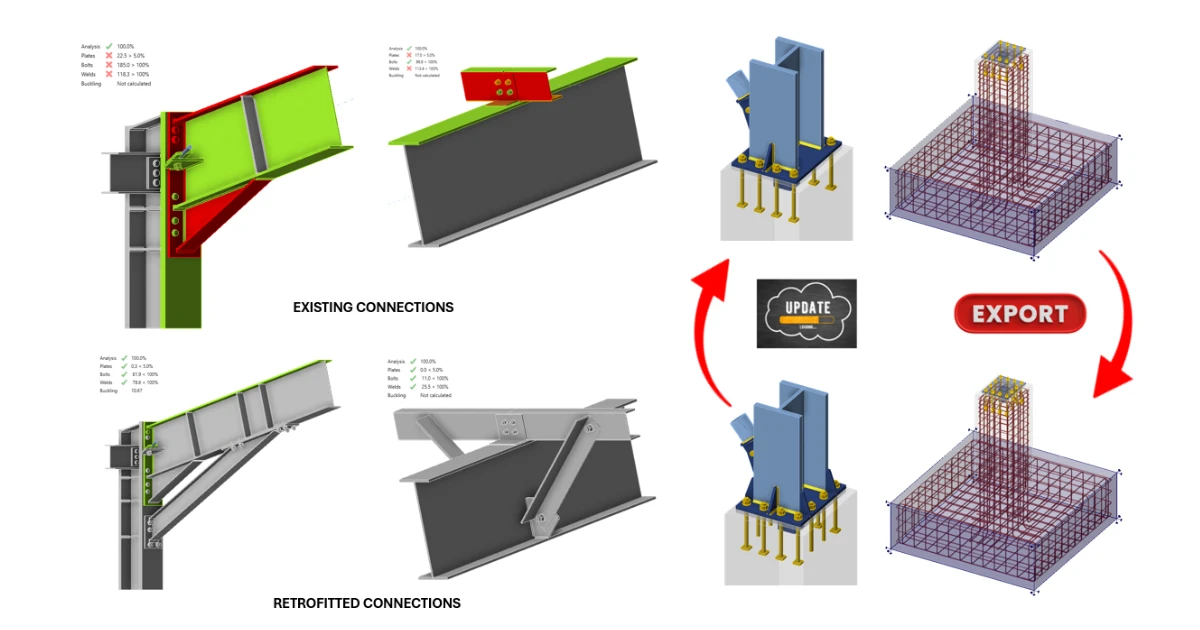


Why Retrofitting and Strengthening is Becoming Essential?
Across the world, many structures such as industrial warehouse and factories were constructed decades ago using older design codes. At that time, those structures were fully compliant and adequate for their intended purpose. However, there are always instances that the structure may be retrofitted/strengthened due to the following:
- Updated building code requirements or increase loading provision
- New operational demands
- Sustainability initiatives such as installation roof top solar panels that increases the load on the structure
- Asset extension strategy instead of demolishing/reconstruction
From structural engineer's perspective, this immediately raises several critical questions such as:
- How much reserve capacity still exists in the members and connections?
- Are the existing members and its connections still adequate?
- Will the global stability of the existing structure still acceptable?
- Which members or connections requires strengthening?
- Can strengthening be optimized without excessive cost?
For engineers, these are no longer considered as a simple design checks. This becomes structural assessment and rehabilitation problem where he/she must evaluate both the current condition of the aging structure and the future demands.
What Makes Retrofitting Existing Structure Challenging?
Unlike new structures, retrofitting and strengthening projects rarely begins with a perfect information. Most of the time engineers encounters the following:
- No drawings - in case there is, it is either outdated or incomplete.
- Site conditions that differ from original drawings or documentation.
- Uncertain material properties used.
- Undocumented modifications (e.g. historical repairs with unknown quality)
In many cases, the original engineer who designed the structure may no longer be involved, and the structure may already have undergone operational loading changes and maintenance interventions.
The challenge becomes even more complicated when evaluating steel members and its connections. In reality, retrofitting existing structure have already experience years of deterioration due to certain factors such as corrosion in steel. Yet, the traditional design approach often relies on simplified hand calculations that may not accurately capture this and therefore the true behavior of the joint connections is not realize accurately.
In retrofit project, engineers are often trapped between two risks:
- Designing too conservatively and making the project unnecessarily expensive;
- Designing with less confidence and risk exposing the project to safety or compliance concern.
This is exactly where advanced connection analysis in IDEA StatiCa becomes essential.
How IDEA StatiCa Can Help Engineers in Retrofit Projects?
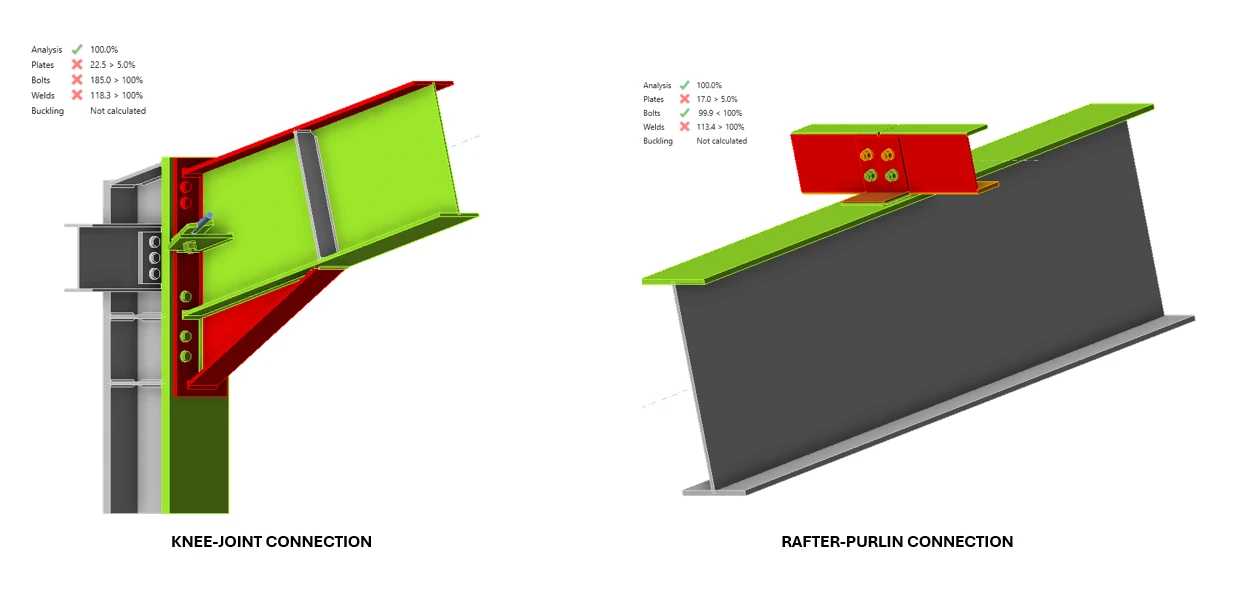
In this example, an industrial steel structure is to be assessed and evaluated whether its existing members and connections are still adequate to resist additional loads due to installation of roof solar panels and at the same time comply with the new provision of the building code.
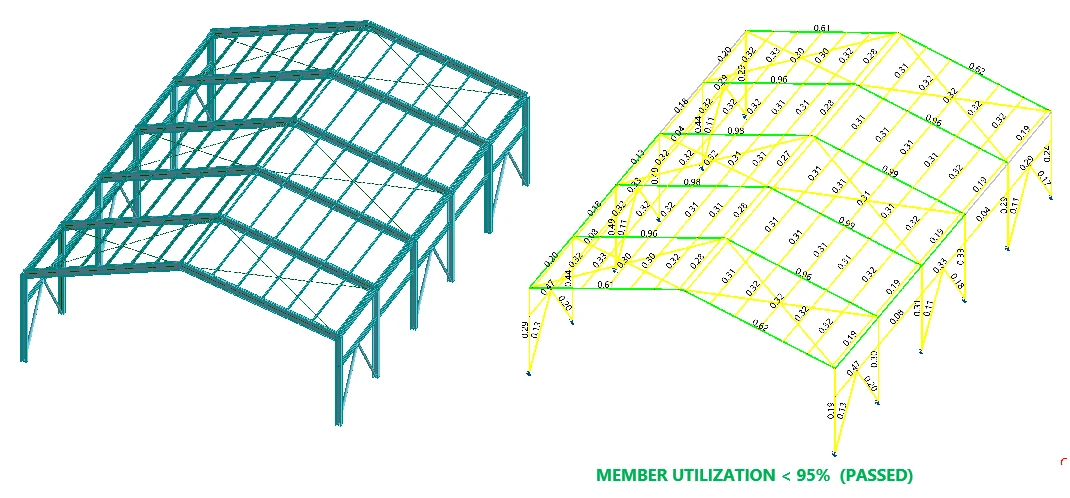
After the engineer gathered the information of the existing structure, the initial task is to verify its global stability from his global FEA analysis software (ie STAAD, ETABS, Robot, etc). In the example below, it is found that the structural members are still adequate after imposing the additional loads from the roof solar panels.
But how about the connections? Is it also still adequate?
IDEA StatiCa can perform the following for further evaluation:
1. Export the model to Checkbot to capture the internal forces.
Engineers can export his global FEA analytical model (STAAD, ETABS, SAP2000, etc) to IDEA StatiCa Checkbot, with this, the internal forces will be captured accurately as well as the orientation and geometry of the structure. With bulk analysis in Checkbot, engineers can quickly identify which connections requires strengthening and save time instead of manually identifying it.
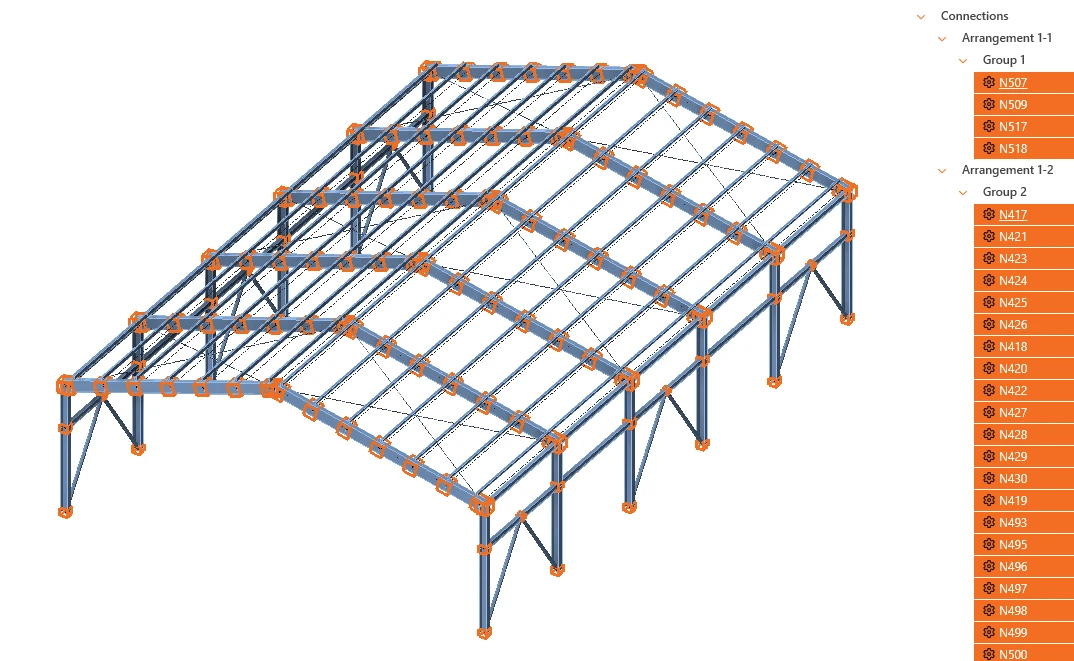
2. Evaluate the capacity of existing connections in Connection app
Engineers can analyze the connection based on the updated loads, but not only that, he also have to consider over the course of the years the deterioration of the members as well as the fasteners in the connection.
One of the biggest advantages of IDEA StatiCa is its capability to realistically analyze existing steel connections with deteriorated components through parametric input of material properties. Given that this can be inspected on site to obtain actual size, in connection application, you can modify the dimensions associated with the members and components within the connection. In the image below, the dimensions of the members as well as the bolts has been reduced to take into account degradation.
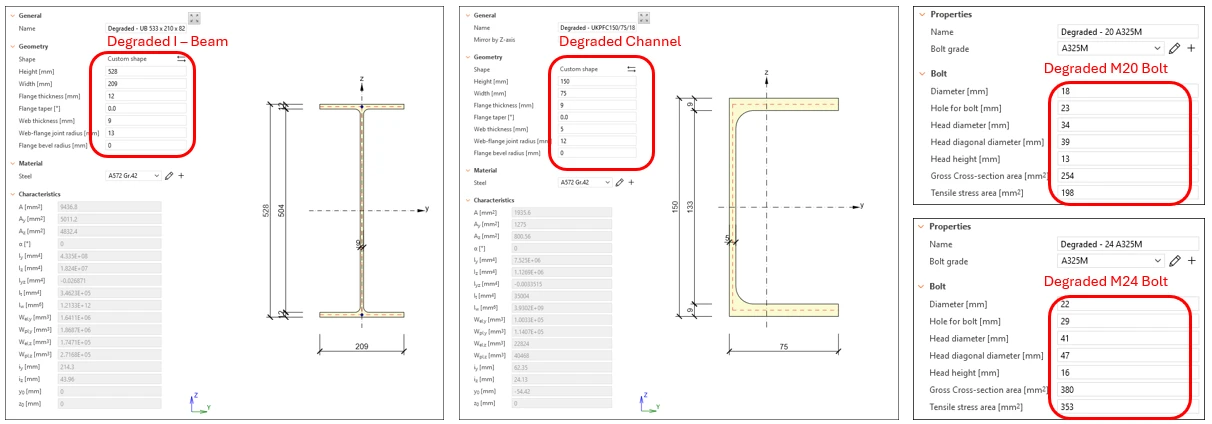
Based on this we can realistically assess the level of failure of the connection and decide how strengthening can be done within the connection.
My colleague Ralph Pullinger from IDEA StatiCa UK team has a great article on this. Read through his article about Connection assessment for degradation and gain more insights.
3. Strengthening of existing connection
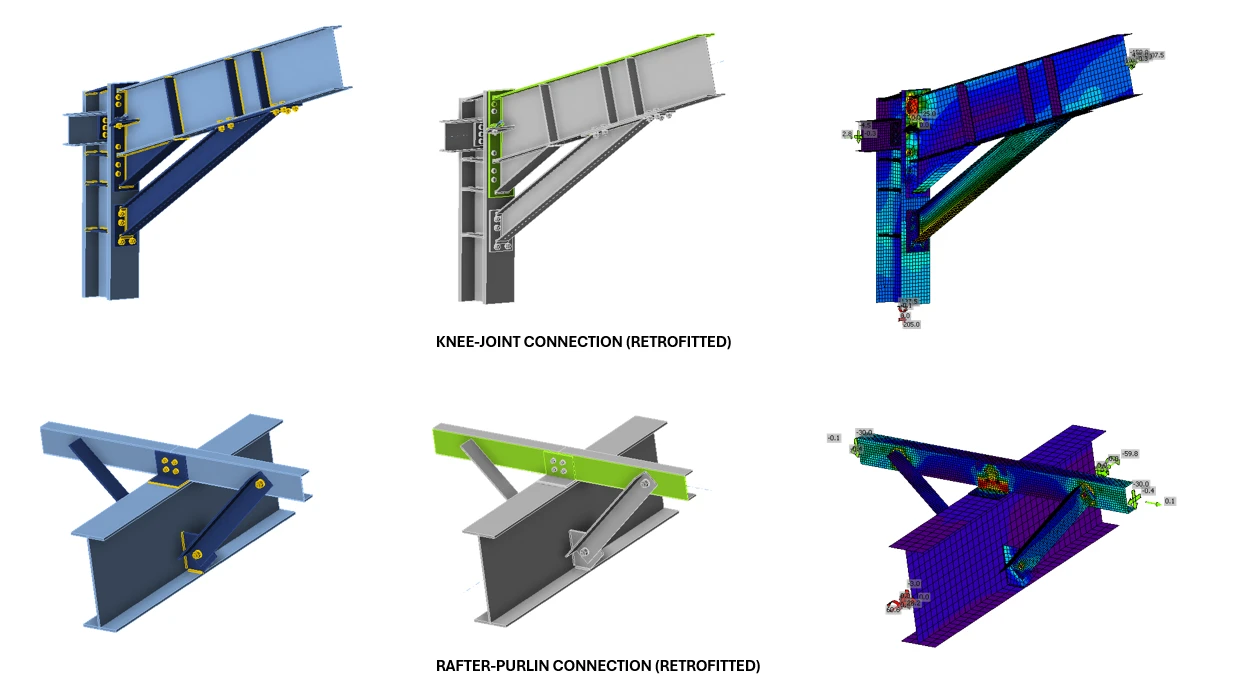
With the assessment of the existing connections now done, strengthening the joints by either providing additional stiffening members, ribs, stiffening plates, etc. can be easily done in connection application.
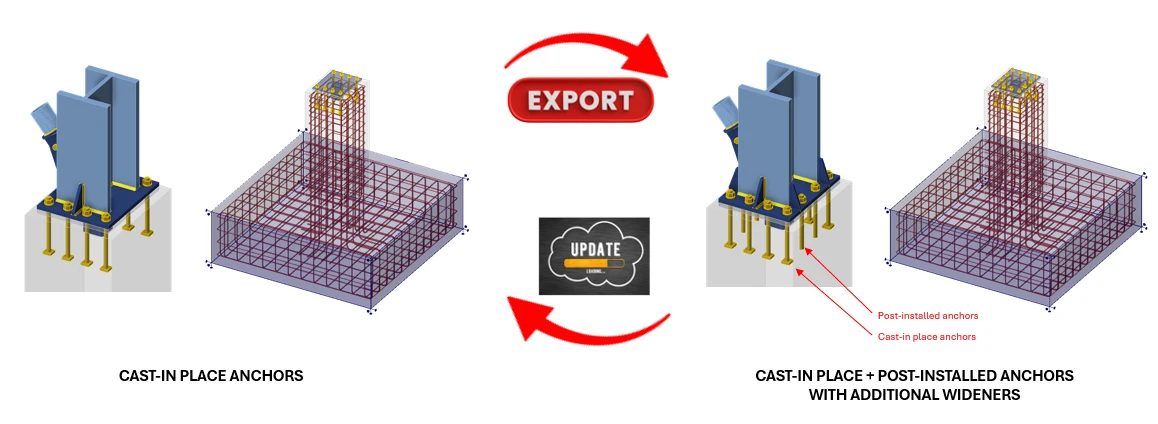
For strengthening of base plates, in order to have realistic behavior, the common challenge for strengthening anchors is combining in the analysis the existing cast-in anchor with the post-installed anchors, and engineers lack the tool to assess this problem. For this, the code-check can be easily done in the Connection and Detail 3D application. Combining pre-installed and post-installed anchors can be analyzed accurately, and with the latest improvement in IDEA StatiCa 26.0, updating design with changes such as additional stiffeners and anchor bolts can be done more quickly without affecting the existing reinforcement.
Conclusion
Updated building design code, change of use, sustainability initiatives such as installation of roof solar panels are just few of the many reasons that drives the growing demand for retrofitting and strengthening of existing structures that was constructed decades ago. However, retrofitting and strengthening is not the same as designing new structures, it is about understanding the current health and remaining capacity of the aging structure.
With advanced connection analysis and retrofit modeling capability, parametric input in properties of members that enables the assessment of component's deterioration, IDEA StatiCa helps engineers retrofit/strengthen existing connections of aging steel structures with a much better accuracy, optimization, and confidence.
Take the latest version of IDEA StatiCa for a test drive today
Get 14 days of full access, completely free.
Check out IDEA StatiCa for free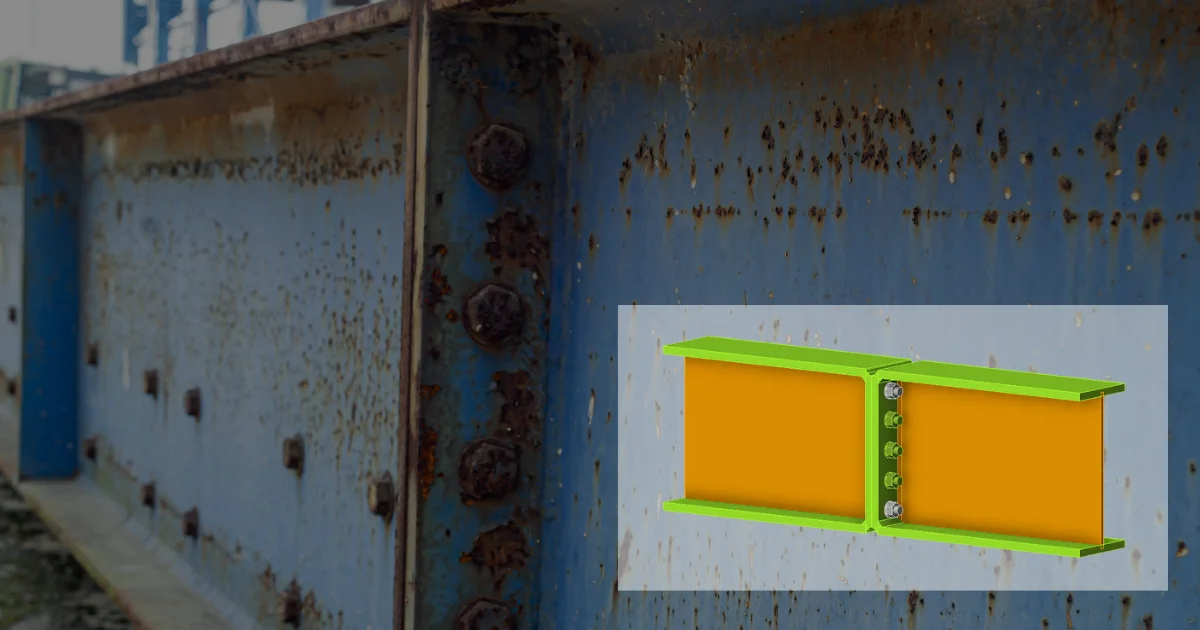
- Steel
- Connection design
- Blog post
Connection design RFIs – Retrofitting existing steel connections
Read more
- Concrete
- Reinforced concrete
- Blog post
Retrofitting and strengthening concrete structures for a sustainable future
Read more
- Concrete
- Reinforced concrete
- Prestressed concrete
- Sample projects