
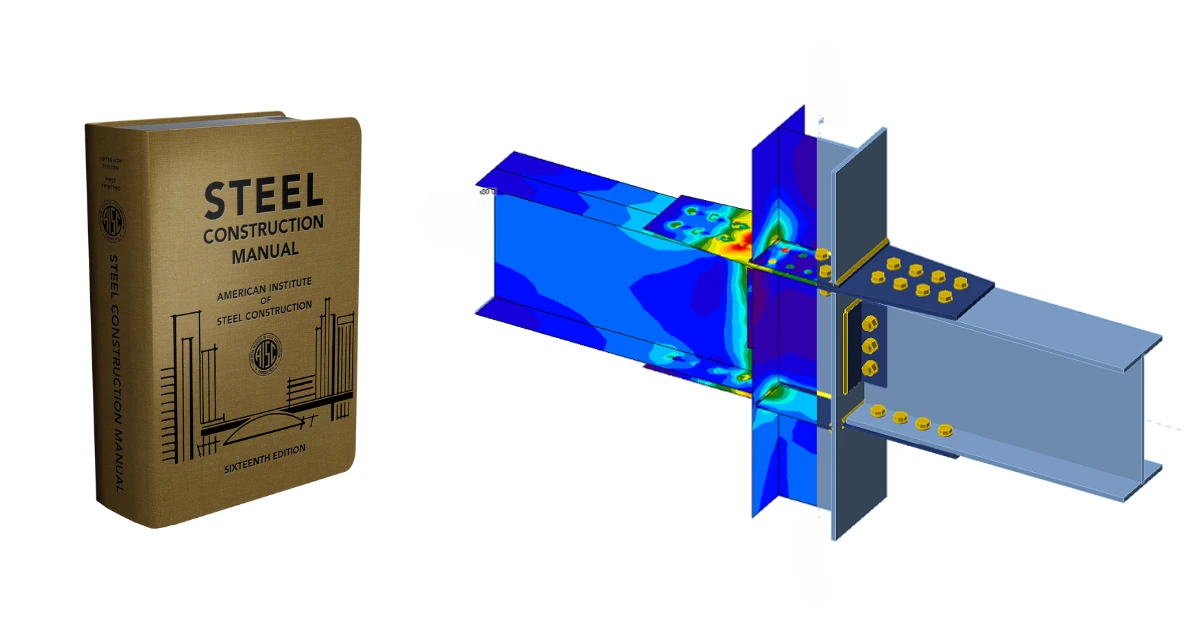


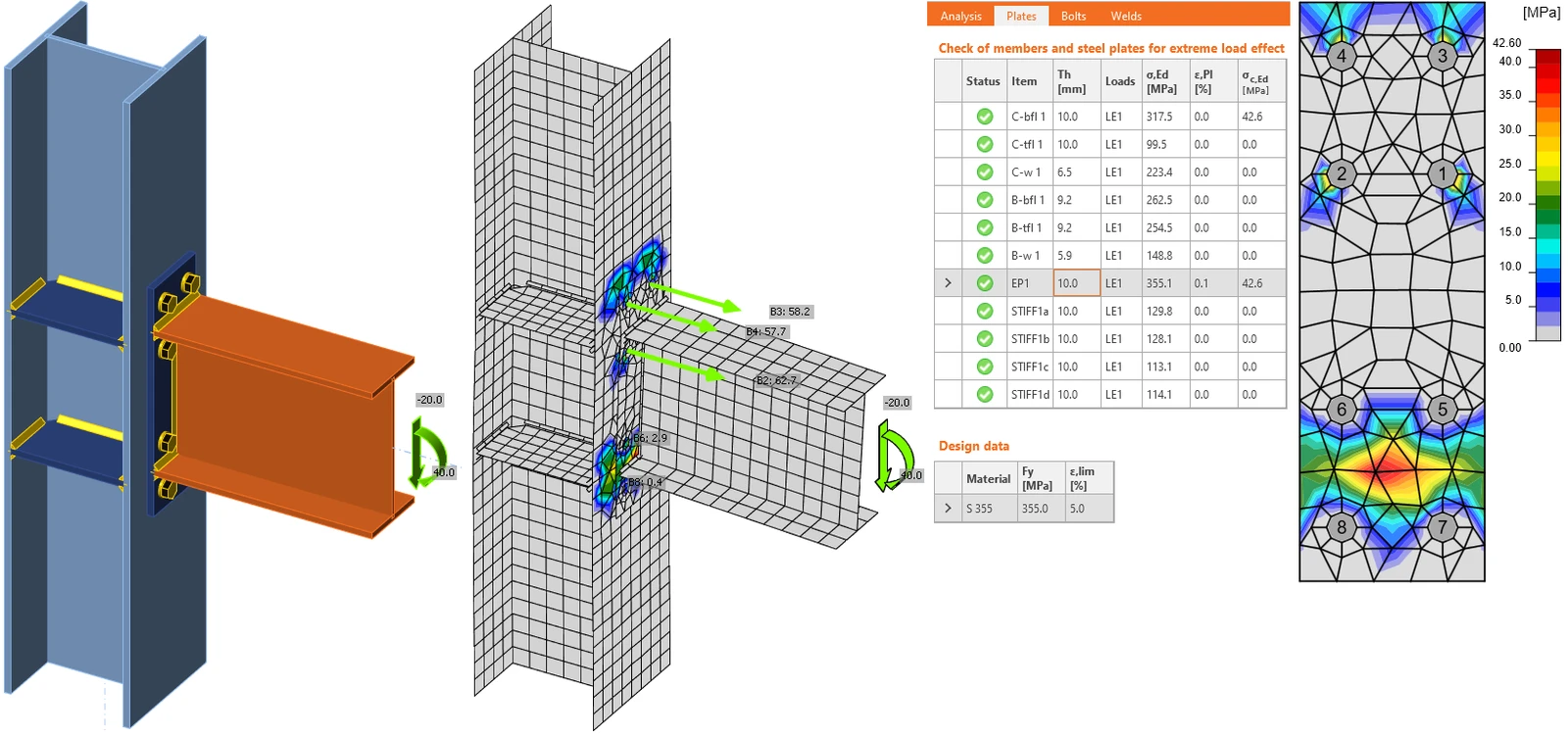
Eindige elementenanalyse in het algemeen, en niet-lineaire eindige elementenanalyse in het bijzonder, zijn al vele jaren bekend als een haalbare methode in het onderzoek. Het heeft bijgedragen aan de ontwikkeling van de normenformules en bepalingen die ingenieurs gebruiken. Daarnaast wordt niet-lineaire eindige elementenanalyse in de praktijk uitgebreid toegepast in de VS en wereldwijd om constructieve vraagstukken op te lossen, van eenvoudig tot complex.
Amerikaanse normen en standaarden, waaronder ACI, AISC, TMS, NDS en andere, bevatten bepalingen die het gebruik van niet-lineaire eindige elementenanalyse toestaan voor constructieve elementen en verbindingen die niet door de normen worden gedekt, en die doorgaans complex zijn. Als de normen het gebruik van deze methode toestaan voor complexe vraagstukken, dan kan zij ook eenvoudige vraagstukken oplossen die vereenvoudigende aannamen bevatten. Onderzoek heeft aangetoond dat grentoestanden van staaf- en verbindingsontwerp kunnen worden vastgelegd met eindige elementenanalyse. Hieronder staan enkele referenties uit verschillende secties van het AISC-handboek.
Het commentaar bij AISC 360 geeft op verschillende plaatsen de mogelijkheid aan om eindige elementenanalyse en niet-lineaire eindige elementenanalyse te gebruiken, zoals:
- "The provisions also permit the use of computational analysis (e.g., the finite element method) to replace the Specification equations used to evaluate limit states covered by Chapters D through H, J, and K" in the Commentary section: Appendix 1, Comm 1.1 page 573, of the 16th edition of the AISC manual.
- "Any method of design that is based on inelastic analysis and satisfies the given general requirements is permitted. These methods may include the use of nonlinear finite element analyses (Crisfield, 1991; Bathe, 1995) that are based on continuum elements to design a single structural component such as a connection, or the use of second-order inelastic frame analyses (Clarke et al., 1992; McGuire et al., 2000) to design a structural system consisting of beams, columns and connections." In Comm 1.3 16.1-582 of the 16th edition of the AISC manual.
- "When the connections to be modeled do not fall within the range of the databases, it may be possible to determine the response characteristics from tests, simple component modeling, or finite element studies (FEMA, 1995)." In B3. Commentary, page 16.1-322 of the 16th edition of the AISC manual.
- "When the design engineer encounters beams that do not contain an axis of symmetry or any other shape for which there are no provisions in the other sections of Chapter F, the stresses are to be limited by the yield stress or the elastic buckling stress. The stress distribution and/or the elastic buckling stress must be determined from principles of structural mechanics, textbooks or handbooks, such as the SSRC Guide (Ziemian, 2010), papers in journals, or finite element analyses. Alternatively, the designer can avoid the problem by selecting cross-sections from among the many choices given in the previous sections of Chapter F." in Comm. F12 16.1-393 of the 16th edition of the AISC manual.
- "For weld lengths greater than 100 times the weld size, the effective length should be taken less than the actual length. The reduction factor, provided in Section J2.2b is the equivalent to that given in CEN (2005), which is a simplified approximation of exponential formulas developed by finite element studies and tests performed in Europe over many years." In Comm J2. page 16.1-484 of the 16th edition of the AISC manual.
AISC Design Guide 1 Base connection design for Steel Structures, derde editie, bevat twee nieuwe bijlagen (Bijlagen C en D) om methoden te bieden voor de weergave van kolomvoetverbindingen in raamanalyse en ontwerprichtlijnen voor de simulatie ervan via eindige elementenanalyse.
- Bijlage D - Richtlijnen voor het gebruik van eindige elementenanalyse voor voetplaatanalyse en -ontwerp, gericht op details van blootgestelde kolomvoetverbindingen
AISC Design Guide 24 Hollow Structural Section connections, derde editie, vermeldt:
- "The Commentary to AISC Specification Chapter K cites inelastic finite element (FE) analysis as a tool for design beyond the limits of applicability for experienced engineers, and this option is permitted by AISC Specification Appendix 1. Both welded and bolted connections may be designed by FE methods, with elastic analysis being sufficient for fatigue design but inelastic analysis being generally necessary to capture the ultimate limit state. Any limitations of the chosen software should always be checked to ensure that the software has the capability of properly investigating and capturing the limit state being investigated. This may involve confirmation of nonlinear analysis, failure criteria, sufficient number of nodes and elements permitted, element types in the library, and so forth." in Chapter 2.13, pg 41.
- "In this case, the FE modeling technique and chosen mesh and material parameters should be verified against some FE analyses from the research literature or from collected benchmark cases (which in turn have been validated), such as by Wald et al. (2017)." in Chapter 2.13 pg 41.
Constructeurs en verbindingsontwerpers kunnen een set tools gebruiken om hun werk te doen — om staalverbindingen veilig, nauwkeurig en snel te ontwerpen conform AISC. IDEA StatiCa, met zijn unieke en geteste EEM-oplossing, maakt deel uit van deze toolkit. Lees meer over de methode in onze theoretische achtergrond en uitgebreide set verificaties.